When I told my husband I was going to become Catholic, he was quite shocked. Before he could respond, I added, “So will you be my sponsor?” We were driving down Rural Road in Tempe, Ariz., on the way home from Mass, with our 2-year-old buckled into the back seat. Although we were married in the Church and committed to raising our children Catholic, I had never before expressed a desire to enter the Church myself.
My call to Catholicism had come privately, and I chose to discern my response to that call largely on my own. One thing, however, I knew for certain: I wanted my husband to join me on this journey. We began OCIA, the Order of Christian Initiation for Adults (then called RCIA), in the fall and attended the evening classes together, turning them into a kind of weekly date night — sometimes even managing to secure the babysitter early enough to grab a small bite to eat beforehand.
Although we sat at the same table and heard the same lessons, the experience for each of us was profoundly different. My husband was a cradle Catholic, educated in Catholic schools and faithful to Sunday Mass throughout his life, yet he received a second catechesis. Now, as an adult, a husband and a father, the teachings took on new depth and meaning. I, on the other hand, had grown up a practicing Protestant Christian, heavily involved in my church and in large youth conferences. As I entered OCIA, the vast treasure trove of Catholic knowledge and tradition, the magisterium of the Church, the sacramental life and the lives of the saints were all opened to me. I was amazed at how much there was to learn, and how much I had never known.
The real transformation, however, did not come through intellectual exercises, reading, lectures or discussion. It came toward the end of the process, when I experienced Eucharistic adoration for the first time. Before stepping into the church that evening, I stood in the narthex with a fellow OCIA catechumen. We made eye contact and exchanged a small shrug, both unsure of what to expect, but trying to remain open because the true presence of the Lord in the Blessed Sacrament had been a reality I struggled to accept.
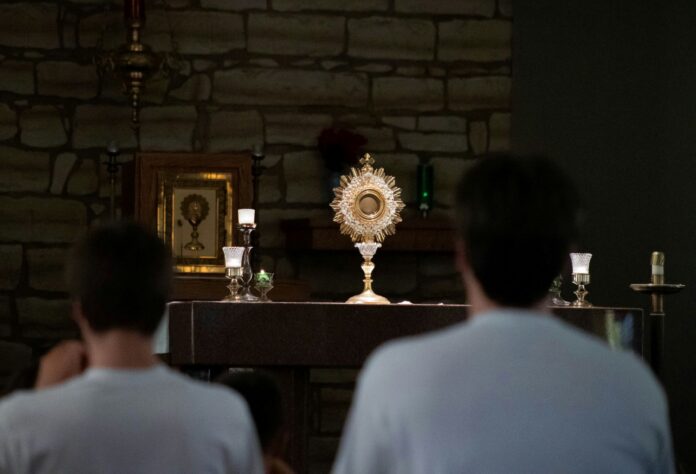
We entered the sanctuary together and took our places in a pew near the altar, an arm’s length apart. Jesus in the host was brought forth and placed in the monstrance as the leadership team and sponsors began to sing “O Salutaris Hostia.”
I gazed upon Him, hidden in the Eucharist, and I just knew. It was my Lord. My eyes saw the consecrated host, but my heart recognized Jesus. I was overcome with emotion and turned to look at my classmate. His eyes were fixed on the monstrance, his face also wet with tears.
I do not know how long that first period of adoration lasted. Time seemed suspended. But it sealed for me the reality that Jesus was truly present here in this Church, in the Eucharist, in the sacraments. And my heart longed for Him.
What had begun as an intellectual exercise, a quiet curiosity explored while my toddler napped, became an encounter with the living God and an invitation to a life transformed in, with and through Him.
That invitation is offered to each one of us.
More recently, as a sponsor myself, that has been my deepest hope for my OCIA sister: that she, too, would come to recognize Jesus’ presence — body, blood, soul and divinity — in the Eucharist. That reality is what keeps so many of us devoted. Amid seasons of dryness in prayer, moments of despair and frustrations with human imperfection, I hear the words of St. Peter after Jesus’ teaching on the Eucharist: “Master, to whom shall we go? You have the words of eternal life. We have come to believe and are convinced that You are the Holy One of God.”
This mystery can be discussed, shared, taught and defended, but it must ultimately be experienced for true transformation to occur. No amount of explanation can convince the heart. St. Catherine of Siena is attributed as saying, “The human heart is always drawn by love,” and Jesus is love incarnate.
Shortly after that experience of adoration, I stood before my priest once again during the Easter Vigil with tears streaming down my face as I waited to receive my first holy Communion. My hands trembled as I formed a small cradle for my Lord, and I heard the words, “The body of Christ.” With a pounding heart, I managed to respond, “Amen.”
I believe.
Believing changed everything. Becoming Catholic changed everything. Receiving the outpouring of the Holy Spirit in confirmation, sealing the gifts first given in baptism, changed everything. In the silence before the Blessed Sacrament, everything can change.