Catholics across the United States are observing Natural Family Planning (NFP) Awareness Week during July 19-26. The annual initiative promotes the education of fertility awareness-based methods and the Church’s teachings on marital love and responsible parenthood. The occasion coincides with the publication of Humanae Vitae, the 1968 encyclical by Pope Paul VI, addressing morality on the same topics through the lens of divine revelation and natural law.
The Diocese of Phoenix’s Office of Natural Family Planning recently took part in a national survey that reflects the benefits many couples experience when incorporating NFP into their marriage. Greater religiosity was reported in couples practicing NFP, in addition to higher numbers of Mass attendance and experiences of a personal relationship with God. “Openness to life” was reported in at least 53-percent of couples incorporating NFP compared to 25-percent of partners who use some form of birth control.
There is also a benefit seen in relationships as partners understand each other’s fertility patterns, noted Armida Escarcega, coordinator of Natural Family Planning for the Diocese of Phoenix. The survey indicates that at least 77-percent of couples who practice NFP report better communication compared to 49-percent for couples who use contraception.
The percentage of effectiveness alone is reflective of the impact of NFP.
“One of the things that many people don’t know is that the calendar, or rhythm method [promoted in the secular medical industry] … only has a 70-percent success rate when used accordingly,” explained Escarcega. Natural Family Planning, on the other hand, when practiced correctly, has a 99-percent accuracy rate.
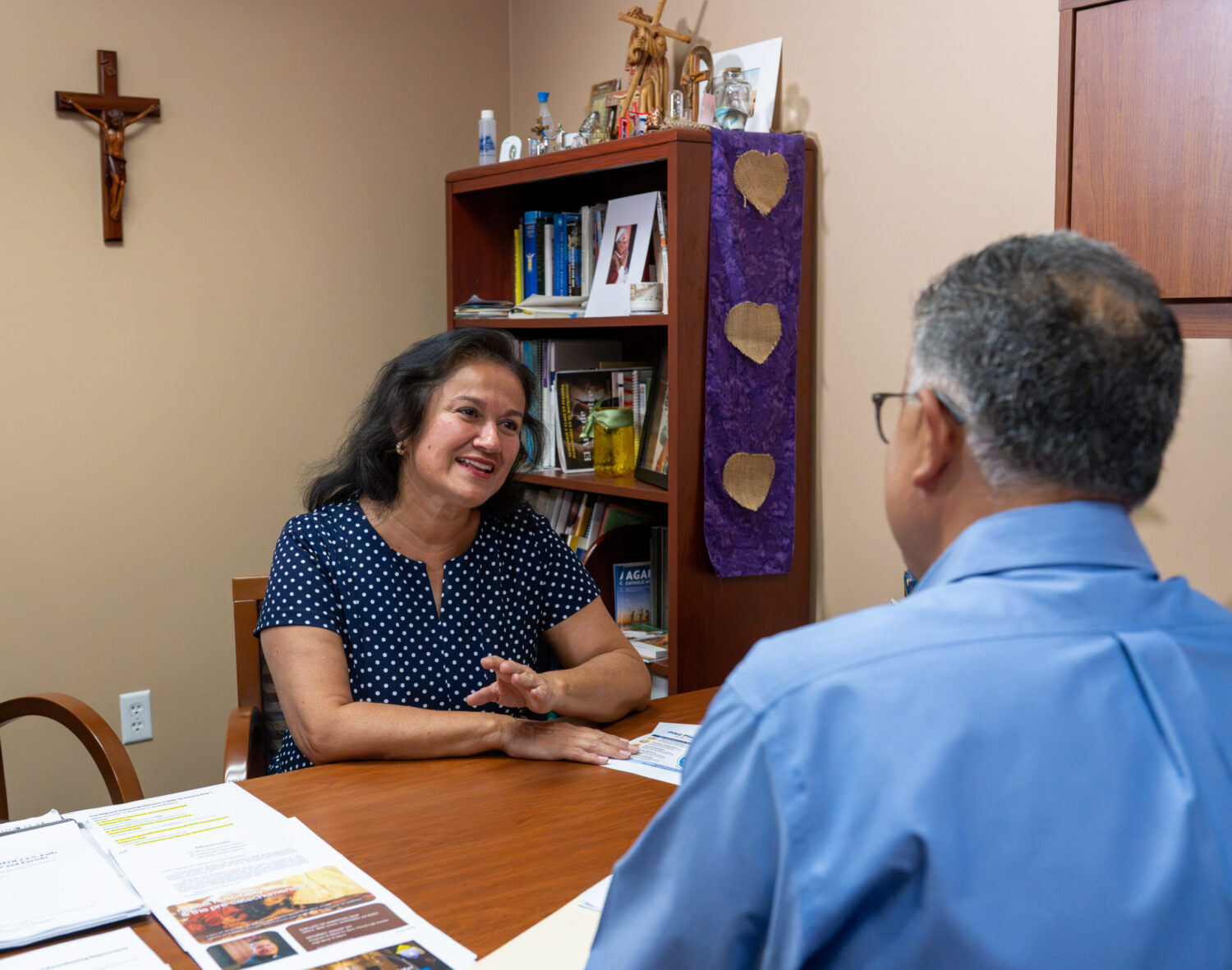
In her work, Escarcega accompanies engaged and married couples, as well as those experiencing miscarriage or infertility. She said she helps couples discover the joy of living life according to God’s plan as she guides them in learning about the “blessed tool” of NFP that “gently — albeit sacrificially — leads to a stronger relationship with each other and with God.”
She also serves on the United States Conference of Catholic Bishops’ board of Natural Family Planning and has been an NFP instructor for over 30 years.
“We are not in unknown territory,” Escarcega said, emphasizing the broad knowledge of women’s health and fertility.
“There is enough science behind a woman’s fertility … that [the accuracy of Natural Family Planning] is unquestionable scientifically. The fact that people don’t know it — that’s another story.”
But NFP goes deeper than science.
Escarcega shared that NFP invites couples to embrace their roles as “co-creators” with God by receiving the gift of life and becoming truly responsible parents. She went on to express that planning responsibly means that spouses exercise discernment, while ultimately recognizing that God has the final word.
A marriage transformed
Escarcega shared her own experiences of discovering the beauty of NFP — which for her and her husband was a journey. Having been raised in a Catholic family, when it came time for her to be married, she knew little else but that contraception was not permitted. Escarcega assumed, as many women do, that she knew everything necessary.
“Fast forward four years into our marriage and three kids in between, I thought, ‘I’m tired … I don’t know what to do.’”
The family had moved three times within those four years, leaving Escarcega exhausted to the point of crisis. As a result, she developed a fear of becoming pregnant again. This experience led to friction between her and her husband, which she said eventually led to constant fighting. They had a difficult time understanding one another’s perspective, she shared.
“It was amazing how little we knew about how each other’s bodies actually work physiologically,” said Escarcega, which she now recognizes so clearly in hindsight.
Having always been active in the pro-life movement, as a young mother of three children, she wondered how she could continue to give authentic testimony to the goodness of life when she herself was so afraid of becoming pregnant.
Then, she was introduced to NFP.
One Sunday, the then-director of the NFP Center, Peggy Frei spoke after Mass at the Escarsega’s parish. Frei described heated words that have been exchanged between couples that use contraception; the men reports feeling “left out” and the woman reports feeling “used.”
“This is our exact fight!” Escarcega thought. “But [my husband] and I don’t use contraception … Why do we feel like this if we are following Church teaching?”
Although Escarcega remained skeptical, Frei’s talk stirred a curiosity, and she decided to take a NFP course. She went in seeking a natural method to avoid pregnancy but came out with tools that transformed her marriage.
“If you had told me that NFP was this wonderful thing that everyone loves — that it aids in communication — I would have said, ‘Baloney. It’s only good for evading a pregnancy,’” Escarcega said.
“But we learned it and it worked, golly it worked!”
She noticed quickly that communication between her and her husband improved. Soon she looked back and realized, “We hadn’t fought in six months!” It had been six months nearly to the day that she had begun charting her cycle using NFP.
As marital communication improved tremendously, Escarcega realized she’d only scratched the surface of the deeper realities of NFP. It was through her further study of Pope St. John Paul II’s Theology of the Body, the pontiff’s teachings on love, relationships and the human body, that she began to spiritually interiorize its principals.
As she dove deeper into Theology of the Body, she looked back on all the components of NFP she had learned and began to connect the pieces.
“I recognized that God has made us — not only Adam and Eve, but John (her husband) and Armida — to unite … so that we could reflect the depth of the intimacy of the Trinity.
“God the Father and God the Son are united in such a deep way that their communion becomes the Holy Spirit,” she continued. “[Pope] St. John Paul II calls this the communio personarum, which translates to ‘communion of persons.’” She said in this way, humanity bears the image of God, not only in creation but also through the union of husband and wife.
Viewing contraception from this theological height, Escarcega saw that “it makes a tear at the beginning of the meaning of a couple’s union … separating [the marital act] from its intended meaning and purpose — the communion of persons.”
The crosses of infertility and miscarriage
For couples who desire to build a family but experience infertility or miscarriage, the cross they carry can be especially heavy. The diocesan Office of Natural Family Planning does not exist solely for those who are able to conceive children; it also seeks to accompany men and women bearing these crosses.
One initiative of accompaniment is the St. Gerard’s Mass of Comfort, an annual springtime Mass at the Diocesan Pastoral Center in downtown Phoenix for those struggling with a season of infertility. In 2024, as part of a yearlong celebration of the golden anniversary of Natural Family Planning in the Diocese of Phoenix, the NFP Office hosted the first-ever diocesan retreat specially for couples in a season of infertility. The retreat was so successful that it soon expanded into the more fully developed St. Gerard’s Outreach in 2025. The hope is that that outreach, named after the patron saint of pregnant mothers, will reach four corners of the Diocese of Phoenix, hosting gatherings four times a year involving a meet-and-greet with the pastor, time for sharing and adoration.
The Office of Natural Family Planning also desires to accompany couples who suffer miscarriage or infant loss. It can be common for those surrounding the couple to urge them to focus on something else — perhaps hope for a future child or gratitude for the children they already have. But the diocesan office recognizes that grief is not healed through sorrow being pushed away or buried. As a result, they with We Carry You Still, a local organization that ministers to families amid miscarriage and infant loss through burial options, memory items and resources, among other recommendations.
“I want couples to know that … there are others going through the same,” said Escarcega. “A support group is always great because you hear how others are coping, how others are suffering. There is something about sharing a cross.
“I want couples to know that they are not alone and that the Church cares for them.”
For more information on natural family planning, infertility and miscarriage resources, click here.
For more information on National Family Planning Awareness Week, click here.
Contributions by Catherine Mulhern