ORLANDO, Fla. (OSV News) — The future of religious life depends on different congregations, with different charisms, working together like a symphony, the president of the United States’ largest leadership conference for Catholic sisters told the group’s members.
The Leadership Conference of Women Religious, which represents about two-thirds of the nation’s nearly 35,000 sisters, held its annual assembly Aug. 11-14 in Orlando. More than 1,300 congregational leaders and their guests were in attendance.
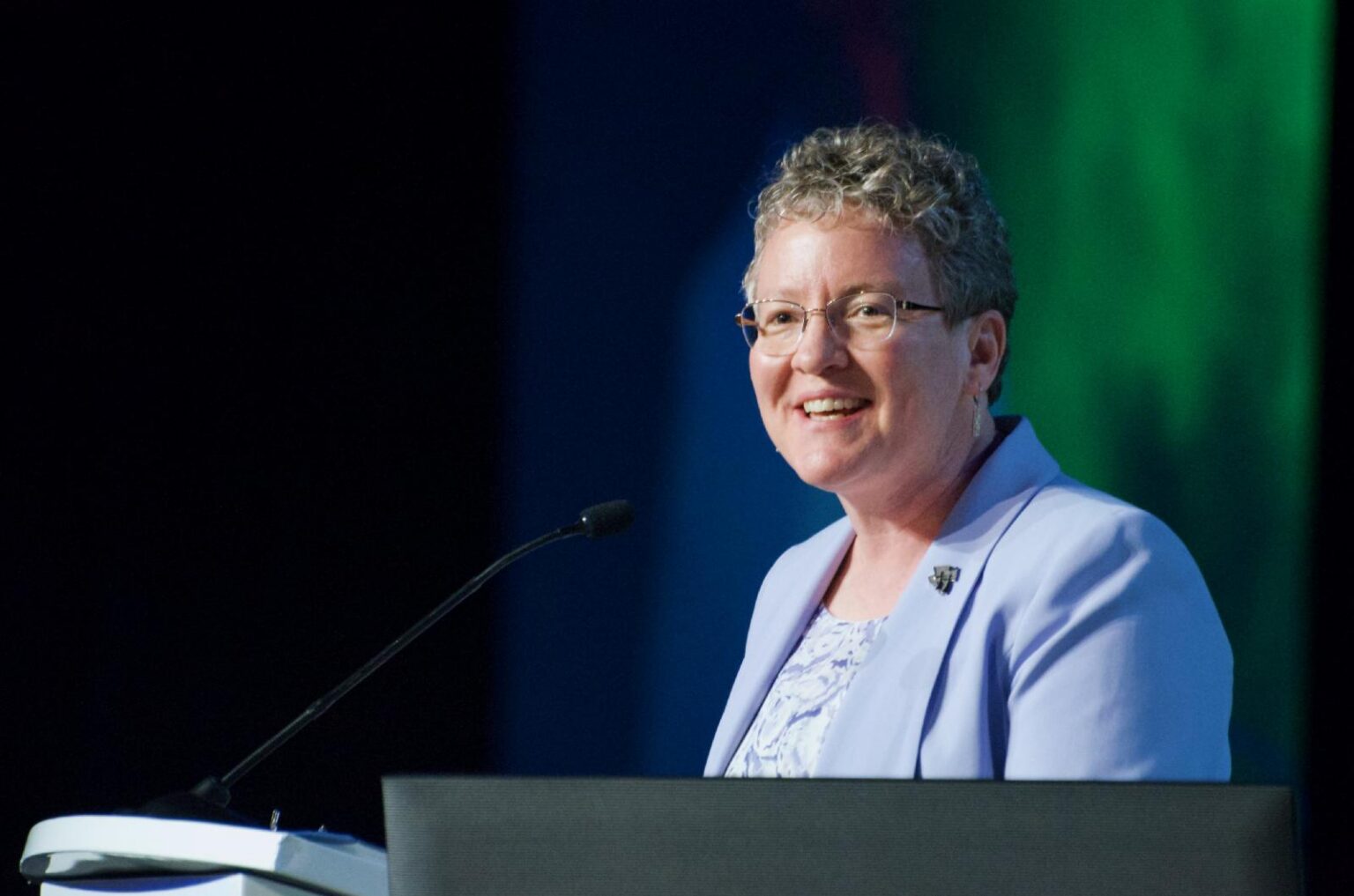
LCWR’s outgoing president, Sister Vicky Larson, a member of the Presentation Sisters of South Dakota, told attendees in her Aug. 12 presidential address that the assembly’s theme, “Many Charisms, One Spirit, One Call” can best be seen through a musical lens. Good music requires the group to listen to each other.
“The Holy Spirit is asking us to lead by listening,” Sister Vicky said. “Not indifferent listening. Not surface listening. But deep, contemplative, Spirit-led synodal listening — the kind that changes us.”
A song with only one note on one instrument would be “flat, lifeless and unrecognizable,” she said.
Must ‘weave many different notes together’
“Yet when we weave many different notes together — when melody meets harmony, something far more beautiful emerges,” Sister Vicky said. “Something layered, textured and alive.”
The suffering world needs the melody and harmony of religious life, she said.
“Look for bridges and connections with one another. Listen for harmony,” said Sister Vicky, whose one-year term as president was to end with the close of the assembly. “Just as a choir or symphony brings together many diverse voices or instruments, each taking its turn to carry the melody — we need all charisms in religious life, as well as all people in all vocations around the world, to come together to create the integrated music of humanity.”
Even dissonance — when notes seem to clash against each other — is part of music, forcing patience as your ear waits for resolution, she said. Dissonance can be a problem or it can be part of the story the music tells.
Helping world move through ‘dissonance’ toward ‘resolution’
“We live in a world filled with dissonance between people, political parties and nations,” Sister Vicky said. “I believe that we can help the world learn to either create space to hold dissonance or else help the world move through it toward resolution.”
Music also has context, and the context of religious life in the United States right now is one of change, especially demographically.
Sister Vicky talked about how her own congregation has had to let go of many of its sponsored ministries, closing its college and deconstructing its motherhouse. At its chapter in March, the congregation discerned it would be their final one, as they will not have enough members with capacity for another in 2030. They will move toward an appointed leader, or commissary, by 2028.
“This is not a sad song. This is a courageous act of listening to the future,” Sister Vicky said before being interrupted by applause. “This is a courageous act of recognizing that we are part of a bigger picture of God’s call to the world and the Spirit’s unity.”
And all of it is part of how God uses religious life.
Transformation ‘a natural sign of evolution’
“The profound transformation of religious life is part of a continual cycle — growing in some places, merging in others and coming to fulfillment in still others,” she said. “This is not a sign of decline. This is a natural sign of evolution.”
And religious life, just as music is meant to be shared, is not about serving itself.
“The call we hear is not for ourselves alone. Religious life has never existed for its own sake. It exists for the transformation of the world,” Sister Vicky said. “We are called to listen to the cries of the Earth and the cries of those made poor. We are called to stand with migrants, survivors of violence and those who are marginalized.”
Religious life, she said, has always shaped itself to the needs of the time, and the needs of this time require unity and harmony.
“We have the opportunity to create music together none of us could compose alone,” Sister Vicky said. “The Spirit is drawing us into a shared rhythm — not a uniform sound, but a courageous weaving of our distinct charisms into a living, evolving symphony. Harmony gathers our differences into something more beautiful and whole.”
Pope Leo’s video message to assembly
As the second day of the LCWR assembly opened, Pope Leo XIV sent a video message encouraging the sisters to foster vocations to religious life in the United States.
“The work of fostering religious vocations is of vital importance,” noting that despite secularization, there is also “a growing hunger for God” among the young.
“As many of us have personally experienced, Christ’s call to follow him with an undivided heart through vows of poverty, chastity and obedience brings joy, peace and fulfillment,” he said.
The morning also included an address by Xavière Missionary Sister Nathalie Becquart, undersecretary of the Synod of Bishops at the Vatican, on synodality and religious life.
“As consecrated women and men coming from so many different places and congregations across the Americas, you are not on the margins of the synodal journey. You are at its heart,” Sister Nathalie said.
Thanked men and women religious of U.S.
She also thanked the men and women religious of the United States she met while studying at the Chicago Theological Union and Boston College.
“I come to this conversation not as an outsider explaining synodality to you, but as a sister among sisters and brothers who shares the same vocation, and who has had the extraordinary privilege of accompanying the synodal journey of the whole church from the inside, doing so aware of how much I have received from many women and men religious in the United States,” Sister Nathalie said.
“I would not be the woman religious I am today, serving at the Vatican, without the support, the formation and the accompaniment I received from so many U.S. sisters and other religious,” she added. “And I am here to listen to what you carry — because the exchange of gifts is not a metaphor. It is what this assembly is actually for.”
With the close of the assembly the evening of Aug. 14, LCWR’s new president was to begin her one-year term: Sister Debra Sciano, 68, provincial leader of the School Sisters of Notre Dame’s Central Pacific province.
Whether representing abused children as a prosecutor, navigating years of tension between U.S. Catholic sisters and the Vatican, or helping lead one of the country’s largest communities of Catholic sisters, colleagues told Global Sisters Report that Sister Debra approaches every challenge with the same attentiveness, empathy and instinct to listen.
Dan Stockman is national correspondent for Global Sisters Report. This story was originally published by Global Sisters Report, a project of National Catholic Reporter, and is distributed through a partnership with OSV News.