
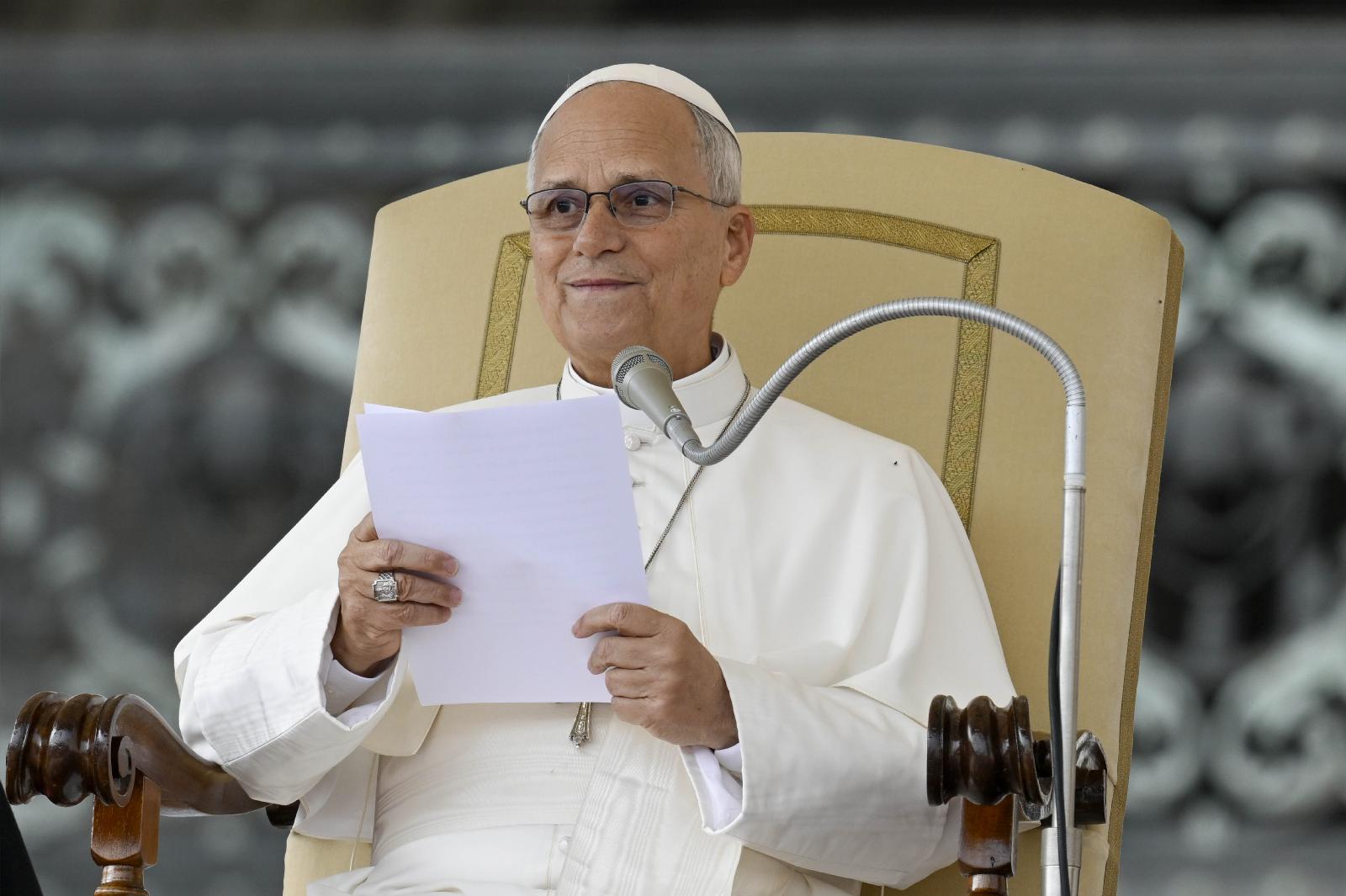
(OSV News) — The following is the full text of Pope Leo XIV’s general audience address given Oct. 28 in St. Peter’s Square.
The Documents of the Second Vatican Council. IV. Constitution Gaudium et Spes. 7. The relationship between faith and culture.
Dear brothers and sisters, good morning and welcome!
The Second Vatican Council could not fail to address the subject of culture and its relationship with the Christian faith. It does so in the second chapter of the second part of the Constitution Gaudium et Spes (GS).
The Catholic Church has always been concerned with accompanying the preaching of the Gospel with the establishment of schools of every kind, aimed at advancing the human, cultural and spiritual formation of men and women across the five continents. Medieval universities, as we know, were born from the heart of the Church, making a decisive contribution to the development of Western civilization. At the same time, the progress of culture and knowledge raises ever new and deeper questions, prompting believers to give an account of their faith (cf. 1 Pet 3:15–17). Finally, as expressions of the spiritual dimension of the human being, the various manifestations of culture contribute to opening minds to the perennial questions on the meaning of the world and of human existence, thus preparing people to receive the Gospel of Jesus Christ.
The relationship between faith and culture finds its primary foundation in the Incarnation: if the divine Word became flesh and came to dwell among us (cf. Jn 1:14), then faith too is an incarnate reality, interwoven with the culture in which it is immersed. It is also required to become culture, that is, to reach the person in their living environment, made up of human words, traditions, religious meaning, art and poetry, thought and science. As Saint John Paul II loved to repeat, “a faith that does not become culture is a faith not fully accepted, not entirely thought out, not faithfully lived”.
Faith can be embodied in all cultures, because it does not identify itself with any of them in a specific one. It dwells within them, shaping them from within according to the “form” of Jesus Christ; that is, through charity, service and the filial recognition of God’s fatherhood. In this way, the Church draws from the various cultures all that is good, beautiful and true, in order to embody and transmit the message of the Gospel. At the same time, “the Church, sent to all peoples of every time and place, is not bound exclusively and indissolubly to any race or nation, any particular way of life or any customary way of life recent or ancient. Faithful to her own tradition and at the same time conscious of her universal mission, she can enter into communion with the various civilizations, to their enrichment and the enrichment of the Church herself” (GS, 58).
The Church promotes culture because it is a good in itself, a service to the human being and to the fulfilment of her vocation on earth. For this reason, Gaudium et Spes exhorts the international community to ensure that everyone has access to fundamental cultural goods, by overcoming illiteracy and the lack of education. All those who are capable of accessing higher education – the Council boldly states – must be placed in a position to do so in practice. Furthermore, “it will belong to all to acknowledge and favour the proper and necessary participation of women in the cultural life” (GS, 60).
In addition, Gaudium et Spes upholds the need to direct teaching towards a certain unity of knowledge, even though changing living conditions may make this more difficult (cf. GS, 61). Christians are the first who must strive to bring about this unity of wisdom, first and foremost within themselves. Although they have received from Revelation the answers to the great questions of existence, they are not thereby exempt from patient intellectual and cultural formation; on the contrary, their human and scientific knowledge must go hand in hand with the substance of their faith, which must be continually deepened with age and in accordance with their level of study. The Council addresses a particular appeal to theologians: “Let those who teach theology … strive to collaborate with men versed in the other sciences through a sharing of their resources and points of view. Theological inquiry should pursue a profound understanding of revealed truth; at the same time it should not neglect close contact with its own time that it may be able to help these men skilled in various disciplines to attain to a better understanding of the faith” (GS, 62).
Brothers and sisters, the Constitution Gaudium et Spes reminds us not to live the faith in a spirit of opposition or hostility towards the world, culture and its human expressions, but rather exhorts us as follows: “May the faithful, therefore, live in very close union with the other men of their time and may they strive to understand perfectly their way of thinking and judging, as expressed in their culture” (GS, 62). Achieving a mature and responsible synthesis between faith and culture is, in fact, a necessary condition for persevering in the Christian vocation, as well as an essential requirement for bearing witness to the faith before the world and communicating it to others in a credible manner.
Special Greetings
I extend a warm welcome to all the English-speaking pilgrims and visitors taking part in today’s Audience, especially those from England, Ireland, Denmark, Sweden, Ghana, Japan, Jordan, Laos, Pakistan, the Philippines, Canada and the United States of America. In particular, I greet the members of the Youth Group from the Diocese of Samoa-Pago Pago on their pilgrimage to Rome and Assisi. Upon each of you and your families, I invoke the joy and peace of our Lord Jesus Christ. God bless you all!
Summary
The Second Vatican Council’s Pastoral Constitution Gaudium et Spes, reflecting on the Church in the modern world, also addresses the topic of culture. In promoting culture in all its forms, the Church has always combined the proclamation of the Gospel with the establishment of schools, seeking to foster human and spiritual formation, encouraging believers to give an account of their faith (cf. 1 Pet 3:15–17) and preparing all peoples to receive the Gospel. The authentic relationship between faith and culture is rooted in the Incarnation. Faith, therefore, enriches and brings to fulfillment every culture it encounters, and is itself called to become a culture that is shaped by Christ. In this way, Gaudium et Spes affirms the need to cultivate a fruitful integration of knowledge, expressed in a way of living the faith marked by a positive outlook on the world and history.