SAVANNAH, Ga. (OSV News) — Five Franciscan friars killed in present-day Georgia for defending Church teaching in 1597 were beatified Oct. 31 in a Mass where Church leaders considered their witness amid historical complexities and contemporary challenges.
The Mass at the Savannah Convention Center began at 11 a.m. with Cardinal Frank Leo of Toronto, the papal delegate, as principal celebrant.
“The 16th-century Franciscan friars from Spain, courageous missionaries ministering to the Guale people in La Florida, are bright lights for our journey of faith, as they reflect the light of Christ into the challenges and complexities of a wounded world,” he said in the homily. “It is imperative to remember those blessed souls who have gone before us, marked with the sign of faith, especially those who gave the supreme witness of their very lives.”
Concelebrating bishops included Archbishop Gabriele Caccia, papal nuncio to the U.S.; Bishop Stephen D. Parkes of Savannah; Bishop J. Kevin Boland, bishop emeritus of Savannah; Archbishop Gregory J. Hartmayer of Atlanta; Archbishop José Rodríguez Carballo of Mérida and Badajoz, Spain; and Archbishop Joan-Enric Vives i Sicília of Urgell, Spain, a delegate of Spain’s episcopal conference.
Also concelebrating the Mass were Father Michael Perry, provincial minister of the Province of Our Lady of Guadalupe of the Order of Friars Minor, and Father Giovangiuseppe Califano, the order’s postulator general, along with dozens of other priests. The liturgy included both English and Spanish, with Latin included in the hymns.
‘Unconquered heralds of Christ’
Near the beginning of Mass, Bishop Parkes made the official request for beatification to Cardinal Leo, briefly outlining the history of the friars’ cause. He noted that the Church is celebrating a Jubilee Year marking the 800th anniversary of the death of St. Francis of Assisi, the founder of the Franciscans.
Bishop Perry read short biographies in English of each of the Georgia Martyrs, drawn from contemporary accounts and records, followed by the biographies in Spanish read by Father Pablo Migone, the Diocese of Savannah’s vicar of mission advancement and one of the driving forces behind the effort to recognize the Georgia Martyrs formally as saints of the Church.
Cardinal Leo then read aloud Pope Leo XIV’s apostolic letter proclaiming the five friars beatified. Archbishop Hartmayer, a Conventual Franciscan friar, read the letter in English, and Archbishop Vives i Sicília read the letter in Spanish.
The letter, which Pope Leo signed in Rome Sept. 30, 2026, the feast of St. Jerome, called the Georgia Martyrs “unconquered heralds of Christ” who “placed the saving truth of the Gospel before their own safety.” It also established Sept. 22 as the martyrs’ liturgical memorial.
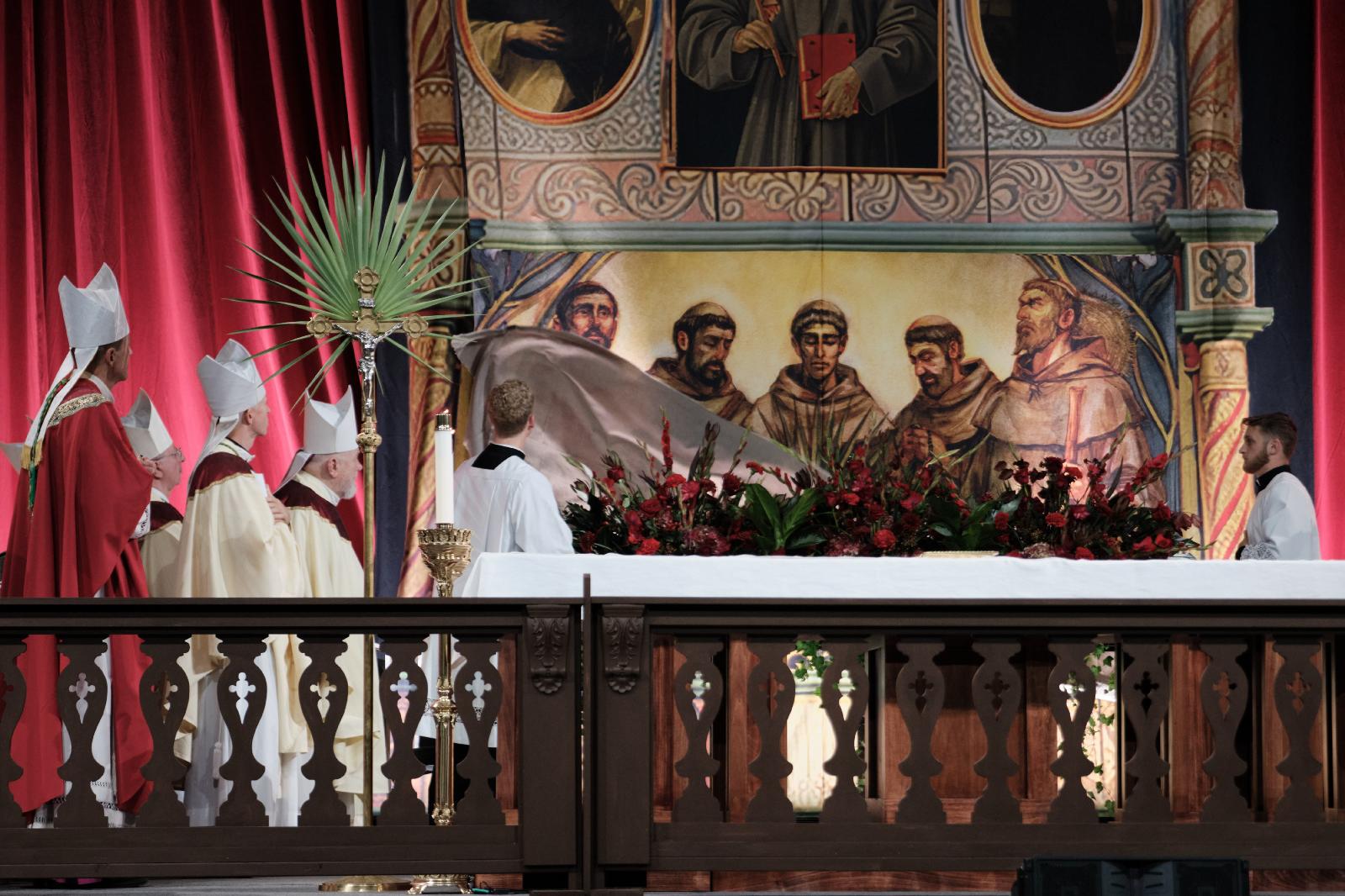
With the official proclamation, the official beatification image of the five friars was unveiled to the hymn “Holy God, we praise thy name.” Drawing on traditional depictions of the martyrs, the artwork “The Georgia Martyrs” by Savannah artist Jared Matthew Seff won a contest for the official image held this year by the Diocese of Savannah.
1597 Guale Uprising
In 1597, the Spanish Franciscans Pedro de Corpa, Blas Rodríguez de Cuacos, Miguel de Añon, Antonio de Badajoz and Francisco de Veráscola were ministering at five missions along the coast and barrier islands of present-day Georgia when they were killed out of hatred for the faith by a band of Indigenous men between Sept. 14-17.
The friars’ murders were prompted by Father de Corpa angering the heir to a Guale chiefdom, Juanillo, by telling him that as a baptized Christian, he could not follow his culture’s custom and take a second wife. Juanillo and his men killed the priest at a mission near the contemporary city of Eulonia, Georgia, before killing four of the other five Franciscan missionaries ministering in the area. The sixth friar, Francisco de Avila, was kidnapped and tortured for months before being set free. The incident is known as the 1597 Guale Uprising.
At the time, the Spaniards knew the wider coastal area as La Florida, home to the settlement of St. Augustine, established in 1565. By 1595, the friars had established five missions along the coast. Prior to their murders, the six Franciscans appear to have lived among the Guale and other indigenous peoples in peace, without a military presence, for two years.
The beatification Mass drew around 10,000 attendees. The processional cross was adorned with palms, a traditional sign of martyrdom. The liturgy included a choir and orchestra. A setting of Psalm 116 in Spanish by Marc Cerisier and a motet for Communion titled “Eternal Glory” by Jessica French were composed for the liturgy.
Martyrs’ witness to Church teaching on matrimony
In remarks after the beatification rite, Bishop Parkes said, “I truly believe that through the intercession of Blessed Pedro de Corpa and four companions there will be greater respect for the dignity and character of the sacrament of holy matrimony.”
He continued: “May the witness of these holy men inspire fidelity between spouses, called into the covenantal bond of holy matrimony and help to create a renewed commitment to the growth of faith-filled families in the state of Georgia and beyond.”
In the homily, preached in English and Spanish, Cardinal Leo spoke about the martyrs’ witness to the truth of Church teaching and how their lives 400 years ago challenge Christians to more deeply embrace their faith today. In Spanish, the cardinal sent a special greeting to the delegation that came from Spain to share in this moment of faith and joy.
With their beatification, “these newly minted blesseds are constituted powerful intercessors and extraordinary examples for every believer,” he said.
“Fidelity to Christ himself is the glory of the martyrs,” Cardinal Leo said. “The Church considers martyrdom an exceptional gift, and as the fullest proof of life.”
The Catechism of the Catholic Church teaches that martyrdom “is the supreme witness given to the truth of the faith. It means bearing witness even unto death,” he said, quoting paragraph 2473. “The martyr bears witness to Christ who died and rose, to whom he is united by charity. He bears witness to the truth of the faith and of Christian doctrine. He endures death through an act of fortitude.”
“For those who have not entered into the mystery of God in Christ, their death might seem as a total and utter catastrophe, but it is not so,” he said.
Pointing to the Mass’ Gospel reading from John 15:18-21, Cardinal Leo said, “St. John sets the record straight.”
“Whoever is begotten by God conquers the world, and the victory that conquers the world is our faith,” he said. “Who indeed is the victor over the world, but the one who believes that Jesus is the Son of God?”
“Very often today, aspects of the Catholic faith are challenged by many, and in countless ways we are cajoled and tempted to water down the very demands of the Gospel — to compromise the integrity of our faith, and to conform ourselves to the spirit of this age,” he continued.
With the martyrs’ witness, “we come to comprehend more clearly” the need to conform one’s life to Christ, “and to see everything and anyone in our life — relationships, studies, work and ministry — in relation to him and to his eternal kingdom.”
Faith the greatest gift to share
Cardinal Leo noted that the beatification coincided with the 250th anniversary of the signing of the Declaration of Independence in the United States and the 800th anniversary of St. Francis’ death.
“Of the many gifts we can give to others, the faith is among the greatest,” he said. While Christians can share their time, resources and belongings, “preaching, teaching, sharing and witnessing to the faith is truly No. 1 on the list,” he said.
The martyrs’ example helps young people in particular, he said, “to appreciate that no greater treasure can be found in this earthly existence than following Jesus with an undivided heart and using generously our gifts to serve others and to build up God’s kingdom. The meaning, the purpose, and the joy we experience in living for the Lord is unparalleled.”
He concluded: “There are still some things today worth living and dying for.”
Trees at beatification to be planted at martyrs’ monument
As the Mass ended, Bishop Parkes gave thanks to God for the witness of Blessed Pedro de Corpa and his four companions. He recognized the Church dignitaries present at the beatification and the work of those who helped to advance the martyrs’ cause and efforts to prepare the beatification liturgy.
He said that the eight palm trees used during the beatification to adorn the convention center would be transplanted at the Georgia Martyrs’ monument at Nativity of Our Lady Catholic Church in Darien, Georgia.
“If you happen to be driving by, perhaps you will stop, say a prayer and give thanks to God for the graces received and for family life,” he said.
A long road to beatification
Reports from civil and religious leaders in the months and years after the Franciscans’ deaths reveal that the slain friars’ contemporaries saw them as martyrs. New research in the 20th century about the history of La Florida and the Georgia Martyrs bolstered efforts to move forward with a cause for their beatification.
The Mass program recognized the many people over decades who were instrumental to the martyrs’ cause, dating back to Bishop John M. Gannon of Erie, Pennsylvania, who served as that diocese’s shepherd from 1920-1966, proposed that the U.S. bishops petition the Holy See for the Georgia Martyrs’ cause.
The names of the Georgia Martyrs were included in two efforts in the early 20th century to launch canonization causes for people, many of whom were missionaries, martyred for the faith over the course of several centuries in the United States and surrounding countries. After neither effort moved forward, the Franciscans decided to focus their efforts on a group of martyrs who died for the same reason, honing in on Blessed Pedro de Corpa and companions.
With the support of the Order of Franciscans Minor, the Diocese of Savannah opened the cause for the martyrs’ canonization in February 1984 under Savannah’s Bishop Raymond W. Lessard, who died in 2016. In January 2025, Pope Francis authorized the Dicastery for the Causes of Saints to formally recognize the five friars’ martyrdom “in hatred of the faith” and they received the title “venerable.”
The Mass’ program also recognized the contributions of Franciscan Father Conrad Harkins, the former vice-postulator for the cause who died in 2020, and David Hurst Thomas, senior curator in residence for North American Archaeology at the American Museum of Natural History, “for their extraordinary contributions” to the cause. “Their work on the ruins of Mission Santa Catalina de Guale shed new light on the intersection of Chiefdom, Crown, and Church during the Spanish mission period on the Georgia coast,” it stated.
Location of Georgia Martyrs’ relics a mystery
While what was recovered of the martyrs’ relics was linked to miraculous cures, their current location is unknown. Remains of all the friars but Friar Francisco were identified after their deaths, and their relics and some other personal items were collected in the months and years that followed and brought to St. Augustine. Some scholars speculate that Franciscans took the martyrs’ remains with them to Cuba when St. Augustine transferred to British rule in 1763. A skull recovered at the Fort King George State Historical Site in Darien may have belonged to one of the friars and is being tested to learn more about its origins.
On Nov. 1, Bishop Parkes will celebrate a Mass of thanksgiving at 11:30 a.m. at the Cathedral Basilica of St. John the Baptist in Savannah, which will also be livestreamed at the cathedral’s website, savannahcathedral.org.
The Georgia Martyrs’ beatification was the second beatification to take place in the United States this year. In September, Blessed Fulton J. Sheen was beatified by papal delegate Cardinal Luis Antonio Tagle at The Dome at America’s Center in St. Louis.
Beatification is the second-to-last stage in the process that seeks canonization, by which the pope proclaims that a person is truly in heaven. A beatification comes after the person’s life, reputation and writings are investigated. For martyrs, beatification does not require the confirmation of a miracle attributed to their intercession. However, a miracle is usually required for canonization.
Maria Wiering is senior managing editor for OSV News. Lauretta Brown, OSV News’ culture editor, reported from Savannah.