The Diocese of Phoenix’s expanding faith-based higher-education options are alive and well as Avila University Arizona welcomed its second-ever class of students earlier this week.
The Missouri-based Catholic university opened its Goodyear, Ariz., campus in August 2025, offering the opportunity for students to earn graduate-level degrees in business and technology management as well as complete undergraduate learning.
Its second fall semester began Aug. 31.
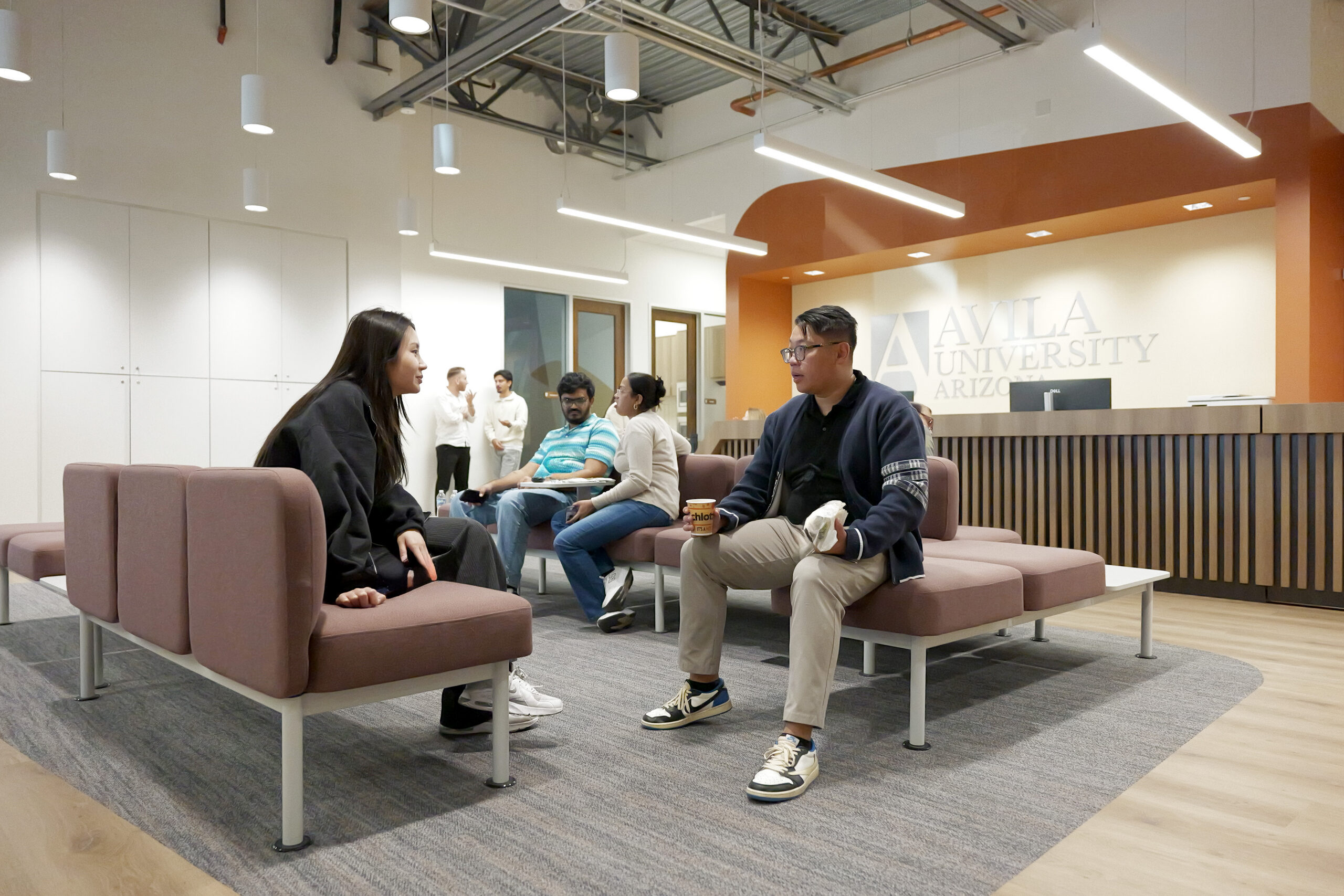
Located within Goodyear Civic Square off McDowell Road and 150th Drive, the bright, modern campus features large, modern classrooms with floor-to-ceiling windows, a dedicated student lounge with a kitchen and furnished study areas. The Georgia T. Lord Public Library, part of the Maricopa County Library System, is next door.
Students learn both in the physical classroom setting as well as online.
Avila’s master’s programs include: MBA in Project Management, MBA in Healthcare Administration, Master of Science in Technology Management with a concentration in Artificial Intelligence, Master of Science in Technology Management with a concentration in Business Analytics and Master of Science in Technology Management with a concentration in Data Science
All master’s programs are STEM designated, which may allow up to 36 months of optional practical training in the United States, a feature designed to attract and support international students. Optional practical training is temporary employment that is directly related to a student’s major area of study
“We are honored to be able to provide more opportunities for students across the United States and the globe to study in our programs,” said then-Avila University President Jim Burkee, Ph.D., on the eve of the campus’ 2025 opening.
“Offering these experiences to international students is another way we honor the legacy of our founding sisters [Sisters of St. Joseph Carondolet], focused on diversity and its expression, serving the dear neighbor without distinction.”
In its latest development, Avila University Arizona announced it will launch a new Bachelor of Science in Cybersecurity.
The program is designed to help students develop a foundation in information technology and cybersecurity while exploring areas such as secure programming, network security, digital forensics and cybersecurity policy.
School leaders see Avila’s curriculum as pivotal to enabling students to leverage their learning to secure positions in the area’s growing technology, health care, logistics, aerospace and advanced manufacturing sectors.
“You are surrounded by employers that hire skilled graduates,” said Avila University Arizona campus’ manager Tracy Vasquez.
Catholic roots
The school gives students ample opportunity to practice and develop their Catholic faith.
Students must complete 15 hours of community service each academic year as a requirement for graduation. This allows them to volunteer at organizations such as local food banks, shelters and community centers, taking part in activities such as tutoring, supporting donation drives, youth sports coaching, nonprofit fundraising, volunteering at shelters and helping with blood drives.
This service component reflects Avila’s spiritual influence.
Founded in Kansas City, Mo., in 1916, Avila University was inspired by the Sisters of St. Joseph Carondolet, an order that traces its roots to 1650 in Le Puy, France. Living among the communities to whom they dedicate their service, they arrived in the United States in 1836 in St. Louis, Mo.
Their spiritual and corporal works of mercy are those “which will most benefit the dear neighbor.”
The spirituality of the Sisters of St. Joseph is centered in love, the central commandment of Jesus — a love that seeks to achieve unity of neighbor with neighbor, and neighbor with God, according to the order’s U.S. website.
Avila University Arizona joins Benedictine University in Mesa, Ariz., Creighton University in central Phoenix, The College of St. Scholastica in Mesa and Phoenix and Bismark, N.D.-based University of Mary’s Mary College in Tempe, Ariz. as Catholic institutions of higher learning within diocesan boundaries.