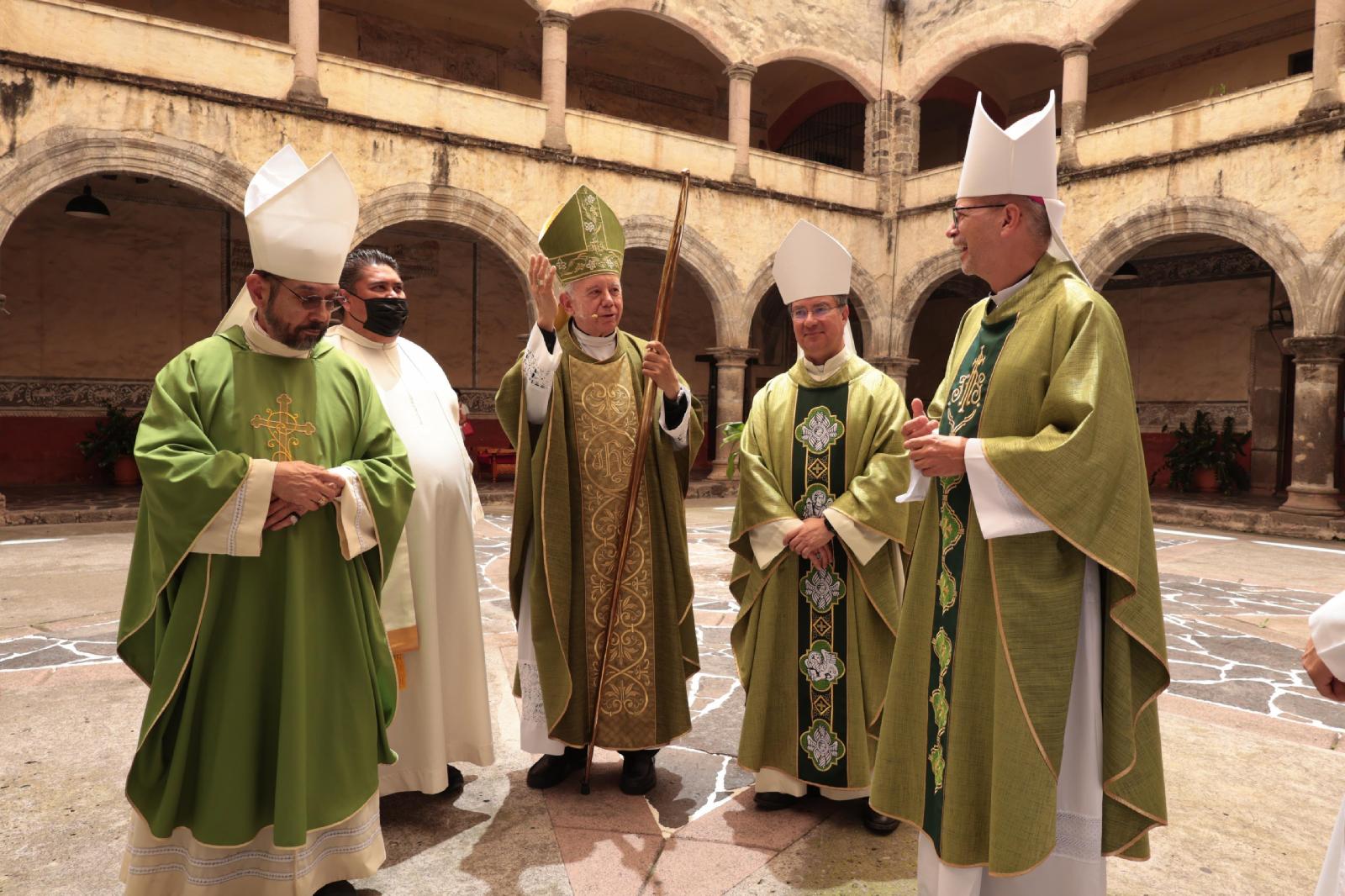
(OSV News) — In recent days, a fraternal gathering brought together representatives of the U.S., Mexican and Canadian episcopal conferences in Cuernavaca, Mexico, to share experiences, identify common challenges and seek pastoral collaboration on migration, human dignity and evangelization.
OSV News spoke with them about the outcomes, conclusions and commitments resulting from this Aug. 30-Sept. 4 gathering.
Bishop Ramón Castro Castro, president of the Mexican Bishops’ Conference, initiated this trilateral meeting, which he described as the first of its kind in Church history. The bishops came together “as brothers” and pastors to analyze the three nations’ social, political and economic realities so that they could “discern in accordance with what the Holy Spirit is asking of us” and “seek ways to better serve our people at such a difficult, complex and challenging time,” Bishop Castro said.
“These realities — migration, politics and the economy — are so different, yet we are united by a single baptism, a single Church, a single ministry and a single service,” said Bishop Castro.
He added that the violence plaguing Mexico is undoubtedly one of the greatest challenges facing his Church and one of its deepest sorrows. “It is a violence that we must confront and that is forcing us to question so many important and difficult issues,” he said.
“As Mexican pastors, we are trying to find a way to seek peace,” he assured, adding that each Mexican bishop is “weaving” a “much-needed network of peace.”
Alongside the specific challenges each country faces, the participants also highlighted signs of hope.
Bishop Daniel E. Flores, vice president of the U.S. Conference of Catholic Bishops, told OSV News about the bishops’ prayer before the tilma of Our Lady of Guadalupe at the Basilica of Our Lady of Guadalupe in Mexico City and their shared commitment to finding new ways to evangelize and accompany immigrants, vulnerable communities, young people and families. “The remedy comes through grace. Grace comes through personal and human encounter, and in this, the Virgin Mary sets a great example, as she went out to seek Juan Diego,” he said.
Experiences of Migrants at the center of the meeting
In a joint statement titled “Three Nations, One Church, One People Walking in Communion” — issued in Spanish, English and French on Sept. 4 — the bishops agreed that migration is a common challenge for Mexico, the United States and Canada.
“To contemplate the phenomenon from the country of origin and transit, and then from the countries of destination, made it possible to look together at the two shores of one same journey,” the bishops noted in the statement. “In the faces of those who migrate we recognized stories, needs and hopes that call for our closeness, accompaniment and solidarity.”
In an interview with OSV News, Bishop Pierre Goudreault, president of the Canadian Conference of Catholic Bishops, emphasized the challenge of welcoming and integrating migrants as peers who enrich not only the Church but also Canadian society. “For me, it is important not to view the migration situation as a problem, but rather as brothers and sisters whom we need to welcome properly,” he said.
He noted that, although recently the Canadian government has been tightening its immigration laws, Canada has a strong tradition of welcoming the migrant community, adding that “nearly 30% of our population is of foreign origin.”
On the subject of immigration, Bishop Flores, who shepherds the Diocese of Brownsville, Texas, home to one of the main border crossings between the United States and Mexico, stated that “every Church must adapt to the realities it is facing, and that can only be done if we are in direct contact with the people affected.”
He also noted that it is not merely “a matter of statistics,” but a matter of recognizing the circumstances people face in each country.
Although these circumstances vary between Mexico, the United States and Canada, “the Church’s mission is to always be in touch with the reality of the families, the faces, and the people affected, and to respond practically to these realities,” he said.
Immigration issues are Catholic issues
Bishop Flores acknowledged that one of the Church’s main challenges in the United States is the fear that immigrant families live with and the uncertainty about the future, which “affects evangelization and efforts to spiritually nourish the sources of Catholic life in the country, access to the sacraments, and the ability to participate freely in Mass.”
According to a 2025 joint Catholic-Evangelical report published by the USCCB and other Evangelical Christian groups, of the 10 million people estimated to be at risk of mass deportation in the United States, eight out of ten are Christian and six out of ten are Catholic. The report also revealed that nearly one in five Catholics (18%) in the U.S. is at risk of being deported or lives with someone who is.
Bishop Óscar Cantú of San Jose, California, chair of the USCCB Subcommittee on Hispanic/Latino Affairs, told OSV News that the meeting repeatedly addressed migration.
“We are very concerned,” said the bishop, referring to what the migrant population has endured in Mexico and the U.S. “We have already experienced this in the United States in a profound and alarming way over the past two years.”
Immigrant detentions in the United States have increased in recent months. In June, U.S. Immigration and Customs Enforcement detained more than 43,000 people, the highest monthly figure since the start of Trump’s second term, according to CBS News. The majority of people held in U.S. immigration detention centers have no criminal record — as of July 11, 70.6% of the 65,765 detainees had no criminal record, according to the Transactional Records Access Clearinghouse at Syracuse University.
Bishop Eugenio Lira Rugarcía of Matamoros-Reynosa, head of the Episcopal Dimension of Pastoral Care of Human Mobility at the Mexican episcopal conference, said in a video that the gathering helped participants understand “the diversity of the realities in each country,” as well as “the situation of our migrant brothers and sisters,” and discern measures in light of those circumstances.
In an interview with OSV News, Bishop Goudreault, who shepherds the Diocese of Sainte-Anne-de-la-Pocatière in Québec, emphasized that the Church in Canada faces the challenge of growing secularization.
“In Canada, we have two distinct cultures — French and English — and each culture has its own riches but also its differences,” he added, referring to the two largest culture groups that exist alongside Canada’s Indigenous cultures. He said it is essential to respect those differences, “but also to participate in the mission by walking together.”
He also highlighted ongoing dialogue with the government over the Church’s concerns about laws affecting life and human dignity, which he said has been well received.
Fruits of this meeting
The delegate bishops from the three episcopal conferences identified common initiatives “as proposals to strengthen the paths of collaboration,” the joint statement noted.
Bishops consulted by OSV News agreed that a key outcome was stronger ecclesial communion and fraternity among the three episcopal conferences.
“The Church is about communion,” Bishop Cantú told OSV News, while encouraging people not to lose hope despite the political situations each country may be facing.
Bishop Flores said the meeting yielded new vocation and evangelization projects, priest exchanges and continued episcopal meetings, while participants highlighted closer collaboration and communion among the three churches as a key fruit of the gathering.
Bishop Goudreault said the meeting was “the beginning of a journey that we will continue and undertake together with our brother bishops from each of the countries and also with the people of God, because this meeting is truly meant to better serve the people of God.”
Marietha Góngora V. is an OSV News correspondent. She writes from Washington.