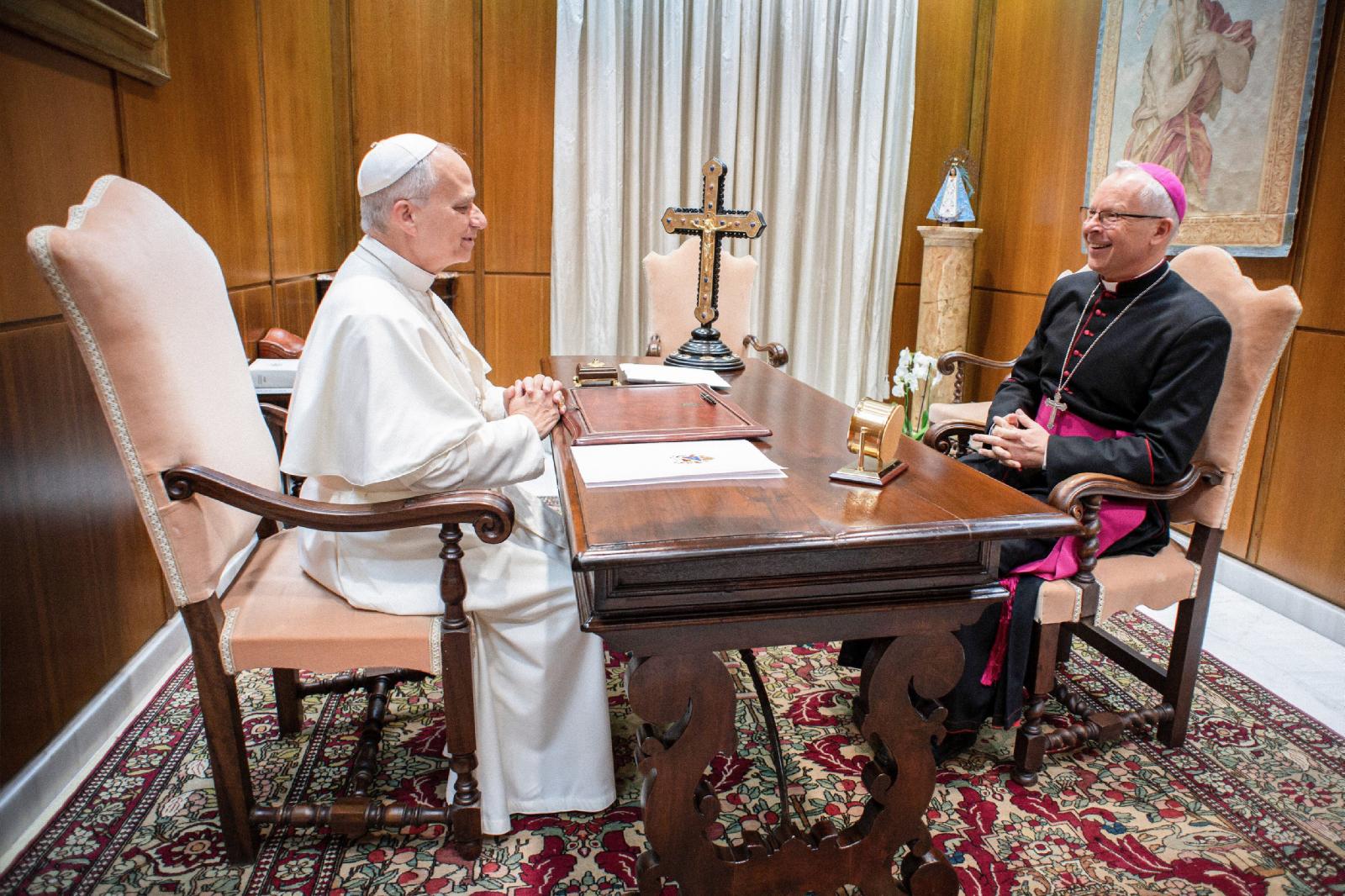
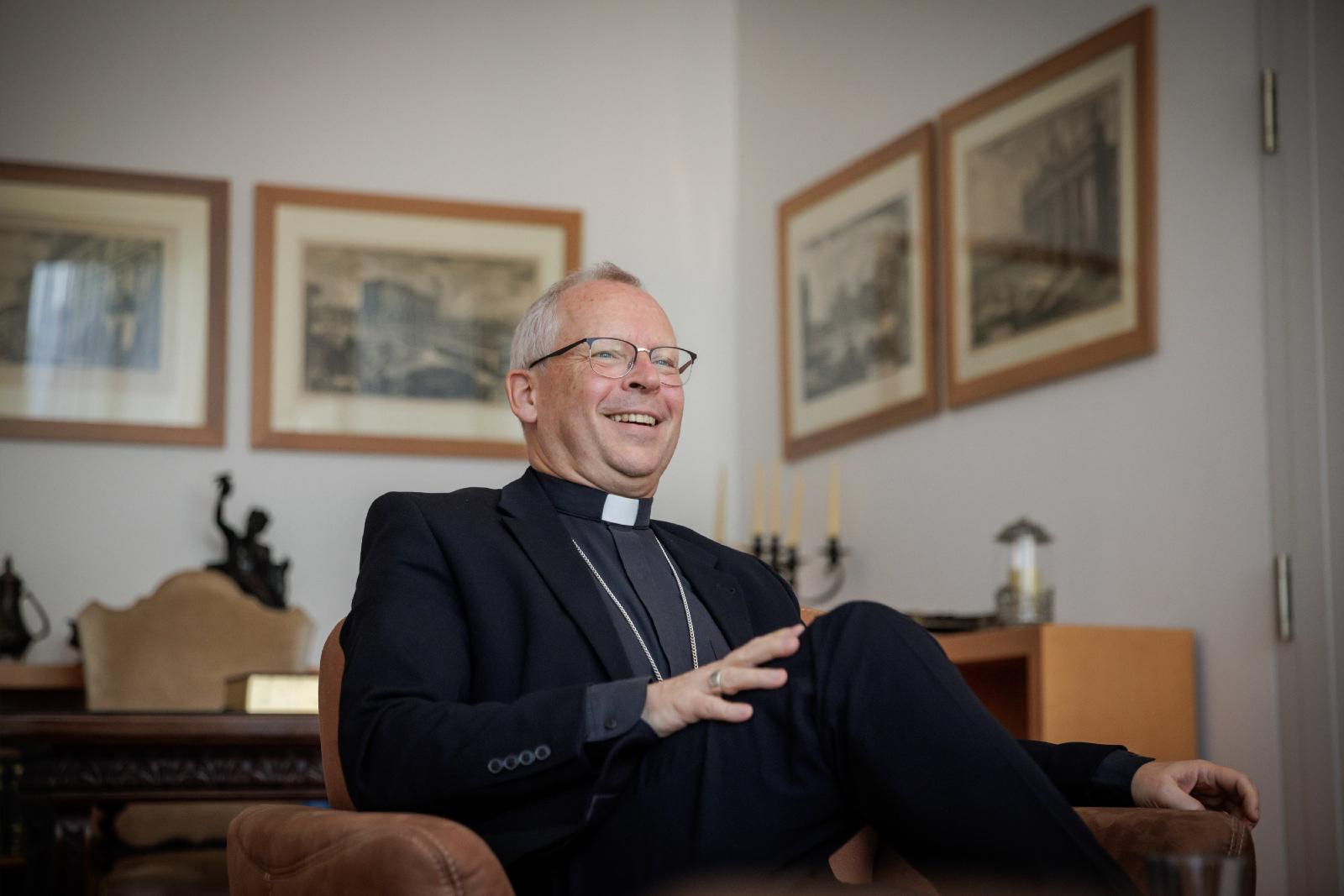
(OSV News) — The new apostolic nuncio to Germany, Archbishop Hubertus van Megen, warned the country’s bishops against charting a separate course for the local Church, reminding them that Catholic unity relies on fidelity to the papacy and the Eucharist.
In his first address to the bishops Sept. 28, the Dutch prelate said the pope “safeguards the visible unity of this Church” while the Eucharist “leads the faithful ever deeper into that unity” with Christ at its center.
“Together, they preserve the Church from becoming a mere federation of separate communities, or even an NGO with a Christian veneer,” he said, echoing warnings from Rome over recent reform efforts. “The office of Peter preserves communion in faith and ecclesial governance; the Eucharist brings this communion to its highest fulfillment in the Body and Blood of Christ.”
The German bishops’ conference gathered in the central German city of Fulda for its annual fall plenary assembly Sept. 28-Oct. 1. Among the topics of discussion were the theological significance and impact of “Magnifica Humanitas” (“Magnificent Humanity”), Pope Leo’s encyclical on safeguarding the human person in the age of artificial intelligence.
The conference said that the bishops would also discuss the investigation and handling of sexual abuse cases, adult baptisms in Europe, synodality and refugee issues.
Pope named new nuncio to Germany April 9
Before Pope Leo appointed him to Germany on April 9, Archbishop van Megen served as apostolic nuncio to Kenya.
In his address to the assembly’s opening session, the nuncio acknowledged political tensions in Germany after the far-right Alternative for Germany party, or AfD, made electoral gains by securing unprecedented victories in eastern state elections.
The party, which has raised concerns over its ideology, anti-immigration stance and close ties with Russia, was explicitly condemned by the German bishops’ conference in a 2024 statement, drawing parallels to the rise of the Nazi party and right-wing extremism in the 20th century.
The AfD, the bishops wrote, “oscillates between genuine right-wing extremism” and “right-wing populism.”
“We say with all clarity: racial nationalism is incompatible with the Christian image of God and man. Right-wing extremist parties and those that are rampant on the fringes of this ideology therefore cannot be a place of political activity for Christians and cannot be voted for,” the statement read.
Archbishop van Megen noted that “discussions concerning the future of the Republic, including those surrounding the recent elections, are at times conducted with great passion.”
Sometimes tensions ‘appear almost insurmountable’
“Tensions exist that sometimes appear almost insurmountable,” he said. “It is not only the Church that finds itself in a time of crisis and upheaval; German society, too, is increasingly asking itself: Quo vadis? Where are you going?”
He also acknowledged that as the nuncio to Germany, “I live in a country undergoing a profound transformation that leaves many people unsettled.”
“I myself am also only at the beginning of my ministry in Germany. I am becoming ever more conscious of how much I do not yet know or do not yet fully understand,” he said. “Over the past weeks, it has become clear to me that it will take time to genuinely understand the deeper spiritual and cultural currents of this country. Perhaps it is not even about understanding everything immediately.”
The apostolic nuncio also implicitly addressed the controversial Synodal Way, a three-year reform process led by the German bishops’ conference.
The process has made a number of proposals, including blessings for same-sex couples and the ordination of women, that have raised concerns, particularly from the Vatican.
Proposal to allow qualified laypeople to deliver some homilies
The Synodal Way also proposed allowing qualified laypeople to deliver the homily during Sunday and feast day Masses, based on pastoral needs, and the German bishops approved it during their spring assembly in February.
However, the Vatican Dicastery for Divine Worship and the Discipline of the Sacraments announced June 23 that it had denied the bishops’ request.
The late Pope Francis was critical of the Synodal Way and warned that it was guided by ideological principles rather than the Holy Spirit.
Reflecting on the meaning of the word “synod,” Archbishop van Megen said it stood for “the experience of journeying together,” and not individually.
Synodality, he said, “can never be the concern of individual groups alone while others are left behind. The People of God wander through the desert together. The Good Shepherd also searches for the one lost sheep. This applies not only to the Church, but equally to the entire country.”
The nuncio also emphasized that Rome “is the visible center and the guarantor of the unity of the Universal Church, to which the Church in Germany also belongs.”
No local Church ‘is more or less Church than another’
While every local Church has its own dignity and mission, Archbishop van Megen reminded the bishops that no local Church “is more or less Church than another.”
“The Church in Africa differs from the Church in Europe, as it does from that in Latin America or Asia,” he explained. “None of these Churches holds primacy on account of its size or cultural influence. All are members of the one Body of Christ.”
Archbishop van Megen said that while it is a “time of great transformation” in which “certain developments fill us with concern,” the Catholic Church in Germany must remember that “we do not walk this path alone.”
“Precisely for this reason, we may look to the future with complete confidence,” he told the bishops. “Our hope is not founded on human concepts or strategies, but on the Lord, who guides and renews His Church.”
“Where we remain in communion with Him, where we listen to one another, where we preserve unity with the Universal Church and the Successor of Peter, there the Holy Spirit can open up new paths,” the archbishop said.
Junno Arocho Esteves is an international correspondent for OSV News. Follow him on X @jae_journalist.