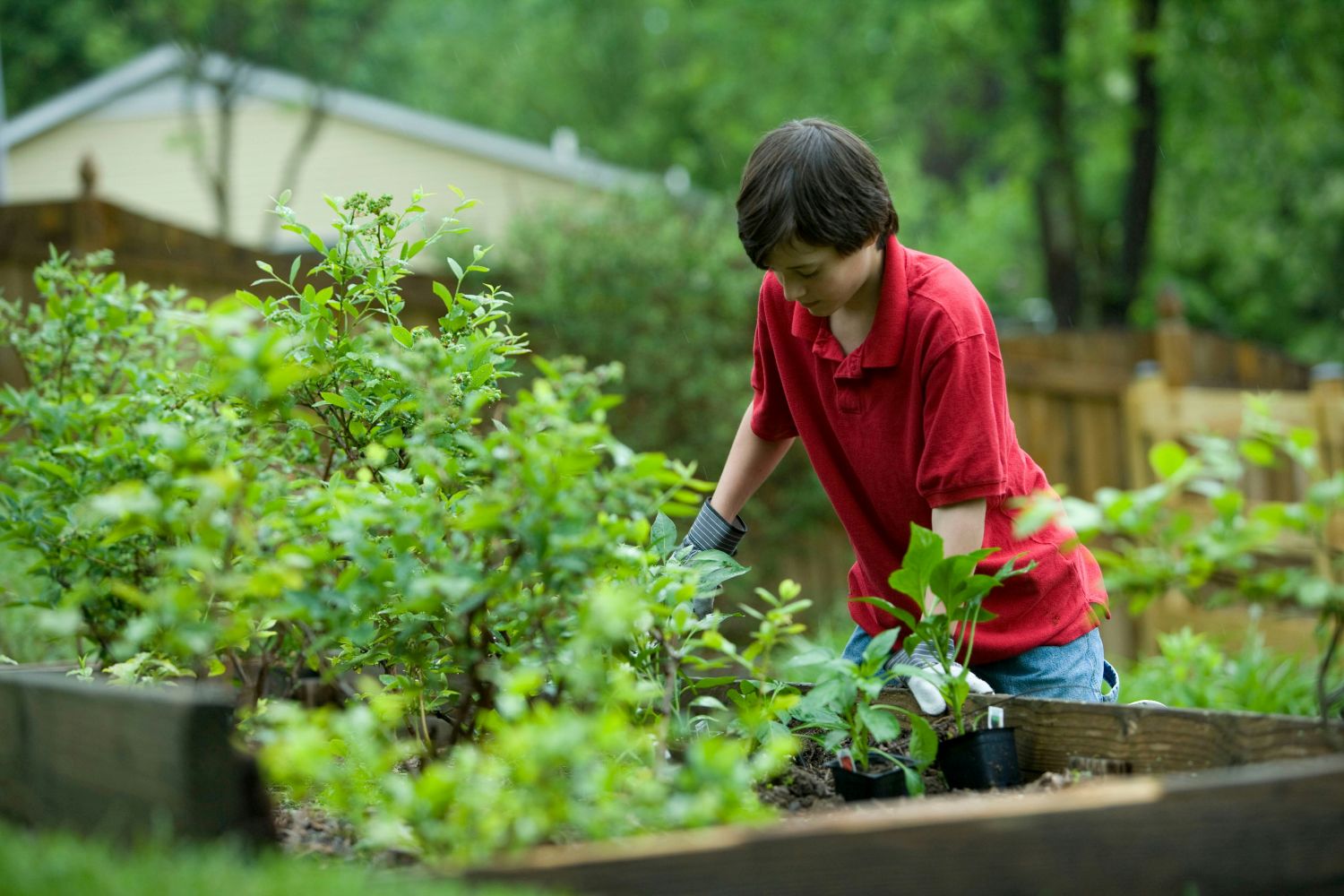
Fruits not commonly found in Arizona — bananas, guavas, mangoes and passion fruit — grow behind the youth center at Annunciation Catholic School in Cave Creek, Ariz. Berries and herbs blossom in the shade of the fruit trees, and vegetables flourish in planter boxes nearby. This thriving food forest and vegetable garden is known as The Angelus.
Annunciation is the only Catholic school in the state with a food forest — a sustainable agricultural system of edible plants that replicates patterns found in nature. Dr. Sharon Pristash, the founding principal when the school opened in 2009, was inspired to start the garden so students could learn where their food comes from.
“I grew up in the country in Wisconsin, so I know all about where food comes from. But I think most kids don’t,” Dr. Pristash said. “We’re big on nutrition here. Kids eat a lot of unhealthy foods, and we want them to learn to eat food straight out of the earth.”
In the fall of 2022, Dr. Pristash recruited a few moms to help start the garden by sending an announcement in the school’s newsletter. She then hired consultant Justin Haddad to design the landscape.
Haddad uses a practice called permaculture — a combination of the words “permanent” and “agriculture.” Permaculture works in harmony with nature to create long-lasting, food producing ecosystems. It is guided by three ethics: care for the earth, care for the people and fair share of the surplus.
In January 2023, Haddad planted over 50 fruit trees in the garden. These trees form a canopy layer that provides shade to the vines, herbs and berry bushes growing below.
Within The Angelus, Haddad never uses weed killer or pesticides. Birds, rabbits and insects are welcome in the food forest and are valued as a natural part of the ecosystem. For Dr. Pristash, her experience of The Angelus reminds her of the Garden of Eden.
“God gave us this earth and said to take care of it. We don’t use any sprays to keep the birds or the bunnies off, because they’re part of God’s creation too.”
The Angelus garden club
Terri Cole, a catechist and parishioner at St. Gabriel the Archangel Catholic Church in Cave Creek, Ariz., began to volunteer at The Angelus in September 2023. The following month, she started a garden club for students at Annunciation.
Now in its third year, the garden club involves two eight-week sessions and is open to fourth through eighth graders. Students learn how to plant their own food and care for God’s creation.
Cole shared that the name of the garden — The Angelus — “just seems to blend with the parish (St. Gabriel the Archangel) and the school (Annunciation Catholic School). It’s all about Mary!”
Cole opens every club meeting with The Angelus Prayer, a traditional Catholic prayer commemorating the Incarnation, or a prayer to St. Fiacre, the patron saint of gardeners. By now, most of the students know The Angelus Prayer by heart.
Students enjoy the garden club because they get to go outside, observe the plants and eat fruit straight from the trees. For many students, it is their first time seeing where their food comes from.
“They think it’s cool the way the trees are growing and producing fruit,” said Cole. “The figs and the pomegranates are the first to show, and the first time they ever saw that, they wanted to pick the fruit right off the trees.”
During the garden club, students decorate signs for each of the plants, learn about the different shapes of the trees and test the soil. Some students even bring a piece of The Angelus home to their families.
“The kids take home herbs like mint, thyme and oregano,” Cole noted. “One of the students’ families even planted a moringa tree at their house.”
In addition to the garden club, Cole also leads The Angelus Stewards, a program open to seventh and eighth graders. These students are knowledgeable about The Angelus and help monitor it during events.
As The Angelus quite literally continues to grow, Cole envisions it as a site for social events or harvesting opportunities. Dr. Pristash also hopes The Angelus can be a way to give back to the community in the future.
“We would love to have our own farmers market or put out a table after Mass on Sundays with ripe produce from the garden,” Dr. Pristash said. “We could give some to St. Vincent de Paul to feed the hungry and live out our Catholic Social Teaching.”