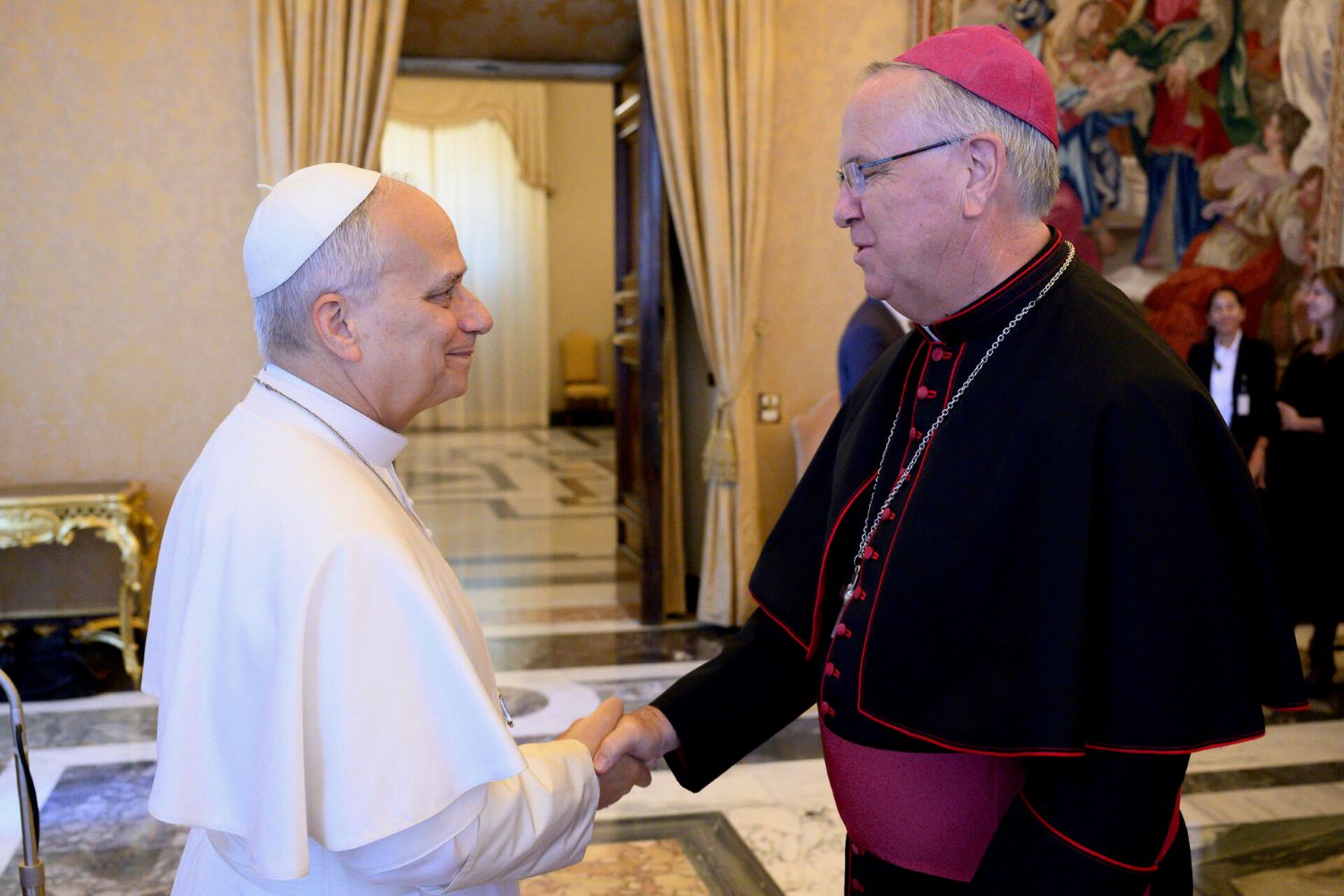
Bishop John Dolan reflects on his recent visit to Vatican City and his meeting with Pope Leo XIV.
Last week I had the privilege of participating in a gathering that took place in Vatican City where ministers of education, representatives from nations across South America and leaders from the Holy See came together to address one of the most pressing challenges facing our world today: the intersection of education, mental health and rapidly advancing digital technologies, including artificial intelligence.
The meeting, which took place on May 29, was entitled, “Maps of Hope for a Regional Educational Agenda: Mental Health, Digital Technologies and Education,” and was held at Villa Pia, the home of the Pontifical Academy of Sciences.
Together, we listened to the experiences, challenges and successes of the various nations that were represented. Throughout the day, one message seemed to continuously emerge: mental health is no longer simply a clinical concern. It finds overlap in the educational, social and cultural challenges that impact children, young people, families and communities throughout the world.
I heard many countries report rising levels of anxiety, physiological distress, suicide attempts and other mental health concerns among youth. I also found great hope and encouragement in the innovative ideas and programs that were described to bring together schools, families, healthcare systems, community organizations and governments. A common theme among participants was an emphasis on prevention, early intervention, teacher formation, family engagement and creating educational environments that promote not only academic achievement but also integrated human well-being.
It made me deeply grateful and proud of the programs we have here in the Diocese of Phoenix, including our Office of Mental Health Ministry and the Office of Human Dignity. Both hold a commitment to serving the human person and promoting the common good — and both ministries helped make my participation in this important international dialogue possible.
Ultimately, our local work and the mission of the universal Church remind us that social ministry is not merely about responding to immediate needs; it’s about building relationships, fostering human dignity and helping create communities where every human person can flourish.
Being human in the digital age
The following day, May 30, we gathered with Pope Leo XIV in the Consistory Hall of the Apostolic Palace. Cardinal José Tolentino de Mendonça, prefect of the Dicastery for Culture and Education, Dr. Emilce Cuda, secretary of the Pontifical Commission for Latin America and Archbishop Carlo Maria Polvani, secretary of the Dicastery for Culture and Education were also present.
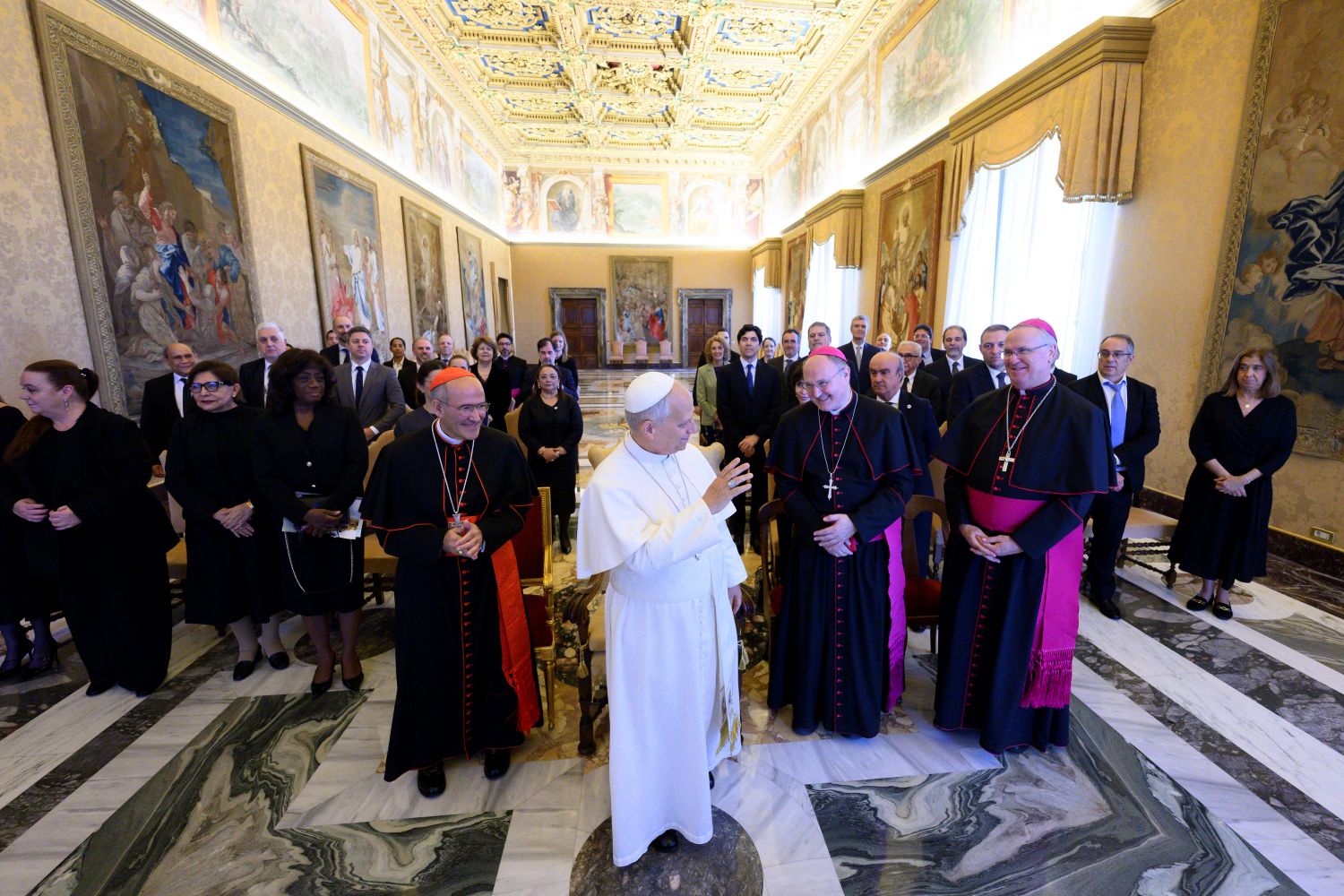
Pope Leo addressed us, elevating the discussion even further — beyond programs and policies to the deeper question: what does it mean to be human in the digital age?
The Holy Father observed that while many young people possess increasingly sophisticated technology, they often struggle to find meaning, purpose, hope and belonging. He spoke of what he calls the “loss of inner constellations,” noting that many young people may know how to navigate the digital world, but lack the interior maps needed to answer life’s most important questions.
One of the most memorable lines from his address was: “We are a desire, not an algorithm.” To me, those words capture the heart of the Church’s contributions to this global conversation.
Artificial intelligence and additional emerging technologies hold tremendous promise, but they must always remain in the service of the human person. Technology connects us, Pope Leo reminded us, but education forms us. Human beings cannot be reduced to data points, performance metrics or algorithms. We are persons created in the image and likeness of God, called to relationship, purpose and communion.
Belonging, relationships, meaning and hope
The recommendations that emerged from the conference had several emphases: the need for mental health support to become a structural component of education systems, for families and schools to work in closer partnership and for governments to coordinate policies across education, health and social services. Participants also proposed creating an Ibero-American Network on Education, Health and Holistic Well-Being to foster collaboration and share best practices throughout the South American region.
These conversations resonated with me deeply, particularly with the work our diocesan Office of Mental Health Ministry has undertaken since its founding in December 2022. From day one our approach has been rooted in accompaniment, education and advocacy. We often say that we do not diagnose, prescribe or treat; we love. The conference in Rome affirmed that authentic mental health ministry requires more than clinical care — it requires belonging, relationships, meaning and hope.
I am also excited and encouraged by the opportunities for future collaboration throughout Latin America. Working alongside Deacon Ed Schoener, President of the International Association of Catholic Mental Health Ministers, and other leaders who were present, including the Vice President of Ecuador, María José Pinto, we hope to support the development of Catholic mental health ministries in countries across South America. Our goal is not to replace existing governmental or educational initiatives, but to accompany them, offering the Church’s unique contribution to human flourishing and development.
May the discussions at Villa Pia and the reflections of Pope Leo remind each one of us that the future of education, mental health and technology will ultimately depend on the vision of the human person that guides them. As Catholics, we believe every person possesses an inherent dignity that can never be reduced to an algorithm, that education must form both minds and hearts and that technology must serve humanity rather than define it.
In a world searching for direction, perhaps the Church’s most important task is helping people rediscover those inner constellations that guide them toward meaning, belonging and the love of God.
In doing so, we help draw new maps of hope for future generations.