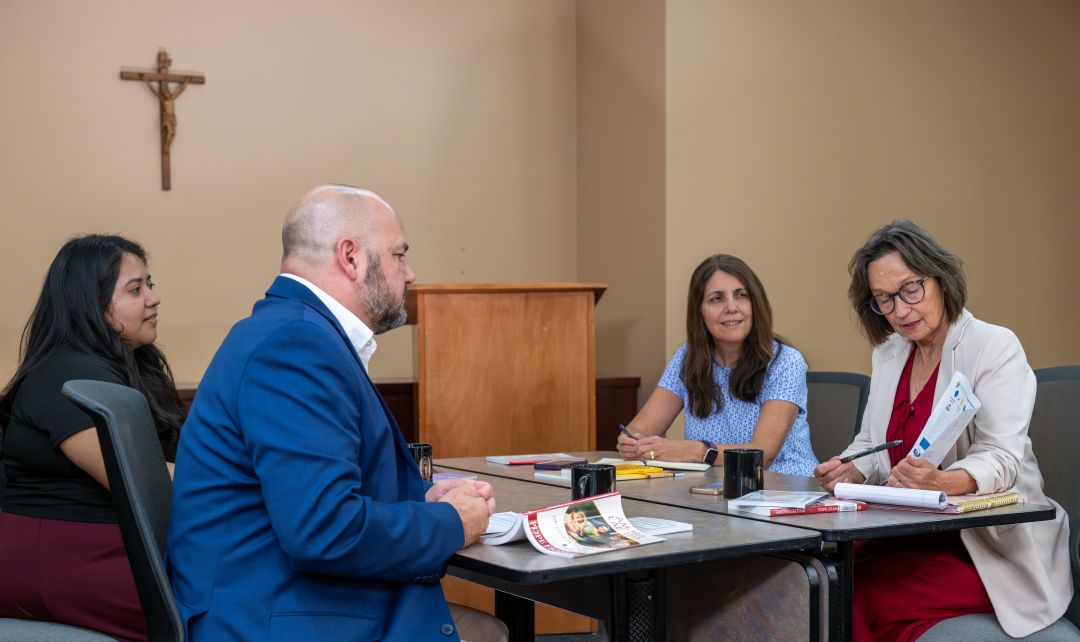
For Jose Antonio Martinez, his first and best catechism teachers were his parents. Now married for 29 years with three children of his own, the love and accompaniment he experienced growing up now pours into his role as director of Marriage, Family Life and Spirituality for the Diocese of Phoenix. In tandem with Bishop John Dolan’s vision expressed in TILMA, his seven-year pastoral plan on evangelization, Martinez oversees the marriage preparation process with a focus on mentorship, accompaniment and ongoing formation.
Throughout the process, engaged couples take a series of steps, all with intentional formation in mind. They meet with their pastor, complete a marriage preparation inventory to get to know themselves and one another, complete a marriage life-skills course, attend a retreat, receive instruction in natural family planning (NFP) and celebrate the sacrament of reconciliation all before saying, “I do.”
After their wedding day, couples are also invited to attend marriage retreats at parishes, a natural way for them to integrate into parish life, and are offered the opportunity for ongoing accompaniment from NFP instructors.
Though there are steps to the process, Martinez emphasized that marriage preparation is not about checking the boxes. “We need to listen [to these couples],” Martinez shared. “What do they need? What is their story?”
A couple’s journey begins long before their engagement. Martinez said that formation “begins within the family … in the daily gestures through which love, faith and values are passed on.”
This holistic approach to marriage preparation was deepened during a trip that Martinez made to Rome, where he had the joy of meeting with executives from the Dicastery (department) for the Laity, Family and Life.
“God surprised me!” Martinez said. “They shar[ed] some ideas … And they gave me the model they have [for married life] in the dicastery.”
Martinez returned to the diocese with resources such as Catechumenal Pathways for Married Life by the Dicastery for the Laity, Family and Life. The resources also coincide with materials from the U.S. Conference of Catholic Bishops, such as Called to the Joy of Love: National Pastoral Framework for Marriage and Family Life Ministry.
Inspired by these resources, at the diocesan level there is an emphasis on accompaniment and creating a space for couples to encounter each other in the fullness of relationships and life, wounds and all. “Part of our mission is to develop resources and spaces that accompany these wounds with respect, compassion and hope,” Martinez said. “No one should feel excluded from this journey.”
Supporting lifelong relationships
Many couples on the journey to marriage through the diocesan preparation program didn’t grow up in Catholic homes. Diane Saunders, the director of the diocesan Office of Evangelization, Discipleship and Spirituality, has seen this firsthand.
“It’s actually quite rare … that a couple comes in, both formed, both Catholic, as well as … catechized in the Catholic community. It presents kind of a different set of challenges.”
These challenges led to questions that have shaped the marriage preparation model: How does the preparation process include the family? How does the process root couples within their faith community for ongoing support and lifelong relationships?
Saunders knows how important faith community is in marriage. She has been married 45 years and has five grown children. She shared that research points to the family as being the single most important part of transmitting the faith, another reason why her team places a renewed emphasis on accompanying couples in their faith.
Saunders shared that the marriage preparation process follows a “Trinitarian, relational, sacramental view of formation.” In this approach, couples grow in intimacy with each other and with God. Additional resources in areas such as family life and spirituality, ongoing spiritual formation and grieving families are being developed to help couples grow in all areas of their relationship, both leading up to their wedding day and beyond.
This emphasis on authentic and lifelong relationship coincides with the recent consecration of the United States to the Sacred Heart of Jesus on June 12, 2026. The image of the Sacred Heart depicts Jesus’ heart as open, visible.
“Recognizing the importance of the open heart, the yielded heart, the receptive heart, that’s so important in marriage,” Saunders said.
Authentic conversations
Luis Salinas is the coordinator of Marriage, Family Life and Spirituality and has been married 26 years.
Within the marriage preparation process, he works with parishes to host retreats which are led by married couples who share their testimonies. Engaged couples have shared with Salinas that personal testimonies are the best part of the retreat.
“We can have very good material … but the experience of the facilitators … that makes the change.”
Many couples come in not knowing what a healthy marriage looks like. According to Salinas, 50-percent of couples in marriage preparation come from families with parents who are divorced. Difficult topics are not shied away from, such as mental health and domestic violence. Authentic conversations and formation bring to light challenges that couples have experienced and help provide a path forward. They also serve as a reminder to couples that the Church is here for them in all the difficulties and joys of the marriage journey.
Salinas is already seeing the fruits of these retreats. At one retreat, a couple expressed their appreciation for the topics covered, especially the reality of mental health. Now, the couple volunteers with the diocesan Office of Mental Health Ministry.
Another woman participated in the diocesan marriage preparation program 20 years ago and discerned that she wasn’t ready for marriage. She just recently attended one of the marriage preparation retreats with someone else, thankful for the developing process.
“The retreat, it’s part of the discernment,” Salinas said. “If someone decides they’re not going to get married, [it] doesn’t mean that the retreat was bad. It was doing its job.”
There is also a curriculum being created for couples who are beyond child-bearing years. Salinas recently spoke with a couple in marriage preparation who are 82 and 79. There’s a place for these couples in the diocese.
Salinas shared that it’s easy for couples to get caught up in the marriage preparation process — the paperwork, the interviews — but “you’re not by yourself.”
“There’s some [marriage preparation] requirements because the Church is Mother, and mothers want to protect [their] children, so they can find a good vocation in marriage, [so they can be] happy together, grow old and after many years of marriage, they can … see that marriage is a blessing for their life and for the community.”