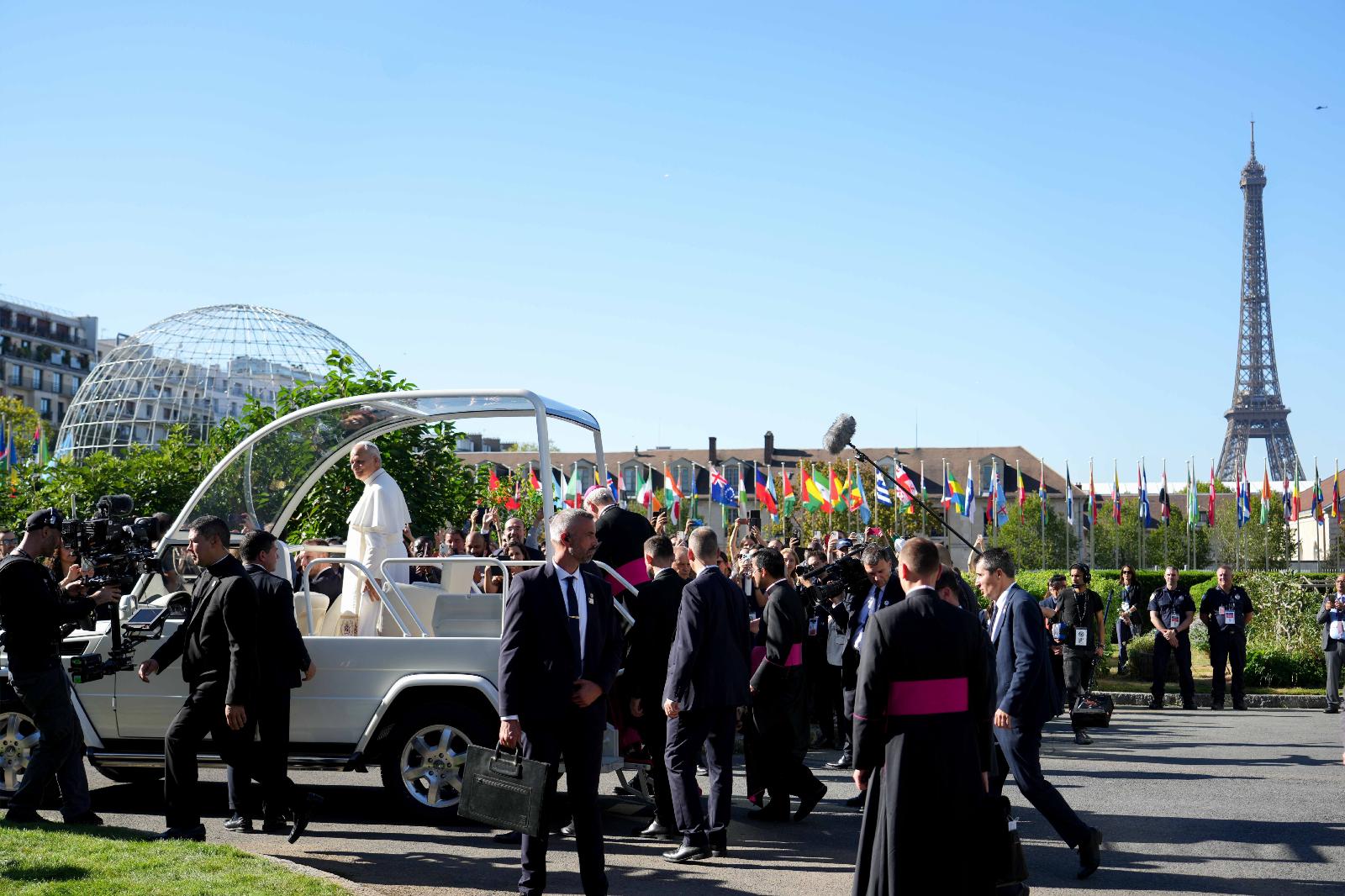
PARIS (CNS) — On the first official papal state visit to France in 18 years, Pope Leo XIV stepped into one of the country’s perpetual underlying tensions: the place of religion in a republic whose modern political identity was partly forged through separation from the Catholic Church.
Throughout the Paris leg of his Sept. 25-28 apostolic journey, Pope Leo argued that France’s deeply rooted tradition of secularism, or “laïcité,” need not exclude religion from public life. Instead, he said religious institutions and the state can work together in defense of human dignity and the common good.
“An authentic secularity, then, consists not in excluding religion from the public sphere or from education, but in striving to ensure that the state and religious institutions maintain dialogue and join forces in the service of the common good,” he told government officials, civil society leaders and the diplomatic corps at the Élysée Palace Sept. 25.
French President Emmanuel Macron offered a similar interpretation of the country’s secular tradition in welcoming the pope at the Élysée Palace. French “laïcité,” he said, is “in no way the negation of religion,” and guarantees the freedom to believe or not believe both privately and publicly.
He told Pope Leo that his message would appeal “to the conscience of all French people.”
Contradictions in France’s Catholicism
The relationship between Catholicism and the French Republic, however, has been marked for centuries by both intimacy and conflict.
Catholicism’s historic closeness to the monarchy and political authority in France helped fuel anti-Catholic movements and the push for church-state separation. France’s 1905 law formally separated churches and the state, while the country’s constitution today defines France as a secular republic that respects all beliefs.
Yet Catholicism remains deeply embedded in French history and culture, said Florian Michel, a historian and theologian at the Sorbonne in Paris.
“You cannot understand this Catholic dimension without also taking the measure of the hostility and the contradictions that have continually confronted this French tradition,” Michel told Catholic News Service Sept. 23.
Those contradictions remain visible. The French state covers costs for maintenance at many historic churches, including Notre-Dame Cathedral, while debates regularly surface over public funding related to religious events and the presence of religious symbols in public life.
‘A deeply Catholic cultural matrix’
Alexandra Maclennan, a religious historian at the University of Caen Normandy, told CNS that debates over Christmas crèches or other religious symbols in public spaces recur regularly.
“Yet, we cannot deny that we are in a deeply Catholic cultural matrix in France, because we see church steeples everywhere,” she said in a video interview Sept. 18.
Michel pointed to another example: despite France’s strict secular tradition, the French president holds the centuries-old honorary title of canon of the Basilica of St. John Lateran, the cathedral of the bishop of Rome.
“There you have it: once again, French-style ‘laïcité,’ the complexity of history,” he said in a video interview.
Surge in numbers seeking baptism
At the same time, the Catholic Church in France is seeing striking growth in the number of people seeking baptism.
More than 13,200 adults were baptized in France in 2026, a 28% increase from the previous year and more than three times the number recorded a decade ago, according to the French bishops’ conference. Forty-two percent were between 18 and 25.
Meeting catechumens and newly baptized Catholics at the Institut Catholique de Paris Sept. 26, Pope Leo acknowledged that such growth could appear paradoxical in a society “marked by a deeply secularized culture,” but it contradicts the “defeatist attitude” and must be protected as a seed “that strives to grow even amid the thorns.”
“Your experience and your testimonies, dear catechumens and newly baptized, are a tangible sign of the action of God’s grace, which far surpasses statistical and sociological analysis,” he said.
‘Fervor is being reborn’
The excitement for the pope’s arrival was apparent at the Stade de France, where an estimated 80,000 young people gathered for a prayer vigil with the pope, featuring music, performances on the lives of French saints and fireworks.
For Guy Bassot, a young adult at the prayer vigil, the Catholic faith is being rediscovered among younger generations and a “fervor is being reborn,” in response to a polarizing and isolating time in society with the rise of extreme politics and social media.
“It is a beautiful response for all these young people, because in fact it is a response to an entire system in which we are uprooted, where we are losing an enormous number of reference points everywhere,” he told CNS Sept. 25. “And it is something to hold onto, a rock for us, something solid for young people, to propel us forward in life.”
Role of secularism
Bassot said that his country’s enshrined value of secularism is not the enemy of Catholicism, because together, the country, like a human being, has duality.
“‘Laïcité’ is a surface framework for living together, in effect, and it must be respected,” he said. “But beyond that, the human person has a deep search for something supernatural, something very great, very powerful. Faith comes in addition to ‘laïcité’; it adds another depth.”
Addressing the young people, Pope Leo emphasized that a stronger public presence for faith should not mean confrontation.
“Our battle is not a battle against others. It does not employ the weapons of violence, contempt or oppression,” he said. “Our only weapon is that of self-giving love.”
Warning against a ‘paradise of machines’
Throughout his trip, the pope repeatedly pointed to new technology as one area in which religious and ethical voices should contribute to public debate.
At the Élysée Palace, he returned to concerns raised in his encyclical “Magnifica Humanitas,” warning that humanity risks becoming conditioned by a “paradise of machines” without education in ethical discernment.
Such discernment, he said, is “indispensable if we are to recognize the genuine good that enables human beings to flourish … with unconditional respect for their interior freedom and their sacred dignity.”
Macron likewise highlighted artificial intelligence in his welcome, saying it was already transforming work, education, research and information. He called the pope’s message on AI “essential” and said artificial intelligence must remain “a servant and not a master.”
Yet, the pope made it clear that even as technology progresses, there is still an important role for religion in society.
Education must address life’s meaning
Pope Leo carried the same argument to the United Nations Educational, Scientific and Cultural Organization later Sept. 25, saying technological and scientific development alone cannot answer humanity’s deepest questions.
“No education can be considered complete if it fails to address the question of life’s meaning,” he told representatives of UNESCO.
Religious traditions, he said, have a “culturally necessary and irreplaceable role” because they grapple with questions about the origin and purpose of human life.
Notre-Dame’s significance
The unique balancing act between France’s secular present and its Catholic inheritance was perhaps most visibly embodied at Notre-Dame Cathedral.
Celebrating vespers there Sept. 25, Pope Leo recalled the fire that devastated the cathedral in 2019 and the response that followed far beyond the Catholic community.
“Notre-Dame is more than a monument,” he said. “The collective effort to rebuild it, and the splendor of the result reveal that the heart of a people beats here.”
Macron similarly described Notre-Dame in his welcome address as “a part of us,” saying the rebuilt cathedral had been returned not only to Catholics but to all French people and the world.
For Maclennan, the cathedral fire was a national trauma that demonstrated how difficult it is to separate Catholicism entirely from French cultural identity.
“The hardest thing is to secularize people’s thinking and people’s values,” she said.
Michel said a significant part of French identity remains rooted in Catholicism, even as the country’s relationship with the church continues to be contested on the political stage.
‘Meaning is the oxygen of the mind’
However, Pope Leo repeatedly pointed out that the search for something deeper and more eternal was an intrinsic part and an almost unstoppable quest of the human person.
“Human beings cannot live without meaning. Meaning is the oxygen of the mind,” he had told UNESCO.
Evidence of that was again on display Sept. 26 when enormous crowds, estimated at more than 700,000, filled the Place de la Concorde and stretched along the 1.2-mile Avenue of Champs-Élysées for Pope Leo’s final Mass in Paris.
In his homily, the pope reassured the faithful that the search for God, truth and meaning still had a place in contemporary France.
“You long to rediscover a horizon filled with light and to build a renewed nation upon roots nourished by faith,” he said. “You are called to bring hope wherever discouragement and spiritual dryness prevail.”
Josephine Peterson writes for Catholic News Service in Rome.