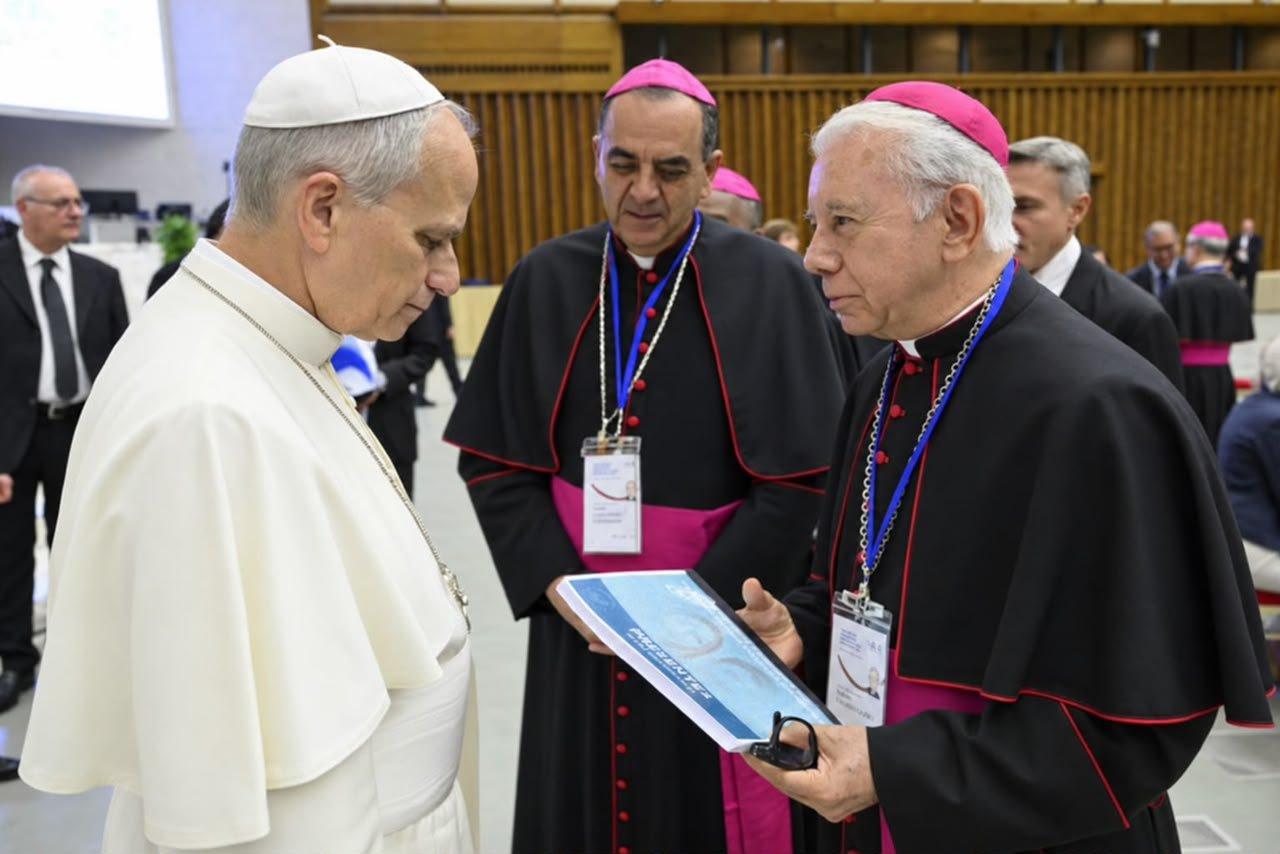
(OSV News) — Days before Pope Leo XIV announced that he would undergo surgery at Rome’s Gemelli Hospital, the Mexican bishops’ conference presented him with a book documenting the cases of people who have gone missing in the country.
The Mexican Church raises its voice amid an ongoing security crisis that left swaths of the country under the control of drug cartels.
Conference president Bishop Ramón Castro Castro of Cuernavaca delivered the 200-page book — titled “One Name, a Thousand Voices” — to Pope Leo in the Vatican on Oct. 8.
“We would like to say that this document bears witness to a prolonged episode in the life of a people numbed by so much violence. But it does not. If it were an episode, this story would have ended,” the book said in the introduction. “Yet the faces and names of disappeared people over the past twenty years are part of a past that stubbornly insists on remaining in a present that seems to stretch on without end. A present that makes it impossible to imagine a habitable future that we can share.”
The introduction concluded, “We present these faces, these names of more than 132,000 people across the country, with profound respect for their pain, with a sincere and unwavering commitment not to look away, and with the conviction that we must organize hope around justice, shared responsibility, and truth.”
Names, photos, dates of disappearance, last known whereabouts
The book shares the names and photos of 1,152 individuals, along with the date of their disappearance and last known whereabouts. Several anecdotes on several of the missing are shared: a guitar left on a bed that hasn’t been played since; a diary with a half told entry; a mother missing the past four birthdays of her children.
“Tens of thousands of relationships, stories, tasks and objects have been suspended in silence as deafening as it is unfathomable, elusive, almost impossible to put into words,” the document read.
Mexico’s bishops have raised the voices in recent years and urged Catholics to tend to Mexico’s many victims of violence, along with embracing the cause of the “Madres Buscadoras” — the collectives of families, often led by mothers, who have formed to find their missing kin in the face of government indolence and indifference.
Cardinal Pietro Parolin, Vatican’s secretary of state, met with some of the Madres Buscadoras on an August trip to Mexico and voiced support during a Mass celebrated at the Basilica of Our Lady of Guadalupe in Mexico City.
“The goal (of the book) is to demonstrate solidarity with groups of families searching for their loved ones by making Pope Leo aware of the tragedy our country is experiencing,” said Jesuit Father Jorge Atilano, director of the National Dialogue for Peace, an initiative for pacifying Mexico sponsored by the Mexican bishops’ conference, the Jesuits’ Mexico province and the Conference of Religious Superiors of Mexico.
‘Feeling united’ with pope ‘in this shared pain’
“It is about feeling accompanied by the pope, feeling united in this shared pain, and raising awareness of the reality our country is living through,” the priest said.
The bishops’ advocacy for the families of the missing comes as Mexican President Claudia Sheinbaum boasts of a sharp decrease in criminal activity since she took office two years ago, including a 51% drop in the homicide rate.
Father Atilano said the homicide rate had dropped, but disappearances had increased. He added that many parts of Mexico remain under the control of drug cartels with local police forces compromised.
“Having territorial control is profitable, for selling security services (extortion) to a company, for selling votes to a political party, for recruiting young people, or for imposing economic projects,” he explained.
Mexico has proved dangerous for Catholic clergy, too. Father Román de la Cruz Hernández was found murdered Sept. 15 in central Hidalgo state. The state prosecutor Francisco Fernández said Oct. 6 that it was following “two lines of investigation,” but declined to provide further detail.
Bishop receives online threats for speaking out
Bishop Juan Espinoza Jiménez of Aguascalientes, meanwhile, received online threats from a social media influencer known as José Lápiz. In an Oct. 1 post on X, Lapiz offered 40,000 pesos (roughly $2,175) for someone to attack the bishop, who has spoken out in homilies on Mexico’s public security shortcomings.
“Today, we hear talk at the national level of freedom and pluralism, yet threats of imprisonment are leveled against those who think differently or oppose decisions that harm our nation,” Bishop Espinoza said in a Sept. 27 homily. “We also hear talk of national sovereignty, even as the country is handed over to criminals.”
Aguascalientes state prosecutor Manuel Alonso García told Radio Formula that an investigation is underway. “We’re not going to wait for an aggression to occur to act,” he said Oct. 7.
Bishop Espinoza has promised to continue speaking forcefully.
“The Church has the duty to proclaim the Gospel, defend the dignity of every person, and raise her voice against whatever harms life, justice, peace, and the common good. This is part of my obligation as father and shepherd of this diocese,” Bishop Espinoza said Oct. 11 in a statement.
“Threats should not lead us to fear, confrontation, or hatred — and certainly not to silence the truth.”
David Agren writes for OSV News from Buenos Aires, Argentina.