(OSV News) — While six years separate the two most recent U.S. beatifications of Blessed Michael J. McGivney in 2020 and Blessed Fulton J. Sheen on Sept. 24, mere weeks pass before the next: five Franciscan friars known as the Georgia Martyrs on Oct. 31.
Cardinal Frank Leo of Toronto will celebrate the 11 a.m. beatification Mass, which will be livestreamed on social media channels and the diocesan website, diosav.org, as well as by EWTN.
Speaking about the Georgia Martyrs with OSV News, Cardinal Leo said, “We all have that same command from the Lord Jesus to go make disciples.”
“The Georgia Martyrs offered more than self-sacrifice,” he said. “They brought it to the next level in terms of self-gift. … It was a choice and a decision to make a gift to the Lord by becoming a gift to his people, who needed to know him and to live for him.”
Who are the Georgia Martyrs?
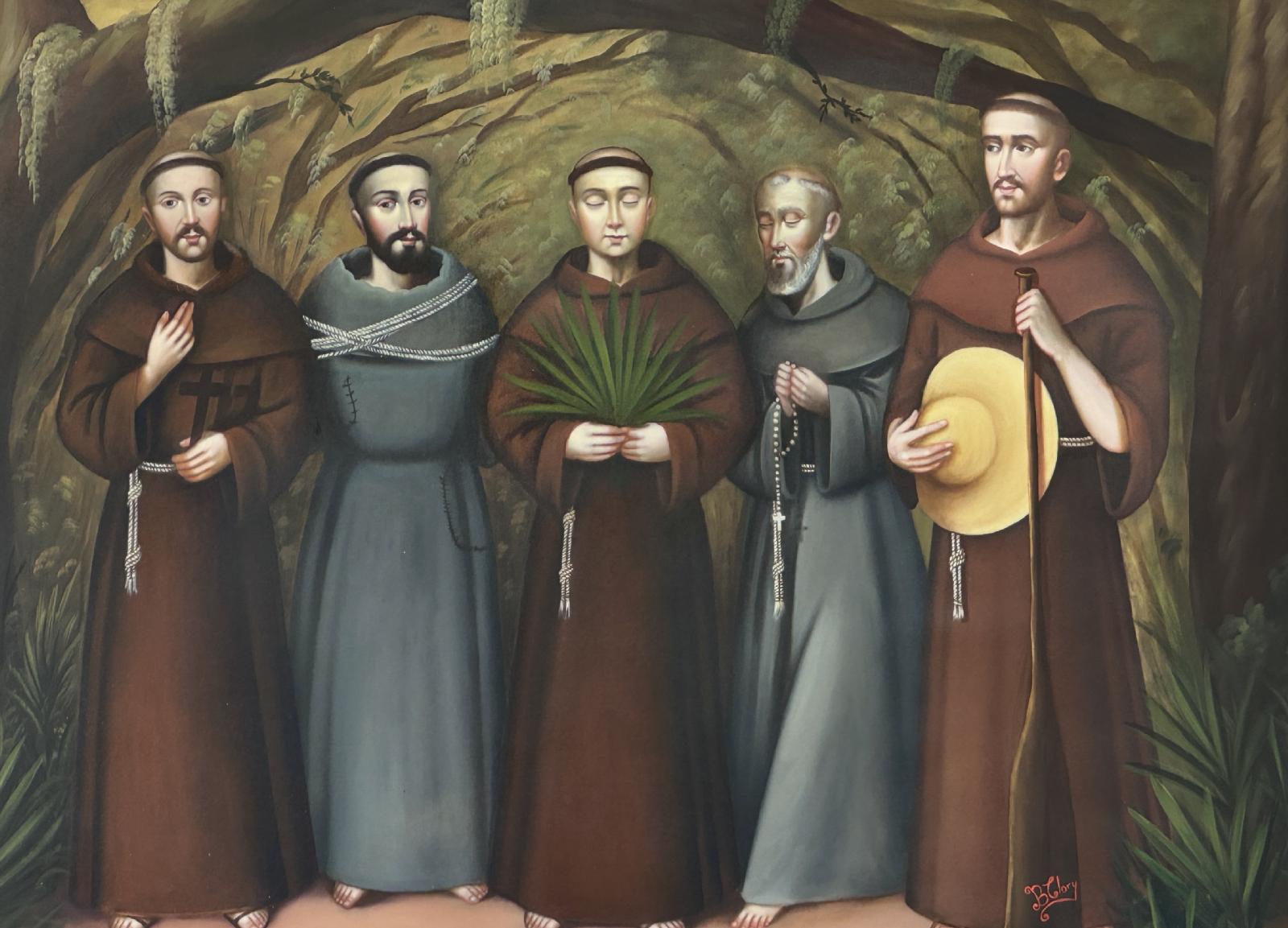
In 1597, the Spanish Franciscans Pedro de Corpa, Blas Rodríguez de Cuacos, Miguel de Añón, Antonio de Badajoz and Francisco de Veráscola were ministering at five missions along the coast and barrier islands of present-day Georgia when they were killed out of hatred for the faith by a band of Indigenous men between Sept. 14-17.
The friars’ murders were prompted by Father de Corpa angering the heir to a Guale chiefdom, Juanillo, by telling him that as a baptized Christian, he could not follow his culture’s custom and take a second wife. Juanillo and his men killed the priest at a mission near the contemporary city of Eulonia, Georgia, before killing four of the other five Franciscan missionaries ministering in the area. The sixth friar, Francisco de Avila, was kidnapped and tortured for months before being set free. The incident is known as the 1597 Guale Uprising.
At the time, the Spaniards knew the wider coastal area as La Florida, home to the settlement of St. Augustine, established in 1565. By 1595, the friars had established five missions along the coast. Prior to their murders, the six Franciscans appear to have lived among the Guale and other indigenous peoples in peace, without a military presence, for two years.
About a month after the friars were killed, the governor of La Florida led an expedition to locate the martyred friars’ bodies. According to the Diocese of Savannah’s website on the martyrs, there is no record of Friar Francisco’s remains being found. The bodies of Friars Blas, Miguel and Antonio were found buried in shallow graves on St. Catherines Island. The men in the October 1597 expedition reburied them, with the exception of the severed head of Friar Miguel, which they took with them.
Less than a decade later, when Franciscans had returned to the coastline to evangelize, the friars’ bodies on St. Catherines Island were exhumed and brought to St. Augustine, but their whereabouts today are unknown. Some scholars speculate that Franciscans took the martyrs’ remains with them to Cuba when St. Augustine transferred to British rule in 1763.
Friar Pedro de Corpa was decapitated and his body was not found; the location of his skull is uncertain. A skull recovered at the Fort King George State Historical Site in Darien may belong to Friar Pedro or Father Francisco, and testing is underway to learn more about its origins.
The Georgia Martyrs highlight missionary Church
The National Eucharistic Pilgrimage drew attention to the martyrs in May, as the nine perpetual pilgrims spent the third day of their pilgrimage in southern Georgia, walking in a Eucharistic procession at Fort King George, where Friar Francisco is believed to have been killed.
The five Franciscans’ martyrdom is “a reminder of how the Church has, over the centuries, continued to send out missionaries to all peoples, to all nations, to faraway places,” Father Pablo Migone, vicar for mission advancement for the Diocese of Savannah, said during that visit. “That is something we have done from the very beginning from the words of Jesus to the apostles.”
Beatification details
The Beatification Mass is not ticketed, and seats in the Savannah Convention Center are first come, first served. Doors for the liturgy open at 8 a.m. Oct. 31. The convention center will host the Georgia Martyr Museum between 8-10:30 a.m. and 1-2:30 p.m.
The Mass coincides with Halloween, the eve of All Saints’ Day. It also coincides with the Jubilee Year of their order’s founder, St. Francis of Assisi, which commemorates the 800th anniversary of his death.
On Nov. 1, Bishop Stephen D. Parkes of Savannah will celebrate a Mass of thanksgiving at 11:30 a.m. at the Cathedral Basilica of St. John the Baptist in Savannah, which will also be livestreamed at the cathedral’s website, savannahcathedral.org.
The slain Franciscans were seen as martyrs by their contemporaries
Reports from civil and religious leaders in the months and years after the Franciscans’ deaths reveal that the slain friars’ contemporaries saw them as martyrs. New research in the 20th century about the history of La Florida and the Georgia Martyrs bolstered efforts to move forward with a cause for their beatification.
With the support of the Order of Franciscans Minor, the Diocese of Savannah opened the cause for the martyrs’ canonization in February 1984 under Savannah’s Bishop Raymond W. Lessard, who died in 2016. In January 2025, Pope Francis authorized the Dicastery for the Causes of Saints to formally recognize the five friars’ martyrdom “in hatred of the faith.”
Alongside the sainthood cause for the five Georgia martyrs is a separate cause for the Martyrs of La Florida Missions, which encompasses 58 people martyred in the region between 1549 and 1715. Known as Antonio Inija and Companions, Servants of God, their collective cause officially opened Oct. 12, 2015, and includes Dominican, Franciscan and Jesuit priests; lay men and women; and children, including an unborn child.
Maria Wiering is senior managing editor for OSV News.