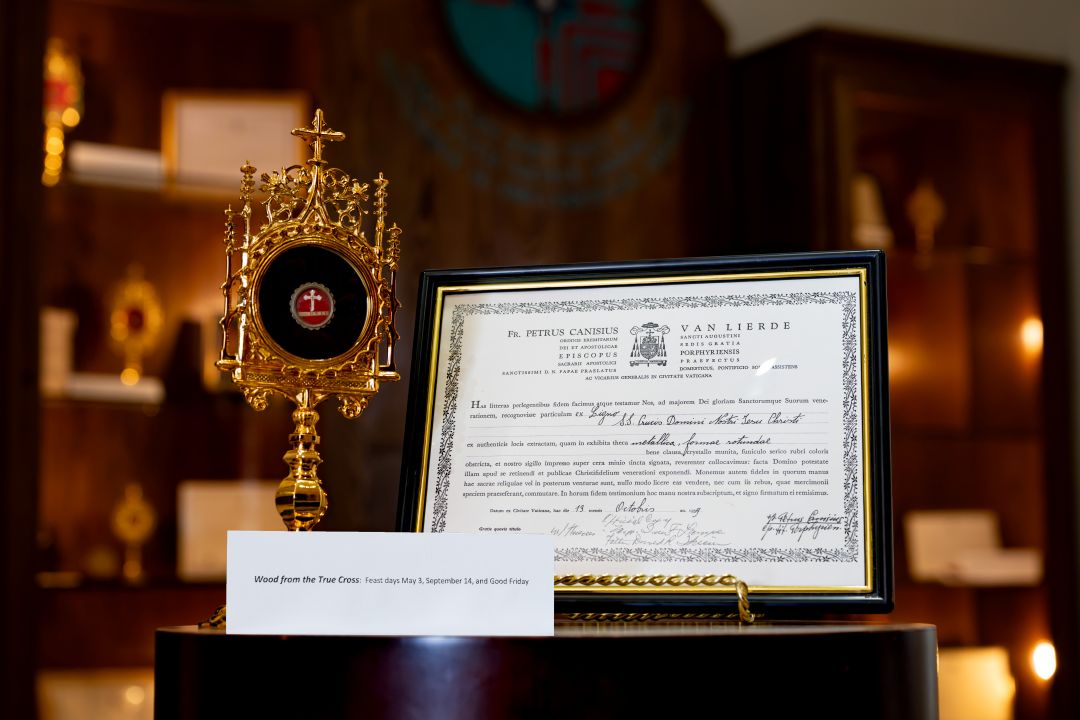
When the souls of saints leave their earthly bodies, parts of them are left behind for the faithful to remember them by. These remnants, known as relics, are physical objects associated with a saint or blessed recognized by the Catholic Church, or remnants from the life of Jesus Christ. Relics can be found in parishes throughout the Diocese of Phoenix, and the Solemnity of All Saints (Nov. 1) is a particular opportunity to seek them out for veneration.
While some parishes have relics for public display, the majority of churches in the Diocese of Phoenix also have a relic of a saint encased within the church’s main altar. This custom of preserving relics in churches dates back to the first century when priests would celebrate Mass over the tombs of martyrs. Over time, the tradition was modified into the incasing of saints’ relics in the primary altar of a church or in a gold display case called a reliquary. Depending on the parish, the faithful can venerate relics at special times of the year, asking for the saint’s intercession.
A parish’s devotion to Padre Pio
Fr. Fred Adamson is the pastor at St. Bernard of Clairvaux Parish in Scottsdale, Ariz. The parish hosts a Padre Pio prayer group and has a particular devotion to the saint, who received the stigmata, the physical wounds of Christ mystically manifested on the body.
“St. Bernard of Clairvaux Parish has been blessed with the gift of a glove worn by Saint Padre Pio that covered the stigmata wound on his right hand,” said Fr. Adamson.
“The relic was given to our parish at the request of Bishop Thomas Olmsted … in 2018 … and is permanently displayed outside of our confessional chapels.”
The relic is also brought out for public veneration on the second Monday of each month during a Mass for healing at 6 p.m., followed by a Padre Pio prayer service.
“Over the years, many people have found strength, consolation and healing through these times of prayer,” said Fr. Adamson. “Some have experienced physical healing; others have received new employment, reconciliation and restoration in family relationships, or the grace to endure suffering with greater faith and peace.”
Understanding the classes of relics
The Catholic Church recognizes three types of relics which may be venerated by the faithful.
“First-class relics are [parts of] the physical remains of a saint — bone, hair, nail, etc.,” explained Chris Martinez, director of Liturgy at St. Timothy Catholic Church in Mesa, Ariz.
Relics from the life of Christ, such as a piece of the True Cross or parts of the pillar on which He was scourged are also considered first class.
“Second-class relics are clothing or items used or owned by a saint, [such as] a bible, rosary or habit,” Martinez continued.
A third-class relic is an item that has been touched to a first or second-class relic.
A saintly gift
“At St. Timothy, we have a total of 74 saints’ relics … including [those of] the 12 Apostles, plus St. Paul and St. Timothy. Of [these relics], 61 are first-class and 13 are second-class.”
Most of these relics were acquired through Fr. Carlos Martins, who serves as director of Treasures of the Church, a worldwide ministry dedicated to displaying relics for public veneration. In 2014 he came to display his collection at St. Timothy.
“The response of excitement, reverence and inquisitiveness of the parishioners was so strong that Fr. Martins offered [Fr. Charlie Goraieb, the pastor at the time], some of the relics he had duplicates of,” Martinez explained.
Shortly thereafter, funds were raised to build a room to display the relics. Following construction, it was blessed by Bishop Olmsted. Now, it remains open seven days a week: Saturday through Thursday from 7 a.m. to 8 p.m. and Friday from 7 a.m. to 3 p.m.
While many miracles have been traced to the veneration of relics, it is not the relic alone which accomplishes miracles, but God working through the relic. By doing so, God “proposes saints as models and intercessors,” to inspire the faithful in “holiness” and “missionary zeal.” (CCC 828)
Martinez is one who has received such inspiration.
“It’s like being in a room with all of your friends,” Martinez explained.
“I always feel peaceful whenever I am in the relic room … My time there is spent [in thinking] how cool it is to have this collection of people who have done incredible things regarding the faith. [I often think], will my works, words or actions impact others as the people in this room have impacted me?”
Fr. Adamson agrees that relics can have a deep impact on the lives of the faithful.
“[This] is perhaps the greatest lesson of the relic,” said Fr. Adamson. “It is not an object of superstition, nor is our devotion ultimately about [the saints themselves]. Rather, it is a reminder of holy [men and women] who gave their lives to Christ and sought to lead countless souls into a deeper relationship with Jesus.”
“Now You Know” is a weekly series where priests from the Diocese of Phoenix answer common Catholic questions. Each short episode offers engaging insights and “ah-ha” moments, explores Church history and provides the opportunity for a deepening of faith. Check out more videos here.