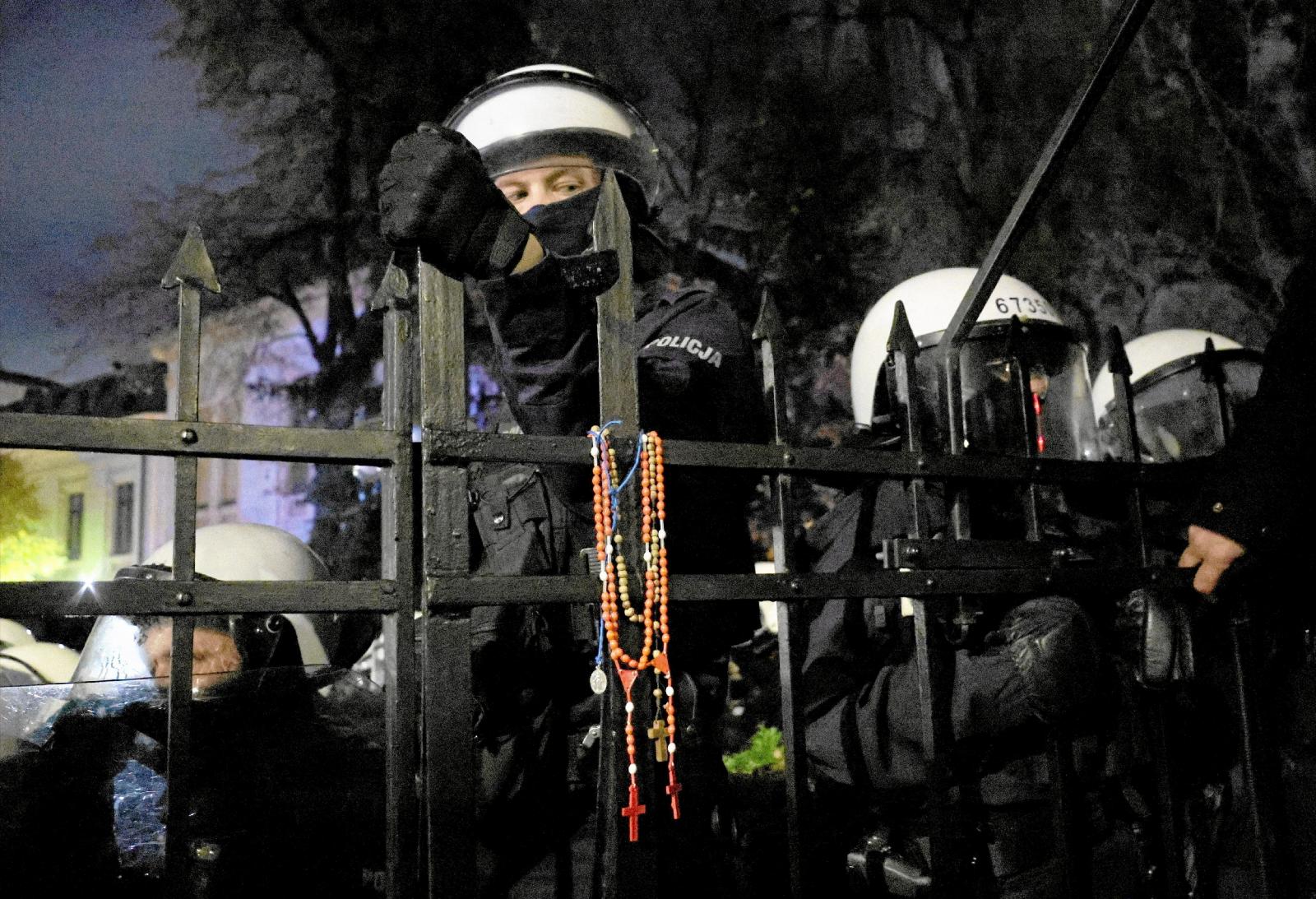
WARSAW, Poland (OSV News) — Poland’s president cut short a foreign trip, police intervened outside the Constitutional Tribunal and protesters gathered in Warsaw as a bitter struggle over control of the country’s highest constitutional court escalated.
Amid the growing political crisis, bishops in a majority-Catholic country issued urgent appeals for peace, restraint and respect for the rule of law.
In an Oct. 31 statement, the leadership of the Polish bishops’ conference warned that the escalating dispute over the Constitutional Tribunal “is leading to a profound crisis of the state.”
“It is not the Church’s role to determine the causes of this dispute or who is responsible for its failure to be resolved,” the bishops said as they called for an end to the escalation, constructive dialogue and peaceful solutions, urging Poles to support efforts toward national agreement and reconciliation.
Urging the faithful to consider fasting, personal sacrifice for good of country
Cardinal Konrad Krajewski, the archbishop of Lódz and a longtime Vatican official who served as papal almoner throughout the pontificate of Pope Francis, urged Catholics to go further by considering fasting and personal sacrifices for their country.
Speaking during morning Mass at the Lódz cathedral Oct. 31, attended by members of the ecumenical Taizé community, Cardinal Krajewski asked the faithful to pray for those responsible for Poland’s future.
“Many Poles did not sleep last night,” he said. “Please, I ask you to pray for our homeland, for those who govern. For wisdom, for good judgment, so that they bring peace, not division.”
He also warned against reaching a point at which the situation would become extremely difficult to control and stop. “Perhaps we need to make some sacrifices, perhaps fast,” Cardinal Krajewski pleaded.
What happened in Warsaw on Oct. 30
The confrontation is the latest chapter in a judicial dispute that has divided Poland for more than a decade and now pitted President Karol Nawrocki against Prime Minister Donald Tusk‘s government.
The immediate crisis began Oct. 30, when an announcement appeared on the Constitutional Tribunal’s website stating that its president, Bogdan Swieczkowski, and vice president, Bartlomiej Sochanski, were to be suspended for one month.
Anna Korwin-Piotrowska, elected to the tribunal by the current parliament, said she had issued the orders and was assuming responsibility for the court’s administration. The tribunal’s existing leadership rejected the move, claiming that its website had been unlawfully taken over and that Korwin-Piotrowska was not a legitimate judge.
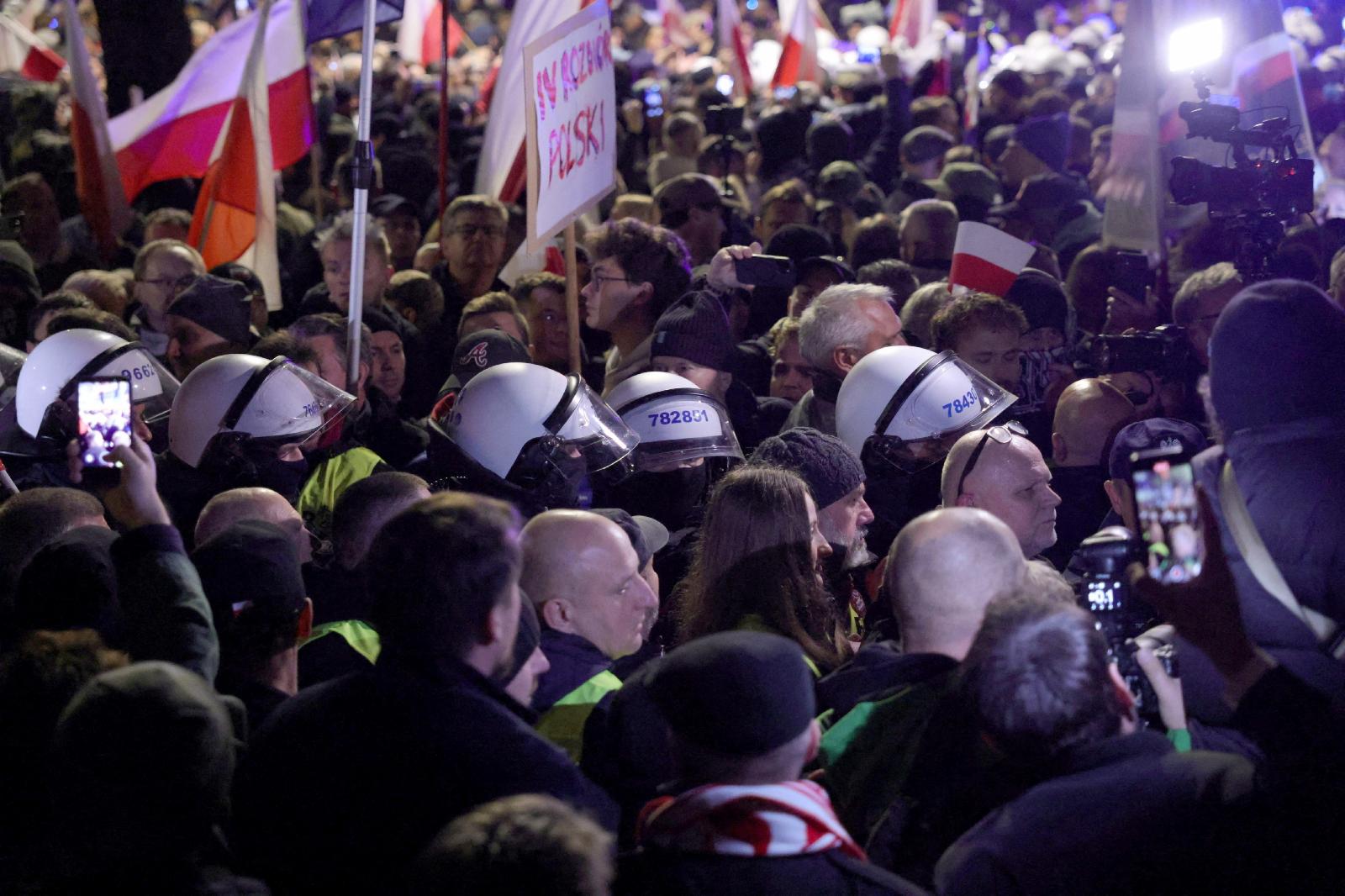
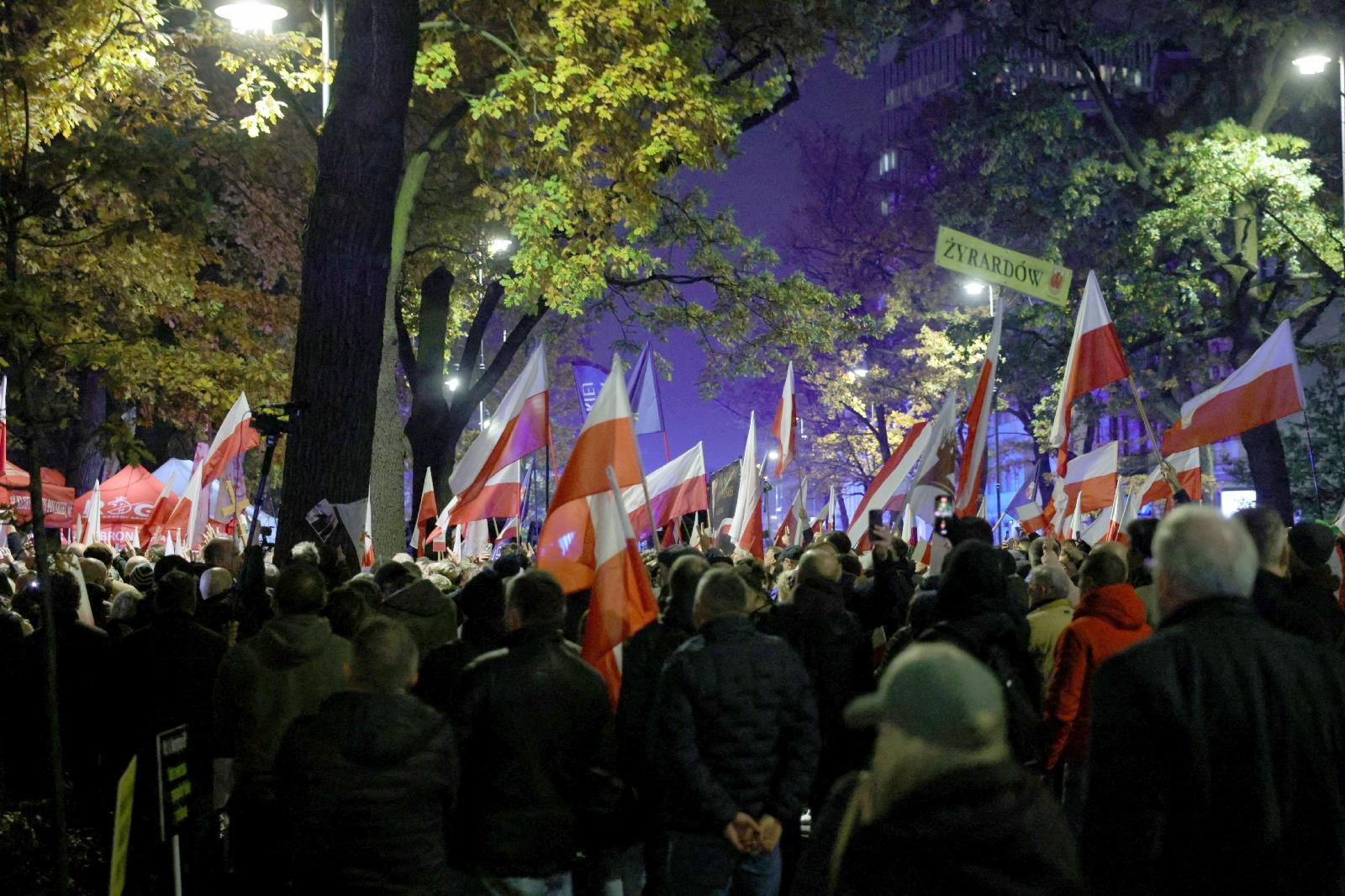
Within hours, protesters gathered outside the building, joined by politicians from the opposition Law and Justice party. Police secured the grounds, and three people were detained after demonstrators breached a fence, according to The Associated Press.
Poland’s prelates praying for agreement and reconciliation
Archbishop Wojciech Polak of Gniezno, the primate of Poland, appealed for reconciliation in an Oct. 31 statement. He urged all sides of the political dispute to ease social tensions and avoid further escalation, calling on them to seek a common solution through dialogue.
“Let us pray that the Lord may transform our hearts and make them ready for agreement and reconciliation,” Archbishop Polak said.
Cardinal Grzegorz Rys of Kraków meanwhile appealed for finding paths of reconciliation in a country that is deeply polarized, where the conservative president and center-left government leaders barely talk to each other.
“Unless we in Poland get to the very root of everything that has so dramatically divided us, any attempt at a superficial resolution of these conflicts will be futile,” Cardinal Rys told the Catholic program of public television channel TVP.
If root causes of the political conflict will not be addressed, the prelate warned “it will amount to nothing more than a short-lived, tactical truce that fails to achieve the true objective. Reconciliation must be at least as deep as the division itself,” he said, echoing words of St. John Paul II.
Deep internal divisions in Poland between supporters of government and of president
The confrontation however was nothing short of deepening divisions and prompted an extraordinary decision by President Nawrocki, who was flying to Senegal for an official visit. “At a moment like this, the President must be in Poland. I am cutting short my flight to Senegal. I am returning,” he wrote on X.
Nawrocki returned to Warsaw and entered the tribunal building overnight. His arrival led to a physical confrontation at the tribunal’s entrance, where video footage showed him pushing through a group of people standing in the doorway. The president’s spokesman accused them of trying to block his entry, while the other side accused Nawrocki of pushing judges. In a statement Oct. 31, the president accused those behind the leadership change of violating Poland’s constitutional order and taking control of a state institution by force.
The crisis also drew a social media comment from the U.S. Ambassador to Poland Tom Rose. “We appear to be witnessing an unprecedented confrontation over the government’s use of state power and the independence and authority of a constitutional institution,” he wrote on X Oct. 30.
Rose stressed that the United States did not intend to interfere in Poland’s internal affairs, but urged all sides to avoid further escalation and violence.
The Constitutional Tribunal, which under Poland’s Constitution has 15 judges elected by parliament, determines whether legislation complies with the Polish Constitution. Unlike the U.S. Supreme Court, it is a separate constitutional court rather than the country’s highest appeals court.
Poland also has a system in which executive power is divided between a prime minister, who leads the government, and a directly elected president, who serves as head of state and can veto legislation. The dispute over the tribunal dates to 2015. The current conflict involves the status of judges elected by parliament, the president’s refusal to receive the oaths of some of them, and competing interpretations of the legal authority of the tribunal’s leadership.
Archbishop of Warsaw invoking the ‘intercession of Mary, Queen of Poland’
As the confrontation unfolded, Archbishop Adrian Galbas of Warsaw appealed to Catholics to pray for the country. “In the context of the actions surrounding the Constitutional Tribunal, I earnestly ask all believers to pray for our homeland,” he wrote on Facebook Oct. 30. “Let us pray for social peace, and for those in power to receive the gift of prudence and humility.”
He asked “all those who exercise authority” to “act honestly” and “in accordance with the rule of law,” he wrote, invoking the intercession of Mary, Queen of Poland, and the country’s patron saints.
Bishop Artur Wazny of Sosnowiec approached the crisis from the perspective of Christian responsibility.
“Do not be overcome by evil but overcome evil with good,” he wrote on social media, quoting St. Paul’s Letter to the Romans. He said the biblical instruction was not a sign of naivety but a demanding test of conscience and responsibility for Poland.
“Every crisis of institutions is ultimately a test of our consciences,” Bishop Wazny wrote. He warned that when law and human emotions become a battlefield, Christians have a duty to protect their inner peace and respect for others.
Prayers for prudence and restraint in political disputes
He also called for prayer for prudence and restraint in political disputes, and for the law always to serve people rather than provide a temporary advantage.
Archbishop Andrzej Przybylski of Katowice issued a formal appeal Oct. 31, explicitly referring to the events surrounding the Constitutional Tribunal. “I join the voices of many bishops in Poland,” he wrote, calling for prayer and penance for justice and social love, and for resolving problems “not through force, but through the law in force and dialogue.”
The archbishop also called for respect for human rights and an end to violence. He asked that prayers for Poland be included in Masses and other services throughout his archdiocese.
Leaders of conferences of Major Superiors of Institutes of Consecrated Life in Poland also issued a joint appeal, warning that the events surrounding the Constitutional Tribunal were deepening divisions and weakening public trust in state institutions.
“Social peace does not come from imposing one’s will,” they wrote, calling for respect for the constitution, dialogue and prayer for the country during Masses, community prayer and Eucharistic adoration.
Katarzyna Szalajko writes for OSV News from Warsaw, Poland.