
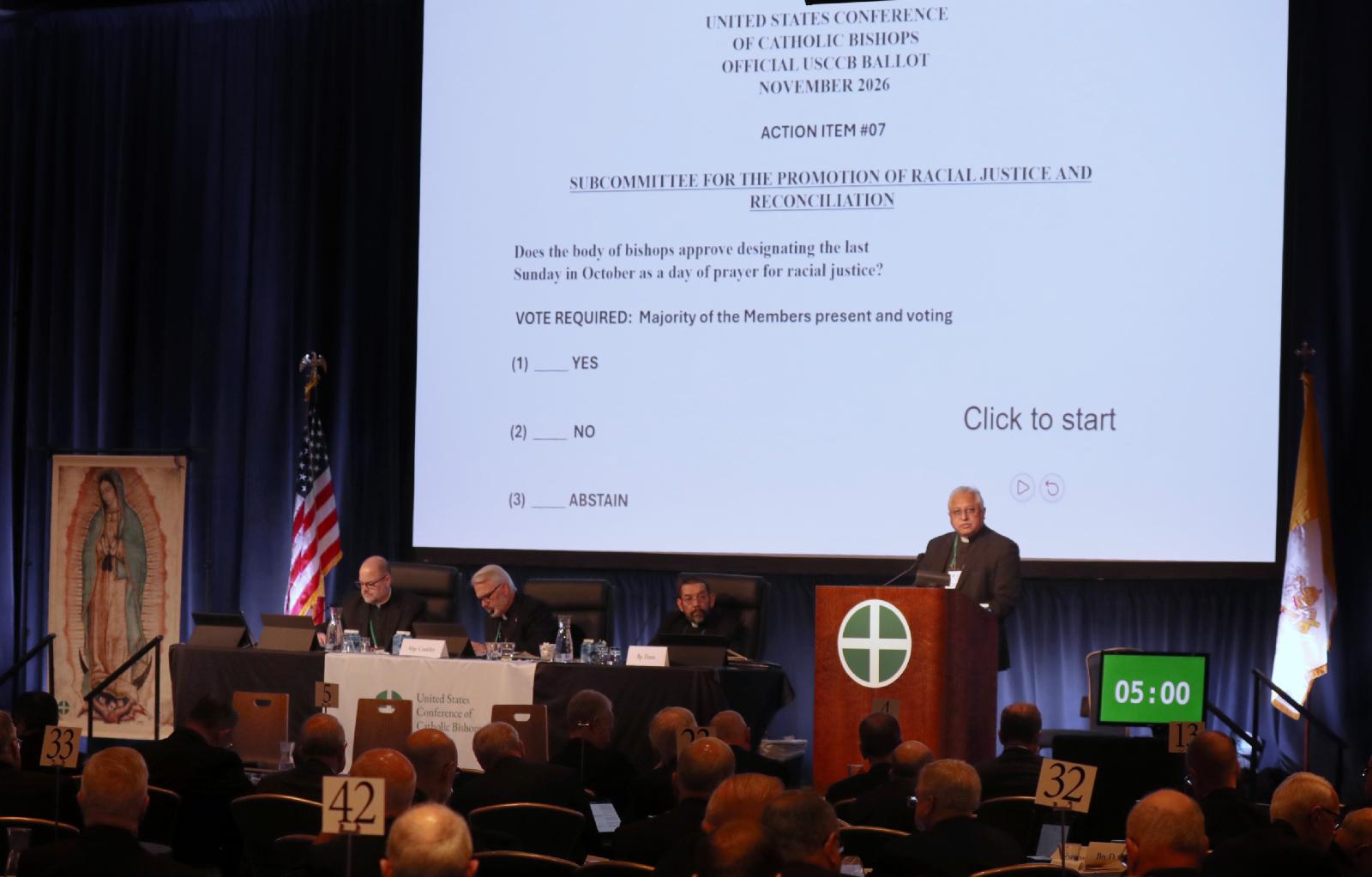
BALTIMORE (OSV News) — The nation’s Catholic bishops have approved a motion to designate the last Sunday in October as a day of prayer for racial justice.
The decision was determined by a vote Nov. 18 amid the U.S. Conference of Catholic Bishops’ annual fall plenary, held Nov. 16-19 in Baltimore.
A total of 180 bishops voted in favor of the observance, with 15 voting against and seven abstaining.
Bishop Daniel E. Garcia of Austin, Texas, chairman of the USCCB’s Subcommittee for the Promotion of Racial Justice and Reconciliation, presented the action item for consideration, saying the establishment of such a day “creates sacred space for reflection, repentance and the conversion of hearts, fostering deeper reconciliation within the body of Christ and across our communities.”
The subcommittee, first launched in 2017 as the Ad Hoc Committee Against Racism, was approved as a permanent entity under its new name by the USCCB’s administrative committee in September 2025 as a permanent entity. Bishop Garcia was named its inaugural chairman in November 2025.
Speaking to OSV News ahead of the vote, Bishop Garcia — who previously shared his own childhood experiences of racism — said that day of prayer for racial justice was “an opportunity for the Church at large to draw some recognition to an aspect of racism that in some ways we’ve not wanted to talk about, and that’s the whole aspect of racism in the Church.”
That aspect is not confined to the past, he said, but manifests itself “in the present day, age and climate.”
“We see the divisiveness and the polarization,” which at times manifest themselves along the lines of “color or ethnicity,” he said.
He also pointed to intensified fears of discrimination experienced under the Trump administration’s crackdown on immigration, which has seen widespread allegations of racial profiling in immigration enforcement operations.
Ending racism, Bishop Garcia said, “first and foremost” begins with prayer: “Asking God to heal our hearts of the wounds of the past, and to help us as we try to work through this complex situation that we encounter today, both civilly but also in the Church,” he said.
Day of prayer to be ‘reflection on racial justice and reconciliation’
In his plenary address, Bishop Garcia cited a recently released study by the Center for Applied Research in the Apostolate, which found that 60% of adult Catholics in the U.S. believe racism exists within their local community, with about 4 in 10 (39%) saying they have experienced racial discrimination generally.
That figure was higher among Black Catholics (66%), Hispanic Catholics (54%) and Asian Catholics (54%).
Citing CARA’s data, Bishop Garcia said in his address that “26% of Black respondents indicated that they have personally experienced racial discrimination within their parishes or Catholic schools.”
He also noted that only 48% of the study’s participants said they were familiar with the USCCB’s 2018 pastoral letter against racism, “Open Wide Our Hearts: The Enduring Call to Love.”
“These findings underscore the continued need for initiatives that promote racial justice, inclusion, and reconciliation within the Church and broader society,” said Bishop Garcia.
Bishop Garcia also noted that the timing of the day of prayer for racial justice — coordinated in consultation with the bishops’ Committee on Divine Worship — “would coincide with either the 30th or 31st Sunday of Ordinary Time.”
“The readings are very fitting for this designation,” he said, adding that “placing this observance at the end of October would provide a meaningful transition into November, a month that recognizes both Black Catholic history and Native American heritage.”
As a result, the day of prayer would “serve as a bridge between related observances,” creating increased pastoral opportunities for addressing racism, while incorporating “reflection on racial justice and reconciliation more fully into the liturgical life of the Church.”
Pray ‘to be more open-hearted to the person who is different’
Speaking to OSV News prior to the vote, Bishop Garcia said that “racism is not something we’re born with.”
“It’s learned behavior,” he explained.
But “that man, that woman who is different from me — who has a different skin color, who speaks a different language — they are also a daughter and a son of God,” Bishop Garcia told OSV News. “And if I claim to be Catholic and Christian, then I have to start there.”
Through prayer, the Lord can heal those wounded by racism, while — as the psalmist pleads in Psalm 51 — creating “a clean heart” that honors and respects others, he said.
“Whether you’re a person that’s maybe been the subject of discrimination, or one who has discriminated against someone, there’s always an ability to change,” said Bishop Garcia. “There’s conversion in every one of us. God doesn’t give up on us.”
And for that reason, he added, “Pray to God for the grace to be more open-hearted to the person who is different, or who is a stranger in my midst.”
Gina Christian is a multimedia reporter for OSV News. Follow her on X @GinaJesseReina.