
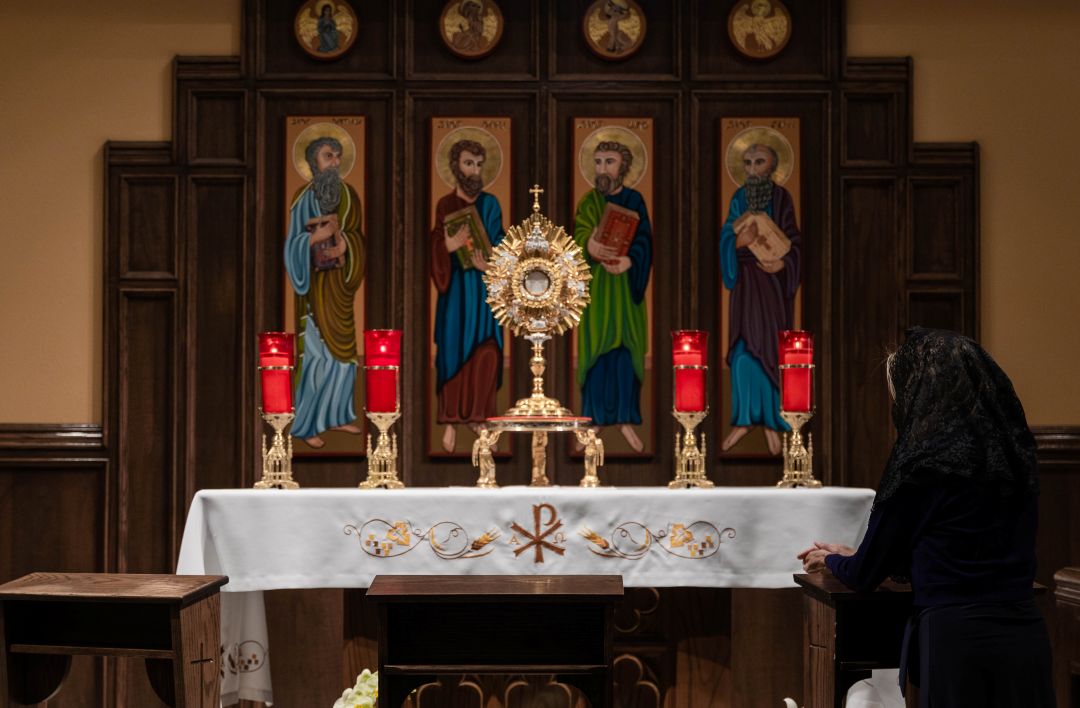
On the corner of 38th Street and Greenway, amid fast food drive-thrus, automobile repair shops and an elementary school, sits a small yet impactful adoration chapel — the heart of St. Joan of Arc Parish in Northern Phoenix. It’s a familiar space to Candida Kirkpatrick, a wife, mother and spiritual director who has spent countless hours there adoring the Lord in the Blessed Sacrament.
For Kirkpatrick, the Eucharist isn’t simply one part of her life; it’s everything.
“I have found it to be extremely, incredibly healing in my own journey … being able to go into that space and under His divine gaze. Whether I’m in joy or sorrow, I come as I am,” she said.
For years, Kirkpatrick has felt drawn to a deep prayer life and the invitation to abide in the Lord, particularly through the sacraments. She expressed what a blessing it is that God has arranged her life in such a way that she is able to attend daily Mass and make a Holy Hour, a 60-minute time of prayer in the adoration chapel, most days.
“I feel like the Lord has been the source — of course, He always is — of so much healing and very deep healing within.”
And while encountering Jesus in the Eucharist has changed Kirkpatrick’s life, the One she encounters there pours forth into every aspect of her ministry, particularly in her accompaniment of others through spiritual direction.
“In sitting in Eucharistic adoration and being able to go out to others, my prayer is always that I will bring His divine gaze and holy face to others and really recognize the dignity of each human being,” she continued.
“People want to be seen, known, heard and understood, but oftentimes I think they’re not experiencing the fullness of it. And so there’s a great thirst, and there always has been, to see the face of God.”
The ‘preciousness’ of each person
Kirkpatrick didn’t always know she wanted to be a spiritual director.
“I always wanted to help people, but I didn’t know that spiritual direction even existed,” she said. “I thought that I might want to become a counselor or a psychologist, but then suddenly I shifted to international politics and desiring to go into diplomacy, of all things.”
After going to college in Washington, D.C., she took her first job working for an immigration lawyer. It was here that she began to encounter people in what she calls their “sacred stories.”
“It really gave me a very rich experience in hearing people’s stories, sitting with them … and really accompanying them on the journey. Within that there are many joys and sorrows and traumas. So, people were bringing that to me, and I felt very blessed and honored to be in that space.”
Kirkpatrick first witnessed the example of intentional accompaniment through her late mother, Kathleen Torzala, who Kirkpatrick said was always there for family, friends, neighbors and anyone in the community or parish in need.
“She really was a pivotal exemplar for me as she worked with so many different kinds of people, honored their gifts and served as a source of encouragement … for those who were hurting, in distress or in need.”
As her own sacred story unfolded, Kirkpatrick continued to accompany others in a variety of roles: as a wife, a mother of two now-grown children, a member of the Secular Order of Discalced Carmelites (OCDS) and eventually as a spiritual director.
But she always looks back to that first job where a particular thread of grace seemed to begin in her life.
“I see the hand of God, of course, in every moment, but especially in gifting that to me as kind of my first job out of college because I think that’s where I really experienced the preciousness of each individual person and their sacred story.”
Tenderness, sharing and community
Kirkpatrick describes spiritual direction as a sacred space where the Holy Spirit, who is “the Divine Director,” moves. She emphasized that the environment fostered must be free, permeated with prayer and reverencing the story of the directee, the individual being accompanied.
“Amidst our weakness, our unworthiness, our humanity, God recognizes and provides the gifts to be in that space and to, in a sense, break bread with the other,” said Kirkpatrick. “It’s really a space of tenderness, of sharing, of community.”
Having received spiritual direction training through the Centre for Applied Carmelite Spirituality (CACS), she now serves as the North American coordinator for CACS’s spiritual direction formation program.
At the beginning of every spiritual direction session, Kirkpatrick prays with the directee, listens to their struggles, joys and challenges and guides the directee in discerning how the Lord is working through these very ups and downs of life. She also helps individuals grow in self-knowledge, delving into areas such as temperaments, charisms, natural abilities, strengths and weaknesses.
“Spiritual directors witness to the movement of the Holy Spirit … accompanying the directee in recognizing how the Holy Spirit is working, is forming, is molding, is speaking or whispering in their sacred journey, in the mysteries that are unfolding in their lives,” said Kirkpatrick.
She described her own disposition as a spiritual director as sitting in a posture of “encouragement, wonder, amazement” as directees have breakthroughs, “a-ha” moments and epiphanies that weren’t making sense before.
“It’s being able to really be comfortable with the Holy Spirit, who is the Divine Architect and Artisan … He’s always going to go way beyond the boxes or limitations [we put on Him in our humanity.]”
Between sessions, Kirkpatrick can be found in front of the Eucharist, contemplating the divine gaze of God as she prays for her directees and their prayer intentions.
Kirkpatrick is profoundly humbled by the opportunity to accompany others on their journey. And along the way she has learned that God can take any situation, any pilgrimage toward Him, with a variety of complexities and backgrounds, and make it beautiful.
“There is no person that is exempt from these graces — from His love, from His touch — and who is not fearfully and wonderfully made. And that’s not just a pious platitude. I mean, it is the truth.”