
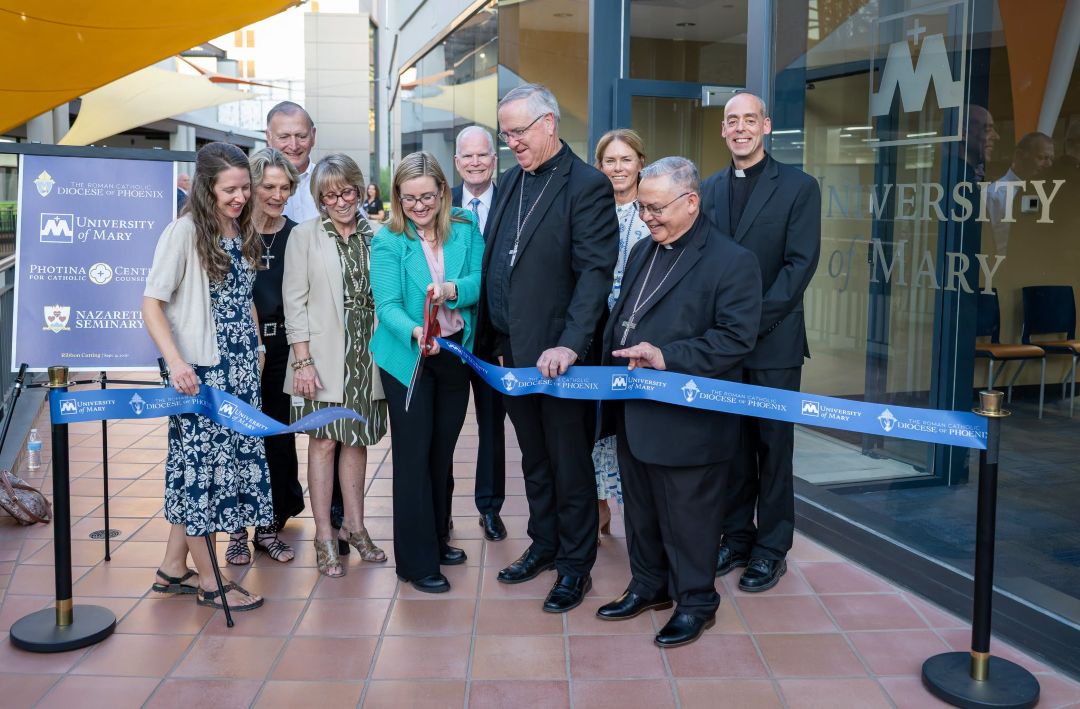
The Diocese of Phoenix’s visionary Nazareth Seminary and groundbreaking Mental Health Ministry, in collaboration with the University of Mary (UMary), have launched an innovative partnership to educate future priests in the growing diocese, while simultaneously expanding training for Catholic mental health professionals to address the region’s surging need for care.
On Wednesday (Sept. 9) during the ceremonial ribbon cutting and opening, Bishop John Dolan welcomed educators from the Bismarck, N.D.-based UMary, Nazareth Seminary leaders, seminarians and Phoenix Mayor Kate Gallego, among others, to the Arizona Center, a mixed retail, office and commercial complex in the downtown Phoenix area where the new Education Center resides.
Announced earlier this year, the 3,132-square-foot Education Center will support both Nazareth Seminary and the Photina Center for Catholic Counseling. The university will provide graduate-level theology courses by day, and education, professional development and resources for counselors and therapists by evening. The Photina Center will support the work of the Mental Health Ministry, including its innovative program to place counselors in the diocese’s Catholic schools.
“Tonight is not simply about opening a new building,” Bishop Dolan said moments before he, the mayor and others cut the ceremonial ribbon, opening the site. “It’s really about creating a place where people will be prepared to serve others.
“The people formed here will carry what they learned beyond these walls and into their parishes, their families and communities; into the lives of those who need their care, whether through priestly ministry or mental health services,” the bishop said. “This work is ultimately about accompanying people and helping them recognize they are cherished, made in God’s image and likeness — and that can never be annulled — and they are not alone.”
The event was hosted by Xico Art Gallery, Arizona’s oldest cultural arts organization, which provides a space for Latino and indigenous artists.
“We’re excited to be neighbors with you,” said Executive Director Angelina Bravo. “There is a deep connection between the Church and art.”
Mayor Gallego, a longtime project supporter, hailed the innovative partnership that fueled the project.
“Mental health challenges are affecting so much of our city, including our children, our families and our seniors. It is so powerful when faith-based institutions can work with government to get more done and deliver for our residents.
“Today is a great day for our city,” she added.
Forming future priests
The Education Center, a second-floor suite within the complex off East Van Buren, 3rd and 5th streets, features two classrooms, offices for educators and trainers and a mini-kitchen. Its location across the street from the Diocesan Pastoral Center (DPC) will allow easy access from the DPC parking garage.
UMary’s Graduate School of Theology will offer two in-person graduate degrees: a four-year Master of Divinity and a 36-credit Master of Arts in Theology. While seminarians preparing for the priesthood will pursue both degrees, the MA in Theology is open to all students.
“We’ll have local faculty. The professors will be from Phoenix, whether priests, religious or lay people,” said Dr. Eric Westby, PhD, associate professor of Theology at the University of Mary.
“We’re really excited about what this is going to do for the Church in Phoenix.”
Previously, seminarians from the diocese had to travel out of state for graduate-level education. With the arrival of UMary’s new venue, that education will become more meaningful, as seminarians can learn near the parishes where they are serving in formation, assisting in religious education and performing other duties. In April 2026, eight seminarians from the diocese of Phoenix were the first from Nazareth Seminary to graduate with a bachelor’s degree in Catholic Studies and Philosophy through UMary while studying locally in the diocese. They flew to North Dakota to walk at graduation.
“The key is they study while engaged with the pastoral work of the diocese,” explained Fr. Paul Sullivan, rector of Nazareth Seminary. “While they’re working at a parish, they’re studying theology. They’re able to apply what they’re learning while they are learning it. So, it’s not information for later, it’s information to be applied right now and perhaps understood in a deeper way as they serve alongside priests.”
That instant application can profoundly impact a seminarian or young priest’s effectiveness.
Alexander Vinciguerra, a fifth-year seminarian from St. Thomas Aquinas Parish in Avondale, Ariz, and a UMary graduate, is grateful for the opportunity to continue his studies locally.
“I’m very excited to enter into theology. Ecclesiology, Church history; these are subjects I have been interested in as a practicing Catholic. I’m looking forward to studying them more formally.”
Meeting mental health challenges
The local connection also will produce more well-trained Catholic mental health professionals.
The nation is seeing a rise in mental health concerns and Catholic dioceses, schools and parishes are not immune.
The Photina Center, as part of the University of Mary’s Liffrig Family School of Education and Behavioral Sciences, will give counselors the skills to deliver clinically sound care that aligns with Church teaching. The center takes its name from St. Photina, who Eastern Christian tradition describes as the Samaritan woman who encounters Jesus at the well in chapter four of St. John’s Gospel. Photina means “light,” embodying the center’s goal to illuminate paths of hope and healing for individuals, families and communities.
Photina Center courses are offered both online and in-person. Students also can apply what they’re leaning in the field as an intern or professional. This includes work with local Catholic practitioners as well as being part of the diocese’s expanding counseling program in Catholic schools. Currently in nine schools, the program, now in its pilot stage, will grow to 12 schools in the near future.
UMary’s Master of Science programs in clinical mental health counseling and school counseling are accredited by the Council for Accreditation of Counseling and Related Educational Programs (CACREP). The counseling program that will be offered through the center is currently seeking CACREP authorization.
“Today, we are not simply opening doors, we are building bridges between faith, education and professional mental health care,” said Dr. Christina Jurekovic, PhD, chair of University of Mary’s graduate counseling program and an assistant professor of counseling with Liffrig.
“We’re creating opportunities for healing, strengthening communities and investing in a future where every person knows they are seen, supported and valued.”
According to the Substance Abuse and Mental Health Services Administration, which is part of the U.S. Dept. of Health and Human Services, one in five adults nationwide, or about 61.5 million people, experienced some form of mental illness in the past year. Meanwhile, the profession is struggling to provide enough counselors and therapists.
“It’s pretty dire,” said Dr. Jurekovic.
For Catholics, finding treatment from a professional whose training and education align with the faith is critical, she noted.
“For the [patient,] if the person counseling them does not understand or have a sense of how to thoughtfully integrate faith and counseling, it can feel cold or hollow; not part of who they are and what they believe in at their core.
“Our students are invited to be their genuine, authentic selves by learning how to integrate faith and counseling together. I think it’s creating a long-term profession that fits who they are,” she explained.
Mary Permoda, director of the diocese’s Mental Health Ministry, said the Photina Center will help provide excellent clinical care while honoring each person’s dignity as individuals created in God’s image and likeness, and she thanked each of the parties involved.
“This collaboration reflects what can happen when organizations, united by a common mission, come together to serve the needs of the community. [This] represents much more than a new program; it is an investment in the future of our community.”