
Synod: Let young people describe their reality, walk with them to God

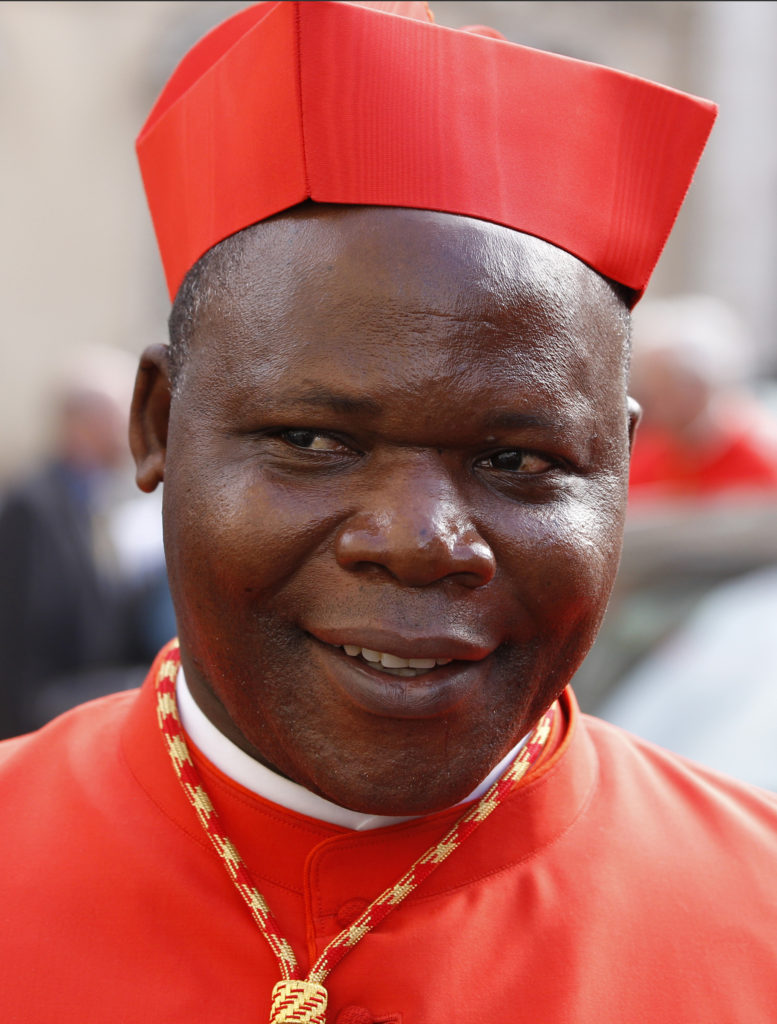
Cardinal Dieudonne Nzapalainga of Bangui, Central African Republic, is seen at the Vatican Nov. 19, 2016. In early May, the cardinal warned against revenge after a priest and at least 24 lay Catholics were killed during a gun and grenade attack on a Mass in the country's capital. (Paul Haring/CNS) See CENTRAL-AFRICA-ATTACK May 3, 2018.
Cardinal Dieudonne Nzapalainga of Bangui, Central African Republic, the youngest cardinal in the world, is seen at the Vatican Nov. 19, 2016. The key question before the Synod of Bishops is: “What is God trying to tell us through young people?” said the 51-year-old cardinal. (Paul Haring/CNS)

By Cindy Wooden
Catholic News Service

VATICAN CITY (CNS) — The Catholic Church’s youngest cardinal, 51-year-old Cardinal Dieudonne Nzapalainga of Bangui, Central African Republic, said the key question before the Synod of Bishops is: “What is God trying to tell us through young people?”

Finding better ways to pass the faith on to younger generations is one part of the task, the cardinal told reporters Oct. 6. The other part is to encourage them and support them in sharing the faith with others.

Participants in the synod of bishops — the 267 voting bishops, priests and religious brothers, as well as the 72 experts and observers — spent the evening of Oct. 5 and the morning of Oct. 6 getting to know each other in their small groups, which are divided by language.

The groups, taking what they hear in the synod’s general assembly sessions, are to make suggestions for a final synod document.

The Vatican does not publish the texts of speeches given in the sessions but allows the bishops to do so.

Auxiliary Bishop Mark Edwards of Melbourne, addressing the synod during the morning session Oct. 5, suggested taking St. John Vianney and his experience in Ars, France, as a model.

Moving to Ars, the bishop said, St. John Vianney did not know exactly where the town was, so he convinced a shepherd to take him, promising, “If you show me the way to Ars, I will show you the way to heaven.”
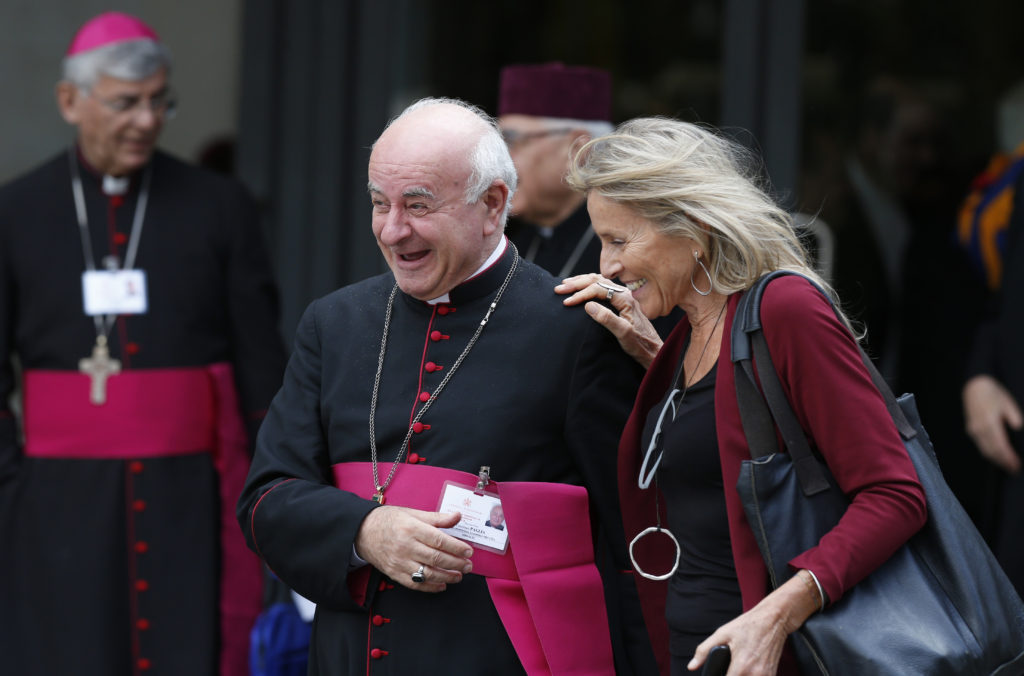
Archbishop Vincenzo Paglia, president of the Pontifical Academy for Life, shares a laugh with Chiara Giaccardi, an Italian professor of sociology, as they leave a session of the Synod of Bishops on young people, the faith and vocational discernment at the Vatican Oct 5. (Paul Haring/CNS)

And once the priest arrived in the town, he said, he got to know it and its people, not treating it “as a version of the previous parish where he had worked.”

“We stand at the edge of a new era,” Bishop Edwards told the synod. “We knew how to be Church in the past, how to pass on the faith and how to be effective missionaries,” but “at least some of what we did isn’t effective anymore.”

Young people, though, “more instinctively grasp the lay of this land with its values of equality, inclusion, respect, authenticity and the integration of multiple aspects of life such as body and soul.”

Bishop Edwards did not suggest that older Church members just give up, but said an “intergenerational encounter” is necessary. Church leaders and ministers must say to young people, “You show us the lay of this land, the way to the place where you dwell, and we will show you the way to God.”

Walking with young people, elders in the faith can help them encounter Christ, the bishop said. “When they meet Jesus, he will change their hearts. And this will enable them to discover appropriate ways to live fruitfully and really humanly and as effective Church in the tensions of this new age.”

Archbishop Luc Cyr of Sherbrooke, Quebec, spoke to the synod Oct. 4 about the importance of guiding and protecting the freedom of Catholic young people involved in new movements or religious communities.
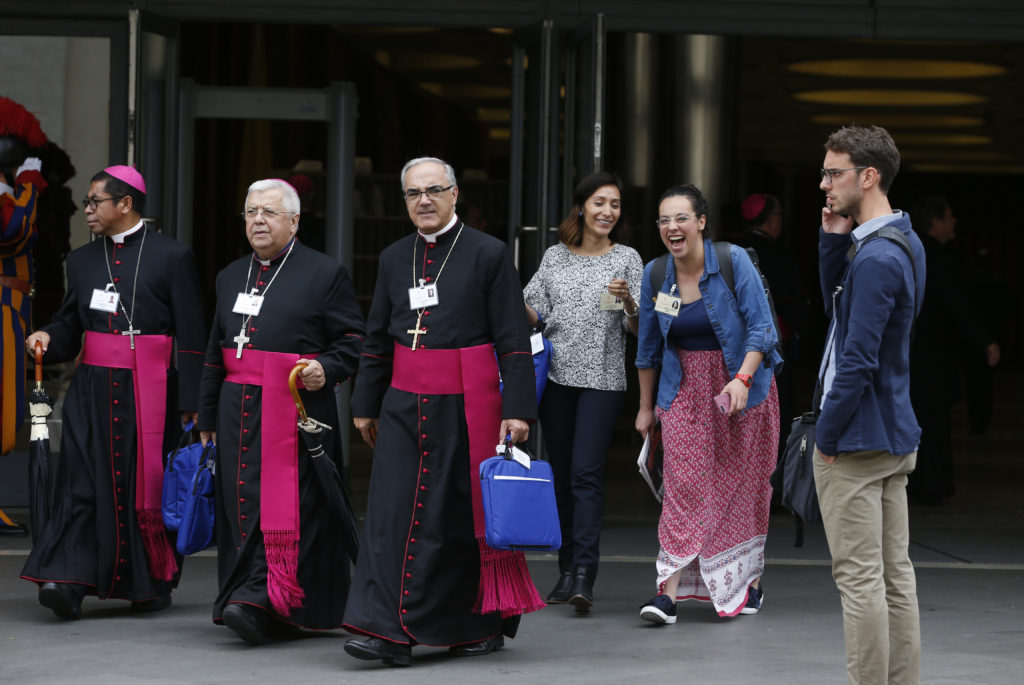
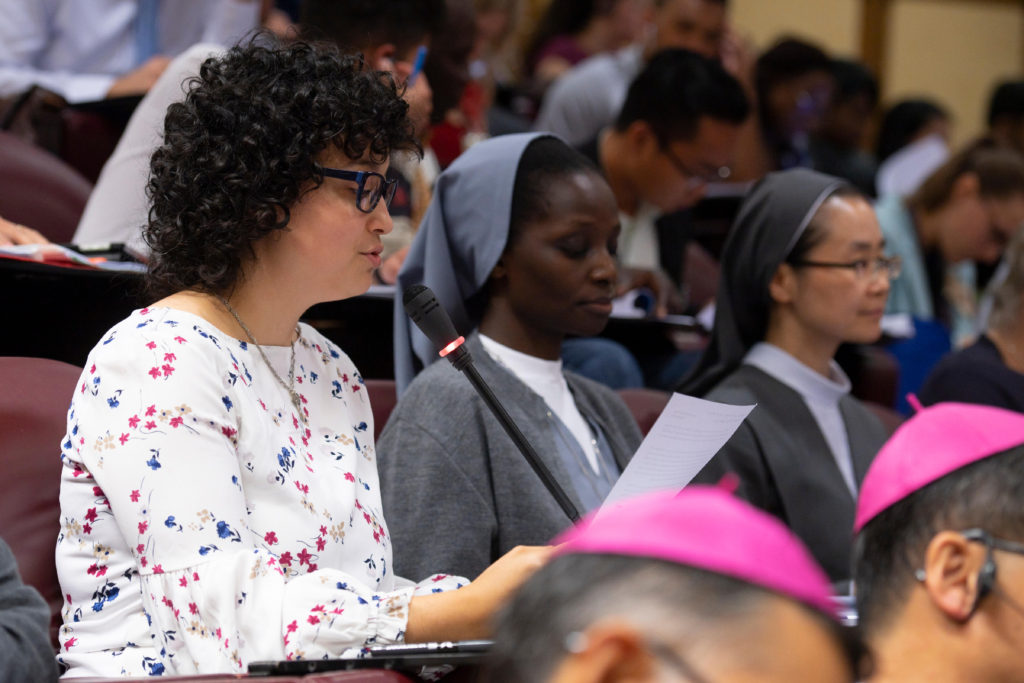
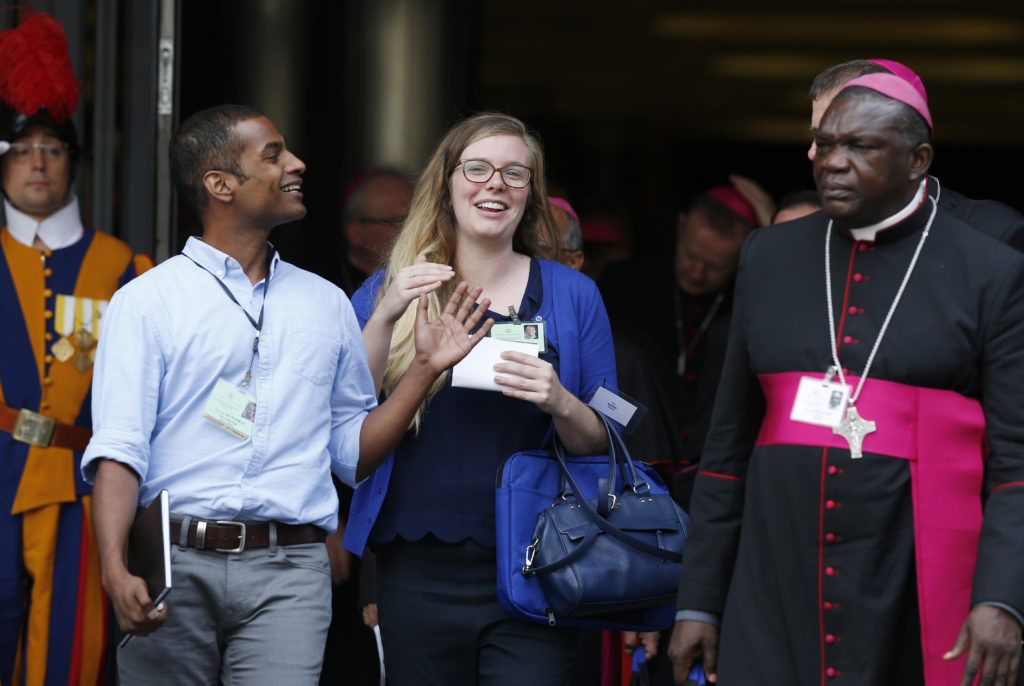
Bishops and youth delegates leave a session of the Synod of Bishops on young people, the faith and vocational discernment at the Vatican Oct 5. (Paul Haring/CNS)

When young people feel a call to religious life, “we must do everything to assure that their freedom” is respected, he said. In some groups, he said, “it was evident that the exploration of a vocation was not done in conditions that were favorable to making an informed choice.”

The archbishop did not mention any group by name. However, his archdiocese is home to the Marie-Jeunesse Family, which in January closed all but its Sherbrooke house and began what it termed a period of “deep restructuring.”

Archbishop Cyr told the synod that when young people are enveloped too quickly in a community “where the way of life leaves little space for freedom and empowerment,” some of them experience enormous pressure to enter religious life and don’t realize until they are in their 30s or 40s that they had not made the choice in full freedom.

For “healthy discernment” of a vocation, a young person needs a wise guide, the availability of a counselor outside the group and continued contact with his or her family, the archbishop said.

“Above all,” he said, “it is important to reiterate to everyone that the Lord calls people freely to freedom.”

Ukrainian Catholic Bishop Bryan Bayda of Saskatoon, Saskatchewan, spoke to the synod about how young people are looking for authentic Christians to accompany them and that means people who will challenge the young to be authentic Christians themselves.

“Youth seek relationships of trust and discover how certain people, places or things either support or deceive them in their search,” he said. “They want commitment from others as they search for belonging, safety, honesty, integrity, peace and meaningfulness in life.”

Over time, he said, they should “discover their vocation in life is to become the very people they seek in friendships; that is, recognizing holiness is desirable, visioning themselves as holy and pursuing holiness.”

Young U.S. religious woman talks to synod about ‘accompaniment’

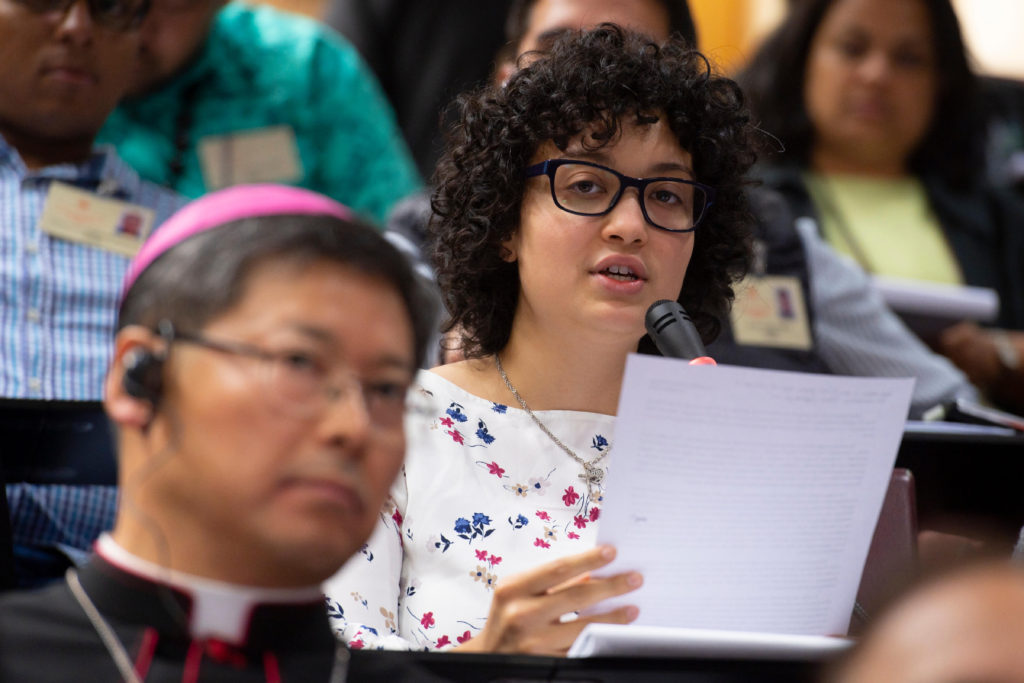
Sr. Briana Santiago, a member of the Apostles of the Interior Life from San Antonio, speaks at a session of the Synod of Bishops on young people, the faith and vocational discernment at the Vatican Oct. 4. (CNS, via Vatican Media) See SYNOD-YOUNG-SANTIAGO Oct. 5, 2018.
Sr. Briana Santiago, a member of the Apostles of the Interior Life from San Antonio, speaks at a session of the Synod of Bishops on young people, the faith and vocational discernment at the Vatican Oct. 4. (CNS, via Vatican Media)

By Cindy Wooden
Catholic News Service

VATICAN CITY (CNS) — The first person under 30 to address the Synod of Bishops was Sr. Briana Santiago, a 27-year-old member of the Apostles of the Interior Life from San Antonio.

“I think all of us young people need to be listened to first of all and then guided” in discovering who they are and who God is calling them to be, Sr. Santiago told the synod Oct. 4.

Several sessions of the synod were to begin with a brief presentation from one of the 36 young people appointed observers at the synod. Several of them, like Sr. Santiago, participated in the presynod meeting of young adults in Rome in March.

The meeting brought together more than 300 young adults from around the world; the vast majority were active Catholics, but the group also included members of other religions and young people who profess no faith at all. Sr. Santiago told the synod she also helped read and summarize the comments of another 15,000 young people who followed the presynod on Facebook.

“I was surprised by how many desires we young people have in common despite our many countries and cultures,” she said. “There was so much joy in that hall — the joy of getting to know and being known, which you could hear in the laughter, the songs and the chatter during breaks.”

Sr. Briana Santiago, a member of the Apostles of the Interior Life from San Antonio, speaks at a session of the Synod of Bishops on young people, the faith and vocational discernment at the Vatican Oct. 4. (CNS, via Vatican Media)

“We young people want dialogue, authenticity, participation, and there we found welcome by adults who were open and wanting to know what we carried in our hearts,” she said.

“In short, we want to be met where we are — intellectually, emotionally, spiritually, socially and physically,” she said, paraphrasing the presynod’s final statement.

The desire to be recognized, accepted and only then guided forward is something Sr. Santiago told the synod she has experienced on a personal level, too.

The people God placed in her life, she said, included a parish priest who was “one of us and, in his closeness, I saw a welcoming Church that was concerned about even the least of its members and my heart melted in the face of that love.”

She was blessed, she said, with catechists who “didn’t speak only about rules, but also about their personal relationship with Christ” in a way that “changed my image of God from judge to Father.”

While in university, she said, she met a religious sister “who took seriously everything I was experiencing and accompanied me, helping me to pray and develop my interior life.”

Young Catholics are looking for those kind of people, she told the synod.

How the synod works: Cardinal shares statistics, working rules

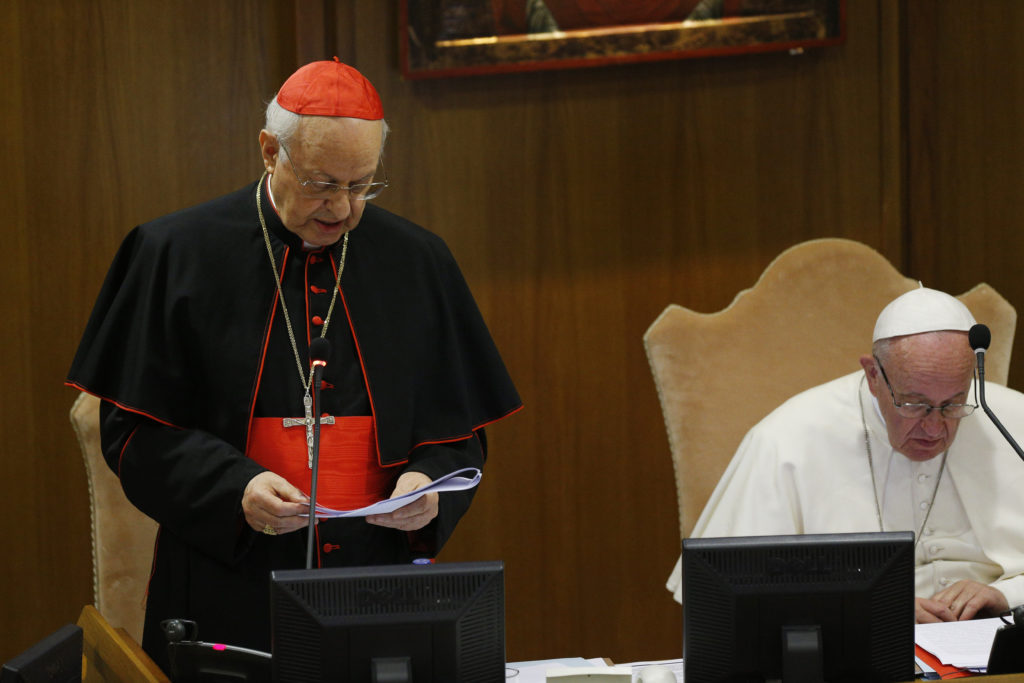
Cardinal Lorenzo Baldisseri, secretary-general of the Synod of Bishops, speaks as Pope Francis attends the opening session of the Synod of Bishops on young people, the faith and vocational discernment at the Vatican Oct. 3. (Paul Haring/CNS) See SYNOD-NOTES Oct. 3, 2018.
Cardinal Lorenzo Baldisseri, secretary-general of the Synod of Bishops, speaks as Pope Francis attends the opening session of the Synod of Bishops on young people, the faith and vocational discernment at the Vatican Oct. 3. (Paul Haring/CNS)

By Cindy Wooden
Catholic News Service

VATICAN CITY (CNS) — Cardinal Lorenzo Baldisseri, general secretary of the Synod of Bishops, introduced the work of the synod on young people Oct. 3 with a variety of statistics and informational notes.

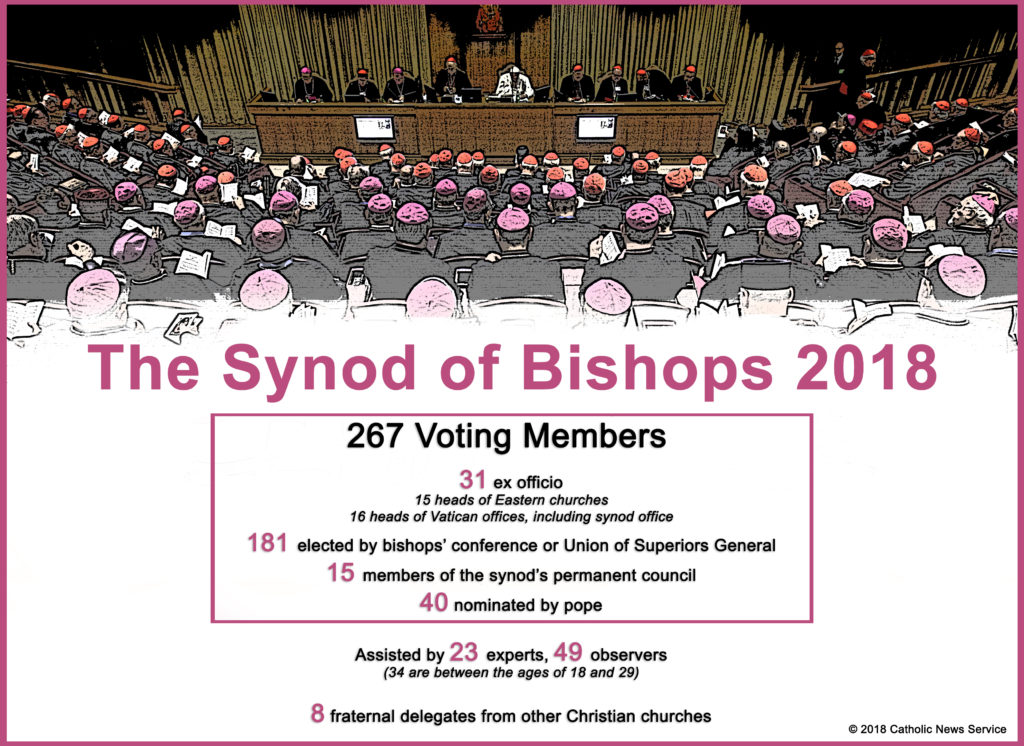
He told the gathering that the 267 voting members of the synod include: 51 cardinals (including two patriarchs and three major archbishops of Eastern Catholic Churches); four other patriarchs of Eastern Catholic Churches; the major archbishop of the Ukrainian Catholic Church; 45 archbishops; 102 diocesan bishops; 37 auxiliary bishops; six apostolic vicars; one bishop prelate; eight religious-order priests and two religious brothers representing the Union of Superiors General; and 10 diocesan and religious-order priests nominated by Pope Francis.

The synod’s working document was prepared with input from an online questionnaire for young people, responses from bishops’ conferences around the world and the results of a presynod meeting of young adults in March.

More than 220,000 people accessed the online questionnaire the Synod of Bishops’ office had active in June-December 2017, the cardinal said. Just over 100,000 people ages 16-29 — 58,000 young women and 42,500 young men — completed the survey.

Just over 50 percent of the respondents were 16-19 years old, he said. And more than 16,000 of the completed questionnaires originated with users in Uganda, making it the country with the highest response rate.

The preparatory document for the synod was released in January 2017 and included a series of questions to be answered by national bishops’ conferences or bishops’ synods of the Eastern Catholic Churches and by the offices of the Roman Curia. Cardinal Baldisseri said 40 percent of the Eastern Churches and 68.4 percent of the bishops’ conferences responded.

The rate is low for a synod. For the first assembly of the Synod of Bishops on the family in 2014, more than 80 percent of bishops’ conferences responded; for the 2012 synod on new evangelization, the synod office had reported that 81.5 percent of the conferences responded.

This graphic shows a breakdown of who will participate in the Synod of Bishops on young people, the faith and vocational discernment. The meeting will take place Oct. 3-28 at the Vatican. (Graphic by Robert Duncan/CNS)

The general sessions in each of the first three weeks of the synod are devoted to one section of the three-part working document, Cardinal Baldisseri explained. Each voting member of the synod is allowed to address the general session only once and only for four minutes. His remarks must refer to the section of the working document being discussed that week.

In addition, at each working session, one of the 34 synod of observers who is between the ages of 18 and 29 will speak.

Continuing a practice begun by Pope Benedict XVI, the evening sessions of the synod end with one hour of “free discussion.” Again, each synod member may speak for no more than four minutes.

The 12 sessions of the synod’s working groups are where members can shake off those time limits and where experts, observers and the eight fraternal delegates from other Christian denominations also are free to speak.

The synod participants will be divided into 14 working groups according to language: French, Italian, English, Portuguese, Spanish or German. Although the groups are commonly referred to by their Latin name — “circuli minores” — there no longer is a Latin-language small group at the synod.

In accordance with new rules published just before the synod, participants will not be working on “propositions” to submit to Pope Francis, but on “amendments” to the synod’s working document with a view of transforming it into a final document to be submitted to the pope.

Pope Francis will decide whether it can be published, and he can decide whether to adopt it as his own teaching.

Bishop Fabio Fabene, undersecretary of the Synod of Bishops, told reporters Oct. 4 that no decision had been made yet on whether the bishops will be voting on the final document as a whole or whether they will be voting on the document’s individual paragraphs. “As we move along, we will decide.”

Vatican reviewing McCarrick case, vows to pursue truth no matter what

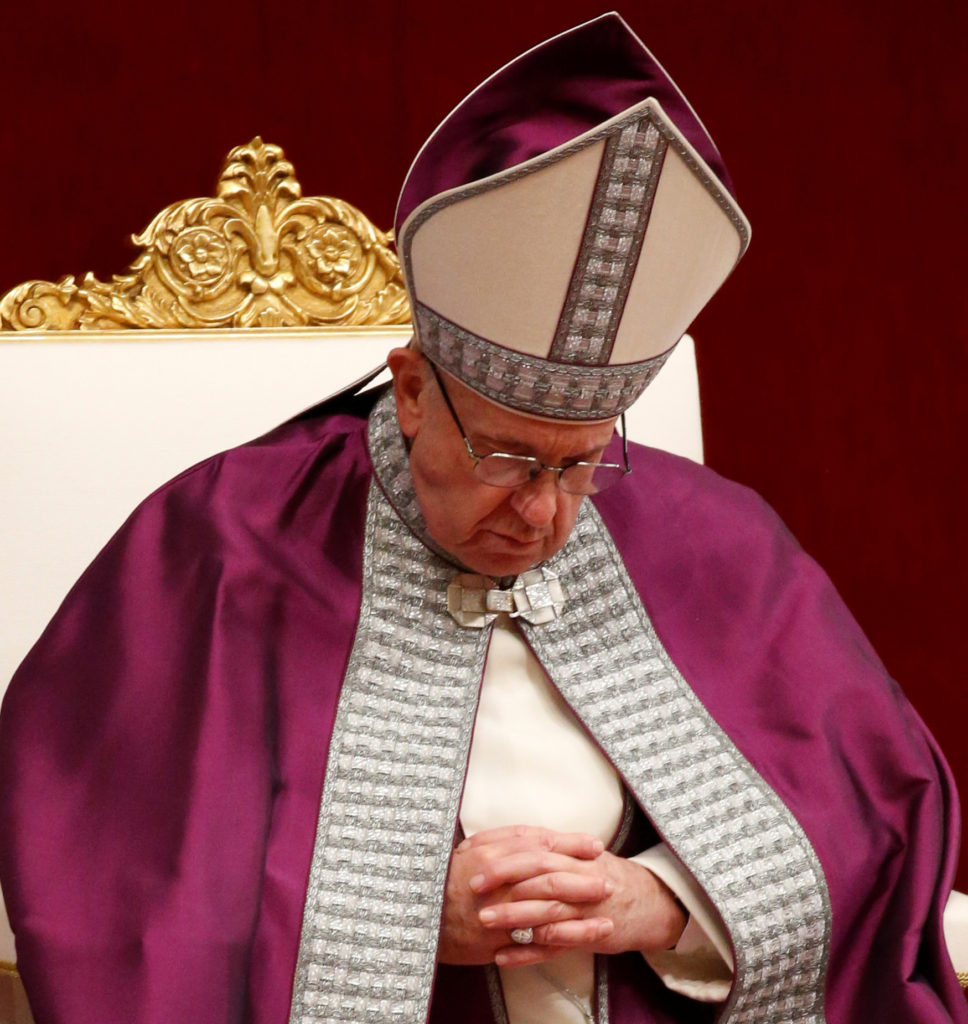
Pope Francis prays as he leads a Lenten penance service in early March in St. Peter's Basilica at the Vatican. "No effort must be spared" to prevent future cases of clerical sexual abuse and "to prevent the possibility of their being covered up," Pope Francis said in an Aug. 20 letter addressed "to the people of God." (Stefano Rellandini/CNS, via Reuters) See POPE-ABUSE-LETTER Aug. 20, 2018.
Pope Francis prays as he leads a Lenten penance service in early March in St. Peter’s Basilica at the Vatican. “No effort must be spared” to prevent future cases of clerical sexual abuse and “to prevent the possibility of their being covered up,” Pope Francis said in an Aug. 20 letter addressed “to the people of God.” (Stefano Rellandini/CNS, via Reuters)

VATICAN CITY (CNS) — Promising a thorough review of how the Vatican handled allegations of sexual misconduct by former Cardinal Theodore E. McCarrick, the Vatican acknowledged that what happened may fall short of the procedures that are in place today.

“The Holy See is conscious that, from the examination of the facts and of the circumstances, it may emerge that choices were taken that would not be consonant with a contemporary approach to such issues. However, as Pope Francis has said: ‘We will follow the path of truth wherever it may lead,’” the Vatican said in statement released Oct. 6.

Cardinal Daniel N. DiNardo of Galveston-Houston, president of the U.S. bishops’ conference, welcomed Pope Francis’ pledge to fight attempts to cover up cases of sexual abuse and to stop offering special treatment to bishops who have committed or covered up abuse.

“On behalf of my brother bishops in the United States, I welcome the statement of Oct. 6 from the Holy See which outlines additional steps Pope Francis is taking to ensure the faithful are protected from the evil of sexual assault,” Cardinal Daniel N. DiNardo said in a statement released Oct. 7 in Rome.

The Executive Committee of the U.S. Conference of Catholic Bishops had said in August that they would seek such an investigation, and leaders of the bishops’ conference met with Pope Francis Sept. 13 to tell him how the Church in the United States has been “lacerated by the evil of sexual abuse.”

After the meeting with the pope, neither the bishops nor the Vatican mentioned an investigation. However, Cardinal DiNardo and Archbishop José H. Gómez of Los Angeles — vice president of the conference — are at the Vatican for the Synod of Bishops and are likely to meet the pope again Oct. 8.

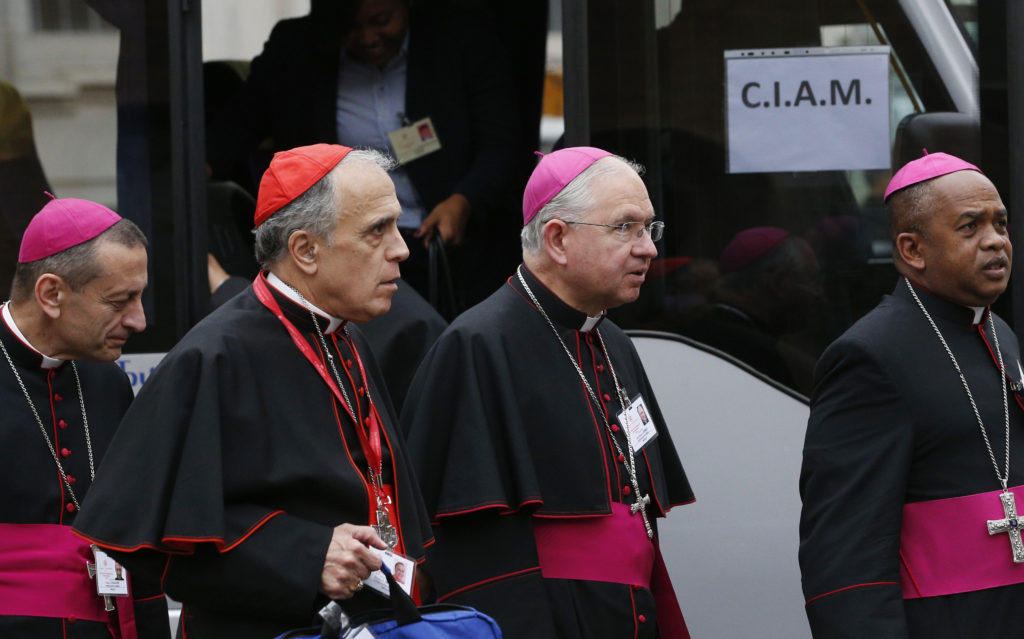
Cardinal Daniel N. DiNardo of Galveston-Houston, president of the U.S. Conference of Catholic Bishops, (second from left), and Archbishop Jose H. Gomez of Los Angeles, vice president of the conference (third from left), arrive for a session of the Synod of Bishops on young people, the faith and vocational discernment at the Vatican Oct 5. (Paul Haring/CNS)

Renewing its commitment to uncovering the truth, the Vatican also said that information gathered from its investigation as well as “a further thorough study” of its archives regarding the former cardinal will be released “in due course.”

“Both abuse and its cover-up can no longer be tolerated and a different treatment for bishops who have committed or covered up abuse, in fact represents a form of clericalism that is no longer acceptable,” the Vatican said.

“The truth will ensure the terrible sins of the past are not repeated,” said Cardinal DiNardo. “The courage of abuse survivors who first brought the horrific truth of sexual abuse to light must continue to be matched by our courage as pastors to respond in justice.”

The U.S. cardinal’s statement was published the same day Cardinal Marc Ouellet, prefect of the Congregation for Bishops, responded to allegations by Archbishop Carlo Maria Viganò, former nuncio to the United States, that Pope Francis knew about and ignored the allegations against then-Cardinal McCarrick.

Cardinal Ouellet called Archbishop Viganò’s accusations a “political” ploy that had wounded the unity of the Church.

“Out of respect for the victims and given the need for justice, the inquiry currently underway in the United States and in the Roman Curia should provide a comprehensive and critical study of the procedures and the circumstances of this painful case in order to prevent something like it from ever happening in the future,” Cardinal Ouellet said.

Cardinal DiNardo said he and all the U.S. bishops “offer our prayers and solidarity for the Holy Father. We urge all in the Church, particularly the bishops, to reaffirm our communion with Pope Francis who is the visible guarantor of the communion of the Catholic Church.”

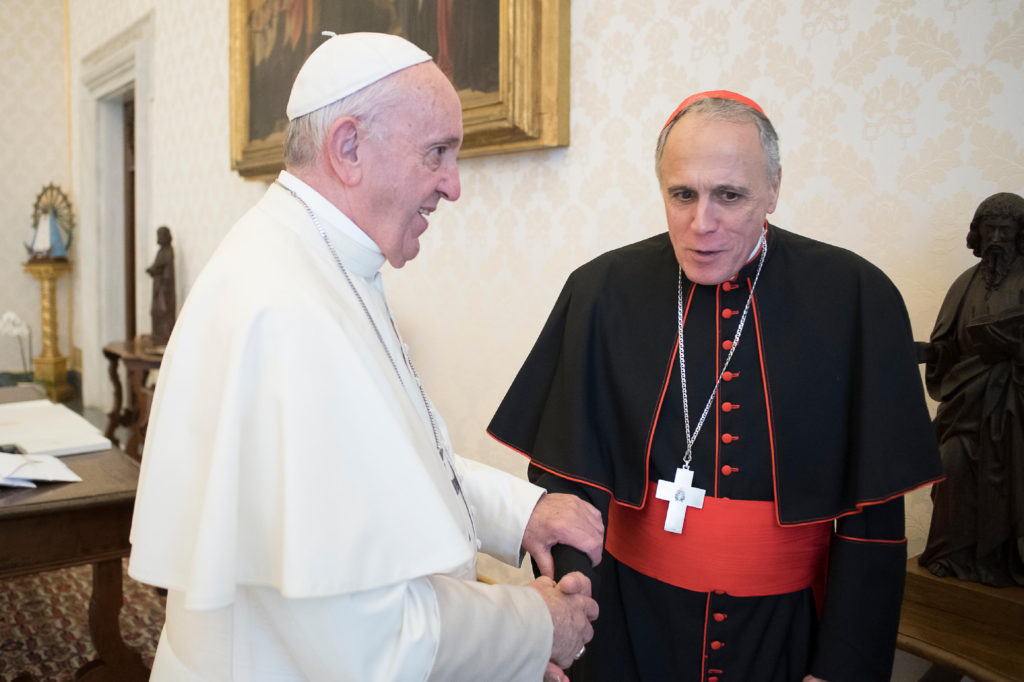
Pope Francis greets Cardinal Daniel N. DiNardo of Galveston-Houston, president of the U.S. Conference of Catholic Bishops, during a private meeting in 2017 at the Vatican. Pope Francis will meet Sept. 13 with Cardinal DiNardo and with Cardinal Sean P. O’Malley of Boston, president of the Pontifical Commission for the Protection of Minors, the Vatican press office announced Sept. 11. (CNS, via L’Osservatore Romano)

According to the Vatican statement, the pope ordered a preliminary investigation by the Archdiocese of New York after an allegation that Archbishop McCarrick abused a teenager 47 years ago; the allegation subsequently was found to be credible.

Pope Francis, the Vatican said, accepted Archbishop McCarrick’s resignation from the College of Cardinals after “grave indications emerged during the course of the investigation.”

In the weeks after the allegations were made public, another man came forward claiming he was abused as a child by Archbishop McCarrick and several former seminarians have spoken out about being sexually harassed by the cardinal at a beach house he had.

The Vatican statement comes more than a month after Archbishop Carlo Maria Viganò, former nuncio to the United States, released an 11-page “testimony” claiming that Church officials, including Pope Francis, failed to act on the accusations of abuse by Archbishop Theodore E. McCarrick.

In his statement Aug. 25, Archbishop Viganò said the Vatican was informed as early as 2000 — when he was an official at the Secretariat of State — of allegations that Archbishop McCarrick “shared his bed with seminarians.” Archbishop Viganò said the Vatican heard the allegations from the U.S. nuncios at the time: Archbishop Gabriel Montalvo, who served from 1998 to 2005, and Archbishop Pietro Sambi, who served from 2005 to 2011.

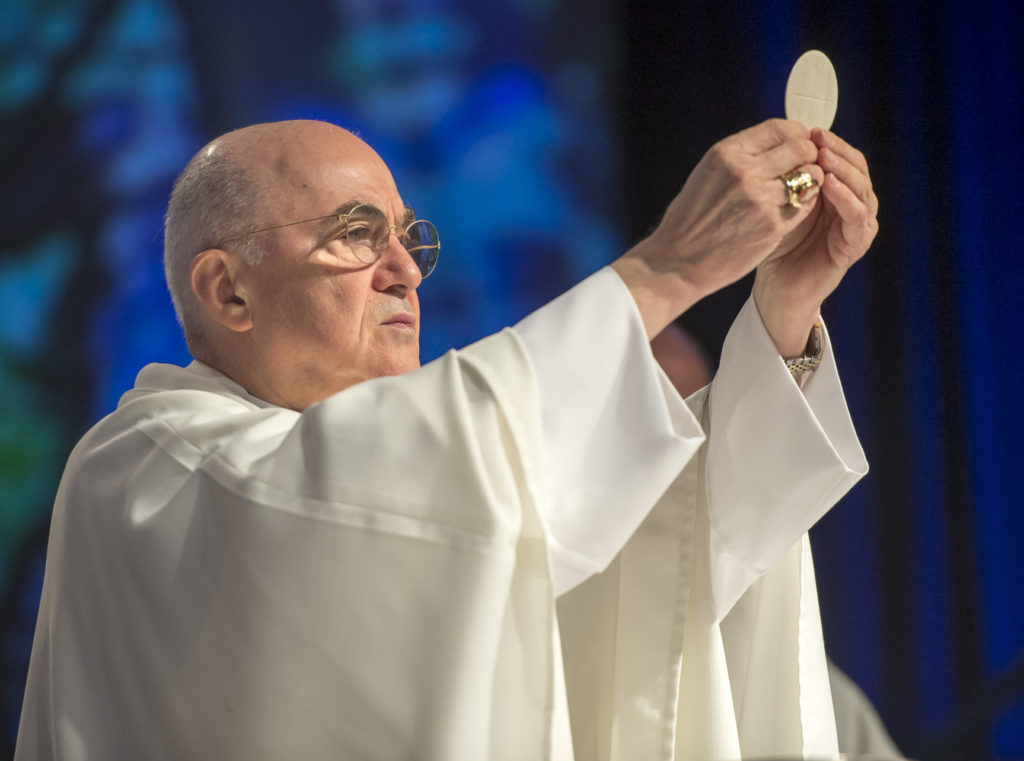
Archbishop Carlo Maria Viganò, former apostolic nuncio to the United States, accused Church officials, including Pope Francis, of failing to act on accusations of abuse of conscience and power by now-Archbishop Theodore E. McCarrick. Archbishop Viganò is pictured in a 2013 photo. (Bob Roller/CNS)

A 2006 letter obtained by Catholic News Service Sept. 7 suggested that then-Archbishop Leonardo Sandri, the former Vatican substitute for general affairs, acknowledged allegations made in 2000 by Fr. Boniface Ramsey, pastor of St. Joseph’s Church Yorkville in New York City, concerning Archbishop McCarrick.

Archbishop Viganò had claimed that Pope Benedict XVI later “imposed on Cardinal McCarrick sanctions similar to those now imposed on him by Pope Francis.”

“I do not know when Pope Benedict took these measures against McCarrick, whether in 2009 or 2010, because in the meantime I had been transferred to the Governorate of Vatican City State, just as I do not know who was responsible for this incredible delay,” he said.

Then-Cardinal McCarrick, he claimed, “was to leave the seminary where he was living” which, at the time, was the Redemptoris Mater Seminary in Hyattsville, Maryland, and was also “forbidden to celebrate Mass in public, to participate in public meetings, to give lectures, to travel, with the obligation of dedicating himself to a life of prayer and penance.”

However, photos and videos during the time of the alleged sanctions gave evidence that Archbishop McCarrick appeared in public with Archbishop Viganò and continued to concelebrate at large public Masses and visit the Vatican and Pope Benedict himself.

Almost a week after issuing his original accusations, Archbishop Viganò modified his claim and said Pope Benedict made the sanctions private, perhaps “due to the fact that he (Archbishop McCarrick) was already retired, maybe due to the fact that he (Pope Benedict) was thinking he was ready to obey.”


Junno Arocho Esteves and Cindy Wooden from Catholic News Service contributed to this report.

Bishops say young people need to be heard, not arrogantly lectured

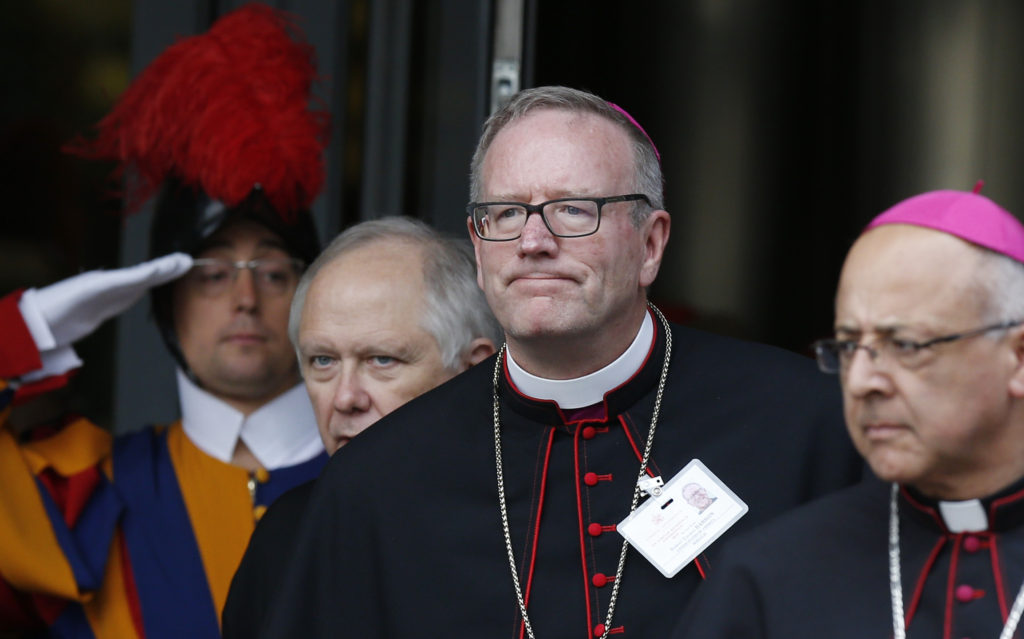
Los Angeles Auxiliary Bishop Robert E. Barron leaves a session of the Synod of Bishops on young people, the faith and vocational discernment at the Vatican Oct. 5. (Paul Haring/CNS) See SYNOD-YOUNG-SANTIAGO, SYNOD-BARRON-ONAH and SYNOD-BRIEFING Oct. 5, 2018.
Los Angeles Auxiliary Bishop Robert E. Barron leaves a session of the Synod of Bishops on young people, the faith and vocational discernment at the Vatican Oct. 5. (Paul Haring/CNS)

By Junno Arocho Esteves
Catholic News Service

VATICAN CITY (CNS) — The Catholic Church needs to communicate the beauty and intelligence of faith to young men and women without resorting to condescending and aggressive methods, Auxiliary Bishop Robert Barron of Los Angeles told members of the Synod of Bishops.

A “renewed apologetics and catechesis” can help young people who are tempted to leave the Church due to convictions “that religion is opposed to science or that it cannot stand up to rational scrutiny, that its beliefs are outmoded, a holdover from a primitive time, that the Bible is unreliable, that religious belief gives rise to violence and that God is a threat to human freedom,” Bishop Barron said in his speech to the synod Oct. 4.

“I hope it is clear that arrogant proselytizing has no place in our pastoral outreach, but I hope it is equally clear that an intelligent, respectful and culturally sensitive explication of the faith (‘giving a reason for the hope that is within us’) is certainly a ‘desideratum (desire),’” he said.

Later that evening, Bishop Barron joined Nigerian Bishop Godfrey Igwebuike Onah of Nsukka at an event dedicated to the synod on youth, faith and vocational discernment.

The University of Notre Dame’s Center for Ethics and Culture sponsored the event in Rome.

Seven Notre Dame students spoke at the event about their faith, highlighting their positive experiences while also expressing their concerns that internal divisions and the scandal of sexual abuse are wounding the Church.

Bishop Onah, 62, told participants it was important for bishops to listen to young men and women, otherwise the synod risks becoming a meeting of “only old people” talking about young people.

“As one bishop rightly pointed out,” he said, “sometimes we talk about our own experience of youth thinking that it corresponds with the present experience of young people, not remembering that our experience 30, 40, 50, 60 years ago is quite different from the experience of young people today.”

Bishops and youth delegates leave a session of the Synod of Bishops on young people, the faith and vocational discernment at the Vatican Oct 5. (Paul Haring/CNS)

Nevertheless, Bishop Onah added, “even though many old people are talking about youth, it is still positive that they are doing that.”

The Nigerian bishop said he was moved by the testimonies of the students, including Aly Cox, a Notre Dame law student, who said that the Church — wounded by the scandal of division and abuse — “is in need of healing.”

Bishop Onah said that like Christ’s wounds, which were still visible after his resurrection, the Church’s wounds do “not deprive the Church from being a healer.”

“The wounds on the body of the Church, the wounds on the body of Christ, will never destroy the Church,” he said. “That is my feeling because that body is risen.”

He also said one root of the scandal is that seminarians, priests and bishops are “wrongly made to believe that we are different.”

“We are not (different),” Bishop Onah said. “We are struggling with the same emotions, the same passions and rejoicing over the little achievements we make on our road to holiness as you do.”

If Church leaders had realized that sooner, he added, “we wouldn’t have had to cause all this harm in hiding the fact that we are just men, ordinary men.”

Earlier that day, Bishop Barron told the synod that his work as founder of Word on Fire Catholic Ministries confirmed that inadequate education about Church teaching is among the “crucial stumbling blocks to the acceptance of the faith among young people.”

Among the major religions, he explained, “Catholicism was second to last in passing on its traditions,” and the “army of our young who claim that religion is irrational is a bitter fruit of this failure in education.”

While some may view apologetics as “something rationalistic, aggressive, condescending,” he said he would propose a new way of explaining and defending religious doctrine that “would not be imposed from above but would rather emerge organically from below, a response to the yearning of the mind and the heart.”

The works of St. Thomas Aquinas, for example, often emerged from lively debates over disputed questions “that stood at the heart of the educational process in the medieval university,” he said. “Thomas was deeply interested in what young people were really asking. So should we.”

He also told the members of the Synod of Bishops that, without “denigrating the sciences,” a renewed catechesis can show young men and women that there are “non-scientific and yet eminently rational paths that conduce toward knowledge of the real.”

Bishop Barron said the beauty of faith as depicted in music, art, architecture and liturgy as well as the compelling lives of the saints can also provide “a powerful matrix for evangelization.”

The Church, he said, “must walk with young people, listen to them with attention and love, and then be ready intelligently to give a reason for the hope that is within us. This, I trust, will set the hearts of the young on fire.”

‘Every Life: Cherished, Chosen, Sent’ is theme of Respect Life Month

WASHINGTON (CNS) — Each year the U.S. Catholic Church observes October as Respect Life Month, which calls Catholics “to cherish, defend and protect those who are most vulnerable, from the beginning of life to its end, and at every point in between,” said the chairman of the bishops’ pro-life committee.
For this year’s pro-life observance “we become even more aware of the need for messengers of God’s love and instruments of his healing” due to the clergy sex abuse crisis and other assaults on human dignity, New York Cardinal Timothy M. Dolan said Oct. 3.

As the church approaches Respect Life Sunday, “our hearts are heavy with revelations of how those who should be most trustworthy have not only failed in this regard but have inflicted immense evil,” he said.

As Cardinal Daniel N. DiNardo of Galveston-Houston, president of the U.S. Conference of Catholic Bishops, said, “The body of Christ is lacerated,” added Cardinal Dolan, who heads USCCB Committee on Pro-life Activities.

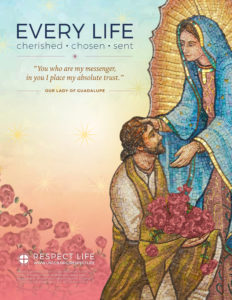
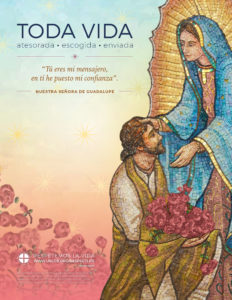
The theme for this year’s Respect Life Month is “Every Life: Cherished, Chosen, Sent,” which highlights “our call to build a culture of life as missionary disciples, the cardinal said.

The USCCB Secretariat of Pro-life Activities provides English- and Spanish-language resources for observing the month and to use all year at www.usccb.org/respectlife. Among the resources are:
There also are articles on Catholic teaching on several life issues, including abortion, disabilities, assisted suicide, end of life, contraception and abortion healing.

This year’s theme draws on the story of Our Lady of Guadalupe and St. Juan Diego. Mary appeared to him as a pregnant indigenous woman. She “sent him with miraculous flowers in his cloak to tell the bishop to build a church where people could receive her Son and her loving, tender care. ”

“By embracing the mission entrusted to him, St. Juan Diego helped bring Christ’s transforming love to cultures gripped by oppression and death,” says the reflection. “Like St. Juan Diego, let us embrace our daily mission to help others encounter God’s transforming, life-giving love.”

Cardinal Dolan said: “We are called and sent to be messengers of God’s love, treating one another as cherished and chosen by Him. In doing so, we help build a culture that respects all human life. The Body of Christ needs you. The world needs you.”

Open skies: Vatican Observatory preparing public stargazing tour

By Carol Glatz
Catholic News Service

VATICAN CITY (CNS) — When people ask why the Vatican has an observatory, one Jesuit priest says it’s because it cannot afford a particle accelerator.

The nerdy quip by the Vatican Observatory’s vice director, Jesuit Father Paul Mueller, has become his signature response to people’s inevitable surprise when they discover that popes have stockpiled telescopes, and the Church does not oppose science — even if it won’t buy a 16-mile long, multibillion-dollar particle accelerator.

Eleven Jesuit astronomers live, work and pray together year-round as they conduct top-notch research either at the modern Mount Graham International Observatory in Arizona or at their historic headquarters on the grounds of the papal summer villa and gardens in Castel Gandolfo near Rome.

“Science is part of our life; for us there is no conflict, no tension” with their Catholic faith and religious vocation, said Fr. Mueller, a U.S. priest who has degrees in physics, history, philosophy and theology and a doctorate in the history and philosophy of science.

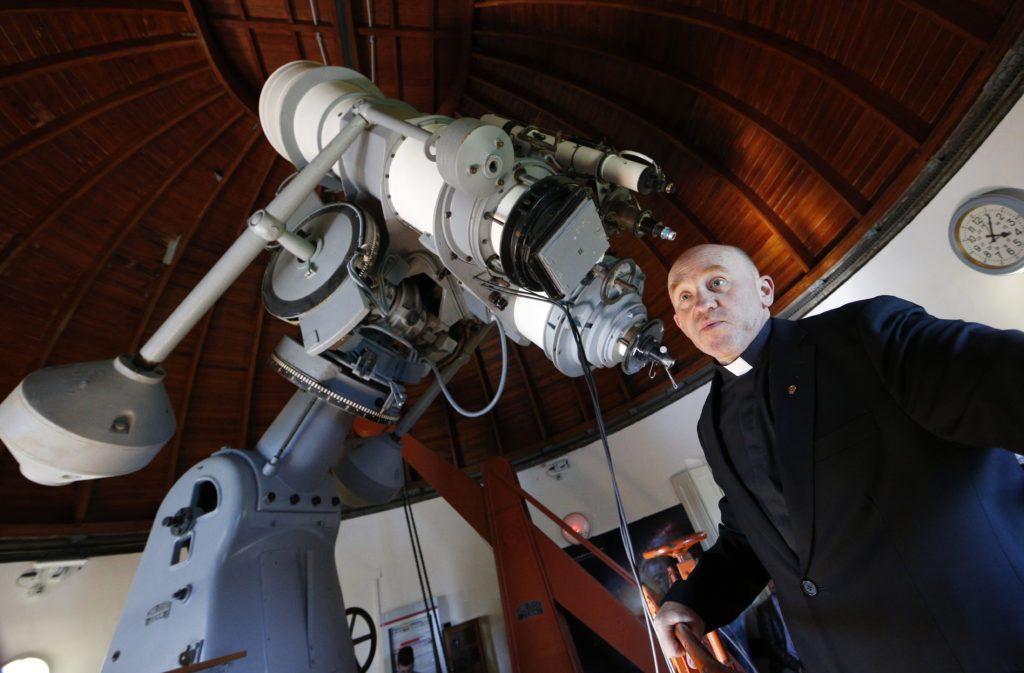
Jesuit Father Gabriele Gionti, an astronomer, talks about a 1935 Zeiss telescope during a tour for media representatives of the Vatican observatory at the papal villa at Castel Gandolfo, Italy, Sept. 28. (Paul Haring/CNS)He spoke to Catholic News Service Sept. 30 during a Vatican-led tour of the observatory’s facilities at the papal villa.

Reporters were treated to a full tour of the four observatory domes and telescopes housed in two separate buildings — one being the papal summer residence itself with a stunning view of Lake Albano below and the other being a newly refurbished building nestled within the wooded gardens.

The recently renovated facility houses the now fully restored Carte du Ciel (Celestial Map) telescope from 1891, a Schmidt telescope from 1957 and a new exhibit showcasing a number of historical scientific instruments, artifacts and meteorites from the observatory’s collections.

The plan is to open the unique space to the public starting in the summer 2019 with visits organized by the Vatican Museums.

Fr. Mueller said one idea would be to have groups tour the villa’s garden, have dinner and then open one of the observatory domes for a night of stargazing. The Vatican Museums already organize special tours of the papal villa and gardens at Castel Gandolfo.

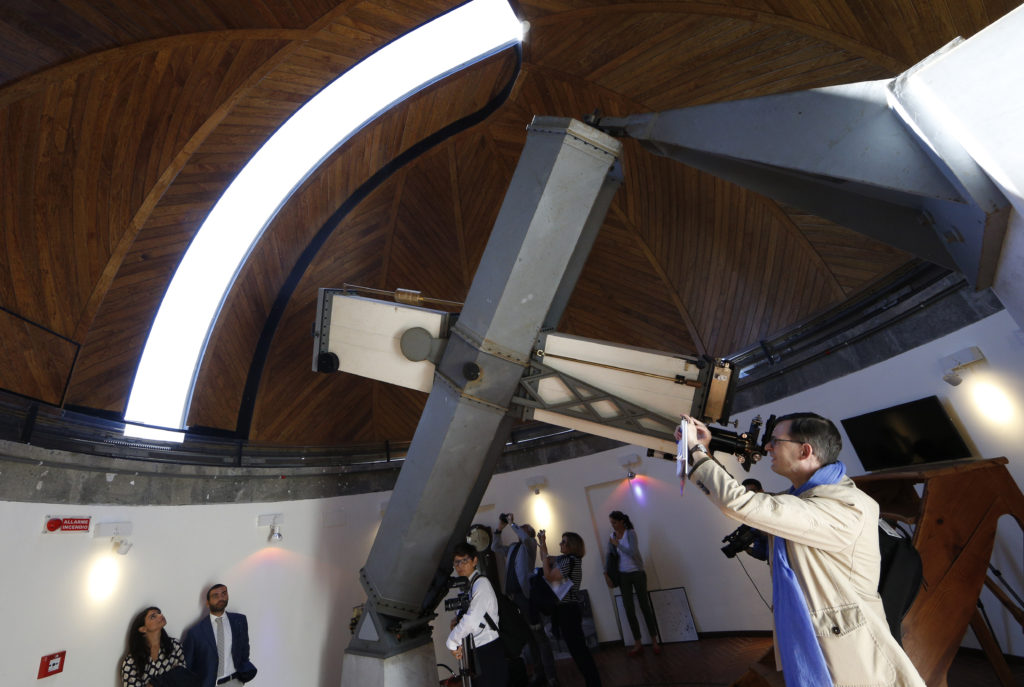
A journalist takes a photo of the 1891 Carte du Ciel (Celestial Map) telescope during a tour for journalists of the Vatican observatory at the papal villa at Castel Gandolfo, Italy, Sept. 28. The telescope was used by the Vatican for its part in an international survey of the night sky. (Paul Haring/CNS)

The observatory traces its origins back to an observational tower erected at the Vatican by Pope Gregory XIII in 1578 in preparation for reforming the Western calendar. Over time, a number of posts for celestial observation were set up along the Vatican walls and elsewhere in Rome, such as atop the Church of St. Ignatius where Jesuit Father Angelo Secchi — the father of astrophysics — conducted much of his work.

Pope Leo XIII formally established the Vatican Observatory — placed on a hillside behind the dome of St. Peter’s Basilica — in 1891 as a visible sign of the Church’s centuries-old support for science.

The pope’s main observatory, by now entrusted to the Jesuits, was eventually moved to the papal summer residence in Castel Gandolfo in 1935. Two observational domes were built on the top of the pope’s summer villa to house two Zeiss telescopes purchased that year.

While the details and starting dates of the star-watching tour still have to be worked out, Fr. Mueller said it will offer a great way to make the historical treasures, work and achievements of the Vatican Observatory more “public and visible.”

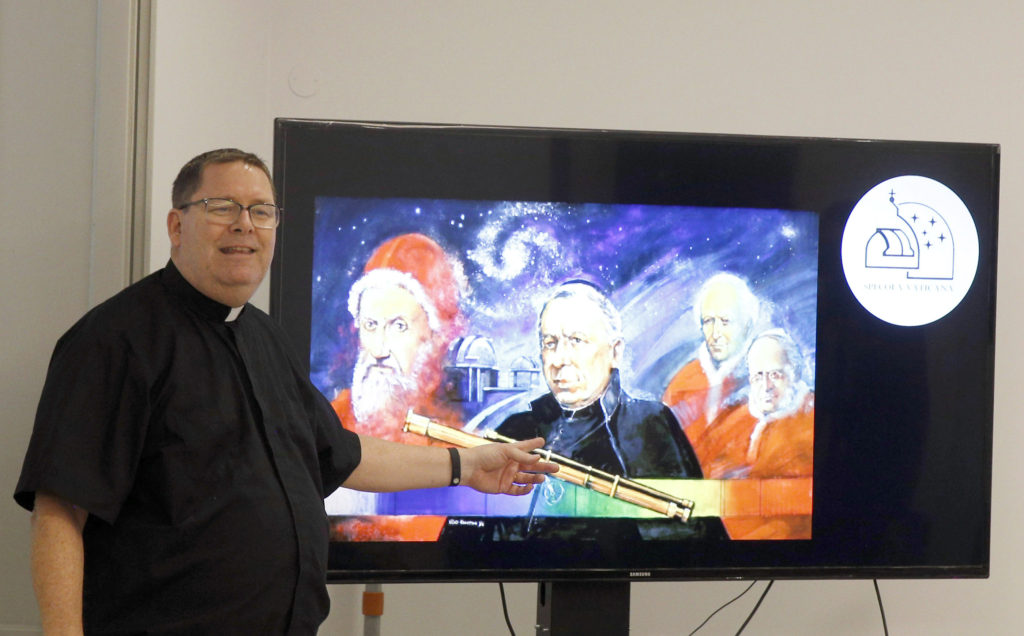
Jesuit Father Paul Mueller, vice director of the Vatican Observatory, talks about the history of the observatory during an observatory tour for journalists in Castel Gandolfo, Italy, Sept. 28. (Paul Haring/CNS)

The Carte du Ciel telescope was moved in 1942 from the Leonine Tower in Vatican City to the papal villa and, in 1957, it was joined by a Schmidt wide-angle telescope that Pope Pius XII purchased with his own money as a gift to the observatory, astronomer Jesuit Father Gabriele Gionti told reporters.

The Jesuit observatory staff set up a second research center in Tucson, Arizona, in 1981 after Italian skies got too bright for nighttime observation. And in 1993, in collaboration with Steward Observatory, they completed the construction of the Vatican Advanced Technology Telescope on Mount Graham — considered one of the best astronomical sites in the continental United States.

Visitors who participate in next year’s sky-watching tour at the papal gardens are expected to use what Fr. Mueller called “the jewel” of their observatory — the Carte du Ciel telescope. It was purchased after Italian astronomer and meteorologist, Barnabite Father Francesco Denza, easily convinced Pope Leo in the late 1800s to let the Holy See take part in an international survey of the night sky.

The Vatican was one of about 18 observatories around the world that spent the next several decades taking thousands of glass-plate photographs with their telescopes and cataloging data for the massive project. Sisters of the Holy Child Mary Emilia Ponzoni, Regina Colombo, Concetta Finardi and Luigia Panceri helped map and catalog nearly half a million stars for the Vatican’s assigned slice of the sky.

A display showing the planets is seen at the Vatican observatory at the papal villa at Castel Gandolfo, Italy, Sept. 28. (Paul Haring/CNS)

A space systems consultant engineer and associate member of the observatory, Claudio Costa, oversaw the telescope’s recent restoration. He was the last person to use the historic telescope before it fell into disuse in the 1980s and he was the first to use it after restorers got it fully functioning again.

Soon, the staff hopes it will be the public’s turn to peek through this piece of history and view the heavens in a whole new way.

“When we use the telescopes to examine the heavens, that’s a kind of worship,” Fr. Mueller said.

Science, he said, is searching for the truth, which exists in “two books: the book of Scripture and the book of nature.”

While people may struggle to make sense of what they see, in the end, the priest said, “the truth is one, (the books) cannot disagree because God is the author of both books.”

Archbishop urges synod to use care with language, especially on sexuality

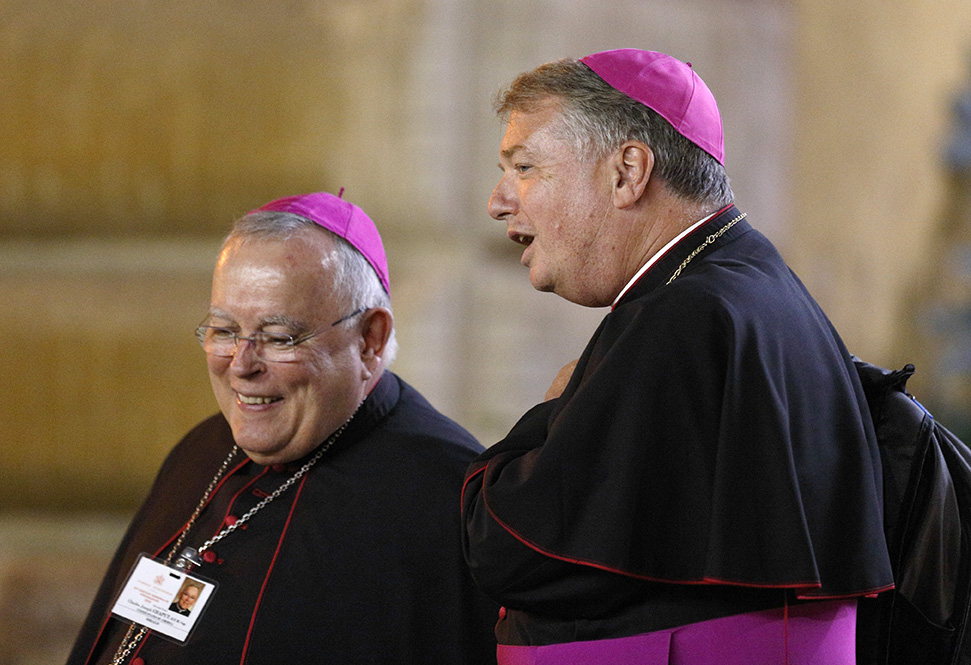
Archbishop Charles J. Chaput of Philadelphia and Archbishop Anthony Fisher of Sydney leave the opening session of the Synod of Bishops on young people, the faith and vocational discernment at the Vatican Oct 3. (Paul Haring/CNS) See POPE-SYNOD-BEGINS Oct. 3, 2018.
Archbishop Charles J. Chaput of Philadelphia and Archbishop Anthony Fisher of Sydney leave the opening session of the Synod of Bishops on young people, the faith and vocational discernment at the Vatican Oct 3. (Paul Haring/CNS)

By Cindy Wooden
Catholic News Service

VATICAN CITY (CNS) — Archbishop Charles J. Chaput of Philadelphia told members of the Synod of Bishops their task was to help young people understand Catholic teaching on sexuality and to avoid using terms like “LGBTQ” that make it seem as if the Church categorizes people that way.

The working document for the Oct. 3-28 synod on “young people, the faith and vocational discernment” used the acronym for lesbian, gay, bisexual and transgender once. It said:

“Some LGBT youths, through various contributions that were received by the General Secretariat of the synod, wish to ‘benefit from greater closeness’ and experience greater care by the Church, while some bishops’ conferences ask themselves what to suggest ‘to young people who decide to create homosexual instead of heterosexual couples and, above all, would like to be close to the Church.’”

The text of Archbishop Chaput’s speech was published online by catholicherald.co.uk; his office confirmed the text was his.

The archbishop, a member of the synod’s permanent committee, told the synod that “what the Church holds to be true about human sexuality is not a stumbling block. It is the only real path to joy and wholeness.”

And, he said, for the Church “there is no such thing as an ‘LGBTQ Catholic’ or a ‘transgender Catholic’ or a ‘heterosexual Catholic,’ as if our sexual appetites defined who we are.”

Because there are not “discrete communities of differing but equal integrity” within the Church, he said, “it follows that ‘LGBTQ’ and similar language should not be used in Church documents, because using it suggests that these are real, autonomous groups, and the Church simply doesn’t categorize people that way.”

During a synod session that included several speeches recognizing ways in which Church members have failed the younger generation, Archbishop Chaput cited “a combination of ignorance, cowardice and laziness in forming young people to carry the faith into the future.”

“Explaining why Catholic teaching about human sexuality is true, and why it’s ennobling and merciful, seems crucial to any discussion of anthropological issues,” the archbishop said. “Yet it’s regrettably missing” from the synod’s working document, which participants will use as the basis of their discussions and will amend to form a final text.

“The elders of the faith community have the task of passing the truth of the Gospel from age to age, undamaged by compromise or deformation,” the archbishop said.

“The clergy sexual abuse crisis is precisely a result of the self-indulgence and confusion introduced into the Church in my lifetime, even among those tasked with teaching and leading,” he said. “And minors — our young people — have paid the price for it.”

Catholics believe that “who we are as creatures, what it means to be human, why we should imagine we have any special dignity at all” are all questions that find their ultimate answer “only in the person of Jesus Christ, redeemer of man.”

“If we lack the confidence to preach Jesus Christ without hesitation or excuses to every generation, especially to the young,” he told the synod, “then the Church is just another purveyor of ethical pieties the world doesn’t need.”

Feast of St. Francis of Assisi

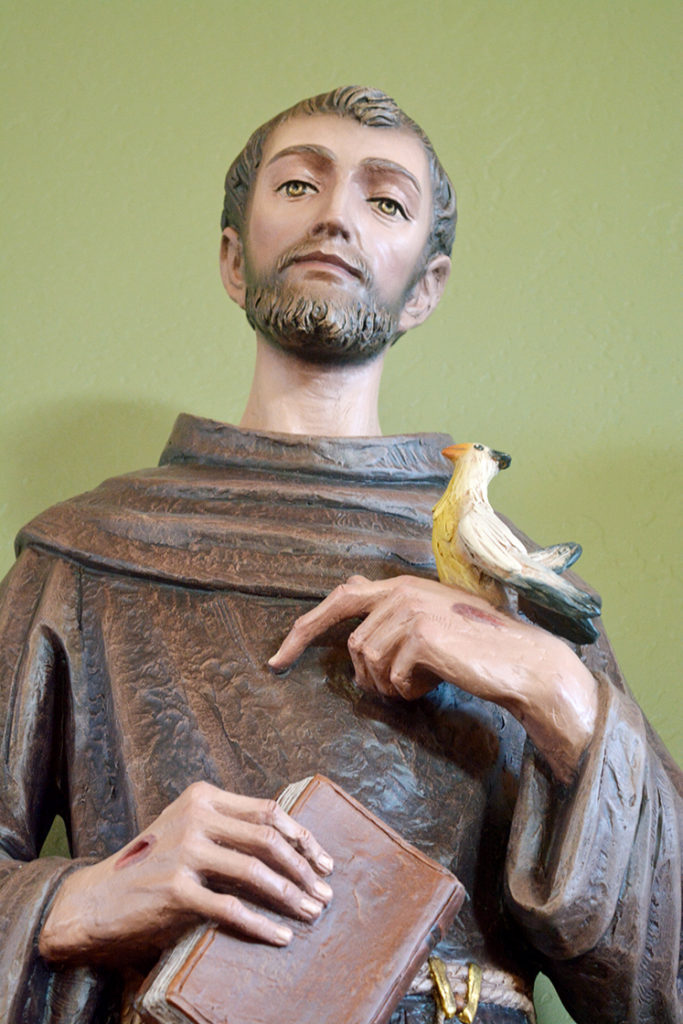
A statue of St. Francis sits on the right side of the altar in San Francisco de Asís Parish in Flagstaff. (Lisa Dahm/CATHOLIC SUN)
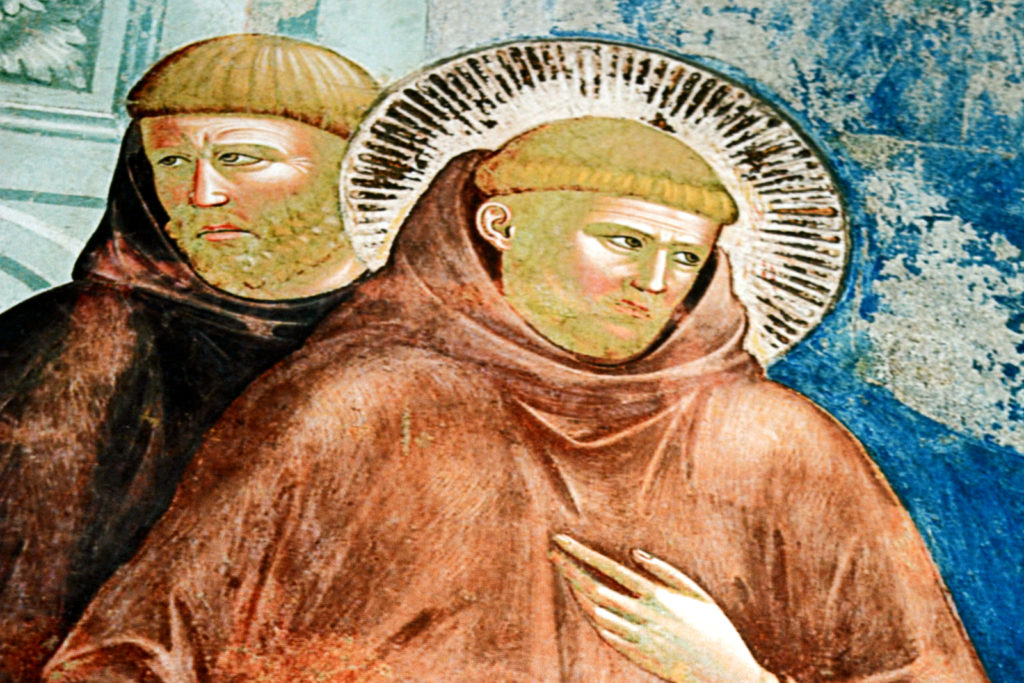
A mural of St. Francis is on the wall of San Francisco de Asís Church in Flagstaff. (Lisa Dahm/CATHOLIC SUN)
A statue of St. Francis sits on the right side of the altar in San Francisco de Asís Parish in Flagstaff. (Lisa Dahm/CATHOLIC SUN)

Oct. 4

The son of a wealthy Italian merchant, Francis was a playboy who experienced a profound conversion after going to war for Assisi, being imprisoned, and enduring a debilitating illness.

He renounced his family and riches, and lived a life of radical poverty and service because he believed Christ had asked him to. He founded the new mendicant Order of Friars Minor, or Franciscans, and helped found the Poor Clares and Franciscan Third Order.

Pope Pius XII said Francis could be called “a second Christ” and in 2013 Argentine Cardinal Jorge Mario Bergoglio took this medieval saint’s name when he was elected pope.

Prayer of St. Francis of Assisi

Lord, make me an instrument of your peace.
Where there is hatred, let me sow love;
where there is injury, pardon;
where there is doubt, faith;
where there is despair, hope;
where there is darkness, light;
and where there is sadness, joy.

O Divine Master, grant that I may not so much seek
to be consoled as to console;
to be understood as to understand;
to be loved as to love.

For it is in giving that we receive;
it is in pardoning that we are pardoned;
and it is in dying that we are born to eternal life. Amen.

Francis is the patron of animals, environmentalists, merchants and Catholic Action, and also a patron of Italy.

San Francisco de Asís Parish and School in Flagstaff, St. Francis of Assisi Parish in Bagdad, St. Francis of Assisi Parish in Seligman, St. Francis of Assisi Native American Mission in Ak Chin and St. Francis of Assisi Native American Mission in Scottsdale and St. Francis Catholic Cemetery are all under his patronage. He is also the patron of several religious communities serving in the diocese, including:

He is also the patron of several religious communities serving in the diocese, including:

Palestinian Catholic, modeling St. Francis, cares for abused animals

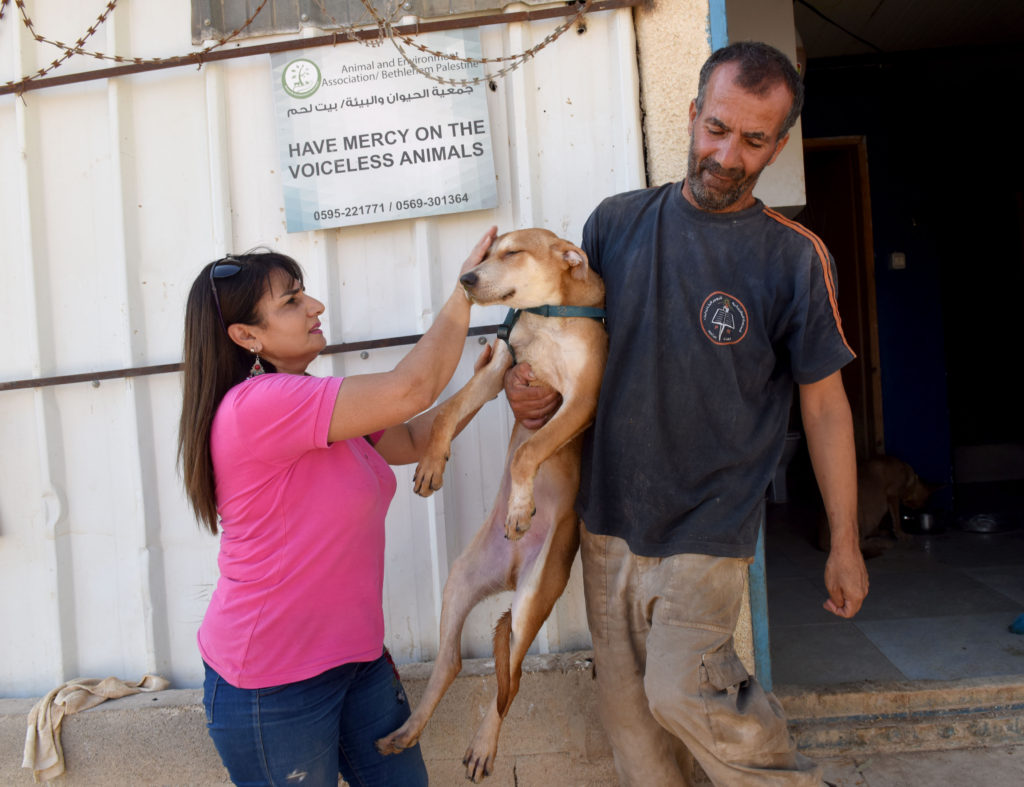
Diana Babish pets a dog being held by Younis Jubran Oct. 3 outside Babish’s animal shelter in Beit Sahour, West Bank. (CNS photo/Debbie Hill)

By Judith Sudilovsky
Catholic News Service

BETHLEHEM, West Bank (CNS) — God gives everyone a mission, Diana George Babish said as she fielded a phone call about a dog who had been shot in Hebron. The mission God gave her is to take care of the abused and abandoned animals in the West Bank and the Gaza Strip, she said.

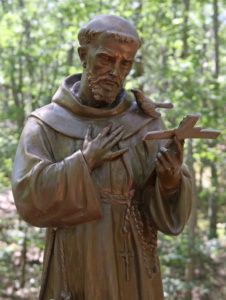
A statue of St. Francis of Assisi, patron of animals and the environment, is seen at Our Lady of the Island Shrine in Manorville, N.Y. The saint’s feast is celebrated Oct. 4. (CNS photo/Gregory A. Shemitz)

“God is pushing me to do this work. I believe it is something sacred,” said Babish, who uses an image of St. Francis surrounded by animals for her online profile.

Babish, a Catholic, admitted that it is not an easy mission in a place where, traditionally, society gives little importance to treating animals with compassion and routinely considers government-approved shooting and poisoning of stray animals as the best solution to population control.

“It is very difficult for me with the culture here; it is a very closed mentality,” she said. She spoke to Catholic News Service as she was trying to coordinate the injured dog’s transportation to her animal shelter in Beit Sahour, a village adjacent to Bethlehem.

“They continue to poison and shoot dogs because they don’t consider their lives to be of value.”

Her day began with the rescue of a 3-week-old puppy who was being kicked around like a ball by a group of schoolboys.

A few years ago, she traveled to Assisi, Italy, and she said she continues to draw strength for her work from the pilgrimage.

“Until now the pigeons still stay on his statue,” she said. “If God did not want anyone to take care of animals, he would not have given that mission to St. Francis.”

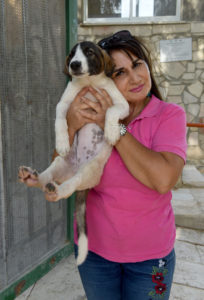
Diana Babish poses with a puppy outside her animal shelter Oct. 3 in Beit Sahour, West Bank. (CNS photo/Debbie Hill)

Last year Babish, who is in her late 40s, quit her day job as a bank manager to dedicate herself full time to running the first animal shelter in the West Bank, the Animal and Environment Association–Bethlehem Palestine, which she established in 2013.

In addition to $13,700 she received in donations, Babish used $20,000 of her own money to build the shelter. Currently it is run solely on donations and other forms of assistance, some of which also come from Israeli animal rescue organizations and individuals. Many of the dogs and cats she has rescued have been adopted or are being fostered by Israelis. By early October, she had rescued more than 400 dogs and more than 100 cats from the streets of West Bank cities. Recently she sent 15 dogs for adoption to Canada.

Babish has many critics within Palestinian society, including members of her own family, who complain that she is working with Israelis and spending her efforts on animals rather than people. Some charge her with profiting from the donations she receives, she said.

Still, Babish brushes off the insults and accusations thrown at her.

“If we had vets here in Palestine who had the proper equipment and treatments to care for the animals, or people who would adopt the dogs, I would leave them here. But Palestinians don’t want street dogs, most only want pure-bred dogs,” she said. “We in the rescue community put aside politics for the well-being of the animals. I tell (my critics) God gives each one of us our mission, and there are a lot of organizations taking care of people. My mission is to take care of the animals, the most vulnerable beings in the world.”

It was close to 9:30 p.m. and she had not yet eaten her dinner. She was working out the logistics of how to take three puppies and one adult dog to their foster homes in central Israel, then take other animals to a veterinary clinic to be treated and neutered. She also was preparing travel papers for a cat who was to be flown to her new home in Sweden.

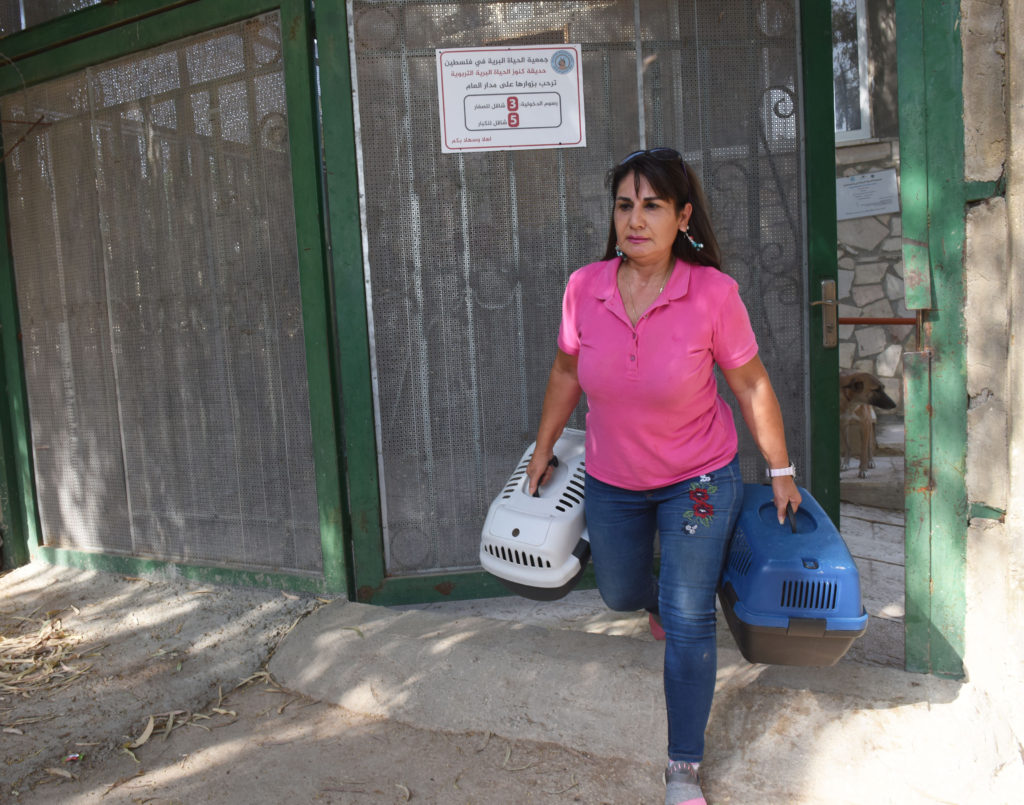
Diana Babish carries cats in crates to a truck from her animal shelter Oct. 3 in Beit Sahour, West Bank. (CNS photo/Debbie Hill)

Babish has 11 board members, 13 general members and two workers who help her in the day-to-day work at the shelter. Slowly she is making inroads into changing societal views about animals and rescue, she said.

The reality of life as a Palestinian is never far, though, and Babish must have an Israeli travel permit to go into Israel. She and a driver make rounds in Israel several times a week.

“A lot of (Palestinians) start to see that animals are very important. I am raising awareness through Facebook, fighting animal abuse,” she said. Some of her posts have received 14,000 views, she said. “Step-by-step I am creating more soldiers to fight for the sake of animals.”