Sister Gabriela Luna Diaz, a member of the Eucharistic Missionaries of St. Teresa, visits a Hispanic family in northwestern Wisconsin in this Oct. 14, 2015, file photo. The Vatican released Pope Francis' message for World Mission Sunday, which will be celebrated Oct. 23 with the theme, "You shall be my witnesses." (CNS photo/Rich Kalonick, Catholic Extension)
By Junno Arocho Esteves, Catholic News Service
Living out and proclaiming the Gospel are inseparable aspects at the heart of an authentically Christian life and witness, Pope Francis said in his message for World Mission Sunday.
“Every Christian is called to be a missionary and witness to Christ. And the church, the community of Christ’s disciples, has no other mission than that of bringing the Gospel to the entire world by bearing witness to Christ,” the pope wrote in his message for the celebration, which will be held Oct. 23.
The theme chosen for the 2022 celebration is taken from the Acts of the Apostles: “You will be my witnesses.” The Vatican released the pope’s message Jan. 6.
In his message, the pope reflected on three key “foundations of the life and mission of every disciple,” beginning with the call to bear witness to Christ.
While all who are baptized are called to evangelize, the pope said the mission is carried out in communion with the church and not on “one’s own initiative.”
“Indeed, it was no coincidence that the Lord Jesus sent his disciples out on mission in pairs; the witness of Christians to Christ is primarily communitarian in nature,” the pope wrote. “Hence, in carrying out the mission, the presence of a community, regardless of its size, is of fundamental importance.”
Furthermore, he added, those who follow Jesus are called not only to proclaim the Gospel, but to bear witness to it by the way their live their lives.
“Missionaries of Christ are not sent to communicate themselves, to exhibit their persuasive qualities and abilities or their managerial skills,” he said. “The example of a Christian life and the proclamation of Christ are inseparable. One is at the service of the other. They are the two lungs with which any community must breathe if it is to be missionary.”
Jesus sent and continues to send his disciples out to evangelize the whole world, the pope said, and that has and continues to involve bearing witness to Christ even amid persecution.
“Due to religious persecution and situations of war and violence, many Christians are forced to flee from their homelands to other countries. We are grateful to these brothers and sisters who do not remain locked in their own suffering but bear witness to Christ and to the love of God in the countries that accept them,” the wrote.
Catholics must acknowledge how “the presence of faithful of various nationalities enriches the face of parishes and makes them more universal, more Catholic,” he said. “Consequently, the pastoral care of migrants should be valued as an important missionary activity that can also help the local faithful to rediscover the joy of the Christian faith they have received.”
“Christ’s church will continue to ‘go forth’ toward new geographical, social and existential horizons, toward ‘borderline’ places and human situations, in order to bear witness to Christ and his love to men and women of every people, culture and social status,” he wrote.
Lastly, the pope said the call to bear witness must be “strengthened and guided by the Spirit,” especially through prayer “when we feel tired, unmotivated or confused.”
“Let me emphasize once again that prayer plays a fundamental role in the missionary life, for it allows us to be refreshed and strengthened by the Spirit as the inexhaustible divine source of renewed energy and joy in sharing Christ’s life with others,” he wrote.
Recalling the example of lay and religious men and women who tirelessly worked to promote evangelization, Pope Francis said that “the same Spirit who guides the universal church also inspires ordinary men and women for extraordinary missions.”
“I continue to dream of a completely missionary church, and a new era of missionary activity among Christian communities,” the pope wrote. “Indeed, would that all of us in the church were what we already are by virtue of baptism: prophets, witnesses, missionaries of the Lord, by the power of the Holy Spirit, to the ends of the earth!”
XaviËre Missionary Sister Nathalie Becquart, undersecretary of the Synod of Bishops, is pictured in the chapel at her office at the Vatican Jan. 5, 2021. In an interview with Catholic News Service, Sister Becquart explained some of the characteristics of a "synodal church." (CNS photo/Paul Haring)
By Cindy Wooden, Catholic News Service
VATICAN CITY (CNS) — As many Catholics try to understand what Pope Francis might mean by a “synodal church,” he highlighted some of the essential characteristics — especially humility and trust — in homilies and speeches over Christmas and early in the new year.
Preaching on the feast of the Epiphany, Jan. 6, for example, he told Catholics that they need to learn from the Magi not to be afraid to take a new path when the Holy Spirit inspires them to do so.
“This is also one of the tasks of the synod: to journey together and to listen to one another, so that the Spirit can suggest to us new ways and paths to bring the Gospel to the hearts of those who are distant, indifferent or without hope, yet continue to seek what the Magi found: ‘a great joy.'”
Xavière Missionary Sister Nathalie Becquart, undersecretary of the Synod of Bishops, told Catholic News Service Jan. 5, “I see seeds of synodality already growing.”
Her shorthand explanation of synodality is “coming from the ‘I’ to the ‘us.'”
Synodality means recognizing that being a Christian is being part of a community with shared gifts and responsibilities, called to listen to the way the Holy Spirit is inspiring each of the baptized and collaborating to find more effective means of sharing the Gospel, she said. “It is to highlight that what we have in common through baptism is more important than all our differences of status, age, vocation or roles.”
That recognition, though, is impossible without the virtue of humility, as Pope Francis emphasized in his speech to leaders of the Roman Curia Dec. 23.
“Humility alone can enable us to encounter and listen, to dialogue and discern, to pray together,” the pope told them. “If we remain enclosed in our own convictions and experiences, the hard shell of our own thoughts and feelings, it will be difficult to be open to that experience of the Spirit, which, as the Apostle (Paul) says, is born of the conviction that we are all children of ‘one God and Father of all, who is above all and through all and in all.'”
Pope Francis kicked off the process for the Synod of Bishops in October, and while dioceses around the world were asked to begin local listening sessions shortly thereafter, the process is expected to move into high gear in 2022.
While Catholic media in the United States, for example, have written much about the slow start of the process in many dioceses, “more than 50% of the dioceses in the U.S.” have named coordinators and are beginning the listening sessions, Sister Becquart said.
Those sessions, she said, are the heart of the synod, which is no longer an “event” celebrated when a representative group of bishops meet for three weeks in Rome but is a process that begins with local groups of Catholics praying, sharing and discerning together.
While it may be uncomfortable, listening to each other cannot be fruitful without an acknowledgment of one’s own limitations and biases — humility, she said.
Bishops, pastors and others with a leadership role in the church are called to have a broader vision, which requires even greater humility and patience in listening to all and being willing to consider other points of view and other experiences, Sister Becquart said.
“Christianity isn’t about knowledge, it’s about living like Christ,” she said, which is why Pope Francis insists so much on listening to the poor and to the people who are on the “periphery” of social, economic and even ecclesial power structures.
Another thing the pope said Jan. 1, the feast of Mary, Mother of God, was that the church needs “mothers, women who look at the world not to exploit it, but so that it can have life. Women who, seeing with the heart, can combine dreams and aspirations with concrete reality, without drifting into abstraction and sterile pragmatism.”
Sister Becquart said she does not believe it is possible to say, “Women are like this; men are like that, so women can bring this to the church.”
“The challenge is to be the church with men and women together,” she said.
And, she said, it cannot be denied that in many parts of the world and the church, “the experience of women is mainly of being dominated by men,” but despite or because of that, they also tend to have “a capacity of resilience.”
In her personal experience and in her research, Sister Becquart said, “synodality is a path of reconciliation, of healing,” including between men and women or between clergy and laypeople.
The Xavière Missionary knows the symbolic power of a woman having a vote at a Catholic Synod of Bishops, something she is expected to have as undersecretary of the synod, but she insisted “what is more important is to have the voices of women at every stage” of the process, and not just its final deliberations.
Pope Francis kisses a figurine of the baby Jesus as he celebrates Mass for the feast of Epiphany in St. Peter's Basilica at the Vatican Jan. 6, 2022. (CNS photo/Yara Nardi, Reuters)
By Junno Arocho Esteves, Catholic News Service
Just as the Magi were guided by a shining star, Christians can rest assured that the light of Christ will guide them to a happy and meaningful life, Pope Francis said on the feast of the Epiphany.
“The Magi teach us that we need to set out anew each day, in life as in faith, for faith is not a suit of armor that encases us; instead, it is a fascinating journey, a constant and restless movement, ever in search of God,” the pope said.
Pope Francis celebrated the feast day Mass in St. Peter’s Basilica Jan. 6.
In accordance with an ancient tradition, after the proclamation of the Gospel, a deacon chanted the announcement of the date of Easter 2022 (April 17) and the dates of other feasts on the church calendar that are calculated according to the date of Easter.
After celebrating Mass, the pope led the recitation of the Angelus prayer with visitors in St. Peter’s Square.
In his Angelus address, the pope said that in prostrating and worshipping baby Jesus, the humble Magi showed that their true wealth did not lie in fame or success, but in “their awareness of their need of salvation.”
Like the Magi, Christians must also follow their example of humility, otherwise, “if we always remain at the center of everything with our ideas, and if we presume to have something to boast of before God, we will never fully encounter him, we will never end up worshipping him.”
“If our pretensions, vanity, stubbornness, competitiveness do not fall by the wayside, we may well end up worshipping someone or something in life, but it will not be the Lord,” the pope said.
Earlier, in his homily at Mass, the pope reflected on the journey of the Magi to Bethlehem. Although “they had excellent reasons not to depart,” having already attained knowledge and wealth, the three men “let themselves be unsettled” by the question of where the Messiah would be born.
“They did not allow their hearts to retreat into the caves of gloom and apathy; they longed to see the light,” the pope said. “They were not content to trudge through life, but yearned for new and greater horizons. Their eyes were not fixed here below; they were windows open to the heavens.”
The “spirit of healthy restlessness” that led them on their journey, he explained, was “born of a desire” to seek something greater than themselves or what they possessed.
Christians also must live their journey of faith like the Magi, which “demands a deep desire and inner zeal,” and they must ask themselves whether their faith has remained stagnant in a “conventional, external and formal religiosity that no longer warms our hearts and changes our lives,” he said.
“Do our words and our liturgies ignite in people’s hearts a desire to move toward God or are they a ‘dead language’ that speaks only of itself and to itself?” he asked. “It is sad when a community of believers loses its desire and is content with ‘maintenance’ rather than allowing itself to be startled by Jesus and by the explosive and unsettling joy of the Gospel.”
Departing from his prepared remarks, the pope said it was also sad when a priest or bishop closes the door to a desire for God and instead falls into “clerical functionalism.”
The current crisis of faith in life and in society, he added, is “related to a kind of slumbering of the spirit, to the habit of being content to live from day to day, without ever asking what God really wants from us.”
And, he said, Christians must allow themselves to be “unsettled by the questions of our children, and by the doubts, hopes and desires of the men and women of our time.”
Their journey, he said, also mirrors the upcoming Synod of Bishops on synodality, which is a time of listening “so that the Spirit can suggest to us new ways and paths to bring the Gospel to the hearts of those who are distant, indifferent or without hope, yet continue to seek what the Magi found: ‘a great joy.'”
The Magi’s journey ends with the adoration of baby Jesus, Pope Francis noted.
“Indeed, our hearts grow sickly whenever our desires coincide merely with our needs,” the pope said.
“God, on the other hand, elevates our desires; he purifies them and heals them of selfishness, opening them to love for him and for our brothers and sisters. This is why we should not neglect adoration: let us spend time before the Eucharist and allow ourselves to be transformed by Jesus,” he said.
President Donald Trump supporters storm into the U.S. Capitol in Washington Jan. 6, 2021, during a rally to contest the certification of the 2020 presidential election. (CNS photo/Shannon Stapleton, Reuters)
By Dennis Sadowski, Catholic News Service
A year since the insurrection at the U.S. Capitol, Msgr. Salvatore A. Criscuolo continues to see the physical pain and mental stress among officers of the Washington Metropolitan Police Department.
A volunteer chaplain serving the department for 36 years, Msgr. Criscuolo, 72, regularly hits the streets, where he hears from officers who continue to struggle having fought with fellow Americans bent on blocking the peaceful transition of the presidency.
“Many officers are still not able to get back to work,” he told Catholic News Service.
Every chance he gets, Msgr. Criscuolo takes to the streets to talk with officers. At times he’ll ride a police motorcycle. Most of the time he seeks out officers on the beat to see how they are doing, whether they were involved in the Capitol riot or not. They talk about family, their careers and their daily struggles.
Msgr. Criscuolo said he was shaken by the violence as well.
He recalled being with officers on Pennsylvania Avenue when demonstrators, largely supporters of former President Donald Trump, passed by.
“Then everything broke loose,” he said.
The priest told the officers he wanted to join them at the Capitol. But they told him to return to his residence at nearby St. Patrick Church, where he retired as pastor in 2019, so he would be safe.
At the church, about a mile and a half from the Capitol, Msgr. Criscuolo turned on his police scanner. “You could hear the intensity and the fear of the officers that day,” he said.
The priest called the events of the day “frightening.”
“Unless you were there and unless you know them (the officers), you can’t imagine what they experienced. It was a six-hour battle. It was a war against other Americans, which is even more frightening.”
The next morning, Msgr. Criscuolo returned to the streets to be with the officers. He met with those who were on duty, working 12- to 16-hour shifts.
“I went out there to talk with them to see how they were doing, to listen to their stories. They were beaten up. More so emotionally, just beaten up. A couple of them actually went to confession the day after, which is not unusual after an event like this,” he said.
In the year since the violence that postponed, but did not derail, congressional certification of President Joe Biden’s election as the country’s second Catholic president, Msgr. Criscuolo said he has seen a deeper resolve among police officers to put their lives on the line to preserve democracy.
“I’ll be out there tomorrow (Jan. 6),” he said. “I’ll go the various districts. I’ll go to talk.”
Meanwhile, the pastor of St. Joseph Church on Capitol Hill told CNS Jan. 5 that he did not foresee a return of violence on the one-year anniversary of the insurrection.
Father William Gurnee, a former congressional staff member, said the events of that day were disconcerting. The parish is just three blocks northeast of the Capitol.
“We’re a town used to protests, used to marches, so it doesn’t faze us. But the mood of the country was somewhat on edge and that was reflected on Capitol Hill,” he said.
The parish always has welcomed congressional staffers — holding different political philosophies — to Mass. Politics has never interfered in the ministries of the parish, Father Gurnee said.
“We have Democrats. We have Republicans. We have independents. Everybody is welcome at St. Joseph’s. We’re neighbors,” he said.
Despite holding such sentiments, Father Gurnee said he has noticed a gradual decline in the sense of community in the neighborhood. He is seeing fewer people relocating their families, leading to few encounters outside of the parish — such as at schools where kids would be enrolled or at a local grocery store.
“They’re not having the opportunity to know each other as people,” he said.
In response, Father Gurnee tries to connect newcomers in other ways. When someone comes to Mass and introduces himself or herself, he will point out others in a similar situation. “It’s one of my big jobs particularly,” he said.
More importantly, he said, is keeping the focus on Jesus and letting people know he and the parish at large are there to support them.
“As a former congressional staffer, I was taught that these members of Congress have so many people in their face asking for stuff,” Father Gurnee said. “I make it very clear that I’m here to serve them, not to ask for something.”
Elsewhere, Franciscan Action Network and Faithful Democracy were hosting an online interfaith prayer service the evening of Jan. 5 to mark the anniversary of events at the Capitol.
Patrick Carolan, Catholic outreach director for Vote Common Good, said the prayer service will allow participants the opportunity to consider their role in responding to the violence and how they may feel called to move forward. Participants also will be invited to fast on Jan. 6.
In a post on Franciscan Action Network’s “Acting Franciscan” blog, Carolan and Brian McLaren, a Protestant theologian, author and social justice activist, called on people of faith, and ministers in particular, to end their support of efforts to thwart democracy and discontinue espousing the falsehood that Trump actually won the presidency in 2020.
“Every bishop, priest, and minister who is not part of the problem needs to become part of the solution by speaking out with conviction against current attempts to sabotage our elections and destroy our democracy,” they wrote. “And the rest of us need to join our voices with theirs and come together to heal a divided nation as we hold accountable those who continue efforts to destroy it.”
They invited people to spend Jan. 6 registering voters and to join one of the many candlelight vigils nationwide that will serve to send “a unified demand to Congress” to enact stronger voting rights and democracy protections in federal law.
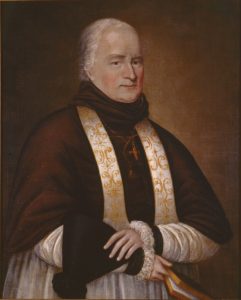
An oil painting of Archbishop John Carroll was completed in the early 19th century by Joshua Johnson. (CNS photo/courtesy Archdiocese of Baltimore)
By George P. Matysek Jr., Catholic News Service
BALTIMORE (CNS) — An oil painting of Baltimore Archbishop John Carroll, the first Catholic bishop in the United States, has long been one of the most prized works of art owned by the Archdiocese of Baltimore.
For generations, the image of a serene-looking archbishop dressed in clerical garb and a tasseled stole has peered at visitors from a wall in the archbishop’s residence attached to the Basilica of the National Shrine of the Assumption of the Blessed Virgin Mary in Baltimore.
An oil painting of Archbishop John Carroll was completed in the early 19th century by Joshua Johnson. (CNS photo/courtesy Archdiocese of Baltimore)
What most people don’t know is that Joshua Johnson, the artist who painted the portrait, was biracial, had been enslaved and became a self-taught artist regarded as the first professional African-American artist in the newly formed nation.
Johnson’s image of Archbishop Carroll is now on loan through Jan. 23 to the Washington County Museum of Fine Arts in Hagerstown as part of an exhibition of Johnson’s art called “Joshua Johnson: Portraitist of Early American Baltimore.”
Daniel Fulco, the museum’s curator, said Archbishop Carroll’s selection of Johnson to paint his portrait speaks volumes about the esteem in which the artist was held. The painting was completed sometime between 1810 and 1815, not long before Archbishop Carroll’s death.
“The fact that he would approach this African American portraitist in the city at that time in history is really remarkable,” Fulco said, “because Carroll was painted by the likes of Gilbert Stuart.”
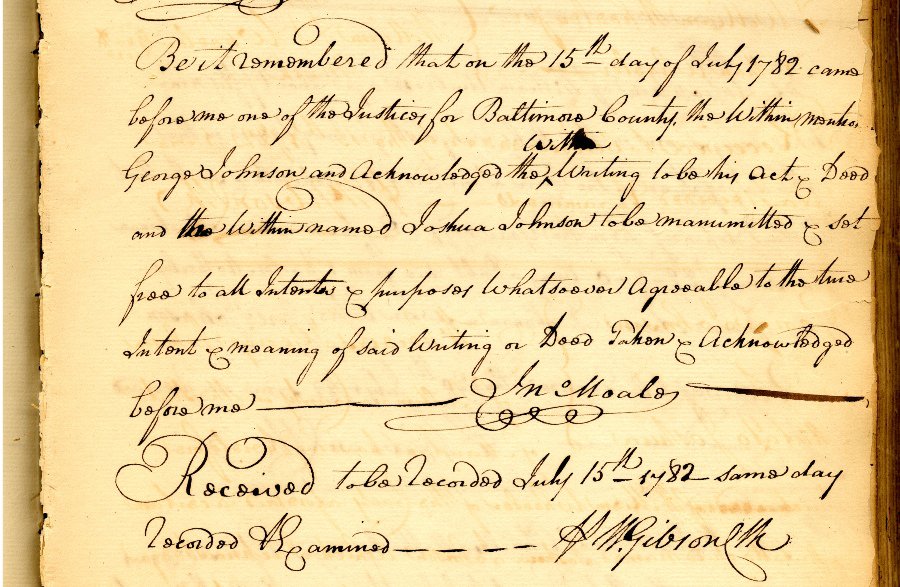
Johnson was born into slavery in rural Baltimore County to a white man named George Johnson and a Black slave woman owned by William Wheeler Sr. His father purchased Johnson when he was 19 and released him from slavery several years later.
As a young man, Johnson worked as a blacksmith’s apprentice and taught himself portraiture art. He purchased advertising in newspapers, declaring himself a “self-taught genius, deriving from nature and industry his knowledge of the art.”
He made a name for himself painting several prominent Marylanders, including politicians, doctors, merchants and sea captains. Many of his portraits are held by the Maryland Center for History and Culture in Baltimore, which loaned them for display at the current Johnson exhibition.
Fulco said Johnson likely came into contact with Archbishop Carroll because Johnson’s wife was Catholic and their five children were baptized at St. Peter’s Pro-Cathedral, the church that served as the cathedral prior to Archbishop Carroll’s commissioning of the Baltimore basilica.
He told the Catholic Review, newspaper of the Archdiocese of Baltimore, that some researchers believe Johnson may have been Catholic, although there is no confirming documentation.
Archbishop Carroll, who himself had owned enslaved persons, represented the most prominent leader Johnson painted over the course of his career.
In the past, Jeremiah Paul Jr., a contemporary of Johnson, had been erroneously credited as the painter of the Carroll portrait.
“In my view and in the view of other scholars, the painting is by Joshua Johnson,” said Fulco, noting that the portrait contains Johnson’s “signature style,” including thinly applied paint and the use of graphite to heighten areas of the composition.
Johnson is an important figure in early federal and late colonial American portraiture art, Fulco said, whose story shows the increasing contributions of African Americans to U.S. society in the late 18th and early 19th centuries.
“He provided a model for other African Americans that they, too, could be practicing artists capable of intellectual and creative achievement,” Fulco said.
For more information about the free Johnson art exhibition, visit wcmfa.org.
Part of Joshua Johnson’s manumission papers from 1782 show his release from slavery. Johnson became a well-respected portraiture artist. (CNS photo/courtesy Maryland Center for History and Culture via Catholic Review)
Pope Francis gestures as he greets people during his general audience in the Paul VI hall at the Vatican Jan. 5, 2022. (CNS photo/Paul Haring)
By Junno Arocho Esteves, Catholic News Service
As the foster father of Jesus, St. Joseph is an example of the need for loving fathers and mothers in “an age of notorious orphanhood,” Pope Francis said.
The “demographic winter” in many Western countries, due in part to couples unwilling to have children, “diminishes us, it takes away our humanity,” the pope said Jan. 5 during his weekly general audience.
There are “many couples do not have children because they do not want to, or they have just one, but they have two dogs, two cats. Yes, dogs and cats take the place of children,” the pope said, eliciting laughter. “Yes, it’s funny, I understand, but it is the reality.”
“In this way, civilization becomes aged and without humanity because it loses the richness of fatherhood and motherhood. And our homelands suffer because they do not have children,” he added.
Among those present at the audience, which was held in the Paul VI audience hall, were members of Rome’s Rony Roller Circus troupe, including jugglers, acrobats, dancers and clowns, who performed for the pope and the pilgrims present.
“I thank the young men and women who have performed this show,” the pope said. “It is a show that puts us in contact with beauty, and beauty always lifts us up, beauty makes us go beyond. And beauty is a path to the Lord.”
In his main talk, Pope Francis continued his series on St. Joseph, reflecting on his role as Jesus’ foster father.
In recognizing Jesus as his son, St. Joseph shows that “a man does not become a father simply by bringing a child into the world, but by taking up the responsibility to care for that child.”
St. Joseph, he continued, also teaches the value of fatherhood and motherhood, especially by those who “welcome life by way of adoption,” and “shows us that this type of bond is not secondary; it is not an afterthought.”
“This kind of choice is among the highest forms of love, and of fatherhood and motherhood,” the pope said. “How many children in the world are waiting for someone to take care of them! And how many spouses wish to be fathers and mothers but are unable to do so for biological reasons; or, although they already have children, they want to share their family’s affection with those who have been left without.”
Speaking off the cuff, the pope said that the example of fatherhood and motherhood was an important value to think about because “our civilization is something of an orphan.”
Pope Francis encouraged couples, especially newlyweds to “think about having children, giving life, because they will be the ones who will close your eyes (at death), who will care for you in the future.”
“And if you cannot have children, think about adoption. It is a risk; yes, having a child is always a risk, either naturally or by adoption. But it is riskier not to have them. It is riskier to deny fatherhood or to deny motherhood, be it real or spiritual,” the pope said.
As he has been doing since beginning his series on St. Joseph, Pope Francis read a prayer he had written.
He asked St. Joseph to “be close to the many children who have no family and who long for a daddy and mommy,” and to “support couples who are unable to have children.”
“Make sure that no one lacks a home, a bond, a person to take care of him or her,” he prayed. “And heal the selfishness of those who close themselves off from life, that they may open their hearts to love.”
Migrants from Haiti cross the Rio Bravo near El Paso, Texas, to turn themselves in to U.S Border Patrol agents to request asylum Jan. 3, 2022. (CNS photo/Jose Luis Gonzalez, Reuters)
By Rhina Guidos, Catholic News Service
WASHINGTON (CNS) — Biden administration officials announced Jan. 3 additional legal help for migrants seeking asylum in the U.S. who are being forced to stay in Mexico under a Trump-era policy that has been difficult to revoke.
Even as the administration seeks in its own way to make improvements to the Migrant Protection Protocols, or “Remain in Mexico” policy, government officials have asked the Supreme Court to step in and end it. The policy, also known as MPP, keeps asylum-seekers waiting across the southern border until their cases can be heard by U.S. immigration courts.
Immigrant supporters have long complained about the danger and conditions migrants face while they wait in dangerous border towns.
But U.S. government officials said they now have a system in place to transport migrants safely to shelters and to provide them access to legal representation, two of the main complaints about the policy.
In 2018, with cooperation from Mexico, the Trump administration implemented the policy, seeking to deter asylum-seekers from entering the United States.
President Joe Biden paused MPP as soon as he took office in 2020, and then formally ended it. But his administration was forced to implement it again in early December 2020 after a court said officials had not ended it properly. The Supreme Court agreed. On Dec. 13, the 5th U.S. Circuit Court of Appeals shut down the latest appeal by the Biden administration to end it.
Since the Biden administration reinstated the policy at a point of entry in El Paso, Texas, in early December, more than 200 migrants and asylum-seekers were forced to stay on the other side of the border, according to Department of Homeland Security figures.
The policy since then has expanded to various points of entry along the border and the administration has been trying to portray it as more humane than before, saying it also has engaged Mexican officials into providing safer conditions for migrants.
The head of the U.S. Conference of Catholic Bishops’ migration committee, Auxiliary Bishop Mario E. Dorsonville of Washington, said in December that the better way forward was to end MPP.
“We are deeply dismayed by the reimplementation of MPP,” he said. “Unfortunately, attempts by the (Biden) administration to make this program ‘more humane’ — however well-intentioned — will not cure its inherent faults, nor will they alleviate its inevitable toll on human lives.”
Bishop Olmsted processes out of St. Bernadette Church after celebrating the liturgy.
St. Bernadette Church’s beautified interior meant to draw faithful closer to Christ
By Tony Gutiérrez, The Catholic Sun
SCOTTSDALE – Not paying attention to the Scripture readings or homily might be forgiven at St. Bernadette Parish in North Scottsdale. It’s easy to be captivated by the beauty of the newly installed art inside the church, that in itself serves a homiletic purpose.
“Before the formal written Catechism, the way that [the Church] would catechize would be through art,” said the Very Rev. Don Kline, pastor of St. Bernadette and vicar forane of the diocese’s Northeast Deanery.
St. Bernadette was established as a parish in 1995, but it did not have a permanent worship space until 2016 and wasn’t dedicated until May 25, 2017. The late Father Pete Rossa, who was pastor at the time, wanted to build a beautiful church. It was built with a cruciform footprint and Romanesque architecture that allowed for good acoustics. The French influence is noticeable, a nod to the parish’s patroness.
“If I were to die tomorrow, it would be my sincerest hope not that I be remembered for this church, but that I would be remembered for bringing you closer to Jesus Christ because that is our mission, that is our hope, that is our longing at the core of our faith,” Fr. Rossa said at the time the church was opened. He died just over a year later, on Sept. 13, 2017. While much of the interior remained bare, it had been Fr. Rossa’s vision to continue to beautify the church.
“It’s so, so beautiful, and it’s such a great tribute to Fr. Pete, who first had the idea that we really needed to have beauty in order to evangelize today. He was so convinced of that,” Bishop Thomas J. Olmsted told the Sun in an interview. “He built the church, but this was all waiting to be done. So, I’m so grateful that Fr. Kline has carried through with such fidelity to the original vision, but we didn’t imagine it would be even more beautiful than we thought.”
Zabinia Arvizu, a 19-year-old student at Arizona State University in Tempe who also attends All Saints Newman Center that serves the school, grew up as a parishioner at St. Bernadette. Both she and her boyfriend, 20-year-old ASU student Patrick Kossler from St. Timothy Parish in Mesa, were struck by the beauty of the church.
“Every time that I step into this church, I fall in love with the faith all over again. It’s just such a beautiful reminder of the beauty of God and how He works in people’s lives,” said Arvizu. “Seeing how many people that the church has brought in, and just seeing how beauty really does reflect God and draw us closer to Him is so powerful to me.”
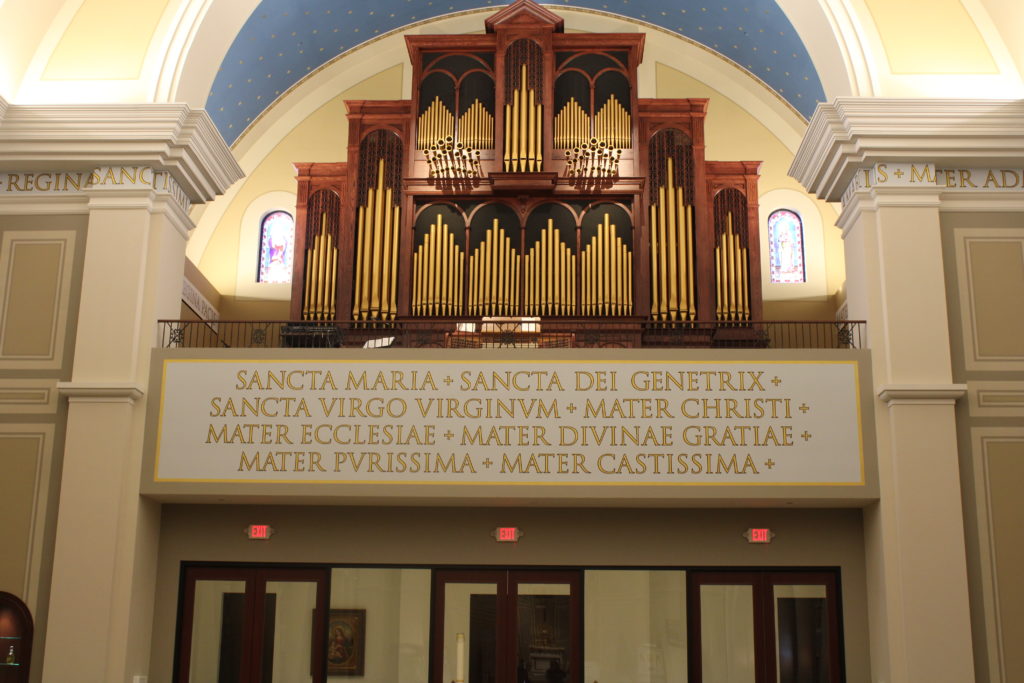
The organ was part of the original plan six years ago but did not come to fruition. It was built in the church by Peragallo Organ Company. Workers carried in piece by piece, pipe by pipe. The 3,000 pipes are powered completely by natural acoustics, with no electric power.
Sacred Music as Sacred Art
Bishop Olmsted paid a pastoral visit to St. Bernadette on Dec. 19, 2021, the Fourth Sunday of Advent, to see the new art and dedicate a new organ, which was part of the beautification project. In his homily, he referenced a 1999 article in the Catholic apologetics journal This Rock titled “I Was Converted by Mozart.” In it, the author, Eric M. Johnson, describes beauty as what brought him to the Church.
“‘It was through music and art that I encountered a positive, inspiring vision of Catholicism. … It was through my ears and eyes that I first became attracted to the faith,’” Bishop Olmsted quoted Johnson as writing. “It was sacred music that turned this man towards God, lifting him above confused thinking and attuning his soul to the Lord,” the bishop commented.
Standing in the choir loft at 300 square feet, the organ was assembled by Peragallo Organ Company. With 3,000 pipes, it functions using natural acoustics rather than electricity.
“It’s really just out of this world. It’s so much fun to get to sing with it, and I don’t know how to put it into words,” said Brina Ziemann, who has served as music director for three years.
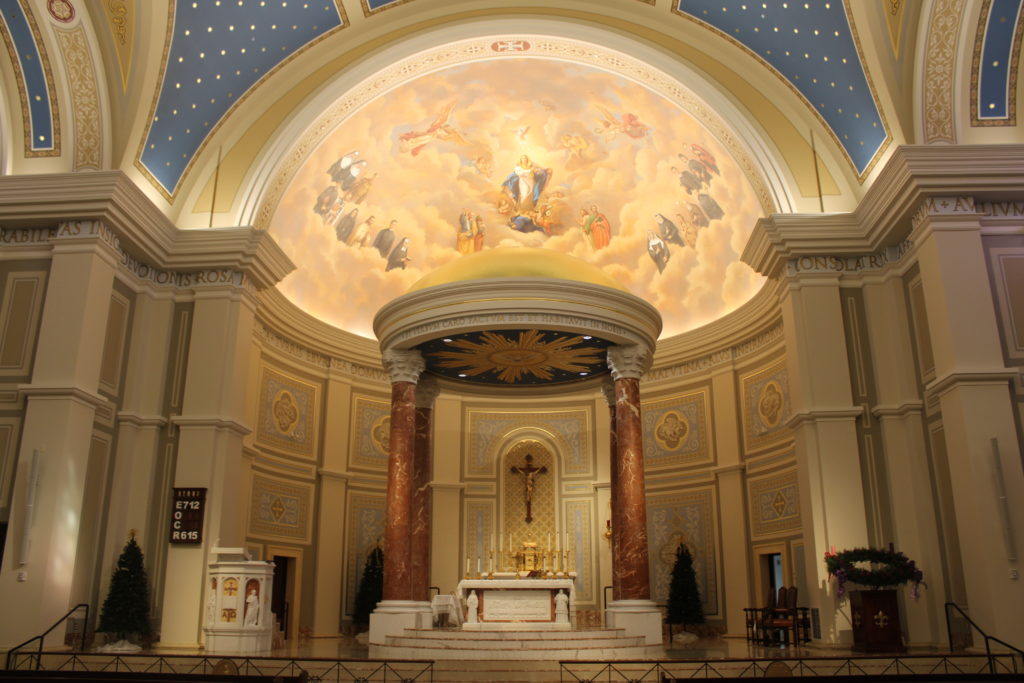
She noted that from the choir loft she can see the apse, a hemispherical semi-dome above the altar, that features a replica of “The Immaculate Conception” by Italian Rococo painter Giovanni Battista Tiepolo.
“When the organ is playing the ‘Ave Maria’ by Schubert, and I get to look at her as I’m singing it, it’s like I’m singing just to her, and it’s beautiful,” she said.
Her husband, Ben Ziemann, sings bass in the choir and described how using his gift in the newly adorned church affected him.
“Singing in such a beautiful place, you just get overwhelmed with tears and emotions at times,” he said.
Pictured in the apse are American saints and blessed, with space to add more images as causes for canonization progress. Front Row, Left: St. Damien de Veuster of Moloka’i, Bl. Stanley Rother, St. Frances Cabrini, St. Juan Diego, Bl. Michael McGivney, Bl. Miriam Teresa Demjanovich; Back Row, Left: St. Marianne Cope, St. Katharine Drexel, St. Junípero Serra; Front Row, Right: St. Théodore Guérin, St. Rose Philippine Duchesne, St. Kateri Tekakwitha, Bl. Solanus Casey, St. Isaac Jogues; Back Row, Right: Bl. Francis Xavier Seelos, St. Elizabeth Ann Seton, St. John Neumann
Cloud of Witnesses
In addition to the Blessed Virgin depicted in the apse, on either side of her are angels, saints and blesseds, including all of those canonized and beatified from the United States — the only such artistic collection of all of them together in the diocese, and possibly the nation, including the most recently beatified [October 2020] — Bl. Michael J. McGivney, founder of the Knights of Columbus. They are all surrounded by clouds as if joining in the liturgy from heaven.
“It literally looks like you’re entering heaven itself, and the liturgy itself brings us into heaven,” Bishop Olmsted told the Sun in describing the apse. “We’re one with the liturgy in heaven.”
For Eveling Ortega, who has been a parishioner since she attended the attached St. John XXIII School in the 1990s, this rendition is the most impactful to her because it reminds her of her own call to holiness.
“It’s a representation of heaven and of what we want to obtain,” said Ortega in Spanish. “It’s something that I want for me, too, but more importantly, for all of family, my loved ones and the entire world, that we can all be there.”
That’s the type of perspective that Fr. Kline had hoped for in highlighting those from our country who’ve been elevated by the Church.
“So much of our culture has just dumbed things down to the bare minimum. There are great conversations to be had about incredible people who have lived among us, and we wanted to be able to help people start the conversation by depicting some of the greats who walked among us who were just like us in many ways, so we can relate,” he said. “It gives us hope, saying, ‘Maybe I got a shot. Maybe I could become one of those saints.’”
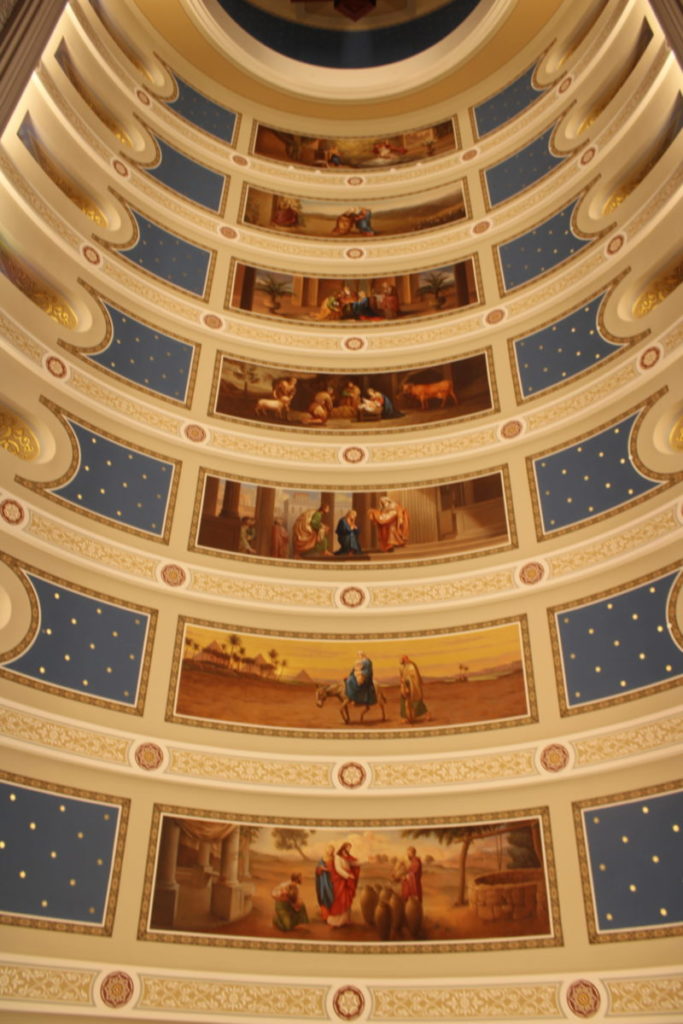
The blue field filled with stars points toward heaven. This is reminiscent of the painted churches of the Central European immigrants in the 19th century. The center images depict episodes from the Blessed Virgin Mary’s life, including Annunciation, Espousal, Nativity, Presentation in the Temple, Flight into Egypt, Wedding at Cana, and Crucifixion.
Drawn to Heaven
Reminiscent of the painted churches of Central Europe and of immigrants from there, the ceiling is painted blue with a field of stars, meant to make the visitor think of Heaven.
“It’s a very typical traditional way of depicting the celestial, the heavenly,” said Fr. Kline. “The church, the high ceilings, everything is meant to really direct us or point us to heaven, to God, the things of God. That’s why down below, you see less art, but it’s meant to carry your eyes up to the heavens.”
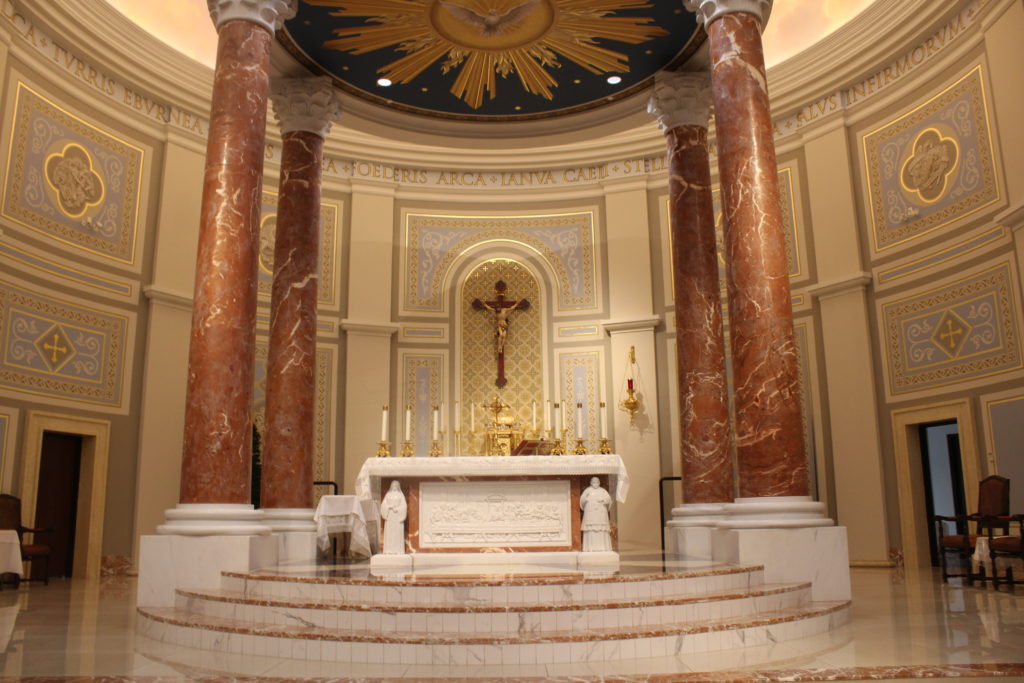
Above the Communion rail is a painting of the Holy Trinity — God the Father holding a post-crucifixion Jesus, with a dove representing the Holy Spirit flying underneath the Father’s arm.
“For me, that’s the most important, because it’s our Father, our Redeemer, our Savior, where we want to go, Heaven,” said Eveline’s mother, Janneth Ortega, in Spanish.
Just above the altar, the Holy Spirit in the form of a dove can be seen on the underside of the baldacchino, which calls to mind the priest calling Him down when consecrating the Eucharist. Esther Keeley, who was visiting her daughter’s family from Fair Oaks Ranch, Texas, during that weekend, shared how the beauty overwhelmed her.
“When I went up to receive Communion and knelt at the altar, I was overwhelmed, and tears just started brimming up in my eyes. I couldn’t control it,” said Keeley, who attends St. Peter the Apostle Parish in Boerne in the Archdiocese of San Antonio. “I was struggling to control it, but I was overwhelmed with the beauty of the church, of everything, of the altar, of the Holy Spirit over the altar. It’s amazing.”
Dcn. Peter Auriemma, who studied art history in Rome and serves as a docent for the church, reflected on assisting in the liturgy in the updated sanctuary.
“When the priest calls down the Holy Spirit, as deacon up there, I’m ringing the bell, and I can’t help but look up and see the image of the Holy Spirit right above, coming down,” he said. “It’s an unspeakable blessing to be a part of this.”
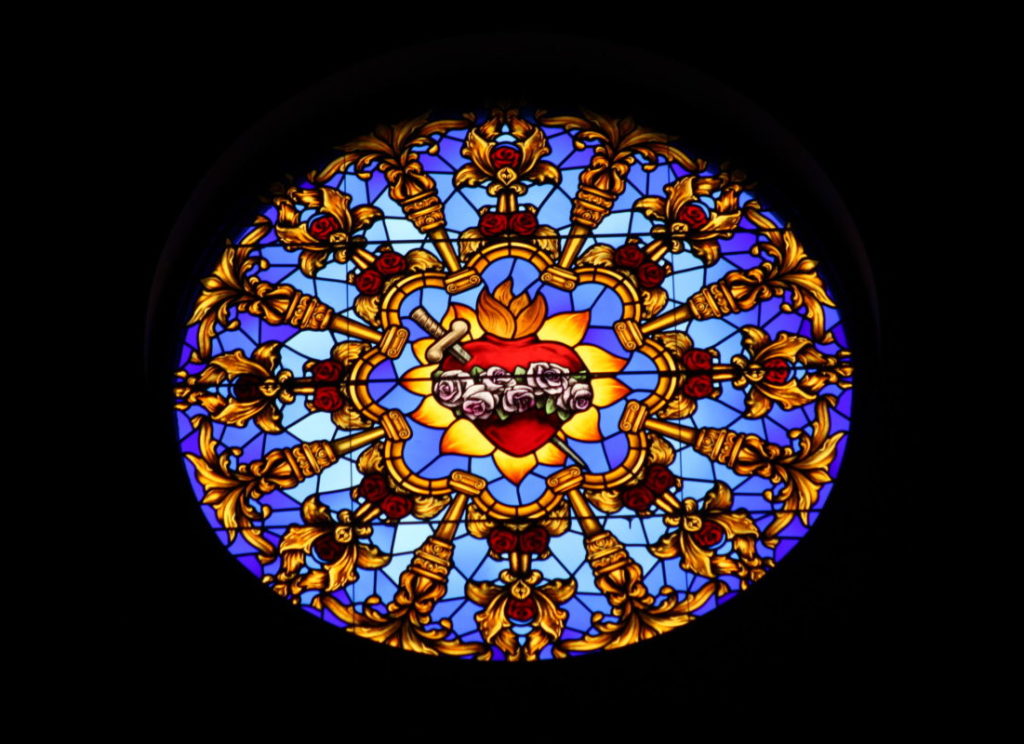
Stained glass depicting the Immaculate Heart of Mary fills the left wing of the parish, across from the Sacred Heart of Jesus. The stained glass is hand blown in Germany and Poland, with other windows featuring the 12 Apostles, Four Archangels, and other saints.
Beauty offers hope
The plans to beautify the interior was initially intended for just the apse, but it incrementally flowed from there to the nave of the church, including the ceiling. Before the project began, Fr. Kline organized a prayer team to spend time in Adoration.
“It was all wrapped in a mantle of prayer from the very beginning,” he said, noting that the COVID-19 pandemic had just begun around the same time. “When we started this project, it was the beginning of the pandemic. We thought people need to have some kind of hope in the midst of this terrible time in people’s minds. That also was pushing us to say, ‘How can the Lord use us to bring a little bit of hope in a time when it seems to be difficult to find?’”
Noting the ugliness of the pandemic, Bishop Olmsted thanked parishioners for choosing to focus on beauty, instead.
“You chose instead to focus on beauty; for what is ugly tires the human spirit and corrodes the heart,” he said. “On the other hand, beauty endures into eternity as it expands to infinite proportions. It will last forever in the presence of God.”
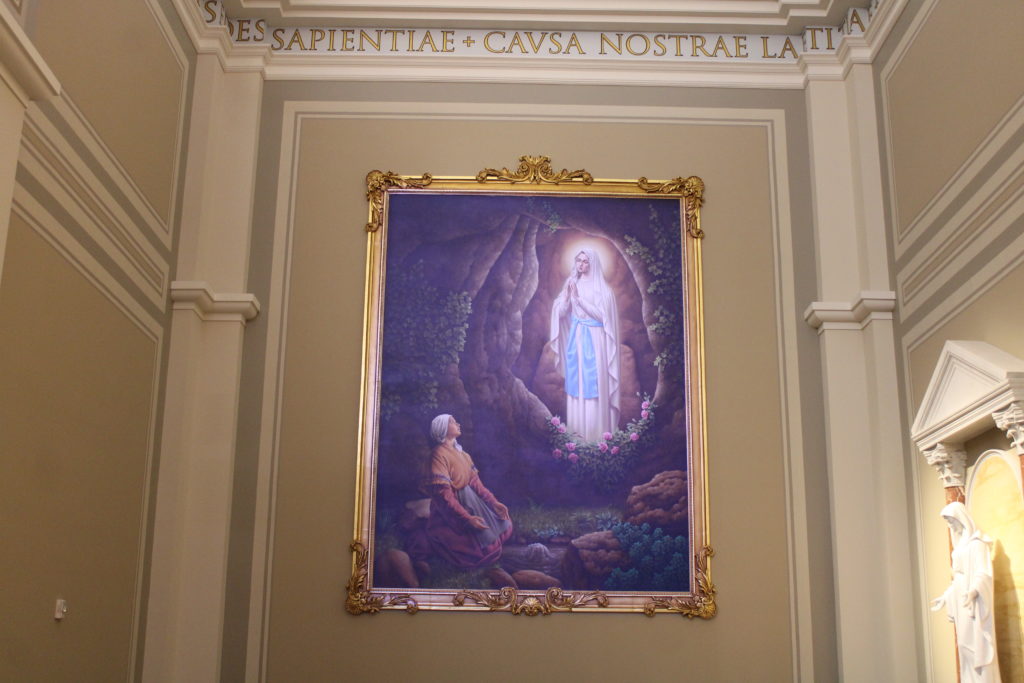
The project had been planned for approximately a year-and-a-half. The church closed May 15, and parishioners met in the original worship space which is now used as a parish hall. At any given point, there were more than 50 different artists working at different sections of the church — one company designed the stained glass windows, one person painted a large rendition of St. Bernadette encountering Our Lady of Lourdes, yet another painted the Stations of the Cross placed throughout the church, etc. But God, said Fr. Kline, was the “master artist” of the project.
“There were so many moments where we were just like, ‘How did that happen?’ It was so beyond anything we could have imagined. We were just so excited to see what God was going to do next, because it really was beyond all of us,” said Fr. Kline. “The artists would all say the same thing, ‘This is the most incredible work we’ve ever been a part of,’ and how they were themselves inspired beyond anything they could have imagined. So, they, too, felt this is something bigger than us.”
The total cost of the project was just less than $3 million. Part of the funding came from the “Together Let Us Go Forth ~ Juntos Sigamos Adelante” campaign, primarily for the bells and part of the stained glass windows. There was no other campaign; rather, the parish relied on the generosity of donors.
“We were very blessed to be able to have generous, anonymous donors, often time, who just gave towards the project and still are,” said Fr. Kline. “People will pay for beauty. When they’re inspired, they believe in the project, they will get behind it. People would just come forward and say, ‘Father, we want this to happen. How can we help?’”
The Immaculate Conception reveals herself to St. Bernadette at Lourdes.
Honoring parish patroness
Featured prominently in the Gospel — or left — wing of the church, which is typically dedicated to the Blessed Mother, is a life-size painting of Our Lady of Lourdes appearing to St. Bernadette Soubirous — the parish’s patroness — as a 14-year-old peasant girl in 1858. It is illuminated by a spotlight from the opposite wing. A painting of the Holy Family by the same artist is planned to be installed on the Epistle — or right — wing.
Martín Perez, who was part of the Knights of Columbus Fourth Degree honor guard from Our Lady of the Rosary Assembly 2374 serving the parishes of St. Bernadette, Blessed Sacrament and St. Bernard of Clairvaux, all in Scottsdale, and St. Joseph in North Phoenix, said he was honored to serve, adding that he was particularly touched by the painting.
“The portrait of St. Bernadette has been very illuminating to me,” said Perez, who is also a past grand knight and current trustee for the parish’s Council 12164. “It just sticks out. It almost feels like you’re in real time when you look at it.”
Also on the ceiling are episodes in the life of the Blessed Mother, and on the walls encircling the perimeter of the church is the Marian Litany of Loreto, written in Latin, which is still the official language of the Church. A statue of Our Lady of Lourdes that used to stand atop the baldacchino in the sanctuary will be used to build a replica of the grotto to her found in Lourdes, along with a forthcoming statue of St. Bernadette.
“There’s nothing like it here that I’ve found the United States, certainly not in Arizona that depicts it the same way again,” remarked Fr. Kline. “People will have to travel to France in order to see this scene, and we’re going to bring it right here to Scottsdale, Arizona.”
The Marian nature of the church honors St. Bernadette’s role as the visionary of Our Lady revealing herself as the Immaculate Conception, and the saint once referred to herself as a “broom” to be used by the Blessed Virgin.
“People say, ‘It’s a very Marian church.’ Well, why not?” said Fr. Kline. “This was bigger than St. Bernadette, and I think she would have wanted it that way. No Immaculate Conception, Our Lady appearing to her, no Bernadette.”
Referencing the Visitation of the Virgin Mary to her cousin Elizabeth found in the day’s Gospel reading (Lk 1:39-45), Bishop Olmsted said in his homily that beauty overflowed from the event.
“Mary made haste to visit her cousin, for she knew the gift of being the Mother of God was meant to be shared, not hoarded,” he said. “Her visit would bring immense joy to Elizabeth and be an example for us who are called, today, to bear joyful witness to Christ.”
The baldacchino hearkens back to the Old Testament where Holy of Holies in the Ark of the Covenant is carried underneath a tent. The Holy Spirit is depicted because it is the Holy Spirit that descends upon the altar when the priest consecrates the Eucharist. The carvings in the altar depict St. Bernadette, patroness of the parish, the Last Supper, and St. John XXIII, patron of the school. The grapes and wheat next to the Tabernacle represent the species of the Eucharist. The four evangelists are pictured as depicted in the Book of Revelation. “Et Verbum caro factum est, Et habitavit in nobis” flanks the sanctuary, meaning “And the Word became flesh and made His dwelling among us.”
Evangelistic impact
Paul Zucarelli and his wife travel half an hour from Fountain Hills every Sunday because of the beauty of the church.
“I just think of all the people that will be saved here and find Jesus with the sacraments long after I’m dead, [and] all the future generations that will come to know Christ because of this beautiful church,” he said.
Dcn. Auriemma said the effects the new art has on people is at the “heart of evangelization” and serves as a catechetical tool for Catholics.
“Above all, it’s the sense of returning to true beauty as being the portal to the divine — the gateway to encountering God,” he said. “The beauty here in this church speaks for itself.”
Quoting the philosopher Plato in his homily, Bishop Olmsted said that “beauty is the splendor of truth” that inspires goodness and love.
“May St. Bernadette’s Parish, and the beauty of this church and organ, together with the virtuous lives of its parishioners, bring many people to discover and rejoice in the wondrous beauty of God, found most fully in Jesus, our Lord.”
Elizabeth Ann Bayley, the future Mother Seton and future saint, was 19 when she married William Magee Seton, 25, a scion of a wealthy New York family and a prosperous young businessman. The couple had five children. William died in 1803 in Italy, and two years later Elizabeth became a Catholic. In 1809, she founded the U.S. Sisters of Charity in Emmitsburg, Md. (CNS photo/The National Shrine of Saint Elizabeth Ann Seton)
EMMITSBURG, Md. (CNS) — The National Shrine of St. Elizabeth Ann Seton in Emmitsburg is launching a series of initiatives to expand awareness of first U.S.-born saint, it announced Jan. 4, on the saint’s feast day.
The initiatives build on the momentum of a yearlong commemoration of the 200th anniversary of the saint’s death.
“Underlying all that we do at the shrine is the strong belief that Mother Seton does not belong to the past. She belongs to all of us today and all those in the future who seek greater meaning in their lives and a friend in heaven,” said Rob Judge, executive director of the shrine.
The initiatives for 2022 include a series of essays, continued retreats and an added at-home retreat, an emailed prayer program and the renovation of the shrine’s museum and visitors center.
The shrine will publish on its website a bi-weekly series of spiritual essays profiling Catholic artists, novelists, poets and visionaries, from the perspective of St. Elizabeth Seton’s life and spirituality.
The first essay by Catholic poet Paul Mariani describes the sensations of a concerto and the profound feelings it elicits through the eyes of Thomas Merton and Mother Seton.
Other essays will highlight the poet and Catholic convert Denise Levertov and former actress Mother Dolores Hart.
It will also resume its Seeds of Hope retreats and will add a prepared home retreat based on St. Elizabeth Seton’s writings. The in-person retreat program is described as the only one in the U.S. geared primarily to those on the margins of society.
The at-home retreat, scheduled to begin during the Easter season, is particularly aimed to those struggling with anxiety as a means to build faith and resiliency in a time of uncertainty.
The shrine has developed an email prayer program called: “Lift Up My Soul: 15 Days of Prayer with Saint Elizabeth Ann Seton” using the writings of Mother Seton to help readers integrate themes of the saint’s faith into daily life.
The shrine also plans to break ground this summer on its work of a fully renovated and expanded museum and visitor center highlighting the life and legacy of Mother Seton and the sisters who took her message to the world. Funds for this effort are from the shrine’s capital campaign that is close to reaching its $7 million goal.
Information about the initiatives can be found at www.setonshrine.org.
Also on Jan. 4, the shrine also released its latest video in the “Seeker to Saint” series, which tells the unique American story of St. Elizabeth Seton. The newest video, “Finding Mary,” shows how the saint’s devotion to Mary developed and then helped her through many trials.
Pakistani Christian children play in front of tents provided for Christian families whose homes were set on fire by a mob, in Lahore, Pakistan, in this March 12, 2013, file photo. In a video message released by the Pope's Worldwide Prayer Network Jan. 3, 2022, the pope dedicated his prayer intention for people who suffer from religious discrimination and persecution. (CNS photo/Mohsin Raza, Reuters)
By Junno Arocho Esteves, Catholic News Service
To discriminate against or persecute those who profess their faith is an intolerable act that threatens the fraternal bonds shared by humanity, Pope Francis said.
“How can we allow that in this society — which is so civilized — there are people who are persecuted simply because they publicly profess their faith? Not only is it unacceptable; it’s inhuman, it’s insane,” the pope said.
In a video message released by the Pope’s Worldwide Prayer Network Jan. 3, the pope offered his prayer intention for the month of January, which he dedicated to people who suffer from religious discrimination and persecution.
“Let us pray that those who suffer discrimination and suffer religious persecution may find in the societies in which they live the rights and dignity that comes from being brothers and sisters,” he said.
In his video message, the pope said religious freedom is not just about allowing freedom of worship but also “makes us appreciate others in their differences and recognize them as true brothers and sisters.”
Pope Francis prayed for an end to religious persecution and discrimination and that the world would “choose the path of fraternity” because “either we are brothers and sisters or we all lose.”
“As human beings, we have so many things in common that we can live alongside each other, welcoming our differences with the joy of being brothers and sisters,” the pope said.
“And may a small difference, or a substantial difference such as a religious one, not obscure the great unity of being brothers and sisters,” he said.