
Church workers fight fear, myths as Ebola worsens in Sierra Leone

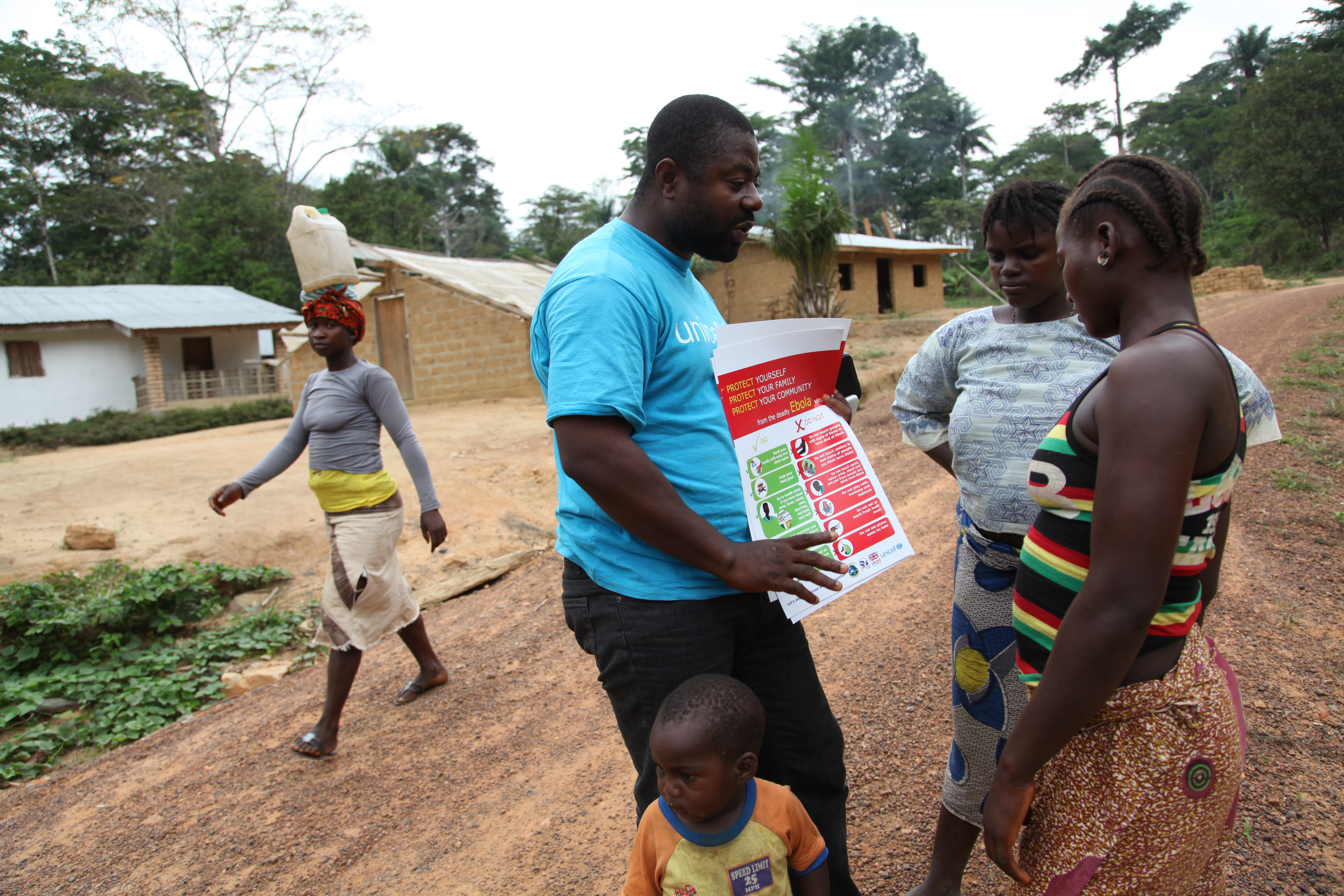
A man in Lofa, Liberia, educates villagers in late April on the prevention of Ebola disease. A Catholic priest from Sierra Leone asked for prayers for West African countries affected by Ebola. (CNS photo/Ahmed Jallanzo, EPA)

CAPE TOWN, South Africa (CNS) — It is hard for people in Sierra Leone not to lose hope as the death toll rises and worldwide fear grows over the worst Ebola outbreak on record, said the head of Caritas in the Archdiocese of Freetown, Sierra Leone.

“Our situation is desperate,” said Father Peter Konteh, executive director of Caritas.

In a July 30 telephone interview from Freetown, Father Konteh said the mood of the West African country was bleak following the July 29 death of the doctor who had been leading the country’s fight against the highly contagious disease.

The Ebola death of Dr. Sheik Umar Khan, who worked at the Kenema Government Hospital in eastern Sierra Leone, “has left us feeling defenseless,” Father Konteh said, noting that the hospital center Khan ran “is the only place in the country equipped to deal with Ebola.”

Sierra Leone declared a state of emergency July 31 and called in troops to quarantine Ebola patients as the death toll from the outbreak of the virus hit 729 in the West African countries of Guinea, Liberia and Sierra Leone.

Symptoms of the disease, which has no known cure, include vomiting, diarrhea and internal and external bleeding. The fatality rate of the current outbreak is around 60 percent.

Fear among local people that if they go to the hospital “they won’t come out again” is largely fueled by the fact that the bodies of people who die of Ebola in hospitals “are put into bags and buried, and their loved ones don’t see them again; there is no burial ceremony,” Father Konteh said.

Michael Stulman, regional information officer for the U.S. bishops’ Catholic Relief Services, said cultural traditions, including the washing of a body by family members before it is buried, are problematic in fighting the spread of Ebola, because the disease is at its most contagious in its advanced stages.

In a July 31 telephone interview from Freetown, Stulman said dispelling myths that are worsening the crisis forms a large part of the work that Catholic Relief Services is doing in Sierra Leone.

CRS staffers are training elders and traditional leaders to enable them to spread information on how to avoid contracting the virus and “what to do if they feel sick,” said Stulman, who visited Sierra Leone July 24-Aug. 1.

CRS, part of the Caritas network, has been working closely with Sierra Leone’s National Ebola Task Force on awareness-raising campaigns, using radio and other mediums to disseminate critical messages about prevention, transmission and treatment of the disease.

Father Konteh represents the Catholic Church on the task force. He said that at the Caritas office in Freetown, “we give people chlorine to wash their hands with” as well as information leaflets.

“It’s a case of simple hygiene,” he said, noting that an interreligious forum issued a statement to dispel myths “spread by religious fanatics saying it’s a plague and calling on people to come to prayer centers they’ve set up instead of health care facilities.”

CRS also had to clarify the nature of Ebola to people who believe that the hospital deaths are the result of a political plot by anti-government forces, Stulman said.

Father Konteh said government, religious leaders and civil society now recognize that Ebola is a “national catastrophe” and are working together to stop its spread.

Reacting to fear among doctors and nurses of contracting Ebola while at work, the health department has stepped up provision of protective gear for staff at hospitals, he said.

Patients diagnosed with Ebola who are removed from hospitals by their families before they have recovered are cause for great concern, Stulman said, noting that a woman taken home to Freetown from Kenema hospital died in the ambulance on her way back.

“The fastest you can get from here to Kenema hospital by road is two days,” Father Konteh said, noting that Freetown’s hospital does not have the necessary equipment to treat Ebola.

“Our health system is not strong enough to cope with this,” he said.

Sierra Leone’s health system has limited supplies and minimal human resources, Stulman said.

He also said that while many international organizations are leaving Sierra Leone for fear of contracting Ebola and the U.S. Peace Corps is evacuating hundreds of its volunteers in affected countries, CRS has no plans to leave.

“We’re sticking around,” Stulman said, noting that CRS has been working “on the frontlines” in Sierra Leone for more than 50 years and has built strong partnerships with local organizations.

Father Konteh said Ebola has had “ripple effects on all interactions.”

Many people’s livelihoods depend on trading at big market places, “but they are staying away now,” he said.

In eastern Sierra Leone, some schools closed and postponed examinations indefinitely, he said.

— By Bronwen Dachs, Catholic News Service.

Church aid agencies coordinate relief for Gazans, plan for future need

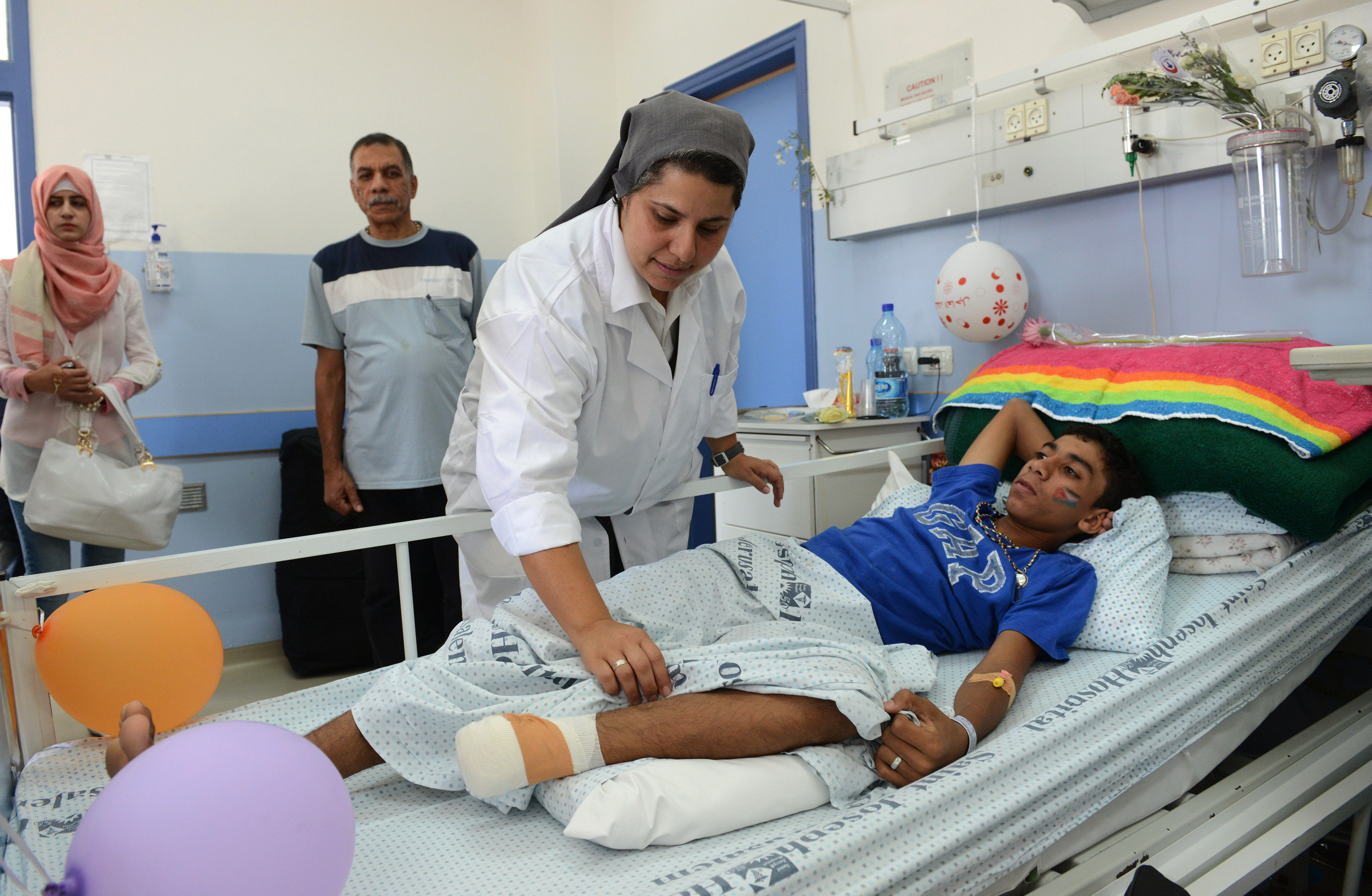
Sister Muna Totah, a member of the Sisters of St. Joseph of the Apparition, works on Karim Nofal, 15, of Gaza, at St. Joseph Hospital in Jerusalem July 30. The teenager is one of 23 Gaza patients being treated at the hospital, which specializes in head- and chest-trauma wounds. (CNS photo/Debbie Hill)

JERUSALEM (CNS) — With close to a quarter of a million Palestinians rendered homeless by the continuing and intensifying fighting between Hamas and Israel in Gaza, the Coordinating Catholic Aid Organizations met three times in as many days to organize action to confront the humanitarian crisis.

In addition to the current material needs — food, water, personal hygiene items, medicine and diesel fuel for generators — the Catholic aid associations from the Holy Land, U.S. and Europe are beginning to plan for the psychosocial needs of Gazans at the eventual end to the confrontation.

“We are talking about a massive number of people who will be in need of help, and of at least 200,000 children who will need intervention,” said Sami El-Yousef, regional director of the Jerusalem Office of the Catholic Near East Welfare Association.

CNEWA ran such a program after the Israeli incursion into Gaza in 2012, he said.

In addition, he said, lack of drinking water has become a critical issue with the bombing of Gaza’s only electrical power plant, which has left the area largely without electricity for pumping water and sewage treatment. Diesel fuel is urgently needed for generators while milk for young children is also in short supply, he said.

CNEWA had been supplying the Anglican Al Ahli Arab Hospital with fuel for the generator for intermittent power outages, but after the attack on the power plant in late July, the hospital was left without any fuel and had to shut down all operations, said El-Yousef, who received a phone call from the hospital in the middle of the night. The next day he was able to provide the hospital with funds to purchase more fuel. The hospital needs some 500-600 liters of fuel per day now because the generator is its only source of power, said El-Yousef.

The unsanitary conditions in the streets are also causing illnesses, and El-Yousef said many children are coming to the hospital with cases of malnutrition, diarrhea and fever. The hospital is also treating many of those injured, he said. Other clinics are located in dangerous areas and have been shut down almost from the start of the hostilities, he said.

“It is really desperate,” he said.

Though there are medicines available in Gaza, there is a shortage of medications in the hospitals because people and institutions have used up their credit lines, and cash to purchase them is not available, El-Yousef said. CNEWA has been able to give written financial assurances to the banks, enabling the hospital to make necessary purchases, he said.

“Every day the situation is getting worse and people are reluctant to move outside,” said El-Yousef.

Catholic Relief Services’ country representative in Jerusalem, Matthew McGarry, credited the “heroic” staffers in Gaza for their continued dedication in distributing aid kits to those most in need during lulls in the fighting. Several of the staff members have lost family members, and others are now homeless but have continued to work to provide for others, he said.

“They are a committed, selfless team,” he said. “They are doing God’s work.”

In the last week of July, CRS supplied 500 families with nonfood kits, which included things like cooking sets, cleaning supplies, personal hygiene kits, water storage buckets and solar powered lanterns. Staffers normally would have been able to distribute 500 packages per day but could not because of the precarious situation, McGarry said.

He said CRS was in the process of procuring and distributing another 2,500 such aid packages and was working to get medical relief supplies via the U.S. Agency for International Development.

McGarry said people were desperate, and on July 30 the staff halted distribution when dozens of people who had not been registered came to the distribution point demanding the packages. Their details were taken and CRS will look to see if they fit the CRS criteria: people whose homes have been destroyed and who are not receiving any other assistance, said McGarry.

He said staffers have been able to procure some of the supplies locally, which helps Palestinians, while other supplies came from USAID shipments through the Israeli border, in coordination with Israeli authorities, he said.

“The situation is increasingly desperate and catastrophic,” he said. “The numbers are so huge and the needs so enormous.”

— By Judith Sudilovsky, Catholic News Service. 
Changing needs, changing names: Reform of Curia is Vatican tradition

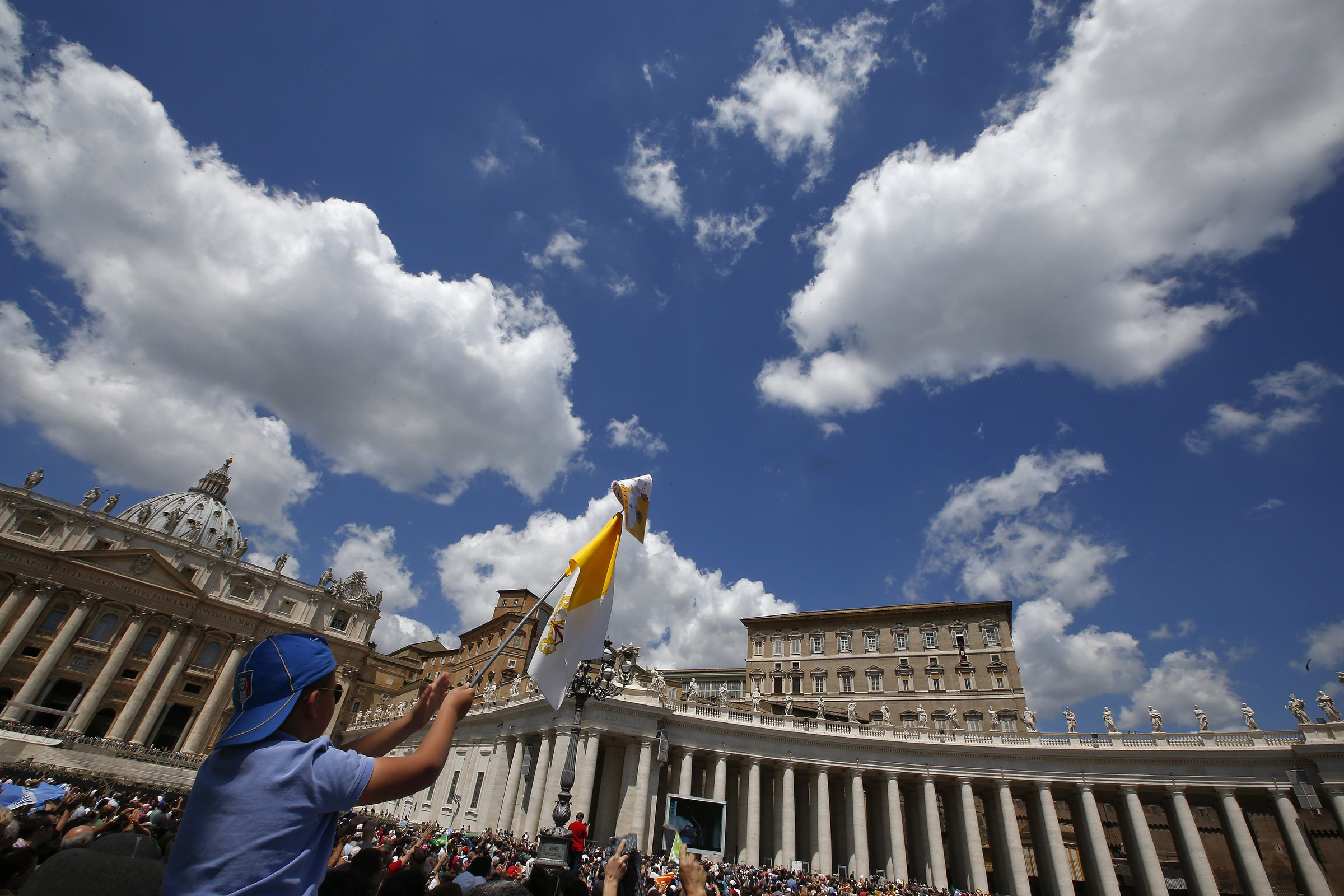
A child waves a flag as Pope Francis leads his Sunday Angelus in St. Peter's Square at the Vatican May 18. (CNS photo/Tony Gentile, Reuters)
A child waves a flag as Pope Francis leads his Sunday Angelus in St. Peter’s Square at the Vatican May 18. (CNS photo/Tony Gentile, Reuters)

VATICAN CITY (CNS) — Pope Francis and his international Council of Cardinals continue to study the most effective and efficient way to organize the Roman Curia, a large bureaucracy with a long history of expansions and a few, short-term, attempts at consolidation.

For centuries, popes were assisted in their ministry by the cardinals meeting in consistories; the practical matters were handled by what was called the Apostolic Chancery. But as the church grew and matters became more complicated and more time-sensitive, offices were added. The first was the Sacred Congregation for the Inquisition, a tribunal established in 1542 by Pope Paul III to judge heresy and orthodoxy.

Over the next four decades, a few other offices were added, but an organized Roman Curia came into existence only with Pope Sixtus V in 1588.

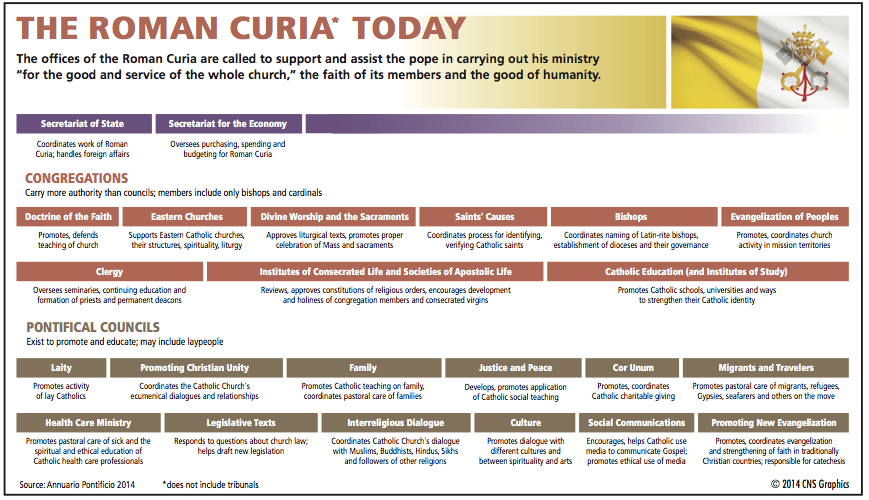
Currently the principal offices of the Roman Curia are the Secretariat of State, nine congregations headed by cardinals and 12 pontifical councils led by cardinals or archbishops. The offices share the mission of helping the pope carrying out his ministry “for the good and service of the whole church and of the particular churches,” according to St. John Paul II’s 1988 apostolic constitution “Pastor Bonus” (“The Good Shepherd”).

Pope Francis and his international Council of Cardinals continue to study the most effective and efficient way to organize the Roman Curia, a large bureaucracy with a long history of many expansions and a few, short-term attempts at consolidation. (CNS graphic/Anthony DeFeo)

In a December address to officials from the curial offices, Pope Francis said he knows there are saints among them, but a renewed commitment to service and humility always is necessary.

“When the attitude is no longer one of service to the particular churches and their bishops, the structure of the Curia turns into a ponderous, bureaucratic customs house, constantly inspecting and questioning, hindering the working of the Holy Spirit and the growth of God’s people,” he said.

In a first step toward reorganizing the Curia, Pope Francis created the Secretariat for the Economy in February.

With only a few modifications, the current structure of the Roman Curia was established by St. John Paul with “Pastor Bonus.”

While the apostolic constitution affirms the curial offices are “juridically equal among themselves,” the congregations are entrusted by the pope with more direct jurisdiction over church matters than the pontifical councils have.

Here is a brief history of the current secretariats and congregations, based mainly on historical notes included in the Annuario Pontificio, the Vatican yearbook:

Secretariat of State

  • Section for General Affairs
  • Section for Relations with States

The current structure of the Secretariat of State — with one section dealing with internal church affairs and the other acting as the Vatican’s foreign ministry — and its role as the coordinating body for the work of the entire Roman Curia was set out in “Pastor Bonus.” The ancient roots of the office go back to the actual secretaries of the popes, including those responsible for corresponding with Vatican nuncios, or ambassadors, around the world.

Secretariat for the Economy

The secretariat answers to the Council for the Economy and exercises authority over all economic and administrative activities within the Holy See and the Vatican City State, including budget making, financial planning, hiring, procurement and the preparation of detailed financial statements.

Congregations

  • Congregation for the Doctrine of the Faith
    The oldest of the congregations, it began as a commission of six cardinals who served as a tribunal for judging suspected cases of heresy and schism. The doctrinal office is charged with promoting and defending the Catholic faith. Until 1968, the pope himself held the title of prefect of the congregation and would appoint a cardinal as secretary or pro-prefect.
  • Congregation for Eastern Churches
    Established by Pope Pius IX in 1862 as a section for the affairs of the “Oriental rites” within the Congregation for the Propagation of the Faith, it became a separate entity in 1917. The congregation is charged with assisting the Eastern Catholic Churches, Eastern Catholic faithful living in predominantly Latin-rite areas and the churches present throughout the Holy Land.
  • Congregation for Divine Worship and the Sacraments
    The congregation, which deals with liturgical questions and the celebration of the sacraments, has been the subject of alternating periods of autonomy and consolidation. The Congregation for the Discipline of the Sacraments was established by Pope Pius X in 1908. The Congregation for Divine Worship was established in 1969 by Pope Paul VI. Pope Paul united the two offices in 1975 and then, in 1984, Pope John Paul made them autonomous. Four years later, with “Pastor Bonus” the two were again joined.
  • Congregation for Saints’ Causes
    The office handling the process for investigating sainthood candidates and preparing their canonizations was established by Pope Sixtus V in 1588. At the time, the congregation also dealt with questions of the liturgy and divine worship. According to the Annuario Pontificio, the two offices were one because the sainthood process concludes with the candidate being added to the church’s liturgical calendar. The two sections were made separate congregations by Pope Paul VI in 1969.
  • Congregation for Bishops
    The congregation, also set up in 1588, initially was responsible primarily for the creation or amalgamation of dioceses. In 1908, Pope Pius X added to its tasks coordinating the search for new bishops to be named by the pope, oversight of the way bishops governed dioceses and responsibility for setting policies for seminaries. In 1958, Pope Pius XII established the Pontifical Commission for Latin America, placing it under the Congregation for Bishops’ jurisdiction. Pope Paul VI made some slight changes in 1967 and the congregation’s current form was established with “Pastor Bonus.”
  • Congregation for the Evangelization of Peoples
    The congregation traces its origins back to the commissions of cardinals Pope Pius V and Pope Gregory XIII set up in the late 1500s to coordinate foreign missions, including in India and in newly Protestant parts of northern Europe. In 1599, Pope Clement VIII established the Congregation for the Propagation of the Faith, but it existed only for a few years. Pope Gregory XV re-established it in 1622. According to “Pastor Bonus,” the congregation promotes evangelization and missionary cooperation around the globe and has special responsibility for bishops, dioceses and developing jurisdictions in Africa, the Far East and parts of the Pacific and Latin America.
  • Congregation for Clergy
    Known as the Congregation of the Council until 1967, the office was established in 1564 to promote the correct interpretation and implementation of the decrees of the Council of Trent. Over time, those tasks were assigned to different Vatican offices and, little by little, the congregation was given other responsibilities. “Pastor Bonus” decreed it would promote the spiritual, pastoral and intellectual development of diocesan priests and permanent deacons, oversee priests’ councils and parish councils and the correct administration of church goods. It also was responsible for promoting catechesis, a responsibility Pope Benedict XVI transferred to the Pontifical Council for Promoting New Evangelization in early 2013. Pope Benedict also gave the congregation responsibility for overseeing seminary education, a task that had belonged to the Congregation for Catholic Education.
  • Congregation for Institutes of Consecrated Life and Societies of Apostolic Life
    The congregation dealing with religious orders and consecrated men and women was established by Pope Sixtus in 1586 and confirmed two years later in his Roman Curia organization. In 1601, the congregation was expanded to include responsibility for bishops as well, but in 1908 it went back to focusing on religious. The office approves the constitutions of religious orders as well as promoting the holiness of life of individual religious and consecrated virgins.
  • Congregation for Catholic Education (and Institutes of Study)
    Pope Benedict slightly altered the congregation’s name in 2013, removing “of Seminaries” from the parentheses when he gave the Congregation for Clergy responsibility for seminary oversight. The congregation is part of the original Roman Curia and was set up in 1588 to coordinate studies at major church-run universities in Rome, Bologna, Paris and Salamanca. In 1967, Pope Paul added an office for Catholic schools to congregation.

— By Cindy Wooden, Catholic News Service.

Foundation for Senior Living celebrates 40 years of serving Arizona’s elderly, disabled

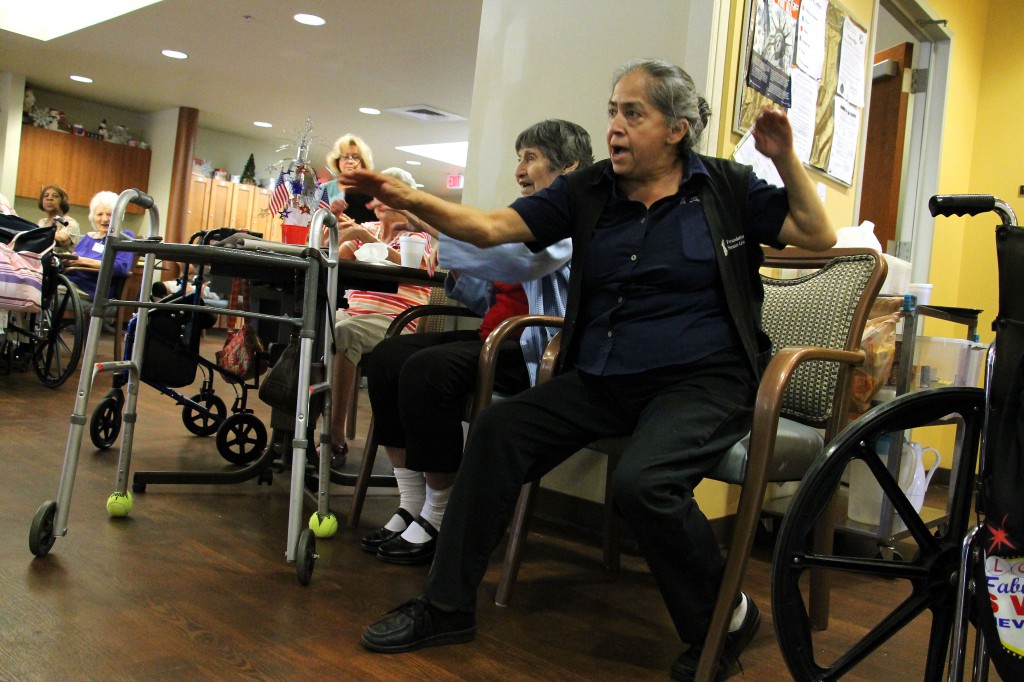
Daily exercise and cognitive activities alongside crafts, special activities and friendly conversation keep seniors and adults with disabilities who attend one of the Foundation for Senior Living’s three adult day health centers healthy and as independent as possible. (Ambria Hammel/CATHOLIC SUN)

[dropcap]E[/dropcap]very weekday seniors and disabled adults arrive at one of three adult day health facilities that the Foundation for Senior Living has been running since its inception 40 years ago.

Clients tackle crossword puzzles, participate in group exercise and discuss current events. They also snack or work on crafts. A few occasionally nap.

[quote_box_right]

Foundation for Senior Living

For information about its array of services for the elderly and adults with disabilities, call
(602) 285-1800 or visit www.fsl.org.[/quote_box_right]

Every activity furthers the Foundation for Senior Living’s mission: to promote greater physical and emotional well-being for seniors and adults with disabilities. That in turn preserves the dignity and independence of clients. Services support their caregivers too.

“It gave my dad meaning, purpose, joy,” Marisue Garganta said of her father’s time at one of the day centers. “We needed somewhere to place him daily to have his life fulfilled.”

Garganta’s father suffered from Parkinson’s disease and enjoyed his time at the center to finish an array of projects. He died several years ago.

Garganta, who joined the board of directors before her father became a client, is in her third year as chair. She described the Foundation for Senior Living’s work as innovative, important and strategic for clients at home and in the hospital.

“The passion for me both professionally and personally is that they’re really living the ministry,” Garganta said. “You walk into any of their programs and you see Jesus there.”

“Our goal here is to keep clients at their maximum functioning level as long as possible,” said Carolyn Hutchens, center director for the Adult Day Health Services facility in Tempe.

She can easily point to success stories too. Hutchens recalled one of the facility’s first clients in the late 1980s. A wife enrolled her husband of 56 years.

They didn’t have a modified bathroom at home and the only way she could help her husband bathe — and keep him out of a nursing home — was due to the physical therapy he received through the Foundation for Senior Living. The strength he maintained there was enough to get him into the shower at home.

The organization has boosted other efforts to keep loved ones at home over the years. A Caregiver House opened in Phoenix seven years ago. It sits on the same property as the Foundation for Senior Living’s administrative offices.

Staff offers training for professional and family caregivers plus seniors and adults with disabilities who manage their own care needs. They show how to give bed baths, reposition a loved one in bed, transfer from a wheelchair and use a Hoyer lift. Visitors also learn about opportunities for home design or modification and ideas for self-care and rejuvenation as a caregiver.

Servant leadership

The concept was so popular that the Foundation for Senior Living launched a mobile caregiver training unit two years ago. The 26-foot bus travels statewide with staff essentially putting the caregiver house on wheels.

The Arizona Caregiver Coalition reports some 855,000 family caregivers statewide and the Foundation for Senior Living is equipping them to manage their role. Guy Mikkelsen, president and chief executive officer, said the Foundation for Senior Living has continually re-invented itself to respond to the outside world, especially addressing health care as a poverty reduction strategy. Great visionaries serving on the board of directors for Phoenix’s Catholic Charities played a key role in shaping the Foundation for Senior Living too.

“We have always been very entrepreneurial to meet the needs of the community” while keeping servant leadership as a core value, Mikkelsen said. The Foundation for Senior Living has successfully diversified. In addition to day health services, home care and home health care that address the whole person, the organization runs assisted group living homes and affordable housing including a newly refurbished multifamily housing property in East Phoenix.

It also offers home energy solutions and operates the Southwest Building Science Training Center.

The ‘Father of Lies’ must be opposed, cathedral rector tells faithful

Fr. John Lankeit, rector of Ss. Simon and Jude Cathedral, told those gathered for the July 25 holy hour that they must not get discouraged when the faith is attacked.

The following is the text of the homily given by Fr. John Lankeit, rector of Ss. Simon and Jude Cathedral at the July 25 holy hour to oppose the ‘black mass’ planned for Oklahoma City.

Fr. John Lankeit, rector of Ss. Simon and Jude Cathedral, told those gathered for the July 25 holy hour that they must not get discouraged when the faith is attacked.

Satan is not one to go down easily in a fight. When we take the battle to him, we can be sure he’s going to go down swinging, taking as many victims with him as he can. At 4:48 p.m. this afternoon and again at 5:51 p.m., as I was thinking and praying about these words, a very loud alarm went off on my phone. It was a weather alert: A dust storm warning until…yep, you guessed it…7 p.m. tonight! I thought, “Wow, can you believe it? Something to discourage those who are on the fence about coming tonight!”

But please don’t think that even this weather alert is a mere coincidence. Anyone involved in exorcism or deliverance ministry will tell you that, when on their way to do battle with Satan—to pray for and over someone pestered by demonic influences—any number of things can happen to impede the trip—from a car breaking down, to locking your keys in the house, to a swarm of bees showing up around your car. I didn’t even make these examples up…they’ve really happened!

Satan — and those he uses to carry out his plans — is counting on Christians to cower, to give in to fear…to hunker down rather than stand up. He’ll try every trick in the book, playing on our sense of fairness, appealing to political correctness, manipulating our desire for human respect, kicking up a dust storm, to keep us from standing firmly in the truth — the truth that evil must be opposed vigorously. If we’ve learned anything from 20th century history — from the murderous dictatorships that arose during the century just concluded — it is that the agents of evil are terrified of us recognizing our power in Christ. Evil is terrified that we will respond. We must not be afraid! We must not feel helpless! We must not believe the Father of Lies when he tells us we’re outgunned and outmatched just because a few influential people and institutions wield worldly power! Why? Because as St. Paul said to the Ephesians:

“…we are not contending against flesh and blood, but against the principalities, against the powers, against the world rulers of this present darkness, against the spiritual hosts of wickedness in the heavenly places.” (Eph 6:12)

Yes, our spiritual foes are more cunning and more powerful than the human beings, and the institutions they employ to carry out their mission. But we must never…ever…forget, who we have on our side in the spiritual battle…the One True God—Father, Son and Holy Spirit!

We must not get discouraged when our faith is attacked. In fact, the greater our faith, the more we will see such attacks—like the “black mass” in Oklahoma—as an “invitation” from the Lord to stand up and confidently let the Light of Christ shine. In a great spiritual book entitled, Into Your Hands, Father, the author writes:

“God makes use of evil in such a superb way and with such skill that the result is better than if there had never been evil.”

(Into Your Hands Father, p. 15)

Tonight gives us occasion to call things what they are. To be crystal clear who we are and what we’re about. Tonight gives us the opportunity to say we will not tolerate this kind of evil, we will no longer take attacks on our faith sitting down. Nor will we employ the weapons of the Evil One. We will not resort to the tactics of those who oppose us. We will follow St. Paul’s plan for suiting up for spiritual warfare:

“Therefore take the whole armor of God, that you may be able to withstand in the evil day, and having done all, to stand. Stand therefore, having girded your loins with truth, and having put on the breastplate of righteousness, and having shod your feet with the equipment of the gospel of peace; besides all these, taking the shield of faith, with which you can quench all the flaming darts of the evil one. And take the helmet of salvation, and the sword of the Spirit, which is the word of God. Pray at all times in the Spirit, with all prayer and supplication. To that end keep alert with all perseverance, making supplication for all the saints…” (Eph 6:13-18)

We are making supplication for everyone…praying that the Lord will penetrate the hardened hearts of the godless secularists in government who look the other way when Christianity is attacked. Praying for the conversion of those who are immersed in Satanism. Praying for the vulnerable souls who are looking for God, but who are being led to believe that darkness and evil are the things that will satisfy their souls. God said through the Prophet Isaiah:

“Woe to those who call evil good and good evil… “ (Isa 5:20)

There is nothing good…nothing beneficial…nothing beautiful about devil worship.

As Archbishop Paul Coakley of Oklahoma City put it:

“Acts of public sacrilege undermine the foundations of civil society and have no redeeming social value. They undermine respect for social, cultural and religious institutions. They mock and tear down and provide no comparable social goods.” https://archokc.org/office-of-the-archbishop/home/3529-deliver-us-from-evil-amen

Speaking of Archbishop Coakley, we will have a letter out in the courtyard to Archbishop Coakley after the Holy Hour. I ask all of you to sign it in order to express to him our solidarity with him and his flock.

Satan is a creature — a fallen angel — and therefore, not divine. “Worship” or “homage” paid to him is not “religion”. It’s the opposite — we might say it’s “sacreligion”, but not religion, and therefore, it deserves no protection from the state, from God, or anyone else. It must never be considered a right to be protected because our civic duty — the exercise of our rights — has as its purpose, to contribute to the common good. Satan is evil, the very opposite of good, and therefore there can be no logical justification for a government building being used for something that is damaging to the public good. We have no duty to, nor should we tolerate something designed for the “common evil.”

But we did not come here tonight to debate politics or policy or even to plot our strategy for petitioning the Oklahoma City government!

We came here to worship the One True God. We gather in the Real Presence of Jesus Christ…the Son of God…the Second Person of the Holy Trinity. We put our confidence in Jesus, because he is the surest and swiftest way to defeat Satan.

We are not contending against the “flesh and blood”, but rather, contending with the “Flesh and Blood” of Jesus Christ in the Holy Eucharist. Satan uses darkness to attack and confuse. St. Paul wrote to the Corinthians:

“…the god of this world has blinded the minds of the unbelievers, to keep them from seeing the light of the gospel of the glory of Christ, who is the likeness of God. For what we preach is not ourselves, but Jesus Christ as Lord, with ourselves as your servants for Jesus’ sake. For it is the God who said, ‘Let light shine out of darkness,’ who has shone in our hearts to give the light of the knowledge of the glory of God in the face of Christ.” (2 Cor 4:4-6)

So how do we counter this darkness? With the Light of Christ, which lives in our souls since the day of our Baptism. Jesus speaks directly to us when he says:

“You are the light of the world. A city set on a hill cannot be hid. Nor do men light a lamp and put it under a bushel, but on a stand, and it gives light to all in the house. Let your light so shine before men, that they may see your good works and give glory to your Father who is in heaven.” (Mt 5:14-16)

Our Father is in Heaven…and He’s calling us to an eternal family reunion. We have stood up to be counted in the spiritual battle tonight. We have unleashed a Holy Fire that has inflicted a heavier blow on the Devil that we even realize. But that’s not even the best news! In the Gospel proclaimed tonight, we heard the exchange between Jesus and the soldiers whom He sent out for the first head-to-head battle with the Devil:

“The seventy-two [disciples] returned with joy and said, ‘Lord, even the demons submit to us in your name.’ He replied, ‘I saw Satan fall like lightning from heaven. I have given you authority to trample on snakes and scorpions and to overcome all the power of the enemy; nothing will harm you. However, do not rejoice that the spirits submit to you, but rejoice that your names are written in heaven.’” (Lk 10:18-20)

Our names are written in Heaven. And the love of God has been written into our hearts! We are the light of the world. The world needs to see this light. The lost souls in this world need to see this light.

Tonight…thanks to your presence, and the Lord’s Real Presence, the Light of Christ is shining brightly. Satan tried to stop us with a dust storm. But, tonight, it is we who have unleashed a storm of cosmic proportions — the power of our Eucharistic Lord — and it is the Devil who must take cover! And we will continue to stand fast in Jesus Christ for our good, for the good of our nation…for the good of our world…every time he rears his ugly head.

Hundreds turn out to oppose ‘black mass,’ pray for cancelation

"We put our confidence in Jesus, Fr. John Lankeit told the faithful who packed Ss. Simon and Jude Cathedral for a holy hour July 25. Jesus, Fr. Lankeit said, is "the surest way to defeat Satan."
“We put our confidence in Jesus, Fr. John Lankeit told the faithful who packed Ss. Simon and Jude Cathedral for a holy hour July 25. Jesus, Fr. Lankeit said, is “the surest way to defeat Satan.”

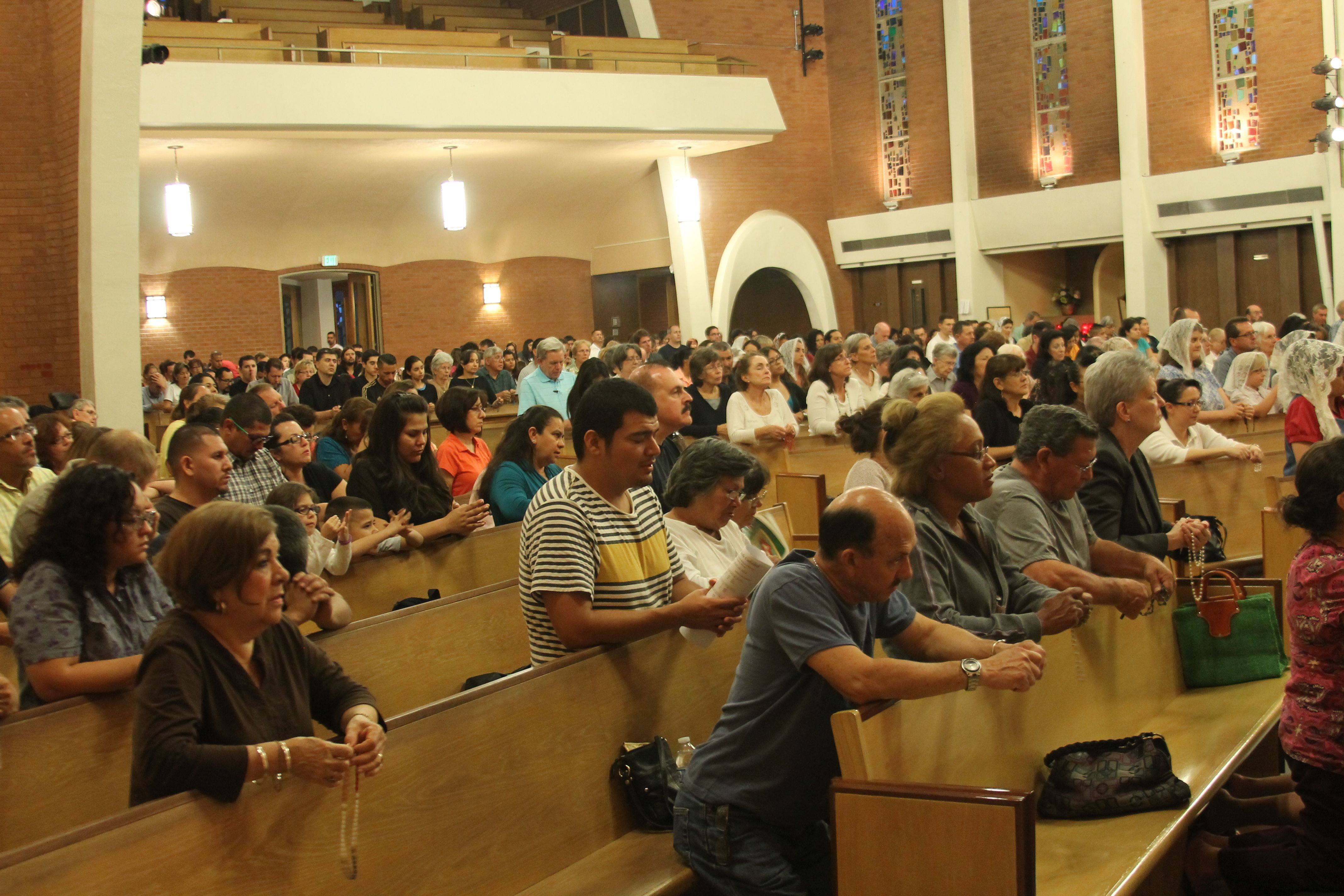
Hundreds of Catholics braved storm warnings to attend a holy hour July 25 in hopes that a “black mass” to be held Sept. 21 in Oklahoma City might be cancelled.

They knelt inside a nearly full Ss. Simon and Jude Cathedral to pray the rosary, sing hymns, adore the Eucharist and listen to a fiery homily from Fr. John Lankeit, rector of the cathedral.

Referring to the multiple storm warnings issued shortly before the holy hour was set to begin, Fr. Lankeit told the crowd Satan would stop at nothing to try and thwart God’s people from gathering to pray for a cancelation of the black mass.

A black mass is a sacrilegious ceremony that invokes Satan and desecrates a Eucharist stolen from a Catholic church. The host is then used in a profane, sexual ritual.

“Satan — and those he uses to carry out his plans — is counting on Christians to cower, to give in to fear, to hunker down rather than stand up,” Fr. Lankeit said. “He’ll try every trick in the book, playing on our sense of fairness, appealing to political correctness, manipulating our desire for human respect, kicking up a dust storm, to keep us from standing firmly in the truth — the truth that evil must be opposed vigorously.”

From infants to the elderly, young families and widows, the faithful prayed inside the cathedral for an hour, then stood in long lines in the courtyard to sign a letter of support for Archbishop Paul Coakley of Oklahoma City, where the black mass is scheduled to occur.

Jane Rivard, who is new to the Phoenix area, said the need for the holy hour was apparent to her. She felt the rosary the congregation prayed was powerful and found Fr. Lankeit’s homily to be an accurate portrayal of the reality of spiritual warfare.

“The evil that exists in the world is something we can’t see but it’s very prevalent. That is why we are having this holy hour,” Rivard said. “During the rosary, I felt this great strength and oneness of the faith.”

Adam Celaya made the effort to attend even after a long day at work.

“You have to,” Celaya said. “When our backs are against the wall and we can come through like this I think it’s awesome.”

Celaya said he was saddened by the prospect of a black mass, but he was steadfast in his resolve to oppose it, along with many other Catholics.

“What’s going on out there in Oklahoma is really disheartening,” Celaya said, “but I just I guess it’s a bigger reason for everybody to get together and fight for the Lord. It’s time to stand up.”

Growing opposition

There’s been a firestorm of criticism surrounding the news that Oklahoma City has agreed to allow its civic center to be used for a black mass. In Massachusetts, outrage over a black mass planned by a student group at Harvard University led to the event being cancelled.

Bill Donohue, president of the Catholic League for Religious and Civil Rights, didn’t mince words when describing his take on plans for a black mass to be held in a taxpayer-supported facility.

“Oklahoma City had better think twice about this. The Civic Center is funded by the taxpayers, many of whom are Catholic, and they are not obliged to pay for attacks on their religion,” Donohue said.

By allowing a black mass to take place at the civic center, Donohue said, the city was violating community standards and opening itself up to a lawsuit. He cited Lynch v. Donnelly, a 1984 U.S. Supreme Court decision.

In the decision, “Justice Warren Burger explicitly said that the Constitution ‘affirmatively mandates accommodation, not merely tolerance, of all religions, and forbids hostility toward any.’ If a ‘black mass,’ whose sole purpose is to show hostility toward Catholicism, does not meet Burger’s dictum, then it has no meaning,” Donohue said.

Archbishop Coakley told Catholic News Agency that the black mass was “truly offensive” not only to Catholics, but to many others as well.

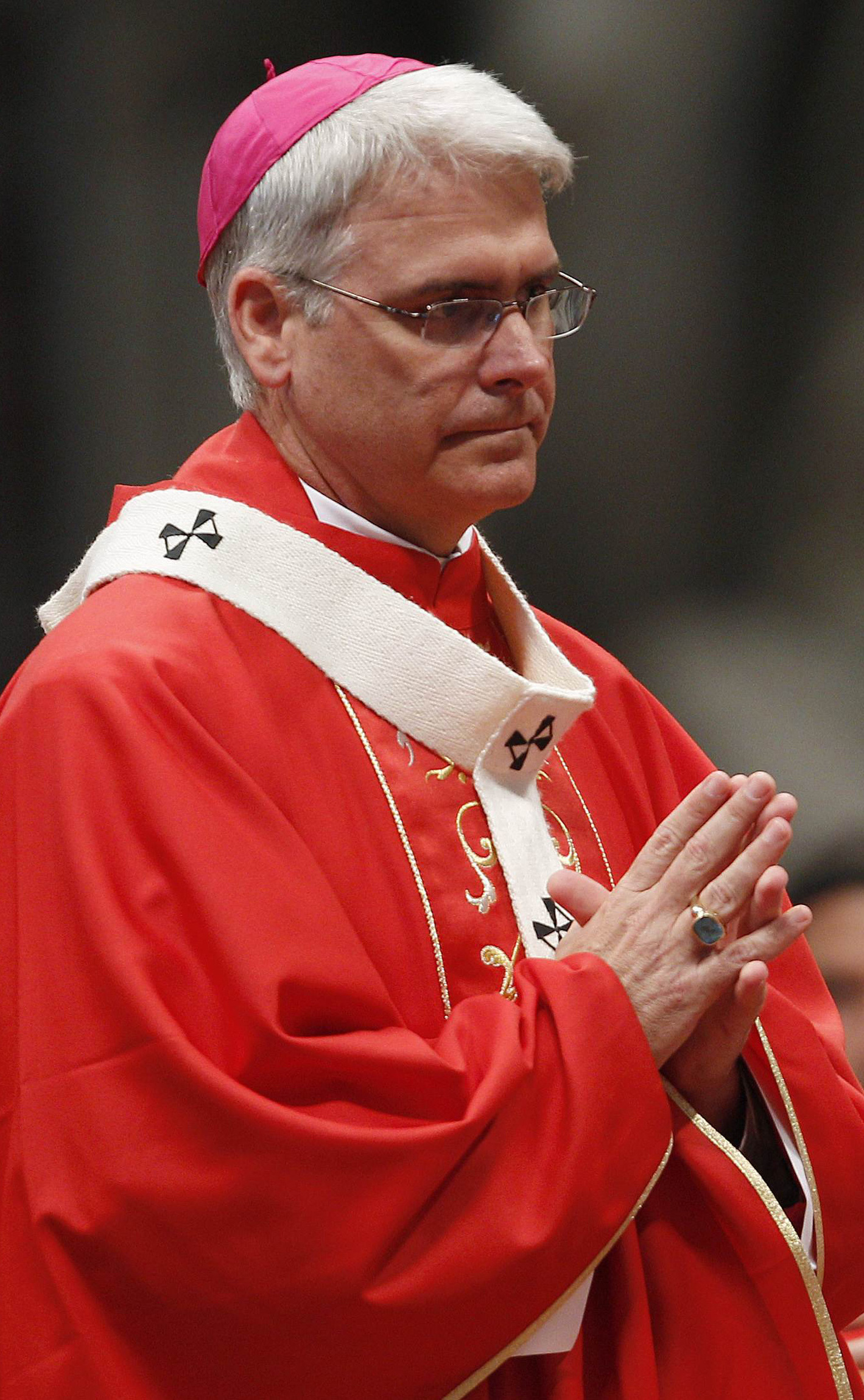
Archbishop Paul S. Coakley is pictured in 2011 after receiving a pallium from Pope Benedict XVI at the Vatican. (CNS photo/Tony Gentile, Reuters)

“There are common standards of decency that civic-minded people uphold that are necessary for constructive public discourse, and this violates all of those standards,” Archbishop Coakley said July 16. “This is a mockery of one faith, a hostile act toward a significant faith community, the Catholic community.”

The power of prayer

Laura Jezek attended the July 25 holy hour at Ss. Simon and Jude Cathedral with her 4-month-old baby in tow as well as her husband and 10 other children. The older Jezek kids were helping get signatures for the letter of support for Archbishop Coakley.

“I came here tonight because when I heard about this black mass, it just broke my heart because I love Jesus,” Jezek said. “The thought of somebody desecrating my Lord is unbearable.”

Jezek, who along with her family became joined the Catholic Church two years ago, said she was sure that the holy hour made a difference.

“There’s not a lot I can do in this world, but I think prayer is the most powerful thing. I know if we are all here together in unity praying for this, the Lord is going to hear our prayers,” Jezek said.

Martin Pueyo agreed.

“I think prayer is something that you can’t see but it makes a difference,” Pueyo said.

Angel Cotello said he and his wife and two children attended the holy hour to pray for everyone in need. “We’re the Church militant — we have to stand strong and stand united,” Celaya said.

Campaign against human trafficking must focus on victims, speakers say

The cover of the book "Trafficked" by Sophie Hayes is seen during a 2012 conference at the Vatican on combating human trafficking. (CNS photo/Marcin Mazur, Bishops' Conference of England and Wales)
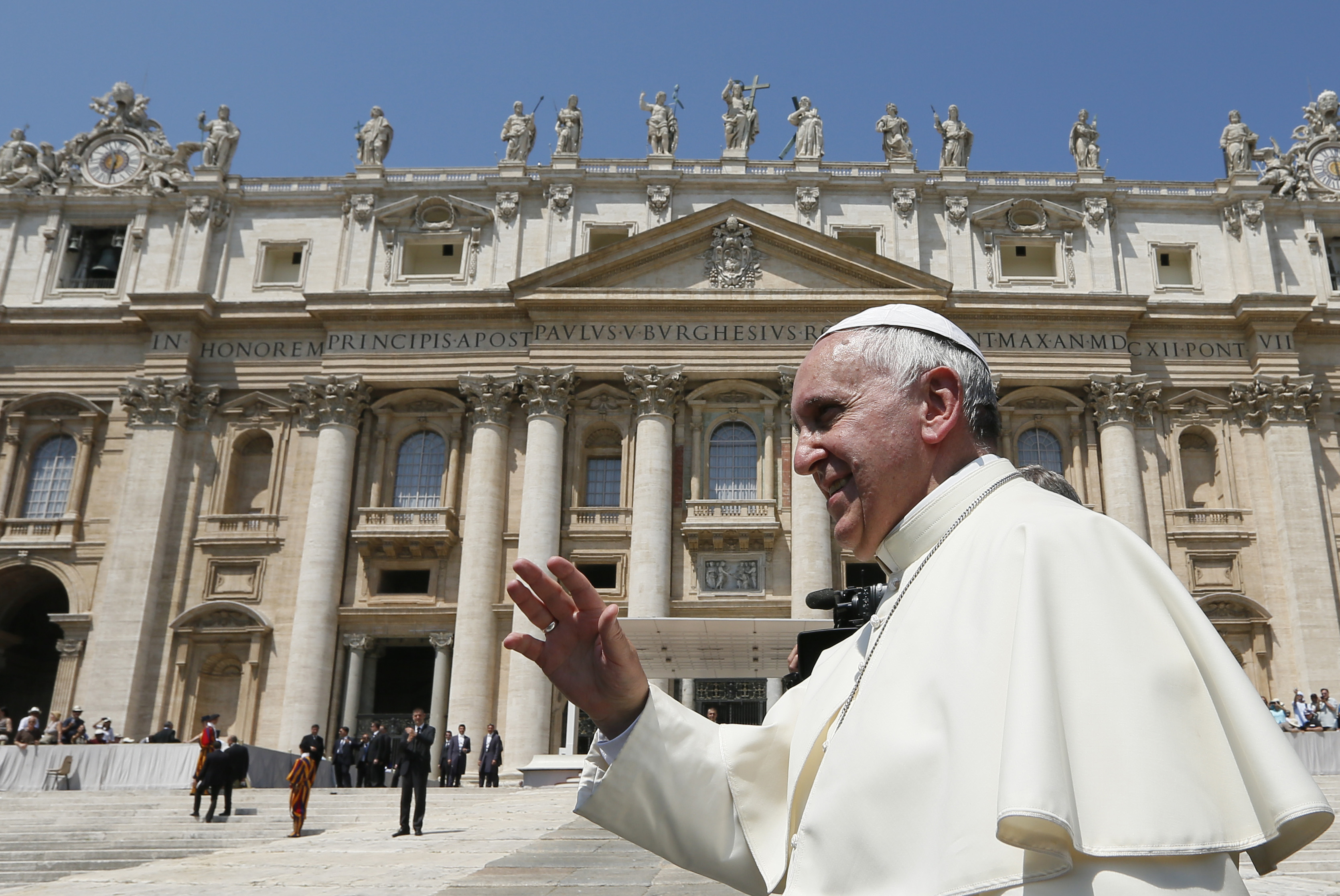
Pope Francis greets the crowd as he leaves his general audience in St. Peter's Square at the Vatican June 11. The pope denounced those responsible for human trafficking, slave labor and arms manufacturing, saying people producing weapons of war are "merchants of death." (CNS photo/Paul Haring)
Pope Francis greets the crowd as he leaves his general audience in St. Peter’s Square at the Vatican June 11. The pope denounced those responsible for human trafficking, slave labor and arms manufacturing, saying people producing weapons of war are “merchants of death.” (CNS photo/Paul Haring)

VATICAN CITY (CNS) — Estimates of the number of people around the world who are victims of human trafficking are rising, partly because globalization has made it easier to move people and partly because governments, churches and international organizations are better at recognizing the phenomenon, a U.S. government official said.

Luis CdeBaca, ambassador-at-large in the State Department’s Office to Monitor and Combat Trafficking in Persons, held a digital video conference July 29 with priests and religious, ambassadors accredited to the Holy See and journalists gathered at the office of the Pontifical Academy of Sciences.

[quote_box_right]Full report[/quote_box_right]The conference and discussion about the U.S. State Department’s 2014 Trafficking in Persons Report took place on the eve of the first U.N. World Day Against Trafficking in Persons.

[quote_box_right]Full article[/quote_box_right]Pope Francis has called human trafficking “a crime against humanity.” Meeting trafficking survivors, religious sisters caring for victims and dozens of senior police officials in April, he called human trafficking “an open wound on the body of contemporary society, a scourge upon the body of Christ.”

Participants at the July conference, sponsored by the U.S. Embassy to the Holy See, focused particularly on victims and survivors of trafficking, repeatedly quoting Pope Francis’ exhortations to touch and heal the wounded body of Christ in the person of those exploited and enslaved by others.

Agreeing with John McCarthy, Australia’s ambassador to the Vatican, that Pope Francis has brought the issue of human trafficking back onto the public agenda, CdeBaca said one of Pope Francis’ key contributions has been “not just talking about, but living this notion of touching the flesh of Christ.”

Trafficking ensnares people who are vulnerable economically or socially, he said, but the victims “are not weak. They are often the strongest ones. They are often the ones who are willing to travel for a new and better life,” but are tricked by smugglers.

[pull_quote_center]Ken Hackett, the U.S. ambassador to the Holy See and co-host of the conference, said, “Whether it’s child labor in Southeast Asia, organ trafficking in Central America, sex trafficking in the Middle East or Eastern Europe, child soldiers in Africa, or labor exploitation in the United States, trafficking touches virtually every part of our global community.”[/pull_quote_center]

Bishop Marcelo Sanchez Sorondo, chancellor of the Pontifical Academy of Sciences and chair of the interreligious Global Freedom Network, described human trafficking as “an accelerator of criminal wealth creation,” pointing to the International Labor Organization’s estimate that organized crime networks reap about $150 billion a year from trafficking in persons, about 80 percent of that from prostitution.

This photo illustration of a woman depicts the despair the victims of sex trafficking often say they feel. Women religious have joined with members of local communities in efforts to combat exploitation of young girls being trafficked and "to help heal the wounded." (CNS photo/Lisa Johnston, St. Louis Review)
This photo illustration of a woman depicts the despair the victims of sex trafficking often say they feel. Women religious have joined with members of local communities in efforts to combat exploitation of young girls being trafficked and “to help heal the wounded.” (CNS photo/Lisa Johnston, St. Louis Review)

CdeBaca said that whether a country outlaws prostitution, makes it illegal to pay for sex or legalizes and regulates prostitution, every country has a problem with people being trafficked for sex.

In a similar way, he said, traffickers exploit immigration laws, convincing victims of poverty and violence that they are the ones who can get them to safety and a better life.

Comprehensive immigration reform in the United States would help, he said. Helping people in the country illegally gain legal status would bring them “out of the shadows,” removing the fear of deportation that keeps many from denouncing their exploiters.

A well-organized system for matching up U.S. labor needs with people who want to go to the United States to work, bypassing the smugglers, also would help, he said.

Poverty is the driving force behind trafficking, participants said.

“People end up having to use themselves as collateral,” CdeBaca said. “If they had credit cards, if they had the ability to take a loan out on their parents’ house so they could buy a new roof for their parents, they would not have to basically use themselves as the loan.”

— By Cindy Wooden, Catholic News Service.
[quote_box_left]Related articles:

CATHOLICS MATTER: Carolyn Diercksmeier — Woman’s uncommon life story focused on mercy, service to others

Carolyn Diercksmeier is a parishioner at Our Lady of Joy Parish in Carefree.

[dropcap]G[/dropcap]rowing up in New Haven, Conn., Carolyn Diercksmeier’s life was colored with the rich hues of abiding Catholic faith.

“In our family, everything centered around the holy days and feasts of the Church,” Diercksmeier said. She attended daily Mass all through grade school and high school and entered the religious life at 18. For years, she enjoyed teaching math to junior high students. As time went on, however, she found herself enveloped in deep depression, a sorrow she couldn’t shake.

“I had to face my hidden demons,” Diercksmeier said. “I left the security of the religious life and returned to my parents’ home.” Not long after, her father died and she was left to care for her invalid mother for 11 years. She married, but a year later, her husband was diagnosed with a serious lung disease. The couple moved to Arizona for the warmer climate and for the last five years of her husband’s life, Diercksmeier was homebound, caring for his every need.

“With God, always expect the unexpected,” Diercksmeier said. “My life has had twists and turns that I could never have predicted in a thousand years, but I have come to trust completely that whatever He sends my way is best for me.”

She’s a familiar face at Our Lady of Joy Parish in Carefree where she once ran the Rite of Christian Initiation. These days, she volunteers in the office and gift shop, serves as lector and sacristan and works in the ministry of care. Beyond that — and one wonders where she finds the energy — she’s a hospice volunteer. These moments of quiet, heartfelt prayer she shares with the dying are what Diercksmeier finds deeply ­rewarding.[quote_box_left]

Parish: Our Lady of Joy in Carefree.

Apostolates: Lay Carmelite, ministry of care, hospice 11th hour companion, sacristan, lector, volunteer in church office and gift shop.

The glue that holds her faith together: Being able to spend time in adoration before the Blessed Sacrament. Only here at the foot of the cross can we find all that we are looking for. If people only realized this, our churches would never be empty.

What keeps her going when she gets discouraged: All I need to do is stand in front of the Blessed Sacrament.

What she loves about being Catholic: I love the Mass, the sacraments, the Church and all the rich traditions that are part of our heritage that have come down through the ages. I am thankful that we have so many good, holy priests to help us.

[/quote_box_left]

It begins with a phone call. Someone is near death, but has no one in the world to sit with them as they pass into eternal life.

“Sometimes they die while I am there holding their hand,” Diercksmeier said. “It’s such a privilege to be there at the person’s last moments…I want to help these people call on the mercy of God at the end of their life.”

Diercksmeier joined the order of Lay Carmelites in the Valley and for the last seven years has been undergoing formation. Monthly meetings involve studying the lives of the Carmelite saints, the history of the Church and how to live the Gospel.

“The busier you are, the more time you need in prayer, not less,” she said. “We have to be in tune with Him and listen to Him.” She draws her strength — and that boundless energy — from the Eucharist and gets choked up talking about the mercy of God.

“He is saying, ‘All you need is My mercy.’ That is a message that I want to tell people. He doesn’t care where we’ve been — He is interested in where we are going.”

People, she said, particularly the homebound, are “starving to hear about the Lord” but are often alone.

“That’s what life is about,” Diercksmeier said, “to make the Lord known and to make Him known and loved.”

Let me call you ‘brother’: Pope takes ecumenism one step at a time

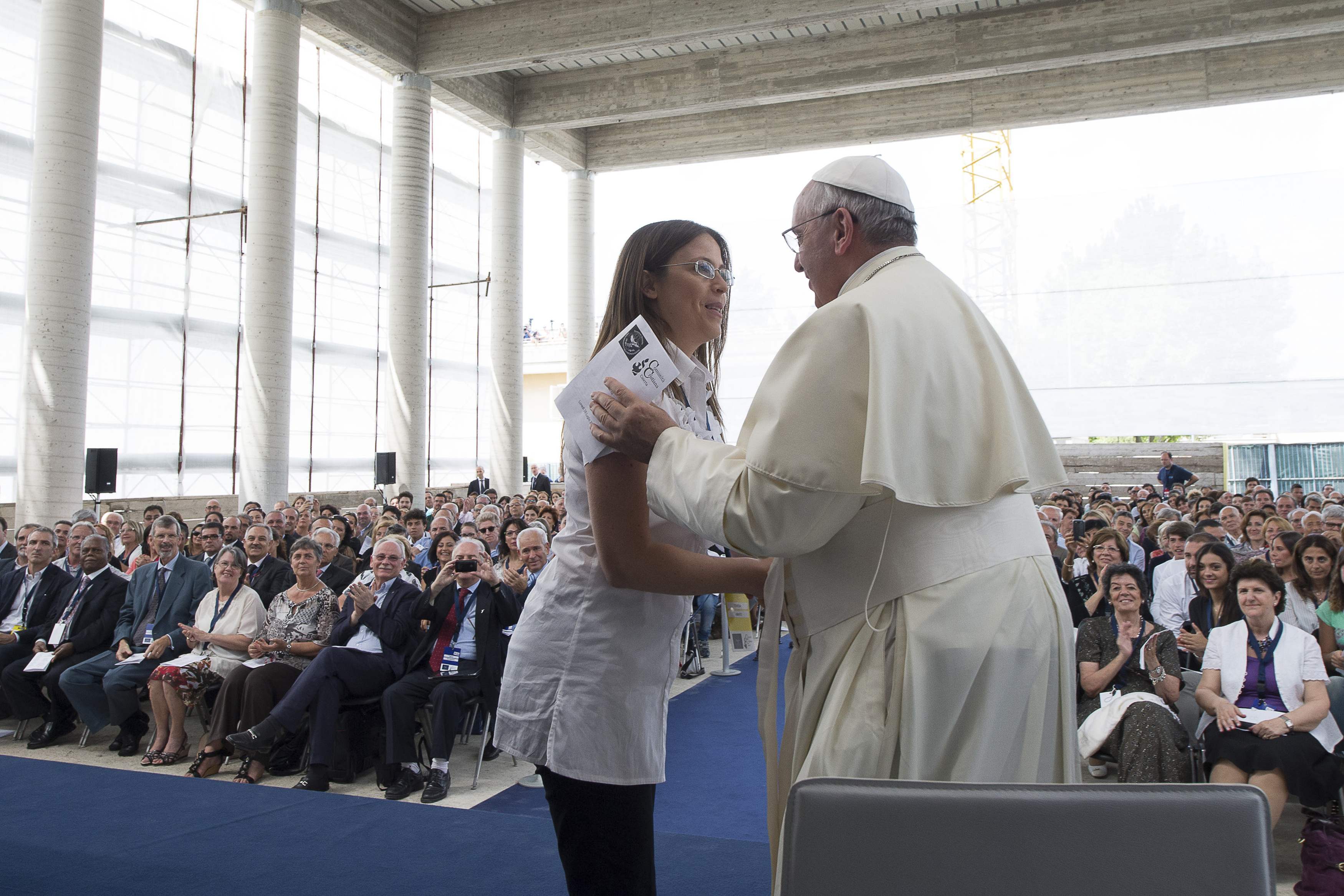
Pope Francis greets a woman during his visit with Giovanni Traettino, a Protestant pastor and his friend, in Caserta, Italy, July 28. Pope Francis said he knew people would be shocked that he would make such a trip outside of Rome to visit a group of Pentecostals, “but "I went to visit my friends.”" (CNS photo/ L'Osservatore Romano via Reuters)
Pope Francis greets a woman during his visit with Giovanni Traettino, a Protestant pastor and his friend, in Caserta, Italy, July 28. Pope Francis said he knew people would be shocked that he would make such a trip outside of Rome to visit a group of Pentecostals, “but “I went to visit my friends.”” (CNS photo/ L’Osservatore Romano via Reuters)

VATICAN CITY (CNS) — The only name Pope Francis wants divided Christians to call each other is “brother” or “sister.”

“When one walks in the presence of God, this brotherhood results,” the pope told evangelical and Pentecostal Christians July 28 in Caserta.

The pope himself acknowledged that some people would be shocked by his decision to visit a Pentecostal church; while the Vatican has had an official dialogue with some Pentecostals and evangelicals since the 1970s, by and large, Catholic-Pentecostal relations have not been easy.

For years, “sect” was the nicest thing even Vatican documents had to say about the burgeoning Pentecostal communities in Latin America and Africa. The nicest thing many of those communities have to say about the Catholic Church is even worse.

And even as Pope Francis was preparing his visit to the Pentecostal Church of Reconciliation in Caserta, the Italian Evangelical Alliance and other communities issued a statement sharply critical of Catholic Church teaching and, especially, critical of evangelical communities in Italy and around the world who hope for ecumenical rapprochement with Rome.

The groups said they “maintain as incompatible with the teaching of Scripture a church that believes it is a mediator of salvation” and “a church that has assumed the responsibility of adding dogmas — like the Marian ones — to the faith.”

“Apparent similarities with evangelical spirituality and faith in some sectors of Catholicism are not in themselves a reason for hope in a real change,” said the statement published July 19. The leaders called on evangelicals warming to Rome to exercise “healthy biblical discernment” and focus instead on “bringing the Gospel of Jesus Christ to the whole world.”

For Pope Francis, as for the popes who preceded him, that is a key point.

“Given the seriousness of the counter-witness of division among Christians, particularly in Asia and Africa, the search for paths to unity becomes all the more urgent,” the pope wrote in his apostolic exhortation, “The Joy of the Gospel.” “Missionaries on those continents often mention the criticisms, complaints and ridicule to which the scandal of divided Christians gives rise.”

Full unity in faith and the sacraments is the ultimate goal of ecumenism in fulfillment of Jesus’ prayer that his disciples would be one so the world would believe. But using the metaphor of setting out and walking with the Lord, a key image of Christian life for Pope Francis, the movement toward Christian unity is something that happens one step at a time.

For Pope Francis, it is not about waiting for others to catch up with you. It is about everyone continuing to walk with and toward the Lord, supporting and learning from the brothers and sisters God places on the same path. The closer everyone gets to holiness, the closer they will be to one another.

While Pope Francis’ gestures are new, the basic idea of growth in unity being the result of growth in fidelity to Christ is not. During the Week of Prayer for Christian Unity in 2012, Pope Benedict XVI said, “The full and visible Christian unity that we long for demands that we let ourselves be transformed and that we conform ourselves ever more perfectly to the image of Christ. The unity we pray for requires an inner conversion that is both common and personal. It is not merely a matter of cordiality or cooperation, it is necessary above all to strengthen our faith in God, in the God of Jesus Christ, who spoke to us and made himself one of us.

“It is necessary to enter into new life in Christ, who is our true and definitive victory; it is necessary to open ourselves to one another, understanding all the elements of unity that God keeps for us and gives us ever anew,” Pope Benedict said.

Pope Francis told the group in Caserta that one thing present among Christians since apostolic times, but definitely not a gift of God, is name-calling.

On the path of Christian life, “when we stop and spend too much time looking at each other, we start a different journey, an ugly one,” the pope said. In the First Letter to the Corinthians, St. Paul criticizes early Christians who, bragging and promoting rivalry, started saying, “I belong to Paul” or “I belong to Apollos,” rather than “I belong to Jesus.”

The pope said it was like saying, “I am the church, you are a sect.”

“It is not the Holy Spirit who makes division,” Pope Francis told the Pentecostals. “The one who creates divisions is the jealous one, the king of envy, that sower of weeds: Satan!”

“The Holy Spirit creates diversity in the church,” he said. “And this diversity is very rich and very beautiful. But then, the Holy Spirit also brings unity and, in that way, the church is one in its diversity.”

As he did in January when he recorded a video message to a group of U.S. Pentecostals on a pastor’s iPhone, Pope Francis used the Genesis story of Jacob’s sons selling their brother Joseph out of jealousy, only to be united with him again when they set off to Egypt in search of food during a famine.

“Let us try to walk in the presence of God in order to be irreproachable,” the pope said in Caserta. “Let us try to go find the nourishment we need and end up finding our brother.”

—By Cindy Wooden Catholic News Service. 

Ohio order’s straw-bale house shows off energy-efficiency in design

St. Francis Sister Jane Frances Omler shows straw-bale insulation in the exterior walls of the energy-efficient house she helped build in Tiffin, Ohio, in this July photo. The Sisters of St. Francis of Tiffin built the house as a demonstration project to show that by incorporating non-traditional materials and a renewable-energy system, a house -- or almost any structure -- can be comfortable and good for the environment. (CNS photo/Chaz Muth)

TIFFIN, Ohio (CNS) — One Ohio religious order is hoping its energy-efficient straw-bale house will sprout ideas in the minds of visitors to reduce fossil fuel consumption and even invest in renewable forms of energy for heating and cooling their homes.

The Sisters of St. Francis of Tiffin built the house as a demonstration project to show that by incorporating an alternative design, nontraditional materials and a renewable-energy system, a house — or almost any structure — can be comfortable and good for the environment.

“The mission of the house is to educate people on the benefits of using natural materials, using the passive solar concept and alternative energy,” said Sr. Jane Frances Omler, one of two Sisters of St. Francis, living in the two-bedroom, 1,300-square-foot house.

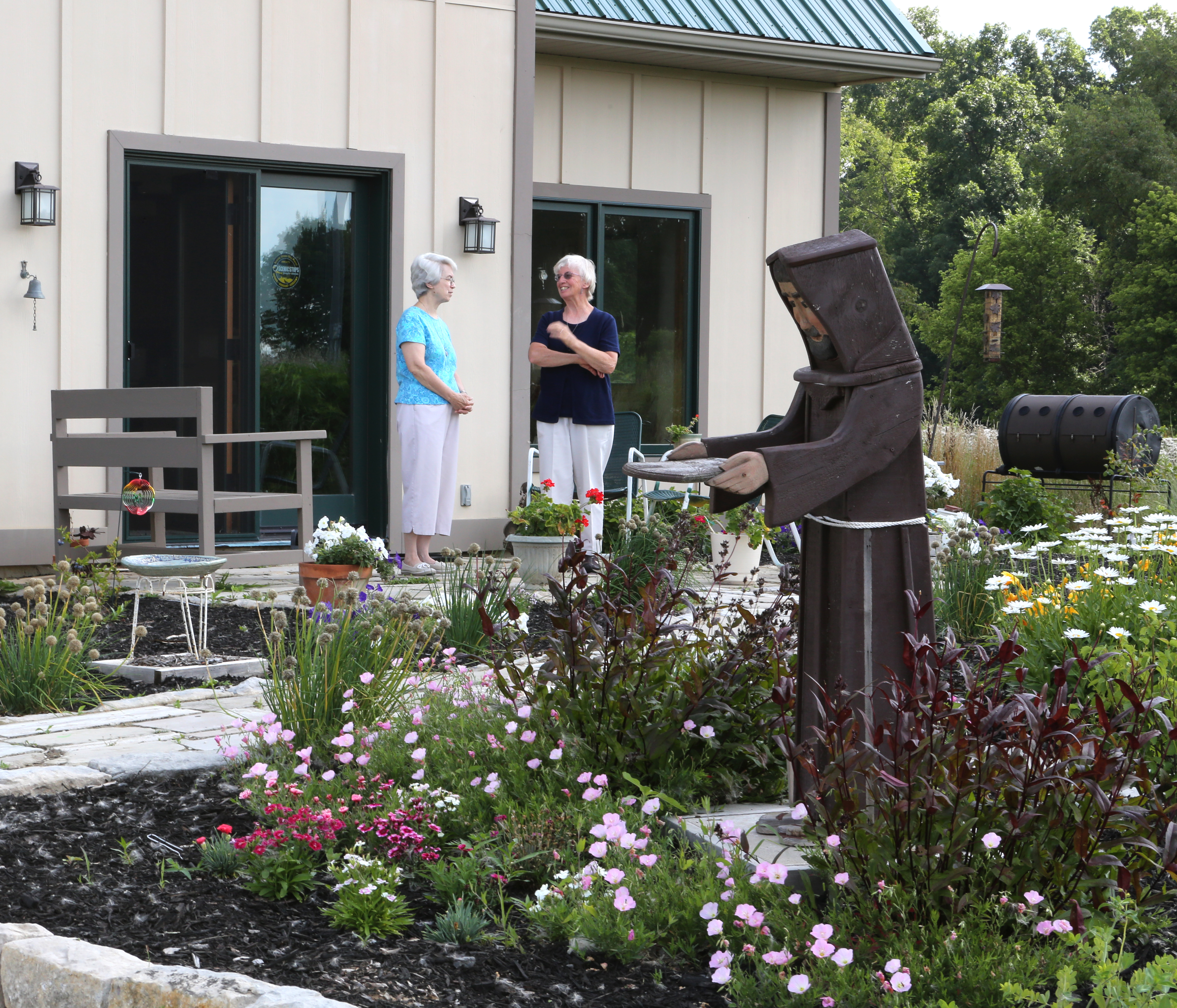
St. Francis Sister Jane Frances Omler, right, and St. Francis Sister Jacqueline Doepker talk on the patio of the energy-efficient straw-bale house they helped build in Tiffin, Ohio in a July photo. The Sisters of St. Francis of Tiffin built the house as a demonstration project to show that by incorporating non-traditional materials and a renewable-energy system, a house -- or almost any structure -- can be comfortable and good for the environment. (CNS photo/Chaz Muth)
St. Francis Sister Jane Frances Omler, right, and St. Francis Sister Jacqueline Doepker talk on the patio of the energy-efficient straw-bale house they helped build in Tiffin, Ohio in a July photo. The Sisters of St. Francis of Tiffin built the house as a demonstration project to show that by incorporating non-traditional materials and a renewable-energy system, a house — or almost any structure — can be comfortable and good for the environment. (CNS photo/Chaz Muth)

All of the house’s electricity is supplied by a small wind turbine. Various components and construction techniques reduce the need for heating and cooling:

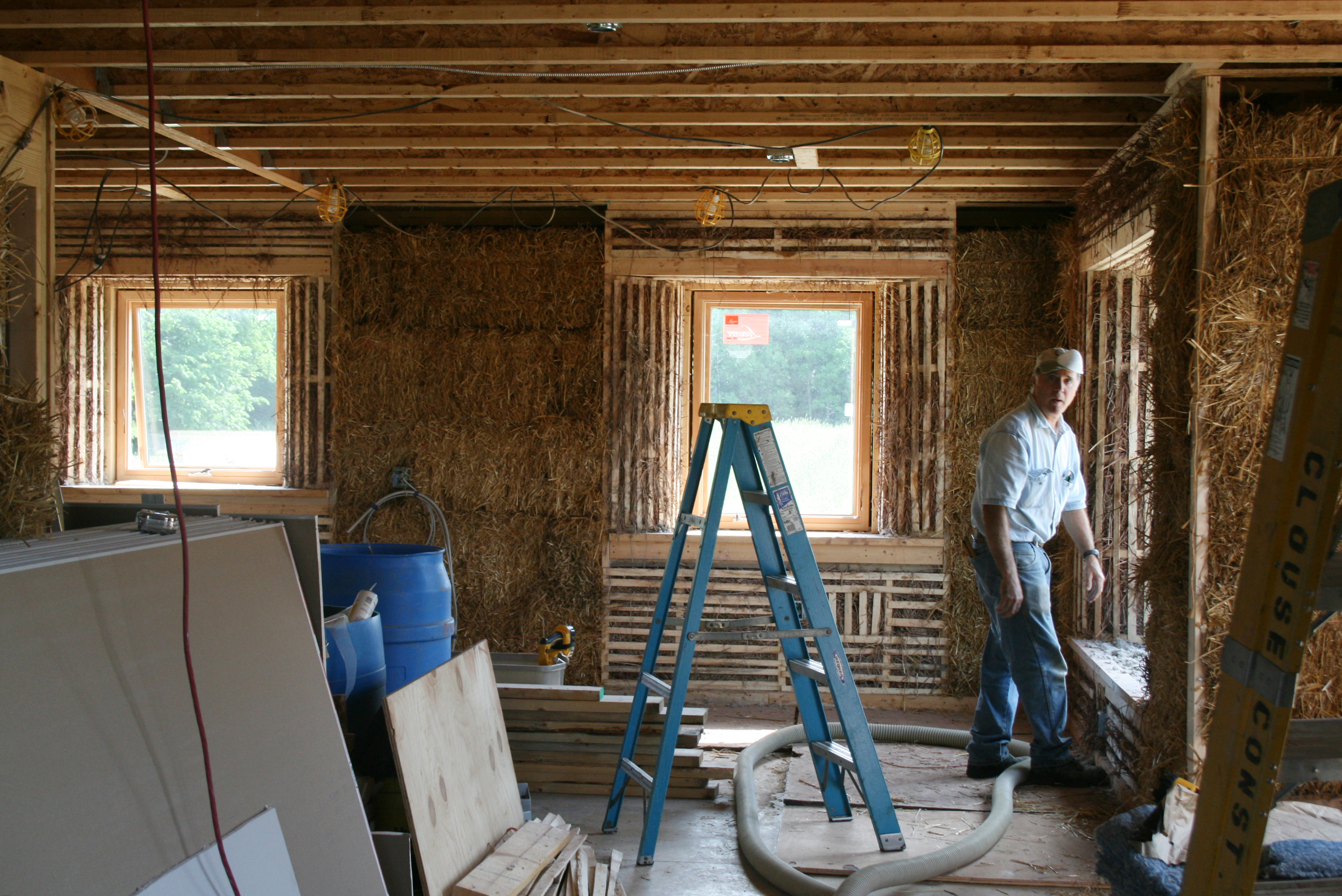
  • 300 straw bales tightly stacked and anchored within 20-inch wide exterior walls
  • a natural clay-based plaster coating on interior walls
  • long-lasting fiber cement siding
  • a 26-inch base of a ultra-lightweight material called millcell, manufactured in Germany from recycled glass
  • passive solar design that takes advantage of the warmth of winter sunlight while reducing heating from the sun in summer
  • triple pane glass windows, most of which face south

“That passive solar I never quite understood until I lived here for a year,” Sr. Jane told Catholic News Service. “That sun goes right on top of the house in the summer and doesn’t come in. And then as the winter approaches in the fall, the sun goes low and starts finding its way in.
“It’s so beautiful, the shadows, everything. It’s so beautiful to live close to the sun and benefit from what it can give us. When we invented air conditioning and furnaces, we just forgot about the sun,” she added.

St. Francis Sister Jane Frances Omler shows straw-bale insulation in the exterior walls of the energy-efficient house she helped build in Tiffin, Ohio, in this July photo. The Sisters of St. Francis of Tiffin built the house as a demonstration project to show that by incorporating non-traditional materials and a renewable-energy system, a house -- or almost any structure -- can be comfortable and good for the environment. (CNS photo/Chaz Muth)
St. Francis Sister Jane Frances Omler shows straw-bale insulation in the exterior walls of the energy-efficient house she helped build in Tiffin, Ohio, in this July photo. The Sisters of St. Francis of Tiffin built the house as a demonstration project to show that by incorporating non-traditional materials and a renewable-energy system, a house — or almost any structure — can be comfortable and good for the environment. (CNS photo/Chaz Muth)

A small window built into a living room wall allows visitors to see in fact that the walls are filled with straw.

About $200,000 was invested in the property. The amount includes grants, donations and gifts from corporations and individuals. Construction took about four years from start to finish as the order worked to secure funding in phases.

Sr. Jane and Sr. Janet Hay moved into the house in December 2012. Sr. Jane said the house remained comfortable during the bitterly cold winter of 2013-2014 despite temperatures falling far below zero on several occasions.

Joe Ferut Jr., president of Ferut Architects in Vermilion, Ohio, designed the house. He told CNS that passive solar design has become increasingly popular among homeowners who choose to remodel a house or build from scratch.

[quote_box_right]Green design ideas from Ferut Architects[/quote_box_right]While straw-bale construction is unusual, Ferut, who is Catholic, said he is finding that more people are looking to sustainability and energy efficiency in design as they seek ways to minimize fossil fuel consumption.

Ferut worked with natural building consultant Mark Hoberecht, a chemical engineer at NASA who runs HarvestBuild Associates in nearby Columbia Station, near Cleveland. His firm specializes in the use of natural materials in construction.

A worker puts straw bales inside the walls of a house using alternative construction materials on the grounds of the Sisters of St. Francis of Tiffin, Ohio. The religious order built the house as a demonstration project to show that by incorporating non- traditional materials and a renewable-energy system, a house -- or almost any structure -- can be comfortable and good for the environment. (CNS photo/courtesy Sisters of St. Francis of Tiffin)
A worker puts straw bales inside the walls of a house using alternative construction materials on the grounds of the Sisters of St. Francis of Tiffin, Ohio. The religious order built the house as a demonstration project to show that by incorporating non- traditional materials and a renewable-energy system, a house — or almost any structure — can be comfortable and good for the environment. (CNS photo/courtesy Sisters of St. Francis of Tiffin)

He told CNS that building homes using natural materials such as straw is beginning to gain interest in the U.S. after seeing success in Germany.

Sr. Jane has named the house Little Portion Green. She took the name from the small Porziuncola (little portion) church, now within the Basilica of Santa Maria degli Angeli, in Assisi, Italy, where St. Francis was inspired to start the Franciscan order.

The Tiffin order has long promoted sustainability and care of the environment on its 500-acre campus. The property includes a small organic farm; the Franciscan Earth Literacy Center, which hosts programs on the environment and a summer day camp for children; and a solar panel array that powers the center.

Planting seeds

The inspiration for the house is rooted in Sr. Jane’s 26-year ministry in West Virginia. In 1996 she coordinated the construction of a 400-square-foot chapel in the woods near Spencer, about 50 miles northeast of Charleston. Not satisfied with traditional construction techniques, she looked into alternative building materials and discovered plans for straw-bale buildings.

“I thought let’s do something real different and innovative because a lot of people would be interested in it. Nobody is interested in doing the same old stuff,” she said.

Soon after, Sr. Jane relocated to Mingo County in southwestern West Virginia where she ran educational programs for children at Big Laurel Learning Center. Operated by Catholic women religious, the center is located on a 500-acre trust established to protect the land from development and to provide a place for people to continue to live their Appalachian heritage.

In 1998, the first mountaintop removal coal mining operations began near the land trust.

Mountaintop removal mining involves the clear cutting of trees and the blowing off of the tops of mountains to reach coal seams. While the coal industry maintains that the practice allows easier access to coal to meet the country’s growing electricity needs, critics of such mining point to ill health among nearby residents, damaged homes and polluted air and water sources as being far too costly a price to pay to keep energy costs low.

Sr. Jane educated residents about the dangers of mountaintop removal mining. When Sr. Jane returned to Tiffin, her hometown, in 2006, she continued to help people understand that the coal taken from the mountaintops in such a destructive manner is being used to generate electricity in places like Ohio. She eventually determined that she wanted to live in a house that was not using electricity generated by coal-burning power plants.

Students from Tiffin area schools and their parents regularly visit the straw-bale house as part of the order’s earth literacy programs. Sr. Jane tells them that even if they cannot live in a house that is fully reliant on renewable energy, they can take steps to reduce their consumption of coal-generated electricity by adding insulation to walls and attics and replacing old-style incandescent light bulbs with more efficient LED models.

“I always tell the kids ‘Ask for an LED light for Christmas,'” she said.

— By Dennis Sadowski, Catholic News Service