Migrants in Tapachula, Mexico, wait in a stadium Dec. 3, 2021, as they hope to receive help from the Mexican government to obtain humanitarian visas to transit Mexico. (CNS photo/Jose Luis Gonzalez, Reuters)
WASHINGTON (CNS) — CatholicVote, a political advocacy group, has filed a lawsuit against the Biden administration seeking information about how the government and church-affiliated groups, mainly in the Diocese of Brownsville, Texas, have gone about “facilitating a record surge in illegal immigration.”
The lawsuit was filed under the Freedom of Information Act Feb. 4 with Judicial Watch.
The suit said the organizations want records of communication between administration officials and the Diocese of Brownsville; Bishop Daniel E. Flores, who heads the diocese; Catholic Charities of the Rio Grande Valley; Sister Norma Pimentel, “in her capacity as the executive director of the local Catholic Charities; and the Humanitarian Respite Center in McAllen, Texas, which Sister Pimentel is known for administrating.
A Feb. 9 email said CatholicVote was “demanding transparency from the federal government and to know whether and how it has funded and coordinated with Catholic-affiliated charities in facilitating a record surge in illegal immigration.”
A news release issued the same day by the Wisconsin-based group said the administration has refused to provide information on its communication with the Catholic-affiliated border charities mentioned in the suit.
Judicial Watch is a Washington-based activist group that files FOIA lawsuits to investigate government officials’ conduct.
“American Catholics deserve to know the full extent of the U.S. government’s role in funding and coordinating with Catholic Church-affiliated agencies at the border, and what role these agencies played in the record surge of illegal immigrants over the past year,” Brian Burch, president of CatholicVote, said in a statement.
“We will do whatever is necessary to uncover the truth,” he said.
The Catholic faith tradition, because of its long and noted history of being forced to be on the move, provides programs throughout the world to welcome and accompany those who are forced to leave their homelands. It’s a position historically backed by the work of U.S. Conference of Catholic Bishops as well as Catholic groups in the U.S. and around the world.
CatholicVote also said it was seeking “all communications” between the U.S. Customs and Border Patrol and the USCCB as they pertain to Sister Pimentel, the respite center and the Catholic Charities agency with which she is affiliated.
Sister Pimentel, a member of the Missionaries of Jesus, has received praise, including from Pope Francis, for her work with migrants under the auspices of the Brownsville Diocese, which helps those who cross into the U.S. near the McAllen and Brownsville area at the respite center, close to the U.S.-Mexico border.
On Feb. 10, Fox News reported that Republican Congressman Lance Gooden, of Texas, had sent the network a letter in which he questioned Catholic organizations about their role at the border and accused them of helping fuel problems at the southern border.
Fox said Gooden had written to several faith-based nonprofits, also called nongovernmental organizations or NGOs, including Catholic Charities USA, about retaining “any relevant documents and communications related to encouraging, transporting and harboring aliens to come to, enter or reside in the United States, needed for future oversight or legislative requests from the United States Congress.”
“I am troubled by the growing role NGOs have in fueling the drastic increase in illegal immigration across our southern border and throughout the country,” Fox said, quoting an email the congressman sent to the network.
The congressman’s letter also was sent to the faith-based groups Lutheran Immigration and Refugee Service and Jewish Family Services. Both organizations also help migrants.
Catholic Charities USA told Fox News Feb. 10 that “the Catholic Church has been ministering to the poor for 2,000 years and Catholic Charities, the U.S. humanitarian arm of the church, has been caring for our vulnerable sisters and brothers since 1910.”
“In collaboration with every administration since our founding a century ago,” the group said, “we are on the ground doing what they can’t — caring for those who are homeless, hungry, disaster-stricken, out-of-work and suffering. Our work is humanitarian, not political, and we proudly serve both citizens and migrants in our country.”
SCOTTSDALE, Ariz — Nearly 500 worshippers, a number of whom live with chronic physical and mental conditions gathered for the Diocese of Phoenix’s annual World Day of the Sick Mass of Healing and Reconciliation Saturday, Feb. 5; a week before the annual observance dedicated to prayer for the ill and infirm around the globe.
The Mass, celebrated at St. Bernard of Clairvaux Parish in Scottsdale, was highlighted by the Sacrament of the Anointing of the Sick and a homily by Bishop Thomas J. Olmsted that focused on finding God’s goodness in the midst of physical suffering.
Dozens of individuals, some pushed in wheelchairs or who moved gingerly using walkers or canes, made their way down the aisles of St. Bernard of Clairvaux’s nave to receive the sacrament in which the bishop or a priest offers a blessing to each individual while anointing that person on his or her forehead and the palms of his or her hands with holy chrism oil. Bishop Olmsted was joined in the rite by Fr. Michael Straley, pastor of St. Bernard, and several other priests.
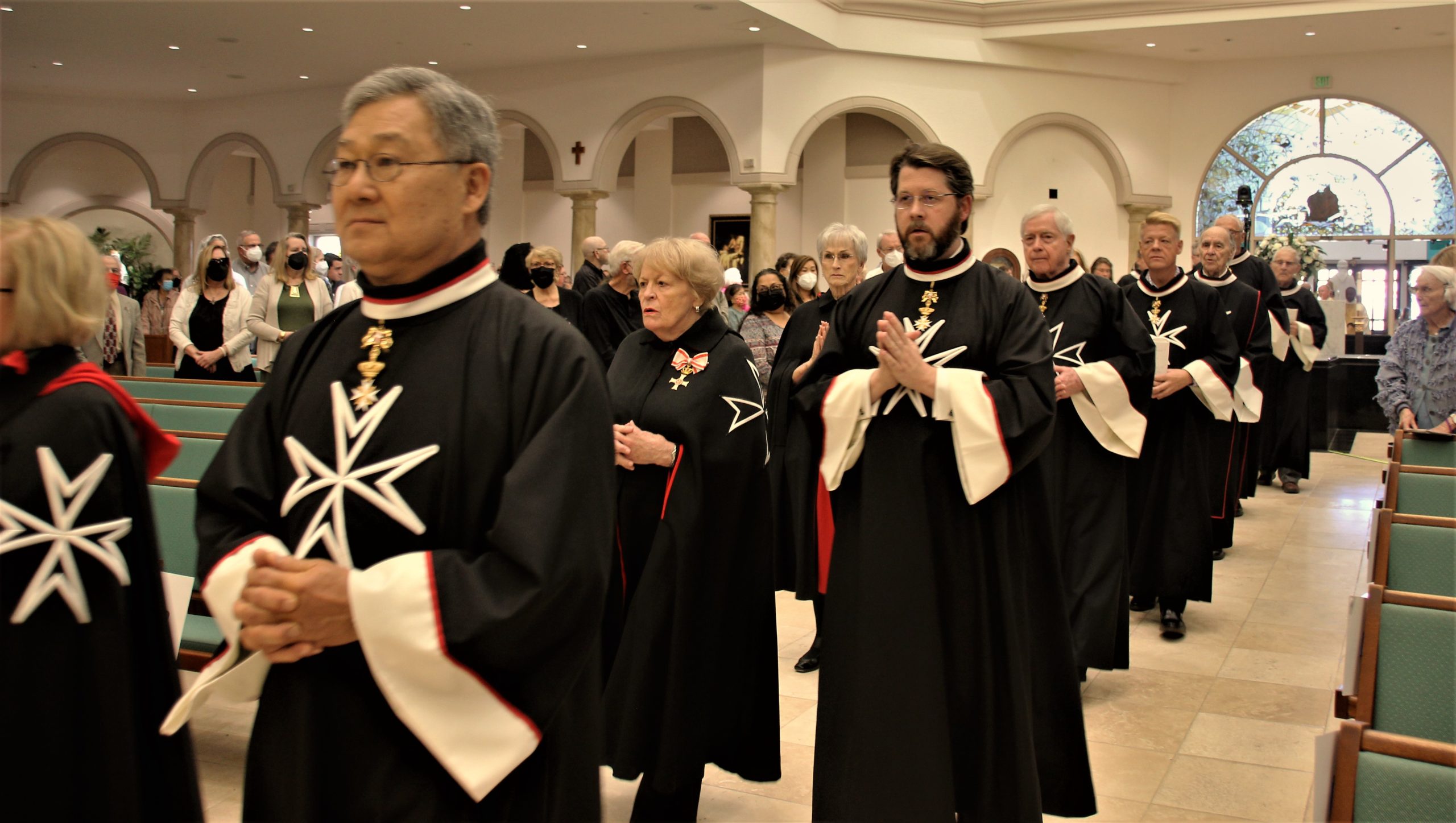
Knights and Dames of the Sovereign Order of Malta process at the start of the Diocese of Phoenix’s World Day of the Sick Mass of Healing and Restoration at St. Bernard of Clairvaux Church in Scottsdale, Saturday, Feb. 5. (Jeff Grant/THE CATHOLIC SUN)
The Mass is organized and coordinated annually by the Sovereign Order of Malta, one of the world’s oldest Catholic lay religious organizations. Established in 1113, the Order is guided by its motto Tuitio Fidei et Obsequium Pauperum — nurturing, witnessing and defending the faith, and serving the poor and the sick.
During the Liturgy of the Anointing, the bishop and concelebrating priests laid hands on a group who came for anointing. The bishop then offered a prayer of thanksgiving over the holy oil. The celebrants blessed each recipient with these words as they anointed the person: “Through this holy anointing, may the Lord in His love and mercy help you with the grace of the Holy Spirit,” and “May the Lord who frees you from sin save you and raise you up.”
The experience touched some of the anointed in a deep and profound way.
“Inside, I just have an overwhelming feeling; I can’t explain it in words. I feel really blessed,” beamed Maura Lenz, 59 of Phoenix. A regular worshipper at St. Raphael in Glendale and St. Paul in Phoenix Lenz suffers from dystonia, a state of abnormal muscle tone resulting in muscular spasm and abnormal posture.
“It was a very uplifting experience, very fulfilling, it was emotional, too,” explained Trish Mahoney. A first-time participant in the healing Mass, Mahoney suffers from frequent open wounds, stemming from psoriatic arthritis. She also has osteoarthritis and poor circulation below her knees, conditions developed in her late 50s that keep her in a wheelchair. Mahoney was invited by her friend since college, Mary Madonia, a parishioner of St. Timothy in Mesa who signed the pair up after seeing the Mass’ promotion on the Diocesan website. A friend of Mahoney’s since the 1970s, when the pair met in college, Madonia had attended the 2020 Mass, but continues to be moved by the experience.
“I knew how fulfilling it was. It was very powerful,” she said, her voice beginning to break. “It was very difficult, It touched a lot of emotions, seeing the most infirm individuals receive anointing.”
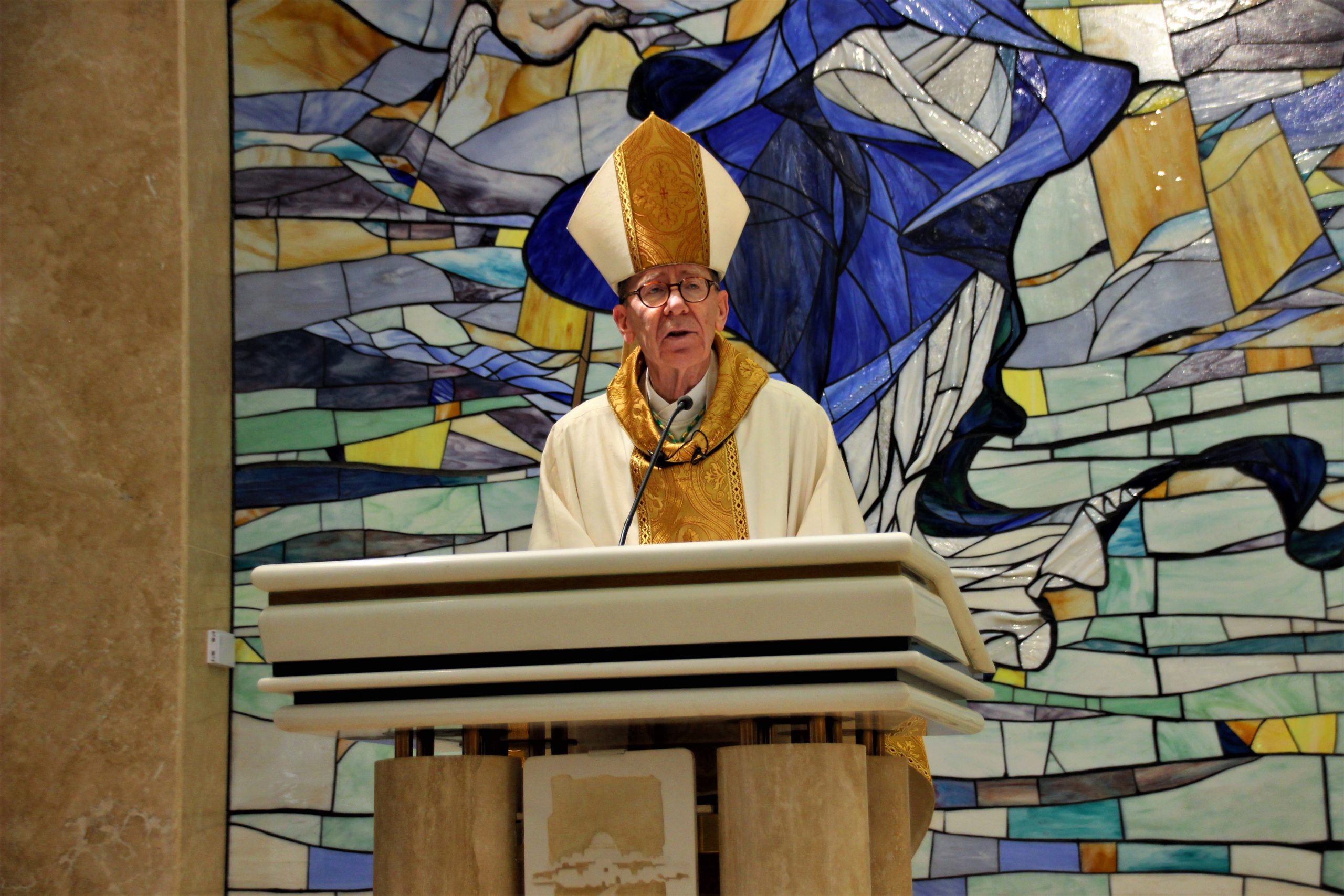
Bishop Thomas J. Olmsted delivers the homily during the Diocese of Phoenix’s World Day of the Sick Mass of Healing and Restoration at St. Bernard of Clairvaux Church in Scottsdale, Saturday, Feb. 5. (Jeff Grant/THE CATHOLIC SUN)
The rite immediately followed a homily in which Bishop Olmsted emphasized physical suffering and the emotional and spiritual pain that often accompanies it as blessing and a vehicle by which Christ’s followers carry out His command to aid and pray for the sick.
Pointing to the day’s responsorial Psalm – Psalm 89:1 which find the psalmist able to praise God because of His faithfulness in spite of earthly trouble – the bishop said the words carry “a particular resonance” when proclaimed at a Mass of Healing and Anointing.
He pointed as well to the final words of the day’s Recessional hymn, Oh God Beyond All Praising. “Whether our tomorrows be filled with good or ill, we’ll triumph through our sorrows and rise to bless you still: To marvel at your beauty and glory in your ways,
and make a joyful duty our sacrifice of praise,” the bishop recited.
“The gift of faith – believing in the love of Jesus, both in sickness and in health – is a wondrous blessing that the world cannot understand. In facing serious illness and the possibility of death, the gift of faith in Jesus shines with ever greater radiance. Even without fully understanding when serious illness has approached – in the love of Christ, when accepted in hope and trust in divine mercy – our faith overflows with meaning and even with song,” the bishop said.
“We cannot find meaning in life until we learn to trust the Lord no matter what. An opportunity to trust and to grow in trust of the Lord arises when we are seriously ill. Illness forces us to cope with pain and to face the unknown. It can also prompt us to question God’s love. Our patience is put to the test as is the patience of those around us. At the same time, the experience of illness opens the door for us to encounter Jesus in a more profound and personal way. For whenever we are ill, or in great need, the Lord draws near.”
“Even those around the ill are affected,” he added.
“The mystery of human suffering touches every human person. We all our familiar with pain. It stirs up our fears. We may even feel it is impossible to go on. However, in the face of hopelessness and fear, the Holy Spirit is within our hearts, stirring up within us an even keener awareness of the mercy of God.”
Maura Levy of Phoenix, left, and her daughter, Brieann, following the Diocese of Phoenix’s World Day of the Sick Mass of Healing and Restoration at St. Bernard of Clairvaux Church in Scottsdale, Saturday, Feb. 5. (Jeff Grant/THE CATHOLIC SUN)
This year marks the 30th observance of World Day of the Sick. Announced in 1992 by St. John Paul II as a way for believers to offer prayers for those suffering from illnesses, the day is also used to encourage prayers for caregivers of the ill and those in the health care field. John Paul II, as pope, introduced the day a year after being diagnosed, himself, with Parkinson’s disease. It was first observed a year later in 1993. The day falls every year on Feb. 11, which also is the Feast Day of Our Lady of Lourdes.
Attendance was off this year, compared with 2021, when the Mass resumed in person following a year’s hiatus due to the COVID-19 pandemic. Next year, the Mass will return to its longtime site, Ss. Simon and Jude Cathedral, where renovations have pushed the rite out to Scottsdale the past two years. Order of Malta Western Association Board of Directors member, Timothy Jefferies, attributed the drop-off to continuing news coverage of the pandemic, specifically the illness’ Omicron variant, which is considered less lethal than other forms but highly contagious. “We had the same number of RSVPs as last year, but people were panicked,” he explained.
As it has been regularly, the service was live-streamed on the Diocese’s Facebook page and YouTube channel and broadcast throughout Arizona on AZTV 7 and globally on EWTN.
Those unable to attend or who preferred to remain away could submit prayer requests online established by the Order. Jefferies said the number of prayer requests remained high, with an estimated 2,000-3,000 received. The Order will carry those requests on its annual pilgrimage to Lourdes, the town in southern France where the Blessed Mother appeared in a series of apparitions to St. Bernadette, a 14-year-old peasant girl, in 1858. The grotto where the visions occurred is said to contain water with special restorative health properties. A total of 70 miraculous healings have been recognized at Lourdes since St. Bernadette’s visions, the latest in 2018.
The prayer requests will be deposited in a bin at the grotto during the Order’s next pilgrimage during the last week of April, Jeffries said. The nature of the requests has been pretty consistent, with submissions citing a variety of illnesses, but also mentioning other topics. “Troubled marriages, children with great challenges such as suicidal tendencies and drug use, The prayer requests are highly indicative of the swath of challenges the faithful face,” he noted. Requests can be submitted online until April 24.
Knights and Dames with the Order escort a group of the ill – referred to as malades – on the pilgrimages. Malades are chosen annually for the trip in the year ahead after submitting applications to the Order. While the application deadline for 2022 has past, the Order is accepting requests to be included in the 2023 pilgrimage.
Jeffries said that period likely will close “around the end of October.” The malades’ trip is funded “100 percent” by the Order, which has room for each to being a traveling companion. “We look to companions to pay or raise the funds,” Jeffries explained. “We have found it is very easy for companions because it is so compelling.” At least one former malade attended the Mass at St. Bernard.
Maura Lenz made the 2014 pilgrimage and came to Scottsdale in part to reconnect with Knights and Dames who she was with in France. She also welcomes the chance to speak with others suffering conditions similar to hers. “I’ve been disabled for 37 years, and, I believe at one point, I felt there was a reason and believe God chose this path so I could help other people in what they are going through.”
Father Paul Hartmann, a priest of the Archdiocese of Milwaukee, is seen in this undated photo. He was named associate general secretary of the U.S. Conference of Catholic Bishops in Washington Feb. 10, 2022. (CNS photo/courtesy USCCB)
WASHINGTON (CNS) — Father Paul Hartmann, a priest of the Archdiocese of Milwaukee, has been appointed associate general secretary of the U.S. Conference of Catholic Bishops, effective in May.
In the post, he will serve as administrator of the USCCB’s pastoral offices and a member of the executive staff.
His appointment, announced Feb. 10, was made after consultation with the USCCB’s Executive Committee and with the permission of Archbishop Jerome E. Listecki of Milwaukee, according to a news release.
Ordained to the priesthood in 1994, the priest has served as judicial vicar for the metropolitan tribunal in Milwaukee since 2003, along with assignments as pastor of various parishes and as president of Catholic Memorial High School, his alma mater, from 2007 to 2018.
He graduated from Jesuit-run Marquette University with a double major in communications and philosophy. He attended St. Francis de Sales Seminary in Milwaukee, where he earned a master’s in divinity and has a licentiate in canon law from The Catholic University of America in Washington.
“I am very grateful to Archbishop Listecki for allowing Father Hartmann to assume these new duties,” said Father Michael J.K. Fuller, USCCB general secretary, who made the appointment.
“Father Hartmann brings with him a background in communications, the practice of canon law and pastoral experience to carry out the priorities of the bishops under the leadership of Archbishop (José H.) Gomez,” USCCB president, Father Fuller said in statement. “He will be a great addition to the staff of the conference, and I look forward to working with him.”
Father Hartmann has served as chaplain to the St. Thomas More Lawyers Society of Wisconsin and the Wisconsin area’s Knights of Malta. A member of the Canon Law Society of America since 1997, he was elected to the organization’s board of governors.
In June 2017, Father Hartmann was appointed pastor of two Wisconsin parishes, St. Monica in Whitefish Bay and St. Eugene in Fox Point, while remaining judicial vicar.
A woman on a boat talks with a friend in the evening in Valletta, Malta, in this March 25, 2010, file photo. The Vatican announced that Pope Francis will visit the island nation of Malta April 2-3, 2022. (CNS photo/Paul Haring)
VATICAN CITY (CNS) — Pope Francis will visit Malta April 2-3, a Vatican spokesman said.
Accepting the invitation of the president, civil authorities and bishops of the Mediterranean country, the pope will visit the cities of Valletta, Rabat and Floriana and the island of Gozo, Matteo Bruni, the spokesman, said in a written statement Feb. 10.
“The program and further details of the journey will be announced in the near future,” he said.
Malta is an archipelago made up of three main islands where St. Paul and his companions washed ashore nearly 2,000 years ago. Today, more than 90% of the country’s 460,000 people profess to be Catholic.
Pope Benedict XVI visited Malta in 2010 to help commemorate the 1,950th anniversary of St. Paul’s arrival and the birth of Christianity in this Mediterranean nation situated between Sicily and North Africa.
He met privately with local sex abuse victims in the midst of a worldwide storm over how the church handled clerical sex abuse; he assured the survivors that the church was doing everything in its power to bring perpetrators to justice and to prevent further abuse of young people.
The retired pope appointed his special promoter of justice at the Congregation for the Doctrine of the Faith, who dealt directly with many abuse cases, then-Monsignor Charles Scicluna, to be the auxiliary bishop of Malta. Today he is Malta’s archbishop and adjunct secretary of the doctrinal congregation.
Malta — along with Italy, Spain and Greece — continues to be a major point of arrival for many migrants crossing the sea illegally, and current European Union policies have left these countries on their own to rescue, shelter, verify and try to integrate these migrants.
Pope Francis visits with Pope Benedict XVI at the retired pope's residence after a consistory at the Vatican in this Nov. 28, 2020, file photo. This photo was released by the Vatican Feb. 9 after Pope Francis, at his general audience, praised Pope Benedict's comment in a statement the previous day recognizing his own presence before "the dark door of death." (CNS photo/Vatican Media)
By Carol Glatz, Catholic News Service
VATICAN CITY (CNS) — Pope Francis was among those showing their support for retired Pope Benedict XVI, sending his predecessor “a beautiful letter,” according to the former pope’s secretary.
In the letter, Pope Francis “speaks as a shepherd, as a brother” and “expressed once again his complete trust, his full support and also his prayers,” said the secretary, Archbishop Georg Gänswein.
The archbishop spoke to the Italian news program TG1 Feb. 9 about the retired pope’s letter in response to a report on sexual abuse cases in the German Archdiocese of Munich and Freising, which the former pope headed as Cardinal Joseph Ratzinger from 1977 to 1982.
Pope Benedict, who has denied allegations of mishandling four cases of clerical sexual abuse put forth by the report, emphasized in a letter Feb. 8 his feelings of great shame and sorrow for the abuse of minors and made a request for forgiveness to all victims of sexual abuse.
Archbishop Gänswein was asked to respond to criticisms by some victims’ advocates and media in Germany that Pope Benedict’s apology was insufficient.
“Whoever reads the letter in a sincere way, the way in which the letter was written, cannot agree with these criticisms or these accusations. He asks all victims of abuse for forgiveness,” he said.
The archbishop, who started working with the former pope in 1996 at the Congregation for the Doctrine of the Faith and became his personal secretary in 2003, was asked how he saw the pope react to the growing abuse scandals during his tenure.
A clear indication of how the pope felt, the archbishop said, can be seen in the meditations he wrote as cardinal for the Good Friday Way of the Cross in 2005, writing forcefully about how much “filth there is in the church,” even among those in the priesthood.
There are measures, documents and evidence that show how much he, first as Cardinal Ratzinger, then as Pope Benedict, did “in order to make progress in a cleanup from within in a suitable way,” Archbishop Gänswein said.
Asked about the allegations of mishandling of abuse cases when the pope was archbishop of Munich, the aide said no evidence of his guilt was presented in the report.
“The accused does not have to prove his innocence,” he said. “If they have proof, then they must say, ‘This is the proof you are guilty.'”
SoFi Stadium in Inglewood, Calif., is seen Jan. 30, 2022, after the Los Angeles Rams defeated the San Francisco 49ers 20-17 in the NFC Championship game to advance to Super Bowl LVI. (CNS photo/Bing Guan, Reuters)
By Tom Hoffarth, Catholic News Service
LOS ANGELES (CNS) — For the first time in 30 years, the NFL’s Super Bowl has arrived in Los Angeles — and with it, a fair share of the global media hype for which the annual sporting event is known.
But just as predictably, the game also has brought attention to what has long been portrayed as the dark side of the Super Bowl: the risk of human trafficking.
In the days leading up to the Feb. 13 game in Inglewood’s new SoFi Stadium, local authorities have warned of coming sting operations and criminal penalties associated with sex trafficking.
For several weeks, initiatives such as “It’s A Penalty” program have enlisted Rams kicker Johnny Hekker and other NFL players to remind visitors in places like the Los Angeles International Airport of the factors that make Southern California a trafficking hotspot: its proximity to international borders; its attractiveness to runaway youths; and the presence of inner-city gang commerce.
Last year, for example, more than 70 people were arrested and six possible victims were aided following an investigation into sexual exploitation during Super Bowl week in Tampa, Florida.
In Los Angeles, nonprofit organizations also have stepped up their outreach to educate the public as well as offer victim assistance, including the SOAP Project, which distributes bars of soap to L.A.-area hotels labeled with tips on how to identify possible victims in need of immediate help.
But while local Catholic advocates involved in the fight against trafficking appreciate the renewed attention, they also warn there’s a risk in thinking the Super Bowl is an isolated occasion of danger.
“It may be counterintuitive to how the media talks about trafficking related to this as a ‘Super Bowl issue,’ but that rhetoric can take away from the fact there are injustices done all the time,” said Sister Anncarla Costello, a Sister of Notre Dame, who is chancellor of the Archdiocese of Los Angeles.
She also is president of the board of directors of Los Angeles-based Coalition to Abolish Slavery and Trafficking, or CAST.
The Los Angeles Times went even further, decrying the association between the Super Bowl and the heightened risk of trafficking as a “myth” and “falsehood” in a Feb. 6 editorial.
Sister Anncarla noted the recent surge in human trafficking cases has been a result not of major sports events, but in large part due to circumstances caused by the COVID-19 pandemic.
“The danger is if we perpetuate this rhetoric around certain events such as the Super Bowl, people can start to associate human trafficking to only sporting events,” Sister Anncarla told Angelus, the online news outlet of the Archdiocese of Los Angeles.
“This tends to mitigate the need to continue to educate people regarding the presence and the prevalence of this horrible crime, which happens every day, in every city and town, and even right next door,” she said.
CAST, working with the Department of Justice, provided support to nearly 2,000 human trafficking survivors in 2021, a 556% increase since pre-pandemic 2019. Hotline calls also were up 97%.
Michael Donaldson, senior director of the Archdiocese of Los Angeles’ Office of Life, Justice and Peace, sees human trafficking as a scourge deeply intertwined with many of the other important life issues his department deals with.
For example, Donaldson noted, abortions are often procured by perpetrators as a form of birth control for victims, homelessness can result from a victim fleeing a trafficker, and those who slip out of foster care often end up introduced into this vicious cycle.
“As a life issue, it is something Catholics need to be part of,” said Donaldson. “We can’t be silent especially as we are in the major center of it.”
Susan Patterson, the director of Through God’s Grace Ministry, has hosted a human trafficking resource table at OneLife LA, an annual event in January. Patterson said she has encountered many who had difficulty believing human trafficking was happening locally.
“For the faith community, a path has been clearly laid out for what we can do regarding pro-life, homelessness, and other issues, but, it is not clear what the role of the church is in the fight against human trafficking,” said Patterson.
She also helped start the SoCal Faith Coalitions Against Human Trafficking, whose member parishes include St. Lawrence Martyr Church in Redondo Beach and St. Joseph Church in Long Beach.
Patterson noted that the church has shown paths for what faithful can do regarding issues such as abortion and homelessness, “but it is not clear what the role of the church is in the fight against human trafficking.”
“We are not going to arrest our way out of the problem of human trafficking,” said Patterson, who believes that ending the scourge of sex trafficking calls for community support from Christians of all denominations.
One tool in that effort has been the 2020 Christian documentary film “Blind Eyes Opened: The Truth About Sex Trafficking in America,” offered to congregations as an educational resource.
Producer Geoff Rogers noted that one often-overlooked factor in LA’s sex trafficking is the proliferation of the adult entertainment business.
“(L.A.) has a history of sexualization of people for sale, both men and women,” said Rogers. “When you dive deep into this topic, it is as simple as the economics of a supply answer to a demand problem. Where does the demand come from? Often, the addiction to pornography taking place with a desire for unhealthy sex.”
Rogers, co-founder of the faith-based U.S. Institute Against Human Trafficking based in L.A., said that while human trafficking is not particular to the Super Bowl, it does attract anti-trafficking campaigns, which “is a great way to raise awareness,” since “so many watch this game around the country.”
Sister Anncarla said, “Many of us cannot be on the front lines of the fight against human trafficking for whatever reasons, but instead of sidestepping the issue, we have the power to lift in prayer those who can … and, of course, our suffering sisters and brothers who are the victims. We all can do something.”
Sister Melinda Pellerin, a Sister of St. Joseph of Springfield, Mass., participates in a "Standing for Hope" event Aug. 4, 2020, sponsored by her religious community. (CNS photo/courtesy Sisters of St. Joseph of Springfield via Diocese of Springfield)
By Rebecca Drake, Catholic News Service
SPRINGFIELD, Mass. (CNS) — The topic of racism can be a source of conflict. But when Sister Melinda Pellerin found herself in a conversation with a woman who denied the existence of systemic racism in the U.S., she let her faith lead her response.
“And so I had to come to the point where I can go many ways with this, but I’m going to go the way of Jesus,” she said. “I’m going to still look at this woman, as I try to look at everyone, as beloved, a child of God.”
Sister Pellerin, who professed her final vows as a Sister of St. Joseph of Springfield in 2019, was the first, and is still the only, African American sister in her congregation.
She was interviewed as part of a television series on Black Catholics produced by the Catholic Communications ministry of the Springfield Diocese. She currently is a pastoral minister at Holy Name Parish in Springfield.
In responding to the Gospel call to seek racial justice, Sister Pellerin said Catholics are well-equipped for the challenge.
“Think of Catholicism and what that word means,” she said. “We are family and if the members of our family are suffering, are in pain, or being persecuted, we are obligated to do something about it. And our obligation means to start an educational experience by teaching people about it.”
She said the first step in this educational experience is to do something that Jesus did very well: listen.
“But I want you to hear with your ears and with your heart, what this issue is all about,” she said to the interviewer, “and, as a white woman, you have not experienced it, but walk with me because I can tell you how I experience it.”
Like other Black Catholics interviewed for the series, Sister Pellerin’s roots are in Broussard, Louisiana, where the shadow of racism loomed over the most sacred moment of the Catholic liturgy: the reception of the Eucharist.
“And my grandmother and great-grandmother would tell me stories about, ‘Oh, and we went into church, Blacks had to sit in the back, and white Catholics sat in the front, and then Father would give Communion to the white Catholics first and then put on gloves and give Communion to us.”
But when Sister Pellerin asked her great-grandmother why she chose to remain in a segregated church, this was her answer: “And she said, ‘It’s not about where I sit in that church, it’s about looking up at that cross. And I have dedicated my life to Jesus and what Jesus wants to do. And I’m going to fight so that things will not always be this way.'”
Growing up as a Catholic at the former Holy Family Parish in Springfield, Sister Pellerin still wondered why her family was in “the white church” — until the Springfield Diocese ordained its first African American priest, Father Warren Savage, in 1979.
“And I really learned the history of my church, which is part of the Catholic Church,” she said. “Very few Catholics know the rich history we have contributed to the Catholic Church.”
But since becoming a Sister of St. Joseph, this former award-winning teacher has used her educational skills to share the history of Black Catholics, including working with the Federation of the Sisters of St. Joseph to create a “Juneteenth Calendar.”
“But we didn’t just do the fifteenth of June,” she said. “Every (day) in June I highlighted a different person from Africa who was a Christian in the early Catholic Church and African American Catholics.”
And while studying the history of Black Catholics reveals racism in the church, Sister Pellerin said Black Catholics can lead the way to healing and reconciliation.
“Black Catholics have dealt with this division in the church since Black Catholics started going to the church and I always say to myself, ‘We know how, with no way, we found a way.’ And so within this church, and within the segregation of the Catholic Church, our spirituality can come; we can celebrate that.”
Suggesting a way to begin the healing process, she cited the example of Springfield Bishop William D. Byrne, who soon after his December 2020 ordination and installation, held a Holy Hour and eucharistic adoration to pray for healing for clergy abuse victims.
“I loved the bishop when he got together and there was a prayer service over people who have been hurt by priests, and when he was in front of the Eucharist, I kept saying to myself, ‘We’ve got to do this for, not only those instances, but for racism in this country: Go before the Eucharist and pray about it.'”
It is the closeness to Christ in the Eucharist, she said, that has provided strength to Black Catholics who have faced discrimination both inside and outside the church.
“African American Catholics understand it through the racism and separation and Jim Crow: They still went into that church and sat in the back and received Communion, whether that priest put on a glove, it wasn’t about that glove,” she said. “It was about that, the Eucharist, the body of Christ. It’s what I will take inside of me and what I will take with me.”
A candidate for citizenship in New York City is seen during a U.S. Citizenship and Immigration Services naturalization ceremony July 22, 2020. (CNS photo/Shannon Stapleton, Reuters)
By Rhina Guidos, Catholic News Service
WASHINGTON (CNS) — Biden administration officials replaced a Trump-era mission statement Feb. 8 with a shorter one, emphasizing “America’s promise as a nation of welcome and possibility.”
Trump administration officials had put their touch on the mission statement for U.S. Citizenship and Immigration Services, more commonly known for its USCIS acronym, causing furor in 2018 after omitting the phrase “a nation of immigrants.”
After the 2018 changes, the Trump officials said the agency administered “the nation’s lawful immigration system, safeguarding its integrity and promise by efficiently and fairly adjudicating requests for immigration benefits while protecting Americans, securing the homeland and honoring our values.”
In announcing a new statement, USCIS Director Ur M. Jaddou said Feb. 8 that “the United States is and will remain a welcoming nation that embraces people from across the world.”
“At its core, USCIS is about delivering decisions to families, businesses, workers and those seeking refuge in our country on their applications, petitions, requests and appeals. This new mission statement reflects the inclusive character of both our country and this agency,” Jaddou said.
The agency, under the U.S. Department of Homeland Security, grants immigration benefits and promotes citizenship, processing applications for family petitions, work permits, permanent residency cards, humanitarian benefits and naturalization services.
“We strive to provide a timely decision, be it yes or no, and with the utmost respect, to every petitioner or person who seeks a benefit from USCIS, be it a U.S. citizen seeking to reunite with a family member, a U.S. business attempting to hire a skilled foreign national, a lawful permanent resident seeking naturalization, or a person who hopes to find a place of refuge from persecution,” Jaddou said.
While Jaddou said the new statement better reflects a “commitment to an immigration system that is accessible and humane,” many have recently criticized the administration for keeping in place some restrictive measures from the Trump administration that keep migrants out.
Cincinnati Bengals kicker Evan McPherson, right, celebrates his game-winning field goal on GEHA Field at Arrowhead Stadium in Kansas City, Mo., Jan. 30, 2022. (CNS photo/Jay Biggerstaff, USA TODAY Sports via Reuters)
LOS ANGELES (CNS) — Archbishop José H. Gomez of Los Angeles and Archbishop Dennis M. Schnurr of Cincinnati are rooting for their home team in Super Bowl LVI, but they also have placed a friendly wager on the outcome of the Feb. 13 showdown between the Rams and the Bengals.
The prelates announced the wager in a joint video posted online Feb. 9.
For his part, Archbishop Gomez offered baked treats from the City of Angels beloved Porto’s Bakery. On his end, Archbishop Schnurr offered a case of Cincinnati’s own Graeter’s ice cream.
“I look forward to celebrating the Rams’ victory with the delicious Graeter’s ice cream that Archbishop Schnurr will be sending my way,” commented Archbishop Gomez.
“One of the best parts of the Bengals’ triumph will be digging into the famous Porto’s pasteles and cookies provided by my friend Archbishop Gomez,” responded Archbishop Schnurr.
The prelates also are encouraging Catholics to get involved in this friendly exchange by donating to each archdiocese’s Catholic Education Foundation, or CEF, in the spirit of the big game by going to www.bishopsbiggame.com.
“Or follow #BishopsBigGame on social media to see how you can be a part of the excitement and donate to support Catholic school students in the name of your favorite team,” said a news release about the episcopal wager.
“The CEF of the ‘winning’ archdiocese will receive 60% of the total fund and the CEF of the other archdiocese will receive 40% of the total fund,” it said. “All proceeds collected will go directly to the respective CEFs, which provide needs-based tuition assistance for students attending Catholic schools.”
To get things started, each archbishop has made of a donation of $1,000 to the joint fund set up to receive all donations.
“I am so proud of the Catholic schools of the Archdiocese of Cincinnati and the work of the Catholic Education Foundation. Through the generosity of the faithful, the CEF is providing millions of dollars of financial assistance each school year,” Archbishop Schnurr said.
“We may disagree on the winning team, but on Catholic education, our bet is on our Catholic schools in both archdioceses all the way,” added Archbishop Gomez.
“I’m proud of the great work of our students, teachers, staff, families and parish communities that make our Catholic Schools great,” he said, “and for the generous support of the faithful through CEF so that our students have the opportunity to learn and grow to become the leaders of tomorrow.”
Pope Francis touches the head of a baby as he greets family members during his general audience in the Paul VI hall at the Vatican Feb. 9, 2022. (CNS photo/Vatican Media)
By Carol Glatz, Catholic News Service
VATICAN CITY (CNS) — People have a right to life, not to death, which must be welcomed but never provoked, Pope Francis said.
“The right to care and treatment for all must always be prioritized, so that the weakest, especially the elderly and the sick, are never discarded,” he said Feb. 9 during his weekly general audience.
The pope also criticized a problem he said is real for older people “in a certain social class” of not being given all of the medicine or care they need since they lack the money.
“This is inhumane. This is not helping them, this is pushing them more quickly toward death,” he said. They must be cared for and not marginalized.
The pope’s remarks were part of his series of audience talks about St. Joseph and his role as the patron saint of a “happy” death, a term used to describe a last stage of life that is peaceful and full of faith and hope.
Pope Francis praised a recent comment by retired Pope Benedict XVI, who, at nearly 95 years of age, recognizes his own presence before “the dark door of death.”
It is “good advice” for everyone, Pope Francis said, because today’s “so-called ‘feel-good’ culture tries to remove the reality of death.” People seek to ignore “our finite existence, deluding ourselves into believing we can remove the power of death and dispel fear.”
The COVID-19 pandemic has brought the reality of death back into focus, he added, and so many people “have lost loved ones without being able to be near them, and this has made death even harder to accept and process.”
The Christian faith is not about removing the fear of death; “rather, it helps us to face it” with trust in Christ’s promises, he said. Christians know for certain, he said, that Christ is risen and “awaits us behind that dark door of death.”
“We cannot avoid death, and precisely for this reason, after having done everything that is humanly possible to cure the sick, it is immoral to engage in futile treatment,” the pope said, referring to the Catechism of the Catholic Church’s teachings on the legitimacy of refusing “overzealous” treatment not to cause death but to accept it (paragraph 2278).
When it comes to the experience of death itself, of pain or of suffering, he said, “we must be grateful for all the help that medicine endeavors to give, so that through so-called ‘palliative care,’ every person who is preparing to live the last stage of their life can do so in the most human way possible.”
However, the pope warned against confusing such care with unacceptable interventions that lead to killing people. “We must accompany people toward death, but not provoke death or facilitate assisted suicide.”
This ethical principle, he said, applies to everyone, “not just Christians or believers.”
At the end of his main audience talk, the pope reminded people of the church’s celebration of the World Day of the Sick Feb. 11. He asked that all people experiencing illness be guaranteed health care and spiritual accompaniment.
He urged people to pray for those who are ill, their families, health care and pastoral workers, and everyone who helps care for their needs.