Red, White and Blue Mass pays tribute to veterans

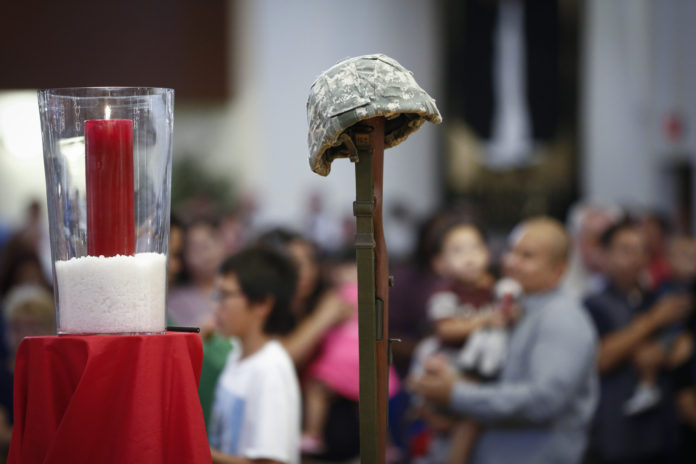
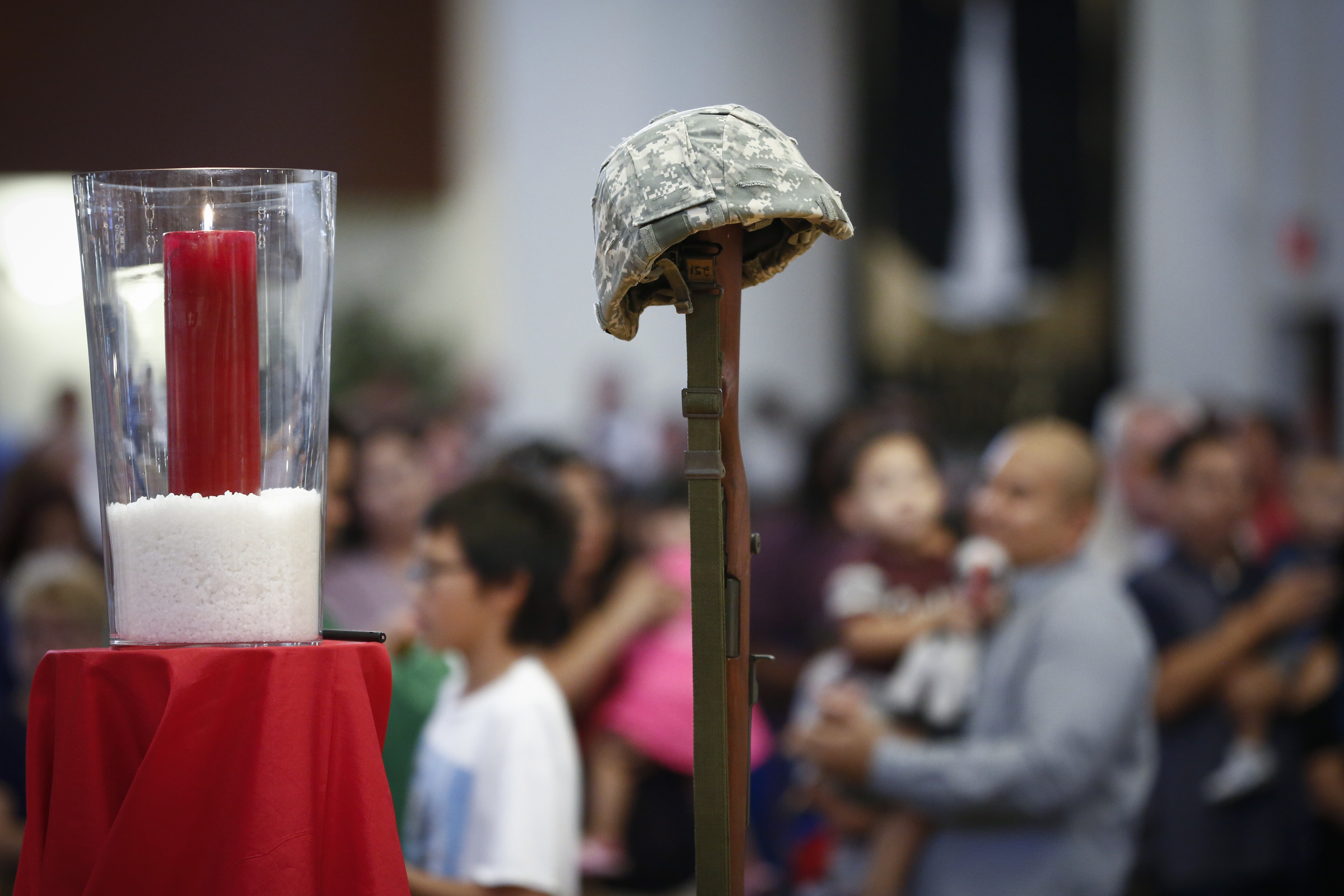
A military helmet rests on a rifle during the sixth annual Red, White and Blue Mass at St. Thomas Aquinas Church in Avondale, Ariz., Nov. 6. During the Mass, the Diocese of Phoenix honored active and retired service men and women and those who have died in service to the country. Veterans Day is Nov. 11. (CNS photo/Nancy Wiechec)

By Jeff Grant
The Catholic Sun

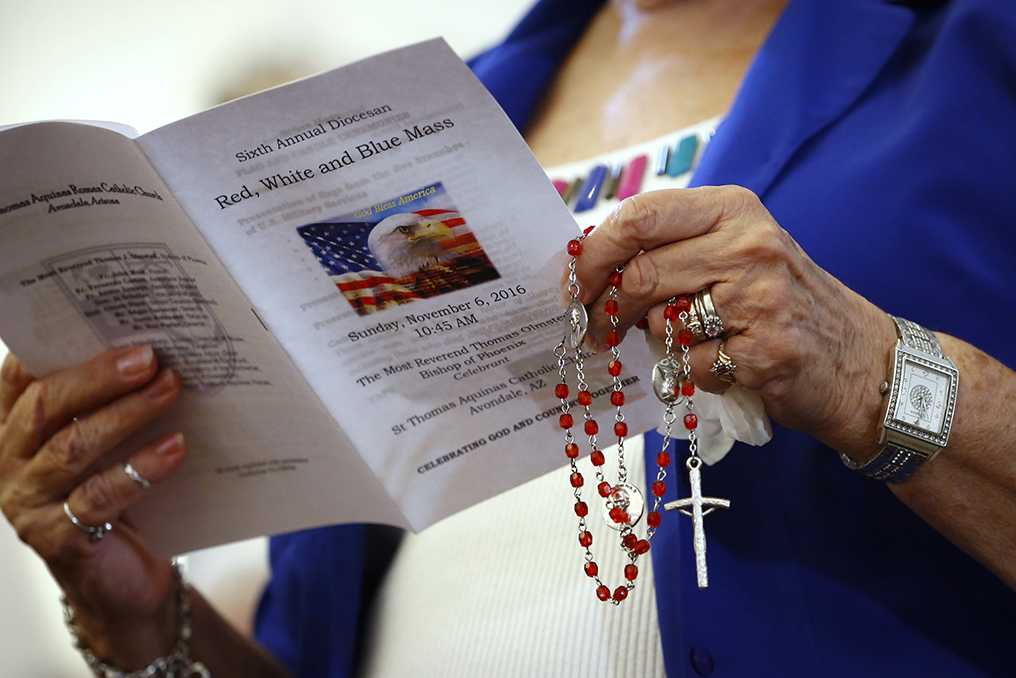
AVONDALE — Honoring military service members of all faiths the Sunday before Veterans Day, Bishop Thomas J. Olmsted celebrated the sixth annual Red, White and Blue Mass, drawing an estimated 1,500 people — including many veterans and their families — to St. Thomas Aquinas Parish Nov. 6.

“Today’s military is all-volunteer. It wasn’t always that way. (This Mass) is a spiritual way to let people know who served,” explained lector Gus Oviedo, a retired Coast Guard member from St. Thomas Aquinas.

The nearly-hour-and-a-half liturgy opened with a procession of flags from all service branches: Army, Navy, Marines, Air Force, Coast Guard; with members of the Knights of Columbus serving as the honor guard. A candle-lighting by military members, followed, and later there were prayers for veterans.

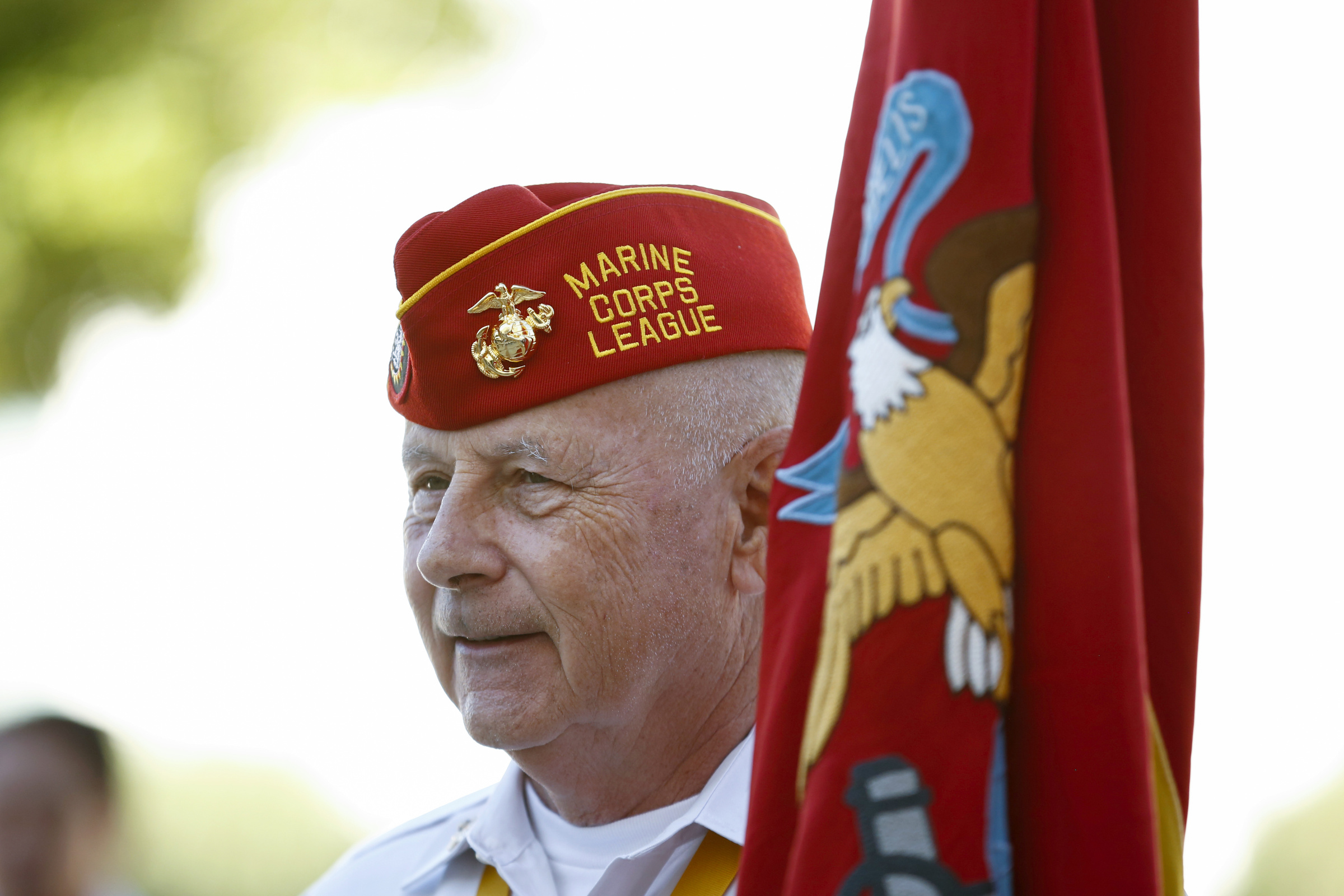
Veteran Gerry Schaller holds the Marine Corps flag following the sixth annual Red, White and Blue Mass at St. Thomas Aquinas Church in Avondale, Ariz., Nov. 6. The Diocese of Phoenix marked the occasion to honor active and retired service men and women and to recall those who died in service to the country. Veterans Day is Nov. 11. (CNS photo/Nancy Wiechec)

In his homily, Fr. Greg Menegay of Our Lady of Perpetual Help Parish in Scottsdale, a onetime Army radio mechanic, told the congregation that life — like a military obstacle course — can present challenges that can be overcome through “constant sharpening of the skills of the faith: prayer, the Sacraments, study of scripture and service.”

“You always have to look at those obstacles and figure out, ‘How do I deal with it? How do I go over, under and through it because I can’t go around it.’ When you negotiate (them), you feel a sense of accomplishment; you feel stronger in your faith. You feel closer to Christ because you have moved past whatever it was that drew you away.”

Service members said they were touched by the message and expressions of support for veterans.

“It was great. If you can go through the ropes of the course, you can go through the obstacles of life. You don’t have to be military to like this Mass,” said 18-year-old Reinholdt Heck, a St. Thomas Aquinas parishioner preparing for Army basic training at Fort Sill, Oklahoma.

The Diocese of Phoenix marks its sixth annual Red, White and Blue Mass at St. Thomas Aquinas Church in Avondale, Ariz., Nov. 6. The occasion honored active and retired service men and women and recalled those who died in service to the country. Veterans Day is Nov. 11. (CNS photo/Nancy Wiechec)

The Diocese of Phoenix marks its sixth annual Red, White and Blue Mass at St. Thomas Aquinas Church in Avondale, Ariz., Nov. 6. The occasion honored active and retired service men and women and recalled those who died in service to the country. Veterans Day is Nov. 11. (CNS photo/Nancy Wiechec)

“It was beautiful. It fills you with pride,” added Cmdr. Elie Suida, a longtime member of the Navy Reserve and parishioner from St. Thomas Aquinas. “I’m retired, but I still work with men and women returning from Afghanistan and the Gulf. We still care about our veterans, and we want them to know that,” she said.

“The military is a brotherhood. It doesn’t matter what branch you serve in. We have all served our nation, and we’re proud of that service, and this is one way we honor that,” said Tim Kraemer, a St. James the Greater parishioner and member of the Army whose service included tours in Vietnam and mobilization for Desert Storm as well as operations in the Balkans.

Reliance on one’s faith is key to a soldier’s well-being, and the Mass is a vehicle of outreach to discouraged or struggling vets, said Dcn. Ron Tenbarge of St. James Parish in Glendale.

“The pressure and challenge of military life can do one of two things: it can draw you closer or separate you (from your faith) to some degree. You’re reaching out (here) to those and try to draw them back in and recognize their service. Our country needs to do that.”

Seton students salute veterans

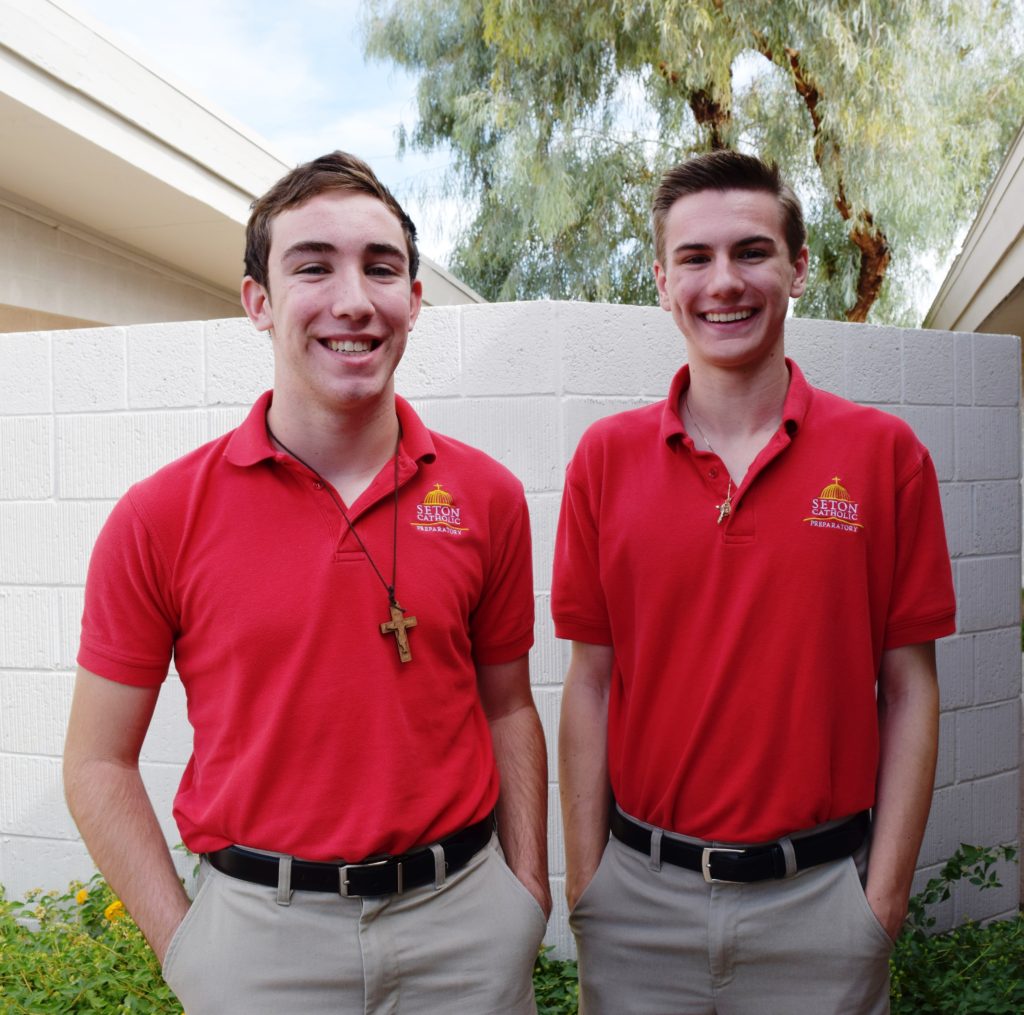
Dillon and Tyler (courtesy photo)
Local organizations recognized Seton Catholic Preparatory juniors Dillon Shipley and Tyler Creech for their salutes to veterans, particularly those who served in Vietnam. (courtesy photo)

Two Seton Catholic Preparatory students went above and beyond the Chandler school’s annual recitation of the Rosary for the U.S.A. on Veteran’s Day. The Rosary prays in particular for the military and each branch of government.

Dillon Shipley, a junior, was the first-place winner of the annual Phoenix Veterans Day Parade essay contest. Shipley drew upon the experience of his uncle, a Vietnam veteran, for his essay, “DEROS,” which stands for Date Eligible for Return from Overseas. That date kept troops going.

Read Shipley’s essay

“As his time got closer, he created a plan to take the cash that he had, $1,300, to buy a motorcycle and tour the country,” Shipley wrote. His uncle was former 2nd Lieutenant Rick West.

Shipley described his uncle’s flight to the U.S. on a packed “Freedom Bird” and his joy at arriving at his Illinois home. The planned motorcycle adventure, however, would have to wait: Within a week, West found work as an attorney.

Americans today are proud of those who served in the once unpopular war, Shipley said, concluding the essay with, “Welcome home, Vietnam Veterans. Your DEROS is today.”

Shipley received a cash prize and will ride in Phoenix’s Veterans Day parade. This is the third consecutive year that Seton students have won or placed in the essay contest, which is open to Maricopa County high school students.

Tyler Creech, also a junior, recently spoke at a East Valley chapter meeting of the Vietnam Veterans of America and performed the National Anthem. Members presented him with a commemorative medal honoring him as a partner.

Creech said it was an honor to sing the Anthem for veterans and will perform it at Seton’s fourth annual “Tribute to Veterans,” which begins at 8:15 a.m. Friday, Nov. 11 (Veterans Day) at the school.

‘Outstanding Fundraising Executive’ title goes to Catholic Charities

Tamara Bohanon
Tamara Bohanon

Tamara Bohannon, vice president of advancement at Catholic Charities, and a parishioner of St. Francis Xavier, received the Outstanding Fundraising Executive Award from the Association of Fundraising Professionals, AFP, Nov. 9.

With more than 20 years of fundraising and communication experience, Bohannon leads a team of staff and volunteers in the areas of development, marketing, volunteer services and community engagement. Currently, Bohannon and her team are championing an effort that encourages community members to take advantage of the Arizona tax credit.

“The tax credit costs individuals nothing, but makes a huge difference in helping veterans, the domestically abused, foster care families and others in need,” says Bohannon. “Fundraising is a passion for me, especially when I can see how much of an impact our dollars make in creating a path to self-sufficiency for families in need. The tax credit is a way for others to choose where their tax dollars go and make a difference.”

Bohannon received AFP’s award during the association’s Spirit of Philanthropy Leadership Awards luncheon at the Camelback Inn in Scottsdale. John Scola from the Phoenix Rescue Mission in Phoenix, nominated her.

Take a tour of Catholic Charities

Sign up now. Various Tuesdays and Thursdays through February 2017.

Arizona voters side with bishops in rejecting Proposition 205

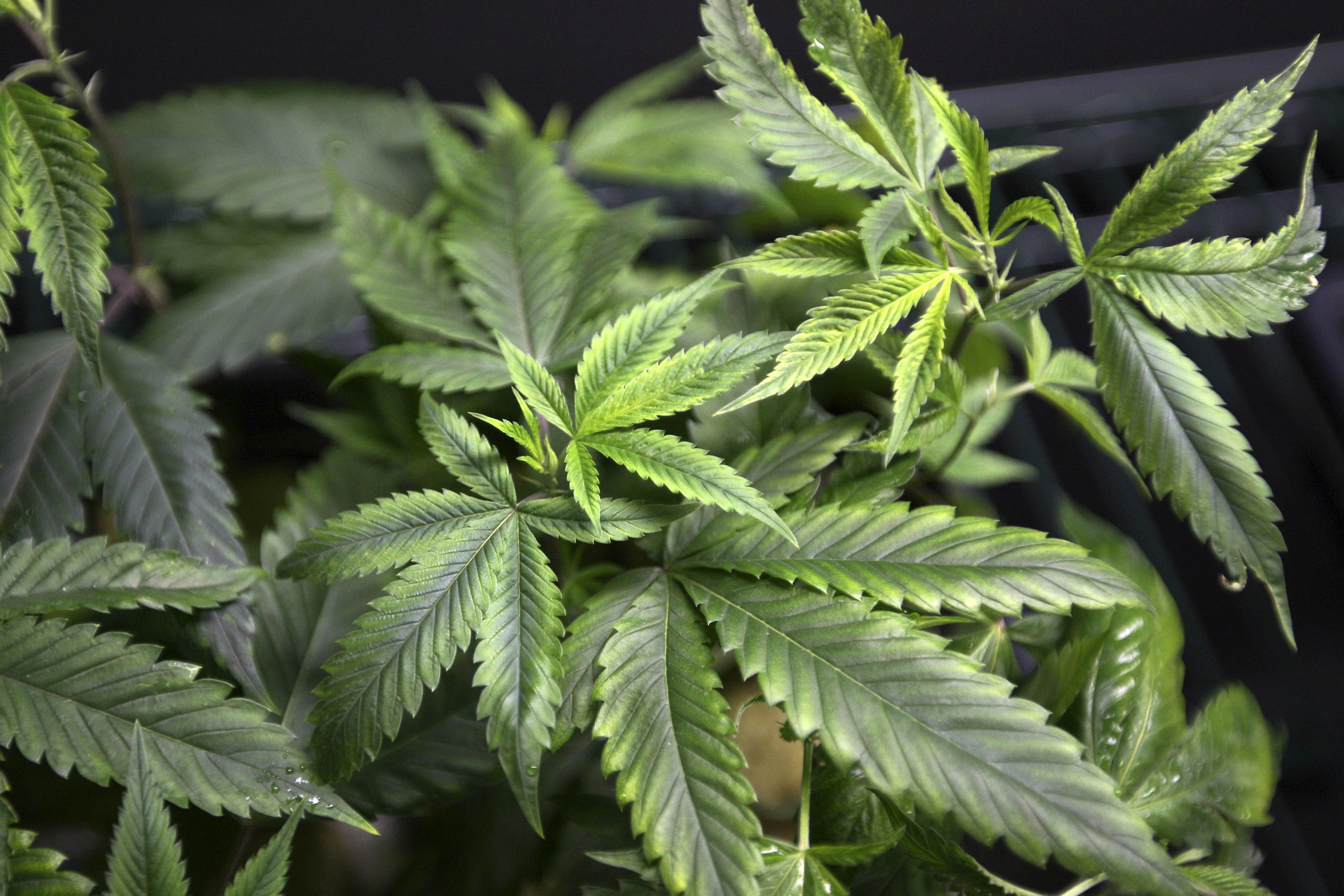
Marijuana plants for sale are displayed at the medical marijuana farmers' market at the California Heritage Market in Los Angeles in this July 11, 2014 file photo. (CNS photo/David McNew, Reuters)
Marijuana plants for sale are displayed at the medical marijuana farmers’ market at the California Heritage Market in Los Angeles in this July 11, 2014 file photo. Arizona voters rejected Proposition 205, which would have legalized recreational marijuana in the state. The bishops had publicly opposed the measure. (CNS photo/David McNew, Reuters)

By Carol Zimmermann
Catholic News Service

WASHINGTON (CNS) — Arizona voters rejected Proposition 205, which would have legalized recreational marijuana, while voters in California, Massachusetts, Nevada and Maine approved similar initiatives. Arizona, California and Massachusetts bishops spoke out against the initiatives.

“I give thanks to God that Arizona voters rejected the measure to legalize recreational marijuana, thereby safeguarding many, especially children and young people, from the falsehood that drug use is socially and morally acceptable,” said Bishop Thomas J. Olmsted of Phoenix the day after the election. “Our state will be a safer place for kids and families because this measure was defeated.”

The Boston Archdiocese spent $850,000 in a last-minute effort to defeat the ballot measure, saying increased drug use was a threat those served by the Catholic Church’s health and social-service programs. A Boston Globe report on the campaign quoted an archdiocesan spokesman who said the money was from a discretionary, unrestricted central ministry fund.

In a statement opposing the ballot measure, the Massachusetts Catholic bishops referenced a report from the National Institute of Drug Abuse that said marijuana is the most commonly used illicit drug in the United States.

“Its widespread use and abuse, particularly by young people under the age of 18, is steadily increasing while scientific evidence clearly links its long-term damaging effects on brain development,” the bishops said.

Voters in Arizona also voted for Proposition 206 to increase the minimum wage to at least $12 an hour by 2020. Voters in Maine and Colorado voted for similar initiatives and in Washington they voted to increase it to $13.50 an hour by 2020. Catholic Charities USA has long been a proponent of raising the minimum wage as have other groups that work to reduce poverty, although the bishops of the Arizona Catholic Conference did not publicly take a position one way or the other.

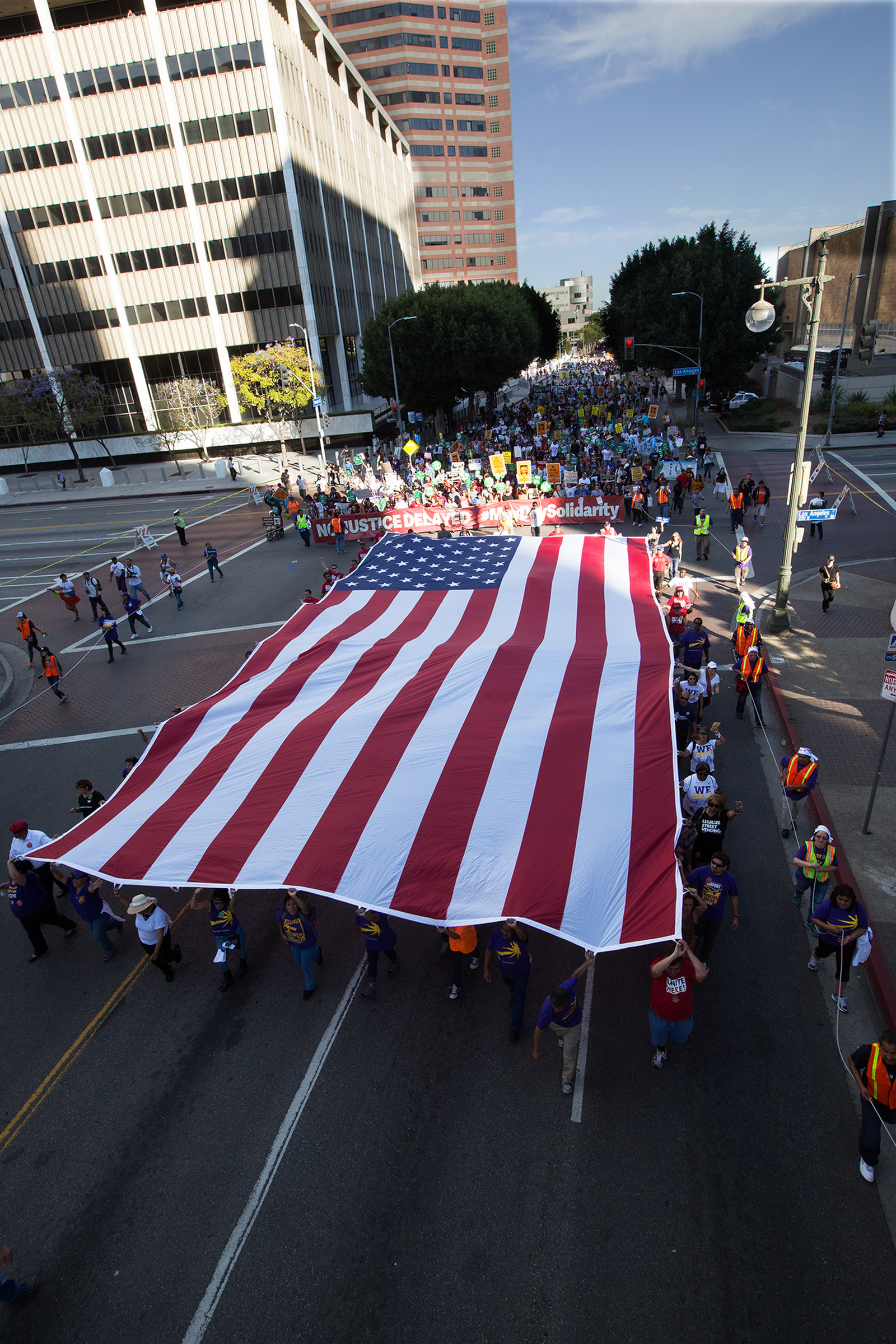
International Workers' Day supporters gather in downtown Los Angeles May 1 to raise awareness about minimum wage and immigration issues. (CNS photo/Victor Aleman, Vida-Nueva)
International Workers’ Day supporters gather in downtown Los Angeles May 1 to raise awareness about minimum wage and immigration issues. (CNS photo/Victor Aleman, Vida-Nueva)

In other referendums around the country, voters went against nearly all of the ballot initiatives backed by Catholic leaders and advocates, passing an assisted suicide measure in Colorado and in favor of the death penalty in three states.

In Colorado, the only state with an initiative to legalize assisted suicide, voters passed the measure, making the state the sixth in the nation with a so-called “right-to-die law,” joining Washington, Oregon, California, Vermont and Montana.

“The decision the voters of Colorado have made to legalize physician-assisted suicide via the passage of Proposition 106 is a great travesty of compassion and choice for the sick, the poor, the elderly and our most vulnerable residents,” said Jenny Kraska, executive director of the Colorado Catholic Conference.

“Killing, no matter what its motives, is never a private matter; it always impacts other people and has much wider implications,” she said in a Nov. 9 statement.

Kraska also said the state’s initiative will only “deepen divides along lines of race, ethnicity and income in our society and entrench us deeper into a culture that offers a false compassion by marginalizing the most vulnerable.”

The three death penalty referendums before voters this year all ended in favor of capital punishment. Bishops and Catholic conferences in these states had engaged in efforts to educate Catholics in particular on this issue and urge them to vote against it.

Oklahoma voters re-approved the use of the death penalty after the state’s attorney general had suspended executions last year. Nebraska voters also reinstated the death penalty that had been repealed by state lawmakers last year.

In California, voters defeated a ballot measure to repeal the death penalty in the state and narrowly passed an initiative aiming to speed up executions of death row convictions.

Karen Clifton, executive director of the Catholic Mobilizing Network, the national Catholic organization working to end the death penalty, said in a Nov. 9 statement that “despite referendum losses” in those states, she was hopeful “the country will continue to move away from the death penalty and toward a greater respect for life.” She also praised the work of Catholics on the state level to end the death penalty.

Clifton said the state ballots gave Catholics the chance to “prayerfully reflect on the dignity and worth of all life during this Jubilee Year of Mercy and to continue moving away from violence as the answer in our criminal justice system.”

The California Catholic Conference said it was “extremely disappointed” that the ballot to repeal the death penalty didn’t pass, stressing “it would have been the fitting culmination of a yearlong calling to live out the works of mercy.” And the Catholic bishops of Nebraska expressed similar disappointment, saying in a statement they would “continue to call for the repeal of the death penalty when it is not absolutely necessary to protect the public safety.”

Measures on climate change, an issue backed by the Catholic Climate Covenant, were rejected by voters. In Washington state, a ballot initiative called for the first carbon tax in the U.S., and a Florida measure would have restricted the ability of homeowners to sell electricity created through rooftop solar panels.

Before being called to serve church, Kansas clergy served in armed forces

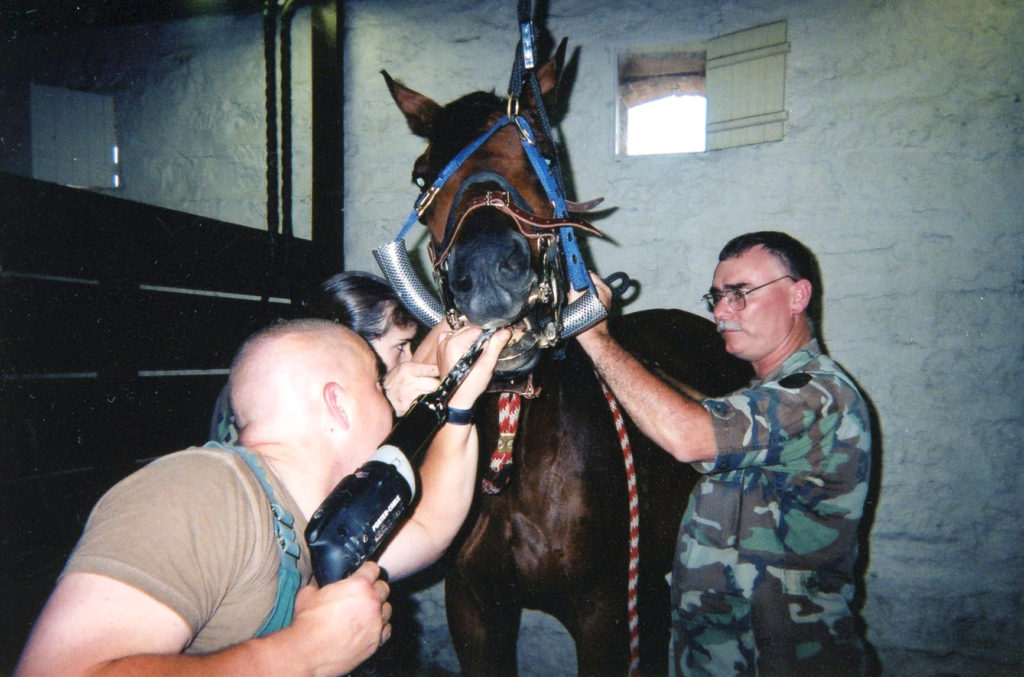
Fr. Richard Daise, right, is pictured in an undated photo working with one of the horses at Fort Riley, Kan. Fr. Daise, pastor of Sacred Heart Church in Colby, Kan., is a trained veterinarian who spent nearly 28 years in the U.S. Army caring for animals used in the military, before he discerned a call to the priesthood. (CNS photo/courtesy The Register)

By Karen Bonar
Catholic News Service

SALINA, Kan. (CNS) — Service is important to those in the U.S. military. As Veterans Day Nov. 11 neared, The Register, newspaper of the Diocese of Salina, talked with some clergy members who were in the armed forces before turning to serve the church.

Here are their stories:

From Army veterinarian to priest

Fr. Richard Daise, who is pastor of Sacred Heart Church in Colby, said the U.S. Army might sound like an odd career choice for a veterinarian, but he spent nearly 28 years serving the country as a veterinarian.

“Essentially I was drafted and forgot to get out,” he quipped.

When his number was selected during his second year of college, Fr. Daise signed up with the Reserve Officers’ Training Corps at Kansas State University in Manhattan. Joining the ROTC allowed him to complete his degree in veterinary science.

“By that time, the U.S. involvement in the Vietnam conflict was over, I still had a two-year obligation to serve,” he said. “The game plan was to serve my two years as an Army veterinarian and then get out and open a rural veterinary practice in western Kansas or eastern Colorado.”

But his two years were spent in Korea, which was such a positive experience that he extended his commitment.

“Each time I thought about getting out of the service, they offered me either a great assignment or more education,” Fr. Daise said. “I jumped at the chance every time.”

His military career took him to Texas, Minnesota, Hawaii and Alaska in the United States, as well as other international locations that included Korea, the Netherlands, Israel, Egypt, Germany and Panama.

“I have received advance degrees and traveled to much of the world while experiencing almost all aspects of the veterinary profession while serving our country in the U.S. Army. I have been truly blessed,” Fr. Daise said.

A frequent question he receives relates to his job as a veterinarian in the Army.

“There are no longer horses in the cavalry,” he explained, but it does have working dogs, as well as 2,000 horses and mules, and lab animals in research and development facilities. Fr. Daise also pointed out the Navy has marine mammals — for example, dolphins who retrieve test missiles fired over the open ocean.

In addition to caring for the animals, Fr. Daise said he worked on food safety.

“There wasn’t a FDA or USDA guaranteeing food for the entire military,” he said. “Our food inspectors and animal techs were responsible for a safe food supply for the troops.”

He also worked in preventative medicine.

“We would go into a region and see what diseases were there,” Fr. Daise said. “If we had to send the Marines in, we would give them the appropriate vaccinations before they went in.”

He entered the seminary after retiring from the military at age 55.

“I believe I was called to be a veterinarian, and that slowly evolved into the call to the priesthood,” Fr. Daise said. “I would have been a lousy priest when I graduated from school at 24 years old. I needed that time to discern.”

Educating the youth about military service is something that is important to the priest.

“Many of our young people growing up in our diocese have had no experience of having a veteran in their family or even knowing a veteran,” Fr. Daise said. “They know you’re supposed to be grateful for their service and protecting us, but it’s not like having someone in their family who is a veteran.”

He planned to take a group of fifth- and sixth-grade students from Sacred Heart Grade School in Colby and St. Mary Grade School in Ellis on a field trip to visit the home of Father Email Kapaun in Pilsen Nov. 9.

The Kansas-born priest was an Army chaplain who died serving prisoners of war during the Korean War and who is a candidate for sainthood. In April 2013, he was honored posthumously with the Medal of Honor, the highest military honor, in a White House ceremony.

“He is a veteran and a hero that all Kansas Catholics should know,” Father Daise said. “I believe Father Kapaun is the reason I am a parish priest today.”

Seminarian pilot

Military service was always a way of life for Dcn. Leo Blasi. His father, Frank, served in the Army during Korea. Dcn. Blasi had seven uncles and one aunt who served in both the Army and Navy.

“I wanted to be a pilot,” Dcn. Blasi said. “I knew (joining the Army) was the only way I could afford it. There was patriotism before there was interest in aircraft, but flying was the final thing that pulled me in.”

A retired Army veteran, he served in the U.S. Army from 1985 to 2014 — 11 years active duty and the remaining 18 in the Army National Guard. His active duty assignment was first as a Black Hawk helicopter pilot and later as a maintenance test pilot.

Dcn. Blasi served in Bosnia from 2002 to 2003 and Iraq from 2009 to 2010. The rest of his military career included living in Panama and all over Europe.

The assistance wasn’t all international, though. Dcn. Blasi said his service in the National Guard took him to fight fires in California in 2005, assist in the aftermath of Hurricane Katrina in Louisiana in 2005 and carried hay bales to stranded cattle in western Kansas in 2007.

“It always feels good to help others,” Dcn. Blasi said. “To do it when they are in desperate need, when there is nowhere else to turn, when nobody else can do it, that makes it more special.”

Through nearly three decades in service, Dcn. Blasi said he’s witnessed changes in attitude toward the armed forces.

“People in their 20s and 30s are more appreciative of the military now than they were in the ’60s and ’70s,” he said.

Dcn. Blasi said taking a day to remember and honor veterans is important.

“When a person signs the dotted line to join a service, it is a blank check to the public for the value up to and often including their own life,” he said. “That is an important thing to remember. That is what Veterans Day is about.”

Dcn. Blasi is a transitional deacon for the Diocese of Salina. He anticipates being ordained a priest in 2017.

Seminary sandwiches military service

Among some of the last drafted to serve in Korea, Fr. Norbert Dlabal served two years for the U.S. Army infantry while he was taking a break from his seminary studies.

“I knew getting drafted was inevitable because I was at the upper edge of the age bracket,” said the priest, who is pastor of Our Lady of Perpetual Help Parish in Goodland. “It didn’t bother me; I accepted it.”

The draft led to his basic training at Fort Riley followed by a stretch in South Korea in the early ’60s.

Although he was taking a break from formal seminary studies, his unit was in need of someone to help minister to the troops, so he offered.

“I assisted the chaplain in providing religious services and other needs to the personnel,” he said.

His assignment was with occupation forces south of the Demilitarized Zone.

“I was still pretty young and needed to grow,” Fr. Dlabal said. “It certainly introduced me to another part of the world.

“It was a good growing and learning experience. You learn discipline and to sacrifice your own desires, preference and plans for those around you.”

Once his service was complete in 1962, Fr. Dlabal said he took a little more time before returning to the seminary and completing his theological degree. He was ordained a priest in 1972.

Celebrating and honoring Veterans Day is essential, he said.

“It gives people the chance to reflect on important matters — matters of justice and peace and the horrible reality of war,” Fr. Dlabal said.


Religious, lay leaders react to Trump win in presidential election

President-elect Donald Trump delivers his acceptance speech at the New York Hilton Midtown in Manhattan in the early morning hours Nov. 9. (CNS photo/Shawn Thew, EPA) See ELECTION-TRUMP-REACTION Nov. 9, 2016.
President-elect Donald Trump delivers his acceptance speech at the New York Hilton Midtown in Manhattan in the early morning hours Nov. 9. (CNS photo/Shawn Thew, EPA)

WASHINGTON (CNS) — Lay and religious leaders of all stripes reacted to news of Donald J. Trump’s upset win in the Nov. 8 presidential election.

Most expressed hope that Trump would pay attention to their agenda, while others were more decidedly downbeat and still others counseled prayer.

Archbishop Joseph E. Kurtz of Louisville, Kentucky, president of the U.S. bishops’ conference, outlined an ambitious agenda in a Nov. 9 post-election statement that congratulated Trump and all election victors.

“The bishops’ conference looks forward to working with President-elect Trump to protect human life from its most vulnerable beginning to its natural end. We will advocate for policies that offer opportunity to all people, of all faiths, in all walks of life,” Archbishop Kurtz said.

“We are firm in our resolve that our brothers and sisters who are migrants and refugees can be humanely welcomed without sacrificing our security. We will call attention to the violent persecution threatening our fellow Christians and people of other faiths around the world, especially in the Middle East. And we will look for the new administration’s commitment to domestic religious liberty, ensuring people of faith remain free to proclaim and shape our lives around the truth about man and woman, and the unique bond of marriage that they can form.”

Archbishop Kurtz added, “Now is the moment to move toward the responsibility of governing for the common good of all citizens. I believe God will give us the strength to heal and unite,” he said, referring to a need to bridge the divides created in the country by such a contentious election.

After Trump clinched the Electoral College majority early Nov. 9, Cardinal Sean P. O’Malley of Boston tweeted, “Congratulations to President-elect Donald Trump. May God grant you good health, wisdom and courage during your presidency.”


“We are delighted that tonight’s election results reflect America’s pro-life consensus in the House, Senate and presidency. We applaud candidates that took a stand on the most critical human rights issue of today, abortion,” said Jeanne Mancini, president of the March for Life.

“We congratulate President-elect Trump on his hard-fought win, as well Vice President-elect Pence, and our friends in Congress,” Mancini added. “We look forward to working together to fulfill President-elect Trump’s campaign promises to ensure pro-life Supreme Court justices, pro-life policies, and defunding America’s primary abortion provider, Planned Parenthood.”

Philippe Nassif, executive director of In Defense of Christians, urged Trump to “prioritize the protection of the ancient ethnic and religious minority communities of the Middle East, and a region in which these communities can coexist and thrive peacefully in their native lands” in a Nov. 9 statement. “The Christian values of tolerance and coexistence, and the innovations that these communities have contributed to their societies for so many centuries are essential for a stable and secure Middle East, which is in the national security interests of the United States and the world.”

“We must continue the fight to reconcile (the Rev.) Billy Graham’s message of righteousness with (the Rev.) Dr. Martin Luther King’s march for justice,” said a Nov. 9 statement by the Rev. Samuel Rodriguez, president of the National Hispanic Christian Leadership Conference.

“Now that the presidential election is finally behind us, our nation must put partisan politics and divisive rhetoric behind us as well. Instead of the agenda of the donkey or the elephant, Christians must be about the Lamb’s agenda,” Rodriguez added.

“We are committed to dialoguing with those who think differently and will attempt to engage President-elect Trump,” said a Nov. 9 statement by Scott Reed, executive director of the PICO National Network, which was founded by a California priest. “But President-Elect Trump should be forewarned that our faith will not allow us to permit him to fulfill his promise to criminalize immigrants by conducting mass deportations, or sit idly in the face of racial profiling of African-Americans, Latinos and religious minorities.”

“Today is indeed a dark day in American history. A man who built the foundation of his campaign for the White House on some of the most disturbing elements of our nation — racism, xenophobia, sexism — is now set to become the most powerful leader in the world,” said a Nov. 9 fundraising email by Laura Barrett, the new executive director of Interfaith Worker Justice.

“Whether it’s health and safety on the job, the ability to recover stolen wages from unscrupulous employers, or progress toward a living wage, we can’t assume any worker justice victory is safe from being rolled back under a Trump presidency,” Barrett said.

“Donald Trump made many promises to pro-lifers over the course of his campaign, and the pro-life generation will make sure he keeps those promises as president,” said a Nov. 9 statement from Kristan Hawkins, president of Students for Life of America.

“Our nation rejected a party and a culture that supports not a single restriction on abortion. Abortion mattered in this election as it was the most-searched term in regards to the election on Google,” she added. “The bottom line is this: today’s election results give us the momentum we need to achieve our mission of abolishing abortion in our lifetime.”

David Harris, CEO of the American Jewish Committee, congratulated Trump on his win and also offered best wishes to his Democratic rival, Hillary Clinton, in a Nov. 9 statement.

“Now that the election is over, a first priority should be to address the wounds of an extraordinarily divisive contest,” Harris said. “The United States is one country with one destiny, and any expression of bigotry and exclusion, as we’ve regrettably seen during the extended campaign, must never be allowed to corrode our pluralistic fabric.”

Four sisters following ‘Plan of God’ plant U.S. roots in Tempe

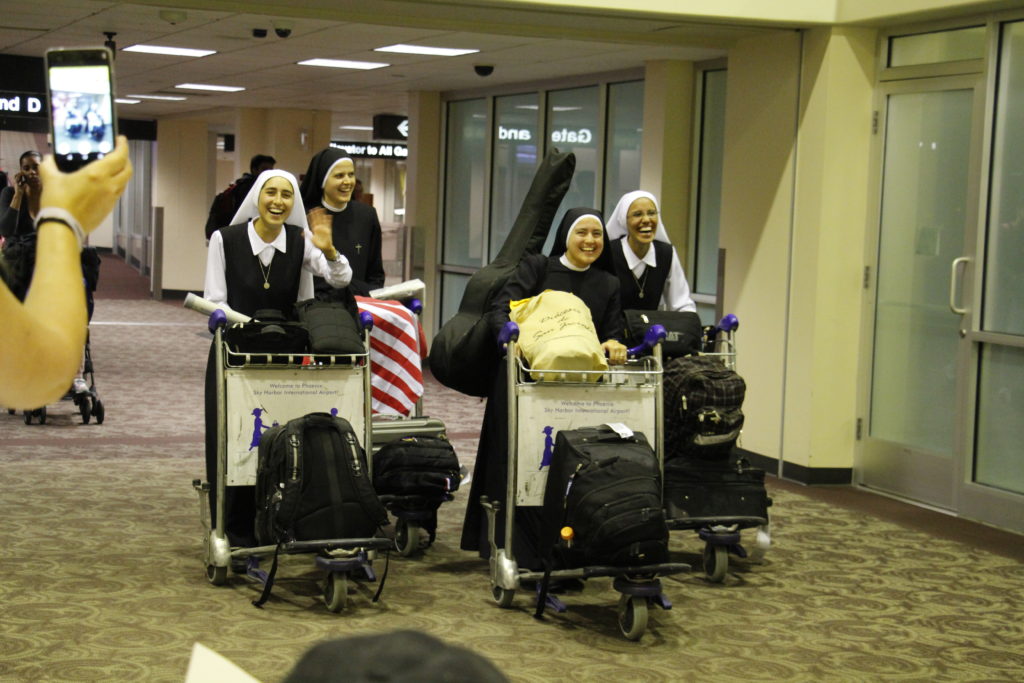
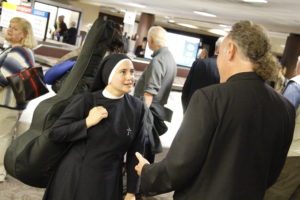
Four Servants of the Plan of God emerge from Terminal 2 at Sky Harbor International Airport Oct. 28. The sisters will serve at Our Lady of Mount Carmel Parish and School plus outreaches at nearby Arizona State University via St. Paul's Outreach and the All Saints Catholic Newman Center. (Ambria Hammel/CATHOLIC SUN)

A good portion of Terminal 2 knew a special arrival was imminent.

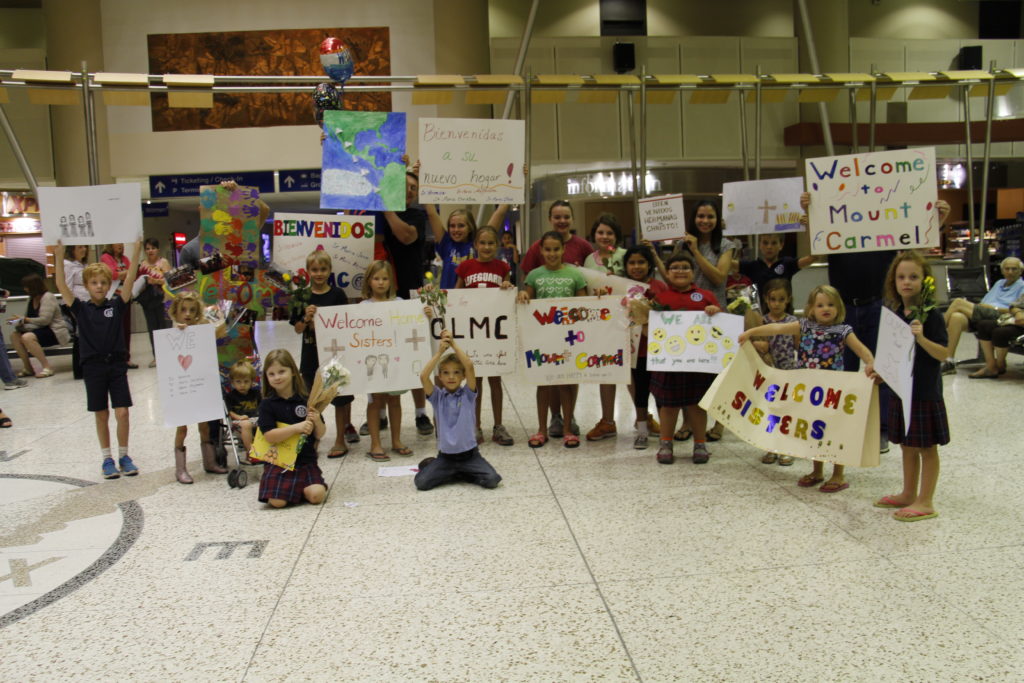
People of all ages from Our Lady of Mount Carmel Parish and School filled the circular waiting area outside of security at Phoenix Sky Harbor for an hour Oct. 28. Handmade signs read, “Welcome Home Sisters!” “Bienvenidas a su nuevo hogar,” “We are [an array of positive emoji faces] that you are here,” and “We heart Sr. Veronica, Sr. Maria Christina, Sr. Maria Alejandra and Sr. Maria Jose.” A young girl held a variety of handmade cards for the Servants of the Plan of God who would be flooding the parish and school.

Children from Our Lady of Mount Carmel School and parish practice holding up their welcome signs at Sky Harbor International Airport Oct. 28. Classrooms made them and personal cards in anticipation of the arrival of Servants of the Plan of God, a religious community based in Peru. (Ambria Hammel/CATHOLIC SUN)
Students and members from Our Lady of Mount Carmel School and Parish practice holding up their welcome signs at Sky Harbor International Airport Oct. 28. Classrooms made them and personal cards in anticipation of the arrival of Servants of the Plan of God, a religious community based in Peru. (Ambria Hammel/CATHOLIC SUN)

The Diocese of Phoenix is the religious community’s first U.S. apostolate. Servants of the Plan of God was established in Lima, Peru in 1998 and has expanded to South America, Africa, Asia and Europe.

Our Lady of Mount Carmel Parish knew since early in 2016 that the sisters were coming. There was a standing ovation at Masses the day of the announcement.

“It’s going to change the dynamic for us,” Dcn. Jim Carabajal predicted while waiting to greet the sisters at the airport.

It seemed like several planeloads of disembarking passengers snaked their way past the children’s welcome signs before anyone caught a glimpse of four habited sisters, two in white, temporary veils and two in black veils. The sisters’ smiles couldn’t get any bigger as they saw 30-some people with signs, flowers, balloons and an array of cameras.

Four Servants of the Plan of God emerge from Terminal 2 at Sky HArbor International Airport Oct. 28. The sisters will serve at Our Lady of Mount Carmel Parish and School plus outreaches at nearby Arizona State University via St. Paul's Outreach and the All Saints Catholic Newman Center. (Ambria Hammel/CATHOLIC SUN)
Four Servants of the Plan of God emerge from Terminal 2 at Sky Harbor International Airport Oct. 28. The sisters will serve at Our Lady of Mount Carmel Parish and School plus outreaches at nearby Arizona State University via St. Paul’s Outreach and the All Saints Catholic Newman Center. (Ambria Hammel/CATHOLIC SUN)

As soon as they stepped foot past security, the sisters, whose 16-year-old order has recorded four original CDs, offered an original a cappella tune. They repeated it during weekend Masses.

“The time has come — we will announce you Lord. We’ll bring our light and joy. The time has come — we will announce you Lord. We feel our hearts reborn. The time has come. Here we are,” the sisters sang.

Parishioners and school families who gathered at the airport immediately responded with a song of their own, expressing how long they have waited to welcome sisters back to the parish — more than three decades. The song recognized their presence as a sign of God’s love.

Parish leaders expect the sisters to be involved in many areas, especially education, liturgy, music and youth ministry.

One of the Servants of the Plan of God greets Fr. John Bonavitacola, pastor at Our Lady of Mount Carmel, following the sisters' arrival at Sky Harbor International Airport Oct. 28. (Ambria Hammel/CATHOLIC SUN)
One of the Servants of the Plan of God greets Fr. John Bonavitacola, pastor at Our Lady of Mount Carmel, following the sisters’ arrival at Sky Harbor International Airport Oct. 28. (Ambria Hammel/CATHOLIC SUN)

“I’m just excited to see what God has planned,” said Fr. John Bonavitacola, pastor, pointing out that the parish is the grateful recipient of the sisters’ discernment. “I think there’s a bigger plan that God hasn’t told me yet.”

Their living arrangements and one-fourth of their apostolates are more concrete. Parishioners provided the funds and furnishings to help them move into their new convent near Our Lady of Mount Carmel.

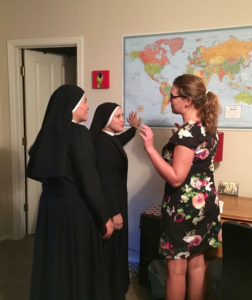
Sr. Maria Jose, who has been a sister for about 12 years, will support St. Paul’s Outreach and the All Saints Catholic Newman Center, both serving students at nearby Arizona State University.

“The sisters have an incredible joy about them that was very welcoming,” said Monica Butler, mission leader for St. Paul’s Outreach at ASU.

Monica Butler, a mission leader for St. Paul's Outreach serving Arizona State University, discuss the Peruvian origins of the Servants of the Plan of God during their visit in May. (photo from spo.org/azblog)
Monica Butler, a mission leader for St. Paul’s Outreach serving Arizona State University, discuss the Peruvian origins of the Servants of the Plan of God during their visit in May. (photo from spo.org/azblog)

She wasn’t able to join the welcoming crew at the airport, but met Sr. Veronica when she visited with the Servants of the Plan of God’s mother superior last spring. Butler described the sisters as “definitely sold out for Christ” and “very much alive for their vocation.”

“I think she was very encouraged by our witness and we were encouraged by theirs,” Butler said.

St. Paul’s Outreach oversees separate men’s and women’s households for college students. The residences offer Morning Prayer and Liturgy of the Hours a few times a week plus community dinner.

Butler is excited that the five women in one household and 10 men in another will be able to see another side of vocations close at hand, calling the Servants of the Plan of God “walking witnesses of Christ’s love.”

She is personally excited to apply her Spanish Literature major by speaking Spanish with the sisters. The sisters are quite content speaking English también.

A fifth sister, Sr. Stephanie, is expected to arrive in December. The Catholic Sun hopes to connect with them directly later this year.

Vatican secretary of state congratulates Trump, offers prayers

Republican presidential candidate Donald Trump speaks during a 2015 campaign event in Phoenix. (CNS photo/Nancy Wiechec)
Republican presidential candidate Donald Trump speaks during a 2015 campaign event in Phoenix. Mr. Trump won the presidential election Nov. 8, becoming the first person to not have had any previous military or public service experience elected to the highest office in the land. (CNS photo/Nancy Wiechec)

By Cindy Wooden
Catholic News Service

VATICAN CITY (CNS) — Congratulating Donald Trump for his victory in the U.S. presidential election, the Vatican secretary of state expressed hope that people would work together “to change the global situation, which is a situation of serious laceration, serious conflict.”

Cardinal Pietro Parolin, Pope Francis’ top aide, spoke about the election early Nov. 9 during a meeting at Rome’s Pontifical Lateran University. The Vatican then released a transcript of his remarks.

“First of all,” he said, “we respectfully must take note of the will expressed by the American people in this exercise of democracy that, they tell me, was characterized by a large turnout at the polls.”

“We send our best wishes to the new president that his administration may truly be fruitful,” the cardinal said. “And we also assure him of our prayers that the Lord would enlighten and sustain him in his service to his country naturally, but also in serving the wellbeing and peace of the world.”
Cardinal Parolin was asked about the polemics that arose earlier in the year between Trump and Pope Francis over the question of immigration, especially concerning the U.S.-Mexico border.

“Let’s see how the president acts,” Cardinal Parolin said. “Normally, they say, it is one thing to be a candidate and another to be president, to have that responsibility.”
“It seems premature to make judgments” until Trump is inaugurated and begins making decisions, Cardinal Parolin said.
During an in-flight news conference Feb. 17 after a trip to Mexico, the pope was asked about his reaction to Trump’s proposal that the United States extend a fence along the full length of the border and his comments to Fox Business Network that Pope Francis is a politician and is being used by Mexicans.

“As far as being ‘a pawn,’” the pope said, “that’s up to you, to the people, to decide.”

But one thing Pope Francis said he did know was that “a person who thinks only of building walls, wherever they may be, and not building bridges, isn’t Christian.”

Asked if a Catholic could vote for such a candidate in good conscience, the pope told reporters: “I’m not going to get mixed up in that. I’ll just say, this man is not Christian if he says this” about building walls.

Diocese welcomes five newly ordained deacons

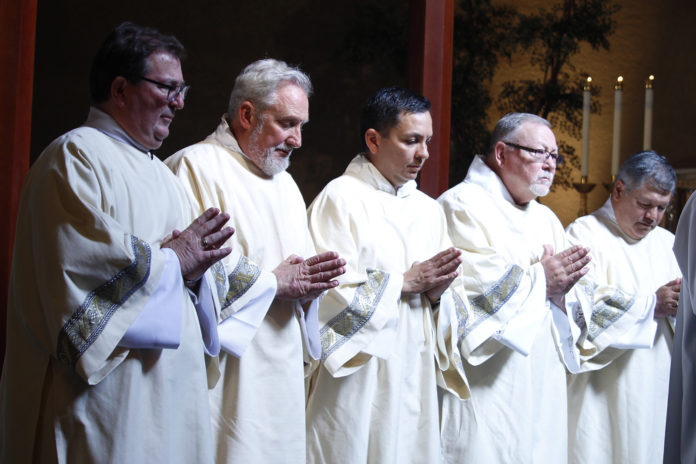
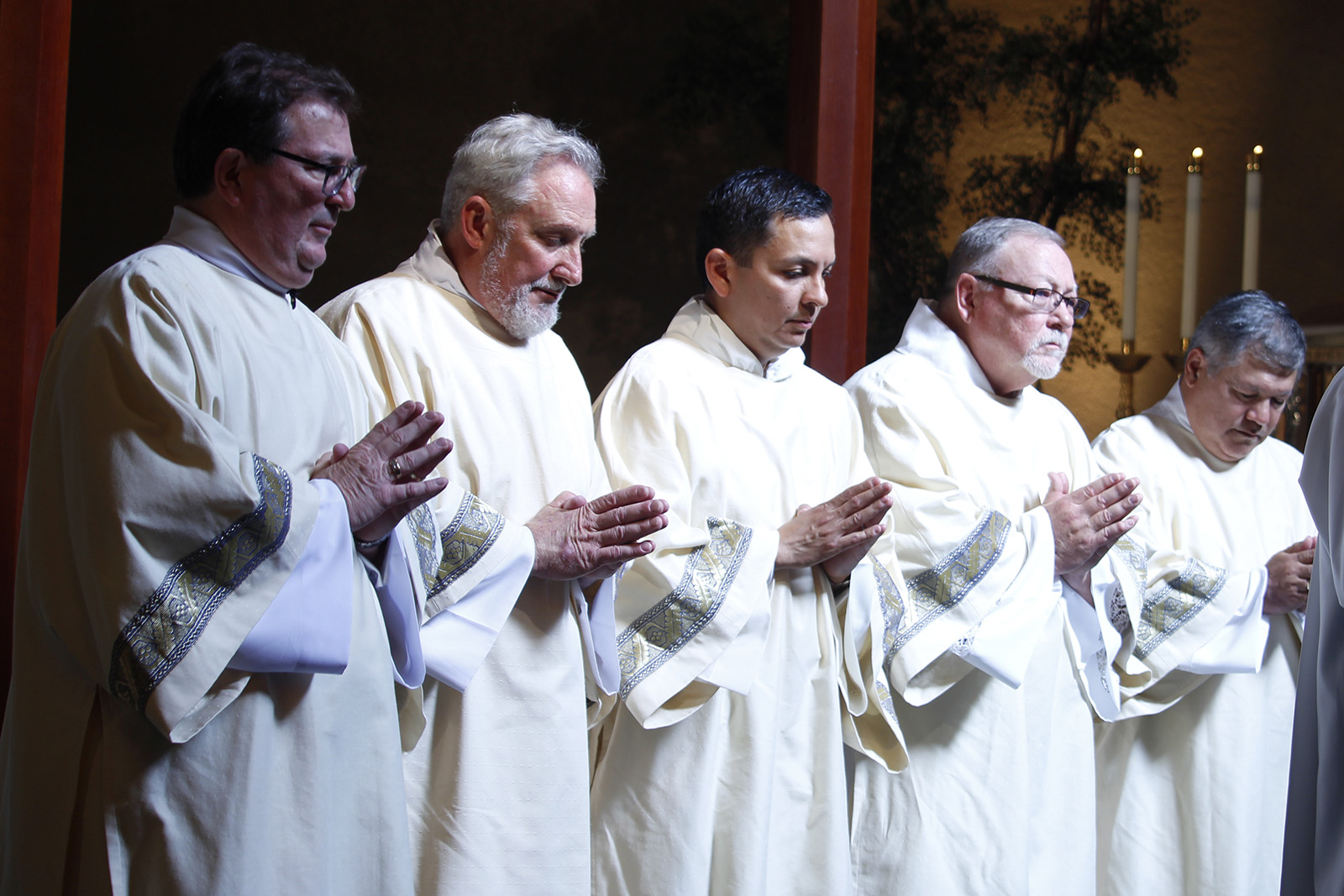
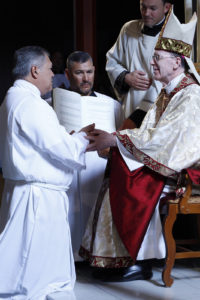
Newly ordained Deacons Gary Scott, Tony Smith, Billy Chavira, Chris Giannola and Marvin Smith stand in the sanctuary of Ss. Simon and Jude Cathedral during their ordination Mass Nov. 5. (Ambria Hammel/CATHOLIC SUN)
Newly ordained Deacons Gary Scott, Tony Smith, Billy Chavira, Chris Giannola and Marvin Silva stand in the sanctuary of Ss. Simon and Jude Cathedral during their ordination Mass Nov. 5. (Ambria Hammel/CATHOLIC SUN)

New deacons and assignments

Everything became official two or three months prior, but nine days before ordination, pending holy orders still seemed surreal.

“I can’t believe I got that letter from the bishop — that he’s calling me to ordination. I’m still kind of in awe that I’ve been called,” Dcn. Tony Smith said.

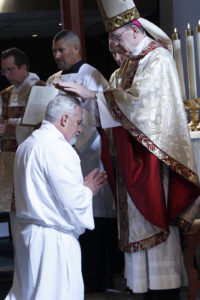
That letter formally wrapped up a five-year formation process plus two years of academic preparation through the Kino Catechetical Institute prior to that. His call to holy orders was one of five that became a reality when Bishop Thomas J. Olmsted ordained the men to the permanent diaconate at Ss. Simon and Jude Cathedral Nov. 5.

Dcns. Billy Chavira, Christopher Giannola, Gary Scott, Marvin Silva and Tony Smith began serving at local parishes — largely their own — the following day and in the community the same week. Ordained deacons carry out a service of the Word, the altar and charity.

Deacons proclaim the Gospel, prepare the Sacrifice and distribute holy Communion. The now 250 deacons serving the Diocese of Phoenix also instruct believers and unbelievers in holy doctrine, preside over public prayer, bring holy Communion to the dying and conduct funeral rites.

Marvin Silva promises obedience to Bishop Thomas J. Olmsted and his successors during the ordination rite. (Ambria Hammel/CATHOLIC SUN)

Dcn. Silva looks forward to praying for the sick and giving Communion to those at the county hospital. He knows his ordination strengthened him for such work. Dcn. Silva was among many deacons and their wives who pointed to the bishop’s laying on of hands as a powerful moment.

“When he was laying his hands on me, I felt something marvelous — pouring the Holy Spirit over my head,” said Dcn. Silva, who will also serve at St. Mary Parish in Chandler, particularly during the weekly televised Mass in Spanish. The father of three and guitarist has roots in both Nicaragua and Canada.

“At a time in our nation when many of our family members … and many of our friends and neighbors are falling away from the practice of our faith, and when many others have lost confidence that they could do something great for God, the Lord Jesus is filling you with the joy of the Gospel and the grace of diaconate ordination,” Bishop Olmsted said in his homily. He cited the early martyrs St. Stephen and St. Lawrence as models.

Bishop Olmsted lays hands on Tony Smith, ordaining him to the permanent diaconate Nov. 5 at Ss. Simon and Jude Cathedral. (Ambria Hammel/CATHOLIC SUN)

Deacons can also baptize the faithful and assist at and bless marriages. The Giannola family knows that intimately. Dcn. Giannola’s father-in-law, also a deacon, officiated his marriage to his wife, Mary, decades ago and baptized and gave Communion to every family member until his death.

Mary cherished the chance to help vest her husband with his alb prior to Mass. She also liked that the litany of the saints allowed ordinands to be spiritually united with loved ones who have passed on. She said that was important to her husband.

Dcn. Giannola was eager to answer the call to greatness that Bishop Olmsted preached about. It’s achieved by being a strong witness to marriage and family life to the world, he said.

Bishop Olmsted described the desire to do great things as “a sign of the Holy Spirit at work within the soul. These are qualities I look for in candidates for the ministry of deacons. But they are not common in society today and they were not common in Jesus’ day. Jesus warned His first disciples to reject a counterfeit greatness.”

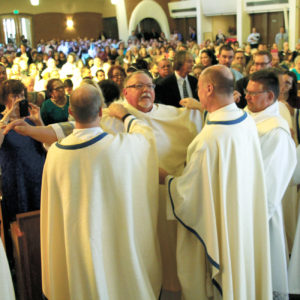
Priests and deacons of the diocese vest Dcn. Chris Giannola during his ordination Mass Nov. 5. (Ambria Hammel/CATHOLIC SUN)

Dcn. Giannola, in brief remarks to the crowd during the ordination reception, credited the formation process for helping him strive for true greatness. People already seek him out for spiritual advice, questions and support, his wife said.

Penni Scott, whose husband Gary was also among the ordinands, sees similar qualities in her husband.

“He loves to talk with people, interact with people and help make their lives better,” she said.

That’s a big part of why lining up and processing into the cathedral at the beginning of Mass was so moving for Dcn. Scott. He had a chance to see and hear nearly everyone there united in prayer for him and his fellow ordinands.

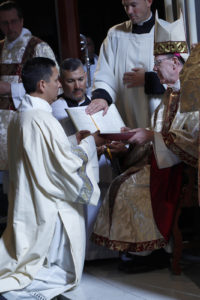
Dcn. Billy Chavira receives the Book of the Gospels from Bishop Olmsted, being told to “Believe what you read, teach what you believe, practice what you teach.” (Ambria Hammel/CATHOLIC SUN)

They processed in and joined their families in the pew, but only for the first part of Mass. They spent the remainder at the altar and lying prostrate down the center aisle. That moment was powerful for Dcn. Chavira.

“When you’re in a physical position of complete surrender, it gives you inner peace knowing the whole Church is praying for you,” Dcn. Chavira said. When he stood, he was less nervous.

His wife, Maria, also keyed in to the laying on of hands and the history of what the Church has established through that. She, like many of the deacons’ wives, sees her husband’s servant heart.

“It’s just an extension of what he already does — serving the people of God through the ministry of the Church,” she said.

Newly ordained Dcn. Gary Scott helps prepare the altar for the Liturgy of the Eucharist moments after he was ordained to the permanent diaconate Nov. 5. (Ambria Hammel/CATHOLIC SUN)

Sesmia Trujillo, Dcn. Chavira’s religious education teacher in first grade at St. Anthony where he grew up, agreed. She and her mother were among many people who came from different parts of his life, even if they weren’t Catholic, because they understood what the faith meant to him.

“This is just one step further in his spiritual journey as well as his professional one,” Trujillo said.

The entire liturgy was emotional for Isolda Silva and Diana Smith, both deacon wives, especially when Smith’s husband offered her the chalice at Communion. The couple teared up a bit. Silva described her husband’s ordination day as a beautiful dream she didn’t want to wake up from.

Dcn. Jim Trant, director of the diaconate, encouraged the crowd at the reception to support the new deacons in their ministries. They have given themselves over to God and rededicated themselves to their families, he said. “You are looking here at five saints in the making.”

Pope: World needs a justice system open to hope, not just punishment

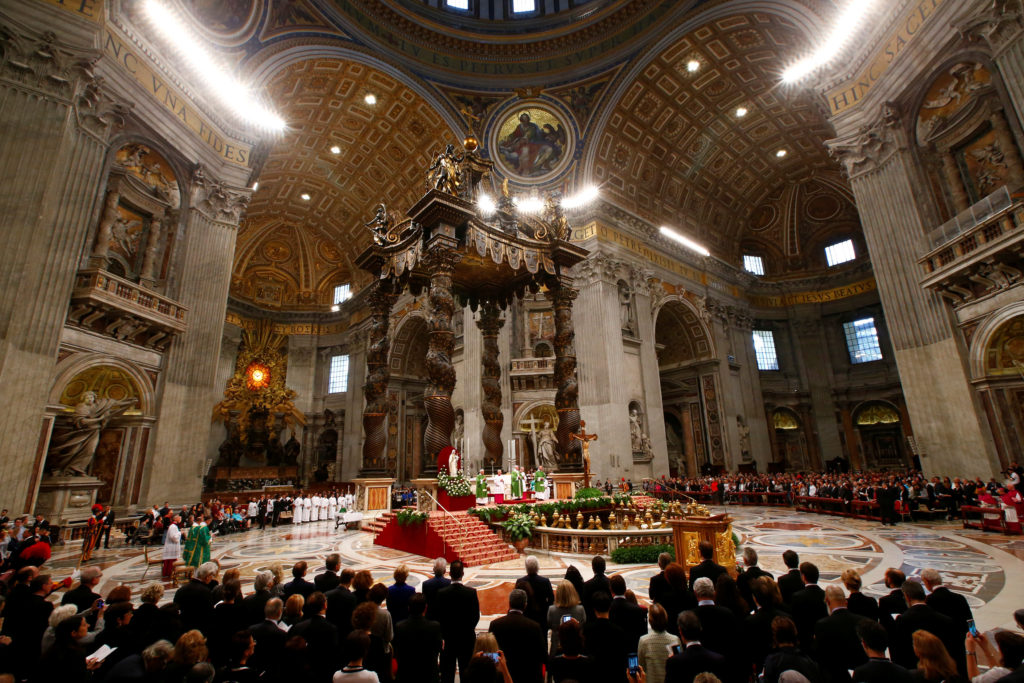
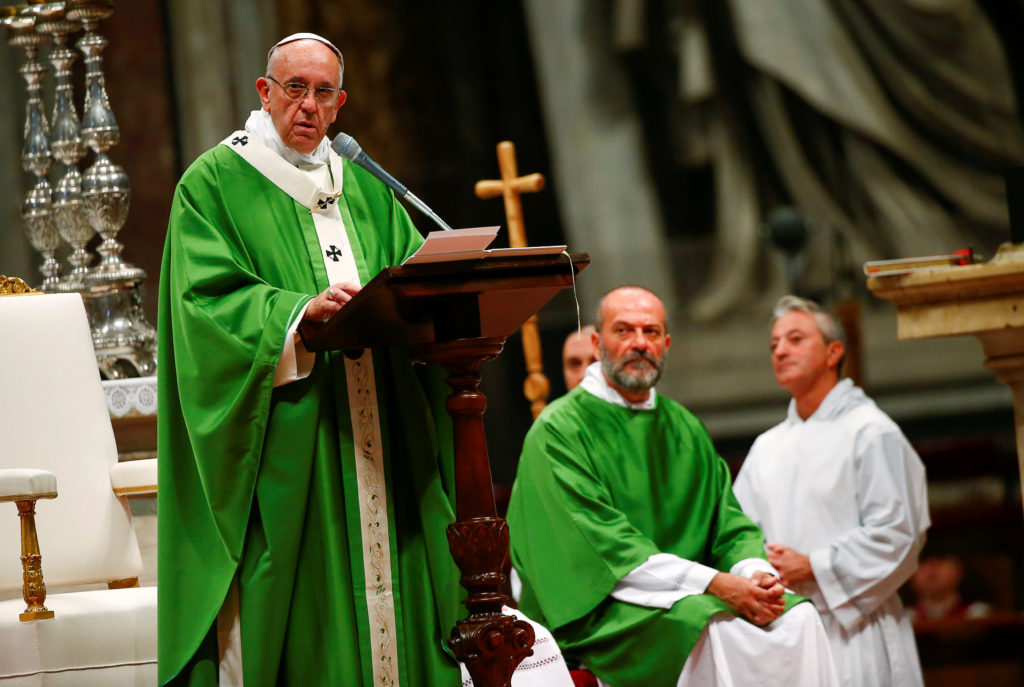
Pope Francis celebrates a Jubilee Mass for prisoners Nov. 6 in St. Peter's Basilica at the Vatican. (CNS photo/Tony Gentile, Reuters)

An image of Our Lady of Mercy, with Jesus holding a chain, is displayed during the jubilee for prisoners at the Vatican Nov. 6.

By Junno Arocho Esteves
Catholic News Service

VATICAN CITY (CNS) — After celebrating Mass with detainees and people who had been in prison, Pope Francis called on governments to mark the end of the Year of Mercy by extending clemency to deserving inmates.

The pope also called for renewed efforts to ensure justice systems not only punish crimes but also work to give prisoners hope for the future.

Civil authorities must work to improve living conditions for those serving time “so that the human dignity of prisoners may be fully respected,” the pope said Nov. 6 during his Sunday Angelus address in St. Peter’s Square.

Pope Francis celebrates a Jubilee Mass for prisoners Nov. 6 in St. Peter's Basilica at the Vatican. (CNS photo/Tony Gentile, Reuters)
Pope Francis celebrates a Jubilee Mass for prisoners Nov. 6 in St. Peter’s Basilica at the Vatican. (CNS photo/Tony Gentile, Reuters)

The pope’s appeal for “an act of clemency toward those imprisoned who are considered eligible to benefit from this measure” came after his celebration of a jubilee Mass for prisoners. Some 1,000 current and former prisoners from 12 countries, as well as priests, religious men and women and laypeople who work in prison ministry, attended the Mass.

Detainees from several prisons in Italy and Spain were given special permission to attend the Mass for the Year of Mercy. Inmates from Italian prisons in Brescia, Busto Arsizio and Palermo served as altar servers, while a choir composed of prisoners and volunteers from the Dozza prison in Bologna provided the music for the celebration.

In his homily, the pope reflected on the Sunday readings, which he said acknowledged “God as the source” of hope.

“Hope is a gift of God. We must ask for it,” he told the inmates and former inmates. “It is placed deep within each human heart in order to shed light on this life, so often troubled and clouded by so many situations that bring sadness and pain.”

The gift of hope, he added, is especially present “whenever someone makes a mistake” but feels the awakening of repentance and forgiveness through God’s mercy.

The jubilee celebration is a time for prisoners and those who have served time to remember that while a price is paid for breaking the law, “hope must not falter,” he said.

Pope Francis celebrates a Jubilee Mass for prisoners Nov. 6 in St. Peter's Basilica at the Vatican. (CNS photo/Tony Gentile, Reuters)
Pope Francis celebrates a Jubilee Mass for prisoners Nov. 6 in St. Peter’s Basilica at the Vatican. (CNS photo/Tony Gentile, Reuters)

“Paying for the wrong we have done is one thing,” the pope said, “but another thing entirely is the ‘breath’ of hope, which cannot be stifled by anyone or anything.”

Those who are behind bars are not the only ones who are imprisoned, the pope warned. People can also fall into “a certain hypocrisy” that judges current and formerly incarcerated “as wrongdoers for whom prison is the sole answer,” he said.

Pope’s prison visits

“I want to tell you, every time I visit a prison, I ask myself: ‘Why them and not me?‘ We can all make mistakes; all of us. And in one way or another, we have made mistakes,” the pope said, departing from his prepared text.

Hypocrisy can lead Christians to overlook the fact that people can change their lives, he said, but it also makes it impossible for them to see that they, too, are prisoners, locked up within walls of prejudice, ideology and the idols of “a false sense of well-being” and money.

“At such times, we imprison ourselves behind the walls of individualism and self-sufficiency, deprived of the truth that sets us free,” the pope said. “Pointing the finger against someone who has made mistakes cannot become an alibi for concealing our own contradictions.”

Prisoners and formerly incarcerated people should resist being held back by their past mistakes and instead look toward the future with hope, knowing that God’s mercy and forgiveness is greater, he said.

While the past cannot be rewritten, he said, learning from one’s mistakes “can open a new chapter of your lives.”

Through the power of faith, Pope Francis said, repentance by those who have offended and forgiveness by those who have been wronged is possible.

“When violence is met with forgiveness, even the hearts of those who have done wrong can be conquered by the love that triumphs over every form of evil,” he said. “In this way, among the victims and among those who wronged them, God raises up true witnesses and workers of mercy.”