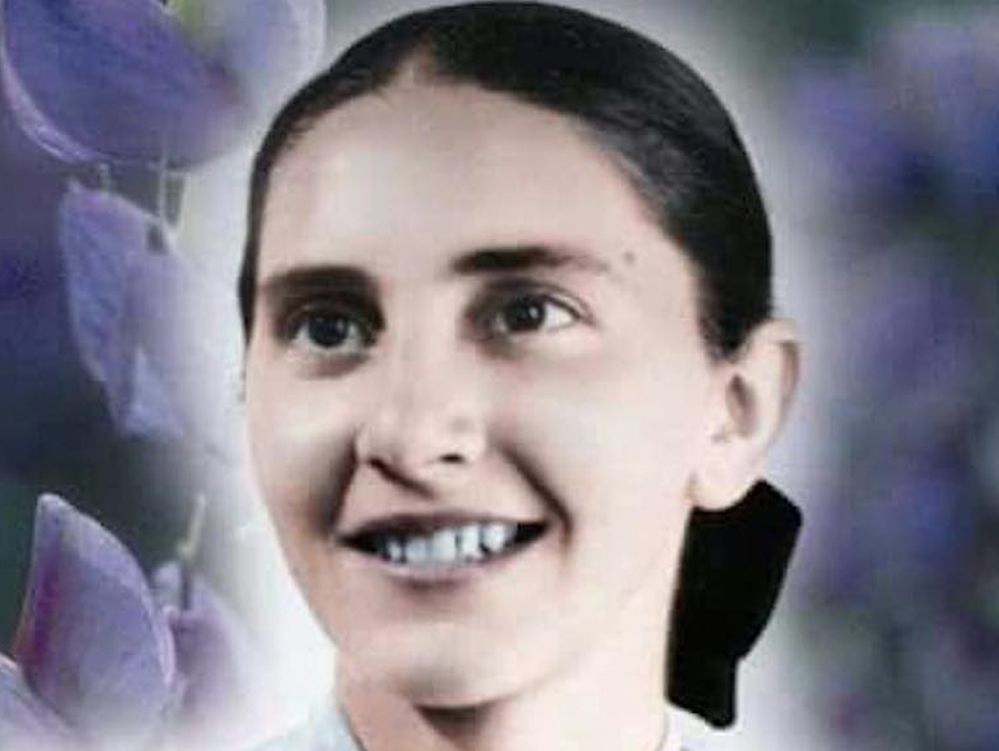
Servant of God Maria Felicia of Jesus in the Blessed Sacrament, known as "Chiquitunga," is seen in this undated portrait. The member of the Order of Discalced Carmelites will be beatified June 23 in her native Paraguay. (CNS, courtesy Central Beatification Commission of Paraguay) See PARAGUAY-BEATIFY-MARIA-FELICIA April 6, 2018.
Servant of God Maria Felicia of Jesus in the Blessed Sacrament, known as “Chiquitunga,” is seen in this undated portrait. The member of the Order of Discalced Carmelites will be beatified June 23 in her native Paraguay. (CNS, courtesy Central Beatification Commission of Paraguay)
By Santi Carneri Catholic News Service
ASUNCIÓN, Paraguay (CNS) — In rural Paraguay in 2002, a newborn who spent 20 minutes without signs of life after the umbilical cord was cut was declared dead after attempts to revive him failed. A nurse at the scene then prayed for the intercession of “Chiquitunga” and the baby came back to life.
The miraculous healing of Angel Ramon in the Department of San Pedro was attributed to the intercession of Venerable María Felicia de Jesús Sacramentado in a March 7 decree announcing her beatification from the Congregation for Saints’ Causes.
The eldest of seven children, María Felicia Guggiari Echeverría was born in Villarica, Paraguay, Jan. 12, 1925. “Chiquitunga,” as she was popularly known, will become the first Paraguayan woman to undergo beatification, a step toward sainthood.
Maria Felicia was a member of the Order of the Discalced Carmelites when she died in Asunción April 28, 1959, after contracting hepatitis.
“Our joy is overflowing” at this anxiously awaited announcement, said Carmelite Father Cornelio Villalba.
“We thank God for this great gift,” he said, noting that the Church in Paraguay now has to “prepare for this great event.”
More than 60,000 people are expected to attend the June 23 beatification Mass at the General Pablo Rojas Stadium in Asunción, the Paraguayan capital.
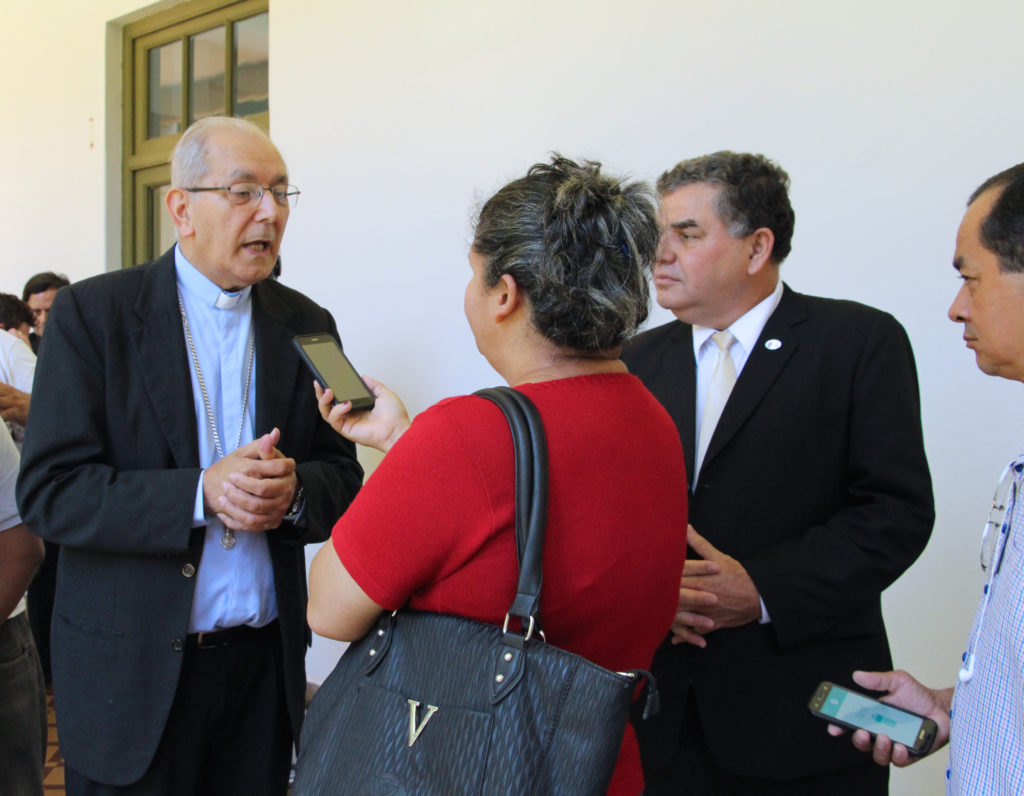
Archbishop Edmundo Ponziano Valenzuela Mellid of Asuncion, Paraguay, talks to the press March 7 after Pope Francis signed the decree allowing the beatification of the venerable Servant of God Maria Felicia of Jesus in the Blessed Sacrament, a member of the Order of Discalced Carmelites in Paraguay. (CNS, courtesy Central Beatification Commission of Paraguay)
Maria Felicia “led a life of missionary action and contemplation,” the archbishop said.
From the age of 14, she devoted herself intensely to prayer and the apostolate, and became involved in the Catholic Action of Paraguay. She worked with children, young workers, university students with problems, the poor, the sick and the elderly.
Filled with admiration for the “spirituality of a young woman,” the Church in Paraguay wants Maria Felicia “to be the patron of Paraguayan youth because she is a model of holiness,” Archbishop Valenzuela said.
The beatification process was started in December 1997, and Pope Benedict XVI declared Maria Felicia “venerable” in 2010.
The last words of Chiquitunga, who took the Discalced Carmelite habit in 1955, were: “How happy I am! … What a joy to meet my Jesus! … Jesus, I love you, what a sweet encounter! Virgin Mary,” Anibal Casco, communications officer for the Paraguayan bishops’ conference, told Catholic News Service.
For the beatification Mass, Paraguayan artist Koki Ruiz will make an altarpiece with more than 20,000 rosaries donated by parishioners, Casco said.
When Pope Francis presided at Mass at Nu Guazu Park in Paraguay in 2015, he stood in front of a 72-foot-tall, 131-foot-wide corn altar built by Ruiz with 32,000 corncobs, 200,000 baby coconuts, 1,000 squashes, and 771 pounds of seeds and grains, he told America magazine at the time.
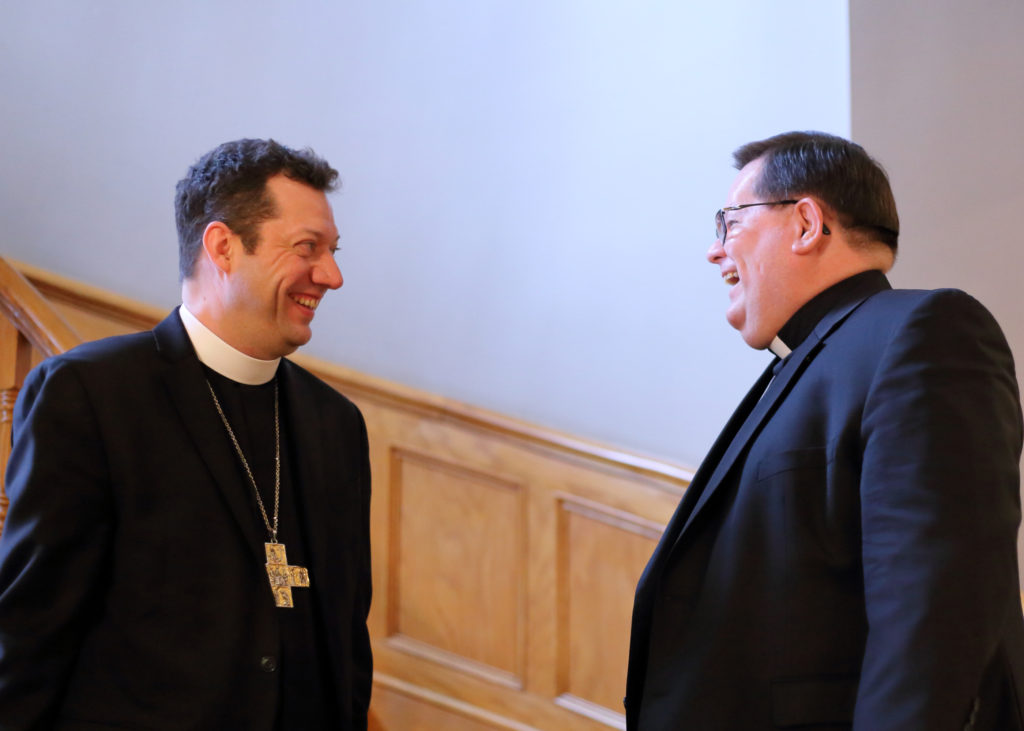
Cardinal Gerald Cyprien Lacroix, archbishop of Quebec, and Anglican Bishop Bruce Myers of Quebec share a laugh Dec. 12, 2017 in Old Quebec’s Episcopal Palace. (Philippe Vaillancourt/CNS, via Presence) See QUEBEC-CARDINAL-BISHOP-ROOMMATES April 6, 2018.
Cardinal Gerald Cyprien Lacroix, archbishop of Quebec, and Anglican Bishop Bruce Myers of Quebec share a laugh Dec. 12, 2017 in Old Quebec’s Episcopal Palace. (Philippe Vaillancourt/CNS, via Presence)
By Philippe Vaillancourt Catholic News Service
QUEBEC CITY (CNS) — “Really?” Cardinal Gerald Lacroix, archbishop of Quebec, recalls the reaction of people when they learned that the Anglican bishop of Quebec was living with him in the Episcopal Palace.
“And, how is it?” he was often asked. “Well, you know,” he replied with a hint of humor, “he eats cereal like us, he prays to God like us.”
For a little over a year, from May 2016 to July 2017, Bishop Bruce Myers of the Anglican Diocese of Quebec lived with the cardinal. The Anglican bishopric, located a few blocks away in Old Quebec, was occupied by Bishop Dennis Drainville, the outgoing bishop. He asked his friend Cardinal Lacroix if he could house his successor, Bishop Myers, for a while.
The arrangement opened an unexpected new chapter in a long tradition of friendship between Quebec City’s Catholics and Anglicans.
“I shared moments of prayer, daily meals, social life. I felt completely integrated in the life of this residence,” Bishop Myers said. “He was one of us, one of our family,” Cardinal Lacroix added.
The complicity between the two men is striking. They often prayed together. And when Bishop Myers attended Mass, he refrained from receiving Communion, respecting the Catholic teaching and tradition.
“I received the Eucharist spiritually with my confreres,” he said. “For me, it was one of the most important moments of each day, to be present, even if I wasn’t able to receive the Blessed Sacrament with my confreres.
“It has given me every day a little momentum toward reconciliation, more energy toward the day when we can gather at the same table of the Lord and share the same sacrament. It’s a manifestation of the real but imperfect communion between our two Churches. Being present, for me, is a testimony to communion and visible unity,” he explained.
“It was painful for him, but for us too,” Cardinal Lacroix agreed. The fact that Bishop Myers can participate in celebrations but not receive communion shows that “there is still a way to go” toward unity. “And it’s important that it’s visible too. We wanted to be true. And it’s good that it’s suffering, because we don’t want it to stay that way. We want to achieve full unity.”
“It’s not a matter of just praying by looking at each other from a distance. We share the prayer. There is a good chance, if we get closer to the Lord together, that there are steps that will be made,” said Cardinal Lacroix, who said Pope Francis was happy to learn about his friendship with Bishop Myers.
Bishop Myers then pointed to his pectoral cross.
“Today, I wear the cross given by Cardinal Lacroix and the two auxiliary bishops of Quebec. It’s a gift of enthronement they found for me in Rome. It was blessed by the Holy Father,” he said.
The two bishops shared parts of their daily routine but also learned from one another. In that respect, Cardinal Lacroix said he is particularly appreciative of Bishop Myers.
Bishop Myers noted that he benefited from hearing details about the ongoing reflection within Quebec Catholicism on the challenges of Christianity in today’s world. “I received a great episcopal formation from my neighbors,” he said.
In terms of ecumenism, the two religious leaders are convinced that unity will not come from a decree, but from experiences shared among people. Still, they recognize the importance of dialogue and ecumenical exchanges.
Prior to his installation, Bishop Myers worked on ecumenism for the Anglican Church of Canada.
“I always felt in my heart that it was not just me who was housed here at the archdiocese and who was in communion with you,” said Bishop Myers, turning to the cardinal. “I took the entire Anglican Diocese of Quebec with me. So it was an interpersonal relationship, but ecclesial at the same time.”
He added that he observed a difference in attitude among Anglican worshippers since the inauguration of the archbishop’s cathedra at Holy Trinity. “You’re seen in the cathedral almost as often as me. I see how people greet you: as a neighbor, as a friend. And that’s exactly what you are here,” Bishop Myers told the cardinal.
In recent months, Bishop Myers has lived at the Anglican bishopric, only a few minutes away from Cardinal Lacroix. One evening the cardinal and a few colleagues went for a walk, and realized they had not yet visited Bishop Myers at his home. They knocked on the door and started talking. Then Cardinal Lacroix pretended to take Myers’ arm and told him, teasingly, “It’s time for you to come home now.”
Philippe Vaillancourt is editor-in-chief of PRESENCE INFO, based in Montreal.
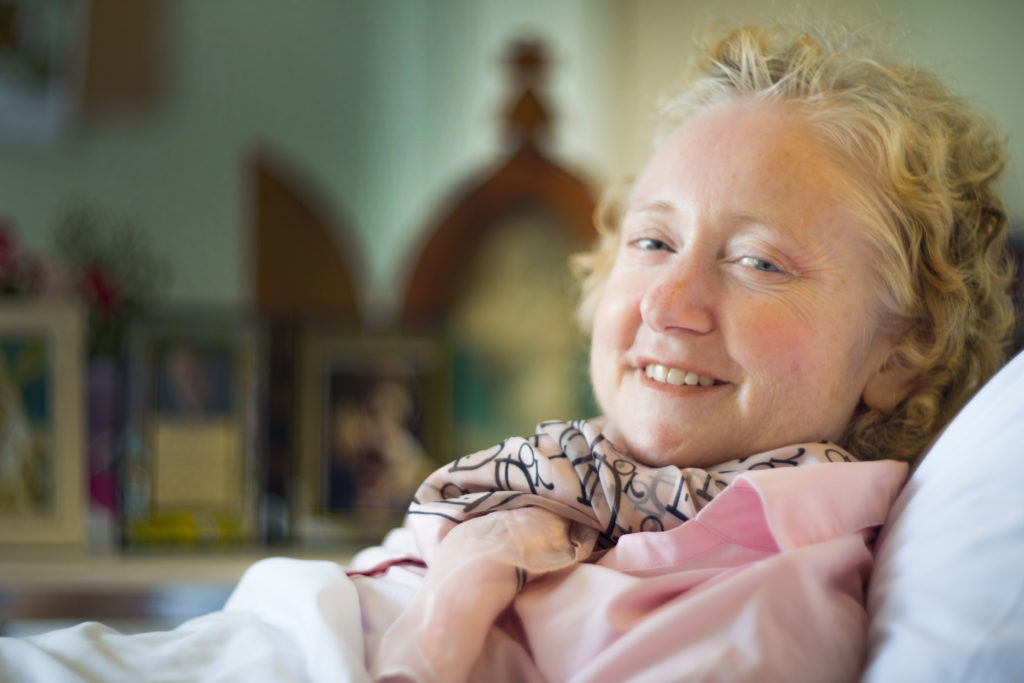
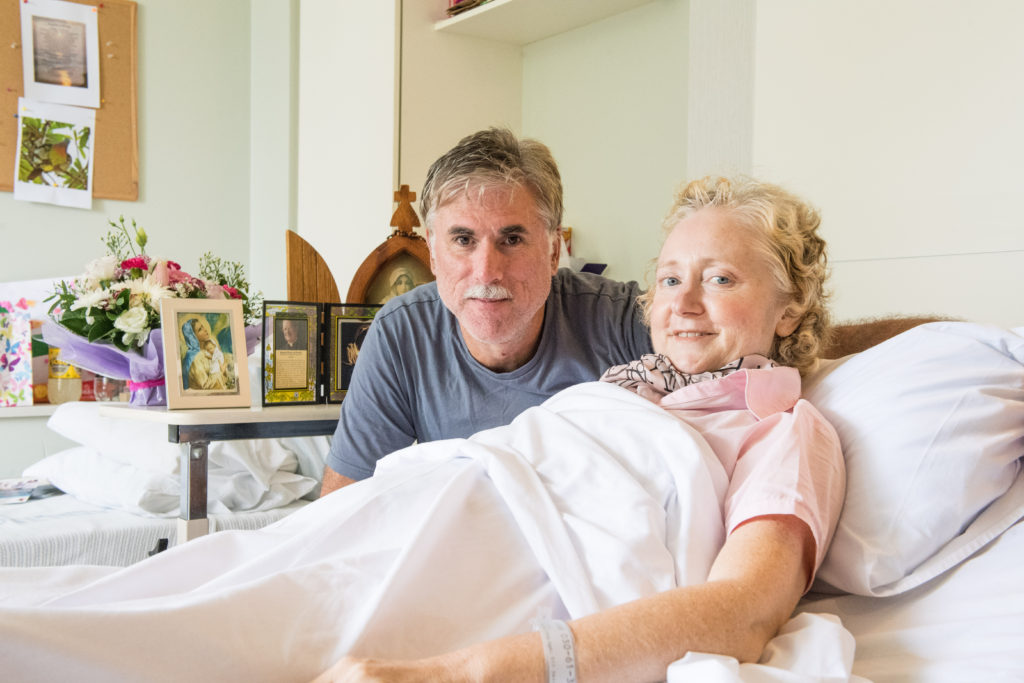
Anna Corry poses in her bed March 16 at Neringah Hospital, a palliative care facility in Wahroonga, Australia. The 50-year-old former nursing educator, who had endured an aggressive type of breast cancer since her diagnosis in January 2016, died Holy Thursday, March 29. (Giovanni Portelli/CNS, via The Catholic Weekly) See AUSTRALIA-WOMAN-EUTHANASIA April 4, 2018.
Anna Corry poses in her bed March 16 at Neringah Hospital, a palliative care facility in Wahroonga, Australia. The 50-year-old former nursing educator, who had endured an aggressive type of breast cancer since her diagnosis in January 2016, died Holy Thursday, March 29. (Giovanni Portelli/CNS, via The Catholic Weekly)
By Marilyn Rodrigues
Catholic News Service
SYDNEY (CNS) — In March, as Anna Corry lay dying, she sent out a request to speak publicly about her opposition to euthanasia.
The 50-year-old former nursing educator had endured an aggressive type of breast cancer since her diagnosis in January 2016. This January, she and her husband, Martin, a paramedic, and their sons Michael, 17, Dominic, 14, and Andrew, 11, received the news that although chemotherapy had shrunk the 10-cm tumor near her heart, the cancer had spread through her body.
She died Holy Thursday, March 29, but not before the parishioner of St. Bernadette’s in suburban Castle Hill shared her thoughts on euthanasia and assisted suicide with The Catholic Weekly, newspaper of the Archdiocese of Sydney.
Australia will have a voluntary assisted dying law in force in the state of Victoria next year, while a state legislature committee investigates the issue in Western Australia.
Corry told the paper she believes opting to shorten her own life would have robbed herself, her family and friends of “an incredible amount of joy” during her final weeks.
Some say churches should stay out of the debate around dying and the law, and that the terminally ill themselves should have more say; Corry said she discovered, through her own experience, arguments against legalizing euthanasia that are quite apart from her Catholic faith.
“(People who use euthanasia) are potentially robbing friends and family of beautiful acts of kindness and service which bring them much joy,” she said. Her family would not have had those experiences “if I had, perhaps 12 or even six months ago, committed suicide through the act of euthanasia.”
“If I had told my children I was potentially looking at euthanasia, they would feel robbed of a mother for weeks or months that they could have had, and it could have created a lot of anger within them.
“And if there were a cure discovered (shortly afterward), imagine how the family would feel. That would be an incredible amount of suffering for them.”
Anna Corry poses with her husband, Martin, in her bed March 16 at Neringah Hospital, a palliative care facility in Wahroonga, Australia. The 50-year-old former nursing educator, who had endured an aggressive type of breast cancer since her diagnosis in January 2016, died Holy Thursday, March 29. (Giovanni Portelli/CNS, via The Catholic Weekly)
Corry left her home in Cherrybrook in Sydney’s northwest for a bright and spacious room at Neringah Hospital, a palliative care facility in Wahroonga, where she received many visitors, including friends who came to pray with her each day.
She said she understands the fear of a terminal disease’s progression, including the loss of independence and physical discomfort.
“A diagnosis of a terminal illness can be an enormous strain of stress and fear on a person and the family,” she said, but added there is no reason to fear unbearable pain at the end of life.
“Every type of pain can be addressed, and I’ve witnessed that myself. I can’t understand why people aren’t instructed that the pain relief available is totally adequate.”
She said she believes a desire for euthanasia can sometimes indicate a lack of healthy self-love.
“A lot of people don’t feel they deserve to have their family look after them. I’ve heard that a lot of people who … don’t want to burden their family; they feel lonely, they are disconnected from their family.
“It’s more about emotional pain in my view, not so much physical pain,” she added.
Corry told The Catholic Weekly her journey with cancer included intense “peaks and troughs” physically and spiritually. And she said she had to work through anger, anxiety and heartbreak at having to leave her children.
But she also expressed gratitude for her disease, which she said enriched her marriage and taught her the value of friendship and generosity as well as a deeper appreciation of time.
“I didn’t know that a marriage could be so happy until now,” she said.
“It’s given my husband an opportunity to serve me in a way that he’s never ever done before, and we love each other now more than ever,” she said. “It’s a very deep love, it’s a very personal love, and I guess it’s a little bit fearful because we won’t be with each other, or at least communicating with each other in a human sense.
“(Though) we will through prayer,” she added.
Hundreds of Corry’s friends and family were praying for a physical cure as well as a spiritual cure of being able to accept whatever God’s will would be for her. She said the second request had been granted.
“Just before I came into (this) hospital I started to trust Our Lord, and I started to feel a peace and joy that I’ve never felt before, and an acceptance of His will,” she said.
Marilyn Rodrigues is a Sydney-based writer and mother of five who writes for THE CATHOLIC WEEKLY.
Bryan Stevenson, center, a recipient of the 2018 Martin Luther King Jr. Nonviolent Peace Prize Award, shares a moment April 4 with the Rev. C.T. Vivian and Atlanta Archbishop Wilton D. Gregory. The 93-year-old Vivian was a close friend and ally of Rev. King during the civil rights movement. (Michael Alexander/CNS, via Georgia Bulletin) See MLK-ATLANTA April 5, 2018.
ABOVE: Bryan Stevenson, center, a recipient of the 2018 Martin Luther King Jr. Nonviolent Peace Prize Award, shares a moment April 4 with the Rev. C.T. Vivian and Atlanta Archbishop Wilton D. Gregory. The 93-year-old Vivian was a close friend and ally of Rev. King during the civil rights movement. (Michael Alexander/CNS, via Georgia Bulletin)
By Andrew Nelson Catholic News Service
ATLANTA (CNS) — Churches around the Archdiocese of Atlanta solemnly rang bells 39 times in commemoration of the 50th anniversary of the assassination of the Rev. Martin Luther King Jr.
From Atlanta’s Blessed Sacrament Church and the Shrine of Immaculate Conception to Flowery Branch’s Prince of Peace Church, the tolling bells marked Rev. King’s 39 years of age when he was fatally shot in Memphis, Tennessee, on April 4, 1968.
Fr. Small said the moment was an opportunity for parishioners and members of a nearby Lutheran church to be together with their faith communities to “share in a legacy that for many has been a defining inspiration in their lives.”
The prayers helped people be aware the day was not merely a civic observation, but that the moment and the life of Rev. King had deeper significance, the priest told The Georgia Bulletin, Atlanta’s archdiocesan newspaper.
The King Center, led by CEO Bernice King, the daughter of the slain leader, awarded the Martin Luther King Jr. Nonviolent Peace Prize, its highest recognition. The award recipients were attorney Benjamin Ferencz, an investigator and prosecutor of Nazi war crimes following World War II, and attorney Bryan Stevenson, author of “Just Mercy” and the founder and director of Equal Justice Initiative in Montgomery, Alabama.
Upon receiving the award, Stevenson shared a message he attributed to Rev. King: “We have to stay hopeful even in the face of these difficulties. Hopelessness is the enemy of justice.”
Rev. King taught the community to stand when others sit and to be a voice for justice when others remain quiet, he said.
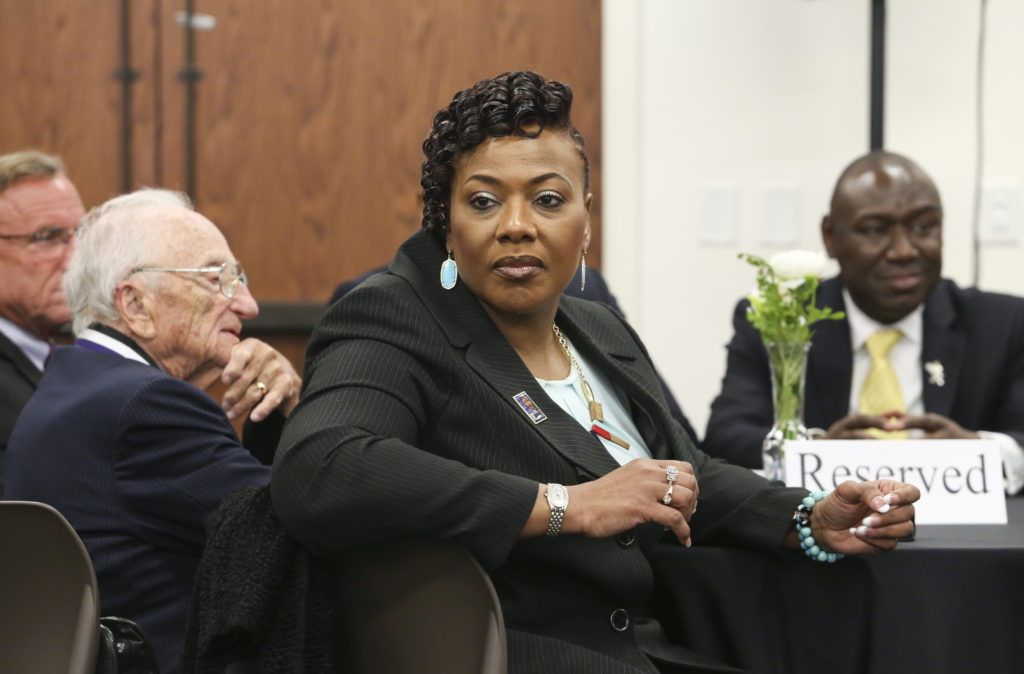
Bernice A. King, daughter of the Rev. Martin Luther King Jr. and chief executive officer of the Martin Luther King Jr. Center for Nonviolent Social Change, looks on April 4 at the Martin Luther King Jr. Nonviolent Peace Prize Awards luncheon. The occasion marked the 50th anniversary of the assassination of her father and the founding of the King Center by her mother, Coretta Scott King, in 1968. (Michael Alexander/CNS, via Georgia Bulletin)
Archbishop Gregory, who is the first African-American Catholic archbishop in the country, gave the invocation at the awards luncheon, held at Ebenezer Baptist Church, the home church of Rev. King, born in Atlanta Jan. 15, 1929.
The archbishop said he believes Rev. King would be asking more of the country. Rather than statues, roads and holidays named in his honor, the archbishop said the civil rights leader instead would want the country to be courageous and tackle the issues he embraced.
“He would be humbled by this recognition, but disappointed his true legacy has yet to be achieved,” said Archbishop Gregory.
The country wrestles with “blatant racial injustice,” and the resort to violence, as the disparity between the rich and the poor “continues unabated in a land as richly blessed as ours,” he said.
“What would he have us do?” asked the archbishop. “He would have us take up the tasks that remain unfinished.
“His prophetic voice would challenge us all,” he continued, “to work more vigorously to rid our nation of violence, to be actively engaged in the political arena that so needs purification, to follow the lead of our young people who call for and demand responsible gun control, and to recognize the countless thousands of homeless and hungry people still living in the shadow of our opulence even in this blessed Atlanta community.
“These actions would be the legacy he would most desire in 2018, 50 years after his assassination.”
Catholics attending the event recalled with clear memories where they were when news of the assassination spread.
The archbishop was a junior at his college seminary doing service at a school. When he and his classmates returned to their campus, he saw the fires from riots burning in Chicago some 40 miles away.
“It was just startling. I was just terribly disappointed. I remember thinking that did not have to happen,” he said.
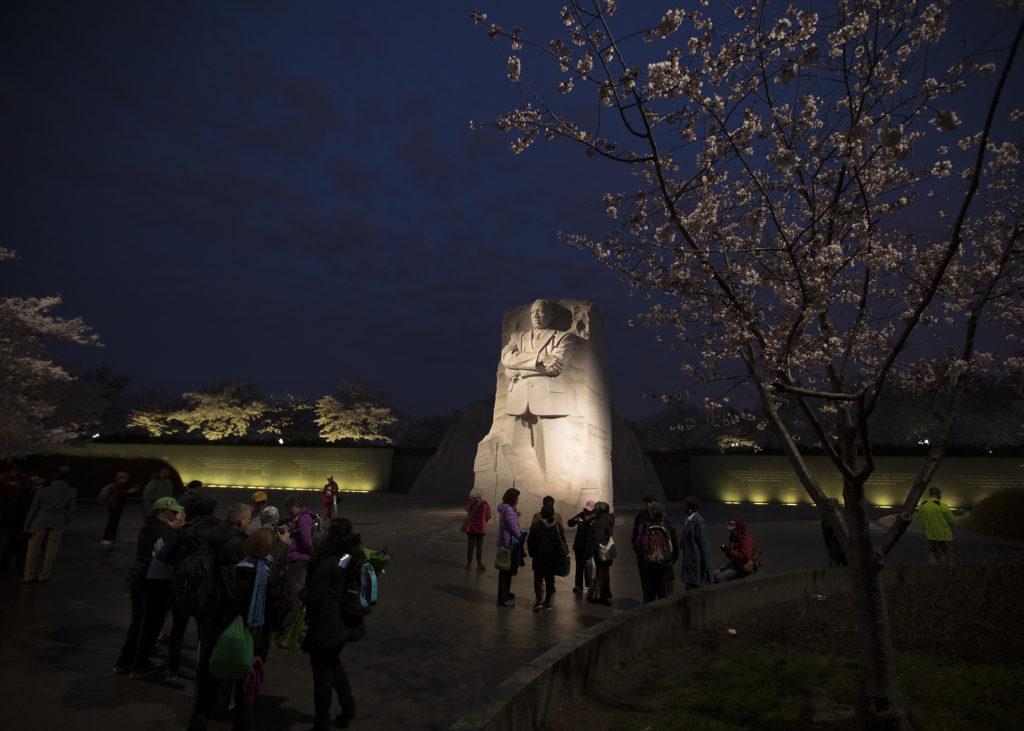
People gather during dawn around the Martin Luther King Jr. Memorial in Washington April 4. The day marked the 50th anniversary of the assassination of the civil rights leader in Memphis, Tenn. (Tyler Orsburn/CNS)
Archbishop Gregory said he feared at the time that riots and looting in many cities would set the movement for civil rights back.
Monica Kaufman Pearson, the first African-American to anchor a daily evening newscast in Atlanta and an award-winning journalist, was a sophomore at the University of Louisville, Kentucky.
“Everyone was nervous. I remember the concern because riots broke out that night,” she said.
Pearson grew up in Louisville and attended St. Peter Claver Church and went to Presentation Academy, a girls school started by the Sisters of Charity of Nazareth, Kentucky.
She said her late mother made a point that has stayed with her: “If God could allow his son to die for our sins, so we could be saved, Dr. Martin Luther King died so that we could be free.”
“He was a martyr for the cause,” said Pearson, who worships at Our Lady of Lourdes Church across the street from the King Center.
For her, King’s message of peace and reconciliation remains powerful because it surprises people.
“Most people, when they are attacked, usually attack back. I really believe in turning the other cheek. … It disarms people,” said Pearson.
“You are doing the right thing and if you are harmed in some way during that process by people who don’t know Jesus, you need to pray for them,” she added. “And maybe their actions, they will learn, they will learn and feel the presence of the Holy Spirit that tells them, ‘What you are doing is not right.’”
Andrew Nelson is a staff reporter at THE GEORGIA BULLETIN, newspaper of the Archdiocese of Atlanta.
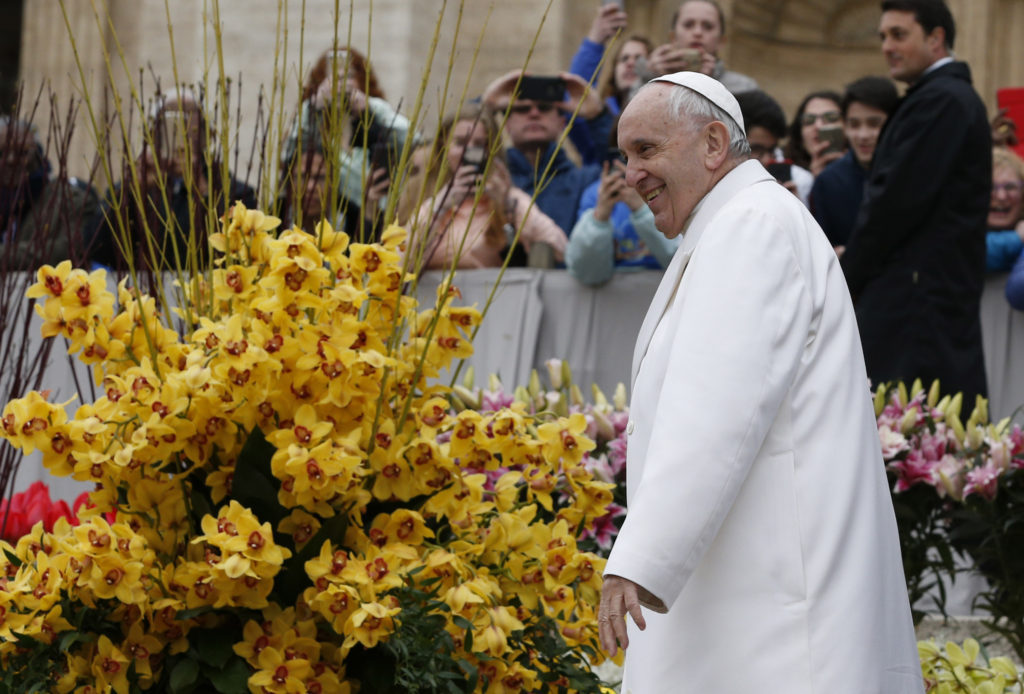
Pope Francis walks near Easter flowers during his general audience in St. Peter's Square at the Vatican April 4. (CNS photo/Paul Haring) See POPE-AUDIENCE-WITNESS April 4, 2018.
By Junno Arocho Esteves Catholic News Service
VATICAN CITY (CNS) — The final words at Mass — “Go in peace” — are an invitation to Christians to proclaim God’s blessings through their lives, not an opportunity to go outside and speak ill of others, Pope Francis said.
Through the Eucharist, Jesus “enters in our hearts and in our flesh so that we may express in our lives the sacrament we received in faith,” the pope said during his weekly general audience in St. Peter’s Square April 4.
“But if we leave the church gossiping, saying, ‘Look at this one, look at that one,’ with a loose tongue, the Mass has not entered into my heart. Why? Because I am not able to live the Christian witness,” he said. “Every time I leave Mass, I must leave better than when I entered, with more life, with greater strength, with a greater desire to give Christian witness.”
An estimated 20,000 pilgrims gathered in St. Peter’s Square dressed in bright ponchos and holding umbrellas to shield themselves from the cold rain.
After circling the square in his popemobile, the pope made his way to the stage, which was still adorned with flowers from the Easter celebrations.
Flowers, the pope said, are a symbol of the joy and happiness of Jesus’ resurrection when “our justification blossomed, the holiness of the Church blossomed.”
Pope Francis walks near Easter flowers during his general audience in St. Peter’s Square at the Vatican April 4. (CNS photo/Paul Haring) See POPE-AUDIENCE-WITNESS April 4, 2018.
Wishing the faithful in the square a happy Easter, Pope Francis also had a special greeting for his predecessor, retired Pope Benedict XVI.
“I would like all of us to wish a Happy Easter to the former bishop of Rome, the beloved Pope Benedict, who is watching us on television. To Pope Benedict, let us all wish him a Happy Easter and give him a big applause,” he said.
In his main talk, the pope focused on the closing rites of Mass, finishing a series of audience talks on the liturgy.
As the Mass ends, he said, “the commitment of Christian witness” begins at home, at work and any time a Christian interacts with others; the idea is to “become Eucharistic men and women.”
“What does this mean?” the pope asked. “It means letting Christ act through our works: that his thoughts become our thoughts, his feelings become our feelings, his choices become our choices.”
Departing from his prepared remarks, Pope Francis said that by “mortifying our selfishness,” Christians create a greater space for the Holy Spirit to act in their lives and “widen their souls” after receiving the Eucharist.
“Let your souls be widened! Not these narrow, closed, small, selfish souls. No! Great souls, big souls with great horizons,” he said.
The fruits of the Eucharist, the pope added, are “destined to mature in daily life” and grow like a grain of wheat through “our good works, attitudes and becoming like Jesus.”
In receiving the Body and Blood of Christ, Pope Francis said, men and women are called to “pass from the flesh of Christ to the flesh of our brothers and sisters,” especially the poor where Jesus “awaits to be recognized, served, honored and loved by us.”
“May our lives always be in bloom, like Easter, with the flowers of hope, of faith, of good works,” he said. “May we always find the strength for this in the Eucharist, in our union with Jesus.”
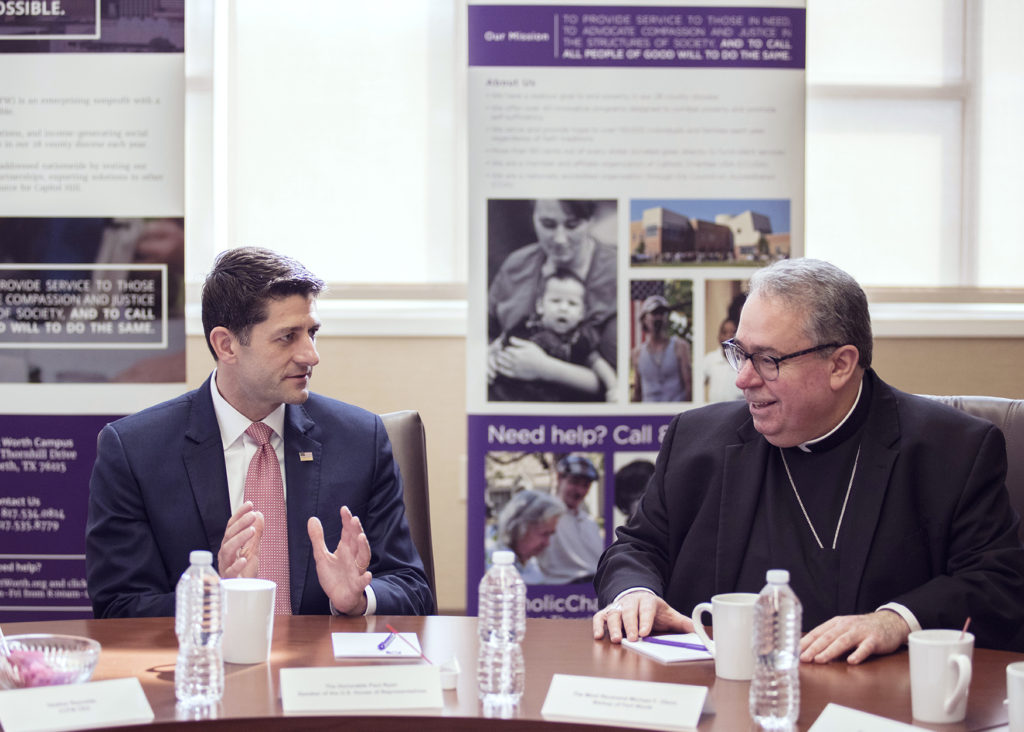
House Speaker Paul Ryan, R-Wis., a Catholic, talks with Heather Reynolds, CEO and president of Catholic Charities Fort Worth, Texas, during a town hall meeting on poverty April 3 at the charity's Fort Worth campus. (CNS photo/Juan Guajardo, North Texas Catholic Magazine) See CATHOLIC-CHARITIES-RYAN April 6, 2018.
House Speaker Paul Ryan, R-Wis., a Catholic, talks with Heather Reynolds, CEO and president of Catholic Charities Fort Worth, Texas, during a town hall meeting on poverty April 3 at the charity’s Fort Worth campus. (Juan Guajardo/CNS, via North Texas Catholic Magazine)
By Susan Moses Catholic News Service
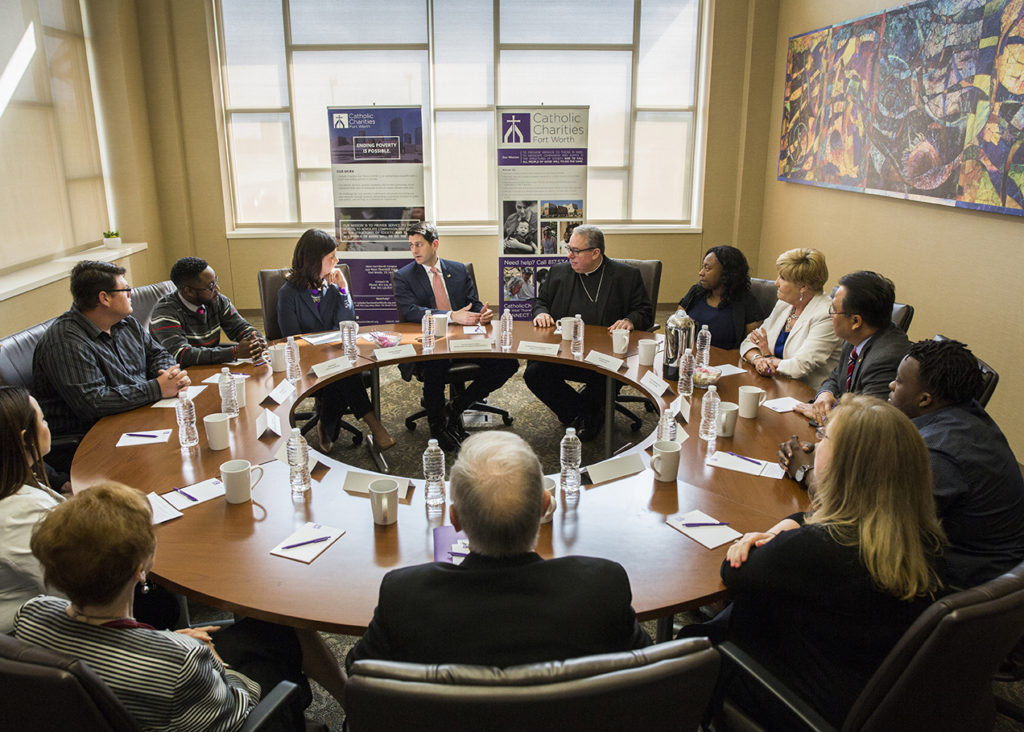
FORT WORTH, Texas (CNS) — House Speaker Paul Ryan, R-Wisconsin, has been studying poverty at the federal level from Washington, but he took a few hours to learn what poverty looks like on the front lines with a visit to Catholic Charities Fort Worth April 3.
After touring the facility and meeting with three clients and case managers, Ryan and Heather Reynolds, president of Catholic Charities Fort Worth, met with the agency’s staff and supporters to discuss the 50-year war on poverty — the welfare and social legislation introduced by President Lyndon B. Johnson to help end poverty.
One problem Ryan articulated is that the federal government has been measuring its success in eliminating poverty by how much it has contributed to the 80-plus federal programs that assist the poor, which adds up to more than $15 trillion over 50 years. However, few of those programs evaluate actual outcomes, he said.
“We spend all this money,” Ryan said, “but we don’t measure whether it’s working or not. In this 21st century, data century, we’re in, clearly we ought to be able to measure the outcomes of these programs. But how you do that matters, and you want to make sure you do it in a very academically rigorous way and you’ve got to respect people’s privacy.”
House Speaker Paul Ryan, R-Wis., a Catholic, visits with Bishop Michael F. Olson of Fort Worth, Texas, during a private roundtable discussion on poverty-fighting efforts at Catholic Charities Fort Worth campus April 3. (Juan Guajardo/CNS, via North Texas Catholic Magazine)
Catholic Charities Fort Worth also has been trying to break the cycle of poverty, and it came to the same realization that its efforts needed to be measured to determine their effectiveness. Two years ago, the nonprofit partnered with the Wilson Sheehan Lab for Economic Opportunities at the University of Notre Dame to evaluate the efficacy of their poverty assistance programs.
Year-one results indicate that intensive case management is crucial to accomplishing the Catholic agency’s goal of eliminating poverty, one family at a time, in the 28-county diocese it serves.
Success has been measured in two programs in particular: Stay the Course, which provides low-income college students with comprehensive social support to help them complete their degrees; and Padua Pilot, which gives clients broad-based intensive case management to assist them with their health, finances, education, child care, housing and other needs.
Looking at six years of data, the Notre Dame researchers determined that Stay the Course students have been four times as likely to complete their degrees compared to the control group. And in Padua Pilot’s first year, clients saw their incomes increase 19 percent while their spending decreased 20 percent.
Tonita Burbage, a Catholic Charities client who attended the town hall, was laid off in 2014 and struggled with unemployment and underemployment for two years. She credited Catholic Charities’ assistance in helping her find a full-time job with benefits so she could support her two daughters without government assistance.
House Speaker Paul Ryan, R-Wis., a Catholic, has a roundtable discussion on poverty April 3 with Bishop Michael Olson of Fort Worth, Texas, Heather Reynolds, president of Catholic Charities Fort Worth, and Catholic Charities caseworkers and clients. (Juan Guajardo/CNS, via North Texas Catholic Magazine)
The organization helped her with job training, developing a resume and providing interview outfits. However, Burbage said what helped the most was “to have someone support everything that I want to do and having that open door where I could call anytime or email — to have someone listening.”
Ryan said the gains accomplished by intensive case management prove that the federal government needs to “manage the supply lines, but not the front lines of fighting poverty.”
He envisioned federal resources working in partnership with the private sector at the local level to move families out of poverty.
Fort Worth Bishop Michael F. Olson, who accompanied Ryan on his tour of Catholic Charities, said the speaker’s visit “shows that Church and state can work together, and I think it also shined a light on why our Catholic Charities is doing so well.
“Case management is an anchor to our Catholic Charities,” the bishop said. “It exists in other programs throughout the U.S., but we’ve had the far-sighted investment to make this an anchor of how we approach the eradication of poverty.”
Reynolds, who gave testified on poverty reform on Capitol Hill in 2014, thanked Ryan for his willingness to “disrupt the status quo and put front and center the American dream, because that’s what we’re about at Catholic Charities.”
At the town hall, Ryan said he is a “big fan of the Catholic Charities model” and would like to see the “beautiful casework management system replicated. I really believe this is among the keys to fixing poverty and addressing it at its root core to break the cycle of poverty.”
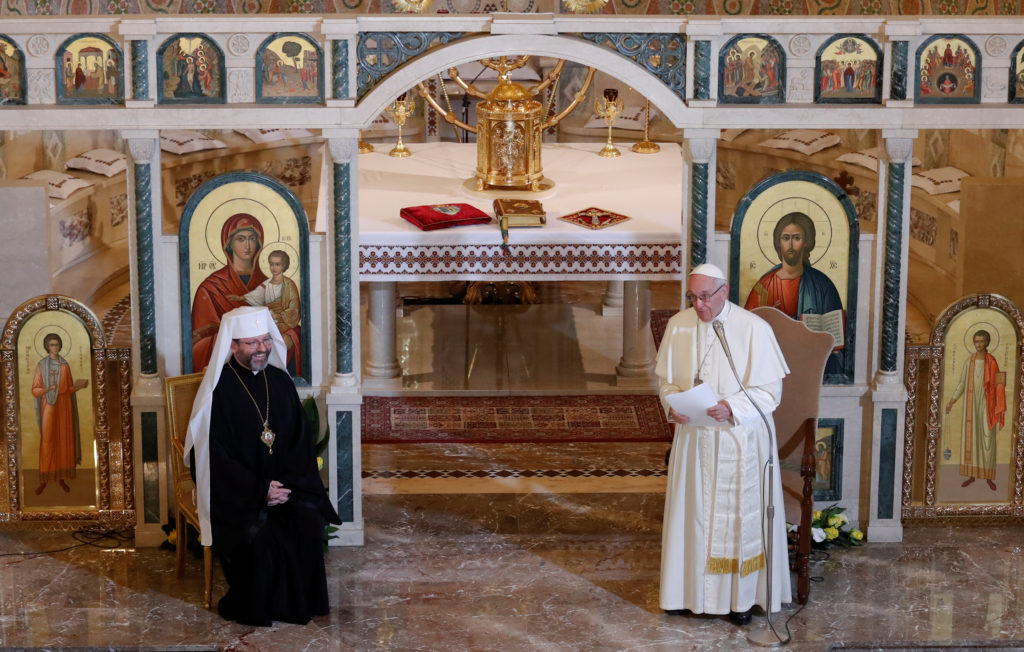
Pope Francis speaks next to Archbishop Sviatoslav Shevchuk of Kiev-Halych, head of the Ukrainian Catholic Church, during a Jan. 28 meeting with the Ukrainian Catholic community at the Basilica of Santa Sophia in Rome in January. The Ukrainian Catholic Church is the largest of the Eastern Catholic churches, which are described in "Oriente Cattolico," a three-volume book published by the Vatican. (Remo Casilli/CNS, via Reuters) See VATICAN-LETTER-EASTERN-CATHOLICS April 5, 2018.
Pope Francis speaks next to Archbishop Sviatoslav Shevchuk of Kiev-Halych, head of the Ukrainian Catholic Church, during a Jan. 28 meeting with the Ukrainian Catholic community at the Basilica of Santa Sophia in Rome in January. The Ukrainian Catholic Church is the largest of the Eastern Catholic Churches, which are described in “Oriente Cattolico,” a three-volume book published by the Vatican. (Remo Casilli/CNS, via Reuters)
By Cindy Wooden
Catholic News Service
VATICAN CITY (CNS) — The story of the Christian family includes tales of how its Eastern and Western branches separated, grew apart, attempted reconciliation, hurt each other and now are trying to work together for the sake of the children today and for generations to come.
But it is also a story of heroic faith, steadfastness and yearning for unity in the face of danger and persecution, as well as a modern narrative about the challenges and rewards of allowing differences in culture and heritage to enrich the whole family rather than divide it.
All of those stories, told from the point of view of Eastern Catholics, are recounted in the three-volume, 1,200-page opus, “Oriente Cattolico (The Catholic East),” published by the Congregation for Eastern Churches.
There is a significant Eastern Catholic presence within the Diocese of Phoenix boundaries, and the Diocese of Phoenix has maintained a relationship with parishes of the different Eastern Churches.
Pulling together the family tree and family history took 14 years and involved dozens of scholars, bishops and the heads of the Eastern Catholic Churches. The last time the congregation published a comprehensive volume about all the Churches it assists was in 1974.
The work was coordinated by Paulist Father Ronald G. Roberson, associate director of the U.S. Bishops’ Secretariat of Ecumenical and Interreligious Affairs. Before undertaking the massive project for the Vatican, he authored “The Eastern Christian Churches: A Brief Survey,” and has updated that seven times.
Work on an English translation of the new volumes is in the early stages, he told Catholic News Service. A swift translation is not expected, he said, but it obviously will not take as long as it took to produce the Italian volume.
“It took so long because of the methodology we adopted for producing the texts,” he said. “First, we asked an expert to produce a draft, then it went to a second expert for comments, then to the head of the Church being described, and then to the congregation for final approval.”
In the big family that is the Catholic Church, a family with some 1.3 billion members, the Eastern Catholic Churches have about 17.7 million members, according to the Vatican statistics used in “Oriente Cattolico.”
The Ukrainian Catholic Church is the largest with almost 4.5 million members, and the Syro-Malabar Church, with more than 4.2 million, is a close second. The smallest “Church entities” in the book are the Byzantine apostolic exarchates of Greece and Turkey, which together count just over 6,000 faithful, and the Russian Catholics, who are believed to number about 3,000.
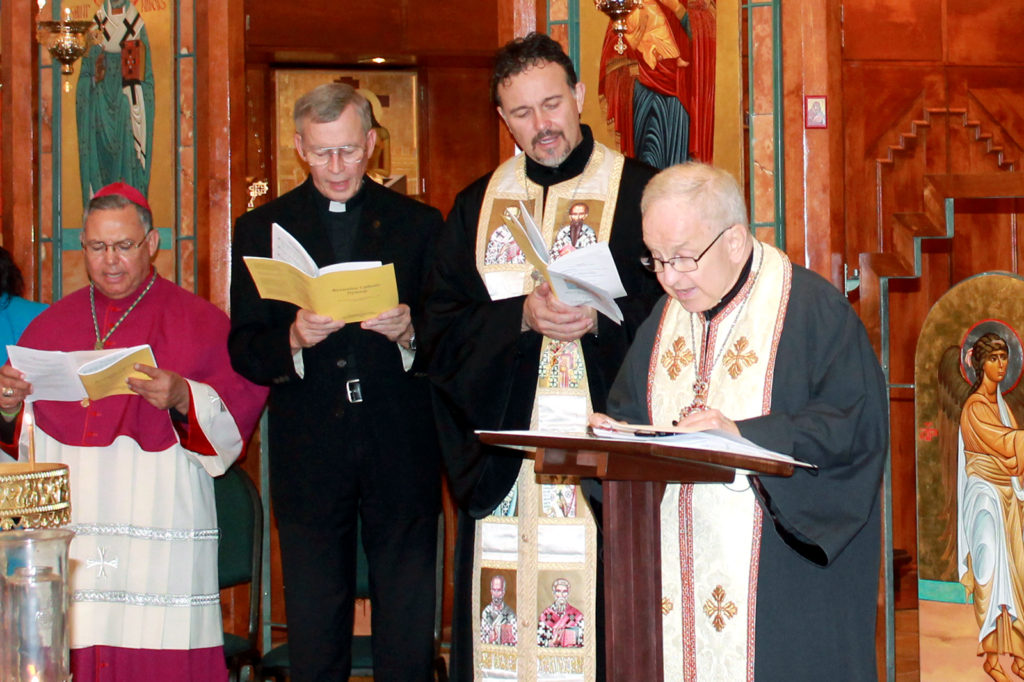
Bishop Gerald N. Dino, bishop emeritus for the Holy Protection of Mary Byzantine Catholic Eparchy of Phoenix, leads a prayer at a prayer service for the Week of Prayer for Christian Unity Jan. 24 at St. Stephen Byzantine Catholic Cathedral. Behind him are, (left to right) Auxiliary Bishop Eduardo A. Nevares of the Diocese of Phoenix, Fr. Michael Diskin, vice chancellor for the diocese and president of the Arizona Faith Network, and Fr. Diodoro Mendoza, rector of St. Stephen and chancellor of the eparchy. (Tony Gutiérrez/CATHOLIC SUN)
The new volumes present the history and current makeup of the Eastern Churches, grouped according to their structures, and lists them as:
Six “patriarchal churches,” that is, those with a patriarch and a high level of self-rule, although in communion with the pope. They are the Coptic, Syriac, Melkite, Maronite, Chaldean and Armenian Catholic churches. Within the Diocese of Phoenix boundaries, these include:
Four led by major archbishops and having most of the autonomy of the patriarchal churches. They are the Ukrainian, Syro-Malabar, Syro-Malankara and Romanian Catholic churches. Within the Diocese of Phoenix boundaries, these include:
Four “metropolitan churches” led by archbishops. They are the Eastern Catholics of Ethiopia and Eritrea; the Ruthenian Catholics in the United States; the Slovak Catholics; and the Hungarian Catholics. Within the Diocese of Phoenix boundaries, this includes the Holy Protection of Mary Byzantine Catholic Eparchy of Phoenix, including:
Nine Eastern Catholic communities with eparchies or apostolic exarchates, which are similar, respectively, to dioceses and apostolic vicariates in the Latin-rite church. These are the Italo-Albanian Eparchy of Italy; the Eparchy of Krizevci, Croatia; the Ruthenian Eparchy of Mukachevo, Ukraine; the Exarchate of Sophia, Bulgaria; the exarchates of Greece and Turkey; Exarchate of Macedonia; the Exarchate of the Czech Republic; the Exarchate of Serbia; and the exarchic Monastery of Santa Maria of Grottaferrata, Italy.
Three Eastern Catholic communities without their own hierarchy: Byzantine Russian Catholics, Belarusian Catholics and Eastern-rite Catholics in southern Albania.
“Oriente Cattolico,” a three-volume book on the Eastern Catholic churches, says those churches contribute to the search for Christian unity by being themselves and maintaining their liturgical, spiritual, theological and even disciplinary traditions. (CNS)
Writing the preface for “Oriente Cattolico,” Cardinal Leonardo Sandri, congregation prefect, said the book was designed to make sure Catholics “know, honor and love the Churches of the East that are in full communion with the apostolic see of Rome,” to present a resource for consultation about the Eastern Catholic Churches and to pay “homage to the Churches of the Christian East — Catholic and Orthodox — and their numerous martyrs and confessors of the faith.”
Unfortunately, he wrote, “similar tragedies are repeated today and the Christians of the East pay a heavy tribute to the hatred that persecutes Christians or divides them.”
The divisions and, particularly, efforts to heal them received special treatment in the volumes and not just on the level of the international Catholic dialogues with the Orthodox and the Oriental Orthodox churches.
The book, for example, has a separate chapter on ecumenism and the Code of Canons of the Eastern Churches, highlighting the code’s insistence on the obligation of all Catholics to work and pray for unity.
The book acknowledges that throughout history many attempts were made to “latinize” the Eastern Churches that were in communion with Rome, making them look and sound more like the rest of the Catholic community. But the chapter on canon law insists the Eastern Catholic communities contribute to the search for Christian unity by being themselves and maintaining their liturgical, spiritual, theological and even disciplinary traditions, which, for example, can include having both celibate and married priests.
For the past 50 years, the popes have insisted that as the task of healing the divisions in the Christian family proceeds, respect for the identity and heritage of the Eastern Churches demonstrates that the re-establishment of full unity would not mean smaller members of the family would be asked to sacrifice their identity.
NASHVILLE, Tenn. (CNS) — Fr. Pat Connor was on his way from a graduate class at the University of Memphis to St. Joseph Hospital to visit a priest friend the evening of April 4, 1968.
That’s when he heard the news crackle over his car radio speakers: the Rev. Martin Luther King Jr. had been critically injured by a gunshot wound and was being rushed to St. Joseph.
Realizing he wouldn’t be able to get near the hospital under those circumstances, Fr. Connor headed home to his residence at Immaculate Conception Church on Central Avenue, just a few miles from the Lorraine Motel, where Rev. King was shot.
After local news outlets later announced Rev. King’s death, an eerie silence followed. “Real news was hard to get at the time,” recalled Fr. Connor, now a retired priest of the Diocese of Nashville, which at the time encompassed all of Tennessee.
Armed National Guardsmen rolled up and down Central Avenue, the only vehicles moving through the streets, determined to quell any potential rioting. Smoke and flames erupted in the distance.
The assassination of Rev. King evoked a visceral reaction in communities across the country, as grief, anger and racial tensions rose to a volatile level.
The civil rights leader went to Memphis to stand with the striking sanitation workers, and his presence among them was “like Jesus coming into my life” recalled Clinton Burrows in the documentary “At the River I Stand,” which chronicles the strike and Rev. King’s involvement in the movement, leading up to his assassination. When Rev. King was killed, it represented nothing less than the slaying of a prophet.
Half a century after his death, many of the issues he tackled are still part of our national dialogue.
“Fifty years ago it was about overturning laws and policies that really concretely divided us,” said Christ the King parishioner Megan Black, who holds a master of divinity degree from Vanderbilt University.
“Now, we’ve changed the laws but we still have the structures that are designed to keep people of color sick, uneducated and incarcerated,” she told the Tennessee Register, Nashville’s diocesan newspaper. “The consequences are very much felt and lived in the black community. There’s still work to be done.”
The long march toward equality, toward the mountaintop and the promised land that Rev. King spoke of the day before he died, continues.
In the days following Rev. King’s death, Fr. Connor and fellow members of the Nashville diocesan priests’ council met in Memphis with city government representatives and then with members of the sanitation workers’ union, which the mayor of Memphis did not recognize at the time. They decided to issue a statement backing the workers, reinforcing “that they had a right to march and be on strike,” Fr. Connor said.
They agreed when Rev. King told the workers in Memphis that “all labor has dignity,” and “it’s a crime for people to live in this rich nation and receive starvation wages.”
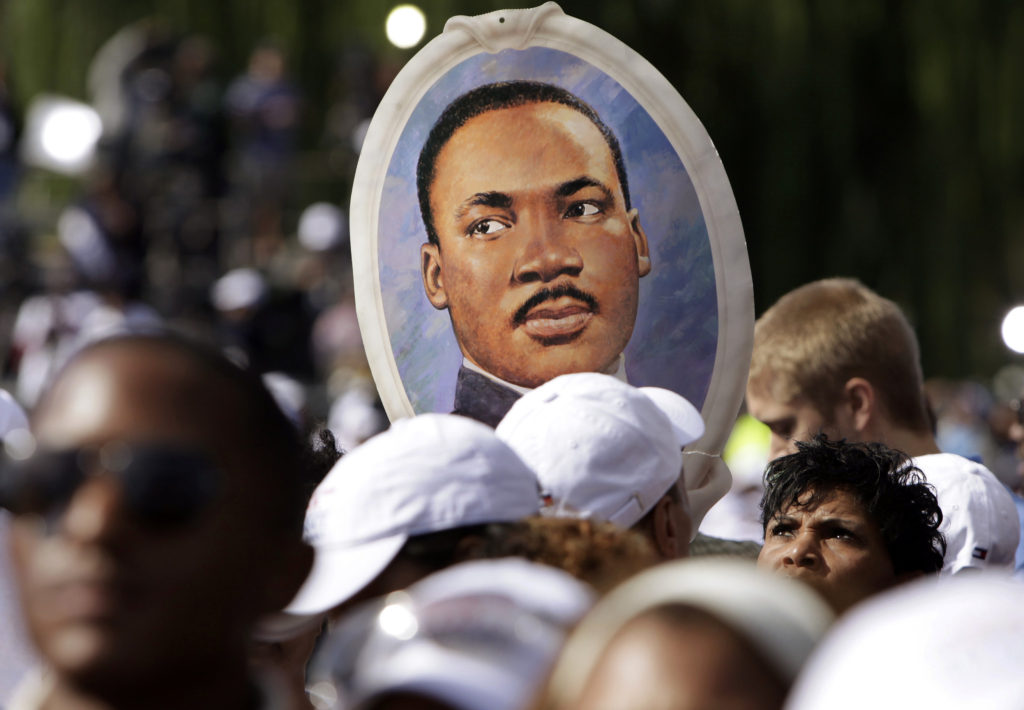
A woman holds a portrait of the Rev. Martin Luther King Jr. during the 2011 dedication of the King memorial at the National Mall in Washington. Fifty years after the assassination of the civil rights leader, “we need to ask ourselves if we are doing all we can to build the culture of love, respect and peace to which the Gospel calls us,” the U.S. bishops’ Administrative Committee said March 28. (Yuri Gripas/CNS, via Reuters)
The priests’ council also recommended to Nashville Bishop Joseph A. Durick that the diocese make a $1,000 donation to support the striking workers’ families, almost all of whom were African-Americans living below the poverty line.
“We began to get some pretty nasty calls at the rectory” after that news came out, Fr. Connor said. “Some people had a really bad reaction to that.”
That brought into sharp focus for Fr. Connor just how bitterly divided the people of the diocese were on confronting racial justice.
He remembers how white parishioners who were staunchly opposed to integration openly challenged Bishop Durick’s support for Rev. King and the sanitation workers’ strike, his stance on civil rights, even his authority as bishop. “It definitely took a toll on him, but it didn’t stop him,” Fr. Connor said.
When Bishop Durick was named coadjutor bishop of Nashville in 1964, he began the arduous task of convincing white Catholics that it was high time for African-Americans to move beyond the second-class place they had been relegated to for so long.
Mitchell wrote his graduate thesis on “The involvement of the Catholic Church with the black community in Nashville, 1954-1970,” and personally interviewed Bishop Durick on several occasions.
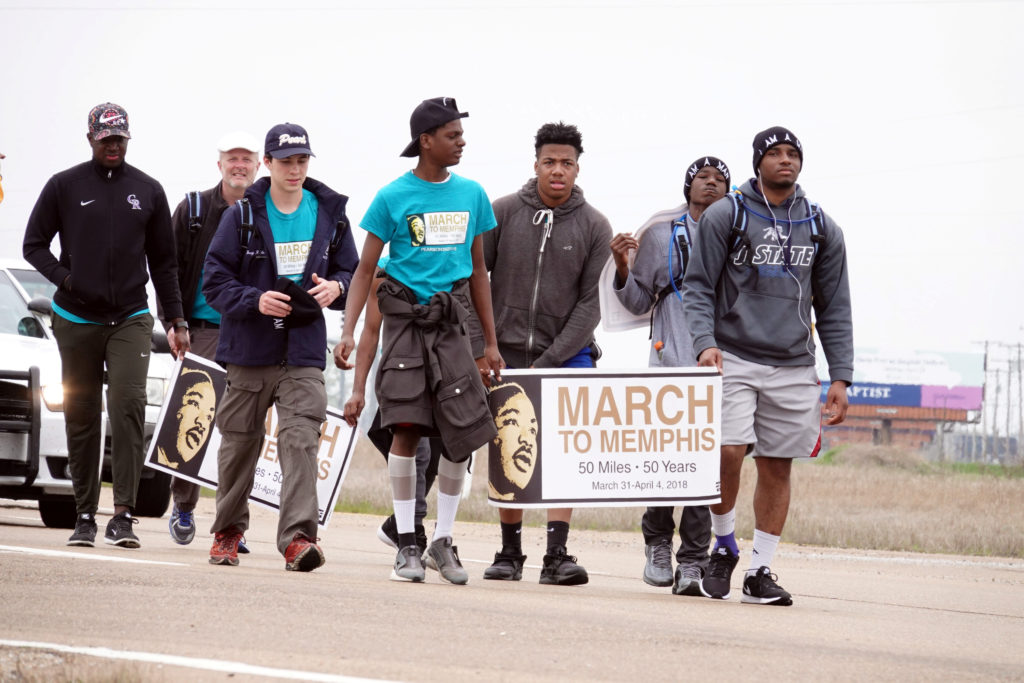
A group of teenagers from Pearl, Miss., walk along U.S. Highway 61 just south of Memphis, Tenn., April 2, on their 50-mile “March to Memphis” tribute to the Rev. Martin Luther King Jr. April 2. April 4 marks the 50th anniversary of the death of the civil rights leader in Memphis. (Karen Pulfer Focht/CNS, via Reuters)
Even though Bishop Durick and his “kitchen cabinet” of allies were at the forefront of the civil rights movement in Tennessee, their message did not always filter down to the white Catholics in the pews or reach the historically black parishes.
Members of the black Catholic community were often left wondering, “Are there any … priests of white congregations openly challenging segregation? Encouraging their congregations to take action to end segregation? To be part of the civil rights movement?” Mitchell said. “If they were, they were keeping it secret from the black folks.”
One of Rev. King’s legacies is that “he held the church accountable for its complicity in racism,” said Black, of Christ the King Parish. “He reminded the church of what it stands for.”
A lifelong Catholic, Black is the national clergy organizer for PICO National Network. In her job, she has worked with organizers in the Black Lives Matter movement, and “absolutely” sees these modern-day advocates for racial justice as walking in the footsteps of Rev. King, holding both civil and clerical servants accountable.
The Catholic Church has a role to play in dismantling racism, Black said, noting the U.S. Conference of Catholic Bishops last August established the Ad Hoc Committee Against Racism, with Bishop George V. Murry of Youngstown, Ohio, as its chairman. The U.S. bishops also are expected to issue a new pastoral on racism. Their 1979 pastoral on the issue is now in its 19th printing.
But more action is needed, Black feels.
She would like to see funding for comprehensive resources and a solid curriculum that can be used at the parish level.
Black recently organized a Lenten adult education series at Christ the King addressing race. “I sense there is a deep hunger for these types of conversations,” she said. “But it’s hard to find a way into it.” What’s needed is “profound spiritual leadership … to confront race in a radical way.”
The night before he was murdered, Rev. King delivered his famous “Mountaintop” speech at the Mason Temple, the Church of God in Christ in Memphis.
“I just want to do God’s will,” he told the enthusiastic crowd packed inside the church. “And He’s allowed me to go up to the mountain. And I’ve looked over, and I’ve seen the Promised Land. I may not get there with you. But I want you to know tonight, that we, as a people, will get to the promised land.”
Before he died, Rev. King was in the final planning stages for a large-scale Poor People’s March on Washington; today, there is a new Poor People’s Campaign, built around a “national call for moral revival,” designed to “recapture what Dr. King called the ‘revolutionary spirit’ needed to solve these systemic problems” of racism and poverty.
The modern-day movement for civil rights, Black said, can “remake what it means to be religious: I’m a person who takes action, who is aligned with the poor and marginalized,” a person who is carrying on the unfinished work that was started so many decades ago.
Theresa Laurence is a staff writer at the TENNESSEE REGISTER, newspaper of the Diocese of Nashville.
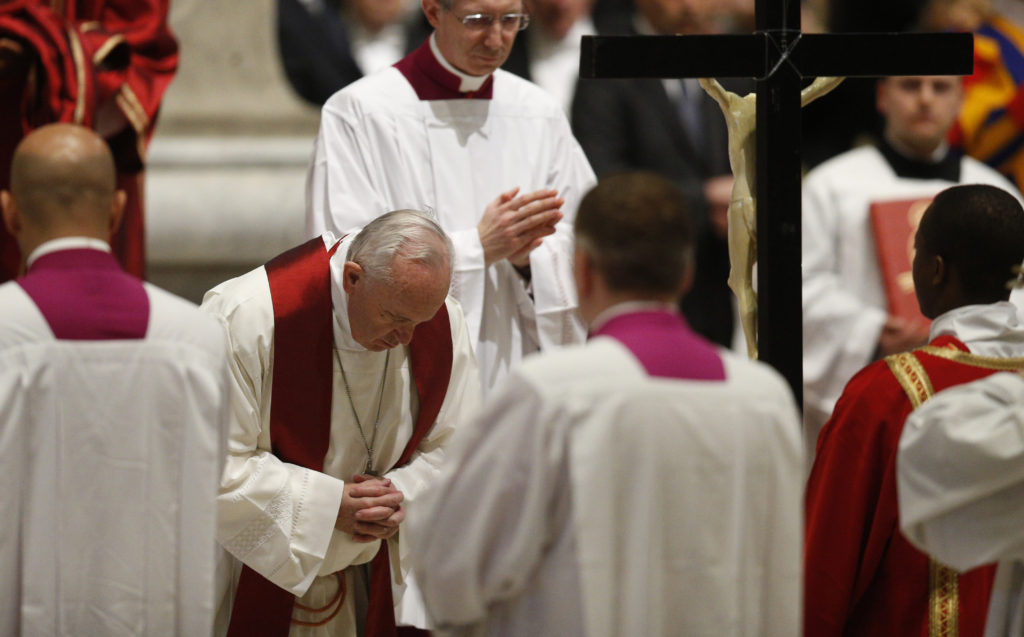
Pope Francis venerates the crucifix during the Good Friday service in St. Peter's Basilica at the Vatican March 30. (CNS photo/Paul Haring) See POPE-GOOD-FRIDAY March 30, 2018.
Pope Francis venerates the crucifix during the Good Friday service in St. Peter’s Basilica at the Vatican March 30. The Vatican announced that the April 6 that the Holy Father will release a new apostolic exhortation, “Gaudete et Exsultate (Rejoice and be Glad)” on “the call to holiness in the modern world” April 9. (CNS photo/Paul Haring)
By Cindy Wooden
Catholic News Service
VATICAN CITY (CNS) — “Rejoice and Be Glad,” Pope Francis’ new apostolic exhortation on “the call to holiness in the modern world,” will be released April 9, the Vatican announced.
The document, called “Gaudete et Exsultate” in Latin, will be presented at a Vatican news conference by Archbishop Angelo De Donatis, the papal vicar for the Diocese of Rome.
Joining the archbishop will be Gianni Valente, an Italian journalist working for Fides, the news agency of the Congregation for the Evangelization of Peoples, and Paola Bignardi, an educator and past president of Italian Catholic Action.
The title of the apostolic exhortation is the phrase used in Matthew 5:12, the end of the Beatitudes, which reads: “Rejoice and be glad for your reward will be great in heaven.”
Pope Francis, 81, has published two previous apostolic exhortations, both of which offered reflections on meetings of the Synod of Bishops. “Evangelii Gaudium (The Joy of the Gospel),” published in 2013, focused on proclaiming the Gospel in the modern world and included proposals from the 2012 synod on new evangelization. “Amoris Laetitia (The Joy of Love),” was released in 2016 and focused on ministry to and with families. It included proposals discussed during sessions of the Synod of Bishops in 2014 and 2015.
Some walks are easier than others. The walk into an abortion clinic is likely among the toughest.
Those who join an April 14 benefit walk can make the journey some take toward an abortion clinic a story of a successful “turnaround” toward a true crisis pregnancy center instead. The walk raises funds for the Choices Pregnancy Centers of Greater Phoenix. Catholics, Protestants and people of goodwill are expected to join in a concrete way to help end abortion.
“Every aspect of the Body of Christ can come together — Catholic, Protestant, all sorts of people who love God and love life and want to make a difference for life,” said Raul Reyes, president of the CPC. “It is the most effective way a believer can save a life.”
Since its establishment in 1983, the CPC of Greater Phoenix has organized walks for life of varying levels of intensity and commitment. After a short hiatus, Reyes and his wife, Christine, executive director, revitalized the annual event, which has now been continuing for about five years.
The Walk for Life is the largest pro-life walk organized by a pregnancy center in Arizona. This year, the CPC walk expanded to three locations — Arizona State University’s Tempe and ASU West campuses plus Desert Springs Community Church in Goodyear.
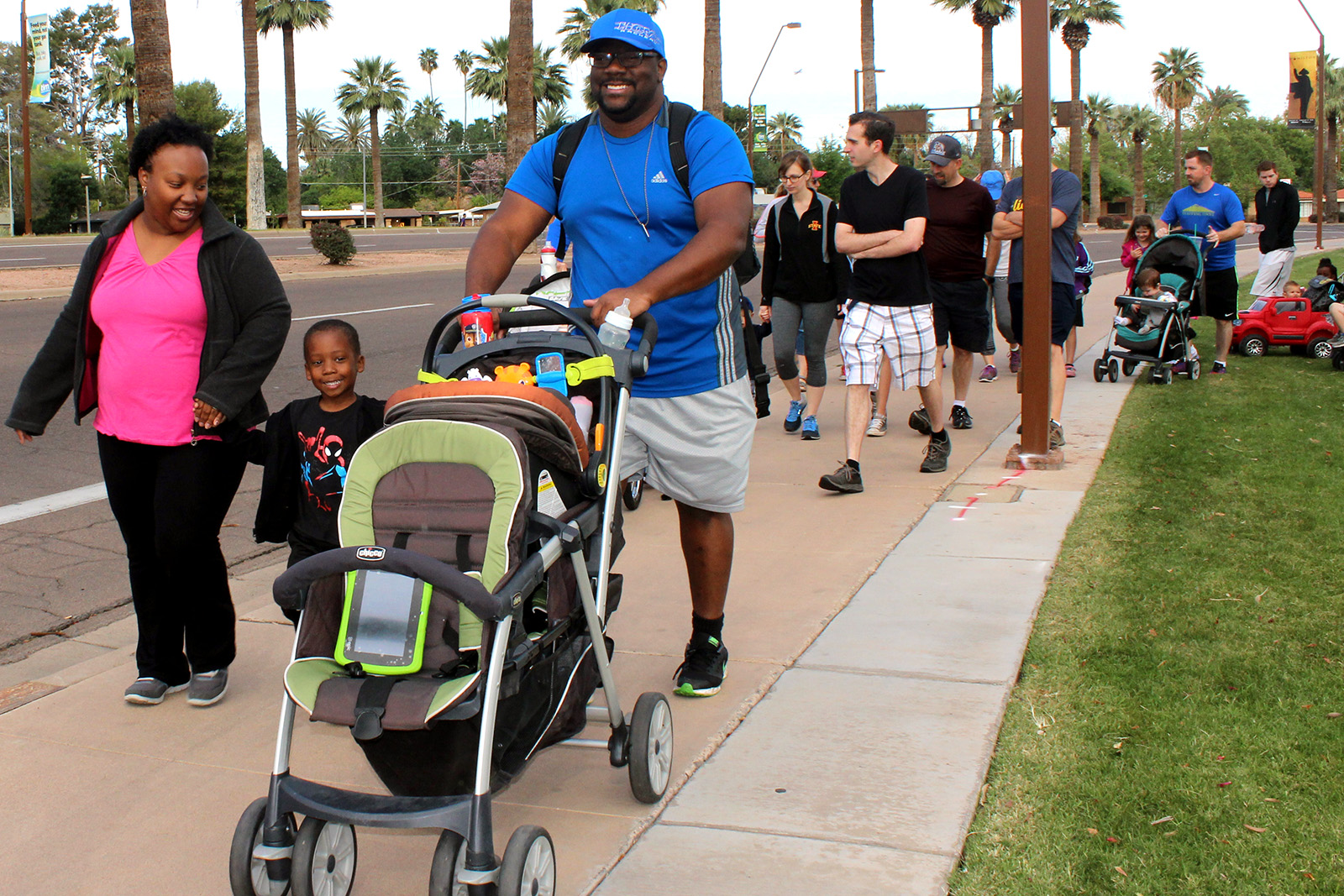
The family-friendly event features prizes for participants. Those who raise $200, for example, receive a Walk for Life T-shirt to help spread the pro-life movement. Community organizations will have tents where representatives talk about the pro-life movement and live music is planned to keep participants energized.
CPC is an evangelical Christian-based organization with a mission, according to its website, to “turn the hearts of mothers to their children, and the hearts of parents to their Heavenly Father.” The organization currently has three pregnancy centers and is opening a fourth this year at Camelback and 19th Avenue.
The Diocese of Phoenix has collaborated with the CPC on a number of occasions, including the recent March for Life in January and pro-life boards. Ecumenical cooperation is what excites both Reyes and Phelan about the upcoming Walk for Life.
“For us to work together with our separated Christian brethren and others of good will, who have concern for life — we are more effective when we do things in tandem,” Phelan said.
“It’s so important that we show that we are united as Catholic and Protestant, especially when it comes to the issue of life,” Reyes said. “It’s a beautiful Body of Christ. We are standing united for the life of these unborn babies.”
A young family bears witness for life with their children during last year’s Walk for Life. (Courtesy of Raul Reyes)
“Anything that shows support that’s national or [increases] local attention may be helpful in making a decision to save a life,” said the court’s regent Joyce Stallions.
Reyes expects about 300-400 participants at each walk location and hopes to raise around $250,000 to fund the CPC’s pro-life mission.
Phelan believes pro-life events such as the Walk for Life illustrate the joyful and loving aspects of the pro-life movement, starkly different from the usual angry portrayal Phelan believes the movement normally receives.
“I’m looking forward to it being another joy-filled example of how the pro-life movement actually lives and exists,” Phelan said.
The witness to Christian living — Catholic or otherwise — is what makes the Walk for Life a powerful testament to the growing pro-life movement in Arizona and nationally.
Participants can still register for the walk online at the CPC’s website, cpcphoenix.org.