


Pope Francis spoke about St. John Paul II during his weekly general audience Oct. 22.
Pope Francis spoke about St. John Paul II during his weekly general audience Oct. 22.


The worldwide pilgrimage of the traditional Christian icon of Our Lady of Czestochowa, also known as the Black Madonna, is ending its U.S. pilgrimage in the Diocese of Phoenix. Local Catholics have opportunities daily through Nov. 1 to venerate it.
The pilgrimage is part of Human Life International’s historic From Ocean to Ocean Campaign in Defense of Life. The organization has affiliates and partners in more than 80 nations.
[quote_box_right]
5:30 p.m. Mass with veneration until 7:30 p.m. Oct. 24 at Our Lady of Guadalupe Shrine, Flagstaff
noon-1:30 p.m. Oct. 25 at 40 Days for Life, Flagstaff
5 and 7 p.m. Masses Oct. 25-26 at St. Joseph the Worker, Williams
8 and 10 a.m. Masses Oct. 26 at St. Anne Mission, Ash Fork
8 a.m. and 7 p.m. Masses Oct. 27 at Our Lady of Mount Carmel, Tempe
noon-3 p.m. Oct. 27 at 40 Days for Life, Tempe
5 p.m. Mass Oct. 30 at Maggie’s Place, Phoenix. Veneration until 8 p.m.
Oct. 31 40 Days for Life, Chandler
4 p.m. arrival, 6 p.m. Mass Nov. 1 at Our Lady of Czestochowa Parish, Phoenix. Icon departs 3 p.m. Nov. 2.
Learn more about the history of the Black Madonna and the first ever worldwide pilgrimage with a sacred icon, launched for the protection of the most vulnerable of persons at the beginning and end of life, at HLI’s coverage of the U.S. pilgrimage.[/quote_box_right]Catholics in the Diocese of Phoenix can see the icon Oct. 24-25 in Flagstaff and during evening Masses Oct. 25 at St. Joseph the Worker Parish in Williams before it moves to Ash Fork for morning Masses Oct. 26. It spends all day Oct. 27 in Tempe before spending three days in the Diocese of Tucson.
The image returns to the Diocese of Phoenix Oct. 30 for Mass and veneration at the Fiat House of Maggie’s Place. Human Life International is the world’s largest grassroots pro-life and pro-family organization.
The image of the Black Madonna will bear witness at the 40 Days for Life site in Chandler Oct. 31 and conclude its U.S. tour Nov. 1 at Our Lady of Czestochowa, a Polish parish in Phoenix. The icon arrives at 4 p.m. with Mass and 6 p.m. The image will remain there until 3 p.m. Nov. 2. Hundreds of Catholic faithful are expected to attend the culminating ceremony of HLI’s custodianship of From Ocean to Ocean Campaign in Defense of Life.
Fr. Peter West, HLI’s vice president for missions and current custodian of the Pilgrim Icon of Czestochowa, will hand over custodianship of the treasured Christian icon to Fr. James Heyd, a Chicago priest and well-known advocate for life and family at a special outdoor Mass presided over by Dominican Father Jacek Buda.
“Catholics and Orthodox Christians, particularly of Polish or other Eastern European descent, have long had a great devotion to the Black Madonna, and they know her history of awe-inspiring miracles,” Fr. West said in a statement. “But I can say for sure that over the last 14 months, we have seen a great growth in many other Christian communities of devotion to the Mother of Jesus. We pray that the Black Madonna will bring many graces to the Dioceses of Phoenix and Tucson, and inspire an increased devotion and faith, including a faith that is active in the defense of all life.”
He also vowed continued prayers for Fr. Heyd and future custodians around the world who join in the historic campaign in defense of the unborn and most vulnerable brothers and sisters in Christ.
[quote_box_center]

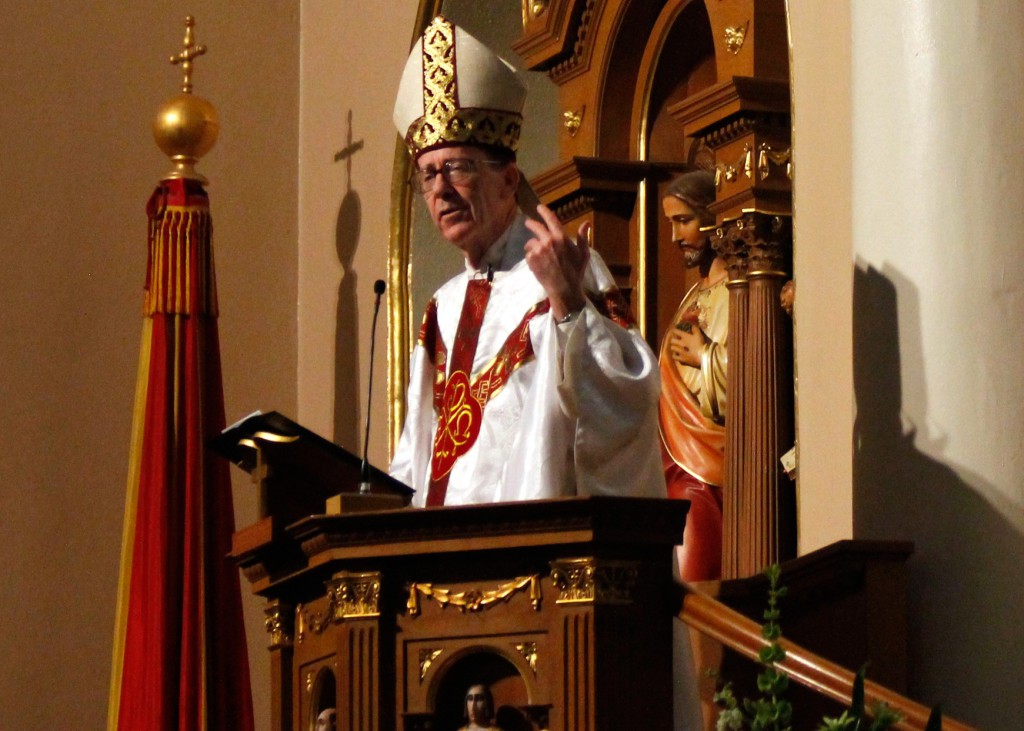
Following are Bishop Thomas J. Olmsted’s homily notes for the Mass celebrating the first feast day of St. John Paul II. It was celebrated Oct. 22, 2014, at St. Mary’s Basilica in Phoenix.
On the 50th anniversary of his ordination as a priest, St. John Paul II published a memoir which offered a personal glimpse into his priestly heart. He focused on two words, two realities that were the most prominent in his life: mystery and gift — the mystery of Christ and the gift of believing in Him.
Looking back over 76 years, Karol Wojtyla might have chosen to see only pain and suffering, for he had known more than his share of those. Instead, he saw gift and mystery.
Something similar happened to an American contemporary of Karol Wojtyla by the name of Dorothy Day. Like the future Polish pope, she loved writers and poets, including the Russian novelist Fyodor Dostoevsky. Looking back on her tumultuous life, she found great meaning and even consolation in Dostoevsky’s words: “Love in reality is a harsh and dreadful thing compared to love in dreams.”
The gift of love reaches us in the mystery of suffering with Christ. This truth came home to Dorothy when she least expected it, when, after having aborted her first child, and while living with a man who did not believe in marriage, she gave birth to a little girl. Within weeks of her baby’s birth, Dorothy knew beyond a doubt that the best thing she could do for her child was the gift of Baptism. And in order to baptize her child she herself needed to be baptized; and for that to happen, she had to make costly changes in her life. But, with new-found faith, she could see that it is the harsh and dreadful love of Jesus on the Cross that brought light and joy to the darkness of her heart.
When Jesus’ disciples on the way to Emmaus looked back on the previous days’ events in Jerusalem, they saw only defeat and shame in the Passion and death of their Master. When asked by the companion who had joined them along the way, “What kind of things happened there?” they said, “Are you the only visitor to Jerusalem who does not know what has taken place there?” Jesus, then, helped them to see gift and mystery where previously they saw defeat and shame. This is what Jesus taught Karol Wojtyla, the future John Paul II, to do.He came to believe in Jesus words, “It was not you who chose me, but I who chose you and appointed you to go and bear fruit that will remain” (Jn 15:16).
Already as a little child, Karol Wojtyla discovered a love that was embodied in the tenderness of his mother and the protective care of his father, but that reached far beyond his Polish home in Wadowice, a love that would carry him, one day, to nearly every country in the world as an Apostle of Jesus Christ, a servant of the servants of God.
But, as is the case for many, his vocation in life was not something he perceived during his teenage years. At that time, he had a passion for the theater, and a keen interest in the study of languages. A call to the priesthood never seriously entered his mind until his academic career came to a sudden stop with the outbreak of the Second World War and the German occupation of his homeland. When the university he was attending was closed down, he became engaged in an underground theater, a dangerous enterprise during the brutal martial law imposed by the Nazi regime. But, as he braved the dangers of performing in the “Theatre of the Living Word,” the word of God came alive for him in a new way; he heard the Lord calling him to become a priest. It was the mystery of evil that helped the future pope to discover the far greater mystery of God’s love.
This was a lesson he never forgot, one that was repeated on many occasions throughout his life: the love of God breaks through in the most unexpected ways, precisely when evil seems to triumph or sorrow breaks our heart.
St. Paul writes about this gift and mystery in his many Letters of the New Testament. Today, through his letter to the Ephesians, he says, “To me, the very least of all the holy ones, this grace has been given, to preach to the Gentiles the inscrutable riches of Christ, and to bring to light for all what is the plan of the mystery…accomplished in Christ Jesus our Lord.”
No one expected Saul of Tarsus to become a follower and then an apostle of Jesus—least of all Saul himself. But the gift of faith in Christ is indeed a mystery. The Lord chooses the weak to confound the strong, the foolish to humble the wise. And, as St. Paul insisted, the Lord chooses the worst of sinners to show the power of His mercy for all.
In the Gospel, today, Jesus tells us to be prepared for God to work in unexpected ways in the world. He says, “You, too, must be prepared, for…the Son of Man will come…at an hour you do not expect.”
No one expected Cardinal Karol Wojtyla to be elected pope in October 1978. All the pundits and talking heads overlooked this man from behind the Iron Curtain. His name was not among the “papabile” suggested by experts outside or inside the Church. But God’s ways are not our ways; they are far better and far more wrapped in the mystery of love.Pope Saint John Paul II liked to say, “There is no such thing as coincidence.” We may not understand why the Lord does what He does but we can be sure that all things unfold under his providential love.
Jesus tells us today, “Much will be required of the person entrusted with much, and still more will be demanded of the person entrusted with more.” We praise God that He entrusted so much to Karol Wojtyla, and that he responded with such heroic love to the gift and mystery.

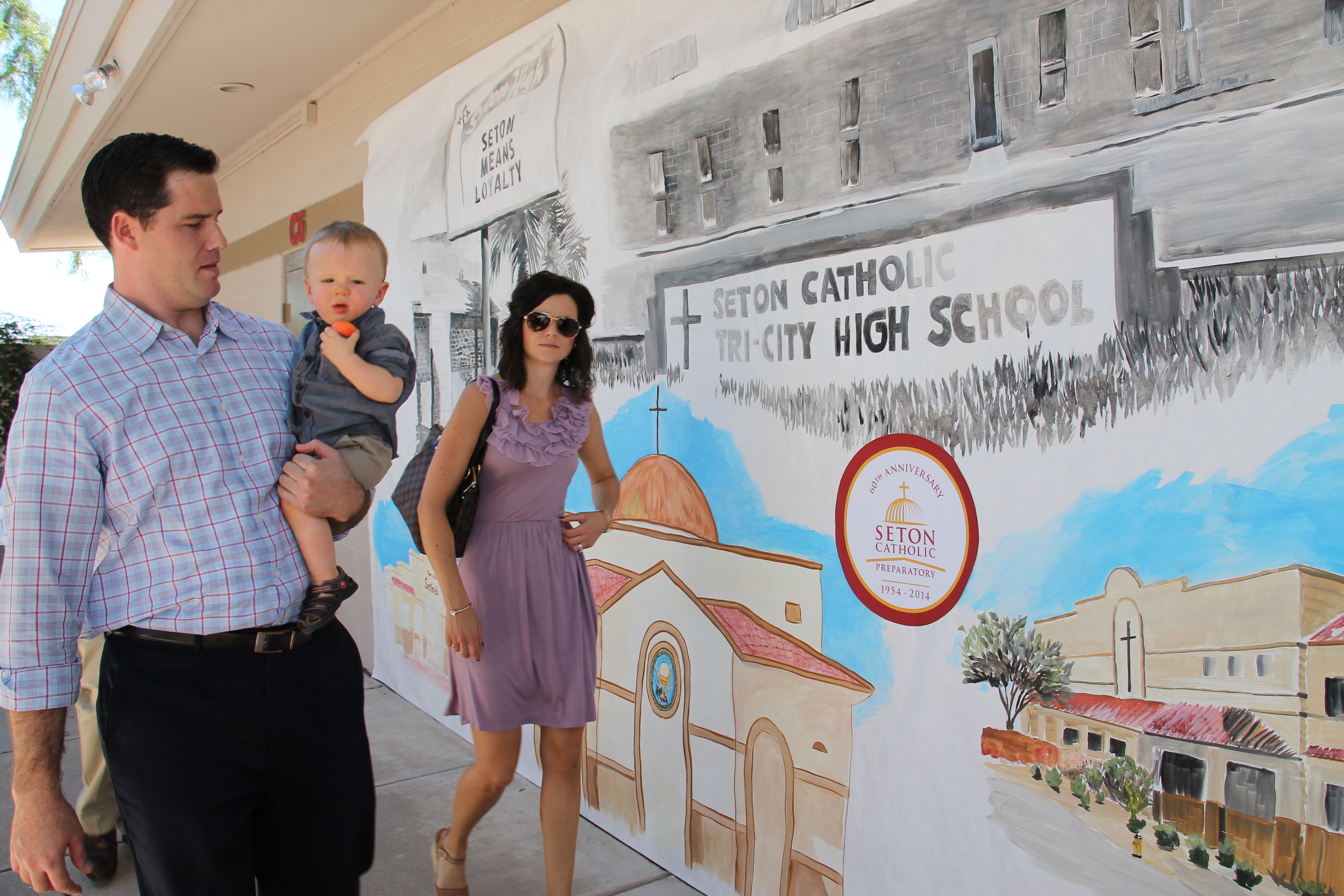
CHANDLER — Sixty years ago, the Sisters of Charity of Seton Hill opened a small Catholic school serving mostly migrant and farming families. Today, families from all over the East Valley choose Seton for its strong Catholic values and rigorous academics.
The school has three generations of alumni who have gone on to college and career success, become heads of domestic churches found within the home and held their duty to God and country in high regard via the military and government leadership.
“We wanted our kids to grow up in the faith. I think that’s all it was,” Sylvia Stoll told The Catholic Sun following an Alumni Mass and Hall of Fame Awards luncheon Oct. 4 at Seton.
She and her husband, Mark, were part of the first graduating class in 1958. The Stolls dated and married after high school, sending all four children through Seton. Four grandchildren are also alumni with two more current students. Another pair are future Sentinels.
[quote_box_right]
Alumni? Update your info
Future student? Art and poetry contest for junior high students
[/quote_box_right]Seton Catholic is deeply rooted in Catholicism. The entire campus community focuses on St. Elizabeth Ann Seton’s charisms — courage, determination, faith and love — a year at a time via guest speakers, service opportunities and retreats.
“I know why we’re here: to get to heaven. And I need all the help I can to get them there,” Sylvia said.
Countless teachers, Sisters of Charity — Sr. Marie Therese still offers tutoring — and Christian Brothers have provided such support. Fr. Doug Lorig, pastor of St. Maria Goretti in Scottsdale, spent four years at Seton as chaplain and theology teacher. He singled out three men in whom he saw potential vocations and held them after class to say so.
Two of them are now priests in the Diocese of Phoenix. Seton honored one of them, Fr. Chris Fraser, JCL, with the Distinguished Alumnus Award this month. The judicial vicar, Seton Class of ’89, distinguished himself by becoming one of four classmates to take four years of Latin, obtaining a trio of degrees including a doctorate in Canon Law and becoming a priest.
He concelebrated the Alumni Mass alongside fellow alum Fr. Scott Sperry, who was ordained in June, and Msgr. Jerry McCarthy, Class of 1964 and moderator of the curia for the Diocese of Tucson.
Fr. Fraser said the high school experience is a time of growth in developing gifts, relationships, “and where we understand, in a more mature way, the centrality of faith in Christ and the blessings poured upon us through the gift of the sacraments.”
He said a true Catholic education presents the cross of Christ as the model, “the blueprint and ultimately, the destiny of every person…. In the end, we have to be willing to see the cross in those years, which molded us to be the people we are today, which should move us to gratitude.”
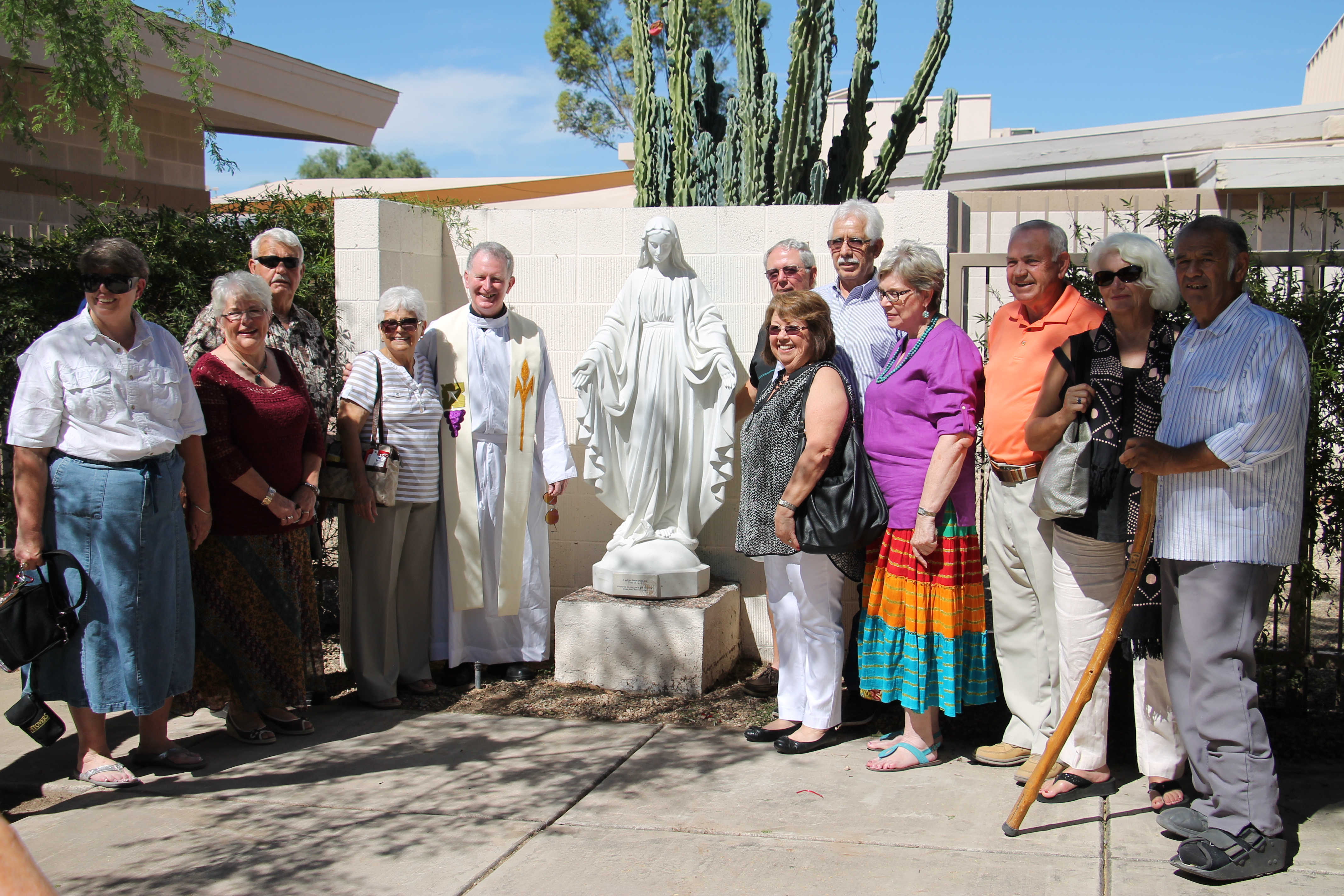
The alumni celebration included the blessing of a restored Mary statue sponsored by the Class of ’64. It’s all that remains of Seton’s original campus and was a gift from the Class of ’58.


GREENSBORO, N.C. (CNS) — Keith and Donielle Wilde know what it means to live this every day: “Jesus, I trust in you.”
Married for 17 years, the Catholic parents of nine children under the age of 12 and the owners of a concrete business in Summerfield rely heavily on their faith in Christ and the Church.
But shortly after Donielle became pregnant with her 10th child in April, doctors found that her breast cancer, which had been in remission for the past nine years, had returned — and their faith was put to the test again.
“The beginning of this year was extremely difficult for Keith and me,” Donielle recalled. “The business, financial stressors, and 11 of us living under the same roof had us both feeling maxed out. In our minds, we were sure that God had given us all that we could handle.
“However, God would soon reveal that He had other plans. Since we were using NFP (natural family planning), we were more than a little surprised to find out we were pregnant with our 10th child,” she told the Catholic News Herald, newspaper of the Charlotte Diocese.
After sharing the feelings of joy and excitement, the couple “began to wonder how God could think we were able to handle more. But He never let us down before,” Donielle said.
So they prepared to welcome their 10th child, a fifth daughter.
But when Donielle went to her OB-GYN for a routine ultrasound nine weeks into her pregnancy, life took another unexpected turn. The ultrasound revealed a large mass on one of her ovaries.
The tumor was cancerous. At 16 weeks safely into her pregnancy, Donielle underwent surgery to remove it.
“With God’s grace, we never lost our peace in spite of all that was happening,” she said. “In fact, our faith grew stronger and our hope for a healthy pregnancy and delivery was in the forefront of our prayers, as well as all those praying for us.”
Tests revealed that the tumor was not ovarian cancer, but Stage IV breast cancer that had metastasized. The breast cancer she had successfully fought in 2005 had returned, and doctors told her the hormones produced by her pregnancy were speeding its growth.
Both the ovarian specialist and the oncologist strongly advised Donielle to begin treatment immediately. She had two options:
“It felt as if the moment was frozen in time,” Donielle said. “Looking back, it was as if we were in the midst of a spiritual battlefield, and the forces of good and evil were intently watching to see what our choice would be … but in reality there was no hesitation in making our decision. We would not abort our child or place her in harm’s way for any reason.”
Keith recalled the day they met with the oncologist and received the diagnosis.
“As a father, it is very strange to sit across from someone, at arm’s length, and listen to that person tell you to kill your child,” he said. “I know that is a very blunt description of what took place — but it is also accurate. I realized that he did not see it that way. The doctor is a good man, kind, a father. He is a competent professional and very dedicated to doing all he can to save Donielle’s life.
“But he simply did not see the child in her womb as a person. The pregnancy was a condition to be dealt with so that Donielle’s treatment could begin.”
But he said he and his wife never wavered on their decision.
“We calmly accepted the news, and calmly refused the abortion,” Keith added. The couple decided to postpone treatment for Donielle’s cancer until after their daughter is born.
She was to have a C-section in early November, four weeks before her due date, which will be “followed by the start of any suggested cancer treatments,” Donielle said. “Further treatment will be determined upon results of testing after she is born.”
Dr. Lewis Lipscomb Jr. is a pro-life OB-GYN who is caring for Donielle and the couple’s unborn baby, and he has dealt with life-threatening situations like this before.
“I have cared for courageous moms who have fought through cancer during their pregnancies — including women with breast cancer, melanoma, lymphoma, cervical cancer and uterine cancer,” Lipscomb said.
Despite some medical complications, Donielle “is doing very well,” he said, — and the baby is developing normally.
“Donielle is a courageous and prayerful woman,” Lipscomb said. “She has faced multiple life-threatening and life-changing situations with genuine grace. She is an authentic witness for life to everyone she encounters.”
Said Donielle, “We feel very hopeful that our little girl will be healthy and strong. We’ve accepted in our hearts whatever it is God has willed for my life. Whether it be healing from cancer, strength in suffering or a peaceful death, my heart remains at peace knowing Christ and our Blessed Mother will give my family and me all the grace we need to live it out.”
As Catholics, “our decision not to abort and to postpone treatment was rooted in our faith,” Keith said. “We are pro-life by virtue of our Christianity. We have placed God at the center of our marriage, and He has blessed us profoundly. Now He has given us a cross to bear — who are we to say no?”
Donielle said the couple’s nine children and the 10th on the way are “a constant reminder to me of God’s love.”
For her, being Catholic is more than speaking words or reading books but “is how we are called to live our lives,” she added.
Catholics must “go forth and live the Gospel, do works in faith striving to imitate Christ,” Donielle said, and to consider “what is God is asking of me, personally, to better live out the Gospels? Whatever the answer may be, I ask you to fearlessly give God your ‘fiat,’ your ‘yes.'”
— By SueAnn Howell, Catholic News Service.

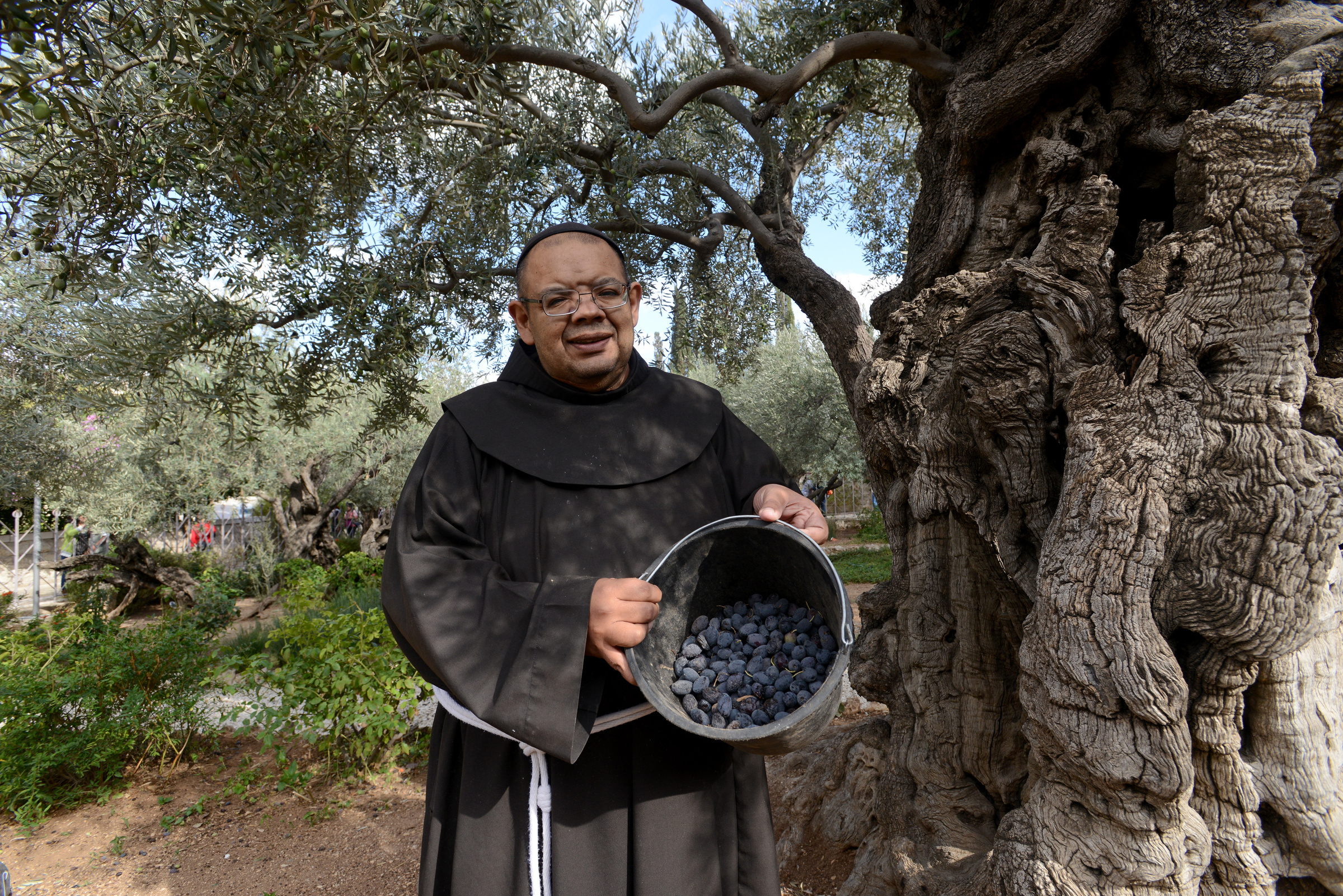
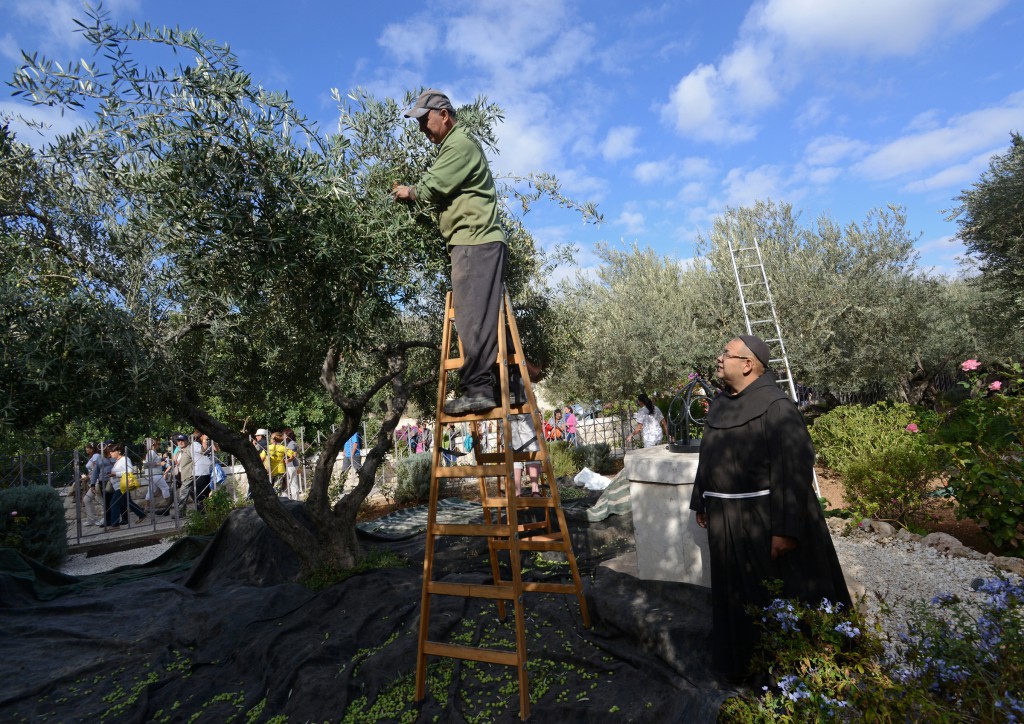
JERUSALEM (CNS) — For Salim Badawi, a Greek Orthodox Palestinian from the West Bank village of Beit Jalla, the opportunity to help a group of Franciscan priests harvest olives in the Garden of Gethsemane on the Mount of Olives offers a sense of hope amid the adversaries his family has faced in their own olive groves.
He said much of the olive grove of his extended family has long been unreachable as it was taken years ago to build an Israeli settlement, now considered a neighborhood of Jerusalem.
An uncle tries every year — unsuccessfully — to reach the land, Badawi said.
“Here I feel hope that maybe one day it will be different, maybe we will one day be allowed to go there and pick our olives,” Badawi told Catholic News Service while reaching into the branches of one of the trees that can be traced to the time of Christ. “The olive trees are still there, but we can’t reach them. I feel something special in this holy place where we are picking the oldest olives in the area, maybe in the whole world.”
At the bottom of the tree, Karina Henriquez, a volunteer from Chile, places olives that drop from the branches into a sack. For her, the trees that continue to bear fruit after thousands of years are a symbol of Jesus, who is still giving fruit to all who seek him.
Henriquez does not want to discuss politics, but she knows that Israelis and Palestinians are good people.
“Too bad they can’t solve their problems. We were hopeful with the pope’s visit, but then there was the war,” she said.
Still, Henriquez feels the need to share the pope’s message of speaking to the soul of people about love and peace. “We have to pray so God will place peace and love in the hearts of all people,” she said.
Since the Franciscans retook possession of the small olive grove adjacent to the Church of All Nations in 1681, the Franciscan fathers have tended to eight of what are believed to be the oldest olive trees in the Holy Land. Tradition, backed by modern genetic testing, holds that the gnarled trees were grafted at some point during the Crusader era from a single tree that was a witness to Jesus’ agony more than 2,000 years ago.
Today, the trees are part of the Garden of Gethsemane, fenced off and protected from the crowds of faithful who come on pilgrimage to the site. To accommodate pilgrims, the Franciscans keep a box of small branches pruned from the trees from which people can freely take a memento.
As the olive harvest begins in the Holy Land, Father Benito Choque, an Argentine who is superior of the Franciscan community at the church, ponders the significance of the olive in the Bible as he greets pilgrims outside the fence and walks among the trees inside the garden. A few pilgrims ask for an olive from the trees, but the friar gently denies their request. If he gives an olive to one, then all the other pilgrims will want one, too, he explained.
“These oldest of trees are a testament to Jesus’ suffering,” Father Choque said. The ancient trees continue to speak to those who will hear, he said.
The Franciscans have been in the Holy land for eight centuries under mandate of the Holy See, and their mission, he explained, is to live with the Jews and Muslims, transmitting their charism.
“What the Crusaders in the past did with their weapons, we do with prayers,” Father Choque told CNS. “I believe God has given something beautiful to humanity and I think the people of this land are blessed also with the planting of the olive trees.”
Though now there is confrontation not far from the trees, the priest sees the harvest as a time that unites people as families gather to pick olives and neighbors and friends meet at the olive press to make the fruit into oil used in cooking throughout the year.
Franciscan Father Diego Dalla Gassa, who guides volunteers at the garden, said he urges them to consider the vocation of the olive and the olive tree, likening them to the life of Jesus. They are cared for with the rain which God provides and in the end, they are meant to be pressed for the oil so precious and important in the region, he noted.
“It is very beautiful for us to pick the olives here from the trees we have cared for. When we collect the olives, we understand we are doing what God does with us. When we see an olive on a faraway branch, we must reach out to it to take it and so it happens with us that God is reaching out for us, searching for us,” Father Dalla Gassa said.
“This place interprets all of the life of Jesus,” he added. “Jesus was pressed here (as the olive is pressed) and we received the beautiful oil, in this case the blood (of Jesus).”
The Franciscans utilize every part of the olive, the oil is blessed and used for the Chrism Mass on Holy Thursday at the Church of the Holy Sepulcher, including the sacraments of baptism, confirmation, ordination of priests, and anointing the sick. Last year, the Franciscans sent a bottle of the blessed oil to Pope Francis for Holy Thursday in anticipation of his pilgrimage to the Holy Land.
The olive pits are sent to a few Christian Palestinian families who traditionally make them into rosaries which are then gifted to the Franciscan priests.
In addition to the eight old trees, the garden includes a younger tree planted by Pope Paul VI during his visit in 1964 and the newest sapling planted by Pope Francis during his pilgrimage earlier this year.
— By Judith Sudilovsky, Catholic News Service.

When Tom Monaghan, founder of Domino’s Pizza and former owner of the Detroit Tigers turned 50, he could no longer belong to the Young President’s Organization.
That’s when the Catholic businessman decided to found Legatus, an organization geared toward corporate executives and their spouses. Today, thousands belong to the international Catholic organization. Members meet monthly to pray, share a meal and listen to a speaker.
[/quote_box_right]
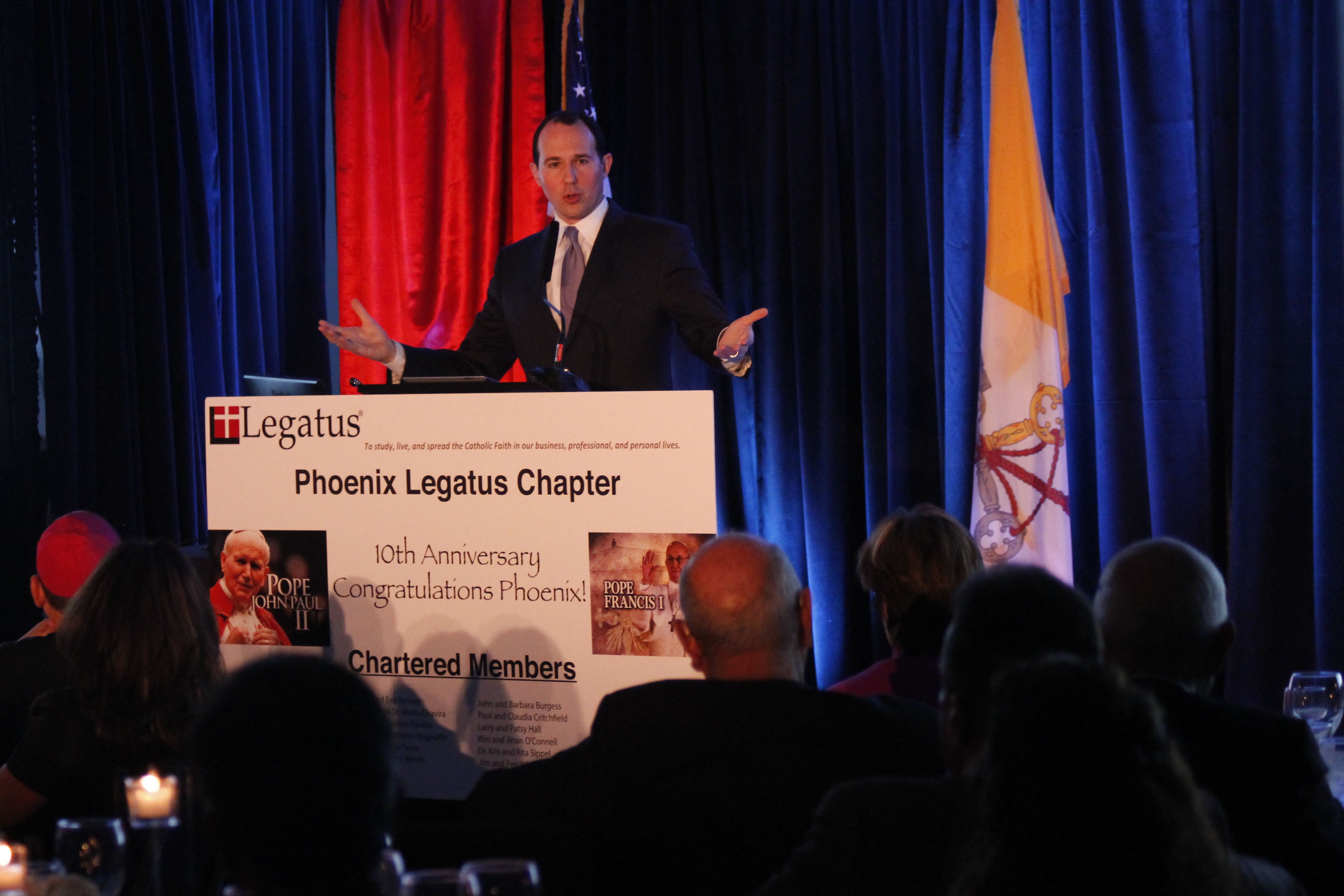
The Legatus chapter in the Diocese of Phoenix was founded 10 years ago, and members gathered at the headquarters of the Alliance Defending Freedom to celebrate Oct. 7.
Raymond Arroyo, international best selling author, news director and lead anchor of EWTN News, was the featured speaker at the anniversary event. His talk focused on signs of hope in the midst of mounting challenges around the world.
In an interview with The Catholic Sun, Arroyo said many have lost sight of hope.
“It’s a sin against the Holy Spirit to give up hope,” Arroyo said. “We have to cling to hope, but people have forgotten what it is.”
Arroyo pointed to examples of people with extraordinary challenges who overcame difficulties. Their witness, he said, shows that “you don’t have to be perfect to be hopeful or to be a conveyor of hope.”
Mattie Stepanek, a young man with muscular dystrophy who passed away in 2004 at age 14, was one of the people Arroyo focused on during his presentation to Legatus.
“He was an incredible sign and witness of hope to the very end,” Arroyo said.
Arroyo also lauded the work of Legatus, an organization he said has an important mission.
“Legatus empowers people who are in positions of influence and authority in organizations and the culture at large to go out and revivify the culture,” Arroyo said.
Maureen and Phil Adams have belonged to Legatus since 2006. They said the organization helps like-minded Catholic business leaders to build relationships and grow spiritually.
“Legatus offers some unique opportunities,” Maureen said. “We network, pray and enjoy each other’s company while being spiritually fed and educated. There is no other organization like it.”
Stephen Henley, central region coordinator for Legatus, said the organization helps Catholic business leaders grow their faith. Every Legatus meeting begins with a rosary, confession and Mass.

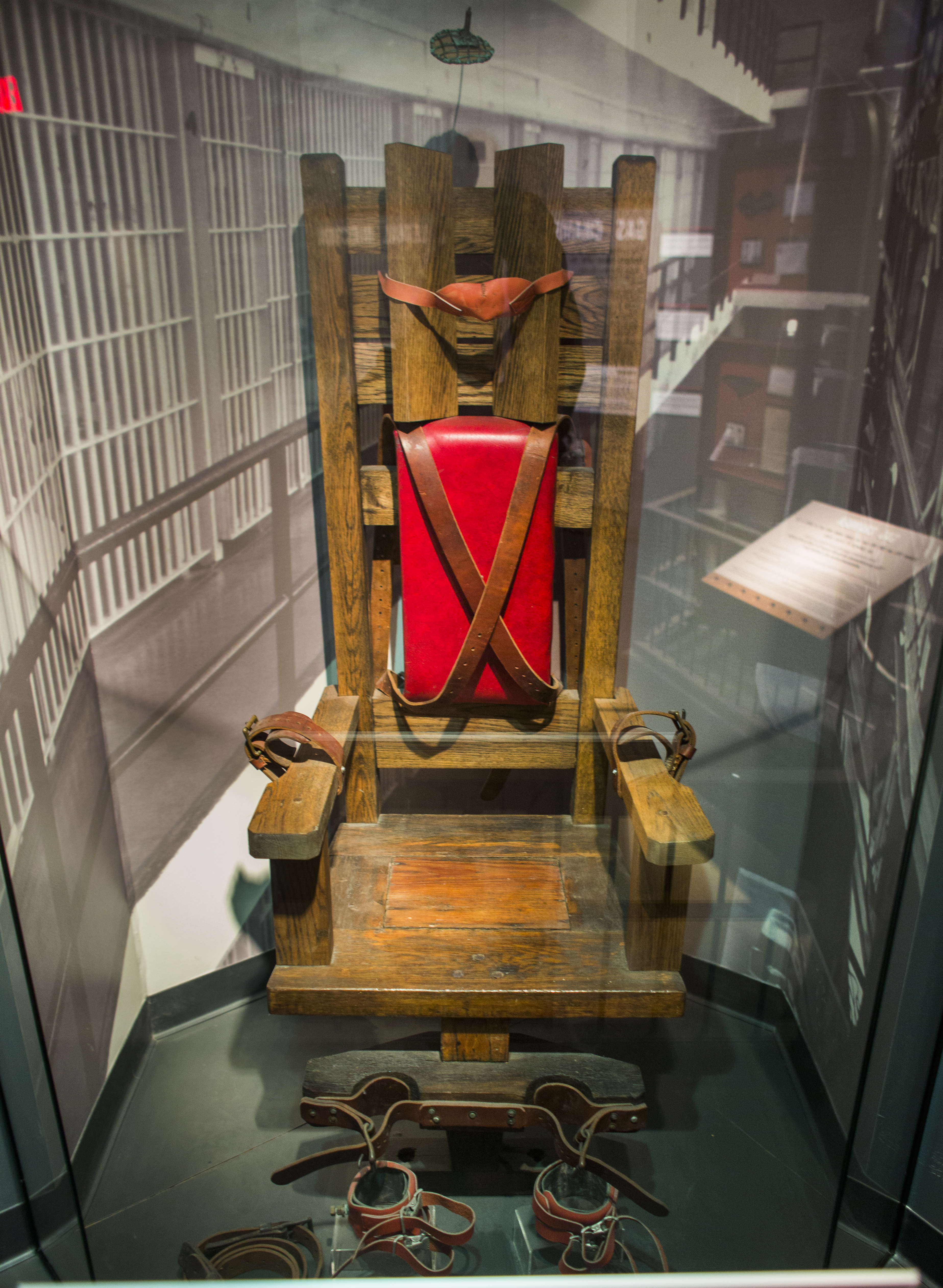
VATICAN CITY (CNS) — Pope Francis called for abolition of the death penalty as well as life imprisonment, and denounced what he called a “penal populism” that promises to solve society’s problems by punishing crime instead of pursuing social justice.
“It is impossible to imagine that states today cannot make use of another means than capital punishment to defend peoples’ lives from an unjust aggressor,” the pope said Oct. 23 in a meeting with representatives of the International Association of Penal Law.
“All Christians and people of good will are thus called today to struggle not only for abolition of the death penalty, whether it be legal or illegal and in all its forms, but also to improve prison conditions, out of respect for the human dignity of persons deprived of their liberty. And this, I connect with life imprisonment,” he said. “Life imprisonment is a hidden death penalty.”
The pope noted that the Vatican recently eliminated life imprisonment from its own penal code.
According to the Catechism of the Catholic Church, cited by Pope Francis in his talk, “the traditional teaching of the church does not exclude recourse to the death penalty, if this is the only possible way of effectively defending human lives against the unjust aggressor,” but modern advances in protecting society from dangerous criminals mean that “cases in which the execution of the offender is an absolute necessity are very rare, if not practically nonexistent.”
The pope said that, although a number of countries have formally abolished capital punishment, “the death penalty, illegally and to a varying extent, is applied all over the planet,” because “extrajudicial executions” are often disguised as “clashes with offenders or presented as the undesired consequences of the reasonable, necessary and proportionate use of force to apply the law.”
The pope denounced the detention of prisoners without trial, who he said account for more than 50 percent of all incarcerated people in some countries. He said maximum security prisons can be a form of torture, since their “principal characteristic is none other than external isolation,” which can lead to “psychic and physical sufferings such as paranoia, anxiety, depression and weight loss and significantly increase the chance of suicide.”
He also rebuked unspecified governments involved in kidnapping people for “illegal transportation to detention centers in which torture is practiced.”
The pope said criminal penalties should not apply to children, and should be waived or limited for the elderly, who “on the basis of their very errors can offer lessons to the rest of society. We don’t learn only from the virtues of saints but also from the failings and errors of sinners.”
Pope Francis said contemporary societies overuse criminal punishment, partially out of a primitive tendency to offer up “sacrificial victims, accused of the disgraces that strike the community.”
The pope said some politicians and members of the media promote “violence and revenge, public and private, not only against those responsible for crimes, but also against those under suspicion, justified or not.”
He denounced a growing tendency to think that the “most varied social problems can be resolved through public punishment … that by means of that punishment we can obtain benefits that would require the implementation of another type of social policy, economic policy and policy of social inclusion.”
Using techniques similar to those of racist regimes of the past, the pope said, unspecified forces today create “stereotypical figures that sum up the characteristics that society perceives as threatening.”
Pope Francis concluded his talk by denouncing human trafficking and corruption, both crimes he said “could never be committed without the complicity, active or passive, of public authorities.”
The pope spoke scathingly about the mentality of the typical corrupt person, whom he described as conceited, unable to accept criticism, and prompt to insult and even persecute those who disagree with him.
“The corrupt one does not perceive his own corruption. It is a little like what happens with bad breath: someone who has it hardly ever realizes it; other people notice and have to tell him,” the pope said. “Corruption is an evil greater than sin. More than forgiveness, this evil needs to be cured.”
— By Francis X. Rocca, Catholic News Service.

His leadership helped bring down the Soviet Union. He forgave the man who tried to kill him. He traveled the world and wrote 14 encyclicals. Throughout his 27-year papacy, St. John Paul II inspired millions.
On Oct. 22, Catholics around the world celebrated the influential late pope’s feast day for the first time ever. Bishop Thomas J. Olmsted of the Diocese of Phoenix presided at a noon Mass at St. Mary’s Basilica in honor of St. John Paul II who visited the downtown church in 1987. Just inside the doors, members of the congregation took turns kneeling in the spot where St. John Paul II once prayed.
Bishop Olmsted recalled being in St. Peter’s Square the day Cardinal Karol Wojtyla was elected pope. He said the news media was there in force and many were showing photos of the man they thought would be elected to the papacy.
“All the pundits had overlooked this man…none of them had his picture,” Bishop Olmsted said, “but God’s ways are not our ways — they are far better than our ways.”
He also recalled the late pope’s words about Divine Providence.
“John Paul II liked to say there is no such thing as coincidence. We might not understand … but we can be sure that all things are unfolding under His providential hand,” Bishop Olmsted said.
Karol Wojtyla did not hear the call to the priesthood early in life, but discovered his vocation later on, Bishop Olmsted said. As a young man, he became involved in the underground theater in Poland during the time of the brutal Nazi occupation.
Read Bishop Olmsted’s homily: Gift and Mystery
“It was the mystery of evil that helped Karol discover the greater mystery of God’s love,” Bishop Olmsted said. “The love of God breaks through in the most unexpected ways precisely when evil seems to triumph or sorrow breaks the heart.”
St. John Paul II, who held the first World Youth Day in 1986, touched the lives of countless individuals who today serve the Church today as married couples, priests and religious sisters. Many members of the “JP2 generation,” as it has been dubbed, were present at the Oct. 22 Mass. Katrina Zeno, coordinator of the John Paul II Resource Center for the Diocese of Phoenix, was one of them. To pray in the church where St. John Paul II once prayed and to hear a homily given by Bishop Olmsted, who worked for the saint for years was exhilarating, she said.
“Bishop Olmsted said it well, that St. John Paul II titled his own reflection on his life ‘Gift and Mystery.’ We forget a gift is often surprising and unexpected,” Zeno said. “In a time when human resources cannot bring about a change, that is often when our hearts and eyes are open to receiving God’s action in new way.”
Lisa McDaniel, a physician’s assistant at Morning Star Obstetrics and Gynecology, said that besides her parents, St. John Paul II has been the greatest human influence on her life.
“His writings on the Theology of the Body transformed the way I look at every single person I encounter — strangers, patients, family and myself,” McDaniel said. “It’s helped me to see that my body and my life are gifts.”
I used to wrestle with the concept of Make a Difference Day, reportedly the nation’s largest national day of community service. It’s generally the last Saturday of October — excluding Halloween — so millions of volunteers will take to their community Oct. 25.
A day was not enough, I thought. Besides, there are plenty of people who more regularly volunteer their time to make a difference in the lives of others — whether it’s through a simple smile, some labor intensive project or a donated item — who never get recognized.
So why recognize people who join this annual effort?
Well, because the annual effort can be the start of a lifetime effort.
“Service can be contagious. Once we work service into our schedules and see the benefits, it becomes a way of life. But for those who are in the beginning stages and looking for ways to serve, there are a number of things to consider,” Marge Fenelon wrote in the second of a two-part series on service in OSV Newsweekly.
The article said the most important thing is to approach service in humility and with an open heart. This makes volunteers available to God and his people, not interior wants and needs.
If you’re discerning ways to get involved in helping your neighbors in big and small ways — whether it’s Oct. 25 or a different day — here are some opportunities to consider:
