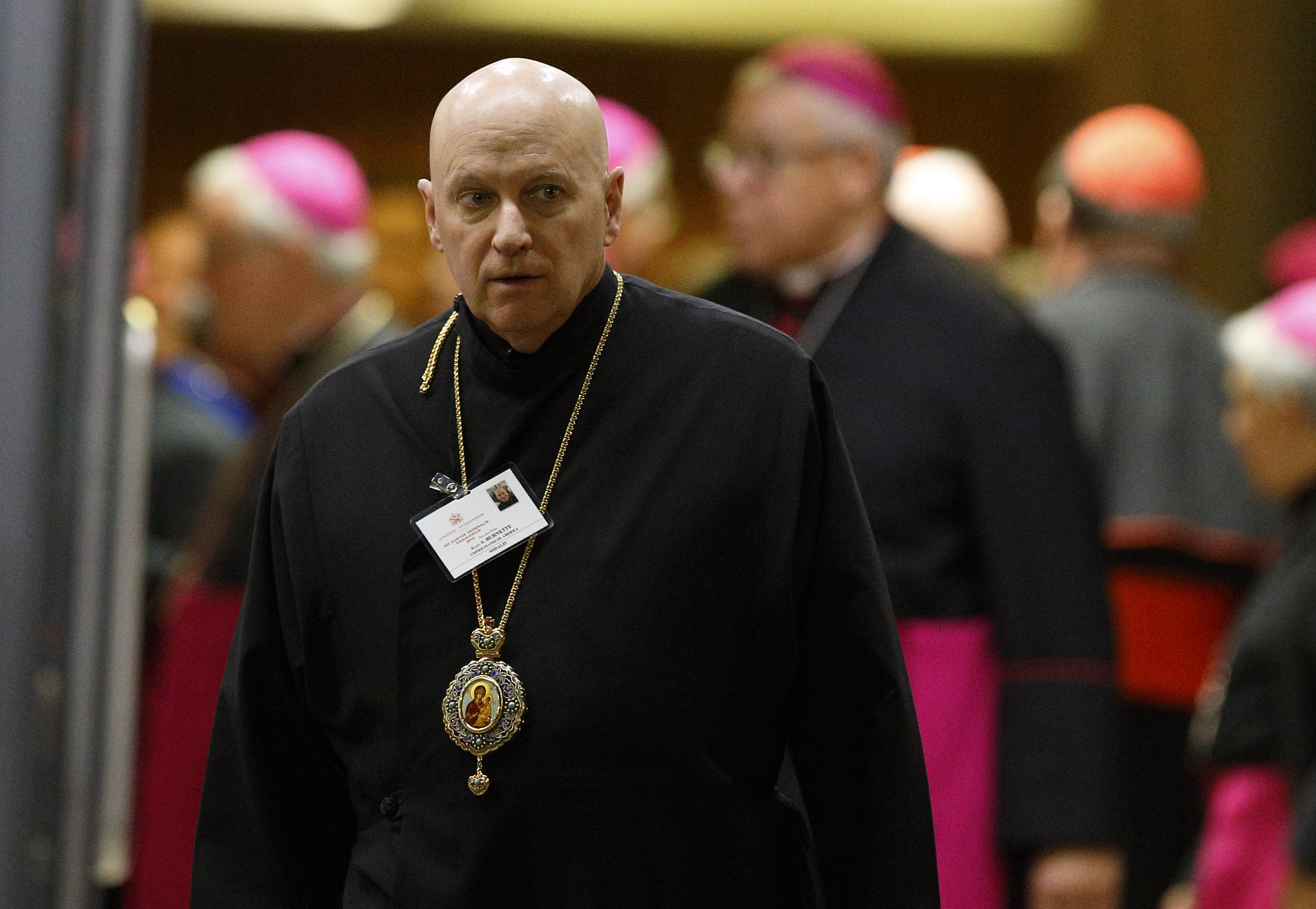
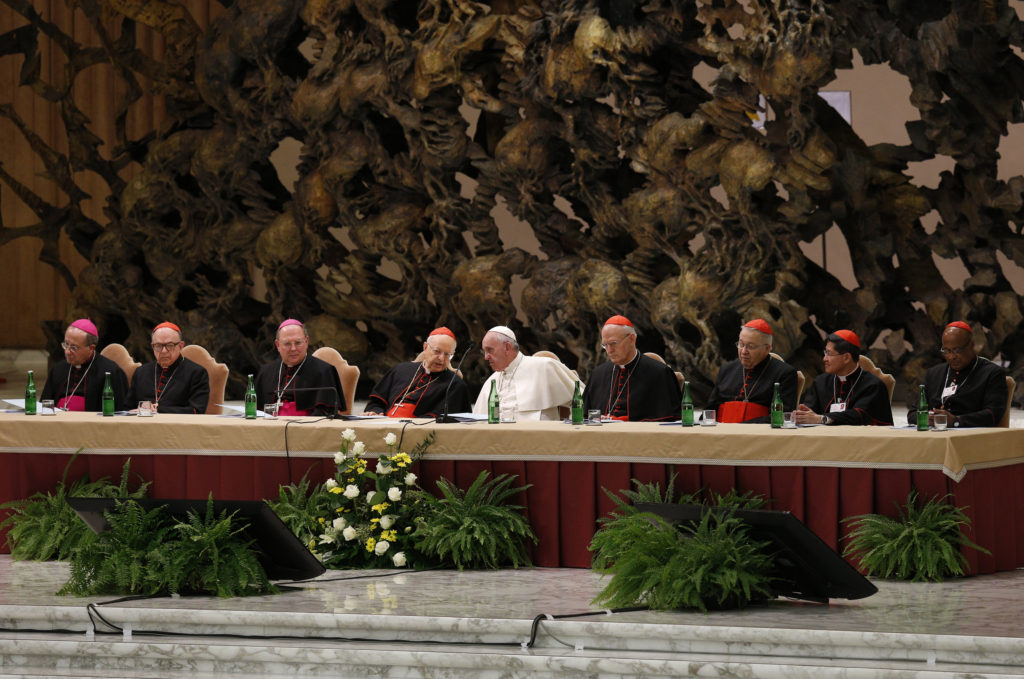
Bishop Kurt R. Burnette of the Byzantine Eparchy of Passaic, N.J., leaves the final session of the Synod of Bishops on the family at the Vatican Oct. 24. (CNS photo/Paul Haring)
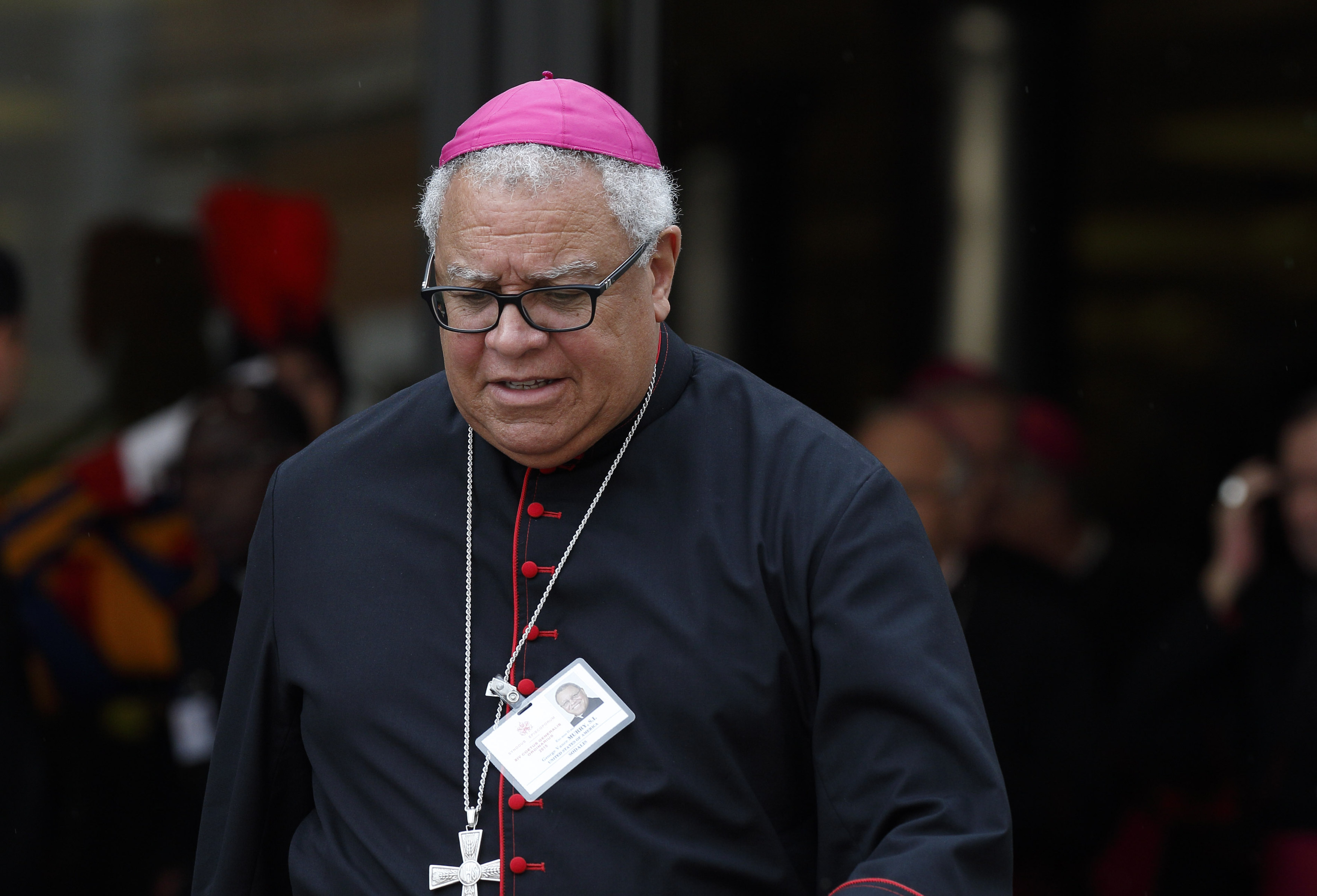
Bishop George V. Murry of Youngstown, Ohio, leaves a session of the Synod of Bishops on the family at the Vatican Oct. 14. (CNS photo/Paul Haring)
VATICAN CITY (CNS) — Several hours before the final report of the Synod of Bishops was put to a vote, two U.S. bishops said that what is new is not the Church’s message, but the synod’s emphasis and attitude toward the role of the family in the modern world.
Bishop George V. Murry of Youngstown, Ohio, and Bishop Kurt Burnette of the Byzantine Catholic Eparchy of Passaic, New Jersey, met with journalists Oct. 24 at the Pontifical North American College.
Bishop Murry was among 45 prelates appointed by the pope to attend the synod. Bishop Burnette was invited to attend as a substitute for Bishop William Skurla, the head of the Byzantine Catholic Archeparchy of Pittsburgh five days before the start of the synod.
Both bishops spoke about a perception — an erroneous one, they said — that the final document would introduce change and reform, two words Bishop Murry said should be separated.
The synod report, Bishop Murry said, has a “new emphasis and a new focus” on the role of the family to remind them “of their essential role in passing on faith, in passing on culture and in being a symbol of God’s ongoing love and forgiveness.”
“To bring that together in one place, to articulate that clearly and unambiguously, I think is new,” the bishop said.
As for changes in procedures, for example, with regard to divorced and civilly remarried Catholics, Bishop Murry said, “That is not there, that was not the direction that the synod went.”
“The Synod Fathers recommended to the Holy Father that the expedited annulment process be used,” he said, “that it be more commonly used by people rather than saying we’re going to create a completely new way of handling these marriages where there is divorce and civil remarriage.”
Bishop Kurt R. Burnette of the Byzantine Eparchy of Passaic, N.J., leaves the final session of the Synod of Bishops on the family at the Vatican Oct. 24. (CNS photo/Paul Haring)
Bishop Burnette agreed the report shows a “new attitude, a new emphasis” in facing the challenges in ministering to families. Based on his own pastoral experience, the Byzantine bishop said that it is not enough to tell people what’s wrong, rather a minister must tell them “that there is a way out” and “that God is open to them.”
“It’s not a different message, it’s a different emphasis, he said. “And I really believe that’s what Pope Francis is trying to tell people.”
“You don’t have to tell people they have something wrong; they know. Telling them that there is a way out is what they don’t know. That’s why they stay where they are instead of moving on,” he added.
The Byzantine Catholic Church is one of 23 self-governing Eastern Churches in communion with the pope. Bishop Burnette said that in certain pastoral matters, the Eastern Churches can serve as a model of unity in diversity for the Roman Catholic Church.
The word “catholic,” he said, refers to parts of the faith that are universal and that “had come from Christ and the apostles,” and not the parts “expressed in individual cultures and traditions.”
The Eastern Churches in union with Rome have a great deal of diversity and that “in that diversity there is a sense of unity,” Bishop Murry said. “I think that we can all learn something from that.”
Pope Francis greets family members during an audience with Roma, Sinti and Irish Travelers and other itinerant communities in Paul VI hall at the Vatican Oct. 26. The pope called for an end to centuries of prejudice against Gypsy communities. (CNS photo/Paul Haring)
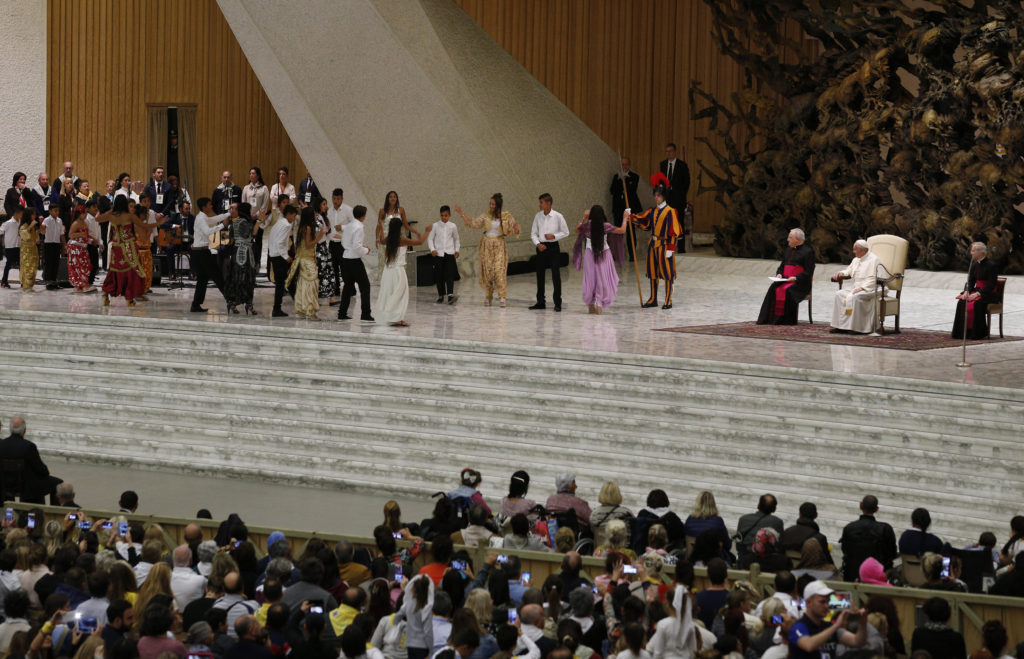
Pope Francis watches as dancers perform during an audience with Roma, Sinti and Irish Travelers and other itinerant communities in Paul VI hall at the Vatican Oct. 26. The pope called for an end to centuries of prejudice against Gypsy communities. (CNS photo/Paul Haring)
VATICAN CITY (CNS) — Treated to music, dance and songs reflecting a unique mix of cultures and languages, Pope Francis called for greater respect, integration and care of Gypsy communities.
“The time has come for uprooting centuries-old prejudices, preconceptions and mutual distrust that often are the basis for discrimination, racism, and xenophobia,” he said.
The pilgrimage, running from Oct. 23-26, was promoted by the Pontifical Council for Migrants and Travelers, the Italian Bishops’ Conference, the Diocese of Rome and the lay Community of Sant’Egidio.
During the audience in the Vatican’s Paul VI hall, musicians played traditional songs that also reflected the various influences of the native cultures of the lands they live in like, Spain, Ireland and Eastern Europe. A group of young Muslim girls and boys danced in colorful dress for the pope to music reminiscent of the Orient.
Commemorating the 50th anniversary of Blessed Paul VI’s Mass for Gypsies in 1965, Pope Francis quoted his predecessor’s words saying, “Wherever you end up, you are considered a nuisance and foreign … Not here. … Here you will find someone who loves you, respects you and helps you.”
While praising the progress made since that historic moment in evangelization, new vocations and social development in Gypsy communities, Pope Francis recognized the continued difficulties, misunderstandings and challenges facing many of them.
They, like all people, have the right to dignified living conditions and employment, an education and health care, he said.
The respect and promotion of these basic human rights are the foundation of peaceful coexistence, “in which different cultures and traditions safeguard their respective values in an attitude, not of closure and contrast, but of dialogue and integration.”
The pope condemned the continued tragedies that unfold in some Gypsy communities, like children dying from the cold or fires caused by arson attacks or faulty heaters; children falling prey to “depraved persons; young people and women who are involved in drug or human trafficking.”
These tragedies happen, he said, “because often we succumb to indifference and the inability to accept customs and ways of life different from ours.”
Pope Francis greets family members during an audience with Roma, Sinti and Irish Travelers and other itinerant communities in Paul VI hall at the Vatican Oct. 26. The pope called for an end to centuries of prejudice against Gypsy communities. (CNS photo/Paul Haring)
While urging the church and local communities to do more outreach, Pope Francis also called on the Gypsy communities to do their part in being constructive members of society and “good Christians, avoiding all that is not worthy” of being a Christian, namely, “lies, scams, fraud and fights.”
“Dear friends, do not give the mass media and public opinion the opportunity to speak badly of you. You are the protagonists of your present and future.”
He also urged families to encourage their children to get an adequate education and demand from public authorities, when needed, their kids’ right to sign up for school.
Education contributes to the “healthy development” of the person and gives them the needed skills to enter the work world, he said.
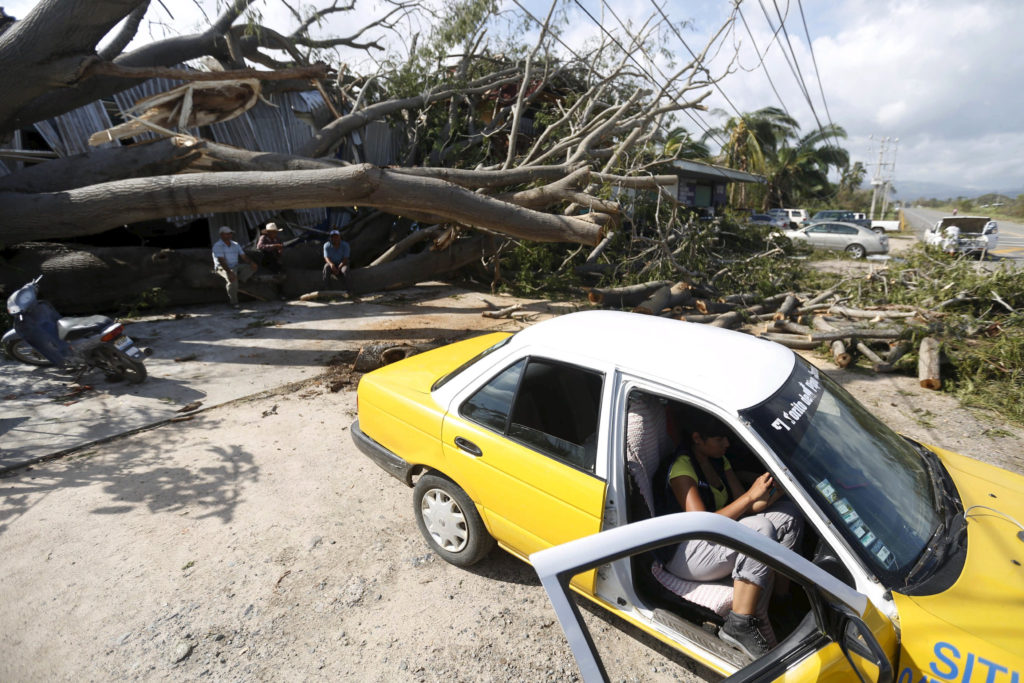
A person sits in a car by a felled tree in Melaque, Mexico, Oct. 24. (CNS photo/Edgard Garrido, Reuters)
A person sits in a car by a felled tree in Melaque, Mexico, Oct. 24. (CNS photo/Edgard Garrido, Reuters)
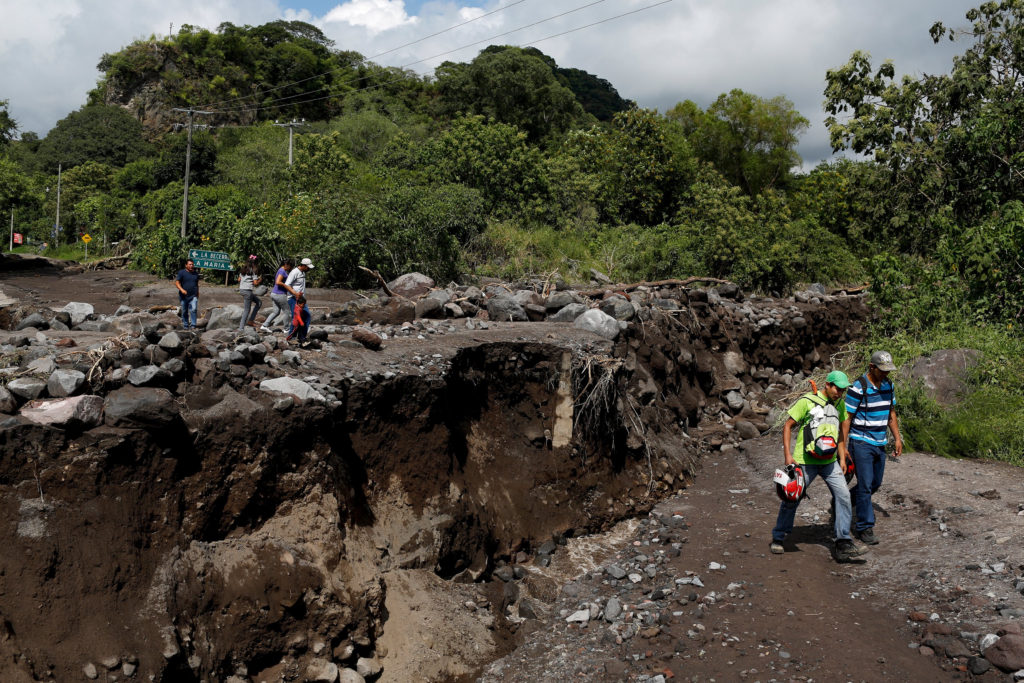
MEXICO CITY (CNS) — Mexico is mopping up after Hurricane Patricia hit its Pacific Coast with Category 5 strength, but left surprising little damage and few deaths, given the severity of the storm.
An official with Caritas Mexico, the church’s charitable arm, says the storm left a mess in parts of the dioceses serving the western states of Colima, Jalisco and Nayarit with flooding and property damage, but mostly impacted small settlements and rural areas — which were being provided with assistance from parishes diocesan collections.
“The evaluation that they’re doing at this time says that there is not a crisis situation,” said Jose Luis Lopez, director of emergency responses for Caritas Mexico, relaying information provided by local Caritas chapters.
The aftermath came as a relief for Mexico, which was bracing for the worst. Hurricane Patricia was predicted to bring unprecedented destruction. It also showed the country’s capability in responding to strong storms — which crash both coasts frequently — especially as experts say climate change is likely to cause more intense hurricanes with increased frequency.
“What has surprised us was the rapid increase (in the storm) to the point it reached Category 5 strength,” Lopez said.
Hurricane Patricia escalated into a Category 5 hurricane as it moved over warm waters in the Pacific, packing winds of more than 200 miles per hour and making landfall Oct. 23 in the evening hours. It was expected to dump up to 12 inches of rain on coastal communities and more as it moved inland.
Lopez credited a quick response by the government and civil protection officials, who issued warnings, opened shelters for those seeking safety and prepared clean-up plans. He also credited citizens, who haven’t always acted with urgency in times of crisis and sometimes stay put due to fears of losing their few possessions to either floods or looters.
“In general, we see a population paying attention to warnings,” Lopez said.
“As Catholics, as people of faith, we see a population that was praying,” he added.
The storm struck Mexico as one of the strongest hurricanes ever registered in the Western Hemisphere, but it avoided populated areas by arriving in a region between Manzanillo and Puerto Vallarta known as the Costa Alegre. It also quickly lost strength as it hit the Sierra Madre.
Residents walk near a damaged bridge in Comala, Mexico, Oct. 24. (CNS photo/Tomas Bravo, Reuters)
“Nature was kind,” said Gerardo Ruiz Esparza, communications and transportation minister. “It made the hurricane go straight into the mountain.”
The newspaper La Jornada reported the storm’s strongest winds were concentrated in a band about 30 miles wide — much narrower than previous monster storms.
More people also paid attention to the government warnings than in past problematic storms, said Fr. Rafael Rico, director of Caritas in the Diocese of Autlan, which includes the coastal communities where Hurricane Patricia made landfall.
Diocesan priests said the storm hit hardest in poor communities sustained by fishing, coconut groves and banana groves, and that those with the least lost the most as their homes were unable to withstand the strong winds.
“There are poor families that have lost everything,” said Fr. Rico, adding that relief supplies gathered from an Oct. 25 collection would be delivered within two days.
“There are issues here that have to do with climate change,” he said.
“We’re aware that these phenomena, with incredible variation in so little time” — like Hurricane Patricia rapidly reaching Category 5 status — “have to do with a situation of change, which we cannot ignore.”
“This situation should make us more attentive because we live in areas where hurricanes occur,” Fr. Rico added.
Young men and women in New Zealand are devoting their lives to the Church. We hear from some of them about their path ahead.
National Vocations Awareness Week is Nov. 1-7 in the U.S. and this video gives a glimpse into what young men and women worldwide experience when they answer God’s call to a religious vocation.
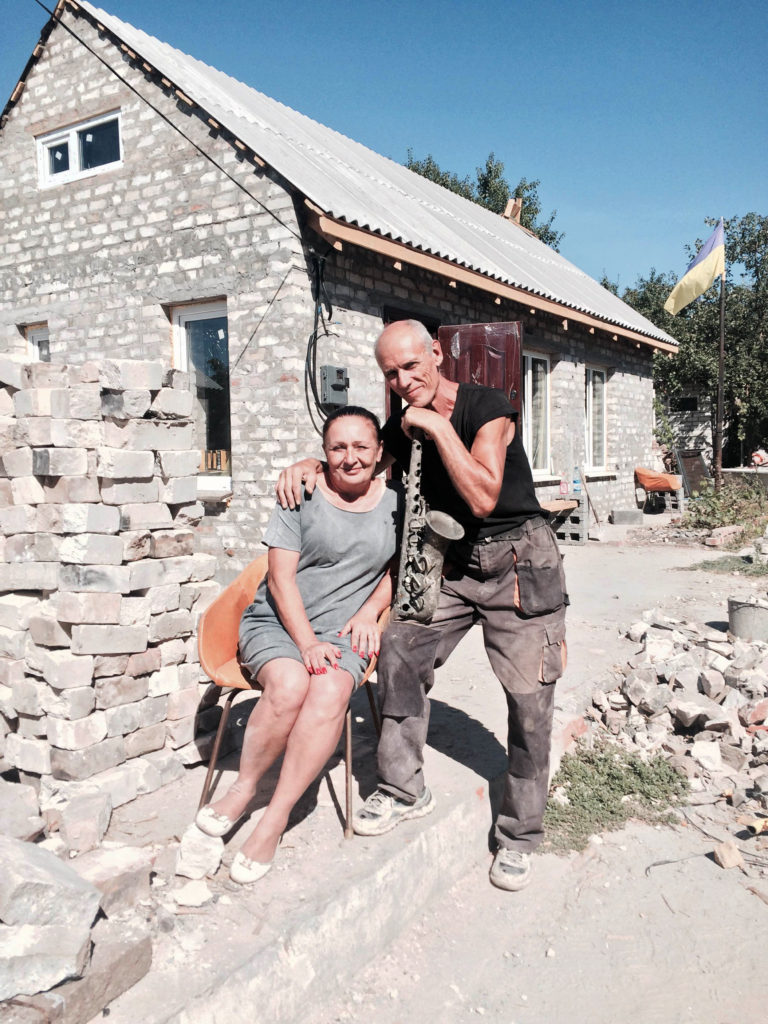
Ira and Hennadiy pose for a photo in front of their destroyed home in Slovyansk Aug. 25. Volunteers from "Building Ukraine Together" helped them rebuild their house. (CNS photo/Pavlo Didula)
Ira and Hennadiy pose for a photo in front of their destroyed home in Slovyansk Aug. 25. Volunteers from “Building Ukraine Together” helped them rebuild their house. (CNS photo/Pavlo Didula)
LVIV, Ukraine (CNS) — Rebuilding in Ukraine does not just mean construction.
“We restore walls of the houses and destroy the walls between people,” is the slogan of volunteers with “Building Ukraine Together,” an initiative of young people from western and central Ukraine, who are helping people in the eastern regions to rebuild their houses destroyed during fights between pro-Russian militants and the Ukrainian military forces. Sixteen months of fighting left nearly 7,000 people dead and more than 17,000 injured, according to the U.N. refugee agency, UNHCR.
Ihor Feshchenko, a journalism student from the Ukrainian Catholic University, is one of the volunteers.
“Here in Lviv, we observe a war from 1,000 miles through tablets and computers or donate money sometimes. But during this camp, there was a sense that I was actually doing something that really helped,” he said. He added that he did not tell his mother that he was going to the east of the country, because the front line was just some 50 miles from the city in which they worked.
Volunteers work in the cities of Kramatorsk and Sloviansk, strongholds for pro-Russian forces liberated by the Ukrainian Army after fierce battles.
“We came to Kramatorsk after the city was liberated in late July 2014 on a weekend and saw great destruction. On some streets there were no buildings that survived,” recalled Vitaliy Kokor, executive director of Lviv Education Foundation, the nongovernmental organization that runs these small rebuilding projects.
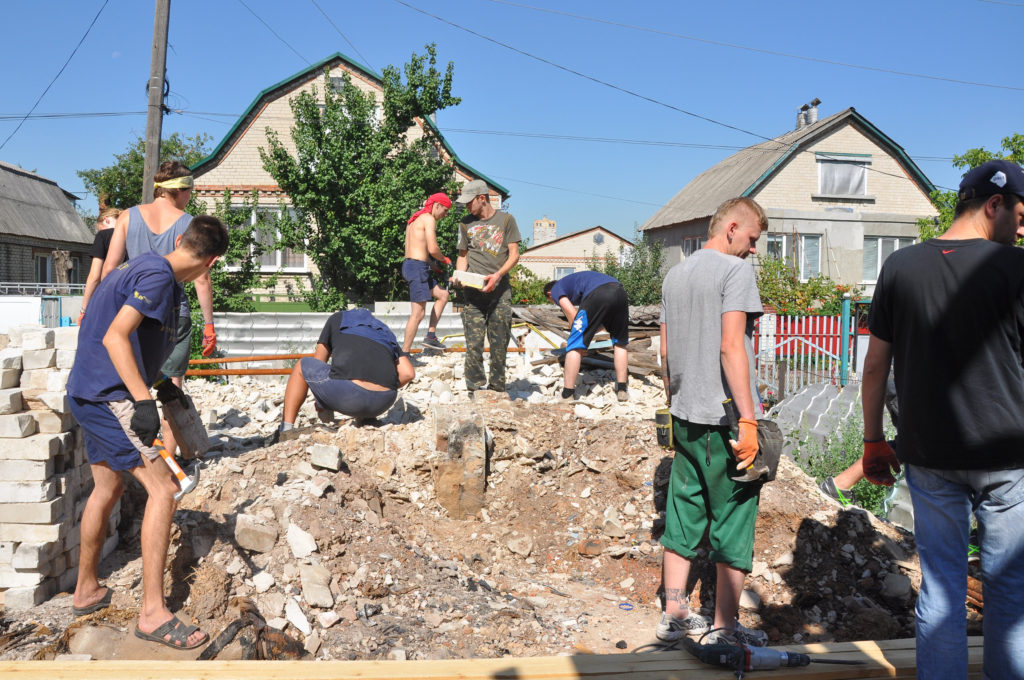
After this trip, they decided to launch a reconstruction camp to answer the great need they saw. Sixty volunteers — students mainly from Lviv but also from Kiev — responded and took part in the camp for a month last fall. About $5,000 was raised on a crowd-sourcing platform, and local entrepreneurs helped with materials, so that close to 30 houses and apartments were renovated.
More construction camps were held in December and August, but even after 12 months of peace, the needs are still huge, said Kokor. He added that international charities, religious organizations, and small nongovernmental organizations like his cannot fill all the gaps.
Local people who suffered from the conflict help volunteers — with materials, food and manual labor.
“We see them as partners, for our true task is community-building and reconciliation, not only restoration of houses and apartments. A physical destruction is a consequence of mental confusion, conflicts between people,” said Kokor.
This was also the philosophy behind the small construction camps in Western Ukraine earlier this year. Volunteers from the East helped restore a house damaged by fire and a school assembly hall in the village of Bortnyky.
“There’s a lot of talk about the need for reconciliation in Ukraine, but we don’t think that’s where you begin. First, people need to work together, achieve something together, build relationships and trust, and then eventually they can tell their different stories,”said Jeffrey Wills, member of the Lviv Education Foundation’s board.
Volunteers from Lviv, Ukraine, clear debris to repair sewer and septic tank lines Aug. 5 in eastern Ukraine. The home was destroyed by three mortar shells during the war. (CNS photo/Maria Voronchuk)
Construction and renovation works are not the only activity to bring the community together. The “Vilna Khata” (Freedom Home) in Kramatorsk and the “Teplytsia” (Greenhouse) in Slovyansk are youth programs that grew out of building projects. The programs invite young people for bonfires, movie screenings, and evening discussions and ask different organizations to present their initiatives. They hold exhibitions and workshops and invite famous cultural and public figures. For example, one recent guest in Slovyansk was Ukrainian Catholic Bishop Borys Gudziak of Paris, president of the Ukrainian Catholic University.
Andriy Kozlov, a university alumnus and native of Kramatorsk, said the educational component is as important as restorations.
“We need to create a critical mass of young people that would know the world and bring this knowledge to the city,” he told CNS.
Wills, who helped build Ukrainian civil society through different projects for 20 years, said there are several wars going on in Ukraine.
[/quote_box_right]
“The one against tanks, the one against ignorance and propaganda, the one against corruption, and perhaps the most importantly the one against hard hearts. In the name of ‘communism,’ the Soviet Union destroyed real community and caring for neighbors — and that’s what the service camps and youth initiatives are rebuilding,” he said.
Anastasiya Vorobyovska, who is studying public administration program at the Ukrainian Catholic University, said “volunteers return home tired but happy.”
“They are well aware that this week they could spend somewhere at the sea, but decided to help their country and people. The sense and understanding that this is my country and is my personal responsibility, I like most about this camp,”said Andriy Levytsky, manager of the projects and programs for Lviv Education Foundation.
Archbishop Blase Cupich from Chicago and a surprise guest offer final reflections
While you’re listening, here is an inside look at some of the working groups of participating delegates.
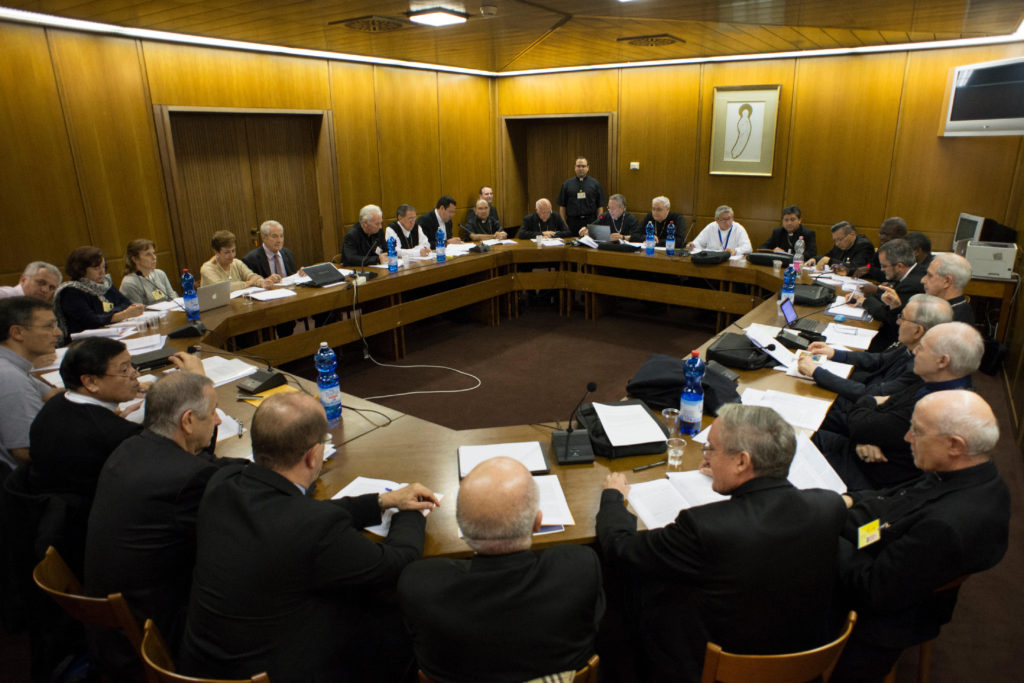
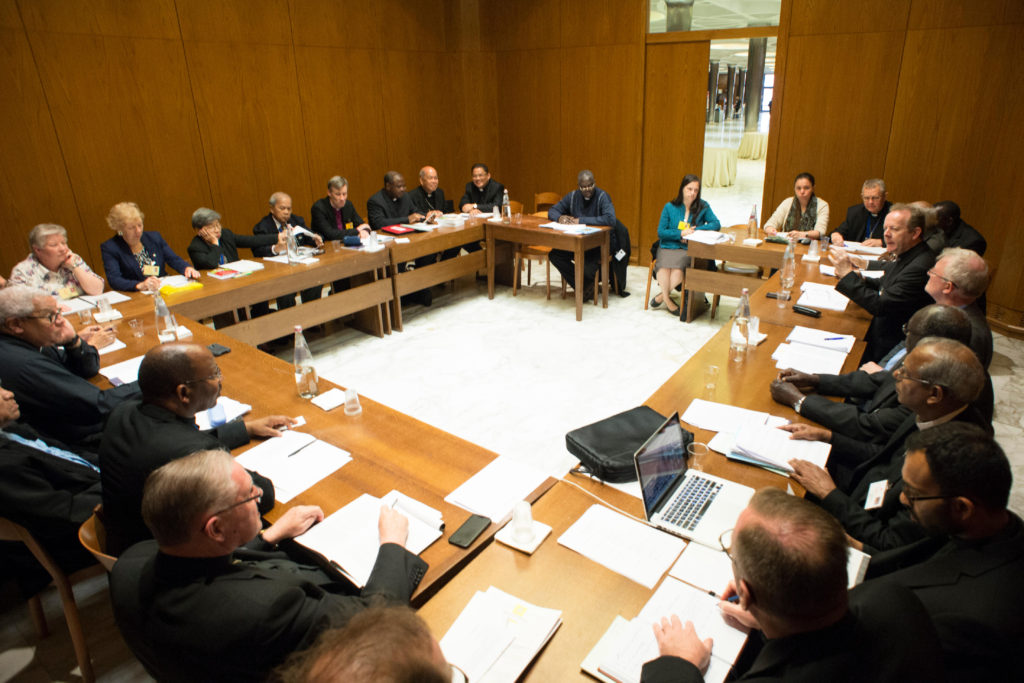
Spanish-speaking delegates at the Synod of Bishops on the family meet to discuss the working document at the Vatican Oct. 19. (CNS photo/L’Osservatore Romano)English-speaking delegates at the Synod of Bishops on the family meet to discuss the working document at the Vatican Oct. 19. (CNS photo/L’Osservatore Romano)
Parents who have lost babies release balloons at St. Cecilia Church in Quebec City for the Feast of the Angels Oct. 17. (CNS photo/Philippe Vaillancourt, Presence)
Parents who have lost babies release balloons at St. Cecilia Church in Quebec City for the Feast of the Angels Oct. 17. (CNS photo/Philippe Vaillancourt, Presence)
QUEBEC CITY (CNS) — Cars continued to arrive in the parking lot of St. Cecilia Church, an unusual sight on a chilly and gray Saturday morning. A bit hesitant, the occupants slowly gathered in the church.
The crowd was mostly men and women in their 30s and 40s. Some were accompanied by children. Despite polite smiles and warm welcomes, the atmosphere was heavy.
They all had something in common: mourning the loss of a baby.
Few among the group were regular churchgoers. But for at least one morning, they participated in the feast of the angels, a liturgical celebration organized by the staff at St. Charles Borromeo Parish, of which St. Cecilia is one component, and Les Perseides, a lay organization that supports grieving parents who have lost a baby through miscarriage, stillbirth or perinatal death.
The organization is named for the annual Perseid meteor shower, or shooting stars.
The observance occurs once a year, usually around Oct. 15, designated as Infant Loss Remembrance Day in Canada and the United States. It’s the third year that the parish has hosted the service.
Whether they have lost a child recently or a while back, the parents still carry a heavy heart. They gather to honor the memory of their child and reflect on the uphill road they have faced in their mourning.
Sabrina Courant, Les Perseides president, welcomes the families with a warm handshake. She said she joined the organization so that her daughter, Myriam, can “keep on living.” Four years ago, Courant lost Myriam in the 41st week of pregnancy, two days before she was supposed to be delivered.
“There’s no relation between the love and care you’ve put into your child and the number of weeks he has lived,” said Courant, a Catholic.
“Faith helped us, my husband and I, to cope with that ordeal,” she explained. “A lot of grieving couples, even nonchurchgoers, tend to blame the Lord for their loss. That thought once glimpsed in the back of our minds. However, our faith was stronger, and we figured out that it wasn’t his fault and that he certainly opened his kingdom to our little one. And that he supported us along the way.”
Organizing the event takes time and much thought.
“We have to find the proper tone and set up a formula that accommodates both steady churchgoers and nonbelieving mourners,” she said.
In the sacristy, the Deacon Simon Nadeau, the presider at the service, peered at the parents seated in the pews. “It’s always, well, tricky,” he admitted. “You must be ready to welcome them as they are.”
Deacon Nadeau’s first contact with perinatal loss came when he prepared some couples for the baptism of their child. One day, a couple told him that they felt unable to go to church for the baptism, mentioning that they still felt guilty about an abortion they chose during a previous pregnancy.
Many people live such tragedies and are left to cope on their own, Deacon Nadeau said.
“One might say that the church has overlooked such realities. I’m not here to exclude anyone. Wherever and whenever that loss happened, come. Come, the Lord welcomes you as you are,” he said, taking his place in line for a silent procession.
About 200 people gathered in the church for the feast of the angels. Deacon Nadeau reminded the assembly that they were there to pray and to “celebrate the life of those (deceased) babies.”
Before he was to read an excerpt from St. Paul’s letter to the Thessalonians, French-Canadian singer Marie Denise Pelletier’s “Berceuse pour un ange” (“Lullaby for an Angel”) resonated throughout the church.
Many in the congregation became emotional as they listened to the lyrics:
“I’ll never hear you say Mommy, Daddy.
“Nor singing your first song.
“Yet you were already living in my flesh.
“I already had chosen your first name.
“You, the child I longed so much.
“You, the vanished child.
Tears flowed. Some parents buried their faces in their hands while being comforted by a relative or friend.
The celebration continued with a testimonial from Sebastien Tremblay, a young father who said he never goes go to church except for the annual prayer service. Five years ago he and his wife lost their daughter, Melina, four days after she was born.
“Those four days allowed us to get prepared, so that we may have the time to pack up our bags for the strenuous and long journey we were called to face, mourning our little one,” Tremblay said between frequent pauses to clear his throat.
“We’re still crying,” he continued. “Yet, six years later, we try to focus on the happiness we experienced in those nine months and four days that we were together. We cherish the miracle of having known and having loved madly our little angel, before she vanished forever.
“Even if our eyes are still red and swollen, we wish to wear a warm smile while waving our hands to her and telling her how much we still love her,” Tremblay concluded before returning to the pew where his wife and two young daughters sat. The girls never had the chance to meet their older sister.
The celebration continued with symbolic gestures: the lighting of candles, the naming of deceased babies, the writing of messages on helium-filled white, pink and red balloons that were to be released outdoors. By the end, the heaviness had lifted and had become a joyous clamoring.
The assembly moved outside to the parking lot where the balloons were released skyward.
A crying couple hugged while watching the balloons swarm in the air. Not far away, a little girl asked her family where the balloons were going.
“They’re going to Raphael’s party,” said the lady next to her.
“Can we also go to his party?”
“Not yet, darling. Not yet.”
— By Philippe Vaillancourt, Catholic News Service. Follow Vaillancourt on Twitter: @PresenceInfo.
Pope Francis is flanked by an unidentified priest and Cardinal Ricardo Ezzati Andrello of Santiago, Chile, as he arrives for a session of the Synod of Bishops on the family at the Vatican Oct. 22. (CNS photo/Paul Haring)
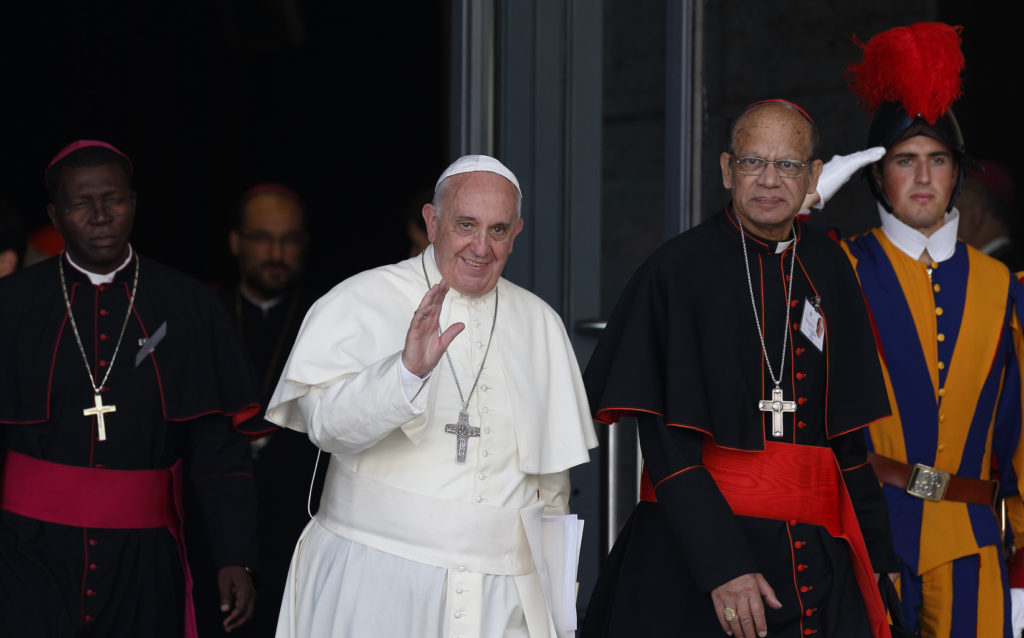
Pope Francis walks next to Indian Cardinal Oswald Gracias as he leaves a 2014 morning session of the extraordinary Synod of Bishops on the family at the Vatican. (CNS photo/Paul Haring)
Oct. 22: Final draft background and presentation
In the afternoon, Cardinal Lorenzo Baldisseri, synod general secretary, was to explain to the assembly how the final draft was prepared. Hungarian Cardinal Peter Erdo of Esztergom-Budapest would give a brief presentation outlining the document and the text would be distributed. Synod participants will review the full written text at their leisure.
Oct. 23: Final draft discussion and amendments
The synod assembly will discuss the final draft report in the morning, make comments and submit additional amendments and concerns in writing until early afternoon. The drafting commission will work the final suggestions and changes into a more polished final report by the evening.
Oct. 24: Final document presentation and vote
The final document will be presented to the assembly in the morning and come up for a paragraph-by-paragraph vote by the synod fathers in the afternoon. The text’s approval will require a two-thirds majority vote. Pope Francis will receive the final text in Italian. The pope will decide whether to make the text public or not.
Oct. 25: Closing Mass in St. Peter’s Basilica
[/quote_box_right]
VATICAN CITY (CNS) — After nearly three weeks of intense discussion and debate, the Synod of Bishop’s final document on the family was not expected to have any hard-hitting answers, a member of the drafting commission said.
Rather, the report was aiming to be a reflection of the overall sense of the “mind of the house” and indicate some general pastoral directions, Indian Cardinal Oswald Gracias of Mumbai told reporters at a Vatican news conference Oct. 22.
That is because “very clearly we are not touching doctrine, this synod is not making doctrine, but it’s really seeing what’s the pastoral approach, what guidelines can we give” the pope, who convoked the synod for their input.
The drafting commission’s goal was to compile a text that would represent all the different concerns and opinions expressed during the synod as well as create “a text which would give a pastoral direction acceptable to everybody,” the cardinal said. He added that the 10-person commission voted unanimously in favor of the contents of the resulting draft.
Adhering to the synod’s theme of “The vocation and mission of the family in the church and in the contemporary world,” the completed draft “doesn’t get into very, very specific points in that sense, it is more general speaking of the great needs” facing today’s families, Cardinal Gracias said.
“I don’t think we have seen the solutions yet,” he said, “but at least we have begun to speak about the problem and we’ve begun to say that this has to be tackled and this has to be studied.”
“As we deepen our understanding, I’m sure we will find a way forward. This happened in the church before,” he said, adding that by confronting and discussing challenges directly, the church “will find a way forward.”
The pope appointed the commission to oversee the compilation and writing of the final text, called the “relatio finalis.”
Cardinal Gracias said that as of noon Oct. 22, there were fewer than 100 numbered paragraphs in the draft version being presented to the synod fathers for review and amendments. The original working document for the synod had 147 numbered paragraphs.
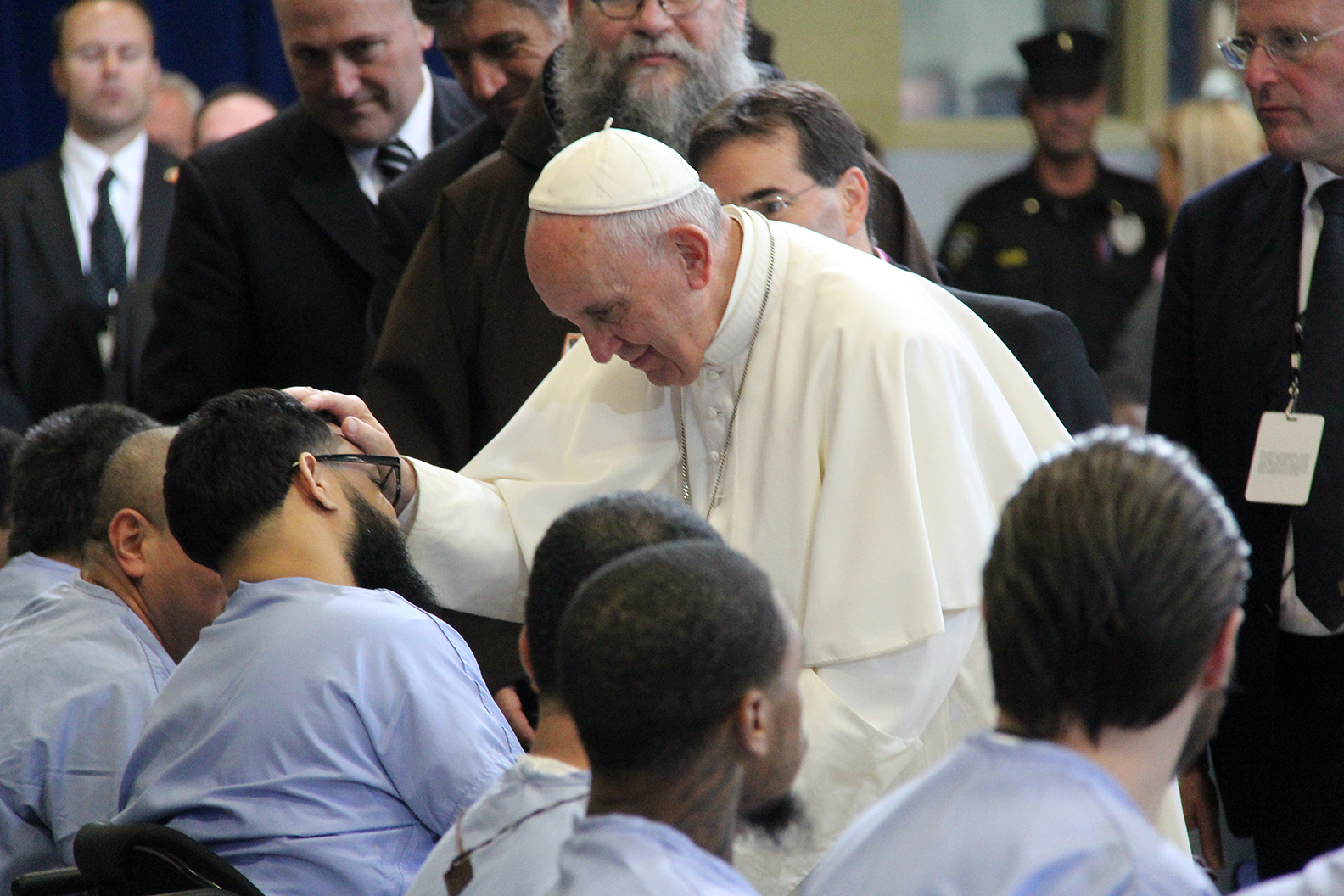
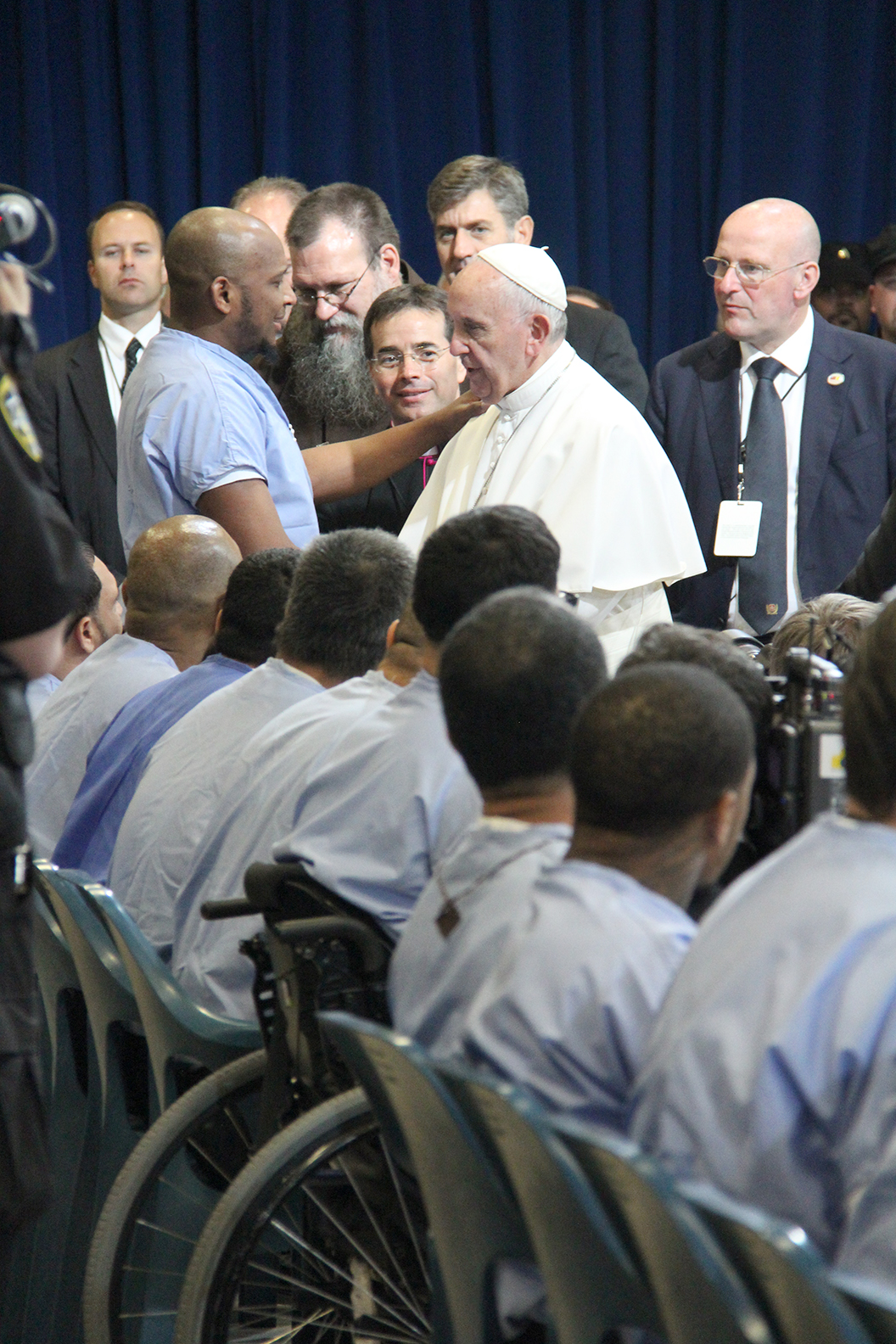
Pope Francis blesses an inmate at teh Curran-Fromhold Prison in Philadelphia Sept. 27 during his Apostolic Visit to the U.S. The Holy Father greeted each inmate personally after delivering remarks aimed at encouraging them to get their lives back on track during their imprisonment. (Justin Bell/CATHOLIC SUN)
Pope Francis blesses an inmate at the Curran-Fromhold Prison in Philadelphia Sept. 27 during his Apostolic Visit to the U.S. The Holy Father greeted each inmate personally after delivering remarks aimed at encouraging them to get their lives back on track during their imprisonment. (Justin Bell/CATHOLIC SUN)
“Unbelievable,” “goosebumps,” “breathtaking,” “ecstatic,” “once in a life time,” “amazing,” “tears to my eyes”: these were some of the words and phrases inmates used to describe their encounters with Pope Francis at the Curran-Fromhold Correctional Facility in northeast Philadelphia Sept. 27.
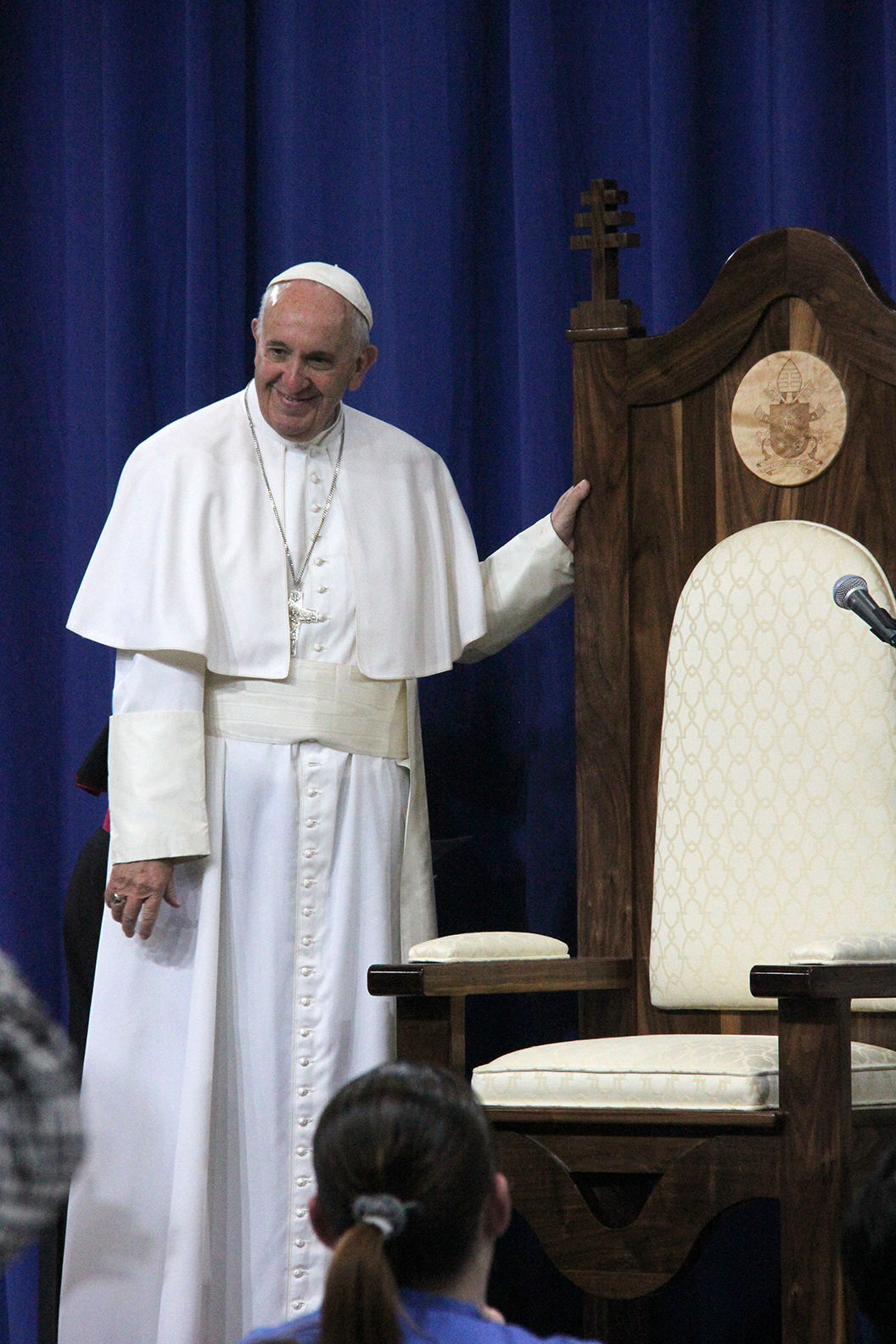
But it is a good bet that Pope Francis didn’t want to be put on a pedestal, even though inmates and instructors made him a striking chair complete with his papal insignia for the visit.
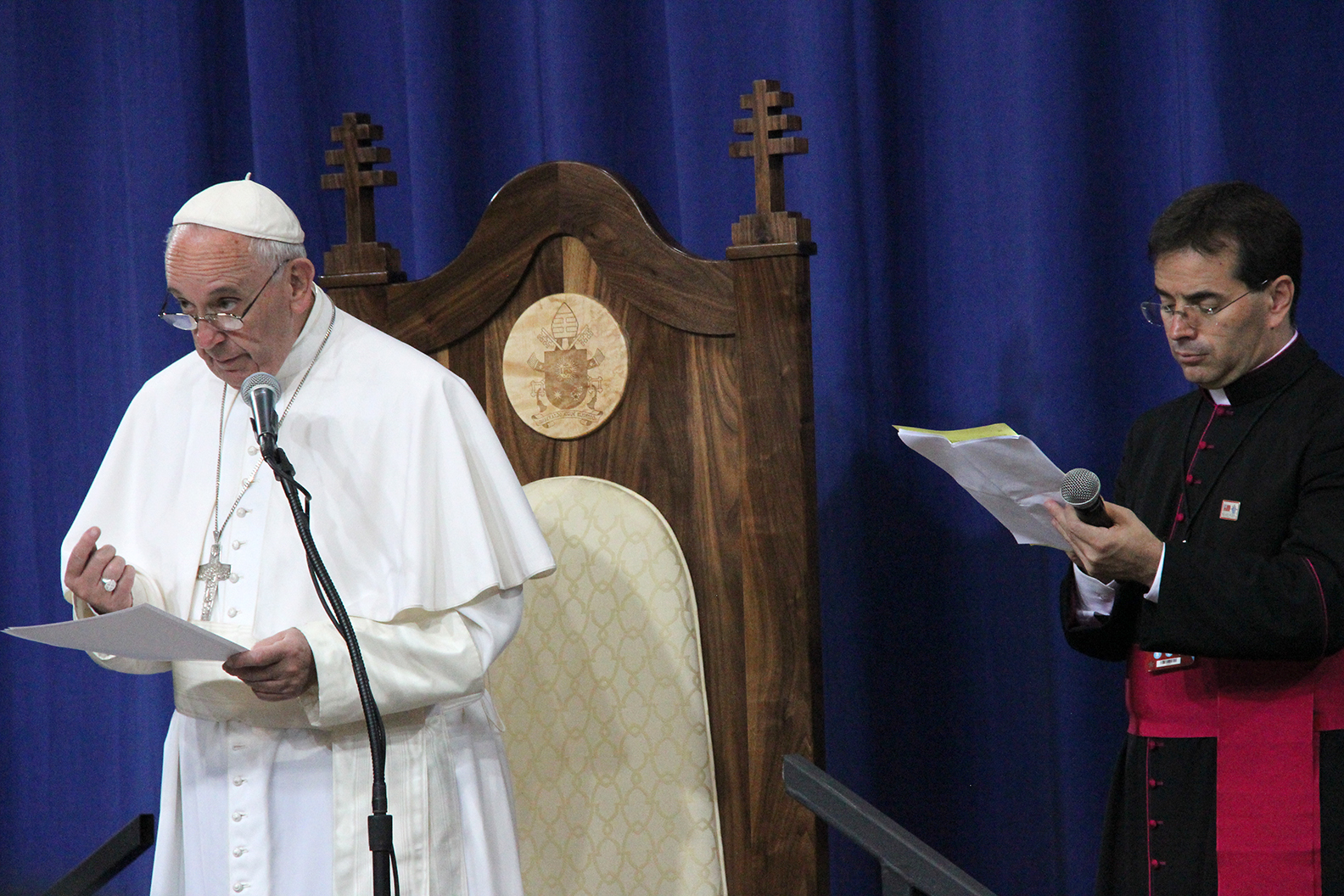
“I am here as a pastor, but above all as a brother, to share your situation and to make it my own,” said Pope Francis to the inmates.
“I have come so that we can pray together and offer our God everything that causes us pain, but also everything that gives us hope, so that we can receive from Him the power of the Resurrection,” he continued.
Before Pope Francis arrived, around 70 inmates were brought into the room, where families, correctional officers, public relations officials and members of the media were anticipating the big moment.
Pope Francis stands next to the chair that was constructed by inmates at the prison. (Justin Bell/CATHOLIC SUN)
Women inmates from the nearby Riverside Correctional Facility took the front-row seats, with the men behind them in three sections. The focal point of the room seemed to be the 6-foot tall chair made of walnut.
Shawn Hawes, a spokeswoman for the Philadelphia Prison System, said that inmates chosen for the visit had little or no behavioral issues while in custody, and also demonstrated a faith commitment with attendance to services or classes.
Warden Michelle Farrell instructed everyone to take their seats and noted that the Pope would be arriving early. Before long, bishops and priests entered the room from the side and not long after that and without fanfare, Pope Francis emerged from the front of the room and gave a thumbs up after seeing the chair.
Speaking from a prepared statement, he addressed the inmates in Spanish, with Msgr. Mark Miles, a member of the papal entourage, translating into English. In his message of solidarity as well as Christ’s power to cleanse, the Holy Father did not stray far from the official text of his visit.
“We know in faith that Jesus seeks us out. He wants to heal our wounds, to soothe our feet which hurt from traveling alone, to wash each of us clean of the dust from our journey,” the pope said.
He spoke of Christ’s desire to heal. “He doesn’t ask us where we have been, He doesn’t question us about what we have done,” the pope said. Instead, Christ came to offer healing, hope, and dignity restored so the journey can begin again.
“He wants us to keep walking along the paths of life, to realize that we have a mission, and that confinement is not the same thing as exclusion,” said the pontiff.
Pope Francis addresses prisoners and correctional officers at the Curran-Fromhold Correctional Facility in Philadelphia Sept. 27. Behind him is his interpreter Msgr. Mark Miles. (Justin Bell/CATHOLIC SUN)
“Life means ‘getting our feet dirty’ from the dust-filled roads of life and history. All of us need to be cleansed, to be washed,” and in a notable addition to the official text, “all of us — and me in first place.”
As poignant as his message to the room, what will likely be more memorable to the inmates was the personal visit he gave each of them. Inmates, correctional officers and Warden Farrell spoke to The Catholic Sun after the Holy Father’s visit.
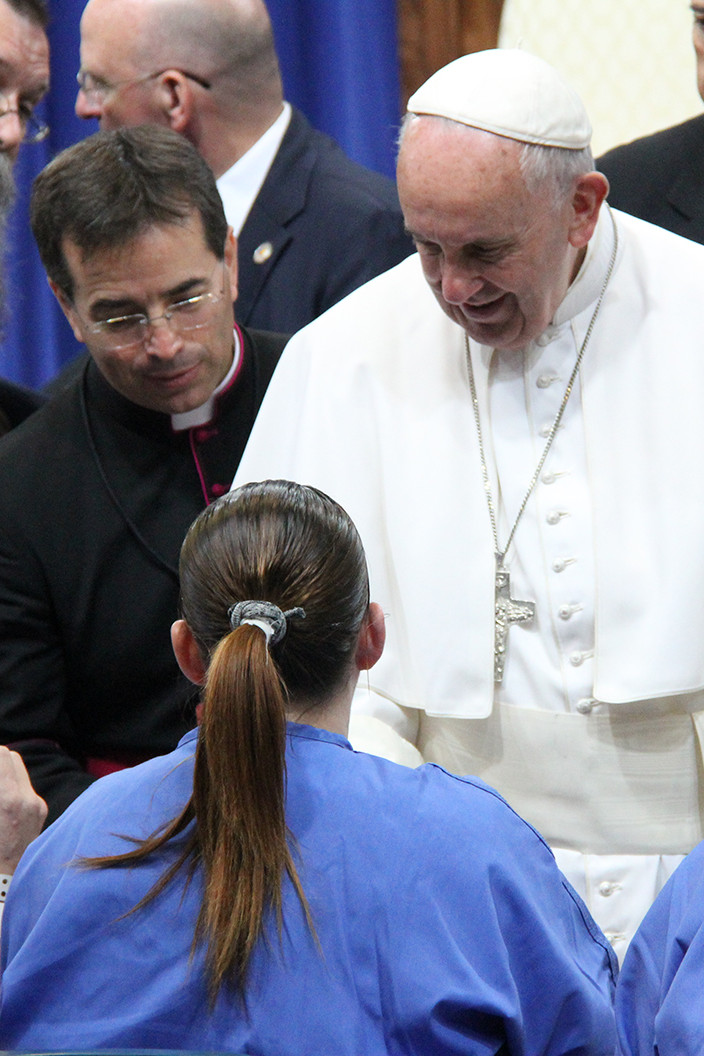
Leaving the front of the room and accompanied by Vatican personnel, Pope Francis stopped by every inmate, shaking hands, giving blessings, receiving at least one hug and offering encouraging words. His aides also gave each inmate a rosary and a prayer card of the pope.
Pope Francis greets inmate Stacie Sickel. “I bless you and your children,” she recalled the Holy Father telling her. “That right there, just brought tears to my eyes, just for him to touch me, period.” (Justin Bell/CATHOLIC SUN)
“I’m just ecstatic right now, I love it,” said Stacie Sickel who was seated in the front row and had a scapular blessed for one of her friends at Riverside.
She said when the pope approached her, she asked for a blessing.
“He said, ‘I bless you and your children,’” she recalled. “That right there, just brought tears to my eyes, just for him to touch me, period.”
The pope’s message of making new paths and journeys also resonated with her.
Instead of “backtracking and being so depressed and down on yourself, just try to move forward with yourself and your self-esteem [will] get higher,” said Sickel.
Christopher Custer only found out the day before that he would be included with the group of inmates for the papal visit.
“It was a once-in-a-lifetime opportunity. Just, I got goosebumps, you know what I mean? Amazing, that’s pretty much all I can sum it up as,” he said.
He said it is something that he will remember the rest of his life.
“I think people just have to be more unified and try to get along together,” said Custer.
Custer said that his Catholic faith had been boosted before the visit, but that this “gave me newer insight, more hope, more positive — a better outlook on life, I think more than anything.”
With regard to the Holy Father’s message to and presence among the inmates, Warden Farrell said, “I think it probably gave them a message of hope and that they’re not forgotten, that everyone is a sinner and that everyone can be forgiven.”
Pope Francis embraces an inmate during his visit to the prison. (Justin Bell/CATHOLIC SUN)
Farrell, who is Catholic, said it was “such a moving experience” that she will never forget, and also noted about the visit that “there was no one who is better than anyone else — that even the pope can come and show his humility and come amongst even the most marginalized of our population.”
Before leaving the room, Pope Francis had at least one more blessing to give. One of his aides noticed that Stephanie Brophy was showing in her six-and-a-half month of pregnancy. Brophy, the Archdiocese of Philadelphia’s associate director of communications, had wanted to get a “glimpse of him up close.”
The aide motioned for Brophy to come over.
“His eyes lit up and he reached out his hand to shake my hand, so I did and then he put his hand on my belly and blessed it,” Brophy said, speaking of the Holy Father and her unborn child.
And the chair the inmates made for Pope Francis? It’s a gift, so it will be passed on to the Archdiocese of Philadelphia which will ship it to the Vatican with other gifts given to Pope Francis during his historic journey to the City of Brotherly Love.
“The chair is beautiful,” said Pope Francis to the inmates after making his rounds and before leaving them.
Pope Francis and leaders of the Synod of Bishops on the family and top officials from the synod's general council attend an event marking the 50th anniversary of the Synod of Bishops in Paul VI hall at the Vatican Oct. 17. The pope outlined his vision for how the entire church must be "synodal" with everyone listening to each other, learning from each other and taking responsibility for proclaiming the Gospel. (CNS photo/Paul Haring)
Pope Francis and leaders of the Synod of Bishops on the family and top officials from the synod’s general council attend an event marking the 50th anniversary of the Synod of Bishops in Paul VI hall at the Vatican Oct. 17. The pope outlined his vision for how the entire church must be “synodal” with everyone listening to each other, learning from each other and taking responsibility for proclaiming the Gospel. (CNS photo/Paul Haring)
VATICAN CITY (CNS) — Members of the Synod of Bishops on the family agree that Catholic families are the beating heart and busy hands of the church, but the tensions in the synod hall demonstrate that what they don’t agree on is a vision of the church and its primary attitude to the world.
As the Catholic Church marked the 50th anniversary of the close of the Second Vatican Council — the last session was held Sept. 14-Dec. 8, 1965 — debates within the synod indicated that reflections on the council have shifted from differences over the meaning of individual council documents and moved on to its general vision of the structure of the church and the relationship of the church to the world.
“The discussion is about the future of the church,” German Cardinal Reinhard Marx told a group of reporters Oct. 20. Some synod members seem to view the church as “a castle to be defended, surrounded by enemies. That I can’t understand,” he said. “The church is a sacrament in the midst of people,” reaching out, challenging, bringing healing.
The synod highlighted the fact that the family is at the very heart of the church: The family is where the faith is lived and passed on and where the Christian community most strongly impacts and is impacted by the surrounding society.
As pastors, members of the synod were wrestling, for example, with the questions of Communion for the divorced and civilly remarried and with how best to respect the dignity of homosexual persons while defending marriage as a union of one man and one woman for life.
But none of the bishops thought the questions ended there.
A church living in the midst of the people obviously is challenged by the variety of cultures those people represent. Maintaining unity while responding to diversity and even learning from it has been a task the Christian community has struggled with from the beginning, and not always successfully. The dangers are real.
From the beginning of the synod, members discussed the possibility that in a truly universal church, some pastoral approaches to particularly important questions could be tailored to local situations.
Members of the synod’s German-speaking small group said outreach to the divorced and civilly remarried was one of those situations. But English Group A, which had Australian Cardinal George Pell as its moderator and U.S. Archbishop Joseph E. Kurtz as its recording secretary, said leaving a matter that touches on the indissolubility of marriage up to individual bishops’ conferences “would risk harm to the unity of the Catholic Church, the understanding of her sacramental order and the visible witness of the life of the faithful.”
English Group D, led by Cardinal Thomas C. Collins of Toronto with Archbishop Charles J. Chaput of Philadelphia as secretary, reported that in their group, “One bishop said that the issue of admitting divorced and remarried persons without an annulment to Communion was such a vital matter of doctrinal substance that it could only be handled at an ecumenical council and not at a synod.”
Australian Archbishop Mark Coleridge of Brisbane, who has become a must-read blogger during the synod, wrote Oct. 22, “For me personally, one real fruit of the synod has been a deeper and richer understanding of synodality in the life of the church,” particularly the way Pope Francis explained it in a speech Oct. 17 as a style of “journeying together” with everyone — the pope, bishops, priests and laity — listening to, teaching and learning from each other.
“The pope spoke of synodality as a permanent feature of the life of the whole church rather than an occasional feature of episcopal life — and went on to set episcopal collegiality and the Petrine ministry within this context,” Archbishop Coleridge said. “This struck me as a deep and simple articulation of the vision of the church found in the teaching of Vatican II, and it made sense to me for the pope to say that this is where God is leading the church as we launch into the third millennium.”
Pope Francis insisted in that speech Oct. 17 that “it is not advisable for the pope to take the place of local bishops in the discernment of every issue which arises in their territory. In this sense, I am conscious of the need to promote a sound ‘decentralization.'”
However, he did make it clear that, in the end, he is the pope and has the responsibility “to speak as ‘pastor and teacher of all Christians,’ not on the basis of his personal convictions but as the supreme witness” to the faith of the church and as “the guarantor of the obedience and the conformity of the church to the will of God, to the Gospel of Christ and to the tradition of the church.”
Cardinal Daniel Sturla Berhouet of Montevideo, Uruguay, posted a comment on Facebook Oct. 13 saying, “The difficulties that are encountered in the synod process because of the diversity of opinions and of sensibilities are those of any living organism, and they can be shared precisely in the certainty” that the pope will give the final word and keep them united.