
Vatican official visits Mexico to mark 30 years of diplomatic ties

Cardinal Pietro Parolin, Vatican secretary of state, speaks during a visit to Mexico City April 26, 2022, to mark 30th anniversary of diplomatic ties with the country. (CNS photo/foreign relations secretary)

By David Agren, Catholic News Service

MEXICO CITY (CNS) — Speaking in a conference with Mexico’s foreign relations secretary, the Vatican secretary of state lauded church-state relations in Mexico as exemplary — an acknowledgment of the church’s improved standing in a country where priests were previously persecuted and Catholic rebels took up arms against an anti-clerical government.

“Today (in Mexico) church and state are called to be an example for other countries to show that it is possible to overcome extremism and polarization, increasingly creating a culture of fraternity, freedom, dialogue and solidarity,” Cardinal Pietro Parolin said April 26 at a conference marking the 30th anniversary of Mexico and the Vatican establishing diplomatic relations.

“Perhaps it’s premature to offer an evaluation,” Cardinal Parolin said. “But being aware of the long and complex historical path completed in Mexico in church-state relations, it is important … to look to the future, opening new spaces for dialogue and institutional collaboration.”

Mexico and the Vatican officially established diplomatic relations in 1992, ending a period of the Catholic Church not having official legal status in the country. The approval that year of the Religious Associations and Public Worship Law removed anti-clerical measures such as rules prohibiting priests and nuns from wearing their habits in public.

Relations reached such an acrimonious point early in the past century that the Cristero Rebellion erupted in western Mexico between 1926 and 1929, and churches were closed.

Church observers say church-state relations existed informally prior to 1992, but were discreet — to the point then-President José López Portillo welcomed St. John Paul II upon his arrival in 1979 with the terse greeting: “I leave you in the hands of the hierarchy and the faithful of your church and may everything be for the good of humanity.”

Mexican politicians, who in past years avoided public appearances with prelates, have subsequently sought out the pope for photo ops. Church observers say the 1992 restoral of relations came as then-President Carlos Salinas de Gortari sought legitimacy for a suite of structural reforms, including privatizing hundreds of state-run enterprises.

Foreign Secretary Marcelo Ebrard — who fell out of favor with church leaders when he was Mexico City mayor after promoting laws decriminalizing abortion and allowing same-sex marriage — appeared with Cardinal Parolin at the conference. Many people believe Ebrard has presidential aspirations.

“I see increasing action from the Holy See and Mexico in the international arena, in favor of peace in a difficult, uncertain and conflictive world that lies ahead of us,” Ebrard said. The Vatican and Mexico, he added, coincide on “the search for peace and taking concrete actions to reduce arms trafficking, the production of weapons, the proliferation of weapons around the world.”

Prior to the conference, Cardinal Parolin met with President Andrés Manuel López Obrador at the National Palace. Both men later walked together to the inauguration of a temporary replica of the Sistine Chapel built in the central Zócalo square.

Neither Cardinal Parolin nor López Obrador commented on their meeting. López Obrador, who identifies as “Christian,” later tweeted, “Relations with the Catholic Church translate into friendship and respect. … I personally consider Pope Francis to be an exceptional spiritual leader and humanist.”

Mexico City Mayor Claudia Sheinbaum — also thought to have presidential aspirations — greeted Cardinal Parolin in the Zócalo, too. She later tweeted: “I think we’re experiencing a special moment in relations (between Mexico and the Vatican) because the thinking of @Pontifex_es shares the principles of austerity, justice, love for others and an orientation toward the poor” — ideas raised often by López Obrador.

While in Mexico, Cardinal Parolin celebrated the April 23 episcopal ordination of the new apostolic nuncio to the Republic of Congo and Gabon, Mexican Archbishop Javier Herrera Corona.

The cardinal also celebrated Mass at the Basilica of Our Lady of Guadalupe April 25 for the inauguration of the Mexican bishops’ biannual meeting.

Cardinal Parolin warned the Mexican bishops, “We face challenging times, caused by various ideologies and interests that seem to want to supplant the true evangelical values.” But he urged them to keep their “eyes open to see the miseries of the world, the wounds of so many brothers and sisters deprived of dignity.”


Hope and joy reawaken when old and young come together, pope says

Father Volodymyr Medvid, a chaplain and head of Caritas of the Ukrainian Greek Catholic Church, shows Pope Francis artwork while meeting with a group of Ukrainians after his weekly general audience in St. Peter's Square at the Vatican April 27, 2022. In the group were 11 orphaned children who escaped Ukraine and found assistance in early March from an Italian Catholic organization. (CNS photo/Vatican Media)

By Carol Glatz, Catholic News Service

VATICAN CITY (CNS) — If young people recognize all that they have received with gratitude and older people take the initiative of relaunching hope in young people for their future, then nothing can stop the flourishing of God’s blessings among people, Pope Francis said.

Urging visitors to make sure they help bring young and older people together to talk and connect, the pope said, this is a “bridge that we have to reestablish more strongly,” because it is through this connection that salvation, hope and joy flow.

The pope made his remarks April 27 during his weekly general audience in St. Peter’s Square, where he also asked that people “persevere in praying constantly for peace.”

In his greetings to visitors after his main catechesis, the pope asked that people pray for weapons to be silenced “and may those who have the power to stop this war listen to the cry for peace of all of humanity.”

The pope continued his series of talks dedicated to the meaning and value of “old age” and focused on how important it is there be an “alliance” between old and new generations, highlighting the widow Naomi and her daughter-in-law, Ruth, as an example.

The story, presented in the Book of Ruth, of “these two faithful women shows that, in God’s providential plan, the covenant of love and fidelity uniting the generations can prove immensely enriching for families and for the growth of a society that respects the dignity and gifts of each of its members, however young or old,” according to the summary of the pope’s catechesis.

Pope Francis said Ruth’s devotion helps Naomi stop being so pessimistic and even inspires her to take the initiative to help Ruth build a new future, by guiding and encouraging her.

“In some cases, the tendency of the elderly toward pessimism needs to be countered by the affectionate pressure of the young,” he said.

There are all sorts of clichés and prejudices when it comes to family members, especially between a mother-in-law and daughter-in-law, he said.

Pope Francis, known for cracking jokes about mothers-in-law, said — jokes aside — it is important to recognize and honor their role as the mother of one’s spouse.

“She is a mother, she is older. One of the most wonderful things about grandmothers is them seeing their grandchildren. When their children have children, they come back to life,” he said.

The pope asked that families take special care in maintaining a good relationship with their in-laws, even if they sometimes act like they are “a little bit special.”

The parents of one’s spouse have still sacrificed a lot, he said, and families can at least try to make their in-laws happy, so they can live out the rest of their years in joy, he said.

“And if they have some kind of flaw, help them to correct it. And to all the mothers-in-law out there, let me say, be careful with what you say, because the tongue is one of the ugliest sins of mothers-in-law. Be careful,” he said.

The pope asked that people “rediscover the Book of Ruth,” especially its reflections on love and its catechesis on the family. “This short book also contains valuable teaching on the alliance of the generations: where youth shows itself to be capable of restoring enthusiasm to mature age, and old age discovers it is capable of reopening the future to wounded youth.”

“If the young open themselves to gratitude for what they have received and the elderly take the initiative of relaunching their future, nothing can stop the flourishing of God’s blessings among peoples!” he said.

When greeting Polish pilgrims, Pope Francis recalled that April 27 marked the eighth anniversary of the canonization of St. John Paul II. “We pray for his intercession so that we might be faithful witnesses to Christ and his merciful love in the world, our families and places of work.”

He apologized for needing to sit during the meet-and-greet portion at the end of the audience.

“This knee just will not get better, and I can’t be on my feet too long,” he said.

Reporting previously that he has a strained ligament and swelling of the knee, the pope was having even more difficulty than usual walking from the popemobile to his chair at the audience. He has had to cancel a number of scheduled meetings and appointments due to his doctor’s insistence he rest.


Supreme Court examines ‘Remain in Mexico’ asylum rule

People in support of asylum seekers rally near the Supreme Court in Washington April 26, 2022, as the court hears oral arguments in President Joe Biden's bid to rescind a Trump-era immigration policy that forced migrants to stay in Mexico to await U.S. hearings on their asylum claims. (CNS photo/Elizabeth Frantz, Reuters)

By Carol Zimmermann, Catholic News Service

WASHINGTON (CNS) — After nearly two hours of oral arguments April 26, the Supreme Court justices had mixed views on the Biden administration ending a Trump-era immigration policy called “Remain in Mexico.”

The policy in question is the Migrant Protection Protocols, or MPP, which requires asylum-seekers to stay in Mexico until their cases can be heard in U.S. immigration courts.

Immigration supporters, including many Catholic organizations, have spoken out against this policy. And during oral arguments, activists held a rally outside the Supreme Court holding signs with the message “safe not stranded.”

The policy, put in place in 2019, has been a headache for the Biden administration. Once President Joe Biden took office in 2021, he paused the policy, then formally sought to end it a few months later in June.

But in August of that year, after Texas and Missouri sued to maintain the program, a judge with the U.S. District Court for the Northern District of Texas told administration officials that they had to continue complying with the policy, saying they had not ended it properly.

Last December, a federal judge reinstated the program with some changes made by the Biden administration, including a pledge to resolve cases within six months and to pay for migrants’ transportation to and from hearings.

The question now before the nation’s high court is whether immigration officials must send asylum-seekers to Mexico or if they can allow them into the United States while they await their hearings.

Some of the justices questioned the administration’s ability to release immigrants into the United States, but they also questioned how Texas courts can determine public policy.

Solicitor General Elizabeth Prelogar said the law does not contain a provision requiring migrants to be returned to Mexico, and she also pointed out that there is a “public benefit” to allowing migrants who pass criminal background and other checks into the U.S., freeing the detention beds for those who are more dangerous.

She also said it was impossible on a practical level to detain all migrants at the U.S.-Mexico border since there are less than 40,000 immigration detention beds.

Chief Justice John Roberts said that although the government can’t possibly detain all who cross the border, he wondered if releasing large numbers of them into the U.S. was in compliance with federal law.

Since reinstating the immigration rule, the Biden administration has enrolled 3,012 migrants in the Remain in Mexico program, primarily asylum-seekers from Cuba, Nicaragua and Venezuela.

Texas Solicitor General Judd Stone stressed that federal law requires U.S. border officials to either detain or return migrants to Mexico and said that if the U.S. has reached capacity limit to detain migrants, immigration officials should be returning them to Mexico where they can await their asylum hearings.

But those being forced to wait in Mexico have said they have been in dangerous situations and have found it hard to find lawyers to handle their cases.

“The legal rights, safety and humanity of thousands of men, women and children have been ignored as they have been forced to wait in life-threatening conditions in Mexico due to MPP,” said Anna Gallagher, executive director of Catholic Legal Immigration Network, known as CLINIC.

“We pray that the Supreme Court will recognize that MPP is both illegal and immoral so that the Biden administration can put an end to the shameful program once and for all,” she said in an April 26 statement.

CLINIC filed an amicus brief in this case urging the Supreme Court to reverse the lower court ruling brought by Texas and Missouri, which ordered the government to reinstate the policy.

Joan Rosenhauer, executive director of Jesuit Refugee Service/USA had a similar take. “For over three years, MPP has forced thousands of asylum-seekers to wait for their asylum hearings in dangerous border towns, subjecting them to systemic danger and violence,” she said in a statement, adding that her organization “works directly with people in northern Mexico as they await their opportunity to pursue asylum and find safety in the U.S. We hear every day of the violence and suffering they experience.”

Last December, the head of the U.S. Conference of Catholic Bishops’ migration committee, Auxiliary Bishop Mario E. Dorsonville of Washington, also said the policy should be stopped.

“We are deeply dismayed by the reimplementation of MPP,” he said. “Unfortunately, attempts by the administration to make this program ‘more humane’ — however well-intentioned –will not cure its inherent faults, nor will they alleviate its inevitable toll on human lives.”

A decision in this case, Biden v. Texas, is expected by late June.


Newly found Maryland site reveals clues about Catholic colonists

Kyle Vanhoy sifts through rubble March 16, 2022, at the Historic St. Mary's Fort site in southern Maryland. (CNS photo/Zoey Maraist, Catholic Herald)

By Zoey Maraist, Catholic News Service

ST. MARY’S CITY, Md. (CNS) — While English colonists who arrived in the New World were looking for greater opportunities, many of the Catholic colonists who arrived in Maryland also were looking to escape religious persecution.

Historic St. Mary’s City, a living history museum in southern Maryland, keeps the story of those Catholic colonists alive while its archaeologists are still digging up clues to the past.

In 1634, the ships the Ark and the Dove landed on the shores of Maryland carrying more than 100 English Catholics and Protestants, led by the Catholic Leonard Calvert. The newcomers settled in a fort before gradually building up St. Mary’s City, a metropolis in southern Maryland that would serve as the colony’s first capital.

For decades, religious tolerance for Christians was the law of the land. But the colonists weren’t free of the political and religious strife that rocked society in Europe. In the late 1680s, England’s Glorious Revolution replaced a Catholic ruler with the staunchly Protestant King William and Queen Mary. Soon, Maryland was no longer controlled by the Catholic Calvert family but instead became a royal colony where the Church of England was the state religion.

In 1695, Francis Nicholson, the royal governor, moved the capital to Annapolis, a more centrally located city where fewer Catholics lived. St. Mary’s City became a shell of its former self, and the site of that original fort was lost to history.

Fortunately, archaeology has helped uncover much of the old city’s mysteries over the past few decades. “There was no map of St. Mary’s City, other than one map with no street layouts, no buildings, no nothing,” said Peter Friesen, director of education at the living history museum. “It’s through the 50 years of archaeology that we were able to figure out where a lot of these buildings are that we’ve reconstructed.”

One of those buildings is a Catholic church. The first group of colonists to come to Maryland included Jesuit Fathers Andrew White and John Altham, and other priests followed over the years. At first, they used an old witchott, a type of Native American dwelling, to celebrate Mass, then a wooden chapel, then a cruciform brick chapel with windows and a stone floor. But the building survived for only a few decades.

In 1704, the Maryland legislature passed the “Act to Prevent the Growth of Popery,” which banned Catholics from voting or holding office, taxed them twice and only allowed them to worship in their homes.

The St. Mary’s City sheriff locked the brick chapel so that it could no longer be used for worship. “Then the Jesuits (took) the chapel apart brick by brick and used the bricks to rebuild a different chapel on private property that they owned at St. Inigoes, which is five, six miles south of (St. Mary’s City) and is now part of a (military) base,” said Friesen.

To replace the loss of churches, Catholics began to add “Mass rooms” to their homes, and several are still in existence, including one at the Doughoregan Manor near Ellicott City.

The foundation of the original brick chapel was discovered in 1938 and more than 50 years later was extensively excavated by archaeologists. The chapel was rebuilt in the style of other Jesuit churches of the time.

Though the historians were learning more about the colonial town, one thing remained elusive: the location of the original fort.

Their more than 50-year search often was sidetracked by other discoveries, such as the uncovering of three lead coffins buried in one of the transepts of the brick chapel. But last year, Historic St. Mary’s City announced they had finally found the fort after a geophysicist used magnetometry, ground-penetrating radar and other technology to identify the post holes of the fort’s walls. Excavation has helped them learn more about life inside the fort, and has uncovered Catholic artifacts.

A silver crucifix, rosary beads and a medal of Aloysius Gonzaga, a future Jesuit saint, all were discovered at Historic St. Mary’s. Two identical medals were found, one inside the fort, of five saints who were canonized by Pope Gregory XV in 1622: St. Ignatius Loyola, St. Francis Xavier, St. Teresa of Avila, St. Philip Neri, and St. Isidore the Farmer, who stands in the center holding a farming tool.

“Medals like this were becoming very popular in the 17th century as a consequence of multiple things,” said Jennifer Ogborne, curator of collections. “People wanted items of devotion they could carry with them as part of the Counter-Reformation. It became much easier to make them in the late 16th and early 17th centuries so they could be produced for a wider audience.”

One of the latest discoveries from the fort site is a small metal Caravaca cross. For centuries, pilgrims have visited the Spanish town of Caravaca to venerate a piece of the true cross. The relic is displayed in a cross with two horizontal bars, and the artifact has the same shape. There is still lots to learn about the tiny devotional object that was plucked from the Maryland dirt, said Ogborne. “We are very excited about that cross.”

Historic St. Mary’s City explores more than just religious history. Visitors can see a tobacco farm, a replica of the Dove, the ship that brought the colonists, and models of period Native American homes.

But for Catholics and other people of faith, St. Mary’s City is notable for its radical commitment to religious tolerance. The ideals the early colonists espoused lived on. Within 100 years of Maryland’s legal penalization of Catholics, the First Amendment enshrined freedom of religion as a fundamental American right.


‘Smell of sheep’ in Ukraine reeks of scorched homes, death, chaplain says

Pope Francis greets Father Oleksandr Khalayim, a Ukrainian military chaplain, during an audience with Missionaries of Mercy priests at the Vatican April 25, 2022. The pope commissioned the priests during the Year of Mercy for the special mission of preaching God's mercy and showing it, especially through the sacrament of reconciliation. (CNS photo/Vatican Media)

By Carol Glatz, Catholic News Service

VATICAN CITY (CNS) — Having “the smell of sheep” for one military chaplain serving in Ukraine has now meant being surrounded by the smell of burned homes and lives.

“Every city has its own smell of suffering. It can’t be described. The church here must become saturated with this smell and stay close by with different ways of helping,” said Father Oleksandr Khalayim.

“The real church is a flexible church” that can be wherever it is needed, he said in an interview with Vatican News April 26.

Father Khalayim, a military chaplain and a missionary of mercy, is a priest of the Diocese of Kamyanets-Podilskyi in the southwest of the country near the border with Moldova and Romania.

The priest was in Rome for an April 23-25 World Meeting of Missionaries of Mercy, sponsored by the Pontifical Council for Promoting New Evangelization.

Asked how he brings mercy and forgiveness as a chaplain to a war zone, Father Khalayim told Vatican News that “there must be dialogue before forgiveness. Forgiveness must be accepted, and it is a long journey” that may take “three or four generations.”

“For me, right now it is hard to talk about forgiveness if bombs keep coming, if children are still being killed, if our cities are still being bombed,” he said. “To forgive what women and children have suffered through is truly difficult.”

“Yes, we Christians must talk about forgiveness, but we cannot exploit this word, because forgiveness comes with responsibility. God forgave not just with words, but with his heart. It will be necessary to have a long period of care for the heart,” said the priest who had been serving as spiritual director at the major seminary in Horodok, near Lviv.

As a missionary of mercy, he said when he speaks with soldiers, he explains that mercy means asking them not to kill if it is possible. But that is not easy for those on the frontlines who are defending their country.

“Even this is mercy — to defend your home and family,” he said.

When the war broke out, he said he thought about how he could help, and he chose to be close to the people — soldiers, volunteers and especially the elderly, “so no one feels alone.”

Father Khalayim spoke about Pope Francis’ mandate “that priests must have the smell of sheep,” that is, of their people. “And now the church in Ukraine has this smell — the smell of burning, the smell of war” and “the smell of death.”

In Bucha and Gostomel, there is “the stench of things scorched” and in Chernihiv it smells like “abandonment with everything destroyed” and people left on their own and helpless, he said.

“One person couldn’t move for five days, no one could help. The only thing she could do was get water from the home heating radiator to drink. That’s how she survived,” he said.

In addition to all the solidarity and assistance Ukraine has been receiving, he said, the country also needs people who will seek out the truth.

“The enemy hides behind many lies and propaganda. The truth cries out, there is no need to be afraid to tell the truth,” he said, even though it may come at a cost, either by losing material security or one’s own life.

Father Khalayim was one of nearly 400 missionaries who met with Pope Francis at an audience at the Vatican April 25.

The pope commissioned the priests during the 2015-2016 Year of Mercy for the special mission of preaching God’s mercy and especially to encourage Catholics to rediscover the grace of the sacrament of reconciliation.


Catholic leaders thankful for Melissa Lucio’s stay of execution

Melissa Lucio is seen in this undated photo. Lucio, a Catholic mother of 14, was sentenced to death in Texas in 2007 for the death of her 2-year-old daughter, Mariah, that Lucio, now 53, has maintained was due to an accidental fall down a stairwell. The Texas Court of Criminal Appeals granted a stay of execution April 25, 2022. (CNS photo/courtesy Melissa Lucio's defense team via Texas Catholic Conference of Bishops)

By Carol Zimmermann, Catholic News Service

WASHINGTON (CNS) — Catholic leaders were thankful that death-row inmate Melissa Lucio was granted a last-minute stay of execution April 25, but they also said her sentence shows a failure in the use of capital punishment in this country and stressed that they would continue to pray for Lucio and her family and advocate on her behalf.

Lucio, 53, a Catholic mother of 14 and a grandmother, was scheduled for execution April 27 for the 2007 death of her 2-year-old daughter, Mariah, that Lucio has maintained was due to her daughter’s accidental fall down a stairwell.

The Texas Court of Criminal Appeals, which issued a stay of execution, ordered the 138th Judicial District Court of Cameron County to consider the new evidence presented by Lucio’s legal team.

Lucio will remain on death row while her case goes back to trial court to examine new evidence her attorneys say shows that the toddler’s death was an accident caused by an undiagnosed injury sustained after falling down the stairs two days before she died.

“I am grateful the court has given me the chance to live and prove my innocence. Mariah is in my heart today and always,” Lucio said in a statement through her attorneys. “I am grateful to have more days to be a mother to my children and a grandmother to my grandchildren.”

Lucio heard the news of the stopped execution in a phone call with state Rep. Jeff Leach, a Republican, and began sobbing when she heard it, attorneys told reporters in an April 25 Zoom call.

Lucio’s sister, Sonya Valencia, told reporters that the family members were thankful for support they had been given and added: “Our faith has gotten us through this.”

The Texas Catholic bishops had joined a broad coalition of faith leaders, Latino organizations, anti-domestic violence groups and the Innocence Project in urging state leaders to commute Lucio’s sentence and conduct a meaningful review of her case.

An application for clemency submitted March 22 by her attorneys included new evidence not only about Lucio’s daughter but information the jury never heard that shows Lucio was a victim of sexual abuse and domestic violence.

The evidence also said Lucio’s confession was just repeating what officers said during her five-hour interrogation and that she asserted her innocence more than 100 times during that interrogation. It included statements from four jurors who said they have grave concerns about evidence withheld from them at the trial.

“We give thanks to God that Melissa will not be executed this week and that she will soon have the opportunity for a new trial to prove her innocence,” said Krisanne Vaillancourt Murphy, executive director of Catholic Mobilizing Network.

In an April 25 statement she added that with Lucio’s case, “we see clearly how deeply flawed our capital punishment system is, and how it places innocent lives at risk. Her story also reveals how this system targets the most vulnerable among us, including people of color and those with histories of serious trauma.”

Vaillancourt Murphy said Lucio is “a Mexican-American mother, a devout Catholic and a lifelong victim of sexual and physical abuse. It has been disturbing to learn how, after suffering the unimaginable loss of her young daughter, Melissa was then further victimized and retraumatized by our legal system.”

She also thanked the Catholic bishops of Texas for their “committed advocacy on Melissa’s behalf.”

The Texas Catholic Conference of Bishops similarly commended the state court for intervening for Lucio but emphasized that her case “highlights the serious flaws in our justice system that allowed her to be condemned to death on the basis of a dubious conviction.”

Sister Helen Prejean, a Sister of St. Joseph of Medaille and longtime opponent of the death penalty, echoed this view, tweeting April 25 that she was “so thankful that a court finally stepped in today and stopped Melissa Lucio’s execution.”

“The death penalty is always horrific, but executing a mother for a crime that never even happened? Melissa was coerced into making a false confession 15 years ago. May the truth come out now,” she said.

She also said that those in the criminal legal system “should prioritize accuracy and getting to the truth.”

“Isn’t that the least we should expect? What does it say about priorities in the system when police and prosecutors fight tooth and nail against reforms to prevent false confessions?” she tweeted.

In a recent court appeal filed by Vanessa Potkin, an attorney for Lucio and director of special litigation at the Innocence Project, said: “There is just too much doubt. We cannot move forward in this case and risk executing an innocent woman.”

Attorneys for Lucio have sought relief multiple times to no avail. The U.S. Court of Appeals for the 5th Circuit said Lucio had been denied her right to fully defend herself but that procedural rules barred the court from overturning her conviction. The Supreme Court has declined to take up Lucio’s case.

The Innocence Project, in a brief filed with the Supreme Court, questioned the manner of interrogation used on Lucio about her daughter’s death. “Interrogation may sometimes psychologically pressure even innocent people to confess to crimes they did not commit,” it said, adding that the risk of a false confession is “heightened when the interrogated suspect is a battered woman.”


South Sudan bishop hopes for conversion after men sentenced for shooting

Italian-born Bishop Christian Carlassare of Rumbek, South Sudan speaks from a hospital in Nairobi, Kenya, in a video message posted on Twitter April 28, 2021. Bishop Carlassare expressed hope for conversion and healing as a court sentenced a Catholic priest and three others for his shooting. (CNS photo/Comboni Missionaries)

By Fredrick Nzwili, Catholic News Service

NAIROBI, Kenya (CNS) — Bishop Christian Carlassare of Rumbek, South Sudan, expressed hope for conversion and healing, as a court sentenced a Catholic priest and three others for his shooting.

Italian-born Bishop Carlassare, 44, was shot in his legs at his residence in Rumbek April 26, 2021, slightly over a month after the Vatican appointed him to lead the diocese. The attack forced the rescheduling of the Comboni priest’s consecration as the bishop of the diocese in central South Sudan.

Rumbek had been without a bishop since 2011, following the death of Bishop Cesare Mazzolari, also a Comboni missionary.

In a statement after the sentencing April 25, Bishop Carlassare said: “We appreciate the commitment and dedication of the government and the court. Though sad for what has happened and the resulting suffering, we pray that truth may bring conversion and healing.

“As a church, we look forward with hope during this Easter time and remember Jesus’ call for forgiveness.”

A High Court judge in Juba ruled that Father John Mathiang Machol, Moris Sebit Ater, Laat Makur Agok and Samuel Makir were guilty of participating in the attack.

Father Machol will serve a seven-year jail term. In March, he was charged with inciting and plotting against the bishop-designate. He was serving as coordinator of the diocese when Bishop Carlassare was appointed.

Agok and Ater were convicted of executing the actual attack and will serve four years in jail. Makir, convicted of hiding evidence, will serve a five-year jail term, according to news reports.

Malith Mading, the defense lawyer, has he will appeal the ruling, according to Sudan-based Eye Radio.

“We agree with the decision, but we disagree with the findings of the judge,” he said.


Good or bad nations do not exist since wickedness is everywhere, pope says

Pope Francis looks at a gift presented to him by Trinitarian Father Luigi Buccarello, superior general of the order, during an audience with members of the Trinitarian order in the Apostolic Palace at the Vatican April 25, 2022. (CNS photo/Vatican Media)

By Carol Glatz, Catholic News Service

VATICAN CITY (CNS) — There is no such thing as a “good” or “bad” nation because wickedness can be found everywhere, Pope Francis said.

“Once there was a habit of dividing humanity into the good and the bad: ‘This country is good,’ ‘But it makes bombs!’ ‘No, it’s good and this one is bad,'” he said in off-the-cuff remarks April 25 at the Vatican.

“No. Today wickedness has pervaded everyone and there are good and bad people in every country. Wickedness, today, is everywhere, in every nation. Perhaps even at the Vatican!” he said.

The pope made his remarks during an audience with members of the Trinitarians who were in Rome attending an annual conference of Trinitarian International Solidarity, the order’s international organization that supports communities of persecuted Christians.

The Trinitarians were founded by St. John de Matha in the 12th-century to promote devotion to the Holy Trinity. In the beginning, the order’s unique apostolate was the ransom of Christians held captive by nonbelievers during the Crusades, reflected in their formal name of the Order of the Most Holy Trinity and of the Captives.

Today, the order’s apostolate includes parish ministry, education, chaplaincies in prisons and hospitals, and work with the homeless, and they also offer solidarity with and advocate on behalf of victims of persecution, torture and oppression.

Pope Francis thanked them for their special charism, which is “flagrantly timely, unfortunately.”

Today, the world boasts that slavery has been abolished, “when, in reality, there are many, too many men and women, even children, reduced to living in inhumane conditions, reduced to slavery,” he said.

Their conference on religious persecution also is timely, he said, because it is highlighting how “religious freedom is violated and sometimes trampled upon in many places and in different ways — sometimes crudely and openly, other times subtly and hidden from sight.”

The pope apologized for having to greet the members while he was sitting down because of his knee.

The pain, he said, is being caused by “that affliction that, once upon a time, was called ‘Nun’s Knee'” because it is most often caused by frequent kneeling. The pope was referring to prepatellar bursitis, a condition in which the cushioning, fluid-filled sac in front of the kneecap becomes inflamed or infected and puts pressure on the adjacent parts of the knee.

He also told the Argentine paper La Nación recently that his limited mobility and pronounced limp are due to a torn or strained ligament in the knee. He said in that interview he was rejecting injections, preferring the use of ice and pain relievers.

On his doctor’s orders, the pope once again canceled his day’s scheduled appointments April 26, which was to include taking part in the day’s session of the Council of Cardinals.


Court seems to side with football coach over postgame prayers

Joe Kennedy is seen in this undated photo. School officials at Bremerton High School in Washington suspended, and later fired, the football coach because he prayed after football games. (CNS photo/courtesy First Liberty Institute)

By Carol Zimmermann, Catholic News Service

WASHINGTON (CNS) — The majority of Supreme Court justices seemed to side with a former high school football coach April 25 who said his postgame prayers on the field — that cost him his job — amounted to private speech and not the public school’s endorsement of religion.

During nearly two hours of oral arguments, several justices emphasized that private speech is still private, and protected by the First Amendment, even if it takes place on public grounds. But some justices also pointed out that this private prayer on the field could also seem coercive because players could feel like they should participate.

Prayer by teachers and coaches “kind of puts undue pressure on students to participate when they may not wish to,” said Justice Elena Kagan. “They feel like they have to join religious observations they don’t wish to join.”

Justice Brett Kavanaugh wondered about the player “who thinks, if I don’t participate in this, I won’t start next week. Every player is worried about playing time.”

The case involves Joseph Kennedy, former assistant coach at Bremerton High School, outside of Seattle, who had been told by school district officials to stop these prayers on the 50-yard line. When his contract was not renewed, he sued the school for violating his First Amendment rights.

A lower court agreed with the school district, bringing Kennedy to the nation’s high court seeking a reversal.

Kennedy’s lawyer, Paul Clement, stressed that the “government doesn’t endorse all private speech just because it takes place on school grounds,” and said there was no evidence that students felt coerced to join in.

But Richard Katskee, representing the school district, pointed out that Kennedy “insisted on giving audible prayers that students could join, and then he created a zoo on the field.”

The justices also brought up a number of hypothetical situations that seemed to emphasize that they did not think Kennedy’s actions on the field equaled government endorsement — such as coaches who cross themselves before a game or a math teacher who reads the Bible aloud before school starts.

Richard Garnett, Notre Dame professor of law and director of the Notre Dame Program on Church, State and Society, said he was encouraged to see many justices skeptical of the school district’s argument that it had to censor Coach Kennedy’s private prayer in order to avoid any appearance that it had ‘endorsed’ his religious beliefs.”

In a statement, he said the case was not about “reimposing prayer in public-school classrooms. Instead, it is a case about protecting all individuals’ right to speak freely — and to pray — in the public square.”

An amicus brief filed in this case by Notre Dame Law School’s Religious Liberty Initiative said the court should “remind lower courts and regulators that the Establishment Clause of the First Amendment is not an excuse for censorship.” The group also the court should clarify its doctrines and discard the unworkable and unjustified ‘endorsement test.'”

The “Lemon test,” which came up frequently in oral argument about the coach’s prayer, is based on a 1971 Supreme Court case Lemon v Kurtzman and used to determine if a law violates the First Amendment.

The coach said he made a commitment to thank God after each game, win or lose, since he started coaching in 2008, and made it a point to kneel by the sideline after the game by himself for quiet prayer. Eventually, he was joined in this practice by many of the team members.

One player’s parent said their son, an atheist, felt like he had to join in prayer or face potential loss of playing time.

School district officials told Kennedy to stop the postgame prayers in keeping in line with the Constitution’s Establishment Clause prohibiting the government from favoring one religion over another.

Kennedy asked the school to just give him 15 seconds to kneel on the field for silent prayer when the players were off the field, which the school district officials denied, calling it a violation of policy. Instead, the school district offered to give the coach a private space to pray or said it would allow him to pray after the crowd had left the stadium.

Kennedy’s announcement that he would not comply prompted a large group of supporters — including parents, a state legislator, and members of both teams — to join him at the 50-yard line after a game in October 2015. After that, the school district placed Kennedy on paid administrative leave.

During a performance review, the head football coach said Kennedy shouldn’t be rehired because he violated the school district’s policy. Kennedy did not seek to be rehired for the coaching position and instead filed his lawsuit in federal District Court.

The Supreme Court decision in this case, Kennedy v. Bremerton School District, is expected in June.


Over 350 pray Good Friday Rosary for Life outside Glendale abortion clinic

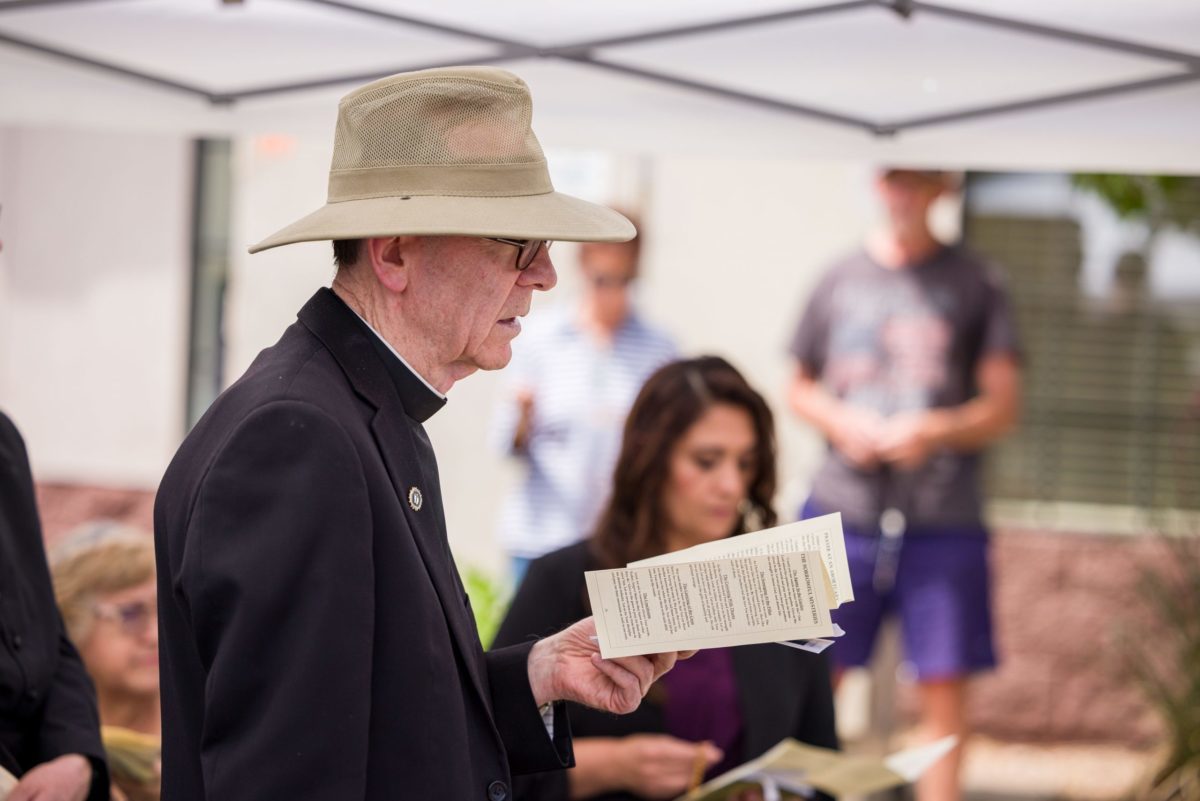
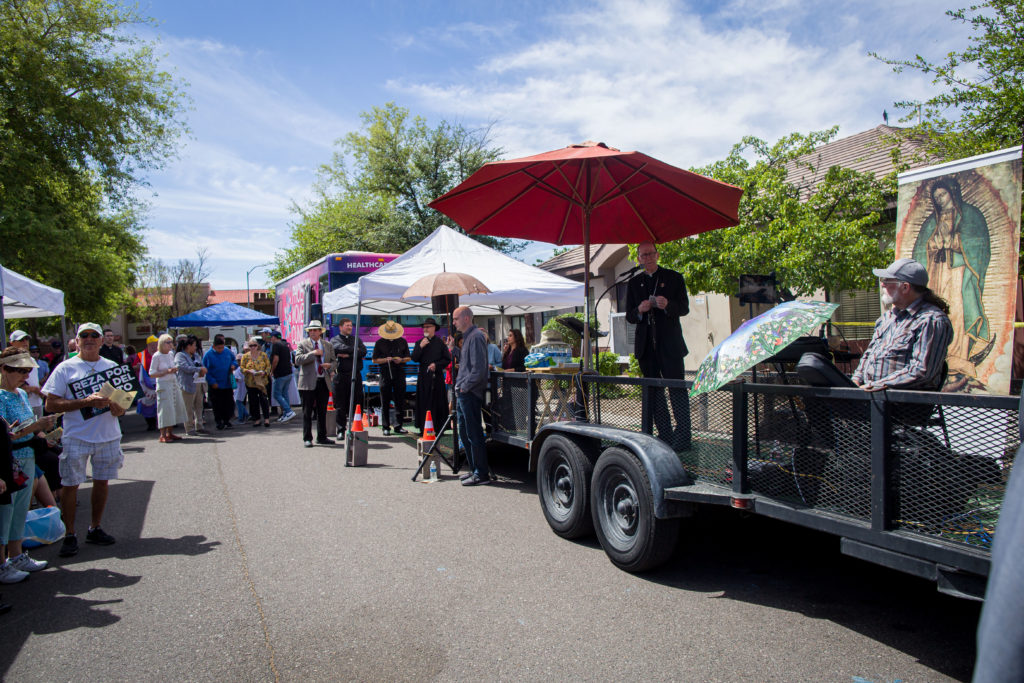
Bishop Olmsted leads the recitation of the rosary outside of Planned Parenthood on Good Friday.

By Jeff Grant, The Catholic Sun

Good Friday, the day Christians commemorate the Crucifixion and death of Jesus Christ as payment for the sin of humankind, has for two decades in the Diocese of Phoenix also been a time for Catholics to gather publicly to pray for the lives of the unborn, as well as the mothers contemplating ending their pregnancies and the workers performing those procedures.

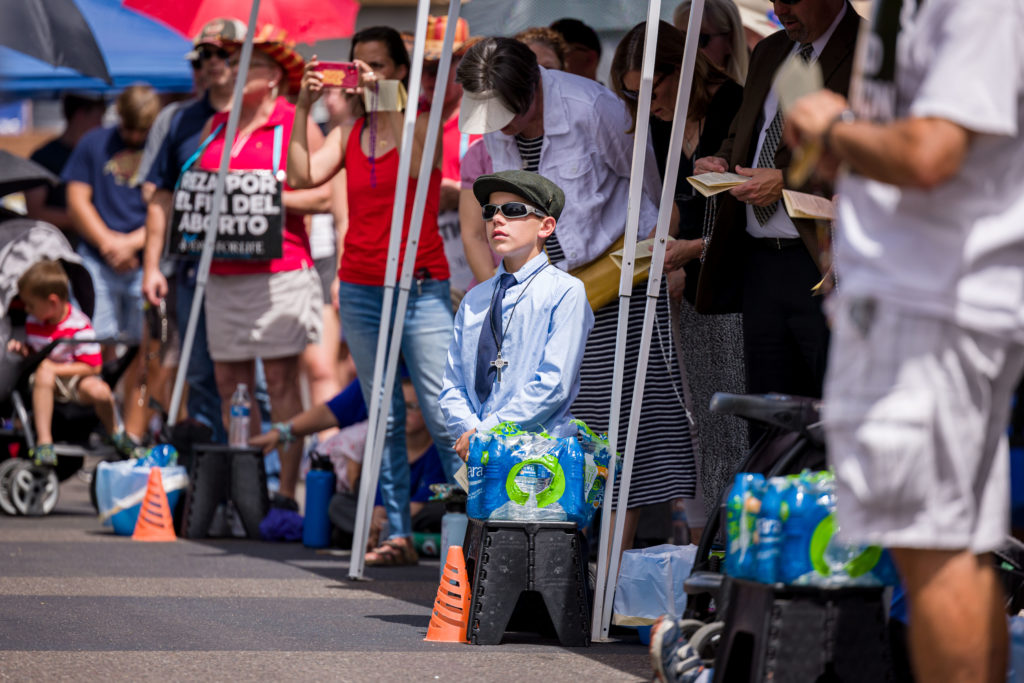
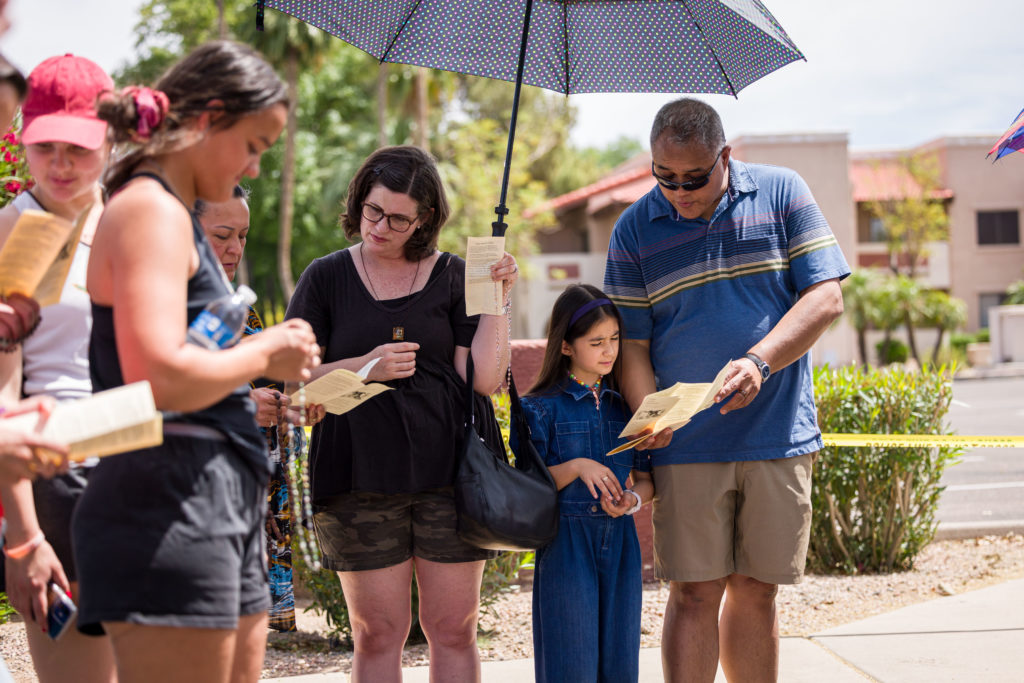
That is why on April 15, under the bright sunshine and 85-degree heat outside Planned Parenthood’s Eugie Avenue clinic, more than 350 individuals, many clutching rosaries, on their knees, heads bowed, lifted their voices and hearts to God for those who cannot.

Led by Bishop Thomas J. Olmsted, participants prayed the five decades of the Rosary for Life and were urged to continue asking God to change hearts and minds for life.
Glendale police estimated the turnout at around 360, a number in line with past Good Friday rosaries there.

“This is where the innocent are killed, and our law doesn’t protect them in any way,” said Bishop Olmsted after the Rosary. “So, we need to stand here and lift up this great injustice and pray for justice and also with hope there will be changed hearts,” he said.

“Jesus’ death was a great injustice. (but) He overcame the world. That’s why we come here full of hope because we come with faith in Him,” the bishop continued.

No abortions were being performed at the clinic during the Rosary. In fact, the building was closed. There were no vehicles in its lot and no visible activity outside. But abortions, both chemical and surgical, have been carried out there for years.

“What goes on inside there is horrific, said Lynn Dyer, who led one of the decades of the Rosary, and attends Mater Misericordiae Church and Most Holy Trinity Church, both in Phoenix. “I can’t wrap my head around the fact they are killing innocent human beings in there. If they were killing animals, there would be thousands of people out here, protesting.”

“It’s a lack of respect for life in our society today. We have to pray, pray, pray we can turn this around,” added Dyer, who is part of a volunteer group that transports “turnarounds” – women who change their minds about having an abortion.

“Our Lady asked us so many times to pray the Rosary, and so many miracles have happened because of that,” she continued.

The recently concluded 40 Days for Life Spring Campaign, a regular program of prayer, sidewalk counseling and public outreach, produced fruitful results outside the Eugie Avenue site. According to Glendale 40 Days Campaign leader Tammy O’Connor, a dozen women arriving at the clinic over the course of the campaign decided against going ahead with their abortions.

O’Connor was thankful for all the “prayer warriors” who supported the campaign, which opened in early March with a Mass celebrated by Bishop Olmsted at St. Mary’s Basilica downtown.

This year’s rosary took place amid increased optimism among pro-life forces that the Supreme Court of the United States may be ready to reverse its landmark 1973 Roe v. Wade ruling legalizing abortion.

Overturning Roe v. Wade would send the issue back to the states.

Over two-thirds of the 50 are now poised to enforce their own laws – either allowing or banning the procedure. Arizona Gov. Doug Ducey in late March signed a ban on abortion after 15 weeks of gestation. Florida’s governor signed a similar ban April 14, days after Oklahoma’s governor signed a law making it a felony to perform the procedure in that state. A Texas law enforcing a ban after 6 weeks of gestation withstood a state challenge in March after the U.S. Supreme Court ruled the state was the proper forum for Texas’ case.

Some pro-life advocates credit the shift in support for life in part to young adults.
On Friday, a significant portion of the crowd appeared to be under age 35. There also were a number of families with very young children, something Bishop Olmsted points to as a positive sign for the future of the pro-life movement.

“I’m delighted with all the little children here today. That’s really hopeful. It shows beautiful families, mothers and fathers who really want their children to know about this and pray for an end to it,” he said.

Zoe Jenen, 19, of St. Thomas the Apostle Parish in Phoenix, felt being there was a good example to others her age.

“There are not a lot of young people who are pro-life and (it is important) to show other young people you can be young and pro-life. It’s emotionally moving for anyone to see or hear a baby’s heartbeat (in an ultrasound). You can’t hear or watch and say, ‘That’s not human.’”

Matthew Engelthaler, who oversees St. Thomas the Apostle’s Pro-Life Group, brought his son, Jacob, 3. Engelthaler said prayer remains perhaps the powerful tool in the cause.

“Christ died on the Cross for all of us. The Crucifixion represents the opening of Heaven, and we representing the part of humanity that doesn’t get to experience it here on Earth.”