
New documentary chronicles ministry of papal preacher

Cardinal Raniero Catalamessa, a Capuchin Franciscan friar, is the subject of an 83-minute documentary film, "The Preacher to the Popes: Raniero Cantalamessa," which will have its worldwide premier Dec. 18, 2021, at St. Patrick's Theatre in Norfolk, Va., and via livestream at cantalamessamovie.com. (CNS photo/courtesy CMAX Media via The Catholic Virginian)

By Janna Reynolds, Catholic News Service

RICHMOND, Va. (CNS) — Most Catholics probably know there are specific roles within the papal household that support the papacy.

Many may not be aware that the preacher to the papal household, also known as the apostolic preacher, is one of those official roles, a role established by Pope Paul IV in 1555.

Cardinal Raniero Cantalamessa, a Capuchin Franciscan friar, is the longest serving person in that position. He was appointed by St. John Paul II in 1980 and was reappointed by Pope Benedict XVI and Pope Francis.

The faithful around the world will soon be introduced to the cardinal in “The Preacher to the Popes: Raniero Cantalamessa,” a documentary that aims to foster authentic relationships among Christians of every tradition.

The worldwide premiere will be Dec. 18 at St. Patrick’s Theatre in Norfolk, Virginia. There will be an in-person audience for the film and it also can be viewed online at cantalamessamovie.com.

“He’s an orthodox charismatic, so he has this deep understanding of the roots of the church and church teaching and Scripture, but he’s also very in tune with the gifts of the Holy Spirit,” Ashley Zahorian, director and producer of the film, told The Catholic Virginian, newspaper of publication of the Diocese of Richmond.

“So he’s very popular in a lot of circles, and he’s a very good, authentic Catholic,” she added. “He’s really popular among Protestants because they see what Catholicism should be.”

Zahorian first met Cardinal Cantalamessa in 2014 when he was the keynote speaker and she was giving a presentation on media evangelization at an Awakening the Domestic Church conference at Regent University in Virginia Beach.

The film’s executive producer, Deacon Darrell Wentworth, who serves at St. Gregory the Great Parish in Virginia Beach, worked with Zahorian to plan the conference. He had met then-Father Cantalamessa in 2012.

The deacon has been involved with ecumenism for the Diocese of Richmond since the early 2000s. He became a member of the Pontifical Council for the Laity in 2010 and in 2014 was asked to represent North American leaders of the Catholic Fraternity of Charismatic Covenant Communities and Fellowships — the organization that wanted to bring the preacher to the papal household to that conference in Virginia Beach.

In their ecumenical work, Deacon Wentworth and his colleagues sought a concept for a religious film that could “bring together Catholics, Pentecostals, charismatics and authentic Christians of every tradition around the core message of the Gospel.”

Cardinal Cantalamessa was the answer to Deacon Wentworth’s search.

“The preacher of the papal household is really the only person in the world that is commonly recognized as authentically authoritative in every Christian tradition,” he said. “Everybody loves this guy because he’s just a humble man who has a grounded, authentic understanding of patristics,” the study of the work of the early church fathers.

After the Awakening conference, Zahorian got then-Father Cantalamessa’s contact information and inquired about doing a documentary.

“He said that he had turned down EWTN before, but yes, he would let me do a documentary on him because of how we met each other and the trust level that we were coming from the same perspective,” she recalled.

“For a documentary, there’s a lot of research, a lot of finding out who to interview, interviewing them, and then taking the hundreds of hours of footage and finding what makes the cut for an 83-minute film,” Zahorian said.

Deacon Wentworth said his job as executive producer is “to connect the dots and introduce Ashley and her team of media people to the people who are friends with the pope, in evangelization theology, leaders of pontifical commissions.”

A challenge in producing the film was that work could only be done when the team had time and money available. The budget for the film is $250,000, some of which has yet to be raised.

Another test was COVID-19. As the pandemic made in-person meetings impossible for a time, some interviews had to be conducted over Zoom.

“I have very high standards in video production, so I had to get over that for the sake of the story,” Zahorian said.

When one of the team’s post-production workers got sick, others stepped up to help.

Cardinal Cantalamessa’s order was hesitant about the project because they were concerned it would be too celebratory of someone still living, and they wanted the filmmakers to consider waiting to finish it until after his death. That changed in late 2020 when Pope Francis announced the friar would be elevated to cardinal.

“We were given the blessing to move forward,” Zahorian said, “so we kicked back into high gear after that announcement.”

One of the things Zahorian said she admires most about Cardinal Cantalamessa is how he inspires everyone.

“You cannot look at him and not see joy, so somebody watching the film is going to leave inspired to do whatever it is God is calling them to do in their lives right now, and that Christianity is full of joy,” she said.

“When you watch the film, you’re going to see God moving in every one of the churches,” Deacon Wentworth noted. “That’s the key. The Holy Spirit is moving us all into deeper communion with one another because that’s what the Holy Spirit does.”

He sees the documentary as a tool for evangelization, which he defines as “the process of discovering who you are in Christ, and then helping others discover who they are in Christ.”

After the premiere in Norfolk, “The Preacher to the Popes” will be shown in limited screenings, with assistance from United in Christ, an international organization for Christian unity. Parishes, schools and other groups will be able to schedule screenings after the premiere.

“Ultimately, we want to encourage people to be watching these meaningful films and discussing them in small groups. So step one is see it, so that you know that you can vouch for it personally and see that it would fit for your community, and then schedule the time that you can share it with your broader community,” Zahorian said.

Following Pentecost, interested viewers will be able to stream the film on demand on CMAX.TV. It also will be shown on EWTN, Shalom, Catholic TV, CBN and Stremio for a period of time.


Court keeps Texas abortion law in place, allows challenge to continue

A pro-life supporter takes part in a demonstration outside the U.S. Supreme Court in Washington Nov. 1, 2021, as the court heard arguments over a challenge to a Texas law that bans abortion after six weeks. On Dec. 10, the Supreme Court said clinics' legal challenge to the law can continue but in the meantime the law would remain in effect. In a separate action, a judge at a Texas district court ruled Dec. 9 the new law violates the state's constitution. (CNS photo/Evelyn Hockstein, Reuters)

By Carol Zimmermann, Catholic News Service

WASHINGTON (CNS) — The Supreme Court said Dec. 10 that clinics can continue to challenge a Texas law that bans most abortions after six weeks of pregnancy but in the meantime the law would remain in effect.

Eight justices said the challenge could go forward. Justice Clarence Thomas opposed it.

Chief Justice John Roberts, writing separately, urged the U.S. District Court judge to act quickly in reviewing the law.

“Given the ongoing chilling effect of the state law, the District Court should resolve this litigation and enter appropriate relief without delay,” he wrote.

The Texas abortion law, signed by Republican Gov. Greg Abbott in May, went into effect Sept. 1.

During oral arguments about it Nov. 1, the justices considered whether the Justice Department and state abortion clinics can even challenge the abortion law in federal court because of the way the law was set up with citizens’ enforcement.

This was the third time the nation’s high court considered the Texas abortion law. On Sept. 1, it ruled against blocking it and on Oct. 22, it said the law would remain in effect before its expedited review Nov. 1.

Jeanne Mancini, president of the March for Life Education and Defense Fund, said in reaction to the court’s Dec. 10 decision: “Today the court ruled on a procedural issue without addressing the merits of the case challenging the Texas Heartbeat Act.”

She said the Texas law came about because “for decades Roe has blocked states from being able to regulate abortion” and added that she hopes the court’s upcoming ruling in the Mississippi case “returns this right to the people.”

When the Supreme Court first ruled against blocking the Texas abortion law, the Texas Catholic Conference, the public policy arm of the state’s Catholic bishops, said this action marked the first time since Roe v. Wade that the nation’s high court “has allowed a pro-life law to remain while litigation proceeds in lower courts.”

On Dec. 1, the Supreme Court examined Mississippi’s ban on most abortions after 15 weeks of pregnancy and heard requests to overturn the court’s 1973 Roe decision that legalized abortion.

In the oral arguments, the majority of justices seemed willing to let the state’s abortion ban after 15 weeks stay in place, but it was unclear if they would take this further and overturn Roe.

If the court ultimately sides with Mississippi, it would be the first time the court would allow an abortion ban before the point of viability that most consider to be at 24 weeks and could lay the groundwork for abortion restrictions from other states. Viability is when a fetus is said to be able to survive on its own.

The U.S. Conference of Catholic Bishops, in a court brief supporting Mississippi, said abortion is not a right created by the Constitution and called it “inherently different from other types of personal decisions to which this court has accorded constitutional protection.”

The day before the Supreme Court’s opinion on the Texas abortion law, a Texas state district court judge ruled that the means of enforcing the state’s abortion law — involving citizens to sue its violators and receive financial compensation — was unconstitutional.

The decision, issued by Judge David Peeples, keeps the state’s abortion law in effect.

Abortion providers in the state called it a step in the right direction, while pro-life advocates were disappointed.

Texas Right to Life said they would “immediately appeal this unjust ruling.”

Kimberlyn Schwartz, director of media and communication for Texas Right to Life, said: “The abortion industry’s lawsuit abuses the judicial system and turns this court into a mere platform for airing criticisms against the boldest pro-life law to take effect since Roe v. Wade.”


Christmas is time for sharing, not commercialism, pope says

Pope Francis greets a child during an audience in the Paul VI hall at the Vatican Dec. 10, 2021, with delegations from Italy and Peru who donated the Christmas tree and Nativity scene displayed in St. Peter's Square. (CNS photo/Vatican Media)

By Junno Arocho Esteves, Catholic News Service

VATICAN CITY (CNS) — The Christmas tree and Nativity crèche should evoke the joy and the peace of God’s love and not the selfish indulgence of consumerism and indifference, Pope Francis said.

Meeting Dec. 10 with delegations from Andalo in Italy’s Trentino-South Tyrol region and from Peru’s Huancavelica region — responsible, respectively, for the Christmas tree and the Nativity scene in St. Peter’s Square — the pope said the traditional Christmas symbols bring an atmosphere that is “rich in tenderness, sharing and family closeness.”

“Let us not live a fake, commercial Christmas! Let us allow ourselves to be enveloped by God’s closeness, by the Christmas atmosphere that art, music, songs and traditions bring to our heart,” he said.

The delegations were at the Vatican for the evening ceremony to light the Vatican Christmas tree and unveil the Nativity scene. However, the Vatican announced earlier that due to less-than-favorable weather predictions for the evening, the traditional outdoor ceremony would be held inside the Paul VI hall.

In the evening, despite the rain and cold temperatures, dozens gathered in St. Peter’s Square to witness the lighting of the Christmas tree. In the audience hall, the sounds of festive holiday music in Quechua played as videos of a children’s choir from Huancavelica were shown to commemorate the Andean-inspired crèche.

Archbishop Fernando Vérgez Alzaga, president of the commission governing Vatican City State, also welcomed the delegations from northern Italy and Peru and said their contribution was a symbol that “Europe and America are united in paying homage to the King of Kings.”

The Nativity scene in St. Peter’s Square featured 30 statues depicting Mary, Joseph, the Three Kings, shepherds and various flora and fauna from Huancavelica. The figures were dressed in the traditional bright, multicolored garments of the region’s Indigenous Chopcca people.

Next to the Andean Nativity scene stood a 90-foot-tall Christmas tree. The spruce tree came from a sustainably managed forest in the Dolomite mountains in northern Italy’s Trentino-South Tyrol region. The round wooden ornaments were also from Trentino.

During the meeting with Pope Francis, the two delegations were joined by a group of young men and women from a parish in Padua who created the Nativity scene displayed in the audience hall.

Expressing his gratitude to the delegations for their gifts, the pope said the traditional garments worn by the figures in the Nativity scene “represent the people of the Andes and symbolize the universal call to salvation.”

“Jesus came to the world through the concreteness of a people to save every man and woman, of all cultures and nationalities. He made himself small so that we might welcome him and receive the gift of God’s tenderness,” he said.

He also said the spruce tree was a “sign of Christ” and a reminder of God’s gift of uniting “himself with humankind forever.”

As Christmas festivities draw near, Pope Francis said the créche remains a symbol of hope that God “never tires of us” and that he chose to dwell among men and women “not as one who stands on high to dominate, but as the one who stoops low, small and poor, to serve.”

“For it to be truly Christmas, let us not forget this,” the pope said. “God comes to be with us and asks us to take care of our brothers and sisters, especially the poorest, the weakest and the most fragile, those whom the pandemic risks marginalizing even more.”


Using ‘holidays’ instead of ‘Christmas’ isn’t inclusive, cardinals say

Pope Francis answers questions from journalists aboard his flight from Athens, Greece, to Rome Dec. 6, 2021. In comments to reporters on the plane the pope said that the idea of not talking about Christmas is "an anachronism" reminiscent of the dictatorships of days gone by, including the communists. (CNS photo/Vatican Media)

By Cindy Wooden, Catholic News Service

VATICAN CITY (CNS) — Dropping references to Christmas in favor of “winter holidays” in official European Union communications was an idea that was not meant to offend but did and could even push some Christians toward right-wing populist political parties, said Cardinal Jean-Claude Hollerich of Luxembourg.

The cardinal, president of the Commission of the Bishops’ Conferences of the European Union, told reporters at the Vatican Dec. 10 that the best way to make Europe more inclusive for members of all religions “is not to put religion in the sphere of the private, but to give all religions access to the public space.”

In late October, Helena Dalli, the EU equality commissioner, distributed a 30-page internal handbook for making official EU communications more inclusive. An Italian newspaper published excerpts in late November, setting off a firestorm of criticism, particularly over Dalli’s reminder that not all Europeans celebrate Christmas and that even those who do don’t all celebrate on the same day since some who follow the Julian calendar celebrate in January.

Dalli withdrew the handbook in late November, promising to revise it.

Still, Pope Francis was asked about it Dec. 6 during his news conference with reporters on his flight back to Rome from Greece.

The idea of not talking about Christmas, he responded, is “an anachronism” reminiscent of the dictatorships of days gone by, including the communists.

Joining Cardinal Hollerich at a Vatican news conference to present plans for the European Catholic Social Days in March, Cardinal Peter Turkson, prefect of the Dicastery for Promoting Integral Human Development, said the suggestion to refer to “holidays” rather than Christmas is a sign of a mistaken idea that to promote dialogue and tolerance, people must hide their identity.

But a real dialogue will never occur between people who have “shed” their identity, he said. It’s more about sharing one’s values and learning about the values and experiences of others.

Cardinal Hollerich said unthinking moves by the EU to sideline the faith of many Europeans could easily backfire because it can push Christians to align themselves with “populist politicians who use the name of Christian” but, in effect, are “nearly anti-Christian in their practical attitudes,” especially when it comes to helping migrants and refugees.


Catholics must defend rights of the weakest, defenseless, pope says

Pope Francis greets Damiano Nocilla, president of the Italian Catholic Jurists Union, during an audience with members of the union at the Vatican Dec. 10, 2021. The pope called on Catholic jurists to protect the rights of the weakest. (CNS photo/Vatican Media)

By Carol Glatz, Catholic News Service

VATICAN CITY (CNS) — Catholics must contribute to helping protect the rights of the defenseless, weak and rejected, Pope Francis said.

“This is an intrinsic call to our faith” and not some insignificant or “passing” moral norm, he said in an audience at the Vatican with Italian legal experts, lawyers and judges.

“Even the least, the defenseless, weak individuals have rights that must be respected and not trampled on,” he said.

The pope met Dec. 10 with members of the Italian Catholic Jurists Union who were in Rome attending a national congress Dec. 9-11 dedicated to the legal protection of those who are vulnerable.

“Never before have Catholic jurists been so called upon to affirm and protect the rights of the weakest within an economic and social system that pretends to include diversity but, in fact, systematically excludes those who have no voice,” Pope Francis said.

“The rights of workers, migrants, the sick, unborn children, people nearing death and the poorest are increasingly neglected and rejected in this throwaway culture,” he said. “Those who are not able to spend and consume seem to be worthless.”

“But to deny fundamental rights, to deny the right to a dignified life, to physical, psychological and spiritual care, and to a fair wage means denying human dignity,” he said, highlighting the way many seasonal workers are treated and literally “used” to pick fruit or vegetables “and then paid miserably and thrown out, without any social protection.”

He said he can still see and feel what he experienced at the Mytilene refugee camp in Lesbos, Greece, during his recent trip there, and repeated his call that all people and their human rights be protected, and that “the dignity of each person should come before everything.”

“Yet, how far we are from this kind of respect!” the pope said. “Abuse, violence, neglect and omissions only increase the throwaway culture. And those without protections will always be marginalized.”

“You, as Catholic jurists, are asked to contribute to ‘reversing the course,’ promoting awareness and the sense of responsibility” in the ways their roles or authority allow, he said.

“Recognizing rights in principle and guaranteeing them in practice, protecting the weakest, is what makes us human,” the pope said. “Otherwise, we allow ourselves to be dominated by the law of the strongest and give free rein to oppression.”

The recognition of the rights of the weakest “does not derive from a governmental concession. And Catholic jurists are not asking for favors on behalf of the poor but are firmly proclaiming those rights that derive from the recognition of human dignity,” he said.

That is why the role of Catholic jurists, whether they are consultants, lawyers or judges, “is to contribute to the protection of the human dignity of the weak by affirming their rights” so that they can contribute to upholding human fraternity and not “disfigure the image of God imprinted in each person,” he said.


Organization calls attention to untold number of ‘missing’ migrants

Women with the Caravan of Mothers of Disappeared Migrants gather on Capitol Hill in Washington Oct. 19, 2021, to share stories of family members who have gone missing along migration routes. (CNS photo/Elizabeth Frantz, Reuters)

By Rhina Guidos, Catholic News Service

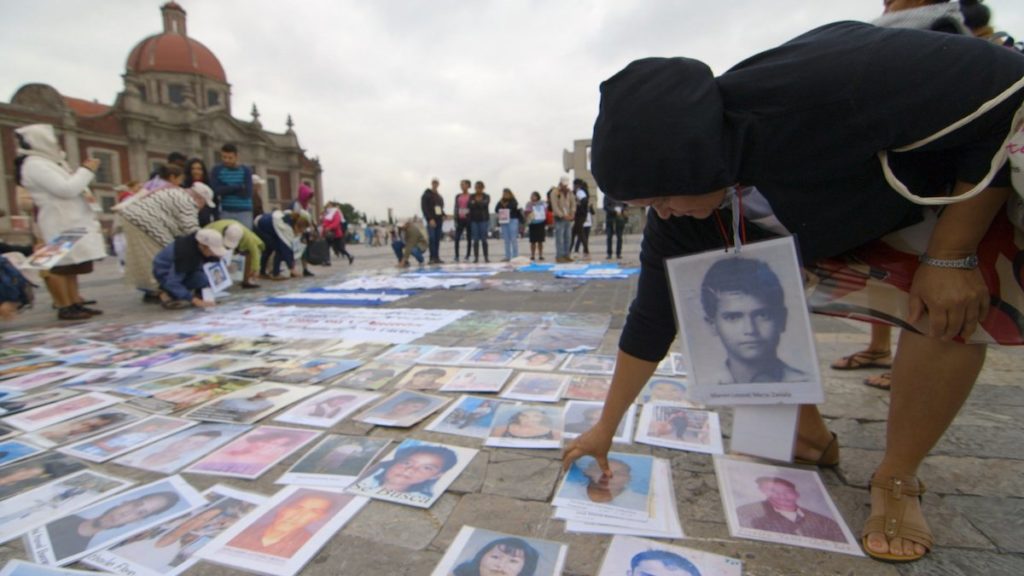
WASHINGTON (CNS) — On paper, some call them “missing,” but many families of the migrants know it’s likely that they’re dead.

Now, the International Organization for Migration, through the Missing Migrants Project, is hoping to shed some light on the plight of families looking for their loved ones as well the magnitude of migrant deaths.

Since 2014, the project has recorded 45,427 missing migrants, just a fraction of “incidents in which migrants, including refugees and asylum-seekers, have died at state borders or in the process of migrating to an international destination.”

“Behind every death is a family — mother, father, brother — searching for answers … they suffer a profound agony over their dead loved ones who are missing,” Rudi Maxwald, senior regional liaison and policy officer with the International Organization for Migration, said in a Dec. 7 webinar that focused on deaths and disappearances on migratory routes in Central and North America.

“Many of them will never have the certainty of what happened to them, nor will they receive their remains. These are unimaginable human tragedies that will affect thousands of families of migrants the rest of their lives,” he said.

Julia Black, a project officer with the organization, said the project has registered more than 5,700 people who have lost their lives in migration journeys in the Americas since 2014, including over 1,000 in 2021.

Though some are classified as “missing,” it’s important to understand, she said, that missing, in this context, usually means “that a person has died in the process of international migration and or they have disappeared, usually at sea, or they are presumed to be dead.”

This is a scene from the 2017 documentary “A Place of Absence.” The documentary follows director Marialuisa Ernst and her journey with a Caravan of Mothers of Missing Migrants, who are Central American women desperately searching for sons and daughters who vanished en route to the U.S. (CNS photo/courtesy A Place Films, LLC.)

Some have died during the migration journey because of exposure to the cold, lack of food or water, drowning, in accidents on dangerous transportation routes, violence encountered along the way, falling ill and having no access to health care during the journey, among some of the reasons, said Maxwald.

Edwin Viales of the Missing Migrants Project said the organization is looking at movements of people from South and Central America, but there have been many “invisible shipwrecks” for which they don’t have information, as citizens from places such as Venezuela, Cuba and other nations near the Caribbean take to the seas out of desperation.

The number of known cases would have to be multiplied four times to arrive at anything that resembles a real estimate, he said.

“There may be many other people who could be dead or missing for which no one has any (idea) that those incidents took place,” he added.

Behind the numbers, the organization also is hoping to encourage governments to do more to help families look for loved ones.

“Uncertainty and loss when a migrant disappears create huge impacts on families,” Viales said.

Some begin by asking their loved one’s friends or take to social media to ask if anyone has heard from them. But other than, they have no help from governments. Families need to be treated with respect and must be the focus of the processes that lead to investigations regarding missing migrants, Viales said.

“Across the Americas, there are important gaps regarding official, accessible and effective processes to search for missing migrants. Civil society organizations often fill the gaps,” the Missing Migrants Project says on its website.

“So many people don’t even know where to start when searching for a missing person. States need to create a clear, accessible mechanism to help in the search,” said the organization’s Kate Dearden.

In mid-October, Pax Christi USA and the Sisters of the Mercy of the Americas sponsored a group of women called Caravan of Mothers of the Disappeared, who were looking for sons and daughters who were never heard from again after migrating to the U.S.

Though the issue is starting to get some visibility, it is not a prominent topic on the immigration front.

It’s important to consider ways of preventing the dangerous situations that migrants encounter, Maxwald said, and for that to happen, immigration should be “safe, orderly, regular and with dignity, protecting the migrants and making sure no one is left behind.”


Doctors: Advances since Roe confirm abortion ‘takes life of unborn child’

A medical professional speaks with an expectant mother during an ultrasound examination in this 2016 photo. (CNS photo/Thomas Serafin, courtesy Knights of Columbus)

By Jodi Marlin, Catholic News Service

At 15 weeks’ gestation, a fetus responds to touch. The neurotransmitters and nerves needed to process and transmit pain signals have formed, and most of the spinal column has hardened into bone.

As early as 21 weeks, the fetus can survive outside the womb.

None of these realities were known in 1971, when a case came before the Supreme Court that would ultimately give a mother the right to abort her unborn child.

During the past 50 years, advances regarding the biological genesis of humans have disproven the basis on which the court, in Roe v. Wade, presumed a lack of justifiability of a ban on abortions — except to save the live of the mother — that was in place in the defendant’s home state of Texas.

The court’s 1973 decision legalizing abortion nationwide rested on the use of the word “person” in the 14th Amendment, which protects the mother’s privacy.

Notably, there was great disagreement over when an unborn child becomes a living being whose rights compete with those of the mother.

Since then, techniques in research tools and prenatal surgery, advancements in viability and the proliferation of support options for mothers with unexpected pregnancies have conspired to erode many of the arguments offered then and now for the right to terminate life in the womb.

The many layers to comprehending the humanity of an early gestation fetus begins with the “absolutely critical” advancements in science over the last five decades, according to Dr. Tara Sander Lee, senior fellow and director of life sciences for the Charlotte Lozier Institute, an organization that brings the power of science, medicine and research to bear in pro-life policies and public awareness.

Fifty years ago, expectant parents could barely see their unborn child in the womb because ultrasound technology was fairly new and rudimentary, Sander Lee explained.

Now, ultrasound technology gives physicians better and faster diagnostics and new tools that can not only detect, but when appropriate, even treat malformations of the unborn.

“So, there’s this whole development of what we call the perinatal revolution, where you can actually perform surgery on the unborn while still in the womb,” she told Catholic News Service.

While the original ultrasound images were static and black and white, 3D, 4D and real-time images are the norm today.

“We can see in real time the baby move, and with absolute clarity,” said Sander Lee. As early as 15 weeks, even whether the fetus is favoring their right or left hand can be observed.

Dr. Kathleen Raviele, past president of the Catholic Medical Association and an OB-GYN, added that mothers and their physicians can see the fetal heartbeat by six weeks, observe the movements of the baby, assess the anatomy and determine his or her sex far earlier than could be done just two generations ago could do.

“So those involved in abortion cannot say this is a ‘blob of tissue’ — they know this is a baby, and that abortion takes the life of an unborn child,” she said.

If an early ultrasound or test determines the presence of a malformation in the fetus, the most severe ones — including spina bifida and twin-to-twin transfusion syndrome, which can result in the death of both babies — has been done as early as 15 weeks in these pregnancies. In the latter situation, it proven to be a lifesaving procedure for one, if not both babies.

“This ability to be able to better visualize inside the womb has really allowed us to be able to then treat some of these conditions early on. And even for those that are untreatable, we can give the parents and physicians time to plan for a meaningful and rich life,” said Sander Lee.

In terms of viability, it was known at the time of Roe v. Wade that it was only possible to save premature babies born between 24 and 28 weeks: That clock has been moved up as well.

“We know now that we can save babies routinely at 22 weeks, and sometimes even younger as early as 21 weeks,” said Sander Lee. “That means about just 19 weeks after fertilization.” The world’s most premature baby, born last year at just 21 weeks, celebrated his first birthday this summer.

The Catholic Medical Association argues that the 24- to 28-week criterion for viability is unworkable, demonstrating the flaws in predicting viability, especially if the person responsible for such a prediction is the abortion provider, whose interest is not in protecting life.

“The viability standard for protecting human life is arbitrary,” said Dr. Marie Hilliard, co-chairperson of the association’s ethics committee.

“Much is based on access to prenatal and high quality post-natal care,” she told CNS. “Current technology available to diagnose prenatal conditions, and treat the most complex neonatal conditions, were unimagined in 1973 (when the Roe decision was handed down), easily moving viability to as early as 22 weeks’ gestation.

“These facts are irrefutable, indicating that even earlier that 22 weeks’ gestation there is the presence of ‘potential’ human life. … Science now clearly demonstrates that from the moment of conception the unborn baby is a human being, not a ‘potential’ human being.”

Fifty years of research also has provided a much deeper understanding of fetal pain and suffering.

For Mississippi, the point at which fetal pain is possible is 15 weeks; the state’s law banning abortions after 15 weeks is currently under review by the U.S. Supreme Court, which heard oral arguments in the case — Dobbs v. Jackson Women’s Health Organization — Dec. 1.

But sometimes the fetus feels pain earlier.

“It’s incredible, but they may feel pain from as early as 12 weeks’ gestation — and definitely by 18 weeks,” said Sander Lee. “This is just a phenomenal amount of information that we didn’t have at the time of Roe. We didn’t really understand how much suffering these babies could go through inside the womb.”

A growing body of research suggests that the cortex is not absolutely necessary for the perception of pain. So, if the cortex is not fully developed in the unborn, that doesn’t mean that they’re they can’t perceive pain.

“But I think the more compelling piece of research is, when they go in through the uterus and inject a baby with anesthesia, you can see the baby’s facial pain expression,” said Sander Lee.

“It’s absolutely remarkable,” she said. “There are bodies of scientific evidence, studies done that show there is actually a pain response and suffering. There have also been a lot of studies showing that they release stress hormones as well.”

In an amicus brief filed in Dobbs v. Jackson Women’s Health Organization, the Catholic Medical Association and co-filers expressed the opinion that the court should “extricate itself from the arbitrary line-drawing that Roe and Casey engaged in while attempting to settle the abortion controversy. … Any arbitrary line that the court might seek to replace the viability cut-off with would simply amount to yet another act of judicial legislating.”

Viability is complex and it’s understanding of it was flawed and incomplete in 1971, the brief states.

“Casey” referenced in the brief is Casey v. Planned Parenthood, the high court’s 1992 decision that affirmed Roe and also stressed that a state regulation on abortion could not impose an “undue burden” on a woman “seeking an abortion before the fetus attains viability.”

The culmination of five decades of medical and research advancements rests in the simple truth that during pregnancy, there are two patients, said Sander Lee.

“We have the unborn child, who is a separate patient from the mother,” she said. “So we need to treat both patients, and our ability to do that has come miles since Roe.”

After nearly 50 years of legalized abortion in the U.S., the emotional scars and the hardened hearts of all the mothers and fathers, grandparents and siblings of those aborted children have had a devastating effect on families and society, said Raviele.

“Our only hope for recovering our humanity as a country is to stop taking innocent unborn lives and provide the pregnant woman with the support she needs to carry her child to term.”


Mass marks end of diocesan phase of inquiry for Day’s sainthood cause

New York Cardinal Timothy M. Dolan addresses the congregation during a Mass marking the conclusion of the Archdiocese of New Yorkís investigation of Dorothy Day's candidacy for sainthood Dec. 8, 2021, at St. Patrick's Cathedral in New York City. (CNS photo/Gregory A. Shemitz)

By Beth Griffin, Catholic News Service

NEW YORK (CNS) — More than 1,500 people filled St. Patrick’s Cathedral Dec. 8 to witness the formal end of the diocesan phase of the sainthood cause for Dorothy Day.

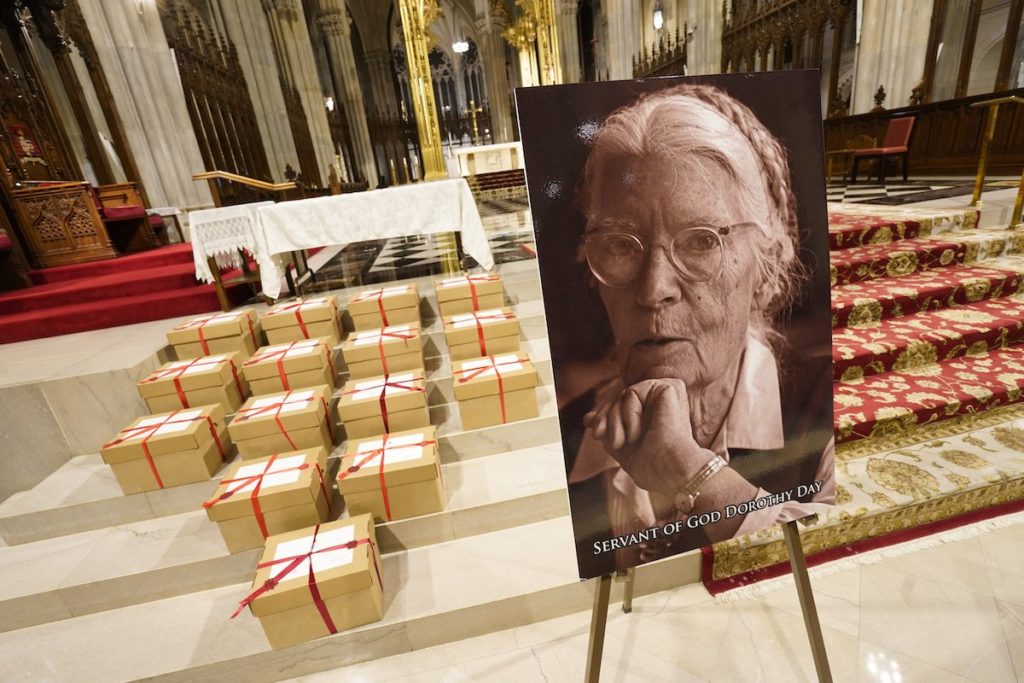
Following official protocol established by the Vatican Congregation for Saints’ Causes, Cardinal Timothy M. Dolan of New York stamped a hot wax seal onto red ribbon binding the final box of documents collected during the 23-year process.

Cardinal Dolan closed the diocesan inquiry with a decree. He and other officials of the inquiry took an oath attesting to its integrity and promised to safeguard the confidential testimony of those they interviewed in the process.

In response, the congregation offered cheers and a standing ovation.

Dorothy Day was born in Brooklyn in 1897. She worked as a journalist for several Socialist newspapers and was an activist deeply interested in the plight of farmers and workers. She was received into the Catholic Church in 1927.

In his homily, Cardinal Dolan said Day was dismayed at the lack of visible Catholic advocacy or witness when she covered a hunger march in Washington in 1932.

On Dec. 8 that year, the feast of the Immaculate Conception, she prayed at the National Shrine of the Immaculate Conception (now a basilica), for God to reveal a providential plan for her as a Catholic to serve the poor and unemployed.

When she returned to New York, she met Peter Maurin, an itinerant French worker and scholar whom Cardinal Dolan described as “one of the most eccentric people you’d ever want to meet.” Maurin was steeped in Catholic social teaching, and he and Day developed a vision of a society constructed on Gospel values.

Day and Maurin founded The Catholic Worker newspaper, “houses of hospitality” for the indigent and ultimately a lay movement dedicated to the daily practice of the works of mercy, the embrace of nonviolence, prayer and life in community and voluntary poverty.

There are now 240 local active Catholic Worker communities. The Catholic Worker newspaper is published seven times a year and is sold for 1 cent an issue.

Day was a daily communicant who practiced social justice, pacifism and charity. She was arrested multiple times for protesting in support of striking workers and against wars. She died in 1980 at a Catholic Worker house in New York City.

George Horton, one of the vice postulators of Day’s cause for sainthood, told Catholic News Service that Cardinal John J. O’Connor of New York asked him in the late 1990s to convene a group of people who knew Day to examine if she should be proposed for sainthood.

“There was unanimous support, but also concerns about the cost and how the church would picture her. Dorothy called people to put into action the Sermon on the Mount, to practice charity and justice. She called people to the deepest sense of the Gospel that was not always on the front burner,” he said.

Horton said Day’s pacifism was seen as a threat by some people and there was concern that an abortion she obtained in the 1920s would be singled out as a defining issue.

“Dorothy was loved by the people who knew her and they did not want her legacy to be diluted,” Horton said.

Cardinal O’Connor initiated the canonization process in 2002 and Day was given the title “Servant of God.” The Dorothy Day Guild was established in 2005 to support the cause and receive information about “graces and favors” received through her intercession. The sainthood process was reinvigorated in 2014.

Cardinal Dolan said Day’s cause got a huge boost when Pope Francis visited the U.S. in 2015 and identified her as an important representative of the American people.

The cardinal said that while “jammed in the back seat of the pope’s little Fiat” after a prayer service at St. Patrick’s, he asked the pope to consider declaring Day “Venerable” at a public Mass the following day. The pope agreed to look into it.

Cardinal Dolan said he was embarrassed at breakfast the next morning when Pope Francis told him he could not make the declaration because the diocesan phase of the inquiry in her cause was not complete.

Horton and Jeffrey Korgen, the cause coordinator, said the road to sainthood is a complex legal process. Horton said the Congregation for Saints’ Causes provides detailed canonical instruction and several books have been written to interpret them.

Korgen said some of the rules are unwritten and Waldery Hilgeman, a canon lawyer in Rome who is the postulator of the Day cause, provided critical assistance. Horton said Hilgeman made annual visits to New York and conducted Zoom meetings to review progress and provide guidance.

The process entails collecting public and private written works and interviewing people who knew the candidate. Theological censors review the documents and weigh in on their consistency with Catholic doctrine, Korgen said.

Sealed archival boxes containing documents related to Dorothy Day’s canonization cause are seen in the sanctuary following a Mass Dec. 8, 2021, marking the conclusion of the Archdiocese of New York’s investigation of Day’s candidacy for sainthood at St. Patrick’s Cathedral in New York City. The documents, which detail Day’s holy and heroic virtues, will be reviewed by the Vatican Congregation for Saints’ Causes. (CNS photo/Gregory A. Shemitz)

Once the documents are received in Rome, they will be studied. Then would come the next step in the canonization process — a declaration of Day’s heroic virtues, after which the church would give her the title “Venerable.” Next would come beatification, after which she would be called “Blessed.” The third step is canonization.

In general, a miracle verified to have occurred through the intercession of the sainthood candidate is needed for beatification and another such miracle is needed for canonization.

Horton said more than 150 people, mostly volunteers, helped collect information and transcribe Day’s voluminous handwritten diaries. He cited members of the Ignatian Volunteer Corps and the Dorothy Day Guild for their tireless efforts.

Korgen said the record includes Day’s entire FBI file detailing multiple investigations into accusations she was a Communist. She was cleared each time, he said, and the reports generally concluded, “some might consider her a pain, but they still vouched for her and that she was well-intentioned.”

Horton said, “Dorothy Day is a saint for our time. She gives us a center when there is so much division in our country. She was an orthodox Catholic who fed the poor and worked for social justice. She gives us a vision of finding common ground and building community.”

He said it was a special gift for him to work with people who knew Day and were “real sources” for demonstrating her belief that Christ can be found in every person.

Cardinal Dolan concelebrated the Mass with Auxiliary Bishop Edmund J. Whalen of New York and 12 priests. Kathleen DeSutter Jordan, a longtime Catholic Worker member and editor, and Martha Hennessy, a granddaughter of Day, proclaimed the readings.

There are 50,702 pages of documents in the 17 original sealed boxes on their way to Rome. They weigh almost 700 pounds. And of course, the shipment also includes a copy of each document, per congregational instructions.


Court examines death-row inmates’ claims of ineffective counsel

Demonstrators in Washington rally against the death penalty outside the U.S. Supreme Court building Oct. 13, 2021. (CNS photo/Jonathan Ernst, Reuters)

By Carol Zimmermann, Catholic News Service

WASHINGTON (CNS) — The Supreme Court’s last case of the year Dec. 9 looked at when death-row inmates can raise claims that they were given ineffective counsel.

The justices examined combined cases of Arizona death-row inmates who want to submit new evidence in federal court hearings about ineffective counsel they say received.

Arizona wants to block submission of new evidence based on interpretation of a federal law.

Although inmates can challenge their sentences under the Constitution, the Antiterrorism and Effective Death Penalty Act of 1996 says they can only use evidence previously produced in state court proceedings.

The justices, who heard the cases of inmates David Ramirez and Barry Jones, have to determine if the Supreme Court’s 2012 decision in Martinez v. Ryan applies to them. This ruling gave an opening for inmates to show evidence found after the state court record proceedings.

The two men were convicted of murder and sentenced to death. Ramirez was convicted on two counts of first-degree murder for the 1989 stabbing deaths of his girlfriend and her 15-year-old daughter. Jones was convicted of murder, sexual assault and child abuse in the 1994 for the death of his girlfriend’s 4-year-old daughter.

In separate rulings last year, the 9th U.S. Circuit Court of Appeals ordered new hearings for both men, citing the Supreme Court’s Martinez decision.

Arizona Solicitor General Brunn Roysden III argued Dec. 9 that the court’s Martinez decision should be reversed based on the federal law.

Robert Loeb, the inmates’ lawyer, said: “There is a right to have trial counsel here, and there was never a fair trial for Mr. Ramirez or for Mr. Jones. And the fact that they give a Hail Mary opportunity for relief at the end of the day, or can give a pardon to Mr. Jones, that does not mean the right to effective trial counsel is being vindicated here.”

Christina Swarns, executive director of the Innocence Project, wrote a Dec. 3 opinion piece in The New York Times about this case, pointing out that since 1989, almost 3,000 people have been wrongfully convicted of crimes in the United States. And since 1973, 186 people condemned to death have been exonerated.

“Bad lawyering — including poor preparation, inadequate investigation and intrinsic bias — was a leading cause. This sobering number, surely an undercount, should compel careful and thorough judicial scrutiny of the cases in which a lawyer clearly failed to properly represent a client, especially where there is substantial evidence of innocence,” she said.

Swarns added that the “path to proving wrongful conviction remains convoluted, invariably involving twists and turns and numerous obstacles. It shouldn’t be that way. But Arizona is urging the Supreme Court to make this already difficult road all but impassable.”

Hours after the oral arguments, Sister Helen Prejean, a Sister of St. Joseph of Medaille, who is a longtime opponent of the death penalty, expressed her views on social media.

In a long Twitter thread, she said: “Ramirez was represented at trial by an appointed lawyer who had never handled a death penalty case. The trial lawyer later admitted that he was not prepared and not qualified. David Ramirez’s trial lawyer failed to present evidence that Ramirez is intellectually disabled and had suffered significant brain damage. The lawyer chalked his failures up to inexperience.”

She also said Jones’ trial lawyer “failed to investigate or present evidence suggesting that he is actually innocent. Helpful medical and forensic evidence was never shown to the jury. Multiple other viable suspects were not investigated.”

Sister Prejean said Arizona’s argument that “neither Ramirez nor Jones should have been allowed to present new evidence after their state appeals ended … is based on the idea that a lawyer’s actions are also the actions of their client. So, if a lawyer fails to raise an argument, then their client also failed to raise that argument,” something that she said “doesn’t make common sense.”

She called it unreasonable for Arizona officials to say that Ramirez, “who has severe mental impairments, is somehow responsible for the inadequacies of his appointed lawyers.” She also said the case is “especially stark” for Jones, who she said has “significant evidence of innocence.”

In her “closing argument” on Twitter, Sister Prejean said that during oral arguments the attorney representing Arizona repeatedly said: “innocence is not enough.”

“All of this goes to show that the death penalty is not reserved for the worst of the worst crimes, but instead for the people who had the worst of the worst lawyers,” she said.

A decision on this case is expected by the end of next June.