
God dreams of a world where all are welcomed as family, pope says

Pope Francis greets people as he leaves an ecumenical prayer with migrants in the Church of the Holy Cross in Nicosia, Cyprus, Dec. 3, 2021. (CNS photo/Paul Haring)

By Cindy Wooden, Catholic News Service

NICOSIA, Cyprus (CNS) — Pope Francis told migrants that, like them, God dreams of a world where everyone recognizes each other as brothers and sisters.

God “asks us not to be content with a divided world, divided Christian communities, but to journey through history drawn by his own dream: the dream of a humanity freed of walls of division, freed of hostility, where there are no longer strangers, but only fellow citizens,” he told migrants during an emotional ecumenical prayer service Dec. 3 in the Church of the Holy Cross in Nicosia.

Thamara da Silva, who came from Sri Lanka, told the pope: “Every day, I have to reduce everything that I may be, or hope to be, or want to become, into a check mark next to a box on a form. I have to use a word or two to explain myself to one of the few who might choose to ask or to acknowledge that I am even here. What do I say? Usually I must choose ‘xenos,’ ‘foreigner.'”

“But what I want to scream is ‘person,’ ‘sister,’ ‘friend,’ ‘believer,’ ‘neighbor,'” she said.

The Holy Cross church compound, which includes the Vatican nunciature and the offices of Caritas Cyprus, is on the U.N.-patrolled green line separating the largely Greek Cypriot southern two-thirds of the island from the predominantly Turkish Cypriot northern third.

Cyprus also has the European Union’s highest per capita number of migrants, refugees and asylum seekers. Many of them travel across the sea from Turkey, landing in the north where there are no border controls, then try to sneak across the green line.

Tensions and frustration have increased because of the combination of increasing migration and suspicion that Turkey is promoting it, along with the economic challenges COVID-19 has posed to an island reliant on tourism.

Reaffirming the Dec. 2 statement of Cypriot President Nicos Anastasiades, the internal affairs ministry said Dec. 3 that Pope Francis had arranged for 50 asylum-seekers to be transferred to Italy.

Included in the group who will be moving, the ministry said, are Enjei Grace and Daniel Ejube, both from Cameroon, whose story has been told in newspapers around the world. Thinking they could enter Europe through northern Cyprus, they have been living in a tent on the green line since May — with neither side willing to take them in.

Later, the Vatican announced Pope Francis would help move a dozen migrants from Cyprus to Italy before Christmas. A spokesman for the Vatican said that did not rule out more following later. News agencies were reporting that the others would follow in January and February.

While he did not mention taking the migrants, Pope Francis told the group in Holy Cross Church that the Cypriot government cannot be blamed for knowing that it cannot welcome, house and provide for all those arriving in the country; others must help.

Elizabeth V. Kassinis, executive manager of Caritas Cyprus, told the pope the Catholic charity is trying to respond to overwhelming needs. “We are working to fill the gaps in the social safety net as best we can.”

“Thanks in large part to our partnership with Catholic Relief Services,” the U.S. bishops’ overseas aid agency, and other donors, “we kept our doors open throughout the pandemic and provided support to more than 10,000 individuals across the island.”

Caritas staff and volunteers have a dream, too, she said. “We dream that more can be done, more people can be reached, more communities transformed, more of us involved in each other’s lives.”

Maccolins Ewoukap Nfongock, originally from Cameroon, told Pope Francis, “I am someone pained by the lack of love that makes me feel less than others, unwanted, a burden; by the subtle hate that robs me of a kind word, a much-needed smile on a cold day; by the barriers of the community in which I find myself.”

Rozh Najeeb, from Iraq, told the pope he has been on a journey, forced to run from “violence, bombs, knives, hunger and pain.”

But he also said he dreams it will be a journey toward “a place of safety and health, a place that affords liberties and choices, a place where I can give and receive love, a place where I can practice my faith and my customs, proudly sharing them with others, a place where I can dare to hope.”

Mariamie Besala Welo, from Congo, described herself as a person “full of dreams,” big dreams. “I dream of a world where no one is forced to fight, to do battle, give up, flee or cry — except maybe for joy,” she said.

But she said she has “small dreams,” too. “I close my eyes and dream of the smell of my grandmother’s cooking, the fields after a good rain that will nurture the seeds, the sea breeze.”

“I dream of smiles,” she said, instead of people being suspicious of her or surprised that she can speak Greek.

Making it clear that he had received the text of their speeches weeks ago, Pope Francis said they reflected “the beauty of the truth” and the powerful way God reveals “his kingdom of love, justice and peace” to those without clout in the world.

“In the faces of our marginalized and discarded brothers and sisters,” including migrants seeking a new home, Christians must see the face of Christ, he said.

The stories of the migrants in Cyprus, the pope said, make him think of the thousands of others in many parts of the world who feel forced to flee their homes, sell all they have and yet cannot be sure they won’t drown at sea or die in a desert.

Apologizing for speaking so long, Pope Francis told the group, “It is my responsibility to help open people’s eyes.”

Especially in a country “marked by a painful division,” Pope Francis said, people longing for unity must begin by accepting others as kin, recognizing the human dignity of each person.

That, he said, is God’s dream. “We’re the ones that don’t want it.”


Catholics show they are ‘doers of the Word’ with generosity to collections

Bishop James S. Wall of Gallup, N.M., is pictured outside his residence in 2011. He is the chairman of the U.S. Conference of Catholic Bishops' Committee on National Collections. (CNS photo/Bob Roller)

By Bishop James S. Wall of Gallup, New Mexico, chairman of the U.S. Conference of Catholic Bishops’ Committee on National Collections

In this season of Advent as we prepare for the birth of our Lord and the celebration of the greatest gift of all, I am immensely grateful to the Catholics who have expressed their love for Jesus by giving generously to help the poor and marginalized through the national collections of the U.S. Conference of Catholic Bishops.

Many of you have given despite your own struggles during the COVID-19 pandemic. Be assured that our Lord sees your generosity and is using your gifts to create change in communities and in the lives of people who once felt hopeless. The eight collections administered by the U.S. bishops support the church’s works of evangelization, catechesis, social justice and community development at the local, national and global levels.

We were blessed by your prayers for and donations to the Catholic Campaign for Human Development, the Catholic Home Missions Appeal, the Catholic Relief Services Collection, the Catholic Communication Campaign, the Collection for the Church in Central and Eastern Europe, the Collection for the Church in Latin America, the Solidarity Fund for the Church in Africa and the Bishops’ Emergency Disaster Fund.

The faithful who gave sacrificially to these national collections when they were themselves in need have shown our world the loving face of Jesus. Your gifts are transforming the lives of struggling communities and hurting people through practical assistance to the poor and by helping to spread the Gospel of Jesus in places where the church is new, small or challenged.

I have seen the fruits of your gifts in my own Diocese of Gallup, which is materially the poorest diocese in the United States. Created primarily to serve Native and Indigenous communities, it has 52 parishes and 22 missions across two states in a territory the size of the state of Illinois. Many parishioners live in areas so remote they cannot bring their children to religious education each week.

Thanks to your gifts to the Catholic Home Missions Appeal, a priest in one of our most isolated parishes has brought religious sisters in to run a three-week faith formation camp. It is bringing young people and their parents to the Lord — and back to Mass. Your gifts are making an eternal difference in their lives.

That is why I am glad to serve as chairman of the U.S. bishops’ Committee for National Collections. I see what your gifts do as refugees arriving in the United States are warmly welcomed into communities across the country because you supported the Catholic Relief Services Collection.

Through the Catholic Communication Campaign, CAPP-USA (U.S. affiliate of the Centesimus Annus Pro Pontifice Foundation) produced videos and infographics explaining the core concepts of Catholic social teaching and how they apply to current social issues.

In Tennessee, Statewide Organizing for Community eMpowerment (SOCM) works to keep poisons out of streams and wells and help mining communities transition to sustainable energy, with your support to the Catholic Campaign for Human Development.

Your generosity extends to those suffering from natural and man-made disasters through the Bishop Emergency Disaster Fund.

But the impact of your generosity extends beyond the borders of our own country: In Cameroon, refugee families traumatized by civil war will sleep a little better tonight because your gifts to the Solidarity Fund for the Church in Africa have integrated therapy for post-traumatic stress disorder into a program of pastoral care.

And thanks to your contributions, homeless people in Croatia are receiving the spiritual support and counseling they need to turn their lives around with the help of the Collection for the Church in Central and Eastern Europe. In Brazil, lay leaders receive nine months of spiritual formation for evangelization and learn how to share the Gospel and lovingly address difficult issues, because of your gifts to the Collection for the Church in Latin America. It’s all thanks to you.

Most of you give at Mass or through your parish’s e-offertory program. And the online giving platform #iGiveCatholicTogether now provides options to give to these programs, so it’s now possible to make an extra gift or make up for missing the parish collection.

Through whichever way you give, you are fulfilling the scriptural exhortation to be “doers of the Word,” whose actions help to build the kingdom of God. More information on the USCCB national collections is at usccb.org/committees/national-collections. To learn more about #iGiveCatholicTogether, visit igivecatholictogether.org.

Thank you again for your generosity. As we joyfully anticipate the birth of our Lord at Christmas, may this Advent season be a time of prayer in gratitude for the many blessings we have received through God’s grace and mercy.

Being a child of God must not be taken for granted, papal preacher says

Cardinal Raniero Cantalamessa, preacher of the papal household, presents Advent meditations for Pope Francis, officials of the Roman Curia and Vatican employees in the Paul VI hall at the Vatican Dec. 18, 2020. (CNS photo/Vatican Media)

By Carol Glatz, Catholic News Service

VATICAN CITY (CNS) — Baptism is a gift from God that is waiting to be opened to be fully and joyfully experienced by each Christian, said the preacher of the papal household.

What awaits each person is the astonishment of faith, “that eyes-wide-open and that ‘Oh!’ what splendor in opening the gift,” and coming to a full understanding that each person is a child of God and, therefore, all are brothers and sisters to each other, said Cardinal Raniero Cantalamessa Dec. 3.

The cardinal offered his first Advent reflection to officials of the Roman Curia in the Vatican’s Paul VI hall, while Pope Francis was visiting Cyprus. The meditation looked at St. Paul’s teaching in his letter to the Galatians on God sending his son so that people may become “God’s free children in Christ.”

Cardinal Cantalamessa said a “mortal danger” for Christians is when they do not fully open their eyes to the reality and wonder of being a child of God or when they take it for granted.

Jesus teaches that God is the father of every human being — sinners and the just — and that he loves and cares for each one individually, he said.

“It will be thanks to this one Son that humanity can become children of God, too, in a real sense and not just metaphorically,” he said.

The grace of baptism confers many gifts: “divine filiation, remission of sins, the dwelling of the Holy Spirit (and) the theological virtues of faith, hope and charity embryonically infused in the soul,” he said.

Through baptism, one is truly born from God, receiving “his Spirit that is, if you will, his DNA” so that “the life of God himself flows” within a person, he said.

But, it is one thing to know the truth of one’s faith and another to actually believe and experience it, he said. People must go “from faith to wonderment. I would dare say, from faith to incredulity! A very special incredulity” in which a person of faith believes, but realizes it is so boundless, enormous and incredible.

Baptism, he said, “is like a jam-packed gift-parcel kept sealed … like some Christmas gifts that were forgotten somewhere” and have not been opened yet.

A baptized person possesses all the titles or privileges for living a Christian life and receiving its fruits, “but does not possess the fullness of the reality,” he said, citing St. Augustine’s explanation of the difference between the sacrament itself and the effect or grace of the sacrament.

“So what is missing then? We are missing faith-astonishment, that eyes-wide-open” wonder in opening that gift — an “illumination” that is baptism, he said.

No one can tell God he must choose a favorite among his children or insist he belongs on someone’s side, he said. “You cannot dictate to a father this cruel alternative to choose between two children just because they are fighting with each other.”

Cardinal Cantalamessa said, “When we are at odds with someone, before even asserting and arguing our point of view — which is also legitimate and sometimes due — we will say to God, ‘Father, save my brother, save both of us. I don’t want that I am right and he is wrong; I want that he is in the truth, too, or at least in good faith.'”

Being merciful like this toward others is indispensable for living life according to the Holy Spirit and for living with others, especially for families, communities and even the Roman Curia, he said.


Faith leaders urge changes in bill’s provisions for funding child care

U.S. Speaker of the House Nancy Pelosi, D-Calif., presides over the House floor on Capitol Hill in Washington Nov. 19, 2021, as the Build Back Better Act passes and moves on to the Senate. (CNS photo/Al Drago, Reuters)

WASHINGTON (CNS) — The Build Back Better Act’s plan to expand affordable child care and ensure that quality prekindergarten is available to all families “is a worthy goal,” but as written these provisions “will suppress, if not exclude” many faith-based providers from participating, according to Catholic and other religious leaders.

“We are writing to express our urgent concerns regarding the child care and universal prekindergarten provisions in the House-passed Build Back Better Act,” said a Dec. 1 letter the faith leaders sent to U.S. Sens. Patty Murray, D-Wash., and Richard Burr, R-N.C., the chairwoman and ranking member of the U.S. Senate Committee on Health, Education, Labor and Pensions.

The signers represent religious denominations, schools and charities “that comprise and serve millions of Americans,” the letter said.

Among the signers were the U.S. Conference of Catholic Bishops’ Committee for Religious Liberty, chaired by Cardinal Timothy M. Dolan of New York, and the USCCB’s Committee on Catholic Education, chaired by Bishop Thomas A. Daly of Spokane, Washington.

Catholic Charities USA and the National Catholic Educational Association also signed the letter, along with Jewish, Muslim and other Christian associations.

The Build Back Better Act “does not preclude parents from selecting faith-based providers,” the letter said, but its current provisions “make it virtually impossible for many faith based providers to participate in the program.”

The bill does so, it continued, by departing from current federal child care policy and attaching “new compliance obligations that would interfere with providers’ protected rights under Title VII and Title IX regarding curricula or teaching, sex-specific programs — such as separate boys or girls schools or classes — and preferences for employing individuals who share the providers’ religious beliefs.”

The Build Back Better bill changes how providers receive public monies by defining “all providers as recipients of federal financial assistance, whether the funds come via certificates, in the child care program, — or direct grants, in the prekindergarten program,” the letter explained.

“Making faith-based providers of child care and prekindergarten into recipients of federal financial assistance triggers federal compliance obligations and nondiscrimination provisions,” it said.

Currently, these child care providers are exempt from some nondiscrimination provisions.

Low-income families have traditionally received funds from the Child Care and Development Block Grant program that they may use at a variety of child care centers, including those run by churches and other religious organizations. These various programs are not considered direct recipients of federal funds.

The block grant program receives federal funding but is administered by the states to provide child care subsidies to families who qualify for them.

“The faith community has always affirmed that parents should choose the best environment for care and education of their children,” the faith leaders’ letter said.

“The current Build Back Better Act provisions would severely limit the options for parents, suffocate the mixed delivery system for child care and pre-kindergarten, and greatly restrict the number of providers available for a successful national program,” it said.

The U.S. House of Representatives narrowly passed the Build Back Better Act Nov. 19, and it is now under consideration in the Senate.

The faith leaders asked Murray and Burr to give “urgent attention to address” their concerns about the measure “to ensure that faith-based providers are able to participate” in the bill’s child care and universal prekindergarten programs.

Read the full text of the letter.


Study: Young adult Catholics actively engage in faith — just not in parish

Campers participating in a service project help clean up a walking trail at Immaculate Conception Seminary in Huntington, N.Y., July 11, 2017, while attending the Quo Vadis Camp at the seminary. (CNS photo/Gregory A. Shemitz, Long Island Catholic)

By Mark Pattison, Catholic News Service

WASHINGTON (CNS) — A new study suggests that young adult Catholics ages 18-35 engage in practices to bolster their faith, but tend to do so outside their parish.

Those activities often take the form of small Christian communities, according to the study, issued in November by the Center for Applied Research in the Apostolate based at Georgetown University in Washington.

“Most of the people who are involved in faith groups are not involved in a known national organization” such as Cursillo, the Knights of Columbus and similar outfits, said Mark Gray, one of three co-authors of the study, “Faith and Spiritual Life of Catholics in the United States.”

Rather, he added, “it’s a collection of friends, it might be in a neighborhood community, it might be on a dorm floor.”

“The biggest surprise is how boldly young adult Catholics are participating in their faith life outside the parish,” Gray said. “Most research and commentary outside of data collection is that young adults are so inactive. In one way, that’s right. They’re disconnected from their parish … but they’re finding ways to practice it (their faith) in groups.”

When planning for the study started in 2019, “we didn’t know there was going to be a pandemic,” Gray said, but CARA managed to “tweak it a bit.”

The coronavirus pandemic, though, may have done little to deter young adults from their established spiritual routine.

“It was much easier for Catholics to carry on these practices — their faith outside the parish,” Gray told Catholic News Service in a Dec. 1 phone interview. “It was something they were doing before, and we assume they’ll continue to do it in the future.”

“Overall, 60% of Catholic young adults, ages 18 to 35, in the United States indicated that they participate in a faith-related group outside of attending Mass at their parish,” the 181-page study said.

“Prior to the pandemic, 55% of those participating in a Catholic community or group were active in it at least once a month. About one in 10 were active more than once a week,” it said, adding that among this cohort, 65% engaged in prayer during their meetings, the only activity that registered a majority of responses.

Other activities, in descending order of frequency, were socializing (36%), reading and discussing Scripture (30%), faith sharing (29%), group silence (23%), discussing spirituality (19%), raising money or collecting donations (18%), recreational group activities (15%), directly serving others (15%) or the Eucharist (14%).

CARA undertook the study on its own initiative; Gray said no Catholic organization commissioned it.

“No one was coming to us,” he added. “There had been one previous study in the 1990s,” and that did not resemble the scope of the new report. “Our study was focused more on behavior — ‘what do you do’ — than based on ‘how do you feel,'” he said.

The study found there are more young adults who participate in a faith group outside of the parish regularly than go to Mass at their parish church regularly. When asked why, top reasons they cited, according to Gray, were: “Older generations have too much influence in the parish. They also express discontent as to the roles of women available in the church. Those are things they’re not comfortable with.”

Other reasons cited by about a third of respondents, if not more, included the clerical sexual abuse scandal, the church’s teachings on homosexuality and on birth control, “a feeling that the church is not open to dialogue with other religious faiths,” and church teachings on divorce and remarriage.

Prior to the pandemic, 13% of Catholic young adults attended Mass at least once a week, the study said, while 21% attend Mass less than weekly but at least once a month, 31% attended Mass a few times a year, and 36% say they rarely or never attend Mass.

In addition 73% of respondents agree “somewhat” or “strongly” that they can be a good Catholic without going to Mass every Sunday, while 55% said they do not consider it a sin to miss Mass on Sunday. The latter figure came in second to “busy schedule” as the top reason for not going to weekly Mass.

“Interviewees feel strongly that the successful engagement of young people in SCCs (small Christian communities) requires that the church listens to these young people, supports them and gives them agency. The church needs to listen to young people, both on the institutional level and human level,” the study reported.

“The church needs to meet them where they are — rather than waiting for them in the parish — reach out to them — rather than wait for them to make the contact — give them space to talk about things important to them, accompany them in their suffering and struggles, make them feel accepted, affirm them (and) encourage them.”

CARA conducted a national survey of 2,214 Catholics ages 18-35 July-August 2020. The margin of error for survey results is plus or minus 3.59%.

Of the respondents, 44% were white non-Hispanic, 43% were Hispanic, 6% were Asian, 4% were Black or African American, and 3% were some other race or ethnicity. Fifty-three percent were female and 47% were male.

On average, CARA found, “a typical group meeting is attended by 19 to 22 people. Significantly, Hispanic groups meetings are attended by nine to 11 people more, on average, than other groups’ meetings.”

CARA also conducted interviews with respondents who agreed to be interviewed after being surveyed, and included some comments from the interviews in the study.

“Hispanics have a different way of proceeding with the matters of the church than Americans,” one interviewee said. “For example, American(s) have too many rules, too many formalities, no spontaneity, everything is controlled.”

Interviewees commented on the tenuous nature of small Christian communities within a parish. “Pastors get moved in and out every eight or 12 years. If your pastor was supportive of it and you got a new guy that came in that’s not, they’re gone then. So, like, everything rests unfortunately with whether or not a pastor that is put into your parish supports these movements,” one interviewee said. Another remarked, “There’s no system for continuity.” A third said the bishop also needs to be supportive.

“The church has not invested nearly as much money in the accompaniment of young adults as it has with teenagers,” one interviewee said.

In another interview, someone talked about why a small Christian community may not work.

“I asked a Catholic sister who coordinated the small Christian communities in New Jersey. And I asked her what’s the biggest obstacle when you’re forming these small Christian communities in (these) middle-class parishes? And her answer was shocking to me. Fear. Fear,” the interviewee said.

“She said, ‘People don’t want to be vulnerable to their neighbors, to share their weaknesses.’ I mean, weaknesses may be divorce, alcoholism, a child on drug abuse,” the interviewee continued. “They don’t like to do that and they feel that if they’re pressured into these small Christian communities, people are sharing what we call their vulnerability and their weaknesses. She said that’s, for many middle-class whites, (why) they want to avoid that.”

Read the full study.


Meeting Cypriot leaders, pope urges dialogue for peace, care for migrants

Pope Francis greets clergy as he arrives for a welcoming ceremony with Cypriot President Nicos Anastasiades at the presidential palace in Nicosia, Cyprus, Dec. 2, 2021. (CNS photo/Amir Cohen, Reuters)

By Cindy Wooden, Catholic News Service

NICOSIA, Cyprus (CNS) — Sympathizing with the Cypriot government and citizens feeling overwhelmed by an influx of migrants and refugees, Pope Francis urged them to remember their history as a crossroads and meeting place of people of different cultures and traditions.

After a private meeting with Cypriot President Nicos Anastasiades Dec. 2, the pope told government officials and civic leaders that he saw his trip as a visit to “an island that, down through the centuries, has not isolated peoples but brought them together; to a land whose borders are the sea.”

“You are an open door, a harbor that unites,” he said.

Since late 2018, Cyprus has received more asylum-seekers per capita than any country in the European Union, in addition to hundreds of foreign workers. Especially with economic difficulties and a drop in tourism because of the COVID-19 pandemic, many people on the island are struggling.

Arriving at the presidential palace, Pope Francis paid homage to the late Archbishop Makarios III, the head of the Orthodox Church of Cyprus, who became the nation’s first president in 1960 and is still honored as the “father of the nation.”

“Makarios” in Greek means “blessed,” and the pope invoked the archbishop’s name to speak about the Eight Beatitudes as “the compass that, in every latitude, indicates the routes that Christians must take in the voyage of life.”

“Everyone can be ‘blessed,’ and blessed are above all the poor in spirit, those who have experienced suffering in their lives, those who live in meekness and mercy, all those who, without pretense, practice justice and are peacemakers,” the pope said.

When people live the beatitudes, he said, “the Gospel becomes youthful and fills society with fresh hope.”

But he acknowledged that it is not easy — either with the newer wave of migration or the decades-old problems of a literally divided island. Turkey is the only country in the world that recognizes the northern third of the island as the Republic of Northern Cyprus. Since 1974, U.N. peacekeepers have patrolled a buffer zone between the two parts of the island as U.N.-brokered negotiations continue to falter.

Pope Francis called Cyprus “a pearl of great price in the heart of the Mediterranean,” but also noted that pearls form only after a grain of sand or other irritant enters an oyster, and that the process takes time.

Anastasiades told the pope that the new migrants to Cyprus are not the only people who have been uprooted from their homes; thousands of Cypriots, especially Christians, whose roots are in the north, have been unable to return to their homes, he said.

And, while not explicitly blaming Turkey, as some people, do for allowing migrants to enter the European Union by crossing the sea to Cyprus, the president spoke of “large flows of illegal immigrants through the occupied territories” and acknowledged “we have encountered countless difficulties in their management.”

“It is for this reason that we would like to express our gratitude as a state for your initiative to transfer 50 immigrants from Cyprus to Italy,” Anastasiades said.

Matteo Bruni, director of the Vatican press office, declined Nov. 30 to comment on reports that the pope was making such arrangements, and Bruni was not available during the pope’s meeting with the president. News reports, however, said the immigrants would arrive in Italy in the weeks following the pope’s visit.

More than helping Cyprus, Anastasiades said, the pope’s “symbolic initiative” sends a message to the member countries of the European Union that they must do more to help the countries on the front line of immigration and to help those seeking safety and a better life for themselves and their families in Europe.

Speaking after the president, Pope Francis told the Cypriot leaders that he prays for peace on the island and a healing of its division.

The only way forward is dialogue, he said. “We know that it is no easy road; it is long and winding, but there is no other way to achieve reconciliation.”


Pope, arriving in Cyprus, tells Catholics to celebrate, welcome diversity

Pope Francis leads a meeting with priests, religious, deacons, catechists and members of church groups and movements at the Maronite Cathedral of Our Lady of Grace in Nicosia, Cyprus, Dec. 2, 2021. At left is Cardinal Bechara Rai, Maronite patriarch. (CNS photo/Vatican Media)

By Cindy Wooden, Catholic News Service

NICOSIA, Cyprus (CNS) — The Catholic Church is a mosaic of different rites and cultures and must show the world the beauty of welcoming all people as brothers and sisters, Pope Francis told the Catholics of Cyprus.

Beginning his Dec. 2-4 visit to the island with a meeting with bishops, priests and religious rather than with government officials, the pope highlighted the religious value of welcoming and diversity in a nation struggling with migration.

Located on the eastern edge of the Mediterranean and just south of Turkey, Cyrus has a large Orthodox majority, but also centuries-old communities of Maronite and Latin-rite Catholics, whose numbers have grown because of foreign workers, especially from the Philippines, Vietnam, Sri Lanka and India.

On the flight from Rome to Larnaca, a city on the sea about 30 miles from Nicosia, Pope Francis told reporters, “It will be a beautiful trip, but we will touch some wounds.”

One of those wounds — the fact that for more than 40 years the island has been divided between the mostly Greek Cypriot south and the mostly Turkish Cypriot north — explained why the pope landed in Larnaca. The Nicosia airport is now mainly the headquarters of the U.N. peacekeeping force that patrols the “green line” between the north and south.

The other wound — migration — was the center of the pope’s attention even before he left his residence Dec. 2. He met with 12 refugees from Syria, Congo, Somalia and Afghanistan now living in Italy. Some of them, the Vatican said, came to Rome from the Greek island of Lesbos with the pope in 2016. The pope is scheduled to make his second visit to Lesbos Dec. 5.

And, before arriving at Rome’s Fiumicino airport, he stopped at the nearby parish of St. Mary of the Angels and greeted the 15 refugees the parish is supporting.

On the plane, a French reporter gave the pope a gift from a Catholic parish in Calais, France: a kite made from the tattered tents of asylum-seekers stuck in Calais but hoping to get to England. It included the name, Aleksandra Hazhar, of a baby girl born prematurely on the Calais beach in 2020; she died a few days later.

Meeting with the bishops, priests, religious and seminarians in the Maronite Cathedral, which is located on the “green line” and has the blue-bereted peacekeepers patrolling out front, Pope Francis described Cyprus as “a land of golden fields, an island caressed by the waves of the sea, but above all else a history of intertwined peoples, a mosaic of encounters.”

“The church, as catholic, universal, is an open space in which all are welcomed and gathered together by God’s mercy and invitation to love,” the pope said. “Walls do not and should not exist in the Catholic Church. For the church is a common home, a place of relationships and of coexistence in diversity.”

“Who is the source of unity in the church?” the pope asked. “The Holy Spirit. And who is the source of diversity in the church? The Holy Spirit.”

And, encouraging the bishops and priests to be patient with their people and sensitive to their cultural differences, Pope Francis said “proselytism within the church” can be just as harmful as proselytism outside. Guiding and correcting people is one thing, he said, but must be done gently and with great mercy.

“We need a patient church,” he said, “a church that does not allow itself to be upset and troubled by change, but calmly welcomes newness and discerns situations in the light of the Gospel.”

“The work you are carrying out on this island, as you welcome new brothers and sisters arriving from other shores of the world, is precious,” he said. Like the apostle Barnabas, described in the Acts of the Apostles as a Cypriot, “you, too, are called to foster a patient and attentive outlook, to be visible and credible signs of the patience of God, who never leaves anyone outside the home, bereft of his loving embrace.”

“The church of Cyprus has these same open arms: It welcomes, integrates and accompanies,” the pope said, after listening to St. Joseph Sister Perpetua Nyein Nyein Loo speak on behalf of the four women’s congregations that work on the island.

In addition to running schools, she said, “much of our work consists in defending the basic human rights of those in need and of migrant workers, who frequently must bear the burden of disproportionate debts as well as harsh and unfair treatment, including unpaid wages, excessively long working hours, verbal and physical abuse and other forms of discrimination.”

Pope Francis also encouraged the Catholics to show “respect and kindness” for the nation’s other Christian communities.

Cardinal Bechara Rai, the Lebanon-based patriarch of the Maronite Catholic Church, welcomed the pope to the cathedral and told him that the main Christian communities on the island — Cypriot Orthodox, Maronite and Latin-rite Catholic and Armenian Orthodox — have “optimal relations.”

But Pope Francis said that same kind of patience and acceptance is needed within the church as well.

“We are brothers and sisters loved by a single Father,” he told them.

Arguing is normal, the pope said, adding as an aside that he and his four siblings argued almost every day when he was growing up, but they still came together as a family around the dinner table.

“This is what fraternity in the church means: We can argue about visions, sensibilities and differing ideas,” he said. “Yet let us always remember: We argue not for the sake of fighting or imposing our own ideas, but in order to express and live the vitality of the Spirit, who is love and communion.”


Second chances: Vatican Christmas stamps feature work of homeless artist

Adam Piekarski stands in front of his paintings in his studio at Palazzo Migliori, the Vatican's homeless shelter, Dec. 1, 2021. Piekarski, a homeless man from Poland currently living in Rome, was commissioned to paint images for the Vatican's 2021 Christmas stamps. (CNS photo/Junno Arocho Esteves)
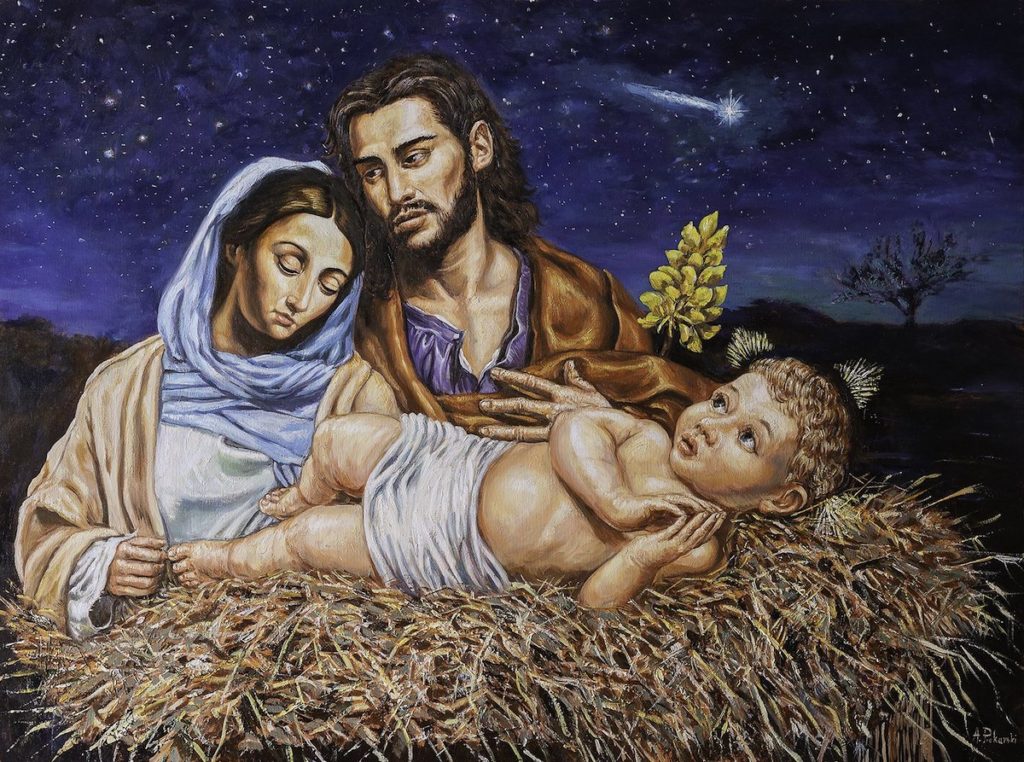
An image of the Holy Family is featured on one of the Vatican’s 2021 Christmas stamps. The images on the stamps were painted by Adam Piekarski, a homeless man from Poland currently living in Rome. (CNS illustration/courtesy Vatican Philatelic and Numismatic Office)

By Junno Arocho Esteves, Catholic News Service

VATICAN CITY (CNS) — Adam Piekarski, a homeless man from Lódz, Poland, never imagined that the sketches he would draw in his free time while waiting for the public showers near Bernini’s Colonnade would lead to the opportunity of a lifetime.

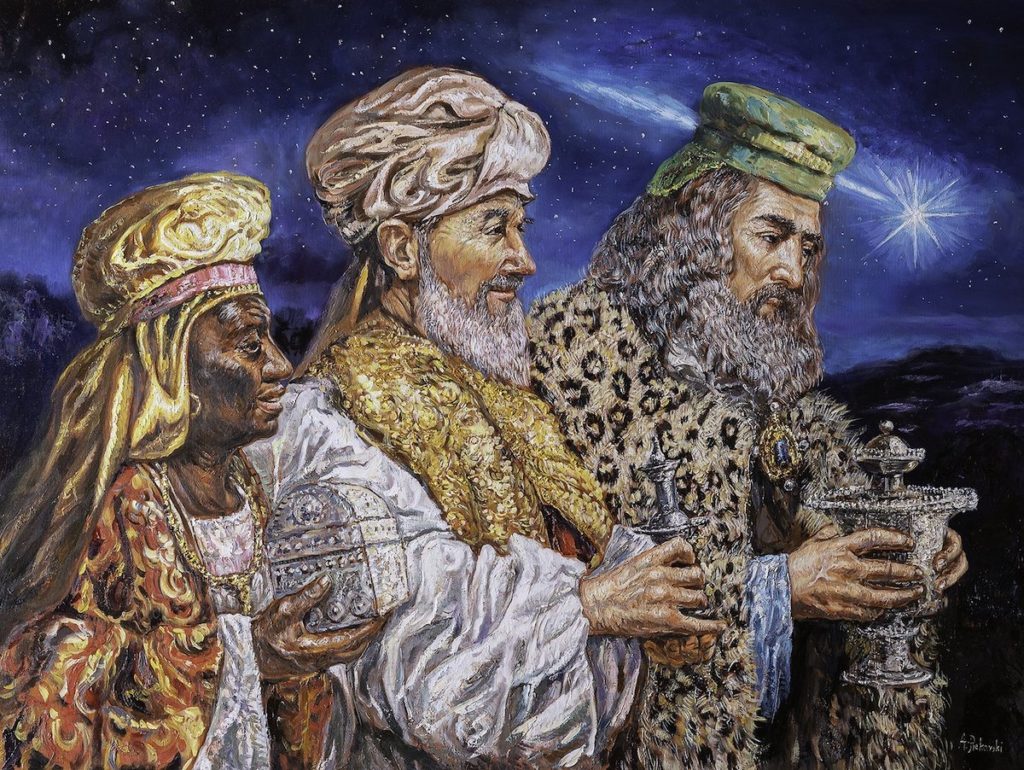
In November, the Vatican Philatelic and Numismatic Office announced that its 2021 set of commemorative Christmas stamps would feature images of the Magi and the Holy Family painted by Piekarski.

“Art is my passion even though I never studied it,” Piekarski told Catholic News Service Dec. 1 from a quaint studio just across the street from St. Peter’s Square.

“He went to a technical school in Poland and studied gardening in Lódz,” added Redemptorist Father Leszek Pys, known by many as Father Ruben, a fellow Pole who was among the first to realize Piekarski’s talent.

Piekarski left Poland six years ago and, like many migrants, made his way to Rome seeking a better life.

The Eternal City, he explained, is a place that remains in the heart of many Polish people as a source of inspiration for some of Poland’s greatest artistic icons, such as Henryk Sienkiewicz, author of “Quo Vadis,” and Henryk Siemiradzki, whose paintings often depicted life in ancient Rome.

However, upon his arrival, the harsh reality of finding work, coupled with a fondness for Italian wine, led Piekarski down the dark path of alcoholism that he continues to fight each day.

With Father Ruben serving as translator, Piekarski told CNS that his life began to change after meeting the Polish priest while waiting in line for the public showers for the poor at the Vatican.

Father Ruben told CNS that, at the time, he was trying to figure out a low-cost option for a painting of St. Clement Mary Hofbauer, co-founder of the Redemptorist congregation, to commemorate the 200th anniversary of his death.

Explaining his dilemma to Pallottine Sister Anna, a nun who volunteers helping the poor at the public showers, he was introduced to Piekarski, who would often spend his time sketching while waiting for his turn at the showers.

Father Ruben then provided Piekarski with paints, brushes and found a workspace in the crypt of the Church of Santa Maria in Monterone, where the burgeoning artist honed his artistic abilities.

His work drew the attention of Cardinal Konrad Krajewski, papal almoner, who then introduced Piekarski to Father Francesco Mazzitelli, then-deputy director of the Vatican Philatelic and Numismatic Office.

Father Ruben told CNS that when asked by Father Mazzitelli to design the 2021 Christmas stamps, Piekarski’s answer was an emphatic “no.” However, the Italian priest’s persistence finally moved the Polish artist to finally do it.

For the painting of the three Magi, Piekarski based their likeness on two friends who are also homeless; the third, he explained, was an original image meant to represent all homeless men and women.

An image of the Magi is featured on one of the Vatican’s 2021 Christmas stamps. The images on the stamps were painted by Adam Piekarski, a homeless man from Poland currently living in Rome. (CNS illustration/courtesy Vatican Philatelic and Numismatic Office)

Father Mazzitelli, who was appointed Nov. 27 as an official in the Office of the Papal Almoner, told CNS that Piekarski’s story was an example of Pope Francis’ call to “nurture tomorrow’s hope by healing today’s pain.”

“What has happened to Adam is a sign for everyone, because each one of us knows someone who has hidden gifts and talents,” Father Mazzitelli said. “The pope saying that we must nurture hope means he has given us a mission — to the church and to each one of us — that we must build up hope in others.”

Father Ruben noted that installing showers for the homeless at the Vatican was more than just an act of charity for the poor during the 2015 Jubilee Year of Mercy, but a fundamental gesture that gave homeless men and women dignity.

“You can’t give back someone’s dignity by giving them a sandwich or a euro nor even by asking them their name. That is more of a philanthropic gesture that makes us feel good about ourselves,” the Polish priest said.

“But for that person, that sandwich, that euro doesn’t change anything,” he added. “But allowing them to clean themselves means giving them back their dignity.”

Piekarski credits the public showers for not only being the starting point of his journey as an artist, but the place where he decided to confront his battle against alcoholism.

“For someone who is suffering from alcoholism or who is slightly drunk,” Father Ruben recalled Piekarski telling him, “it is embarrassing to show up to clean themselves. But going there is the first step in getting out of alcoholism because, once they are at the showers, they want to change their lives.”

While he continues to paint from a small studio at Palazzo Migliori, the Vatican’s homeless shelter, Piekarski now works as an evening security guard at a property owned by the Knights of Malta, who became acquainted with him after he completed a portrait of the late Fra’ Giacomo dalla Torre, the grand knight of the order who died in 2020.

“Life is a mystery and God wanted it this way,” Piekarski told CNS. “What has happened is a dream and I still can’t believe it. God has a great sense of humor.”


Pro-lifers hopeful about outcome of Dobbs case, urge prayers for court

A group from Liberty University in Lynchburg, Va,. is seen near the U.S. Capitol in Washington Dec. 1, 2021, the day Supreme Court justices heard oral arguments in a case about a Mississippi law that bans abortions after 15 weeks of gestation. (CNS photo/Tyler Orsburn)

By Julie Asher, Catholic News Service

WASHINGTON (CNS) — The chairman of the U.S. bishops’ pro-life committee Dec. 1 urged Catholics, people of other faiths and all people of goodwill to unite in prayer that the U.S. Supreme Court will overturn Roe v. Wade in its eventual ruling on Mississippi’s ban on most abortions after 15 weeks of pregnancy.

His statement was issued the same day the court heard oral arguments in Dobbs v. Jackson Women’s Health Organization, an appeal from Mississippi. Its ban was struck down by a federal District Court in Mississippi in 2018 and upheld a year later by the New Orleans-based U.S. Court of Appeals for the 5th Circuit.

The Mississippi law is being challenged by the state’s only abortion facility, the Jackson Women’s Health Organization. It’s the first major abortion case the court has heard in decades.

“In the United States, abortion takes the lives of over 600,000 babies every year,” said Baltimore Archbishop William E. Lori, chairman of the U.S. Conference of Catholic Bishops’ Committee on Pro-Life Activities. “Dobbs v. Jackson Women’s Health could change that.”

“We pray that the court will do the right thing and allow states to once again limit or prohibit abortion, and in doing so protect millions of unborn children and their mothers from this painful, life-destroying act,” he added. “We invite all people of goodwill to uphold the dignity of human life by joining us in prayer and fasting for this important case.”

If the court’s ruling, expected in July, upholds the ban, it possibly also could overturn Roe and send the abortion issue back to the states to decide laws on it.

Archbishop Lori directed people to prayfordobbs.com for Catholic and ecumenical prayers and resources for community engagement and action “as we await the court’s decision in this case.”

Pro-life advocates and supporters of keeping abortion legal gathered outside the Supreme Court rallying for their respective positions on the issue as the justices heard oral arguments in the case inside the court.

Beyond the court building’s steps, statements about the Mississippi law and predictions about the outcome of the case came from all quarters.

U.S. Sen. Jeanne Shaheen, D-N.H., predicted there would be “a revolution” if Roe v. Wade is overturned.

Shaheen, who is on record as a supporter of widespread access to abortion, said that young people in particular would find it unacceptable if the court strikes down the legal precedent set by Roe in 1973 legalizing abortion nationwide.

U.S. Rep. Rosa DeLauro, D-Conn., called on the Senate to Pass the Women’s Health Protection Act. The measure, passed by the House Sept. 24, codifies Roe and establishes the legal right to abortion on demand at any stage of pregnancy in all 50 states under federal law.

“The Mississippi case brought before the Supreme Court is a product of Republican attacks on reproductive rights spanning decades,” said DeLauro, a Catholic. If Roe is overturned, the court will be “depriving individuals across the country of their right to choose to have an abortion,” she said.

Many pro-lifers hoping Roe will be overturned emphasized how many scientific advances have been made in the nearly 50 years since that decision was handed down, advances they argued that have led to unprecedented information on the developmental stages of the unborn child from conception to birth.

Father Frank Pavone, national director of Priests for Life, pointed to what he called the “utterly weak and time-worn arguments” that he said were made by Justices Stephen Breyer, Elena Kagan and Sonya Sotomayor, considered the liberal members of the court.

Among their comments was Sotomayor’s claim that only “fringe” doctors believe in the existence of fetal pain as a reason to restrict abortion.

“They do not acknowledge that the changes in science are real, or that the confusion thrust upon judges and legislators by the court’s approach to abortion is also real,” Father Pavone said in a statement.

“These and other objective reasons have led us to the day when Mississippi, and other states, believe it is time to enact stronger protections for the unborn, and for unelected judges to stop imposing policies that the legislatures should be responsible for instead,” he said.

At the rally outside the court, Grazie Pozo Christie, a radiologist and a senior fellow with The Catholic Association, similarly commented that “incredible advances in science and fetal medicine have rendered viability a totally incoherent legal standard.”

“Science and common sense tell us children in the womb are as undeniably human as the rest of us,” remarked Brian Burch, president of CatholicVote, an independent political advocacy group. “We know for instance that by 15 weeks they already have beating hearts, can suck their thumbs, and even feel pain.”

“It is time to overturn Roe and allow Americans to once again pass laws that reflect these basic values,” he said in a statement.

He added that “millions of faithful Catholics across the nation are hopeful after today’s oral arguments that the Supreme Court of the United States will restore sanity to its abortion jurisprudence which has enabled over 62 million American children to be aborted since 1973 when Roe v. Wade was decided.”

“Protecting innocent life is the preeminent moral issue for Catholics but it is also the condition of any just society, and abortion robs our most vulnerable citizens of that most basic human right,” Burch said.

Not all eyes on the court were in the nation’s capital.

In Illinois, Tom Brejcha, president and chief counsel of the Thomas More Society, said the country has “the first real legal opportunity in over a decade to topple” Roe, which “has left a tragic trail of human carnage: more than 62 million dead children and countless broken families and wounded souls.”

He said the Thomas More Society, a public interest law firm, has assisted thousands of clients, including some of the nation’s leading pro-life figures, “all of whom have either spoken to the opportunity now facing the Supreme Court or are actively engaged in the cry to ‘Overturn Roe.'”

Louisiana Right to Life associate director Angie Thomas said that while no one can predict the outcome of a Supreme Court case on the basis of oral arguments, she was heartened that at least six of the nine justices asked questions that seemed to support Mississippi’s ban.

In a news conference outside the pro-life organization’s New Orleans headquarters, Thomas noted that Justice Brett Kavanaugh stressed the court should remain “scrupulously neutral” on issues “that are just this complicated and this divisive,” allowing those issues to be decided by individual states and their elected representatives.

In addition, Thomas said, Justice Samuel Alito interjected during the nearly two hours of oral arguments that the rights of the unborn child had to be considered along with the rights of the mother.

“Alito mentioned that the fetus has an interest in life, too, when the other side was talking about the women’s interest,” she said. “He mentioned how there are two interests there that actually are difficult to hold together.”

“These justices are really digging into the difficult issues of where there is an objective line of protection (for the unborn child) and how do you truly balance these interests, and should the court even be doing that?” Thomas said after the news conference. “It’s more important that the Supreme Court just remain neutral and allow the states to work this out.”

“New York is going to be very different than Louisiana, but it is the power of the people to make that decision,” she told the Clarion Herald, newspaper of the Archdiocese of New Orleans.

Thomas said advances in science have proven beyond a shadow of a doubt about the humanity of the unborn child from its earliest stages.

“At 15 weeks, the child is moving, the child has a beating heart and the child’s organs are formed,” she said.

“We have the chance to protect that child. … We could have a significant change in abortion law in America today,” Thomas added. “And, if that change happened, in Louisiana we are ready to be a post-Roe, abortion-free community where women are truly helped and babies are protected.”


Gathered outside court, pro-lifers feel hopeful about outcome of Dobbs

Pro-life activists and other supporters protest outside the U.S. Supreme Court building in Washington Dec. 1, 2021, ahead of the court hearing oral arguments in the case Dobbs v. Jackson Women's Health Organization, an appeal from Mississippi to keep its ban on abortions after 15 weeks of pregnancy. (CNS photo/Jonathan Ernst, Reuters)

By Kurt Jensen, Catholic News Service

WASHINGTON (CNS) — The pro-life rally on the sidewalk outside the U.S. Supreme Court Dec. 1 found much to cheer about as the nine justices inside heard arguments in Dobbs v. Jackson Women’s Health Organization.

They cheered when rally emcee Alison Centofante of Live Action announced she was 21 weeks pregnant.

They let out a louder whoop at when Abby Johnson was introduced. She is the former Planned Parenthood clinic director who became a pro-life activist and is the subject of the film “Unplanned,” based on her book.

And by the time the mostly youthful crowd reached a few thousand in number and stretched down First Street, it let out a roar for Mississippi Attorney General Lynn Fitch, who had been observing the court arguments.

If the justices uphold the Mississippi law, which bans nearly all abortions at 15 weeks, their ruling could overturn the 1973 Roe v. Wade decision legalizing abortion — which would then return the issue of abortion to the states.

“Today is our day,” said Rep. Steve Scalise of Louisiana, the House Republican whip. “This is what we’ve been waiting for.”

“What an amazing day, right?” Fitch said. “Over the past 50 years, our world has changed. It’s time that our laws caught up.”

She said that if the court’s decision, not expected until July, does return all abortion laws to the states, “We are ready, willing and able to do the job.”

Mississippi state Sen. Jennifer Branning, a Republican, called the court hearing “a great example of what can happen when private citizens stand with elected officials to protect this most basic right (to life).”

“Abortion dehumanizes everyone it touches,” said Johnson. “It hurts women, men, families and of course our most innocent, the preborn. Abortion also hurts those who work in the abortion industry.

“None of this is about women’s rights,” she added. “This is about the right to harm every woman and child who walks through their doors. In 1973, we didn’t know. But we know better now. When you know better, you do better.”

“Someday future generations of Americans will look back on us and wonder how and why such a rich and seemingly enlightened society, professing to being devoted to human rights, so blessed and endowed with the capacity to protect the weakest and most vulnerable, could have instead so aggressively promoted death to children and the exploitation of women by abortion,” said Rep. Chris Smith, R-N.J., a co-chair of the Congressional Pro-Life Caucus.

“Much to the dismay of abortion activists, pro-life Americans have not become desensitized to abortion. In fact, just the opposite has occurred,” said Jeanne Mancini, president of the March for Life Education and Defense Fund. “The march grows every year and I can’t think of a more tangible or hopeful sign that (previous Supreme Court abortion rulings) are not settled law.

“We are all united here today by our common understanding that every life from the moment of conception is precious and deserves legal protection.”

“Abortion is the sharpest soul-searching question before us as a nation,” said Congresswoman Cathy McMorris Rodgers, R-Wash. Should the court decide in favor of the Mississippi law, she thought it could be “an opportunity to bring healing. An opportunity to bring hope,” she said.

The rally began at 9 a.m. and stretched past noon.

Marjorie Dannenfelser, president of the pro-life group Susan B. Anthony List, referenced Anthony in her remarks.

She quoted from Anthony’s 19th century newspaper “The Revolution” about abortion: “The act will burden her conscience in life, it will burden her soul in the grave. But thrice guilty is the one who drove her to the dreadful deed.”

Dannenfelser concluded, “Half a century of abortion on demand under Roe v. Wade, 63 million missing children and countless wounded mothers, and the brokenness and suffering that radiates through our whole culture has only proven her point.”

“Today the court did a great job articulating its constitutional role: not to pick winners and losers on divisive issues like abortion, but to remain ‘scrupulously neutral,’ as Justice (Brett) Kavanaugh said,” Carrie Severino, president of Judicial Crisis Network, said in a Twitter thread.

“The way it works out will look different in different states, but the court should let the people decide.”

Grazie Pozo Christie, a radiologist and a senior fellow with The Catholic Association, took issue with some comments made during the oral arguments by Justices Elena Kagan and Sonia Sotomayor about the viability of a fetus.

Also, Sotomayor said only “fringe” doctors believe in the existence of fetal pain as a reason to restrict abortion.

“Contrary to the arguments of Justices Kagan and Sotomayor, incredible advances in science and fetal medicine have rendered viability a totally incoherent legal standard

“Justice Sotomayor’s assertions … were wholly ignorant of the tremendous scientific advances in fetal medicine,” Christie said in her statement. “As recently as last year, doctors in the Journal of Medical Ethics wrote, ‘Current neuroscientific evidence supports the possibility of fetal pain before the ‘consensus’ cutoff of 24 weeks’ and may be as early as 12 weeks.”

As for the viability issue, “contrary to the arguments of Justices Kagan and Sotomayor, incredible advances in science and fetal medicine have rendered viability a totally incoherent legal standard,” she said. “Just last week, the world heard news that a baby born at 21 weeks and survived set a new record for premature survival.”