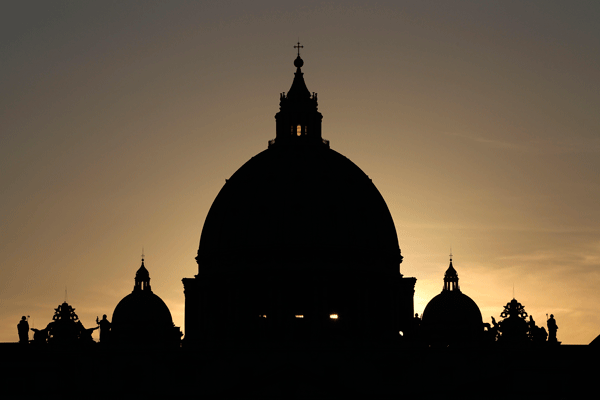
The dome of St. Peter's Basilica is seen at sunset at the Vatican Sept. 16, 2010. (CNS photo/Paul Haring)
VATICAN CITY (CNS) — Vatican spokesman Father Federico Lombardi confirmed that Paolo Gabriele, the pope’s private assistant, was arrested after private Vatican documents were found in his possession in connection to the so-called “VatiLeaks” scandal that began in January.
Father Lombardi said Gabriele was arrested the evening of May 23 by Vatican police after they found the illegally obtained documents in his home, which is on Vatican territory. He was still under arrest as May 26, the day the Vatican statement was issued. The dark-haired assistant can often be seen with the pope sitting in the front seat of the popemobile, next to the driver during papal general audiences on Wednesdays.
The spokesman said Vatican judge Nicola Picardi has completed “the first phase” of a preliminary investigation and Vatican judge Piero Antonio Bonnet has begun the next step of the inquiry.
Father Lombardi said May 25 that Gabriele, then unnamed by the Vatican, had been questioned by Vatican judges in order to obtain further information.
Gabriele has named two lawyers to represent him during the Vatican investigation and he has already had a chance to meet with them, Father Lombardi said.
The investigation will continue until enough evidence has been collected and then Judge Bonnet will either call Gabriele to stand trial or be acquitted, he said.
A committee of three cardinals Pope Benedict XVI appointed in April to look into the leaks had asked the gendarmes to investigate.
Dozens of private letters to Pope Benedict and other confidential Vatican correspondence and reports, including encrypted cables from Vatican embassies around the world, were leaked to an Italian journalist, Gianluigi Nuzzi. He published the documents in a book, “Your Holiness,” released May 17.
In a statement two days later, Father Lombardi called the publication of the letters for commercial gain a “criminal act” and said the Vatican would take legal action. The publication, he said, violated the right to privacy and the “freedom of correspondence” of Pope Benedict, the letter writers and the pope’s closest collaborators.
In the book’s introduction, Nuzzi said his main source for the texts told him he was acting with a “small group” of Vatican insiders concerned about corruption and a thirst for power within the Vatican. According to his source, Nuzzi said, none of the people giving him documents knew who the others were.
—By Carol Glatz and Cindy Wooden, Catholic News Service
A member of the U.S. Army Old Guard places a flag at one of the more than 220,000 graves of fallen U.S. military service members buried at Arlington National Cemetery in Virginia May 24. Memorial Day, observed May 28 this year, is a national day of remem brance honoring members of the U.S. armed forces who died in service. (CNS photo/Jason Reed, Reuters)
Catholic Cemeteries throughout the Phoenix Diocese will be honoring “valiant men and women who have helped ensure our peace” this Memorial Day.
St. Francis Cemetery, 8 a.m., 2033 N. 48th St., Phoenix
Calvary Cemetery, 10 a.m., 201 W. University, Flagstaff
Queen of Heaven, 8 a.m., 1562 E. Baseline Road, Mesa
All Souls Cemetery, 8:30 a.m., 700 N. Bill Gray Road, Cottonwood
Holy Redeemer, 7:30 p.m., 23015 N. Cave Creek Road, Phoenix
Holy Cross Cemetery, 8 a.m., 10045 W. Thomas Road, Avondale
WASHINGTON (CNS) — After receiving the inaugural Religious Freedom Award May 24, Baltimore Archbishop William E. Lori encouraged people of all faiths to stand together to defend religious liberty.
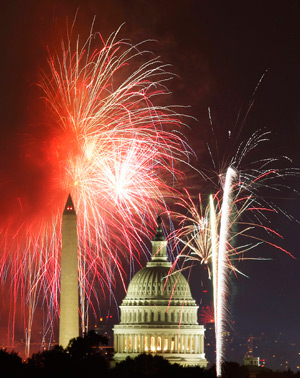
Fireworks light up the sky around the U.S. Capitol and Washington Monument on Independence Day last year. In a new statement released April 12, an ad hoc committee of the U.S. bishops' outlined examples of threats to religious liberty and urged Catholic s to resist unjust laws. It called for "a fortnight for freedom" from June 21 to July 4 for prayer, study and public action emphasizing the Christian and American heritage of liberty. (CNS photo/Reuters)
“U.S. bishops and faithful Catholics in this country, numerous though we may be, cannot fight the tide of radical secularism alone,” Archbishop Lori said at the 2012 National Religious Freedom Award Dinner, held at the Georgetown Four Seasons Hotel in Washington.
“I’m here to ask for your help. Together, we can achieve great things,” he said.
Speaking to a crowd of 300 people from many faiths who came from across the country to attend an all-day National Religious Freedom Conference, Archbishop Lori said “fighting the tide of secularism in general, and current threats to religious liberty in particular, can seem like a daunting task, (but) we know that with God, all things are possible, and we know that prayer is the ultimate source of our strength in this fight.”
The conference was titled “Rising Threats to Religious Freedom,” and it was sponsored by the American Religious Freedom Program, which is part of the Ethics and Public Policy Center.
Speakers representing a range of religious backgrounds, and officials from state government and advocacy groups, spoke about threats to religious freedom and conscience rights across the United States, on the federal, state and local level, and in the military.
Archbishop Lori, who chairs the U.S. bishops’ Ad Hoc Committee for Religious Liberty, warned that the U.S. Department of Health and Human Services’ mandate on contraceptive coverage “has now become the most critical religious liberty challenge that we face in the United States today.”
The mandate “would force virtually all employers, even those with conscientious objections, to provide health coverage for contraceptives, sterilization and abortion-inducing drugs,” he said.
It marks, he said, “the first time that the federal government has compelled religious institutions to facilitate and fund a product contrary to their moral teaching.”
Archbishop Lori noted that earlier that week, Catholic institutions had “been forced to take action by litigation, a course no one desires, but a course that appears to be the only alternative left in order to seek relief from this unjust federal government mandate.”
On May 21, 43 Catholic dioceses, schools, hospitals, social service agencies and other institutions filed a total of 12 lawsuits in federal court around the country challenging the HHS mandate.
Archbishop Lori said an especially problematic part of the mandate is that the federal government defines “which religious institutions are ‘religious enough’ to merit protection of their religious liberty.”
When the health care legislation was being debated more than two years ago, the U.S. bishops urged that it include strong conscience protections. Congress passed the Patient Protection and Affordable Care Act March 21, 2010, and President Barack Obama signed it into law three days later.
When the contraceptive mandate was proposed Aug. 1, 2011, thousands of comments were filed by people across the country urging that Catholic institutions not be forced to facilitate or fund services that violated church teaching.
Archbishop Lori noted that on Jan. 19 of this year, Pope Benedict XVI addressed a group of U.S. bishops visiting the Vatican, warning of growing threats to religious freedom in the United States. Then, he said, the next day, “as if on cue,” HHS announced religious organizations could delay but not opt out of the mandate.
“Despite numerous opportunities to avoid the train wreck,” the archbishop said, the Obama administration Feb. 10 finalized the mandate and also announced that religious employers could decline to cover contraceptives if they were morally opposed to them, but that their health insurers would have to pay for the coverage.
Obama’s announcement about insurers paying the costs was rejected by the bishops and others. Archbishop Lori said it addresses “only a small part of the overall problem, and does so inadequately.”
The mandate’s “unwarranted government definition of religion,” Archbishop Lori said, includes a very narrow definition of a religious employer that would qualify for an exemption — those employers would have to primarily hire and serve people of their own faith.
“This exemption attacks religious freedom by defining it away — by limiting protections essentially to houses of worship, the exemption reduces the freedom of religion to the freedom of worship,” he said.
Archbishop Lori said there has been much misinformation about the issue. “This is not about the Catholic Church wanting to force anybody to do anything; it is instead about the federal government forcing the church — consisting of its faithful and all but a few of its institutions — to act against church teaching.”
He emphasized the religious freedom fight is not one the nation’s Catholic leaders sought, but instead was forced by the government’s action.
“This is not a Republican or Democratic, a conservative or liberal issue. It is an American issue,” he said.
Archbishop Lori said the principles at stake — religious liberty and the life and dignity of all human beings — are central to the Catholic faith.
Religious freedom, the first freedom in the Constitution’s Bill of Rights, Archbishop Lori said, was seen as an essential part the new United States by the Founding Fathers. Thomas Jefferson, he noted, once said: “No provision in our Constitution ought to be dearer to man than that which protects the rights of conscience against the enterprises of the civil authority.”
Archbishop Lori concluded is talk by inviting people to participate in the June 21 to July 4 “fortnight for freedom” campaign organized by the Ad Hoc Committee on Religious Liberty.
At the dinner following the archbishop’s talk, Brian Walsh, executive director of the American Religious Freedom Program, said the program, and that day’s conference, had been organized to defend the “God-given and constitutional” right of freedom of religion.
“Religious freedom is at the core of all of our freedoms,” he said, announcing that his group would be working to establish caucuses in all 50 states to defend religious liberty.”
– – –
By Mark Zimmermann, editor of the Catholic Standard in Washington.
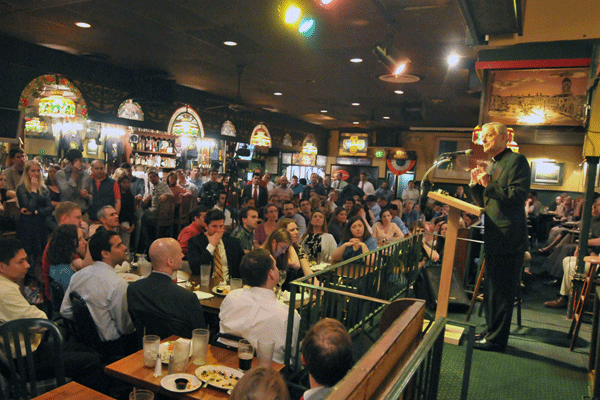
Cardinal Donald W. Wuerl of Washington gives a talk on threats to religious liberty during a Theology on Tap program at Ireland's Four Fields in Washington May 22. The talk came one day after the Archdiocese of Washington and 42 other Catholic entities f iled suit in federal courts around the country to stop three government agencies from implementing a mandate that would require them to cover contraceptives and sterilization in their health plans. (CNS photo/Rafael Crisostomo, Catholic Standard)
WASHINGTON (CNS) — Speaking to a standing-room-only crowd of young adults, Cardinal Donald W. Wuerl encouraged them to pray and stand up for religious freedom.
Such freedom is being threatened, he said, by the U.S. Department of Health and Human Services’ mandate that would force Catholic institutions to provide employee health insurance coverage for abortion-inducing drugs, contraceptives and sterilization procedures, all of which are morally opposed by the Catholic Church.
“It (the threat to religious liberty) is real. It’s not hyperbole,” the cardinal said May 22. “It (the HHS mandate) is the most direct challenge to our religious liberty we’ve ever faced on the federal level.”
The cardinal spoke to an estimated 250 people gathered at an Irish pub in Washington for Theology on Tap, sponsored by the Archdiocese of Washington’s Office of Young Adult Ministry.
His talk came one day after the archdiocese filed a lawsuit in U.S. District Court to challenge the mandate. The local lawsuit was one of 12 actions filed nationwide, on behalf of 43 Catholic institutions, including the Archdiocese of New York and the University of Notre Dame.
In Washington, The Catholic University of America and the archdiocese’s Catholic Charities, Consortium of Catholic Academies and Archbishop Carroll High School are also plaintiffs in that legal action.
“The freedom of religion is part of the DNA of being American,” Cardinal Wuerl said as he opened his talk.
He said the freedom of religion enshrined in the U.S. Constitution’s Bill of Rights has allowed people of faith “to exercise our religion freely” in the United States. But he emphasized that religious freedom is “part of who we are, grounded in our human nature” by God, and “it’s not something the state grants us.”
“Our religious freedom is intrinsic to us — our freedom to follow Christ as we choose, our freedom to worship as we choose, our freedom to live out the Gospel,” the cardinal said.
Cardinal Wuerl said the key problem of the HHS mandate is that it doesn’t allow for a meaningful religious exemption for the Catholic Church and other faith groups, which provide extensive networks of educational, health care and social service programs that serve all people.
“We are our brother’s keeper. We are our sister’s keeper,” said the cardinal, who noted that previous federal laws provided exemptions that safeguarded religious groups from being forced to violate their beliefs.
“The new regulation has imbedded in this a new definition of what makes you religious enough to qualify for an exemption — you can only care for your own (denomination) and you can only hire your own. … (The mandate says if) you don’t qualify for the exemption, you must provide for all services you find morally reprehensible,” the cardinal said.
The mandate’s “radical new definition” of religious ministry poses an unprecedented threat to the religious freedom of Catholic institutions, Cardinal Wuerl said.
He said the lawsuit was filed because related religious freedom legislation is deadlocked in Congress, and the White House in negotiations has refused to offer a meaningful exemption to religious groups.
The lawsuit is about protecting religious freedom, not about contraception, he said.
“They (contraceptives) are available, accessible and affordable. We’re not stopping anybody from getting contraceptives. We’re just saying, ‘Don’t make us provide them'” in violation of Catholic teaching.
Cardinal Wuerl said the U.S. Catholic bishops have supported universal access to health care for the past century. But, he added, government efforts to provide that access must be done in a fair manner respecting the constitutional rights of people of faith.
“How you do it (provide access) makes all the difference,” he said.
When asked by a young adult what those in the audience could do to help stand up for religious freedom, Cardinal Wuerl noted how Pope Benedict XVI has called on Catholics to take up the work of the new evangelization — to deepen their understanding of the faith, to be confident in the truth of the faith, and to share it with others.
“Imagine if every one of us went out and told the story of our faith, what it means to us, how it’s impacting our lives,” the cardinal said.
After his talk, the cardinal joined the young adults in reciting a prayer for religious liberty. The audience members also were encouraged to find out more about the issue by visiting the archdiocese’s new website, www.preservereligiousfreedom.org.
Young adults interviewed afterward said they appreciated the cardinal’s message.
“Like he said, if we don’t fight for it (religious liberty), it can be stamped out,” said Air Force Staff Sgt. Stephen Caruso told the Catholic Standard, Washington’s archdiocesan newspaper. “We need to take this message to our workplaces.”
His wife, Nicole, said it is important for Catholics to be proud of their faith “and not be afraid to share it.”
– – –
By Mark Zimmermann, editor of the Catholic Standard in Washington.
Stumbled upon this news release about Christ the King Jesuit College Preparatory’s first graduating class. The four-year-old school is only the 20th nationwide to use the Cristo Rey model.
Through the Cristo Rey model, Christ the King makes possible the dream of a quality and affordable education for students whose families could not otherwise pay the tuition charged by private schools. Students earn three-quarters of their tuition costs while gaining valuable, life-changing skills and experience through jobs at Chicago area companies.
CHICAGO — Every senior in the first graduating class of Christ the King Jesuit College Preparatory School (CTK) has been accepted to at least one college or university, according to Rev. Christopher J. Devron, S.J. president of the school. The announcement was made at a “College Signing Day Ceremony,” an assembly of the school’s 280+ students this week.
That number is significant in Chicago where it was reported that about 40 percent of high school students drop out and especially noteworthy in the Austin neighborhood of Chicago’s West Side where the challenges for high school students and their families are especially acute.
Eighty-four colleges offered more than 150 acceptances to CTK students. The roster is impressive including: Marquette University, DePaul University, The University of Illinois, University of Iowa, Fairfield University, Bowling Green State University, and Xavier University.
On June 9, this first class of seniors will walk across the stage to receive their diplomas. “As we countdown to graduation, we congratulate our seniors on four years of hard work and dedication, and celebrate this significant milestone today as they announce their choices for college,” adds Rev. Devron.
“This is a momentous occasion for us as these young people are paving a way for everyone in this school,” said Darryl Hobson, assistant principal. “College is no longer a dream, but a reality.
During the signing ceremony, every one of the 50 members of the Class of 2012 took the podium to announce his or her college, share a favorite CTK memory and offer a pearl of wisdom for the student body.
“Don’t ever let people set limitations for you,” senior Shaquocora Henderson, who will enter Marquette University this fall, told the student body. “Go hard toward your goals and never stop dreaming. You have to do whatever you can with whatever is necessary to make it happen for yourself.” (see other senior profiles)
A Chicago-based web software developer presented every graduate with iPads, a case and a $25 gift card for apps.
Christ the King Jesuit College Preparatory School, located on the West Side of Chicago in the Austin neighborhood, opened in August 2008 to educate the area’s underserved teenagers and their families. Small, safe and faith-based, Christ the King expands on a tradition of successful education with a new urban idea and is one of 24 schools in the Cristo Rey Network. All students participate in the Corporate Work Study Program, where they earn the majority of the cost of their education by working entry-level professional positions five days per month.
This year, Christ the King Jesuit College Preparatory students worked with more than 80 businesses and earned more than $1.7 million toward their educational expenses. The school looks to expand the number of businesses involved as the school enrollment continues to grow.
Back in the days when Chuck Colson was willing to run over his grandmother for Richard Nixon, I would have happily done the same to Mr. Colson. Well, that was then, and this is now. And over the past 20 years, I never met a more thoroughly converted Christian, a more ecumenically serious Christian, or a more tenacious Christian than Chuck Colson, who died on April 21. He was a man whom I came, not just to respect, but to love.
Our friendship and collaboration began in the early 1990s, when Herb Schlossberg, the evangelical author, buttonholed me at a Washington reception and expressed concern about the ongoing fracture between Catholics and evangelical Protestants, two communities that Herb thought should be working together to shore up America’s public culture. I mentioned Herb’s concern to Richard John Neuhaus; Neuhaus called Colson; and within a matter of months “Evangelicals and Catholics Together” was born.
What began as co-belligerency in the American culture-war soon evolved in ways none of us had anticipated. Led by Neuhaus and Colson, and prodded by such towering intellects as Avery Dulles, S.J., and J. I. Packer, “ECT,” as we called it, developed into what was arguably the most important theological encounter ever between evangelical Protestant and Catholics. Issues that we had once imagined completely off-the-table—Mary; the communion of saints; justification—were not only broached but examined, pondered and prayed over. And the result was not only a deepening of fellowship but a refinement of thought. That a leading evangelical theologian should today be working on a book on Mary-for-evangelicals says something about the miles traveled, and the centuries of misunderstanding bridged, in those conversations.
ECT returned to the culture-wars in 2010, this time in defense of religious freedom. And just before Chuck Colson died, the U.S. bishops’ Ad Hoc Committee on Religious Liberty commended and cited the ECT statement, “In Defense of Religious Freedom,” that Chuck had helped push to completion.
Life with Chuck Colson also involved adventures. My favorite took place in Rome, about 10 years ago. At a conference held in the old Synod Hall of the Apostolic Palace I ran into Colson, who asked if I might do him a favor. Obviously, I replied. Well, Chuck said, he had met John Paul II on several occasions, but his wife, Patty, a Catholic, had never met the Pope and would be ecstatic if that could be arranged. Nothing easier, I said—at which point Chuck asked if he could bring along another Major Evangelical Figure (as I shall discretely style him) and his wife. No problem, said I.
So Patty Colson, Chuck, Major Evangelical Figure, and Mrs. Major Evangelical Figure met John Paul II, and Chuck called me the night of the general audience to express his thanks. I then asked if he thought a picture of the encounter in the English edition of L’Osservatore Romano would serve our common ecumenical purposes. Chuck, initially enthusiastic, then got cautious: “Wait; I’d better check with [Major Evangelical Figure].” The next day I got another phone call from Chuck: “Don’t do anything. The Pope was sitting when he received us, and [Major Evangelical Figure]’s picture was taken when he was down on one knee in front of the Pope. He’s afraid his fundraising will collapse if that picture gets out!” I laughed, assured him that I would abandon any idea of having the photo run in the Vatican newspaper—and reflected on the still-supple political instincts of a man who found his true vocation only after being driven out of politics.
Chuck knew the threat Major Evangelical Figure feared: at the beginning of our common work, Colson’s leadership in ECT cost Prison Fellowship, the marvelous ministry he founded, millions of dollars in lost donations. Chuck took the hit and soldiered on because he believed that the truth of Christ would prevail, eventually, over hardened hearts. It was a conviction he came to him from hard personal experience. And it made him one of the great Christian witnesses of our time.
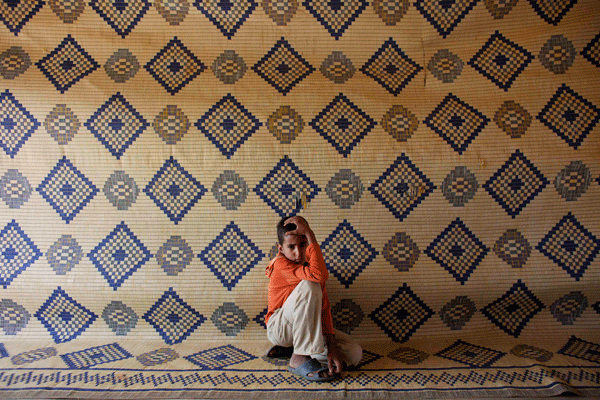
Moussa, a 13-year-old Malian refugee, waits for his mother as she visits a doctor in the Mbera refugee camp in Mauritania May 23. More than 320,000 people have fled their homes due to conflict in northern Mali. Half of them have settled in refugee camps in neighboring countries, according to the United Nations. Mbera, the largest of such camps, is home to more than 64,000 people. The camp's remoteness in the Sahara desert makes delivery of humanitarian assistance difficult. (CNS photo/Joe Penney, Reuters)
ROME (CNS) — Increasing numbers of women are migrating alone, a situation that makes them vulnerable to violence and exploitation, but one that often shows their courage and commitment to making a better life for their families, said speakers at a conference in Rome.
About 214 million people live outside their country of origin, and half of all migrants are women, said Miguel Diaz, U.S. ambassador to the Holy See, which sponsored a panel discussion about migration and women May 24.
The global economic crisis has increased the danger that migrant women and children will fall prey to traffickers as they flee violence and poverty, seeking a better life for themselves and their families, the ambassador said.
Cardinal Antonio Maria Veglio, president of the Pontifical Council for Migrants and Travelers, said in the experience of the Catholic Church, its ministers and aid agencies, women who have been forced to migrate, “despite everything that has happened to them in their lives, respond to their situation with remarkable courage, resourcefulness and creativity.”
“They believe wholeheartedly that the future offers change and possibilities,” he said.
At the same time, the cardinal said, women migrants need special protection. They may be the targets of ethnically motivated rape during times of civil strife; their safety often isn’t ensured even in refugee camps; and many become the head of their household in a land where they do not speak the language or understand the culture.
Martina Liebsch, policy director for Caritas Internationalis, told conference participants that strong myths are believed by both migrants and people in the countries they hope to enter.
Migrants, she said, “often believe in the myth of a better life somewhere else, in developed countries, whereas in fact they often end up undocumented, doing precarious work, with little or no access to rights.”
The people who make the most money out of migration — traffickers and smugglers — “exploit this myth and the dreams.” She said a police officer told a recent Vatican conference that “it is easier nowadays to traffic a person than to traffic drugs or weapons.”
People in the world’s richer countries “have their own myth — that they are being invaded by migrants,” she said. But, in fact, research has demonstrated there is more migration in the developing world because most migrants want to stay as close as possible to their homelands.
In addition, she said, the rich countries rely heavily on migrants for semi-skilled and unskilled labor in construction and in domestic work, including caring for the elderly and for children.
In fact, Liebsch said, while poor countries have long lamented a “brain drain” with the emigration of their highly skilled, highly educated citizens, today many are experiencing a “care drain” with the departure of nurses and those who traditionally have cared for children and the elderly.
National laws, international policies and nongovernmental agency efforts to assist migrants must become more sensitive to the fact that women and men migrants often face very different threats and challenges, she said. In particular, the fact that so many women migrants end up doing domestic work means they are employed in the least regulated sector of most countries’ economies and face the most potential exploitation.
Farah Anwar Pandith, the U.S. State Department special representative to Muslim communities, said whether they are first-generation or fourth-generation immigrants, Muslim women in Europe often are raising their children surrounded by “shrill voices” debating immigration and cultural diversity.
New Muslim immigrants face isolation because of language barriers, but they also face the physical barrier of being forced to live in the poorer neighborhoods. Outreach to promote literacy is important, she said, but emotional support is even more crucial.
“We do not want mothers raising children to tell them that they will never belong to the country, society, communities in which they live. We want mothers to be able to promote opportunities for their children, to give them the opportunity to live up to their God-given potential,” she said.
“The bottom line is to listen to what the women are saying about what’s happening to their families, to their children and in their environment,” she said.
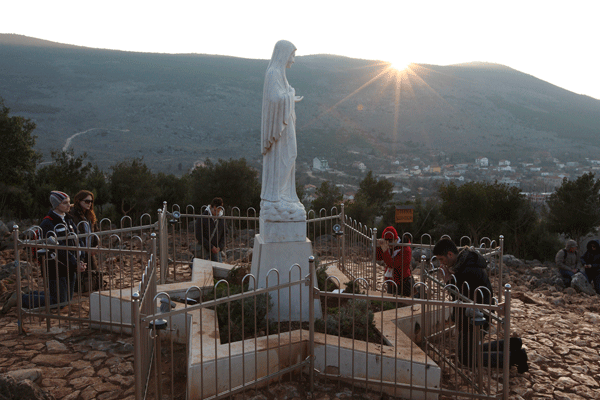
Pilgrims pray around a statue of Mary on Apparition Hill in Medjugorje, Bosnia-Herzegovina, Feb. 26, 2011. The site is where six village children first claimed to see Mary in June 1981. A Vatican-appointed commission is studying the alleged Marian apparitions at Medjugorje. CNS photo/Paul Haring)
VATICAN CITY (CNS) — To help bishops determine the credibility of alleged Marian apparitions, the Vatican has translated and published procedural rules from 1978 that had previously been available only in Latin.
The “Norms regarding the manner of proceedings in the discernment of presumed apparitions or revelations” were approved by Pope Paul VI in 1978 and distributed to the world’s bishops, but never officially published or translated into modern languages.
However, over the past three decades, unauthorized translations have appeared around the world, according to U.S. Cardinal William J. Levada, prefect of the Congregation for the Doctrine of the Faith.
The doctrinal office “believes it is now opportune to publish these ‘Norms,’ providing translations in the principle languages” so as to “aid the pastors of the Catholic Church in their difficult task of discerning presumed apparitions, revelations, messages or, more generally, extraordinary phenomena of presumed supernatural origin,” the cardinal wrote in a note dated December 2011.
His note and the newly translated norms were published recently on the congregation’s website www.doctrinafidei.va.
Cardinal Levada wrote that he hoped the norms “might be useful to theologians and experts in this field of the lived experience of the church, whose delicacy requires an ever-more thorough consideration.”
More than 1,500 visions of Mary have been reported around the world, but in the past century only nine cases have received church approval as worthy of belief.
Determining the veracity of an apparition falls to the local bishop, and the Vatican’s doctrinal congregation established the norms to guide the process.
Granting approval is never brief, with some cases taking hundreds of years. Visionaries and witnesses must be questioned and the fruits of the apparitions, such as conversions, miracles and healings, must be examined.
According to the norms, the local bishop should set up a commission of experts, including theologians, canonists, psychologists and doctors, to help him determine the facts, the mental, moral and spiritual wholesomeness and seriousness of the visionary, and whether the message and testimony are free from theological and doctrinal error.
A bishop can come to one of three conclusions: He can determine the apparition to be true and worthy of belief; he can say it is not true, which leaves open the possibility for an appeal; or he can say that at the moment he doesn’t know and needs more help.
In the last scenario, the investigation is brought to the country’s bishops’ conference. If that body cannot come to a conclusion, the matter is turned over to the pope, who delegates the doctrinal congregation to step in and give advice or appoint others to investigate.
The alleged apparitions at Medjugorje in Bosnia-Herzegovina are an example of a situation in which the country’s bishops requested the Congregation for the Doctrine of the Faith to intervene.
In that case, the congregation established an international commission in 2010 to investigate the claims of six young people who said Mary had appeared to them daily beginning in 1981.
The apparitions purportedly continue and thousands travel to the small town each month to meet the alleged seers and to pray.
Pope Benedict XVI has reaffirmed that the church never requires the faithful to believe in apparitions, not even those recognized by the church.
In his note, Cardinal Levada quoted the pope saying “The criterion for judging the truth of a private revelation is its orientation to Christ himself,” in that it doesn’t lead people away from Jesus, but urges them toward closer communion with Christ and the Gospel.
The cardinal also quoted from the writings of St. John of the Cross, who emphasized that God said everything he had to say in Jesus Christ — in his one and only son and Word.
“Any person questioning God or desiring some vision or revelation would be guilty not only of foolish behavior but also of offending him, by not fixing his eyes entirely on Christ and by living with the desire for some other novelty,” the saint wrote.
Church approval of a private revelation, in essence, is just the church’s way of saying the message is not contrary to the faith or morality, it is licit to make the message public “and the faithful are authorized to give to it their prudent adhesion,” the pope said in his 2010 Post-Synodal Apostolic Exhortation, “Verbum Domini” (“The Word of the Lord”).
On April 12, the Ad Hoc Committee on Religious Liberty of the U.S. Conference of Catholic Bishops (USCCB) issued a document, “Our First, Most Cherished Liberty,” outlining the bishops’ concerns over threats to religious freedom, both at home and abroad. The bishops called for a “Fortnight for Freedom,” a 14-day period of prayer, education and action in support of religious freedom, from June 21-July 4.
The Diocese of Phoenix is planning its own set of special events to highlight the importance of defending religious freedom. The following is a tentative schedule:
Friday, June 22 – Feast of St. Thomas More and St. John Fisher:
Bishop Thomas J. Olmsted – 8:30 a.m. Mass at St. Thomas More Parish
Sunday, June 24 – Feast of the Nativity of John the Baptist:
Bishop Thomas J. Olmsted – 9 a.m. Televised Mass at the Cathedral
Auxiliary Bishop Eduardo A. Nevares – 10 a.m. Mass at St. John the Baptist in Laveen
Friday, June 29 – Feast of Sts. Peter and Paul:
Auxiliary Bishop Eduardo A. Nevares – 7 p.m. Mass at St. Paul Parish
Sunday, July 1 – Masses in Flagstaff, Auxiliary Bishop Eduardo A. Nevares:
10 a.m. English
Noon Spanish
Wednesday, July 4 – Independence Day:
8.30 a.m. Mass at the Cathedral followed by Rosary – Auxiliary Bishop Eduardo A. Nevares
Catholic institutions are encouraged to do the same, especially in cooperation with other Christians, Jews, people of other faiths and all who wish to defend our most cherished freedom.
The fourteen days from June 21—the vigil of the Feasts of St. John Fisher and St. Thomas More — to July 4, Independence Day, are dedicated to this “fortnight for freedom” — a great hymn of prayer for our country. Our liturgical calendar celebrates a series of great martyrs who remained faithful in the face of persecution by political power — St. John Fisher and St. Thomas More, St. John the Baptist, Ss. Peter and Paul, and the First Martyrs of the Church of Rome.
Culminating on Independence Day, this special period of prayer, study, catechesis, and public action would emphasize both our Christian and American heritage of liberty. Dioceses and parishes around the country could choose a date in that period for special events that would constitute a great national campaign of teaching and witness for religious liberty.
LOS ANGELES (CNS) — More than 8,500 pages of material detailing claims of sexual abuse by a group of Franciscan priests and brothers in California were made public May 23.
The release of the documents was one unfinished item of business from a 2006 court settlement that awarded $28 million, the vast majority of it from the St. Barbara Province of the Franciscan Friars and Brothers, to settle abuse claims from 25 plaintiffs.
The province, based in Oakland, used the proceeds from the sale of a closed seminary, where many of the incidents were alleged to have occurred, to help finance the settlement. The high school seminary closed in 1987.
As part of the settlement, the Franciscans agreed to let a judge review for possible public dissemination internal church documents as well as depositions in the litigation, showing how the order handled sexual abuse allegations among its clerics.
None of the six priests and three brothers cited in the documents are in active ministry. Some are dead. Others are living at Franciscan residences and restricted from leaving the grounds unaccompanied.
In the archive are personnel, psychological, confidential and laicization files, as well as witness depositions. One priest wrote a “sexual autobiography” that was included with the release of the files. In some cases, plaintiffs filed applications to amend complaints against some of the priests and brothers.
Other documents include parents’ letters to one Franciscan priest who was jailed for his role in the abuse, to the Franciscan provincial at the time, to then-Bishop Patrick Ziemann of Santa Rosa, who himself had to resign his post in 1999 because of his involvement in a sexual scandal, and to Cardinal Roger M. Mahony, then archbishop of Los Angeles — the archdiocese contributed $2 million to the settlement because some of the acts allegedly were committed at a historic Franciscan-run mission church located in the Los Angeles Archdiocese.
Also available for review are a social worker’s evaluation of one priest, and a “sexual deviancy evaluation” of another priest who had once alluded to abusing 250 minors.
The Franciscans whose files are in the new online archive are Fathers Mario Cimmarrusti, Robert Van Handel, Gus Krumm, David Carriere, Martin McKeon and Gary Pacheco, and Brothers David Johnson, Samuel Cabot and Berard Connolly.
Van Handel and other defendants had fought the release of the documents since the settlement was announced. The case had reached the California Supreme Court, which ruled against the former Franciscans.
Attempts by Catholic News Service to reach the current Franciscan provincial, Franciscan Father John Hardin, for comment were unsuccessful. The province’s website was silent on the release of the files.