
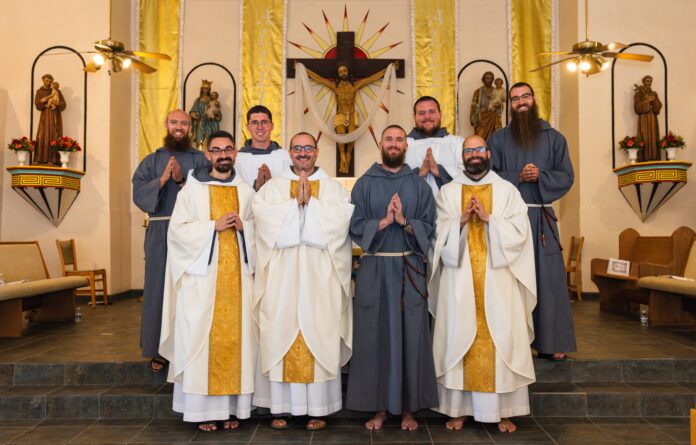
The Franciscan Friars of the Holy Spirit, established in the Diocese of Phoenix with the mission to tend to the pastoral and spiritual needs of Native American communities, will celebrate a momentous occasion on June 29 — 10 years since their founding.
In 2015, there were 11 Native American churches in the greater Phoenix area, which for 30 years had experienced limited access to the sacraments. On the weekends when Mass was not celebrated, parishioners would lead prayer services, praying in a special way for permanent priests to come.
Around the same time, Bishop Emeritus Thomas Olmsted was also praying for permanent priests to serve the missions.
After decades of fervent prayer, five Franciscans arrived at St. John the Baptist in Laveen, Ariz., in 2015. The band of friars lived in an old, unused convent.
Deborah Griffin, longtime parishioner of St. John the Baptist, still remembers the day they arrived. “That was the most exciting day … I just couldn’t believe that it was finally happening.”
Although Griffin did not grow up on the reservation, her mother did. Griffin’s mother led prayer services at the mission for decades before the friars came.
“My mom was always busy trying to keep the faith alive.”
The five priests had been part of a Franciscan religious community in Pennsylvania and had discerned starting a new Franciscan public association of the faithful with the charism of the Holy Spirit. During their first year in Arizona, the friars and Bishop Olmsted took time to discern if they were a good fit for the Diocese of Phoenix and the Native communities.
A year after their arrival, the Franciscan Friars of the Holy Spirit were officially founded as a public association of the faithful on June 29, 2016, by Bishop Olmsted. The friars now oversee and serve 11 locations on four reservations in the greater Phoenix area — Gila River, Salt River Pima-Maricopa and Ak-Chin Indian Communities and the T’ohono O’odham Nation.
Now, Mass is celebrated almost daily at St. John the Baptist Mission and regular Sunday Masses are celebrated at nine of the churches. Numerous anointings, funerals, baptisms and weddings have also been celebrated since the friars’ arrival. Additionally, the friars have started two youth groups, and they minister to Natives in the prisons, juvenile detention center, rehab center and Caring House, a medical rehabilitation facility in Sacaton, Ariz. They also lead monthly praise and worship nights and celebrate frequent healing Masses, praying over people with a wide variety of healing needs and ailments.
When asked what it is like to have weekly access to the sacraments, Griffin said, “It’s the way it should be. It’s just the way of life.”
An eternal impact
Since the establishment of the Franciscan Friars of the Holy Spirit, multiple men have joined the community and are in different stages of the formation and discernment process. Currently, there are four priests, one transitional deacon, one perpetually promised friar and two friars receiving formation at Nazareth Seminary, the Diocese of Phoenix’s fully local seminary. The most recent ordination was Fr. Paul Graupmann, F.H.S., who was ordained on June 6, 2026 at St. Thomas Aquinas in Avondale, Ariz.
“The ordinations [are] just an eye opener of how the faith has come back to our reservation,” Griffins said. She also shared that the friars helped the Native people feel as if they were not forgotten.
There are many people who still have not come back to Mass due to the prolonged period without consistent access to the sacraments. Yet, Griffin has high hopes for the future. “I would hope that [the friars] would bring every Catholic in our community back to the Church … and to carry on with our Native traditions, with Catholicism.”
Fr. Antony Tinker, F.H.S., the community servant who leads the group of friars and was one of the five founding priests said, “I think it’s really beautiful, because … God created a charism specifically to care for Native American peoples. It shows the heart of God, that He cares.”
There have been Franciscan missionaries in the area since the 1760s, including Servant of God Francis Garces. St. John the Baptist was established by Franciscans in the late 1800s.
“We’re [standing] on the shoulders of giants, with the Franciscans and Jesuits and other missionaries,” continued Fr. Tinker. “Unfortunately [a lot of those] missions that were started are no longer staffed because of the lack of priests. And so this [is a] call from God to continue to care for these little missions that the whole Church of America is built on in so many ways.”
Fr. Tinker said that it is a joy to do this work for God. Interacting with the community, getting to know the families and all the baptisms, weddings and everything in between, make the hard moments worth it.
He shared one moment in particular that he will never forget.
There was a Native woman who was completely healed of stage four ovarian cancer after attending a healing Mass hosted by the friars. Not long after, the woman’s father, who wasn’t Catholic, asked to be blessed after hearing about his daughter’s healing. Fr. Tinker blessed him, and he also went into remission. A couple years later, the cancer returned.
By that time, the father was ready to become Catholic.
“[I had] the privilege of baptizing him on his deathbed in his home with his family, confirming him … he died a day or two later.”
Fr. Tinker reflected that if the friars hadn’t been serving on the reservations, the daughter never would have gotten prayed over at the healing Mass, her father may never have reached out and he may not have received the sacraments, passing away as a baptized Catholic.
Fr. Tinker recognizes that good work is happening because of the Lord’s generosity and the generosity of many who have supported the friars over the years.
“We’re able to live the life God’s called us to live because people are so generous.”
Planted in the desert
Fr. Peter Teresa McConnell, F.H.S., vocations director for the Franciscan Friars of the Holy Spirit, moved to Arizona at the end of 2015 to discern with the friars. He was ordained a priest in 2019.
Fr. McConnell talked about the joy-filled Mass on July 2, 2016, celebrating the association being publicly recognized.
“Bishop Olmsted is in many ways the founding father of this community. I just remember him … doing everything that a father does. First, he gave us our names, and then he gave us our habits … he clothed us … he brought us into the diocese and gave us a home here … and then he fed us with the Eucharist.”
Fr. McConnell has found great joy in being received so graciously by the Native communities and by the Diocese of Phoenix.
“It’s hard to imagine my life without the Gila River [community] and these people.”
The friars hope to be like the Franciscan missionaries of the past — like St. Junipero Serra — who never returned home.
“We very much feel like we are like a vine being grafted onto that tree in the Franciscan family … our desire … [is] that we would be grains of wheat here, that we would be planted in this desert, and that we would spend our lives here.”
Fr. McConnell does not want to presume to know what the Holy Spirit will do in the next 10 years, but he is excited for whatever God has in store.
“I have a lot of hope for our community. I have a lot of hope for the people that we serve … I wouldn’t trade these last 10 years for anything.”
Sacred ministers
Br. Damien Van Amerongen, F.H.S., came across the friars online during college and felt a tug in his heart to discern. On May 30, 2026, he made perpetual promises to the community, saying yes to living the statutes that the friars established 10 years ago.
“I did feel the grace to have just a lot of sobriety and clarity in that moment … as I consciously read that I will live poverty, chastity and obedience for the whole of my life, and follow the statutes of the Franciscan Friars of the Holy Spirit with all my heart.”
His next step is to continue formation through Nazareth Seminary. He will continue to live at the friary and commute to Mary College at Arizona State University in Tempe, Ariz., where he will be in the theology program along with diocesan seminarians.
It’s been exciting for him to be part of this “grassroots” public association.
“It feels kind of like [St.] Francis and his first brothers … and then they turned that into the Franciscan order, which still forms the hearts of Christians today.”
He knows that the Franciscan Friars of the Holy Spirit would not have lasted 10 years if it was not for the Holy Spirit, and he sees the Lord at work while living with his fellow friars.
“We carry each other through not only the day-to-day things … but even the hard things, like some of the difficulties in ministry … It’s amazing how the Lord can even just have that foundation of our brotherhood, that makes His yoke easy.”
The journey for Dcn. Lawrence Hogue, F.H.S., to the friars was a little different. Fr. Tinker was his college campus minister. When Dcn. Hogue heard that Fr. Tinker moved to Arizona to help found the Franciscan Friars of the Holy Spirit, he felt a tug to discern with the group. Dcn. Hogue left college a year before he would have gotten his degree in computer programming, and he has not looked back.
On May 16, 2026, Dcn. Hogue was ordained a transitional deacon and will, God-willing, be ordained a priest in 2027. When Bishop John Dolan prayed the prayer of consecration at his transitional diaconate ordination, Dcn. Hogue felt a warmth coming from Bishop Dolan’s hands.
“I was like, oh wow, so I think that was the Holy Spirit … it really strikes me that I’m in the whole apostolic line … just like St. Lawrence.”
Dcn. Hogue is humbled by the people who have supported him
“I know that because of all of [the prayers] that I’m where I’m at … I’m trying to give them a return on their investment … the Church has invested in me to be a sacred minister and I’m just trying to … serve the [Natives] as best as possible.”
As Dcn. Hogue tries “to love people on a daily basis,” he encourages any man who feels a call to religious life to grow in relationship with the Lord.
“Focus on your relationship with God … He’s the guy that’s going to give the call … and He’s the one that will even just move [your] heart.”
Dcn. Hogue is thankful for the ways he’s been able to live out spiritual fatherhood while serving the Native communities.
“The Lord has quite a love for the Natives … they’re the people that I [will] spend my life in service of … I’m just so grateful to be able to do that.”