St. Joseph’s Youth Camp: Rooted in Tradition and Values

Since 1949, St. Joseph’s Youth Camp has provided summers of fun and adventure for thousands of kids. As a traditional youth camp and nonprofit organization, St. Joseph’s Youth Camp provides youth ages 7 to 17 with a week-long overnight opportunity to get outdoors, learn from nature, and have FUN!

Located just 23 miles southeast of Flagstaff, our 19-acre Camp is nestled within the Coconino National Forest at Mormon Lake. Temperatures at this rustic overnight camp average just 79 degrees and offers a refreshing change from Arizona’s hot summers.

Register TODAY to Save Your Spot!

What Makes Us Unique

    • Unlike other summer camps, St. Joseph’s Youth Camp enrollment is limited to just 60-80 Campers per week!
    • Campers receive more individual attention with Camper to Counselor ratios of just 4 to 1.
    • All Staff members are background checked and certified with CPR, First Aid, and AED Training.
    • Each week also includes an onsite Camp Nurse available 24/7.

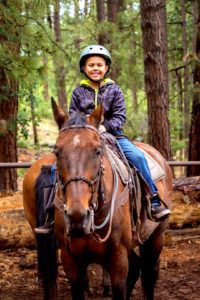
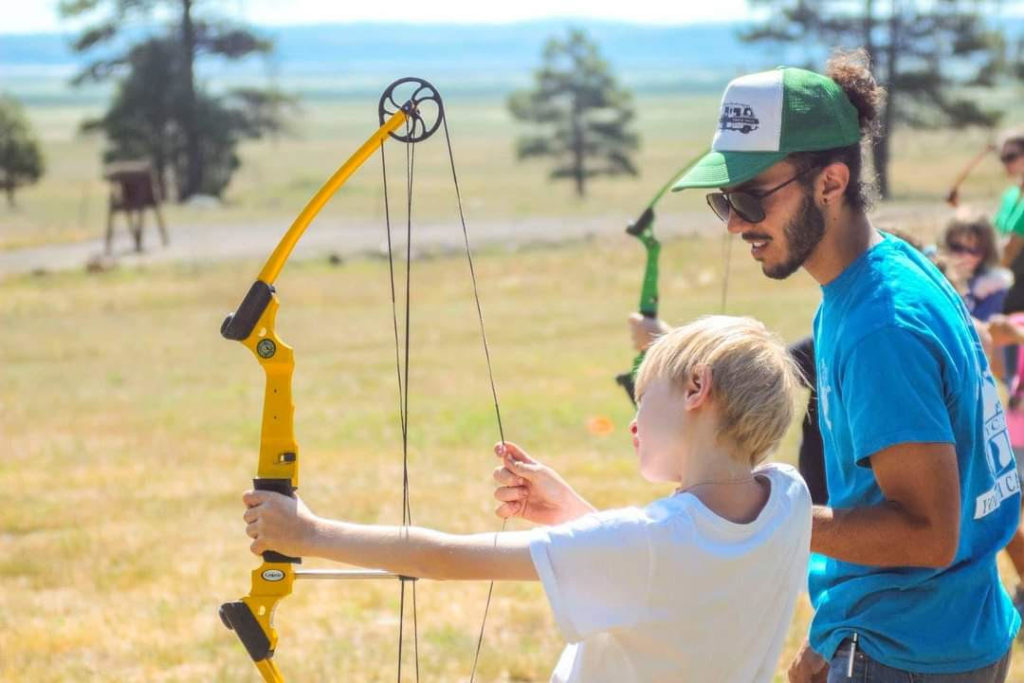
Weekly program activities include horseback riding, kayaking, zip-line course (Teen Week Only), trail hiking, archery, shelter building, astronomy activities, insect and animal discovery and education, campfire and telescope nights, arts & crafts, outdoor volleyball, tetherball, kickball, basketball, and soccer, indoor foosball, checkers, chess, board games and so much more!

A week of Camp includes all lodging and meals, roundtrip transportation from Phoenix, a Camp T-Shirt, and memories that last a lifetime!

2022 Summer Camp Schedule!

Cost: $800 Per Week ($750 if you Register before March 31, 2022)

    • Week 1: June 12 – 18 | Ages 13 – 15 (Teen Week)
    • Week 2: June 19 – 25 | Ages 7 – 12
    • Week 3: June 26 – July 2 | Ages 7 – 12
    • Week 4: July 3 – 9 | Ages 7 – 12
    • Week 5: July 10 – 16 | Ages 7 – 12 (Catholic Week)

Register TODAY to Save Your Spot!

Want to be a Camp Counselor this Summer?

Teens ages 15-17 can participate in our Counselor Training Week, designed to inspire teens to be stronger leaders and mentors. They will learn skills like team building, leadership, and receive training and certification with CPR and AED.

If selected, Counselors in Training will be asked to return as Counselors for the 5 camper weeks that follow to put their skills into action by leading kids ages 7-15 at no additional cost. Also, Counselors have an opportunity to earn 94 Community Service Hours for each week they attend Summer Camp!

Cost: $225

    • Counselor Training Week: June 5 – 11 | Ages 15 – 17

Download the Camper/Counselor Brochure

Register TODAY to Save Your Spot!

Visit us on Facebook and Instagram for all the latest Camp updates!

Accurate information is a human right, pope tells Catholic communicators

Pope Francis accepts a gift from Stan de Saint Hippolyte, deputy CEO of the Catholic media organization, Aleteia, during an audience with participants attending a meeting of the International Catholic Media Consortium on COVID-19 Vaccines, at the Vatican Jan. 28, 2022. (CNS photo/Vatican Media)

By Carol Glatz, Catholic News Service

VATICAN CITY (CNS) — Catholic communicators must help provide correct and truthful information about COVID-19 and its vaccines and do so in a way that avoids oversimplification and creating conflict, Pope Francis said.

“Fake news has to be refuted, but individual persons must always be respected, for they believe it often without full awareness or responsibility,” he said.

“To be properly informed, to be helped to understand situations based on scientific data and not fake news, is a human right. Correct information must be ensured above all to those who are less equipped, to the weakest and to those who are most vulnerable,” he added.

The pope held a private audience in the Apostolic Palace Jan. 28 with people attending a meeting organized by the “International Catholic Media Consortium on COVID-19 Vaccines.”

The consortium is headed by the Catholic media outlet, Aleteia, in collaboration with the Spain-based Verificat and French I.Media. Other founding media organizations include: Our Sunday Visitor, SanFrancesco.org and ReligiĂłn Digital. It includes a scientific committee of researchers, medical experts, scientists, theologians and bioethicists, with the aim of collecting and making available fact-checked, unbiased information for Catholic media in multiple languages.

The “Catholic fact-checking” project was one of a dozen projects chosen in January 2021 to receive funding from the Google News Initiative’s “open fund” for projects promoting factual information about the pandemic and vaccines.

The pope thanked the group for coming together for an initiative that “seeks to be together for the truth,” underlining the importance of people cooperating and sharing their skills and knowledge to provide correct information.

The current spread of misinformation, he said, represents “a distortion of reality based on fear, which in our global society leads to an explosion of commentary on falsified, if not invented, news.”

“Contributing, often unwittingly, to this climate is the sheer volume of allegedly ‘scientific’ information, comments and opinions, which ends up causing confusion for the reader or listener,” he said.

“Accordingly, to be properly informed, to be helped to understand situations based on scientific data and not fake news, is a human right,” he said.

Christian communicators need to do more than just fight against “injustices and lies,” they also always need to promote the human person, he said. “The fundamental distinction between information and people must never be overlooked.”

As people seek to “combat disinformation, to refute fake news and the manipulation of more impressionable minds,” Pope Francis told them, they always must respect individuals and “be evangelical in style, a builder of bridges, a promoter of peace, also and above all, in the search for truth.”

Seeking the truth means tirelessly verifying data and presenting them in a suitable way that helps people in their own search for truth, he said.

This quest must not succumb to commercial interests, “to the interests of the powerful, to the great economic interests,” he said. It requires “seeking an antidote to algorithms projected to maximize commercial profit; it means working to promote an informed, just, sound and sustainable society.”

“Without an ethical corrective, those instruments generate pockets of extremism and lead individuals to dangerous forms of radicalization — and this is what conflict is,” Pope Francis said.

The approach of a Christian communicator “is not one of conflict, it is not marked by an attitude of superiority, and it does not simplify reality,” especially in a way that does not understand the limitations of science, turning into “a kind of ‘fideism,'” he said.

The pope encouraged people to engage in “dialogue with those who have doubts.”

“Reality is always more complex than we think, and we must respect the doubts, the concerns and the questions that people raise, seeking to accompany them without ever dismissing them” and to provide answers “in a serene and reasonable way to questions and objections,” the pope said.

“We should work to help provide correct and truthful information about Covid-19 and vaccines, without digging trenches or creating ghettos,” he said. “The pandemic invites us to open our eyes to what is essential, what is truly important, and the need for us to be saved together.”

“Never let a crisis turn into a conflict,” the pope said. Promote dialogue, collaborate and “let us seek to emerge from it together.”


Vatican projects budget deficit for 2022 as pandemic continues

The dome of St. Peter's Basilica is pictured through the colonnade at the Vatican Jan. 26, 2022. The Vatican has released a budget project that foresees a deficit of $37.1 million in 2022. (CNS photo/Paul Haring)

By Cindy Wooden, Catholic News Service

VATICAN CITY (CNS) — Presenting a budget projection that foresees a deficit of $37.1 million in 2022, the prefect of the Vatican Secretariat for the Economy said he believes the Vatican is on the path to honesty and transparency in financial matters.

“We are well aware that we have made major mistakes in financial management, which have undermined the credibility of the Holy See. We seek to learn from them, and we believe we have remedied them so that they do not happen again,” the prefect, Jesuit Father Juan Antonio Guerrero Alves, told Vatican News.

The secretariat Jan. 28 released the Vatican’s 2022 “Mission Budget,” reflecting a new approach to reporting the income and expenses of the offices of the Roman Curia and related institutions.

The “Mission Budget” includes not just the Vatican Secretariat of State, apostolic nunciatures around the globe and the dicasteries, councils and commissions of the Roman Curia, Father Guerrero said. It also includes entities that “are either the property of the Holy See or depend on and are under the financial responsibility of the Holy See,” including the Bambino GesĂą pediatric hospital in Rome, the four major basilicas of Rome and the shrines of Loreto, Pompei and Padua. The Casa Sollievo della Sofferenza, the hospital in San Giovanni Rotondo founded by St. Padre Pio, will be included in next year’s budget, he said.

The combined budget of the 60 entities that were part of the previous Holy See budget would have been close to 300 million euros ($334 million) for 2022, but with the addition of the 30 new entities into the “mission budget,” the combined budget for 2022 is close to 800 million euros, he said.

The new combination also includes foundations and other entities that generate income for the activity of the Holy See and the church around the world, so the projected deficit is about 12 million euros less than it would have been, according to the report.

The ongoing pandemic is having a negative impact on Vatican finances and that is expected to continue, the budget shows.

While cost containment is still the goal, Father Guerrero told Vatican News, “this year, trying to be optimistic, we have budgeted 13 million euros more ordinary income than last year, (but) we will see how the pandemic behaves.”

The Jesuit also told Vatican News that he is preparing a detailed report on the global Peter’s Pence collection and will send it to bishops’ conferences around the world.

While the figures will not be finalized until late February, he said, “roughly speaking, I can say that in 2021, there has again been a decrease compared to the previous year, which I would venture to quantify at no less than 15%.”

“If in 2020 the total collection of the Peter’s Pence was 44 million euros, in 2021 I do not think it will amount to more than 37 million,” he said. “The decrease in 2021 is in addition to the 23% decrease between 2015 and 2019 and the 18% decrease in 2020, the first year of the pandemic.”

Peter’s Pence is a papal fund used for charity, but also to support the running of the Roman Curia and Vatican embassies around the world. The collection for the fund occurs each year around June 29, the feast of Sts. Peter and Paul.

Father Guerrero also confirmed to Vatican News that a buyer has been found for the property on Sloane Avenue in London’s posh Chelsea district that is at the heart of a Vatican trial for 10 people, including Cardinal Angelo Becciu, accused of financial malfeasance.

The Financial Times had reported in November that the Vatican was in the final stages of a deal to sell the property for the equivalent of more than $270 million, which would mean it would lose as much as $135 million on the property.

Father Guerrero did not provide exact figures but acknowledged there was a loss.

“The contract of sale has been signed, we have received 10% of the deposit and it (the sale) will be concluded in June,” he said. “The loss from the alleged swindle, which has been much talked about and is now being judged by the Vatican courts, was already taken into account in the balance sheet. The building has been sold above the valuation we had in the balance sheet and the appraisal made by the specialized institutions.”


Benedictines’ Ozark hermitage offers 300 acres for spiritual reflection

The chapel at Hesychia House of Prayer in New Blaine, Ark., is seen Sept. 16, 2021. (CNS photo/Aprille Hanson Spivey, Arkansas Catholic)
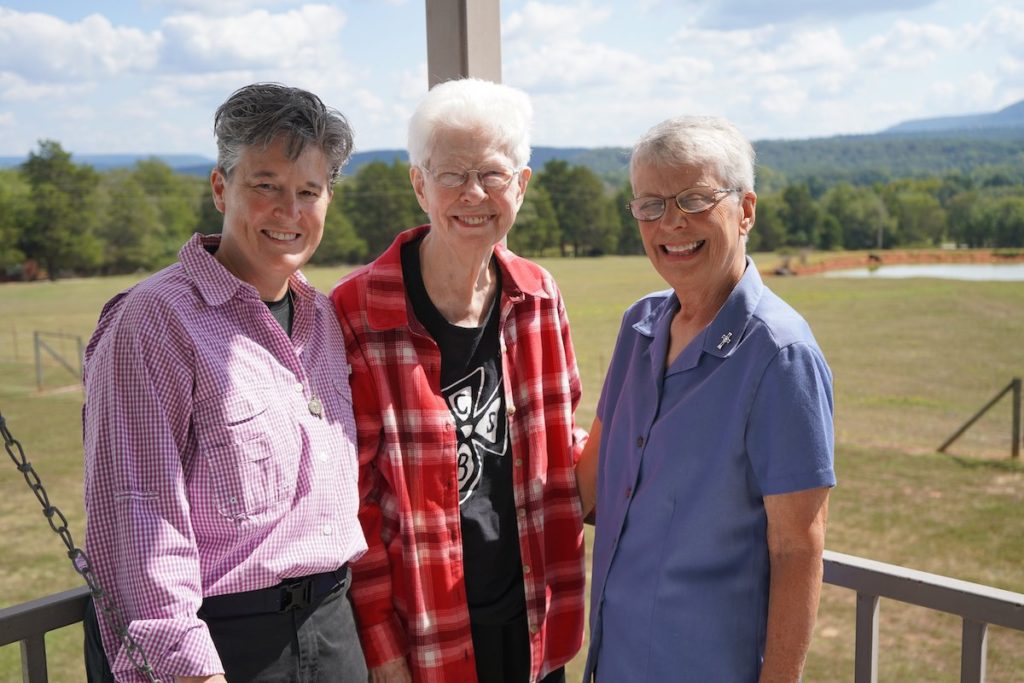
Sister Lisa Atkins, left, director of the Hesychia House of Prayer in New Blaine, Ark., poses for a photo with Benedictine Sister Louise Sharum, the founding director, and Sister Anita DeSalvo, assistant director, Sept. 16, 2021. Sisters Atkins and DeSalvo are Religious Sisters of Mercy. (CNS photo/Aprille Hanson Spivey, Arkansas Catholic)

By Aprille Hanson Spivey, Catholic News Service

NEW BLAINE, Ark. (CNS) — As society gets more anxious, divisive and turbulent with each passing day, Hesychia House of Prayer has been a beacon of stability and peace.

There is something awe-inspiring in pulling into the 40-year-old hermitage amid the backdrop of the distant Ozark Mountains, the cattle grazing and 300 rolling acres the Benedictine sisters credit to God.

“Deep down, the fact that this property, this space has been dedicated explicitly, explicitly, for God since 1879, it’s permeated with prayer over a century,” said Benedictine Sister Louise Sharum, Hesychia’s founding director, about the property owned by the Benedictines.

Hesychia is a ministry of the Benedictines’ St. Scholastica Monastery, but last July the religious order began a partnership with the Religious Sisters of Mercy to lead the house of prayer. Two members of that order, Sisters Lisa Atkins and Anita DeSalvo, were chosen to be Hesychia’s director and assistant director, respectively.

In 1981, the blessing of Bishop Andrew J. McDonald, then bishop of Little Rock, Arkansas, Sister Louise and two other sisters began the Hesychia House of Prayer. “Hesychia” is Greek for “resting in God.”

It is open to anyone who desires to connect with God without distractions. This can mean staying for a night or weekend to even months or years.

Sister Louise, 90, told the Arkansas Catholic, Little Rock’s diocesan newspaper, that she knew right away Sisters Lisa and Anita were a “fit.” “Our charisms basically are very much compatible.”

For Sister Louise, the house of prayer started with a feeling. It came after she stayed at a hermitage in Canada to experience the concept of “poustina,” staying in a sparsely furnished space to fast and pray for 24 hours. She was looking to better understand her dissertation for her doctorate.

After that visit, “I knew deep down my call was not to be a college professor,” Sister Louise said. “I had no idea what it meant, but I knew something deep inside it was different than I thought.”

Little by little, she said she felt called to open a hermitage.

“Spiritual companioning,” or spiritual direction, is available with the sisters. Some guests choose to interact with the three sisters, while others prefer a visit of solitude. Sister Louise said it’s about letting people be who they are before God, letting God reveal his love.

“We can read that; we can hear everybody tell us that from the time we were knee-high to a grasshopper. But until God tells us that in God’s own way, we don’t really know it,” Sister Louise said. “But once you know it, and it’s gradual, you know it’s not the St. Paul experience, but you know deep down.

“In a way, that to me is the main thing that happens when people come here — it’s restful. But the real thing that’s going on underneath is they’re receiving God’s love.”

The four hermitages are named: St. Mark; Sacro Speco, a long-term hermitage; Mother Meinrada, named for the first prioress of St. Scholastica; and St. Hildegard. Each includes a full kitchen, microwave, utensils and coffee maker, heating and air conditioning, full bathroom and a twin bed. Wi-Fi hotspots are available.

Visitors are responsible for their food and meal preparation. Daily Mass is offered at St. Scholastica Church, a short walk or drive from Hesychia. There also are three hiking trails.

A donation of $50 is suggested each night for the first week of stay and $35 a night after. For a one-day visit, a $20 donation is requested. Sister Lisa said they would not turn away any short-term guests who could not afford the fee.

Since about 2004, Sisters Lisa and Anita have visited the hermitage for their annual retreat. However, in recent years, the sisters visited every weekend, allowing Sister Anita to care for her mother, who died in July 2020.

Before accepting the call to lead Hesychia, the sisters served in health care at Mercy Hospital Northwest Arkansas.

Sister Anita was at the hospital for 20 years, supporting the mission and education departments and was a part of the executive team for eight years as a representative of the Religious Sisters of Mercy.

Sister Lisa worked at Mercy as a board-certified nurse practitioner for 17 years. She helped start the community health and benefits department, working toward affordable housing, which will begin this fall.

“When I prayed about it, I really resonated with the call,” Sister Lisa said. “And it was almost as if a new rush of energy, God’s Spirit was just kind of moving within me in a freedom and a deep passion to be about the ministry of Hesychia. I could just feel it in my heart.”

For Sister Anita, a two-month stay following her mother’s death to give her the space to grieve helped her realize the power of Hesychia.

“It provided me exactly what Sister Lisa and Sister Louise have been talking about — time, space, solitude, grounds to walk and be in nature in a way that I had never been, which was healing,” Sister Anita said. “And actually ended up leading me to my own discernment about being here.”

The Hesychia House of Prayer was closed for four months after the pandemic spread in March 2020. The sisters received grants for improvements, and fundraising helped pay for a new tractor to keep up the property and 52 head of cattle.

The hermitages are open to those of any faith or lifestyle. “We don’t judge, we welcome all,” Sister Lisa said.

Each person wishing to make a reservation at a hermitage must be vaccinated and submit a vaccination card as proof.

Sister Lisa said she hopes visitors to Hesychia can experience Jesus in a new way.

“I’ve known about Jesus, I’ve heard about Jesus, I look for Jesus, I found Jesus, but Jesus found me in a different way” at Hesychia, she said. “And I was at a place where I could meet Jesus within myself, in a way that I’ve never experienced before.”

– – –

More information about Hesychia House of Prayer can be found online.


Pope: Church courts must never manipulate facts for a desired end

Pope Francis greets Msgr. Alejandro Arellano Cedillo, dean of the Roman Rota, during an audience for the opening of the judicial year of Tribunal of the Roman Rota at the Vatican Jan. 27, 2022. The Vatican court deals mainly with appeals in marriage annulment cases. (CNS photo/Vatican Media)

By Carol Glatz, Catholic News Service

VATICAN CITY (CNS) — The promotion of justice, including in marriage tribunals, requires a “synodal spirit” of pastoral accompaniment, heartfelt listening and using “the right reasoning” in discernment, Pope Francis said.

This attitude of synodality, he said, “allows for bringing out the essential characteristics” of the judicial process, which is to be at the service of a justice that is inextricably linked to truth and the salvation of souls.

In fact, “any deliberate alteration or manipulation of the facts, aimed at obtaining a pragmatically desired result, is not permissible,” he said. This is a huge danger, he added.

The pope made his remarks during his annual meeting with members of the Tribunal of the Roman Rota, a Vatican court that deals mainly with appeals in marriage annulment cases.

The search for the truth must mark every stage of the judicial process, he told tribunal members Jan. 27.

“It is true that in the process, at times, a dialectic between contrasting assertions takes place; nevertheless, the contradictory (stances) between the parties should always take place in sincere adherence to what for each appears to be true, without closing in on one’s own point of view, but also being open to the contribution of the other participants in the process,” the pope said. Offering one’s own subjective version of the facts becomes “fruitful” when it can be adequately communicated with others in a way that is open to self-criticism.

But that is not the same as manipulating the facts, he said, before departing from his prepared text to further illustrate this “very great danger,” which, when it is not overcome, “even lawyers can cause terrible harm.”

He explained a bishop recently came to him deploring a situation concerning a very serious case facing one of his priests. The pope said the bishop told him a judge of the national tribunal called the bishop to say, “I will do what you tell me. If you tell me to sentence him, I’ll sentence him. If you tell me to clear him, I’ll clear him.”

This sort of thing can happen, the pope said, when there is “no unity” or cohesive way of handling the process, especially when there are conflicting sentences, he said. All parties must work together “because the good of the church, the good of the people, is at stake! This is not a negotiation that takes place.”

While this case had nothing to do with a marriage tribunal, that example of, “What do you want? Shall I sentence him or clear him,” still illustrates the importance of “the prudence of law,” he said. This means working according to “the right reasoning in acting,” that is, that “virtue that judges according to reason, namely, with honesty in the practical sphere,” he said.

The process of synodality can help with this difficult task of discernment, he said, because a synod “is not just asking for opinions, it is not an inquest whereby what each person says applies equally,” because each statement must pass this process of discernment.

“It is a discernment based on walking together and listening, and which allows one to read the concrete marital situation in the light of the Word of God and the magisterium of the church. The judges’ decision thus emerges as having descended into the reality of a vital event,” that is, to discover whether the “irrevocable event” occurred of valid consent upon which marriage is founded, he said.

“I encourage you, therefore, to continue your ecclesial ministry with fidelity and renewed hard work at the service of justice, inseparable from truth and, ultimately, from the salvation of souls,” he said.


In decisions, Breyer has opposed death penalty, supported right to abortion

U.S. Supreme Court Justice Stephen Breyer is pictured in a 2013 photo at Boston University. NBC News reported Jan. 26 that Breyer, 83, the senior member of the Supreme Court's liberal wing, plans to retire after nearly 28 years on the nation's highest court. (CNS photo/Brian Snyder, Reuters)

By Carol Zimmermann, Catholic News Service

WASHINGTON (CNS) — Supreme Court Justice Stephen Breyer formally announced his retirement in a Jan. 27 letter to President Joe Biden after news reports the previous day indicated he planned to retire at the end of the current term.

Breyer and Biden made the announcement public at the White House where Biden said he wished to express the “nation’s gratitude” for Breyer’s “remarkable career of public service and his clear-eyed commitment to making our country’s laws work for its people.”

The president promised to select a nominee worthy of Breyer’s “legacy of excellence and decency” and said he would announce his decision by the end of February. He also said he would nominate a Black woman to the Supreme Court.

Breyer, 83, said in brief remarks that the “experiment” of America still works today as demonstrated by so many who come before the court to solve their major differences under the law.

Breyer has served almost three decades on the court and has been widely seen as one of its liberal voices. His retirement will enable Biden to nominate a successor to Breyer.

During a debate during his campaign for the presidency, Biden said he would appoint a Black woman to the court if he were elected.

Senate Majority Leader Charles Schumer, D-N.Y., said Jan. 26 that Biden’s nominee would receive a prompt hearing by the Senate Judiciary Committee and would be “considered and confirmed by the full United States Senate with all deliberate speed.”

Breyer was nominated by President Bill Clinton in 1994. In recent months, some Democrats have been pleading with the justice, who is the oldest on the bench, to retire soon to ensure Biden could name his successor while Democrats were still in control of the Senate.

In an interview with The New York Times last summer, Breyer said he wasn’t sure when he would retire and that there were many factors that went into that decision.

He also remembered Justice Antonin Scalia telling him that he didn’t want “somebody appointed who will just reverse everything I’ve done for the last 25 years,” which was something he also considered.

In a speech at Harvard Law School last April, Breyer also said he thought it was wrong “to think of the court as another political institution.”

Breyer, who is Jewish, has taken stands that both go against and support Catholic teaching. For example, for several years his decisions have questioned the country’s use of the death penalty, but he has also often sided with laws favoring a right to abortion.

In 2015, in a dissent in Glossip v. Gross, which dealt with the constitutionality of Oklahoma’s use of lethal injections, Breyer wrote that he hoped the court would reassess the constitutionality of the death penalty, noting that it “now likely constitutes a legally prohibited cruel and unusual punishment” under the U.S. Constitution’s Eighth Amendment.

And after a federal execution in July 2020, for which the Supreme Court cleared the way, Breyer wrote a dissent joined by Justice Ruth Bader Ginsburg that said: “A modern system of criminal justice must be reasonably accurate, fair, humane and timely.”

He added: “Our recent experience with the federal government’s resumption of executions adds to the mounting body of evidence that the death penalty cannot be reconciled with those values.”

The justice also wrote two major rulings defending a right to abortion including the 2016 decision that struck down a Texas law imposing restrictions on abortion clinics and doctors. Four years later he wrote the ruling that struck down a similar law in Louisiana.

He also was critical of the court’s decision last December to uphold the Texas law that bans abortions after six weeks of pregnancy while letting one challenge of it move forward.

In 2008, Fordham University’s law school in New York presented Breyer with a prestigious ethics prize in a private ceremony despite a protest held outside the event and a call by a national Catholic organization to rescind the honor in light of the judge’s support for legal abortion.

When the Jesuit-run university announced the award, William Treanor, the law school dean, said Breyer “has devoted his life to the public good” and is “a brilliant, influential and path-breaking scholar.”

He said Breyer embodied the ideals of the ethics prize as a jurist whose “opinions have been marked by thoughtfulness, balance, rigor, and a commitment to justice and liberty. He has been an eloquent and forceful champion of judicial integrity.”

In response to news of Breyer’s upcoming retirement, Kristan Hawkins, president of Students for Life Action, said her organization calls on Republicans “to fight against any nominee who ignores the science of life for the callous calculation that ending innocent lives is the price he or she must pay to get a lifetime appointment on the court.”

Before his years on the bench of the nation’s high court, Breyer was chief judge of the 1st U.S. Circuit Court of Appeals in Boston. His nomination to the Supreme Court had the support of Senate Democrats and Republicans but the pro-life advocacy group, the National Right to Life Committee, was critical of it.

“It is perfectly clear that Breyer will take an expansive view of ‘abortion rights,”’ said National Right to Life legislative director Douglas Johnson at the time.

Breyer’s wife, three children and other family members attended the Rose Garden ceremony in 1994 where Clinton introduced the judge as a consensus-builder and an insightful leader who would help unite the court to speak “with a clear voice.”


People must never forget or repeat horrors of Holocaust, pope says

Pope Francis greets Lidia Maksymowicz, left, in a checkered black and white jacket, who spent 13 months at the Auschwitz-Birkenau concentration camp, during his general audience in the Paul VI hall at the Vatican Jan. 26, 2022. (CNS photo/Paul Haring)

By Carol Glatz, Catholic News Service

VATICAN CITY (CNS) — The cruelty of the Holocaust must never be repeated, Pope Francis said on the eve of the international day of commemoration in memory of the victims of the Holocaust.

The day, celebrated Jan. 27, falls on the anniversary of the liberation of the Auschwitz-Birkenau extermination camp complex in 1945.

At the end of his weekly general audience at the Vatican Jan. 26, Pope Francis said, “It is necessary to remember the extermination of millions of Jews and people of different nationalities and religious faiths.”

“This unspeakable cruelty must never be repeated,” he said. “I appeal to everyone, especially educators and families, to foster in the new generations an awareness of the horror of this black page of history.”

“It must not be forgotten, so that we can build a future where human dignity is no longer trampled underfoot,” the pope said.

At the end of his audience, the pope met with Belarus-born Lidia Maksymowicz, 81, who had spent 13 months at the Auschwitz-Birkenau concentration camp, where she and other children were subjected to Josef Mengele’s medical experiments.

It was her second meeting with Pope Francis, who — at an outdoor general audience May 26, 2021 — had spoken with her, kissed the prisoner number — 70072, tattooed on her left arm and embraced her.

That meeting sparked an idea for her to write an autobiography, with help from the Italian journalist Paolo Rodari. The book, “La bambina che non sapeva odiare. La mia testimonianza” (“The child who did not know how to hate. My testimony”), was recently released in Italian.

At the Jan. 26 audience, she gave the pope a copy of the book, which also contains a preface Pope Francis wrote.

Maksymovicz told ANSA, the Italian wire service, Jan. 26 that she and Rodari decided it would be important to describe the experience of a child during the Holocaust, since so many books cover the experiences of adults who survived.

“One must not forget that more than 200,000 children died just at Auschwitz-Birkenau,” she said.

Even though she was only 3 years old when she and her young mother were taken to the extermination camp, she explained those memories are still vivid and correspond with facts and evidence found by researchers years later.

Her mother was sent to the camp because she was part of the partisan resistance movement in Belarus, while she, as a young child, was designated to become one of Mengele’s “guinea pigs,” she said.

Maksymovicz found her birth mother 17 years after her release from the camp in 1944, when she was adopted by a Polish family.


God offers courage, guidance to those in difficulty, pope says

Pope Francis greets the crowd during his general audience in the Paul VI hall at the Vatican Jan. 26, 2022. The pope explained to the crowd that he had a problem with inflammation in his right knee and that he wouldn't be able to go greet them as usual. Instead the crowd came to him. (CNS photo/Paul Haring)

By Carol Glatz, Catholic News Service

VATICAN CITY (CNS) — God always offers people the help and courage they need to face life’s fears and difficulties, Pope Francis said.

The pope said his thoughts were with all those who “are crushed by the weight of life and can no longer hope or pray.”

Parents, in particular, often must grapple with situations or problems that are out of their control, such as when their child is sick or has a chronic illness. “How much pain is there!” the pope said Jan. 26 during his weekly general audience.

Parents also may be aware their children have “different sexual orientations,” so they must figure out “how to deal with this and accompany their children and not hide in an attitude of condemnation,” he said.

Parents may see their children die of an illness or in a car accident, or they see them struggle in school, he said. There is so much pain or fear, he said, but “never condemn a child.”

Continuing his series of audience talks about St. Joseph, Pope Francis focused on how the saint would discern the voice of God through prayer and dreams.

It is important to be able to recognize the voice of God amid so many other voices, such as “the voices of our fears, the voices of past experiences, the voices of hopes,” the pope said, adding “there is also the voice of the evil one who wants to deceive and confuse us.”

“Joseph demonstrates that he knows how to cultivate the necessary silence and, above all, how to make the right decisions before the word that the Lord addresses to him inwardly,” he said.

God “does not cast us alone into the fire. He does not cast us among the beasts. No,” the pope said. “When the Lord shows us a problem, or reveals a problem, he always gives us the intuition, the help, his presence, to get out of it, to resolve it.”

“Life often puts us in situations that we do not understand and that seem to have no solution. Praying in these moments, this means letting the Lord show us the right thing to do,” he said.

When people experience dangerous situations, “praying means listening to the voice that can give us the same courage as Joseph, to face difficulties without succumbing,” the pope said.

“God does not promise us that we will never have fear, but that, with his help, it will not be the criterion for our decisions,” he said. “Joseph experiences fear, but God also guides him through it,” bringing light to moments of darkness.

To parents facing challenges, the pope said, “Don’t be scared. Yes, there is pain. A lot. But think of the Lord, think about how Joseph solved the problems and ask Joseph to help you. Never condemn a child.”

He praised the compassion and courage he saw in the mothers and fathers visiting their children in prison in Buenos Aires, Argentina, accompanying them rather than abandoning them.

“Let us ask the Lord to give this courage to all fathers and mothers, as he gave it to Joseph. And to pray, no? Pray that the Lord will help us in these moments,” he added.

“It is only when we combine prayer with love, the love for children in the cases I just mentioned, or the love for our neighbor, that we are able to understand the Lord’s messages,” he said.

“May St. Joseph help them to open themselves to dialogue with God in order to find light, strength and peace,” he said.

At the end of his audience talk and general greetings, the pope told visitors that he would be unable to follow his customary practice of walking up to people to greet them. He instead sat in a chair at the foot of the stage for people to come up to him.

“I have a problem with my right leg; a ligament in my knee is inflamed,” he said. “It’s a passing thing. They say this only comes to old people, and I don’t know why it has happened to me,” he said to applause.

The 85-year-old pope had shown some difficulty in walking across the stage with a noticeable limp before the audience. He has also had repeated bouts of sciatica that affect his ability to stand for long periods.


Ukraine deserves peace, Pope Francis says

Pope Francis greets a woman and child during his general audience in the Paul VI hall at the Vatican Jan. 26, 2022. The pope explained to the crowd that he had a problem with inflammation in his right knee and that he wouldn't be able to go greet them as usual. Instead the crowd came to him. (CNS photo/Paul Haring)

By Carol Glatz, Catholic News Service

VATICAN CITY (CNS) — On the day Pope Francis established as a day of prayer for peace in Ukraine, the pope appealed for an end to all war and prayed that dialogue, the common good and reconciliation would prevail.

“Let us ask the Lord to grant that the country may grow in the spirit of brotherhood, and that all hurts, fears and divisions will be overcome,” he said at the end of his weekly general audience in the Vatican’s Paul VI audience hall Jan. 26.

“May the prayers and supplications that today rise up to heaven touch the minds and hearts of world leaders, so that dialogue may prevail and the common good be placed ahead of partisan interests,” he said.

With rising tensions in the region and the threat of a possible Russian-Ukrainian conflict spreading, Pope Francis had set Jan. 26 as a day of prayer for peace in Ukraine.

With the day coinciding with his weekly audience, the pope asked people to pray throughout the day.

“Let us make our prayer for peace in the words of the Our Father, for it is the prayer of sons and daughters to the one Father, the prayer that makes us brothers and sisters, the prayer of children who plead for reconciliation and concord,” he said.

The pope said that as people remember the Holocaust on the eve of International Holocaust Remembrance Day, also “think about the more than 5 million people who were annihilated (in Ukraine) during the time of the last war. They are a suffering people, they suffered famine, they suffered so much cruelty and they deserve peace.”

During a prayer service in Rome’s Basilica of Santa Maria in Trastevere, Archbishop Paul R. Gallagher, the Vatican foreign minister, said that war and its serious consequences deprive many people of their most fundamental rights. The Jan. 26 prayer service was sponsored by the Community of Sant’Egidio.

“It is even more scandalous to see that those who suffer most from conflicts are not those who decide whether or not to start them but are above all those who are just defenseless victims,” the archbishop said.

“It is truly sad to see entire populations torn apart by so much suffering caused not by natural disasters or events beyond human control, but by the ‘hand of man,’ by actions made not in a violent outburst, but carefully calculated and carried out in a systematic way,” he said.

Russia annexed Crimea in early 2014 and, shortly afterward, Russian-backed separatists began fighting Ukrainian government forces in the eastern Ukrainian regions of Donetsk and Luhansk. Some 1.5 million people have fled the region to other parts of Ukraine and thousands of civilians and soldiers have died or been injured.

While in the spring of 2021 Russia was accused by many Western nations of trying to provoke more active fighting by holding military exercises near the border, a massive Russian buildup of troops just over the border created alarm in early December. The buildup has continued and, late Jan. 22, Britain’s Foreign and Commonwealth Office released a statement saying it had evidence that Russia was developing plans to install a pro-Russian government in Ukraine.

All urged to pray, work for ‘a post-Roe America’ that cherishes human life

A pro-life sign is displayed Jan. 21, 2022, during the annual March for Life rally in Washington. (CNS photo/Tyler Orsburn)

By Julie Asher, Catholic News Service

WASHINGTON (CNS) — If Roe falls, “my hope is that we will come together and seize this opportunity to create a post-Roe America where human life is cherished and cared for, and where the family is recognized as the true foundation of a just and prosperous society,” said Los Angeles Archbishop JosĂ© H. Gomez.

“Abortion was among the first social evils opposed by the early church,” the archbishop wrote in his column “Voices,” in Angelus, the archdiocese’s online news outlet, ahead of the Jan. 22 anniversary of Roe. “That commitment has never changed down through the centuries.”

“In the past half-century of legal abortion in America, the Catholic Church has sought to create a culture of care and compassion for women facing challenging pregnancies, and to promote alternatives to abortion such as adoption,” he said. “At the heart of everything we do is our belief that human life is sacred, that every person is created in the image of God and redeemed by the love of Jesus Christ.”

Archbishop Gomez said that as Pope Francis stated, “we can never allow abortion to be regarded as simply a ‘private’ or ‘religious’ matter.”

“Abortion attacks the ‘sacredness of human life,’ the Holy Father reminds us,” he added, “and societies that deny life to the unborn threaten the foundation of all other human rights.”

The Catholic Church “has a duty to bring this perspective to our national conversation about the kind of America we want to create after Roe,” added Archbishop Gomez, who is president of the U.S. Conference of Catholic Bishops.

“We need to insist on what St. Pope John Paul II called ‘the necessary conformity of civil law with the moral law,'” he added. “American history proves that when our laws do not reflect moral law, it leads to the worst injustices. We have seen this with slavery, segregation, abortion and euthanasia.”

He also called for “bold thinking” going forward “on how we can support women and children and promote strong marriages and families.”

The day after his Jan. 19 column appeared, the California Conference of Catholic Bishops issued a statement committing the church “to actively support and advocate for policies and services that enrich the lives of California’s women, children and families.”

The conference, which is the public policy arm of the state’s Catholic bishops, outlined several priorities for the state’s Catholic communities, including:

— To accompany “our sisters … as you walk the journey of motherhood.”

— To raise awareness of “the abundant life-affirming safety net resources available to women, children and families in California through faith-based, community, and public agencies, including food, housing, health care, mental health care, intimate partner violence intervention, paid leave, child care, education, employment, economic and material assistance.”

— “To unite our state’s life-affirming pregnancy shelters, centers, and clinics, creating an accessible statewide network to accompany women facing challenging pregnancies and in the early years of parenthood.”

The Catholic conference said it also will “advocate for transformative family policies,” including increased access to affordable housing, prioritization of homeless pregnant and parenting women and expanded paid leave for families.

Its list of priorities came as Gov. Gavin Newsom and the state’s “pro-abortion” legislative supermajority vowed to turn California — which already has no restrictions on abortion — into an “abortion sanctuary” for the nation if Roe is overturned when the Supreme Court issues its decision this summer in a case involving Mississippi’s law banning most abortions after 15 weeks.

In Texas, retired Bishop Michael D. Pfeifer of San Angelo issued a pastoral statement to mark the Roe anniversary saying that “the staggering magnitude and unbelievable worldwide numbers of abortions” makes abortion “the most urgent, greatest and gravest, moral pastoral issue facing the universal Catholic Church and the church in the USA.”

“As we pray and encourage all Catholics and pro-life Christians around the world to join efforts to stop the enormous magnitude of abortions,” he said, “we focus our attention on our country and working with our bishops, our priests, religious, deacons and all dedicated laypeople to make a super new effort to pull America back from the brink by those who believe in the constitutional principle of life, liberty and the pursuit of happiness for all beginning with the tiny persons in their mother’s womb.”

“Choose life for both the mother and the child” must be “our constant pro-life motto,” he said.

He added that “as followers of Jesus, we understand that when a nation abandons the conviction that all life matters from it’s very beginning, the end result is barbaric” — a result “we must now work to overcome.”

He urged his fellow bishops to “make a concerted effort as pastors and leaders of our people to speak out strongly with a united voice” against abortion and called for developing prayer programs, “centered on the Eucharist”; “constant praying” of the rosary in front of abortion centers; and being “much more proactive in promoting pastoral action, formulating pro-life plans for all the Catholic parishes of our country.”

Bishop Pfeifer echoed the hope of many that the Supreme Court will overturn Roe but also called for support for the Life at Conception Act, introduced by U.S. Sen. Rand Paul, R-Ky., in early 2021.

The legislation would implement equal protection under the 14th Amendment “for the right to life of each born and unborn human.”

During the annual diocesan Mass for Life Jan. 21 in the Cathedral of St. John the Evangelist, Cleveland Bishop Edward C. Malesic told the congregation: “We are all a part of God’s plan. Every unborn child is a part of God’s mysterious plan, too.”

He called the Roe decision “a flawed judgment in 1973” and said “it remains flawed in its interpretation of the Constitution.”

He, too, said the faithful should have hope the law will change, but “unless we change minds and hearts,” we will not advance very far to be a type of society that mirrors God’s kingdom.

People will not be converted to the Gospel of life “by arrogant voices of judgmental people, but by the persuasive power of love and forgiveness that we have found for ourselves in Jesus Christ, our Lord,” Bishop Malesic said. “And women will choose life only when we give them a way to choose it, alleviate their fears and give them a safe place to give birth.”

“Keep those prayers coming for the unborn” and dream big, he added. “But we also must act. Our children are counting on us.”

The Florida Conference of Catholic Bishops in Tallahassee, the public policy arm of the state’s Catholic bishops, said the church is “committed to accompanying all women, including those experiencing unplanned pregnancies or considering abortion.”

Florida’s dioceses, it said, are on board with the U.S. Conference of Catholic Bishops’ initiative Walking with Moms in Need, which connects parishioners with volunteer opportunities at community pregnancy resource centers.

“We wholeheartedly support this ministry that offers tangible, life-affirming support for vulnerable families — fathers, mothers and their babies,” the state Catholic conference said.

“The Catholic Church stands emphatically and unreservedly for the rights of the unborn,” the conference said. “We look forward with the hope that God will soon bring our nation to a profound awareness of the dignity of human life and a recognition that all lives deserve protection under the law.

In a Jan. 12 column in Catholic New York, the archdiocesan newspaper, Cardinal Timothy M. Dolan of New York said he still had Christmas on his mind as he looked ahead to the Jan. 22 anniversary of “the gruesome decision” Roe v. Wade — which he added makes January Respect Life Month “by default.”

“At the center of history, when B.C. becomes A.D., is a mother and her baby,” he said. “Babies are what it’s all about. … Where would we be without babies? Well … extinct!

“Nothing brings hope and promise like the birth of a baby, the sure sign that creation, life, and civilization go on. Lord knows where we would be if babies were not at the center, if infants were looked upon as a curse.”

“Yet … are we close to that?” he continued. “Folks far brighter than I’ll ever be speak about an ‘anti-natalism’ in culture, where pregnancy and babies are thought a burden, where conception and pregnancy are considered a threat to liberation and self-fulfillment.”

Cardinal Dolan noted that right before Christmas, “Pope Francis lamented a ‘demographic winter.’ In his beloved Italy, he noted that the number of deaths last year were higher than the rate of births. That’s haunting!

The late Robert Kennedy — “who beamed over” his children — said “the health of any society can be gauged by the way we treat babies, the fragile and the weak elderly,” the cardinal said. “We may be flunking!”

“‘Choose life, that you may flourish!’ the Bible exhorts. No babies … no life; no babies … no civilization!” he said.