

Pope names Cardinal Czerny interim head of dicastery

Scalabrinian Father Fabio Baggio, undersecretary of the section for migrants and refugees at the Dicastery for Promoting Integral Human Development, Cardinal Peter Turkson, prefect of the dicastery, and Salesian Sister Alessandra Smerilli, interim secretary of the dicastery, pose for a photo at the conclusion of a news conference at the Vatican Dec. 21, 2021. The Vatican announced Dec. 23 that Pope Francis has accepted the resignation of Cardinal Turkson as prefect and that Sister Smerilli will continue in her role. Father Baggio apparently offered his resignation but it was not clear if it was accepted. (CNS photo/Paul Haring)

By Cindy Wooden, Catholic News Service

VATICAN CITY (CNS) — Thanking Cardinal Peter Turkson for his five years of service as prefect of the Dicastery for Promoting Integral Human Development, Pope Francis has decided to name new leadership for the office, said a Vatican communique.

Beginning Jan. 1 and for a limited time, Canadian Cardinal Michael Czerny will serve as prefect and Salesian Sister Alessandra Smerilli will continue to serve as interim secretary, Matteo Bruni, director of the Vatican press office, said in a statement Dec. 23.

In August 2016, Pope Francis had announced the formation of the dicastery by merging the former pontifical councils for Justice and Peace, Cor Unum, Migrants and Travelers, and Health Care Ministry.

The dicastery began operations Jan. 1, 2017, under statutes approved for a five-year experimental period. The pope tapped Cardinal Turkson, who had led the Pontifical Council for Justice and Peace since 2009, to lead the office for that five-year period.

With that mandate up, Bruni said, all the “superiors” of the office offered Pope Francis their resignations. Those superiors apparently included Cardinal Czerny and Scalabrinian Father Fabio Baggio, both of whom were undersecretaries of the dicastery’s Migrants and Refugees Section. Bruni did not say if Father Baggio will continue in his role.

Rumors about the dicastery leadership offering the pope their resignations began a week before the Vatican announcement.

Presenting Pope Francis’ message for World Peace Day 2022 at a Vatican news conference Dec. 21, the 73-year-old Cardinal Turkson told reporters, “All assignments, appointments in the Holy See have a five-year limit. And when five years are up, it is expected that we place our mandate back in the hands of the Holy Father and await whether he confirms, reassigns or prolongs the appointment.”

The cardinal, who’d had a private meeting with the pope Dec. 20, did not provide any details about the meeting. All he would tell reporters Dec. 21 was that he was waiting to hear from Pope Francis.

“If the Holy Father decides to have me continue, that’s what it is. If he decides to reassign me, that’s what it is,” he said. “All of us come here to help and support the Holy Father in his ministry.”

Cardinal Turkson, who was born in Nsuta-Wassaw, Ghana, is the only African currently heading a major Vatican office.

Cardinal Czerny, a 75-year-old Jesuit who was born in the Czech Republic but grew up in Canada, has been one of the two undersecretaries for migrants and refugees since the dicastery was founded. Pope Francis ordained him a bishop and inducted him into the College of Cardinals in 2019.

In March, Pope Francis had named Sister Smerilli, an Italian economist, undersecretary for faith and development at the Dicastery for Promoting Integral Human Development. He named her interim secretary of the dicastery in August after the resignations of Msgr. Bruno-Marie Duffé, secretary, and Argentine Father Augusto Zampini, adjunct secretary.

The change in leadership at the dicastery comes not only at the end of the office’s first five years of existence, it also comes six months after Pope Francis asked Cardinal Blase J. Cupich of Chicago to conduct a visitation of the dicastery “in the context of a normal examination of the activity of the dicasteries, aimed at obtaining an updated understanding on the conditions in which they operate.”

Similar visitations had been conducted of the congregations for Clergy and for Divine Worship and the Sacraments before new prefects were appointed for each.

Cardinal Turkson continues to serve as a member of congregations for the Doctrine of the Faith, Catholic Education, Divine Worship and the Sacraments and the Evangelization of Peoples, as well as the Pontifical Council for Promoting Christian Unity.

The former archbishop of Cape Coast, Ghana, Cardinal Turkson has worked at the Vatican since 2009 when Pope Benedict XVI called him to lead the then-Pontifical Council for Justice and Peace.

 

Family’s faith, values figure into their Tridentine Brewing operation

Jeffery Alcorn, head brewmaster, prepares mash for the Tridentine Brewing Co., in this undated photo. (CNS photo/courtesy Tridentine Brewing via Amanda Lauer)

By Amanda Lauer, Catholic News Service

Trevor Alcorn comes from a storied line of brewers. His great-great-grandmother brewed beer in her bathtub in Chicago during Prohibition in the 1920s.

Home brewing has been a tradition in the family through the decades, but there’s been a 180-degree turnaround in the endeavor since its illicit start.

Alcorn, a lifelong Catholic who lives in northern Illinois, has a home-based brewing operation called Tridentine Brewing.

“My maternal grandfather brewed in the 1990s. He taught my father how to brew,” noted Alcorn. “My dad was brewing a bit then, but for a while the hobby was forgotten. Several years ago, my parents were moving houses and we came across all the brewery supplies that my father had. I asked him to teach me how to brew.”

Originally the brewing was a casual pastime, a relatively simple process. Alcorn likened it to getting a premade mix for a cake. However, since 2019, he, his father, Jeff Alcorn, and brother Cameron Alcorn have upped their brewing game.

“Now we do what all commercial brewers do. We start from scratch with our own grains that we buy,” he said in an interview for Catholic News Service. “It’s almost as if you are an actual chef making something from scratch. The only difference technically between us and a commercial brewer is they’ve got bigger equipment.”

Jeff is Tridentine’s brew master. “He’s the master behind creating all the recipes and everything else for the beer,” Alcorn explained. “Cameron is our graphic designer, he helps us create the website, all of our labels, he’s the design genius behind all that.”

Their product line and graphics are showcased on their website, www.TridentineBrewing.com, and on Instagram, @tridentinebrewing.

What truly sets Tridentine Brewing apart from other brewers is the family’s vision and mission. When they started brewing more frequently, they decided to start naming their beers and, as devout Catholics, they wanted the names to have some meaning, say a reference to a saint.

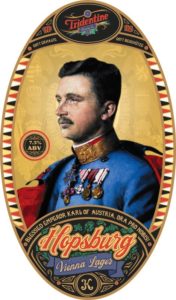
Alcorn has a deep devotion to Blessed Karl of Austria and so one of their creations is named in his honor.

“When we were going through and creating beer recipes, the first few beers that we created were Vienna lagers,” he recalled. “There’s no greater person to link to the Vienna lager than Blessed Karl since Vienna was the capital of Austria-Hungary during his time.

“I came up with the idea of a Hopsburg Beer so I didn’t infringe on the Habsburg name and it had a bit of a quirky twist to it since hops is the key ingredient in the beer-making process.”

Alcorn explained his devotion to the emperor who, along with his wife, Empress Zita, is on the road to sainthood; the empress has the title “Servant of God.”

This illustration shows the label on the Tridentine Brewing Co.’s Hopsburg Vienna Lager, named for Blessed Karl of Austria, who was one of the last monarchs belonging to the House of Habsburg-Lorraine. The Catholic family that operates the home-brewing company in northern Illinois has named some of its creations after saints. (CNS photo/courtesy Tridentine Brewing via Amanda Lauer)

“I’ve always been into history and politics. I held a seat on our local City Council about 10 years ago and was doing some research about World War I and politicians in general,” he said. “When you think about Catholic politicians who have been good role models, they are few and far between.

“I stumbled upon Blessed Karl and found out that he was going through the sainthood canonization process. He was a great father, a great husband and a great politician.”

This devotion goes further than naming a beer after Blessed Karl. Alcorn and his wife, Katelyn, who have four children ages 6 and under, named their 2-year-old daughter Zita, in honor of Empress Zita, and their infant son is named Augustus Karl.

Technically, Tridentine Brewing is a hobby business, which means that the team does not sell their product, but they give plenty away to family, friends and for events such as church picnics.

The most notable occasion where they shared their beer this year was Oct. 21, the feast day of Blessed Karl of Austria. They delivered 200 bottles of Emperor Karl beer to St. Mary Mother of God Church in Washington.

Archduke Eduard Habsburg-Lothringen, a descendent of Blessed Karl, who is the Hungarian ambassador to the Vatican and the Sovereign Military Order of Malta, flew in from Rome to attend the Mass held at the church, which houses one of a handful of shrines in the United States to Blessed Karl.

After the Mass, there was a reception at the church, featuring Blessed Karl beer, and the archduke gave a presentation about the saintly man and held a question-and-answer sessions afterward.

“I loved being able to go to the shrine and the holy sacrifice of the Mass there. The coolest part for sure was meeting His Excellency Ambassador Habsburg in person,” Alcorn said. “I follow him on Twitter (along with nearly 42,000 other fans). He’s a great guy. You can tell he’s very devoted to the faith.”

For his part, the archduke seemed impressed with Alcorn’s product and touched by his devotion to his ancestor.

Alcorn works full-time in IT for a life sciences company but he has a dream of turning Tridentine Brewing into a commercial brewery someday and they’d be able to sell their beer on site, across the Midwest, and their products could then be ordered online and shipped throughout the United States.

“There’s great interest in the United States in Blessed Karl but also something that is Catholic-themed. We’re trying to make all the labels beautiful, really honoring various saints,” he said.

It’s said that food tastes better when made with love so it goes without saying that beer is enhanced when made with prayers.

“There’s a brewing prayer that exists — a beer blessing,” said Alcorn. “So, we’ll pray to the Lord for our beer or pray to St. Wenceslaus because he is patron saint of brewers and we pray to Blessed Karl for his intercession. Especially when we’re brewing his beer.”


COVID-19 vaccines present ‘no ethical problem,’ says head of papal academy

A man receives a dose of the COVID-19 vaccine at a church in Berlin Dec. 20, 2021. Archbishop Vincenzo Paglia, president of the Pontifical Academy for Life, said during a Dec. 22 news conference, that authorized COVID-19 vaccines present no ethical dilemma, while refusing them is irresponsible towards oneself and others. (CNS photo/Hannibal Hanschke, Reuters)

By Carol Glatz, Catholic News Service

VATICAN CITY (CNS) — The Vatican has reaffirmed its support of COVID-19 vaccines with both the head of the Pontifical Academy for Life and a Holy See communique reiterating Pope Francis’ insistence that getting inoculated is “an act of love.”

The Holy See issued its written communique Dec. 22 following the publication the same day of an executive summary by the Vatican’s COVID-19 Commission and a note by the Pontifical Academy for Life; both documents were dedicated to the impact of the COVID-19 pandemic on children.

At the documents’ presentation, Archbishop Vincenzo Paglia, president of the papal academy, told Catholic News Service that authorized COVID-19 vaccines present no ethical dilemma, while refusing them is irresponsible toward oneself and others.

Archbishop Paglia said the church has long been very careful and attentive to the morality of vaccines using cell lines developed decades ago from the tissue of aborted fetuses. It has established that “there is no ethical problem” for the recipient and no cooperation with evil because of the “remoteness” of the original abortions.

“Rather, the problem is the inverse. The risk is the irresponsibility toward oneself and others” by refusing vaccination against a deadly disease, he said.

Also, all vaccines for adults and children, he explained, “must be safe, authorized and guaranteed” by the proper authorities.

Dr. Alberto Villani, an academy member and head of general pediatrics and infectious diseases at the Vatican-owned Bambino Gesù Pediatric Hospital in Rome, told CNS it also is important to remember the ethical dilemma caused by those who intentionally refuse vaccination against COVID-19 and fall seriously ill, requiring hospitalization.

This takes up limited spaces and equipment in hospital intensive care units, denying immediate or adequate care for others, he said.

Villani said it also was questionable when people argue that “only a few” people die or get seriously ill from COVID-19, as if there were “an ethical threshold” of an acceptable number of deaths when in reality each single life has value.

The Holy See statement comes one year after the Congregation for the Doctrine of the Faith published its “Note on the morality of using some anti-COVID-19 vaccines.” Therefore, the Vatican said, “it seemed opportune to reaffirm the favorable position of the Holy See toward vaccines.”

“The Holy Father has defined vaccination an ‘act of love’ seeing as how it aims to protect people against COVID-19,” the communique said. Pope Francis also has repeated the need for the international community to increase cooperation so that “everyone has quick access to vaccines, not as a matter of convenience, but of justice,” it added.

The statement comes as there is ongoing opposition to authorized COVID-19 vaccines and concerns about the morality of using vaccines that used — in either the development or testing phases — cell lines developed decades ago from the tissue of aborted fetuses.

The three vaccines approved for use in the U.S. — Pfizer-BioNTech, Moderna and Johnson & Johnson’s Janssen –- all rely on abortion-derived cell lines, the first two in testing and the Johnson & Johnson vaccine throughout the development, testing and production stages.

In a December 2020 document, the U.S. bishops reiterated Catholic teaching on morally compromised vaccines, noting their use can be justified amid urgent health crises, a lack of available alternatives and their remote connection with the abortions from which their cell lines originated.

The bishops’ document echoes the guidance issued by the Vatican’s doctrinal congregation, which said in its note Dec. 21, 2020, that “all vaccinations recognized as clinically safe and effective can be used in good conscience with the certain knowledge that the use of such vaccines does not constitute formal cooperation with the abortion.”

However, the doctrinal congregation emphasized that “the morally licit use of these types of vaccines, in the particular conditions that make it so, does not in itself constitute a legitimation, even indirect, of the practice of abortion, and necessarily assumes the opposition to this practice by those who make use of these vaccines.”

The congregation repeated the Vatican’s call on pharmaceutical companies and governmental agencies to produce, approve and distribute ethically acceptable vaccines, that is, without using morally compromised cell lines at all.

The doctrinal office also said that “vaccination is not, as a rule, a moral obligation and that, therefore, it must be voluntary.” But from an ethical point of view, “the morality of vaccination depends not only on the duty to protect one’s own health, but also on the duty to pursue the common good,” it added.


Ethiopian bishop describes ongoing conflict as people’s ‘Way of the Cross’

Ethiopian refugees fleeing from the ongoing fighting in Tigray region, carry an infant and a water container at the Fashaga camp, on the Sudan-Ethiopia border Nov. 24, 2020. Bishop Lesanuchristos Matheos of the Eparchy of Bahir Dar-Dessie described the violence in the region as a "Way of the Cross" for the church and the faithful. (CNS photo/Mohamed Nureldin Abdallah, Reuters)

By Laura Ieraci, Catholic News Service

An Ethiopian Catholic bishop has described the massive destruction, suffering and loss of life that continues to plague the people in his eparchy since violence spilled over from the conflict that erupted in the Tigray region more than a year ago.

Bishop Lesanuchristos Matheos of the Eparchy of Bahir Dar-Dessie described the violence as a “Way of the Cross” for the church and the faithful.

“We are all in great tribulation, tension and sorrow with the numerous people who are in exodus, forced to leave their land and property to save their lives and that of their families,” he said in a recent message.

“Numerous lives are lost, public and private properties are looted,” including hospitals, and infrastructure has been destroyed, he wrote.

The “most painful” aspect of his hospital visits, the bishop said, has been ministering to the young girls and women being treated for injuries they sustained as victims of sexual violence. Armed groups on both sides of the conflict have been accused of using rape as a weapon of war.

The eparchy’s territory is just south of Tigray, a region in northern Ethiopia, and spans the entire country, from west to east.

The conflict spilled into the eparchy when armed forces aligned with the former ruling party, the Tigray People’s Liberation Front, known as TPLF, moved out of Tigray and seized several towns within the eparchy’s boundaries — including Dessie, Kombolcha and Kobo — as they advanced toward the capital Addis Ababa. Forces allied with the Ethiopian government later retook the towns.

However, church infrastructure in those areas has come largely undone as religious communities and lay workers scattered and fled to safety.

As summer started, TPLF forces took control of Kobo, where the Capuchin Fathers run St. Joseph Church, an orphanage, an elementary school and high school. By early July, the Capuchins fled with the 20 orphans in their care as part of a mass exodus from Kobo to Woldiya, about 34 miles south. At least one of the Capuchins’ buildings was damaged. Health workers, teachers and other lay workers also fled the town.

The Ursuline Sisters in Kobo, who run a clinic and a kindergarten, however, decided to stay behind to serve the people. But with the collapsed communications infrastructure in Kobo, the bishop said he has not received much news about the sisters.

“The little information we are receiving is from some individuals who know our sisters and who have escaped from the town,” he said. “We are worried about them, as they do not have supplies, especially food and other supplies.”

There has been no “humanitarian support entering into the town for more than four months,” the bishop added.

Although the Ethiopian Catholic Church does not have parishes in northern towns, such as Nefas Mewcha, where sexual violence and the destruction of homes, clinics and other social institutions were rampant, its social and development office is working in these areas offering humanitarian assistance. Staff members have described the situation in the towns as “unimaginable,” Bishop Matheos said.

“With faith as Christians, we still believe that God intervene(s) for this painful experience,” he added.

The eparchy’s social and development office is also assisting internally displaced people in Dessie, but its impact is limited given the need of the more than 200,000 displaced people in the town, the bishop reported.

The church response in Dessie includes providing food and non-food essentials to about 1,200 people, with the Catholic parish offering shelter and meals to about 30 children and elderly people in the church compound. The Capuchin friars and Ursuline sisters in Dessie have remained in the town to continue their ministry, even though many people fled to other towns after the TPLF took control of Dessie.

The bishop’s message included several accounts of laypeople, religious and priests, who fled different towns to escape the violence and destruction.

The suffering is ongoing and will have a lasting impact, the bishop said.

“Therefore, we need to scale up support to respond to the humanitarian crisis and massive rehabilitation work in our eparchy in the near future,” he explained. “We need to work hard to rebuild peace among our communities, promote healing, social coexistence and reconciliation.

“We are all praying for peace to prevail, it is only Christ who is the King of Peace who brings lasting peace.”


Jesus’ humble birth a reminder of God’s love for humanity, pope says

Pope Francis greets people during his general audience in the Paul VI hall at the Vatican Dec. 22, 2021. (CNS photo/Paul Haring)

By Junno Arocho Esteves, Catholic News Service

VATICAN CITY (CNS) — The birth of the son of God in a humble stable, in the presence of both lowly shepherds and majestic Magi, is a “universal event that concerns all of humanity,” Pope Francis said.

During his weekly general audience Dec. 22, the pope said that only through humility can one truly understand God and oneself because it “opens us up to the experience of truth, of authentic joy, of knowing what matters.”

“The Magi may have even been great according to the world’s logic, but they made themselves lowly, humble, and precisely because of this they succeeded in finding Jesus and recognizing him. They accepted the humility of seeking, of setting out on a journey, of asking, of taking a risk, of making a mistake,” he said.

Among those present in the Paul VI audience hall were a group of asylum-seekers who, with the pope’s help, arrived in Italy Dec. 16 from Cyprus under a special humanitarian visa program.

Pope Francis thanked Italian authorities for facilitating their transfer and said those who seek refuge and a better life are not just the concern of the country they arrive in but “for all of humanity.”

“All we need to do is to open one door: the door of the heart,” the pope said. “Let us not forget that this Christmas.”

During the audience, the pope paused his series of talks on St. Joseph to reflect on the coming celebration of Christ’s humble birth in Bethlehem.

“Let’s think (about that),” he said. “The Creator of the universe was not given a place to be born.”

The shepherds, who visited the manger after receiving an announcement of Jesus’ birth by an angel, “personify the poor of Israel, lowly people who interiorly live with the awareness of their own want.”

“Precisely for this reason, they trust more than others in God. They were the first to see the son of God made man, and this encounter changed them deeply,” the pope said.

While little is known of the Magi, he continued, their journey to find Jesus represents those “who have sought God down through the ages, and who set out on a journey to find him.”

“They also represent the rich and powerful, but only those who are not slaves to possessions, who are not ‘possessed’ by the things they believe they possess,” he added.

Despite the vast differences between the shepherds and the Magi, both shared in the joy of Jesus’ birth because their humility led them to see God. The pope said that for Christians, humility “leads us also to the essentials of life, to its truest meaning, to the most trustworthy reason for why life is truly worth living.”

The celebration of Christmas, he added, is a time to invite everyone, especially the poor and those who do not believe in God, to see the “reason for our joy.”

The reason, Pope Francis said, is “knowing that we are loved without any merit, we are always loved first by God, with a love so concrete that he took on flesh and came to live in our midst. This love has a name and a face: Jesus is his name, he is the face of love — this is the foundation of our joy.”


‘Stories of a Generation With Pope Francis,’ Dec. 25, Netflix

This is an image for the TV show "Stories of a Generation With Pope Francis," streaming Dec. 25, 2021, on Netflix. (CNS photo/Netflix)

By Sister Hosea Rupprecht, Catholic News Service

NEW YORK (CNS) — Anyone who has followed the pontificate of Pope Francis will know that he consistently encourages the young to learn from their elders and to remember their roots.

That message is front and center in the series “Stories of a Generation With Pope Francis,” which begins streaming on Netflix Christmas Day.

Based on the pope’s 2018 book “Sharing the Wisdom of Time,” published by Loyola Press, the program showcases stories from people over 70 from all quarters of the globe, including the pontiff himself, as they impart their life experiences to youthful filmmakers. Each of its four hourlong episodes is devoted to a central theme: “Love,” “Dreams,” “Struggle” and “Work.”

There are a few famous names in the lineup, such as Martin Scorsese and Jane Goodall. But most of those who appear on screen, under the overall direction of Simona Ercolani, have never lived in the limelight.

Under the heading of “Love,” we’re introduced to Estela Barnes de Carlotto, a 90-year-old woman from Argentina who spent decades looking for her grandson after her daughter was killed during the unrest of the 1970s in that country. More recently, Vito Forino, 72, went for a sail from his home in Lampedusa, Italy, in 2013 and ended up rescuing 47 people from a sinking refugee ship.

One of those classified as a dreamer is New Zealand climate scientist Dave Lowe. Together with a group of other scholars, Lowe won a Nobel Prize for being the first to measure increasing carbon dioxide in the atmosphere of the Southern Hemisphere in 1972.

Costa Rican Danilo Mena Hernandez, 76, has a more personal dream. He yearns for his blind and developmentally disabled twin sons to be able to feel sand between their toes and the ocean waves lapping at their feet.

Sports enthusiasts are not left out — as shown by the stories of an 88-year-old skydiver who learned the skill from her son and a 77-year-old surfer who thought he could ride a tsunami.

Remorse finds its place in the show as well. Asked by his youngest daughter what his greatest regret is, Scorsese responds, “I would have liked to help raise my other daughters,” thus acknowledging that his film career often took precedence over his family life.

The episode on “Struggle” is particularly moving. Gisèle Assoud Sabbagh, 87, for instance, was born in Aleppo, Syria, but was forced to flee to Beirut. Now, she faces yet another upheaval, having to leave her home and the friends she’s made in Beirut to live with her daughter and grandson in France.

As for “Work,” Mexican midwife Natalia Echeverría Fuentevilla reflects on the satisfaction she derives from knowing that she has helped bring thousands of babies into the world during her lifetime. Ninety-year-old Vietnamese cobbler Trinh Ngoc recalls making shoes for the king of Cambodia in the 1950s. And Nike Okundaye, 70, a Nigerian artist and fashion designer, discusses the freedom her profession gave her.

With its sometimes-mature themes, “Stories” is not suitable viewing for kids. Teens and grown-ups, by contrast, will find it warm, uplifting and inspirational.


Supreme Court sends Texas abortion case to federal appeals court

Pro-life advocates pray near the U.S. Supreme Court in Washington Nov. 1, 2021. (CNS photo/Tyler Orsburn)

By Carol Zimmermann, Catholic News Service

WASHINGTON (CNS) — Less than a week after the Supreme Court ruled that the Texas abortion law could stay in place, the court sent back a lawsuit against the state’s abortion law to a federal appeals court, not to the District Court judge who had tried to block the law.

Abortion providers had asked the court to quickly return the case to a lower court, but this was not the direction they were hoping.

Justice Neil Gorsuch, who wrote the Dec. 10 opinion in the Texas case, signed the court’s short order Dec. 16.

The order granted the providers’ request to fast-track the case beyond the normal 25-day wait time. Instead of sending it to U.S. District Judge Robert Pitman, as providers had asked, the court sent the case to it the U.S. Court of Appeals for the 5th Circuit, which was requested by Texas licensing officials.

The state’s abortion law, in effect since Sept. 1, bans most abortions after six weeks of pregnancy.

Since that day, there has been a lot of action in the courts about the law and how it is enforced by citizens who can sue abortion providers.

On Oct. 6, Pitman issued a 113-page order saying that once the state’s abortion law went into effect Sept. 1, “women have been unlawfully prevented from exercising control over their lives in ways that are protected by the Constitution.”

“This court will not sanction one more day of this offensive deprivation of such an important right,” he added.

The 5th Circuit set aside this ruling and on Oct. 14 reinstated the state’s abortion law, refusing a request from the U.S. Department of Justice to let the lower court ruling stand.

During oral arguments about the law Nov. 1, the justices considered whether the Justice Department and state abortion clinics can even challenge the abortion law in federal court because of the way the law was set up with citizens’ enforcement.

This was the third time the nation’s high court considered the state’s law. On Sept. 1, it ruled against blocking it and on Oct. 22, it said the law would remain in effect before its expedited review.

When the court first ruled against blocking the Texas abortion law, the Texas Catholic Conference, the public policy arm of the state’s Catholic bishops, said this action marked the first time since Roe v. Wade that the nation’s high court “has allowed a pro-life law to remain while litigation proceeds in lower courts.”

On Dec. 9, the day before the Supreme Court’s opinion on the Texas abortion law, a Texas state District Court judge ruled that the means of enforcing the state’s abortion law — involving citizens to sue its violators and receive financial compensation — was unconstitutional.

Abortion providers in the state called it a step in the right direction, while pro-life advocates were disappointed.

In his ruling, the Texas judge, however, did not stop the law from being enforced.

In the oral arguments about the Texas law, abortion clinic providers said the providers should be able to sue state-court judges or clerks, the attorney general and licensing officials. The majority of justices ruled Dec. 10 that Texas licensing officials may be sued, but not state court judges, court clerks or the attorney general.

State officials told the Supreme Court that they plan to ask the appeals court to seek a definitive ruling from the Texas Supreme Court about the role the licensing officials play in enforcing the abortion ban.

On Dec. 1, the Supreme Court examined Mississippi’s ban on most abortions after 15 weeks of pregnancy and heard requests to overturn the court’s 1973 Roe decision that legalized abortion.

In the oral arguments, the majority of justices seemed willing to let the state’s abortion ban after 15 weeks stay in place, but it was unclear whether they would take this further and overturn Roe.


Pour money into education, not weapons, wars, pope tells nations

Cardinal Peter Turkson, prefect of the Dicastery for Promoting Integral Human Development, attends a news conference at the Vatican Dec. 21, 2021, for the release of Pope Francis' message for the Jan. 1, 2022 World Day of Peace. Cardinal Turkson downplayed his offer to Pope Francis to resign as head of the dicastery, saying he had completed his five-year term and it was up to the pope to decide what comes next. (CNS photo/Paul Haring)

By Carol Glatz, Catholic News Service

VATICAN CITY (CNS) — Governments must pour more money into education and drastically reduce military spending for there to be genuine progress and peace in the world, Pope Francis said in his annual message for the World Day of Peace Jan. 1.

“It is high time, then, that governments develop economic policies aimed at inverting the proportion of public funds spent on education and on weaponry,” the pope said.

“The pursuit of a genuine process of international disarmament can only prove beneficial for the development of peoples and nations, freeing up financial resources better used for health care, schools, infrastructure, care of the land and so forth,” he said.

The pope’s message was released Dec. 21 at a Vatican news conference led by Cardinal Peter Turkson, prefect of the Dicastery for Promoting Integral Human Development.

The pope’s message, which the Vatican sends to heads of state around the world, invited everyone to “work together to build a more peaceful world, starting from the hearts of individuals and relationships in the family, then within society and with the environment, and all the way up to relationships between peoples and nations.”

Pope Francis proposed “three paths” for building lasting peace: dialogue between generations and concrete projects they can share; education aimed at building freedom, responsibility and development; and dignified labor that protects people’s rights and the environment.

“Great social challenges and peace processes necessarily call for dialogue between the keepers of memory — the elderly — and those who move history forward — the young,” Pope Francis said.

“The global crisis we are experiencing makes it clear that encounter and dialogue between generations should be the driving force behind a healthy politics,” one that “is not content to manage the present ‘with piecemeal solutions or quick fixes,’ but views itself as an outstanding form of love for others, in the search for shared and sustainable projects for the future,” he said.

Young people, he added, also should be given respect and encouragement for their commitment to working for a more just and sustainable world.

Education helps provide the skills and setting for dialogue between generations, cooperation and sharing expertise and experiences for promoting integral human development, he said. However, “there has been a significant reduction worldwide in funding for education and training; these have been seen more as expenditures than investments.”

At the same time, he said, military expenditures “have increased beyond the levels at the end of the Cold War and they seem certain to grow exorbitantly.”

He called on governments to cut military spending, boost investment in education and do more to “promote the culture of care, which, in the face of social divisions and unresponsive institutions, could become a common language working to break down barriers and build bridges.”

Cardinal Turkson told reporters that trying to build security through stockpiling weapons only creates more distrust, which, in turn, feeds a desire for more weapons.

Working on building trust will help in reducing arms spending, he said, and the more the world develops an increased sense of human fraternity and “closeness,” the more arms will become unnecessary.

The pope said in his message that having dignified work is also part of building and keeping peace as it lets people contribute toward “a more habitable and beautiful world.”

But the COVID-19 pandemic has hurt many in a labor market that was already facing multiple challenges and it has had a devastating impact on “the informal economy, which often involves migrant workers,” he said.

Many migrant workers and their families “live in highly precarious conditions, prey to various forms of slavery and with no system of welfare to protect them,” the pope said. “Currently only one-third of the world’s population of working age enjoys a system of social protection, or benefit from it only in limited ways.”

The only answer to this and other challenges “is an expansion of dignified employment opportunities” and decent working conditions for jobs that support the common good and safeguard creation, the pope said.

“The freedom of entrepreneurial initiatives needs to be ensured and supported,” he said. “At the same time, efforts must be made to encourage a renewed sense of social responsibility, so that profit will not be the sole guiding criterion.”

Companies need to respect the fundamental human rights of workers, and this requires “raising awareness not only on the part of institutions, but also among consumers, civil society and entrepreneurial entities,” he said.

Politics has an active role to play here “by promoting a fair balance between economic freedom and social justice,” he said, adding that Catholic workers and entrepreneurs can find guidance with the church’s social doctrine.

Salesian Sister Alessandra Smerilli, interim secretary of the human development dicastery, said at the news conference, “There is no justice without fair … decent and respectful jobs for all.”

Sister Smerilli, who is also part of the Vatican’s COVID-19 Commission, said the dicastery and commission were launching a “Work for All” project that will get input from people who are “looking for creative solutions to the problems of work” so that the right conditions can be created “for something new to happen.”

“Work can no longer be disconnected from care,” she said.

“If we leave it all to the market, the ‘discarded’ will increase and they will be rejected from (having) income and care; we must put care back at the center of the social contract,” she said.

Read Pope Francis’ Message for the World Day of Peace.

Ascension announces ‘Bible in a Year’ podcast in Spanish starts Jan. 1

This is the logo for the podcast "La Biblia en un AÒo," which debuts Jan. 1, 2022. (CNS photo/courtesy Ascension)

WEST CHESTER, Pa. (CNS) — On Dec. 31, nearly half a million people will complete a yearlong journey of reading the entire Catholic Bible with “The Bible in a Year” podcast.

On Jan. 1 Dominican Father Sergio Serrano and Father Dempsey Acosta will duplicate this journey with “The Bible in a Year” podcast in Spanish.

“As Spanish speakers, we are continually drawn to the stories that our grandparents and family pass down to us orally,” Father Serrano said in a news release from Ascension, a multimedia Catholic publisher based in West Chester, which announced announcing the new “La Biblia en un Año” podcast.

“We will be able to listen every day to the great story that God wants to tell us; the beautiful story that will captivate us. Many of us have waited a long time for it to be told in this way,” said the priest, who is director of the Hispanic Apostolate for the Archdiocese of New Orleans.

Ascension, a multimedia Catholic publisher based in West Chester, is the producer of the podcast in English and is working with the Juan Diego Network on the production of “La Biblia en un Año.”

Father Serrano will host each daily episode of “La Biblia en un Año” and narrate all of the biblical readings. Father Acosta, associate professor of theology at the University of St. Thomas in Houston, will appear as a featured guest on 16 special episodes marking key points in the biblical journey.

“La Biblia en un Año” will use the same popular format and reading plan as its English-language counterpart, in which well-known YouTube priest Father Mike Schmitz read every verse of the entire Catholic Bible in 365 days, using a reading plan based on Scripture scholar Jeff Cavins’ Great Adventure Bible Timeline.

The reading plan organizes the 14 narrative books of the Bible into 12 periods to help readers understand how they relate to one another and to God’s plan for salvation.

Father Schmitz, a priest of the Diocese of Duluth, Minnesota, and a popular Catholic speaker and author, and Cavins created the original podcast with the backing of Ascension.

The show became the No. 1 podcast in all categories in the United States within 48 hours of its January 2021 launch, remained the No. 1 podcast in religion and spirituality for most of the year, and expected 170 million downloads and 4 billion total listening minutes by the end of 2021.

Ascension said its website and social media pages are decorated with over 30,000 five-star reviews “and countless testimonials from listeners who have experienced deep conversions, renewed marriages and even healing from addictions through encountering God in his word via the podcast.”

“The impact of ‘The Bible in a Year’ has been simply stunning,” said Ascension’s president and CEO, Jonathan Strate. “We were so humbled to see God do great things with the ‘loaves and fish’ we offered in this podcast. To see nearly half a million people read the Bible cover to cover, many of them for the first time, was such an honor.”

“We have great hope as we bring this podcast that God has used to change lives and save souls to a new Spanish-speaking audience in 2022,” Strate added.

“Many people have told me that reading the Bible ‘cover to cover’ is very difficult,” said Father Acosta. “The great majority have explained that it’s not necessarily the readings themselves, but that many times they can’t find the context or the logic of the passages.”

“You have to know the history of ancient Israel and early Christianity to be able to put what you’re reading in chronological order,” he said. “This is not an easy task for someone who works and has a busy life.”

The podcast presents a “historical organization of the Bible” and “a proclamation of the Divine Word throughout the history of humanity,” the priest added. “In this proclamation, each listener will participate in the story in which God always speaks to human beings out of love.”

José Manuel De Urquidi, founder of the Juan Diego Network, called the new podcast “a great opportunity for Hispanics around the world.”

“From the hands of experts, but in a very simple and personal format, listeners will be able to rediscover the living word of God that has acted not only in history, but continues to work in the hearts of people and in the world today,” he added.

The Juan Diego Network was a winner of the 2020 Our Sunday Visitor Innovation Prize for groundbreaking work in bringing Catholic audio content to Latino audiences.

Because “La Biblia en un Año” podcast will follow the same reading plan as “The Bible in a Year” podcast, parishes and schools with English- and Spanish-language groups will be able to read the Bible “in sync” together during 2022 and beyond, Ascension noted in its news release.

The free reading plan for “La Biblia en un Año” will be available at www.AscensionPress.com/LaBiblia, and the same resource for “The Bible in a Year” is available at www.AscensionPress.com/BibleInAYear.

All podcast episodes are free and available on Ascension’s website and all major podcast platforms.


Pope: Eat, give gifts, be ‘merry’ this Christmas, but don’t forget Jesus

Pope Francis is interviewed at his Vatican residence by adults facing challenging experiences in their lives for a program broadcast on Italian television Channel 5, Mediaset, Dec. 19, 2021. Journalist Fabio Marchese Ragona, center, hosted the program. (CNS photo/courtesy Mediaset)

By Carol Glatz, Catholic News Service

VATICAN CITY (CNS) — Pope Francis asked people to celebrate a “real Christmas” by recognizing Jesus in their lives and cultivating peace in their hearts.

“What is Christmas? Is it a tree? A statue of a baby with a woman and a man nearby? Yes, it is Jesus, the birth of Jesus,” he said, so “stop for a bit and think of Christmas as a message, a message of peace.”

The pope’s words were aired Dec. 19, the last Sunday of Advent, on Italy’s Canale 5 in the special program, “Francis and the Invisible: The pope encounters the least.”

The program, recorded in the pope’s residence, featured a televised “dialogue” and interview with four people facing serious challenges in their lives: Giovanna, a mother of four who experienced domestic violence and lost her home and job during the COVID-19 pandemic; Maria, who lives in a shelter after sleeping on the streets; Pierdonato, who is serving two life sentences in prison; and Maristella, an 18-year-old student and Girl Scout who was representing all young people who felt isolated and abandoned because of the lockdown and restrictions in place during the pandemic.

Each gave the pope a brief account of the challenges they had been facing as well as their ongoing concerns, doubts and questions about what next steps to take.

For example, Giovanna said she lost her faith the day she and her kids managed to escape a life of poverty and violence and asked, “What can we do to regain our dignity?” and how could she give her children strength.

The pope said the abuse of women by their partners “is almost satanic because it is taking advantage of the weakness of someone who cannot defend herself,” and he also criticized the “humiliating” affront of a parent slapping a child on the face.

When reflecting on the dignity of women who have experienced abuse, the pope said the image that comes to mind is Michelangelo’s Pietà with “Our Lady humiliated before her child — naked, crucified and a miscreant in everyone’s eyes.”

“But she has not lost her dignity and to look at this image during difficult times like yours of humiliation and where you feel you’ve lost your dignity, looking at that image gives us strength,” he said.

He said she was already showing her kids’ strength and said the real problem was finding “a concrete way out — a job, a home and this does not depend only on you,” encouraging her to reach out for help and not be afraid of this moment of crisis, made worse by the pandemic.

He told Giovanna he could see the suffering on her face, but also her dignity, “because you would not be here” if she had none left. “You are on a journey, the danger is to give up” and to see no way out, but “you are still on your feet like Our Lady before the cross.”

Maria described the risks of having no shelter and how that leads to trying to be invisible for safety, but how sad and demeaning it is to feel invisible and hear criticism when people pass by. “Why is society so cruel toward the poor?” she asked the pope.

It is cruelty, he said, “it is the harshest slap in the face for you for society to ignore the problems of others,” perpetuating the culture of indifference which seeks to push aside real problems, such as the lack of housing and employment.

“Indifference is cruel, but do not lose hope, keep walking, keep going, perhaps someone will listen to this and help will arrive, not just material help, but the help of someone who will (touch your) heart and begin to understand the problem,” he said.

Speaking with Pierdonato, who asked whether there was hope for people who wanted to change their lives, the pope said true hope, which comes from God, never disappoints.

“God exists, not in outer space, but next to you, because the way of God is closeness, compassion and tenderness,” he said. God is always with those in prison and those experiencing hardship because his very nature is to be close and a “travel companion,” he added.

But it is also important that the prison system never close the door on hope by depriving people of the chance to change, which is why “the church is against the death penalty, because with death there is no ‘window,’ no hope, it ends a life,” he said.

Responding to Maristella, the pope encouraged her and her generation to continue to seek “real” dialogue and in-person relationships, not just virtual ones, and he assured her it is normal to have doubts, to question or even be angry with God.

The important thing is to have a heart at peace because “an anxious heart cannot seek God, cannot maintain a relationship with God,” so it is important to find serenity, even when experiencing suffering or difficulties, he said.

The Gospel is more than just words, in fact, “I’m worried about preachers who only want to heal a life in crisis with words, words, words. A life in crisis is healed with closeness, compassion, tenderness,” he said.

“You must have the courage to tell the Lord all of your feelings as they come — with the Gospel in hand and a heart at peace,” he added.

The pope concluded by wishing those with him and watching on TV “a real Christmas” with Jesus.

It is OK to celebrate, exchange gifts, eat and be merry, he said, “but do not forget Jesus. Christmas is Jesus who comes, who comes to touch our hearts,” families, homes and lives.