
St. Mary-Basha Catholic School celebrates 70 years of faith in education

Bishop Olmsted greeted a long line of St. Mary-Basha Cath students after
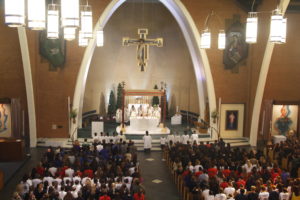
Students from St. Mary-Basha Catholic School read essays they wrote about their Catholic education as Bishop Olmsted and St. Mary Parish's pastor Fr. Dan McBride listen Jan. 30.
Students from St. Mary-Basha read essays they wrote about their Catholic education to Bishop Olmsted and Fr. Daniel McBride at the 70th anniversary Mass Jan. 30. (Joyce Coronel/CATHOLIC SUN)


CHANDLER — Seventy years ago, Fr. Joseph Patterson realized the primarily Hispanic children in his congregation were not being well served by local segregated schools.

The Sisters of Charity of Seton Hill, Greensburg, Pennsylvania, were already teaching religious education classes at the parish.

That’s how the school known today as St. Mary-Basha began back in 1944 with 123 students in a small school on Williams Field Road.

The school has been celebrating its 70th anniversary during the 2014-2015 school year with a number of events, culminating in a Mass with Bishop Olmsted of the Diocese of Phoenix Jan. 30.

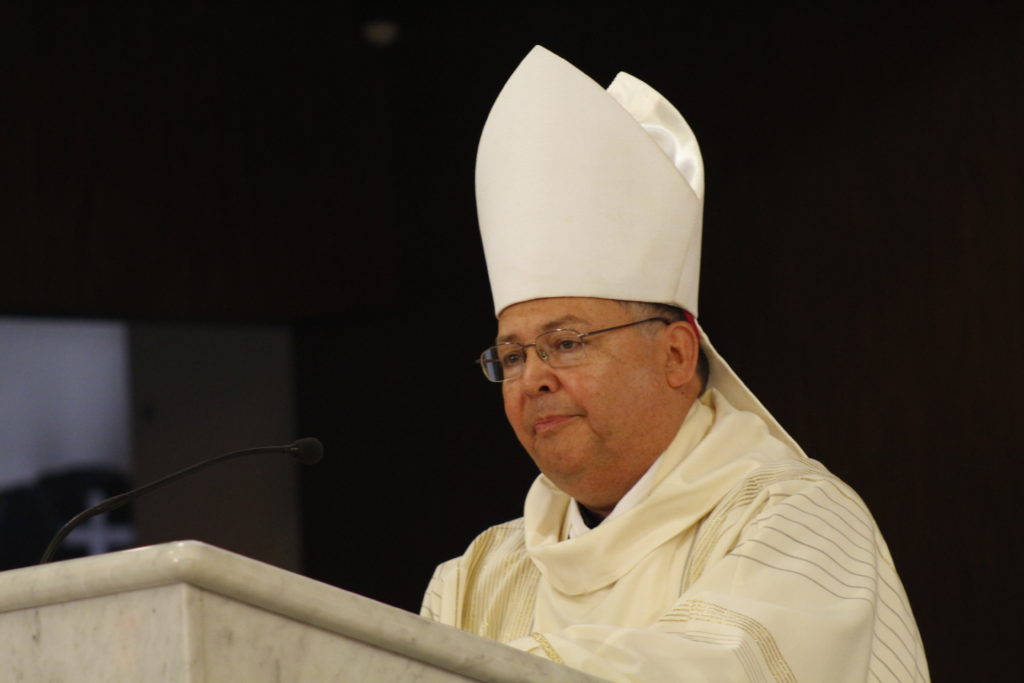
“Think of all the persons we have to thank, those who at the beginning made all the sacrifices,” Bishop Olmsted said. “All the teachers and parents and especially all the young people here who have come to make good friends and worship God together and understand our faith together — that’s what we’re celebrating here today.”

Terry Ryan, who attended St. Mary-Basha with his 10 siblings and graduated from the school in 1973, has been the sixth grade teacher for the last 11 years. Like many members of the faculty, all of his children also attended the school. Through the years, some 35-40 members of the Ryan clan have been a part of the school community. Kay Ryan, the third-grade teacher, is Terry’s brother-in-law. His brother, Deacon Joe Ryan, frequently preaches at school Masses.
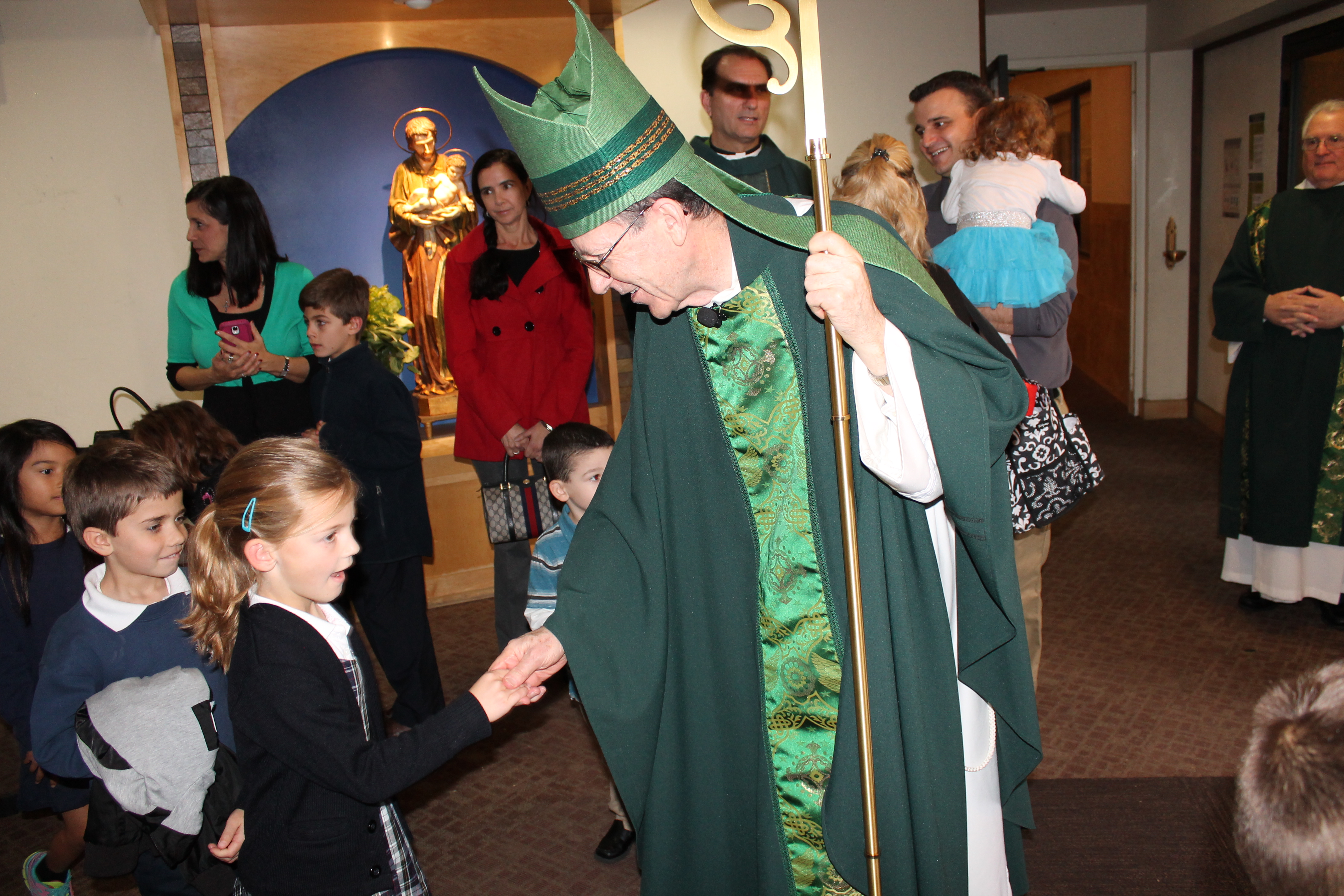
Bishop Olmsted greeted a long line of St. Mary-Basha Cath students after
Bishop Olmsted greeted a long line of St. Mary-Basha students after the school’s anniversary Mass Jan. 30. (Joyce Coronel/CATHOLIC SUN)

The biggest change over the last several decades, Terry said, is that now families come from more than 20 miles away to attend the school.

“It pulls in people in from Maricopa, Ahwatukee, and even Pinal County,” he said. “The best thing about St. Mary-Basha is seeing the generations of kids coming in and the quality stays the same. The faith component is awesome.”

Terry still recalls how he learned about the Eucharist from his second-grade teacher, Sr. Macrina.

“I remember her telling us what a powerful gift we were receiving. I had no doubt it was the Real Presence because of the way she taught us,” Terry said. “When I catch my mind wandering or getting distracted, I remember that.”

The Eucharistic Lord and the Kingdom of God were the themes explored by Bishop Olmsted at the anniversary Mass.

“The fullest time and place where we enter into the Kingdom of God is what we are doing right now, the Mass,” Bishop Olmsted said. “The Eucharist— that is why we are here.”

Solilia Cabrera had tears in her eyes as she expressed her gratitude for the school. Accompanied by her two preschool age daughters and expecting her fifth child, her two sons attend the school. One is in second grade and the other is in kindergarten. This is the family’s second year in the school.

“We had my first son in a public school and when we came here, the first thing we noticed was the morning prayer, something we didn’t have in the other school,” Cabrera said. “That was beautiful. I was very moved to see them standing around the statue of the Virgin to start their day. That’s what I want for my children.”

Brenda Wolf has grandchildren who attend St. Mary-Basha. Their father is an alumnus.

“The fact that you can talk about Jesus, you can say that Christmas is Baby Jesus’ birthday and celebrate those things for what they really are versus have a winter holiday party I just think is fantastic.” Wolf said. “We need Jesus in all our schools.”

At beginning of the all-school Mass, students carried items to the foot of the altar that symbolized different elements of their community. A candle, representing Christ, the light of the world, was brought forth, along with a Bible, a yearbook, a basketball and football and a globe.

The 465 students in the school each signed a large thank-you card they presented to Bishop Olmsted at the close of the liturgy.


Phoenix Diocese Invites Catholics to Participate in Vatican Questionnaire on the Family

synod-survey-2015-7x5-tumblr

Bishop Thomas J. Olmsted announced today the launch of a questionnaire for use at the October 2015 Ordinary Synod of Bishops on the theme, “The Vocation and Mission of the Family in the Church and Contemporary World.”

All of the Catholic faithful are invited to respond to the questionnaire. The responses will help inform Pope Francis and the Bishops of the Synod about the challenges faced by today’s families and enable them to discuss and develop appropriate pastoral solutions.

[quote_box_center]

Take the 2015 Synod Questionnaire for the Synod on the Family

[/quote_box_center]

“I ask Catholics to prayerfully and purposefully consider each question in the questionnaire,” Bishop Olmsted said. “These important questions will assist me in offering a summary on the Synod’s theme of marriage and the family.”

The questionnaire will be available online from Monday, Feb. 2 through Sunday, Feb. 22, in both English and Spanish. The link to the questionnaire is on the Diocesan website at diocesephoenix.org.

The response from the Diocese of Phoenix will be shared with the U.S. Conference of Catholic Bishops and then incorporated into a document that will be forwarded on to the Vatican for use at the Synod.

To help prepare for the October 2015 meeting, Pope Francis has asked Bishops around the world to consult with the faithful in developing a new set of questions aimed at getting a better understanding of the challenges faced today by families. It will explore three parts:

  1. Listening: The Context and Challenges of the Family,
  2. Looking at Christ: The Gospel of the Family, and
  3. Confronting the Situation: Pastoral Perspectives.

In 2013, the Bishops of the world were asked to respond to a series of questions to help gather information to prepare for the Extraordinary General Assembly of the Synod of Bishops taking place in 2014. The responses to these questions were examined thoroughly in an effort to more deeply understand the new challenges of the family. The responses of the faithful to this new set of questions will inform the 2015 Ordinary Synod on the Family.

Diócesis de Phoenix Invita Católicos a Participar en Cuestionario del Vaticano sobre la Familia

synod-survey-2015-7x5-tumblr-spanish.jpg

Obispo Thomas J. Olmsted anuncio hoy el lanzamiento de un cuestionario para el Sínodo Ordinario de los Obispos en Octubre del 2015 sobre el tema, “La Vocación y Misión de la Familia en la Iglesia y el Mundo Contemporáneo”.

Todos los fieles católicos han sido invitados a responder al cuestionario. Las respuestas ayudaran a informar al Papa Francisco y los Obispos del Sínodo sobre los retos enfrentados por las familias de hoy, y a discutir y desarrollar soluciones pastorales apropiadas.

[quote_box_center]

Participe en el Cuestionario del Sínodo sobre la Familia

[/quote_box_center]

“Le pido a los Católicos que con oración y propósito consideren cada pregunta del cuestionario”, dijo el Obispo Olmsted. “Estas importantes preguntas me ayudaran a ofrecer un resumen sobre el tema del Sínodo: el matrimonio y la familia”.

El cuestionario estará disponible en Internet desde el Lunes, 2 hasta el Domingo 22 de Febrero, tanto en Ingles como en Espanol. El enlace para ingresar al cuestionario se puede encontrar en la página en Internet de la Diócesis diocesephoenix.org.

La respuesta de la Diócesis de Phoenix será compartida con la Conferencia de Obispos Católicos de los EE.UU. y luego será incorporada en un documento que será enviado al Vaticano para ser usado en el Sínodo.

En preparación para la reunión de Octubre 2015, el Papa Francisco ha pedido a los Obispos del mundo que consulten con los fieles y desarrollen una nueva lista de preguntas para obtener un mejor entendimiento de los retos enfrentados por las familias de hoy. Se explorara tres partes:

  1. La escucha: el contexto y los desafíos de la familia,
  2. La mirada fija en Cristo: el Evangelio de la familia, y
  3. La confrontación: perspectivas pastorales.

En el 2013, a los Obispos del mundo se les pidió que respondieran a una serie de preguntas para recabar información en preparación a la Asamblea Extraordinaria General del Sínodo de Obispos que tomó lugar en el 2014. Las respuestas a esas preguntas fueron examinadas cuidadosamente en un esfuerzo por entender más profundamente los nuevos retos de la familia. Las respuestas de los fieles a este nuevo cuestionario informaran al Sínodo Ordinario de la Familia 2015.

Cruel and unusual punishment? Court to weigh in on lethal injections

Christian Gohl holds a sign during a vigil held Jan. 28 outside St. Louis University College Church ahead of the execution of death-row inmate Herbert Smulls of St. Louis. Smulls, 56, was executed after midnight Jan. 29 at the penitentiary in Bonne Terre, Mo. Convicted in a 1991 murder committed during a jewelry store robbery, Smulls was granted a temporary stay of execution by the U.S. Supreme Court Jan. 28 but his appeals ran out and he was put to death by lethal injection. (CNS photo/Lisa Johnston, St. Louis Review)

WASHINGTON (CNS) — When the Supreme Court weighs in on the constitutionality of the lethal- injection executions in Oklahoma this year, its ruling will not likely be a tipping point in eliminating capital punishment in the U.S., but some experts say it could be the beginning of the end of this practice.

“It’s not this problem that will end it, but it’s another straw,” said Richard Dieter, executive director of the Death Penalty Information Center based in Washington.

Dieter noted that a lot of public discussion about lethal injections took place last year after the botched execution of Clayton Lockett in Oklahoma, who writhed in pain for 40 minutes before dying of apparent heart failure.

The execution was “quite a shock” and “got a lot of attention,” which he said explains why the drugs used to execute him deserve a review.

In April, the court will hear oral arguments in Glossip v. Gross, a case brought by four death-row inmates in Oklahoma. One of the plaintiffs, Charles Warner, was executed Jan. 15 after the court rejected a stay in a 5-4 vote. The court announced Jan. 23 it would take the case and five days later it agreed to stay the upcoming executions of the other three inmates until it issues a decision.

The case sounds somewhat familiar because in 2008, the court ruled in Baze v. Rees that a three-drug protocol used in Kentucky executions did not violate the Constitution’s ban on cruel and unusual punishment. In this drug combination, the first drug causes unconsciousness, the second brings about paralysis and the third stops the heart.

But in recent years, a shortage of those drugs has caused states to try a variety of drug combinations in their lethal injections, not the drugs the court considered and upheld in 2008. Some combinations, as shown by Lockett’s botched execution, do not always work as intended.

Currently, the 32 states that have the death penalty use lethal injections. If they are going to continue with that method, the deaths can’t take a significant period of time, said Meg Penrose, professor of constitutional law at Texas A&M’s University School of Law.

“The court is saying let’s at least pause and get more information,” she said, adding that she doesn’t think the court would “overturn the death penalty as a method of punishment” but the justices might determine that until better medication is available, states should “use another method.”

According to the plaintiffs’ case, the drug midazolam, the first drug used in Oklahoma executions, does not sedate the prisoner sufficiently thus creating the risk of excessive pain, which violates the standards set in the Baze ruling and in the Constitution.

One of the other plaintiffs, Richard Glossip, was scheduled to be executed Jan. 28 before the stay was announced. Sister Helen Prejean, a Sister of St. Joseph and a longtime anti-death penalty activist, has been a spiritual adviser to 51-year-old Glossip and has said she will accompany him to the execution chamber if he loses his appeals.

During a Jan. 27 news conference at the state Capitol in Oklahoma City, Sister Prejean said: “There is no humane way to kill a conscious, imaginative human being. We the citizens have our name on that gurney.”

According to the Gallup poll last fall, a majority of Americans still support capital punishment, but some feel the tides are slowly turning.

Dieter said the lethal injection cases illustrate the “ambivalence people have about the death penalty” noting that they might be willing to have it but they aren’t “comfortable with the way it’s working.”

He also said people say they support capital punishment yet they vote for legislators and governors who have said they will abolish it.

Marc Hyden, advocacy coordinator for Conservatives Concerned About the Death Penalty, a group which formed in 2013, acknowledged that conservatives have not always been at the front of the anti-death penalty bandwagon but he said that they are starting to shift their opinion, recognizing that it is a pro-life issue and limited-government issue.

Karen Clifton, executive director of the Catholic Mobilizing Network to End the Use of the Death Penalty, said Catholics also are becoming more galvanized in their views against capital punishment.

She said the botched death by lethal injection is not only a “stark reminder” of the dignity of human life, but it also raises public awareness of the death penalty and gives groups such as hers more opportunities to educate Catholics about what Church teaches.

Last October, Pope Francis called on Christians and all people of good will “to fight … for the abolition of the death penalty … in all its forms” out of respect for human dignity.

The U.S. bishops have been advocating against the death penalty for more than 40 years. In 2005, they initiated the Campaign to End the Use of the Death Penalty and continue to work closely with state Catholic conferences, the Catholic Mobilizing Network and other groups to abolish the death penalty in the United States.

Clifton said in recent years more Catholics have been against the death penalty because they have recognized it as a pro-life issue.

“We are executing the marginalized in our society,” she said, noting that the Scriptures are full of references to how “we will be judged by how we treat the least among us.”

— By Carol Zimmermann, Catholic News Service. 

Thinking about religious life? The world is

(CNS illustration/NRVC)

Celebrate World Day of Consecrated Life during #YCL15 by visiting an open house hosted by men and women religious who are serving in the Diocese of Phoenix.

  • Religious Sisters of Mercy — 9:30 a.m.-noon Feb. 7 at 6329 N. 41st Ave. in Glendale. Women who are discerning religious life are particularly welcome to chat with the sisters to learn about consecrated life and the charism of mercy.
    RSVP by Feb. 5 to sr.anthonymary@diocesephoenix.org or (602) 368-2485.
  • Desert Nuns (Poor Clare Sisters of Perpetual Adoration) — 9 a.m. Feb. 8. Mass followed by reception and open house at Our Lady of Solitude Monastery in Tonopah. Includes unique tour of future cloistered areas of the chapel and sharing of the architectural plans for the future monastery. Contact the sisters for good driving directions.
  • Crosier Fathers and Brothers — 2:30-4:30 p.m. Feb. 8 at 2617 E. Campbell Ave. (map) in the Biltmore area of Phoenix (invitation). It’s across the street from St. Thomas the Apostle Parish. Discover the charism of the 805-year-old order and learn what it’s like to live in a religious community and minister to God’s people through an array of ministries.

You can journey along with Sr. Anthony Mary Diago, RSM, through this virtual tour of two religious communities serving the Diocese of Phoenix. Then contact them to see about a real visit or open house. The director for the diocesan Office of Consecrated Life recently visited sisters of the Society of Our Lady of the Most Holy Trinity and Carmelite Missionaries of St. Therese of the Child Jesus.

You might also consider connecting with some of these resources:

  • Waking up the World — It’s a new blog reflecting on consecrated life in the Diocese of Phoenix
  • Giving Voice — It’s a peer-led organization that creates spaces for younger women religious to give voice to their hopes, dreams and challenges in religious life.
    Some of its members host a retreat at Our Lady of Guadalupe Monastery in west Phoenix every year. Check out a reflection from the January retreat. It’s written by the author of “Diary of a Sister-in-Training.”
  • Bishop Olmsted’s message and homily for the Year of Consecrated Life

Check out this bilingual video from Catholic Stuff about vocations:

And while it’s not a vocation event per se, if your schedule permits, consider spending part of a Friday evening with a SOLT Sister — Society of Our Lady of the Most Holy Trinity. Sr. Miriam James Heidland kicks off Catholic Devils Week at the All Saints Newman Center with a talk on authentic love.

Catholic Schools Week Rally highlights [VIDEO]

The annual student rally at the state Capitol celebrates National Appreciation Day for Catholic schools and marks the midway point of Catholic Schools Week. Students from the three dioceses that serve Arizona gathered for a picnic and rally that featured cheers, student testimonies, brief bishop addresses and a short speech from Governor Doug Ducey.


[quote_box_center]

Catholic Schools Week coverage


[/quote_box_center]

Pontifical council to consider challenges women face in society, Church 

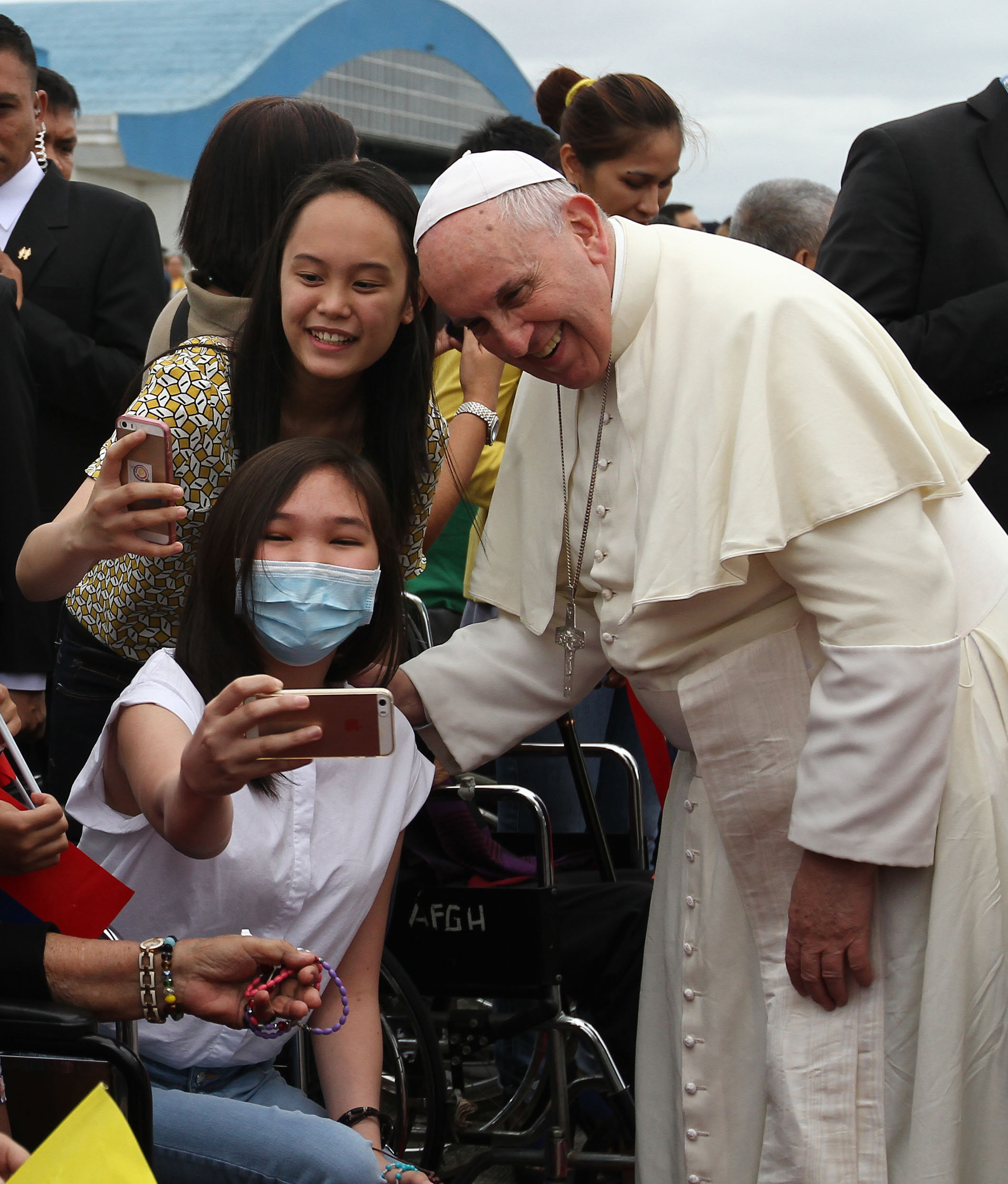
Pope Francis poses for a selfie with young women at Manila's international airport in the Philippines Jan. 17. (CNS photo/Malacanang photo bureau handout via EPA)
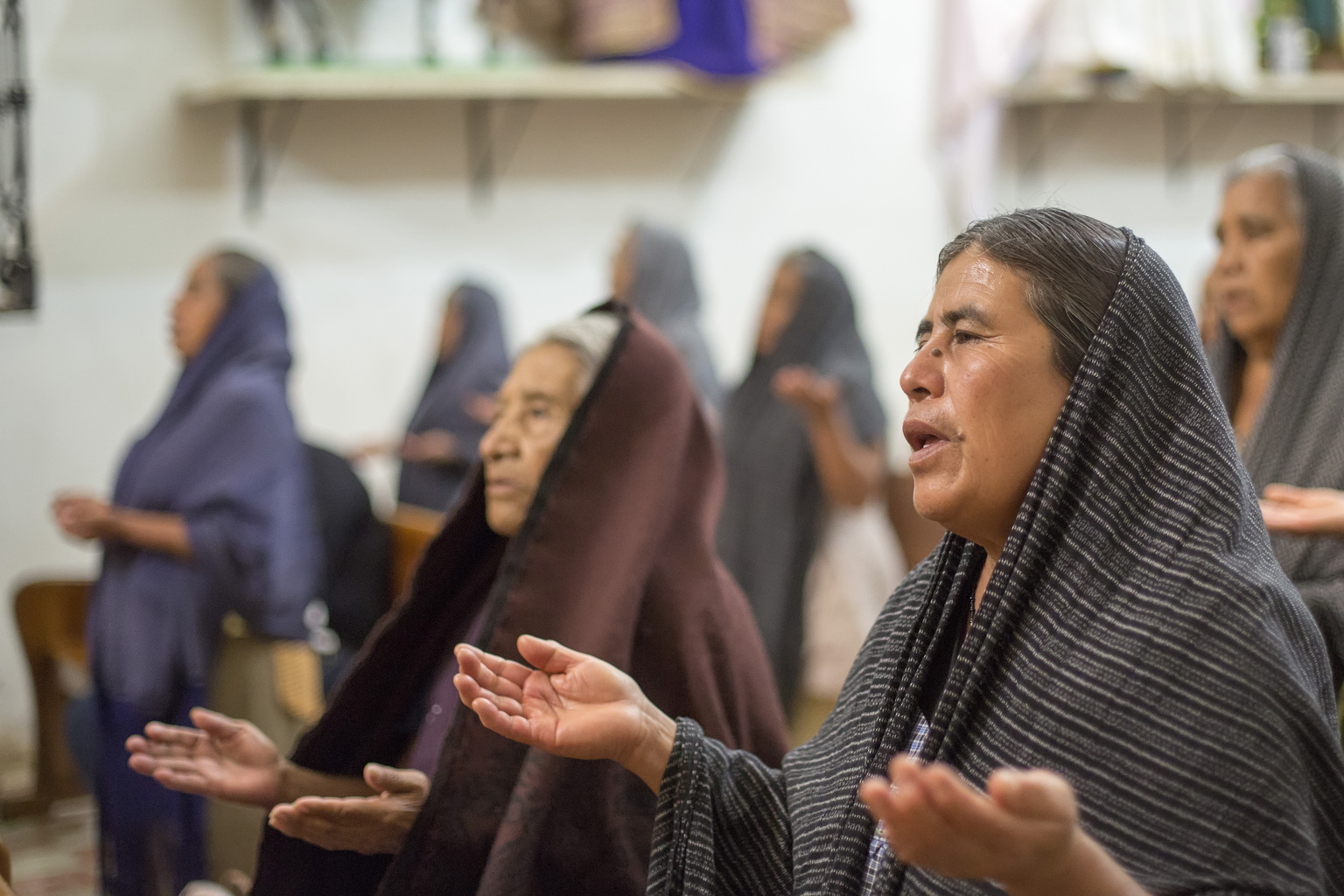
Women pray during Mass at San Sebastian Abasolo church in San Sebastian, in the Mexican state of Oaxaca, Jan. 15 during an annual celebration of the town's patron saint. During the nine-day celebration, a different local resident volunteers to organize a daily Mass, arranging for the priest, flowers, a band and fireworks. (CNS photo/Jim West)
Women pray during Mass at San Sebastian Abasolo church in San Sebastian, in the Mexican state of Oaxaca, Jan. 15 during an annual celebration of the town’s patron saint. The Pontifical Council for Culture has released a document on the role of women in the Church and in society and will discuss the topic in a plenary session in February. (CNS photo/Jim West)

VATICAN CITY (CNS) — Violence against women, cultural pressures regarding women’s physical appearance, attitudes that subjugate women or that ignore male-female differences and the growing alienation of women from the Church in some parts of the world are themes the Pontifical Council for Culture is set to explore.

The council has chosen to discuss the theme, “Women’s Cultures: Equality and Difference,” during its plenary assembly Feb. 4-7 at the Vatican. A news conference was scheduled for Feb. 2, but the council published its discussion document on the topic in late January.

The document, drafted by a group of women appointed by the council, looked at the continuing quest to find balance in promoting women’s equality while valuing the differences between women and men; the concrete and symbolic aspects of women’s potential for motherhood; cultural attitudes toward women’s bodies; and women and religion, including questions about their participation in church decision-making.

Pope Francis poses for a selfie with young women at Manila's international airport in the Philippines Jan. 17. (CNS photo/Malacanang photo bureau handout via EPA)
Pope Francis poses for a selfie with young women at Manila’s international airport in the Philippines Jan. 17. (CNS photo/Malacanang photo bureau handout via EPA)

The council said the theme was chosen “to identify possible pastoral paths, which will allow Christian communities to listen and dialogue with the world today in this sphere,” while recognizing that in different cultures and for individual women the situation will be different.

While cautioning against generalizations, the document rejects the notion that there are no differences between men and women, and that each person “chooses and builds his-her identity; owns him-herself and answers primarily to him-herself.”

In preparing the document and the plenary discussions, the council sought input from women around the world. However, the process was not without criticism, particularly for the English version of a video featuring an Italian actress, Nanci Brilli, asking women to send in their experiences. Many women felt the use of a heavily made-up actress ran counter to the point of seeking input about the real lives of most women. The council quickly took the English version off YouTube.

In the section on women and the Church, the document described “multifaceted discomfort” with images of women that are no longer relevant and with a Christian community that seems to value their input even less than the world of business and commerce does.

Many women, it said, “have reached places of prestige within society and the workplace, but have no corresponding decisional role nor responsibility within ecclesial communities.”

Council members are not proposing a discussion of ordaining women priests, the document said and, in fact, statistics show ordination “is not something that women want.” However, it said, “if, as Pope Francis says, women have a central role in Christianity, this role must find a counterpart also in the ordinary life of the Church.”

The vast majority of Catholic women today do not want a bishop’s “purple biretta,” it said, but would like to see Church doors open “to women so that they can offer their contribution in terms of skills and also sensitivity, intuition, passion, dedication, in full collaboration and integration” with men in the Church.

The preparatory document looked at how much pressure women face regarding their body image and the way women’s bodies are exploited in the media, even to the point of provoking eating disorders or recourse to unnecessary surgery.

“Plastic surgery that is not medico-therapeutic can be aggressive toward the feminine identity, showing a refusal of the body in as much as it is a refusal of the ‘season’ that is being lived out,” it said.

“‘Plastic surgery is like a burqa made of flesh.’ One woman gave us this harsh and incisive description,” the document said. “Having been given freedom of choice for all, are we not under a new cultural yoke of a singular feminine model?”

The document also denounced violence inflicted on women: “Selective abortion, infanticide, genital mutilation, crimes of honor, forced marriages, trafficking of women, sexual molestation, rape — which in some parts of the world are inflicted on a massive level and along ethnic lines — are some of the deepest injuries inflicted daily on the soul of the world, on the bodies of women and of girls, who become silent and invisible victims.”

— By Cindy Wooden, Catholic News Service. 

Bishop Nevares blesses ball field for student athletes

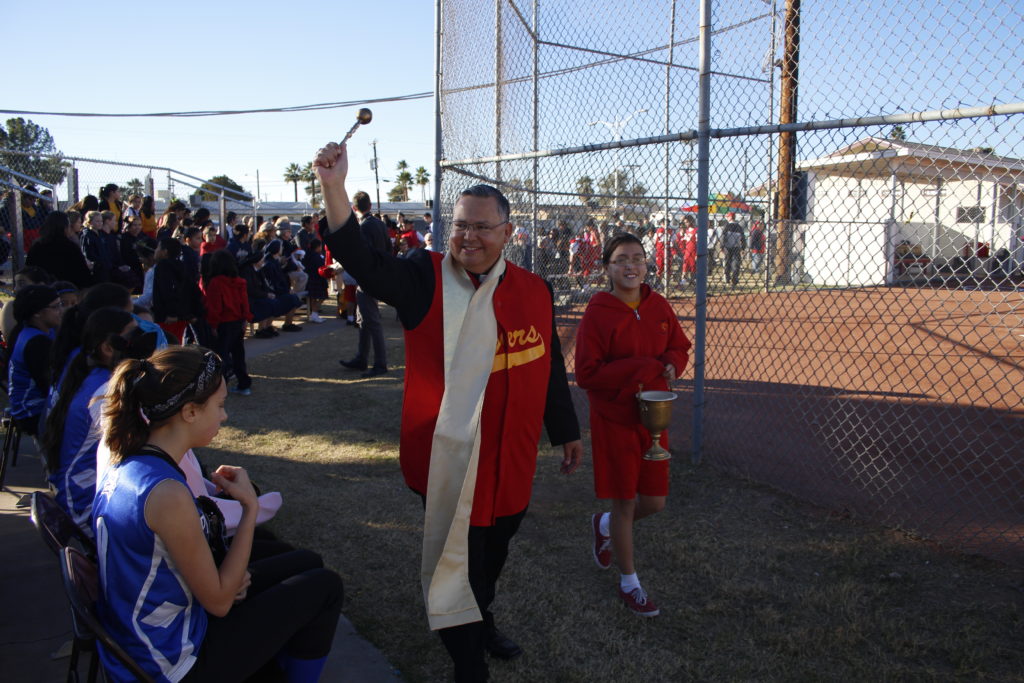
Bishop Eduardo A. Nevares blesses St. Vincent de Paul fans — and opponents — Jan. 22 during a dedication ceremony for the school's revamped ball field. (Ambria Hammel/CATHOLIC SUN)
Bishop Eduardo A. Nevares blesses St. Vincent de Paul fans — and opponents — Jan. 22 during a dedication ceremony for the school’s revamped ball field. (Ambria Hammel/CATHOLIC SUN)

A parade of people stepped up to the plate long before Bishop Eduardo A. Nevares ever took the field to throw out the ceremonial first pitch Jan. 22.

There were 45 donations from the “dig in for the dugout” effort aimed at St. Vincent de Paul School alumni, seven from alumni parents plus former teachers and an anonymous donor. They all wanted to help today’s student athletes have a better place to learn America’s pastime.

So did others in the community. A $1,000 grant from the Arizona Diamondbacks’ Play Ball Fund ended issues with mud on the field. Students from ASU’s Del E. Webb School of Construction designed new dugouts to provide shade for the first time in the field’s 42-year history. Families donated labor for its construction plus that of an equipment storage room, painting and fencing.

Bishop Nevares encouraged athletes and students in the stands to not forget the generosity. He reminded them of the importance of giving back to future generations, especially to the school and church community that nurtured their growth.

“It takes all the chain links hooking together and working together,” the bishop said, comparing teamwork to the intricate work of building the fences that surround the field.

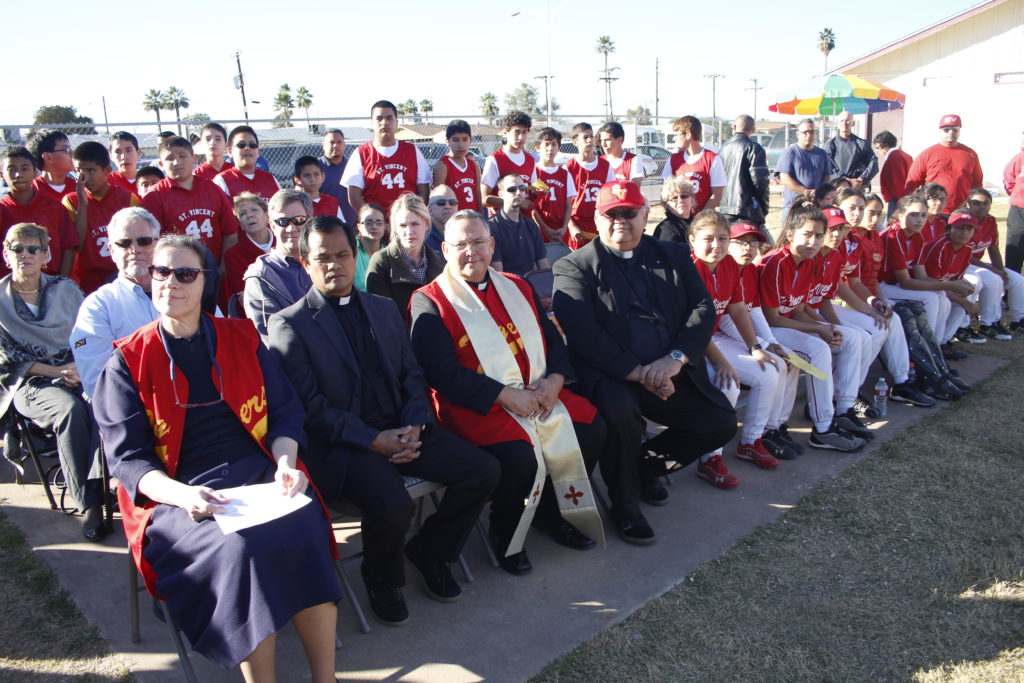
St. Vincent de Paul's baseball and softball teams joined school leaders and Bishop Eduardo A. Nevares for the blessing of their upgraded field Jan. 22. (Ambria Hammel/CATHOLIC SUN)
St. Vincent de Paul’s baseball and softball teams joined school leaders and Bishop Eduardo A. Nevares for the blessing of their upgraded field Jan. 22. (Ambria Hammel/CATHOLIC SUN)

Masonry apprentices were thrilled to help too. Most of their projects are for practice and get torn down right away.

“A lot of them live in the area and they said they’re going to be so proud to drive by and see it still standing,” Rose DeFer, development director, told the fans in the stand.

The Maryvale field is visible along 51st Avenue. Jim Robins, baseball coach, called it a professional job that now has gratitude written all over it. A dedication plaque will eternally serve as a reminder on the field.

Robins and Michelle Risinger, softball coach, took turns during the dedication ceremony handing a framed photo taken during renovation to a representative from every professional group involved. The all-hands-on-deck effort the last six months or so resulted in a new softball/baseball field that was blessed prior to the Tigers’ final softball victory — by a one run lead — of the season.

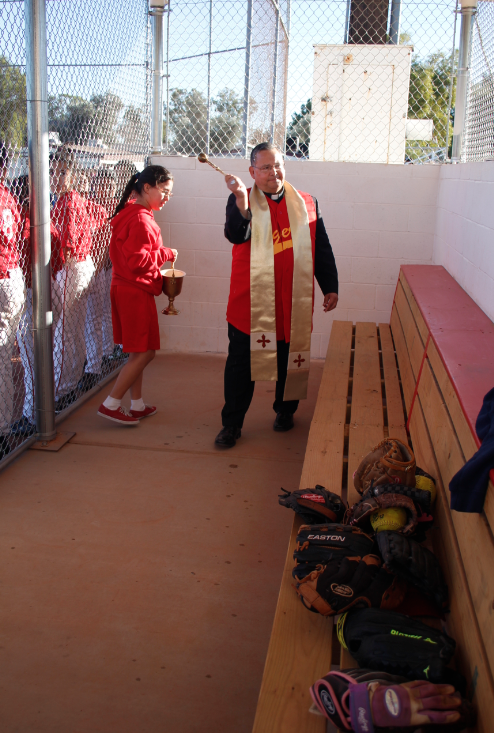
Bishop Nevares blesses St. Vincent de Paul's first shaded dugouts Jan. 22. The tigers can now truly rest between at-bats. (Ambria Hammel/CATHOLIC SUN)
Bishop Nevares blesses St. Vincent de Paul’s first shaded dugouts Jan. 22. The tigers can now truly rest between at-bats. (Ambria Hammel/CATHOLIC SUN)

“It definitely makes it safer to play on by taking out all the rocks that used to exist on the field. It also makes it easier to maintain,” Robins said, “but all in all, it’s just having an upgraded field with real dugouts that makes it more comfortable to play on.”

“It has been something we dreamed of for many years and adds so much to our softball/baseball program,” Risinger said.

Athletes can now truly relax in the dugout without worrying about splinters. A series of single-slat wooden benches was often replaced over the years. The new benches are more of a hardwood material that includes a backrest and a small shelf behind it for equipment.

The athletes are excited to play on the field too. Coach Robins said it looks and feels like the real thing, much like what their neighbors, the Milwaukee Brewers, practice on each spring.

The longstanding field was originally dedicated in 1973 in memory of Cindy Baker, who graduated from St. Vincent de Paul School four years prior. It’s also dedicated to all members of the school and church that were called from this earthly life at a young age.

Students rally at Capitol in support of Catholic education

Bishop Gerald F. Kicanas of Tucson invited student council leaders from Catholic campuses across Arizona to stand in his brief remarks about leadership and the examples Catholic school students set. (Ambria Hammel/CATHOLIC SUN)

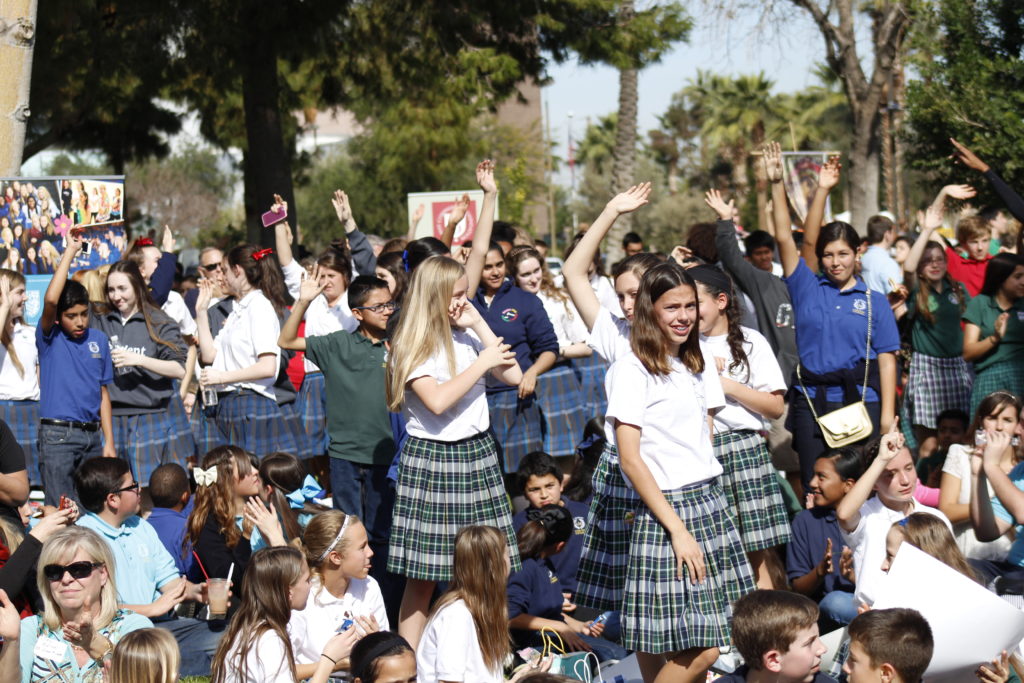
More than 1,000 students, teachers and parents filled a muddy lawn at the State Capitol Jan. 28. Their purpose and energy were far more solid.

They came from across Arizona and some from the Diocese of Gallup, N.M. to celebrate National Appreciation Day for Catholic Schools and the midway point of Catholic Schools Week. The lunchtime rally marked the second of a two-part celebration that brings students together in prayer and gratitude for a faith-filled education and tuition tax credits that help keep many Arizona Catholic schools open.

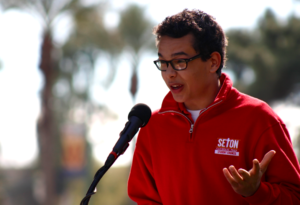
Benjamin Cortez, a sophomore at Seton Catholic Preparatory in Chandler and graduate of Queen of Peace in Mesa, shared what his Catholic education has made for him during the Catholic Schools Week rally at the state Capitol Jan. 28. (Ambria Hammel/CATHOLIC SUN)
Benjamin Cortez, a sophomore at Seton Catholic Preparatory in Chandler and graduate of Queen of Peace in Mesa, said during the Catholic Schools Week rally at the state Capitol Jan. 28 that teachers modeled Christ-like behavior and taught him vital academic skills that continues to pave his way. He admitted he has never been excited to wear a uniform, but encouraged his peers to be proud of the logo on their polo shirt each morning. (Ambria Hammel/CATHOLIC SUN)

Some 49 percent of students who applied for need-based scholarships through Catholic Education Arizona come from families making less than $40,000 per year. Benjamin Cortez, a sophomore at Seton Catholic Preparatory in Chandler, said he recognizes more and more each year the financial strain a family faces in order to afford a Catholic education for its children. Cortez, a graduate of Queen of Peace in Mesa, said teachers modeled Christ-like behavior and invited fellow students to be an example for others.

Catalina Alvarado, an eighth-grader at Ss. Peter and Paul School in Tucson and a life-long Catholic school student, said she has gained life skills, Catholic values and a strong relationship with God plus a commitment to serve others.

Her bishop, Gerald F. Kicanas, expressed confidence that the students will make great contributions to Arizona using words like “super,” “gigante” and “tremendo” to do so. All four bishops who serve Roman Catholics throughout Arizona briefly addressed the crowd.

“We are so privileged that we don’t have to put Jesus outside the school,” Bishop James S. Wall of the Diocese of Gallup, NM said.

[quote_box_center]

Catholic Schools Week coverage

[/quote_box_center]

Standing up for truth

The truths of the Church are weaved throughout the curriculum and throughout the day. Students from St. Michael Indian School in St. Michaels, AZ also showed how their school preserves local culture via a Navajo flute performance from the student band.


Young women from Seton and St. Mary’s High School led the crowd in a series of cheers to thank legislators for maintaining the tuition tax credit since 1997.

All four bishops had breakfast with state lawmakers that morning and a private meeting with Gov. Doug Ducey. Feedback was extremely positive.

“These meetings are very helpful in that they help build relationships between the bishops and important elected officials as we work together to improve the common good from a policy position,” said Ron Johnson. He serves as executive director of the Arizona Catholic Conference, which acts as the legislative arm for Arizona’s bishops.

“Gov. Ducey’s presence at the Catholic Schools Rally was particularly inspiring and contributed to what may have been the best rally yet,” Johnson said.

Bishop Thomas J. Olmsted invited students to tour the state Senate and House of Representatives building to thank them for their service. He said it would give insight into how state-level decisions impact families, especially those living their faith.

“It takes a lot of sacrifice and effort and courage to stand up for truth,” the bishop said.

The governor himself briefly addressed students on the Capitol lawn at lunchtime. He highlighted the state’s commitment to allow parents to choose the school that best fits their child’s and family’s needs. He also thanked students for doing their job.

“I want to challenge you to continue to excel not only at what you’re doing, what you’re learning, what you’re accomplishing, but the example you set for kids across the country,” the governor said.


At Catholic Schools Week Mass, Bishop Nevares urges students to contemplate Jesus on cross

Bishop Eduardo A. Nevares reminded students during  Catholic Schools Week (Ambria Hammel/CATHOLIC SUN)
Bishop Eduardo A. Nevares told Catholic school students from across Arizona that studying the lives of saints — people with vocations just like them — paired with meditating on Jesus on the cross are keys to holiness during a Jan. 28 Mass at Ss. Simon and Jude Cathedral celebrating Catholic Schools Week. (Ambria Hammel/CATHOLIC SUN)

Meditating on Jesus throughout the day is a privilege extended to Catholic school students and the key to holiness.

That’s the message Auxiliary Bishop Eduardo A. Nevares shared with students from across Arizona Jan. 28 at a tightly packed Ss. Simon and Jude Cathedral. The annual all-schools Mass is the first of a two-part celebration marking National Appreciation Day for Catholic Schools. Student representatives from dozens of schools in all three dioceses that serve Arizona filled the pews for an all-school liturgy.

Their bishops surrounded the altar as did a handful of school pastors and high school chaplains.

Bishop Nevares wished the small group of students from St. Thomas Aquinas in Avondale a happy feast day and then went on to acknowledge all of the saints. He encouraged students to know about the patron saint for who they were named or the saint name they took at confirmation.

“It’s very important that all of us are familiar with the lives of the saints… it inspires us to follow their example and to grow in holiness,” the bishop said.

He told them that the Church’s saints had unique gifts and vocations as bishops, priests, religious, married and single. They shared a mission of loving and serving God while on earth and now live with God in heaven, the bishop said.

Hundreds of students packed tightly into the pews at Ss. Simon and Jude Cathedral for an all-school liturgy Jan. 28 as part of Catholic Schools Week celebrations. (Ambria Hammel/CATHOLIC SUN)

Students have vocations to study and learn to the best of their ability, the bishop continued. Bishop Nevares, who will celebrate five years as auxiliary in July, admitted he would have studied harder in school if he knew such a role was part of God’s divine plan.

“Prepare well for whatever God in His holy will has in store for you,” he said.

The bishop described in detail how St. Thomas Aquinas would discern God’s will during Eucharistic adoration. It helped him draw near to the heart, mind, will and soul of Jesus Christ, the bishop said.

“This day and age, meditation of the holy cross is not very popular. Sometimes there’s not even a crucifix at home,” he continued. St. Thomas Aquinas knew that true wisdom, knowledge and understanding can come from meditating on Jesus on the cross.

An increase in every virtue and decrease in human weakness are other fruits of meditation and adoration, he said, detailing how Jesus modeled divine patience, humility, love and obedience, especially on the cross.