
Student says many welcomed church’s ‘safe space’ amid Ferguson turmoil

Parishioners from 10 churches in Ferguson, Mo., walk to City Hall Nov. 2. Former Ferguson mayor Brian Fletcher, a parishioner at Blessed Teresa of Calcutta, said his "heart is broken" over the destruction caused by rioters in the St. Louis suburb. (CNS photo/Lisa Johnston, St. Louis Review)
Parishioners from 10 churches in Ferguson, Mo., walk to City Hall Nov. 2. Former Ferguson mayor Brian Fletcher, a parishioner at Blessed Teresa of Calcutta, said his “heart is broken” over the destruction caused by rioters in the St. Louis suburb. (CNS photo/Lisa Johnston, St. Louis Review)

LOUIS (CNS) — People are seeking an understanding of why race is such a contentious subject in St. Louis, wanting to get to the “underlying issue” of why it is “so embedded” in its history, said Laura Downing, a student at St. Louis University.

The senior social work major from Decatur, Illinois, was a volunteer when the university’s campus church, St. Francis Xavier, offered a “safe space” the night the grand jury decision in the Ferguson case was handed down.

More than 100 people came to the basement of the parish center Nov. 24 during the turmoil following the announcement that a grand jury did not indict Police Officer Darren Wilson in the shooting death of Michael Brown.

The place of prayer and comfort was open for 48 hours as people stopped in to talk about the issues involved in the protests and violence that followed, with volunteers facilitating the discussion.

The Jesuit-run university’s campus ministry program led a prayer vigil at the clock tower on campus, and some students attended a protest south of the main campus and the school’s medical campus.

Downing said students reacted with questions, curiosity and confusion.

She was with a group of primarily students who wondered why protesters were burning buildings, what the meaning of it was, and why people were so mad, Downing told the St. Louis Review, the archdiocesan newspaper.

“We also talked a lot about the need to see people as people, drawing on empathy — of course people are mad, and when they are mad they do stuff like this. It doesn’t justify it,” she said, but it offers an explanation.

Downing, who attends St. Francis Xavier (College) Church and the Cathedral Basilica of St. Louis, got involved because “everyone is made in the image and likeness of God. As a Christian, Jesus wants me to love all people. It really, really hurts him deeply when his children are being hurt and oppressed.”

St. Louis puzzles her, as she sees churches that are predominantly African-American and others that are predominantly white but few that are fully integrated. “That’s not how it’s supposed to be. We let our human nature — of wanting to separate ourselves because we’re afraid of people who are different — we let that idea permeate ourselves and the Church. And that’s not what the Church is supposed to be about.”

Instead, she said, people need to come together because “we are the body of Christ.”

Downing does not want Catholics to be afraid of others or the issues. “It’s like JPII (St. John Paul II) or Jesus — they said, ‘Don’t be afraid.’ And what do we do? We get afraid. I do it myself. I get afraid. But it’s really just about trusting in God. Telling God, ‘I’m afraid right now, but I’m going to submit to you, really try to do your will, to reach out to this person because you made this human being, you love this human being.'”

Patty Libby, a senior political science and women’s studies major from St. Louis, said the campus ministry program made an impact by highlighting the human issues and social justice issues involved. Others praised the leadership of the university’s president, Fred Pestello, for promoting conversation.

Nebu Kolenchery, a senior public health major from Arlington Heights, Illinois, said that the safe space was a response to “a very trying time.” He was one of six people who took charge of the effort, with an overwhelming response from volunteers.

They wanted “to be present to our reality instead of pretending we’re not part of the city,” Kolenchery said. “It was very good to see people coming together here. … The majority were seeking dialogue with people different than themselves. I’d like to think that cultural change is happening.”

— By Joseph Kenny, Catholic News Service. 

Outpouring of love, faith draws thousands to vibrant ‘Honor Your Mother’ celebration

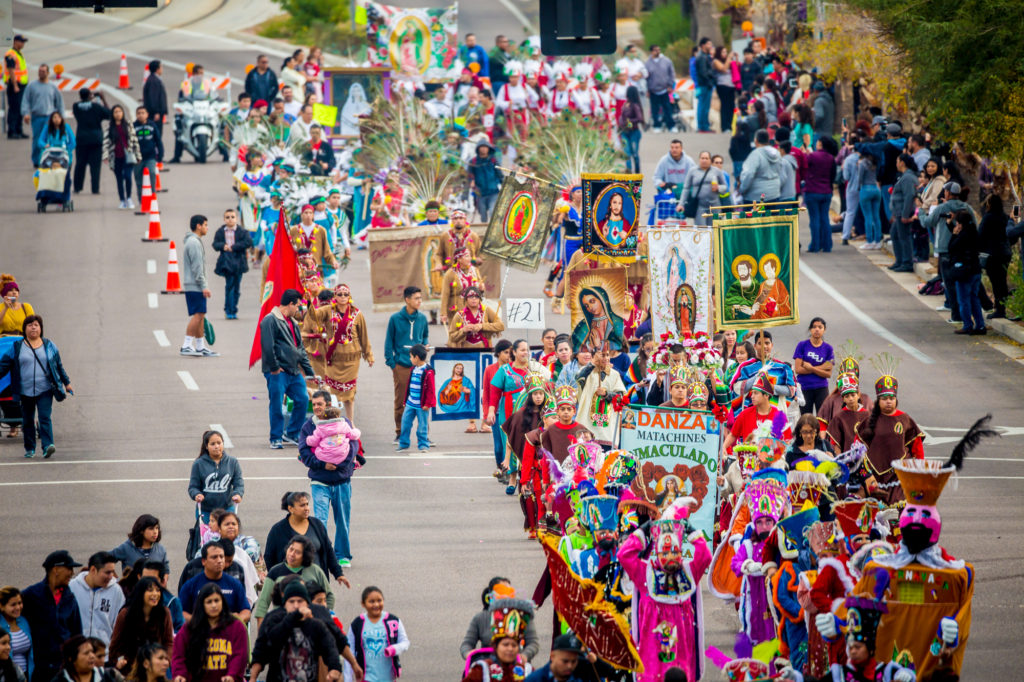
Thousands of people were drawn to the streets of downtown Phoenix Dec. 6 in our outpouring of love for Our Lady of Guadalupe at the annual Honor Your Mother event. (Billy Hardiman/CATHOLIC SUN)

[dropcap type=”4″]T[/dropcap]housands of people were drawn to the streets of downtown Phoenix Dec. 6 in an outpouring of love for Our Lady of Guadalupe at the annual Honor Your Mother celebration.

Phoenix police shut down traffic to allow for the parade of colorfully arrayed participants in a procession that stretched from Immaculate Heart of Mary Church all the way to the area just outside St. Mary’s Basilica and the Diocesan Pastoral Center.

[quote_box_right]

Honor Your Mother Photo Gallery

[/quote_box_right]

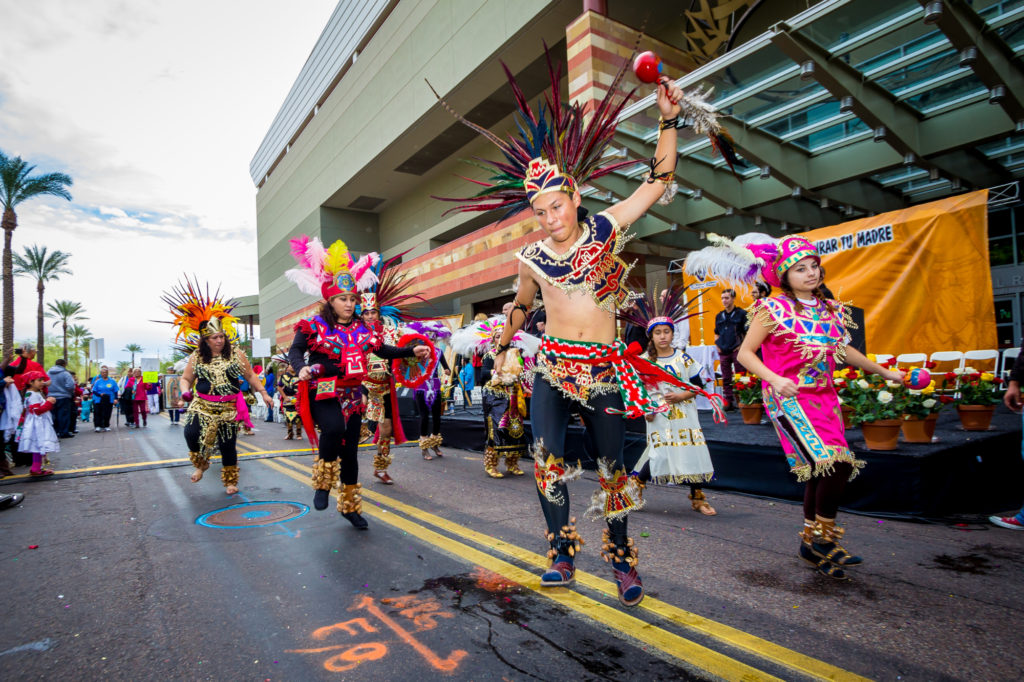
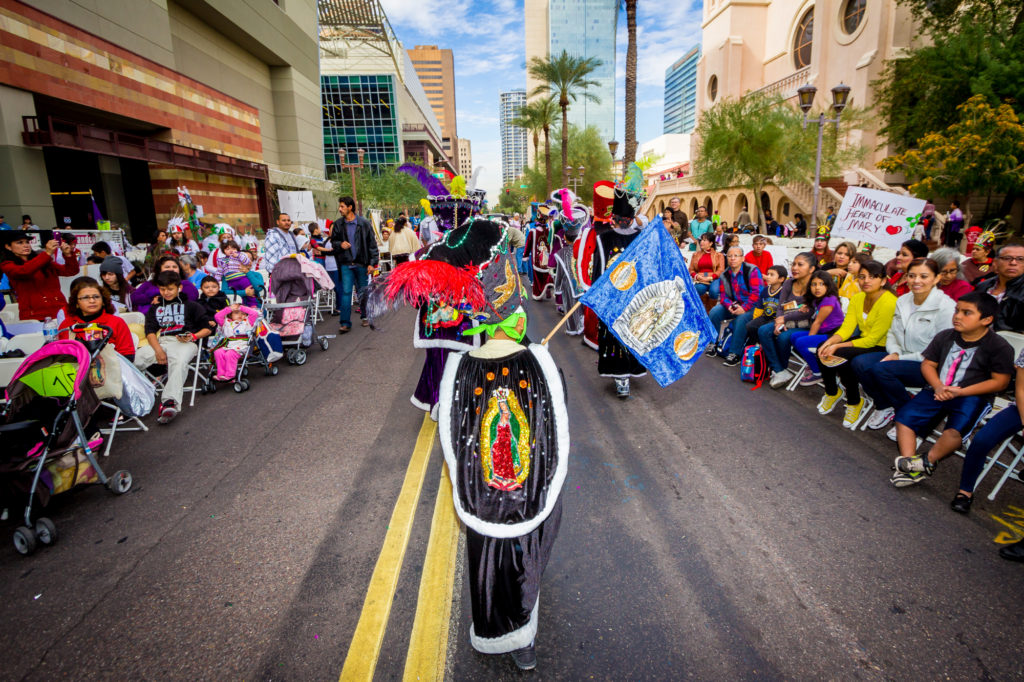
Dozens of dance groups, many bearing images of Our Lady of Guadalupe on sequined costumes and feathered head dresses, twirled in unison down the street, beating drums and shaking maracas. Many held statues of the Blessed Mother adorned with roses and banners that proclaimed the name of their parish or prayer group.

Alicia Delgado of St. Mark parish was carrying her nearly 2-year-old nephew, dressed as a tiny St. Juan Diego. The toddler, who sported a marker mustache and miniature tilma, had fallen asleep in her arms in spite of the drumming of matachine groups that made their way down Monroe Street.

“We come every year to celebrate the Virgin of Guadalupe,” Delgado said. “He’s little and doesn’t understand what’s going on, but we want to involve him anyway.”

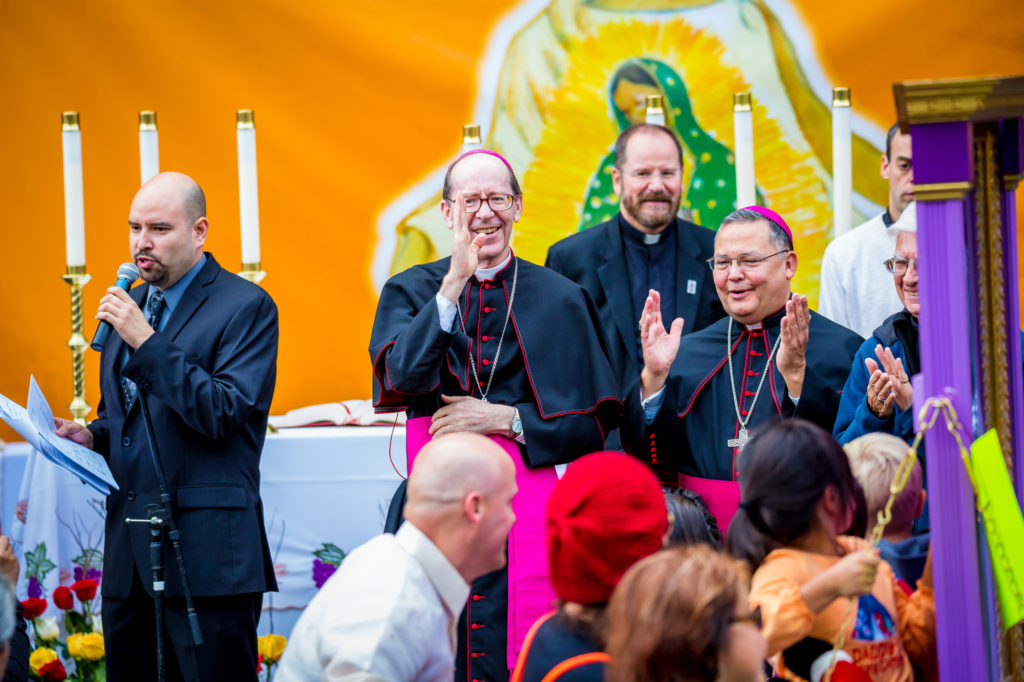
Bishop Thomas J. Olmsted and Auxiliary Bishop Eduardo A. Nevares look on as thousands of people process through the streets of downtown Phoenix Dec. 6 in our outpouring of love for Our Lady of Guadalupe at the annual Honor Your Mother event. (Billy Hardiman/CATHOLIC SUN)

Bishop Thomas J. Olmsted and Auxiliary Bishop Eduardo A. Nevares, stood on the stage in front of the Phoenix Convention Center for more than an hour as the parade made its way past. Both bishops commented on the presence of the many infants and small children at the event.

“You can see the faith is being transmitted from parents to children,” Bishop Nevares said. “It’s wonderful to see that the faith isn’t just for older people. Thank you, parents and grandparents, for passing on the faith.”

Raimundo Olvera stood holding a large banner emblazoned with an image of Our Lady of Guadalupe. Olvera was one of two dozen members of the Tepeyac Dance Group based in Mesa.

“All my life I’ve believed in God and in her,” he said. “We keep our tradition going.”

Luisa Delgado of Tempe was with her mother and infant daughter and said the family attends the event every year.

“The Virgin prays for us and she wants us to be in unity with our brothers,” Delgado said. “She wants us to love each other and to be in union with Christ in love. We pray at home, too.”

“Many people all over the world are being persecuted and killed for the faith. What a joy it is to express our faith without fear.”

Jorge Sandoval of St. Catherine Parish was one of the masters of ceremony for the procession. The annual Honor Your Mother festivities, he said, demonstrate the great love the Hispanic community has for the Blessed Mother, especially under her title of Our Lady of Guadalupe, but they’re also meant to draw others. A Filipino group participated in the parade, carrying an image of Our Lady.

“We come as children of God and children of our Blessed Mother to celebrate our faith and to pray together and also to be with our bishops,” Sandoval said. “I think this event shows we can unite together as Catholic brothers and sisters to pray and celebrate our faith. There’s a lot of joy.”

Thousands of people were drawn to the streets of downtown Phoenix Dec. 6 in our outpouring of love for Our Lady of Guadalupe at the annual Honor Your Mother event. (Billy Hardiman/CATHOLIC SUN)

A bilingual, outdoor Mass, concelebrated by both bishops and several priests from around the diocese, followed the procession, with Bishop Nevares giving the homily.

“To have this opportunity to express our faith is a miracle,” Bishop Nevares said. “Many people all over the world are being persecuted and killed for the faith. What a joy it is to express our faith without fear.”

Thousands of people were drawn to the streets of downtown Phoenix Dec. 6 in our outpouring of love for Our Lady of Guadalupe at the annual Honor Your Mother event. (Billy Hardiman/CATHOLIC SUN)

English cardinal: Young Africans being seduced into modern slavery

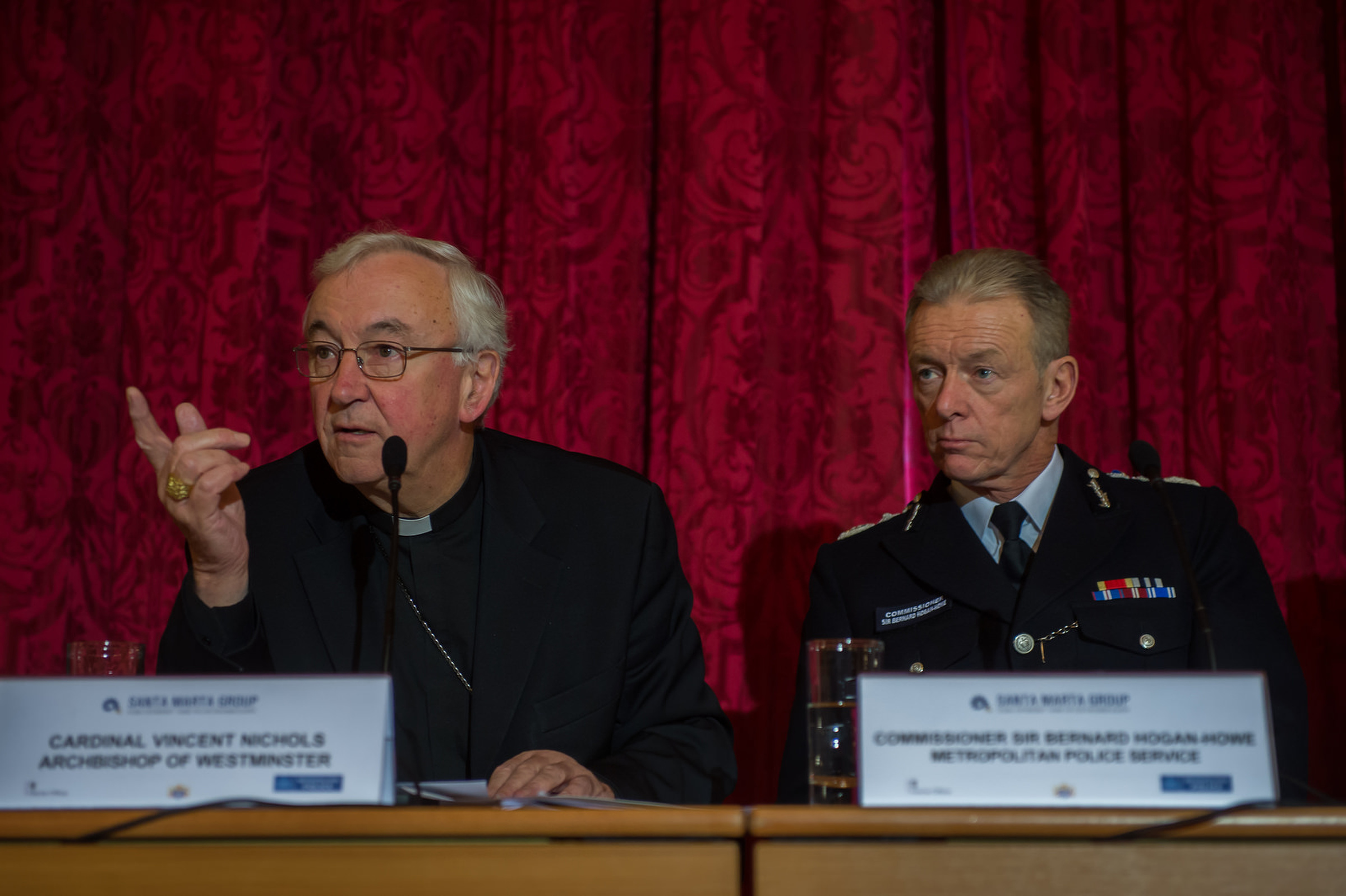
Cardinal Vincent Nichols of Westminster speaks during a human trafficking conference in London Dec. 6. The British governmentÕs Home Office has estimated that about 13,000 people in the United Kingdom have been trafficked into activities ranging from prostitution to domestic service and work on fishing boats. (CNS photo/Marcin Mazur, Catholic Communications Network)

MANCHESTER, England (CNS) — Young Africans are being seduced into modern slavery by the promise of a dream that never comes true, an English cardinal told a conference on human trafficking.

Cardinal Vincent Nichols of Westminster said “there seems to be no enticement that isn’t being used” by human traffickers to entrap children.

The cardinal told the conference Dec. 6 that he was shocked to learn of the “extent and type of enticement and abuse of people that goes on in Africa” in particular. He cited as an example the offer to play soccer in the English Premier League to children who appear to excel at the sport.

“As soon as they get to England they are enslaved,” said Cardinal Nichols, president of the Bishops’ Conference of England and Wales. His remarks were reported by the British Broadcasting Corp.

“They come in search of a dream, but of course don’t find it,” he said.

“There are plenty of people who are willing to entice them and sell them the dream in order to get them here,” he added.

Cardinal Nichols made his comments during the second international conference of the Santa Marta Group, which met in London Dec. 5-6.

The conference, “Taking the Lead on Human Trafficking,” involved a gathering of senior politicians, police, and Church representatives with the aim of “developing strategies to combat human trafficking,” said a pre-conference statement by the Bishops’ Conference of England and Wales.

It was attended by Sir Bernard Hogan-Howe, London police commissioner; British Home Secretary Theresa May; and Karen Bradley, minister for modern slavery and organized crime.

In a Dec. 5 message of support to the conference, Pope Francis said he was “deeply grateful” for the resolve of the participants “in combating this evil.”

“Your labors to promote ongoing dialogue on the legal remedies to human trafficking and on the essential care of those who suffer this enslavement are especially important because of the hidden nature of this crime,” the pope said.

“We must never forget, nor may we ignore, the suffering of so many men, women and children whose human dignity is violated through this exploitation,” he said, adding that he could assure the conference that the Catholic Church “remains steadfast in her pledge to combat human trafficking and to care for the victims of this scourge.”

The Santa Marta initiative was launched by Pope Francis at the Vatican April 10, when he described human trafficking as a “crime against humanity … an open wound on the body of contemporary society, a scourge upon the body of Christ.”

The conference in London sought to build on the joint police and Church initiative in England that has been running for three years in the hope that good practice will be copied, developed and adapted around the world.

In a Dec. 3 statement, Cardinal Nichols said: “There is much to be done, but the emergence of the Santa Marta Group’s international network is an important step toward helping the victims and fighting this crime.”

The conference heard that there had been a fourfold rise in victims of human trafficking seeking help from British authorities over the past four years.

According to the BBC, Sir Bernard said: “Often, people are trafficked at a young age believing that they are entering a better world, when in reality they are entering a far worse world from which they cannot escape.”

The British government’s Home Office has estimated that about 13,000 people have been trafficked in the U.K. into activities ranging from prostitution to domestic service and work on fishing boats.

— By Simon Caldwell, Catholic News Service. 

Pope Francis calls for solidarity in creating a world without nuclear weapons

Representatives of several faith traditions assembled Dec. 6 at the International Campaign to Abolish Nuclear Weapons' Civil Society Forum in Vienna. From left, Jonathan Frerichs with the World Council of Churches; Christopher Weeramantry, a retired judge from Sri Lanka; Mustafa Ceric, a former leader in the Islamic community of Bosnia-Herzegovina; Akemi Bailey-Haynie, a Buddhist from the U.S. whose mother is a survivor of the Hiroshima atomic bombing; and Ela Gandhi, a peace activist in South Africa. (CNS photo/Chaz Muth)

VIENNA (CNS) — Pope Francis called on world leaders, activists and people of faith to pull together to rid the world of the threat of nuclear weapons.

Archbishop Silvano Tomasi, the Vatican’s permanent representative to U.N. agencies in Geneva, read the pope’s statement in Vienna Dec. 8 at the opening of Vienna Conference on the Humanitarian Impact of Nuclear Weapons.

In his message, Pope Francis restated the Vatican’s long-standing advocacy for the global elimination of nuclear weapons and said peace is not just a balance of power, “but true justice.”

The pope’s statement said nuclear nations should move beyond the mere ideal of the abolition of atomic weapons stressed in The Treaty on the Non-Proliferation Of Nuclear Weapons and take the next steps toward meeting that objective.

“The humanitarian consequences are predictable and planetary,” the pope said in the statement, read before representatives of more than 150 countries gathered for conference.

More attention should be given to the unnecessary suffering that would result from the use of nuclear weapons, the pope’s statement said. He encouraged open dialogue between nuclear and non-nuclear states, with the inclusion of religious communities and civil society.

The pope’s statement was one of several during the opening remarks of the two-day conference, in which experts have been dispatched to discuss the short- and long-term consequences of nuclear weapons explosions, especially in the areas of health, environment, climate, food security and infrastructure.

Possession of nuclear weapons does not provide safety or security, but increases the likelihood of accidents and mistrust among nations, said Angela Kane, the U.N. high representative for disarmament affairs.

A nuclear strike would cause devastating effects beyond the borders of the nation targeted for the attack, said Sebastian Kurz, Austria’s foreign minister.

“It would have regional and global consequences,” Kurz told the audience. “No one would win, everyone would lose. It’s high time we move from words to action.”

Scientific experts said nuclear strikes between two nations like the U.S. and Russia would initially kill thousands of civilians and would reduce targeted cities to rubble.

The same experts also said the long-term environmental impact of such an engagement would decrease global temperatures, halt agricultural production and potentially cause billions to die of starvation.

“The risk is high, the danger is real,” said Peter Maurer, president of the International Committee of the Red Cross. “Let’s bring the era of nuclear weapons to an end.”

He said no team on the planet could launch an adequate response if one or more nuclear bombs were detonated, either intentionally or by accident.

Not all was doom and gloom during the opening of the government-sponsored conference.

While there are currently 17,000 nuclear bombs worldwide in a high-alert status, experts told participants that figure is far less than the 70,000 weapons that were combat-ready at the end of the Cold War.

However, the 85 percent reduction in nuclear weapons has created a false sense of security among the masses, who see nuclear destruction as an abstract threat, Kurz said.

In his message, Pope Francis warned of such complacency and encouraged participants of the conference to remind the world of the risks of nations possessing any nuclear weapons.

“I’m convinced the desire for peace will bear fruit in concrete ways,” the pope said in the statement, adding that it was his hope that “a world without nuclear weapons is possible.”

—By Chaz Muth, Catholic News Service.

Spend time in silence and service before Christmas, pope suggests

The crowd watches as Pope Francis leads the Angelus from his studio overlooking St. Peter's Square at the Vatican Dec. 8, the feast of the Immaculate Conception. The banners in Italian says: "The Immaculate will triumph." (CNS photo/Paul Haring)

ROME (CNS) — In the heart of Rome’s high-end shopping district, sparkling with Christmas lights and shiny baubles in the windows of famous designers, Pope Francis prayed that people would spend time in silence and in service as they prepare to celebrate Jesus’ birth.

Celebrating the feast of the Immaculate Conception Dec. 8, Pope Francis prayed for Mary’s intercession so that, “in us, your children, grace also will prevail over pride, and we can become merciful like our heavenly Father is merciful.”

Before laying a basket of cream-colored roses at the foot of a statue of the Immaculate Conception near Rome’s Spanish Steps, Pope Francis recited a special prayer he composed for the occasion.

The feast is a major Rome holiday, and with brilliant blue skies replacing days of gray and rain, thousands of people lined the streets near the Spanish Steps to catch a glimpse of the pope and pray with him for Mary’s assistance.

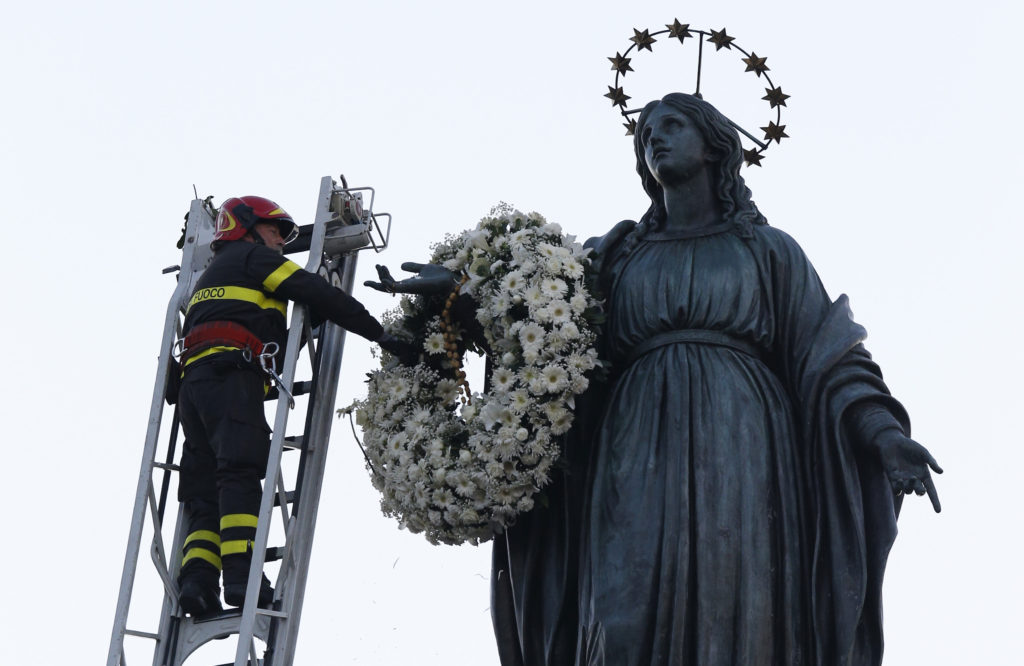
A firefighter places a wreath at the foot of a tall statue of Mary overlooking the Spanish Steps in Rome Dec. 8, the feast of the Immaculate Conception. Rome's firefighters have observed the tradition every year since 1857. (CNS photo/Paul Haring)
A firefighter places a wreath at the foot of a tall statue of Mary overlooking the Spanish Steps in Rome Dec. 8, the feast of the Immaculate Conception. Rome’s firefighters have observed the tradition every year since 1857. (CNS photo/Paul Haring)

Pope Francis said Mary being conceived without sin should give all Christians hope and strength “in the daily battle that we must conduct against the threats of evil,” because her immaculate conception is proof that evil does not have power over love.

“In this struggle we are not alone, we are not orphans,” he said, because Jesus gave his mother to be our mother.

“Today we invoke her maternal protection on us, our families, this city and the world,” the pope said, praying that God would “free humanity from every spiritual and material slavery.”

“In this time that leads up to the feast of Jesus’ birth, teach us how to go against the current,” Pope Francis prayed to Mary. Teach people how to be unencumbered, “to give ourselves, to listen, to be silent, to not focus on ourselves, but to leave space for the beauty of God, the source of true joy.”

In a small blue Ford Focus, the pope was driven to the Spanish Steps’ neighborhood after first stopping for a private prayer at the Basilica of St. Mary Major.

Earlier in the day, with thousands of people gathered in St. Peter’s Square, Pope Francis led the recitation of the Angelus, a Marian prayer.

“Nothing is more effective and fruitful than listening and accepting the word of the Lord.”

Commenting on the feast day’s Gospel reading — Luke’s story of the annunciation to Mary that she would be Jesus’ mother — the pope said it was important that Mary did not respond, “I will do what you say,” but “May it be done unto me.”

“The attitude of Mary of Nazareth,” he said, “shows us that being comes before doing, and that we must let God do in order to be truly as he wants us to be. He will accomplish marvels in us.”

“We, too, are asked to listen to God, who speaks to us and accept his will,” the pope said. “According to Gospel logic, nothing is more effective and fruitful than listening and accepting the word of the Lord.”

The pope also said the Gospel story shows how Mary “is receptive, but not passive.” She agrees to God’s will, receives the power of the Holy Spirit and gives “flesh and blood” to the son of God.

And while Mary was conceived without sin — a special and unique privilege — “we, too, always have been ‘blessed,’ that is loved, and therefore ‘chosen before the foundation of the world, to be holy and without blemish before him,'” as the day’s reading from Ephesians said.

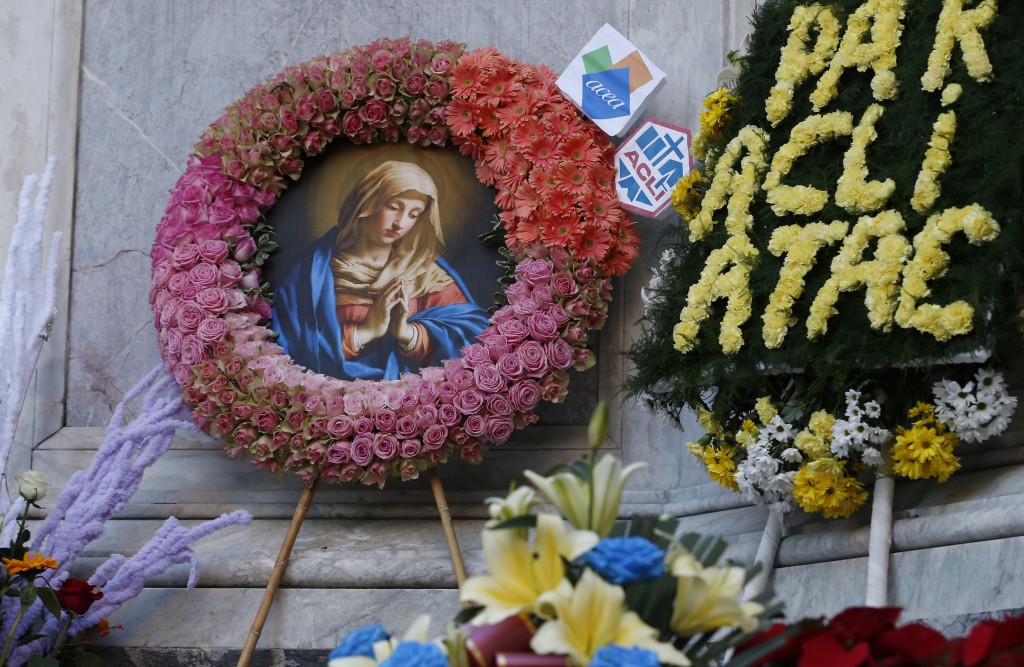
An image of Mary is adorned with flowers at the foot of a tall Marian statue overlooking the Spanish Steps in Rome Dec. 8, the feast of the Immaculate Conception. Rome's firefighters have observed the tradition every year since 1857. (CNS photo/Paul Haring)
An image of Mary is adorned with flowers at the foot of a tall Marian statue overlooking the Spanish Steps in Rome Dec. 8, the feast of the Immaculate Conception. Rome’s firefighters have observed the tradition every year since 1857. (CNS photo/Paul Haring)

Recognizing how blessed they are, the pope said, Christians must be filled with gratitude and ready to share their blessings with others.

“If everything has been given to us, everything must be given again,” he said. “How? By letting the Holy Spirit make us a gift for others.”

Pope Francis encouraged Christians to let the Holy Spirit make them “instruments of welcoming, instruments of reconciliation, instruments of forgiveness.”

— By Cindy Wooden, Catholic News Service.

Donor says helping her pastor an easy decision: ‘He needed a kidney’

Father Michael G. Whyte, pastor of St. Catherine of Siena Parish in West Simsbury, Conn., sits beside parishioner Margaret Domashinski in the parish rectory 10 weeks after Sept. 9 surgery. Domashinski donated a kidney to her pastor to save his life. (CNS photo/Jack Sheedy, The Catholic Transcript)

WEST SIMSBURY, Conn. (CNS) — A parishioner walks up to her pastor and says, “I want to give you my kidney.”

Pastor smiles and says, “OK.”

Don’t expect a punchline. It’s no joke.

Father Michael G. Whyte arrived at St. Catherine of Siena Parish in 2007 and has been pastor there since 2008. A type 1 diabetic, he began experiencing extreme tiredness and nausea at about that time, signs of kidney failure as a result of diabetes. Doctors gave him three choices: go on dialysis and live five or six more years; do nothing and die within six months; or get a kidney transplant and — if it’s from a live donor — live 20 to 25 years.

Two years ago, he announced at Mass that he was on the waiting list for a kidney.

More than one parishioner offered to be tested to see if they would be qualified donors, but Margaret Domashinski, a parishioner who lives in West Suffield, Massachusetts, already knew she would be the one.

“I knew I was a match,” she said during an interview at the parish rectory Nov. 19. “I know that’s kind of spooky, but it’s true. I knew.”

Asked what it was about Father Whyte that prompted her to make the offer, Domashinski paused, as if puzzled by the question. “He needed a transplant. He needed a kidney,” she said.

Father Whyte, looking fit as he sat beside his donor 10 weeks after transplant surgery, said, “I think it is very difficult when someone tells you that they’re considering getting tested or they would like to give you a body part. It is very hard to say” — he struggled for words, then continued — “(a mere) thank-you doesn’t seem to be appropriate.”

When Domashinski made the offer about a year ago, after a daily Mass, Father Whyte was struck by her matter-of-fact attitude. She offered him her kidney “like it was a doughnut,” he said.

Of course, knowing instinctively that you are a match isn’t quite good enough for the medical profession, and Domashinski underwent many levels of testing to ensure that both she and Father Whyte would have good chances of recovery. Their blood types had to match, and they do. Despite having family members with diabetes, the risk at her age — mid-50s — is minimal that she would develop it. Her overall health is good.

Other, more subjective factors came into play also, Father Whyte said. He said doctors asked Domashinski, “How are you going to feel if your other kidney has an issue or if your child needs one?”

He said doctors asked him, “How are you going to feel having a part of another person inside of you?”

“God gives us miracles. We just call it medicine. But there are a lot of miracles out there.”

On a scale of 1,000 to 5,000, with the lowest number being the best match, Domashinski scored 1,000 — the same as a twin would score, he said.

Her husband, Michael, and the couple’s three daughters — ages 17, 13 and 10 — were 100 percent supportive, she said. “Go, Mom!” one daughter said. “Go for it, kiddo!” her husband said.

When it seemed all was set, Domashinski announced in the spring of 2014 that she was going to Africa to do mission work at Kampala Children’s Center in Kampala, Uganda. Father Whyte said, “I got a little concerned. I said, ‘Hey, you’re going with my future kidney.'”

But Domashinski took every precaution and returned safely and in good health.

Father Whyte said, “The day before the surgery, I had a couple of people come in and say they hoped everything goes well, and they would get a little emotional. And I said to myself. ‘What, do they think I’m going to die?'”

He said, “The day of our surgeries — as we are obviously operated on at the same time — the parish held a prayer vigil and … they said it was a nonstop streaming of people coming in lighting candles and saying prayers.”

Surgery was Sept. 9 at Yale New Haven Hospital. Before undergoing three-port laparoscopic surgery to remove one of her kidneys, Domashinski told her doctor, “If I die during this procedure, make sure you give him my pancreas” as well.

But she and Father Whyte came through their surgeries fine. Domashinski said that Father Whyte’s surgeon, Dr. Peter Yoo, came to see her in recovery and said, “Oh, your kidney started working before we even finished sewing it up! Oh, your kidney!”

She thought, “Obviously, he’s some kind of kidney groupie.”

Meanwhile, just hours after his surgery, Father Whyte was walking around his hospital room, not even in the slightest pain. (Domashinski actually had more pain than he had.)

They were both released three days later. At Mass a week later, Father Whyte praised the medical team.

Domashinski said, “And I was sitting in front saying, ‘Yeah, that’s mine! You’ll get 30 years out of it!'” In telling the story, she punched the air with her fist.

Turning to his donor, Father Whyte said, “I don’t know how you feel, but sometimes I’m driving in the car and it hits me. This was major surgery. But at the same token, I was amazed — and I give this credit to God and my doctors — that within six weeks of having this transplant I was back to work and I’m full time.”

Domashinski said the ease of her decision comes from her upbringing. Her parents told her, “You’re not here just to be a piece of furniture.”

Father Whyte said, “As we like to say here at St. Catherine’s, we’re going to take away her envelope. She doesn’t have to give anymore.”

Domashinski said, “I’d like to see more people thinking about all of our priests who are in hospital because not all priests have somebody there to visit them. … We need to take care of these guys. They’ve given everything up.”

Father Whyte said, “You know, I have to be honest, I’m not the bravest person in the world, but I never felt afraid. … I had an entire parish praying for me. What else could happen but good?”

He added, “People are already waiting for another Lazarus to be raised from the dead or another 5,000 to be fed. Just open your eyes. God gives us miracles. We just call it medicine. But there are a lot of miracles out there.”

He looked at his donor and said, “So this is really a miracle. It’s a gift of life.”

— By Jack Sheedy, Catholic News Service. Sheedy is news editor of The Catholic Transcript, newspaper of the Archdiocese of Hartford.
University of Mary-Tempe teaches how to save the planet God’s way

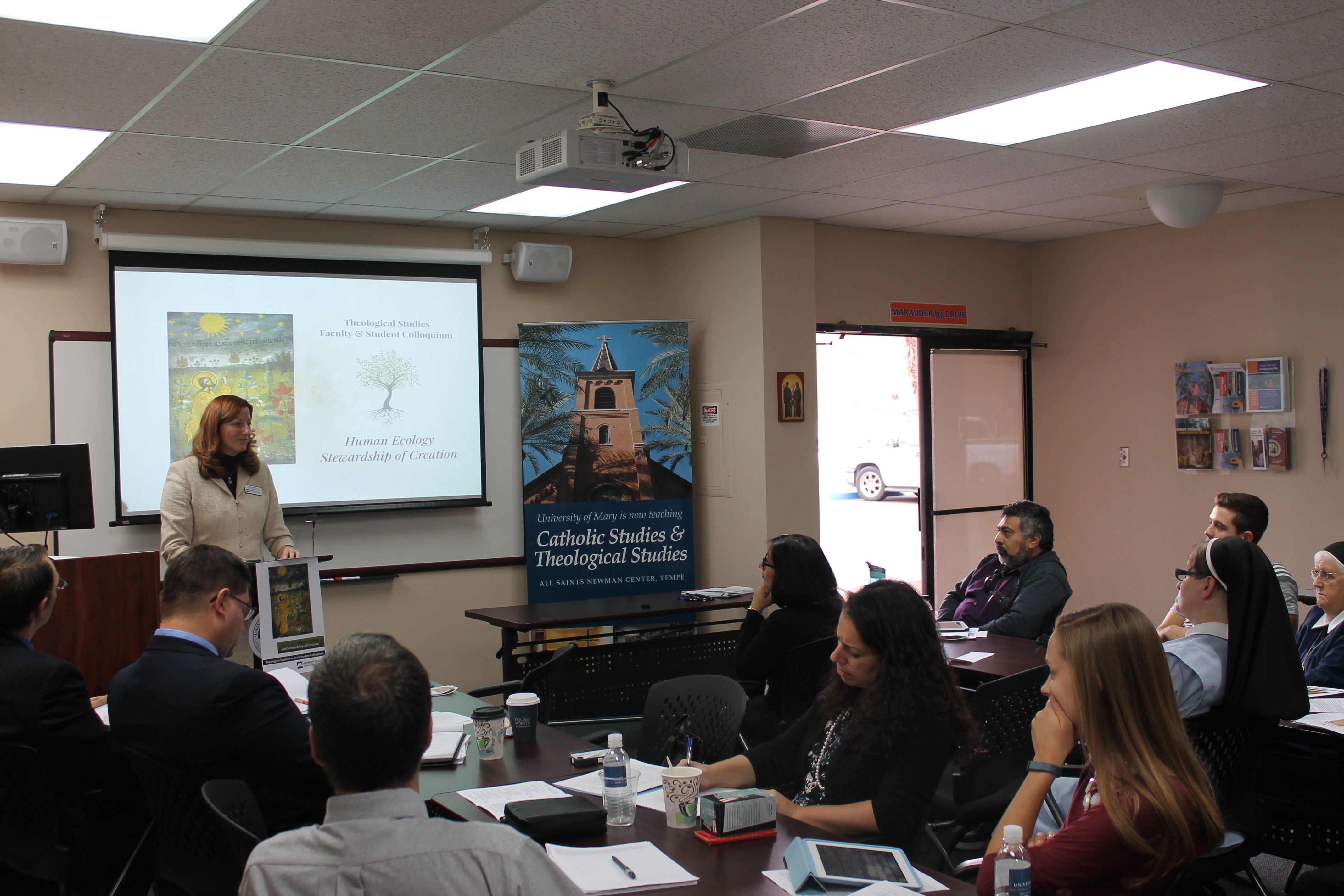
Rev. Dr. Mark Veazie, former assistant professor of public health at the University of Arizona, spoke about Catholic human ecology and human flourishing
Rev. Dr. Mark Veazie, ordained as  a permanent deacon Nov. 8, is a former assistant professor of public health at the University of Arizona. He spoke about Catholic human ecology and human flourishing at the Nov. 21 colloquium.

TEMPE — As Pope Francis prepares to issue an encyclical on man’s relationship to the environment, University of Mary-Tempe hosted a colloquium examining the topic.

From avoiding unnecessary waste to learning about ways to save the planet according to the Bible, the day was packed with plenty of practical information and food for thought.

The Nov. 21 gathering attracted clergy, University of Mary students, faculty and others to hear a panel of speakers address the various dimensions of human ecology.

Deacon Narciso Macia, an engineering professor at Arizona State University’s Polytechnic Campus, located on the former Williams Air Force Base, used contamination discovered at the site to illustrate a larger point. The base closed in 1993 and groundwater and soil contamination was found due to past disposal practices, spills and leaks.

“Do you think the mechanics who were working there at the time thought their actions would have such a big impact?” Macia asked the crowd rhetorically. “Probably not.” Our actions may seem inconsequential, Deacon Macia said, but over time, they add up.

Small sacrifices and conservation techniques to eliminate waste can help make a positive impact on our world, Deacon Macia said, citing the fact that Jesus himself, the same Man who could create something at the snap of His fingers, was concerned with waste, as is evident in the story of the multiplication of the fish and loaves.

He then drew an interesting conclusion from the parable. Deacon Macia reasoned that in the Bible, Jesus started with five loaves of bread and only two fish. When this ratio is compared with modern day dietary recommendations, it is nearly identical to the recommended intake of protein to carbohydrates and fiber. Our world simply cannot sustain every human eating meat twice a day, he said. A diet based mainly on plants and grains is not only beneficial for the environment, but also for our own health.

“It’s not that we shouldn’t eat meat,” Deacon Macia told The Catholic Sun. “It’s that over-consumption of meat is not good for us. Not only that, producing meat requires a lot more energy use than the production of grains.”

And if we’re too busy to donate our old computers to a thrift shop, they end up in a landfill, Deacon Macia said. Components from computers may contain harmful substances such as mercury, cadmium and lead.

The larger focus of the colloquium was to show God’s plan that calls on humanity to be steward, priest, and kin with all of His creation and how people can contribute to conserving the beauty that is God’s planet.

Maggie Otlewski, an ASU senior studying psychology who is also a Catholic studies major at University of Mary-Tempe said she thought the colloquium was informative.

“I really wanted to hear what the Catholic perspective on sustainability is since ASU puts such a focus on it,” Otlewski said.

Dr. Jo Markette of the University of Mary-Tempe's theology and Catholic studies program, spoke about the impact of the birth control pill on the environment.
Dr. Jo Markette of the University of Mary-Tempe’s theology and Catholic studies program, spoke about the impact of the birth control pill on the environment.

Dr. Jo Markette, who oversees the theology and Catholic studies programs University of Mary, spoke about the negative impact on the environment caused by the millions of women who use birth control pills. The active ingredient in birth control pills has been shown to harm wildlife in waterways.

Dr. Leroy Huizenga, chairman of the theology department of the University of Mary in Bismark, N.D., spoke about the ecology of man in an age of technology.

“The Church has a responsibility toward creation and she must assert this responsibility in the public sphere,” Huizenga said. “In so doing, she must defend not only earth, water and air as gifts of creation that belong to everyone. She must above all protect mankind from self-destruction.”

By Johnny Coronel, special to The Catholic Sun.

Grateful hearts in Diocese of Phoenix [VIDEO]

One week ago today we gathered with family and friends to celebrate Thanksgiving. Catholics across the Diocese of Phoenix had a lot to be thankful for and, judging by social media feeds and other online coverage, they shared their blessings with others.

Take a look at the food collection for St. Vincent de Paul at St. Bernard of Clairvaux in Scottsdale in the video above. Below, see how others celebrated Thanksgiving and the days that followed.

From across the Diocese of Phoenix:

From The Catholic Sun:

After 25 years, Phoenix priest called to his heavenly home

Fr. Earl D'Eon (1934-2014)
Fr. Earl D’Eon (1934-2014)

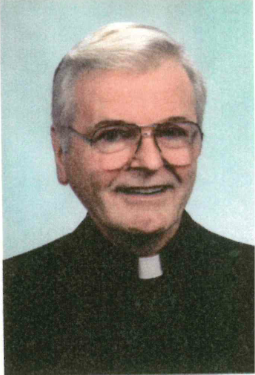
Fr. Earl D’Eon, former pastor of St. Clement of Rome Parish in Sun City, died at home in the West Valley retirement community Dec. 2. He was 80.

Fr. D’Eon was ordained to the priesthood on June 3, 1989 for the Diocese of Phoenix. He served four years in the U.S. Air Force in the ’50s and later lent his voice as an established narrator — for productions such as “Annie” and government documentaries.

He became a parishioner of St. Joseph Parish in Williams, Ariz. and a business owner prior to entering the seminary. He told The Catholic Sun shortly before his ordination that his Catholic foundation at a boarding school run by the Fathers of St. John Eudes served him well, enough, “But then I became very worldly and forgot about becoming a priest.”

[quote_box_right]

Reflections on parish life in Sun City

See what Fr. D’Eon had to say in this archived Associated Press article about Sun City’s unique parish life where every ministry, including altar servers, is fulfilled by adults

[/quote_box_right]

He eventually realized the worldly things didn’t matter because they were temporary. Fellow parishioners saw a vocation in him too and the future priest pursued it.

After ordination, Fr. D’Eon served at Holy Spirit Parish in Tempe, Our Lady of the Desert Mission in Dolan Springs and 10 years at St. Clement of Rome Parish until he retired in 2004. Poor health limited his activity in the latter years, but he still enjoyed living in his home in Sun City. He was seen on Monday trimming bushes in his yard and was said to be in good spirits, according to an email form the Vicar for Priests Office.
[quote_box_center]

Funeral arrangements

At St. Clement of Rome, 15800 N. Del Webb Blvd. in Sun City (map)

  • Visitation: 5-7 p.m. Dec. 9
  • Funeral Mass: 10 a.m. Dec. 10
  • Burial at Holy Cross Cemetery in Avondale

[/quote_box_center]

Everyday saints build their faith on the rock of Christ, pope says

Pope Francis leads his general audience in St. Peter's Square at the Vatican Dec. 3. (CNS photo/Paul Haring)
Pope Francis leads his general audience in St. Peter’s Square at the Vatican Dec. 3. (CNS photo/Paul Haring)

VATICAN CITY (CNS) — “Everyday saints” are those for whom faith is not just about appearances, who do not go around strutting like peacocks, but who live God’s love even in the midst of struggle, Pope Francis said.

Those who are only “apparent Christians,” who put on the faith as if it were makeup, will see that with the first rain the facade will be washed away, the pope said Dec. 4 at his morning Mass in the Domus Sanctae Marthae where he lives.

“Many ‘apparent Christians’ crumble with the first temptation,” he said, because “there’s no substance there.” They have built their faith on sand, like the person in the day’s Gospel reading from the seventh chapter of Luke.

Those who built on the rock of Jesus are the many saints — “not necessarily canonized, but saints — men and women who put into practice the love of Jesus.”

The “everyday saints,” he said, are “the sick who offer their suffering for the church and for others,” they are the elderly who pray for others and “the many moms and dads who keep their families going in the midst of struggle, raising their children, working, facing problems, but always with hope in Jesus. They don’t strut, but they do what they can.”

Pope Francis said the “everyday saints” include “many priests who are hidden away, but work in their parishes with a lot of love: catechesis for children, caring for the elderly and the sick, preparing people for marriage. And every day is the same, the same, the same, but they do not get bored because their foundation is the rock, Jesus.”

The holiness of everyday saints, he said, “gives holiness to the church and that gives hope!”

The fact that those same people make mistakes and sin, the pope said, does not destroy their witness. “If sometimes one of these Christians commits a serious sin, but repents and asks forgiveness,” that too is a sign of having a faith founded on the rock of Christ.

The pope ended his homily praying that as Christians prepare for Christmas God would help them build their faith more solidly on Jesus. “We are all sinners, we are weak, but if we put our hope in him we can move forward. This is the joy of a Christian: knowing that in him there is hope, forgiveness, peace and joy.”

Faith in Jesus, he said, is the source of hope, not “things that are here today and gone tomorrow.”

— By Cindy Wooden, Catholic News Service.