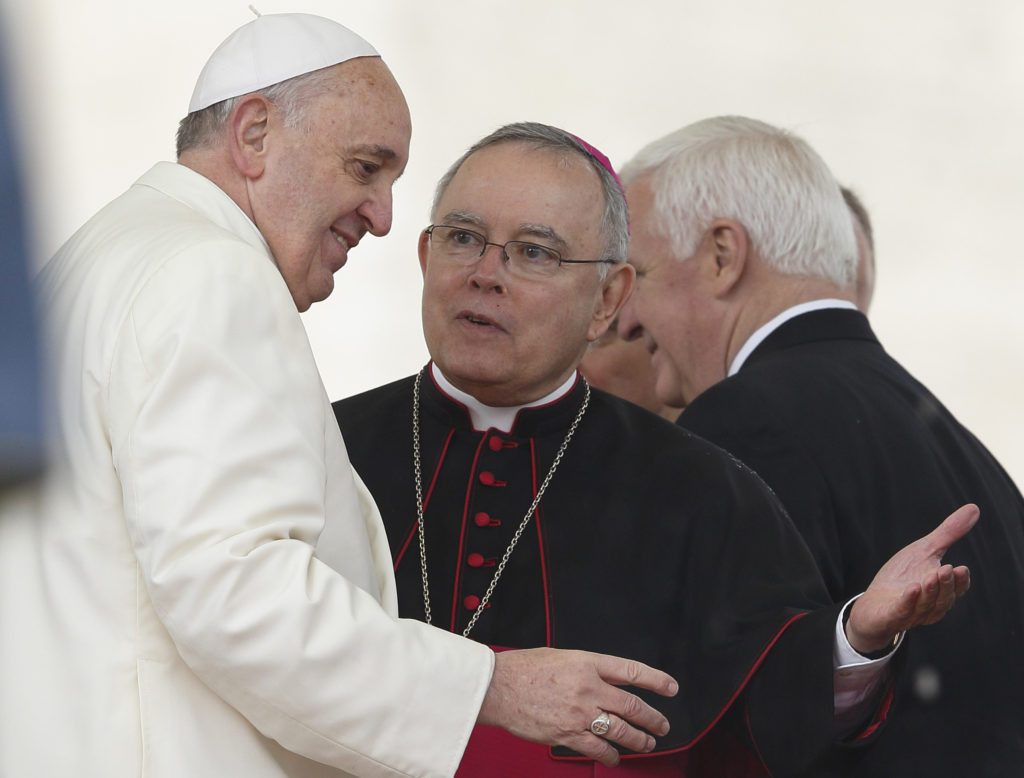
Pope Francis talks with Archbishop Charles J. Chaput of Philadelphia during his general audience in St. Peter's Square at the Vatican March 26. A delegation of government, religious and community leaders from Pennsylvania was meeting with Vatican officials to plan the Sept. 22-27, 2015, World Meeting of Families in Philadelphia. U.S. church and civil officials were preparing for Pope Francis' possible participation in the event. (CNS photo/Paul Haring)
Pope Francis talks with Archbishop Charles J. Chaput of Philadelphia during his general audience in St. Peter’s Square at the Vatican March 26. A delegation of government, religious and community leaders from Pennsylvania was meeting with Vatican officials to plan the Sept. 22-27, 2015, World Meeting of Families in Philadelphia. U.S. church and civil officials were preparing for Pope Francis’ possible participation in the event. (CNS photo/Paul Haring)
FARGO, N.D. (CNS) — Philadelphia Archbishop Charles J. Chaput said Pope Francis has accepted his invitation to attend the World Meeting of Families in the U.S. next year, even though the Philadelphia Archdiocese still has not received official confirmation from the Vatican.
Archbishop Chaput made the announcement July 24 before giving his homily during the opening Mass of the Tekakwitha Conference in Fargo.
“Pope Francis has told me that he is coming,” said the archbishop as he invited his fellow Native Americans to the 2015 celebration being held in Philadelphia Sept. 22-27.
“The pope will be with us the Friday, Saturday and Sunday of that week,” he said.
Jesuit Father Federico Lombardi, Vatican spokesman, said July 25 Pope Francis has expressed “his willingness to participate in the World Meeting of Families” in Philadelphia, and has received invitations to visit other cities as well, which he is considering. Those invitations include New York, the United Nations and Washington.
“There has been no official confirmation by the Vatican or the Holy See of Pope Francis’ attendance at the 2015 World Meeting of Families in Philadelphia,” the archdiocese said in a statement. “We still expect that any official confirmation will come approximately six months prior to the event.”
It said Archbishop Chaput “has frequently shared his confidence in Pope Francis’ attendance at the World Meeting and his personal conversations with the Holy Father are the foundation for that confidence.”
“We are further heartened and excited” by Father Lombardi’s comments, it added. “While Archbishop Chaput’s comments do not serve as official confirmation, they do serve to bolster our sincere hope that Philadelphia will welcome Pope Francis next September.”
Some Mexican media have cited government officials saying a September trip to North America also could include stops in Mexico, but Father Lombardi said that at this moment “nothing operational has begun relative to a plan or program for a visit to the United States or Mexico. Keep in mind, there is still more than a year to go before the meeting in Philadelphia.”
— By Nancy Wiechec, Catholic News Service. Contributing to this story was Cindy Wooden at the Vatican.
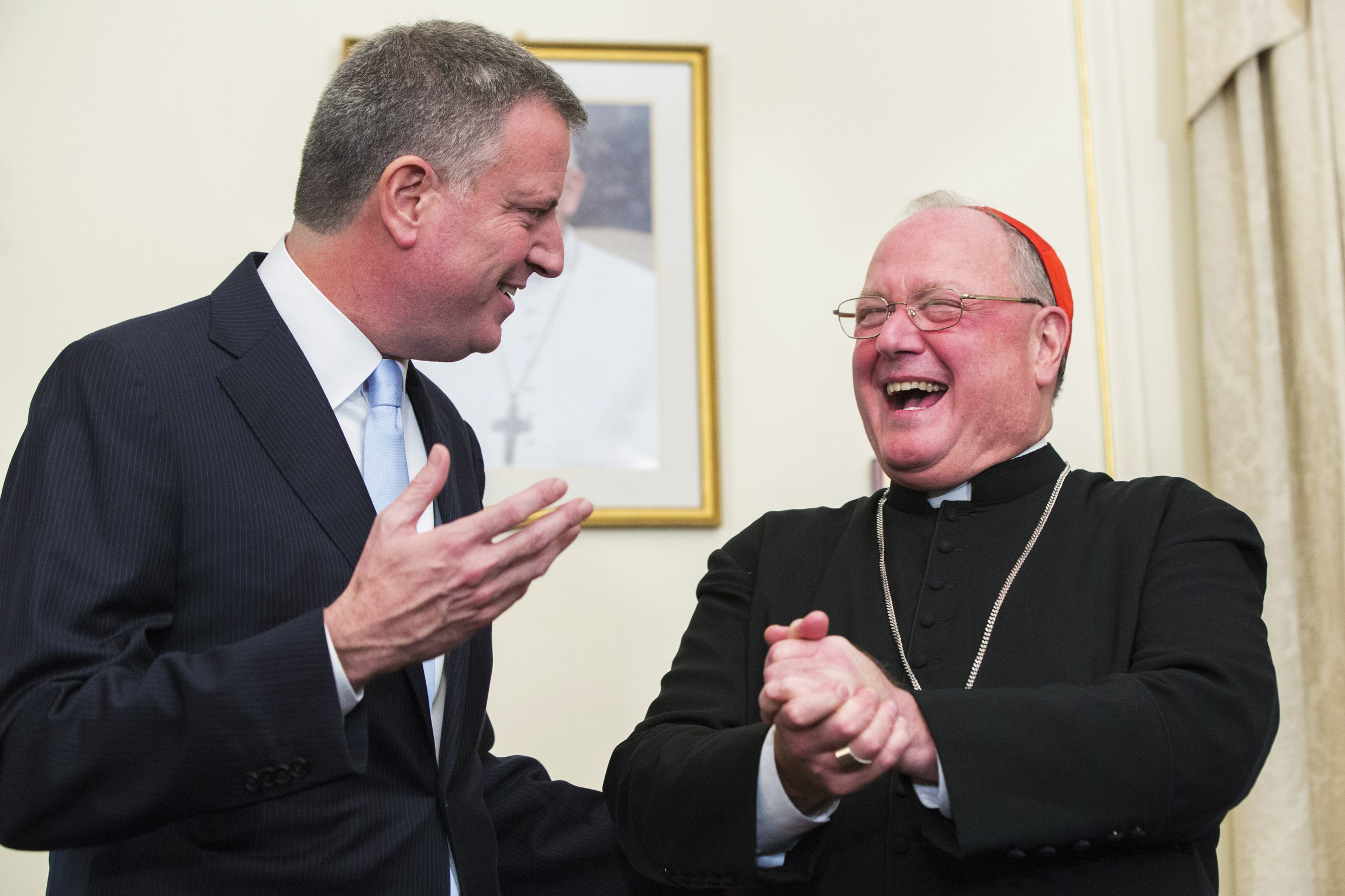
New York City Mayor Bill de Blasio laughs with New York Cardinal Timothy M. Dolan following a meeting at the cardinal's residence in the Manhattan borough of New York Jan. 13. De Blasio met with Cardinal Dolan for the first time since he took office, declaring he will join forces with the cardinal to convince Pope Francis to visit New York City. (CNS photo/Lucas Jackson, Reuters)
New York City Mayor Bill de Blasio laughs with New York Cardinal Timothy M. Dolan following a meeting at the cardinal’s residence in the Manhattan borough of New York Jan. 13. De Blasio met with Cardinal Dolan for the first time since he took office, declaring he will join forces with the cardinal to convince Pope Francis to visit New York City. (CNS photo/Lucas Jackson, Reuters)
NEW YORK (CNS) — New York Mayor Bill de Blasio said it would be an “extraordinary moment for our city and an extraordinary honor” if Pope Francis visited the Big Apple in September 2015, when the World Meeting of Families takes place in Philadelphia.
Organizers of the international gathering hope Pope Francis will attend that event and if he does, many U.S. church and civic leaders hope the pontiff would add a couple of other U.S. cities to his itinerary.
To that end, de Blasio went to the Vatican and met July 21 with Cardinal Pietro Parolin, the Vatican’s secretary of state, “to relate how important it would be for the people of New York City to have the pope visit,” the mayor said.
He held a news conference following his visit with the cardinal. U.S. Ambassador to the Vatican Ken Hackett also attended that meeting and joined de Blasio at the news conference. A transcript of their remarks to the media was posted on the website of the mayor’s office.
“The meeting was very positive,” de Blasio told reporters. “The secretary of state (is) an extraordinary man and it was such an honor to spend time with him, and to relate to him how important it would be for the people of New York City to have the pope visit.
“We understand no one has a more difficult schedule in the world than the pope. And nothing definitive was decided in the meeting, but Cardinal Parolin was very open to the request,” he added.
The mayor said he emphasized that a papal visit would be important not “just for Catholic New Yorkers in the city” but “for all New Yorkers.”
The World Meeting of Families is sponsored by the Vatican’s Pontifical Council for the Family every three years in a different city.
The Philadelphia Archdiocese, headed by Archbishop Charles J. Chaput, is hosting the Sept. 22-27, 2015, meeting. Pennsylvania Gov. Tom Corbett and Philadelphia Mayor Michael Nutter are co-chairmen of the event.
In May, Archbishop Vincenzo Paglia, president of the Pontifical Council for the Family, visited Philadelphia; Catholic and civic leaders there also have invited the pope to visit. In March, Archbishop Chaput visited the Vatican with Corbett and Nutter as part of a delegation of government, religious and community leaders meeting with church officials to plan the family gathering.
Archbishop Chaput has emphasized he does not expect the pope to announce whether he will come to Philadelphia until about March of next year but that the gathering is being planned as though he will attend.
At the news conference with de Blasio, Hackett noted Cardinal Parolin was “very generous with his time” and also touched on the immigration issue in the U.S. He said the prelate was interested in New York’s experience with immigrants, specifically a new ID card that gives those who entered the U.S. illegally and live in New York access to government services. De Blasio signed the card bill into law July 11.
Hackett said the card “really captured” the interest of Cardinal Parolin, who was “just back himself from Mexico and a big meeting on migration.”
De Blasio added that their discussion covered the crisis at the U.S.-Mexico border with the surge of unaccompanied minors and adults from Central America.
“The church has been a leader in calling for compassion and support and a humanitarian response, as opposed to a political response to the crisis,” the mayor said. “And I emphasize that New York City agrees with the position of the Holy See that we have to embrace all immigrants (and) support these children who are now coming across the border, because they are fleeing from violence.”
De Blasio said they also talked about “the broader issue of addressing poverty and income inequality, which as I’ve always said, the pope is the leading voice on the earth in relation to that.”
Asked what further steps can be taken on a hoped-for papal visit, de Blasio said he and other city officials have been working with New York Cardinal Timothy M. Dolan “for months trying to do all we can to encourage and support a visit.”
“I think the point is simply to make clear how much enthusiasm there would be in New York City,” he said. “And how the city of New York would do everything to accommodate the visit.”
De Blasio added, “Obviously we have the advantage of the United Nations being there as well, and that might be appealing to the pope. I think it’s an ongoing dialogue until the pope and his staff are able to determine their approach.”
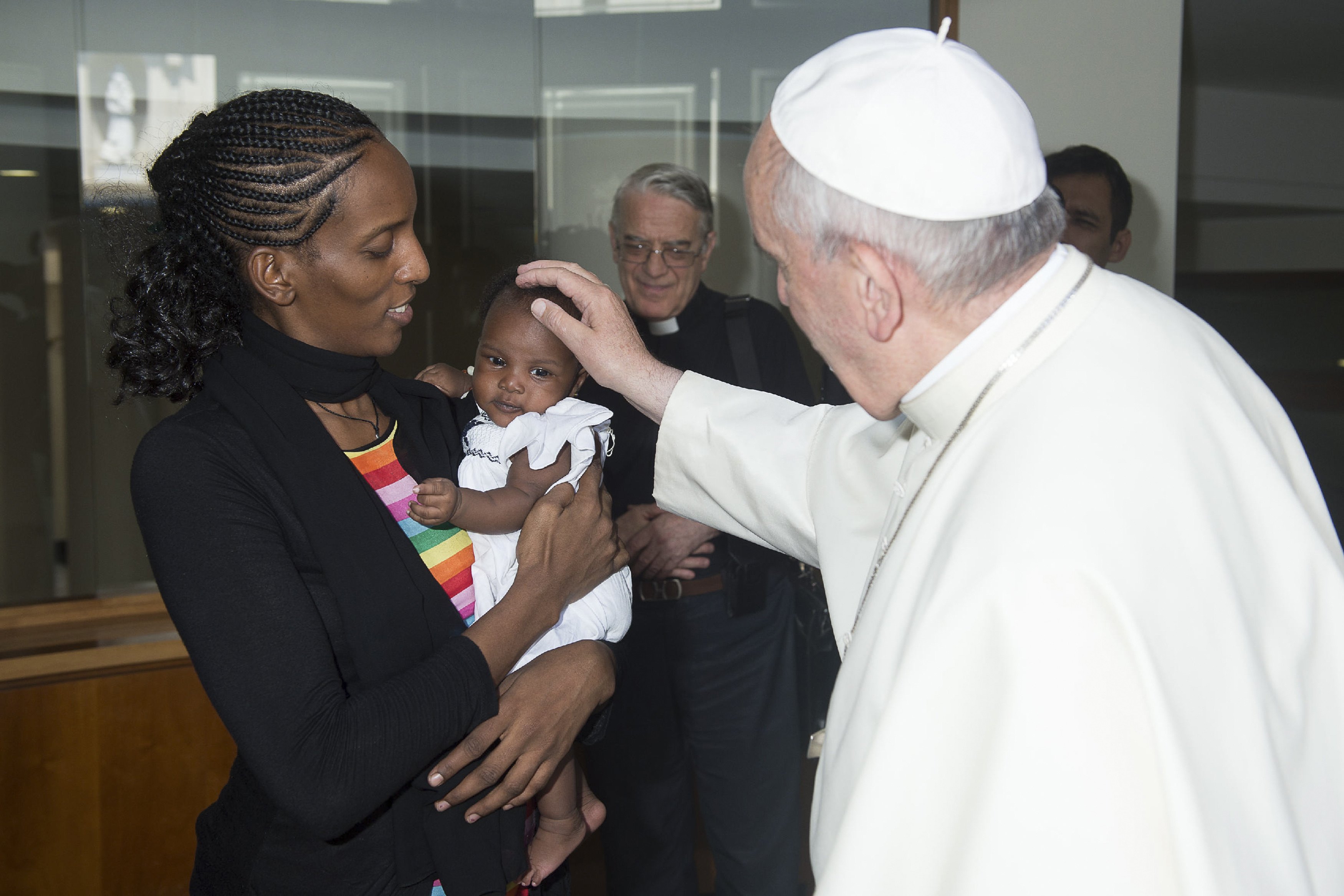
Pope Francis blesses Meriam Ibrahim of Sudan and her baby during a private meeting at the Vatican July 24. The Sudanese woman, who was spared a death sentence for converting from Islam to Christianity and then was barred from leaving Sudan, flew into Rom e July 24 in an Italian government plane. (CNS photo/L'Osservatore Romano via Reuters)
VATICAN CITY (CNS) — Meeting a Sudanese woman who risked execution for not renouncing her Catholic faith, Pope Francis thanked Meriam Ibrahim for her steadfast witness to Christ.
The pope spent 30 minutes with Ibrahim, her husband and two small children July 24, just hours after she had arrived safely in Italy following a brutal ordeal of imprisonment and a death sentence for apostasy in Sudan.
Jesuit Father Federico Lombardi, Vatican spokesman, told journalists that the encounter in the pope’s residence was marked by “affection” and “great serenity and joy.”
They had “a beautiful conversation,” during which the pope thanked Ibrahim for “her steadfast witness of faith,” the priest said.
Pope Francis blesses Meriam Ibrahim of Sudan and her baby during a private meeting at the Vatican July 24. The Sudanese woman, who was spared a death sentence for converting from Islam to Christianity and then was barred from leaving Sudan, flew into Rom e July 24 in an Italian government plane. (CNS photo/L’Osservatore Romano via Reuters)
Ibrahim thanked the pope for the church’s prayers and support during her plight, Fr. Lombardi said.
The Vatican spokesman said the meeting was a sign of the pope’s “closeness, solidarity and presence with all those who suffer for their faith,” adding that Ibrahim’s ordeal has come to represent the serious challenges many people face in living out their faith.
The informal conversation also touched upon the family’s plans now that Ibrahim is free, he said. The pope gave the family a few small gifts, including papal rosaries.
Ibrahim, a 26-year-old Catholic woman originally sentenced to death for marrying a Christian, had been released from prison in Sudan June 23 after intense international pressure. But she was apprehended again the next day at the Khartoum airport with her husband, who is a U.S. citizen, and their nearly 2-year-old son and 2-month-old daughter, who was born in prison just after Ibrahim’s death sentence.
Charged with possessing fake travel documents, Ibrahim was not allowed to leave Sudan, but she was released into the custody of the U.S. Embassy in Khartoum, where she then spent the following month.
Italy’s foreign ministry led negotiations with Khartoum for her to be allowed to leave Sudan for Italy.
She arrived in Rome July 24 aboard an Italian government plane accompanied by her family and Italy’s vice foreign minister, Lapo Pistelli, who led the talks that ended in her being allowed to leave Sudan.
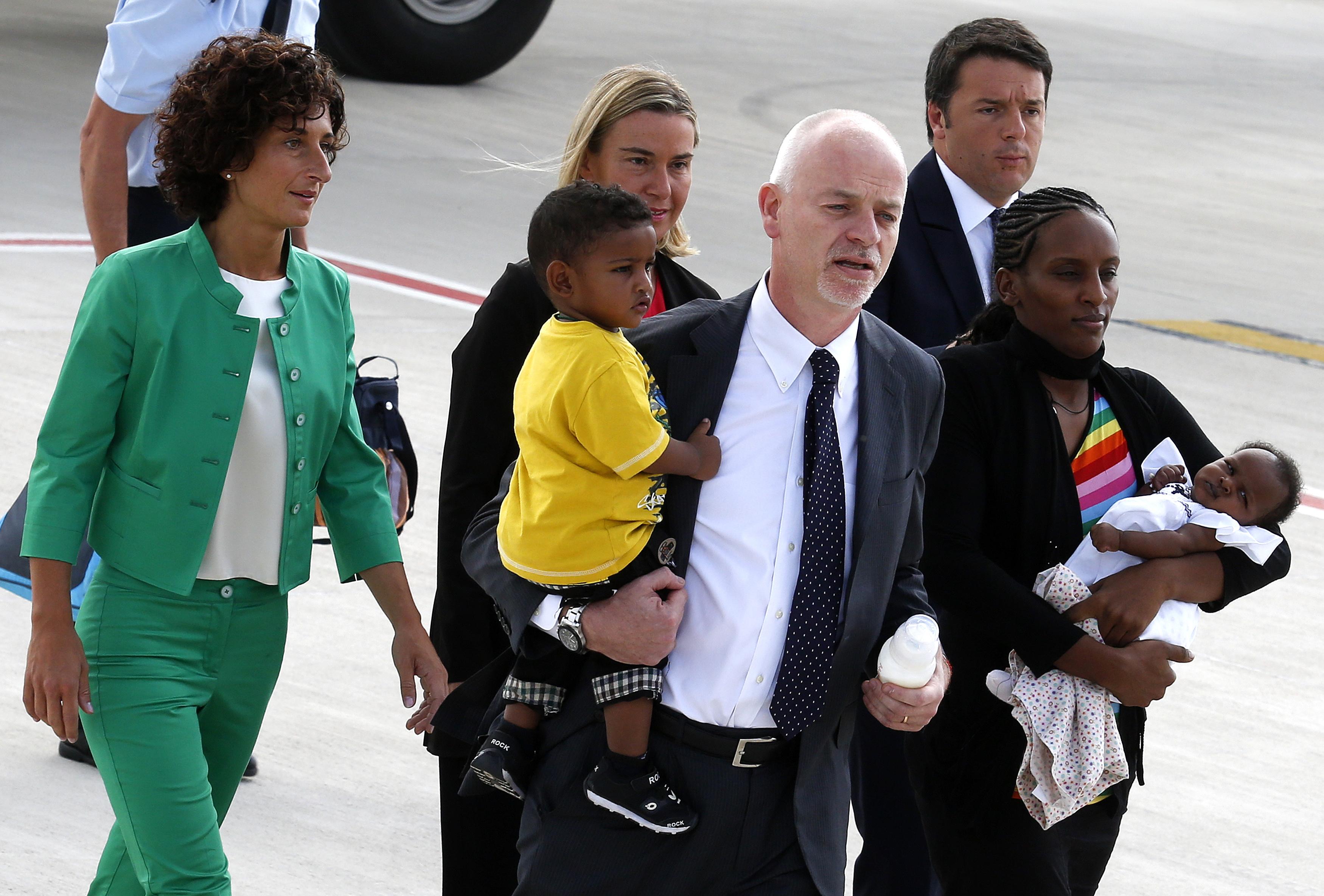
Meriam Ibrahim of Sudan carries one of her children as she arrives with Lapo Pistelli, Italy’s vice minister for foreign affairs, holding her other child. Also pictured is Italian Prime Minister Matteo Renzi, right, his wife Agnese, left, and Foreign Affairs minister Federica Mogherini. Ibrahim, who was spared a death sentence for converting from Islam to Christianity and then was barred from leaving Sudan, flew into Rome on July 24 in an Italian government plane. (CNS photo/Remo Casilli, Reuters)
Pistelli told reporters at Rome’s Ciampino airport that they had left Khartoum at 3:30 a.m. and spent most of the flight sleeping. However, he said, when awake, Martin, the 2-year-old, “practically dismantled the plane.”
The president of the group Italians for Darfur, Antonella Napoli, helped organize Ibrahim’s visit with the pope.
“Meriam will achieve her dream and see the pope. I had promised her that when we met,” Napoli tweeted before Ibrahim’s encounter with the pontiff.
Ibrahim joined the Catholic Church shortly before she married Daniel Bicensio Wani in 2011.
She was later convicted of apostasy and sentenced to death by hanging. Sudan’s penal code criminalizes the conversion of Muslims to other religions, which is punishable by death.
The Khartoum Archdiocese, which followed her case, had said Ibrahim had never been a Muslim because her Sudanese Muslim father abandoned the family when she was 5, and she was raised according to her mother’s faith, Orthodox Christian.
Despite pressure to renounce Christianity in order to be freed, Ibrahim refused. The church in Sudan said the charges against Ibrahim were false and appealed to the Sudanese government to free her from prison.
Ibrahim was scheduled to be in Rome for a few days before heading to New York with her family.
An estimated 2,000 people attend holy hour May 12 at St. Paul Church in Cambridge, Mass., in reaction to plans for a satanic ritual "black mass" to be held in a pub on the Harvard University campus. The student group organizing the "black mass" ultimately cancelled the event. (CNS photo/Gregory L. Tracy, Pilot)
An estimated 2,000 people attend holy hour May 12 at St. Paul Church in Cambridge, Mass., in reaction to plans for a satanic ritual “black mass” to be held in a pub on the Harvard University campus. The student group organizing the “black mass” ultimately cancelled the event. (CNS photo/Gregory L. Tracy, Pilot)
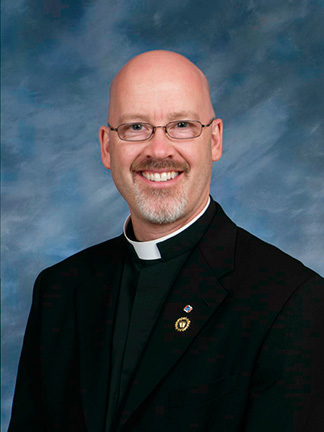
Fr. John Lankeit, rector of Ss. Simon and Jude Cathedral in Phoenix, is urging local Catholics to gather for a 7 p.m. holy hour July 25 in order to pray that a black mass scheduled to take place Sept. 21 in Oklahoma City will be canceled.
A black mass is a sacrilegious ceremony that invokes Satan and desecrates a eucharistic host stolen from a Catholic church. The host is then used in a profane, sexual ritual.
“We will pray specifically for the cancellation of the black mass,” Fr. Lankeit said. “I am calling on all of the Catholic faithful and people of good will to stand firm against the powers of Hell, and in defense of those vulnerable souls who would be drawn to this evil event.”
Fr. John Lankeit, rector of Ss. Simon and Jude Cathedral, has invited the faithful to attend a holy hour to pray that a scheduled black mass in Okla. will not take place.
Ss. Simon and Jude Cathedral is located at 6351 N. 27th Ave., Phoenix.
Archbishop of Oklahoma City Paul Coakley has been an outspoken critic of the black mass.
“There are common standards of decency that civic-minded people uphold that are necessary for constructive public discourse, and this violates all of those standards,” Archbishop Coakley told Catholic News Agency July 16. “This is a mockery of one faith, a hostile act toward a significant faith community, the Catholic community.”
It would be “truly offensive to a significant segment of their population, that is the Catholic, and the Christian community at large,” the archbishop added. “Oklahoma is a very church-minded community; there are not many Catholics here, but a great majority are Christian, and this is really an affront to all Christian believers, and I think the more people are recognizing that, the more they’re willing to speak up.”
The occult group Dakhma of Angra Mainyu has been scheduled to hold a black mass at the Oklahoma City Civic Center Music Hall Sept. 21.
“I give the benefit of the doubt to those who allowed this civic center to be booked by a satanic group for the purpose of a black mass, because my suspicion is that whoever booked it had no idea what a black mass is, how offensive such a thing is,” Archbishop Coakley reflected. “Initially there was ignorance, I think, about what they were getting into.”
When CNA spoke on July 3 with Jennifer Lindsey-McClintock – the music hall’s public information manager – about the nature of the event, she cited the hall’s neutrality policy saying it’s “not for us to judge…whether it is appropriate or not.”
Archbishop Coakley said that “my hope is that through prayer, and through continued communication with the civic officials here, they will come to recognize this is not a prudent course, not a good course, for the city.” He added that he supposes “that if someone desired to rent the civic center to have a public burning of a Quran, or a blatantly anti-semitic sort of program, that the city would rightly find some way to prevent that from happening. And they should. That would be very clear.
“My question, is why can’t they recognize that this is equally offensive to the Catholic community, and act accordingly to prevent such a black eye on the community, such an affront to the Catholic and to the Christian community?”
Lindsey-McClintock, however, claimed that as a city-funded facility, they must “operate in a position of neutrality.” She said that this policy would mean the center would host racist or anti-Jewish events “as long as it was not hosting something specifically illegal in nature, or that during the production they were taking part in illegal activities…we do not discriminate against any group based on the content of their message.”
“I think the more people here in Oklahoma, as well as around the country, have heard about this, and reflected upon what exactly it entails, the more outraged, and upset, people have become,” Archbishop Coakley said. Black masses, he said, are a “grievous sacrilege and blasphemy of the first order…taking what is most sacred to us as Catholics, and mocking it, desecrating it, in vile, often violent and sexually explicit ways…It’s obviously horrendous…what they intend to do with that consecrated Host is offensive beyond description.”
Archbishop Coakley called it a “terribly disturbing development in our community, and I think one of the things people need to realize, is this is inviting very dark and evil forces into our community. I think I have an obligation, we have an obligation, to do what we can do to prevent that from happening – unleashing spiritual influences which are harmful and destructive.”
Noting the recently planned black mass at Harvard, another satanic group’s attempt to place a satanic monument at the Oklahoma capitol, and this planned black mass, the archbishop said that “perhaps if anything, it’s a manifestation that these kinds of groups are becoming emboldened because of a certain kind of increasing tolerance for an increasingly outrageous mode of conduct in our culture.
“I hope to be meeting in the near future with civic officials,” he added. “We’ll continue to explore ways of dialoguing with civic officials.”
“Obviously for us as people of faith, as Catholics, we’re praying for a change of heart, that something will shift, and that there will be a change of direction, and a recognition that this cannot be allowed.”
The archbishop noted that there have been a number of petitions against the event on Facebook and other sites, not organized by the archdiocese, but “very much a grassroots thing.”
“My role in this,” Archbishop Coakley said, “is simply to provide a voice, and leadership, drawing attention to it, and encouraging people to pray, and to voice their concern to civic officials.”
Should the black mass not be canceled, the archbishop said the Catholic community will “find a way to lift up the Eucharist in a way that shows our love for Christ in the Eucharist, our respect and honor for the gift of the Blessed Sacrament.” Whether through Masses of reparation, holy hours, or processions, “we will do what we can do to bear witness to our faith in the true presence of Christ in the Eucharist,” Archbishop Coakley said.
– Carl Bunderson of Catholic News Agency contributed to this story.
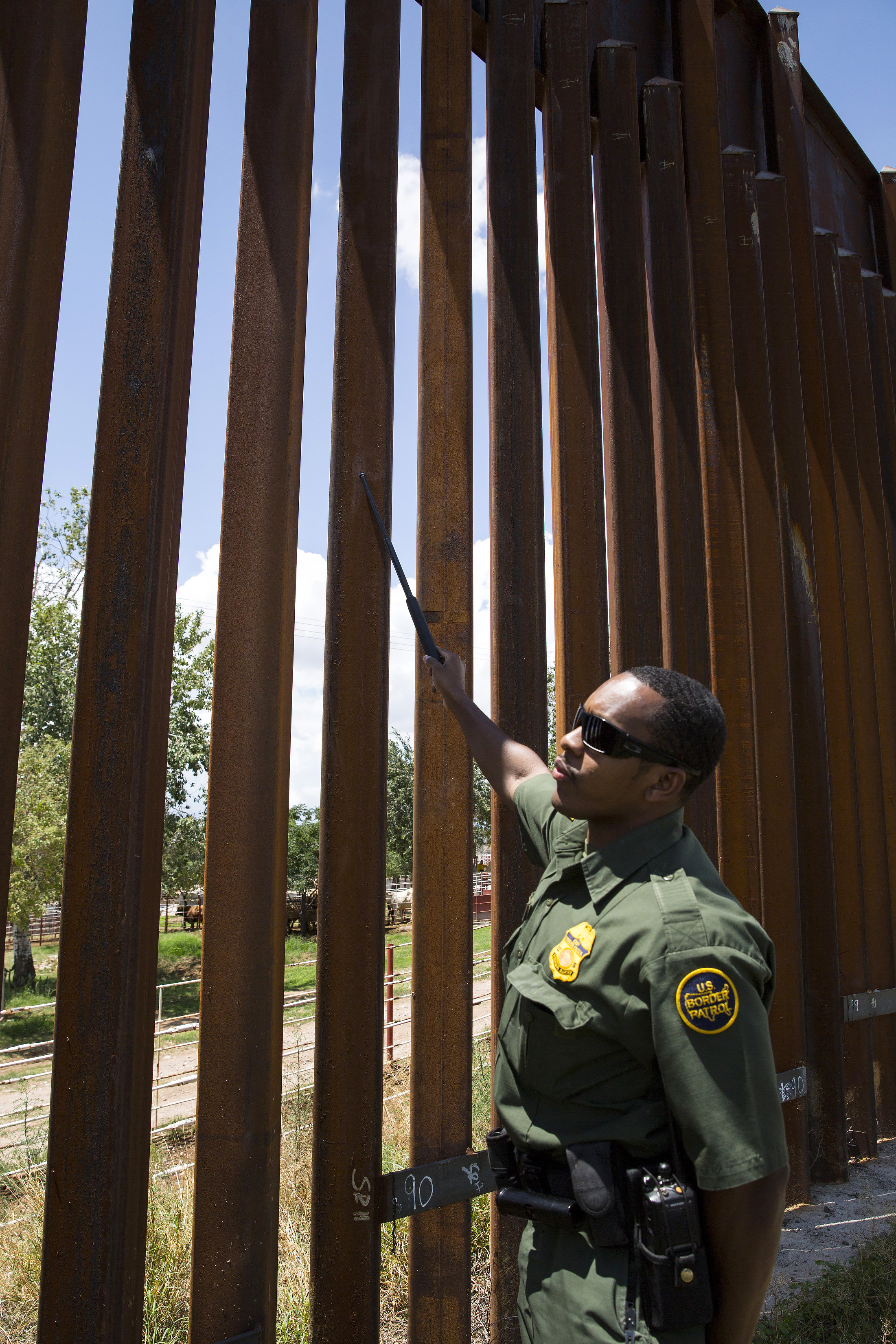
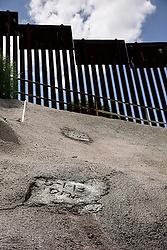
U.S. Border Patrol Agent Bryan Flowers stands on an hill near the international border west of Nogales, Ariz., July 16. He told Catholic News Service that fencing along the international border serves as an obstacle to unlawful crossings, but it "can't s top a person's will to cross if that's what they've decided to do." (CNS photo/Nancy Wiechec)
U.S. Border Patrol Agent Bryan Flowers points to an area on the steel-slat border fence west of Nogales, Ariz., July 16. Flowers said that fencing along the international border serves as an obstacle to unlawful crossings, but it “can’t stop a person’s will to cross if that’s what they’ve decided to do.” (CNS photo/Nancy Wiechec)
NOGALES, Ariz. (CNS) — A shirtsleeve waved from the top of the border fence like a signal flag.
“Someone came over here recently,” said Border Patrol Agent Bryan Flowers pointing to the shirt and rubber-sole skid marks left on the 20-foot-tall rusted steel fence.
Flowers has a keen eye for spotting signs of people on the move. He can make out fresh footprints in the dry desert sand and easily spot newly discarded water bottles, backpacks or clothing.
A former teacher, he is among the 4,100 agents in the Tucson sector of U.S. Border Patrol charged with security along 262 miles of linear border extending from Arizona’s Yuma County to the New Mexico state line.
The agents make daily arrests. Among those taken into custody are people looking for a better life, those seeking jobs or to be with family and hardened criminals, including drug smugglers, human smugglers and traffickers.
Flowers, a public information officer, recently gave Catholic News Service a tour of Border Patrol operations in southern Arizona.
“This border area is safer today than it’s ever been,” he said, outlining infrastructure improvements the agency has made over the last decade.
Upgrades in fencing, roads and monitoring technology, as well as an increase in the number of agents, have helped reduce the number of apprehensions made in the Tucson sector.
Even as apprehensions are down from an all-time high of more than 600,000 in 2000, the sector remains one of the Border Patrol’s busiest regions.
Last year it took into custody 120,939 people, nearly 29 percent of all Border Patrol apprehensions that year.
The Tucson sector also seized more than 1.1 million pounds of marijuana in 2013, accounting for nearly half of all the marijuana confiscated by Border Patrol the same year.
Just before 11 a.m. July 17, the patrol’s Nogales station was processing more than 20 people — including women and children — arrested by agents a few hours earlier.
Unlike the Texas Rio Grande area, Arizona’s southern border did not experience an uptick in apprehensions of unaccompanied minors over the last reported year. The number of family-unit apprehensions in the Tucson sector for the same period did increase from 2,130 to 3,117. (A “family unit” is defined as a child or children accompanied by one or both parents).
In June and July, the Border Patrol’s Nogales station temporarily housed hundreds of undocumented children who had been apprehended in the Rio Grande sector.
Bishop Gerald F. Kicanas of Tucson said he and other community leaders continue to converse with Border Patrol about the treatment of people in its custody. Most recently the focus has been on the unaccompanied children, who he said need pastoral and social services and legal representation.
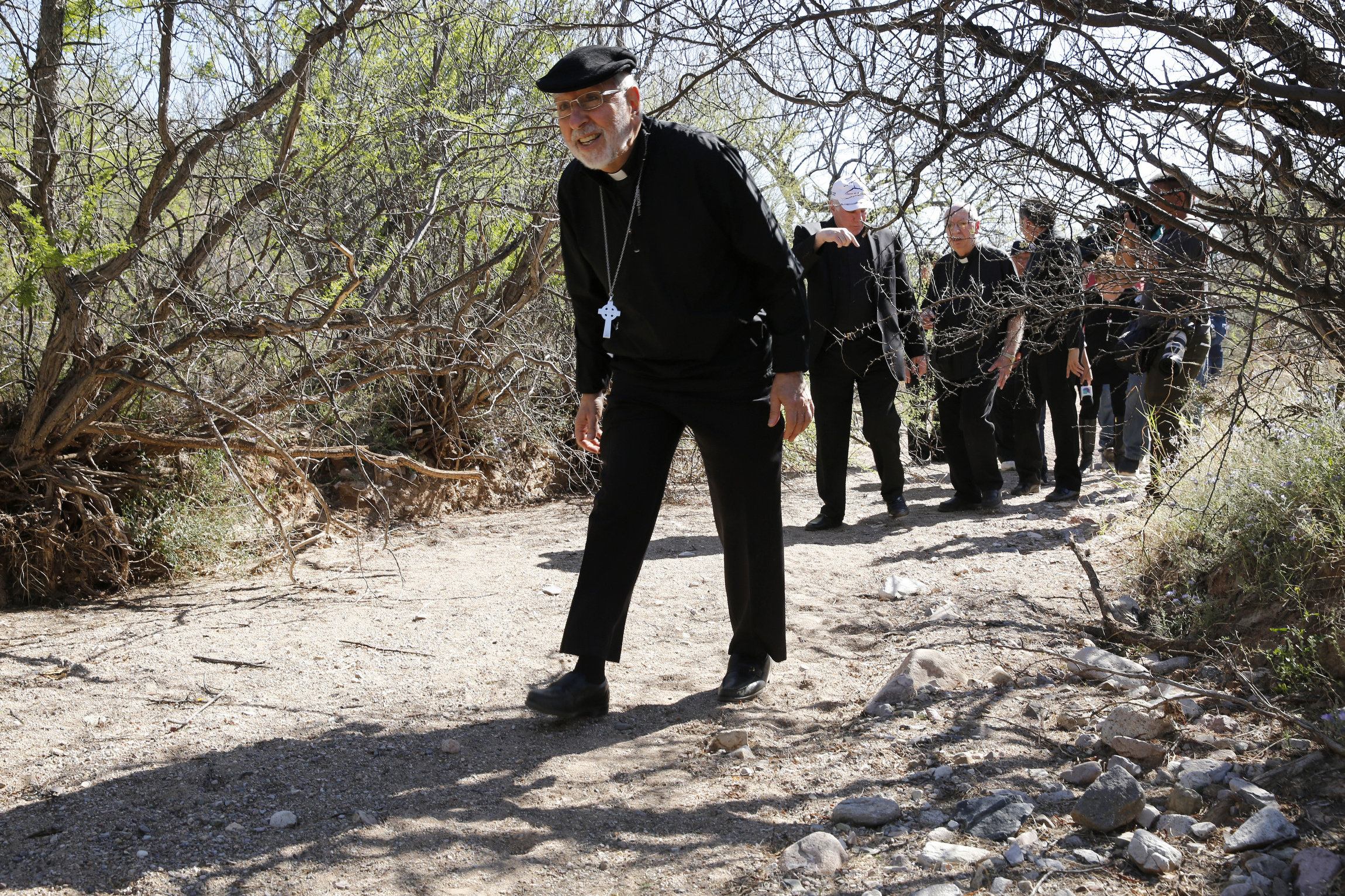
Bishop Gerald F. Kicanas of Tucson, Ariz., ducks under brush in the Arizona desert near Nogales March 31. He was in a group of U.S. bishops visiting the U.S.-Mexico border area to celebrate Mass, talk with migrants and recall the thousands who have died attempting to cross the Arizona desert. The bishops hiked an area where many migrants make their way after illegally crossing into the U.S. from Mexico. (CNS photo/Nancy Wiechec)
Border Patrol is “trying to be as sensitive and as helpful as possible in situations that are very challenging,” he said. “However, we are asking that they be open to letting the community be helpful in caring for the spiritual needs of these children.”
The bishop said he had asked permission to celebrate Mass for children at the Nogales station, but his request was denied.
Bishop Kicanas also said there is still much concern about a 2012 Border Patrol shooting incident that left a Mexican teenager dead on the Sonoran side of the fence near Nogales. An agent or agents reportedly shot several times through the border fence as rocks were being thrown at them.
“I believe there has never been a full report or accounting of the circumstances of that shooting, which has left the family very concerned and anxious,” Bishop Kicanas said. “We have to keep an open dialogue about such cases.”
“When you have as many Border Patrol agents as there are in the Tucson sector, it’s very difficult to make certain that all of them are following all the directives and rules and that they treat everyone with dignity and respect,” Bishop Kicanas said.
At the same time, he added, it’s also helpful for those in the community to be mindful that agents are law enforcement people, not health care or social workers.
Flowers said that although Border Patrol agents’ first responsibility is to secure the border, they do show compassion and care for the individuals in their custody.
“I am not here to judge them,” the agent said. “I’m just here to enforce these laws.”
Border Patrol’s monitoring and detection tools include remote video and radar surveillance; mobile surveillance; K-9 units; infrared scopes; radiation monitors; road checkpoints; and unmanned aerial systems, often referred to as drones.
A date marks the exit of a former secret underground tunnel near the DeConcini port of entry in Nogales, Ariz., in this July 16 photo. The marking was put there last year on the day U.S. Customs and Border Protection sealed the tunnel that had been used to move narcotics and people into the U.S. Seen in the background is the steel border fence. (CNS photo/Nancy Wiechec)
Armed agents patrol paved roads and off-road areas using marked and unmarked vehicles, ATVs, horses, and bicycles and by foot. The U.S. Customs and Border Protection’s Office of Air and Marine provides air support.
Even as Border Patrol bolsters its abilities to keep criminals from sneaking into the U.S., it witnesses breaches every day.
The Tucson sector reported that in early July alone its agents had seized five vehicles, more than $1.1 million in narcotics and apprehended 23 people in connection with criminal cases.
Flowers said criminal elements have means to monitor Border Patrol from Mexico and inside the U.S., and they employ a host of tactics, including violence, to distract or intimidate agents.
And does fencing help in the overall border security strategy?
Fences serve mainly as obstacles to those who are determined to make it over, said Flowers.
“Fencing is not necessarily going to stop a person from entering the country,” the agent said. “You can’t stop a person’s will to cross if that’s what they’ve decided to do. People will try to go over, through or even under any fence.”
Fencing does provide more time for agents to respond to illegal crossings. But it’s only one facet of Border Patrol’s overall plan to deter, detect and identify unlawful activity, Flowers said.
“There is no one-fix solution to keeping our borders safe.”
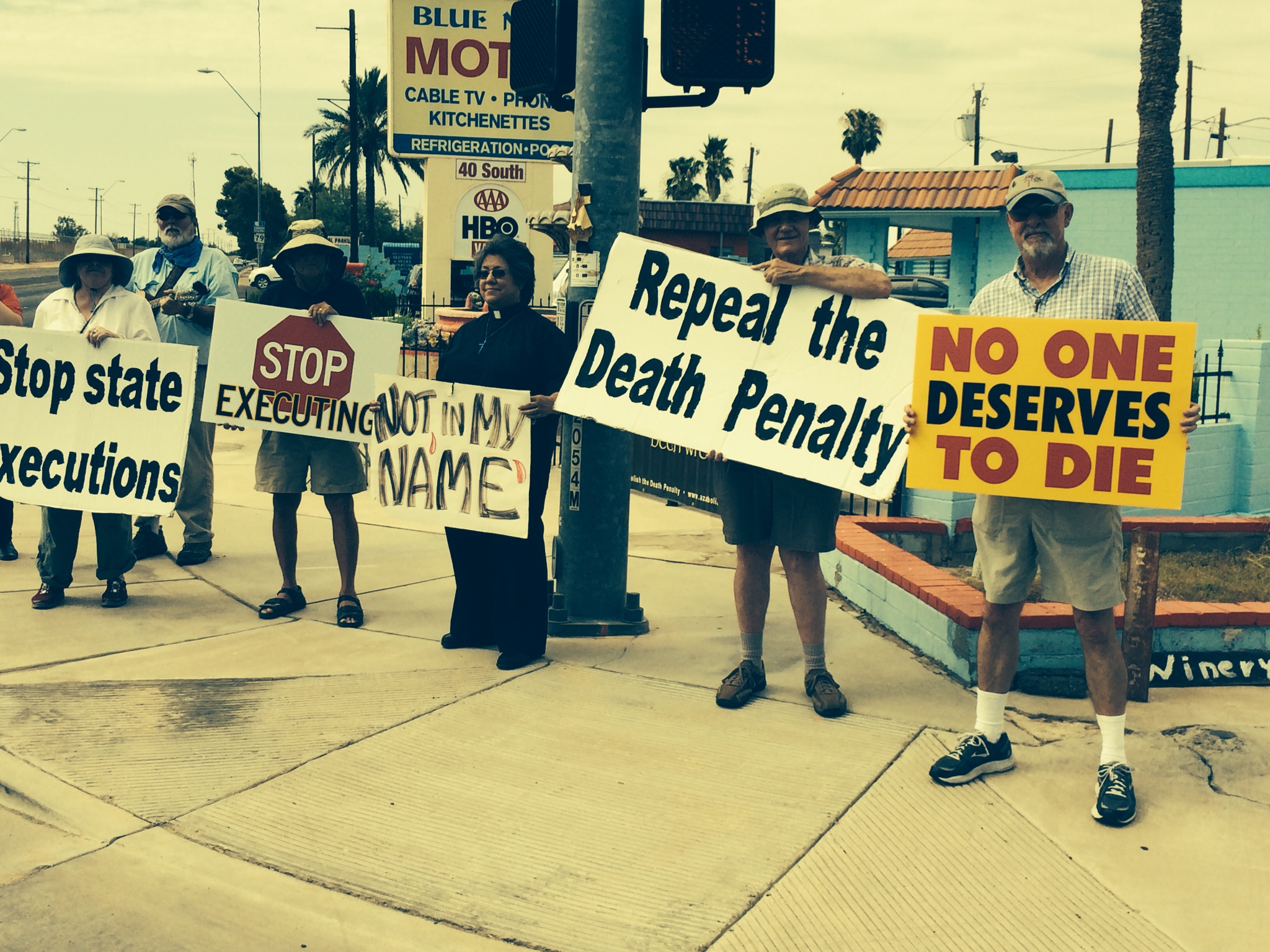
That was the question of the day as opponents of the death penalty stood in a sweltering sun in Florence outside the state penitentiary awaiting news about the execution of Joseph Wood.
Wood, convicted of the 1989 double murder of Debra and Eugene Dietz in Tucson, was scheduled to die July 23. The United States Supreme Court on July 21 vacated an order by the 9th Circuit Court of Appeals, clearing the way for the execution. Then, just before it was to take place, the Arizona Supreme Court issued a temporary stay. Later in the day, that same court lifted the stay and gave the go ahead for the execution.
Wood died nearly two hours after a lethal injection was administered. Critics say he gasped and snorted during his final hours, while Jeanne Brown, the sister of victim Debra Dietz who witnessed both the murder and Wood’s execution, saw things differently. Wood was merely snoring during his execution, Brown said.
Public support wanes
According to a new poll by ABC News and the Washington Post conducted in May and June, American attitudes on capital punishment are shifting downward. The poll revealed an eight-point drop in public support for executions since 2006.
According to the Death Penalty Information Center, support for executions stood at 80 percent in 1994. The ABC News and the Washington Post poll found that 52 percent of American prefer life without parole as punishment for convicted murderers, with just 42 percent supporting the death penalty.
Arizona currently has 119 inmates on death row. Executions at the state prison in Florence began in 1910 with the hanging of Jose Lopez. Twenty-seven other individuals were hanged in subsequent years. In 1934, the state switched to lethal gas as a means of execution. From 1962 onward no executions took place, but in 1992, Arizona voters approved execution by lethal injection. So far, 37 people have been executed by the state of Arizona.
‘Unwavering opposition’
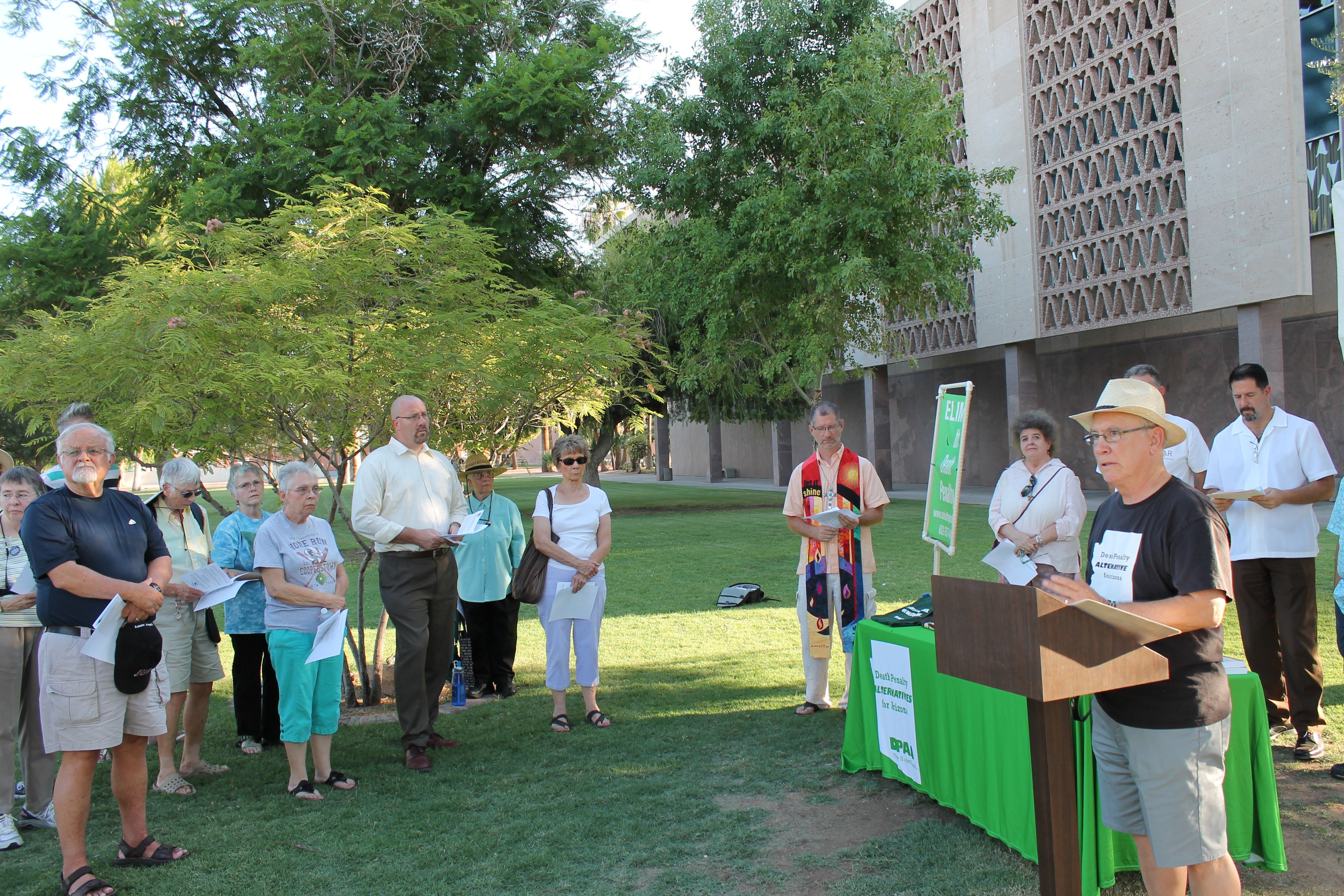
A small but vocal group gathered on the grounds of the state Capitol July 22 to voice their condemnation of the death penalty and to pray for crime victims and those whom the state plans to execute.
Kevin Heade, an attorney with the Central Arizona Lawyers Guild, called the death penalty a “moral outrage.” The manner in which the state planned to kill Wood was shrouded in secrecy, Heade said, and citizens have the right to know where the drugs used in executions come from.
The state of Arizona maintains that it cannot reveal the identity of the suppliers of the drug used in executions because death penalty opponents then pressure suppliers not to provide the drug.
“We are here to speak our unwavering opposition to state sponsored violence,” Heade said. And while he acknowledged the loss of life Wood caused, execution “doesn’t mean that we are going to achieve any kind of justice,” Heade said.
Mike Phelan, director of the office of marriage and respect life issues for the Diocese of Phoenix, addressed those gathered at the prayer vigil.
Quoting from both the Catechism of the Catholic Church and St. John Paul’s Ecclesia in America, Phelan pointed out the Church’s teaching on capital punishment.
“Today…the cases where it is absolutely necessary to do away with an offender are now very rare, even non-existent practically…This model of society bears the stamp of the culture of death, and is therefore in opposition to the Gospel message,” Phelan quoted.
While not equating the death penalty with crimes against innocent life, execution is a contribution to the culture of death, Phelan said. According to St. John Paul, “killing the guilty who are incarcerated and incapable of doing further harm is a contribution to, not a prevention of, a culture of death,” Phelan said. “Abolishing the death penalty in our country brings a culture of life closer, where [we refuse] to have killing on the table to solve our problems.”
Dan Peitzmeyer, of the president of Arizona Death Penalty Alternatives, addresses a group gathered at the state capitol to protest the execution of convicted double murderer Joseph Wood.
Jean Ajamie, active at the Franciscan Renewal Center, was at the prayer vigil June 22 and explained her opposition to the death penalty.
“I feel tremendous sadness that our state does this and that I’m complicit in it because my tax dollars are used for it,” Ajamie said. “I think it’s wrong on all levels…I’m ashamed of the lessons it gives our children.”
She’s been present at many of the vigils held on the eve of executions over the years and believes strongly that the death penalty should be abolished.
“If we’re not going to do it for ourselves and our own morality, then we should at least be thinking about the lesson that it gives to our kids, because violence begets violence,” Ajamie said.
Bob Hungerford, a former Arizona state legislator, spoke to the participants in the vigil, referring to himself as the “token conservative” at the event who was once a Republican but is now a registered Independent. Conservatives, Hungerford said, wrongly think of the death penalty as a liberal issue. It’s not, he said, because state-sponsored executions violate the constitution and are not fiscally responsible. The death penalty, he said, “flies in the face of our God-given right to life.
The Founding Fathers, according to Hungerford, used the term “unalienable” right to life for a reason.
“They had a message in it for us,” Hungerford said. “The right to life cannot be revoked, taken away, surrendered or forfeited, no matter how heinous the act is. We corrupt ourselves by killing. We should not accept it from each other except in justified self defense and we should not accept it from our government,” Hungerford said.
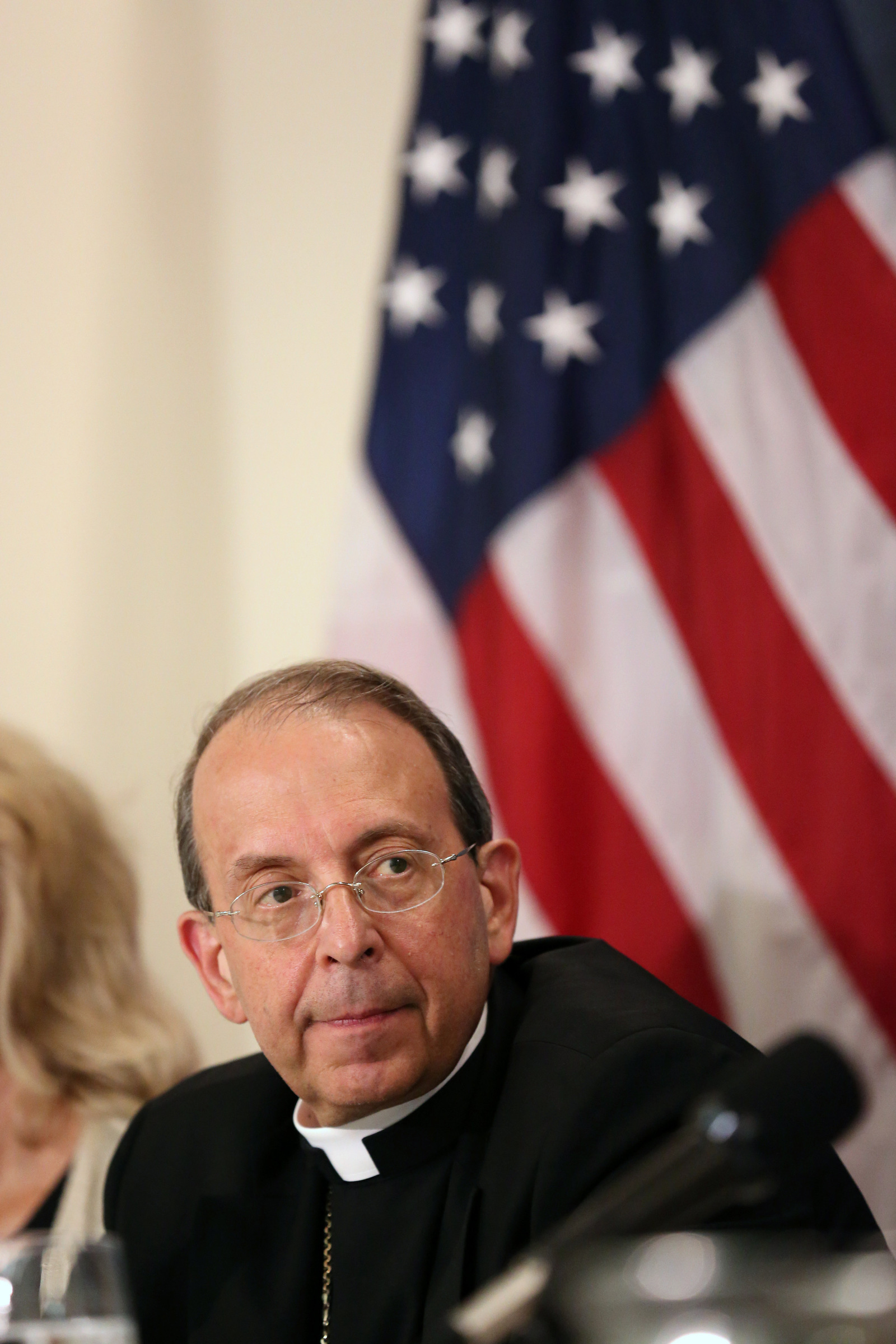
Archbishop William E. Lori of Baltimore addresses a news conference in Washington in July. As chairman of the U.S. Conference of Catholic Bishops' Ad Hoc Committee for Religious Liberty, he has been at the forefront of the bishops' opposition to the Affordable Care Act's contraceptive mandate for employers and to what the bishops see as a too-narrow exemption for religious employers. (CNS photo/Tyler Orsburn)
Archbishop William E. Lori of Baltimore addresses a news conference in Washington in July. As chairman of the U.S. Conference of Catholic Bishops’ Ad Hoc Committee for Religious Liberty, he has been at the forefront of the bishops’ opposition to the Affordable Care Act’s contraceptive mandate for employers and to what the bishops see as a too-narrow exemption for religious employers. (CNS photo/Tyler Orsburn)
WASHINGTON (CNS) — President Barack Obama’s executive order of July 21 has installed workplace rules forbidding the firing of gays, lesbians, bisexual and transgender people by the federal government and federal contractors — a key provision in the Employment Non-Discrimination Act languishing in Congress.
The U.S. bishops have opposed the bill, known as ENDA, which was passed by the Senate last November but was never scheduled for a vote in the House. The bill has been introduced in almost every Congress since 1994.
“Today’s executive order is unprecedented and extreme and should be opposed,” said Archbishop William E. Lori of Baltimore, chairman of the U.S. bishops’ Ad Hoc Committee for Religious Liberty, and Bishop Richard J. Malone of Buffalo, New York, chairman of the Committee on Laity, Marriage, Family Life and Youth.
“In the name of forbidding discrimination, this order implements discrimination,” they said in a joint statement. “With the stroke of a pen, it lends the economic power of the federal government to a deeply flawed understanding of human sexuality, to which faithful Catholics and many other people of faith will not assent. As a result, the order will exclude federal contractors precisely on the basis of their religious beliefs.”
Archbishop Lori and Bishop Malone and two bishops in an earlier posting July 21 on the U.S. Conference of Catholic Bishops’ blog, addressed their opposition to the changes put in place by the executive order because it does not include a religious exemption and could keep Catholic agencies from getting federal contracts.
“To dismiss concerns about religious freedom in a misguided attempt to address unjust discrimination in the workplace is not to advance justice and tolerance. Instead, it stands as an affront to basic human rights and the importance of religion in society,” the four bishops said.
They included Archbishop Salvatore J. Cordileone of San Francisco, chair of the USCCB Subcommittee for the Promotion and Defense of Marriage, and Archbishop Thomas G. Wenski of Miami, chair of the Committee on Domestic Justice and Human Development.
“The U.S. legacy of religious freedom has enabled the Catholic Church and other faith communities to exercise their religious and moral convictions freely and thus contribute to the good of all in society. No good can come from removing this witness from our social life,” they added in the blog posting.
“Eliminating truly unjust discrimination — based on personal characteristics, not sexual behavior — and protecting religious freedom are goals that we all should share. The current political climate makes it very difficult to maintain a reasonable dialogue on these contentious issues, but we must keep trying.”
Fourteen other religious leaders July 1 had asked Obama to include a religious exemption in his executive order. “We are asking that an extension of protection for one group not come at the expense of faith communities whose religious identity and beliefs motivate them to serve those in need,” said the letter.
Among the signatories were Father Larry Snyder, president of Catholic Charities USA, and Stephen Schneck, director of the Institute for Policy Research & Catholic Studies, at The Catholic University of America, Washington.
Schneck, in a July 19 analysis anticipating the executive order, said: “The executive order does not offer the nuanced exemption for religious positions that was sought. But, it does retain the 2002 George Bush executive order language that prohibits religious discrimination in the receipt of federal contracts and allows contracting religious organizations to prefer members of their own faith in some personnel matters.”
He added, “President Obama’s executive order will end discrimination against LGBT citizens in federal contracts while at the same time allowing religious organizations to ensure that key personnel positions in their organizations reflect the values of their faith. … By retaining the Bush order, the administration is recognizing the importance of religious organizations in providing for well-spent federal dollars to the neediest.”
In a statement July 21, Father Snyder said Obama’s executive order “upholds already existing religious exemptions that will allow us to maintain fidelity to our deeply held religious beliefs.”
“As has always been the case, Catholic Charities USA supports the rights of all to employment and abides by the hiring requirements of all federal contracts,” the priest said.
“Specifically, we are pleased that the religious exemption in this executive order ensures that those positions within Catholic Charities USA that are entrusted with maintaining our Catholic identity are to be held exempt,” Father Snyder said.
At a White House ceremony shortly before signing the executive order, Obama said, “Today in America, millions of our fellow citizens wake up and go to work with the awareness that they could lose their job, not because of anything they do or fail to do, but because of who they are — lesbian, gay, bisexual, transgender. And that’s wrong.
“We’re here to do what we can to make it right — to bend that arc of justice just a little bit in a better direction.”
The president added, “Congress has spent 40 years — four decades — considering legislation that would help solve the problem. That’s a long time. And yet they still haven’t gotten it done.”
Lawmakers first drafted a measure similar to ENDA in 1974. The Senate vote last fall on ENDA was 64-32 for passage, with no vote schedule in the House.
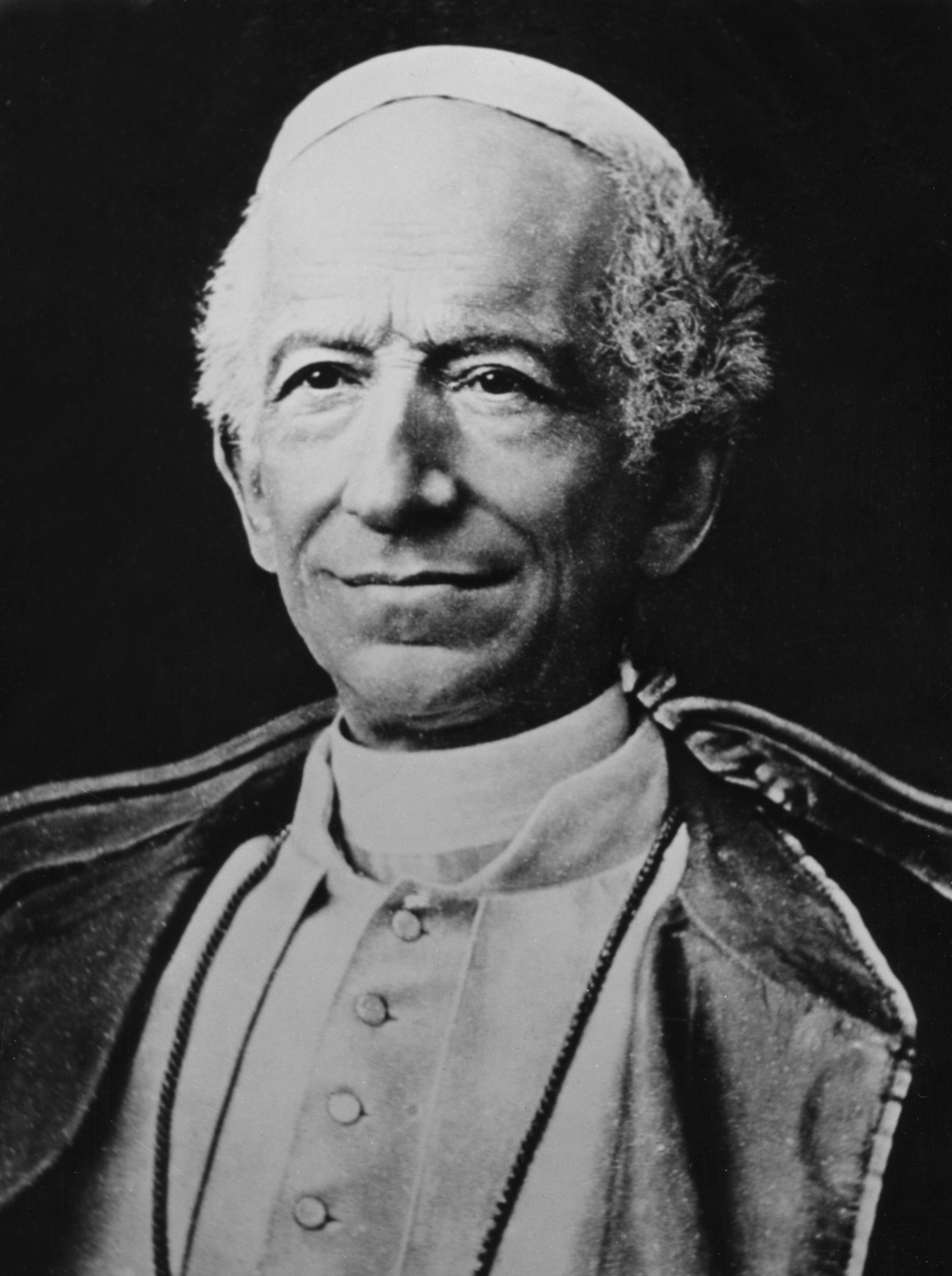
Pope Leo XIII is depicted seated in an official Vatican portrait circa 1878. The pope, credited with being the founder of Catholic social teaching, anonymously crafted Latin riddles for a Roman magazine. (CNS photo/Library of Congress)
VATICAN CITY (CNS) — Going by the pseudonym “X,” Pope Leo XIII anonymously crafted poetic puzzles in Latin for a Roman periodical at the turn of the 19th century.
Pope Leo XIII was born in Italy March 2, 1810. The pope, credited with being the founder of Catholic social teaching, anonymously crafted Latin riddles for a Roman magazine. (CNS photo/Library of Congress)
The pope created lengthy riddles, known as “charades,” in Latin in which readers had to guess a rebus-like answer from two or more words that together formed the syllables of a new word.
Eight of his puzzles were published anonymously in “Vox Urbis,” a Rome newspaper that was printed entirely in Latin between 1898-1913, according to an article in the Vatican newspaper, L’Osservatore Romano.
A reader who submitted the correct answer to the riddle would receive a book of Latin poetry written by either Pope Leo or another noted Catholic figure.
The identity of the mysterious riddle-maker, however, was soon revealed by a French reporter covering the Vatican for the daily newspaper Le Figaro.
Felix Ziegler published his scoop Jan. 9, 1899, a year after the puzzles started appearing, revealing that “Mr. X” was, in fact, the reigning pope, the Vatican newspaper said July 20.
In the pope’s hometown, Carpineto Romano, which is about 35 miles southeast of Rome, students at the middle school now named for him have published 26 of the pope’s Latin puzzles in a new book titled, “Aenigmata. The Charades of Pope Leo XIII.”
Three middle school teachers and their pupils said they have included puzzles they found, but which had never been published before.
One example of the pope’s Latin riddles talked of a “little boat nimbly dancing,” that sprung a leak as it “welcomed the shore so near advancing.”
“The whole your eyes have known, your pallid cheeks have shown; for oh! the swelling tide no bravest heart could hide, when your dear mother died,” continues the translation of part of the riddle-poem.
The answer, “lacrima,” (“teardrop”) merges clues elsewhere in the poem for “lac” (“milk”) and “rima” (“leak” or “fissure”).
Pope Leo, who headed the universal church from 1878 to 1903, had the fourth-longest pontificate in history, after being nudged out of third place by St. John Paul II.
He wrote 86 encyclicals, including the church’s groundbreaking “Rerum Novarum,” which ushered in the era of Catholic social teaching.
Known for his openness to historical sciences, Pope Leo ordered in 1881 that the Vatican Secret Archives be open to researchers and he formally established the Vatican Observatory in 1891 as a visible sign of the church’s centuries-old support for science.
[quote_box_right]More on Pope Leo from Phoenix-based Leonine Publishers[/quote_box_right]A trained Vatican diplomat and man of culture, the pope was also a member of an exclusive society of learning founded in Rome in 1690 called the Academy of Arcadia, whose purpose was to “wage war on the bad taste” engulfing baroque Italy. Pope Leo, whose club name was “Neandro Ecateo,” was the last pope to be a member of the circle of poets, artists, musicians and highly cultured aristocrats and religious.
The pope was also passionate about hunting and viniculture. Unable to leave the confines of the Vatican after Italy was unified and the papal states brought to an end in 1870, he pursued his hobbies in the Vatican Gardens.
He had a wooden blind set up to hide in while trapping birds, which he then would set free again immediately.
He also had his own small vineyard, which, according to one historical account, he tended himself, hoeing out the weeds, and visiting often for moments of prayer and writing poetry.
Apparently, one day, gunfire was heard from the pope’s vineyard, triggering fears of a papal assassination attempt.
Instead, it turned out the pope had ordered a papal guard to send a salvo of bullets into the air to scare off the sparrows who were threatening his grape harvest.
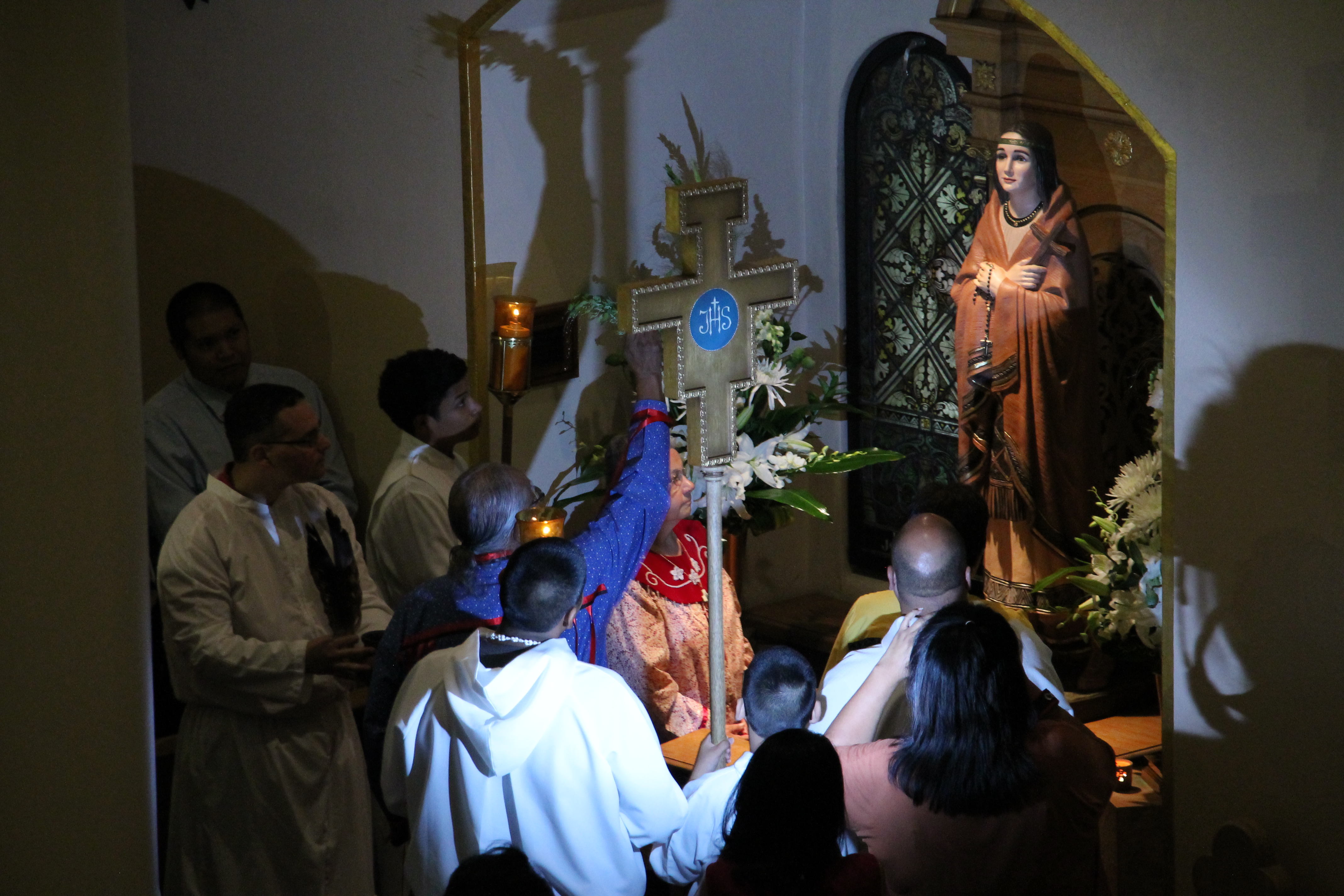
Joseph Enos, an elder in the Native American community, blesses a new statue of St. Kateri Tekakwith at St. Mary's Basilica July 14. Franciscan Father Vince Mesi, pastor, also blessed it. (Ambria Hammel/CATHOLIC SUN)
Joseph Enos, an elder in the Native American community, blesses a new statue of St. Kateri Tekakwith at St. Mary’s Basilica July 14. Franciscan Father Vince Mesi, pastor, also blessed it. (Ambria Hammel/CATHOLIC SUN)
It took less than an hour for a new statue to blend in with those that lined the side walls of St. Mary’s Basilica for years.
Catholics from throughout Arizona respectfully waited their turn to pray in front of a new statue of St. Kateri Tekakwitha immediately following a July 14 Mass celebrating her feast day. Many touched her face, which a bout with smallpox disfigured for much of her life. It cleared up shortly after her death.
Others caressed her from head to toe. A woman gently placed a rosary at her feet. Isabelle Sisto left a traditional basket meant to carry food as a gift from the San Carlos Apache tribe. Part of St. Kateri’s sacrifice as a Christian honoring the Sabbath’s day of rest meant she often went without eating.
Sisto counted herself among 10 members from her tribe in the Diocese of Tucson who braved monsoon weather to attend the feast day celebration.
Archived article on her previewing her canonization[/quote_box_right]“We believe that she’s Native and she represents all the native people,” Sisto told The Catholic Sun. “We still have our traditional prayers too.”
She said they involve the sign of the cross, feathers and yellow powder that creates the smoke that they believe carries their prayer. The liturgy used traditional incense and allowed Joseph Enos, an elder from the Tohono ó odham nation behind the altar to bless the four cardinal directions.
He later offered a Native blessing of the statue too. They were among at least 300 plus six priests who filled the basilica for a special evening Mass. It brought together various tribes in prayer, song, rhythm and custom to honor the world’s first Native American saint. Pope Benedict XVI canonized her in 2012.
An intertribal choir alternated with a small drum circle during a musical prelude.
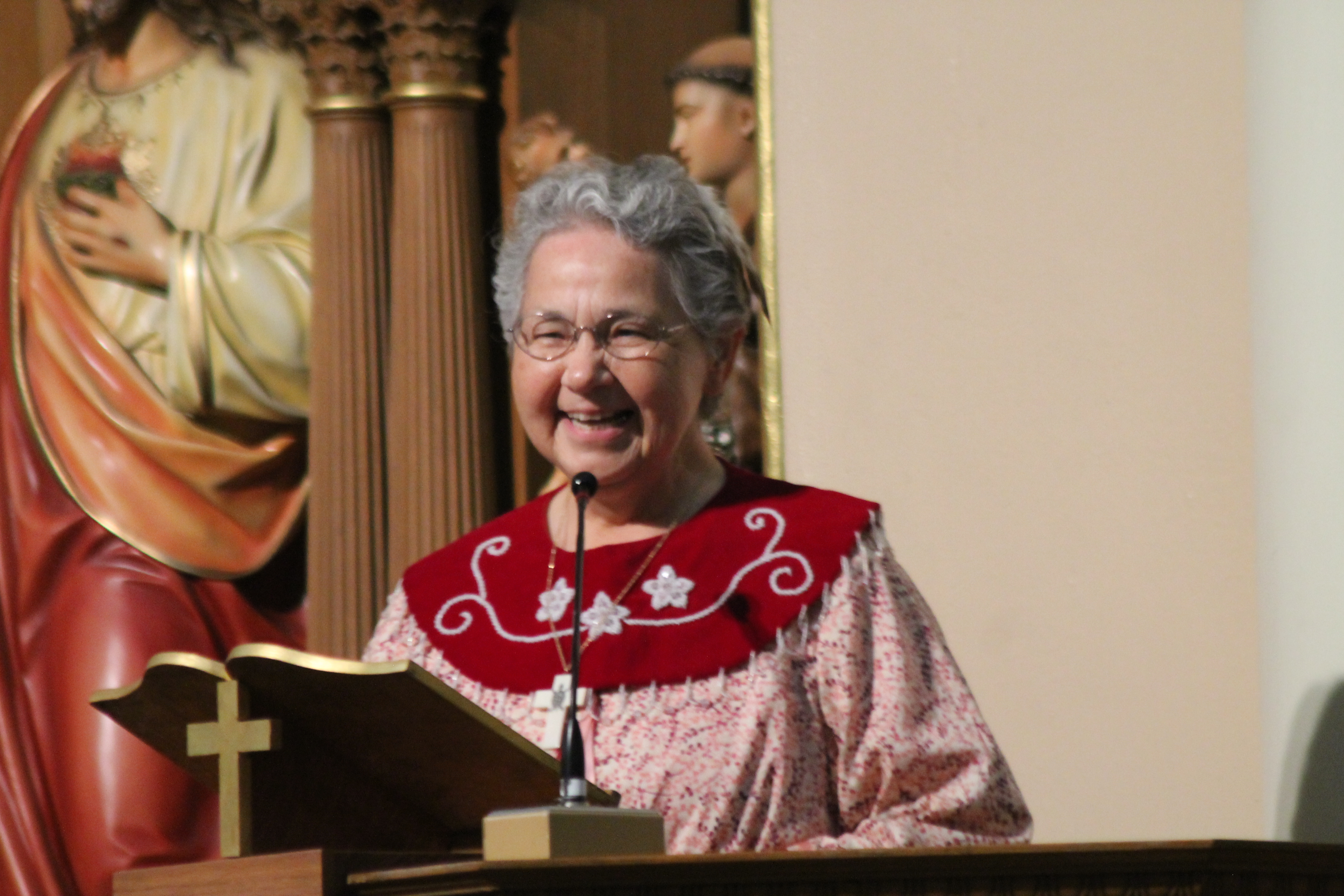
Sr. Kateri Mitchell is executive director of the Tekakwitha Conference and a member of the Mohawk Nation and a Sister of St. Anne. (Ambria Hammel/CATHOLIC SUN)
“It’s a time of rejoicing, a time of giving thanks,” Sr. Kateri Mitchell, executive director of the Tekakwitha Conference said in pre-liturgy remarks. She added that it was appropriate to gather for a eucharistic celebration.
“The Eucharist, for her, was her way in which she met her Christ and the Eucharist is what binds us all together,” Sr. Mitchell said. “She’s a healer and one who gathers her people together.”
The liturgy’s language spoke to those with English and Tohono ó odham tongues with sign language sprinkled throughout.
The Goodnight Song[/quote_box_left]Franciscan Father Vince Mesi, pastor of St. Mary’s Basilica, continued to highlight St. Kateri’s life and impact in a homily that was both spoken and sung. He said she was filled with the Lord’s counsel to be clean of heart and strove to put God at the center of her life.
At 19, St. Kateri refused to be converted to a non-Christian religion and was later baptized on Easter Sunday, but endured much suffering because of it.
She wanted to start an order, but a priest’s advice led her to bring the love of God to others as a lay witness instead. Fr. Mesi finds a deeper inspiration that the many miracles attributed to her intercession following her death.
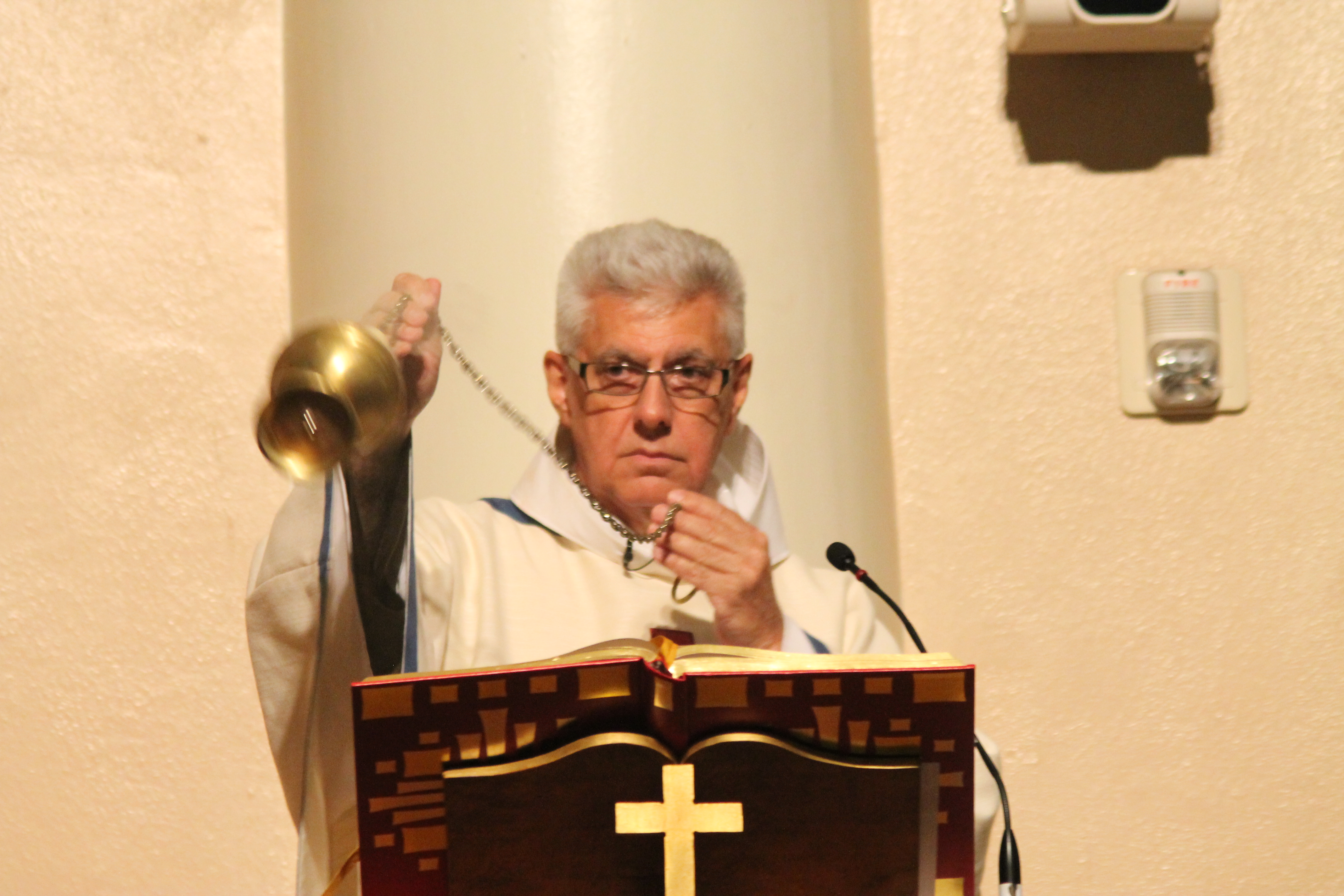
Franciscan Father Vince Mesi (Ambria Hammel/CATHOLIC SUN)
“I think about a strong reminder to me, hopefully to all of us, that we need to be steadfast to the love of God,” Fr. Mesi said and let nothing get in the way.
He proceeded to sing the responsorial psalm — Psalm 16 — which he said described St. Kateri’s inner spirit. He also invited everyone to re-commit themselves to single-hearted service to God’s love and His people.
Massgoers showed a Christian love during a dinner reception in the basilica’s basement with overflow seating arranged in circles, a presentation of symbolic gifts and a musical showcase.
The St. Kateri celebration completed a trio of monthly liturgies allowing some of the diocese’s 15 ethnic communities to visit St. Mary’s Basilica leading up to its 2015 centennial and celebrate their culture. The Tongan community gathered in June and the Filipino community gathered in May.
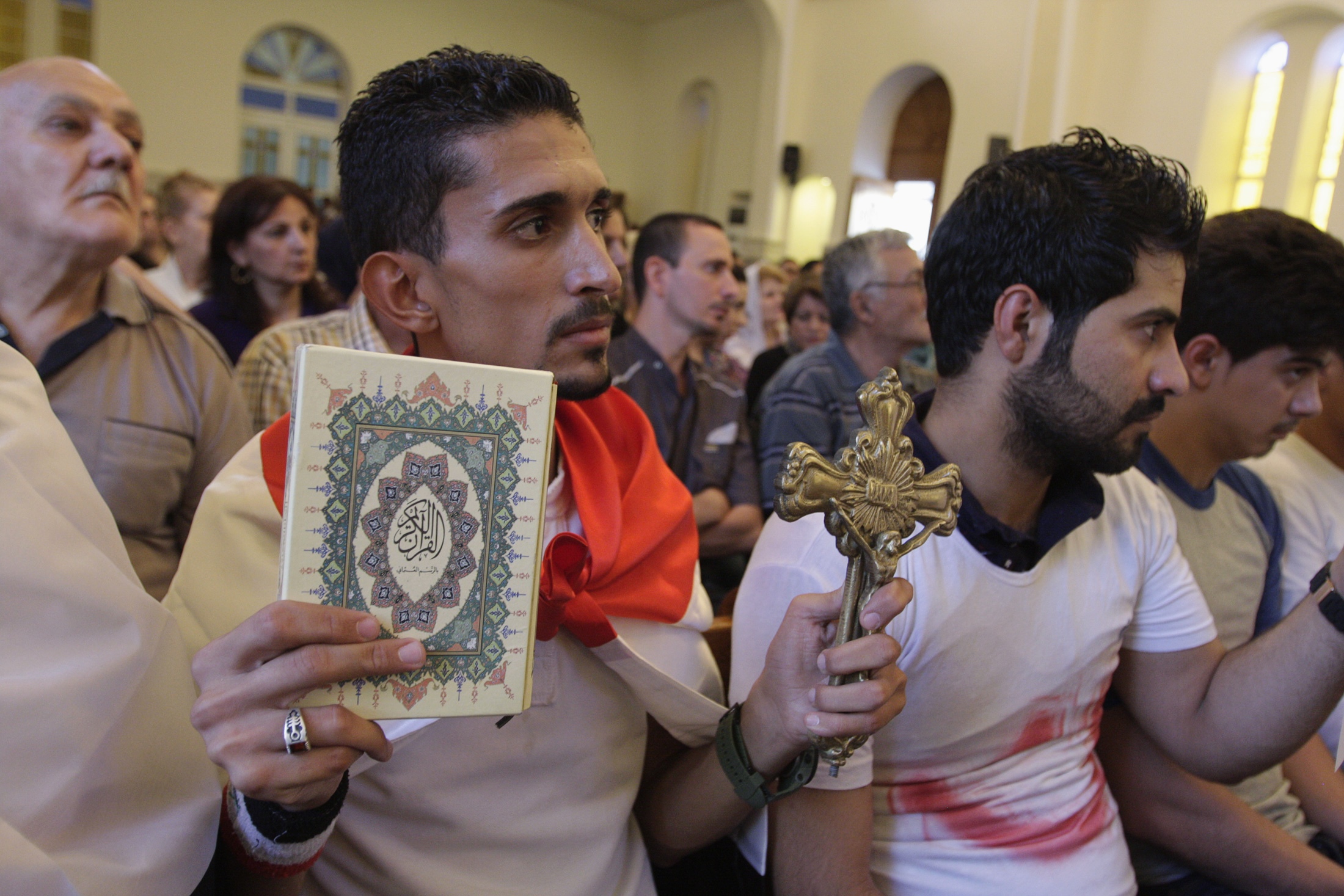
An Iraqi man carrying a cross and a Quran attends Mass at Mar Girgis Church in Baghdad July 20. Pope Francis called for prayers, dialogue, and peace, as the last Iraqi Christians flee the Iraqi city of Mosul. (CNS photo/Ahmed Malik, Reuters)
An Iraqi man carrying a cross and a Quran attends Mass at Mar Girgis Church in Baghdad July 20. Pope Francis called for prayers, dialogue, and peace, as the last Iraqi Christians flee the Iraqi city of Mosul. (CNS photo/Ahmed Malik, Reuters)
VATICAN CITY (CNS) — As the last Iraqi Christians in Mosul fled the city, Pope Francis urgently called for prayers, dialogue and peace.
“Violence isn’t overcome with violence. Violence is conquered with peace,” the pope said before leading thousands of pilgrims gathered in St. Peter’s Square in a moment of silent prayer July 20.
“Our brothers and sisters are persecuted, they are chased away,” he said, as he assured Christians in all of Iraq and the Middle East of his “constant prayers.”
The pope’s plea came as the last Christian families living in Mosul were forced from the city after facing increasing threats, violence and intimidation.
The Islamic State group, which has taken control of Mosul, Iraq’s second-largest city, was threatening to kill any Christians who did not convert to Islam or pay a tax, Syriac Patriarch Ignace Joseph III Younan told Vatican Radio.
The militants in Mosul also burned to the ground the building housing the Syriac bishop’s office, residence and library, and everything inside, he said July 19.
Islamic State fighters “have already threatened that if they don’t convert to Islam, all Christians will be murdered. It’s terrible! This is a disgrace for the whole international community,” he told the radio.
The international community must immediately halt all aid to the Islamic State group, he said.
“Whom are they getting their weapons from? From these extremist nations in the (Persian) Gulf, with the approval of Western political leaders because they need their oil.”
The patriarch said the world community must uphold human rights and the freedom of religion.
“We are in Iraq, Syria and Lebanon: We Christians weren’t imported, we’ve been here for millennia and, therefore, we have the right to be treated as human beings and citizens of these countries,” he said.
Patriarch Younan spoke with Pope Francis by telephone July 20 while visiting Rome and told him of the “disastrous” situation in Mosul.
The pope said “he was following closely and with anxiety the plight of Christians” in Mosul, the patriarch told Catholic News Service.
During their nine-minute phone conversation, the patriarch begged the pope “to continue intensifying efforts with the powerful of this world” and to warn them “that it is a mass purification based on religion which is underway in the province of Ninevah,” whose capital is Mosul.
“What a shame for the silence of the so-called ‘civilized world'” in response to the tragedy, the patriarch told CNS via email.
The Syriac patriarch was in Rome with Syriac Archbishop Basile Georges Casmoussa of Mosul and Syriac Catholic Archbishop Ephrem Yousif Mansoor Abba of Baghdad, to meet with Archbishop Dominique Mamberti, the Vatican’s foreign minister, and explain the plight of Christians in Mosul and surrounding areas.
The patriarch proposed that the Vatican call on its diplomatic corps members to urge their respective governments to take “appropriate measures in order to prevent further killing and abusing of Christians and other minorities in the name of a religion.”
Syriac Catholic Archbishop Yohanna Moshe of Mosul told the Vatican’s Fides news agency that Islamic State fighters took possession of a Syrian Catholic monastery outside of Mosul, near Qaraqosh, July 20.
Earlier, militants occupied Mosul’s Chaldean Catholic and Syriac Orthodox cathedrals, removed the crosses at the front of the buildings and replaced them with the Islamic state’s black flag. Tombs and other places of worship were reported to have been desecrated, too.
Militants singled out homes belonging to Christians and marked them in red paint with the letter “N,” for “Nazarat,” which means Christian, as well as “Property of ISIS,” — the Islamic State group, said Chaldean Auxiliary Bishop Saad Sirop of Baghdad.
“Our worst fears have come true and we don’t know what to do,” he told Aid to the Church in Need.
Those who fled their homes with whatever possessions they could carry were then stripped of everything they owned by the militants at the city’s checkpoints, said Archbishop Jean Sleiman, the Latin-rite bishop of Baghdad.
The militants took people’s belongings, money, personal items “even their cars, leaving them with nothing and forcing them to walk miles under the sun to get to the first Christian villages outside the city where they’re welcomed,” he told SIR, the Italian bishops’ news agency.
Chaldean Catholic Patriarch Louis Sako told AsiaNews that any dialogue with the extremists seemed impossible.
The militants are like “a wall” as they only repeat: “Between us there is nothing but a sword,” the patriarch said. He added that “there is no one of authority to face,” so people “don’t know where they come from and what they really want.”
Patriarch Sako said that as late as the end of June, 35,000 Christians had lived in Mosul, and more than 60,000 lived there before the U.S.-led invasion in 2003. But now, “for the first time in the history of Iraq, Mosul is now empty of Christians.”
“Iraq is heading towards a humanitarian, cultural and historical disaster,” he said in an open letter to Iraqis and the world July 17.
“It is shameful that Christians are being rejected, expelled and diminished” from a land they have shared together with their Muslim fellow citizens for 1400 years, the patriarch wrote.
He urged Muslims who support the Islamic State “to reconsider their strategy and respect the unarmed innocent people of all ethnicities, religions and sects.” He asked Iraqi Christians to be rational, “calculate their options well,” to come together in solidarity and be patient as they prayed “until the storm passes.”
Syriac Catholic Father Nizar Semaan of Mosul told Fides that world leaders must do something concrete, like “include these groups in the list of terrorist organizations” as well as “make public the names of the countries and forces that finance them.”
He said intelligence agencies and some governments “know where certain weapons and money that keep these groups going come from. It would be enough to stop the flow for a month, and these groups would not have any more force.”
Also, Sunni leaders and followers must help isolate the jihadist groups and declare a religious ruling against them, which “would certainly have a significant effect,” the priest said.