Opponents and supporters of Republican presidential candidate Donald Trump demonstrate outside a Los Angeles hotel July 10. (CNS photo/Lucy Nicholson, Reuters)
Opponents and supporters of Republican presidential candidate Donald Trump demonstrate outside a Los Angeles hotel July 10. (CNS photo/Lucy Nicholson, Reuters)
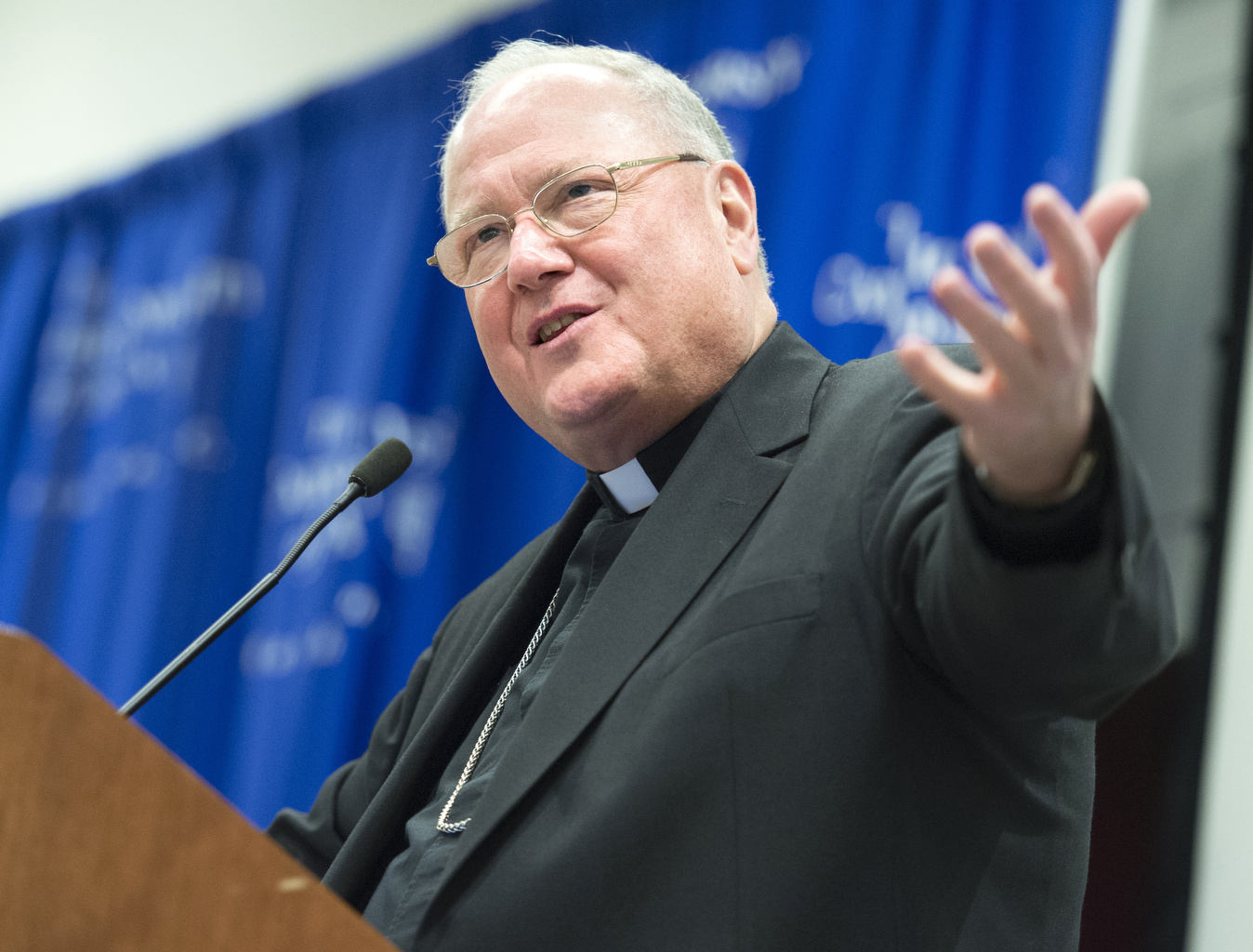
NEW YORK (CNS) — In an op-ed piece published July 29 in the New York Daily News, Cardinal Timothy M. Dolan of New York took issue with the anti-immigrant rhetoric of Republican presidential candidate Donald Trump without explicitly naming him.
He recalled teaching college students about nativism — the policy of protecting the interests of native-born inhabitants against those of immigrants — and telling students it was “a continual virulent strain in the American psyche, which would probably sadly show up again.”
Cardinal Timothy M. Dolan of New York speaks May 20, 2015, at The Catholic University of America in Washington. (CNS photo/Ed Pfueller, Catholic University of America)
The cardinal said the students back then disagreed, telling him: “Who could ever believe now that immigrants are dirty, drunken, irresponsible, dangerous threats to clean, white, Protestant, Anglo-Saxon America?”
“I wish I were in the college classroom again, so I could roll out my ‘Trump card’ to show the students that I was right. Nativism is alive, well — and apparently popular!” the cardinal wrote.
Trump struck a nerve during his presidential campaign announcement when he said “murderers” and “rapists” were among those crossing the U.S.-Mexico border.
Cardinal Dolan said American historians describe two approaches to the immigrant: The nativists “who see the unwashed, ignorant, bothersome brood as criminals and misfits who threaten ‘pure America,’ and are toxic to everything decent in the United States” and those “with the more enlightened and patriotic view” who see immigrants “as a gift to our nation, realizing that the only citizens whose ancestors were not immigrants are the Native Americans. All of us here are descendants of newcomers.”
The cardinal also noted that those who support immigrants also realize the “need to control our borders, fairly regulate immigration and be prudent in our policies and laws.”
Cardinal Dolan said he is “not in the business of telling people what candidates they should support or who deserves their vote. But as a Catholic, I take seriously the Bible’s teaching that we are to welcome the stranger, one of the most frequently mentioned moral imperatives in both the Old and New Testament.”
He also wrote that as an American, he takes “equally seriously the great invitation and promise of Lady Liberty,” noting that it’s one of the reasons why he is “so eager to share with Pope Francis the wonderful work being done by our Catholic Charities to assist immigrants who come to New York, and look to the church for assistance and a warm welcome.”
“I guess, as a Catholic American, I’m a bit biased,” he added.
The cardinal also pointed out that the poet Walt Whitman called New York Archbishop John Hughes a “mitered hypocrite,’ because the prelate defended his poor Irish immigrant flock — the Mexicans of his day — from the nativists.”
Cardinal Dolan said Whitman also described immigrants as “dregs of foreign filth, refuse of convents, scullions from monasteries.”
“Thank God Walt Whitman stuck to poetry, and did not run for president,” the cardinal wrote.
The Pacific Ocean is seen from Old Santa Barbara Mission in Santa Barbara, Calif., May 14. (CNS photo/Nancy Wiechec)
SACRAMENTO, Calif. (CNS) — People with ties to the California mission system see the canonization of its founder as a moment for reflection and reconciliation with native people.
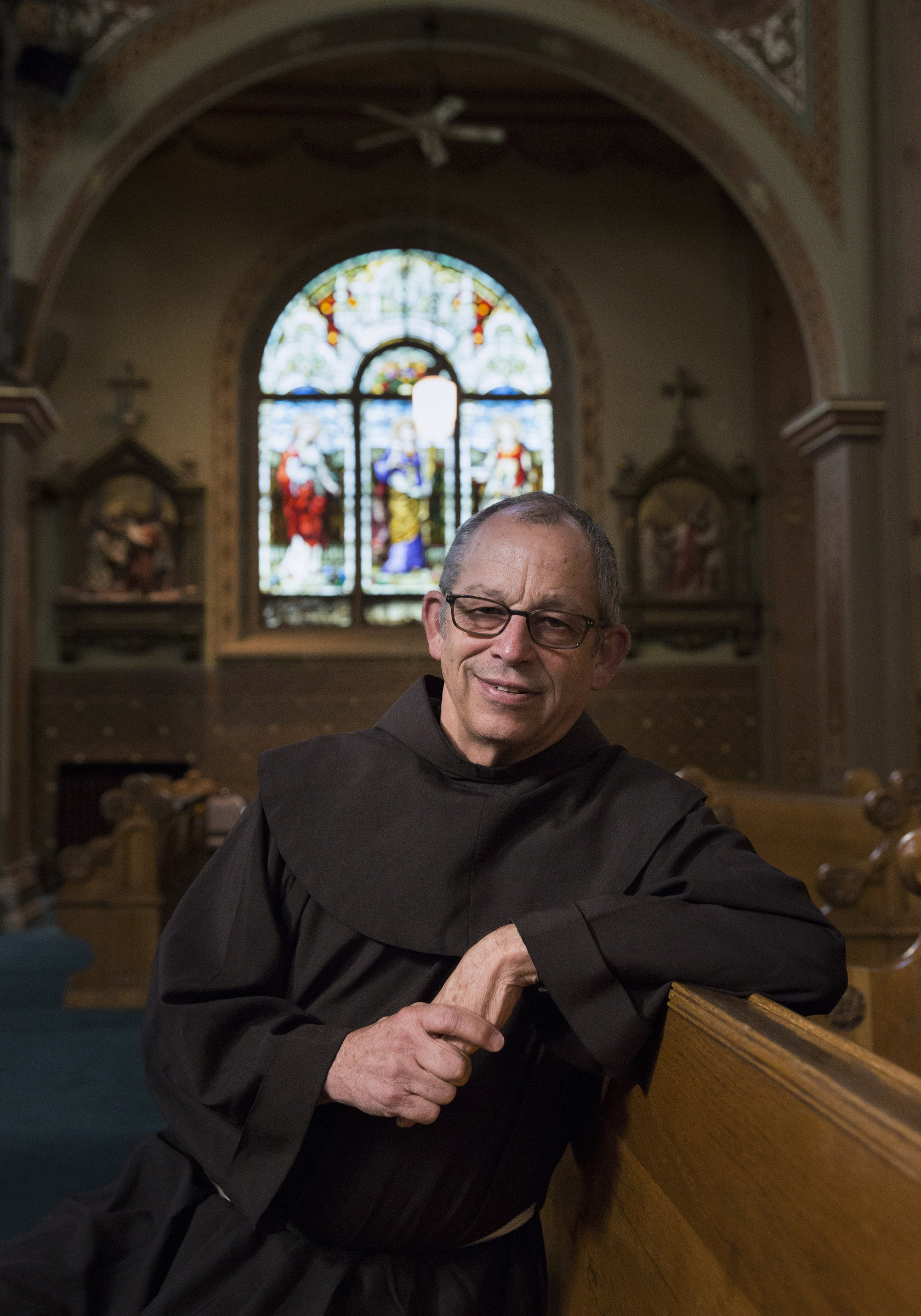
Father Ken Laverone is current vice postulator for the sainthood cause of Blessed Junipero Serra and an advocate of the Spanish missionary. He is pictured at St. Francis of Assisi Church in Sacramento, Calif., where he is pastor. The Franciscan priest was born in San Juan Bautista, Calif., and baptized at the mission there. (CNS photo/Nancy Wiechec)
“The canonization of (Blessed Junipero) Serra has really encouraged us, as well as the diocesan bishops, to seriously look at the place of the California mission Indians and our history and heritage,” said Franciscan Father Ken Laverone, co-postulator in Blessed Serra’s cause. He’s a California-born descendant of Spanish colonizers.
“It’s getting us to look at our relationships with the Native Americans and to reopen the doors of our mission in a greater sense.”
The mission system, Spanish colonial rule and the settlers who came later had profound and lasting effects on native life across the region. Blessed Serra was a highly visible figure inextricably linked to societal changes that led to a 90 percent decrease in the native Indian population in California, even though those effects didn’t fully play out until well after his death in 1784.
Before Spanish colonization, Indians in California numbered more than 300,000. By 1860 there were just 30,000, a consequence of diseases that had been unknown there before Europeans arrived, assimilation, the influx of gold miners and other factors.
Mission Indians were very near extinction by the early 1900s, according to California Lutheran University sociologist Jonathan Cordero, a California Indian who traces his family back to the missions. Cordero’s research has focused on Indian social structures within the missions.
He said mission priests baptized about 80,000 Indians. By 1834, 60,000 had died. By 1900, the number of Indians who had been associated with missions was down to about 800 people, or 1 percent of the number before colonization. Cordero said it would be difficult to pinpoint the number of descendants of mission Indians today.
“Who’s left? We don’t really know. No one’s done a census,” he said.
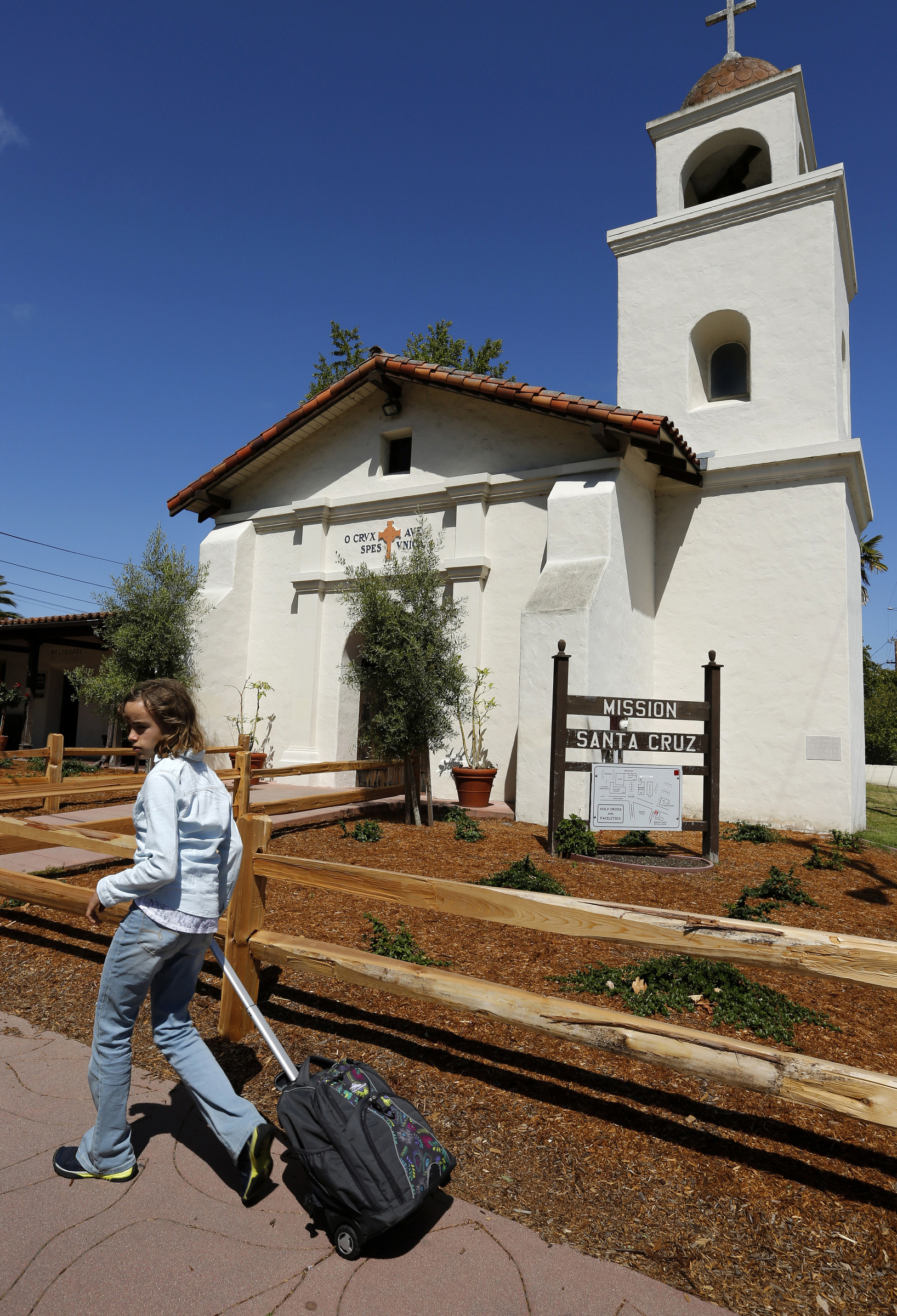
A schoolgirl makes her way past Santa Cruz Mission in Santa Cruz, Calif., May 18. (CNS photo/Nancy Wiechec)
Spanish explorers were the first Europeans known to reach what they called Alta California. Juan Rodriguez Cabrillo, on a quest for the legendary Northwest Passage, sailed along the coast from Mexico into San Diego Bay in 1542 and then to San Francisco Bay later the same year.
Spain did little to sustain its claim to the region until the late 18th century, when British, French and Russians were colonizing in the North Pacific.
“In 1765 Visitor General Jose de Galvez arrived in Mexico, and three years later with Viceroy Carlos Francisco de Croix, submitted a plan for the colonization of California,” said a 1978 article in the San Diego Historical Society Quarterly by Robert Heizer, an archaeologist who studied Native American people of the Southwestern U.S. “This in turn was presented to (Blessed) Serra, president of the declining Franciscan missions of Baja California which recently been taken over from the expelled Jesuit order.”
Relatively quickly, Heizer wrote, military expeditions from Mexico, which included Blessed Serra and other Franciscans, left for Alta California. By July 16, 1769, they had founded the first of the California missions, at San Diego.
The missions had a twofold objective, to bring Christianity to the native people and to assimilate them into Spanish culture as citizens of New Spain. The Spanish erected presidios (walled forts) in San Diego, Santa Barbara, Monterey and San Francisco to protect their interests
Although the number of coastal Indian Catholics today are few, Father Laverone said the faith Serra and his friars instilled is still being lived out in the missions, 19 of which are active churches.
“Lives have been changed in these missions, lives have been healed in these missions, lives have been hurt in these missions. … But faith is alive in these places.”
Andrew Galvan, a descendant of mission Indians and curator of Old Mission Dolores in San Francisco, agrees, but said more needs to be done to invite Indians back to the missions and include their voices in mission affairs.
“This is the opportunity for the Roman Catholic Church in the United States of America and the state of California … to reach out to Serra’s Indians and to bring them into the missions, to open the doors wide, to sing that song that we sing everywhere — all are welcome.”
He said he would like to stand on the steps of Mission Dolores, “open the doors and ring the bells like Junipero Serra … and cry out, ‘Love God, my children. Love God. Amor a Dios!”
The difficulty he said is that native people today are saying, “We’re not welcome. We don’t like what we see. We’re uncomfortable.”
Critics charge that the missions were places of forced labor, that Indians were whipped and shackled, and that baptisms and confirmations were coerced.
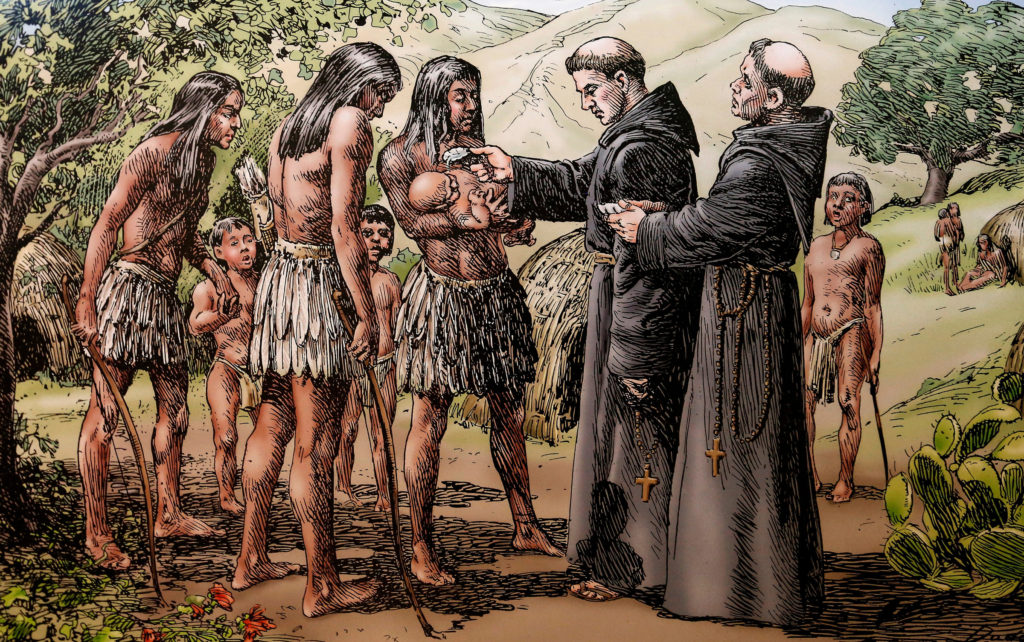
A baptism conducted by California mission friars is shown in a sketch displayed at the Mission Basilica San Diego de Alcala in San Diego July 27. This drawing is part of a collection of sketches depicting mission life by California artists A.B. Dodge and Alexander Harmer. (CNS photo/Nancy Wiechec) See SERRA-TIMELINE July 30, 2015.
University of California at Riverside history professor Steven Hackel, who has written a biography of Blessed Serra, told Catholic News Service that the friar was very much a product of his times.
“In his world almost certainly a good father would have punished him with spankings or with blows if he got out of line,” Hackel said. “A good husband punished a wayward spouse. …That was the way in which he believed he should behave with Indians in the missions. The missionaries believe they are the spiritual fathers of Indians, so they take on the responsibility for punishment, with corporal punishment, with blows and various types of beatings.”
One problem was “this was entirely alien to California Indians,” Hackel explained. “It’s not how they lived. It isn’t something they fully understood. So that creates tension in the missions.”
There also was tension between the friars and the soldiers, who believed it was up to them, and only them, Hackel said, to “correct Indians with blows. … But Serra believed he was an apostolic missionary and he and his other Franciscans were somehow exempt from this kind of military oversight. ”
The friar also looked to the example of his favorite saint, St. Francis of Solano, a 16th-century Spanish Franciscan missionary to South America, who talked about “correcting” Indians with corporal punishment. It seemed to Blessed Serra to be “something he has to do to save Indians’ souls. Indians, of course, resent this and the soldiers think Serra has gone rogue, essentially. He has taken their authority from them. So there’s lots and lots of controversy over this. ”
When the military tries to tell the missionaries that they can’t use corporal punishment anymore, the Franciscans complain that “if we can’t discipline Indians, if we can’t punish them, they will drift away … they’ll become libertines. They’ll forget everything we taught them and go back to their savage state. This is always an issue in California. When missionaries lose the ability to correct Indians, they lose the sense that they can control the mission environment.”
There also were conflicts with the soldiers over Indian labor, which the military needed to build the presidios. Blessed Serra told them no. “We are baptizing Indians to save their souls and to teach them to be good Catholics, not to be your peons,” Hackel said the priest responded.
Despite the contemporary criticism, the Spaniards’ records of his time suggest Blessed Serra was thought of as a man of mercy and forgiveness.
He pleaded for leniency for the Kumeyaay Indians who murdered Franciscan Father Luis Jayme in at San Diego de Alcala Mission during an uprising. Later, he would bestow the sacrament of confirmation on three of the five Indians who took part in the killing.
He also wrangled with Spanish authorities about how soldiers assigned to missions were mistreating Indians. In one case, an unrestrained soldier killed the principal chief of a tribe, “cut off his head and brought it to the mission in triumph,” Hackel wrote in “Junipero Serra: California’s Founding Father.” “Serra was horrified by the soldiers’ violence.”
The Spanish missionaries also made little effort to understand the culture and beliefs of the California Indians. Hackel said this was typical of the evangelists of the 18th century. Although their 16th-century predecessors made a point of learning about local beliefs “so they could overturn them,” he said, Serra and his contemporaries didn’t think the Indians had complicated cultures or full-blown religious beliefs.
“What they have, according to Serra and others, are inherited superstitions from their parents and grandparents,” Hackel said. “Things that aren’t rooted in real spirituality, they’re just naive customs about how the world works. So Serra does not spend much time at all trying to investigate native religion. He’s aware of it. He believes they pray to birds, or in some instances, idols. … He essentially dismisses it as childish superstition and he doesn’t really respect their beliefs.”
It actually wasn’t the case that the missionaries wanted to sweep aside all Indian culture, according to Hackel. Even Blessed Serra thought some aspects of Indian culture — notably its music, singing and dancing — could be incorporated into Catholic practices, he said.
“I humbly ask forgiveness, not only for the offenses of the church herself, but also for crimes committed against the native peoples during the so-called conquest of America,” Pope Francis told a crowd in Bolivia in July.
Also of lasting impact on the tribes was the secularization period that followed Mexico’s independence in 1821, further separating mission Indians from their culture and also from the church.
The Mexican government that then controlled California removed mission lands from Franciscan oversight. Territory that had been intended for Indians was divvied up among Mexican ranchers. The Franciscan missionaries returned to Mexico and mission Indians worked on the ranches or went out to fend for themselves.
Some mission Indians mixed in with Spanish colonists. In some cases the Catholic faith survived among the mission Indians. Such was the situation for Galvan and his family.
The Spanish intention that missions would become parishes did not come to pass until much later. Several of the missions fell into ruin following secularization. After California became a state in 1850, mission properties were returned to the church following an appeal by Joseph S. Alemany, the first archbishop of San Francisco.
Both Pope John Paul II, who beatified Blessed Serra, and Pope Francis, who will canonize him, have spoken of the difficulties and the harm colonization and church’s evangelization efforts had upon native lives and culture.
“I humbly ask forgiveness, not only for the offenses of the church herself, but also for crimes committed against the native peoples during the so-called conquest of America,” Pope Francis told a crowd in Bolivia in July.
It was an unexpected preface to his September visit to the U.S. The canonization will take place in Washington Sept. 23 as the pope hopscotches to events in the nation’s capital, New York and Philadelphia.
Father Laverone said sainthood recognizes a man who, despite all odds, spread the Gospel message where it had not been heard before. And he did so in a “radical” way.
“Serra, with all his limitations, with all his physical ailments, saw the good news as something that had to be proclaimed, and he went to the extreme ends to do that,” said the priest.
He said people may think that was a good thing or a bad thing, but that was his commitment, to bring people who had never known Christ to the Redeemer.
“He was a man of perseverance without a doubt. And maybe sometimes a little bit too much perseverance,” he said.
The Spanish missionary’s own motto, “Siempre adelante, nunca atras” (“Always forward, never back”), speaks to that spirit.
“The Gospel is so important you have to move forward,” said Father Laverone.”We have something to share, we have the good news. People need to learn about God’s mercy and God’s love and the salvation that Jesus brings to us.”
— By Nancy Wiechec and Patricia Zapor, Catholic News Service.
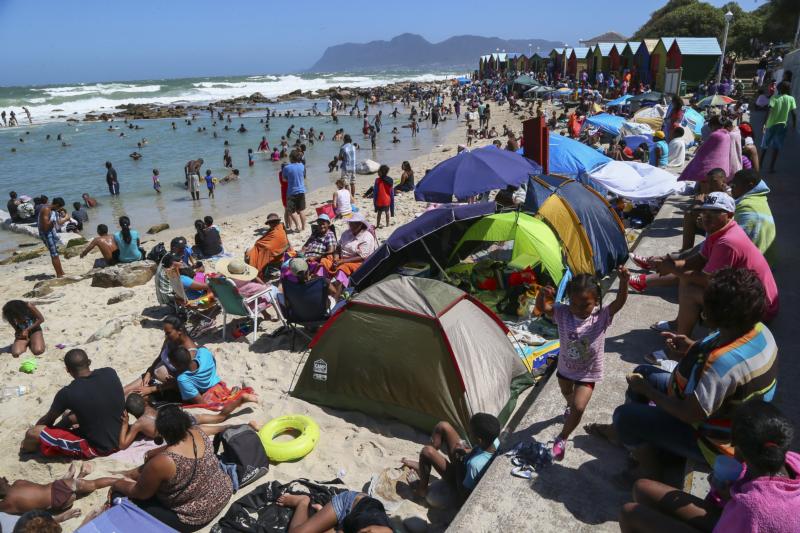
In this 2013 file photo, people spend time on St. James beach in Cape Town, South Africa. (CNS photo/Nic Bothma, EPA)
In this 2013 file photo, people spend time on St. James beach in Cape Town, South Africa. (CNS photo/Nic Bothma, EPA)
VATICAN CITY (CNS) — Pope Francis knows the family is made up of real people living in the real world, which is why he often gives down-to-earth advice.
The Catholic Church has long taught that the family is a school of humanity — the first and best place to learn about love and respect. In fact, a healthy society relies on citizens who learn love, responsibility, loyalty, acceptance of others and solidarity from their family relationships, Pope Francis has said.
The pope, a former teacher, has, in a way, been handing today’s families detailed lesson plans, offering guidance in what actually needs to be done. The world Synod of Bishops on the family, which the pope has convoked for October, also is expected to deliver concrete guidelines for the pastoral care of the family and its members.
By devoting his general audience talks to the family since last December, as well as making the family a key topic of other speeches and homilies, Pope Francis has been offering concrete and, at times, colorful advice, which will give people gathering for the World Meeting of Families in Philadelphia in September plenty of material to parse through.
The pope’s approach starts from the bottom up.
He doesn’t begin with a textbook concept or picture-perfect ideal everyone needs to magically become an exact replica of. The family is a real institution made up of very human, and therefore, limited members who need real help.
With examples from his own life and the real lives of others, he points to what is happening “on the ground” and then builds a pastoral plan — what would God’s response be to this reality.
For example, the Christian response to the all too typical problem of anger or misunderstanding is to choose the path of dialogue, which requires eating lots of tart “humble pie,” he said in a homily in January 2014.
“Sometimes the plates will fly,” the pope said. But “after the storm has passed,” things have to be worked out as soon as possible, “with a word, a gesture,” so no one ends up “isolated in this bitter broth of our resentment.”
Other similarly practical advice he has given couples: play with your kids more, stop the swearing, be more affectionate and always say, “Please,” “May I” and “Thank you.” Moms and dads must lead the way, he says; they are the most influential role models for their kids.
Kissing in front of the children is a “beautiful witness,” he told parents in June 2015. Children watch their parents carefully and “when they see that dad and mom love each other, the children grow in that climate of love, happiness and security.”
He has told youngsters to go out, discover the world and “build everything together, do everything with love, everything is possible and faith is an event always to be proclaimed.”
Talk to your best friend, Jesus, every day, he told children in December 2014, and be “apostles of peace and serenity” at home and at school.
“Remind your parents, brothers and sisters and peers that it is beautiful to love one another and that misunderstandings can be overcome, because when we are united with Jesus everything is possible,” he said.
Giving advice to grandparents, the pope has said that families and kids need their prayers, wisdom and gifts to give them the encouragement, hope and faith they often lack in today’s frenetic world.
“We older people can remind ambitious young people that a life without love is barren. We can tell fearful young people that worrying about the future can be overcome. We can teach young people who are in love with themselves too much that there is more joy in giving than receiving,” he told his fellow seniors in March 2015. The pope’s dream is that families challenge today’s throwaway culture with “the overflowing joy of a new embrace between young and old people.”
Key to drawing the needed strength and inspiration is reading the Gospel, prayer, confession, Communion and fellowship with the poor, he said in May 2015.
“Imagine how much our world would change if each one of us began right here and now and seriously took care of ourselves and generously took care of our relationship with God and our neighbor,” he told Vatican employees and their families before Christmas last year.
The Holy Family is still the perennial role model for families, the pope has said. Mothers can mirror the same love and attention Mary had for her son, and fathers can exemplify the patience and understanding of Joseph who did everything to support and protect his family.
The real secret, he said, is just to “welcome Jesus, listen to him, speak to him, take care of him, protect him and grow with him” like Mary and Joseph did, and “that is how the world will become better.”
Pope Francis knows families cannot do it on their own. He also insists policymakers and leaders devise and support policies that build up families and neutralize their biggest threats: war, poverty, consumerism and economic policies that promote the worship of money and power.
Justice for women must be promoted since, in the West, they face discrimination in the workplace and often are forced to choose between family and job obligations, the pope has said. Also, women too often face violence in “their lives as fiancees, wives, mothers, sisters and grandmothers” and, in developing countries, “women bear the heaviest burden” by having to walk miles to collect water, often risk dying in childbirth, and face kidnapping, rape and forced marriages, he said in May 2015.
Culture needs a humanizing re-haul, too, he said, to ease the pressure on couples to not be afraid of the lifelong commitment of marriage and to see children as a blessing, not a burden.
Pope Francis has been especially vocal about resisting current trends that seek to legitimize same-sex unions, contraception and fluid notions of gender. He warned families in the Philippines against this “ideological colonization that tries to destroy the family” and takes away human identity and dignity, and he repeatedly has reaffirmed church teaching that marriage is a lifelong bond between a man and a woman.
Given the many challenges — both within society and within the walls of the family home — Pope Francis regularly praises the many men and women who are fighting the good fight every day.
Leaders and communities “should kneel before these families, who are a true school of humanity, who are saving society from barbarity” by staying together and safeguarding their bonds amidst difficult conditions, even in poverty and crisis, he has said.
Regular men and women who care for their infirm loved ones, miss a night of sleep and still roll into work the next day are the “hidden heroes” and the “hidden saints” of today, he said.
The pope has urged the men and women who are on the right path to lend a hand to help evangelize and to help other families heal so that the teachings of the faith will touch more people’s hearts and give them the strength to follow God’s will.
Pope Francis talks with Cardinal Sean P. O'Malley of Boston as they arrive for a meeting in the synod hall at the Vatican Feb. 13, 2015. (CNS photo/Paul Haring)
WASHINGTON — Cardinal Seán O’Malley, OFM Cap., archbishop of Boston and chairman of the Committee on Pro-Life Activities of the U.S. Conference of Catholic Bishops (USCCB), responded, July 29, to recent videos showing leaders from Planned Parenthood discussing the provision of fetal organs, tissues, and body parts from their abortion clinics.
Full text of Cardinal O’Malley’s statement follows:
Pope Francis has called abortion the product of a “widespread mentality of profit, the throwaway culture, which has today enslaved the hearts and minds of so many.” The recent news stories concerning Planned Parenthood direct our attention to two larger issues involving many institutions in our society. The first is abortion itself: a direct attack on human life in its most vulnerable condition. The second is the now standard practice of obtaining fetal organs and tissues through abortion. Both actions fail to respect the humanity and dignity of human life. This fact should be the center of attention in the present public controversy.
If the Planned Parenthood news coverage has caused anyone to experience revived trauma from their own involvement in abortion, be assured that any and all persons will be welcomed with compassion and assistance through the Church’s post-abortion healing ministry, Project Rachel. If you or someone you know would like confidential, nonjudgmental help, please visit www.projectrachel.com.
Southern California's ubiquitous palm trees can be traced back to Franciscan missionaries. Not native to state, the first palm in California was said to have been planted by Blessed Junipero Serra in San Diego. Holy Family Church in Los Angeles offers this view of palms. (CNS photo/Tyler Orsburn)
SAN FRANCISCO (CNS) — To Andrew Galvan, Blessed Junipero Serra is a stalwart of faith and mission worthy of the title “saint.”
“He was all wood and nails. He was a tough dude. He fought, he defended, he wrangled, he was frustrated and he was frustrating,” Galvan told Catholic News Service.
A descendant of tribal members from the San Francisco Bay region, Galvan traces his family roots to California’s first Christians, thousands of whom were baptized and confirmed by the 18th-century Spanish missionary.
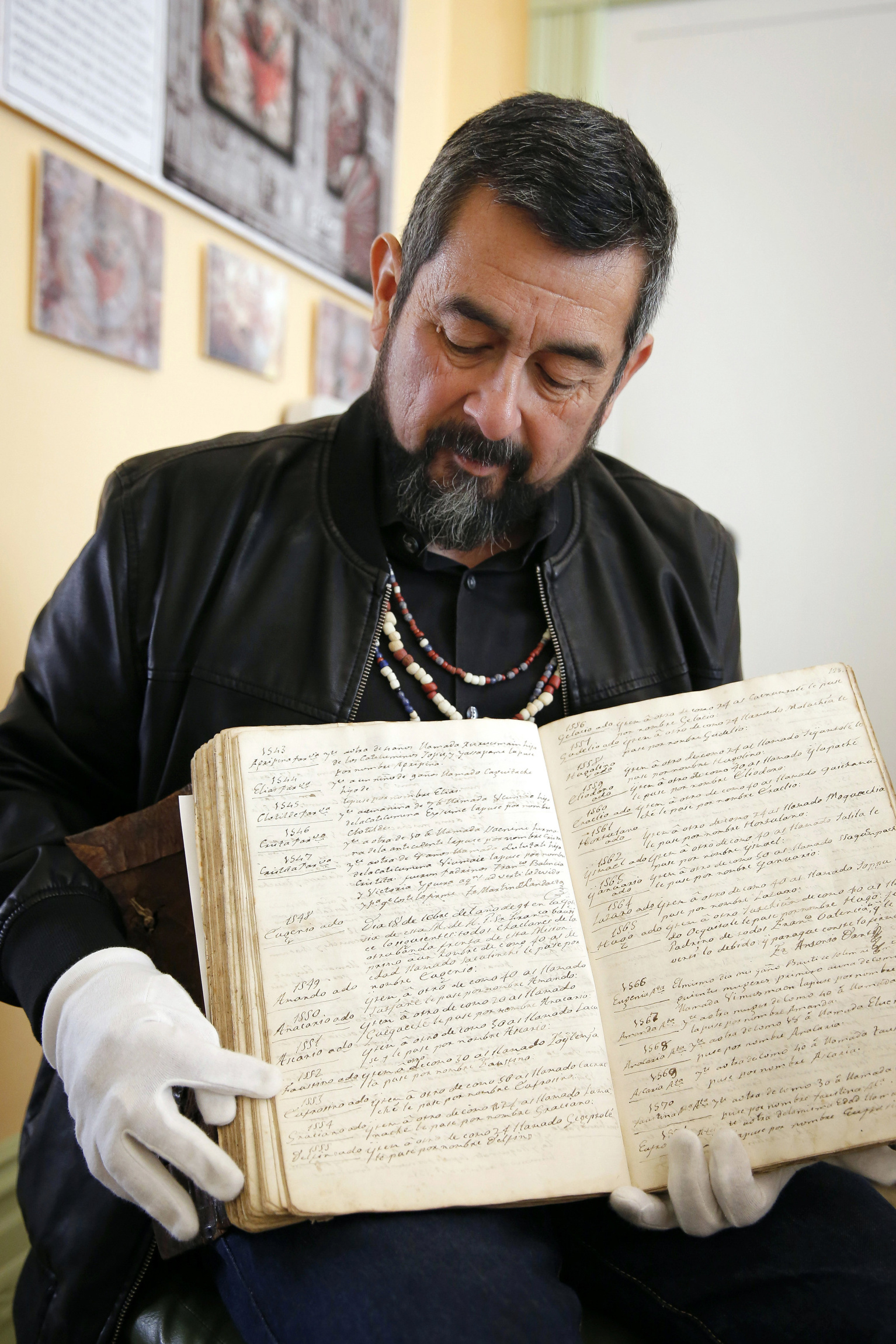
Andrew Galvan points to the entry for his great-great-great-great-grandfather in an early baptismal registry for Mission San Francisco de Asis, also known as Mission Dolores, in San Francisco May 19. Listed as number 1552, the entry shows the Christian name given, Faustino. (CNS photo/Nancy Wiechec))
Pope Francis will canonize Blessed Junipero Sept. 23 in Washington. Galvan said he hopes to be there.
Long a promoter of Blessed Serra, Galvan is the museum director and curator of Old Mission Dolores, the sixth-oldest of California’s 21 historical missions.
He said Blessed Serra was “on fire” to heed Christ’s call to witness, like Jesus’s apostles and St. Francis of Assisi.
“His goal in life, from the time he was a novice … was to be a missionary to Indians in the Americas, to bring the Gospel message where it had never gone before.”
Galvan said the friar, who was beatified in 1988 by St. John Paul II, never veered from that objective and went about it tirelessly, foregoing any convenience for himself.
According to his biographers, he slept little, traveled thousands of miles by foot, quietly endured injury and pain, ate modestly and spent long hours in prayer. When Blessed Serra thought he was failing in his efforts to evangelize, he blamed such defeat on his own sins.
“My God, I couldn’t live the life he lived,” Galvan said.
Miquel Joseph Serra took the Franciscan habit at age 17. He chose the name Junipero, after a companion of St. Francis known for his holy simplicity.
Junipero Serra became an adept student of philosophy and theology and was inspired by the stories of saints and missionaries. Always looking outward, the friar left a successful and comfortable life as a professor to embark on a missionary journey to America, knowing he would never return to Spain.
In Mexico, he spent 17 years building up Indian missions in the Sierra Gorda and traveling far and wide, preaching popular missions. In fervent sermons, he called on those who had fallen from faith to return to God’s mercy.
Blessed Junipero did not reach upper California until he was 55. And when he did, said Galvan, he jumped from his donkey and kissed the ground.
“He’s on sacred ground, because in his mind, being a student of (John Duns) Scotus, he is now entering this world that is completely innocent,” he said referring to the famed Franciscan priest-philospher of the Middle Ages. “And he (Serra) is the one bringing the Gospel where it has never been brought before.”
Galvan has studied Blessed Serra for 37 years and has a unique connection to the soon-to-be saint. He can point directly to him as the person who brought Christ to his family.
“That’s a momentous event,” said Galvan. “I can go into Mission Dolores right here and say, ‘It is in this very room … that my family first became Christian.’ How many people have that joy and pleasure?”
Galvan, though, does not look back with rose-colored glasses. He is acutely aware of the toll upon the California native peoples by the missions, the colonial era and the times that followed.
He calls the encounter between Europeans and Indians an “unmitigated disaster.”
“The colonization destroyed the native people along the California coast because of the destruction of the native environment, the changing of lifestyle and the unfortunate introduction of European diseases.”
After Blessed Serra’s death in 1784, mission populations rose and then sharply dropped. Closely knit mission communities only worsened the spread of illness. Disease was rampant and deadly.
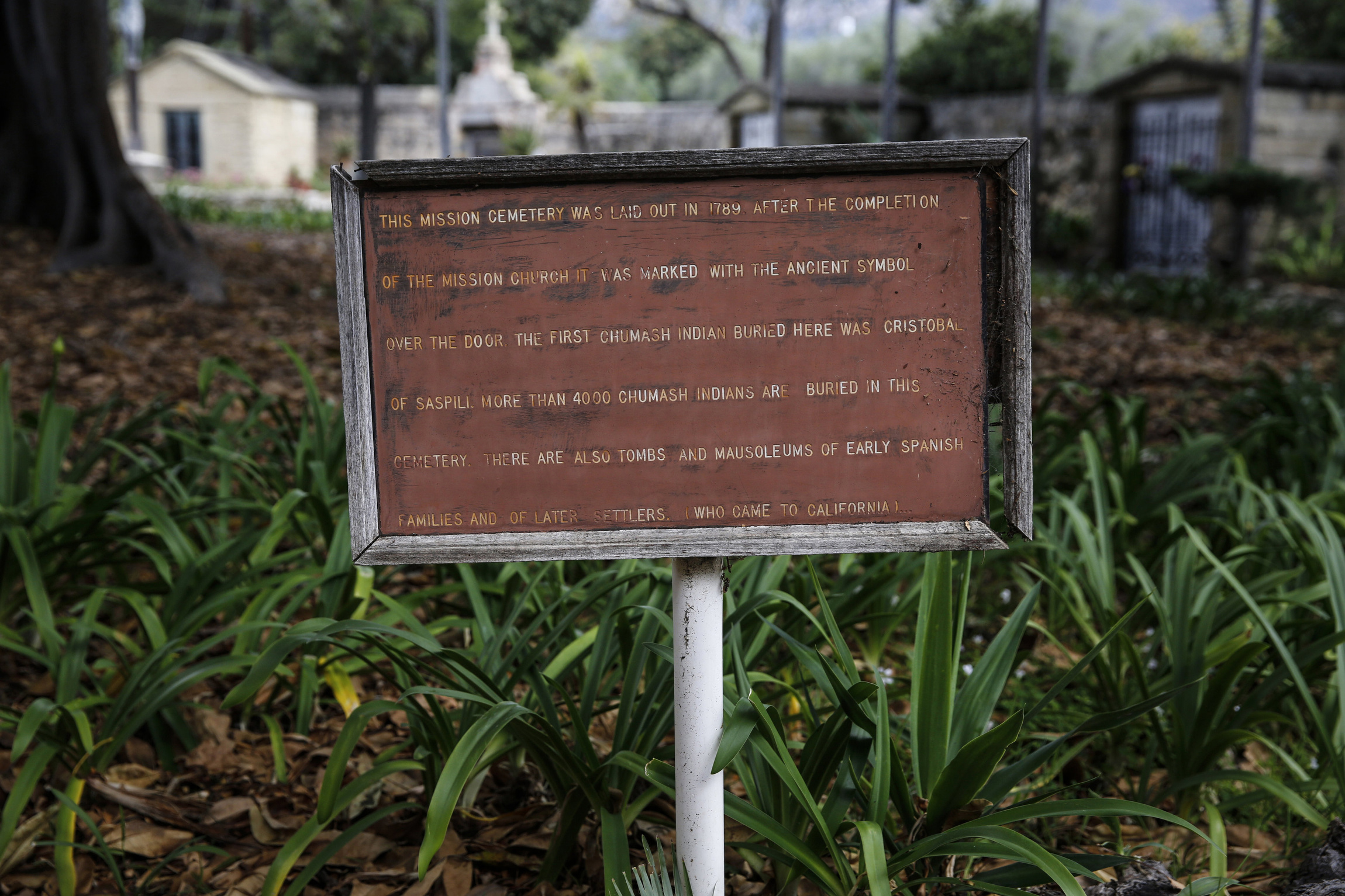
An interpretive sign in the graveyard of Old Mission Santa Barbara gives an idea of the loss: “More than 4,000 Chumash Indians are buried in this cemetery.”
An interpretive sign seen in early May tells visitors that more than 4,000 Chamush Indians are buried in the cemetery at Old Mission Santa Barbara in Santa Barbara, Calif. (CNS photos/Nancy Wiechec)
Despite the harsh history, Galvan said Blessed Serra deserves his devotion.
“He loved my ancestors. He loved Indians, He was in love with the idea of being a missionary here. His descriptions of my ancestors are fantastic,” he said. “I’m in love with him and I’m devoted to him.”
But not everyone shares that enthusiasm.
Galvan’s cousin and apprentice, Vincent Medina, is of a younger generation of California native people promoting and teaching their language and culture. He is one of only a handful of people who can speak and understand Chochenyo, the nearly lost tongue of the East Bay Ohlone.
After studying his people from before and after Spanish colonization, Medina said he doesn’t believe Father Serra should be among those the church names saints.
“Society for Ohlone people before colonization was good,” he said. “The world before us was full of richness. It was full of complexity, it was full of beauty, the language speaks to that, the songs speak to that.
“There was ethnocide in the missions, there was a destruction of language, there was a destruction of culture.”
Medina told CNS Blessed Serra’s canonization will only further the resentment many Indians have toward the church.
Additionally, Medina said he views saints as people who rise above the iniquities of their time. He thinks Blessed Serra might have had better forethought and a gentler approach to sharing his faith.
“He saw death, but he still kept moving forward. To me, that’s not somebody who lived outside of their era. To me, that’s somebody who’s going with the status quo of their time.”
Skyler Gisondo, Steele Stebbins, Christina Applegate and Ed Helms star in a scene from the movie "Vacation." The Catholic News Service classification is O -- morally offensive. The Motion Picture Association of America rating is R -- restricted. Under 17 requires accompanying parent or adult guardian.(CNS photo/Warner Bros.)
Skyler Gisondo, Steele Stebbins, Christina Applegate and Ed Helms star in a scene from the movie “Vacation.” The Catholic News Service classification is O — morally offensive. The Motion Picture Association of America rating is R — restricted. Under 17 requires accompanying parent or adult guardian.(CNS photo/Warner Bros.)
NEW YORK (CNS) — The dog days of summer may inspire the urge to get away from it all. Wise moviegoers, however, will not seek their relief in “Vacation” (Warner Bros.), a dog of a comedy that happily rolls around in all manner of muck.
This wretched revival of the franchise that began with 1983’s “National Lampoon’s Vacation” revolves around a new generation of the same hapless family — the Chicago-based Griswolds — featured in the original. The destination of their sultry season get-away also remains the same: a California amusement park, and Disneyland stand-in, known as Walley World.
[quote_box_right]
Vacation
Catholic News Service classification, O — morally offensive. Motion Picture Association of America rating, R — restricted. Under 17 requires accompanying parent or adult guardian.
[/quote_box_right]
The Griswolds embark on their road trip thither after bumbling patriarch Rusty (Ed Helms) — the teen son in the Reagan-era films — learns that his wife, Debbie (Christina Applegate), and their quarrelsome brace of boys, James (Skyler Gisondo) and Kevin (Steele Stebbins), are bored with the clan’s annual outing to a cabin in the Wisconsin woods. Rusty decides a weeklong ride to the Left Coast, by contrast, will be just the thing to shake up their routine and boost togetherness.
Needless to say, the travels that follow are beset by a variety of disasters. Yet the real calamity befalls viewers as they find themselves dragged along on a forced march through a landscape of tastelessness unrelieved by laughs.
Co-writers and -directors Jonathan Goldstein and John Francis Daley try to disguise their steamy material by cloaking it in family values. Thus, not only do we witness Rusty’s fatherly concern — which eventually morphs into exasperation –but also various scenes that demonstrate his and Debbie’s shared commitment to maintaining the vibrancy of their marriage.
The challenges to their union are typified by Debbie’s attraction to — and Rusty’s jealousy of — their hunky brother-in-law, Stone (Chris Hemsworth). But a stopover at Stone’s Texas home reveals, so to speak, the picture’s real agenda as their host pays Rusty and Debbie an enthusiastically exhibitionist bedtime visit, his tight underwear and contrived poses leaving nothing even to the sleepiest imagination.
Add to this interlude of too much information an inadvertent swim in a cesspool, the numerous obscenities the script puts into preteen Kevin’s mouth as well as ill-advised jokes about AIDS and pedophilia, and pretty soon you’ll be wishing you weren’t here.
The film contains pervasive sexual and extreme scatological humor, frontal male and upper female nudity, about a half-dozen uses of profanity and constant rough and crude language. The Catholic News Service classification is O — morally offensive. The Motion Picture Association of America rating is R — restricted. Under 17 requires accompanying parent or adult guardian.
John Mulderig is on the staff of Catholic News Service.
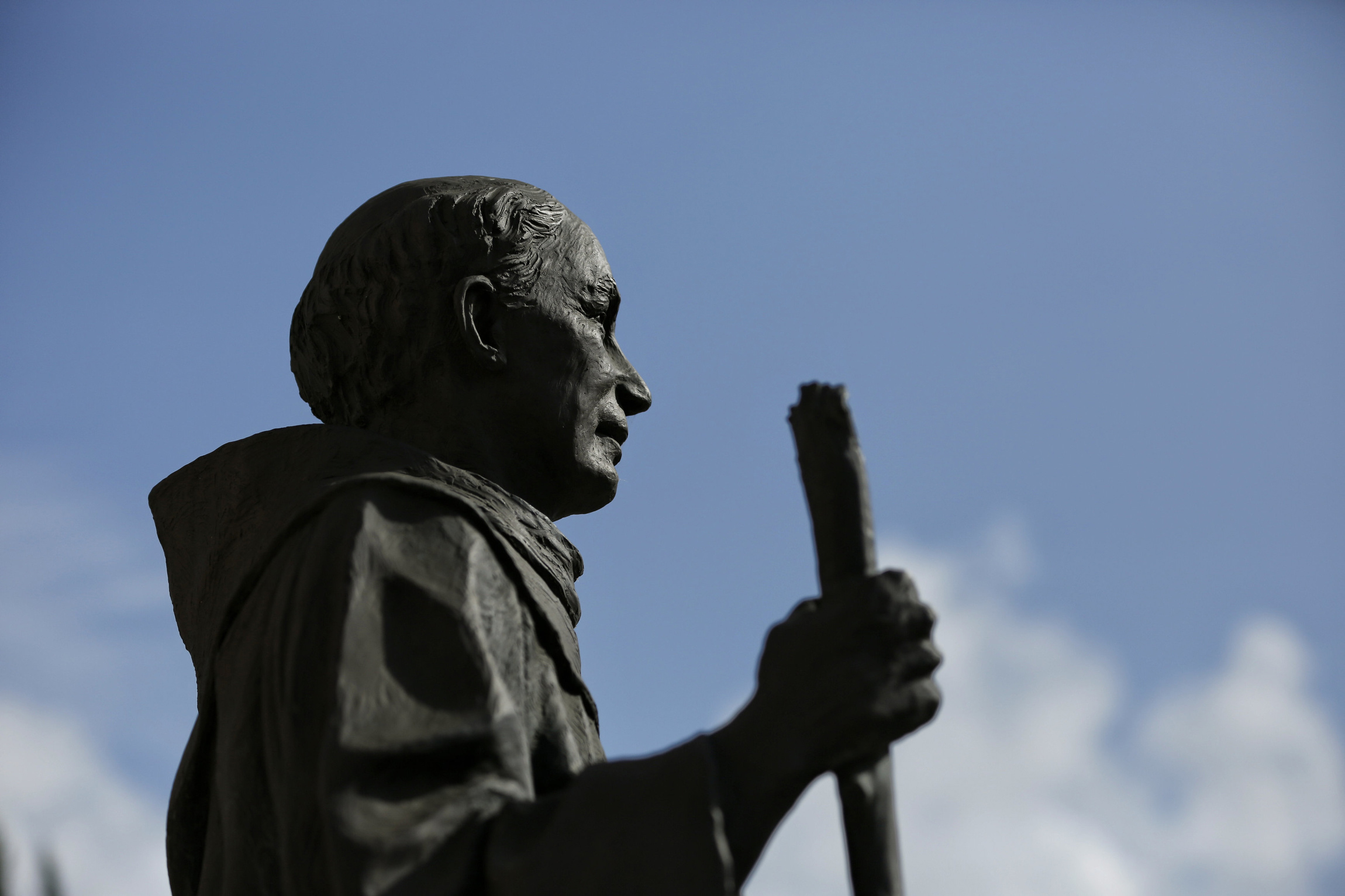
A statue of Blessed Junipero Serra stands outside San Gabriel Mission in early May in San Gabriel, Calif. The first occupants of the mission were the Tonga, called the Gabrieleno by the early missionaries. Today, an active diverse parish celebrates nine Sunday Masses, five in English, three in Spanish and one in Vietnamese. (CNS photo/Nancy Wiechec)
A statue of Blessed Junipero Serra stands outside San Gabriel Mission in early May in San Gabriel, Calif. The first occupants of the mission were the Tonga, called the Gabrieleno by the early missionaries. Today, an active diverse parish celebrates nine Sunday Masses, five in English, three in Spanish and one in Vietnamese. (CNS photo/Nancy Wiechec)
SACRAMENTO, Calif. (CNS) — It’s difficult to miss the mark that the missions have had on the Golden State. Evidence of their influence is seen in places and people throughout California.
The missions provided the “beginnings of who we are today” as Californians, said Franciscan Father Ken Laverone, who is five generations removed from a Spanish soldier assigned to the pueblo of San Juan Bautista.
“I was baptized in the mission,” he said. “I made my first Communion there. I was ordained a priest there. All my family has been buried there, so it’s home for us.
“Most of California as we know it — names of cities, mountains, rivers — they all came from (Blessed Junipero) Serra, the Spanish and the missionaries. So our heritage in a sense, our patrimony in terms of our identity, comes from that.”
Father Laverone, who is a co-postulator in Blessed Junipero’s sainthood cause, admits that not all of the results were good.
“Obviously, the colonization and the effects of colonization brought terrible tragedy into the native country,” he told Catholic News Service.
Spanish colonization, European diseases that ran rampant in missions and the gold rush, during which Indians were enslaved and killed, nearly eradicated California Indian populations.
California mission history is so profound that it has been required study for all fourth-graders in the state. On mission field trips, students find museum displays, artwork and old artifacts, but also parishes that are very much alive.
“I think some people are surprised by that,” said Father Tom Elewaut, pastor of San Buenaventura Mission in Ventura.
An illustration dated 1816 depicts Indians and Franciscans at Mission San Francisco de Asis in San Francisco. The image is part of the historical exhibit at the mission, which also goes by the name Old Mission Dolores. (CNS photo/Nancy Wiechec)
Today, all but two of the 21 historical missions are active churches, and most of those are parishes that continue to serve local communities.
“We have 1,800 active parishioners that attend, participate in Sunday worship,” said Father Elewaut, adding that at every Mass there also are people visiting from across the United States, Canada, Europe or other parts of the world.
Father Elewaut estimates that about half of his parish is Latino. Some families have been with the parish for generations, including the Ortega family, who began the Ortega Chile Packing Co. about three blocks from the mission. It was among the first commercial food operations in the state.
The priest said mission parishes have a unique responsibility to be caretakers of history and mission outreach.
“There’s a certain reverence from the parishioners to preserve the legacy and the spiritual center that has been entrusted to us, to continue to evangelize today.”
San Gabriel Mission is considered the mother church of Los Angeles, a city which is the seat of the largest Catholic archdiocese in the country in terms of Catholic population.
Xavier Vargas and his family are longtime parishioners of San Gabriel. His children and grandchildren were all baptized in the mission, some with the same silver shell used by its first missionaries.
He said he has a high regard for the missions and Blessed Junipero, whom he views as an intelligent, hard-working man who helped educate as well as evangelize native Californians.
When asked what intercession he might pray for from the soon-to-be St. Junipero, Vargas is quick to answer.
“Keep our missions going. Definitely keep our missions going, because there’s a great deal of pride and also a lot of history here that people don’t realize and we take for granted.”
Pope Francis will canonize Blessed Junipero Sept. 23 in Washington. The friar was beatified in 1988 by St. John Paul II.
Many people point to the missions for planting the seeds that eventually grew into California’s multibillion-dollar agricultural industry.
The Franciscans taught Indians to plant and harvest Spanish wine grapes, oranges, almonds, olive trees and other produce. From Mexico the padres brought grazing animals. Today, California remains a top producer of dairy products, almonds and grapes.
A large number of people populating the pews of the missions today are immigrants and the descendants of immigrants from Mexico who came to work California ranches and fields.
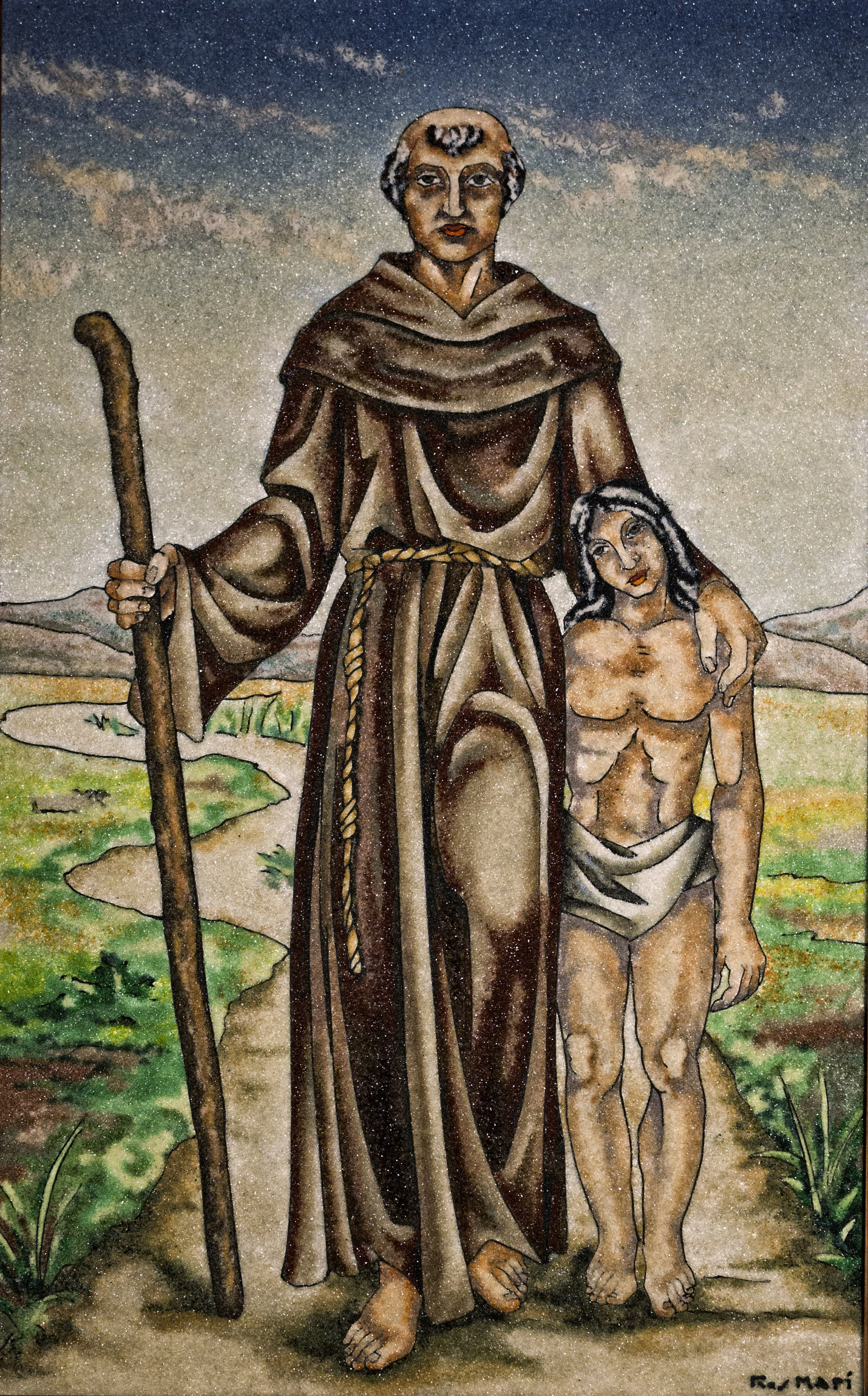
Blessed Junipero Serra is depicted with a California Indian in a painting in early May at Mission San Fernando Rey de Espana in Mission Hills, Calif. (CNS photo/Nancy Wiechec)
Caretakers at Mission Soledad still tend a small grove of Spanish olive trees and sells oil pressed from its fruit in the mission’s tiny gift shop.
Two missions, La Purisima Concepcion in Lompoc and San Francisco Solano in Sonoma, are state parks with exhibits detailing early life of the missions, and the periods of secularization and abandonment and also restoration and revival.
Other missions are parishes as well as centers of city life.
Outside Mission San Luis Obispo de Tolosa, where its steps lead to San Luis Obispo’s Mission Plaza, people often congregate for festivals and concerts.
In the seaside city of Carmel, San Carlos Borromeo de Carmelo Mission hosts a popular classic auto show and festival that draws people from across the county. The Carmel Mission Classic held in August benefits mission restoration efforts and Knights of Columbus charities and includes a “blessing of the cars.”
As tourists wander Carmel mission taking in its beauty and history and getting a glimpse of the final resting place of Blessed Junipero, they often interact with parishioners or typical parish activities like first Communion services and pancake breakfasts.
In Southern California, Mission San Juan Capistrano attracts tens of thousands of students and visitors each year. Its Serra Chapel from 1782 is the oldest extant building in California and the only remaining church where Blessed Serra celebrated Mass.
On the campus of Santa Clara University in California’s Silicon Valley, sits Mission Santa Clara de Asis. The Jesuit university has the distinction of being the first institution of high learning in the state as well as the only California college to be the successor of a Spanish mission. Students, faculty and alumni often celebrate their marriages in the finely restored mission church.
Boy Scouts serve as extraordinary ministers of holy Communion during a Catholic Scouting recognition Mass in 2010 at Sacred Heart Cathedral in Rochester, N.Y. The Boy Scouts of America lifted a ban on accepting openly gay adult volunteers and employees July 27. (Mike Crupi/CNS via Catholic Courier)
Boy Scouts serve as extraordinary ministers of holy Communion during a Catholic Scouting recognition Mass in 2010 at Sacred Heart Cathedral in Rochester, N.Y. The Boy Scouts of America lifted a ban on accepting openly gay adult volunteers and employees July 27. (Mike Crupi/CNS via Catholic Courier)
WASHINGTON (CNS) — The top leaders of the National Catholic Committee on Scouting have made an uneasy peace with the Boy Scouts of America’s decision July 27 to allow openly gay troop leaders and employees to serve in their ranks at the national level.
The Boy Scouts’ decision does not affect decisions about leaders made by local troops and councils and also permits religiously chartered Scout troops to choose leaders whose values are consistent with those of the sponsoring faith.
“It is not entirely clear how these rights will be squared with previous policy changes the Boy Scouts have made … but it appears that the resolution respects the needs of Catholic-chartered organizations in the right to choose leaders whose character and conduct are consistent with those of Catholic teaching,” said a July 27 statement from Edward Martin, national chairman, and Father Michael Hanifin, national chaplain, for the National Catholic Committee on Scouting.
“At the same time, we express strong concern about the practical implications of this resolution, especially for our young people in Scouting, and whether the term ‘sexual orientation’ will be correctly understood and applied only in reference to sexual inclination and not to sexual conduct or behavior,” they said.
According to an information page about the new policy on the Boy Scouts’ website, chartered organizations cab continue to “use religious beliefs as criteria for selecting adult leaders, including matters of sexuality.”
“The resolution also affirms a chartered organization’s right to select its unit leaders based on its religious principles, rejects any interference with that right, and provides that local Scout councils will not interfere with chartered organizations’ rights in this regard,” said a July 28 statement from Bishop Robert E. Guglielmone of Charleston, South Carolina, episcopal liaison to the NCCS. “As chartering organizations, individual parishes, institutions and Catholic schools have always had this right.”
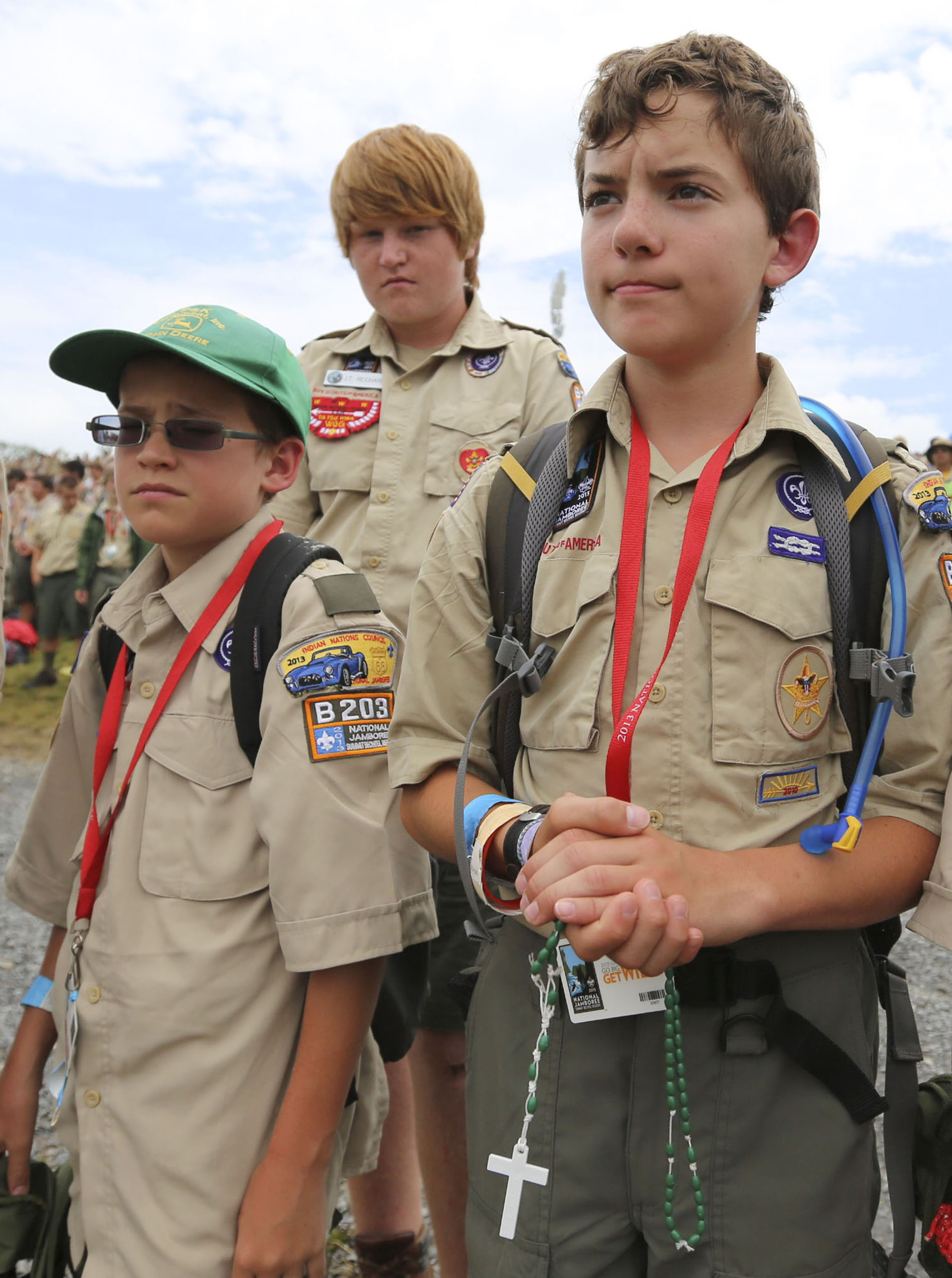
John Jarboe, 13, of Tulsa, Okla., holds his rosary during Mass at the National Boy Scout Jamboree at Summit Bechtel Family National Scout Reserve in Mount Hope, W.Va., July 21, 2013. (Al Drago/CNS courtesy Boy Scouts of America)
However Zachary Wahls, founder of Scouts for Equality — an organization of current and former Scouts that has led the effort to force the BSA to accept openly gay members, expressed concern in a statement that the policy didn’t go far enough.
“While we still have some reservations about individual units discriminating against gay adults, we couldn’t be more excited about the future of Scouting,” Wahls said in the statement. “We look forward to collaborating with our supporters, progressive faith partners, allied non-profit organizations, and the Boy Scouts of America to ensure a fully inclusive Scouting movement.”
In their statement, Martin and Fr. Hanifin said they also were concerned that the new resolution “articulates a position on adult sexual conduct that does not make clear that sexual behavior should be reserved to a husband and a wife in marriage.”
They described an “increasingly challenging” situation with regard to differences in religious and societal beliefs that led to the policy change, but added: “We recognize the vital importance of providing a Catholic emphasis to Catholic Scouts and Scouters seeking ways to live out their ‘duty to God.’
“Our youth don’t want to leave Scouting. … Let’s continue this important journey together and pray for the future of Scouting!” Martin and Fr. Hanifin said.
About 70 percent of Boy Scout troops are run by faith-based groups.
The Mormon church, whose troops account for 17 percent of all Boy Scouts, strongly criticized the policy change.
“The Church of Jesus Christ of Latter-day Saints is deeply troubled by today’s vote,” said a July 27 news release. “When the leadership of the church resumes its regular schedule of meetings in August, the century-long association with Scouting will need to be examined.”
The statement said the church has been examining alternatives, especially for Mormon boys who live in areas without a Boy Scouts presence.
The new policy was crafted by the Scouts’ top leaders, including Robert Gates, the former defense secretary who is now the Scouts’ president. According to the Scouts, 79 percent of its executive board members on a July 27 conference call approved the new policy.
The numbers of Boy Scouts has been slipping in recent years. Faced with criticism over the organization’s policies toward gays, as well as lawsuits against the Boy Scouts and declining business support, the Scouts allowed openly gay youths to join in 2013. Membership dropped 6 percent that year, and slipped another 7 percent last year to 2.4 million. The drop was attributed to departures by some evangelical churches over the 2013 policy change.
When a Boy Scouts committee unanimously recommended July 13 that the ban on gay troop leaders and employees be rescinded, the Southern Baptist Convention looked askance at the move.
Russell Moore, president of the denomination’s Ethics and Religious Liberty Commission, predicted an even greater exodus of Baptists from the Scouts, and expressed skepticism the Scouts would hold the line on protecting the rights of churches and other religious institutions.
“At every point, the Scout leadership tells us that they will go this far and no farther, but here we are again — so it’s hard for me to believe, in the long term, that the Boy Scouts will allow religious groups to have the freedom to choose their own leaders,” Moore told Baptist Press July 14. “In recent years I have seen a definite cooling on the part of Baptist churches toward the Scouts. This will probably bring that cooling to a freeze.”
Pope Francis is flanked by two Polish youths as he uses a tablet to officially open online registration for World Youth Day 2016 in Poland. (CNS photo/Ettore Ferrari, EPA)
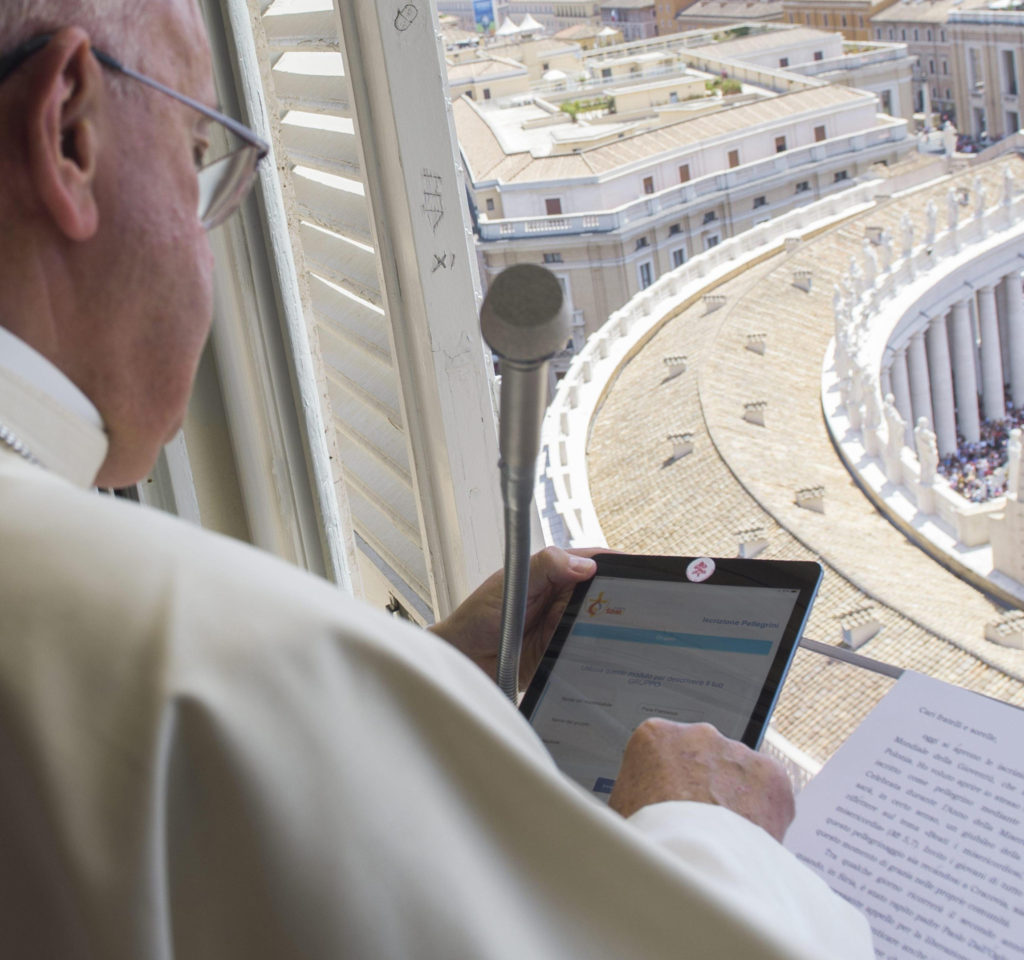
Pope Francis uses a tablet to officially open online registration for World Youth Day 2016 in Poland. He did this during the Angelus from the window of his studio overlooking St. Peter’s Square at the Vatican July 26. (CNS photo/L’Osservatore Romano via EPA)
VATICAN CITY (CNS) — Pope Francis was the first pilgrim to sign up for World Youth Day to be held in Krakow, Poland, launching the opening of registration.
Accompanied by two Polish teenagers who wore World Youth Day 2016 T-shirts, the pope had to make a couple of attempts pressing the screen of a tablet before his online registration went through.
“There. With this electronic device I have signed up for the day as a pilgrim,” he told thousands of people gathered in St. Peter’s Square July 26 for his Angelus address.
The pope said, “I wanted to be the one to open registration” in front of everyone gathered for the Angelus and in the company of two teens on the day sign-ups began July 26.
The celebrations July 26-31, 2016, will come during the Holy Year of Mercy, which Pope Francis proclaimed to invite people to follow the merciful example of God, the Father.
World Youth Day “will be, in a certain sense, a jubilee of youth” during the holy year, as its theme is also about being merciful toward others, the pope said.
God’s merciful power through Jesus “heals every ill of body and spirit,” the pope said before praying the Angelus.
Reflecting on the day’s Gospel reading, St. John’s account of the multiplication of loaves and fish, Pope Francis said the story shows how the disciples tried to find a “market”-based solution by calculating how much money they would need to feed the large, hungry crowd that had gathered by the Sea of Galilee.
A young woman reacts as Pope Francis leads the Angelus from the window of his studio overlooking St. Peter’s Square at the Vatican July 26. The pontiff officially opened online registration for World Youth Day 2016 in Poland. (CNS photo/Max Rossi, Reuters)
“But Jesus substitutes the logic of buying with another logic, the logic of giving” when he points to the generous gift offered by the boy, Andrew, who offered to give all that he had: five small loaves and two fish.
Even though people could not see how such a small contribution could make a difference, “God is able to multiply our tiny gestures of solidarity and let us participate in his gift,” the pope said.
Jesus offers “fullness of life for those who hunger. He satisfies not only material hunger, but also that deeper hunger — the hunger for meaning in life, the hunger for God,” Pope Francis said.
Complaining does nothing to solve the many problems in life, “but we can offer that little we have like the boy in the Gospel,” he said.
Everyone has some kind of talent or skill as well as time, he said. “If we are willing to put them in the Lord’s hands they will be enough so that there will be a little bit more love, peace, justice and above all joy in the world.”
Bystanders watch over the scene at a movie theater in Lafayette, La., July 23. A gunman opened fire at the theater that evening, killing at least two people and injuring nine others before taking his own life, according to local reports. (Lee Celano/CNS via Reuters)
Bystanders watch over the scene at a movie theater in Lafayette, La., July 23. A gunman opened fire at the theater that evening, killing at least two people and injuring nine others before taking his own life, according to local reports. (Lee Celano/CNS via Reuters)
LAFAYETTE, La. (CNS) — Bishop Michael Jarrell of Lafayette offered prayers and sympathy to the victims of a multiplex cinema shooting July 23 in Lafayette in which two were killed and nine wounded.
“On behalf of the Catholic faithful in the Diocese of Lafayette, we offer our deepest sympathies to the families of the victims of the shooting at the Grand Theater in Lafayette,” Bishop Jarrell said in a July 23 statement. “We are all shocked and saddened by this tragedy. We pray that everyone affected by this horror may feel the comforting presence of our Lord Jesus surrounding them during this difficult time.”
The gunman, identified as John Russell Houser, 59, opened fire about 20 minutes into a screening of the movie “Trainwreck.” Of the 13 shots he fired, 11 hit audience members who were watching the film.
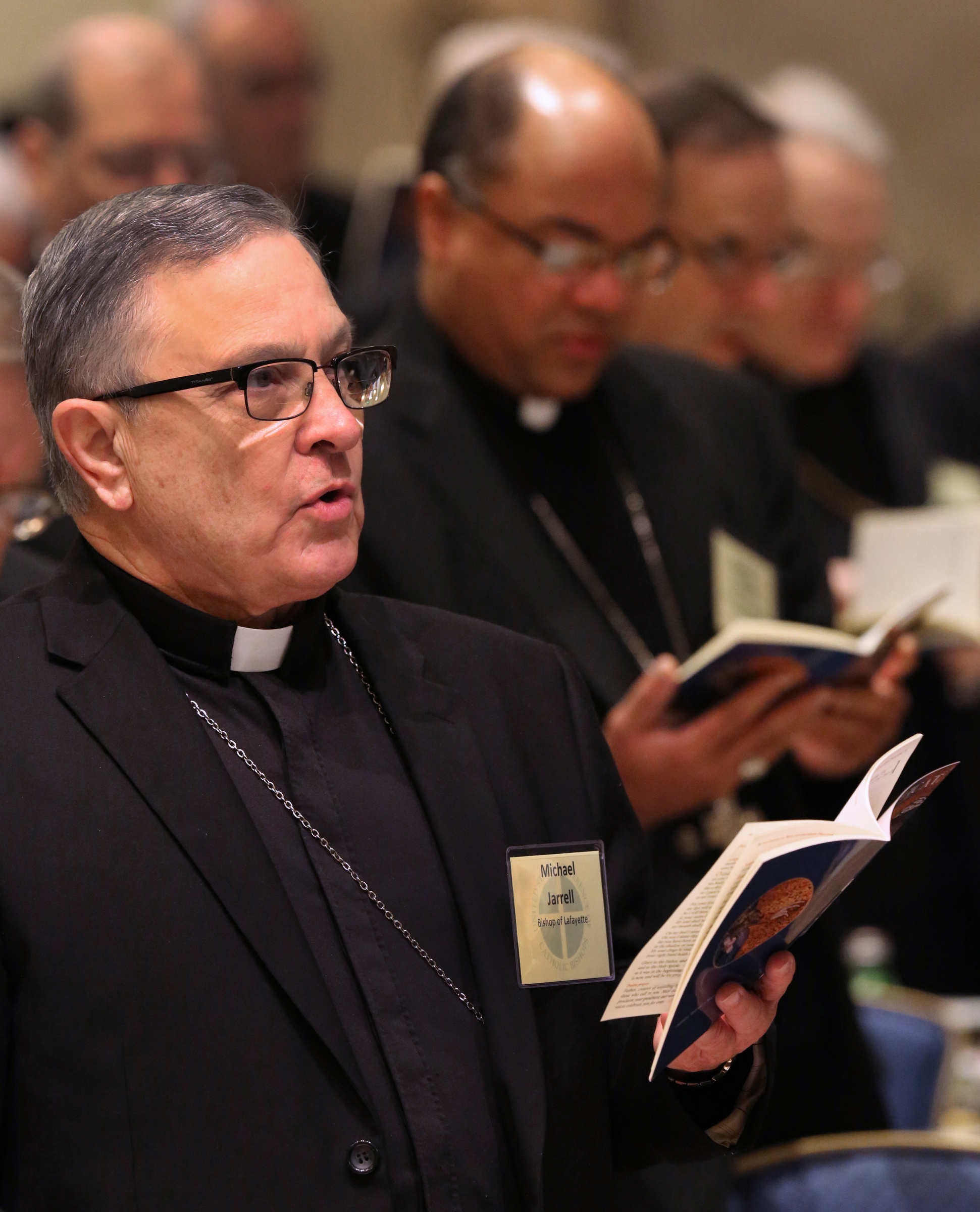
Bishop Michael Jarrell of Lafayette, La., sings during the morning prayer Nov. 11 at the 2014 fall general assembly of the U.S. Conference of Catholic Bishops in Baltimore. Bishop Jarrell offered prayers for the victims of a July 23 shooting at a movie theater in his diocese. (Bob Roller/CNS photo)
There were about 300 people inside the 16-screen cinema at the time of the shooting, about 7:30 p.m. Central time. Police said Houser had intended to blend in with the fleeing patrons, but when he saw police outside the theater, he went back inside and fatally shot himself.
No motive was offered for the shooting, and police acknowledged during a July 24 news conference they may not find a motive. Police added Houser had mental health issues, and that his wife had sought a restraining order against him in 2008. They said he had another magazine of ammunition with him at the theater to continue his shooting spree.
Father Michael Russo, pastor of Our Lady of Fatima Parish in Lafayette, was making his church available for people to leave flowers, notes and other remembrances in the wake of the shooting.
“Lafayette is a place of great faith. We ask all the Catholic faithful and, indeed, all people of goodwill throughout Acadiana to stop, and offer sincere and thoughtful prayer for those who have died, the wounded, their families as well as the perpetrator of this evil act,” Bishop Jarrell said.
“We pray in thanksgiving for the tireless efforts of law enforcement, paramedics and first responders. Our priests and deacons stand ready to pray with any of the wounded and family members impacted by this senseless tragedy. Along with all people of faith, we commit ourselves to promoting a society that respects the dignity of every human life.”