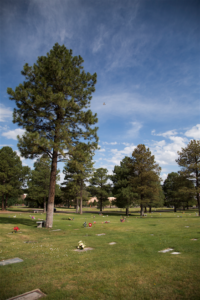
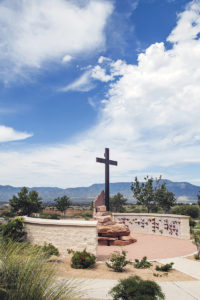
Holy Cross Cemetery and Funeral Home in Avondale, Arizona.
When you think of great partnerships throughout history, there’s a good chance they have these qualities in common: effective communication, complementary skills and, perhaps most significantly, trust.
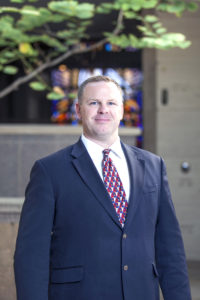
Monica H. Torres is General Manager of Holy Cross Catholic Cemetery and Funeral Home.
As Paty Rodriguez, new cemetery manager, and I settle into our roles at Holy Cross Catholic Cemetery and Funeral Home, I am proud to say that we possess all of these traits and one more, which I believe is most important of all: a shared passion for serving Catholic families with care and compassion as they lay their loved ones to rest.
I joined the team at Holy Cross a few months ago as general manager, and Paty came here shortly thereafter as the cemetery manager. We soon discovered that we were both called to our ministry by personal tragedy—Paty after the unexpected death of her brother and I after losing my father when I was just a baby. Our personal experiences instilled in both of us a keen sense of empathy, and we both feel called to care for families going through the losses we had endured.
We also discovered that our skills and experience dovetail nicely and enable us to provide families with the support they need as they prepare for a Catholic funeral and burial. Paty has many years of experience running cemeteries, and she is generous in sharing her knowledge with me. I bring to our partnership my own experience as funeral director and embalmer, with a specialty in reconstruction, to enable families to partake in the full Catholic funeral experience. Together, we are able to offer families expertise that runs the spectrum of their funeral and cemetery needs.
Paty and I also share a strong sense of community. As natives of the Valley of the Sun, we have deep roots in the greater Phoenix area and have a great respect for the local culture. We’re committed to helping strengthen our Catholic community in the West Valley through a variety of outreach programs. We are also working with local hospitals to help educate them and their patients about our unborn baby burial program.
I hope that you will take the opportunity to come meet us in person during our All Souls Day Mass on November 2 at 4:30 p.m. at Holy Cross Catholic Cemetery and Funeral Home. You also can meet our colleagues at our other locations for All Souls Day Mass. We will have counselors available at each location to answer your questions or give you a tour.
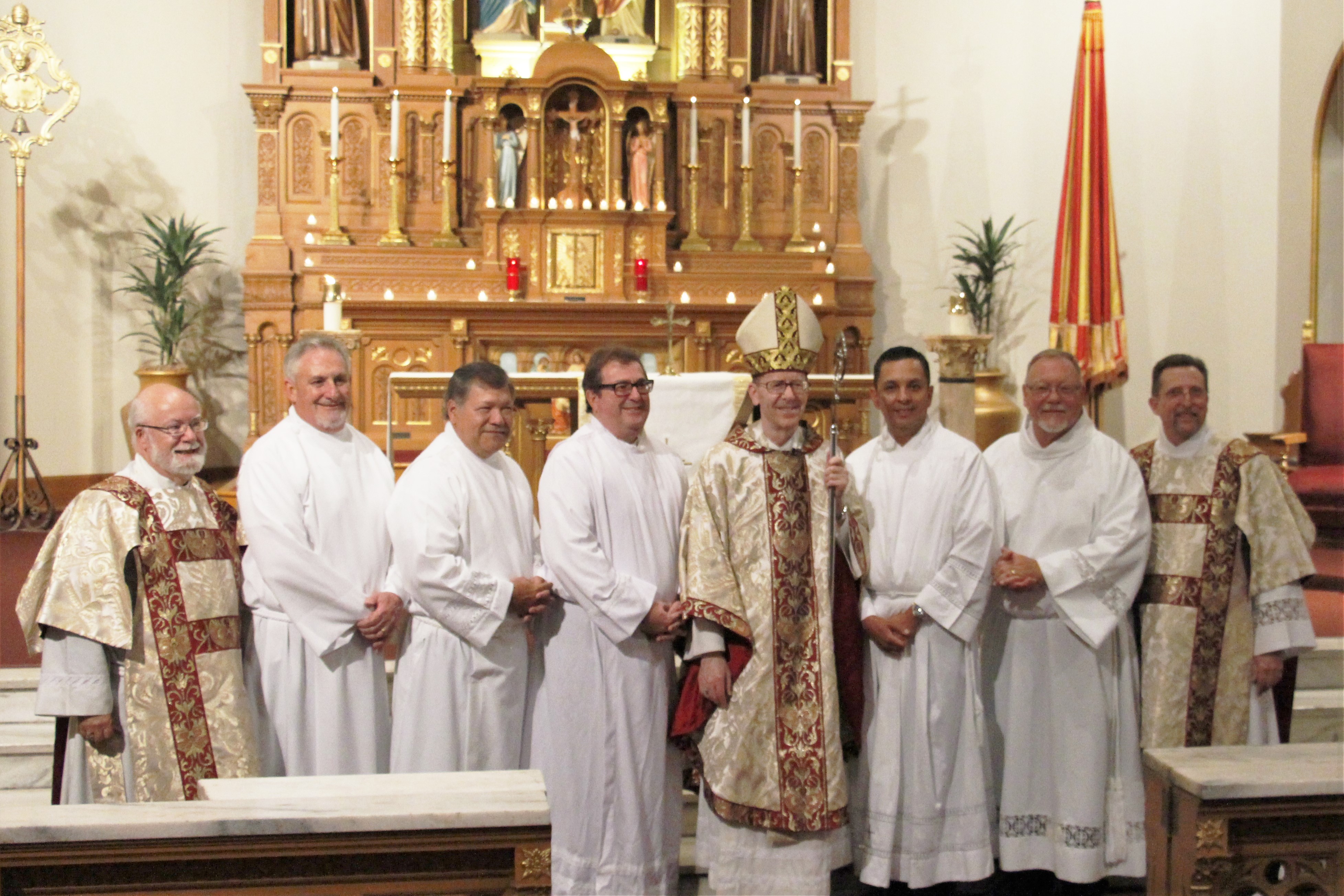
Bishop Thomas J. Olmsted will ordain five men to the permanent diaconate Nov. 5. The five men are pictured with Bishop Olmsted (center), director of the diocesan Office of the Permanent Diaconate Dcn. Jim Trant (far left) and associate director Dcn. Doug Bogart (far right) shortly after they were instituted to as acolytes on Aug. 28, 2015 at Ss. Simon and Jude Cathedral. The candidates are, from left to right: Anthony Smith, Marvin Silva, Gary Scott, William Chavira and Chris Giannola. (Photo courtesy of the Office of the Permanent Diaconate)
Bishop Thomas J. Olmsted will ordain five men to the permanent diaconate Nov. 5. The five men are pictured with Bishop Olmsted (center), director of the diocesan Office of the Permanent Diaconate Dcn. Jim Trant (far left) and associate director Dcn. Doug Bogart (far right) shortly after they were instituted to as acolytes on Aug. 28, 2015 at Ss. Simon and Jude Cathedral. The candidates are, from left to right: Anthony Smith, Marvin Silva, Gary Scott, William Chavira and Chris Giannola. (Photo courtesy of the Office of the Permanent Diaconate)
Bishop Thomas J. Olmsted will confer the sacrament of Holy Orders upon William Chavira, Christopher Giannola, Gary Scott, Marvin Silva and Anthony Smith on Nov. 5 at Ss. Simon and Jude Cathedral.
The faithful are also invited to join the men, their families and the deacons of the diocese for Solemn Vespers with Bishop Eduardo A. Nevares, Nov. 4 at St. Thomas the Apostle Parish.
The diaconate is actually rooted in Scripture. The Holy Spirit led the Apostles to select seven men as “deacons” to assist the bishops and to assume responsibility of the more secular and temporal duties (Acts 6:1-6).
St. Stephen was one of the seven men ordained who labored among the poor. He is also the first Christian martyr.
Dcn. Doug Bogart, associate director of education and formation for the Office of the Diaconate, explained the sacrament of Holy Orders as it applies to deacons.
“A deacon is ordained to be an icon of Christ the Servant, and is meant to be the Church’s call to service sacramentalized,” he said. “We’re all called to be servants but some men are called out to be the sign of that for all the Church.”
Dcn. Bogart said by “fanning the flame,” deacons draw out the gifts, talents, abilities and apostolic service of the laity to “change the world.”
Permanent deacons must meet strict guidelines established by the Church and complete a rigorous 7-year-course of study and formation.
Once ordained, they remain deacons permanently for life, as opposed to “transitional deacons” who are ordained as a step toward priesthood.
“Going through formation is the most unique experience of my life, unlike anything else I have ever done. It is a great opportunity to grow in holiness and humility, in knowledge of our faith, in service to the Body of Christ,” Scott said of formation.
“It is the embodiment of the expression ‘let go and let God.’ Along the way you will meet amazing people, deep and rich in their faith, you will give comfort to those needing comfort, and will experience things that will forever change your life,” he added.
In the centuries that followed the apostles, the Church continued to grow under the guidance of the Holy Spirit.
During the Second Vatican Council in 1964, the Council Fathers approved the restoration of the diaconate as a permanent order, a full part of the three-fold hierarchy of Holy Orders: bishop, priest, and deacon.
Pope Paul VI established the permanent diaconate for the Western Church on June 18, 1967, when he issued Sacrum Diaconatus Ordinem and granted American bishops permission to restore the diaconate in the U.S. on Aug. 30, 1968.
The work of the deacons evolved into three major areas: liturgical, doctrinal, and charitable.
They are called to administer the charitable works of the Church and can baptize, witness marriages, perform funeral and burial services outside of Mass and proclaim the Gospel and preach a homily during Mass.
“There’s always been a longing and calling for me to serve God’s Church. Holy Orders are congruent with medicine, focusing on the physical and beauty of our faith,” said Chavira, an OB/GYN. “It’s the body and spirit together, the totality of the human person.”
Chavira encourages others “to be open and use prayer and discernment” when considering the diaconate because “God does amazing things.”
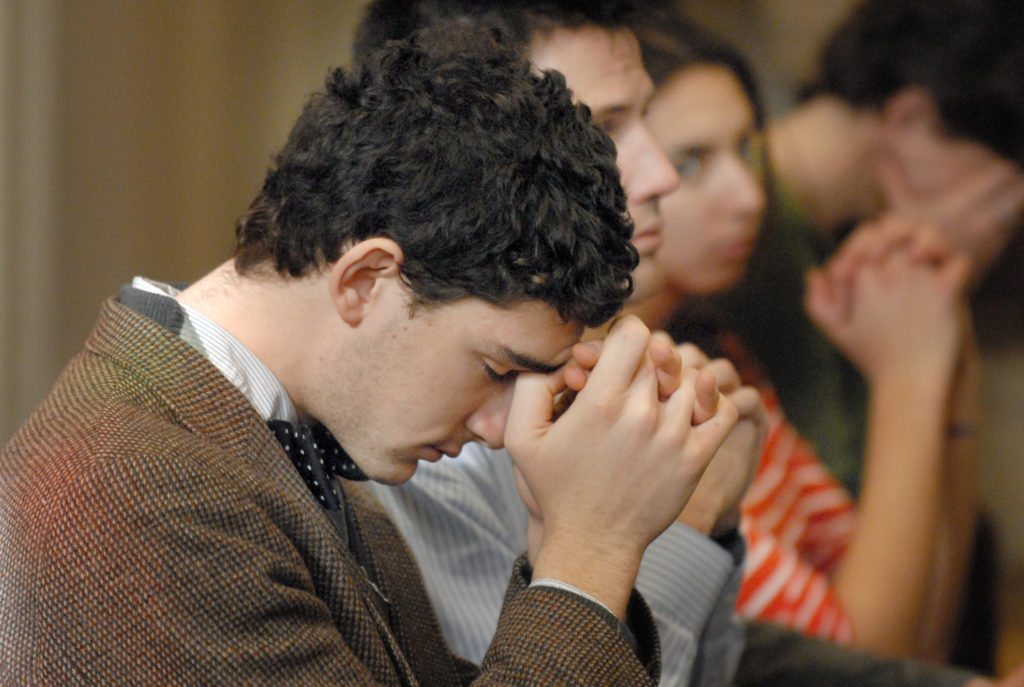
A young man prays during a novena in 2010 at The Catholic University of America in Washington. The Knights of Columbus is urging its members and other U.S. Catholics to pray a novena from Oct. 30 to Nov. 7, the eve of Election Day. (CNS photo/Rafael Crisostomo, El Pregonero)
NEW HAVEN, Conn. (CNS) — The Knights of Columbus is urging its members and other U.S. Catholics to pray a novena from Oct. 30 to Nov. 7, the eve of Election Day.
“The church teaches that Catholics are called to form their consciences based on church teaching and vote in accordance with that well-formed conscience,” said Supreme Knight Carl Anderson, who is CEO of the international fraternal organization based in New Haven.
(CNS illustration/Liz Agbey)
“Pope Francis has said in reference to the U.S. election that we should ‘study the proposals well, pray and choose with your conscience,’ and this novena is designed to help Catholic Americans do that,” Anderson said in a statement.
The Knights’ novena — nine consecutive days of prayer — asks the intercession of Mary, the mother of Jesus, under her title of the Immaculate Conception. Individuals, families, councils and parishes are all invited to participate, the Knights said.
Baltimore Archbishop William Lori will launch the novena prayer Oct. 30, at St. John the Evangelist Church in Severna Park, Maryland.
Mary Immaculate is the patroness of the United States. In 1791, Archbishop John Carroll of Baltimore, the first bishop of the United States, dedicated his diocese to her. The first U.S. diocese, it covered the entire country. In 1846, the U.S. bishops reaffirmed that dedication and Pope Pius IX ratified it in 1847.
Here is the text of the novena:
“Most Holy Trinity: Our Father in heaven, who chose Mary as the fairest of your daughters; Holy Spirit, who chose Mary as your spouse; God the son, who chose Mary as your mother, in union with Mary we adore your majesty and acknowledge your supreme, eternal dominion and authority.
“Most Holy Trinity, we put the United States of America into the hands of Mary Immaculate in order that she may present the country to you. Through her we wish to thank you for the great resources of this land and for the freedom which has been its heritage.
“Through the intercession of Mary, have mercy on the Catholic Church in America. Grant us peace. Have mercy on our president and on all the officers of our government. Grant us a fruitful economy, born of justice and charity. Have mercy on capital and industry and labor. Protect the family life of the nation. Guard the precious gift of many religious vocations. Through the intercession of our mother, have mercy on the sick, the tempted, sinners — on all who are in need.”
According to the Knights, the prayer was written for the 1959 dedication of the Basilica of the National Shrine of the Immaculate Conception in Washington, which includes a bell tower known as the Knights Tower. The Knights of Columbus donated money for the tower’s construction.
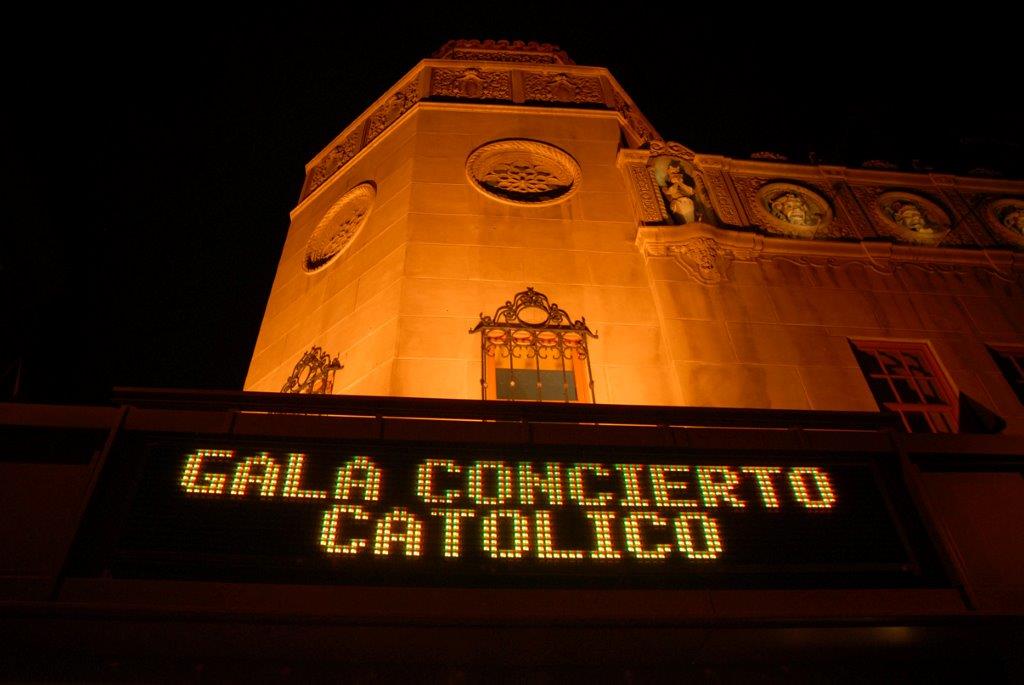
La Segunda Gala Concierto Católico será el 29 de octubre en el Orpheum Theatre. Este foto archivo es de la primer concierto en 2015. (Foto cortesía de la Oficina de Apoyo al Liderazgo Parroquial Hispano)
La Segunda Gala Concierto Católico será el 29 de octubre en el Orpheum Theatre. Este foto archivo es de la primer concierto en 2015. (Foto cortesía de la Oficina de Apoyo al Liderazgo Parroquial Hispano)
2da Gala Concierto Católico
Cuándo: 5 a 10 p.m., el sábado, 29 de octubre de 2016
Dónde: Orpheum Theatre, 203 W. Adams
Entrada general: $15
Más información y venta de boletos: (602) 354-2120, ext. 9001 y (602) 262-7272 o catequesiseventos.org
Todo se encuentra prácticamente listo para la Segunda Gala Concierto Católico en la tarde del sábado 29 de octubre en el Orpheum Theatre que organiza la Diócesis Católica de Phoenix, a través de la Oficina de Apoyo al Liderazgo Parroquial Hispano.
“Deseamos invitar a la comunidad en general, será un evento familiar, será una tarde-noche inolvidable para asistir a un lugar histórico tan hermoso como es el Orpheum Theatre y escuchar música de calidad”, enfatizó Carmen Portela, directora de la mencionada oficina.
Portela anunció que como parte de la concierto habrá una exhibición de arte religioso con obras de artistas locales, principalmente, y recomendó adquirir los boletos cuanto antes.
La Segunda Gala Concierto Católico será estelarizada por famosos cantautores y grupos, entre ellos Miguel Quiñonez, de Perú; El P. Edward Gilbert, de República Dominicana; y Paola Rimada, Guadalajara, México.
También aparecen anunciados en el programa el Ministerio Kaivos, de República Dominicana; el grupo Jaleos y el talentoso cantante local Héctor García.
A través de una carta emitida por la oficina del Obispo Thomas J. Olmsted, el prelado invita a la comunidad católica a asistir al grandioso evento.
El Obispo Olmsted expresó en la misiva que el concierto se realizará, “inspirados por el mensaje de nuestro Santo Padre, el Papa Francisco, a ser una Iglesia en salida, una Iglesia de encuentro, llevando la alegría del evangelio, y bajo el lema ‘Sácianos de tu misericordia, Señor, y toda nuestra vida será alegría y júbilo’”.
Por su parte Carmen Portela mencionó que en el evento “la fe y el arte se unirán a través de la música, y ayudará a las personas a fortalecer su fe”.
Aún hay boletos disponibles a $15 cada uno y pueden adquirirse en persona en la taquilla del Centro de Convenciones de Phoenix – Oeste, por la calle tercera, de lunes a viernes de 10 a.m. a 4 p.m.
Msgr. James Shea, president of University of Mary, prepares to board a stranded bus following the 2016 March for Life in the nation’s capitol. (photo courtesy of University of Mary)
“Our selection is due in no small part, I’m sure, to the resilience and witness of this year’s 2016 March for Life participants from Mary, under the leadership of Pastor Kerry Bender, Dr. Chris Collins, and Sisters Hannah Vanorny and Idelle Badt,” said University of Mary President Monsignor James Shea, who always takes part in the march with Mary students. “Their story is now almost legendary, and it drew more awareness to this year’s March than anyone could have anticipated.”
Shea is referencing the national media attention he and University of Mary students attracted when they and thousands of march-goers were snowbound 54 hours on Pennsylvania turnpike in buses lined up for miles returning home from the 2016 March for Life.
Anne Dziak (Di-ZHAHK) of Chicago, IL, helped lead the chants and cheers on the Mary buses in 2016 as a senior accounting major, and now as an alumna is organizing and in charge of the massive contingent headed to Washington D.C. in January. That’s no easy task for anyone, but Dziak is used to the leadership role. This will be Dziak’s 12th March for Life, after starting a pro-life group at her local parish back home when she was 16 years old. She and her sister helped grow its membership to its current 1,000 and named it The Crusaders for Life in Chicago. The University of Mary contingent she is leading in January expects to be in the hundreds.
“We’re expecting close to 500 students with eight or nine busses — but that number could climb between now and January,” said Dziak. “You can feel the energy and excitement in the air because many who wanted to go last year elected not to because of the stormy weather and now they are all counting down the days. Along with leading the March for Life, it is inspiring to be a part of a university that embodies education ‘for life’ in everything it does and promotes as part of its slogan. As a recent grad I am able to embrace the idea that the education that I received here at the university will benefit me throughout all stages in life. My fellow colleagues and Mary students will be at the forefront of this massive pro-life rally, leading, chanting and marching — for life.”
The March for Life has been held annually in Washington for more than 40 years. It is a bipartisan, interdenominational gathering of hundreds of thousands of Americans who travel to the nation’s capital to testify to a message which is powerful and life-affirming.
The University of Mary, with just over 3,000 students, has been a part of this March for the last six years. In 2016 the University of Mary bused 100 students to Washington D.C.
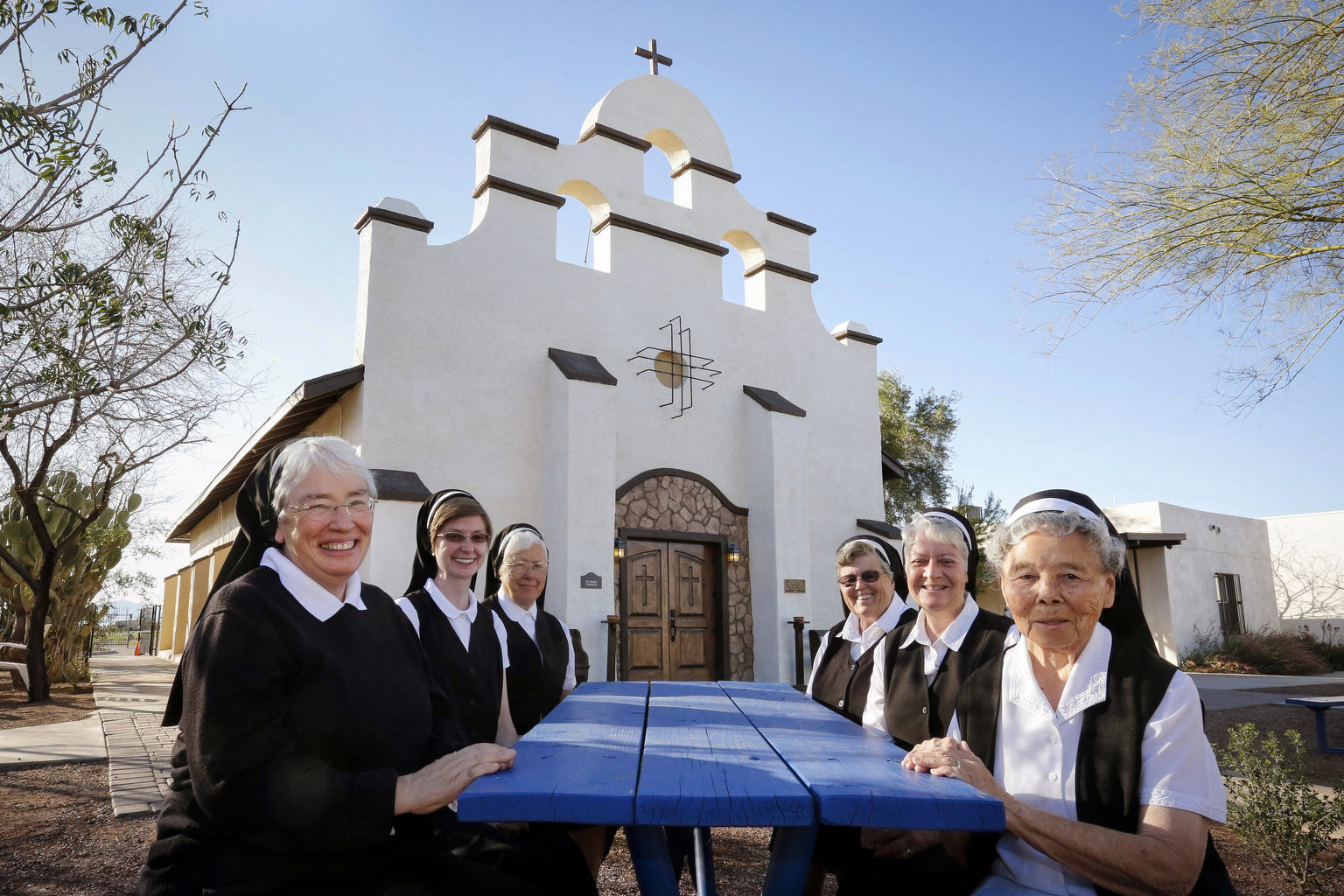
The Franciscan Sisters of Christian Charity serving St. Peter Indian Mission School in Bapchule will receive the “Guardian of Hope” award at this year’s Night of Hope. From left are Sisters Martha Mary Carpenter, Pamela Catherine Peasel, Barbara Jean Butler, Carol Mathe, Maria Goretti Scandaliato and Thereselle Arruda. Not pictured Sr. Hannah. (Nancy Wiechec/CNS)
The Franciscan Sisters of Christian Charity serving St. Peter Indian Mission School in Bapchule will receive the “Guardian of Hope” award at this year’s Night of Hope. From left are Sisters Martha Mary Carpenter, Pamela Catherine Peasel, Barbara Jean Butler, Carol Mathe, Maria Goretti Scandaliato and Thereselle Arruda. Not pictured Sr. Hannah. (Nancy Wiechec/CNS)
Night of Hope
When: 5:30 p.m., Saturday, Nov. 5
Where: Xavier College Preparatory, 4710 N. Fifth St.
BAPCHULE — Here in the windswept desert of the Gila Indian Reservation stands a beacon of hope: St. Peter’s Mission School.
The seven Franciscan Sisters of Christian Charity who live here and staff St. Peter’s rise early each morning and greet the 240 children bused in from a dozen villages that dot the reservation. More than 80 percent are from families whose income falls below the federal poverty guidelines.
The Franciscan Sisters are being honored at this year’s Night of Hope celebration as the recipients of the Guardian of Hope Award. Each year, the gala raises scholarship funds and endowment money for the 14,000 students who attend Catholic schools in the Diocese of Phoenix. The Guardian of Hope award honors those who have had a major impact on Catholic education.
“Last year we gave $125,000 out in scholarship assistance and the need requested was in excess of $450,000,” said MaryBeth Mueller, superintendent of Catholic schools. “Donating to Night of Hope helps students and their parents have the opportunity to stay in Catholic schools.”
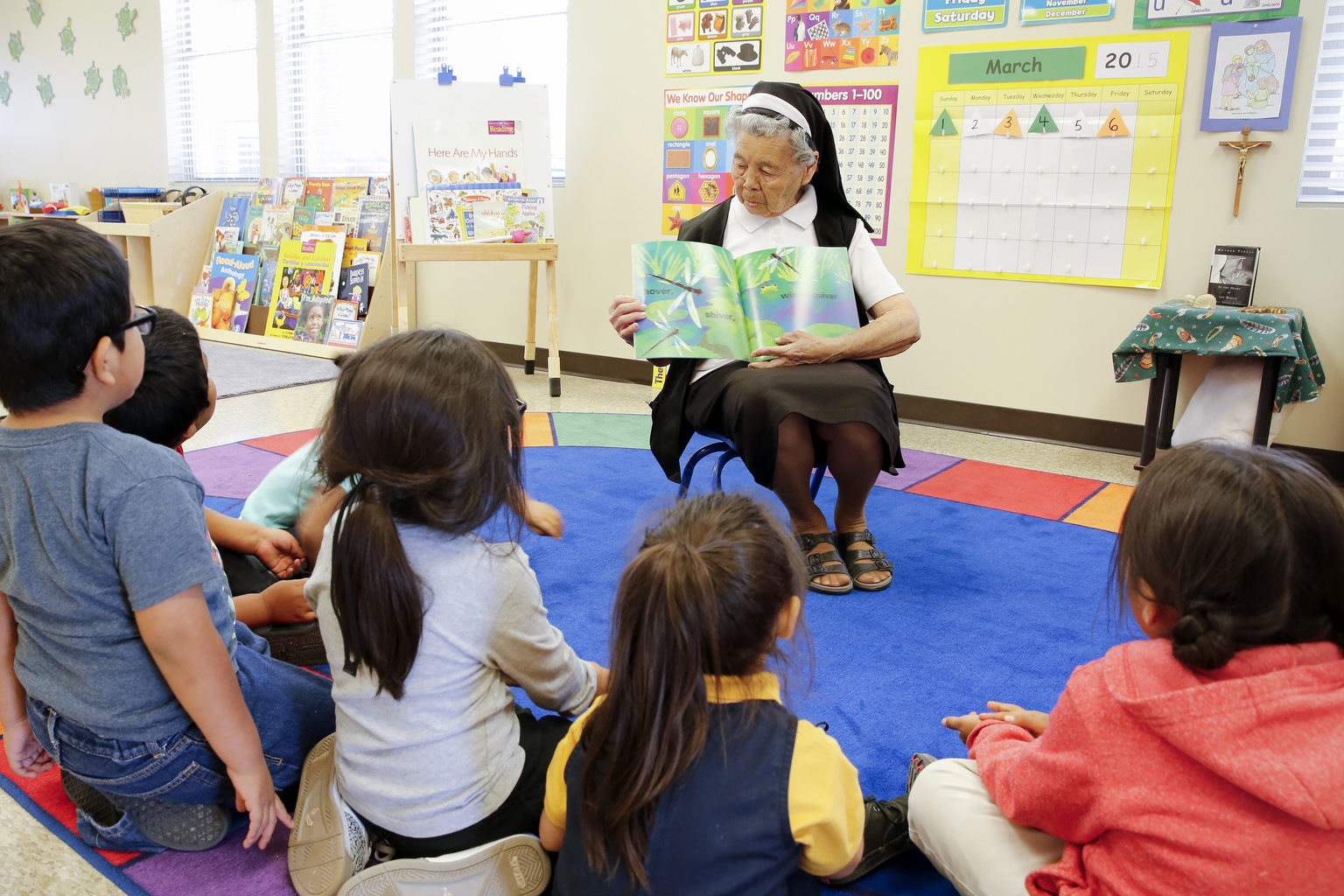
Sr. Thereselle Arruda reads to preschoolers at St. Peter Indian Mission School in Bapchule. The Franciscan Sisters of Christian Charity have served the Gila River Indian Community since 1935. (CNS photo/Nancy Wiechec)
The Franciscan Sisters, living in poverty among the families they serve at St. Peter’s, bring hope to a community facing steep challenges. Sr. Martha Mary Carpenter, principal, waits for the kids at the track each morning where they begin the day by running a mile. Their tribe, the Pima, has the highest rate of diabetes in the world and fitness is emphasized. Often, the students turn to the Sisters for a word of hope.
Sr. Carol Mathe has been teaching at St. Peter’s 20 years. “They’ve got so much on their minds when they come to school in the morning. We put them all in His hands.”
“If something is going on in their families, if something bad happened or they want to talk out there, they shake it out,” Sr. Martha said of the morning laps. “Hope carries us forward. Hope gives us the courage to face each new day because it’s going to get better … and that’s what we teach our children — to become more like Jesus, to be people of hope, people of prayer and people of forgiveness.”
After their run, students head to the chapel for prayer. It’s where they end each day too. During October, they’ve been praying the Rosary in both English and their Native language, O’odham.
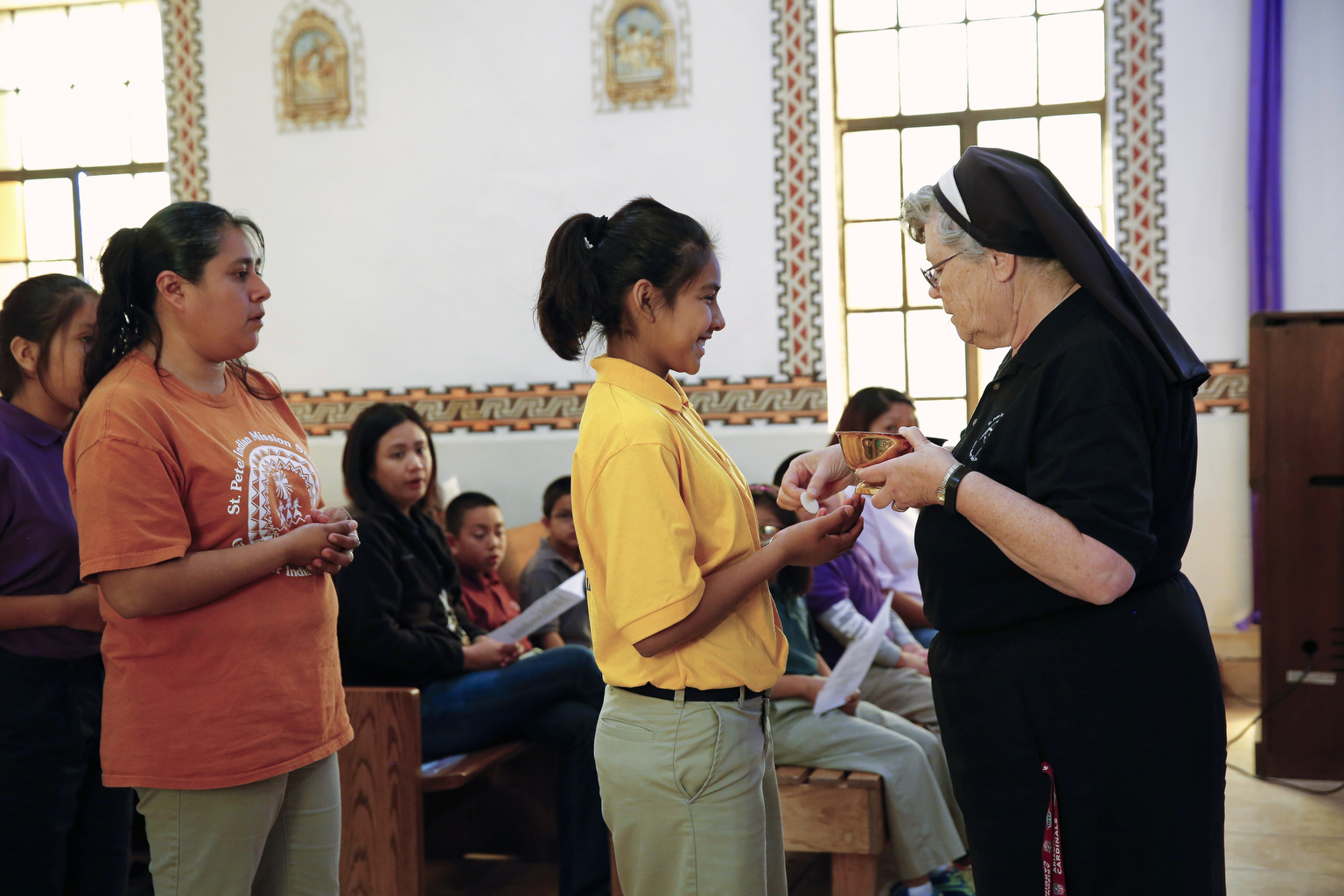
Sr. Carol Mathe distributes Communion during a weekday Mass at St. Peter Indian Mission School in Bapchule. The mission church is the center of the school’s campus and at the heart of the ministry of the Franciscan Sisters of Christian Charity. (CNS photo/Nancy Wiechec)
“We want our children to be grounded in their identities as people of Gila River, so that they can be contributing members of society, to be proud of the fact that they are Indian,” Sr. Martha said. It’s her 32nd year teaching at the school. “Many of the students in the school, I taught the parents,” she said.
Andrea Terry, who graduated from St. Peter’s and drove one of its buses for 25 years, is an ex-officio member of the school board. What would the school be like without the Franciscan Sisters? “I don’t think it would survive — they really make it work,” Terry said. “They are dedicated way beyond what they should be doing, all because they stay and live right here.”
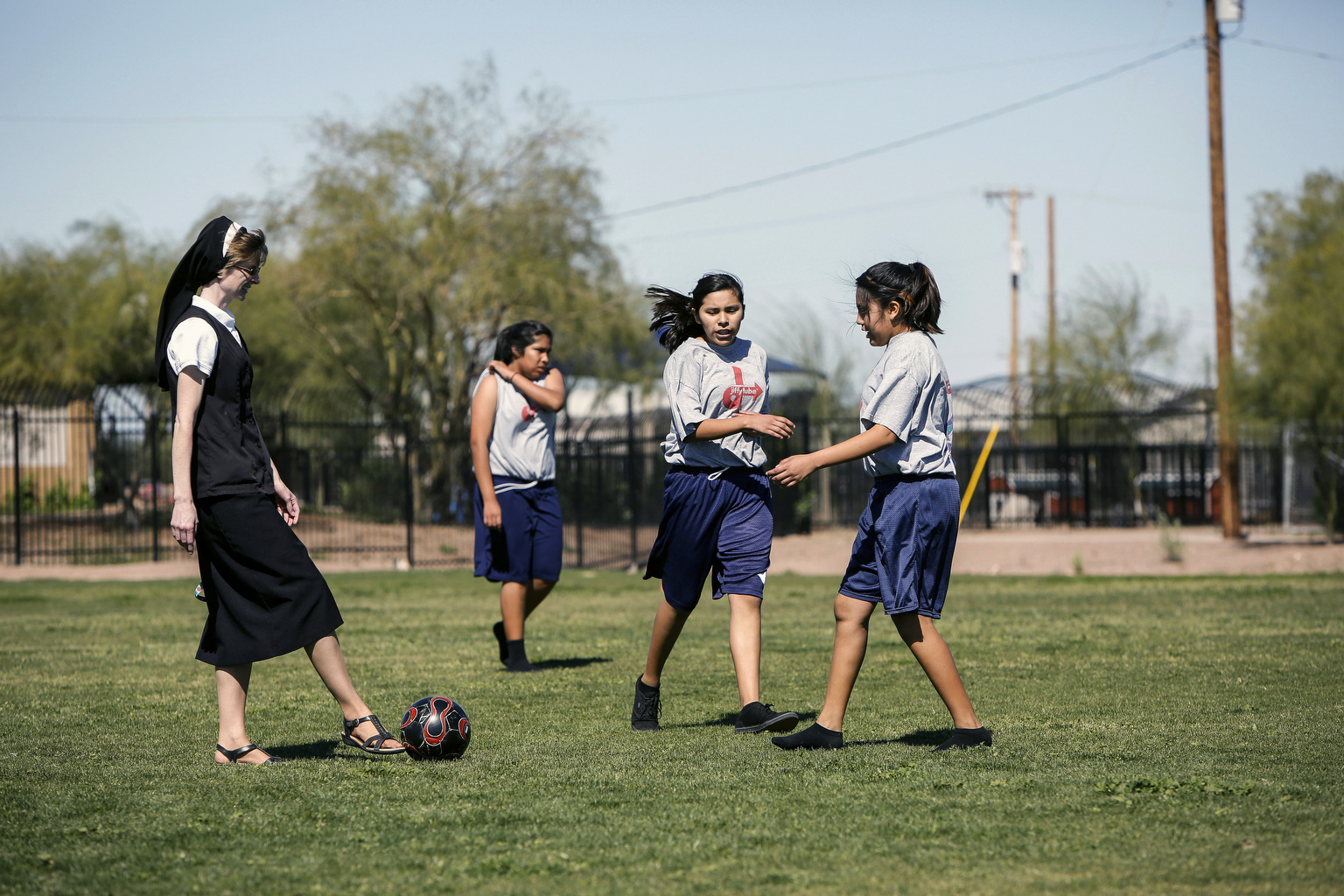
Sr. Pamela Catherine Peasel takes to the soccer field with her junior high school girls at St. Peter Indian Mission School in Bapchule. Franciscan Sisters of Christian Charity have served the Gila River Indian Community since 1935. (CNS photo/Nancy Wiechec)
Sr. Hannah Johnecheck is in her second year at the mission school and has 30 kindergarteners in her classroom. Soft-spoken and young, she said the most important value she is trying to instill in them is a love for Jesus. A deep faith and hope undergird that love.
“We are a consistent, solid force for them and no matter what happens around them, they know the Church, the Sisters are present here and that reminds them that Jesus is always there for them,” Sr. Hannah said.
“We’re teaching our children, that no failure, no mistake is fatal and that they always have to forgive one another as Jesus always forgives us,” Sr. Martha said.
Msgr. James Shea (photo courtesy of University of Mary)
BISMARCK, ND — University of Mary President Msgr. James Shea, known to be at the forefront of the New Evangelization across America, is now at the head table of today’s fastest-growing national Catholic youth outreach — the Fellowship of Catholic University Students. FOCUS Founder and CEO Curtis Martin and fellow members selected Shea to its board of directors.
“FOCUS emboldens young men and women to share the hope and joy of the gospel to their peers, fellow college and university students, and enkindles in them the desire for a deep and meaningful encounter with Jesus Christ and his Church,” said Shea, who is completing his seventh year as president of the Catholic university in Bismarck, ND.
He is the youngest university or college president in America. “FOCUS missionaries serve so selflessly in this noble and good pursuit, and have already transformed the hearts of so many; I’m humbled to be asked and honored to help in any way I can.”
FOCUS, headquartered in Golden, CO, is growing each day as a lay group working hand-in-hand with Catholic parishes and Newman Centers across the country with over 425 missionaries serving on 125 campuses — including four at the Northern Arizona University Newman Center in Flagstaff. The University of Mary currently has alumni working as FOCUS missionaries on other campuses and also hosts a FOCUS chapter.
In 1990, Pope Saint John Paul II began the movement for a New Evangelization and later wrote in The Church of America, “The new evangelization calls for a clearly conceived, serious and well organized effort to evangelize culture in such a way that the Gospel is proclaimed in the language and in the culture of its hearers. It is more necessary than ever for all the faithful to move from a faith of habit, sustained perhaps by social context alone, to a faith which is conscious and personally lived.”
FOCUS and Shea are true servants of JP2 and witnesses to his vision of the New Evangelization across America.
40 Days for Life
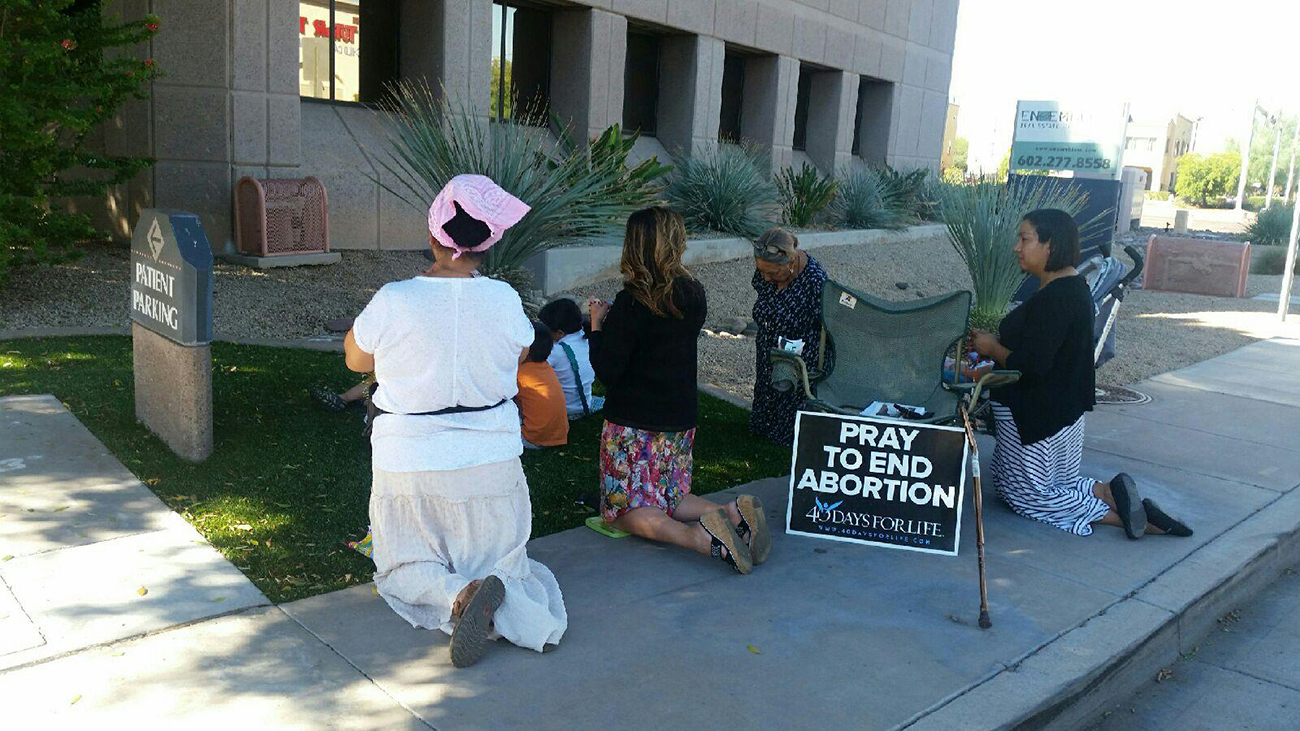
Participants in the 40 Days for Life campaign pray in front of Family Planning Associates in Phoenix where a baby was born alive following an abortion last spring. (Photo courtesy of Nancy Brady)
40 Días por la Vida
Partidarios del movimiento pro-vida rezan afuera del “Family Planning Associates” en Phoenix. (Foto Cortesía por Nancy Brady )
Partidarios del movimiento pro-vida rezan afuera del “Family Planning Associates” en Phoenix. (Foto Cortesía por Nancy Brady/40 DÍAS POR LA VIDA)
40 Días por la Vida
Phoenix: 1331 N. Seventh St., Ste. 225
Flagstaff: 2500 S. Woodlands Village Blvd.
Glendale: 5771 W. Eugie Ave.
Tempe: 1250 E. Apache Blvd., Ste. 108
1ra Gala Cena Pro-Vida
Cuándo: 6 p.m., viernes, 18 de noviembre Dónde: The Fall Event Center, 4635 E. Baseline Rd., Gilbert
2do Congreso Binacional Hispano de Respeto a la Vida y Evangelización
Cuándo: 8:30 a 5:30 p.m., 19 y 20 de noviembe Dónde: Centro de Convenciones de Phoenix, 100 N. Third St.
Eduardo Verástegui será a los dos eventos. Informes:gophx.org/eventos o llame al 602-354-2120, ext. 9000.
Miles de vidas salvadas, 133 trabajadores del aborto que han dejado sus puestos de trabajo y 75 centros que cerraron sus puertas para siempre. El impresionante éxito del esfuerzo de oración 40 Días Para la Vida en medio de una cultura de la muerte ha inyectado nueva energía en el movimiento dedicado a proteger la vida humana desde la concepción hasta la muerte natural.
El mes de octubre, establecido por la Conferencia de Obispos Católicos de los Estados Unidos como el tiempo especial para enfocar en el respeto a la vida, es tradicionalmente el momento en que los esfuerzos para defender la dignidad de la vida humana se fortalecen. La campaña internacional de 40 Días por la Vida que toma lugar en el otoño de la vida se lleva a cabo durante todo el mes de octubre, y en muchos sentidos, se ha convertido en la cara del movimiento.
La campaña internacional se extiende a varios países, incluyendo a México, Bolivia, Colombia y España. Aquí en la Diócesis de Phoenix, varios de los líderes son hispanas, tales como Yanet Cortés, que está encargada de la campaña en Glendale; Patti Romero Hamrick, la coordinadora para Tempe. Norma Partida también está involucrada, trayendo la imagen de la Virgen Peregrina de Guadalupe a los sitios de oración, frente a las clínicas de aborto.
Rosie Villegas, fundadora y directora de Voces por la Vida, recuerda cuando primero invitó a personas en México. “Me preguntaban ¿cómo podemos hacerlo? Ahora están haciendo su propia campaña a nivel nacional y están registrados oficialmente”.
Carmen Portela, directora de la Oficina de Apoyo Liderazgo Parroquial Hispano, dijo que aunque hay muchas personas de habla hispana que están activos en el movimiento pro-vida, espera que más participarán, especialmente después del 2ndo Congreso Binacional Hispano Respeto a la Vida y Evangelización, que tomará lugar el 18 al 20 de noviembre.
Los dos propósitos del congreso, dijo Portela, son “concientizar a la familia hispana de los ataques que está recibiendo la familia y cómo ellos pueden defenderla y capacitar un liderazgo hispano en los asuntos de respeto a la vida”.
Los organizadores están esperando a 700 familias a asistir al evento en el Centro de Convenciones de Phoenix. “Vienen de todo Arizona, principalmente de nuestra diócesis pero también nuestros hermanos del otro lado de la frontera”, dijo Portela, explicando que ha promovido el congreso por medios de programas nacionales de radio.
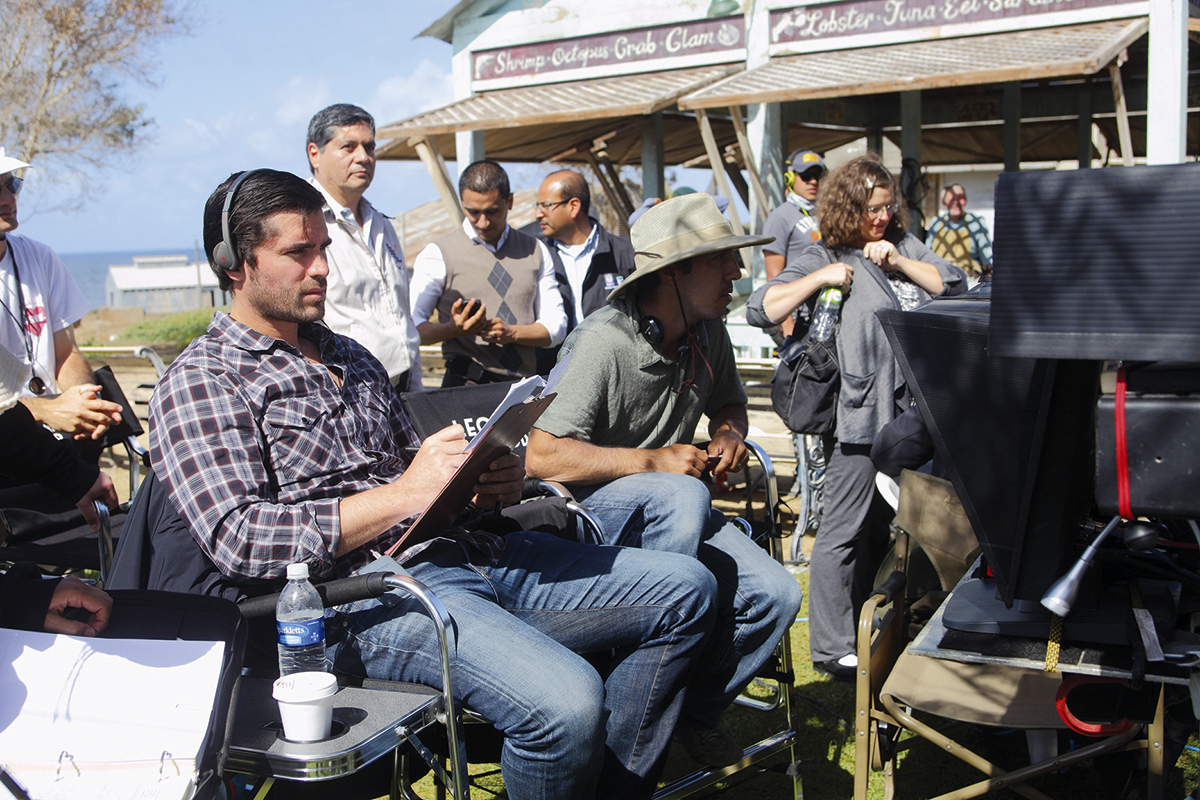
El actor y productor Eduardo Verástegui prepara una escena en su película de 2015, “Little Boy.” Verástegui va a hablar en la gala cena pro-vida el 18 de noviembre y también en el congreso el 19 de noviembre. (CNS foto/cortesía por Metanoia Films)
Eduardo Verástegui, el famoso actor y modelo de “Bella” y que tuvo una conversión poderosa hace unos años, va a hablar en la gala cena pro-vida el 18 de noviembre y también en el congreso el 19 de noviembre. Verástegui es famoso por su películas católicas como la película pro-vida “Bella”, “Cristiada” y “Little Boy”.
“Habrá talleres para toda la familia, para niños, papas, adultos, y líderes”, dijo Portela. “Los niños van a tener una área totalmente para niños con diferentes como marionetas y todo y diferentes dramas, para que los niños disfruten, y va a ser más como una área de evangelización de niños, y eso va a ser el sábado y el domingo”.
También habrá una conferencia para los jóvenes y música apropiada para ellos, dijo Portela, añadiendo que algunas de las sesiones se tratan de cómo hablar con amigas que han tenido un aborto.
“Para los adultos tenemos a Alejandro Bermúdez [el director de ACI Prensa] que va a hablar del Papa Francisco y el Año de la Misericordia y también Manuel Capetillo, de torero y actor a apóstol del rosario”, dijo Portela. Un hombre homosexual que es pro-familia y pro-matrimonio entre un hombre y una mujer también hablará a los adultos.
Some of the 20 acres that makes up Calvary Catholic Cemetery in Flagstaff is seen in this undated photo. (Courtesy photo/Calvary Catholic Cemetery)
His business card calls him a manager, but he largely manages himself.
Patrick Stoffel is essentially the only regular face visitors see when they come to Calvary Catholic Cemetery in Flagstaff and All Souls Catholic Cemetery in Cottonwood. He helps individuals pre-plan their funeral and burial or cremation needs, journeys with those making arrangements last minute, sets up for burials and places headstones.
He would dig the graves too, but leaves that to the experts via a contract with the city. There’s a seasonal mower. All other matters for managing the oldest and newest cemetery serving the Diocese of Phoenix falls to Stoffel.
He is OK with that.
“Even before I could identify it as being a corporal work of mercy, I just felt it was important,” Stoffel said.
He credits his upbringing for that. Stoffel often spent time at the gravesite or mausoleum marker where relatives had their final resting place.
Patrick Stoffel (Courtesy photo/All Souls Catholic Cemetery)
“Friend or family, when someone passes on, you need to be there and be part of that tradition,” Stoffel said. He said the importance of memorializing, interring or other forms of sacred disposition often gets overlooked today.
Church tradition, especially throughout the month of November, is different. Catholics routinely pray for the dead with every recitation of the Rosary and the Fatima prayer. Beginning with All Saints Day Nov. 1 and All Souls Day Nov. 2 and continuing all month, they especially pray for the souls in Purgatory.
Cemeteries are holy grounds for worship and prayer. They witness to a shared faith in the Resurrection and “hold the relics of those who are experiencing the joy of eternal life among the Communion of Saints. They are a link to our Lord in Heaven,” a pamphlet for each Catholic cemetery in the diocese states.
Nov. 23 Unclaimed Dead Memorial Service with André House at White Tanks Cemetery in Litchfield Park
All six of them will hold a Mass on All Souls Day. Stoffel has seen at least 50 people show up each year since his arrival in 2010. He even recalled students from Northern Arizona University holding a candle-lit Eucharistic procession around campus after their own evening Mass Nov. 1. Calvary Cemetery neighbors the college campus.
On Nov. 2, students process from the Newman Center to the cemetery. It’s primarily Latino students who attend and sing songs along the way and then stay for Mass at the cemetery.
Processions following funeral Masses have become more common since All Souls Cemetery opened in 2004. The two-acre cemetery with another 16 acres of growing space sits across the parking lot from Immaculate Conception Parish.
All Souls Catholic Cemetery sits across the parking lot from Immaculate Conception Parish in Cottonwood. (Courtesy photo/All Souls Catholic Cemetery)
“It’s really a special place, especially for the procession to come directly after the Mass and to go to the cemetery,” Stoffel said.
He sees cemetery work as an extension of a local church’s efforts to take care of parishioners. It’s a place to respectfully preserve the body or cremains until the end of time when the body is resurrected and Judgment Day commences.
“From the beginning the Church has honored the memory of the dead and offered prayers in suffrage for them, above all the Eucharistic sacrifice, so that, thus purified, they may attain the beatific vision of God,” the Catechism of the Catholic Church states (1032).
Stoffel, who has a background in forestry, fell into cemetery work in 2000. The public works department he served in back in the Midwest was too big for his comfort. A position opened up in a smaller division that included cemeteries, buildings
and grounds. Now, he can’t imagine doing anything else.
Related
“Sharing my faith” — How a Protestant from Iowa ended up finding love in both his bride and his secular vocation
“I feel blessed to be able to do what I do, to help families through hard times,” Stoffel said.
He draws upon his grief training to help them get through even the most practical of steps that go beyond funeral planning. Stoffel tells families that it’s common for the bereaved to forget to eat and drink in the days and weeks surrounding death of a loved one. He reminds them of their importance and to rest as much as possible, too.
Another part of his job involves listening. Stoffel sees himself as the beginning of the support network a grieving family can rely upon.
“I just let people talk and express themselves. I don’t try to tell them anything in particular,” he said. With little staff around and acres of well-manicured grounds around him, listening comes easily.
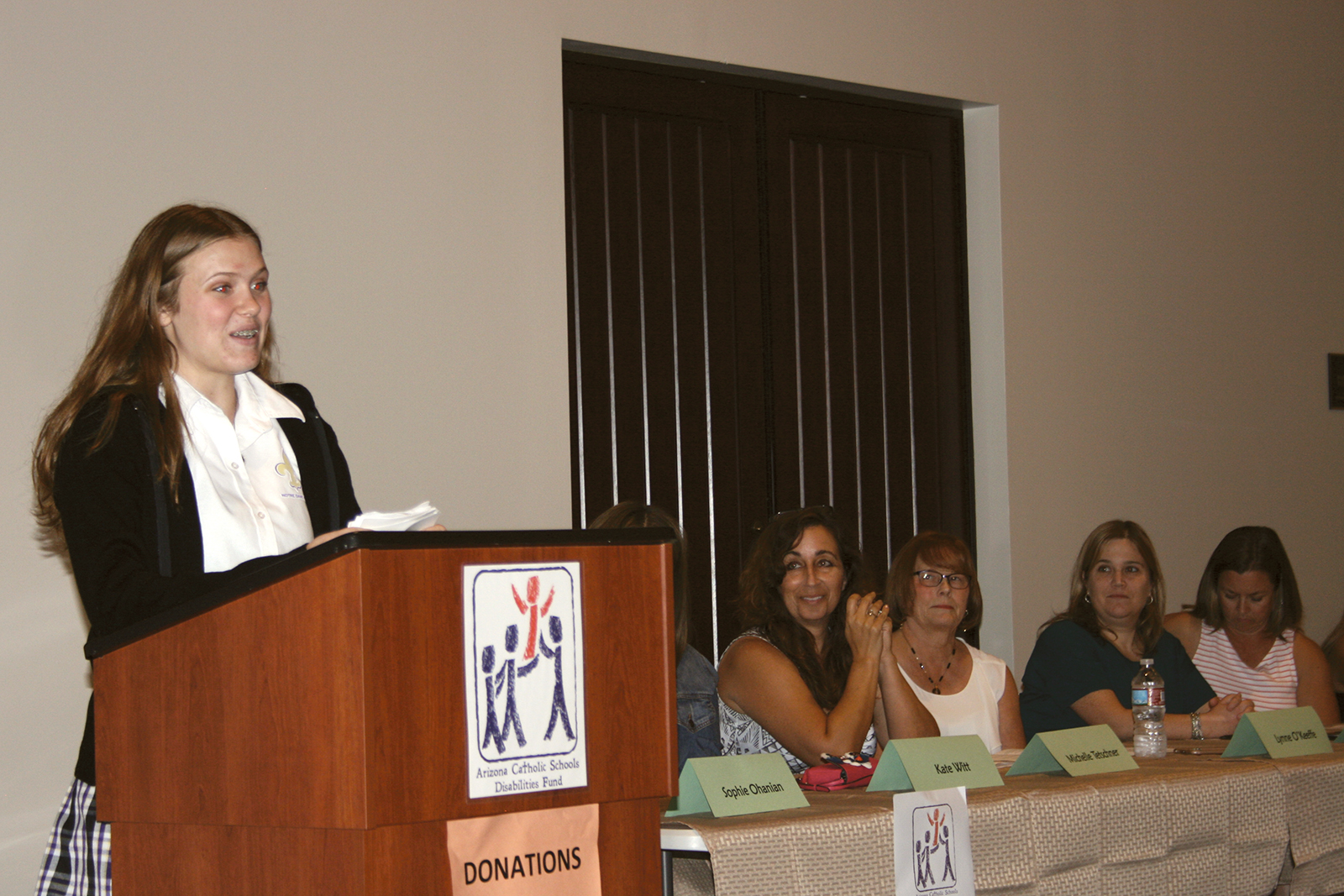
Sophie Ohanian, a freshman at Notre Dame Preparatory, speaks at the ACSDF panel. (Photo courtesy of Lisa Fischer/ACSDF)
Sophie Ohanian, a freshman at Notre Dame Preparatory, speaks at the ACSDF panel. (Photo courtesy of Lisa Fischer/ACSDF)
Arizona Catholic Schools Disabilities Fund
Parents are encouraged to look into the Empowerment scholarship and other student tuition organizations available in Arizona that allow for school choice.
Click here for more information on the Arizona Catholic Schools Disabilities Fund.
By Gina Keating The Catholic Sun
Parents seeking a Catholic education for children with learning disabilities in the Diocese of Phoenix have support from a local grassroots organization.
The Arizona Catholic Schools Disabilities Fund, founded two years ago by Lisa Colangelo Fischer, Ph.D., partners with Catholic schools to educate and support parents, teachers and staff by advocating inclusion of special needs students.
Fischer, a graduate of Xavier College Preparatory, wears a cochlear implant due to a profound sensorineural hearing loss since birth.
The group presented a panel discussion titled, “Success in Catholic Schools from an Exceptional Perspective,” at St. Francis Xavier Parish, Oct. 2.
Founding board member, Kate Witt, is a senior at Xavier College Preparatory who was diagnosed with double deficit dyslexia in seventh grade while attending St. Francis Xavier.
Following her diagnosis, Kate asked for additional help and took class notes “my way” to help ease anxiety.
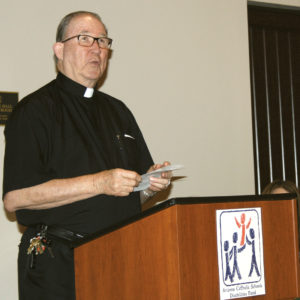
Jesuit Father Dan Sullivan, pastor of St. Francis Xavier Parish, leads the opening prayer for the ACSDF panel Oct. 2. (Photo courtesy of Lisa Fischer/ACSDF)
“Attending a Catholic high school with non-or-little accommodations was difficult but not impossible,” she said. “Always talk to your teachers and explain how you learn and what you need help with. When they understand, it works out.”
Her mother and founding board member, Betsy, is aware of the need for accessible Catholic education for children like her daughter.
“This is so huge, and schools need the money to do this,” Betsy said. “We support the schools through education and funding so they’ll say, ‘yes, we’ll take your child.’”
Colleen McCoy-Cejka, assistant superintendent of the diocesan Catholic Schools Office and president of ACSDF, said a recent $40,000 grant from the Catholic Community Foundation provided training and resources to each of the 28 elementary schools for special education.
Additionally, $13,000 of the grant will go toward scholarships for teachers who want to pursue a certificate or degree in a special education program.
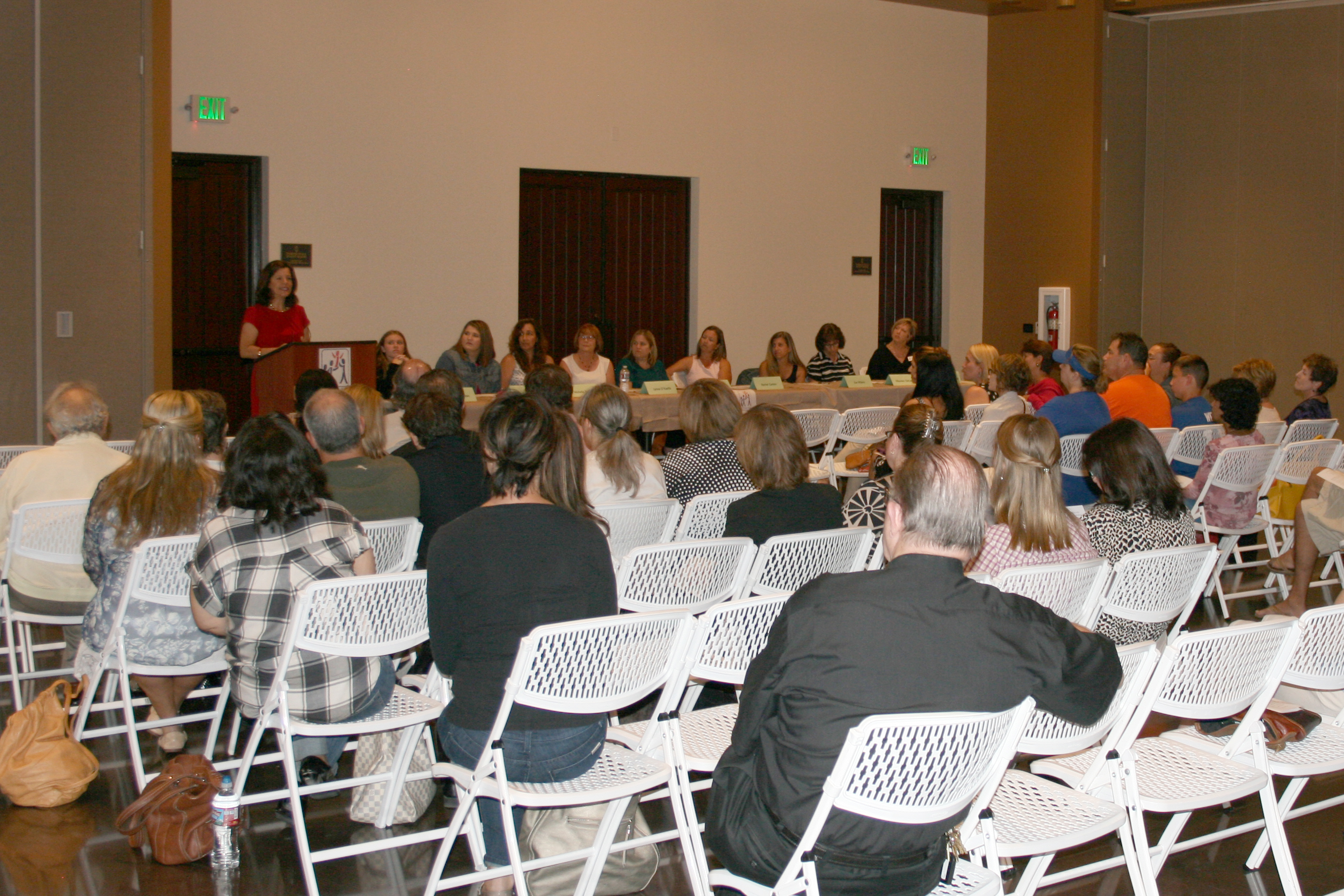
Parents, students and teachers from throughout the diocese attended the ACSDF panel Oct. 2 to learn how to address students with special needs. (Photo courtesy of Lisa Fischer/ACSDF)
“ACSDF has the potential to help schools break down the barriers that they see as prohibitive to admitting students with special needs by providing teacher training and resources,” she said. “As long as a school believes its mission is providing a Catholic education to every family and child that wants one, we want to help that school find a way to meet that Catholic mission.”
Parents need to know there isn’t a way to standardize special education in the diocese because each school is individually incorporated. Schools build their programs based on available resources, McCoy-Cejka said. “It’s a balancing act. So, some schools can admit more students because they have the support system in place while other schools are limited.”
Money is available for students with disabilities through Disabled/Displaced scholarships so that parents can afford a Catholic school tuition and any additional therapies a child might need outside of school, such as speech, occupational or physical therapy. McCoy-Cejka recommended talking to the principal, tuition or business manager or admissions person at any school to learn about scholarships a child might qualify to receive.





 Vespers: 6 p.m., Fri., Nov. 4,