
No byline, but author’s tea room menu has faith written all over it

Sherry Boas stands outside of her newest venture, Crowning Glory Tea Room, on Oct. 6, the day of a grand opening celebration. (Ambria Hammel/CATHOLIC SUN)

FOUNTAIN HILLS — Guests who venture inside the Valley’s newest tea room might find themselves in a glorious time warp.

They’ll step into an early 20th-century American tradition while subtly soaking in hints of sainthood from across the centuries. They’ll sit in one of eight rooms whose décor easily speaks of other eras and sample all four tea colors to please the present palette.

This slideshow requires JavaScript.

Guests will remain in the current day while embracing the future via the new friendships they form and trinkets — plus tea — they can purchase to take home. The glorious time warp is only natural for a place called Crowning Glory Tea Room.

“I just want them to have joy and peace and good memories of coming here and enjoying the food and the environment and just getting a glimpse of heaven,” explained Sherry Boas, owner, who created and designed the 2,200-square-foot space.
Sherry Boas serves guests during an Oct. 6 grand opening celebration. (Ambria Hammel/CATHOLIC SUN)

Boas also knows what she doesn’t want. The St. Anne parishioner, who guests will often see donning a frilly apron, serving guests and respectfully enjoying their fellowship, doesn’t want them worrying about typical tea room “norms.”

Men and children are certainly welcome; one young adult son and an 11-year-old even celebrated a birthday there. Younger children have their share of delights including a treasure hunt of sorts to see if they can spot one or two mini peg saint dolls in each room. Or perhaps collect a full passport of stamps to earn a free high tea.

Crowning Glory Tea Room

16733 E. Palisades Blvd. #101, Fountain Hills

(480) 868-4TEA (4832)
by reservation only. Sign up now for a special All Saints day party and Christmas tea.

crowningglorytearoom.com

Boas said the main comment heard in Crowning Glory Tea Room’s first five months of operation is about how beautiful and peaceful it is.

“They get chills on the outside and they have to come in,” Boas said.
(Ambria Hammel/CATHOLIC SUN)

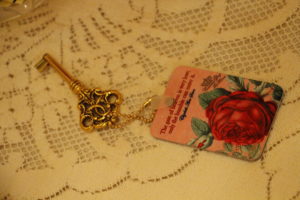
Something about its giant Marian crown, high floral adorned windows and soothing blue color attracts guests. The promise of “heavenly food” and “divine friendship” written simply on one of the doors entices guests too. Each tea room reflects a particular country or region with comfortable seating for two to four friends plus a private dining room serving eight to 10. Mary’s Garden room seats up to 30 guests. Custom-made pillows and a keychain in each room share a quote from a related saint or two.

“Each individual parlor is an individual seating room like a family room,” Boas said. “St. Thérèse is our most popular one because it’s so feminine and the most pink.”
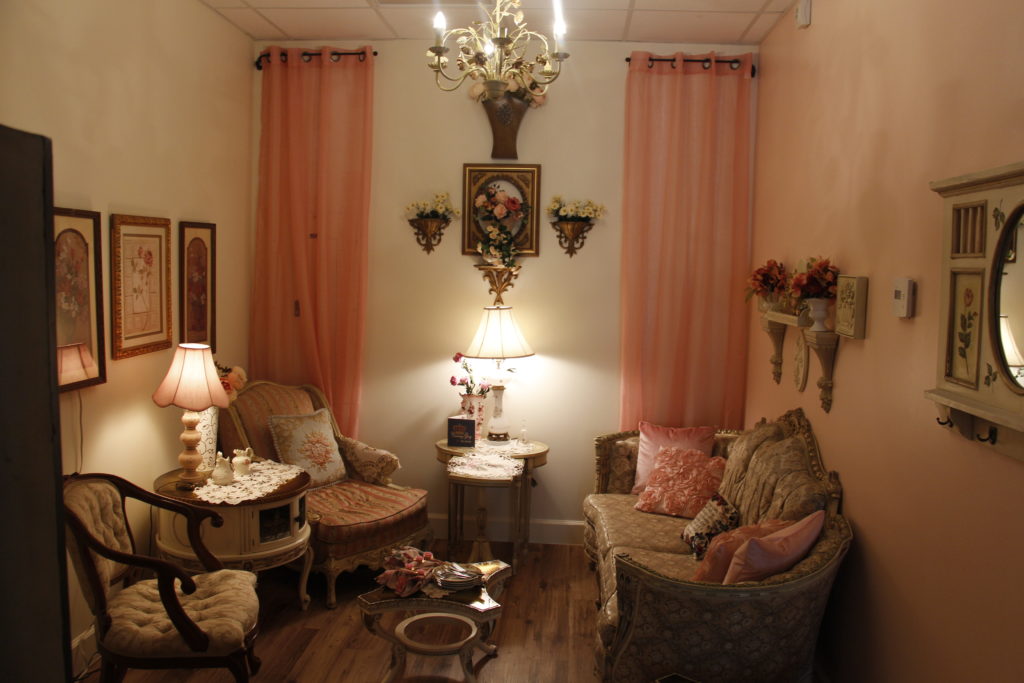
The Lisieux room subtly honors St. Therese of Lisieux via saintly and floral decor. (Ambria Hammel/CATHOLIC SUN)

The menu also speaks of the faith serving coffee named for St. Drago, patron saint of unattractive people — yes, there’s a patron for that — and 20 teas that also boldly display canonized names. Guests often compliment the creativity behind the “Faith, Hope and Chery-Tea” scone.

Crowning Glory Tea Room has given Boas a unique new showcase for her writing talent. The mother of four ages 13-20 has already authored five novels outside of a trilogy, a Rosary meditation and six years worth of CatholicMom.com articles.

“I don’t ask, but I think the majority of people have not been Catholic. They come because they like high tea,” Boas said.
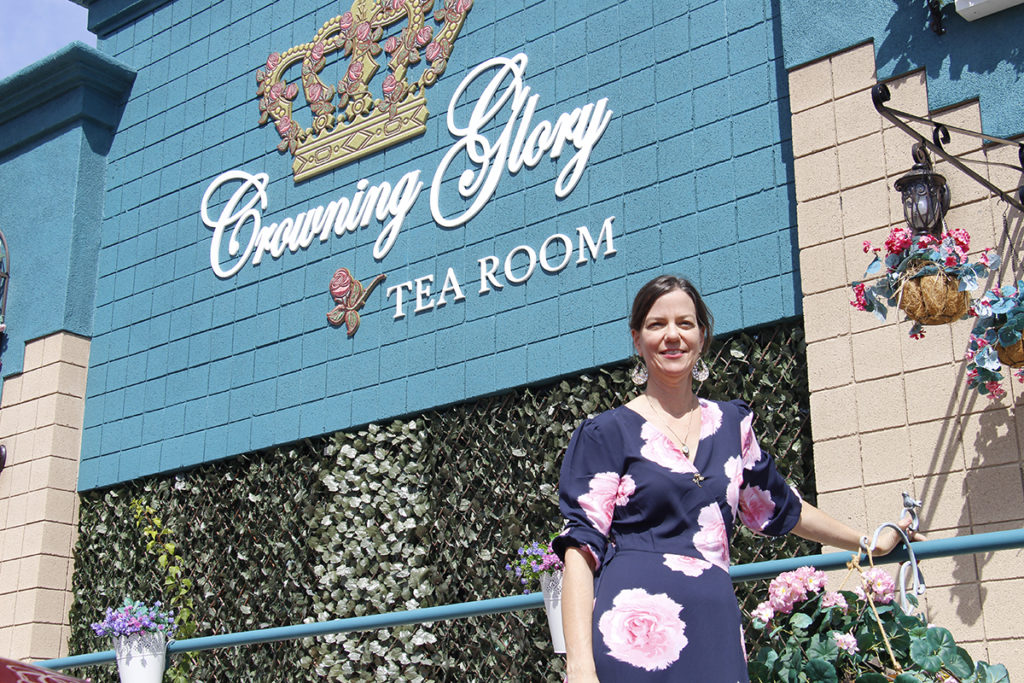
Sherry Boas stands outside of her newest venture, Crowning Glory Tea Room, on Oct. 6, the day of a grand opening celebration. (Ambria Hammel/CATHOLIC SUN)

Locals and even tea enthusiasts from Payson and Texas have visited so far with a Yelp review from two West coast states. The tea room has hosted a bridal party, Bible study and work gathering so far.

“Mostly everyone has said it’s one of the best tea rooms they’ve been to between atmosphere, food, teas and service,” said Mike Jetty, chef. “We just try to make it be a welcoming, loving, cozy place.”

Kimberlee Robinson of Fountain Hills said it’s exactly what she would have dreamed up. She was there on day one with a gift card a client managed to secure and has been back several times for tea and gifts. She likes every room with the French one standing out for its vintage and pink ambiance. Robinson also complimented the growing staff who make and wash everything by hand and tend to daily laundry.

Another guest described the tea room as transcending, saying “It calls you to be your higher self.” Boas credits the patronage of the place and each room. Employees agree saying it’s beyond tea. “We’re serving their soul in some way.”

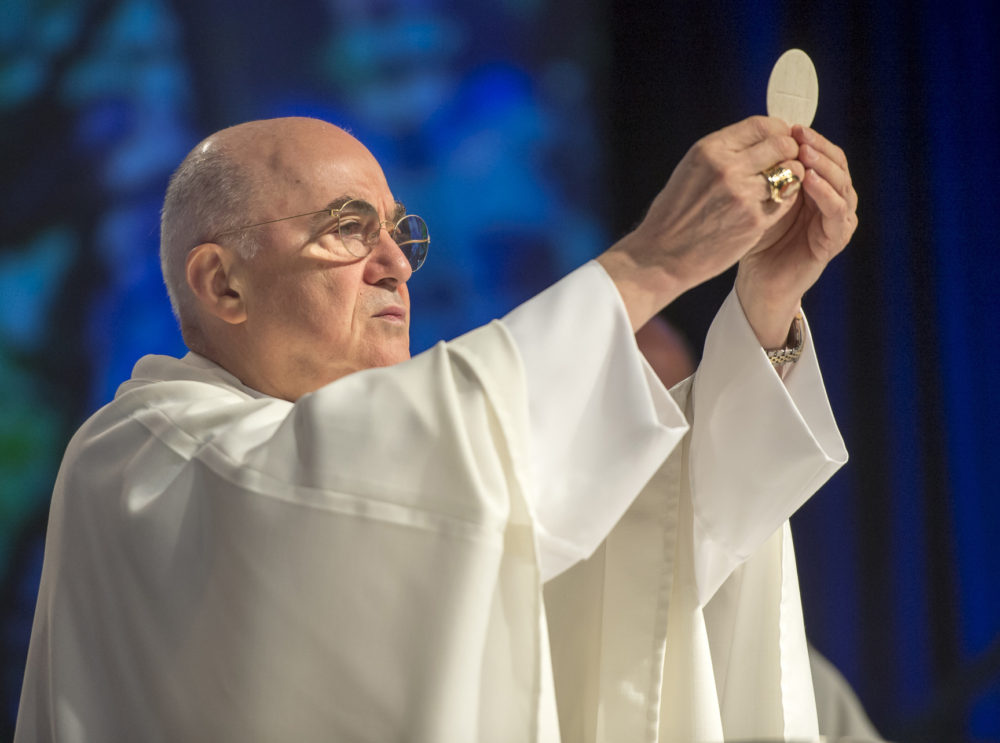
Former nuncio claims vindication after Cardinal Ouellet’s response

Archbishop Carlo Maria Viganò, former apostolic nuncio to the United States, accused Church officials, including Pope Francis, of failing to act on accusations of abuse of conscience and power by now-Archbishop Theodore E. McCarrick. Archbishop Viganò is pictured in a 2013 photo. (Bob Roller/CNS)

Junno Arocho Esteves
Catholic News Service

VATICAN CITY (CNS) — Archbishop Carlo Maria Vigano said he is convinced he was right to accuse Pope Francis and church officials of failing to act on accusations that then-Cardinal Theodore E. McCarrick engaged in sexual misconduct and sexual harassment.

Archbishop Vigano, the former nuncio to the United States, said an open letter released Oct. 7 by Cardinal Marc Ouellet confirmed many of the allegations he first made in late August, when he called on Pope Francis to resign.

Read: Archbishop Vigano’s Third Testimony

The archbishop’s response to Cardinal Ouellet was published Oct. 19 by Italian blogger Marco Tosatti.

“Cardinal Ouellet has written to rebuke me for my temerity in breaking silence and leveling such grave accusations against my brothers and superiors, but in truth his remonstrance confirms me in my decision and, even more, serves to vindicate my claims,” Archbishop Vigano said.

The archbishop had issued an open letter to Cardinal Ouellet in late September urging him to tell what he knew about now-Archbishop McCarrick. Archbishop Vigano’s letter followed a massive statement in mid-August calling on Pope Francis to resign because, he claimed, Pope Francis had known there were sanctions on Cardinal McCarrick and not only did he lift them, he allegedly made Cardinal McCarrick a trusted confidante and adviser on bishops’ appointments in the United States.

However, Cardinal Ouellet’s response said that because there were only rumors and no proof of Cardinal McCarrick’s impropriety, then-Pope Benedict XVI never imposed formal sanctions on the retired Washington prelate, which meant Pope Francis never lifted them.

Cardinal McCarrick “was strongly exhorted not to travel and not to appear in public so as not to provoke further rumors,” Cardinal Ouellet said, but “it is false to present these measures taken in his regard as ‘sanctions’ decreed by Pope Benedict XVI and annulled by Pope Francis. After re-examining the archives, I certify that there are no such documents signed by either pope.”

Archbishop Vigano’s latest letter said the measures were “not technically ‘sanctions’ but provisions, ‘conditions and restrictions.’ To quibble whether they were sanctions or provisions or something else is pure legalism. From a pastoral point of view, they are exactly the same thing.”

The former nuncio also took issue with Cardinal Ouellet’s assertion that the Vatican was aware only of rumors, saying that the “Holy See was aware of a variety of concrete facts and is in possession of documentary proof, and that the responsible persons nevertheless chose not to intervene or were prevented from doing so.”

“They are official correspondence, not gossip from the sacristy,” Archbishop Vigano wrote.

In a statement published Oct. 6, the Vatican said the pope had ordered a “thorough study of the entire documentation present in the archives of the dicasteries and offices of the Holy See regarding the former Cardinal McCarrick in order to ascertain all the relevant facts, to place them in their historical context and to evaluate them objectively.”

The Vatican also acknowledged “that, from the examination of the facts and of the circumstances, it may emerge that choices were taken that would not be consonant with a contemporary approach to such issues.”

Archbishop Vigano also restated his belief that the homosexuality is at the root of the sexual abuse crisis in the church that has “become a plague in the clergy, and it can only be eradicated with spiritual weapons.”

Xavier teacher carves corpus of Christ

Nathan Ward (courtesy photo)
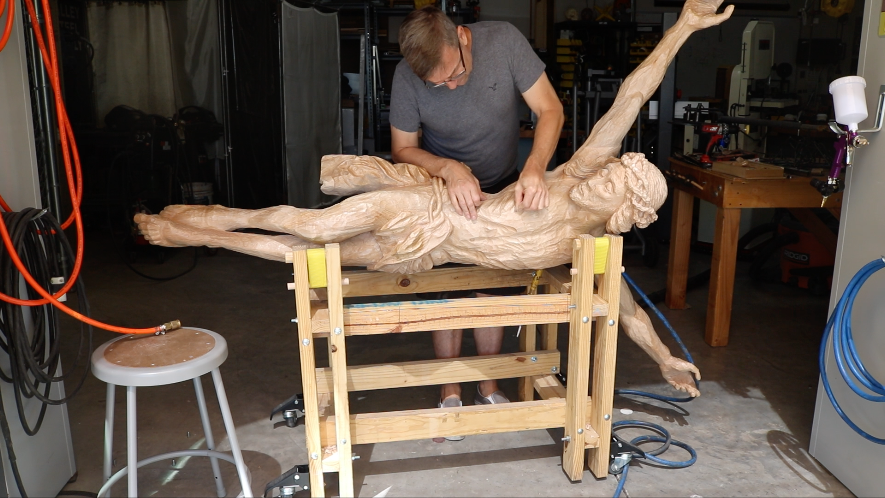
Nathan Ward inspects a nearly finished corpus of Christ that he hand carved over three years, despite having no prior experience in the medium. (courtesy photo)

As Xavier College Preparatory students hit mid semester, they have no excuse for not trying new things that might be outside their comfort zone. Art teacher Nathan Ward has been in their shoes.

He spent three years chiseling away wood that finally revealed a new corpus for the crucifix in the Chapel of Our Lady at Xavier. He completed it in June and installed before students returned to campus in August. It joins the other carved pieces of the altar and ambo and completes the chapel’s interior.

“There are so many anecdotes from my time working on this piece,” Ward said about his soft maple corpus. “I wasn’t sure how I would accomplish it. I eventually asked Jesus to guide my hands and they became his power tools for the carving.”

Never having carved a sculpture with mallet and chisel, Ward worried about using hand tools while mastering the technique on the carving. “The only time I got cut, I was carving the crown of thorns.”

His greatest challenge was carving the drooping head with all the technical aspects involved in that portion of the corpus. The most rewarding aspect was the moment he figured out how to carve the loin cloth. “There was a palpable ‘Aha’ moment when I could visualize the folds of the cloth in the wood and understood how to make it a realistic representation of the soft, pliable material of cloth in the hard, stable material of wood.”

Ward hadn’t contemplated the corpus of Christ on the cross so much since a Xavier pilgrimage to Lourdes a few years ago. “While there, I was struck by the life size crucifixes and got a lump in my throat when I saw them. I got the same lump in my throat when I saw the corpus installed in the Xavier chapel,” Ward said. “I do believe that after this project, no one knows Jesus better than I do.”

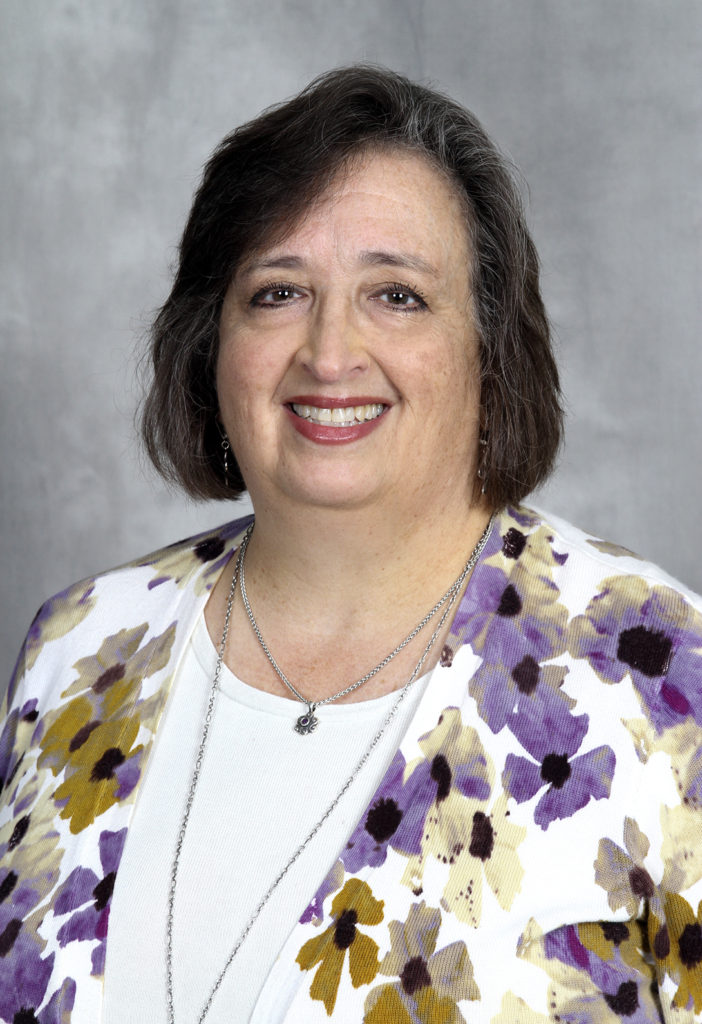
Mary Anne Castranio recalled for devotion to faith, Catholic journalism

Mary Anne Castranio, executive editor of The Georgia Bulletin and vice president of the Catholic Press Association, died early Oct. 12. She had been in Washington attending a two-day meeting of the CPA-CNS Liaison Committee and was admitted to the hospital Oct. 11. She is pictured in a 2017 photo. (Michael Alexander/CNS, via GEORGIA BULLETIN) See ADVISORY-CASTRANIO Oct. 12, 2018.

By Andrew Nelson
Catholic News Service

Mary Anne Castranio, executive editor of The Georgia Bulletin and vice president of the Catholic Press Association, died early Oct. 12. She had been in Washington attending a two-day meeting of the CPA-CNS Liaison Committee and was admitted to the hospital Oct. 11. She is pictured in a 2017 photo. (Michael Alexander/CNS, via GEORGIA BULLETIN)

CONTRIBUTIONS IN CASTRANIO’S MEMORY CAN BE MADE TO OUR LADY OF PERPETUAL HELP HOME IN ATLANTA.

ATLANTA (CNS) — One of Mary Anne Castranio’s biggest joys came only after facing her fears.

Castranio hated to fly but still boarded an airplane for a life-altering trip in June 1998. Then in her early 40s, she traveled to China to be united with her daughter, Amy, whom she adopted.

Marking the 20th anniversary of the adoption this year, she wrote on her Facebook account, “The very best, most wonderful baby girl became my daughter. The joy continues on.”

From that experience, she fostered tight-knit friendships with families with children adopted from China.

“Mary Anne was the kindest of souls. She never met a stranger. She was very loving. Her faith for God always shone through in everything she did. Amy was the light of her life,” said Karen Campbell, a longtime friend who also adopted her daughter from China.

Castranio, executive editor of The Georgia Bulletin, newspaper of the Archdiocese of Atlanta, died Oct. 12. She was 61.

She had traveled to Washington for a meeting with Catholic Press Association and Catholic News Service colleagues when she collapsed.

Castranio joined the archdiocesan newspaper as executive editor in August 2003. She was a well-respected colleague and friend, contributing to conversations surrounding Catholic publications on a national level by being elected to the CPA board and serving as vice president and Southern regional representative.

Atlanta Archbishop Wilton D. Gregory said Castranio willingly placed her communication skills at the service of the archdiocese.

“She always presented the Church’s teachings and principles with integrity and honesty,” he said. “That type of integrity gained her many fans and widespread respect. Her colleagues at the archdiocese will miss her cheerful demeanor and enthusiasm.”

Born at Camp Lejeune, North Carolina, Feb. 21, 1957, she was mostly raised in Cary, North Carolina, the oldest of four children of Patricia and John Castranio.

Castranio earned a bachelor’s degree in English and music education from the University of North Carolina at Chapel Hill and received a master’s degree in secondary English education from Georgia State University.

Later, Castranio studied for a master’s degree in technical communication from Southern College of Technology in Marietta, Georgia, now part of Kennesaw State University. She worked as a senior technical writer at IBM and MAPICS Inc., and spent two years at the Centers for Disease Control and Prevention editing articles for a scholarly medical journal before joining The Georgia Bulletin.

From the adoption community to the parish music ministry, Castranio lived a life of doing for others.

“She was never too busy to do what people asked her to,” said Mercy Sister Carolyn Oberkirch. The women knew each other starting in the 1980s at Our Lady of the Assumption Church in Atlanta and kept in touch when Sr. Carolyn moved to Mobile, Alabama. “She had a lot of giving to share. She was a very loving, loving person.”

Castranio was devoted to her daughter and joined Families With Children From China Atlanta for support and a desire to root her daughter in Chinese culture. “Amy was her life. There’s nobody who ever doubts that,” said Roxanne Lau, a onetime leader of the group.

She led the archdiocesan newspaper through changes in the media landscape and the social media boom as the newspaper staff earned awards from the CPA.

The Georgia Bulletin allowed her talents in writing and editing and a deep faith to intersect.

At the newspaper, she found “a unified vocation that was very genuine and deep,” said Gretchen Keiser, who worked with Castranio as the publication’s editor for 14 years. “Her accomplishments both in the Atlanta Archdiocese and beyond blossomed at every turn with the help of the Holy Spirit.”

Castranio’s faith and her love of the news took her to a leadership role with the CPA.

Her peers knew she was “committed to the craft,” said Joe Towalski, CPA president, who is communications director of the Diocese of St. Cloud, Minnesota, and editor of the diocesan newspaper, The Visitor.

“She was a journalist who always did things the right way. She tried to shed more light than fire with the coverage she did,” he said.

Greg Erlandson, director and editor-in-chief of CNS, first worked with Castranio when they were temporarily filling in for others on the CPA board. He said she understood the value of the Catholic press and the role it plays in communicating the substance and the relevance of the Church to readers.

“In her service on the CPA-CNS Liaison Committee, she was both funny and insightful, direct in her comments and supportive in her actions,” he said.

“I don’t think I was ever in a meeting when she didn’t mention at least once the powerful witness of Eucharistic Adoration in the archdiocese,” Erlandson added. “The Catholic press is in mourning, for we have all lost a great journalistic leader and a great friend.”

Castranio is survived by her daughter, Amy, of Kennesaw; her brother, John Francis Castranio and his wife, Judee, of Cary, North Carolina; her sister, Connie Mooney and her husband, Michael, of Raleigh, North Carolina; her brother, David Castranio and his wife, Lisa, of Cary, North Carolina; and nieces and nephews.

The family was to have a private burial. A memorial Mass for friends and colleagues will be celebrated on Nov. 3, at St. Joseph Church in Marietta, Georgia.


Andrew Nelson is a staff reporter at THE GEORGIA BULLETIN, newspaper of the Archdiocese of Atlanta.

Diocese follows guidelines to ensure dying live their faith in their final days

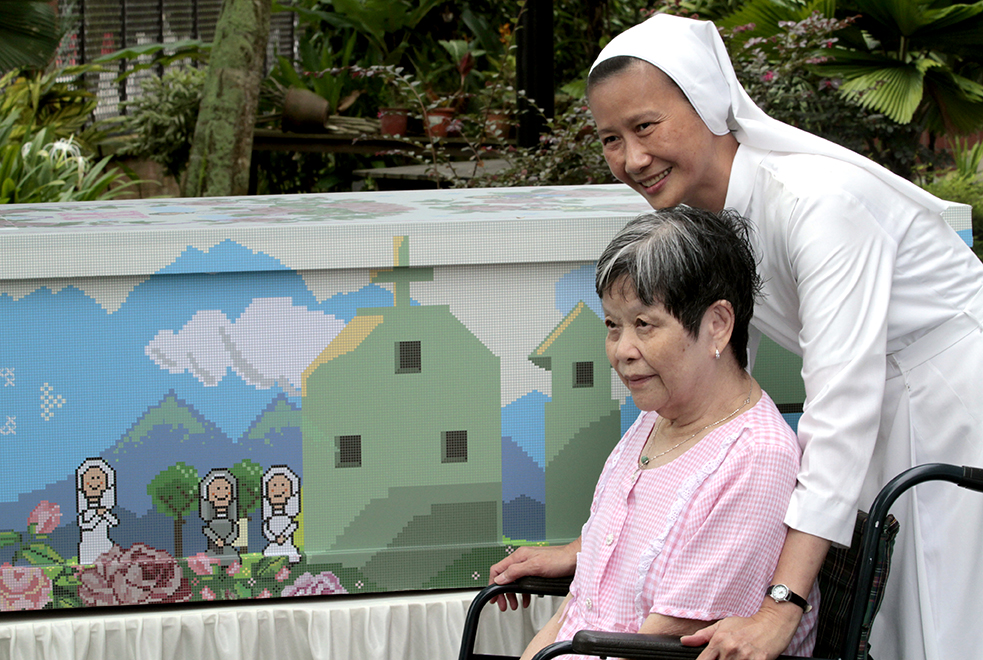
Canossian Sister Geraldine Tan, administrator of St. Joseph's Home and Hospice, smiles as she pushes a patient in her wheelchair in 2010 outside the facility in Singapore. People who are dying must be accompanied with the love of family members and the care of medical professionals, Pope Francis said. (Stephen Morrison/CNS, via EPA) See POPE-EUTHANASIA-HEALTH-CARE Nov. 16, 2017.
Canossian Sister Geraldine Tan, administrator of St. Joseph’s Home and Hospice, smiles as she pushes a patient in her wheelchair in 2010 outside the facility in Singapore. People who are dying must be accompanied with the love of family members and the care of medical professionals, Pope Francis said. (Stephen Morrison/CNS, via EPA) See POPE-EUTHANASIA-HEALTH-CARE Nov. 16, 2017.
Office of Medical Ethics

The Medical Ethics Board was instituted to assist the bishop through providing clinical insights and theological perspectives for understanding complex medical ethics questions.

CONTACT

MORE INFORMATION

USCCB ETHICAL AND RELIGIOUS DIRECTIVES

When Carol Pavlak’s 90-year-old father was nearing his final weeks of life, she knew just where she wanted to turn for the last days he would spend on earth.

“I felt he would be in good hands with a Catholic hospice, knowing if they practiced my faith they would not just feed him drugs and let him go but treat him with dignity,” the 66-year-old Pavlak explained.

But a place that would fill both Carol and her father’s wishes meant meeting specific needs, and that narrowed the choices to essentially one, although that hospice did receive the blessing of Bishop Thomas J. Olmsted to open a second entity in 2017.

A year prior, the bishop instituted a diocesan Medical Ethics Board with Fr. Ignatius Mazanowski, FHS, as director. The goal was to provide “clinical insights and theological perspectives for understanding complex medical ethics questions.” In addition to making recommendations to the bishop on medical-ethics issues that may arise, the board assists in developing relationships with health care institutions within the Diocese of Phoenix; not the least of which are hospices.

Fr. Ignatius said his office is eager to help those institutions fulfill the Church’s guiding principles on respecting life in all services, including hospice, and would help any that requested such guidance.

“That is one of the big reasons I have been given the role of director of medical ethics,” Fr. Ignatius stated in an email, adding that he is always available to consult on end-of-life or other ethical issues.

“I’ll be happy to help you understand and come to a clear perspective on the Catholic Church’s teachings,” Fr. Ignatius said. “I also am available to help guide a secular hospice through the process of becoming a Catholic hospice recognized by the Diocese of Phoenix.”

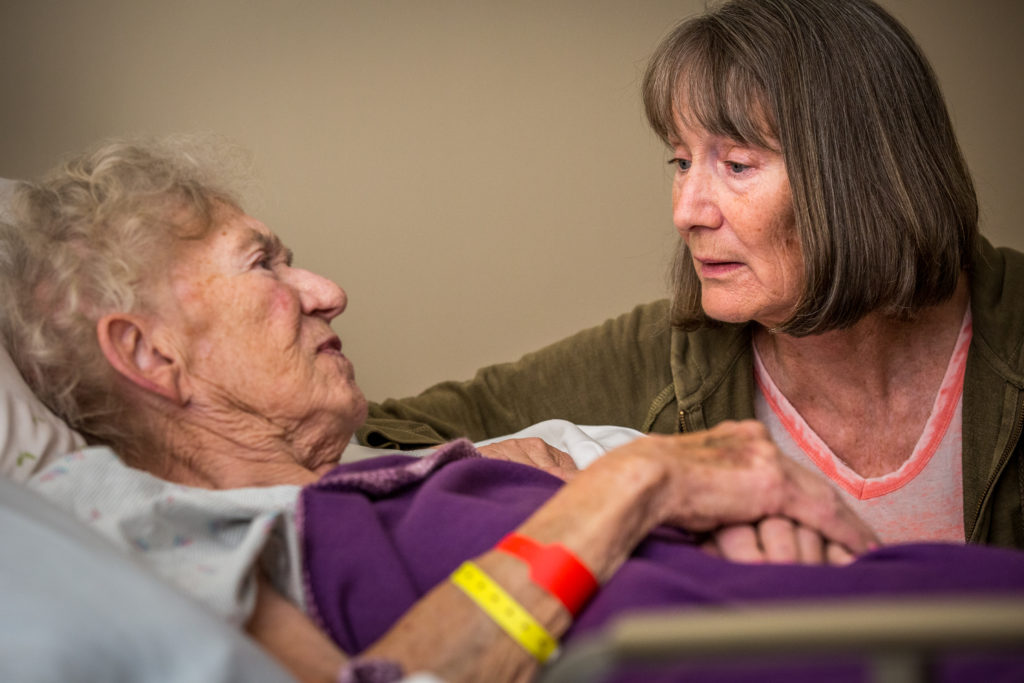
A woman sits at the bedside of her mother in 2016 at de Greeff Hospice house in St. Louis. This special house, the only one of its kind in St. Louis, serves terminally ill individuals. (Lisa Johnston/CNS, via ST. LOUIS REVIEW)

The requirements for diocesan approval are rigorous. But they have to be in order to put the diocese’s and the Church’s name behind a service that is very personal and must allow a Catholic the ability to live by his or her faith.

“Of the 77 Ethical and Religious Directives for Catholic Health Care Services, about a dozen (Directives 55 through 66) apply more directly to care for the seriously ill and dying,” he said. “The principles laid out in the ERDs protect the dignity and sanctity of life, and they guide us in applying Catholic moral and ethical principles to important decisions that Catholics face at the end of life.”

Specifically, the Catholic Church has a clear perspective on when to withdraw hydration and nutrition, how much pain medicine can be prescribed at the end of life, when or if artificial means of life support can be withdrawn, when organ donation is allowed and the reasons why euthanasia is not allowed.

“A Catholic hospice is committed to following these principles,” Fr. Ignatius stated, adding that secular hospices aren’t guaranteed to follow these principles.

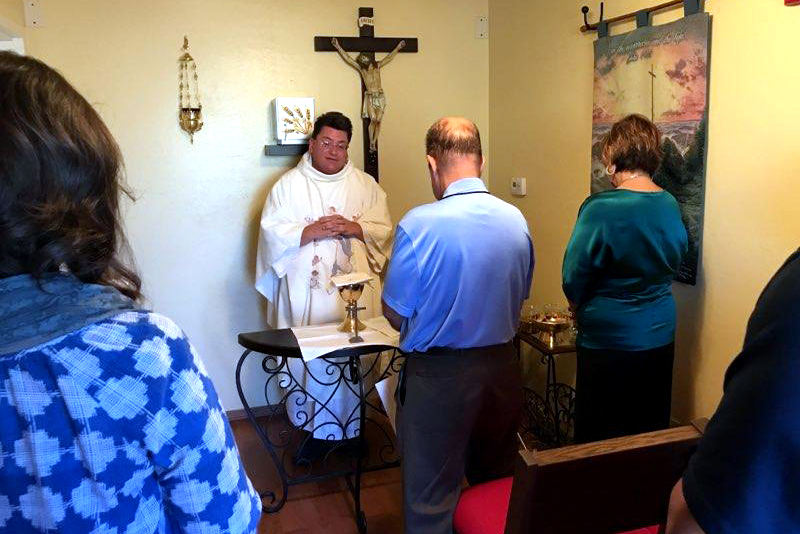
Fr. Michael Accinni-Reinhardt, chaplain for Americare Hospice and Palliative Care, dedicates the St. Mother Teresa Chapel Sept. 6. (Courtesy of Americare Hospice and Palliative Care)

Inside a hospice

At present, the diocese has only one recognized hospice.

Mesa-based Americare Hospice and Palliative Care has operated 14 years and serves all of Maricopa County as well as areas slightly beyond county borders. Its second entity, Holy Cross Hospice, opened last year.

Both operate “according to our faith; our beliefs as Catholics,” said Americare founder and Administrator Christine Minch.

“We never do anything to hasten the deaths of our participants,” added Bobi Martinez, Americare’s Catholic Mission Coordinator and a certified grief recovery specialist.

IV hydration, antibiotics, treatment of infections, laboratory testing, X-rays, a wound-care nurse, physical therapy, nutritional supplements and speech therapy for swallowing assistance are examples.

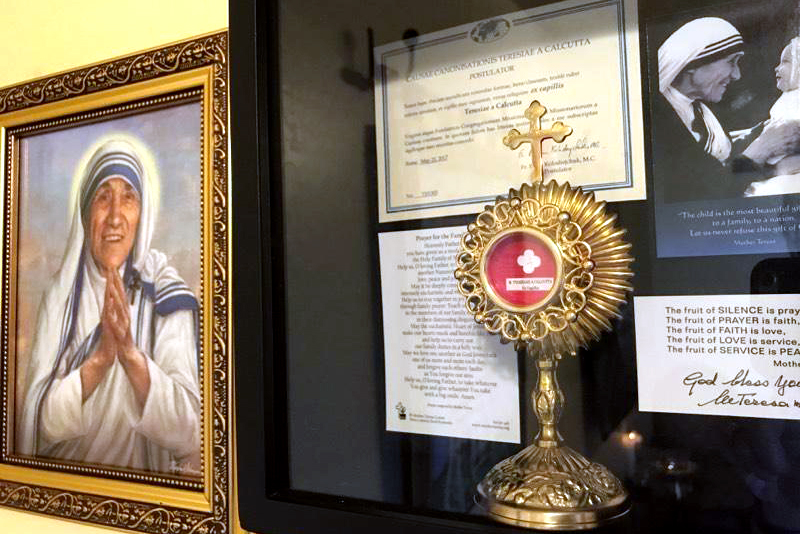
A painting and relics of St. Mother Teresa of Calcutta are found at St. Mother Theresa Chapel at Americare Hospice and Palliative Care Sept. 6. (Courtesy of Americare Hospice and Palliative Care)

“We do take patients with feeding tubes. There are many (hospices) that would not admit those patients, but [here] …, it would be considered vital care. We truly see our mission as taking every patient individually until God decides to call them home,” Minch said.

Although most patients are cared for at home, or in a skilled-nursing or assisted-living facility, the company also recently remodeled its inpatient unit to add the presence of the Blessed Sacrament to its St. Mother Teresa Chapel, a small, eight-person room with kneelers, a mural and a relic.

Pavlak said the services, including the chapel, allowed her father to die with dignity while the family observed its Catholic faith, even members who don’t regularly practice.

My father was ready to go, and he let us know. This was a dignified death; peaceful — the way anyone would want to go,” she said.

Feast of St. Luke the Evangelist

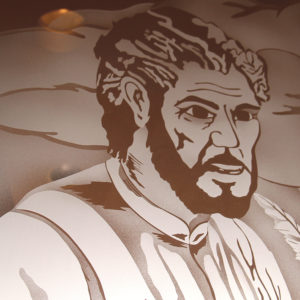
This frosted image of St. Luke greets parishioners at his namesake church in Phoenix as they approach the worship space and in the foyer as they leave. (Ambria Hammel/CATHOLIC SUN)
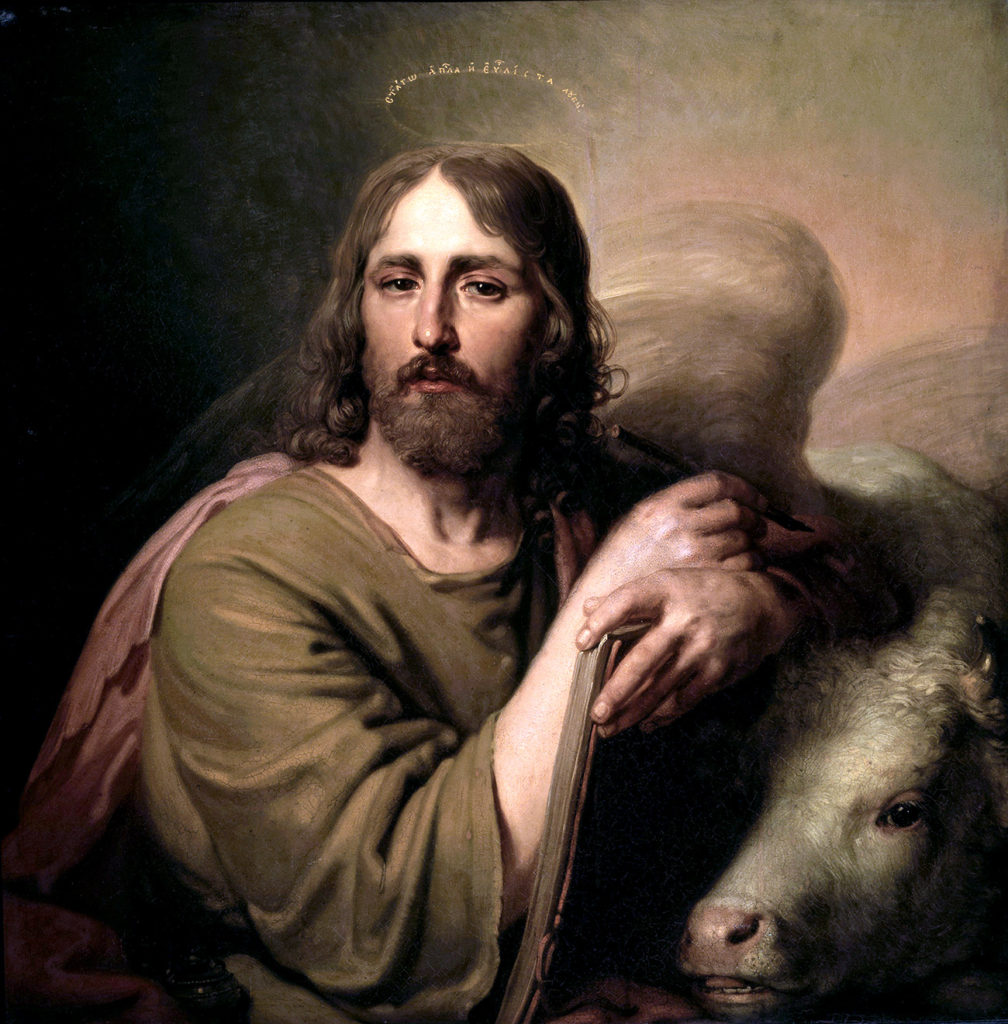
“St Luke the Evangelist Icon,” painted by Vladimir Lukich Borovikovsky (1757-1825)
a Russian painter of Ukrainian origin who dominated portraiture in Russia at the turn of the 19th century. The painting is located at the royal gates of the central iconostasis of the Kazan Cathedral in St. Petersburgh. (Public Domain/WIKIMEDIA COMMONS)

Oct. 18

This frosted image of St. Luke greets parishioners at his namesake church in Phoenix as they approach the worship space and in the foyer as they leave. (Ambria Hammel/CATHOLIC SUN)

Early historians said this author of the third Gospel and the Acts of the Apostles was born to a pagan family in Antioch (Turkey) and converted to Christianity.

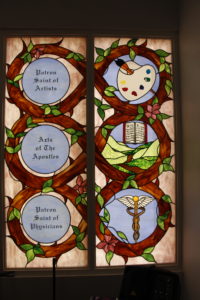
Parishioners at St. Luke in Phoenix will never forget the patronage of the third Gospel writer, who also authored the Book of Acts. It’s clearly depicted in a window behind the choir area. (Ambria Hammel/CATHOLIC SUN)

According to Paul’s letters and Acts, he was a doctor and Paul’s companion during his later journeys and imprisonment in Rome. Luke’s New Testament writings in Greek were for Gentiles, extending to them the salvation promised to Israel.

He is the patron of physicians and surgeons and, because of a legend that he painted a Marian icon, of painters.

He is also the patron of St. Luke Parish in Phoenix and of the Catholic Physicians Guild of Phoenix. The annual White Mass for healthcare professionals, scheduled for Oct. 20 this year at the Diocesan Pastoral Center, is celebrated on a Saturday near his feast day.

Young people called to embrace cross, become saints, say USCCB pres, VP at synod

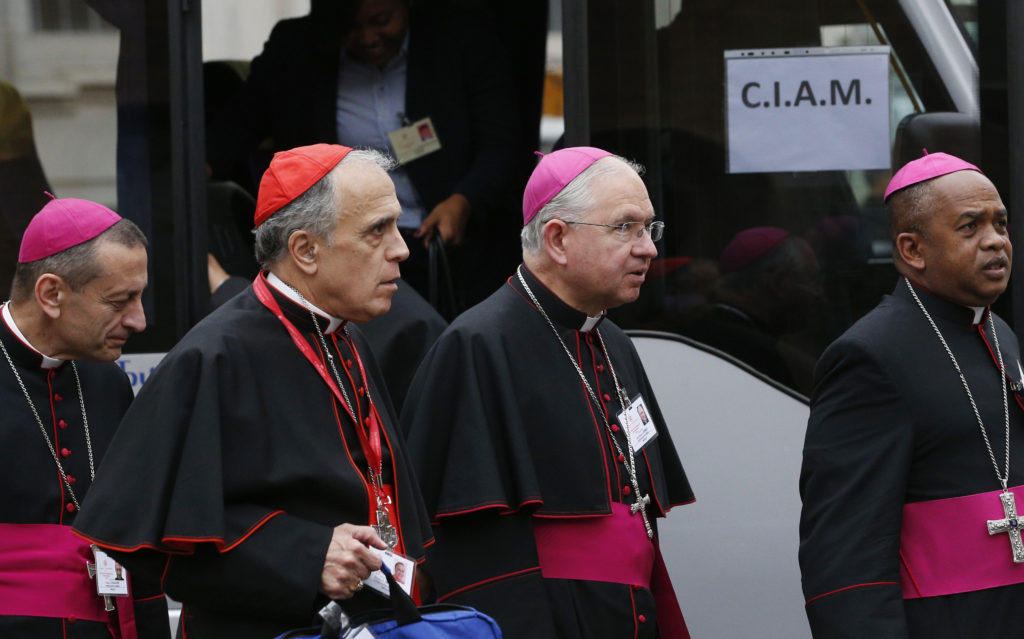
Cardinal Daniel N. DiNardo of Galveston-Houston, president of the U.S. Conference of Catholic Bishops, (second from left), and Archbishop Jose H. Gomez of Los Angeles, vice president of the conference (third from left), arrive for a session of the Synod of Bishops on young people, the faith and vocational discernment at the Vatican Oct 5. (Paul Haring/CNS) See SYNOD-YOUNG-SANTIAGO, SYNOD-BARRON-ONAH and SYNOD-BRIEFING Oct. 5, 2018.
Cardinal Daniel N. DiNardo of Galveston-Houston, president of the U.S. Conference of Catholic Bishops, (second from left), and Archbishop Jose H. Gomez of Los Angeles, vice president of the conference (third from left), arrive for a session of the Synod of Bishops on young people, the faith and vocational discernment at the Vatican Oct 5. (Paul Haring/CNS)

By Cindy Wooden and Anne Condodina
Catholic News Service

VATICAN CITY (CNS) — Cardinal Daniel N. DiNardo of Galveston-Houston, president of the U.S. Conference of Catholic Bishops, used his episcopal motto — “Hail O cross, our only hope” — as the title of his speech to the Synod of Bishops on young people, the faith and vocational discernment.

“The central event for our faith and life is recognizing, interpreting and choosing the invitation to embrace the cross,” he told his fellow bishops Oct. 16.

As the Catholic Church and its members strengthen their commitment to reaching out to young people, helping them “by dialogue to discern their way in the world and the Church for a deeper, more human life,” they cannot ignore the cross, the cardinal said.

“Jesus asks everyone He meets to ‘Follow me,’” he said. “His invitation is strong, not weak; decisive, not anemic.”

As members of the synod discussed the assembly’s working document, making suggestions for how sections should be amended or altered for the gathering’s final document, Cardinal DiNardo said the cross and the meaning of Christ crucified were the key missing pieces.

Promoting youth ministry focused on encouraging a “growth process, a gradual maturing in faith,” has advantages, he said, but it can lead to a situation where “major spiritual themes might be diminished.”

Cardinal DiNardo noted how throughout the Gospels Jesus gradually reveals Himself “as He beckons the Twelve, the crowds and us to the cross, to a crucified Messiah.”

“Jesus evangelizes through His identity as the crucified Lord,” the cardinal said. “It is impossible not to see this throughout the Gospels.”

Cardinal DiNardo told synod members they should not hesitate to present the truth of faith to young people because they “are not fearful. They are willing for a sustained challenge to claim their identity.”

A “vague” call will not attract anyone, the cardinal said. The synod’s final document must “issue a call like Jesus’ call. It must witness to the cross.”

To “capture the imagination” of young people and inspire them, Church leaders should offer them the example of modern saints and call young people to be “everyday saints, each in his or her own way,” said Archbishop José H. Gómez of Los Angeles, USCCB vice president, in his speech to the Synod of Bishops earlier in the day.

“We need to show young people what holiness looks like by living the Gospel we preach, proclaiming Jesus Christ by the way we live. We need to call young people to be saints — and we need to be saints ourselves,” Archbishop Gómez said.

The “urgent priority of all our resolutions from this synod,” he said, should be to proclaim Jesus Christ and to call young people to conversion and new life in Christ.

Western societies, Archbishop Gómez said, offer young people “alternatives for self-creation rooted in the restless consumption of material comforts” instead of calling them “to goodness or beauty or truth.”

“Young people today do not know how to live authentic human lives because the adults of our secular society have not shown them the way,” he said.

However, he said he is confident the Church holds the answer that young people are looking for.

Reach out to the young people and “proclaim the Gospel as God’s beautiful plan of love for our lives,” he urged his brother bishops. By doing this, the dignity and destiny of the human person is revealed.

“God is calling young people to live their lives as a mission, following in the footsteps of Jesus Christ and walking in the company of others who have met Him and made Him the ‘way’ for their lives,” Archbishop Gómez said.

Church leaders, he said, have a mission, which “requires that we model for young people how to pray as a conversation with God and how to contemplate the face of Christ in the pages of the Gospel.”

It also requires “boldly proclaiming and confidently living” the teachings of Christ and helping young people perform the works of mercy, engaging in service to the poor.

“Young people today demand and deserve what every human heart is longing for — the encounter with Jesus Christ,” the archbishop said.

Actress says film captured St. Romero’s humanity, inner struggle, courage

By Denis Grasska
Catholic News Service

More information on the re-release of “Romero.”

SAN DIEGO (CNS) — Over the years, Ana Alicia has seen her past television and film work rebroadcast, introducing the actress to new generations of fans.

But something feels different this time.

The 1989 film “Romero,” based on the life of martyred archbishop St. Oscar Romero, has been remastered and released on DVD and digital-downloading in a special collector’s edition.

“I’m proud of my work in the shows that I’ve done,” said Alicia, who starred on the prime-time 1980s soap opera “Falcon Crest.”

“But this particular project is happening at a time when this man is being recognized by his Church for what he did,” she said in a telephone interview with The Southern Cross, newspaper of the Diocese of San Diego.

Ana Alicia played Arista Zelada, a fictional upper-class friend of Archbishop Romero’s. (Courtesy of Paulist Productions)

The film stars the late Raúl Juliá as Archbishop Romero, who was canonized by Pope Francis Oct. 14 at the Vatican. When appointed archbishop of San Salvador in 1977, he was initially believed to be apolitical. But he soon became a vocal critic of El Salvador’s repressive right-wing government and ultimately paid for his outspokenness with his life. He was assassinated while celebrating Mass March 24, 1980.

“Romero” was the first feature film produced by Paulist Pictures, a production company founded by Paulist Father Ellwood “Bud” Kieser.

When Alicia was offered the role of Arista Zelada, an upper-class friend of the archbishop, she said she may have known the prelate’s name but little else about him. At the time, she was focused on her career and her family and not so much on “what was going on in the world.”

Asked whether she or anyone else associated with the production of “Romero” ever envisioned that they would see the film’s protagonist declared a saint only two decades later, she admitted: “I don’t think that was in any of our thinking.”

It was the opportunity to work with an actor of Juliá’s stature that initially attracted her to the project, and she was “pleasantly surprised” to discover that, in addition to being a talented actor, he also was “a genuine human being.”

“He just gave me so much dignity and respect, and he took his depiction of Romero very seriously,” she told The Southern Cross about a week before the Romero canonization. “He was a complete professional.”

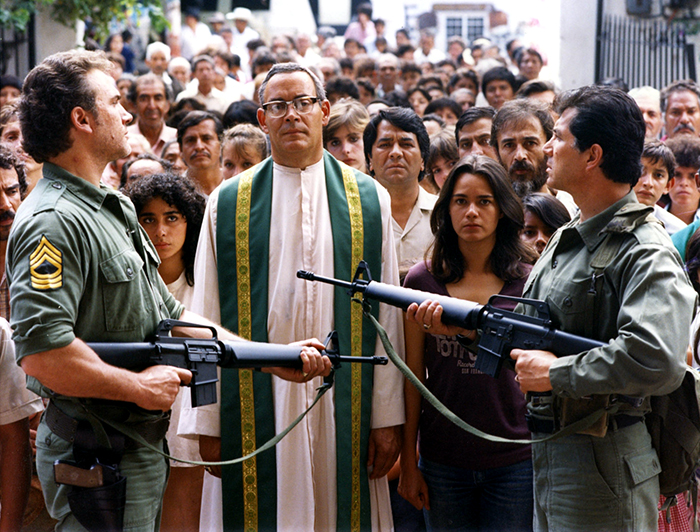
Raúl Júlia depicted St. Oscar Romero, the martyred archbishop of San Salvador, in the 1989 biopic “Romero.” (Courtesy of Paulist Productions)

A review by Catholic News Service called the film a “powerful dramatization of the last three years in the life of Archbishop Romero. “Director John Duigan gets a brilliant performance from Raúl Juliá, who invests the title role with an intense spiritual dimension that makes credible Romero’s courage in condemning the immorality of a ruthless regime,” it said.

In filming “Romero” Juliá told CNS in an interview at the time that seeing how the Church worked with the poor changed his attitude toward the Church and he began to go to Sunday Mass again.

Before making the movie, he said, “I had mostly negative feelings about the Church” and thought it “did not contribute to people’s experience.” But in talking with a U.S.-born Jesuit priest working with the poor in Mexico, Juliá said, “I was sharing my experiences and he shared his and it turned into a wonderful confession.’’

In this still from the 1989 biopic “Romero,” Raúl Júlia portrays St. Oscar Romero in the final moments of his life. (Courtesy of Paulist Productions)

Juliá died in 1994 from complications of a stroke at a hospital on Long Island, New York.

Alicia recalled that, in his determination to give the best performance possible, Juliá was “always questioning himself.” She said this made him “perfect for the role” of Archbishop Romero, a deeply human figure who experienced a lot of “inner turmoil” and “uncertainty” about whether to speak out against the Salvadoran government.

“I think many people don’t see themselves as capable, because they have fear and because they have doubt,” she said. “But if you look at Romero or you look at any of our great teachers or spiritual leaders in the world, there’s doubt, and self-reflection and a lot of angst in their journey. It’s not the type of hero that we see in a Superman.”

Describing today’s world as a “very fragmented” place, Alicia said one aspect of Archbishop Romero’s story that resonates with her is the fact that it “wasn’t about being left or right” with him; he stood up for human rights, regardless of which political ideology was violating them.

In the film, Archbishop Romero is shown pressuring the government to end its repression, but also attempting to negotiate the release of government officials who had been abducted and held hostage by rebels.

“I think that it is a film about a man, a simple man, who cared about his fellow brothers and sisters and struggled as to what was the right thing to do,” she said. “Once he found it in his heart, he stood up, and it didn’t matter who he was standing up against.”


Denis Grasska is assistant editor of THE SOUTHERN CROSS, newspaper of the Diocese of San Diego.

Church’s canon law experts convene in Phoenix

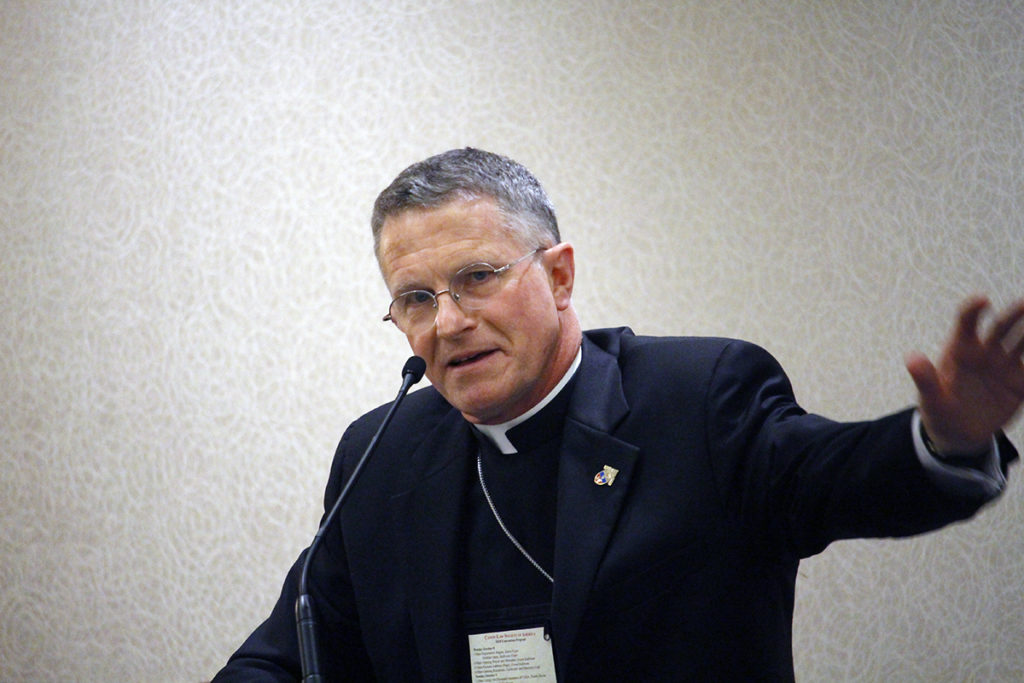
Archbishop Timothy P. Broglio of the Archdiocese for the Military Services, USA gives a keynote address during the 80th annual convention held by the Canon Law Society of America. It was held Oct. 8-11 in Phoenix with locals also giving talks. (Ambria Hammel/CATHOLIC SUN)

Some 360 Church leaders who can confidently not just pronounce a slew of thorough Latin-titled documents, but cite them left and right, converged in Phoenix Oct. 8-11.
There were laity, sisters, priests — also monsignors, bishops and archbishops — among them. All have a hand in Church law. They hailed from a good 45 U.S. states plus its law-making city, five countries and, of course, Vatican City, to reflect on and further embrace the convention theme of “Canonical Equity: In Practice with a Vision for the Future.”

The convention marked the 80th annual gathering of Canon Law Society of America members. The professional association is open to those who want to collaborate in the Church’s pastoral ministry as it pertains to its legal and canonical structures.

Members might spend their days overseeing marriage cases, considering a response to Church scandal, applying RCIA norms, discerning sacramental ministry for those with disabilities and more. The Church has also seen new institutes of consecrated life emerge in recent decades. Canon law experts in each diocese are familiar with the Code of Canon Law that provides norms about them, particularly regarding their foundation.

The nation’s canon experts even heard from those in the Diocese of Phoenix Tribunal. Representatives spoke formally and as a panel during one of 15 breakout seminars. They shared insights from their experience in serving Spanish-speaking people in matters pertaining to marriage nullity. About 60 people were expected to attend the seminar.


Fr. Ernesto Reynoso made it his goal as adjutant judicial vicar to “explain the challenges that cultural tribunals might have in ministering to Spanish-speaking persons.” Fr. Reynoso and others on the panel also spoke about the opportunities that come with having a fully functional and Spanish-friendly tribunal.

“We hope we have something to offer. We hope we can learn from them too,” Nicole Delaney, director of the tribunal, said a day before the seminar. Many U.S. dioceses “are and soon will engage with” the Spanish-speaking population with greater frequency, according to convention material.

Early into the convention, Delaney found the other seminars and keynote speakers “extremely relevant and timely.” One keynote talk examined canon law in relation to equity, economy and reasonableness. Another addressed employing equity, or standing in the breach, and a third looked at equity from the minister’s and community’s perspective.

Upwards of 90 people attended a seminar that examined the idea of a bishop as legislator.

Archbishop Timothy P. Broglio of the Archdiocese for the Military Services, USA gives a keynote address during the 80th annual convention held by the Canon Law Society of America. It was held Oct. 8-11 in Phoenix with locals also giving talks. (Ambria Hammel/CATHOLIC SUN)

“For many priests canon law is a delayed love affair,” Archbishop Timothy P. Broglio of the Archdiocese for the Military Services, USA, began. His extensive bio includes a doctorate in canon law from the Pontifical Gregorian University in Rome and appointments in the Ivory Coast, Central America and Puerto Rico. Archbishop Broglio has tended to legal stuff as a bishop since his November 2007 appointment with the AMS, in addition to roles as chairman of a canonical affairs task force and special assembly and as a member of the Committee on Canon Law and Church Governance.

Lumen Gentium” refers to the authority of a bishop as “vicar and ambassador of Christ. It’s proper and immediate,” Archbishop Broglio said.

He explained that bishops and archbishops have some leeway when it comes to transferring mid-week holy days of obligation to the weekend when more faithful might be able to observe, to set the age for confirmation — as long as it’s past the age of reason — the order of the sacraments of initiation, marriage preparation requirements and more.

“The governance of a diocese is also an expression of a father’s love … in most families, there are rules to ensure a healthy family life … for children to realize their purpose and mission,” Archbishop Broglio said.

Church law should exhibit prudent consultation, heeding the voice of God which resounds in the conscience, he said.

“That seems obvious, but the obvious sometimes needs to be stated.”

Parish, chancery life now fading memory as Fr. Diskin retires

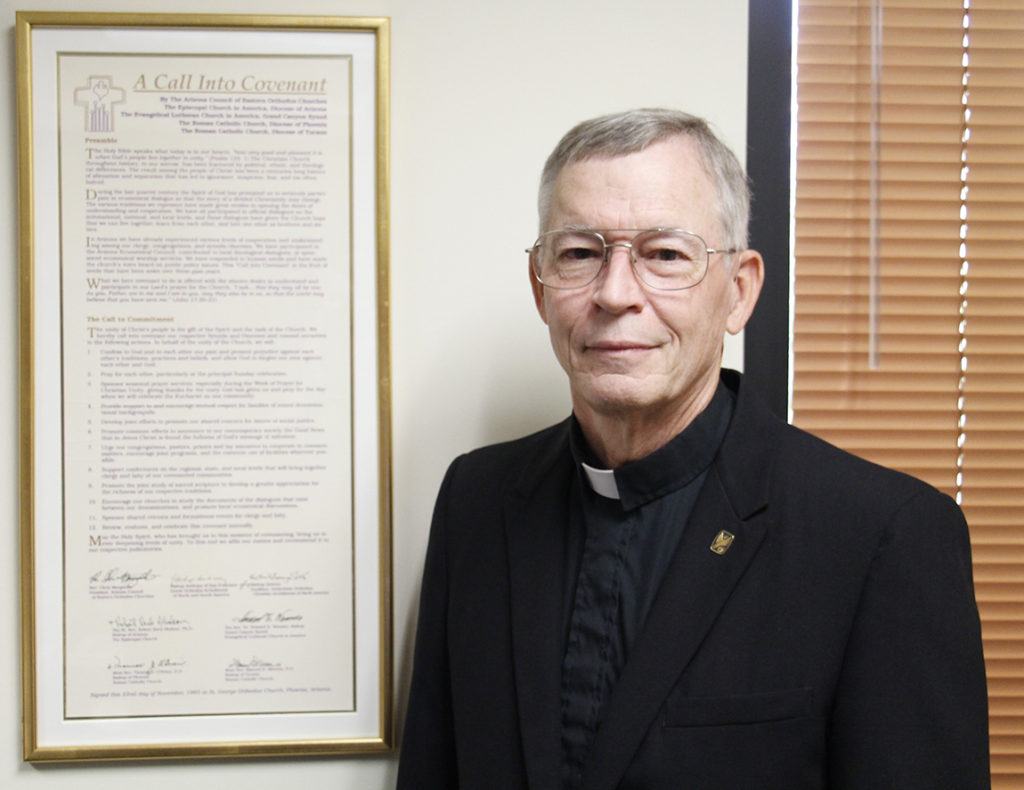
Fr. Michael Diskin retired as vice chancellor for the Diocese of Phoenix Sept. 30, a role he held for 28 years. He also served as diocesan director of ecumenism and religious affairs and poses in his office alongside "A Call into Covenant," a 1993 document honoring the unity of Christ's people among Christian faith congregations in Arizona. (Ambria Hammel/CATHOLIC SUN)
Fr. Michael Diskin retired as vice chancellor for the Diocese of Phoenix Sept. 30, a role he held for 28 years. He also served as diocesan director of ecumenism and religious affairs and poses in his office alongside “A Call into Covenant,” a 1993 document honoring the unity of Christ’s people among Christian faith congregations in Arizona. (Ambria Hammel/CATHOLIC SUN)

The last hard-sided briefcase has likely left the Diocesan Pastoral Center.

“It was his signature item,” Maria Chavira, chancellor, said of her assistant counterpart. It was a role Fr. Michael Diskin held for 28 years until his retirement Sept. 28. Fr. Diskin spent more than a decade prior serving at eight diocesan parishes plus one in his home state of New York since his ordination in 1977.

Most, if not all briefcases coming into the DPC these days, have been replaced with softer-sided computer bags and tablet covers.

Fr. Diskin was computer savvy too, but accomplished vital ministry via phone and face-to-face conversations, whether it was a quip with staff or conversation with laity.

“Fr. Diskin had many priestly gifts but the ones I remember are his ability to listen and respond pastorally to individuals who were experiencing dissatisfaction with the Church. Fr. Diskin had a unique way of putting things into perspective and offering people possible solutions to the issues they were struggling with,” Chavira said.

One struggle the priest himself personally couldn’t get through was his quest to have a “fro yo” machine installed in the cafeteria. Fr. Diskin said at his retirement celebration he would happily come back to bless it should one get installed.

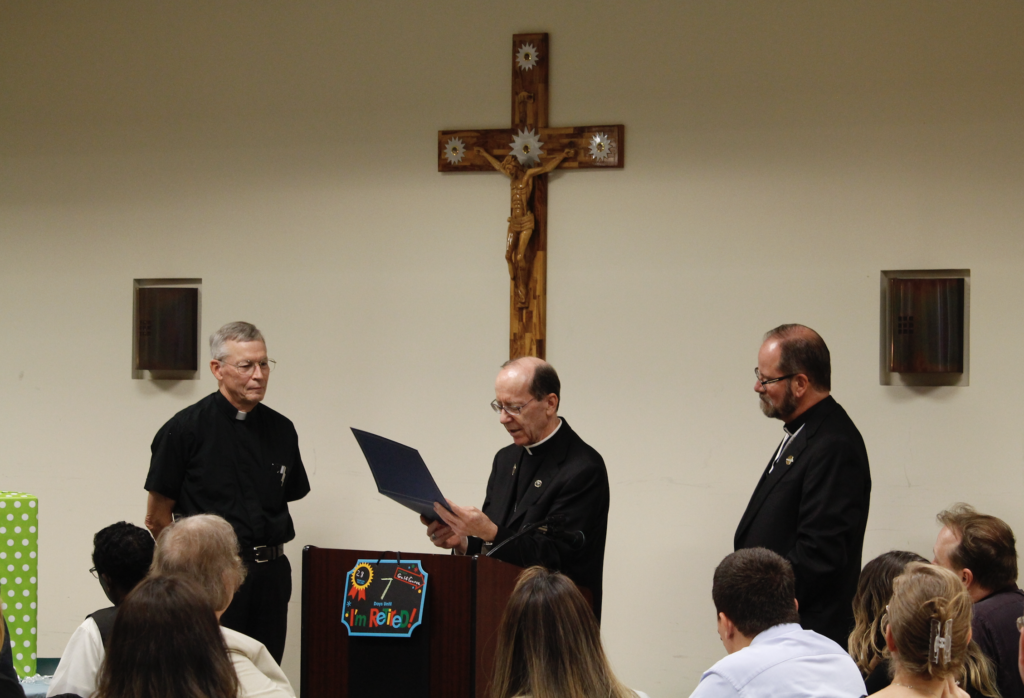
Bishop Thomas J. Olmsted reads a certificate of appreciation for Fr. Michael Diskin’s 28 years of service at the Diocesan Pastoral Center and 41 years of priesthood during a Sept. 19 retirement celebration. (Ambria Hammel/CATHOLIC SUN)

Interfaith networking

Most of Fr. Diskin’s work in the chancery also included double duty as diocesan director of ecumenism and religious affairs. He was appointed as the Catholic representative with the Arizona Faith Network, though it went by another name until 2015. Fr. Diskin served as president of its board of directors and other positions. The Festival of Faith at Bank One Ballpark in 2000 was among its fruits. Some 35,000 people attended a four-hour celebration.

“The most significant change is when the Arizona Ecumenical Council ultimately went through the process of making a decision that in today’s environment, we don’t just need to be ecumenical, but interreligious,” Fr. Diskin said.

Interreligious coverage in The Catholic Sun

Its focus on common social justice issues helped raise Arizona’s minimum wage and Fr. Diskin was specifically involved with an effort to change city bus schedules to help the working poor.

“His great heart was for continuing doing some service in the community with justice issues,” said the Rev. Larry Fultz, executive director of Arizona Interfaith Movement — another local interreligious organization.

“I know he’s going to be missed by the Church. I know he’ll be deeply missed by the faith community, not just the Catholic community, but the faith in general,” Fultz said.

Auxiliary Bishop Eduardo A. Nevares, who served with Fr. Diskin in interfaith efforts, agreed. “Your spirit, your generosity, your kindness, your sense of service have been very admirable over the years,” he said at a retirement celebration.

Serving Catholics worldwide

Fr. Michael Diskin addresses St. Louis the King parishioners during the parish’s 50th anniversary celebration in this 2012 file photo. (Catholic Sun file photo)

That sense of service also meant wearing a third hat as short-term canonical administrator of St. Bernard of Clairvaux and seven years as pastor of St. Louis the King in Glendale.

“In parish ministry, you have direct interaction with members of the faithful. You share their pain and disappointment and their joy in significant life moments,” Fr. Diskin said.

Early into priesthood, he initiated fellowship efforts among freshmen priests. Fr. Diskin rounded up clergy who had been ordained five years or less for social gatherings, whether it was basketball, dinner theater or a trip to Lake Havasu City.

“He loves the Church. He humbly handles the Church behind the scenes,” Bishop Thomas J. Olmsted said.

Fr. Diskin established such modus operandi long before ordination and seminary. He was a daily Massgoer for most of college and supported three ministries in an Army base chapel in Germany. It was bedside reading there from St. Paul that served as his decision point for discerning priesthood.

The Lord first spoke to his heart around age 10 or 11 though upon discovery of a side altar at his home parish honoring the Blessed Mother.

“There was something that took place that stimulated being open to priesthood,” Fr. Diskin recalled, while in his final days at the Diocesan Pastoral Center. The rest is history that has a new chapter waiting to be written.