
Pope: Jesus’ Church offers truth, comfort despite efforts to discredit it

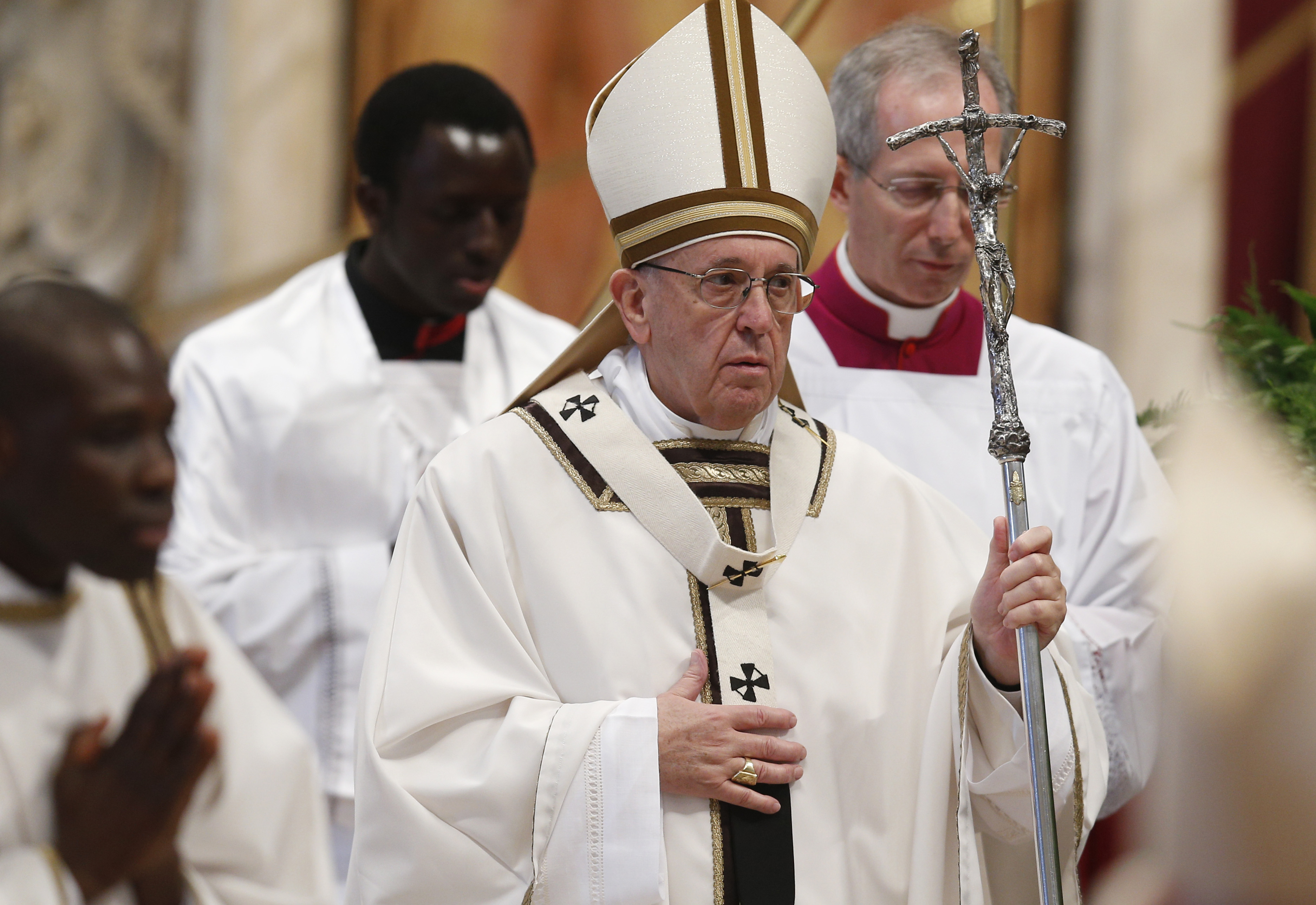
Pope Francis venerates the crucifix during the Good Friday service in St. Peter's Basilica at the Vatican March 30. (CNS photo/Paul Haring) See POPE-GOOD-FRIDAY March 30, 2018.

ABOVE: Pope Francis venerates the crucifix during the Good Friday service in St. Peter’s Basilica at the Vatican March 30. (Paul Haring/CNS)

By Carol Glatz
Catholic News Service

ROME (CNS) — Leading a prayer to God for the grace to feel ashamed and repentant for so many sins in the world, Pope Francis highlighted the hope that always comes from Jesus.

There is hope “because your Church, holy and made up of sinners, continues even today, in spite of attempts to discredit it, to be a light that illuminates, encourages, comforts and witnesses your unlimited love for humanity, a model of altruism, an ark of salvation and a source of certainty and truth,” the pope said.

There is hope “because from Your cross — the fruit of greed and cowardice of many doctors of the law and hypocrites — came the resurrection,” which turned darkness into eternal light and shows that Jesus’ love is their hope, he said.

At the end of the Stations of the Cross in Rome’s Colosseum March 30, the pope read a prayer he wrote, asking Jesus to help “strip us of the arrogance” of the unrepentant criminal that was next to Him at His crucifixion and to become more like the “good thief” who was filled with shame, repentance and hope when he gazed upon Jesus.

In his prayer, which he read from a hillside overlooking the crowds holding candles and a torch-lit cross, the pope listed a number of sins and the shame they cause when one gazes upon Jesus’ supreme act of love.
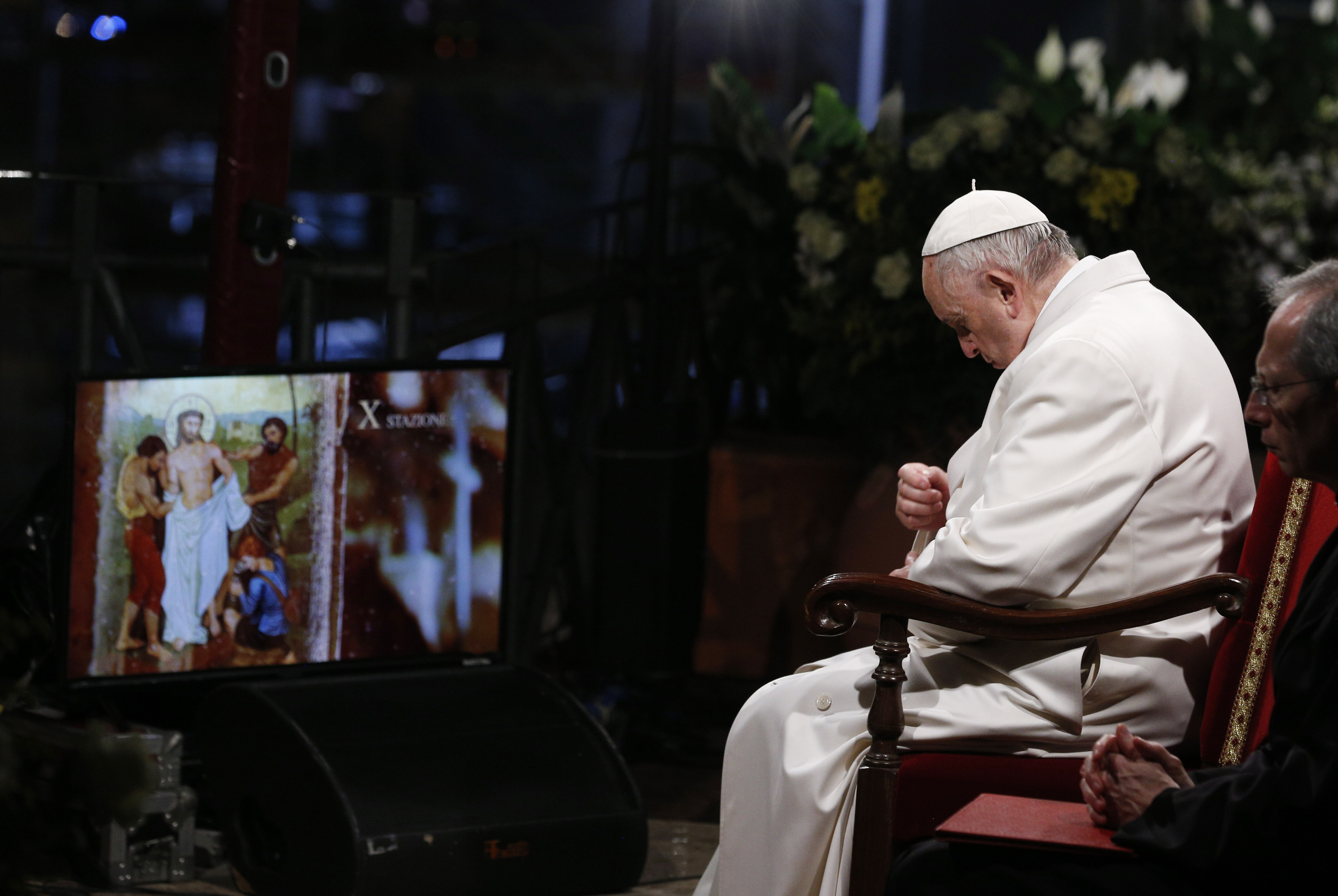
Pope Francis leads the Way of the Cross outside the Colosseum in Rome March 30. (Paul Haring/CNS)

There is shame for: having abandoned God or mocked Him when things got difficult; choosing power, appearances and money over God; there being so many people, even some clergy, who let themselves be misled by ambition and vainglory; leaving younger generations “a world broken by divisions and wars, a world devoured by selfishness where the young, the least, the ill and the elderly are marginalized”; and the shame for having lost all sense of shame.

Repentance comes from recognizing one’s “nothingness” and knowing with certainty that only Jesus can “save us from evil, only You can heal us from our leprosy of hatred, selfishness, pride, greed, revenge, cowardice, idolatry,” he said.

Praying that Jesus always offer the grace of shame and repentance, the pope also prayed people remember the hope contained in His Gospel, which continues to inspire so many people to see that only the good can win over evil, “only forgiveness can conquer rancor and revenge, only a fraternal embrace can dissolve hostility and fear of the other.”

Missionaries, too, bring hope, he said, because they are the ones challenging humanity’s “sleeping conscience” by risking their lives to serve others, including immigrants and the exploited.

The meditations for the late-night event were written by 15 current and former students of a high school religion teacher in Rome. The pope wanted the reflections to be written by a group of young people as part of giving them a voice before the upcoming Synod of Bishops.
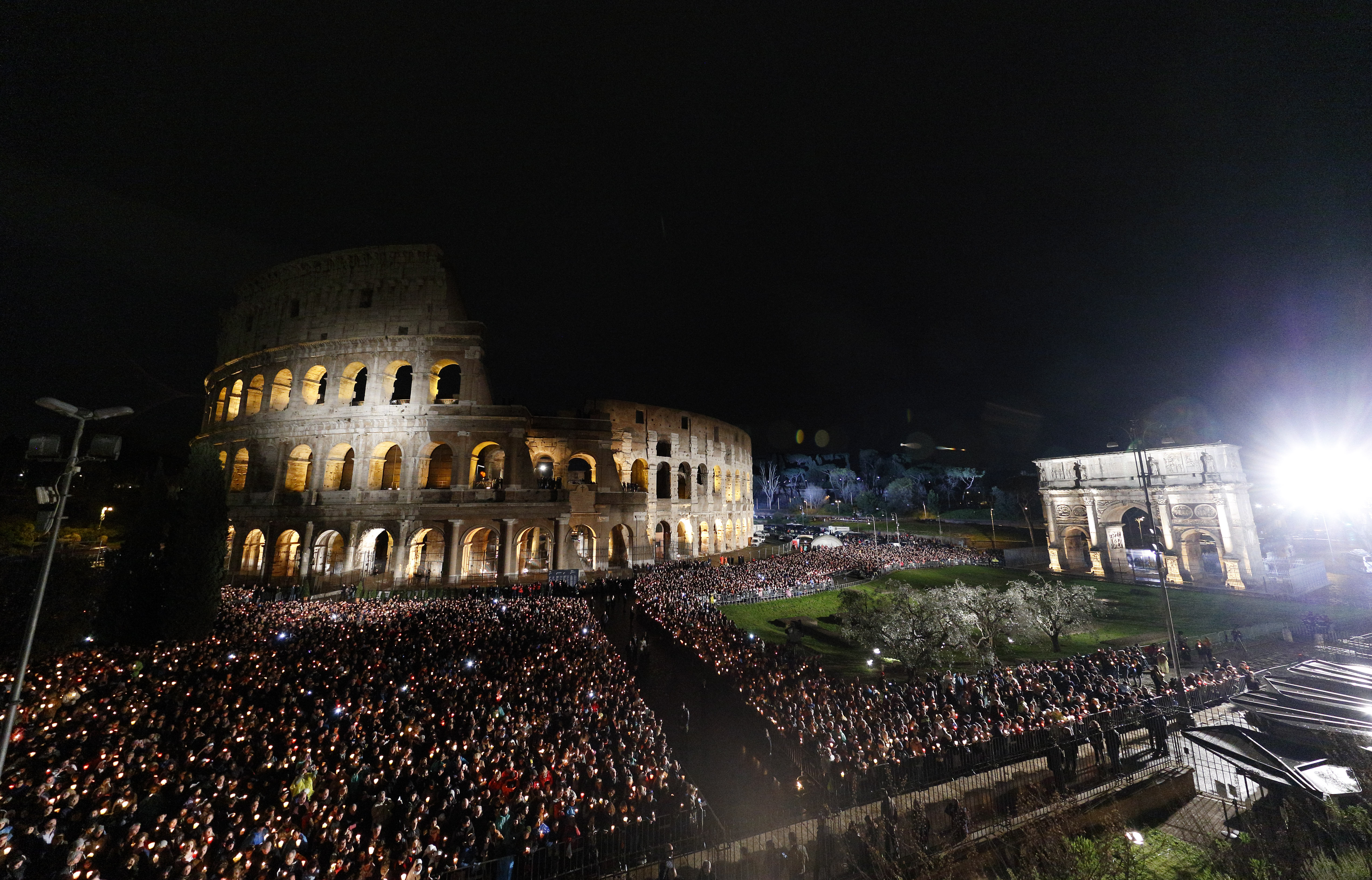
Pope Francis leads the Way of the Cross outside the Colosseum in Rome March 30. (Paul Haring/CNS)

Earlier in the day, Pope Francis presided over the Good Friday Liturgy of the Lord’s Passion, which began with a silent, solemn procession down the central nave of St. Peter’s Basilica.

Two aides then helped the 81-year-old pope down onto his knees as he stretched himself prostrate on the floor before the main altar of the basilica. His bare head rested on a red pillow, in silent prayer, in a sign of adoration and penance. As is customary, the papal household’s preacher gave the homily.

Capuchin Father Raniero Cantalamessa said that while the Church listens to young people in preparation for the synod, the Church must not forget to also help them listen to Jesus and discover what he has to offer.

Repeating the pope’s call for all Christians to renew their relationship with Jesus or at least be open to letting Him encounter them each day, the Capuchin priest said God has a special mission for young people.

Their task, he said, is “to rescue human love from the tragic drift it had ended up — love that is no longer a gift of self but only the possession, often violent and tyrannical, of another.”
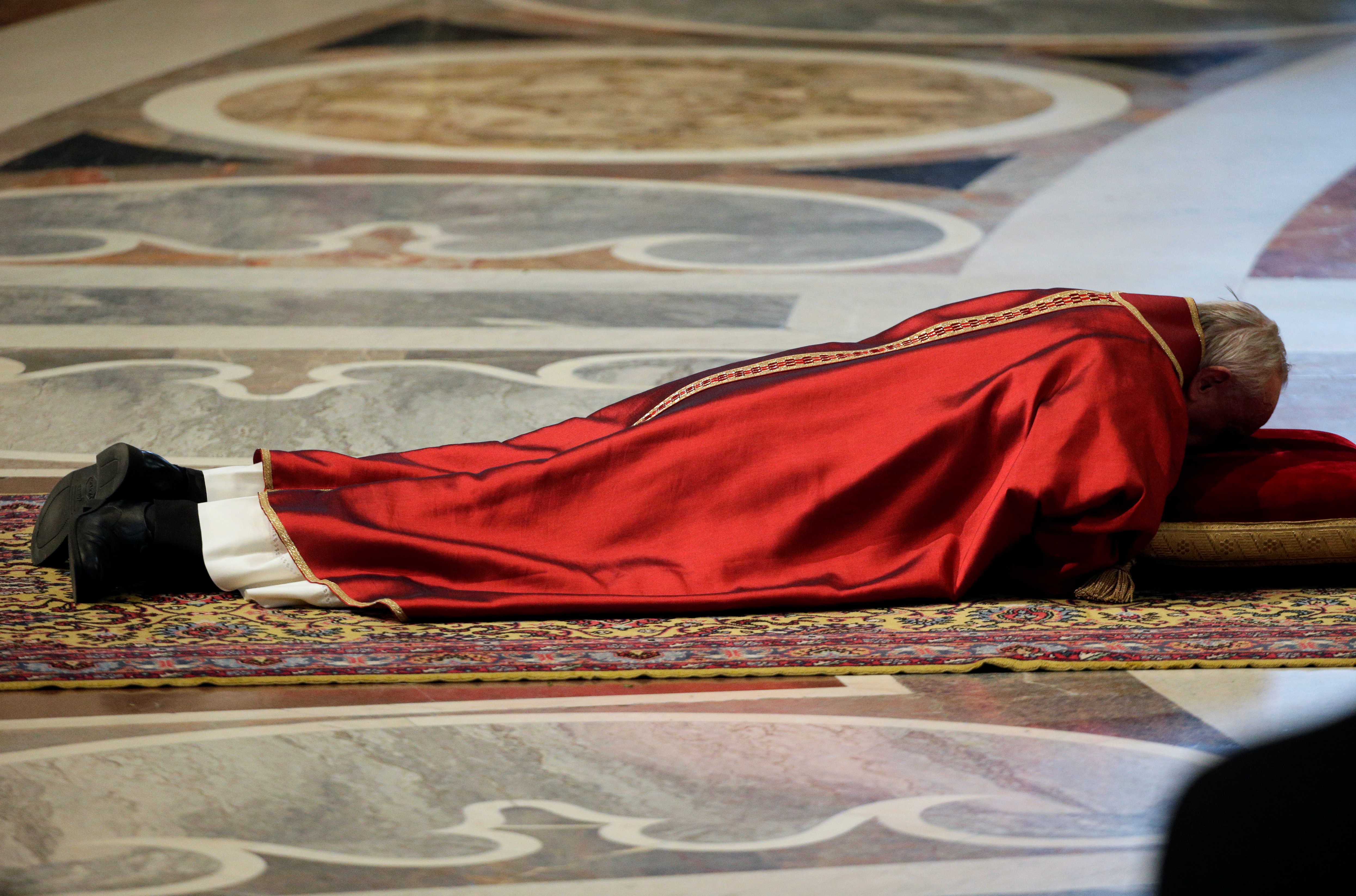
Pope Francis lies prostrate as he leads the Good Friday service in St. Peter’s Basilica at the Vatican March 30. (Paul Haring/CNS)

The ability to be totally giving and welcoming of love requires long preparation, whether it be for the vocation of marriage, religious life or service, he said.

Jesus on the cross is an example of giving Himself for others carried to the extreme, and Christians are called to be courageous in going against the current cultural stream of selfishness and going against the crowd that chases after worldly things, he said.

There is a world out there that has nothing to do with God’s plan, he said; it is a world that has come “under the dominion of Satan and sin” and plays a “decisive role in public opinion,” which is then spread in infinite ways “electronically, through airwaves.”

These mistaken ways are then seen as “the norm” so that when people “act, think or speak against this spirit (it) is regarded as nonsensical or even as wrong and criminal,” he said.

He encouraged young people to go the opposite direction where Jesus, “our God and savior,” awaits.

After the homily, the assembly venerated the cross, which was carried down the central nave and held before the pope. The pope had removed his red chasuble and, in a sign of penance, placed a red stole over his shoulders. He kissed and leaned his head against the cross.

Jesus does not give up on anyone, pope tells prisoners

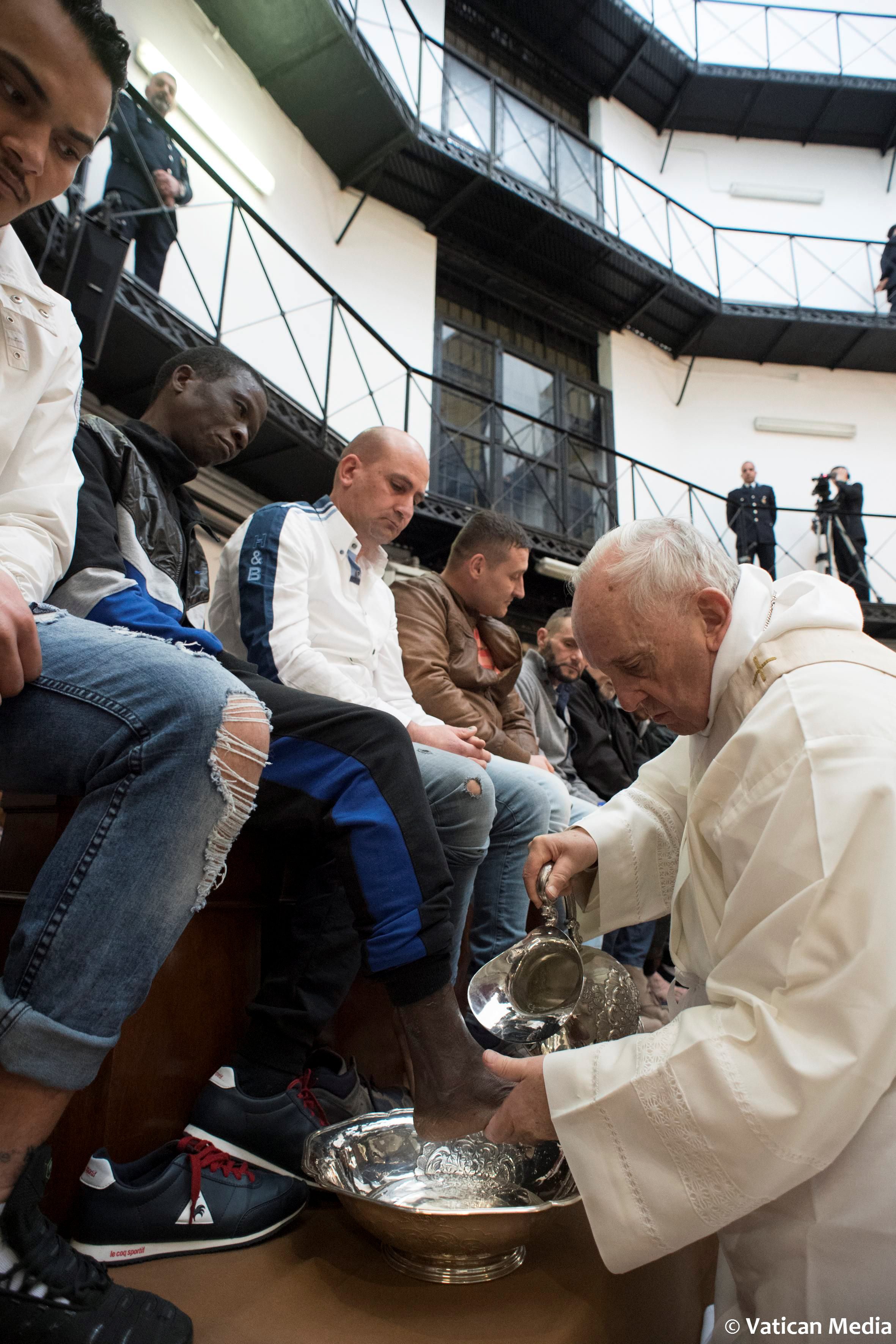
Pope Francis kisses the foot of an inmate during Holy Thursday Mass March 29 at Regina Coeli prison in Rome. The pope celebrated Mass and washed the feet of 12 inmates at the prison. (CNS, via Vatican Media) See POPE-THURSDAY-PRISON March 29, 2018.

ABOVE: Pope Francis kisses the foot of an inmate during Holy Thursday Mass March 29 at Regina Coeli prison in Rome. The pope celebrated Mass and washed the feet of 12 inmates at the prison. (CNS, via Vatican Media)

By Cindy Wooden
Catholic News Service

ROME (CNS) — Before washing the feet of 12 prisoners, Pope Francis told them and hundreds of inmates to remember that Jesus constantly stands before them with love, ready to cleanse their sins and forgive them.

“Jesus takes a risk on each of us. Know this: Jesus is called Jesus, not Pontius Pilate. Jesus does not know how to wash His hands of us; He only knows how to take a risk on us,” the pope said March 29 during his homily at Rome’s Regina Coeli prison.

Pope Francis celebrated the Holy Thursday Mass of the Lord’s Supper at the prison and washed the feet of a dozen inmates. Four were Italian; two were from the Philippines; two from Morocco; and one each from Moldova, Colombia, Nigeria and Sierra Leone, the Vatican press office said. Eight of the 12 were Catholic; two were Muslim; one was Orthodox; and one was Buddhist.

In his brief homily before the foot-washing ritual, Pope Francis explained to the prisoners that in Jesus’ day, the job of washing feet was the task of a slave. “There wasn’t asphalt or cobblestones, there was dust and people’s feet got dirty,” so before they went into a house, the slaves would wash the person’s feet.

The Gospel recounts Jesus washing the feet of His own disciples “to give us an example of how we must serve one another,” the pope said.

Another time, he said, Jesus explained to His disciples that kings want to be served.

“Think of the kings and emperors back then, so many were cruel, they insisted on being served by slaves,” the pope said.

Pope Francis washes the foot of an inmate during Holy Thursday Mass March 29 at Regina Coeli prison in Rome. The pope celebrated Mass and washed the feet of 12 inmates at the prison. (CNS, via Vatican Media)

But Jesus told His followers: “Among you, it must not be like this. The one who rules must serve,” the pope explained.

“Jesus overturns the historic and cultural attitudes of His age — and of today, too,” Pope Francis told the inmates. Jesus says that “the one who rules, in order to be a good boss, must serve. I often think — not of people today because they still are alive and can change their lives, so we cannot judge them — but think of history. If many kings, emperors, heads of state had understood this teaching of Jesus, instead of ruling, being cruel, killing people, if they would have done this, how many wars would not have been fought?”

In His earthly life and still today, the pope said, Jesus goes to “people who are thrown away by society, at least for a while,” and He says to them, “‘You are important to me,’ and Jesus comes to serve us.”

“The sign that Jesus serves us today in Regina Coeli is that He wanted to choose 12 of you today for the washing of the feet,” the pope said.

“I am a sinner like you, but I represent Jesus today. I am His ambassador,” the pope said. “When I kneel before each of you, think, ‘Jesus took a risk on this man, a sinner, to come to me and tell me He loves me.’ This is service. This is Jesus. He never abandons us. He never tires of forgiving us. He loves us so much.”

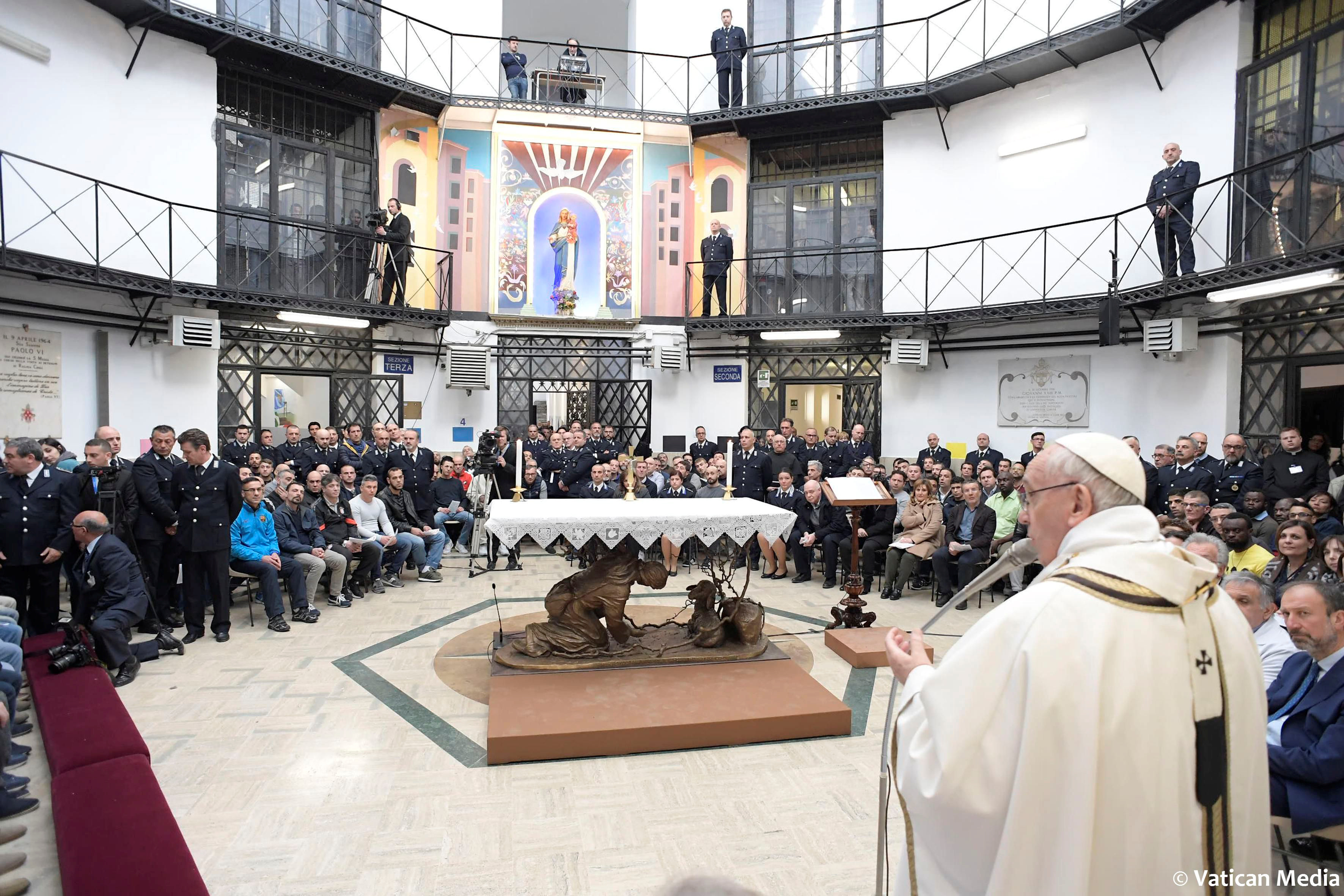
The pope celebrated the Mass of the Lord’s Supper in the rotunda of the prison, a small central area formed from the intersection of various wings of the jail.

The prison is designed to house just over 600 inmates, but currently houses more than 900 men. Some 65 percent of the inmates are non-Italians, Vatican News reported.

At the end of the Mass, a prisoner publicly thanked Pope Francis for his visit and said the inmates would try to do, at least symbolically, what he recommended at his general audience at the Vatican the day before: celebrate Easter by splashing water on their eyes to look at the world with fresh eyes.

The 81-year-old pope responded by confiding in the prisoners that, like many people his age, he is developing cataracts and will have an operation next year to fix them.

Pope Francis delivers the homily during Holy Thursday Mass March 29 at Regina Coeli prison in Rome. The pope also washed the feet of 12 inmates at the prison. (CNS, via Vatican Media)

But, he said, as life goes on and people get busy or make mistakes, they can develop “cataracts of the soul” that prevent them from seeing the world with the hope that is born of Jesus’ resurrection.

“Never tire of renewing your gaze, of having that cataract operation on your soul every day,” the pope told the prisoners.

He also insisted that jail time must be a time to prepare a person to return to society and live as good citizens and that the penalties for crime must be “open to hope.”

“There is no just penalty that is not open to hope,” Pope Francis said. “That is why the death penalty is neither Christian nor human.”

Pope Francis began his visit in the prison infirmary, meeting with prisoners there. After the Mass he was scheduled to visit the prison’s Section VIII, a protected area of the facility for inmates convicted of sexual crimes and other inmates who could be in danger in the general population.

The prison is less than two miles from the Vatican and is no stranger to hosting a pope celebrating Mass. St. John XXIII visited in 1958, Blessed Paul VI in 1964 and St. John Paul II went in 2000.

The Mass March 29 marked the fourth time Pope Francis celebrated the Holy Thursday Mass in a detention facility. In 2013, for his first Holy Thursday as pope, he celebrated in a juvenile detention facility. In 2015 he presided over the Mass and foot-washing ritual at Rebibbia, Rome’s main prison, and in 2017 he went to a prison in Paliano, some 45 miles from Rome.

Bishop to priests at Chrism Mass: Ask Christ to take our hands, hearts in His

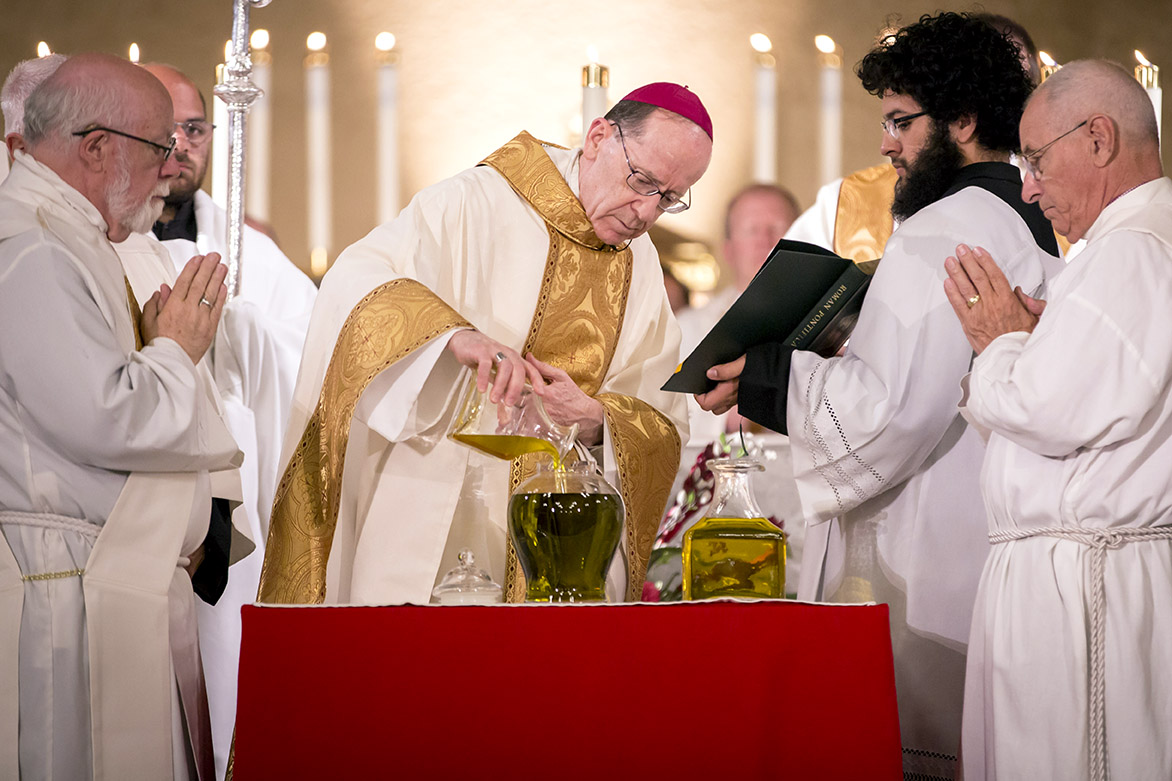
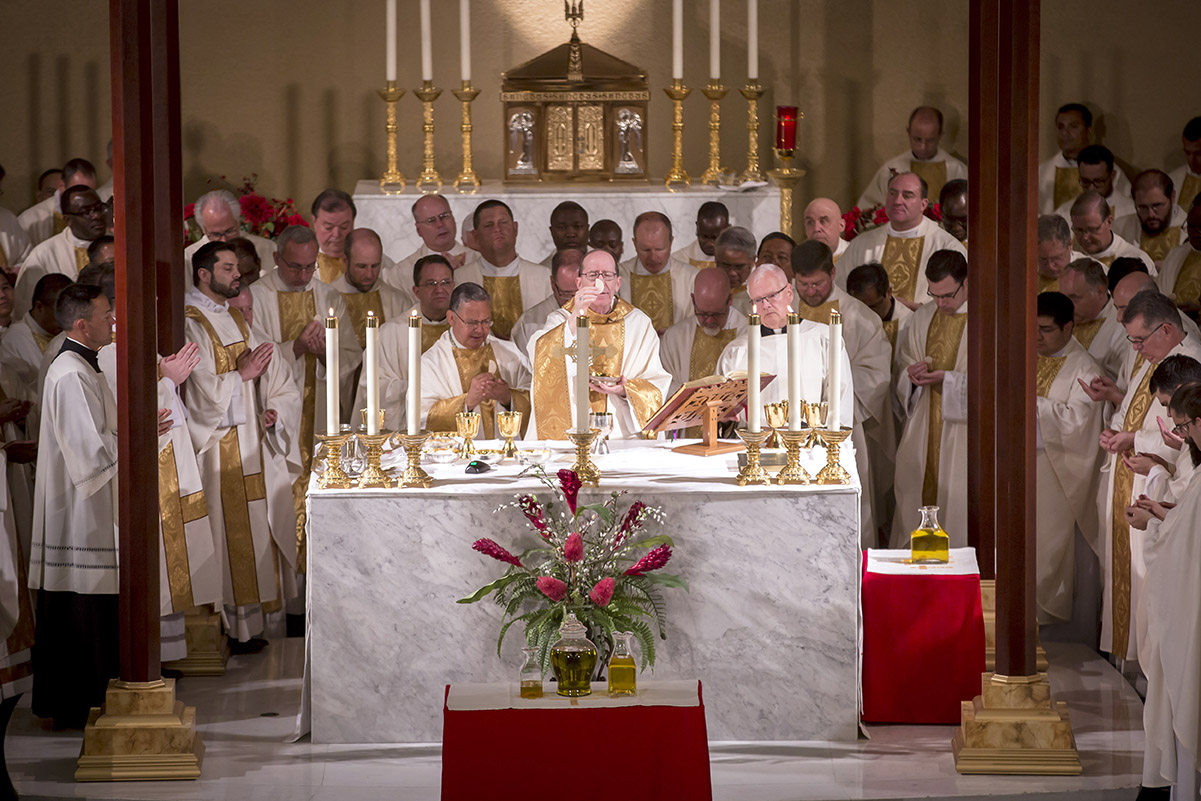
Bishop Thomas J. Olmsted pours chrism oil during the March 26 Chrism Mass at Ss. Simon and Jude Cathedral. (Billy Hardiman/CATHOLIC SUN)

MORE PHOTOS

It was standing room only as priests, religious, deacons and laity from throughout the Phoenix Diocese packed into Ss. Simon and Jude Cathedral for the this year’s Chrism Mass March 26. Members of the Knights of Columbus, Order of Malta and the Equestrian Order of the Holy Sepulchre took part in the opening procession as the choir and congregation sang a spectacular eight verses of “Lift High the Cross.”

The annual liturgy draws a multi-generational crowd of Catholics to witness the bishop blessing the oils that will be used throughout the year in sacramental celebrations such as Baptism, Confirmation, Anointing of the Sick and Holy Orders.

The other big draw for the Mass is that priests of the diocese reaffirm their commitment to priestly service at the conclusion of the homily. “Are you resolved to be faithful stewards of the mysteries of God in the Holy Eucharist and other liturgical rites?” Bishop Thomas J. Olmsted asked them, among other questions. The approximately 150 priests in attendance stood as one and answered in unison: “I am.”

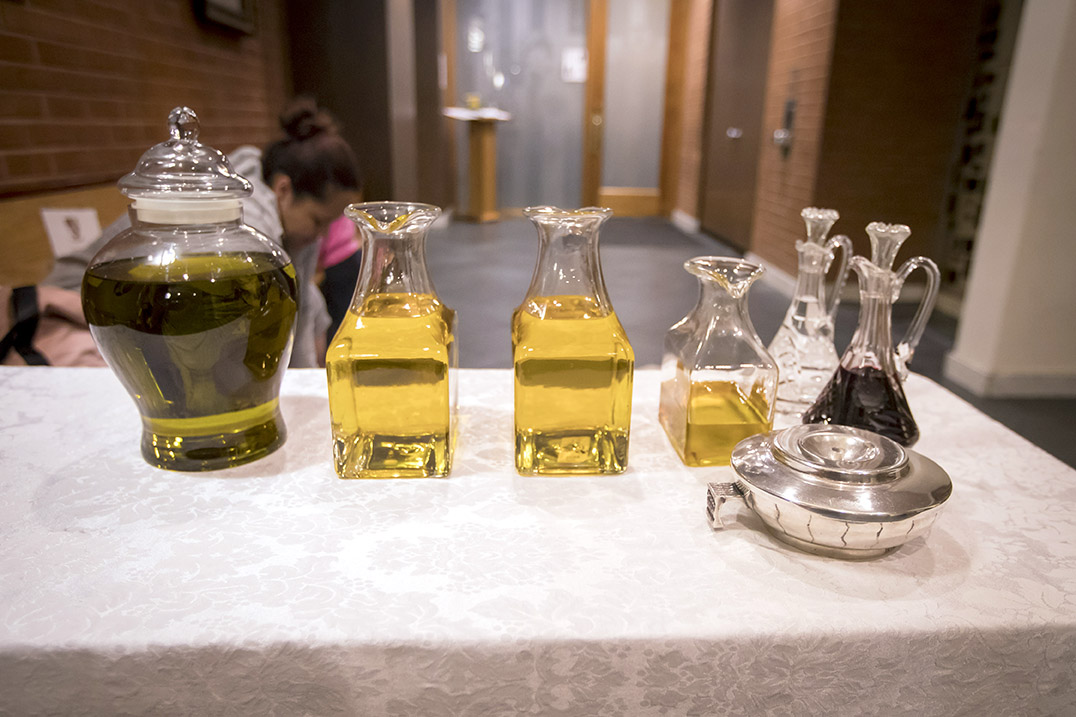
The chrism oils to be used for sacraments throughout the year are placed on a table in the narthex of Ss. Simon and Jude Cathedral before the March 26 Chrism Mass. (Billy Hardiman/CATHOLIC SUN)

Greg and Christina Blanchard drove from Flagstaff to participate in the Mass. For them, it was a bit of a family reunion. Their son, Nathan, a seminarian at the Pontifical College Josephinum in Ohio, served on the altar during the Mass; Greg is in formation for the diaconate. The Blanchard’s daughter, Sr. Rene Noel, teaches first grade at St. Thomas the Apostle School and was on hand with other sisters from her community, the Dominican Sisters of Mary, Mother of the Eucharist.

“It’s a taste of Easter because we don’t get to see her that often,” Greg said. “On these non-planned occasions, it’s a great joy. She takes final vows this summer.”

The blessing of the holy oils was powerful, Greg said, because “it calls to mind the continuing presence of the Holy Spirit in our Church throughout the centuries.”

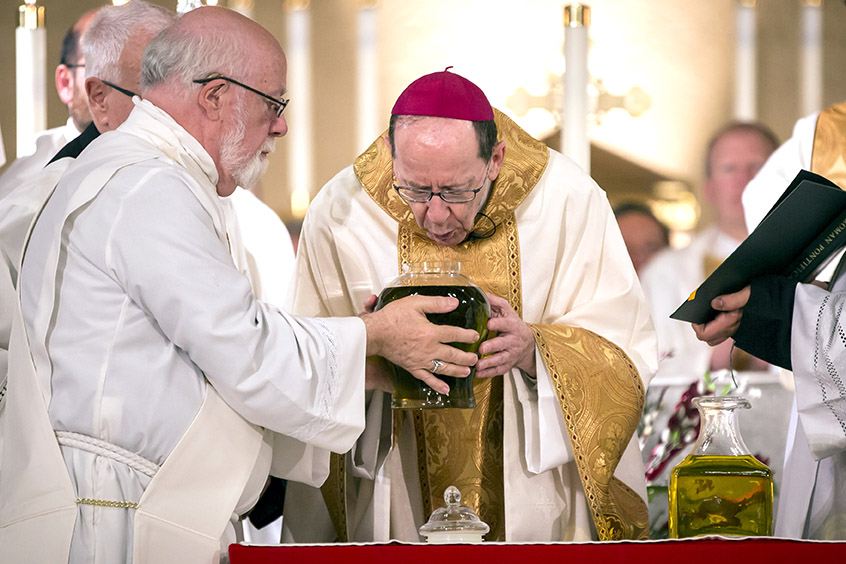
Bishop Thomas J. Olmsted breathes into the chrism oil, a gesture symbolizing the infusion of the Holy Spirit, during the March 26 Chrism Mass at Ss. Simon and Jude Cathedral. (Billy Hardiman/CATHOLIC SUN)

During his bilingual homily, Bishop Olmsted reflected on the Gospel passage in which Jesus reads a passage from Isaiah from the scroll at the synagogue. St. Luke’s portrayal draws attention to Jesus’ hands, the bishop said.

“Before Jesus spoke a word in the synagogue, people noticed what He did with His hands and with what reverence He handled the scrolls,” Bishop Olmsted said. The oils blessed at the Chrism Mass will be taken into the priests’ hands to confer the sacraments, he said, and Jesus brings healing and life to others through the hands of priests.

The Chrism Mass is a worthwhile occasion, the bishop said, for priests to “remember that sacred moment, on the day of Ordination, when our hands were anointed by Christ, and when He, acting through the Bishop, placed His hands upon us and gave us a share in His eternal priesthood.”

Bishop Thomas J. Olmsted leads priests from throughout the Diocese of Phoenix in celebrating the Eucharist during the March 26 Chrism Mass at Ss. Simon and Jude Cathedral. Priests renew the promises they made at their ordinations at the annual Mass. (Billy Hardiman/CATHOLIC SUN)
Prayer of Abandonment

Father,
I abandon myself into your hands;
do with me what you will.
Whatever you may do, I thank you:
I am ready for all, I accept all.

Let only your will be done in me,
and in all your creatures —
I wish no more than this, O Lord.

Into your hands I commend my soul:
I offer it to you with all the love of my heart,
for I love you, Lord, and so need to give myself,
to surrender myself into your hands without reserve,
and with boundless confidence,
for you are my Father.

Bishop Olmsted asked the priests to join with him silently as he prayed aloud the words written by Blessed Charles de Foucauld in the Prayer of Abandonment.

Calling them “my beloved priests and dear sons in Christ,” the bishop encouraged his brother priests to take heart, recalling that it is Jesus who laid His hands on them and uses their hands and voices to consecrate the bread and wine at Mass.

“If, at any time, we become disheartened, let us ask Him to take our hands and hearts in His, to heal and renew them for the service of His Kingdom,” Bishop Olmsted said.

Braxinton Campano, a young parishioner from St. Joan of Arc, stood outside with friends and family after the two-hour Mass. “It was really beautiful,” Campano said. “The Latin hymns gave me the most peace.”

Christina Strafacci, who teaches at the Kino Catechetical Institute, was also in attendance. “I love attending the Chrism Mass each year because the unity of the whole Church is on full display,” Strafacci said. “Listening to the priests renew their commitments and watching the bishop’s blessing of the sacramental oils — it’s all so incredibly beautiful.”

El Papa pide sacerdotes cercanos que sean predicadores callejeros

TEXT DE LA HOMILÍA DEL PAPA

CIUDAD VATICANO (ACI Prensa) — Durante la homilía de la Misa Crismal que el Papa Francisco celebró en la Basílica de San Pedro del Vaticano el 29 de marzo, Jueves Santo, el Santo Padre pidió sacerdotes cercanos, que sean, como Jesús, predicadores callejeros.

Junto al Obispo de Roma, concelebraron los cardenales, los obispos y los presbíteros presentes en Roma. Durante la Celebración Eucarística, los sacerdotes renovaron las promesas realizadas en el momento de su ordenación y, a continuación, se bendijo el óleo de los enfermos, el óleo de los catecúmenos y el crisma.

El Pontífice explicó en la homilía que Jesús “habría podido perfectamente ser un escriba o un doctor de la ley, pero quiso ser un ‘evangelizador’, un predicador callejero, el ‘portador de alegres noticias’ para su pueblo”.

“Esta es la gran opción de Dios: el Señor eligió ser alguien cercano a su pueblo. ¡Treinta años de vida oculta! Después comenzará a predicar”.

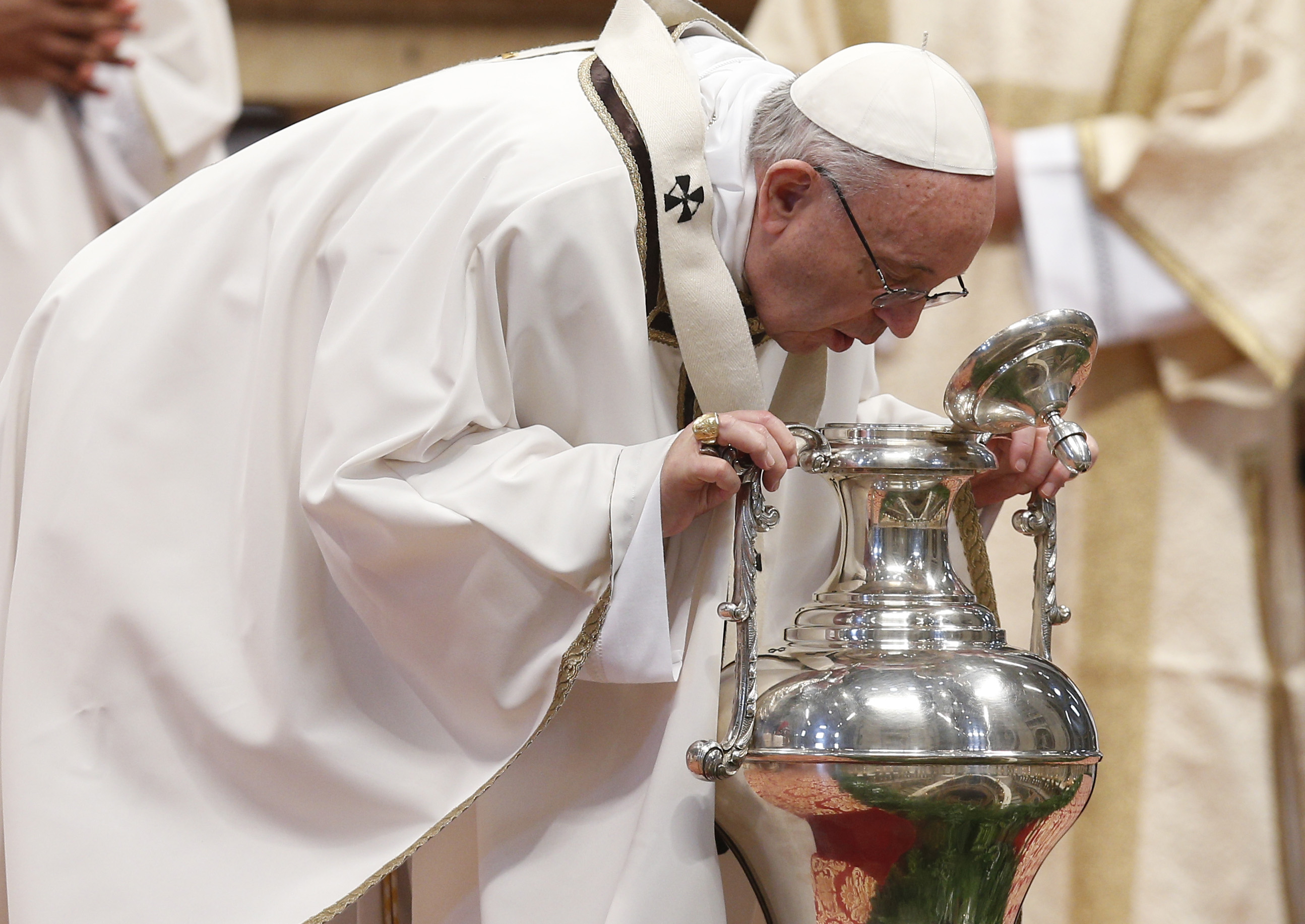
El Papa Francisco respira al óleo crisma, representando el infusión del Espiritu Santo, durante la Misa Crismal el 29 de marzo, Jueves Santo, en la Basílica de San Pedro. (Paul Haring/CNS)

Señaló que “la cercanía es más que el nombre de una virtud particular, es una actitud que involucra a la persona entera, a su modo de vincularse, de estar a la vez en sí mismo y atento al otro”.

Aseguró que “cuando la gente dice de un sacerdote que ‘es cercano’ suele resaltar dos cosas: la primera es que ‘siempre está’”.

Y la segunda “es que sabe encontrar una palabra para cada uno. ‘Habla con todos’, dice la gente: con los grandes, los chicos, los pobres, con los que no creen. … Curas cercanos, que están, que hablan con todos. … Curas callejeros”.

“La cercanía es la clave del evangelizador porque es una actitud clave en el Evangelio (el Señor la usa para describir el Reino)”, subrayó el Papa Francisco.

“Nosotros tenemos incorporado que la proximidad es la clave de la misericordia, porque la misericordia no sería tal si no se las ingeniara siempre, como ‘buena samaritana’, para acortar distancias. Pero creo que nos falta incorporar más el hecho de que la cercanía es también la clave de la verdad”.

El Papa Francisco celebra la Misa Crismal el 29 de marzo, Jueves Santo, en la Basílica de San Pedro. Durante la Misa, los sacerdotes renovaron sus promesas de su ordenaciones. (CNS photo/Paul Haring)

En este sentido, el Papa sugirió meditar tres ámbitos de cercanía sacerdotal:

En primer lugar, “la cercanía en la conversación espiritual, la podemos meditar contemplando el encuentro del Señor con la Samaritana”.

En segundo lugar, “la cercanía en la Confesión la podemos meditar contemplando el pasaje de la mujer adúltera”.

Por último, “el ámbito de la predicación. Meditamos en él pensando en los que están lejos, y lo hacemos escuchando la primera prédica de Pedro, que debe incluirse dentro del acontecimiento de Pentecostés”.

El Papa Francisco finalizó la homilía afirmando que “al sacerdote cercano, ese que camina en medio de su pueblo con cercanía y ternura de buen pastor, no es que la gente solamente lo aprecie mucho; va más allá: siente por él una cosa especial, algo que solo siente en presencia de Jesús”.

Pope to priests: Show Jesus’ truth by being close to the people

By Carol Glatz
Catholic News Service

TEXT OF THE POPE’S HOMILY

VATICAN CITY (CNS) — If Jesus and His truth are to become truly present in today’s world, priests must do what Jesus did and be “street preachers,” going out to encounter and accompany sinners with tenderness and compassion, Pope Francis told the world’s priests.

Jesus “could have been a scribe or a doctor of the law, but He wanted to be an ‘evangelizer,’ a street preacher,” the bearer of good news for His people, the pope said March 29 during the Chrism Mass in St. Peter’s Basilica.

“This is God’s great choice: The Lord chose someone who is close to His people,” Pope Francis said. Jesus’ incarnation implies inculturation, so that people find His presence not only in far-off lands, but in their own parish, “in the new culture of young people,” he added.

Presiding over the first of two Holy Thursday liturgies, Pope Francis blessed the oils that will be used in the sacraments of baptism, confirmation, ordination and the anointing of the sick.

EN ESPAÑOL: El Papa pide sacerdotes cercanos que sean predicadores callejeros

Pope Francis breathes over chrism oil, a gesture symbolizing the infusion of the Holy Spirit, during Holy Thursday chrism Mass in St. Peter’s Basilica at the Vatican March 29. (Paul Haring/CNS)

As Holy Thursday was the day Jesus shared His priesthood with the apostles, Pope Francis led the many priests, bishops and cardinals present in a renewal of their priestly vows. He also dedicated his lengthy homily to how God’s special gift of being close to His people relates to the vocation of being a priest.

Being close reflects an attitude and a way of relating to or connecting with others that allows the priest to be true to himself and be attentive to those with whom he engages, the pope said.

The people immediately recognize those priests as being special, he said. They are priests who are always available and who talk to everyone: adults, children, the poor and those who do not believe; they are “street priests,” he said.

Jesus’ truths are always brought to the people and conveyed naturally, informally, “face to face,” Pope Francis said.

That is because the truth is not only what allows people to size up situations and things from a distance with abstract concepts and logical reasoning, the pope said. “Truth is also fidelity. It makes you name people with their real name, as the Lord names them, before categorizing them or defining ‘their situation.’”

Speaking off-the-cuff, the pope said there is a “terrible” tendency to see and define people by their “adjectives,” their faults and virtues, rather than by their substantive nature, their “noun” as a child of God.

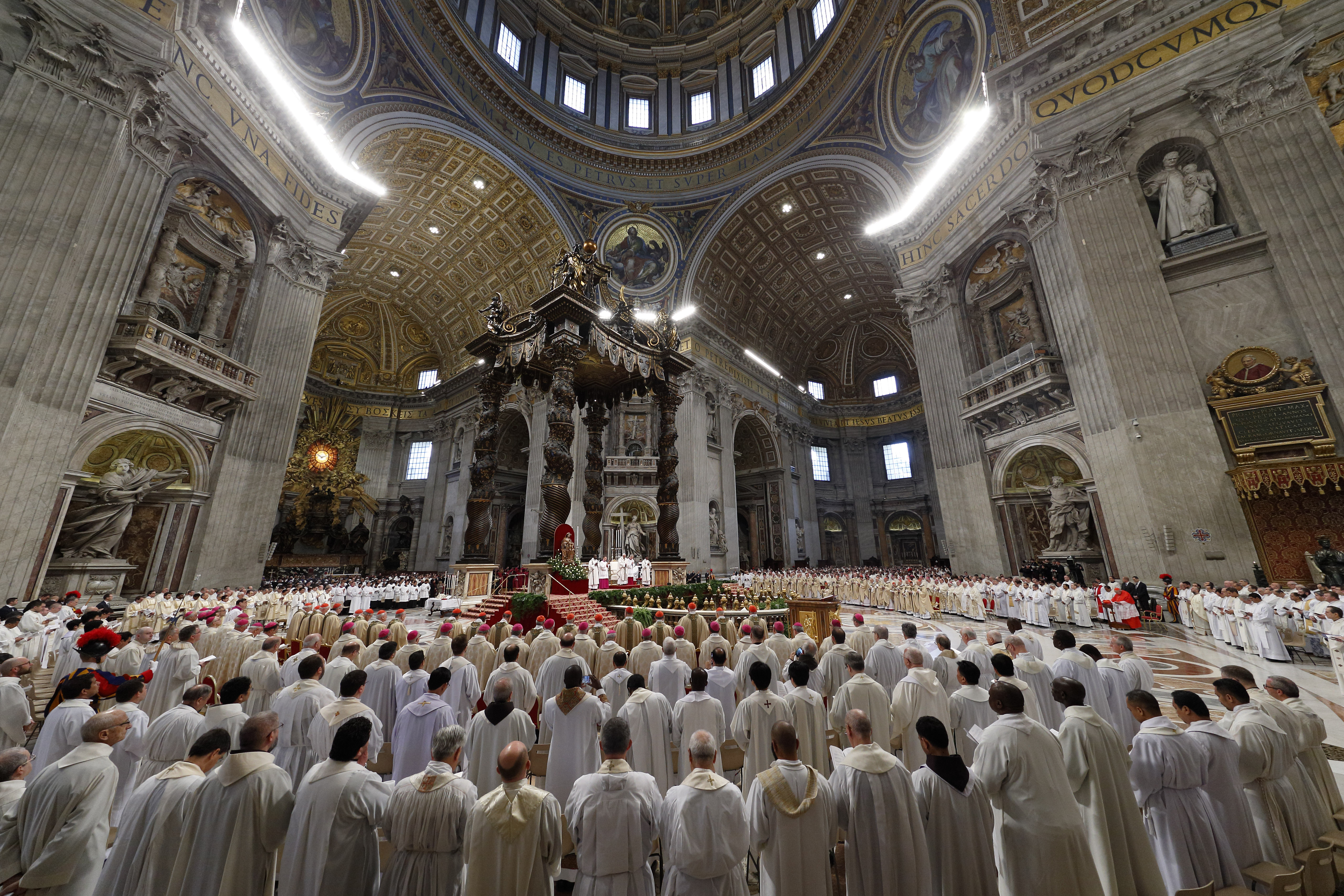
Pope Francis celebrates Holy Thursday chrism Mass in St. Peter’s Basilica at the Vatican March 29. During the Mass, the priests renewed their ordination promises. (CNS photo/Paul Haring)

The pope also cautioned against “the temptation of making idols of certain abstract truths. They are comfortable idols, within easy reach; they offer a certain prestige and power and are difficult to discern.”

This “truth-idol” can disguise itself, dressing itself up with the words of the Gospel, but in a way that the words will never touch people’s heart, he said. And, what is worse, “it distances ordinary people from the healing closeness of the Word and of the sacraments of Jesus,” he told those assembled.

Mary, he said, is also a model of how to be close since “‘she walks at our side, she shares our struggles and she constantly surrounds us with God’s love,’ in such a way that no one feels left out.”

If priests are to say, as Mary does to the servants at the Wedding in Cana, “Do whatever He tells you,” they must first be like her — present where things are “brewing,” like at the wedding feast, he said. “Only through this kind of closeness can we discern which is the wine that is missing, and what is the best wine that the Lord wants to provide.”

A priest’s closeness, he said, is needed in a special way at three times, times when the words, “Do everything Jesus tells you,” need to be heard: during moments of spiritual dialogue, during confession and when preaching the homily.

To understand what this closeness looks like, the pope again pointed to Jesus as the model whose approach and way of speaking with sinners led to their recognizing the truth and conversion.

Pope Francis leaves in procession at the conclusion of Holy Thursday chrism Mass in St. Peter’s Basilica at the Vatican March 29. (Paul Haring/CNS)

When Jesus tells people, “Go and sin no more,” he is not speaking in the “legalistic tone” of someone who believes He must determine the “parameters of Divine Mercy,” he said.

On the contrary, those words need to be spoken in a way that enables the sinner “to look ahead and not behind. The right tone of the words ‘sin no more’ is seen in the tone of the confessor who says to them, willing to repeat them 70 times seven,” the pope said.

Finally, the pope said, “the homily is the touchstone ‘for judging a pastor’s closeness and ability to communicate to his people.’ In the homily, we can see how close we have been to God in prayer and how close we are to our people in their daily lives,” he added.

If a priest feels far from his people, the pope said, he should draw closer to the Lord and the Gospel so “Jesus will teach you his way of looking at people, and how precious in his eyes is every individual for whom He shed His blood on the cross.”

And if a priest feels far from God, he should draw closer to his people, the pope said. “The little ones will teach you to look at Jesus in a different way” because in their eyes, Jesus is captivating, “his good example has moral authority” and his teachings help people’s lives, he said.

Later in the day, the pope was scheduled to celebrate the Holy Thursday Mass of the Lord’s Supper at a Rome prison and wash the feet of 12 inmates.

The art and craft of bread [VIDEO]

This video was originally posted on TED.com in 2008, but given that a group of Franciscan Sisters of Perpetual Adoration gathered as recently as last November to watch it and were “captivated by the facts and the spiritual implications,” especially between bread-making and being part of a eucharistic community, Holy Thursday seemed like a good time to share it.

Peter Reinhart is a master breadmaker, teacher, author and theologian. Full transcript.

Ven. Michael J. McGivney

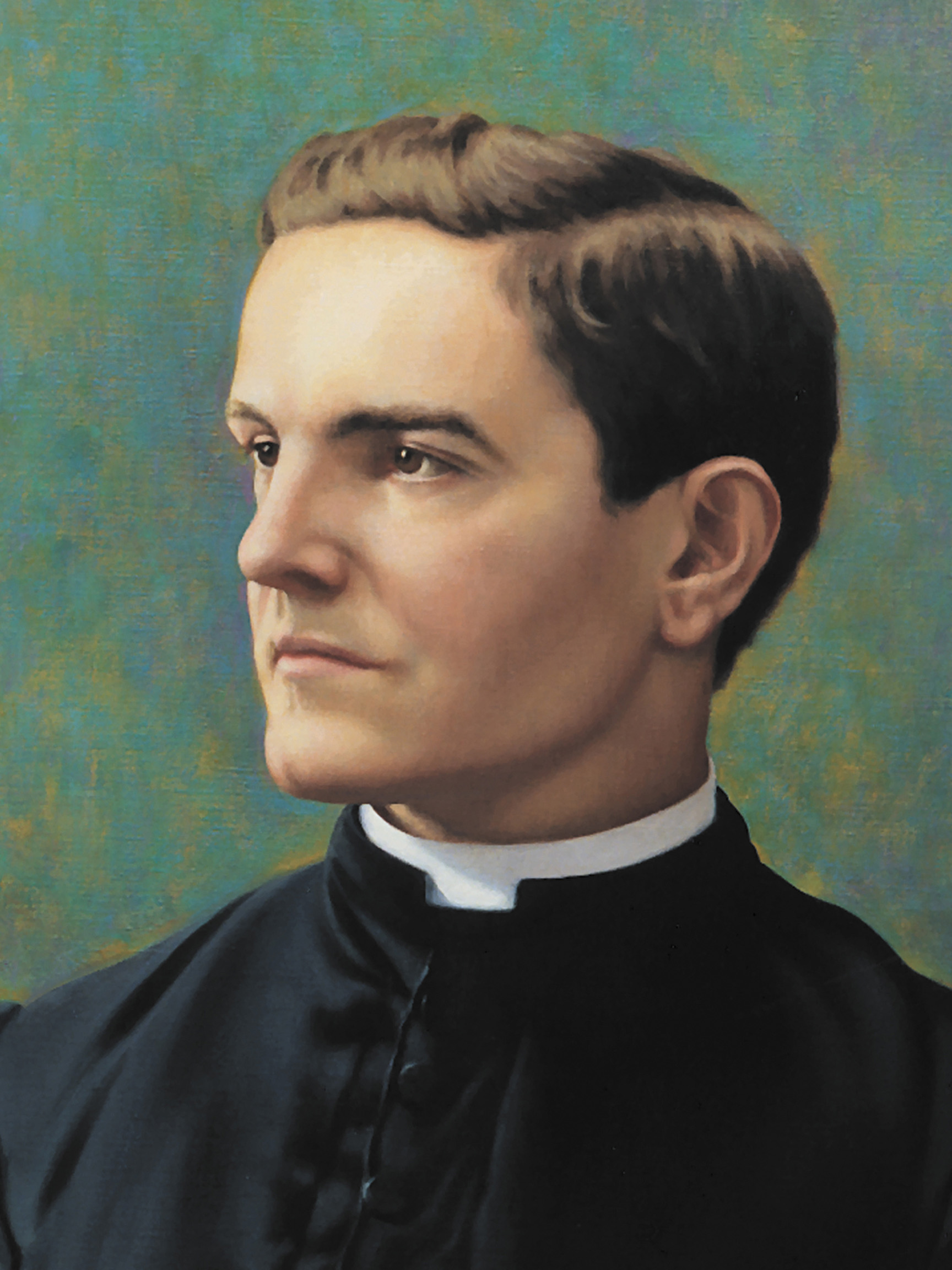
Venerable Father Michael J. McGivney (1852-1890) founded the Knights of Columbus in 1882. (Photo courtesy of the Knights of Columbus)
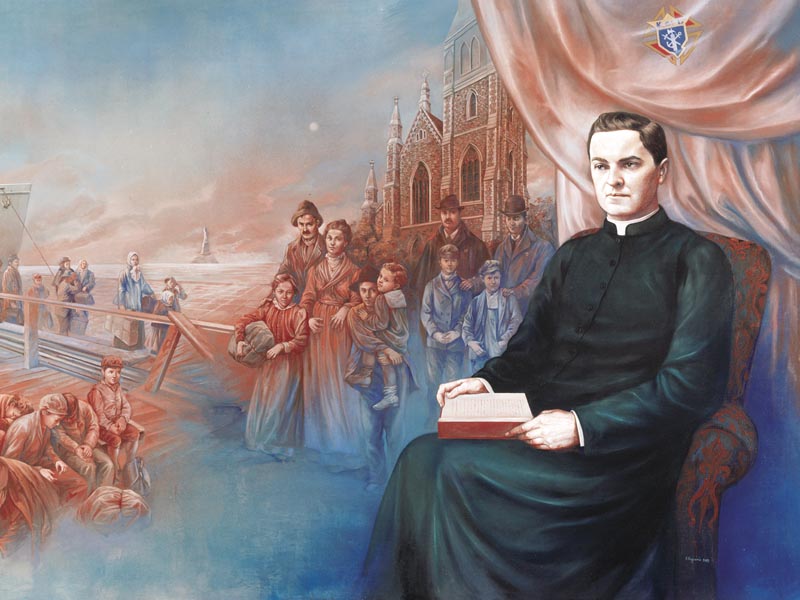
Fr. Michael J. McGivney is depicted in this painting by Antonella Cappuccio. (Courtesy of the Knights of Columbus)
Ven. Father Michael J. McGivney

Born: Aug. 12, 1852
Ordained: Dec. 22, 1877
Founded the Knights of Columbus: March 29, 1882
Died: Aug. 14, 1890
Declared Venerable: March 15, 2008

CAUSE FOR CANONIZATION

Founder’s Day, March 29*

Fr. Michael J. McGivney, the oldest of 13 born to Irish immigrants, was ordained a priest in 1877 for what was then the Diocese of Hartford, Connecticut. Catholics were a minority in New Haven, where Fr. McGivney served as a parish priest, and waves of immigrants were greeted by anti-Catholic sentiments.

Recognizing the struggle of many Catholic immigrants to assimilate into American society and the economy, Fr. McGivney founded the Knights of Columbus as a fraternal mutual aid society in the basement of St. Mary’s Parish. Known for his tireless work for the care of widows and orphans, he died of pneumonia in 1890 at age 38.

Today the Knights of Columbus is the largest lay Catholic organization in the world with 1.9 million members globally and 16,670 members in councils throughout Arizona. He was recognized as “Venerable” by Pope Benedict XVI in 2008.

“Out of love for God’s people, he created the Knights of Columbus as an organization designed to strengthen the faith of husbands and fathers while providing for their families in time of death and bereavement,” said Archbishop William E. Lori of Baltimore, supreme chaplain for the Knights of Columbus at the organization’s annual convention held in St. Louis in 2017.

“Fr. McGivney’s love for the poor, the outcast, the orphan, and the widow remains the true North Star of everything the order does in service to one and in service to all,” he added.

*Although there is no feast day for Ven. Michael J. McGivney, this is the date he is credited with establishing the Knights of Columbus, and is recognized as “Founder’s Day” by the organization. This year it falls on Holy Thursday, and councils are asked to adjust Founder’s Day celebrations to another day so they can fully participate in Holy Week liturgies.

Young Ohio boy’s wish to meet Pope Francis comes true

By Junno Arocho Esteves
Catholic News Service

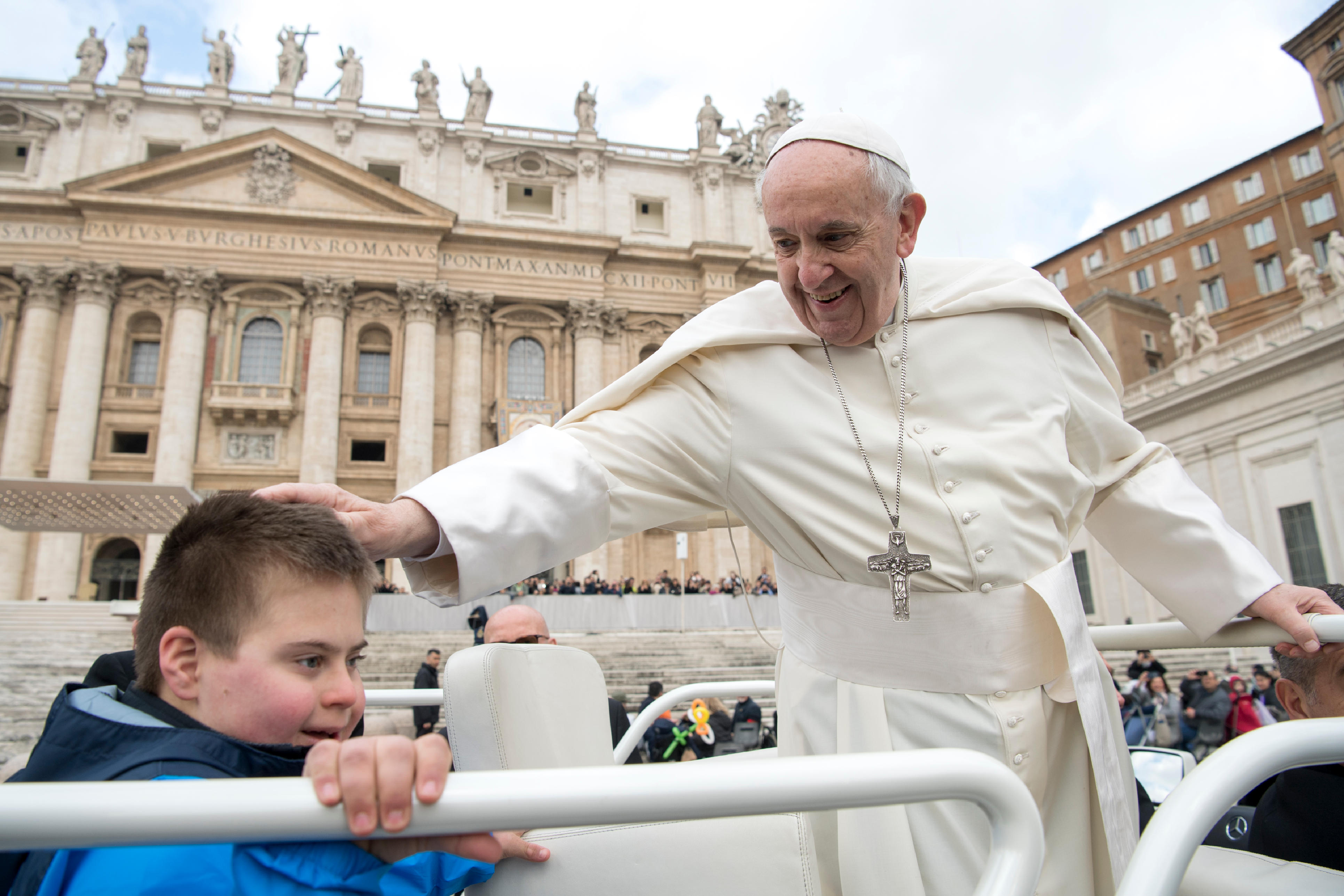
VATICAN CITY (CNS) — While many people hope to catch a glimpse of Pope Francis and greet him, 12-year-old Peter Lombardi got something even better than he imagined.

“Not only did Pope Francis kiss Peter, he asked Peter to ride in the popemobile with him,” Brenda Lombardi, Peter’s mother, told Catholic News Service.

Peter and his family were in St. Peter’s Square March 28 for the pope’s weekly general audience, hoping like most pilgrims to get close to Pope Francis.

First, a security guard lifted Peter over the railing of the popemobile so he could get a kiss from the pope. Then Pope Francis told his security detail to give the boy a seat behind him and, together, they circled the square.

Pope Francis greets Peter Lombardi, 12, of Columbus, Ohio, after the boy rode in the popemobile during his general audience in St. Peter’s Square at the Vatican March 28. Receiving a kiss from the pope was a wish come true for Peter, who has Down syndrome and has survived leukemia. (CNS, via Vatican Media)

“He was gone for like 20 minutes riding with the pope, and the pope kissed him and blessed him,” Lombardi said.

Peter, who has Down syndrome, and his family had been hoping to see the pope in 2015 during the World Meeting of Families in Philadelphia. However, those dreams were dashed when the young boy became ill with leukemia.

While receiving chemotherapy treatment, Peter was watching the papal visit from his hospital room with his family when a representative from the Make-A-Wish Foundation arrived.

His mother said the representative asked, “‘So Peter, what is your make-a-wish?’ And Peter said, ‘I want to be kissed by that man who is kissing all those children on TV,’” Lombardi told CNS.

Along with his wish of greeting the pope, Peter also wished for a lightsaber duel with Darth Vader at Disneyland, a wish the foundation was able to fulfill.

Two and a half years later, after Peter was cured from leukemia, the Lombardi family embarked on a pilgrimage to Rome, Assisi and Medjugorje to thank God for Peter’s healing.

After hearing their story, Mountain Butorac, an American tour guide based in Rome, was able to arrange for the family to stand in the front row to make Peter’s dream come true.

Peter Lombardi, 12, of Columbus, Ohio, rides in the popemobile with Pope Francis during his general audience in St. Peter’s Square at the Vatican March 28. Receiving a kiss from the pope was a wish come true for Peter, who has Down syndrome and has survived leukemia. (CNS, via Vatican Media)

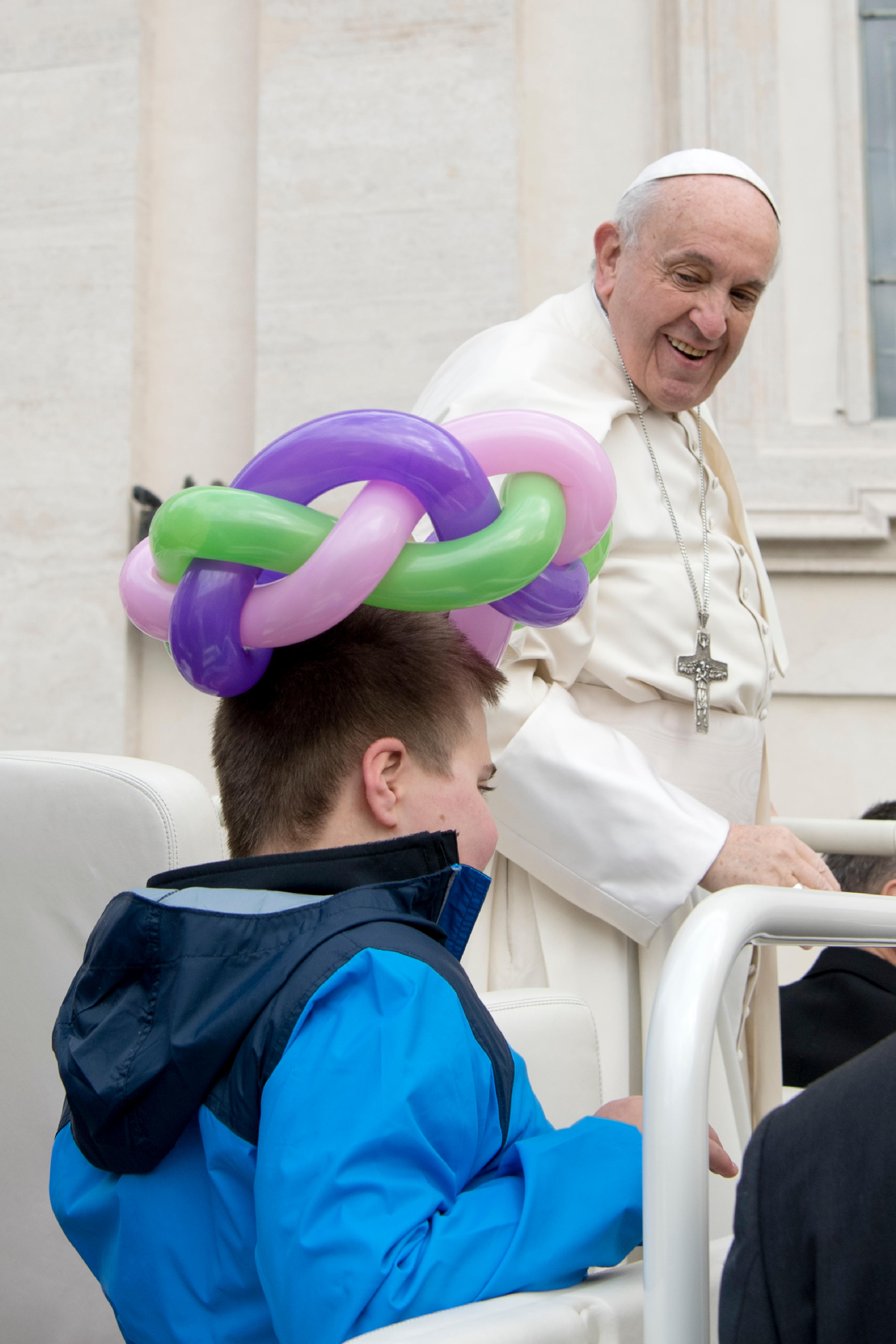
While riding in the popemobile with the boy, Pope Francis was given a balloon shaped into a crown.

Peter said he made one more request in the popemobile.

“(I said), ‘Thank you, pope, give me a balloon,’” Peter told CNS. The pope immediately placed the balloon crown on Peter’s head.

For Peter and his family, the significance of Pope Francis’ gesture wasn’t just a dream come true, but a sign that God had bigger and better plans in store for them.

“That’s how God works, right? We weren’t supposed to see Pope Francis in Philly, we were supposed to see him in the square and Peter was supposed to ride in the popemobile with him. You can’t make this stuff up,” Lombardi told CNS. “So, we thank the Lord for His graces and His mercy.”

Chinese bishop detained briefly during Holy Week

HONG KONG (CNS) — A Chinese bishop was taken away by authorities but was back home the next day, according to a news report.

The Rome-based missionary news agency AsiaNews reported that Bishop Vincent Guo Xijin of Mindong was taken from his home March 26. A source said authorities did not want Bishop Guo, 59, to celebrate the Chrism Mass on Holy Thursday, March 29, because the Mass with all the diocese’s priests would highlight his episcopacy.

Ucanews.com reported on the story from AsiaNews, which said their source noted that authorities were more civilized than on previous occasions and were prepared to hold discussions.

According to AsiaNews, Bishop Guo received a call from his local Administration for Religious Affairs March 26 asking to meet him at his office.

After talks were held for at least two hours, the bishop returned to his home at 7 p.m. to pack his luggage and was take away at 10 p.m. The priest who serves as the bishop’s secretary was also taken away.

https://twitter.com/AsiaNewsEN/status/978552908135456768

Last year, just before Easter, Bishop Guo was also taken away and did not return until 20 days later, ucanews.com reported. He was unable to celebrate his first chrism Mass and was forced to participate in a “brainwashing” class.

Bishop Guo is the bishop of the underground church of Mindong Diocese. He was approved by the Vatican but not recognized by the Chinese government.

It was rumored recently that the Vatican would sign an agreement with China to request Bishop Guo to step down to be an auxiliary bishop, giving way to an illicit bishop, Bishop Zhan Silu of Mindong. Bishop Zhan is recognized by the Chinese government but not approved by the Vatican. Sources say Bishop Zhan would have to pledge his allegiance to the Vatican and seek forgiveness for his illicit ordination before he could be recognized.

Bishop Guo promised to step down, saying that “we can only obey the pope’s decision.”

Victory of Christ

Ilustración de foto por Mick Welsh/SOL CATÓLICO
Photo Illustration by Mick Welsh/CATHOLIC SUN

It was now about noon and darkness came over the whole land until three in the afternoon because of an eclipse of the sun. Then the veil of the temple was torn down the middle. Jesus cried out in a loud voice, “Father, into your hands I commend my spirit”; and when he had said this he breathed his last. The centurion who witnessed what had happened glorified God and said, “This man was innocent beyond doubt.”

— Luke 23:44-47

A Symbol of Victory

In February of 2013, a man spent $92,613 to purchase a bloody sock. The sock was a part of a live auction held at the Fletcher-Sinclair Mansion in Manhattan. This sock was worn by pitcher Curt Schilling in Game 2 of the 2004 World Series on an ankle that had been sutured due to a damaged tendon, and thus, the sock was bloodied during the game.

The only plausible explanation for this behavior is that the man is a baseball fan in general, and/or a Boston Red Sox fan in particular. The Red Sox went on to win the 2004 World Series and break the 86-year “curse” of not having won the championship. You see, to a Boston Red Sox fan, this bloody sock symbolizes victory.

How did the cross, which was a symbol of terrible persecution and shame, a reality so disturbing the Roman orator Cicero said it should not be spoken of publicly, and a death so painful we created a unique word for it (“excruciating” literally “out of the cross”) — become a symbol that early Christians proudly proclaimed? It is because of the One who hung on it, and the victory He won by it.

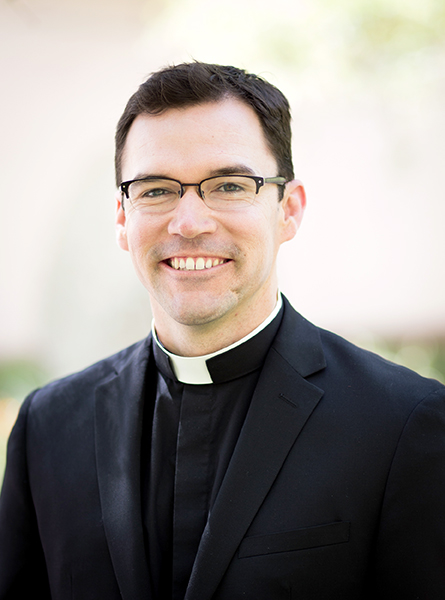
Fr. John Parks is the Vicar of Evangelization for the Diocese of Phoenix.

Jesus is the redeemer of the world. The word redemption means “to buy back.” In ancient times, there were slave markets in which someone could purchase the rights to a slave and then allow them to go free, i.e. to redeem them. Jesus redeems us from the slavery of sin by His death on the cross. His death on the cross is how he “purchased” us from sin, death and the works of Satan so that we might become Children of God living in peace and joy.

A man was willing to pay $92,613 for a bloodied sock because it represented in part the “cost” of Curt Schilling to help win the World Series and a symbol of that victory. When we look at a cross, God proves to us how valuable we are, and it is God’s definitive victory over sin and death on our behalf.

Photo Illustration by Mick Welsh/CATHOLIC SUN

The Resurrection Changes Everything

When I was a first-grader at St. Theresa Catholic School, I was playing one day in the sand box with a fellow student. I was having a great day. I looked up and noticed her looking at me with a grave expression. She said both solemnly and urgently, “There’s a bee on your head.” “What?! Are you serious?” I said hurriedly. “Yes”, she responded. I was frozen in fear as I could feel the bee moving across the back of my neck where my hairline ended. I could not move, paralyzed, waiting for this bee to sting me and ruin my day.

Before the Resurrection of Jesus, death was definitive. No matter how good a person’s life was, they were going to die, and everything that united them to others would be broken. All of humanity was like me as that little boy. No matter how good my day was up to that point, I was going to be stung, and it was going to spoil the day. But after the Resurrection, because Jesus has died for us and come back from the grave, we now know there is a love that is stronger than death itself. Death is now like a bee that has its stinger pulled out. As Dr. Peter Kreeft once remarked, for a Christian, death is no longer a hole you fall into, but now a door you walk through, into eternal life.

Look at how St. Paul says it,

“What then shall we say to this? If God is for us, who can be against us? He who did not spare His own Son but handed Him over for us all, how will He not also give us everything else along with Him? Who will bring a charge against God’s chosen ones? It is God who acquits us. Who will condemn? It is Christ [Jesus] who died, rather, was raised, who also is at the right hand of God, who indeed intercedes for us. What will separate us from the love of Christ? Will anguish, or distress, or persecution, or famine, or nakedness, or peril, or the sword….

No, in all these things we conquer overwhelmingly through Him who loved us.

In Jesus, who has been crucified and raised, we can experience the victorious love of God. A love that is stronger than death itself.