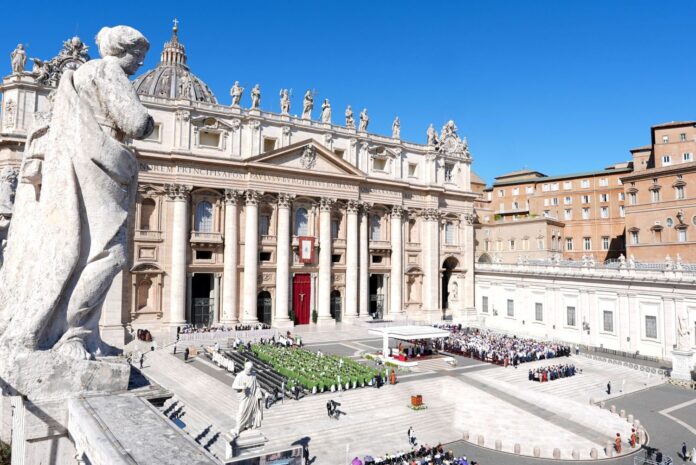
VATICAN CITY (CNS) — Pope Leo XIV announced he will proclaim St. John Henry Newman a doctor of the church Nov. 1 during the Jubilee of the World of Education.
Speaking after Mass Sept. 28 for the Jubilee of Catechists, the pope said St. Newman “contributed decisively to the renewal of theology and to the understanding of the development of Christian doctrine.”
The Dicastery for the Causes of Saints had announced July 31 that Pope Leo “confirmed the affirmative opinion” of the cardinals and bishops who are members of the dicastery “regarding the title of Doctor of the Universal Church which will soon be conferred on Saint John Henry Newman, Cardinal of the Holy Roman Church, Founder of the Oratory of Saint Philip Neri in England.”
St. Newman was born in London Feb. 21, 1801, was ordained an Anglican priest, became Catholic in 1845, was made a cardinal in 1879 by Pope Leo XIII and died in Edgbaston, near Birmingham, England, in 1890.
Even before St. Newman was canonized by Pope Francis Oct. 13, 2019, there were calls for him to be named one of the three dozen doctors of the church — men and women saints, from both the Christian East and West, who are honored for particularly important contributions to theology and spirituality.
The 37 saints currently recognized as doctors of the church include early church fathers such as Sts. Jerome, John Chrysostom and Augustine, and theologians such as Sts. Thomas Aquinas, Bonaventure and John of the Cross, but also St. Therese of Lisieux, who was honored by St. John Paul II in 1997, despite her lack of scholarly achievement.
The Dicastery for the Causes of Saints said 20 bishops’ conferences had petitioned for St. Newman to be declared a doctor of the church, including the bishops of England and Wales, Scotland, Ireland, the United States, Canada and Australia.
“His thought has had a significant impact on 20th-century theology, especially on the Second Vatican Council,” the dicastery said. “Several popes, from Leo XIII to Francis, have drawn from his authoritative teaching in their pontifical magisterium.”
Pope Francis authorized the dicastery to begin the process for the declaration in May 2024 and that September, the Dicastery for the Doctrine of the Faith said that “there were no doubts about the excellence and the quality of the saint’s writings, expressing a completely positive judgment on his ’eminens doctrina’ (eminent teaching).”
Consultants to the dicastery unanimously supported the petition, the dicastery said, as did the cardinals and bishops who are members of the dicastery.
A pilgrimage is more than a journey — it’s a sacred venture in which the pilgrim opens their heart to be changed by an experience of God. Pilgrimage is an integral part of the Jubilee Year. It is an invitation both to a personal journey of the heart, as well as physically visiting places of grace, like the six holy sites around our diocese that Bishop John has designated. More than 2,200 folks have visited these sites and what a blessing it has been not just for them, but for their families and for our entire diocesan community.
But today, I invite us to consider a different kind of pilgrimage: the pilgrimage of life.
In every moment, whether filled with grief or joy, boredom or blessing, we are offered an opportunity to seek the face of God. Personally, I find it easier to reach for God in times of sorrow or elation. Yet, God calls us to seek Him even in — indeed, especially in — the ordinary and mundane. In every single step, God is present and active, longing to walk with us, just as He did with the disciples on the road to Emmaus. (Lk 24:13-35)
This issue of The Catholic Sun focuses on Hope for the Elderly — a hope that is not cheap or easy, but hard-won. It is a hope that has been “put on” like a cloak of grace, weathered by the daily wear and tear of life. Our elderly family members, neighbors and friends are our seasoned pilgrims. Their wisdom has often been formed in the crucible of suffering and deepened by a lifetime of learning to depend on God.
And from that dependence comes a rare and beautiful freedom — a freedom to pour out love, share faith and hand on hope. What a vital role our elders play in our families, our parishes and our world. I witness this in my own life through the remarkable gift of my 98-year-old mother-in-law, Louise.
Louise is the proud mother of five sons, grandmother to eight and great-grandmother to 13. Every single day, she prays for each of them by name, with intention and devotion. But it doesn’t stop there. She is the go-to prayer warrior in her neighborhood and community. Friends from Phoenix often send me intentions to pass along to her, knowing that when she says, “I’ll pray for you,” it isn’t a polite phrase — it’s a sacred promise.
I see this same spirit in our Angels of Hope prayer circle, a new initiative where faithful men and women, many elders themselves, gather together in fellowship to lift up intentions from across our diocese with prayerful hope. Their ministry is hidden but powerful, a beautiful act of spiritual mercy. You can be one of them by joining this mission of intercession — becoming a quiet pillar of prayer for those in need.
In addition to powerful intercessory prayer, Louise also knows suffering. Life has not been easy. Yet she sees the face of God in every person and in every circumstance. Her faith is not only a comfort — it is a conduit of God’s presence. In prayer, she listens to God and then hands on His love with a powerful, maternal tenderness.
Hope in the elderly is real. Louise, with her walker and her rosary, is walking, living proof.
Let us honor our elders. Let us learn from them. And let us walk our own pilgrimages — opening our hearts to be changed every step of the way by an always-present God.
St. John Bosco Catholic School in Phoenix celebrated the momentous occasion of being recognized as a 2025 National Blue Ribbon School this week (Sept. 26) with a school-wide assembly, community prayers of thanksgiving and a sweet on-theme treat: Blue Ribbon ice cream bars.
The nomination was the first in the school’s history and St. John Bosco (PreK-8) was the only private-school honoree from Arizona this year.
The National Blue Ribbon Schools (NBRS) Program honors schools for exceptional achievement. For non-public schools, eligibility requires that student performance in the most recent tested year places the school in the top 15-percent nationally in reading/English language arts, and mathematics on a nationally normed assessment. As the federal program sunsets in 2025, the St. John Bosco community was part of its final cohort of nominees.
“We are profoundly grateful to our teachers and staff for their unwavering excellence; to our students for their hard work and joy; and to … our parents for [their] partnership and trust,” said Principal Jamie Bescak.
“Together, we live our mission of forming faith-filled leaders with strong minds and generous hearts.”
The 3rd Annual Catholic Night at Chase Field was a huge success on Friday evening (Sept. 19), as the Dioceses of Phoenix and Tucson came together for a night of faith, family and fun. The faithful were well represented throughout the stadium, with more than 3,400 tickets sold — an all time high for the popular event. Five dollars from every ticket went toward Catholic School Support 365.
Our Lady of Mt. Carmel Catholic School in Tempe, Ariz., which is celebrating its 80th anniversary this year, had three students from their school join Bishop John Dolan on the field prior to the game for the ceremonial first pitch. Plans are already under way for next year’s Catholic Night.
VATICAN CITY (CNS) — Pope Leo XIV prayed that the leaders of nations would use money and resources to promote the common good rather than using “wealth against humanity” by “turning it into weapons that destroy peoples or monopolies that humiliate workers.”
“Whoever serves God becomes free from wealth; but whoever serves wealth remains its slave,” the pope said Sept. 21 in his homily in the Vatican’s parish Church of St. Anne.
“Whoever seeks justice transforms wealth into the common good,” the pope said, and “whoever seeks domination turns the common good into prey for their own greed.”
The day’s Gospel reading was Jesus’ parable of the dishonest steward from Luke 16:1-13. It ends with Jesus saying, “No servant can serve two masters. He will either hate one and love the other or be devoted to one and despise the other. You cannot serve both God and mammon.”
At both the morning Mass in the small church located just inside Vatican City State and in his midday Angelus address with thousands of pilgrims and visitors in St. Peter’s Square, Pope Leo urged Catholics to consider their relationship to money and material goods.
He also used his Angelus address to thank Catholic organizations holding prayer vigils for peace and raising money for humanitarian aid to Gaza.
“I appreciate your initiative and many others throughout the Church that express closeness to our brothers and sisters who are suffering in that tormented land,” Pope Leo said. “Together with you and with the pastors of the churches in the Holy Land, I repeat: There is no future based on violence, forced exile or revenge. The people need peace; those who truly love them work for peace.”
A group of people in the square were holding a colorful banner that said, in Italian, “Peace for Gaza.” The pope’s call for an end to the violence was met with applause.
At the Mass earlier in the Church of St. Anne, staffed by his Augustinian confreres, the pope prayed that parishioners would “persevere with hope in a time seriously threatened by war.”
“Entire peoples today are being crushed by violence — and even more so by a shameless indifference that abandons them to a fate of misery,” the pope told parishioners. “Faced with these tragedies, we do not want to be resigned, but to proclaim in word and deed that Jesus is the savior of the world, the one who delivers us from all evil.”
Pope Leo prayed that the Holy Spirit would convert hearts “so that, nourished by the Eucharist — the church’s supreme treasure — we may become witnesses of charity and peace.”
Later, in his Angelus address, the pope said Jesus’ parable “invites us to ask ourselves: How are we managing the material goods, the resources of the earth and our very lives that God has entrusted to us?”
Each person must make a choice, he said. “We can follow the way of selfishness, placing wealth above all else and thinking only of ourselves. But this isolates us from others and spreads the poison of competition, which often fuels conflict.”
On the other hand, he said, “we can recognize everything we have as a gift from God, to be managed and used as an instrument for sharing — to create networks of friendship and solidarity, to work for the common good and to build a world that is more just, equitable and fraternal.”
VATICAN CITY (CNS) — The strength of families and their ability to thrive and witness as a “domestic church” require support from the wider church and from governments, particularly in the face of poverty, Pope Leo XIV said.
“We are aware that today there are real threats to the dignity of the family such as poverty, lack of employment, lack of access to health care, abuse of the most vulnerable, migration and wars,” the pope told a group of Latin American church representatives Sept. 19.
The Latin American bishops’ council, the Pontifical Academy for Life and the John Paul II Pontifical Theological Institute for Marriage and Family Sciences brought the representatives to Rome Sept. 17-19 for a shared Jubilee Year reflection on “the future of life and the family” in Latin America.
“Both public institutions and the church have the responsibility to seek ways to promote dialogue and strengthen the aspects of society that support family life and the education of its members,” the pope told the group.
“‘Jubilee,’ in the Old Testament, evoked the idea of return: returning to the land, to the original condition of free people, to the origins of God’s justice and mercy,” he said.
For Catholics this year, the pope said, the Jubilee should be a strong push to return to God and to placing God at the center of one’s life.
“The Jubilee also invites us to think about our roots,” he said, and “the faith we received from our parents, the persevering prayers of our grandmothers as they fingered the beads of the rosary, their simple, humble and honest lives which, like leaven, sustained so many families and communities.”
In Jesus, he said, “we find our true joy: the jubilation of knowing we are at home, in the place where we belong.”
The family is “both a gift and a task,” Pope Leo told the group. “It is essential to foster shared responsibility and the active role of families in social, political and cultural life, promoting their valuable contribution to the community.”
The family also is called “to be a domestic church and a home where the fire of the Holy Spirit burns, spreading its warmth, bringing its gifts and experiences for the common good, and calling everyone to live in hope,” the pope said.
Pope Leo entrusted his prayers to the intercession of the Holy Family, “the perfect model that God offers in response to the desperate cry for help from so many families. By imitating them, our homes will become living torches of God’s light.”
Bishop John Dolan addresses the 10th anniversary Magnificat Meal of the ministry’s Phoenix chapter at St. Helen Parish in Glendale, Ariz., Saturday, Sept. 13. Photo by Jeff Grant for THE CATHOLIC SUN
Sarah Morris loves her Catholic faith.
She attends Mass at St. Thomas the Apostle in Phoenix and enjoys worship and the fellowship of the faithful. But she needed a spiritual connection to others like her: a vehicle that would bring the companionship of Christian women, particularly other Catholics.
“I think [as a culture] we’re disconnected [and] the Internet is ‘no bueno,’” she said, sitting at a table with several other women last Saturday at St. Helen Parish in Glendale, Ariz.
“It’s really fulfilling … to meet other women who are like-minded and alike spiritually,” she continued.
Morris was at St. Helen for the 10th anniversary Magnificat Meal, the signature event of the Magnificat Ministry’s Phoenix chapter.
Founded in 1981 by a group of Catholic women in the Archdiocese of New Orleans who saw the need for a faith-sharing experience in a relaxed social setting, Magnificat Ministry now has more than 80 active chapters throughout the U.S. and the Virgin Islands, and a dozen international chapters.
Morris has attended the meals for several years after receiving an online invitation. It was an instant blessing.
“It’s the fellowship. I love the music. You get to know new women from [different] parishes, make acquaintances and maybe some friendships,” Morris said.
Eventually, she became part of the chapter’s service team.
“That built the relationships,” she explained. “… by serving and praying together. It brings you closer to the Lord when you realize there are other people like you.”
Morris was in her “faith and fellowship” element at the event, greeting visitors, joining in conversation, prayer, singing, laughing and growing in her Catholic walk.
Over 175 men and women attended.
Along with lunch, conversation and worship, they were blessed with a special presentation from Bishop John Dolan.
The chapter, named “Mary: Cause of Our Joy”, held its first meal on Sept.19, 2015, also at St. Helen. Over the years, it has hosted meals at 14 different parishes.
“I join you on this gracious day, to celebrate the 10th anniversary of the Magnificat chapter of the Diocese of Phoenix, where it first started,” said Fr. Mark Nyeko, A.J., St. Helen’s parochial vicar. Fr. Nyeko was standing in for pastor Fr. John Ssegawa, A.J., the chapter’s spiritual adviser, who was out of town.
“This association was able to bring women of different parishes together to share meals, their faith and the Gospel news,” Fr. Nyeko said. “We thank God, who has made this possible. And we thank all of you, the women, who have committed yourselves to this movement to share your life, living for Jesus and following the model of the Blessed Virgin Mary.”
Magnificat Ministry’s purpose is “to help Catholic women open more and more to the Holy Spirit through a deeper commitment of their lives to Jesus as Lord and to impart the Holy Spirit to one another by their love, service and sharing the good news of salvation.”
The Phoenix chapter began inviting men several years ago.
A private association of the Christian faithful, Magnificat chapters operate under the authority of the local ordinary — the bishop or archbishop. (Canon 305.2, 1983 Code of Catholic Canon Law)
The ministry is named for Mary’s prayer of praise while visiting her cousin, Elizabeth, recorded in St. Luke’s Gospel.
After learning from the angel Gabriel that God had chosen her to give birth to the Messiah, Mary went to her cousin with the joyful news. Elizabeth, pregnant herself with John the Baptist, greeted Mary, with the words, “Blessed are you among women, and blessed is the child you will bear!” (Lk 1:42)
To which Mary responded, “My soul magnifies the Lord, and my spirit rejoices in God my savior,” the Magnificat prayer’s opening verse.
Centuries later, ever-developing technology has connected people electronically. But that historic journey, bringing together two women of deep faith and obedience to God is an example that both fosters friendship and spiritual growth, a personal exchange for which there is no substitute, said Magnificat leaders and participants.
“Mary traveled two and a half days,” said chapter coordinator Maureen Kight. “People come here [to these meals] with burdens. But for these two and a half hours, they visit with others, listen to music, enjoy food and are inspired by the speaker.”
Bishop Dolan did not disappoint.
Using a notebook-size portrait of the early Italian Renaissance artist, Bl. Fra Angelico, the bishop discussed Fra Angelico’s use of linear perspective to tell an entire story in a single frame. He encouraged the gathering to similarly open their entire lives to God.
“[After the Annunciation] Mary opened herself to the Lord in a way she hadn’t before,” he explained. “That’s, in essence, what I’m hoping you will achieve over course of this day, and if you should participate in Magnificat, that you would [do so] with that sense of perspective, where you are able to magnify the Lord in your life as you live.”
Kight endorsed that call.
“Mary always points us to her Son. Let this be a day we open our hearts and enjoy the gift of being sons and daughters of the Father,” she encouraged the group.
Or, as chapter founder Laurie Walsh, a St. Helen parishioner, put it, “We proclaim the greatness of the Lord, and we exalt in God, our savior.”
Walsh recounted how she had sought God’s guidance in her life in late 2009, after a large brain tumor prompted her to retire from her job. Following its successful removal, she asked Him to open to her His vision for the next chapter of her life.
“I had to figure [He] saved my life for some reason,” she said. “I knew God wanted to use [me and my husband] in something.”
Her prayers were answered in early 2010 during a charismatic Catholic conference, when someone dropped a Magnificat Ministry flier in her lap.
The following five years were spent meeting requirements to set up the chapter in Phoenix and receiving God’s confirmation — from getting St. Helen pastor, Fr. Ssegawa, to be the chapter’s spiritual adviser, to obtaining a free supply of tablecloths for each meal from a Valley linen company.
“Mary cares about these things,” Walsh said, smiling broadly. “Where she is, joy is.”
The “Mary: Cause of Our Joy” chapter hosts four meals a year at different parishes. The next event will be in mid-December at St. Elizabeth Seton parish in Sun City, Ariz.
St. Frances Xavier parishioner Goldie Byerly hopes to be there.
Sitting at one of the tables following the bishop’s address, Byerly reflected on her outreach to Hispanics as a mental health minister and the challenge of following God without healthy human fellowship.
The gathering impressed her. She’s going to invite others.
“In the Hispanic community, you don’t always know what’s [available]. [But] if you don’t attempt, you don’t know what’s going on. [Here], you pray together. You feel like you’re not walking alone.”
More than 180 priests from across the Diocese of Phoenix gathered in Flagstaff, Ariz., this week for the annual Priest Convocation, the largest number of priests to ever attend. The four days of prayer, fellowship and formation carried the theme “The Priesthood of Tomorrow; For the New Millennium” and featured several presentations on the Diocese of Phoenix’s historic and fully local Nazareth Seminary.
As Arizona’s population has risen steadily, fueling growth in the Diocese of Phoenix, there has been an increase in need for new projects. It’s a busy time in the diocesan Office of Buildings and Properties, which serves the demographic of more than 2 million Catholics.
“There is a lot of development going on all over the place,” noted Sr. Mary Pierre Jean Wilson, RSM, director of Buildings and Properties. “We have a list of almost 100 projects, large and small, that are in some phase of planning, including new buildings and renovations.”
The mission of the Office of Buildings and Properties, which stewards local building projects in the diocese, one of the nation’s fastest growing in the U.S., remains dependable whether the next building project is a church, school or agency.
“Our whole purpose is to help [the diocese] achieve [its] goals and get whatever [it needs] built,” said Tim Ward, assistant director for Construction.
The Office of Buildings and Properties carries the mission to support the technical, administrative and fiscal responsibilities of the diocese in the areas of real estate, construction, renovations, facility management and loss prevention, serving as a procedural liaison for parishes, schools and agencies.
In sum, the Buildings and Properties team assists in new building construction, major maintenance projects, renovations and emergency repairs throughout the nearly 44,000-square-mile diocese.
Among the projects currently in construction at various points are:
A new event center and gym expansion at Seton Catholic Preparatory High School in Chandler, Ariz. The school broke ground April 30 on the project. When completed next October, the two-story, 50,000-square-foot building will house a new gymnasium, brand new athletics rooms, film rooms and locker rooms. With the current gym constantly overbooked by Seton’s many athletics teams, the new space will enable athletes to practice at more reasonable hours of the day.
St. Henry Parish in Buckeye, Ariz., is working on a new catechesis center that it plans to open in the fall of 2026.
Construction of a brand-new church is continuing at St. Rose Philippine Duchesne Parish in the Anthem community in north Phoenix. At present, the parish celebrates Mass in its Spirituality Center, which hosts numerous other activities. The church, which also will allow for uninterrupted eucharistic adoration, is expected to open around Easter 2026.
“They’re beyond excited at St. Rose,” Ward observed.
Sagrado Corazon in Valle, Arizona
And in northern Arizona, far from the diocese’s population center, but not from the heart of diocesan staff, plans for a new church are unfolding in the small town of Valle, Ariz. (population 759), 27 miles south of the Grand Canyon.
Sagrado Corazon (Spanish for “Sacred Heart”) is continuing to raise money for its own church building. About 150 worshippers have been participating in Mass in a makeshift chapel inside a machine shed since 2010, their humble setting reflecting the people’s humble spirit.
Sagrado Corazon in Valle, Arizona
“They just want a little church,” said Sr. Mary Pierre. “It’s exciting to see the desire of this little community to nourish their Catholic faith through worship in a setting worthy of the Lord.”
The community is now in the design phase for a structure with proper insulation, plumbing, restrooms and a sacristy. A donor gifted the community a 1-acre parcel of land and the community was able to purchase an adjoining 1-acre parcel. The diocese assisted in coordinating with ADOT and Coconino County for planning to provide an access road.
The Office of Buildings and Properties is also continuing to oversee the upgrades needed to make the remainder of Bishop John Dolan’s vision of a new, local seminary a reality. Nazareth Seminary incorporates an innovative “homestyle” model through four houses throughout the Valley where seminarians will study and be formed in small communities in a home-like setting.
This summer, renovation began on the final of the four houses. Work on the 75-year-old rectory of St. Agnes Parish in Phoenix, where 12-15 seminarians will live in early years of formation, is scheduled for completion in time to open in fall 2026. St. Agnes House will join St. Gregory House in Phoenix, Our Lady of Perpetual Help House in Scottsdale, Ariz., and St. Mary’s House in downtown Phoenix to form the fully local Nazareth Seminary.
The diocese currently has a record 55 seminarians in formation.
The Buildings and Properties office is eyeing other areas of potential work, as well.
“The parish of Our Lady of Guadalupe is looking to build a new church in Queen Creek,” Sr. Mary Pierre said, “as the community has far outgrown their current church.”
The St. Williams community, who lost their church to a fire in May 2024, are looking forward to a new church as well. They are currently squeezing into a chapel on Lower Buckeye Road. Both parishes often have people outside the building for Mass.
Several other locations could be added to the list — though no decisions have been made — as demand emerges for worship space.
For example, in northwest Peoria, where about 150 people are regularly attending Mass in a school gymnasium in the Vistancia development, Sr. Mary Pierre noted.
In Tonopah, a much smaller group is worshipping on a dairy farm.
No project, of course, starts without confirmation of a reliable, sustainable funding source. The office works closely with the diocesan Finance Office to ensure that requirements are met on each project.
“We make sure we’re not overextending a parish but ensure they get what they need,” said Joni Kimel, Construction project coordinator.
The abundance of facts, figures, studies and processes for this office belies the human element and spiritual blessing each member experiences.
“There are so many different types of people,” she continued. “We enjoy getting to know them. We develop a close relationship with them and see how important the work is to them.”
The variety of their work makes it vibrant, added Ward.
“There are absolutely no two days alike,” he said. “Over the course of my career prior to coming here, I was a building owner, general contractor and architect. This job requires every ounce of experience I’ve ever had, and it is all being applied.”
New leaders, ample experience
While some of the Buildings and Properties leadership team is new, they are not unfamiliar with the terrain.
Led by canon lawyer and civil engineer, Sr. Mary Pierre Jean Wilson, R.S.M., the diocese’s Buildings and Properties office includes industry veterans with the experience needed to help parishes, educators and agency officials navigate all aspects of the construction process.
A member of the Religious Sisters of Mercy of Alma, Mich., Sr. Mary Pierre earned her canon law degree in Rome and worked at the Vatican for seven years. She served in the Congregation for Catholic Education, a dicastery of the Roman Curia that oversees education and formation of Catholics.
An outgrowth of the order founded in Ireland in 1831 by Catherine McAuley, the Religious Sisters of Mercy of Alma are committed to living out their charism of mercy through various ministries, primarily in education and health care.
Since Sr. Mary Pierre is also a civil engineer, when the diocese needed someone to temporarily take over as director of Buildings and Properties a year and a half ago, she was tapped for the role. A month later, she was asked to stay on as the office’s permanent director.
The office also has a new director of Construction.
Zach Kilgas, a 25-year industry veteran who has held various positions throughout his career in the private sector, including project manager, principal and project architect, began his present role in April.
Ward, also a licensed architect, began with the office in late March as assistant Construction director. Ward worked in the private sector as a project manager, owner and director of construction, director of design and partner and several other roles over a 45-year career.
Kimel is a nearly 15-year employee of the diocese.
The team is small but mighty, and it joyfully serves the Diocese of Phoenix.
“God had all this planned out years ago,” said Ward. “Everybody in the building has faith in mind, and we’re excited and want to do good things for others. That in itself is very motivating.”