
Companions on the journey

Bishop Steven R. Biegler of Cheyenne, Wyo., is seen in this 2017 file photo during the fall general assembly of the U.S. Conference of Catholic Bishops in Baltimore. (CNS photo/Bob Roller)

By Bishop Steven R. Biegler, Catholic News Service
This is the official logo for the XVI Ordinary General Assembly of the Synod of Bishops. Originally scheduled for 2022, the synod will take place in October 2023 to allow for broader consultation at the diocesan, national and regional levels. (CNS photo/courtesy Synod of Bishops)

The call to be companions on the journey is prophetic. At a time when society is becoming more fractured, we are invited to discern how we might “walk together” more intentionally. Pope Francis posed this question prior to the war in Ukraine. Now the scenes of horrific violence and distressed people fleeing their homeland incite all humanity to ask: “How can we walk together as brothers and sisters?”

Nearly a year before the war erupted, the synodal document was formulated with that question in mind. In the synod, we are asked to recall how Jesus walked together with people, then to reflect on whether we are imitating his closeness to people.

The “vademecum” poses these questions: “In our local Church, who are those who “walk together?” Who are those who seem farther apart? How are we called to grow as companions? What groups or individuals are left on the margins?” (Vademecum, 5.4).

Pope Francis reminds us that Jesus was constantly reaching out to people on the margins. In the preparatory document for the synod, he wrote, “the work of evangelization and the message of salvation would not be comprehensible without Jesus’ constant openness to the widest possible audience, which the Gospels refer to as the crowd … Jesus’ interlocutor is the “people” of ordinary life, the “everyone” of the human condition, whom he puts directly in contact with God’s gift and the call to salvation.” (Preparatory Document, 18).

We need to constantly reflect on our fidelity to the mission of Christ. The synodal process calls us to step back and ask: Are we proclaiming the gospel to the widest possible audience? Are we journeying together with the people of ordinary life, like Jesus who attended to lepers, the blind, the crippled, and the poor? He told the parable of the good Samaritan because he did not want us to leave anyone alone on the side of the road.

Therefore, Pope Francis has asked us to hold gatherings for every facet of society. He is inviting all the baptized to participate in the synodal process, but he also wants us to listen to the “crowd,” including people who have left the practice of the faith, people of other faith traditions, or of no religious belief. We should be mindful of including those who may risk exclusion: women, the handicapped, refugees, migrants, the elderly and people living in poverty.

You might ask, “How could we ever accomplish such an all-encompassing participation in the synod?” Do not fret. This is not a time to complete the task, but a time for planting seeds. As stated in the preparatory document, “This synodal process need not be seen as an overwhelming burden that competes with local pastoral care. Rather, it is an opportunity to foster the synodal and pastoral conversion of each local Church so as to be more fruitful in mission.” The goal is to nurture the synodal journey as a way of life, not to complete it.

We are invited to be creative. For example, the Diocese of Cheyenne, Wyoming, has begun a conversation with the Eastern Shoshone and the Northern Arapaho people on the Wind River Indian Reservation. We are seeking to promote respectful interaction between Native Americans and other residents of Wyoming, so that we might learn from them and understand their perspective, to encourage ally building between the church and existing organizations. The process will take decades.

Over the past seven months, we have participated in Zoom meetings including diocesan leaders and Native Americans regarding the topic of boarding schools. Then we gathered in-person for an experiential session on intergenerational trauma titled “Repairers of the Breach,” which involved a historical review of government policies and boarding schools. Most importantly, we listened to Native Americans recount how this has adversely affected multiple generations. The experience gave everyone greater understanding and a deeper sense of solidarity.

In an analogous way, Catholics should see the synod as a kairos event to nurture “walking together,” not only in the Church but also in society. The synodal process can be a leaven for respectful listening as our nation addresses racial inequalities, the impasse over immigration, and other contentious political issues. What if we viewed the synodal process within the Church as a way of modeling respectful listening, which contrasts the political discourse often poisoned by angry partisan sentiments?

Then we would accomplish the goal which Pope Francis proposed when he said that the synod is intended to stimulate trust, to bind up wounds, to weave new and deeper relationships, to learn from one another, to build bridges, to enlighten minds, warm hearts, and restore strength to our hands for our common mission (PD, 32).


Pope tells Russian patriarch they are not ‘clerics of the state’

Father Visvaldas Kulbokas, center, serves as translator as Pope Francis and Russian President Vladimir Putin exchange gifts during a private audience at the Vatican in this July 4, 2019, file photo. In an interview with the Italian newspaper Corriere della Sera, published May 3, 2022, Pope Francis said he would like to go to Moscow to meet Vladimir Putin in an attempt to end the conflict in Ukraine. (CNS photo/Paul Haring)

By Carol Glatz, Catholic News Service

VATICAN CITY (CNS) — Warning that the Russian Orthodox patriarch should not “turn himself into Putin’s altar boy,” Pope Francis also said he would like to go to Moscow to meet Vladimir Putin in an attempt to end the conflict in Ukraine.

The pope reiterated that he would not be going to Kyiv “for now,” but “I first must go to Moscow, I must first meet Putin,” he said in an interview with the Italian newspaper, Corriere della Sera, published May 3. Vatican News also published most of the interview.

Pope Francis said he sent a message through Cardinal Pietro Parolin, Vatican secretary of state, “20 days after the war” started, to be delivered to Putin telling him, “I was ready to go to Moscow.”

“We still have not had a response, and we are still being persistent, even though I am afraid Putin may not be able to and may not want to have this meeting right now,” the pope said. “I am doing what I can. If Putin were to open the door. …”

“But so much brutality, how do you not try to stop it? We saw the same thing with Rwanda,” he said, referring to the genocide against members of the Tutsi minority ethnic group in 1994, when at least 500,000 people were killed in about 100 days.

Pope Francis also provided more details about a video call he had with Russian Orthodox Patriarch Kirill of Moscow in mid-March. “I spoke with Kirill for 40 minutes via Zoom. He spent the first 20 minutes holding a piece of paper reading all the reasons for the war.”

“I listened to him, and I told him, ‘I don’t know anything about this. Brother, we are not clerics of the state, we cannot use the language of politics, but of Jesus. We are shepherds of the same holy people of God. That is why we must seek the path of peace, to cease the blast of weapons,'” he said.

“The patriarch cannot turn himself into Putin’s altar boy,” he said.

The meeting that had been planned between the pope and patriarch in Jerusalem June 14, and has since been canceled, had nothing to do with the conflict in Ukraine, the pope said. But even the patriarch now sees that any kind of meeting of theirs could send “an ambiguous sign.”

Patriarch Kirill has been an outspoken supporter of Putin’s war on Ukraine, and the Vatican’s diplomatic team believed such a meeting could lead to “much confusion,” Pope Francis had told La Nación, the Argentine newspaper, in an April 21 interview.

When Russia invaded Ukraine Feb. 24, the pope called Ukrainian President Volodymyr Zelenskyy, he told Corriere della Sera.

“Instead, I didn’t call Putin. I had heard from him in December for my birthday, but this time, no, I didn’t call him,” he said. He explained that he preferred to make a more “clear gesture that the whole world could see and that is why I went to the Russian ambassador” to the Holy See, Aleksandr Avdeyev, Feb. 25.

He said he asked the ambassador “that they explain, (and) I told him, ‘Please, stop this.'”

The pope said the conflict is not just affecting the Donbas region, but there is also “Crimea, it is Odesa — it is taking away the port of the Black Sea from Ukraine, it is everything. I am a pessimist, but we must do everything possible so that the war can end.”

“There is not enough will for peace. The war is terrible, and we have to shout out” against it, he said.


Catholic University names street in honor of Sister Thea Bowman

Students from St. Anthony Catholic School in Washington attend the dedication and blessing of Sister Thea Bowman Drive at The Catholic University of America April 29, 2022. Sister Bowman, who died in 1990, is one of six Black Catholics who are candidates for sainthood. Her sainthood cause was opened in 2018 and she has the title "Servant of God." (CNS photo/Tyler Orsburn)

By Richard Szczepanowski, Catholic News Service

WASHINGTON (CNS) — Officials at The Catholic University of America dedicated and blessed a campus street April 29 named in honor of the late Sister Thea Bowman, a noted educator and evangelist who studied at Catholic University and whose cause for canonization was opened in 2018.

“During her life, Sister Thea was a shining example of religious life, and she worked for social justice, racial equality and harmony among all peoples, especially in the Catholic Church,” said Washington Cardinal Wilton D. Gregory who blessed the new Sister Thea Bowman Drive. “We are pleased to dedicate this street in her honor as a reminder that her life’s work still continues in the church and on this campus today.”

Sister Thea died in 1990 from bone cancer at the age of 52. When she was 15, she entered the Franciscan Sisters of Perpetual Adoration, becoming the first and only African-American member of her order. When she took her vows as a nun, she changed her name from Bertha Bowman to Mary Thea Bowman, and pursued studies at Catholic University where she earned a master’s and doctorate degree in English.

For more than 15 years, Sister Thea was an educator on the high school and college levels. She then began her ministry as an evangelist, traveling the United States to urge priests, bishops and her fellow Catholics to accept her and other African Americans as “fully Black and fully Catholic.”

In addition to her evangelization work, Sister Thea helped found the National Black Sisters Conference to provide support for African-American women in religious life. In 1987, she also helped produce “Lead Me, Guide Me: The African American Catholic Hymnal,” the first such hymnal for African-American Catholics.

“While she went home to God more than 30 years ago, the impact of Sister Thea Bowman’s life is still felt in our own time,” Cardinal Gregory said in blessing the street next to the university’s Columbus School of Law. “By her words and example, she challenged everyone to follow the command of the Lord Jesus to love God with all of our heart and our neighbors as ourselves.”

Among those attending the dedication ceremony was D.C. Mayor Muriel Bowser, who called the late nun “an extraordinary woman of faith.”

Mayor Bowser, who grew up in and continues to attend nearby St. Anthony of Padua Parish said that whenever anyone sees the newly named street, “they will be inspired to do more and to be better.”

The street dedication was recommended by the university’s Sister Thea Bowman Committee, which was formed to promote racial diversity on the campus and the wider community.

“In recognition of Sister Thea’s contributions and lasting impact as a religious sister, as an educator and as the conscience of the church, the university thought it important to honor her in a permanent and visible way by naming a street after her,” said Regina Jefferson, a professor of law at the university’s Columbus School of Law and chairperson of the Sister Thea Bowman Committee.

“We hope that the Sister Thea Bowman Drive will serve not only as a visible tribute to Sister Thea, but also as a constant reminder to each of us to … work together to make positive and meaningful change in our lives, our communities and the world,” she said.

Aaron Dominguez, the university’s provost, praised Sister Thea as “our righteous inspiration.”

“We celebrate Sister Thea by dedicating this road to her, a strong, Black Catholic woman who is in the process of navigating the path toward sainthood in the Catholic Church and whose legacy continues to call us to walk a road of solidarity and unity as one human family,” Dominguez said.

Kelly Woodson, a senior who spoke at the dedication, noted that “the displaying of street names reflects the identification and location of property. Many are aware that Black people were seen as property.” She said Sister Thea’s message was contrary to this emphasizing that no one should be seen as a thing, but instead as “the image and likeness of God’s love.”

“It is imperative that we look to individuals like Sister Thea Bowman to understand that our brothers and sisters — no matter race, creed, religion, ethnicity, etc. — are a part of our lives,” Woodson said.

The motherhouse of the Franciscan Sisters of Perpetual Adoration in La Crosse, Wisconsin, sent a letter that was read during the dedication ceremony, that said they hoped that as people “move along Sister Thea Bowman Drive, you move with love and joy.”

“May the love and joy you bring here today by dedicating this street to Sister Thea spread to the next street and the next street and the next,” the sisters wrote. “May the blessing of the Lord be upon you and all who journey on this road and the path to justice.”


Years of searching culminate in conversion and the birth of a future bishop

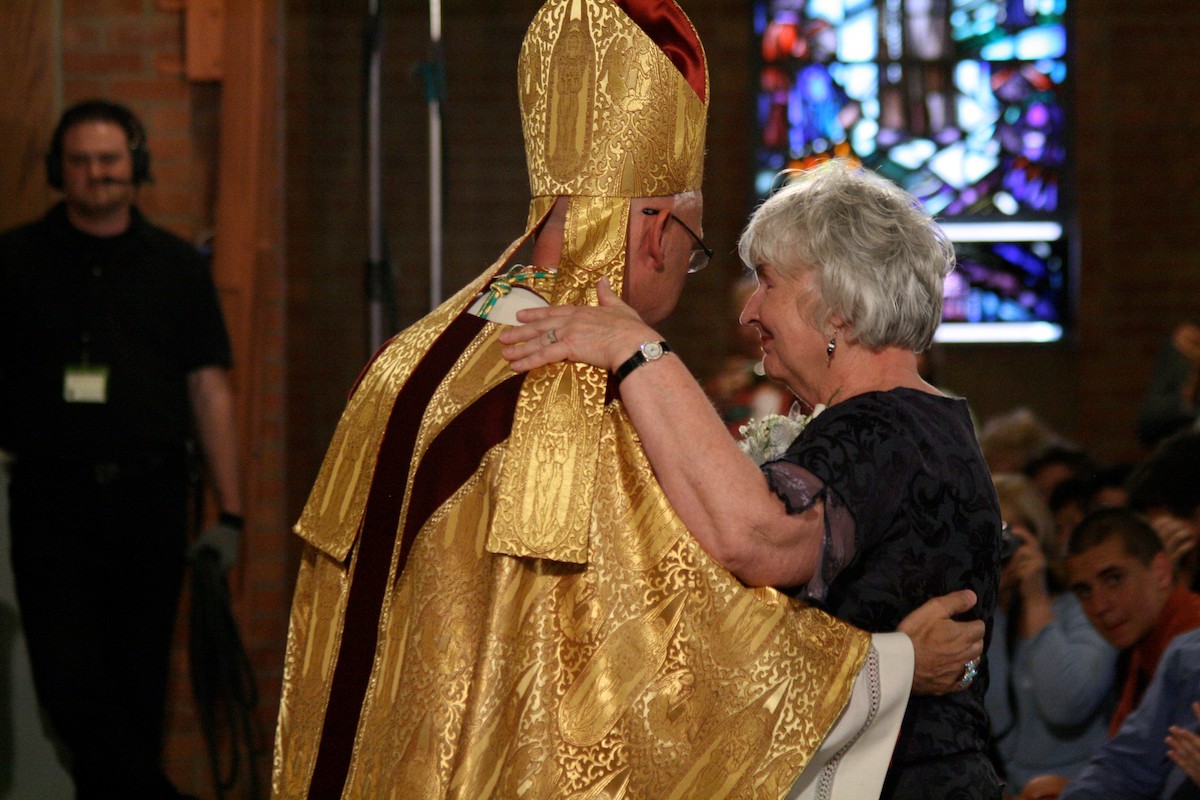
Bishop Jim Wall embraces his mother, Joan, on the day of his episcopal ordination.

By Joyce Coronel, Together Let Us Go Forth ~ Juntos Sigamos Adelante Magazine

Sitting in her quiet front room inside a modest home on a tree-lined street in Chandler, Joan Wall, mother of Bishop James S. Wall of the Diocese of Gallup, describes an early glimpse inside the Catholic Church. She was 11 years old at the time.

Raised as a Methodist in La Grande, Oregon, she recalls there was just one Catholic church in town.

 “I was always kind of fascinated by Catholics because, well, what were they doing?” Joan says. “I remember one time walking home and the door was kind of open. I peeked in, and it looked really different than my Methodist church did.”

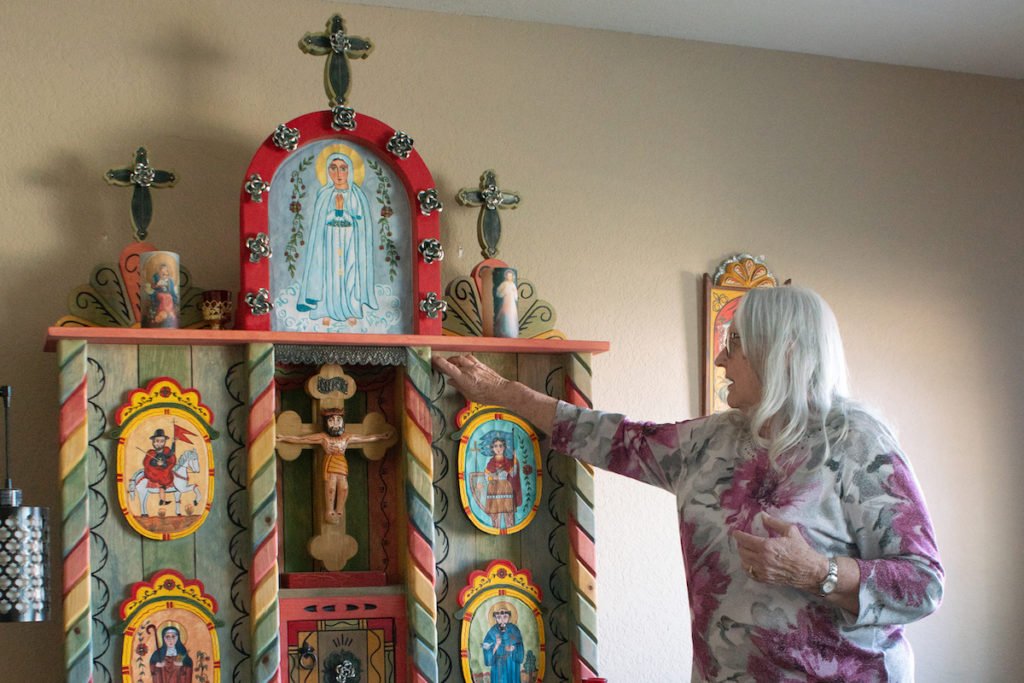
Joan Wall describes elements of the retablo in her living room.

 An elder cousin Joan idolized was married in the Catholic Church. “I thought it was so interesting that she had the courage to become Catholic,” she says with a laugh. “But she seemed very happy with it.” The couple went on to have nine children.

And then came Joan’s college years at Western New Mexico University. “There were maybe only one or two Catholics,” Joan says, but she found someone else who was fascinated by the Catholic religion.

“So, we went down to the Catholic church and met the priest and talked to him a little bit about becoming Catholic. We never went back, but I do remember him explaining the Trinity with a shamrock. It was the first time I’d ever heard it explained that way.”

A few months later, Jim Wall, the man who would one day become her husband, asked her out on a date. James Wall, Sr., would go on to become a high school teacher, plus a track and football coach. He died in 1999.

“It turned out that he really liked the Catholic Church, and he went every Sunday evening with his friends and had the whole time he’d been in college and while he was in the Marine Corps,” Joan says. The couple married later that year in a ceremony at Joan’s home, with a Methodist minister presiding.

For a while, after the wedding, the couple attended a Catholic church. “And then I was ready to go one Sunday, and my husband said, ‘Oh, I think I’ll sleep in,’ and that was the end of it.” By the time they had two children, Joan says she told her husband the children needed to learn about God. For a short stint, Joan took them to an Episcopal church.

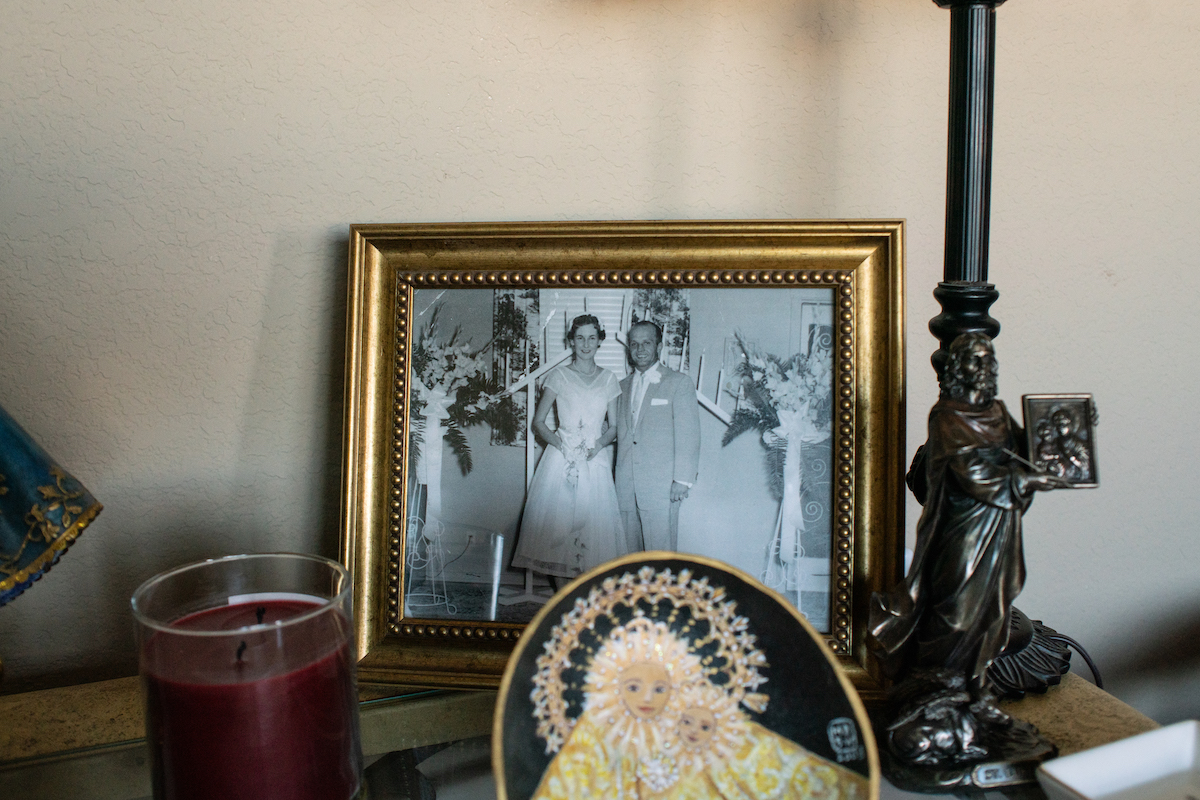
James and Joan Wall’s wedding photo sits on the mantel.

National tragedy sparks conversion

Then came the move to Chinle, Arizona, the center of the Navajo Nation. It was the early 1960s, and Jim was hired as a teacher and coach at the public high school. The assassination of President John F. Kennedy in November 1963 deeply affected Joan.

 “I remember watching his funeral on TV, and I thought, ‘I need to be a Catholic. That’s just the only thing there is.’ It just called to me, and I said to my husband, ‘When we get back home, do you care if I go to the Catholic church and ask a priest to come talk to us?’ And he said, ‘That would be fine.’” The couple had three children at the time.

 She didn’t even know where the Catholic church was in Chinle, but she looked it up and got directions to Our Lady of Fatima Church from a friend.

“There’s a road leading up to it, and you just didn’t really see it from the road if you weren’t looking for it, so I went up there.”

Finding the door of what seemed to be the rectory, Joan knocked and then stood, waiting.

“This priest answered. And I said, ‘You know, I wondered, would it be a problem if you came and talked to my husband and me about the Catholic Church?’ ‘Oh,’ he said. ‘Yes, I’d be glad to.’ And later I realized, that’s what they live for, those things.”

Once a week, Father Ivo Zircabach came and sat at the dining room table with Joan and Jim, explaining the faith. He kicked off the catechesis by delving into the mystery of the Eucharist. Joan says the young priest’s explanation finally addressed a nagging question she’d posed to her Methodist Sunday School teacher years earlier.

“We were reading John where Jesus says, ‘You have to eat My flesh and drink My blood or you do not have Me in you,’ and the people all just left. And I said to my Sunday School teacher, ‘Why didn’t He go after them and say, ‘No, no, I just mean that as a symbol.’” The teacher replied that she didn’t really know, and Joan had always wondered about it.

“Well, Father Ivo, on our first night, he started with the Gospel of John, and he explained that, in the Catholic Church, that really is the body and blood of Christ. And it’s like, ‘Oh. This is the pinnacle of everything and so all the rest of it must be true. I don’t know what it is, but I think I’m ready to do this.’ The question I had for 10 or 12 years was finally answered.”

Bishop Jim Wall embraces his mother, Joan, on the day of his episcopal ordination.

Future shepherd

It was during these months of instruction that Joan became pregnant with the baby who would one day become Bishop James S. Wall. Because they weren’t sure that Joan had been validly baptized earlier in life, she and her husband received the sacrament of Baptism on Holy Thursday in 1964. They were confirmed three weeks later when Bishop Bernard Espelage of the Diocese of Gallup visited Our Lady of Fatima Church.

A few months later, the couple welcomed their youngest son.

Born a few weeks early in October 1964, the future bishop of Gallup, James S. Wall, nearly died within the first hour of life. He was baptized in the hospital where he was born.

Joan told her son after he became a priest: “You know, you didn’t stand a chance. You had so much grace poured out on you!”

Joan and her husband eventually had six children in all, three sons and three daughters.

When her son, then-Father Jim, received the news he had been appointed bishop of the Diocese of Gallup, he called Joan to tell her he needed to see her. The pair had lunch at Liberty Market in downtown Gilbert, the same spot Joan and her husband stopped for groceries when they first arrived in the East Valley decades previously.

The news of her son’s elevation to bishop was stunning, Joan notes.

“He told me, and I thought my heart was going to stop. And he said he thought for a minute he’d killed his mother,” Joan chuckles.

So what kind of child was Bishop Wall growing up? 

“He was just a run-of-the-mill kid growing up,” Joan says with a laugh. She pauses, thinking back.

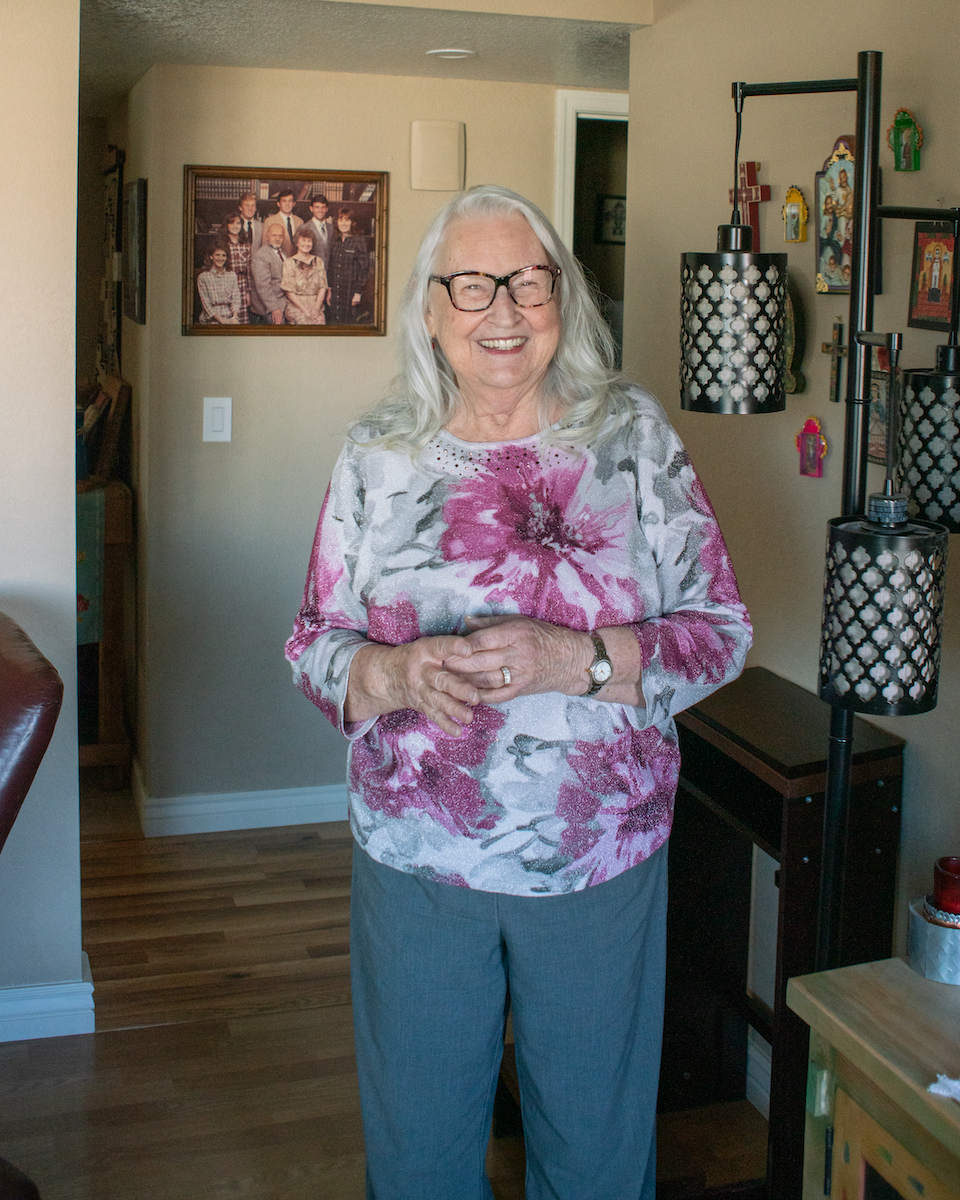
Joan Wall pictured in her Chandler, Ariz. home.

“He did do one thing that nobody else did. He used to get my old Bible that I’d gotten in the fifth grade from the Methodist church, and he would go out in the backyard. He would have church, and he’d be the priest. He’s the only one of all of them who ever did anything like that.”

And just how did she manage to raise a young man who would eventually bear the miter and crozier?

“We always gathered for dinner every night,” Joan says. “I just think that is one of the biggest things you can do for your family is all gather together at least once.” They prayed grace before meals, and Joan says she and her husband made sure the children attended religious instruction classes, then known as CCD (Confraternity of Christian Doctrine).

In the end, though, Joan cautions, “It’s up to God. But I think the biggest thing is, you honor priests, and you honor the Church. Maybe you’re unhappy about something and you talk about it, but you don’t let your kids hear you running the Church down.

“I think if eventually they’re called, the ground will be fertile there so they can do it and feel comfortable about doing it.”

We invite you to participate in discipleship and evangelization efforts at the Diocesan level, including the Together Let Us Go Forth ~ Juntos Sigamos Adelante campaign, the Charity & Development Appeal, the TV MassCatholic School Support 365, and through supporting our seminarians and Nazareth House. If you would like to receive the magazine at your home, we invite you to support the mission by participating in one of these efforts. You may also call our donor services team at (602) 354-2235 to receive future issues or provide one of our team members with an updated address.

Haitians head to Mexico-U.S. border; church seeks humanitarian help

A young Haitian migrant girl traveling with her parents, seeking to reach the U.S., stands outside a temporary shelter at a church in Ciudad Juarez, Mexico, Dec. 20, 2021. The Diocese of Nuevo Laredo has issued and urgent appeal for assistance as hundreds of Haitian migrants arrive in the oft-violent city hoping to apply for asylum in the United States when Title 42 ends in May. (CNS photo/Jose Luis Gonzalez, Reuters)

By David Agren, Catholic News Service

MEXICO CITY (CNS) — A Mexican border diocese has issued an urgent appeal for assistance as hundreds of Haitian migrants arrive in the oft-violent city of Nuevo Laredo, hoping to apply for asylum in the United States.

The Diocese of Nuevo Laredo warned of a “humanitarian crisis” in its April 29 appeal, saying in a brief message: “A large number of Haitian migrants have arrived in our city, and our brothers need our help.” The diocese asked for donations of personal hygiene items, masks and medicines.

“In Nuevo Laredo, all the shelters are being saturated,” said Father Eduardo Monsivais, diocesan spokesman. A migrant shelter run by the Scalabrinians normally can host 200 migrants, Father Monsivais said, but the crush of new arrivals is such that the diocese is repurposing a building to provide temporary housing.

The arrival of migrants in Nuevo Laredo, which borders Laredo, Texas, comes as the U.S. government prepares for the lifting of Title 42 May 23. Title 42 was imposed as a pandemic policy in March 2020 and allowed for migrants to be quickly returned to Mexico without being able to petition for asylum.

Advocates for increased border enforcement and members of the Biden administration expect the number of migrants and asylum-seekers arriving at the U.S. border to increase after more than two years of restricted access to the asylum process.

Homeland Security Secretary Alejandro Mayorkas told Congress April 27, “We expect migration levels to increase as smugglers seek to take advantage of and profit from vulnerable migrants.” The secretary also said: “Our department has been executing a comprehensive strategy to secure our borders and rebuild our immigration system.”

Catholics working with migrants on the U.S.-Mexico border and in Latin America also expect more migrants to arrive at the border with the removal of Title 42.

“Word of any policy considered even slightly favorable will spread,” said Jesuit Father José Luis González, coordinator of the Jesuit Migrant Network, Central America and North America.

Economic conditions had worsened in many countries, Father González said. “Two years of putting a break on migration due to health measures is now going to provoke a large flow” of migrants, he added.

The Tamaulipas state government said in a statement that some 529 Haitians with permission to be in Mexico had arrived in Nuevo Laredo.

In mid-April, Tamaulipas and three other border states reached agreements with Texas Gov. Greg Abbott to ease the slowing of border checkpoints. Texas had started inspecting trucks crossing the U.S.-Mexico border, causing economic losses in both Texas and Mexico.

Father Monsivais said the Haitians arrived in Nuevo Laredo from Monterrey, 140 miles southwest, where shelter space was scarce.

Many Haitians have been stuck in Tapachula, near the Mexico-Guatemala border. Most of the Haitians had arrived in Mexico after spending time in South America and had not been in the Caribbean country for more than a decade, according to Catholics who work with migrants.

Some 14,000 Haitians arrived at the Texas border town of Del Rio in September 2021. Advocates say the Haitians arrived at Del Rio, in part, to avoid security issues in Nuevo Laredo, where drug cartels kidnap and prey up on migrants.

“Migrants here are often in danger due to the violence here in the city,” Father Monsivais said. They have to take risks to at least be protected in a shelter.

An October 2020 report from Doctors Without Borders found that three-quarters of the asylum-seekers it treated in Nuevo Laredo were victims of kidnapping.


Jesus renews love for life, pope says

Pope Francis greets people as he leads the "Regina Coeli" from the window of his studio overlooking St. Peter's Square at the Vatican May 1, 2022. The pope appealed for peace in Ukraine and called the suffering of vulnerable elderly and children a "macabre regression of humanity." (CNS photo/Vatican Media)

By Junno Arocho Esteves, Catholic News Service

VATICAN CITY (CNS) — When disheartened and disappointed in life, Christians can rest assured that the risen Christ brings hope and the courage to begin anew, Pope Francis said.

“When our nets are empty in life, it is not the time to feel sorry for ourselves, to have fun, to return to old pastimes,” the pope said May 1 before praying the “Regina Coeli” prayer with pilgrims in St. Peter’s Square.

“It is time to begin again with Jesus; it is time to find the courage to begin again,” he said. “It is time to put out to sea again with him.”

Reflecting on the Sunday Gospel reading from St. John, which recounted the resurrected Christ’s appearance to his disciples by the Sea of Galilee, the pope said Christians, like the disciples, can be disheartened with life and look for other ways to find meaning.

“This can happen to us, out of tiredness, disappointment, perhaps out of laziness, to forget the Lord and to neglect the great choices we have made, to content ourselves with something else,” the pope said.

Not spending time with family or forgetting to pray can lead Christians to be “wrapped up in our own needs” and only find “that very disappointment that Peter felt, with empty nets, like him.”

Yet, in that moment, Jesus appears again and does not scold but instead “invites them as before, to cast their nets again courageously,” the pope said.

Upon realizing that it was Jesus on the shore, he continued, St. Peter’s gesture of diving into the water to meet him was a “gesture of love” that renews his zeal and proved his “newfound enthusiasm.”

Jesus “invites us to a new impetus — everyone, each one of us — he invites us to dive into the good without the fear of losing something, without calculating too much, without waiting for others to begin,” the pope said.

Just as Christ asked three times if St. Peter loved him, Pope Francis said Jesus also asks Christians the same question because “faith is not a question of knowledge, but of love.”

“Jesus asks you, me, us, who have empty nets and are afraid to start out again, who do not have the courage to dive in and have perhaps lost our momentum,” he said.


Pope denounces ‘macabre regression of humanity’ in Ukraine

A local resident walks past a heavily damaged church in Mariupol, Ukraine, April 28, 2022. (CNS photo/Alexander Ermochenko, Reuters)

By Junno Arocho Esteves, Catholic News Service

VATICAN CITY (CNS) — Renewing his appeal for peace, Pope Francis said he grieves for the suffering of the Ukrainian people, especially given reports of children and the elderly being forcibly deported to Russia.

After praying the “Regina Coeli” prayer with pilgrims gathered in St. Peter’s Square May 1, the pope said that “terrible reports of children being expelled and deported” have caused him to “suffer and weep.”

“And while we are witnessing a macabre regression of humanity, I wonder, along with so many anguished people, if peace is truly being sought; whether there is the will to avoid a continued military and verbal escalation; whether everything possible is being done to silence the weapons,” he said.

Ukrainian officials have accused Russia of deporting thousands of Ukrainian men, women and children to Russia from the besieged port city of Mariupol.

Iryna Vereshchuk, deputy prime minister of Ukraine, said an estimated 40,000 Ukrainian citizens were moved to camps in Russian-controlled territories, BBC News reported.

As Russian forces overrun Mariupol, Ukrainian authorities are racing against time to evacuate civilians sheltering in a steelwork factory in the city. Although some Ukrainians were able to escape, evacuations have been difficult due to Russia’s continued bombardment of established humanitarian corridors.

Speaking to the pilgrims gathered in the square, the pope called for the safe evacuation of civilians trapped in the Azovstal steel plant and urged Christians to “pray the rosary for peace every day” during the Marian month of May.

“Today is the beginning of the month dedicated to the Mother of God,” he said. “My thought goes to the Ukrainian city of Mariupol, ‘the city of Mary,’ barbarically bombed and destroyed.”

Before leading pilgrims in a moment of silent prayer, Pope Francis appealed for an end to the war and expressed his hope that “the path of dialogue and peace be taken.”

“I beg you, let us not surrender to the logic of violence, to the perverse spiral of weapons,” the pope said.


Catholic immigration advocates push for reform on Capitol Hill

Participants of the Raices y Alas gathering are seen during Mass at the Basilica of the National Shrine of the Immaculate Conception in Washington April 27, 2022. (CNS photo/Martin Soros via USCCB)

By Rhina Guidos, Catholic News Service

WASHINGTON (CNS) — Leaders in Hispanic Catholic ministry who gathered in Washington April 26-30 for a national meeting used the occasion to head to the halls of Congress in between meetings to push lawmakers on some form of relief on immigration.

“Citizens and noncitizens alike, we are brothers and sisters in the eyes of Jesus Christ, and our current immigration system is burdensome, expensive, inefficient and far too often creates human suffering,” said Auxiliary Bishop Mario E. Dorsonville of Washington April 27 on the grounds of the U.S. Capitol.

Along with other bishops and leaders in ministry gathered for the sixth Raices y Alas (Roots and Wings) national congress in Washington, Bishop Dorsonville asked lawmakers to use their political power and responsibility to “address these issues” that force millions to live in hiding except when it comes to contributing with their work to the welfare of the nation.

Bishops and other people of goodwill in the United States have been advocating for a just and comprehensive immigration reform but to no avail, he said.

“We come in prayer to ask members of Congress, Republicans and Democrats, to work together to create solutions,” he said. “Immigration reform cannot wait any longer.”

Representatives Dan Newhouse, R-Wash., and Salud Carbajal, D-Calif., joined the Latino Catholic leaders at the event at the Capitol.

Both politicians have worked on the Farm Workforce Modernization Act, which seeks legal status for farmworkers, seeks reforms to the H-2A agricultural guest worker program and “creates a first-of-its-kind, merit-based visa program specifically designed for the nation’s agricultural sector.”

But each approached it from a different point of view.

“We need a system that stops rewarding illegal behavior,” Newhouse said, who also seemed to support some type of immigration help for “children, who through no fault of their own,” were brought into the U.S. illegally as minors.

But any bill would also have to support measures to strengthen national security and secure the southern border, he said.

“I’m so tired of empty promises and I’m sure you are tired of that, too,” he said. “We have to have a system that works for the business (sector), farmers and ranchers … and for our immigrants.”

Carbajal said that while the two had differences in certain areas of policy, they agree on the importance of finding solutions.

“We might have a few differences coming from different parties, but I think we have more in common than differences on immigration reform,” he said. “I think we have found common ground and believe that certainly it’s appropriate to secure our borders, but we should also fix our broken immigration system.”

Channels that previous immigrants, “our forefathers and mothers who came to this country,” had used are broken, creating a bottleneck, Carbajal said.

He thanked the Catholic ministers for organizing a day of advocacy between meetings, urging them to reach out to lawmakers from both sides of the aisle.

“This shouldn’t have to be a partisan issue,” Carbajal said. “We should be able to work together.”

Andrea Anaya-Sandoval spoke about the urgency she feels when it comes to immigration reform. Though she’s temporarily protected as a recipient of the Deferred Action for Childhood Arrivals immigration policy, she said there’s no permanent solution in sight for what will happen when she graduates from college in a couple of years.

“It’s been disheartening for young people like me to see how little has been done” when it comes to immigration reform, she said. “I stand before you today because I’m tired of the promises … I’m exhausted from waiting around for legislators to decide whether I am good enough.”

Also present at the event, Emilce Cuda, Secretary of the Pontifical Commission for Latin America, said “immigrants are not tourists,” but rather they contribute to countries as workers and shouldn’t be discarded by society.

She asked that they be provided better social conditions to survive and thrive in their adoptive countries.

Elisabeth Román, president of the National Catholic Council for Hispanic Ministry, which organized the Raices y Alas gathering, said the organization picked Washington as the site of the event so the more than 400 members from more than 38 states could advocate for matters of social justice, which includes immigration, and to speak for essential workers who kept the country moving during the pandemic.

“We came here with our pastors, our bishops and not for partisan politics,” she said. “That’s why we stood here with a Republican and a Democrat because there are Catholics on both sides of the aisle.”

She urged Latinos in the country who are U.S. citizens to use their voting power.

“What is happening … is unacceptable,” she said. “And it’s time to do something.”


Pope very clear victim care centers must be set up, cardinal says

Boston Cardinal Se·n P. O'Malley, president of the Pontifical Commission for the Protection of Minors, listens as Pope Francis speaks during a meeting with members of the commission at the Vatican April 29, 2022. (CNS photo/Vatican Media)

By Carol Glatz, Catholic News Service

VATICAN CITY (CNS) — Pope Francis has given his safeguarding commission a “very clear” mandate to encourage and supervise the world’s bishops’ conferences in establishing survivor support centers and services, said Cardinal Seán P. O’Malley of Boston, president of the Pontifical Commission for the Protection of Minors.

“The Holy Father wants us to ensure that survivors receive a welcome and an open door when they appeal to the local church in their country. Outreach to survivors needs to be a priority for every part of our church,” he said April 29.

He said, “We will be working on establishing survivor support services at the level of each national church according to the instructions found in ‘Vos Estis Lux Mundi,'” the 2019 papal document which established procedures for reporting allegations of sexual abuse and for holding accountable bishops and religious superiors who protect abusers.

The cardinal and other members of the papal commission spoke to reporters during a news conference at Vatican Radio immediately after their audience with Pope Francis. The commission was holding its plenary assembly in Rome.

Cardinal O’Malley said the pope “stressed that he wants us to have that responsibility to supervise, promote, encourage and report back to him on the progress that is made in fulfilling the mandates of ‘Vos Estis,'” he said.

Oblate Father Andrew Small, secretary “pro tempore” of the papal commission, told reporters it “seems to be the first time the commission has a formal role that’s been identified by the Holy Father in ‘Vos Estis,'” concerning the establishment of “centers of welcome, of healing, of understanding that were mandated” by the Vatican summit of heads of bishops’ conferences in 2019.

Another mandate the pope gave the safeguarding commission was to provide an annual audit of what the church is doing to protect minors and what needs to change. The annual report, which includes what the Roman Curia has been doing, is part of creating greater transparency and accountability, the pope has said.

Father Small said the pope told them that these reports will be part of their job to oversee, supervise and encourage the local churches and to report everything back to the pope, including “where things aren’t going well so that they can be improved.”

Transparency and accountability require “some sort of objective record, some sort of third-party verification that what we say is happening in safeguarding is actually happening” and to “evaluate whether we are getting better or not,” he said.

The idea of auditing reports “has been clearly working in the financial sector” so providing verifiable data “in the safeguarding sector seems to be the only way to rebuild trust,” he said.

“‘Trust, but verify,'” he said.

The reports also will be a good way to consolidate into one place all the positive and effective efforts that have been made, he added.

When asked whether the annual reports would be made public, Father Small said their job is to provide its work to the Holy Father, who, ultimately, “has the last word” on what would happen to them.

“I can’t imagine a world in which the report would not be published,” he said, because the pope linked the report as being instrumental in rebuilding “public trust.”

Juan Carlos Cruz, a survivor of sexual abuse and a member of the papal commission, thanked reporters for not succumbing to media or “societal fatigue” of the problem of abuse in the church.

It was important that the media continue to tell the stories of survivors — “those who were, those who are, those who will come because, unfortunately, this has not ended,” he said.

He said one of the services he hoped the centers would be able to provide survivors at some point would be the latest information about the status of their abuse case in the church because the lack of information about their allegation often re-traumatizes people.

“Vos Estis” provides for the first time a universal law that states that the victim has a right to be advised of the outcome of the investigation concerning crimes allegedly committed by people in leadership.

Cruz said he sometimes hears church leaders say, “Haven’t we done enough?” to which he replies, “No, we are going to follow up until the bitter end.”

Also, he said, the three-year “ad experimentum” norms of the 2019 “Vos Estis” document does not mean “it’s time for it to finish.” It means “it is going to be perfected.”

Cruz expressed how he feels when he hears about Catholics who publicly declare they have left the church because of the sexual abuse scandals.

He said his goal in being honest about the problems and what needs to be done is not to get people to leave the church; it’s “quite the opposite.”

“I’m staying in the church even though they said to me, ‘You’re not worthy of this, you’re not worthy of that.’ But I have stayed in the church because I am Catholic. I am proud of my religion, of my faith,” he said.

Pope Francis, he said, has helped him feel like a “sort of Lazarus, like I’ve resurrected from a really bad place” and now he is trying to help the church from within and would like others to help, too.

“We want people to gain trust, we want accountability in the church and we want things to change for everybody,” he said.


Pilgrims seek St. Junipero Serra’s intercession for California

San Francisco Archbishop Salvatore J. Cordileone blesses Hope Waterman, Matthew Geier, John Paul Hanson and their banner during their journey April 14, 2022. They walked more than 800 miles in the footsteps of St. Junipero Serra on a Lenten pilgrimage to pray for California that spanned the 46 days from Ash Wednesday to Easter Vigil. (CNS photo/Valerie Schmalz, Archdiocese of San Francisco)

By Valerie Schmalz, Catholic News Service

SAN FRANCISCO (CNS) — A trio of young adults and their dog Laika walked more than 800 miles in the footsteps of St. Junipero Serra on a Lenten pilgrimage to pray for California in the 46 days from Ash Wednesday to the Easter Vigil.

Hope Waterman, 27, Matthew Geier, 27 and John Paul Hanson, 24, began walking after the 7 a.m. Ash Wednesday Mass at the first mission, Mission San Diego de Alcalá in San Diego. They concluded in time for Easter Vigil in Sonoma, north of San Francisco, where the 21st and northernmost California mission was founded by the Franciscan friars.

“I wanted to do something for several years to pray for California,” said Waterman, who was inspired to make the pilgrimage to ask the intercession of St. Junipero Serra who founded California’s mission system.

The idea came to Waterman as she was praying with 40 Days for Life in October 2020 in Lander, Wyoming, as the widespread desecration and vilification of St. Junipero Serra’s statues and reputation in California was making headlines. Statues in San Francisco, Los Angeles and San Rafael were among several that were vandalized and the saint’s reputation criticized. The state of California removed a statue of the saint from the State Capitol in 2021.

“The thing I could do to bring about the radical reconversion of California was to pray to the man who brought the faith to California in the first place and to walk the missions of California as a prayer and penance for the salvation of California,” said Waterman, an emergency medical technician in Wyoming who grew up in California and in Texas. “I decided to do it in Lent and start off on Ash Wednesday.”

Waterman met Geier, a park ranger at Chino Hills State Park near Los Angeles and a musician with a medieval and renaissance ensemble, when she was scouting and planning the pilgrimage earlier this year. Geier like the idea and his boss agreed, giving him six weeks off.

Hanson was a childhood neighbor and is a family friend who up until two days before the expedition was undecided. “I meant to say no,” said Hanson when Waterman called him in Irving, Texas, to learn of his final decision, “and somehow I said yes.”

Waterman’s dog Laika, named for the Sputnik canine who was the first to orbit the earth in 1958, made up the pilgrimage’s fourth participant.

The controversy surrounding St. Junipero Serra has been years in the making, with critics saying he took part in the oppression of the native people by the Spanish empire.

Pope Francis canonized the saint during his visit to Washington in 2015.

The 21 missions, beginning with the first one founded by St. Junipero in San Diego in 1769, are integral to the state, Geier said.

“It’s to try to restore a proper appreciation for the missions as a foundation of California. This place was such a deeply Catholic place. The whole society of our state has grown up around these missions,” he said.

Because of his commitment to the reputation of the saint and to California’s Catholic heritage, San Francisco Archbishop Salvatore J. Cordileone met with the trio soon after they arrived in San Francisco Holy Thursday. He blessed their pilgrimage, their banner and various religious articles, praising the initiative which he called “blazing the trail for what I think we should be doing here, a Camino California.”

For Hanson, Geier and Waterman, it was quite a journey: sun, rain, sore feet and a rosary together every night. “Unless we fall asleep during the rosary,” Hanson said.

Most nights they camped out, but in a few cases, members of the informally organized California Mission Walkers put them up and several nights they stayed in hotels.

The three walked everywhere, refusing rides because Father Serra always walked. They also only stayed indoors at places that would allow dogs.

“It’s really fun,” Geier told Catholic SF, the magazine of the Archdiocese of San Francisco. “The three of us have been on the road for six weeks. Both John Paul and I had never been backpacking before.”

He said people have offered them a lot of things and although it was humbling to be on the receiving end, he said it was “encouraging to see so much kindness and generosity and hospitality.”

At the journey’s end, Hanson described California as “a beautiful place with lots of nice people.”