
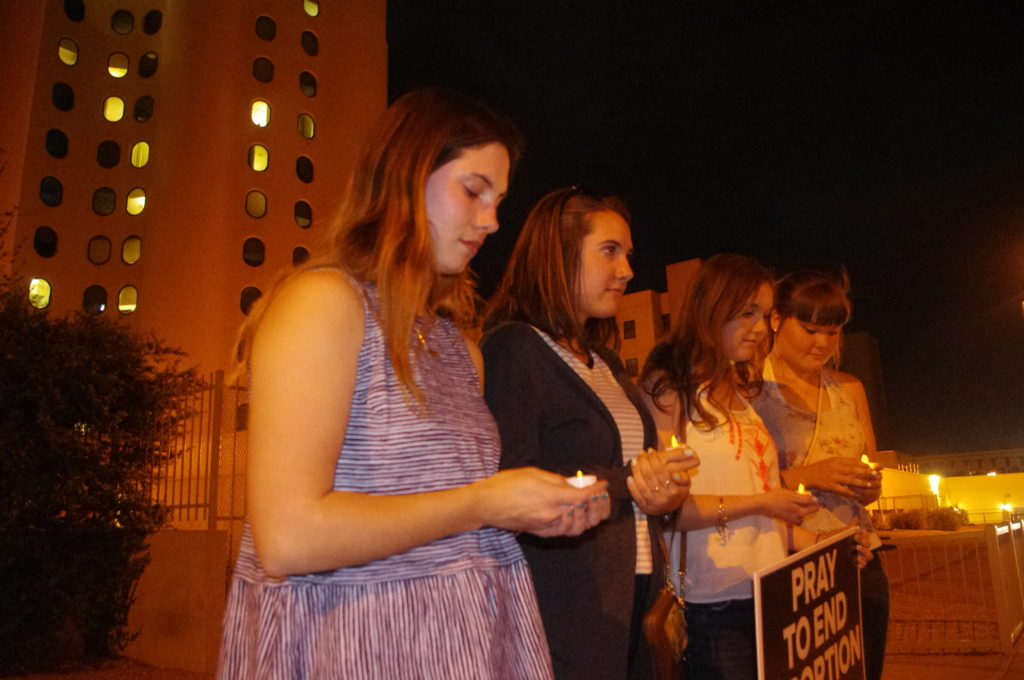
Abortion facility incident sparks prayer vigil, rouses suspicions

caption (Joyce Coronel/CATHOLIC SUN)
Women pray for an infant, its mother and local abortion workers during a prayer vigil in front of Banner University Medical Center Feb. 27. It’s the hospital where a baby was taken following an abortion procedure. (Joyce Coronel/CATHOLIC SUN)

News that an infant may have survived an abortion at a Phoenix facility swept through the Valley Feb. 26.

At a prayer vigil the following evening in front of Banner University Medical Center where the baby was transported, candles lined the sidewalk while some four dozen faithful fingered rosary beads. Participants said they were praying for the baby, the mother and the medical personnel involved.

Members of 40 Days for Life have been praying outside the nearby Family Planning Associates and other abortion facilities throughout Lent. Although they weren’t present when the Phoenix Fire Department arrived at the scene, someone heard the call go out. A baby had apparently survived an abortion.

Sgt. Trent Crump, spokesman for the Phoenix police, said the Phoenix Fire Department broadcasts all of their dispatches online. “It’s called Fire Wire and every time they dispatch, every single call, it’s on there,” Crump said.

In a call to The Catholic Sun, Crump described the incident at the facility.

“There was somebody that thought they saw movement. When the fire department arrived, there were no heart tones. We’re not certain why there was a decision to do a transport of the — not trying to offend anybody — but the tissue or the fetal tissue or, you know, the infant.”

Pressed as to what transpired next, Crump stated that an investigator from the medical examiner’s office had interviewed the doctor who performed the abortion and obtained medical records via subpoena.

JC’s Stride: 9-1-1 call from abortion clinic raises troubling questions

“In this particular case, there is no evidence that this is outside of what’s allowed in the state law,” Crump said. Abortion is illegal in Arizona “after about 24 weeks” but “there’s also some discretion on the doctor on consultation.” The Family Planning Associates website advertises abortions through 23 weeks, six days.

Most of the initial indications, Crump said, were that the fetus involved was 20 or 21 weeks. There will not be an autopsy, he added. “The medical examiner’s office had already made a decision not to take the tissue from the hospital. … We were unable to establish any elements of a crime had taken place at this point.”

The Catholic Sun has requested a copy of the audio file from the 9-1-1 call as well as a copy of the police report but at press time had not received either.

A local nurse who has worked in the Valley with premature infants for decades commented on the situation. Out of concern for privacy issues, The Catholic Sun is not releasing the nurse’s name.

“Something isn’t connecting with this abortion story,” the nurse said. “Say the baby was truly older — I had my dates wrong and the baby is 24 weeks — they should never have done that abortion in the first place. That’s criminal. Something happened because if they were resuscitating the baby, someone needed to think that this was a baby that could be resuscitated. If it wasn’t, if the baby was too young, then why did they try in the first place?”

The questions came as no surprise to John Jakubczyk, a Phoenix attorney and longtime pro-life activist. He suspects that the baby involved was older and called the incident “outrageous.”

“Whether the child was 23 weeks or 28 weeks, there should be an investigation as to how this all took place. The public deserves to know what happened to this baby,” Jakubczyk said.

In an undercover video taken by LiveAction.org at the Family Planning Associates in 2012, an employee advises a woman seeking an abortion at 23 weeks. She is told that she can choose an injection to stop the baby’s heart. “That makes it so, if you were to deliver, there wouldn’t be any movement,” the employee states in the video. “We induce intrauterine demise.” Remains are given to a funeral home where they are cremated and ashes are spread in the desert, the would-be patient is told.

Sheila Riley, practice director at Life Choices Women’s Clinics, said that once a fetus is injected with digoxin to stop the heart, the organs and tissue become unsuitable for donation. Last year, a national controversy erupted when a series of undercover videos at abortion facilities went viral. In the videos, Planned Parenthood officials and employees discuss the sale of fetal body parts.

As to the Feb. 26 incident, Riley offered a blunt assessment: “Abortion facilities see a lot of dead babies. So they know the difference between a dead baby and a live baby,” she said.

The Arizona Legislature is currently considering a bill that would outlaw the sale of fetal tissue.
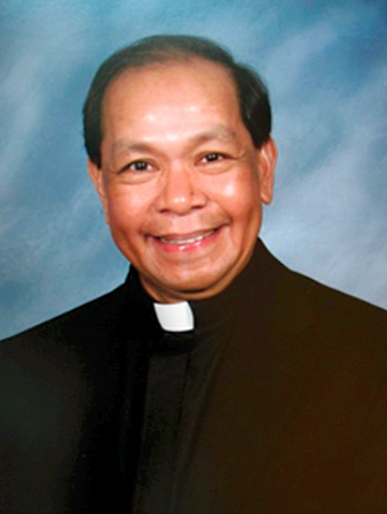
Fr. Francisco Guianan, SOLT, beloved Filipino priest, dies at 59

Screen Shot 2016-03-09 at 12.24.29 PM

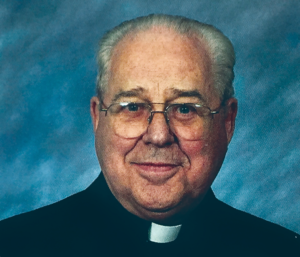
Fr. Francisco Guianan, SOLT

Born: Sept. 10, 1956 on the Island of Rapu-Rapu, Albay, the Philippines

Ordained: Nov. 17, 1988 for the Society of Our Lady of the Most Holy Trinity

Professed Final Vows: Jan. 25, 1995

Service in the Diocese of Phoenix:

Parochial Vicar at Most Holy Trinity, Phoenix 2014-16

Died: March 6, 2016

In Remembrance

Funeral: 4 p.m. viewing, 6 p.m. Mass March 11 at Most Holy Trinity Parish, 8620 N. 7th St.

Whether it was walking to the hospital to pray with an ill parishioner or leading the Rosary with the religious sisters on Monday mornings before Mass, Fr. Francisco Guianan, a Society of Our Lady of the Most Holy Trinity priest, seemed to find time for everyone. He served as the parochial vicar of Most Holy Trinity Catholic Church in Phoenix until his untimely death March 6 at age 59.

“He was so faithful,” said Dcn. John Raphael Dalisay, one of Fr. Guianan’s closest friends, who happened to serve alongside him at the Sunnyslope parish. “I would see him in the mornings walking and praying his Rosary. He was so very happy and most happy when he concelebrated Mass with Pope Francis in Juárez, Mexico during the papal visit.”

“He was the type of person that would make you smile and feel at ease,” said Lizett Lopez, pastor’s assistant. “He would drop everything if he was needed at the hospital or if someone had an emergency.”

He was the adopted child of Dr. Esteban Hidalgo and Anita Lianko Hidalgo of the Philippines. Both preceded him in death. According to Fr. Francisco “Bing” Colasito of St. Rose Philippine Duchesne Parish in Anthem, Fr. Guianan traveled home in October 2015 to bury his mother.

A younger brother, Fr. Rex Hidalgo, is also adopted and has been serving in priestly ministry in the Archdiocese of Nueva Caceres in the Philippines for 18 years.

“Most of the Filipino priests in the Valley called him Fr. Kitz,” said Fr. Colasito, another native Filipino.

Fr. Guianan served in his native Philippines plus a parish in Puerto Rico and Kansas City, Missouri, before his transfer to Most Holy Trinity in September 2014. When he and Dcn. Dalisay met, both were surprised to learn that they grew up in the same area of the Philippines and knew many of the same people.

“We spoke the same dialect so when we got together we would speak Filipino together,” said Dcn. Dalisay. “We had much in common and I am so sorry to lose my friend.”

Days off were often spent with Dcn. Dalisay scouring the neighborhood Goodwill store in search of items to send back home to Fr. Guianan’s nieces and nephews or visiting friends for dinner.

“I will miss his presence, but maybe we will see him again when we reach heaven. I hope he will be there to welcome me. He is my guardian angel looking over me now” the deacon said.

Popular with the parishioners, especially the Hispanic population, Lopez said that Fr. Guianan took his time with people, never rushing them. He didn’t know how to drive so she would take him to appointments and places that were too far to walk.

“He loved being a priest,” she said. “He confided in us one time that when he used to play pretend when he was little, he was always the priest. His friends told him to be the cop or the bad guy, but he always told them no because they needed a priest. He always knew he would be a priest.”

Fr. Weible (1928-2016): world-traveled priest who retired to Arizona

[quote_box_left]

Screen Shot 2016-03-09 at 12.24.03 PM
Fr. Thomas Weible

Born: Feb. 6, 1928, Los Angeles, Calif.

Ordained: April 30, 1959 for the Archdiocese of Los Angeles

Service in the Diocese of Phoenix:

Sacramental and priestly ministry, as needed at various parishes 2004-2016

Died: March 5, 2016

Funeral: 11 a.m. March 10 at St. Anthony of Padua, 232 N. Tegner St. in Wickenburg

[/quote_box_left]

Fr. Thomas Weible was among the pool of priests who local Catholics got to know only in retirement, but his lifetime of priestly ministry impacted countless in at least five countries including several U.S. states. He passed away March 5 at the age of 88.

“One of his gifts was he was a compassionate person. He was a magnet to people,” said Fr. Henry Dahl, who is also serving in Arizona in retirement.

He took care of his longtime friend in later years and was recently looking through Fr. Weible’s address book. He stopped counting after reaching 600 names.

Fr. Weible was a native of Los Angeles. He was born Feb. 6, 1928 the youngest of six children and lost his dad at a young age. His mother worked hard during the Great Depression and beyond to provide for her children, including Catholic education, and never forgot to model the faith.

Fr. Weible served a brief stint in the Army following World War II and entered the seminary shortly thereafter. He was ordained April 30, 1959 in Los Angeles and served in his home archdiocese until he became among 47 Maryknoll Missioners in 1962. Assignments took the priest to Peru, Chile and Bolivia over the next five years, including time as pastor.

Fr. Weible’s command of the Spanish language also allowed him to run an orphanage in Tecate, Mexico for a short time. He spent much of the 1980s as chaplain at Mercy Medical Center in Oregon.

Health issues forced him into an early retirement, but Fr. Weible didn’t slow down much. He served as spiritual director at Mt. Angel Seminary in Oregon and taught English as a second language. He crossed the country in the mid-to-late 1990s to offer supply help for the Diocese of Fall River, Massachusetts and crossed a couple of borders to offer spiritual direction at a seminary in Connecticut.

By 2004, Fr. Weible came to Arizona to be near surviving family, then a sister and two brothers in the Northwest Valley. Despite declining health issues, he continued to offer priestly ministry, including Mass and confession, at various parishes in the Diocese of Phoenix, including St. Clement of Rome in Sun City and St. Anthony of Padua in Wickenburg.

One brother, Robert Weible in Wickenburg, survives him.

Women discover the depths of God’s love at sixth annual PDCCW conference

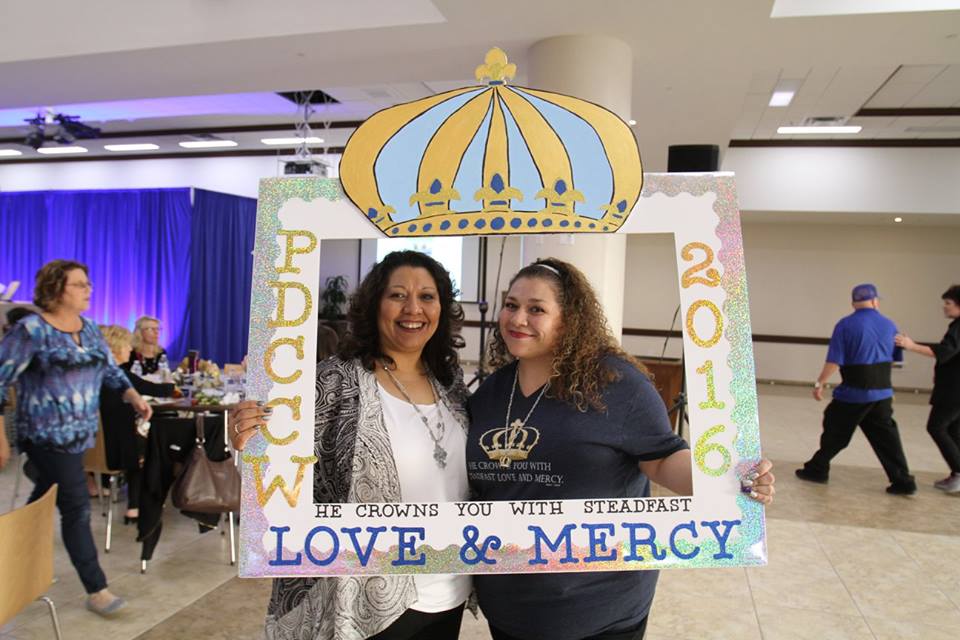
Roberta Bazaldua, left, poses behind a homemade photo frame that touts the theme of the 2016 diocesan Catholic Women's Conference. (photo from Phoenix Diocesan Council of Catholic Women Facebook page)
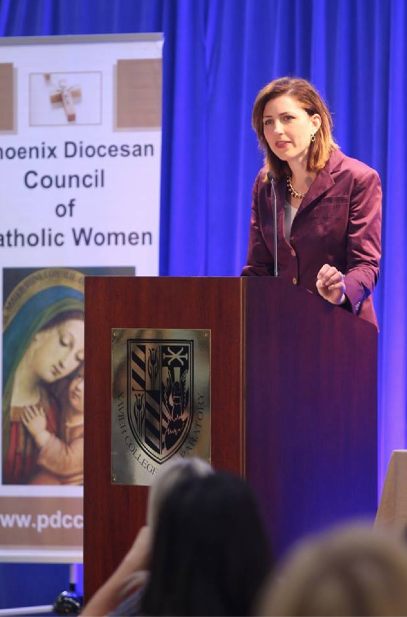
Colleen Carol Campbell addresses her peers at the annual diocesan Catholic Women's Conference Feb. 20. (photo from Phoenix Diocesan Council of Catholic Women Facebook page)
Colleen Carol Campbell addresses her peers at the annual Phoenix Catholic Women’s Conference Feb. 20. (photo from Phoenix Diocesan Council of Catholic Women Facebook page)

Colleen Carol Campbell never expected to find purpose through a relationship with the saints.

“Christmas break and boredom can make a college student do desperate things and one December, it made me crack open a biography of Teresa of Avila — and once I did, I was hooked.”

Campbell, a former presidential speechwriter, print and broadcast journalist and author, was one of seven keynote speakers at the sixth annual Phoenix Catholic Women’s Conference Feb. 20. Her talk, “The Wisdom of the Women Saints,” discussed her journey to find meaning in life and how she stumbled upon it in the lives of the saints.

The conference was held at Xavier College Preparatory and was sponsored by the Phoenix Diocesan Council of Catholic Women. Over 600 women of all ages and backgrounds attended.

Conference highlights

Roberta Bazaldua, second vice president of the PDCCW and chairwoman of the Women’s Conference, stated it’s important for women to attend the conference because it allows women to address their own spiritual needs.

“We’re so busy, there’s just so many things going on in our lives and we usually put everybody else first. As women, that’s just who we are,” Bazaldua said. “We’ll nurture everyone else, we’ll take care of their needs, not fully understanding that we need to be nurtured and we need to have our needs met as well. The conferences allow for that.”

The PDCCW meets with Bishop Thomas J. Olmsted every year, about eight months prior to the conference, to ask for his guidance regarding a theme. Bazaldua mentioned this year was a “no-brainer” with the Year of Mercy being called.

Roberta Bazaldua, left, poses behind a homemade photo frame that touts the theme of the 2016 diocesan Catholic Women's Conference. (photo from Phoenix Diocesan Council of Catholic Women Facebook page)
Roberta Bazaldua, left, poses behind a homemade photo frame that touts the theme of the 2016 Phoenix Catholic Women’s Conference. (photo from Phoenix Diocesan Council of Catholic Women Facebook page)

All of the talks given at the 2016 conference reflected the theme of God’s mercy. Campbell spoke about the pattern of God’s mercy in her life, beginning with the day she read about St. Teresa of Avila.

“Maybe it was the opening chapter of a love story — one very similar to the one that Teresa had lived, in which the Divine Protagonist pursues His beloved with reckless ardor, until He ultimately wins her heart,” Campbell said.

Campbell also explained how women have opportunities to practice acts of mercy in their daily lives. “Think about that irritating co-worker, that never ending pile of laundry, that needy parent, the defiant child. Each gives us a chance to practice charity and patience over selfishness.”

Lita Arroyo, coordinator of high school evangelization at St. Mary Magdalene in Gilbert and keynote speaker at the conference, also described the necessity of showing mercy daily. “I think people are afraid to be merciful,” Arroyo said. “I think we tend to think of mercy as just giving money to people that are asking for something on the freeway off-ramp.”

Arroyo said selfishness with time is also a great obstacle to overcome. “We just don’t have a lot, we think we don’t have any to give — but we do.”

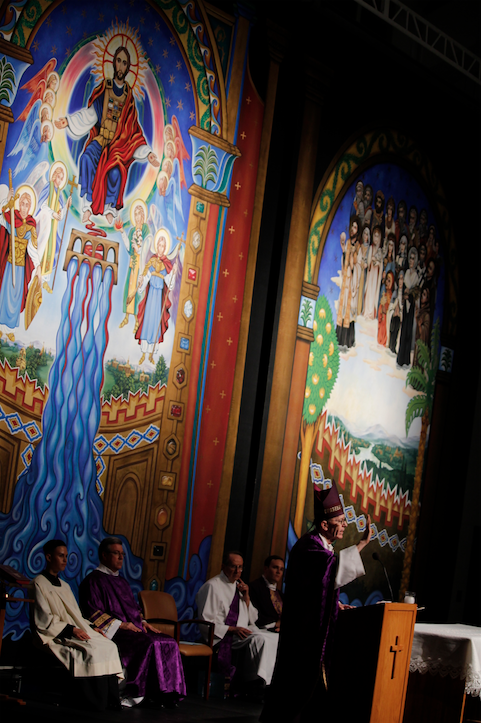
A mural depicting Jesus and angels provide a meditative backdrop as Bishop Thomas J. Olmsted for the closing Mass of the of Bishop Thomas J. Olmsted talks about ___ during (Ambria Hammel/CATHOLIC SUN)
A mural depicting Jesus and angels provide a meditative backdrop as Bishop Thomas J. Olmsted delivers his homily at the annual diocesan Phoenix Catholic Women’s Conference Feb. 20. (Ambria Hammel/CATHOLIC SUN)

Tobi Ballentine, parishioner at St. Timothy in Mesa, left the conference fulfilled. “It’s been very revealing and that causes a lot of contemplation,” Ballentine said.

Alissa Porteous, a young mother and parishioner at St. Mary Magdalene, said attending the conference provided an outlet for young women to get involved in the life of the Church.

“As a young Mom, I feel like us younger women in the diocese need to get involved, we need to show our face,” Porteous said. “It’s been a beautiful day, the gift of Our Lord in the Eucharist is transformational for everybody.”

The conferences concluded with Mass celebrated by Bishop Olmsted. Bishop Olmsted reiterated the depths of God’s mercy in his homily, saying, “Jesus’ love surrounds us on every side: in the doubts, in darkness, in suffering. He’s with us on the whole journey back to eternal life, so let us trust Him.”

Catholic Extension features ‘nuns who rock’ on website, in social media

CHICAGO (CNS) — Dominican Sister Gabriella Williams in the Diocese of San Bernardino, California, gives her heart and soul to her ministry with migrant field workers, hourly laborers and their families living in trailer parks in California’s Coachella Valley.

Sr. Rita Schonhoff, a School Sister of Notre Dame, and Dominican Sister Maria Yelitza Ayala live out their religious vocations by serving desperately poor communities in Missouri and Texas, respectively.

Benedictine Sister Kathleen Atkinson from the Diocese of Bismarck, North Dakota, is the founder and director of Ministry on the Margins, working with prison inmates, former prisoners, the homeless, at-risk youth and others who need to encounter God’s love.

These religious sisters and many more around the United States are being highlighted by Chicago-based Catholic Extension as part of National Catholic Sisters Week March 8-14.

The organization is sharing the stories of Catholic sisters who work in the U.S. mission dioceses it supports by sharing their stories online and via social media.

Through the week, daily posts were to be made on Catholic Extension’s Facebook page and on Twitter using the hashtags #NunsRock and #NCSW2016.

Logo from nationalcatholicsistersweek.org

“Two of the most inspirational things I’ve learned at Catholic Extension are: First, you cannot go to the poorest places in the United States and not find the presence of the Catholic Church,” said Fr. Jack Wall, the organization’s president. “And second, the face of ministry in the poorest communities of America is most often a woman religious.”

Other stories highlighted include Catholic Extension’s U.S.-Latin American Sisters Exchange Program, an initiative that has placed 33 Latin American women religious in dioceses throughout the U.S. to minister to the church’s growing Hispanic population.

Catholic Extension, a national fundraising organization, has been supporting the work and ministries of U.S. mission dioceses since it was founded in 1905.

National Catholic Sisters Week, which is supported by a $3.3 million grant from the Conrad N. Hilton Foundation, is an annual celebration held in conjunction with National Women’s History Month, observed in March. The organization is based at St. Catherine University in St. Paul, Minnesota.

“Created to honor women religious, it is a series of events that instruct, enlighten and bring greater focus to the lives of these incredible women,” says the “About” section of the organization’s website, www.nationalcatholicsistersweek.org. “It’s our chance to recognize all they have done for us. It’s also our hope that as more young women learn about women religious, more will choose to follow their example.”

Pope: Murdered nuns are ‘today’s martyrs’ [VIDEO]

Pope Francis prayed March 6 for victims of a recent attack in Yemen, where four Missionaries of Charity were murdered. Related story.

‘Zootopia’

NEW YORK (CNS) — Anthropomorphism runs amok in the 3-D animated comedy-adventure “Zootopia” (Disney).

As with Disney’s “Cars” franchise, which presented a world of automobiles with human traits, “Zootopia” personifies all creatures great and small. They jabber away among themselves as each earns a living in the bustling metropolis of the title.

Inside jokes and clever puns abound. City dwellers shop at Targoat, sip lattes from Snarlbucks, call up a ride from Zuber — and make deposits at the Lemming Brothers Bank.

At the DMV, short for the Department of Mammal Vehicles, the lines are long and all of the employees are three-toed sloths who, true to their name, move at a glacial pace.

[quote_box_right]

‘Zootopia’

The film contains occasional mild action violence, including torture, bullying, a naturist theme, some rude gags and momentary religious but not irreverent humor.

The Catholic News Service classification is A-II, adults and adolescents.

The Motion Picture Association of America rating is PG, parental guidance suggested. Some material may not be suitable for children.

[/quote_box_right]

The newest arrival in this urban setting, where predators and prey live in apparent harmony, is Judy Hopps (voice of Ginnifer Goodwin). A bright-eyed and bushy-tailed rabbit from the suburbs, Judy is eager to fulfill her lifelong dream by becoming the first bunny officer of the Zootopia Police Department.

Through grit and perseverance, she succeeds, only to face resentment and prejudice from her peers as well as her boss, the imposing buffalo Chief Bogo (voice of Idris Elba). He assigns Judy to parking duty, while much larger cops (including an elephant and a rhino) take on important criminal cases.

Determined to make the best of it, Judy hops into action. As she racks up the tickets, she encounters wily fox Nick Wilde (voiced by Jason Bateman), a small-time con artist.

It turns out that Nick is a key witness in a missing “person” case that Judy wants to solve to win the respect of her co-workers. As natural enemies become collaborators and, ultimately, friends, “Zootopia” morphs into a buddy movie.

Directors Byron Howard (“Tangled”) and Rich Moore (“Wreck-It Ralph”), together with co-director Jared Bush, keep the action moving at a fast pace. Unfortunately, the film takes a dark turn as the investigation proceeds, exposing the seedier side of Zootopia. Scenes of animal conflict and cruelty could frighten and confuse the younger set.

And that’s not to mention the somewhat paradoxical naturist club where animals shed their clothes.

Parents will smile at references to classic films that will fly over their children’s heads. Particularly amusing is Mr. Big (voice of Maurice LaMarche), a tiny arctic shrew who’s a dead ringer for Don Corleone in “The Godfather.” As the mobster threatens our furry duo, the wedding reception scene plays out in the background, and before long Mr. Big is dancing with the bride.

Overall, despite its mixed tone, “Zootopia” offers good lessons in tolerance, hard work and optimism. As Judy reassures Nick, “Life’s a little bit messy. We all make mistakes.”

By Joseph McAleer, Catholic News Service. McAleer is a guest reviewer for Catholic News Service.

Get thee to a confessional: Pope goes and wants you to as well

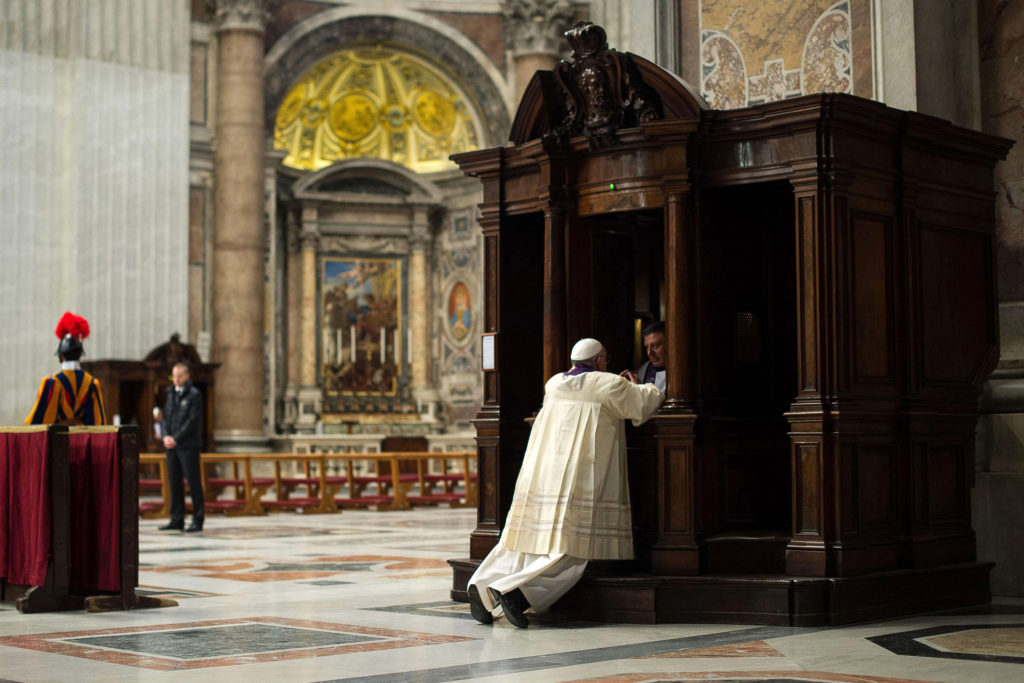
A priest hears confession from Pope Francis during a penitential liturgy in St. Peter's Basilica at the Vatican in this March 28, 2014, file photo. (CNS photo/L'Osservatore Romano via Reuters)
A priest hears confession from Pope Francis during a penitential liturgy in St. Peter’s Basilica at the Vatican in this March 28, 2014, file photo. (CNS photo/L’Osservatore Romano via Reuters)

VATICAN CITY (CNS) — Go to confession. Soon.

For Pope Francis, the Year of Mercy is all about sharing the experience of God’s mercy with others. But first, he wants people to experience it themselves, in the confessional.

Lent is the perfect time for that kind of spring cleaning and at the Vatican, in Rome and in many dioceses around the world, Catholic churches were to have extended hours for confessions March 4-5 in a project called “24 Hours for the Lord.” Afterward, for those who did not make it to a local church, there were still three weeks left before Easter.
[quote_box_center]

#24HoursfortheLord in the Diocese of Phoenix

[/quote_box_center]

The pope has said he goes to confession every two weeks, and he has done so very publicly, most noticeably in 2014 during a Lenten penance service in St. Peter’s Basilica. He also went Feb. 11, on the eve of his trip to Cuba and Mexico, when he stopped by the Basilica of St. John Lateran where the priests of the Diocese of Rome were holding their Lenten meeting. Pope Francis heard the confessions of several priests, then went to confession.

At St. John Lateran, as in almost every speech he has given to priests in the three years since his election March 13, 2013, Pope Francis gave the priests advice, exhortations and pleas that they dedicate time to hearing confessions and that they do so with warmth, care and a father’s love. He wants them to acknowledge the reality of the penitent’s sin, but pay even more attention to the penitent’s desire for forgiveness and a fresh start.

He spends less time telling Catholics to get to a confessional than he does telling priests they have a serious obligation to ensure the experience is not so horrible that the faithful never come back. A lot of that probably has to do with the fact that a turning point in his own life — and the beginning of his discernment about becoming a priest — began with an unplanned confession on the way to a school picnic when he was 17. He said he felt that the priest, whom he’d never seen before, was waiting there to show him God’s mercy.

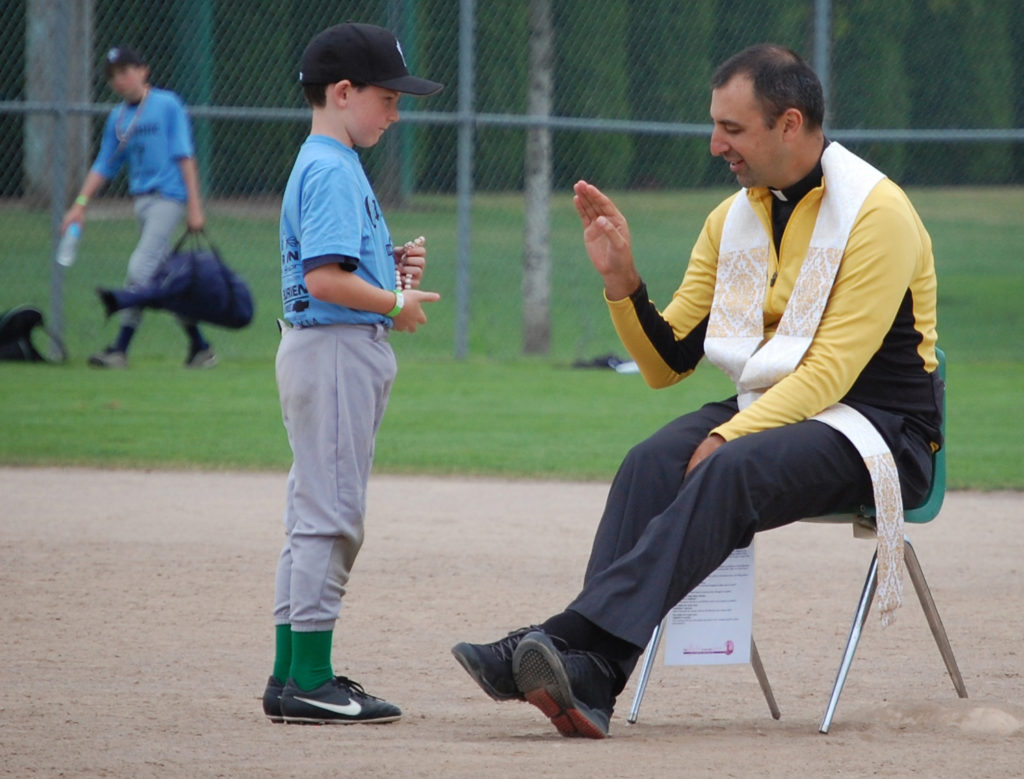
Fr. Bryan Dolejsi, vocations director for the Archdiocese of Seattle, hears a boy's confession in Kent, Wash., in this July 22, 2014, file photo. (CNS photo/Jean Parietti, Northwest Catholic magazine)
Fr. Bryan Dolejsi, vocations director for the Archdiocese of Seattle, hears a boy’s confession in Kent, Wash., in this July 22, 2014, file photo. (CNS photo/Jean Parietti, Northwest Catholic magazine)

Rather than trying to convince people that they are sinners who need to go to confession, Pope Francis tries to take seriously the reasons people say they do not go and gives them another point of view.

“Some say, ‘I confess only to God.’ Yes, you can say, ‘God forgive me,’ but our sins are also against our brothers and sisters, against the church,” he said at a general audience in February 2014. “This is why it is necessary to ask forgiveness from our brothers and sisters and from the church in the person of the priest.”

Embarrassment or shame is another reason people stay away from the confessional, which the pope sees as a normal feeling, but one that should be overcome. “Sometimes when you’re in line for confession, you feel all sorts of things, especially shame, but when your confession is over, you’ll leave free, great, beautiful, forgiven, clean, happy — this is what’s beautiful about confession,” he said.

In the recent book-length interview, “The Name of God Is Mercy,” Pope Francis also spoke about confession as an important means of helping people be truly honest before God. “It’s a way to be real and authentic,” he said. “We face the facts by looking at another person and not in the mirror.”

The pope repeatedly has told priests that in the confessional they should ask only questions that help penitents recognize their sins rather than conducting “a heavy, finicky and invasive interrogation.”

But that does not mean penitents should approach the sacrament without doing their own examination of conscience and even a detailed one.

In “The Name of God Is Mercy,” the pope was asked how one should prepare for confession. His answer: “He ought to reflect on the truth of his life, of what he feels and what he thinks before God. He ought to be able to look earnestly at himself and his sin. He ought to feel like a sinner, so that he can be amazed by God.”

As he said in December 2014, “Go to confession to clean up a bit. This is good for you.”

By Cindy Wooden, Catholic News Service.

Junior high crafters fundraise for charity via Arrupe Marketplace

(Ambria Hammel/CATHOLIC SUN)

By all appearances, one of the Valley’s latest artisan marketplaces was proving itself to be a fairly reputable competitor.

It had a built-in customer base, handmade products that largely catered to their interests and the occasional list of back orders to keep up with demand or ensure custom items.

A St. Francis Xavier student purchases an item at the school's Arrupe Marketplace Feb. 19. Student vendors chose an organization and a specific need to address with their proceeds. (Ambria Hammel/CATHOLIC SUN)
A St. Francis Xavier student purchases an item at the school’s Arrupe Marketplace Feb. 19. Student vendors chose an organization and a specific need to address with their proceeds. (Ambria Hammel/CATHOLIC SUN)

A key difference for the Arrupe Marketplace: every one of its 78 vendors was a seventh-grade entrepreneur. Plus, profits weren’t lining their junior high pockets, but concretely helping fulfill an outstanding need for a local charity committed to social justice.

The Arrupe Marketplace is one facet of the Arrupe Project. The effort is in its sixth year at St. Francis Xavier School and was designed as a way for junior high religion students to intimately support local charities carrying out a spiritual or corporal work of mercy. It also gives students a small taste of business ownership and the responsibilities and decisions that come with it.

[quote_box_right]

Arrupe Project

Photos from Marketplace

Shop yourself after 9 a.m. Mass March 6. Map.

Photos from Commissioning Mass

[/quote_box_right]

The seventh-graders held a one-day marketplace open to students Feb. 19 and will hold one for the parish community after the 9 a.m. Mass March 6. As eighth-graders, students still support a charity — the same one or they might discern a different one — but they organize and execute a fundraiser event on behalf of the charity.

Both were commissioned for their effort during a school liturgy Jan. 21 and earned $10 in startup funds. In either case, St. Francis Xavier students discuss current material needs with someone at their selected organization and use funds to buy and hand deliver the item(s).

“What amazes me is the kids, by the end of their Arrupe Journey, that they don’t look at it as just a grade, but it’s something that’s imprinted on them forever,” said Kelsey McKone, who teaches seventh- and eighth-grade religion.

(Ambria Hammel/CATHOLIC SUN)

A guest speaker from Catholic Charities Community Services addresses the students each fall at the beginning of the Arrupe Project journey. Many students select one of its many programs to support.

Others, through the same discernment process, decide that they would like to support organizations such as the Society of St. Vincent de Paul, Phoenix Rescue Mission, Ryan House, the Smile Project, Foundation for the Blind or UMOM. Whatever they decide, McKone said the beneficiary must be one that stands for Catholic social teaching and must help people, not animals.

Lauren Etsitty decided to support a Catholic Charities program that provides basic essentials for clients transitioning out of homelessness.

“I have a long drive home, so I see a lot of people along the side of the street and it made me really sad,” Etsitty said. She found that the Arrupe Project gave her a way to help them.

The seventh-grader combined her favorite things for the marketplace: flowers, glitter and love for sewing. She sold hand-sewn pillows large letters covered in and artificial flowers.

(Ambria Hammel/CATHOLIC SUN)
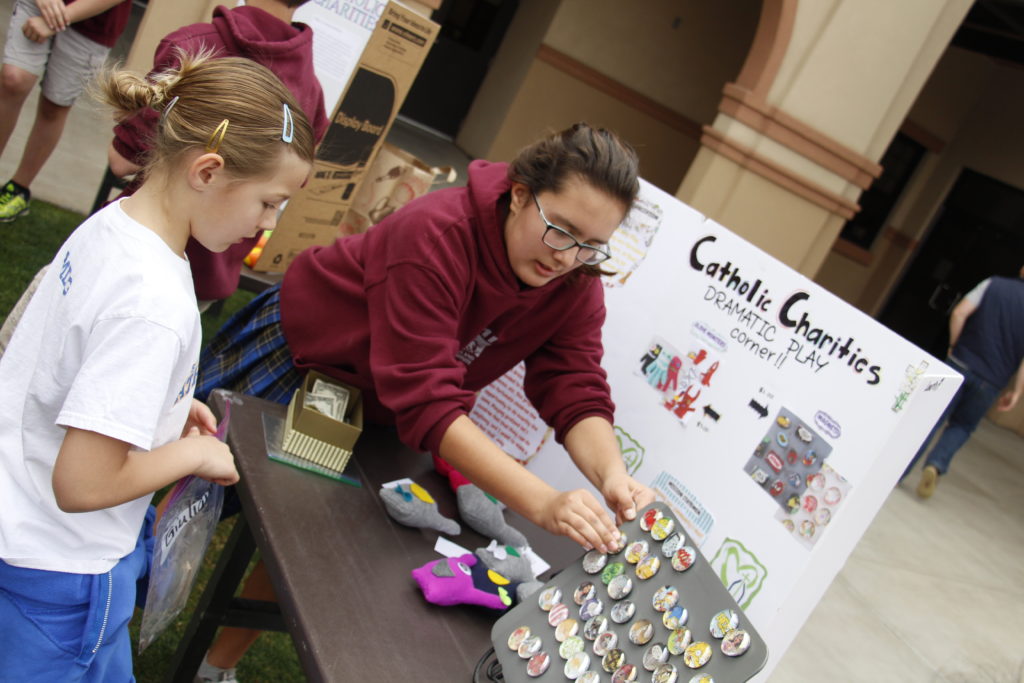
Seventh-graders Ryan Blake and Casey Rich await customers at the school’s annual Arrupe Marketplace Feb. 19. (Ambria Hammel/CATHOLIC SUN)

Classmate Ryan Blake sold a variety of small items: silly puddy, origami wolves after the school’s mascot and custom-painted golf balls. The small containers of brightly-colored slime were his biggest seller. Blake is using proceeds to benefit Ryan House, which helps terminally ill kids and their families.

“It’s an important part of life and it’s important to be happy during that time,” Blake said.

Proceeds from other sales helped refugees to get bicycles to use for transportation, children in foster care, veterans in need of a home and those with autism.

Court hears oral arguments in challenge to Texas abortion restrictions

A person holds up the American flag in front of the U.S. Supreme Court in Washington March 2. (CNS photo/Kevin Lamarque, Reuters)

WASHINGTON (CNS) — The U.S. Supreme Court heard oral arguments in its first abortion case in nine years March 2 in a challenge by Texas abortion clinics to a 2013 state law that requires them to comply with standards of ambulatory surgical centers and their doctors to have admitting privileges at local hospitals.

The almost 90 minutes of oral arguments March 2 were before a court left with eight members following the Feb. 13 death of Justice Antonin Scalia, who regularly voted to uphold abortion limitations and was expected to have provided the fifth vote in this case to uphold the requirements.

If the justices vote 4-4 in a decision on this case, they will uphold a lower court’s decision approving the Texas law, but the case would not set a national precedent.

Stephanie Toti, a lawyer for the Center for Reproductive Rights in New York City, presented the oral arguments on behalf of the clinics and doctors, and U.S. Solicitor General Donald Verrilli Jr. was given 10 minutes to argue for the federal government’s support of the clinics. Scott Keller, solicitor general of Texas, delivered the arguments defending the state law on abortion clinic restrictions.

In 2007, the Supreme Court in a 5-4 decision upheld the federal ban on partial-birth abortion, signed into law in 2003 by President George W. Bush. The law had withstood several court challenges on constitutional grounds before it was upheld.

During the March 2 arguments, justices chided each side for failing to produce better evidence to support their arguments. Some justices challenged the plaintiffs’ claims that the law would put abortion out of reach and also wondered if the state law was the reason so many clinics had closed, and others questioned the state’s motivation for imposing such requirements on abortion clinics and their doctors.

Justice Anthony Kennedy, clearly looked upon as the deciding vote in this case, asked Toti if it would be appropriate for the court to remand the case for more fact-finding, particularly about the capacity of the state’s remaining abortion clinics. Some clinics closed after the Texas law went into effect.

He also asked if the state law may have persuaded women to seek surgical abortions rather than ones induced by drugs.

“Because my reading indicated that medical abortions are up nationwide, but down significantly in Texas,” he said, adding that “this may not be medically wise.”

The solicitor general argued there is evidence showing that the remaining clinics in Texas are not ready to handle large numbers of extra patients they would have to take on because of the closures of clinics that didn’t meet state requirements.

The remaining abortion clinics would need to increase to four or five times their current size to meet the demand and “common sense” says that they won’t be able to do so, Verrilli said.

Keller, arguing in defense of the Texas law, said it strikes a proper balance and that major metropolitan areas in the state that currently have clinics would continue to have them. He also noted that more than 90 percent of Texas women live within 150 miles of an abortion clinic.

A pro-life supporter holds up a sign in front of the U.S. Supreme Court in Washington March 2 on the morning the court heard oral arguments in a challenge to a Texas law imposing new standards on abortion clinics and requiring abortion doctors to have hospital admitting privileges. (CNS photo/Kevin Lamarque, Reuters)

Justice Elena Kagan said the law could affect hundreds of thousands of women who would have to travel much farther to reach a clinic and said the increased distances to a clinic is far greater now than before.

She also wondered why Texas singled out abortion clinics for such rigorous regulation, saying: “I guess what I just want to know is: Why would Texas do that?”

Keller said the state was motivated by the case of Kermit Gosnell, a Philadelphia abortion doctor who in 2013 was convicted of multiple crimes including murder of infants born alive.

Justice Ruth Bader Ginsburg did not buy that argument because she said Gosnell was a lawbreaker whose clinic had not been inspected for more than 15 years, but Texas has aggressively inspected clinics and has found nothing like the Gosnell case.

Opponents of the Texas law have said its requirements for clinics and doctors are simply aimed at closing abortion clinics and have created an “undue burden” on women who want an abortion; the state has maintained the law is protecting women’s health.

The U.S. Conference of Catholic Bishops and other religious groups submitted a joint friend of the court brief in the case supporting the Texas law. The brief said the Supreme Court has held since Roe v. Wade, the landmark 1973 case legalizing abortion in the U.S., that states may enforce standards regarding the qualifications of doctors who perform abortions and the conditions of facilities in which abortions are carried out.

“To hold that states may not enact measures like the Texas law challenged here would be a betrayal of over 40 years of precedent,” the brief said.

Legal analyst Lyle Denniston, writing for the www.scotusblog.com, a blog on the Supreme Court, said the Texas case “provides almost a textbook example of challenging abortion by new regulations of clinic procedures.” He pointed out that before the Texas Legislature adopted two new restrictions three years ago, there were 41 clinics in Texas performing abortions, but after the law was passed — and before it was blocked by the high court — that number dropped to 19, and is likely to drop to 10 clinics in the state if the court upholds the law.

In this case, the court is dealing with a Texas law, similar to other laws in states across the country that restrict abortion clinics, an approach that some argue could have a better chance of success with the court than challenges to abortion procedures.

Denniston also noted there is a possibility the justices will send this case back to the lower courts, which could be determined by preliminary vote when they meet for a private conference as early as March 4. If the case proceeds as expected, a decision should be announced in late June.

The March 2 case, Whole Woman’s Health v. Hellerstedt, had been filed previously as Whole Woman’s Health v. Cole, but the name was changed because John Hellerstedt was appointed commissioner of the Texas Department of State Health Services Jan. 1.

By Carol Zimmermann, Catholic News Service.