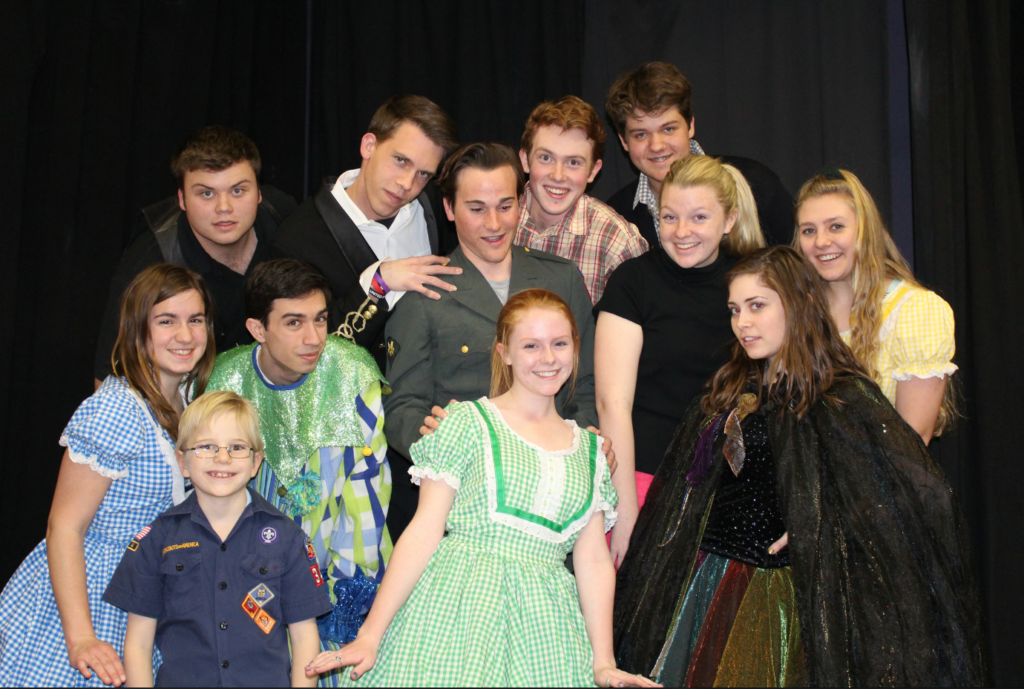
Notre Dame Preparatory cast of "Big Fish." The musical opens Feb. 26. (courtesy photo)
Notre Dame Preparatory cast of “Big Fish.” The musical opens Feb. 26. (courtesy photo)
Notre Dame Preparatory in Scottsdale will be the first high school in Arizona history to present the musical “Big Fish“ Feb. 26-27 and March 4-5 in the school’s auditorium.
Three years ago, NDP drama teacher and the show’s director Bonnie Wilson received a text from a former drama assistant attending “Big Fish” on Broadway in New York City, saying, “We HAVE to do this show.” When the rights became available Wilson said she jumped on it.
[quote_box_right]
“Big Fish”
When: 7 p.m. Feb. 26-27 and March 4-5
2 p.m. Feb. 27 and March 5
Tickets: $10 adults and $5 students NDP box office or at the door
[/quote_box_right]
“Big Fish” is a musical based on a book. It moves back and forth between past and present and fantasy and reality.
Leading the journey is Hale Stewart, a NDP senior who won the 2015 Phoenix Branch of English-Speaking Union Shakespeare Competition. He plays lead character Edward Bloom as both a 60-year-old man and a 16-year-old boy. The role of Bloom’s disillusioned son, Will, is split among two actors who portray him as a young man and as a little boy.
“It’s all about family and the disconnect that often occurs between parents and children and their views of the world,” Wilson said. This show is “heartwarming for the entire family,” she added.
Speaking of Broadway, take a fun look at how school administrators promoted a recent alumni meetup in the Big Apple when James Gmelich, principal, traveled there.
Find the 10 references to Scottsdale’s Notre Dame Preparatory in this Photoshopped image. Our staff is stumped at nine. (courtesy image)
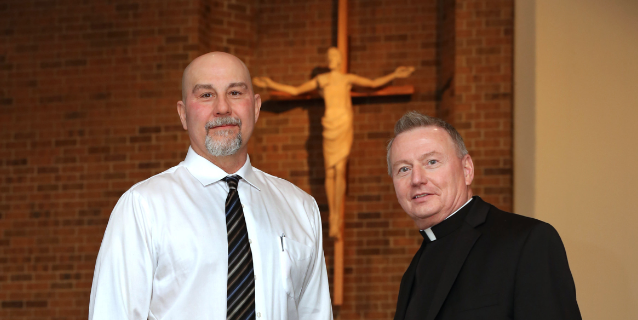
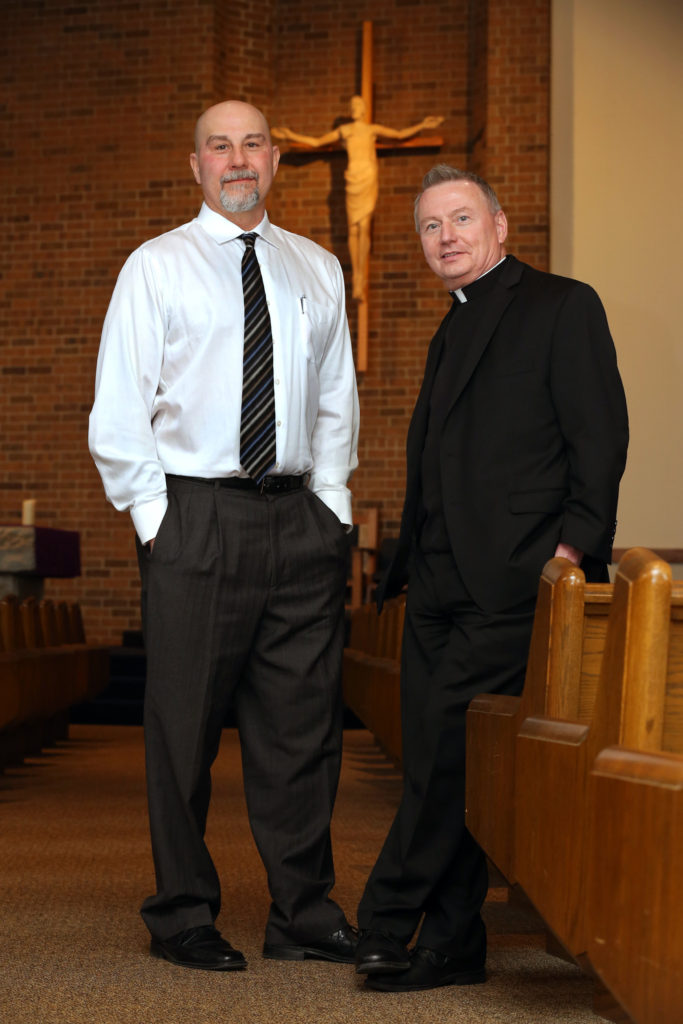
Fr. Neil Kookoothe, pastor of St. Clarence Parish in North Olmsted, Ohio, and former death-row inmate Joe D’Ambrosio pose for a photo Feb. 11. (CNS photo/William Rieter)
NORTH OLMSTED, Ohio (CNS) — When Fr. Neil Kookoothe first met Joseph D’Ambrosio on Ohio’s death row in December 1998, he intended to describe the funeral of the condemned man’s mother.
D’Ambrosio would not listen, however. Another inmate had told him the priest had been a lawyer before ordination. Now, D’Ambrosio pleaded for help with his case.
“It’s God’s providence,” D’Ambrosio, a lifelong Catholic, said recently of Fr. Kookoothe’s unexpected entrance into his life.
A three-judge panel had convicted D’Ambrosio of murder in 1989 after a trial that lasted less than three days. No forensic evidence linked him to the crime and D’Ambrosio insisted he had not killed teenager Anthony Klann.
Fr. Kookoothe hesitated to help.
“My ministry on death row was never about getting involved in their cases,” he said. “I simply wanted to companion some men who had been sentenced to death.”
He told D’Ambrosio he did not have time to read thousands of pages of transcripts and appellate work. Fr. Kookoothe was stunned when the convict informed him that his capital case filled a single volume.
The priest read it, spotting problems in the only witness account that placed D’Ambrosio at the crime scene. Fr. Kookoothe knew, for example, that it was impossible for the victim to scream for mercy with gaping stab wounds in his trachea. Not only was the priest a lawyer, but he also had worked as a registered nurse for 15 years.
Fr. Kookoothe visited D’Ambrosio a few weeks later. He promised to — but only if the prisoner swore he had nothing to do with the murder. Then he added another condition.
“He looked me dead in the eye and said, ‘One little deceit and I’m through with you!'” D’Ambrosio recalled.
Fr. Kookoothe said that some people ignore his background as an attorney and a nurse. They assume he believes anyone claiming to be innocent.
“I think just the opposite is the case,” he said. “I want empirical proof that this is true.”
For his part, D’Ambrosio longed to clear his name.
“He knew that a new trial and new evidence would win his freedom,” Fr. Kookoothe said in an interview for Catholic News Service.
In his ensuing research, the priest learned that Klann, the only witness in a rape trial, had been slain before he could testify. The accused rapist was the same man who fingered D’Ambrosio for Klann’s murder.
Fr. Kookoothe also discovered that the prosecution had withheld crucial evidence from D’Ambrosio’s public defender.
The priest enlisted the aid of journalists who eventually publicized D’Ambrosio’s story. Still, the years rolled by. Then another death-row inmate exhausted his appeals and he asked his spiritual adviser, a minister, to help D’Ambrosio instead. The pastor contacted a prestigious law firm and it agreed to work pro bono on D’Ambrosio’s case.
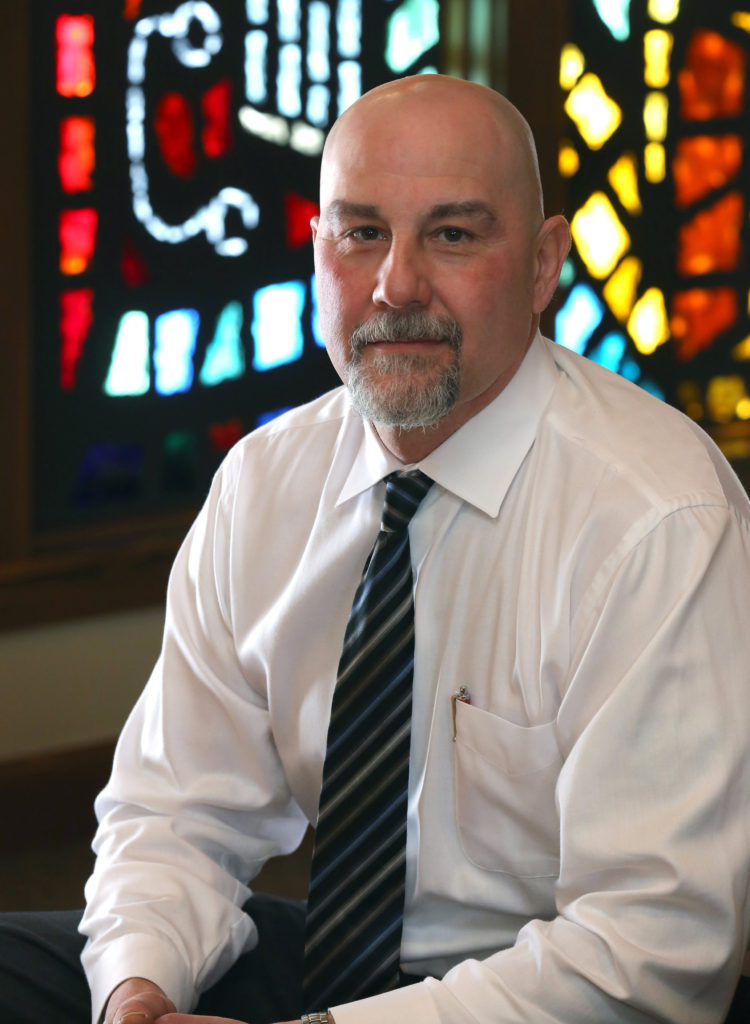
Former death-row inmate Joe D’Ambrosio poses for a photo at St. Clarence Church in North Olmsted, Ohio, Feb. 11. (CNS photo/William Rieter)
Meanwhile, Fr. Kookoothe continued to support D’Ambrosio. The men are close in age, with both in their mid-50s, but the priest developed a paternal attitude toward the prisoner. Prior to a retrial, a judge ordered that D’Ambrosio be released on house arrest. Fr. Kookoothe worried it would be cruel to give D’Ambrosio a taste of freedom, however limited. If the case went against the defendant, he might return to death row within months. Fr. Kookoothe advised him to stay in the county jail.
D’Ambrosio rejected the suggestion.
“One minute of freedom is worth it,” he said. “I was living in a 6-foot-by-9-foot cell for 22 years!”
D’Ambrosio moved into a friend’s apartment, leaving it only for medical appointments and meetings with his lawyers.
Then, during a pre-trial hearing, the prosecution revealed that it still had not shared all physical evidence with D’Ambrosio’s defense team. A federal judge soon ordered D’Ambrosio’s release, and she ruled that his conviction and sentence be expunged. He was exonerated Jan. 23, 2012.
Prosecutors appealed her decision. In 2012, the U.S. Supreme Court refused to hear the case.
David Mills, a court-appointed attorney who ultimately ensured that D’Ambrosio was released and not retried, acknowledged Fr. Kookoothe’s pivotal role years earlier.
“He essentially started everything in terms of overturning Joe’s conviction,” Mills said of the priest. “By meeting with Joe and really listening, he got the ball rolling.”
As a free man, D’Ambrosio no longer needed an advocate, but his life had been on hold for two decades.
By that time, Fr. Kookoothe was pastor of St. Clarence Parish in North Olmsted. Many parishioners had corresponded with D’Ambrosio when he was in prison; some attended his court proceedings. Nobody objected when the parish hired the self-described jack-of-all-trades as a maintenance man.
Congregations of various religious denominations as well as groups opposed to capital punishment often invited D’Ambrosio and Father Kookoothe to relate their experience. When the two finally spoke at St. Clarence, parishioners packed the church. They presented D’Ambrosio with a watch engraved with the date of the Supreme Court decision that allowed him to get on with life.
“It’s one of my most cherished things,” D’Ambrosio said. “I’ve never felt more unconditional love than I have in this parish. This is my family.”
In recent years, D’Ambrosio and Fr. Kookoothe addressed federal public defenders in Arizona and Idaho, the National Defense Investigators Association convention in San Diego and an anti-death penalty organization in London.
In this Year of Mercy, they will make several presentations.
Although he sometimes speaks alone, D’Ambrosio said they work best as a team.
“It’s a brother-type relationship,” D’Ambrosio said.
An incident last year illustrated this.
“Death row is not a good experience,” Fr. Kookoothe said. “If it were me, there would come a time when I wanted to put it behind me, totally, and just move on.”
He asked D’Ambrosio when he wanted to stop speaking about his ordeal.
Almost executed for a crime he did not commit, D’Ambrosio did not need to reflect before answering.
In this undated photo, Pope Francis poses for a photo with Father Frankie Mulgrew, a Salford priest, who helped devise the Mercy Bus for the Year of Mercy. (CNS photo/courtesy Diocese of Salford)
BURNLEY, England (CNS) — A diocese in England is using a double-decker bus as a venue for priests to hear the confessions of people who have stopped going to church.
The Mercy Bus is touring the Diocese of Salford during Lent in an attempt to reach out to lapsed Catholics.
Each Saturday, the bus parks in a busy area of Manchester or one of the outlying towns, and volunteers try to engage shoppers by offering miraculous medals blessed by Pope Francis as gifts.
If they receive a positive response, they are invited on the bus, where they can talk with a priest or receive a blessing — and also go to confession. Two priests offering the sacrament of reconciliation are stationed at the front and rear of the upper deck and one at the rear of the lower deck.
Visitors can also depart with information about the Catholic faith and about times of Masses in their local area.
In this undated photo, Pope Francis poses for a photo with Father Frankie Mulgrew, a Salford priest, who helped devise the Mercy Bus for the Year of Mercy. (CNS photo/courtesy Diocese of Salford)
Fr. Frankie Mulgrew, a Salford priest who helped to devise the project for the Year of Mercy, said interest from the public had “out-passed expectations.”
In the first two weeks, when the bus visited Salford, then Bolton, more than 400 people visited, he told CNS in a Feb. 20 interview in Burnley, on the morning of the bus’ third stop.
Priests later reported hearing the confessions of “significant numbers” of lapsed Catholics, some of whom had not been to church “for decades,” he said.
“We are meeting people where they are, we are parking up beside their lives,” said Fr. Mulgrew, 38, a former stand-up comedian who turned his back on a career in children’s television to become a priest after he said he personally experienced the mercy of God in confession.
“We are saying: ‘If you have got any burdens, come on the bus and be free from them. If you are going through any struggles right now — a family feud, financial problems, a broken relationship — come on board the bus and experience God’s mercy,'” he said.
“We are trying to reconnect people to faith and provide a place of welcome for them, and acceptance, and a place where they are going to encounter God’s mercy in a tangible way in their lives,” Fr. Mulgrew said.
“It is going out joyfully,” he added. “It’s trying to show the church in all its beauty and all its joy.”
Fr. Mulgrew said the initiative was inspired by the public ministry of Jesus “on the hilltops, in marketplaces and at the dinner tables” and also by the open-air Masses celebrated in the slums of Buenos Aires, Argentina, by Cardinal Jorge Bergoglio before he became Pope Francis.
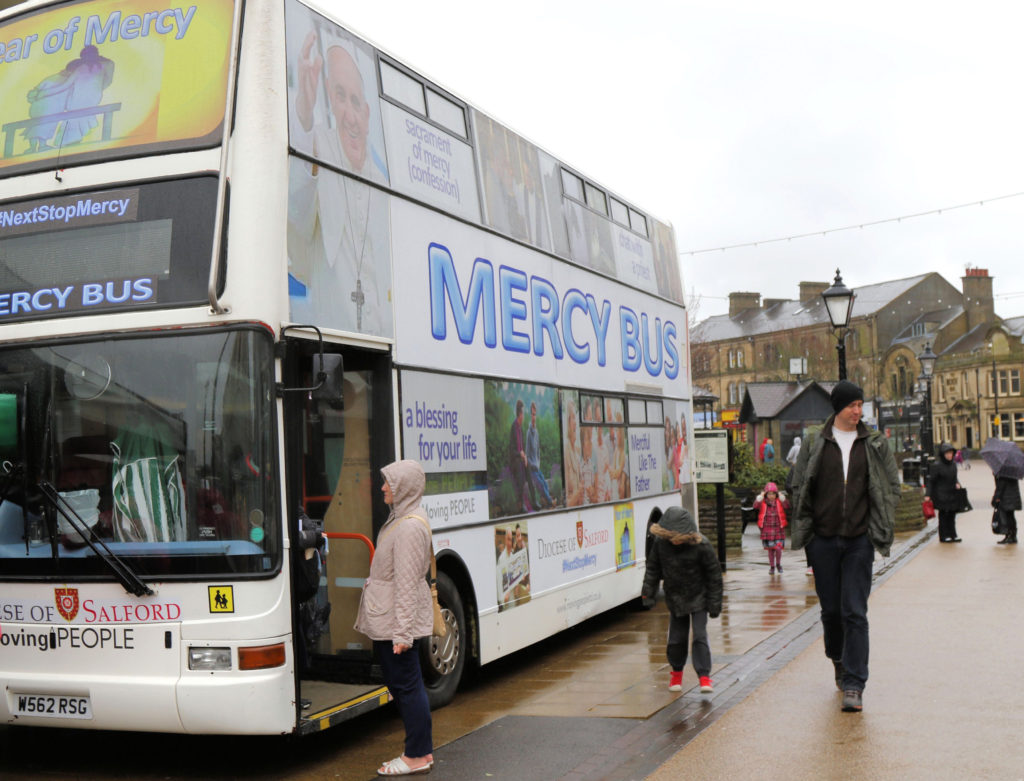
People walk by the Mercy Bus in Burnley, England, Feb. 20. The double-decker bus is used for priests to hear the confessions of people who have stopped going to church. (CNS photo/Simon Caldwell)
The initiative was conceived by a Salford diocesan Year of Mercy “outreach group” of which Fr. Mulgrew, a curate in Blackburn, is a member.
The bus was hired from an Accrington-based company called Moving People at the cost of $330 a day.
Initially, the plan was to use the bus on each Saturday in Lent, but the initiative is proving to be such a success that diocesan officials said they plan to retain the vehicle until the end of the holy year in November.
The front of the bus is emblazoned with the diocesan Year of Mercy logo with its destination entry designated as “#nextstopmercy.”
The sides of bus show images of Pope Francis and priests hearing confessions on either side of “Mercy Bus” in huge letters.
Pope Francis has given his personal blessing to the initiative and, according to Fr. Mulgrew, “laughed spontaneously” when he presented the pontiff with pictures of the Mercy Bus.
“He gave me this great beaming smile which I took as a great encouragement and affirmation of what I was working toward,” Fr. Mulgrew said.
Ahead of the launch, Bishop John Arnold of Salford announced in a press release that “the Mercy Bus is a way of reaching out to people who might not otherwise have contact with the church.”
“We are going out to them, rather than expecting them to come to us,” the bishop said.
The bus is accompanied by up to 40 volunteers and a band of musicians who play live music to draw the attention of the passing crowds.
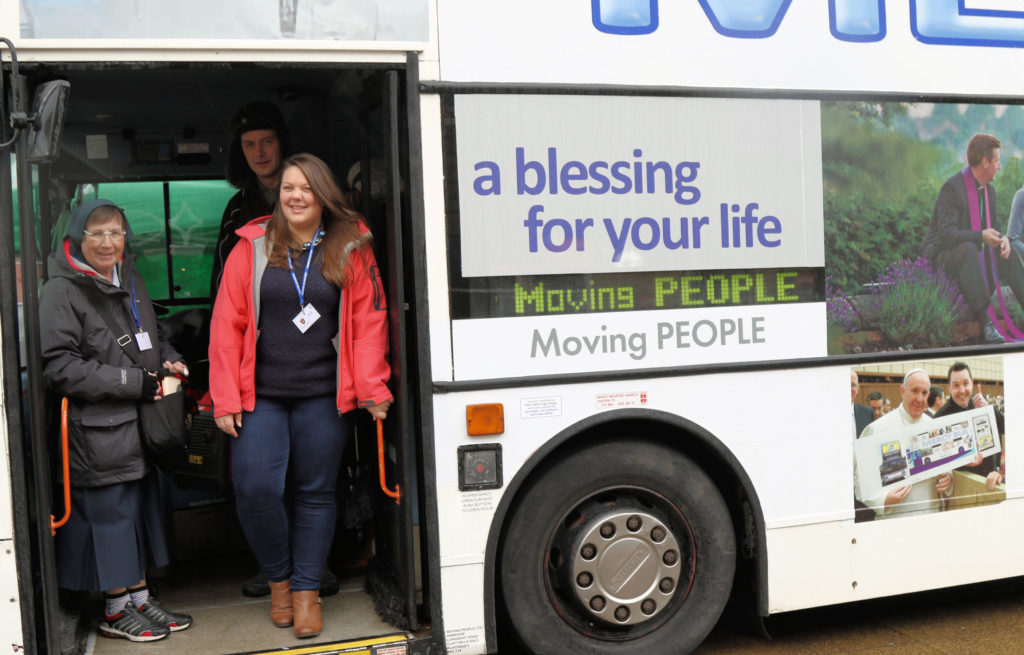
Hannah Beckford, right, a volunteer, poses for a photo on the Mercy Bus in Burnley, England, Feb. 20. Beckford said the bus has “opened the doors of the church” and that people are “coming off the bus smiling and expressing sincere thanks.” (CNS photo/Simon Caldwell)
Among the volunteers is Hannah Beckford who, from 11 a.m. to 4 p.m. each Saturday, approaches shoppers with the offer of a miraculous medal.
“We say ‘Would you like a free gift from the Holy Father?’ and they often come back and ask a bit more about it,” said Beckford, 25, who also serves as a chaplain in St. Joseph’s Catholic High School, Horwich.
“It has caused a lot of interest, especially from people who haven’t been to church for a long time,” she said.
“The amazing thing about it is that it has thrown open the doors of the church,” she said. “People are coming off the bus smiling and expressing sincere thanks.
“It is what the church should be doing. For a long time I have wanted it to go out, and it’s wonderful that in Salford that’s what the church is doing,” she continued. “It is a joy to be a part of it. I love it.”
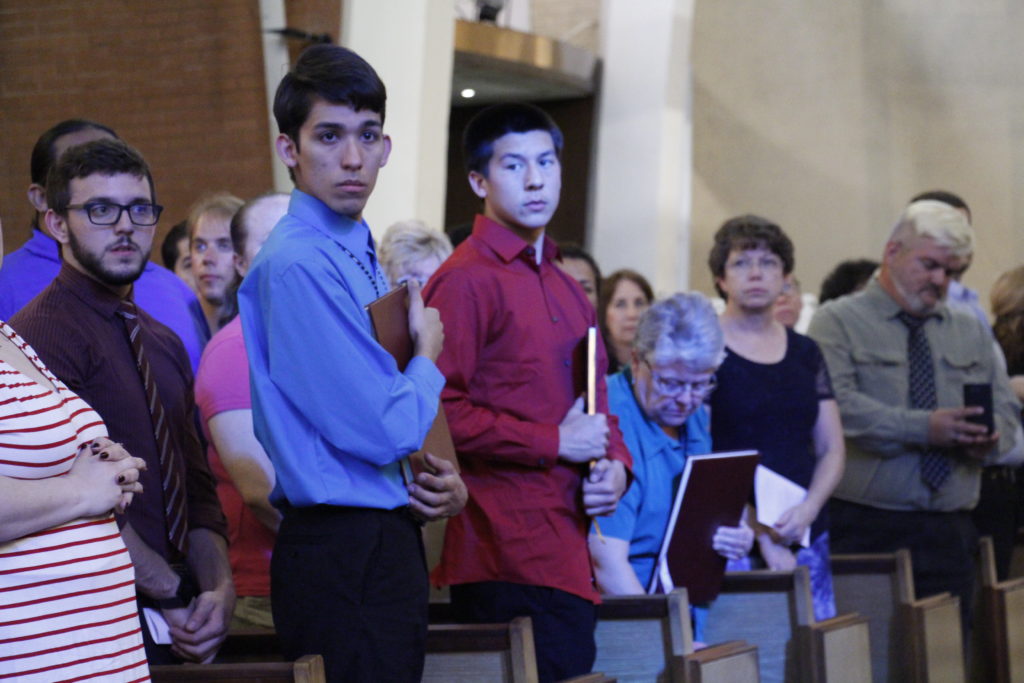
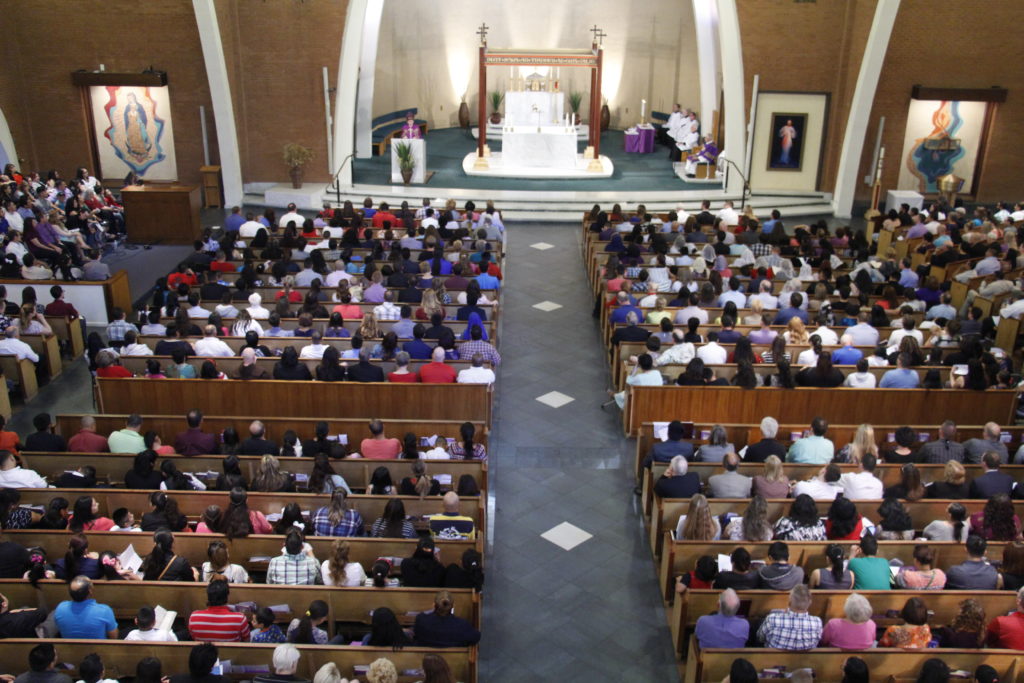
Students in the Rite of Christian Initiation program at parishes throughout the Diocese of Phoenix await Bishop Thomas J. Olmsted's procession into Ss. Simon and Jude Cathedral Feb. 14. (Ambria Hammel/CATHOLIC SUN)
Students in the Rite of Christian Initiation program at parishes throughout the Diocese of Phoenix await Bishop Thomas J. Olmsted’s procession into Ss. Simon and Jude Cathedral Feb. 14. (Ambria Hammel/CATHOLIC SUN)
Some 600 people had a memorable way of showing their newfound or newly re-committed love for the Catholic faith.
They spent part of the afternoon on Valentine’s Day elevating their status from catechumens to the “elect,” who, after finishing the Lenten journey, will seal their commitment to the Church at the Easter Vigil. It was all part of the Rite of Elect held the first Sunday of Lent — which happened to fall on Feb. 14 this year — at Ss. Simon and Jude Cathedral.
The crowd was half students from the Rite of Christian Initiation for Adults and its counterpart for children across the Diocese of Phoenix and half their sponsor. Their teachers spread throughout the crowd too.
They squished into every pew and filled folding chairs that lined the aisles for the occasion. It brings back memories every year for Dan Mueller. He grew up Protestant, but while raising his children Catholic, realized he could be better positioned to help them in their faith if the Church’s prayers were also his own.
Dan Mueller from St. Bernard of Clairvaux (Ambria Hammel/CATHOLIC SUN)
Mueller came into the Church several years ago and is completing his sixth year as an RCIA instructor at St. Bernard of Clairvaux Parish in Scottsdale. This year, there are 17 candidates in the program “getting ready to leave the nest.”
“You watch them go through an intimate part of life’s journey as a friend, as a mentor, as a confidante,” Mueller said.
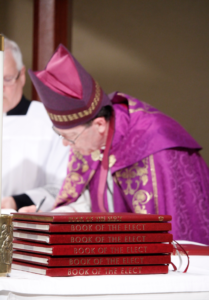
Bishop Thomas J. Olmsted signs each parish’s Book of the Elect Feb. 14. (Ambria Hammel/CATHOLIC SUN)
He was among the dozens of RCIA leaders or students who solemnly processed their respective parish’s “Book of the Elect” down the main aisle during the ceremony. Bishop Thomas J. Olmsted inquired whether those who signed their name in each one had done so of their own free will and after much formation and discernment.
Their godparents vouched for them. Bishop Olmsted reminded the godparents that their work was not finished and that their example will always matter. He also gave a homily aimed at the elect as they embarked on their Lenten journey.
It wasn’t a full Mass because the majority hadn’t made their first communion yet, but the ceremony started off a bit like one. The crowd heard the same readings Catholics worldwide heard at Mass that day: the temptation of Jesus in the desert.
Resisting simple daily temptations helps Catholics resist the devil and grow in virtue, the bishop said, “and giving in to temptation never brings us joy.” He encouraged the crowd to emulate Jesus’ response to temptation: with the Truth. It’s like a lion, he said, let it loose and it will defend itself.
(Ambria Hammel/CATHOLIC SUN)
“Speak it simply and trust that the Word of God will help us defeat Satan and bear fruit in our lives,” the bishop said.
It’s been a bit easy for Tim Niesz to embrace the Word of God throughout RCIA. The St. Bernard of Clairvaux parishioner has been coming to Mass some 44 years with his family. His grandson became fully initiated into the faith two years ago and Niesz thought about doing the same then.
“This is going to make my whole family unit one,” said Niesz, who was Presbyterian and whose 1-year-old granddaughter was baptized earlier that day at St. Maria Goretti in Scottsdale.
“I’ve learned so much to reaffirm what little I did know before,” he said.
The Rite of Election day was meaningful for Steve Nasr too. It was also his birthday and “re-birthday,” he said.
Nasr will also come into the Church at St. Bernard of Clairvaux. He was raised Episcopalian, but graduated from a Jesuit high school, so he sees it more as a coming home than a conversion. Nasr learned is eager to
“I’m looking forward to the Easter Vigil and reconciliation. I need to get rid of some baggage,” Nasr admitted, who said he had learned a lot about true devotion to a faith and about the freedom of free will.
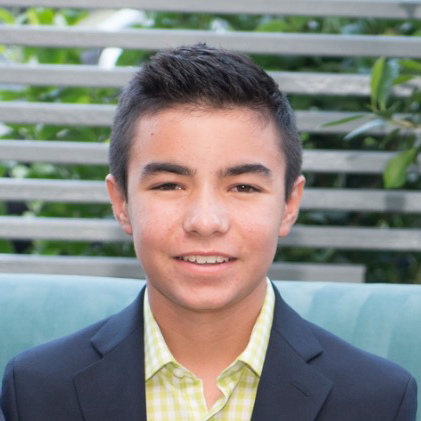
A Brophy freshman spent nine months in another country as a pre-teen to get proper medical care. He’s now healthy and grateful.
Diego Morris is also keenly aware how crucial the proximity of medical treatment and family support are in the healing process. That’s why he agreed to serve as the honorary chairman of the Right to Try initiative in Arizona at age 13. That’s also why he will testify during a “Connecting Patients to New and Potential Life Saving Treatments” hearing before the U.S. Senate Committee on Homeland Security and Governmental Affairs Feb. 25.
The hearing will focus on identifying possible barriers preventing patients from accessing new and potentially lifesaving therapies, often in the face of terminal or debilitating conditions. Morris will offer Congress suggestions about the steps members can take to reduce impediments and help connect willing patients and potential medical innovations.
Morris was 11 when he faced osteosarcoma, a rare bone cancer. England and many other countries have approved drugs for treatment. The U.S. is not one of them.
“I am blessed to have been able to move so far away; most kids don’t have that option,” Morris said. “I believe Americans should have access to medicine and treatments in the U.S. and have the support of their friends and family that you need when you are sick. We should have the right to try to save the lives of our loved ones.”
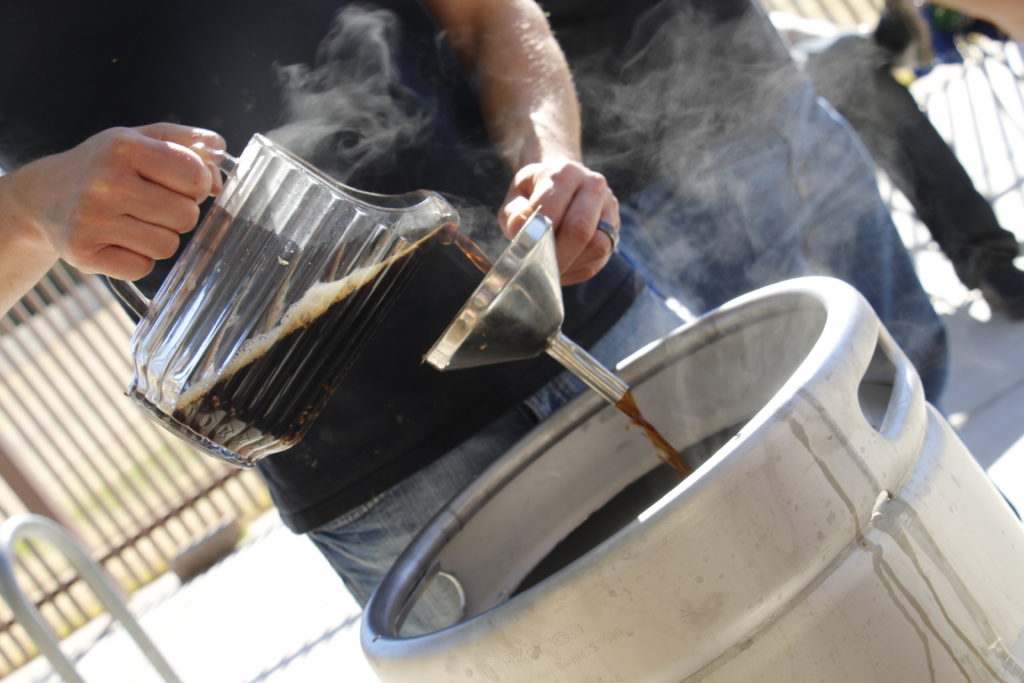
Young adults prepare the first brew out of Our Lady of Perpetual Help Jan. 17. (Ambria Hammel/CATHOLIC SUN)
SCOTTSDALE — Parish leaders are brewing up a new approach to young adult evangelization — literally.
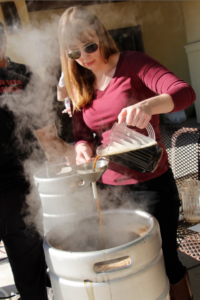
A young adult pours what will ultimately become the first beer out of The Smiling Pope Church Brew during a brewing session at Our Lady of Perpetual Help in Scottsdale Jan. 17. (Ambria Hammel/CATHOLIC SUN)
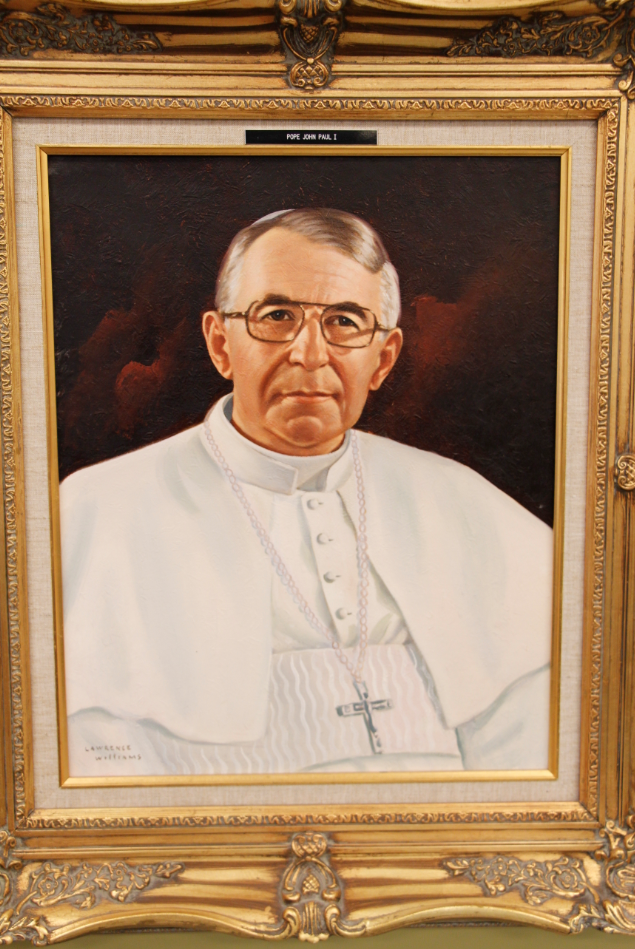
Other papal portraits already found permanent homes around parish grounds. Brian Canon, director of evangelization at OLPH, noticed the one of Pope John Paul, who died 33 days after being elected to the papacy in 1978, did not.
“He’s called the smiling pope. He must have been happy,” Canon said.
He envisioned similar smiles as young adults gathered around the parish’s new 15-gallon brewing system for brewing days — a nod to the current craft beer culture — followed by “Think and Drink” sessions a good month later once the malted beverage is ready. The name stuck.
“Most of the people I talk to think it’s a brilliant idea,” Canon said. “A lot of my non-Catholic friends think it’s hilarious and awesome.”
Several young adults — including a few who briefly stopped by from Tolleson — gathered on a warm Sunday following Mass Jan. 17 to embark on the first brew: an Imperial Rye IPA. Fr. Greg Schlarb, pastor and one of the brewery’s “GoFundMe” start-up sponsors, earned the honor of choosing the first brew.
The Smiling Pope Church Brew
What: Young Adult ‘Think and Drink’ for ages 21+
When: 7 p.m. March 3
Where: Our Lady of Perpetual Help, 7655 E. Main St., Scottsdale
The first “Think and Drink” session is scheduled for 7 p.m. March 3. The topic: “Adventures in Adulting” where three generations of priests will share the joys and struggles of growing up.
Leaders vow to check IDs at the door, not baptismal certificates. Drinks are free, but the alcoholic ones will be limited. Soda and other non-alcoholic beverages will be available for non-drinkers and designated drivers.
Canon is marketing to young adults in their 20s and 30s, but found support among donors beyond that age range. He said it offered a tangible way for them to invest in young adult ministry.
Chris Forschino, the “master brewer” for the day, once connected with Canon while serving on a core team under Canon’s leadership. Forschino sees “The Smiling Pope Church Brew” as an easy social thing for young Catholics and their friends of any or no faith to bond over. He said dancing was the “in” thing for his dad’s generation.
Canon sees the brewing and drinking days as opportunities to reach those who identify as Catholic, but may not often go to Mass. It will open up conversation on where they are in their faith journey and perhaps why.
“We sort of expect that when people show up in a pew, they’ve been evangelized,” Canon said. He called “The Smiling Pope Church Brew” an entry point for people into the Church.
Young adults prepare the first brew out of Our Lady of Perpetual Help Jan. 17. (Ambria Hammel/CATHOLIC SUN)
Catholic Beer Club
For those already in the Church and interested in Catholic friends and casual conversation, the Phoenix chapter of the Catholic Beer Club might be an option too. There are no agendas, just community and relationship, its tagline says.
People like Christian Andreen can attest to that. The Creighton University alumna once launched a chapter near her alma mater and helped re-launch Phoenix’s chapter last August. Conversation often starts with the common ground of the faith, veers off into work, personal and family life as the case may be, but often comes back to Catholicism.
Roughly 30 people from across the Valley, the largest gathering yet, came to the latest meet up Jan. 23 at Papago Brewing Company. Andreen sees the public gatherings as a chance to evangelize and has noticed bartenders asking patrons if they’re “here with the church group.”
“We’re really about enjoying life the way God intends us to,” she said.
The Catholic Beer Club has chapters in at least eight other states.
The University of Wisconsin-Madison’s Badger Catholic Service Team takes their call to know, love and serve quite seriously. They don’t mind traveling 1,700 miles for a service project.
[dropcap]E[/dropcap]ight-hundred years ago, a Spanish priest from Osma took a trip with his bishop, Juan Diego, through France, headed for Norway to retrieve a princess for the son of King Phillip of Spain. The two never made it, through no fault of their own, but because the princess ceased breathing — a deal-breaker in the old days. But what they found was deep and abiding heresy that would make today’s progressive Catholics seem like choir kids.
Dominic de Guzman was the priest and he and Bishop Diego turned from their diocesan duties to battle the heresy rampant in the south of France. They sought permission from the Vatican to form an order of itinerant preachers to travel the world and preach the Good News of the true Gospels. Unfortunately, Bishop Diego passed away, but, fortunately, the dream was left to Dominic to carry on.
“Hounds” is a reference to the play on words in Latin, Domini, meaning God, and canes, meaning “dogs.” We Dominicans have long considered ourselves literally “gone to the dogs.”
Vost divides his material up into “Doers”, “Thinkers”, and “Lovers” (in the contemplative style) though we Dominicans tend to believe that thinking is doing because we all love thinking … and doing. This is a minor point. Vost first discusses the founder of the order and the mystical nature of his personhood. Before he was born, his mother, Jane of Aza, a very righteous and charitable woman, purportedly had a dream in which a dog — yes, here we go again — runs throughout the world with a torch in its mouth, a symbol to Dominic’s mother that he would grow up and spread the fire of the Gospel. Good call. History looks upon Dominic as a fiery hero bringing light to the abject darkness that was the Albigensian heresy.
So many stories make up his life that Vost was able to include only some of them. There is the story of the Innkeeper, an Albigensian whom he stayed up with all night during his journey to Norway bringing the man back to the faith. There is the story of the Gospel of Matthew, which he carried with him at all times, and which he threw in a fire with an Albigensian work to test the veracity of each. The Gospel of Matthew was unharmed and the heretic work was consumed by the flames. There was the story of Dominic selling all of his other books (great treasures in those times) to buy food for the poor. When he formed the order, he formed a convent of nuns, followed by the laity — that’s me — and then the friars, priests and brothers, and finally the apostolic sisters. Education was the foundation of all his preaching and he insisted on it for the rest of us.
When he died, he asked to be buried underneath the feet of the brothers. Dominic is legendary for the Rosary, purportedly given to him by the Holy Mother. Prayer beads existed long before Dominic but who is to say that the prayer form did not begin with him? Certainly not I.
Vost details the life of Bl. Humbert of Romans who helped organize the order into the democratic form — one of the first in Europe — it is in today.
Bl. Fra Angelico is detailed, the painter of such passion that he is often compared to great masters of the era. St. Thomas Aquinas, the great thinker, St. Albert the Great, the great scientist, and lay members St. Catherine of Siena, St. Martin de Porres, St. Rose of Lima, and Bl. Pier Giorgio Frassati are all detailed in their lives and actions.
Of course, the order does not boast but I am weak and can go ahead. We have 93 blesseds, 21 saints, four popes, and three of the 35 doctors of the Church.
Vost’s book is good for me, good for you, and good for the Church. And if you want to inquire about joining the ranks of these “Hounds of the Lord,” email me at rbcurti@hotmail.com.
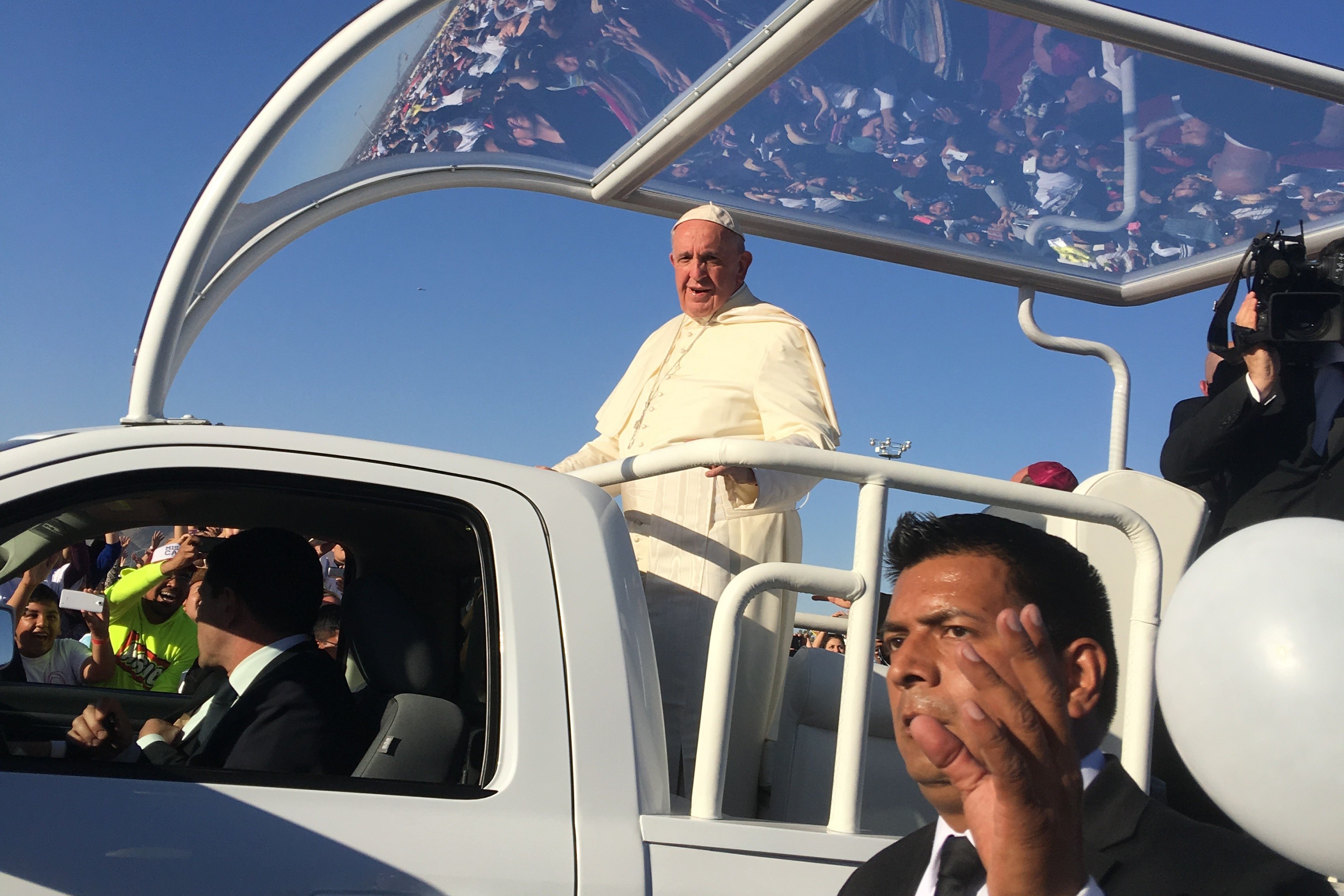
Pope Francis passes by in the Popemobile at El Punto in the former Juárez Fairgrounds where he celebrated the last Mass of his apostolic visit to Mexico. (Photo courtesy of Rosario Espinola)
Pope Francis passes by in the Popemobile at El Punto in the former Juárez Fairgrounds where he celebrated the last Mass of his apostolic visit to Mexico. (Photo courtesy of Rosario Espínola)
CIUDAD JUÁREZ – Just as God called Nineveh to conversion, so too are we called to conversion, through mercy, said Pope Francis at El Punto in the former Juárez Fairgrounds next to the U.S.-Mexico border during the last day of his apostolic visit to Mexico.
The Holy Father landed in Juárez from Morelia earlier in the day. During his day in Juárez, a city which has been plagued by cartel violence over the last decade, he visited the local seminary, addressed a group of prisoners and spoke to members of the maquiladora industry.
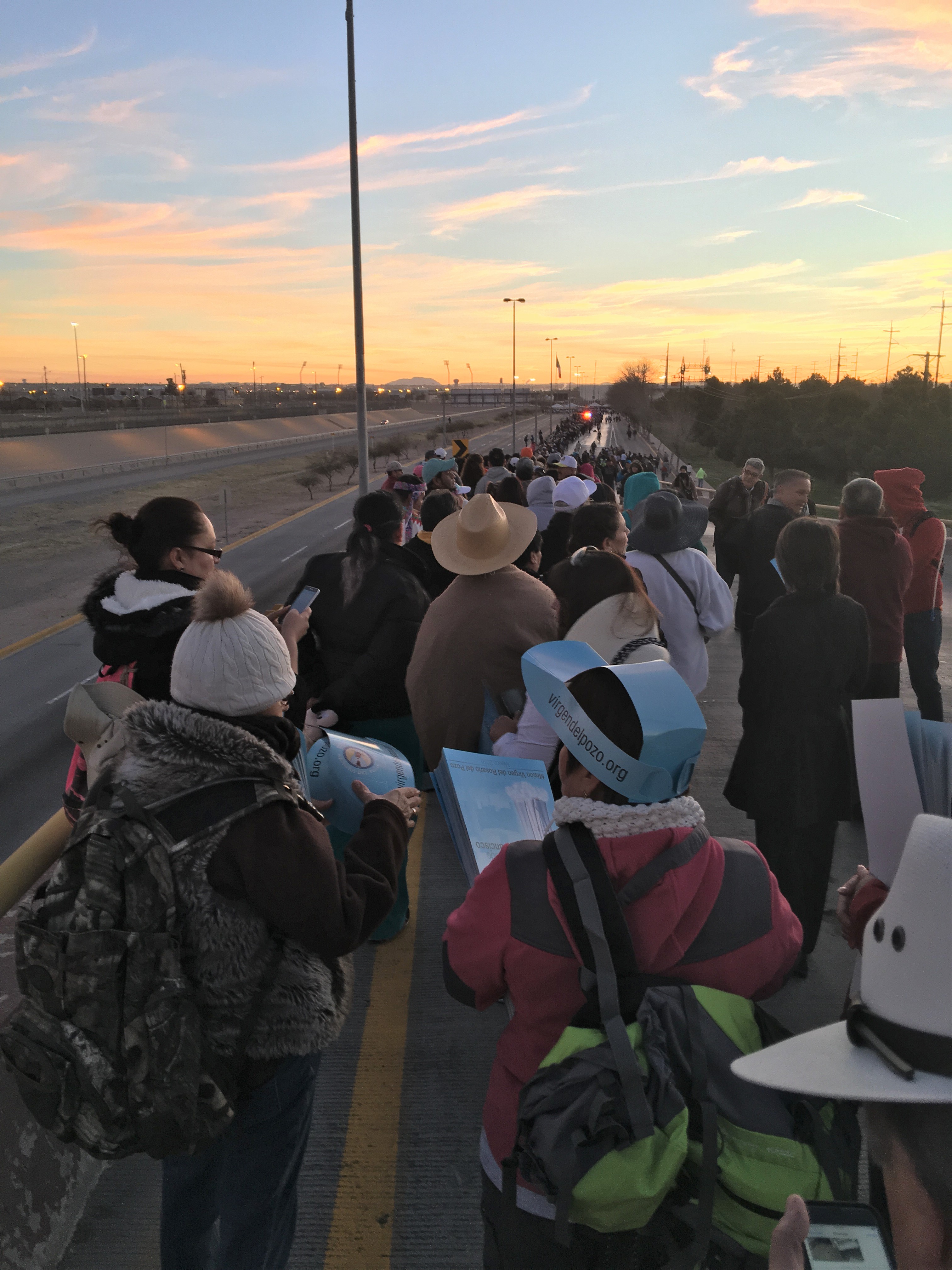
But the climax of his day-long visit to Juárez was the Mass on the fairgrounds. Thousands of people stood in line, some who had been waiting as early as 6 a.m., to get into the Mass. They watched a live video feed of the Holy Father’s motorcade traveling through the streets of Juárez as they waited for him to arrive. As they waited, they chanted “Viva el Papa!”, “Viva Francisco!”, “Viva la Virgen de Guadalupe!”, “Viva Cristo Rey!” and “Viva Padre Maldonado” (St. Pedro Maldonado, one of the Cristero priest martyrs who was from Chihuahua, the Mexican state where Juárez is located).
“Aquí viene el Papa (Here comes the pope)!” announced an emcee for the pre-Mass festivities, as the faithful cheered while watching the Popemobile come into El Punto. As he rode in, the pilgrims sang “Francisco es,” the official song for the Holy Father’s apostolic visit.
Referencing the day’s first reading from Jonah, Pope Francis said that we find the mystery of Divine Mercy.
“Far from bringing destruction, as we so often desire or want to bring about ourselves, mercy seeks to transform each situation from within,” he said. “Herein lies the mystery of Divine Mercy. It seeks and invites us to conversion, it invites us to repentance; it invites us to see the damage being done at every level.”
Mercy entered the hearts of the Ninevites when Jonah entered their city. This reveals that there is always a possibility for change, the pope said.
“Following this, his call found men and women capable of repenting, and capable of weeping,” he said. “To weep over injustice, to cry over corruption, to cry over oppression.”
These tears, he said, lead to transformation, purify our gaze and enable us to see the cycle of sin we are in and can sensitize our gaze and attitude hardened in the face of another’s suffering. They are “tears that can break us, capable of conversion.”
The passage is a relevant one for us today, said the Holy Father, inviting us to conversion, especially in this Year of Mercy. He then acknowledged the thousands of immigrants from Central America and other countries, as well as many Mexicans, who cross the border in Juárez, as in other border areas to pass over “to the other side.”
Pilgrims lined up to enter El Punto as early as 6 a.m. (Photo courtesy of Rosario Espínola)
“Each step, a journey laden with grave injustices: the enslaved, the imprisoned and extorted; so many of these brothers and sisters of ours are the consequence of trade in human beings,” he said.
“We cannot deny the humanitarian crisis which in recent years has meant the migration of thousands of people, whether by train or highway or on foot, crossing hundreds of kilometers through mountains, deserts and inhospitable zones,” he added.
Calling forced migration a human tragedy and global phenomenon, he said that it’s a crisis that can be measured in numbers and statistics, but is better measured with names, stories and families.
“They are the brothers and sisters of those excluded as a result of poverty and violence, drug trafficking and criminal organizations,” Pope Francis said. “Being faced with so many legal vacuums, they get caught up in a web that ensnares and always destroys the poorest. … Injustice is radicalized in the young; they are ‘cannon fodder,’ persecuted and threatened when they try to flee the spiral of violence and the hell of drugs. Then there are many women unjustly robbed of their lives.”
Like the Ninevites, the Holy Father challenged the faithful to ask God for the gifts of conversion, tears and open hearts.
“No more death! No more exploitation! There is still time to change, there is still a way out and a chance, a time to implore the mercy of God!”
At the end his homily, the pope acknowledged those watching a live telecast across the border at the University of Texas at El Paso’s Sun Bowl.
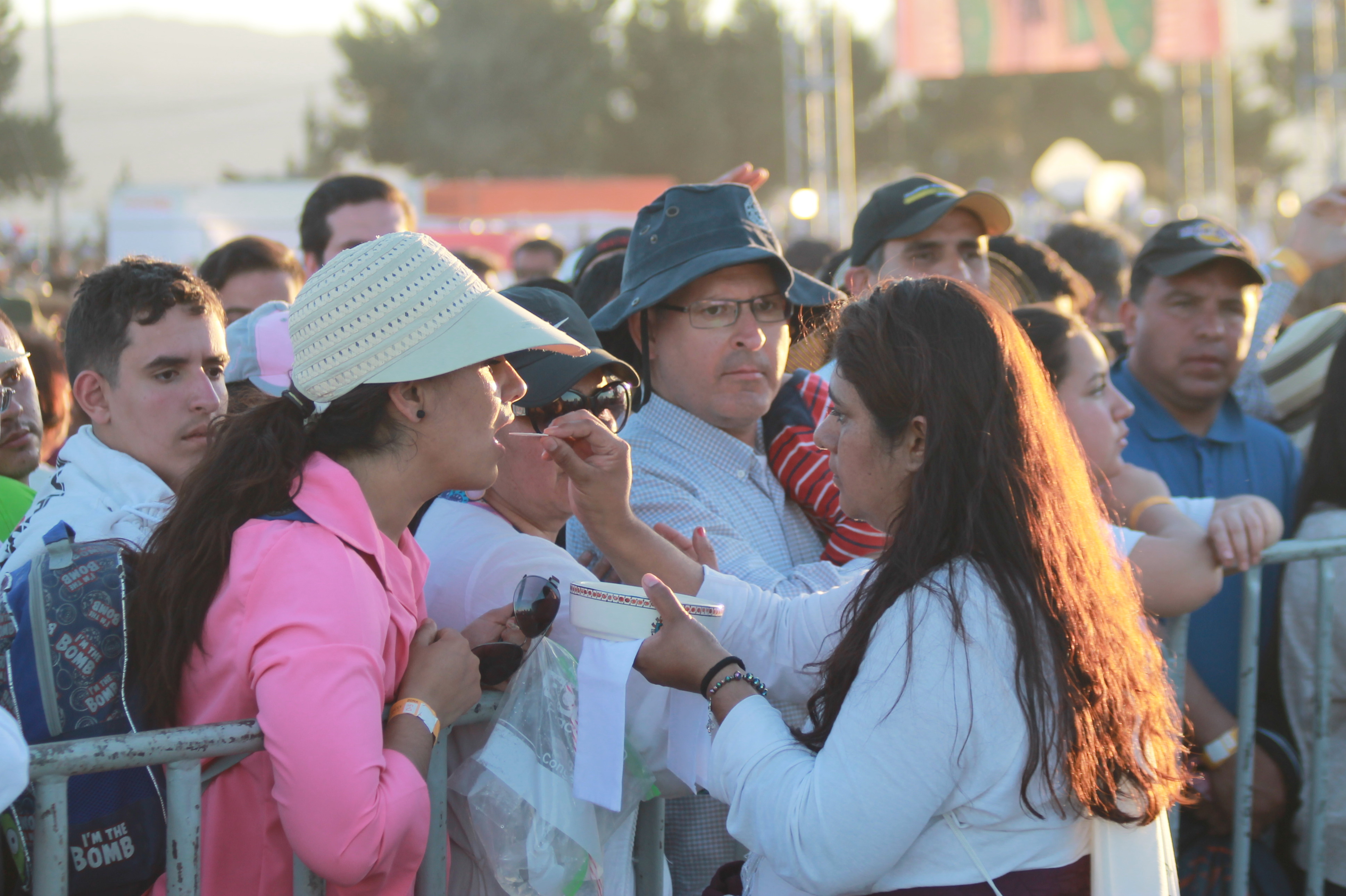
A woman receives the Eucharist at the Papal Mass in Juárez. (Tony Gutiérrez/CATHOLIC SUN)
“Thanks to the help of technology we can pray, sing and celebrate together the love and mercy that the Lord gives us in which no border can stop us from participating in,” he said. “Thank you to our brothers and sisters in El Paso for making us feel like one family and the same Christian community.”
At the end of the Mass, he thanked the Mexican people for their hospitality, calling the country a “surprise.” Noting all the children he saw along his papal route, he said they were the future of Mexico.
“Let us care for them, love them. Children are the prophets of tomorrow, they are signs of the new dawn,” he said. “I assure you that there was a moment when I felt like crying to see so much hope in a people that have suffered so much.
“Mary, the Mother of Guadalupe continues to visit you, continues walking on this land. Mexico doesn’t make sense without her. She continues to help you be missionaries and witnesses of mercy,” he added.
Closing with his signature petition, he asked the people “Please, I ask you, don’t forget to pray for me,” as the faithful cheered cheering, “Francisco, hermano, ya eres Mexicano (Francis, brother, now you are Mexican)!”
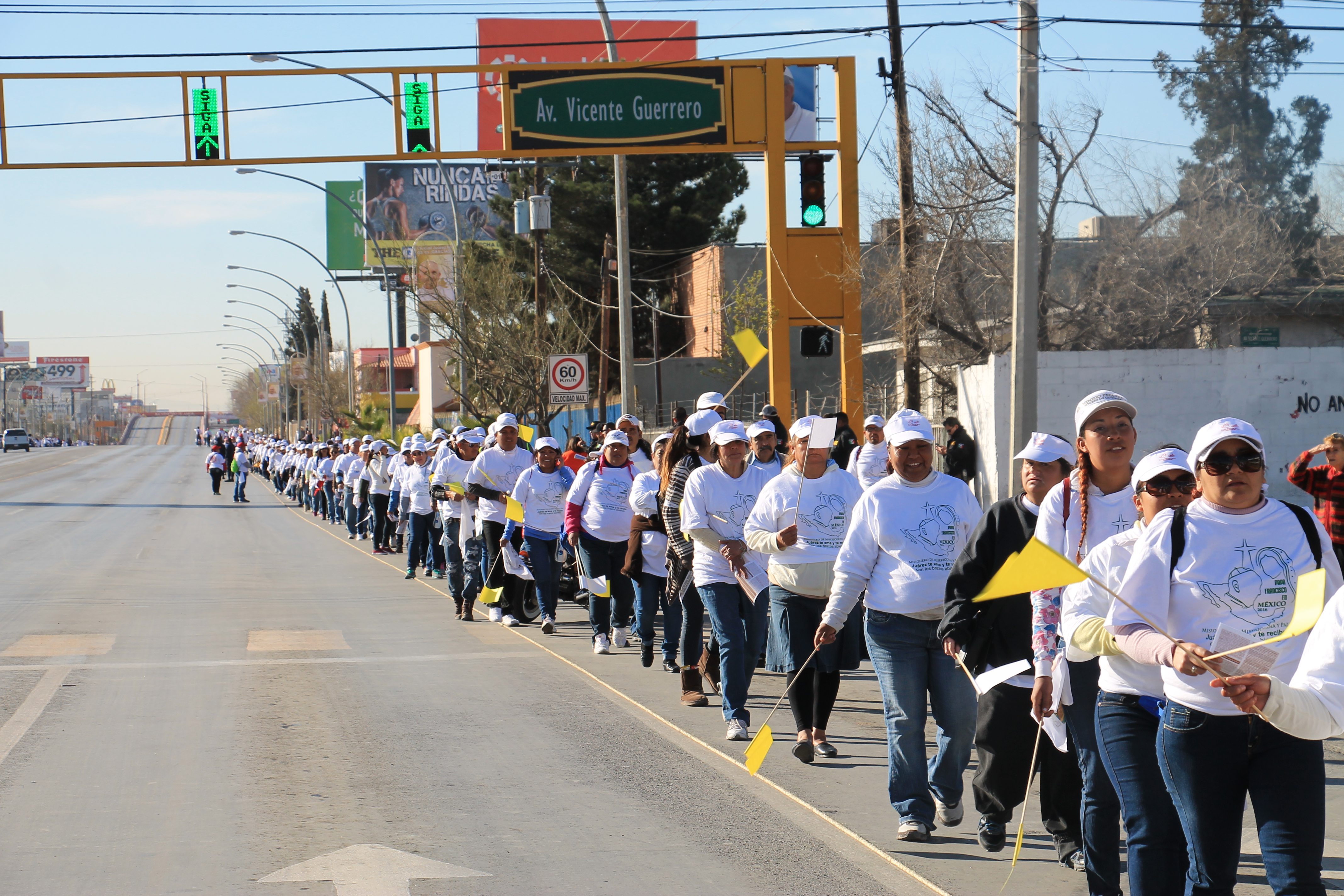
Volunteers line up along Paseo Triunfo de la República to form a human chain to help with crowd control. (Tony Gutiérrez/CATHOLIC SUN)
Volunteers line up along Paseo Triunfo de la República to form a human chain to help with crowd control. (Tony Gutiérrez/CATHOLIC SUN)
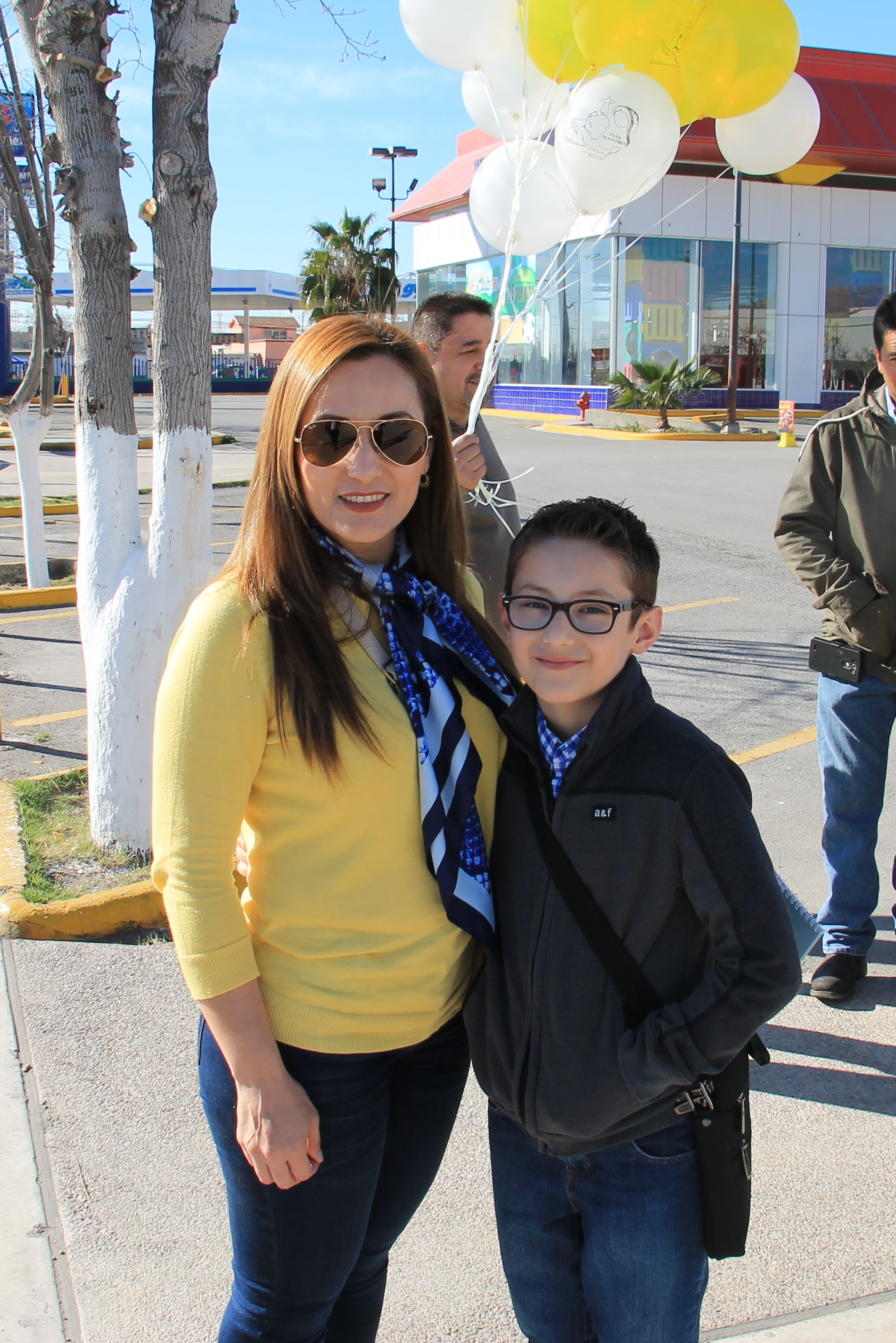
CIUDAD JUÁREZ — Ten-year-old Edgar Garcia didn’t mind waking up at 4 a.m. to cross the border from El Paso into Juárez Wednesday morning so he could see Pope Francis on the last day of his apostolic visit to Mexico.
“He felt even if we only saw him [for a few minutes] it would be a blessing for his family,” said his mother, Karla Garcia. “He told me there’s people coming from far away and we’re across the border. As a parent to see him have that devotion, that’s what brought me to come here.”
Karla Garcia and her 10-year-old son Edgar crossed the border into Juárez early Wednesday morning to see the pope. (Tony Gutiérrez/CATHOLIC SUN)
The Garcias are parishioners at St. Patrick Cathedral in El Paso and were among the thousands of pilgrims and locals who lined the streets along the papal route waiting for the Holy Father to pass by.
“It’s a very happy moment and day for all of us who are here,” said Jorge Barrela, a parishioner at Santuario de Divino Niño Jesus (Sanctuary of the Divine Child Jesus) in Juárez.
Barrela was among the hundreds of volunteers who formed a human chain along Paseo Triunfo de la República, one of the streets on the Holy Father’s route. As part of a human chain, the volunteers helped with crowd control, but they had the added bonus of being in the front to see the pope.
“Perhaps we are pilgrims, serving the Lord,” he said.
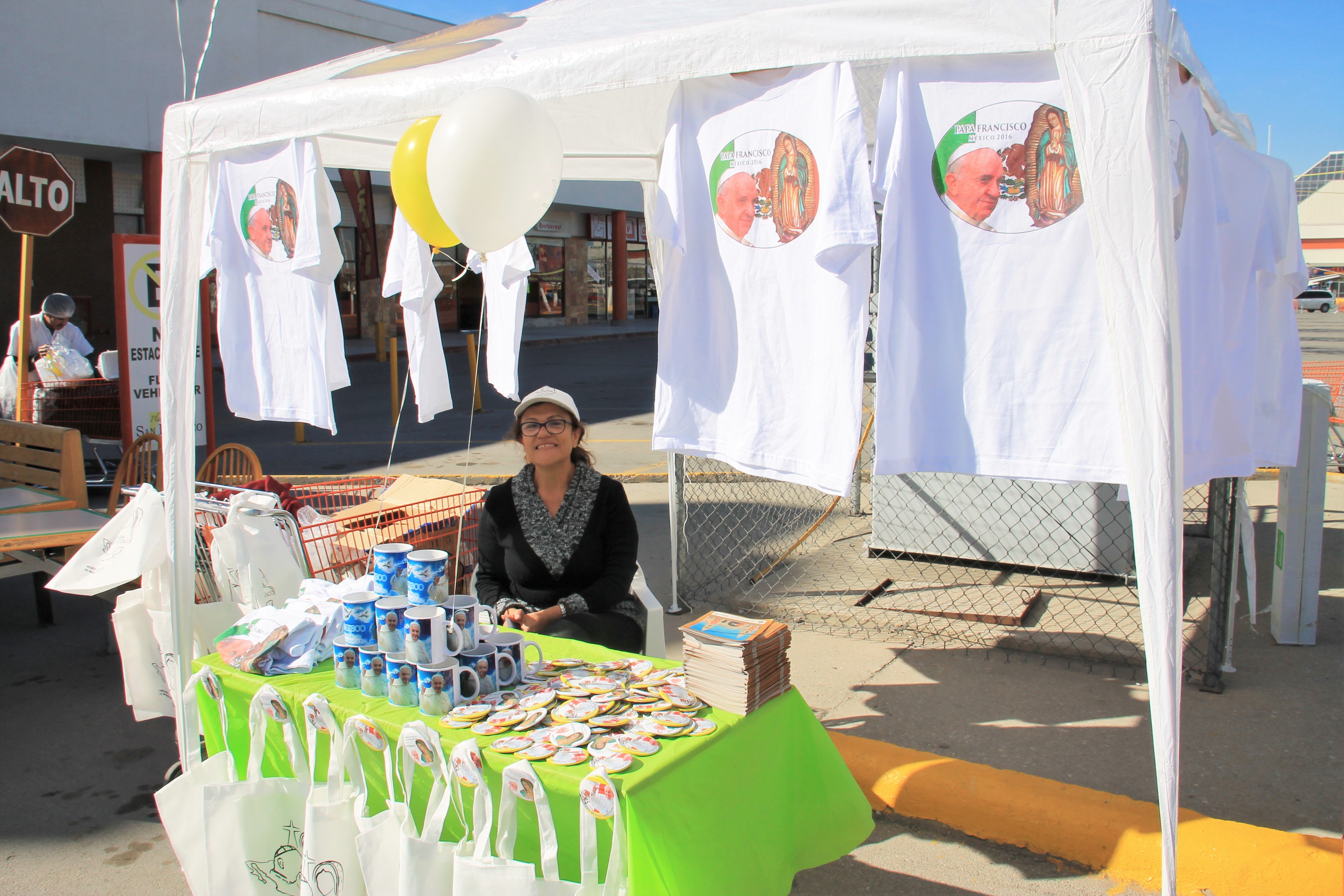
Luz María Leyva, a parishioner at San Lorenzo (St. Lawrence) in Juárez, sat at a table selling T-shirts, mugs and other commemorative souvenirs in the Soriana San Lorenzo supermarket on the street. She was helping a friend who owns several stores inside the supermarket.
“Pope Francis is a beautiful human being,” said Leyva. “I loved that we had a Latino pope, but now that I’ve had a chance to get to know him more, I’m very impacted.”
Luz María Leyva sells T-shirts, coffee mugs and other commemorative souvenirs in the parking lot for the Soriana San Lorenzo supermarket. (Tony Gutiérrez/CATHOLIC SUN)
To her, selling souvenirs for the papal visit is a service to the community.
“Life is full of moments,” she said. “The souvenirs are so [the pilgrims] can remember this moment.”
Irma Terrazas, a parishioner at St. Francis of Assisi in El Paso, crossed the border Tuesday afternoon with her husband and three children.
“It’s a very beautiful thing that he’s concerned about this part of the world,” she said.
Terrazas is originally from Juárez and her family has been staying with her mother, Irma Estrada, a parishioner at San Mateo (St. Matthew) in Juárez. Estrada said that it sends a positive message that the Pope Francis is visiting the border.
“We’re united,” Estrada said. “This is a great blessing for all of Juárez. Tomorrow, we’ll be very content that he came to this land.”