
Cardinal, chaplain praise Scalia as man of faith, family and the law

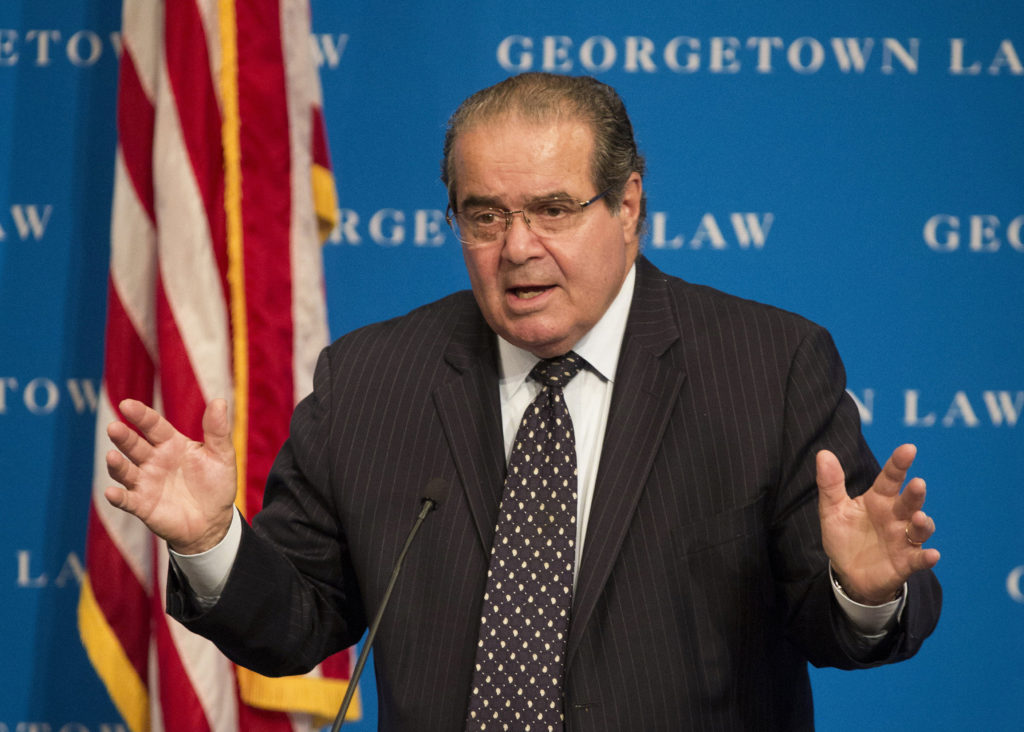
U.S. Supreme Court Justice Antonin Scalia is seen in this Aug. 30, 2013, file photo at Georgetown University Law Center in Washington. Scalia died Feb. 13. (CNS photo/Nancy Phelan Wiechec)

WASHINGTON (CNS) — The late Supreme Court Justice Antonin Scalia’s devotion to his Catholic faith and his family, and his dedication to serving the law and his country, make him a role model for public servants of all faiths, Washington Cardinal Donald W. Wuerl said in a Feb. 16 interview.

“Justice Scalia spoke of himself as a man devoted to his wife and family, committed to the practice of law and a believing disciple of the Lord. All of that enhanced his ability to carry out his public service on the Supreme Court,” the cardinal told the Catholic Standard, Washington’s archdiocesan newspaper.

[quote_box_center]

Attend the Mass of Christian burial via EWTN

It will air 9 a.m. Arizona time Feb. 20 from the Basilica of the National Shrine of the Immaculate Conception. Tune in on EWTN or online.

His son, a priest, will give the homily.

How to donate in his memory.

[/quote_box_center]

“His commitment to family, his dedication to the law and his personal religious faith are all elements that enrich our culture and society. In all of this, he was, for many, a true model.”
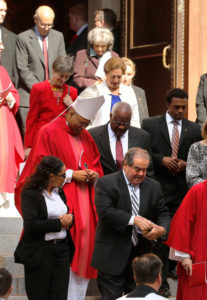
Washington Auxiliary Bishop Martin D. Holley, in red vestments, chats with U.S. Supreme Court Justice Clarence Thomas following the annual Red Mass at the Cathedral of St. Matthew in Washington Oct. 5. Also pictured is U.S. Supreme Court Justice Antonin Scalia, lower center right. The Mass traditionally marks the start of the court year, including the opening of the Supreme Court term. (CNS photo/Jonathan Ernst, Reuters)
Washington Auxiliary Bishop Martin D. Holley chats with U.S. Supreme Court Justice Clarence Thomas following the annual Red Mass at the Cathedral of St. Matthew in Washington Oct. 5, 2015. Also pictured is U.S. Supreme Court Justice Antonin Scalia, lower center right. (CNS photo/Jonathan Ernst, Reuters)

Cardinal Wuerl also noted how Scalia, who died Feb. 13, each year faithfully attended the Red Mass at the Cathedral of St. Matthew the Apostle in Washington. That annual liturgy on the Sunday before the Supreme Court begins its term is celebrated to seek God’s blessing and the guidance of the Holy Spirit on the administration of justice.

“To all who knew Justice Antonin Scalia, it was clear that he was a man of faith,” the cardinal said. “His annual presence at the Red Mass was always his personal testimony to the importance of God and prayer in his life. Invoking the gift of the Holy Spirit was for him a personal act of belief in God’s presence at work in our life and the wisdom of God probing our heart and lending light to our human knowledge.”

The cardinal added, “In conversations with him, it was clear to me that he regularly opened his heart to the Lord.”

Washington’s archbishop said the late Supreme Court justice was also shaped by his Catholic education. Justice Scalia graduated as the valedictorian in his class from two Jesuit schools — Xavier High School in Manhattan, New York, and Georgetown University in Washington, where he earned a bachelor’s degree in history before later earning his law degree from Harvard.

“Justice Scalia’s education, putting him in contact with the great Judeo-Christian tradition, included as well an introduction into an understanding of the best of human wisdom,” Cardinal Wuerl said.

One year after being confirmed as an associate justice of the Supreme Court, Scalia addressed the John Carroll Society, a group of Catholic professional women and men in the Archdiocese of Washington.

In that 1987 address, Scalia said, “A good government should not impede the religious practices of its people. … Its main function is here, ensuring a safe, just and cooperative society.” Those two different spheres, church and state, are “interdependent but separate,” he said.
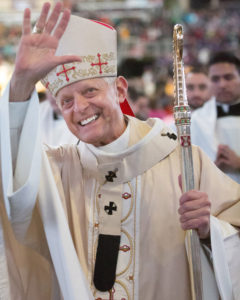
Washington Cardinal Donald W. Wuerl waves as he leaves after celebrating Mass during a pro-life youth rally at the Verizon Center in Washington Jan. 22. Cardinal Wuerl described the late U.S. Supreme Court Justice Antonin Scalia as a man of faith, family and the law. (CNS photo/Jaclyn Lippelmann, Catholic Standard)

Scalia “clearly understood the limits of government in attempting to intrude into the faith life of believers and the limits of any individual faith community in identifying itself with the state,” said Cardinal Wuerl.

Msgr. Peter Vaghi, the longtime chaplain of the John Carroll Society and a friend of Scalia, also praised him as a man of faith and a family man. “His Catholic faith guided his life. He was a family man. He had nine children and 36 grandchildren. He was a man of great integrity, bigger than life. … He was an extraordinary jurist.”

Scalia’s attendance at the annual Red Mass each year underscored the importance of prayer in his life. The justice was an honorary member of the John Carroll Society and received the society’s medal.

The priest, who also is pastor of the Church of the Little Flower in Bethesda, Maryland, said that Scalia’s Italian-American roots “were very much a part of his life.”

“I’m Italian American, and he was the first Italian American to be on the Supreme Court. That was a great source of pride to so many of us who are Italian American,” said Msgr. Vaghi.

The priest also commented on Scalia’s friendship with Justice Ruth Bader Ginsburg, who is Jewish and a liberal. The two were usually were on opposing sides in Supreme Court decisions, but the two justices went to the opera and on vacations together, once even riding an elephant together in India. After Scalia died, Ginsburg issued a statement saying they had been “best buddies.”
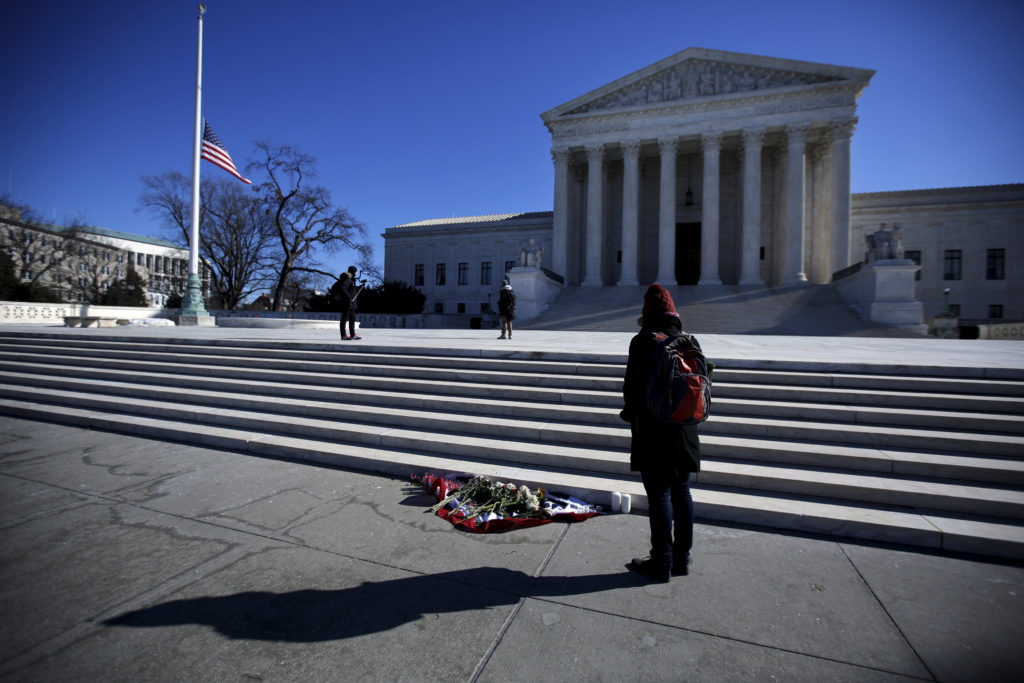
A woman stands in front of flowers outside the Supreme Court building in Washington Feb. 14, the day after the death of U.S. Supreme Court Justice Antonin Scalia. (CNS photo/Carlos Barria, Reuters)

“It was representative of the way things used to be in Washington,” Msgr. Vaghi said, noting how in bygone days, members of Congress from opposing parties would debate issues, and then socialize together afterward. “One can differ and disagree on issues, but still respect each other as individuals. We’ve come a long way from that,” the priest said.


By Mark Zimmermann, Catholic News Service. Zimmermann is editor of the Catholic Standard, newspaper of the Archdiocese of Washington

Catholic groups keep benefit run, hike going strong

Hundreds of supporters will pound the pavement and hit the trail March 5 in support of the Desert Nun Run and Hike for the Homeless. (Catholic Sun file photo)

Runners, hikers and those who just like to help are ready to enjoy the great outdoors while supporting a pair of Catholic causes.

[quote_box_right]

Looking for something to do March 5?

Hike for the Homeless benefiting St. Joseph the Worker

McDowell Mountain Regional Park, 16300 McDowell Mountain Park Dr., Fort McDowell (map)

Desert Nun Run benefiting the Poor Clares of Perpetual Adoration

Kiwanis Park, 95 W. Baseline Rd., Tempe (map)


Both are family-friendly events.

[/quote_box_right]

The Desert Nun Run and a Hike for the Homeless are both March 5 in Tempe and Fountain Hills, respectively. Both consistently draw parish groups, school groups and individuals for a morning of fellowship and exercise while supporting the mission of each organizer.

Those who join the “Take a Hike, Change a Life” event can take a 1.5-mile or 4.5-mile trail at McDowell Mountain Regional Park near Fountain Hills. Hike proceeds allow St. Joseph the Worker to give job-seeking — largely homeless — clients the basic tools they need to secure a job interview and sustainable employment. St. Joseph the Worker’s outreach goes beyond basic résumé and job interview preparation to also offer bus passes to get there, interview and work attire, a razor and ironing station to help them look their best plus job-site tools and even a “home” address to put on the application.

“They give their clients the tools to succeed. They need the money to do that and the hike supports that,” said Polly Fitz-Gerald, director of advancement and alumnae relations at Xavier College Preparatory.

This will be at least the 11th year that Xavier has supported the hike behind the scenes and on the trail. It’s the school’s community-wide service, Fitz-Gerald said.

Anywhere from 15 to 30 members of the student Key Club handle hiker check-in and registration. Alumnae, parents and faculty form a hiking team, sometimes so strong that Xavier has earned the trophy for the largest number of participants many times over. An average of 900 hikers hit the trail each year.

That also includes teams from St. Bernadette and St. Patrick parishes in Scottsdale. This marks the sixth hike Kathleen Kelly supported one of the teams.

Kelly grew St. Patrick’s team from 73 hikers four years ago to some 220 last year. St. Bernadette’s inaugural team last year had 47 hikers.

“Both St. Patrick’s and St. Bernadette’s parishioners are exceptionally enthusiastic about embracing programs to help those individuals who find themselves in unfortunate circumstances, unemployed and often homeless,” Kelly said.

Clients often share their testimony before or after the hike and Kelly realizes how easily she could find herself in their shoes.

“Their stories increase my enthusiasm to support St. Joseph the Worker’s programs and encourage others to do the same,” Kelly said.

Not every supporter has to hike. Virtual hikers are welcome to observe, join the “block party” atmosphere featuring live music, carnival games and bounce houses at the trail head or support the effort from home.

“I just can’t say enough about the staff at St. Joseph the Worker and their commitment to their mission,” Fitz-Gerald said. “These people have at their hearts the betterment of society.”

Desert Nun Run

The Poor Clare Sisters of Perpetual Adoration, who are organizing the Desert Nun Run at Kiwanis Park in Tempe, improve the community through a life of prayer. The sisters look forward to the day when additional vocations and funding allows them to build a cloistered monastery where they will truly be able to pray for the community’s intentions 24/7. Right now, because there are only five sisters on site, Eucharistic Adoration occurs during the day with a monthly 24-hour slot.

The Desert Nun Run draws runners and walkers of all ages who challenge themselves to a 10K, 5K or 1-mile course. The sisters bestow plaques and medallions to top finishers in each age category. The Poor Clares relish that personal interaction, whether it’s with the sisters or among participants who have begun to recognize one another from previous Nun Runs.

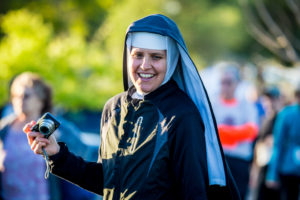
Hundreds, including Poor Clare Sister John-Mark Maria, came out for the 2015 Nun Run at Kiwanis Park to benefit Our Lady of Solitude Monastery and the Poor Clares of Perpetual Adoration. (Catholic Sun file photo)

“It’s become a big social time to gather,” Sr. John-Mark Maria said.

Friendly “Parish Pride” competitions ensured roughly 50 parishes were represented in recent years. Clergy and school challenges also excite the crowd.

This year, Sr. John-Mark said to expect free giveaways, an event theme rooted in mercy — and draws on the latest “Star Wars” movie title — and possibly priests available for confessions. The sisters plan to remain along the sidelines as a sign of hope for the crowd.

“We are with them in the Lord with their joys and with their sorrows,” Sr. John-Mark said. She recalled one group of siblings who support the run each year in honor of their late mother. They still tear up when sharing their purpose.

More than 700 runners and walkers showed up last year. It takes another 100 volunteers to coordinate the flurry of activities. Individuals, parishioners, third orders and Knights of Columbus councils come to help.

“It’s one of the highlights of our fraternal year,” said Al Gillis, a past Grand Knight for Council 15001 at St. Paul Parish.

The men don’t mind getting up at “0-dark-30” to prepare for the family-friendly event that draws three generations of volunteers and participants. They help with parking, food, set up and wherever else they’re needed.

“I can’t even classify it as work because we’re having so much fun,” Gillis said, noting the smiles on their faces and joy among others.

He loves seeing people from all parts of the diocese coming together to support the sisters.

“They’re here to basically serve us and they need a hand,” Gillis said. “It’s pretty much our responsibility to help them.”

St. Paul parishioners were even spotted supporting last year’s Hike for the Homeless.

Hearing that ‘still, small voice’ this Lent draws us closer to God

So how’s your Lent going? Are you ready to grow closer to God or are you in a spiritual rut?

I asked Sr. Mary Fidelis of the Poor Clares of Perpetual Adoration for her thoughts on how to have a more fruitful Lent. She told me it’s all about conversion.

“Ask the Lord in prayer what His desires are for you during this Holy Season. He will let you know! A good question to ask in prayer: ‘Lord, what is keeping me from running with freedom along the path of holiness? Where do I keep stumbling? What separates me from You? In what area of my life am I most selfish?’ Then, take up that cross this Lent, embrace some penance in that area of your life, and prepare for an adventure!”

Joyce Coronel is a regular contributor to The Catholic Sun and author of “A Martyr’s Crown.” Opinions expressed are the writers’ and not necessarily the views of The Catholic Sun or the Diocese of Phoenix.

But how do you hear the voice of God?

Of course, you can hear His voice when you read the Bible and when you listen to the words of counsel and absolution in the sacrament of Reconciliation. You can hear Him in the Mass and in the voice of loved ones and even strangers. But you also have to ask Him to speak to your heart — and then listen.

It’s in those quiet moments of listening that you hear His gentle words fill you with peace and direct your path. You will not hear accusations or condemnation. (That’s generally the voice of the enemy.) You’ll hear Him encourage you to let go, to trust, to forgive, and to sacrifice. You’ll hear Him when you’re heartbroken and doubting His Providence and wondering if somehow He forgot you. “I am here,” He will whisper.

He will speak to you in the stillness of the night when your pillow is wet with tears and you feel afraid or rejected or lost. You’ll hear Him when you ask how it is He wants to draw you even closer to His heart that throbs with love for you, as if you were the only one in the universe. You’ll hear Him in moments of joy when you rock a baby to sleep or consider the beauty of a sunset.

The great prophet Elijah heard the voice of God, not in the wind or the earthquake or the fire, but in that “still, small voice.” You have to train your ear to detect it, and once you’ve got that tuned in, it becomes quite clear. Ask the Lord to help you know yourself better this Lent so you can see what patterns of sin need to be uprooted from the garden of your soul.

Fr. Doug Lorig, pastor of St. Maria Goretti, told me that this self-knowledge is not meant to demean or condemn us, but to work toward the healing of our deep heart. Self-knowledge will help us “begin the hard work of digging out the rocks and weeds in our heart. If we can convince the Holy Spirit that we really do want to do that, He will find a way to put in front of us what has to be addressed,” Fr. Lorig said.

So I did a little digging during prayer and pretty quickly I heard that gentle whisper reminding me how much I enjoy staying up late and then hitting the snooze button the next morning. Why not get up earlier and join Him at daily Mass before work? And I heard a few other suggestions, too.

What about you? What is God calling you to do in order to grow closer to Him this Lent? Take time each day to rest your head on the Sacred Heart of Jesus and listen. It is there that we will hear the still, small voice leading us ever closer to God.

Pope tells Mexican prisoners society needs system of ‘social health’

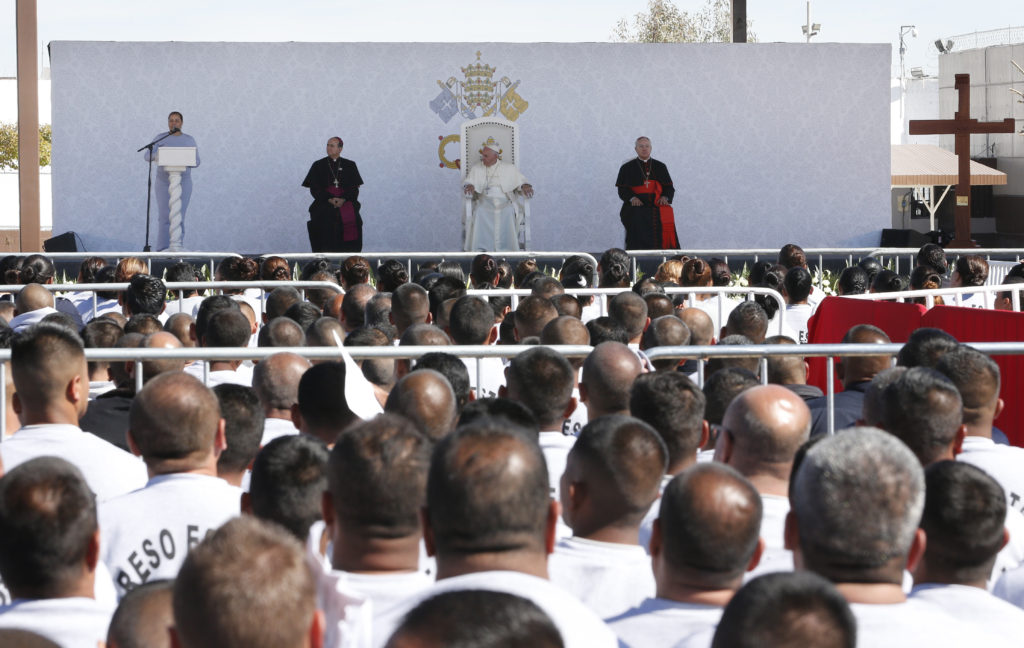
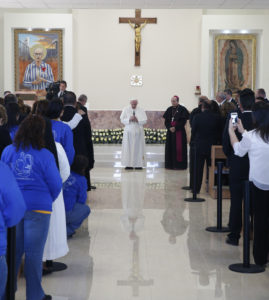
Inmates watch as Pope Francis visits Cereso prison in Ciudad Juarez, Mexico, Feb. 17. (CNS photo/Paul Haring)
Pope Francis listens as an inmate speaks during a visit to Cereso prison in Ciudad Juarez, Mexico, Feb. 17. (CNS photo/Paul Haring)

CIUDAD JUAREZ, Mexico (CNS) — Pope Francis urged society to rethink its ideas of locking up inmates and throwing away the key, calling such an approach another symptom of the “throwaway culture” he often decries and “a symptom of a culture that has stopped supporting life, of a society that has abandoned its children.”

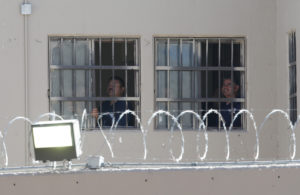
Speaking in a prison previously plagued by riots and controlled by drug cartels in a city once considered the “murder capital of the world,” the pope proposed focusing on prevention, reintegration and a system of “social health,” instead of on only on incarceration and insisting that inmates pay for their crimes.

“Celebrating the Jubilee of Mercy with you is recalling the pressing journey that we must undertake in order to break the cycle of violence and crime,” Pope Francis said Feb. 17 at Cereso prison, home to some 3,000 inmates.

Inmates watch as Pope Francis visits Cereso prison in Ciudad Juarez, Mexico, Feb. 17. (CNS photo/Paul Haring)

“We have already lost many decades thinking and believing that everything will be resolved by isolating, separating, incarcerating, and ridding ourselves of problems, believing that these policies really solve problems,” the pope continued. “We have forgotten to focus on what must truly be our concern: people’s lives; their lives, those of their families, and those who have suffered because of this cycle of violence.”

Pope Francis often includes prison visits in his papal tours, drawing attention to a population on the periphery of the church he is trying to construct. Prison officials in Ciudad Juarez say their facility — once considered the most violent in Latin America — has vastly improved since the horror of its worst year 2010, when 216 murders were committed there and rival gangs, fighting for control of drugs running through Ciudad Juarez, carried out crimes from behind bars.

His trip drew attention to the horrors of Mexico’s oft-maligned prison system, marked by overcrowding, corruption and inmates paying for privileges, protection and basics — everything from toilet paper to proper food. Inmate control inside correctional facilities is common.

The trip follows a brawl — blamed on incarcerated members of rival cartels clashing — in a Monterrey prison a week earlier. Forty-nine inmates died. Pope Francis sent condolences for the tragedy in the Topo Chico prison, where state officials subsequently found luxury cells with king-size beds, bars and even a sauna.

In Ciudad Juarez, the pope proposed prevention, along with reintegration and rehabilitation, which he said, “begins outside, in the streets of the city.”

Pope Francis prays in the chapel during a visit to Cereso prison in Ciudad Juarez, Mexico, Feb. 17. (CNS photo/Paul Haring)

It also “begins by creating a system which we could call social health, that is, a society which seeks not to cause sickness, polluting relationships in neighborhoods, schools, town squares, the streets, homes and in the whole of the social spectrum … a system of social health that endeavors to promote a culture which acts and seeks to prevent those situations and pathways that end in damaging and impairing the social fabric.”

Pope Francis mentioned the Year of Mercy often in his address to inmates, saying: “Jesus urges us to have mercy that embraces everyone and is found in every corner of the world. There is no place beyond the reach of his mercy, no space or person it cannot touch.”

He called concern for prisoners “a moral imperative for the whole society,” in working to toward an improved “common life.”
[quote_box_center]

Photos: Pope visits Juarez prison

[/quote_box_center]

“It is within a society’s capacity to include the poor, infirm and imprisoned, that we see its ability to heal their wounds and make them builders of a peaceful coexistence,” Pope Francis said. “Social reintegration begins by making sure that all of our children go to school and that their families obtain dignified work by creating public spaces for leisure and recreation, and by fostering civic participation, health services and access to basic services, to name just a few possible measures.”

“Social reintegration begins by making sure that all of our children go to school and that their families obtain dignified work by creating public spaces for leisure and recreation, and by fostering civic participation, health services and access to basic services, to name just a few possible measures.”

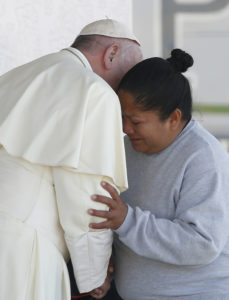
Toward the end of the brief meeting, Pope Francis joined the inmates for a moment of silent prayer, telling them that only they knew what they would ask forgiveness for. Several inmates were seen crying as they prayed.

Pope Francis embraces a female prisoner as he visits Cereso prison in Ciudad Juarez, Mexico, Feb. 17. (CNS photo/Paul Haring)

“I tell you from my own wounds, errors and sin,” he said, “that the Lord wants to forgive.”

He ended his talk with the assembled inmates, sitting under sunny skies outside a recently renovated prison chapel, by urging them to no long be “prisoners of the past,” learn to “open the door to the future,” and speak with their loved ones to put an end to “this cycle of violence and exclusion.”

“The one who has suffered the greatest pain, and we could say ‘has experienced hell,’ can become a prophet in society,” he said. “Work so that this society, which uses people and discards them will not go on claiming victims.”

Jesuit Father Federico Lombardi said the pope’s remarks were broadcast to 389 other prisons, with a potential 254,000 inmates watching.

By David Agren, Catholic News Service.

Woman’s situation points to reality that fewer Mexicans migrate to U.S.

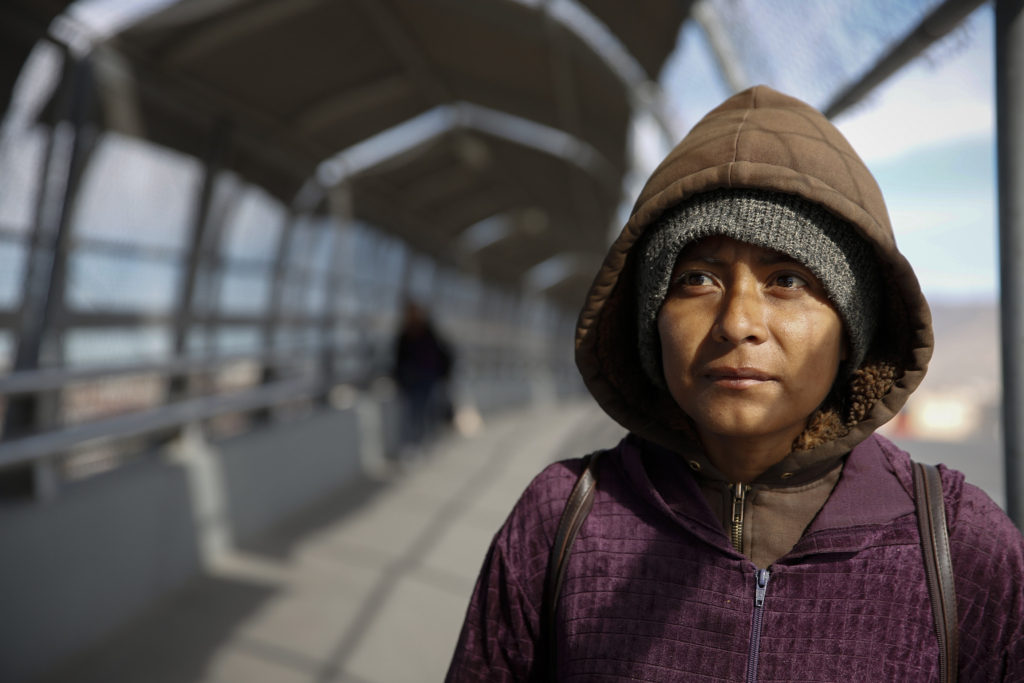
Diana Martinez walks the bridge linking El Paso, Texas, and Juarez, Mexico, at the Paso del Nortre port of entry Feb. 15. She had been deported from the United States and was panhandling for money so that she could return to her home state of Chiapas in Mexico. (CNS photo/Nancy Wiechec) See ELPASO-PAPAL-EVENTS Feb. 16, 2016.
Diana Martinez stands on the bridge linking El Paso, Texas, and Juarez, Mexico, at the Paso del Nortre port of entry Feb. 15. She had been deported from the United States and was panhandling for money so that she could return to her home state of Chiapas in Mexico. (CNS photo/Nancy Wiechec)

EL PASO, Texas (CNS) — Mexican immigration rates have been down for a while, for a time even reversing.

That reality seems to be absent from political circles and the perception of the general American population. But Diana Martinez is proof of it.

“I am from Chiapas, and just got deported,” Martinez told Catholic News Service in an interview midway on the Paso del Norte border-crossing bridge in the western Texas city of El Paso. “I don’t want to try anymore, just want to go home.”

Although Martinez did not have a specific plan, she was begging for money to afford transportation back to her hometown. “I don’t know how I’ll get there … praying to God is what I can only think of,” said the petite, slender young woman. Asked if she adhered to a certain religion, she said no, answering, “I only believe in God.”

She knew Pope Francis was coming to Ciudad Juarez, Mexico, but that seemed to have little value for her situation.

Martinez was brief in telling CNS about the months it took her to make it across Mexico and into the U.S., and about the several times she has been deported.

In the heat of another U.S. election year, immigration has been a theme for candidates, who have promised to fix the situation, but their words on the issue do not seem to reflect the reality being experienced by immigrants like Martinez.

They are the face of a little-mentioned trend originally reported last November by Washington-based Pew Research Center.

The report, titled “More Mexicans Leaving Than Coming to the U.S.,” has a subtitle that summarizes the whole document: “Net loss of 140,000 between 2009 and 2014; family reunification top reason for leaving.”

Diana Martinez walks the bridge linking El Paso, Texas, and Juarez, Mexico, at the Paso del Nortre port of entry Feb. 15. She had been deported from the United States and was panhandling for money so that she could return to her home state of Chiapas in Mexico. (CNS photo/Nancy Wiechec)

Some of the Pew data from the period studied includes:

  • One million Mexicans, including U.S.-born children, left the U.S. for Mexico, while an estimated 870,000 Mexicans came to the U.S.
  • Sixty-one percent of Mexicans who left the U.S. did so voluntarily; 14 percent of those who left were deported.
  • Possible reasons for the decline in Mexican immigration include effects of the U.S. economic recession, resulting in immigrants losing jobs; and a desire to reunite families.
  • The number of Mexicans entering the U.S. illegally who were apprehended by authorities fell to 230,000 in 2014, “a level not seen since 1971,” says the report.
  • Among adults in Mexico, 48 percent say life is better in the U.S. Thirty-three percent say life in the U.S. and in Mexico is equivalent; that figure is 10 percent higher than it was in 2007.

“This shift in immigration is noteworthy. Since 1965, Mexico has sent more immigrants (16.2 million) to the United States than any other country, in what has been the largest wave of immigration in U.S history,” concluded the report.

By Wallice J. de la Vega, Catholic News Service.

‘Risen’ helps revive the biblical epic

Joseph Fiennes and Tom Felton star in a scene from the movie "Risen." The Catholic News Service classification is A-III -- adults. The Motion Picture Association of America rating is PG-13 -- parents strongly cautioned. Some material may be inappropriate for children under 13. (CNS photo/Columbia Pictures)

NEW YORK (CNS) — For more than 40 years, the biblical epic was a recognized — and reliably popular — Hollywood genre.

Conveniently, if not with precision, its heyday might be seen as bookended by MGM’s two classic adaptations of Civil War Gen. Lew Wallace’s 1880 novel “Ben-Hur: A Tale of the Christ.”

The first of these productions, released in 1925 and starring Ramon Novarro, was the costliest silent film ever made. William Wyler’s 1959 remake featured Charlton Heston in the midst of hundreds of camels, thousands of horses (and human extras), battling warships and clashing chariots.

Alternatively, producer-director Cecil B. DeMille’s famously lavish contributions to the category — beginning with his 1923 silent “The Ten Commandments,” and ending with his 1956 updating of the same title — could just as easily be used to define the period.

Following DeMille’s death, Nicholas Ray helmed a 1961 reworking of the celebrated showman’s 1927 take on the Gospel story, “The King of Kings,” dropping the definite article from its title in the process. And 1965 brought director George Stevens’ large-scale screen biography of Jesus, “The Greatest Story Ever Told.”

Several Academy Award nominations notwithstanding, Stevens’ long film was not especially well received, either critically or at the box office. More importantly, the tenor of the times was beginning to shift, leaving the impression that the public no longer had a taste for such movies. Mrs. Robinson was in; except as joke, Edward G. Robinson’s sneering Old Testament villain, Dathan, was out.

So John Huston’s reverent 1966 adaptation of passages from the Book of Genesis, “The Bible: In the Beginning…” represented, temporarily at least, the last artifact of a long tradition.

Recent years, of course, have seen a notable revival in religiously themed pictures. Starting with Mel Gibson’s 2004 blockbuster (if such a label is not too irreverent) “The Passion of the Christ,” which made more than $600 million worldwide, Tinseltown has been forced to reckon with the earnings potential of films either rooted in Scripture or otherwise aimed at believers.

Movies by and for evangelical Christians, for instance, have successfully capitalized on a lucrative market all their own. “God’s Not Dead,” director Harold Cronk’s 2014 adaptation of a book by Rice Broocks, raked in more than 30 times its production budget — a remarkable return for investors of any outlook.

Though there’s certainly nothing bare-bones about it, Gibson’s “Passion” hardly radiates the aura of an epic. Still less does a project like Cronk’s, which adopts a college classroom as one of its principal settings, summon to mind that expansive description.

At least three Hollywood titles of recent vintage have undertaken a sweeping treatment of biblical subjects: Ridley Scott’s “Exodus: Gods and Kings,” Darren Aronofsky’s “Noah,” and Christopher Spencer’s “Son of God,” all released in 2014. As genre resuscitations go, however, this trio of releases produced rather tentative results.

On close inspection, neither of the first two features seemed really comfortable with its sacred source material. The result is that the interpretations and additions in both register as eccentric. As for Spencer’s recounting of the Redeemer’s life, though its approach is certainly straightforward, the level of creativity on display varied widely.

Two soon-to-be-released films seem better positioned to ignite a sustained revival of the marriage of scriptural message with opulent production values: Director Timur Bekmambetov’s updating of “Ben-Hur” and “Risen,” a Resurrection-focused drama directed and co-written by Kevin Reynolds.

While the former movie’s pedigree makes its claims to biblical-epic status obvious, the cast and crew of “Risen” are equally intent on placing their project within the canon MGM and DeMille helped to establish. That point was driven home by remarks some of them offered at a Los Angeles preview and press event for the film.

Producers Mickey Liddell and Pete Shilaimon, for example, made it clear that “Risen” is aimed both at believers and at those who may be lacking in faith. Thus, in addition to the fact that its main character, Roman army officer Clavius, played by Joseph Fiennes, is a dyed-in-the-wool skeptic, “Risen” includes numerous action scenes likely to engage a broad swath of viewers regardless of their worldview.

The balance between secular and religious concerns was also reflected in the way at least two of the leading figures in the cast prepared for their roles. While Fiennes attended a modern-day school for gladiators in Rome to learn the precise fighting style in which Clavius would have been trained, Cliff Curtis, who portrays Jesus, took a six-week vow of silence before and during production.

Additionally, Curtis washed the feet of the actors playing the Apostles. They, in turn, took care to have dinner together every night in order to build up a sense of shared experience and fellowship.

Fiennes expressed the hope that his character’s rough-and-ready manner and faith-averse outlook would offer nonbelieving audience members “a way in” to the story of the Resurrection. Clavius’ occupation, Fiennes pointed out, makes him a man who “reeks of death.” Who better, then, to test the reality of Jesus’ triumph over mortality?

Similarly, shaping the film as a detective story — Pontius Pilate (Peter Firth) commissions Clavius to find Jesus’ body and so put an end to the spreading rumors of his return — will, Fiennes hopes, help broaden its appeal. He pointed out that, as penned by Reynolds in collaboration with Paul Aiello, “Risen” qualifies as a mystery story in both the religious and the literary sense.

The movie is also a story of divinely inspired new beginnings, a “cleansing rebirth,” as Fiennes termed it, for “a world with few hopes.” That sense of optimism — as well as the goal of promoting faith through the arts — gives “Risen” a special resonance for Shilaimon, an Iraq-born Catholic with firsthand experience of religious conflict.

For Tom Felton, the “Harry Potter” veteran who plays Clavius’ aide-de-camp and protege Lucius, participating in the film was an educational experience. “I had never been taught the historical sense of biblical events,” he explained.

Along with faith and hope, forgiveness is another major theme in “Risen.” As Clavius, who helped to supervise Jesus’ crucifixion, gets caught up in that event’s life-altering sequel — which Fiennes aptly characterized as “astounding, arresting and compelling” — Christians as well as moviegoers of every stripe will witness an experience of reconciliation rooted in, but reaching beyond, supernatural belief.

A Columbia Pictures release, “Risen” opens nationwide Feb. 19.

– – –

Mulderig is on the staff of Catholic News Service.

Pope deplores migrant crisis at border [VIDEO]

Pope Francis celebrated Mass at the U.S.-Mexican border Feb. 17.

Related story

‘No more death, no more exploitation,’ pope says at U.S.-Mexico border

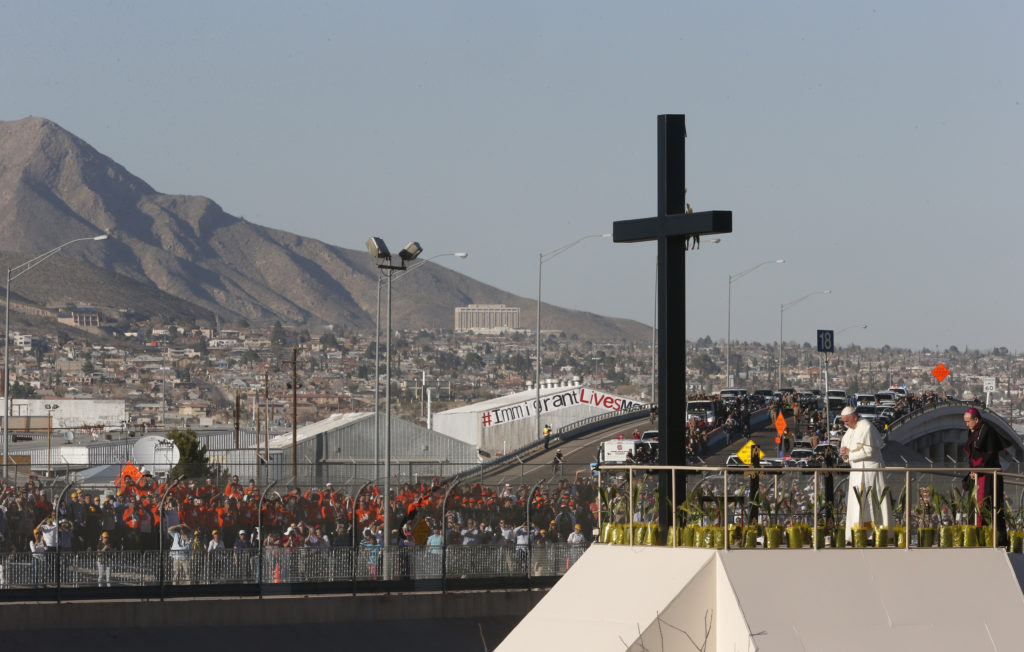
Pope Francis arrives to pray at a cross on the border with El Paso, Texas, before celebrating Mass at the fairgrounds in Ciudad Juarez, Mexico, Feb. 17. (CNS photo/Paul Haring)

CIUDAD JUAREZ, Mexico (CNS) — Speaking from the symbolic platform of the U.S.-Mexico border, Pope Francis pleaded for the plight of immigrants while warning those refusing to offer safe shelter and passage that their actions and inhospitable attitudes were bringing about dishonor and self-destruction as their hearts hardened and they “lost their sensitivity to pain.”

Recalling the story of Jonah and his instructions from God to save the sinful city of Ninevah by telling the residents that “injustice has infected their way of seeing the world,” Pope Francis’ homily called for compassion, change and conversion on migration issues.

He alluded to Mexico and the United States as Ninevah, the city he said was showing symptoms of “self-destruction as a result of oppression, dishonor, violence and injustice.” He also said mercy was a way to win over opponents.

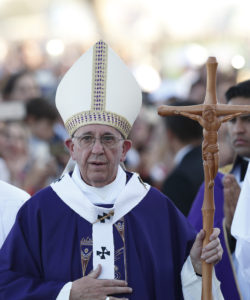
Pope Francis arrives in procession to celebrate Mass at the fairgrounds in Ciudad Juarez, Mexico, Feb. 17. (CNS photo/Paul Haring)

He also preached urgency.

“We cannot deny the humanitarian crisis which in recent years has meant the migration of thousands of people, whether by train or highway or on foot, crossing hundreds of kilometers through mountains, deserts and inhospitable areas,” Pope Francis said Feb. 17 to hundreds of thousands of people from both sides of the border.

“The human tragedy that is forced migration is a global phenomenon today. This crisis, which can be measured in numbers and statistics, we want to measure instead with names, stories and families.”

The Mass capped a six-day trip to Mexico in which Pope Francis traveled to the northern and southern borders and denounced the indignities of discrimination, corruption and violence. During the trip he also asked oft-oppressed indigenous peoples for their forgiveness and chastised the privileged political and business classes — saying their exclusionary actions were creating “fertile ground” for children to fall into organized crime and drug cartels.

Pope Francis delivered his homily a stone’s throw from the Rio Grande, which has swallowed so many migrants over the years as they vainly tried to enter the United States in search of bettering their lot in life and, more recently, escaping violence enveloping Central America.

[quote_box_center]

Related

In silence, pope remembers those who cross Mexican-U.S. border

#PopeInJuarez: an unlikely and historically hilarious hashtag

Panel urges deeper look at immigration issue to see moral implications

[/quote_box_center]

The Mass was celebrated as a binational event with thousands watching across the Rio Grande in El Paso and in a college football stadium. Pope Francis saluted the crowds watching at the Sun Bowl stadium and Bishop Mark Seitz of El Paso for providing technological connections that allowed them to “pray, sing and celebrate together” and “make us feel like a single family and the same Christian community.”

The pope focused on migration, along with the dangers migrants encounter en route to their destinations and the difficulties of surviving on the margins of society without protections.

“Being faced with so many legal vacuums, they get caught up in a web that ensnares and always destroys the poorest,” Pope Francis said.

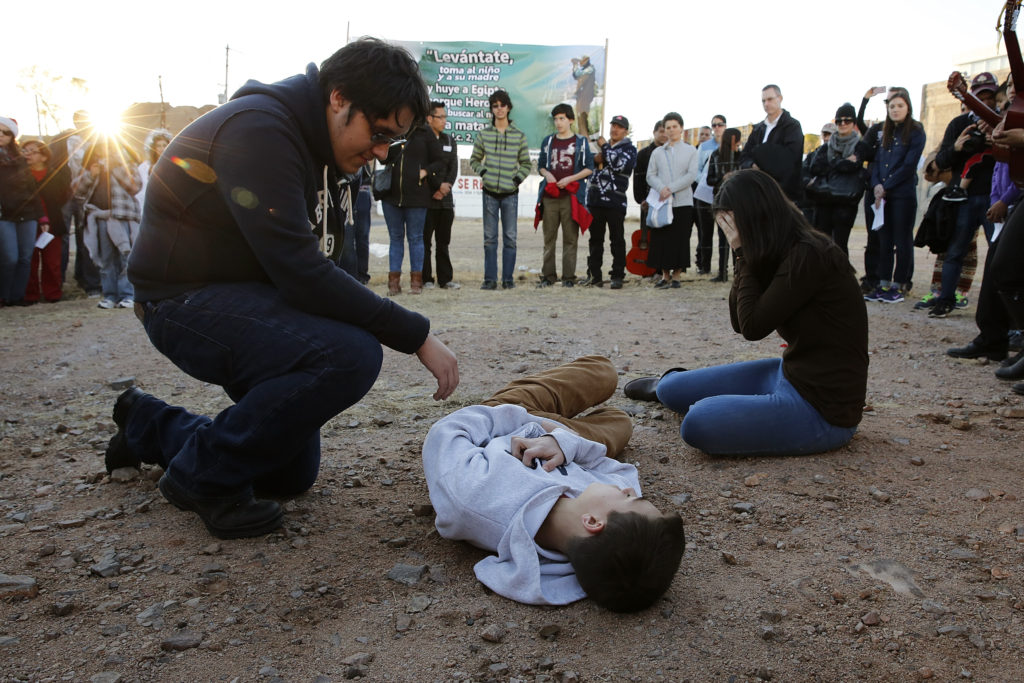
Kino Teens from Arizona act out the tragedies that can befall migrants as the students take part in a binational "posada" in Nogales, Mexico, Dec. 20, 2015. (CNS photo/Nancy Wiechec)
Kino Teens from Arizona act out the tragedies that can befall migrants as the students take part in a binational “posada” in Nogales, Mexico, Dec. 20, 2015. (CNS photo/Nancy Wiechec)

Migration has marked Mexico for generations, though the number of Mexicans leaving the country is now surpassed by those returning — involuntarily or otherwise — as poor job prospects, an increasingly fortified border and anti-immigration initiatives prompt most to stay put.

Ironically, Mexico has assumed an unlikely role over the past several years: enforcer as it detains and deports record numbers of Central Americans trying to transit the country — while many more of those migrants are preyed upon by criminals and corrupt public officials and suffer crimes such as kidnap, robbery and rape. The Mexican crackdown came after thousands of Central American children streamed through Mexico in 2014, seeking to escape forced enlistment in gangs and hoping to reunite with parents living in the shadows of American society, working minimum-wage jobs to support children left with relatives they hadn’t seen in years.

A man leans against a wall near the international border in Nogales, Mexico, Dec. 20. The graffiti reads, "Justice! No Borders!" (CNS photo/Nancy Wiechec)
A man leans against a wall near the international border in Nogales, Mexico, Dec. 20, 2015. The graffiti reads, “Justice! No Borders!” (CNS photo/Nancy Wiechec)

“Each step, a journey laden with grave injustices. … They are brothers and sisters of those excluded as a result of poverty and violence, drug trafficking and criminal organizations,” Pope Francis said, while lauding the priests, religious and lay Catholics who accompany and protect migrants as they move through Mexico — acts of compassion not always popular with the authorities.

“They are on the front lines, often risking their own lives,” he said. “By their very lives they are prophets of mercy. They are the beating heart and accompanying feet of the church that opens its arms and sustains.”

“They are brothers and sisters of those excluded as a result of poverty and violence, drug trafficking and criminal organizations,” Pope Francis said. “Injustice is radicalized in the young. They are ‘cannon fodder,’ persecuted and threatened when they try to flee the spiral of violence and hell of drugs. Then there are the women unjustly robbed of their lives.”

Pope Francis ended his homily by returning to the example of Jonah and his call for conversion in Ninevah. He called “mercy, which always rejects wickedness,” a way to win over opponents, saying it “always appeals to the latent and numbed goodness in every person,” and urged people to follow Jonah’s example.

“Just as in Jonah’s time, so too today may we commit ourselves to conversion,” Pope Francis said. “May we commit ourselves to conversion. May we be signs lighting the way and announcing salvations.”

Ciudad Juarez once held the dubious distinction of “murder capital of the world.” More than 10,000 lives were lost between 2008 and 2012 as drug cartels battled over a coveted smuggling route and young people were seduced by easy money into illegal activities that led to their deaths.

The pope’s visit was promoted by civic officials as a rebirth for Ciudad Juarez, though priests say the city still suffers vices such as exclusion and violence — in lower numbers than before — and jobs with low salaries and long hours in the booming factory for export economy, all of which strain family life.

By David Agren, Catholic News Service.

In Chiapas, pope praises indigenous cultures [VIDEO]

Pope Francis praised the environmental and family values of Latin America’s traditional cultures during his visit to Chiapas Feb. 15.

Mercy transforms shame: What prepared Peter to be the first Pope

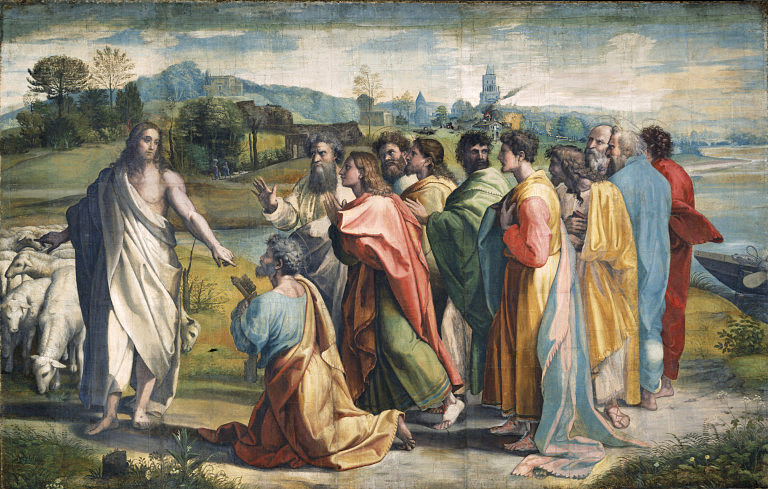
El tapiz de Rafael de 1515, "Encargo de Cristo a san Pedro", muestra a Cristo gesticulando con su mano derecha hacia un rebaño de ovejas, mientras su mano izquierda indica las llaves del Reino de los Cielos que él ha pasado a Pedro, entregándole el liderazgo de la Iglesia. (Dominio público)
Raphael’s 1515 tapestry, “Christ’s Charge to Peter,” shows Christ gesturing with His right hand at a flock of sheep as His left hand points at the keys of the kingdom of heaven that He has passed to Peter, investing him with the leadership of the Church. (Public Domain)

[quote_box_center]

Column in Spanish   *   Column in Español

[/quote_box_center]
[dropcap type=”3″]J[/dropcap]esus was preparing Peter to be the first pope from the first day that He started to call disciples. Little but significant actions reveal this to us. For example, on that first day when Jesus called four fishermen — Peter, Andrew, James and John — as they were cleaning their nets on the seashore, it was Peter whom He asked to pull out a little from the shore so that He could teach a large crowd from his boat.

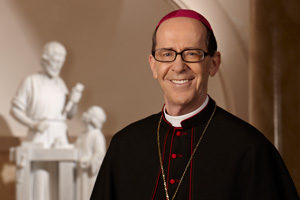
The Most Rev. Thomas J. Olmsted is the bishop of the Diocese of Phoenix. He was installed as the fourth bishop of Phoenix on Dec. 20, 2003, and is the spiritual leader of the diocese's 1.1 million Catholics.
The Most Rev. Thomas J. Olmsted is the bishop of the Diocese of Phoenix. He was installed as the fourth bishop of Phoenix on Dec. 20, 2003, and is the spiritual leader of the diocese’s 1.1 million Catholics.

Of all His disciples, the only one to whom Jesus gave a new name was Simon, whom He called Peter, saying to him (Mt 16:18) “…upon this rock, I will build my Church.” Then, at the Last Supper, it was Peter’s feet that Jesus washed first before the rest of the Twelve; and it was to Peter alone that Jesus said (Lk 22:31), “Simon, Simon, behold Satan has demanded to sift all of you like wheat, but I have prayed that your own faith may not fail; and once you have turned back, you must strengthen your brothers.”

From these experiences, it became evident to all the Twelve that Peter was chosen to be their leader. Thus, he was the one among the Twelve who asked Jesus to explain the meaning of His parables and His precepts. After the Bread of Life discourse when most of His disciples walked away in disbelief (Cf. John 6) and Jesus asked the Twelve, “Will you also go away?” it was Peter who spoke on behalf of the others, saying, “Lord, to whom shall we go? You alone have the words of everlasting life.”

What most prepared Peter to be the first pope was the way Jesus dealt with his burden of guilt after his triple betrayal of his Master. Recall how, after His Resurrection, Christ asked Peter three times if he loved Him. This was not done to further humiliate Peter but to heal his wounds of shame, giving him the opportunity to respond three times, “Yes, Lord, I love you.”

Logo for Holy Year of MercyTo understand the depths of Jesus’ solidarity with Peter, it is helpful to know that the way He asked the question the third time was different from the first two times (Cf. Jn 21:15ff). He used a different Greek word the last time: “Phileis me?” in place of “Agapas me?” The first two times, Jesus was asking “Agapas me?”, “Do you love with me with an unconditional, total love?” Peter, being keenly aware of his own weakness, could not, in all honesty, respond “Agapo se”, “I love you unconditionally.” But he could say “Philo se,” “I love you;” and that is what he did. So, the third time, Jesus put Himself at the same level as Peter and asked, “Phileis me?” knowing that Peter really desired to love unconditionally but knew from bitter experience that he could not do so; it was beyond his own strength. Peter’s answer reflected real honesty, sincere sorrow, true conversion and humble awareness that Jesus’ words at the Last Supper were true (Jn 15:5), “Without me, you can do nothing.”

The Successor to Peter today, Pope Francis, says that mercy “expresses God’s way of reaching out to the sinner, offering him a new chance to look at himself, convert, and believe” (Misericordiae Vultus, 21).

That is what the Risen Christ did for Peter. By Christ’s mercy, Peter was freed of his guilt and shame and freed for his mission from Christ. Now, Peter could be, by God’s mercy and his own humble cooperation, what he could never have been before, the rock on which Christ builds His Church.

Years after this exchange between the Risen Lord and the first Pope, Peter wrote the first of his two New Testament Letters. As he begins, he overflows with gratitude and joy (1 Pt 1:3): “Blessed be the God and Father of our Lord Jesus Christ, who in His great mercy gave us a new birth to a living hope through the resurrection of Jesus Christ from the dead.