


Six straight season-ending wins seals first basketball season for Redhawk men


Valentine’s Day marked a time for red to triumph, especially for the Redhawks at Benedictine University at Mesa.
That’s when the men’s basketball team finished off its first season with a rousing win, 101-78, over the La Sierra Golden Eagles. The points came early and often for the Redhawks and it came from nearly everyone.
By halftime, the lead was up to 25 and it ballooned in the second half to 35 points at one point. Seven players finished in double figures on the afternoon, led by Kyle Tomlinson, a Mesa native who finished off his playing career in style, scoring 16 points.
Anthony Bryant scored 15, Richie Thornton V — who helped lead Bishop Gorman High School in Nevada to three state titles — scored 14, Troy Conley and Jorge Cano each had 11, senior Bobby Ward and Nate Anaya — a former team captain for St. Mary’s High School — chipped in with 10 and Reggie Kindle nearly made it eight players in double figures scoring nine points and leading the team in rebounds with Bryant, tallying eight.
For the seniors Tomlinson, Kindle and Ward, it would be an afternoon they won’t soon forget as all three were recognized before the game for their efforts in helping build the Redhawks program and each had their moments in the sun in-game as well.
“It was very emotional, knowing it was going to be your last college game,” Kindle said. “But it was great being a part of this first year of the program because you get to say you started something.”

For the rest of the team, players hope they can carry the torch into next season. The Redhawks finished year one of the men’s basketball program at 14-15, which included a 9-1 record against California Pacific Conference teams, a mark that will surely be on the minds of their opponents when BenU at Mesa plays a full conference schedule and becomes postseason eligible next season.
The Redhawks also saved their best ball for down the stretch, winning their last six regular season games of the year, plus playing NCAA Division I Grand Canyon University toe-to-toe for the better part of 30 minutes in an exhibition game late in the season. With all of these achievements in their first year of play and the returners coming back next season, the arrow seems to be pointed up for the men’s basketball team heading into the 2016-17 season.
“We set a great foundation our first year,” Conley said. “It started from the coaches and our senior leadership. They provided a good foundation for us moving ahead into next year.
“I think we’ll have a target on our backs next year because we won’t surprise anybody but I think we are prepared for that.”
Journalist with family ties to Juárez goes as both reporter and pilgrim


CIUDAD JUÁREZ ― There was lots of excitement as I drove with my family to Ciudad Juárez yesterday afternoon. For my family, this trip was three-fold.
- First, I am covering Pope Francis’ visit to this city.
- Secondly, we’re coming as pilgrims.
- And lastly, I’m coming home — my mother grew up in Juárez, and I’m staying with my aunt.
The drive from Phoenix to El Paso is a pretty one, even with a toddler in the back seat. As we crossed the bridge into Ciudad Juárez — the first time I’d physically driven into Mexico in about 10 years — we saw the signs everywhere welcoming Pope Francis.
After getting settled in at my aunt’s house, I checked in at the Press Center at one of the convention centers. I had the chance to meet quite a few of my fellow journalists, including members of the Catholic press in Honduras, and others from throughout my native Texas. We talked shop and wished each other well.

Then began the real work. I had the opportunity to meet some pilgrims from Phoenix at the parish near where my family lives. I met them in the gift shop and saw a line going through the whole store. There were hats, T-shirts, and many other items for sale commemorating the pope’s visit. Rosa and Sergio Siller from Sacred Heart Parish in Phoenix were buying gifts to be blessed for friends.
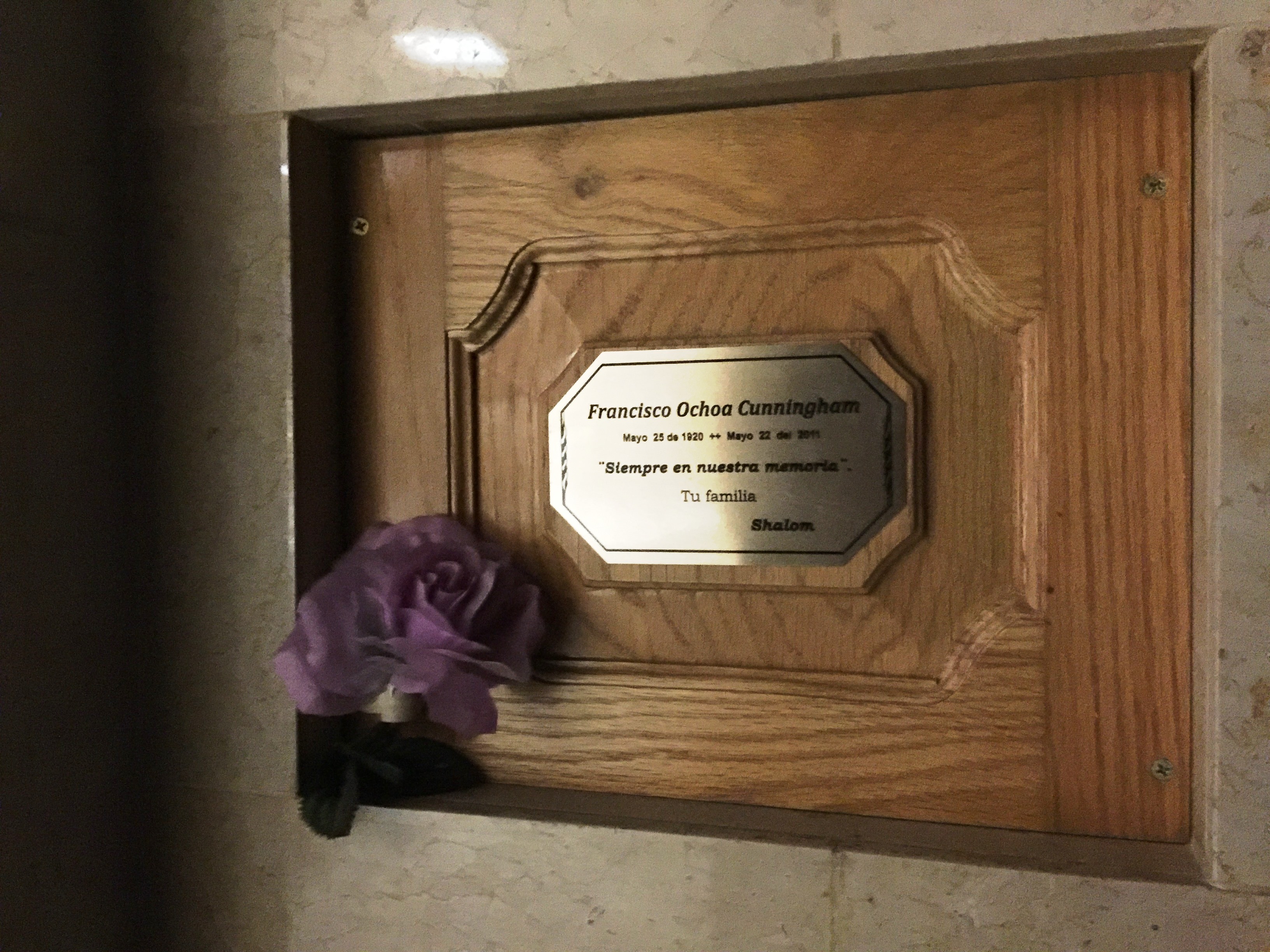
While they waited in line, I decided to go downstairs to the church’s mausoleum. It’s there that my great-uncle, Francisco Ochoa Cunningham, is interred. He’s in the “Santiago” (St. James) section. My great-aunt told me he chose this section honor of his grandfather, an Irish immigrant to Mexico named James Cunningham.
After paying my respects and going back upstairs to interview the Sillers, I found myself feeling the same sentiments as Sergio. He’s a Juárez native and, like me, is staying with family.
I remember visiting my grandparents when I was a kid. My brother and I spent our summers here, and we would have large family gatherings for Christmas. I remember going to the parishes of Sagrada Corazón (Sacred Heart), Sagrada Familia (Holy Family), Señor de Misericordia (Our Lord of Mercy) — where my grandparents are interred, and of course, San Lorenzo. These places are familiar to me, so as violence escalated here while I was in college, my heart wept for this city.
But in the midst of that is hope, a message the Holy Father wants to bring. “He’s going to visit the prisoners, mothers of victims of violence…” Sergio told me. Pope Francis brings “a message of hope, reconciliation and mercy” not just to the city, “but the whole country.”
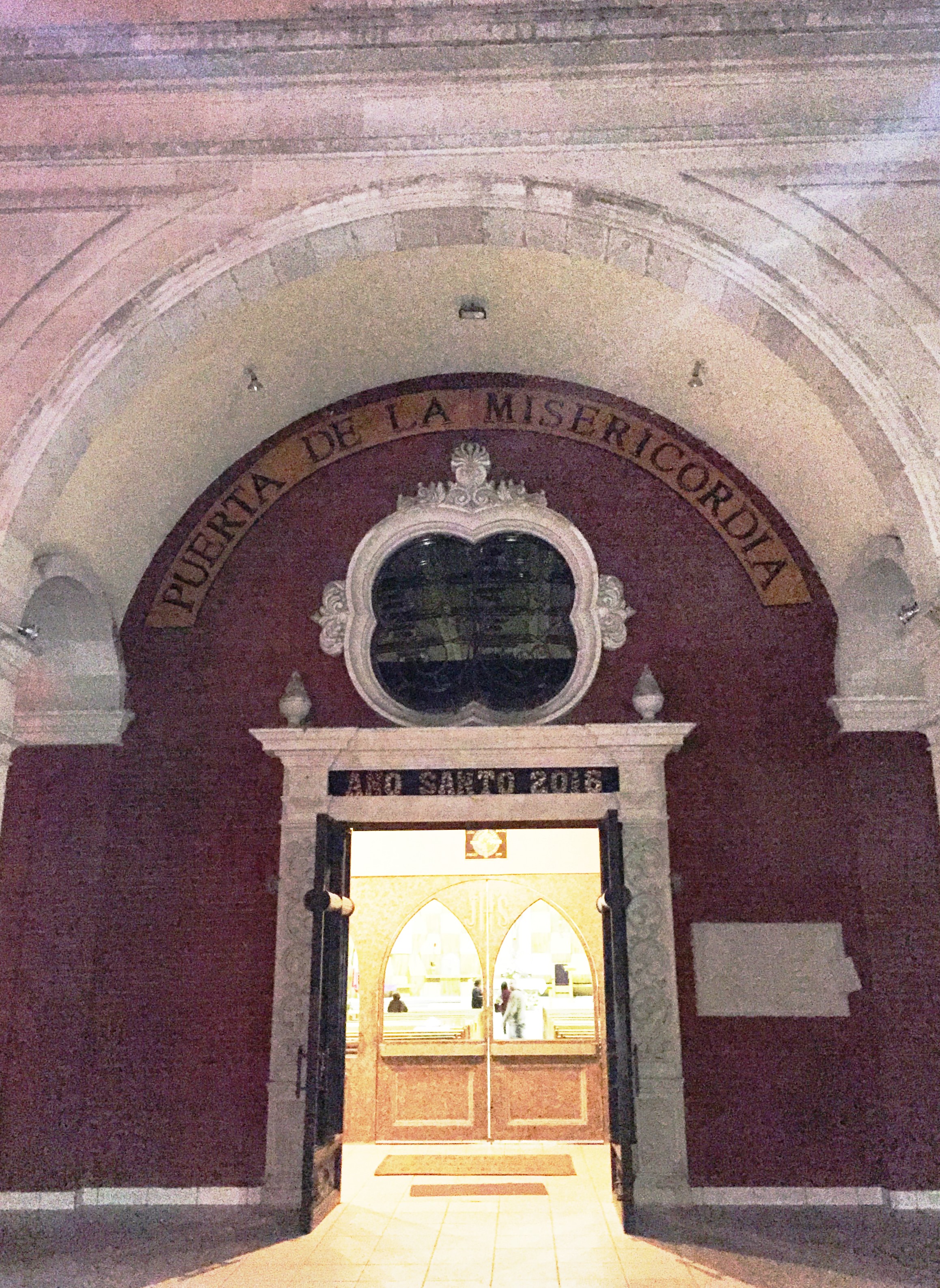
I saw some nuns praying earlier, but I couldn’t find them to interview them when I went back. But I did discover why there were so many people praying there at 8 o’clock at night. At the front of the church is a sign that reads quite boldly: “Puerta de la Misericordia” ― Door of Mercy. I passed through those doors earlier not even realizing the significance.
And speaking of mercy, I developed another story idea when I saw locals passing out commemorative posters. Not sure what they were doing, I approached them and learned they were trying to show hospitality to the pilgrims. They were planning to also provide food and water to the pilgrims lined up along the papal route on Wednesday.
“We want people to know that the people of Juárez are not bad people,” said Carlos Torres.
I was impressed by these local parishioners “welcoming the stranger” into their city. The reality is, Pope Francis’ visit means nothing if people don’t take the message he’s bringing in living out a Christian life, something that Juárez needs, and the people are ready for.
So for me, I’m here to cover the pope’s visit and the pilgrims. But I’m also one of them. I am a pilgrim, and in many ways I’m also a local. And I have hope.
At El Paso church, people pray day and night for pope in Mexico

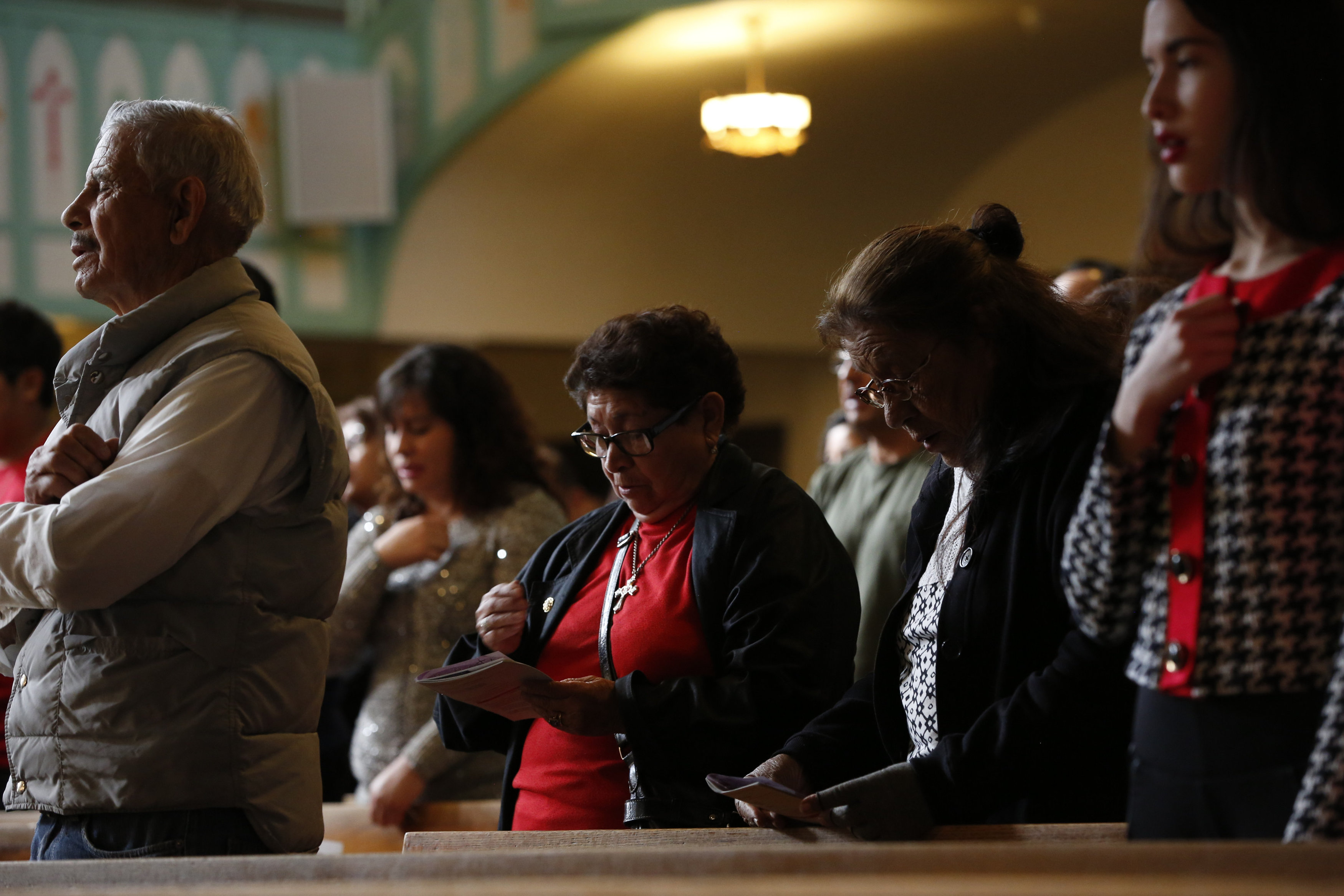
EL PASO (CNS) — In Segundo Barrio, people have been praying day and night for Pope Francis since he set foot in Mexico.
Kneelers were set in front of a figure of the pope in the courtyard of the barrio’s Sacred Heart Church. An image of Our Lady of Guadalupe in tile on a red brick wall peered over the shoulder of his cardboard likeness.
“Every day since the pope arrived in Mexico, in the morning and evening, we pray the Rosary for his intentions — for mercy, peace and for his protection,” said Raquel Garay Williams, a member of the parish council. “Our hope is that the Lord answers our prayers.”
Williams was among dozens of parishioners stopping to pray at the temporary shrine Feb. 14, three days before the pope was to end his six-day Mexican visit in Ciudad Juárez, the Mexican community on the border and El Paso’s sister city.
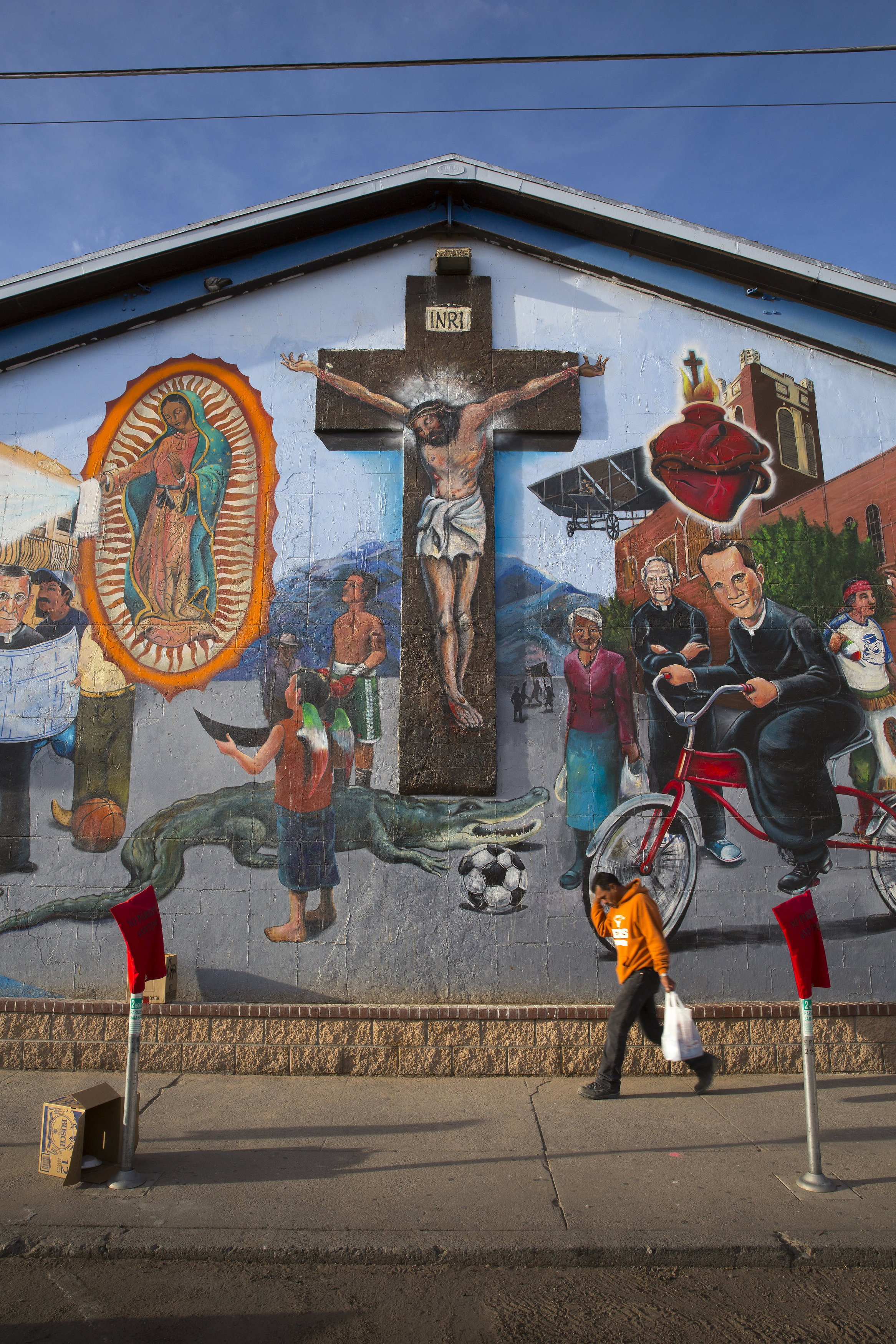
Images of the pope with words of welcome appeared on walls in and around Sacred Heart Church and the Segundo neighborhood.
A culturally vibrant parish, Sacred Heart’s roots stretch back nearly 125 years. It is located blocks from one of El Paso’s busy border crossings. Jesuit-founded and run, the parish serves people in the barrio as well as immigrants and people passing through.
Masses are held in Spanish or in English and Spanish. With its sacramental and catechetical ministries, the parish offers English classes and courses in computer literacy and citizenship. From its parish hall, it runs a restaurant and catering business that employs people and offers low-cost meals.
Florencio Flores, who was born in Mexico but was brought to the U.S. as an infant, has called Segundo Barrio home for quite some time. He stopped in Sacred Heart’s courtyard to kneel and offer a short prayer. He carried the parish bulletin featuring Pope Francis on the front.
“Mexico needs peace for its people,” he said. “Now, with the pope (there), people may find that peace in their heart — to live a new life with Jesus centered in their heart.”
Also visiting the makeshift shrine was the Macias family.
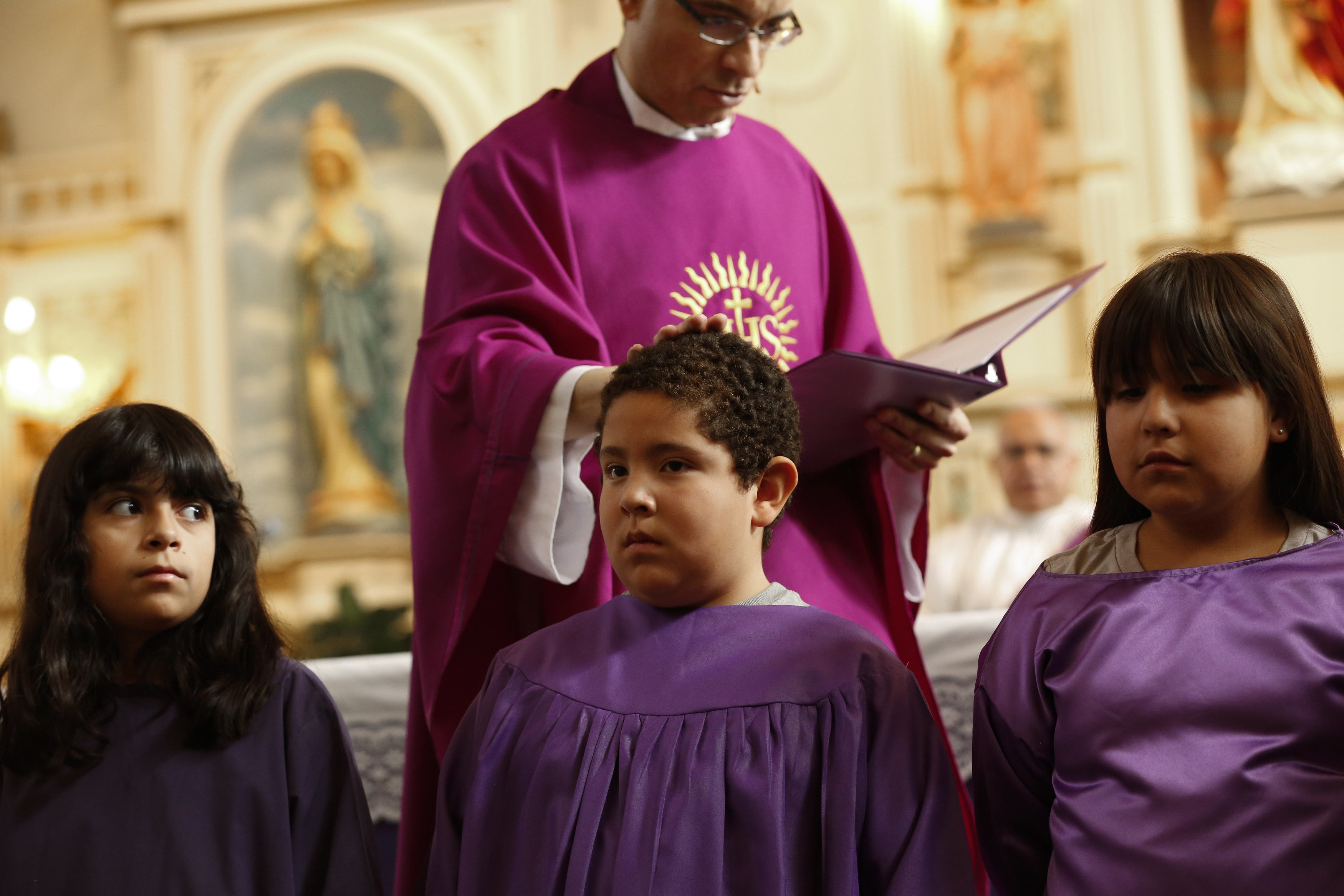
Flor, Olivia and Rose Macias stood in front of the cardboard pope and smiled brightly as their dad clicked a cellphone photo.
It is as close as most will get to the pope himself, but that had not dampened their excitement for his visit to the border area.
“He’s a really good man,” Flor, 10, said of Pope Francis. “He tells good things to the world.”
Archbishop Joseph E. Kurtz of Louisville, Kentucky, president of the U.S. Conference of Catholic Bishops, has asked U.S. Catholics to “unite in prayer with our sisters and brothers in Mexico — especially those most in need of mercy and hope, those suffering most in poverty and fear — and celebrate the great blessing of the Holy Father’s journey to their great nation.”
The archbishop will be with other Americans on the levee in El Paso when Pope Francis celebrates Mass in Ciudad Juarez.
― By Nancy Wiechec, Catholic News Service
El Paso Diocese gets ready for rendezvous with Pope Francis

EL PASO (CNS) — Two days before Pope Francis’ main event in Ciudad Juárez, Mexico, the Diocese of El Paso was coordinating the final touches to its own two main papal events.
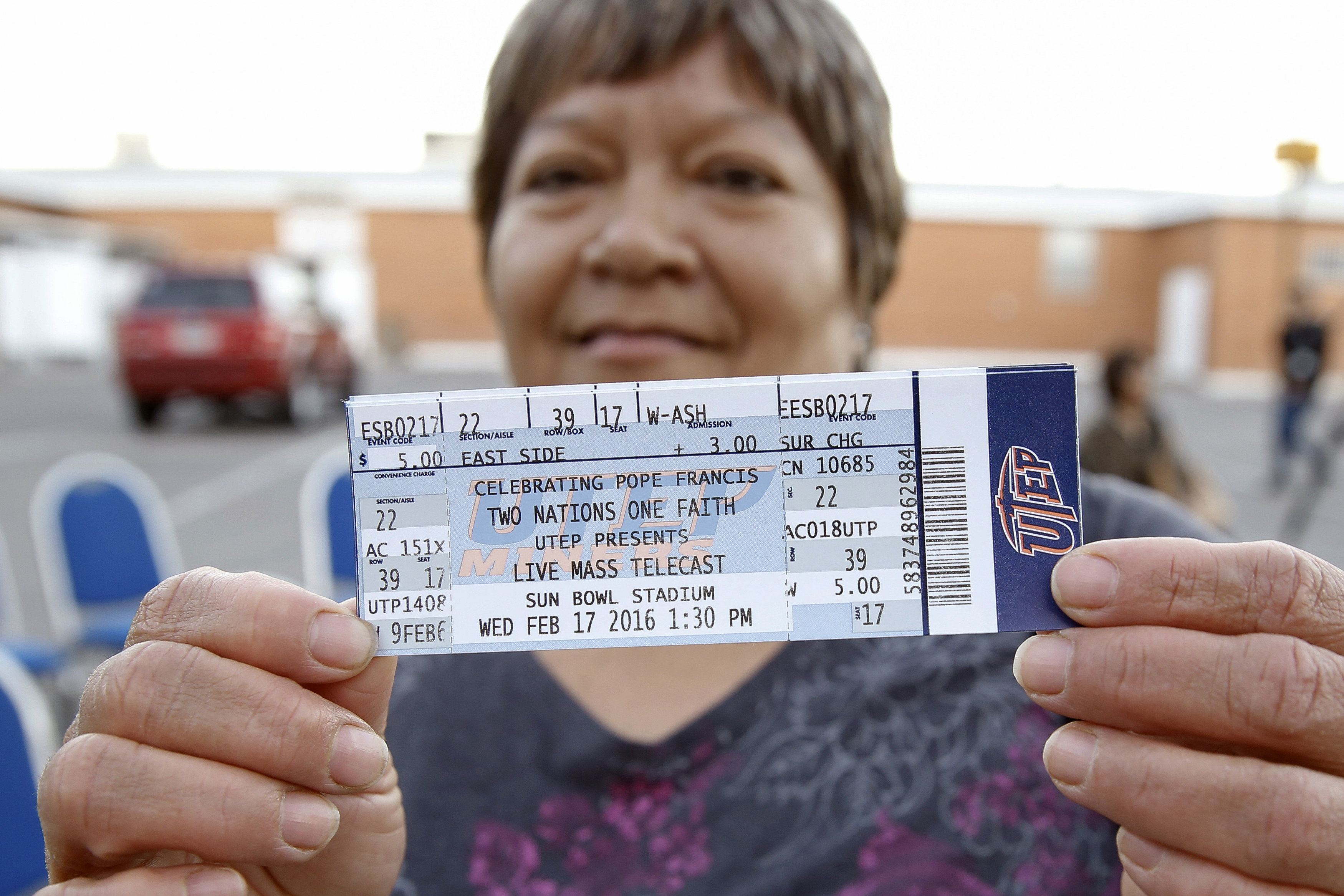
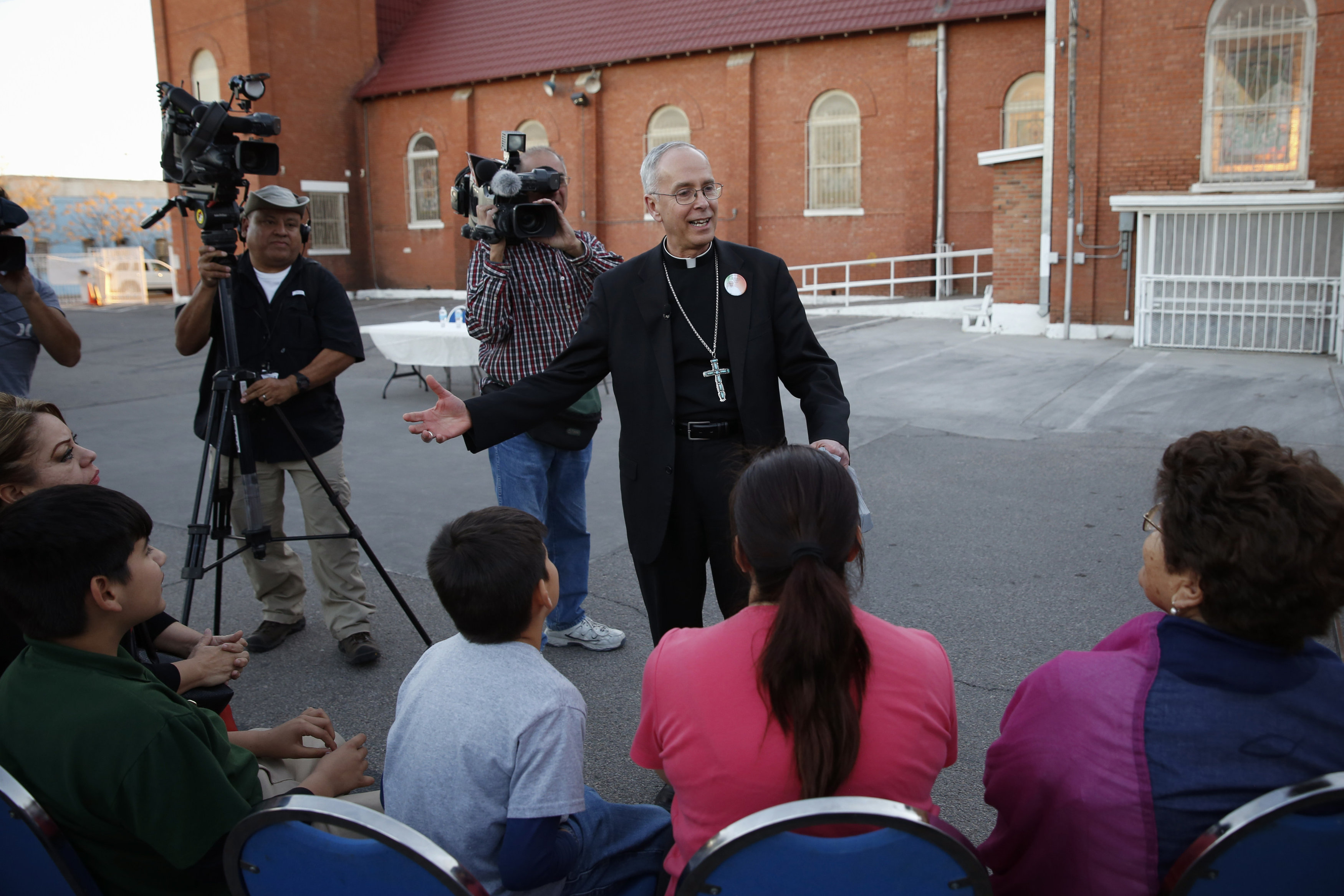
While the Diocese of Juárez’s chancery was bustling with Church officials obtaining their papal Mass credentials, El Paso Bishop Mark J. Seitz was handling a full day of meetings, greeting incoming dignitaries and doing media interviews. He closed the day meeting with parishioners at St. Ignatius Church to distribute 200 free tickets to a celebration to be held at the Sun Bowl Stadium Feb. 17.
“We had this idea because we knew many people would not be able to go across (to Juárez),” Bishop Seitz told Catholic News Service Feb. 15, “and then it became clear that not many people would be able to gather at the border — actually no one — so we were looking for an alternative.”
The bishop said the tickets to the Sun Bowl, priced at $15 for nonparishioners and $10 for parishioners, were selling well, but he was doubtful the event would sell the 51,500 tickets needed to fill it. The 4 p.m. (local time) papal Mass will be simulcasted at the stadium after an afternoon musical show.
“Tickets for the other one were no problem,” he said referring to a gathering scheduled at a reserved area on the edge of the causeway of the Rio Grande, the natural U.S.-Mexico border. “There are only 600 (guests) permitted in an area that is very restricted by the Border Patrol.”
Before starting the Juárez Mass, Pope Francis will take some time to pray, not only with Mass attendees, but also with Church officials, migrants, refugees, immigration activists and victims of violence seated across the river.
Bishop Seitz will be in the party receiving Pope Francis to Ciudad Juárez early Feb. 17, and also will stand with the pope when he prays facing the river and greets the people on the opposite side.
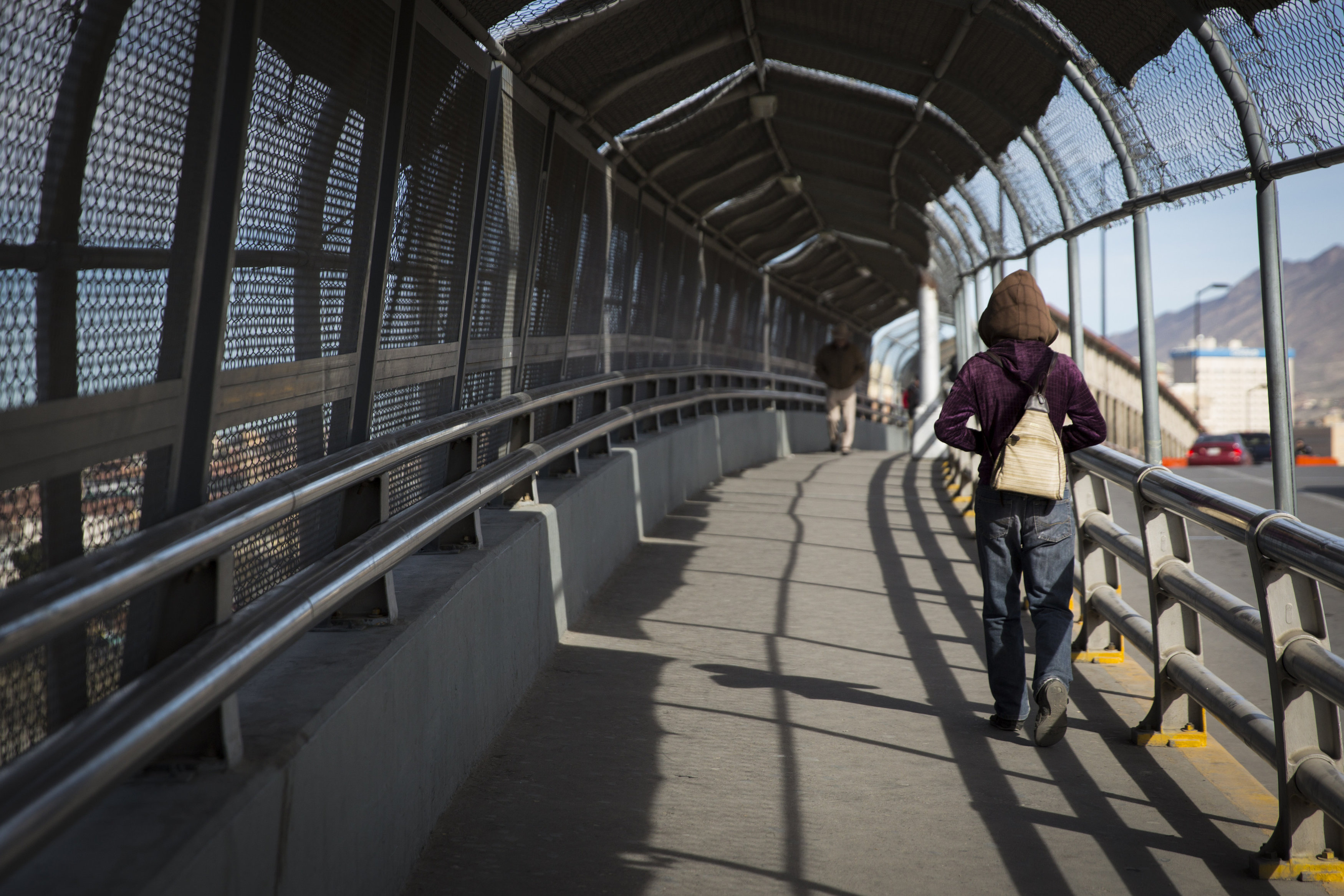
“It’s difficult to put into words how wonderful that is, to have the leader of 1.2 billion Catholics of people here, in our region, people who have suffered a good deal from all the violence across the border,” the bishop said.
Bishop Seitz chose St. Ignatius to receive the free tickets because the parish is located close to the area that will be blocked off all day for the river event. Segundo Barrio, as the neighborhood is called, is one of the poorest in the city.
The Diocese of El Paso has a population of 890,500, of which just over 81 percent is Hispanic; 75 percent of the population is Catholic.
“This is one metropolitan area with a line drawn across it,” said Bishop Seitz of the El Paso-Juárez conglomerate. “And yet there are so many things that connect us. This is a very important day here in El Paso even if the pope isn’t physically crossing the border.”
― By Wallice J. de la Vega, Catholic News Service.
In southern Mexico, pope warns against diminishing importance of family
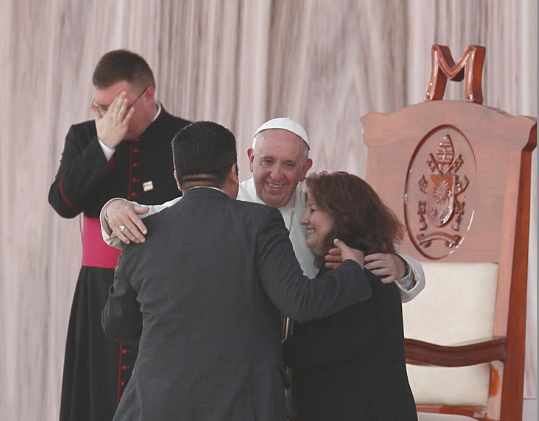
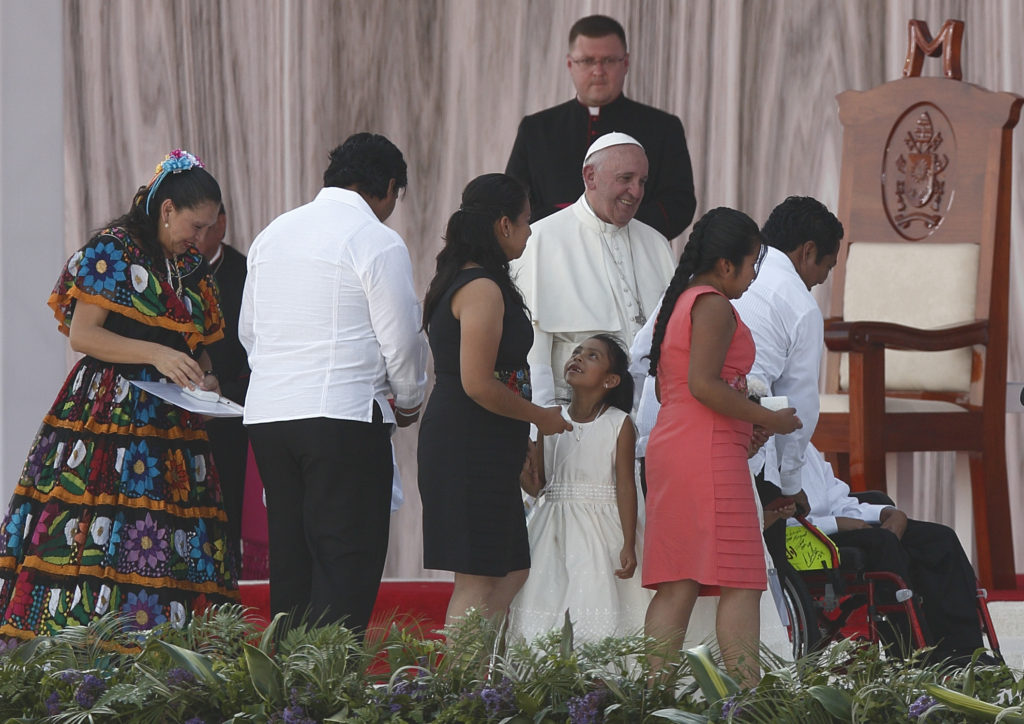
SAN CRISTOBAL DE LAS CASAS, Mexico (CNS) — Pope Francis warned against moves to diminish the importance of the family, peppering his talk with anecdotes and off-the-cuff remarks that kept a packed soccer stadium cheering, laughing and applauding.
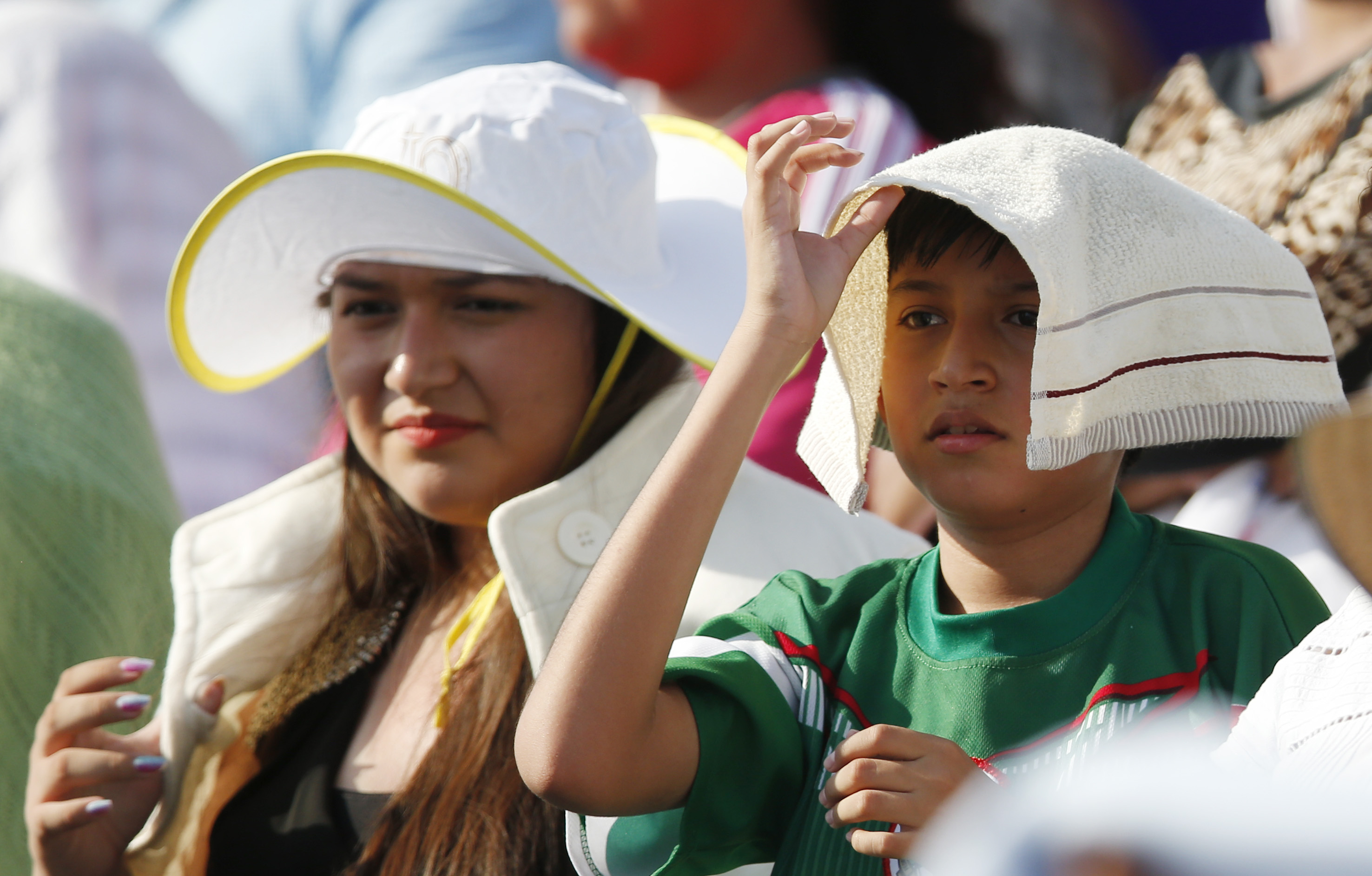
Speaking under a scorching-hot sun as dozens were treated for heat stroke, the pope said family life was not always easy and often was a struggle, but he pleaded for perseverance, saying family life was one of the solutions to increasing isolation and uncertainty and its unintended consequences.
“I prefer a wounded family that makes daily efforts to put love into play to a society that is sick from isolationism and is habitually afraid of love,” Pope Francis said Feb. 15 in front of a boisterous audience of families, who came from across southern Mexican and nearby Guatemala for a celebration in the city of Tuxtla Gutierrez. “I prefer a family that makes repeated efforts to begin again to a society that is narcissistic and obsessed with luxury and comfort. I prefer a family with tired faces from generous giving to faces with makeup that know nothing of tenderness and compassion.”
The pope’s focus on families turned the focus of his six-day visit toward the pastoral issues after hitting hard on matters such as corruption, crime and the country’s often impoverished and exploited indigenous populations.
During the event, a couple from the city of Monterrey — one of whom was divorced — spoke of the stigma and sense of not belonging by not being able to receive Communion, but finding a home in the Catholic Church by serving others and organizing pastoral projects.
“As we came close to our church, we received loved and compassion,” said Humberto and Claudia Gomez, who are married civilly, but not in the church. “It’s marvelous to have a marriage and family in which God is at the center.”
Another speaker, single mother Beatriz Munoz Hernandez, 52, spoke of a childhood marked by “poverty, violence and abandonment” by her father, then of becoming pregnant as a teenager.
“I found the love of God through his church and he rescued me, announced that he loved me, that he didn’t reject me and, above all, that he forgave me,” said Munoz, adding her faith helped in overcoming the temptation of seeing abortion as a solution to several pregnancies.
Pope Francis cracked jokes throughout his speech and strayed from his prepared text. He mentioned a couple married for 50 years and asked “who was the most patient.” The answer was obvious for the pope: “Both of them.”
Departing from prepared remarks, he offered advice for creating happy families and keeping the peace in times of turbulence.
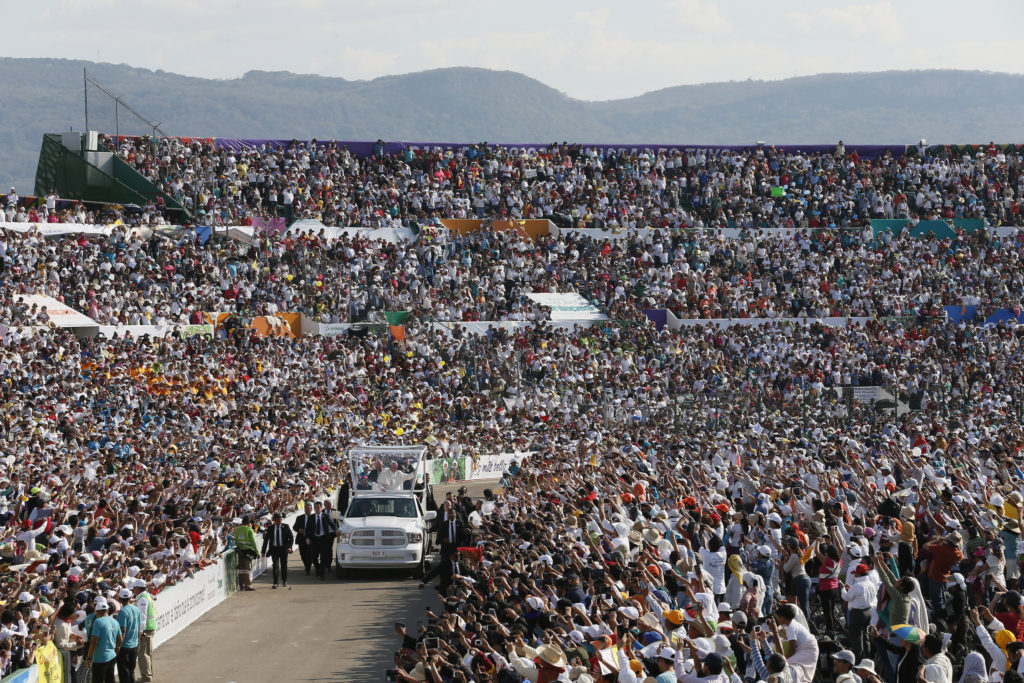
“Do not end the day without making peace,” Pope Francis said. “If you end the day in war, you will end up in cold war, and a cold war is very dangerous in the family, because it will undermine families from underneath.”
Pope Francis focused most on overcoming isolation and uncertainty and its insidious effects.
“Uncertainty is not only a threat to our stomach (which is already serious), but it can also threaten our soul, demoralizing us and taking away our energy, so that we seek apparent solutions that, in the end solve nothing,” he said. “There is a kind of uncertainty which can be very dangerous, which can creep in surreptitiously; it is the uncertainty born of solitude and isolation.”
He cited the example of Humberto and Claudia and their service to others as a solution. Another solution, he said, was with smart public policy, “which protects and guarantees the bare necessities of life so that every home and every person can develop through education and dignified employment.”
“Laws and personal commitment,” the pope said, “are a good pairing to break the spiral of uncertainty.”
Family is often seen as a social safety net in Mexico and a pillar in a low-trust society, though state statistics show people are marrying less, divorcing more and increasingly living in nontraditional families.
Pilgrims, locals look forward to Pope Francis’ message of mercy in Juárez

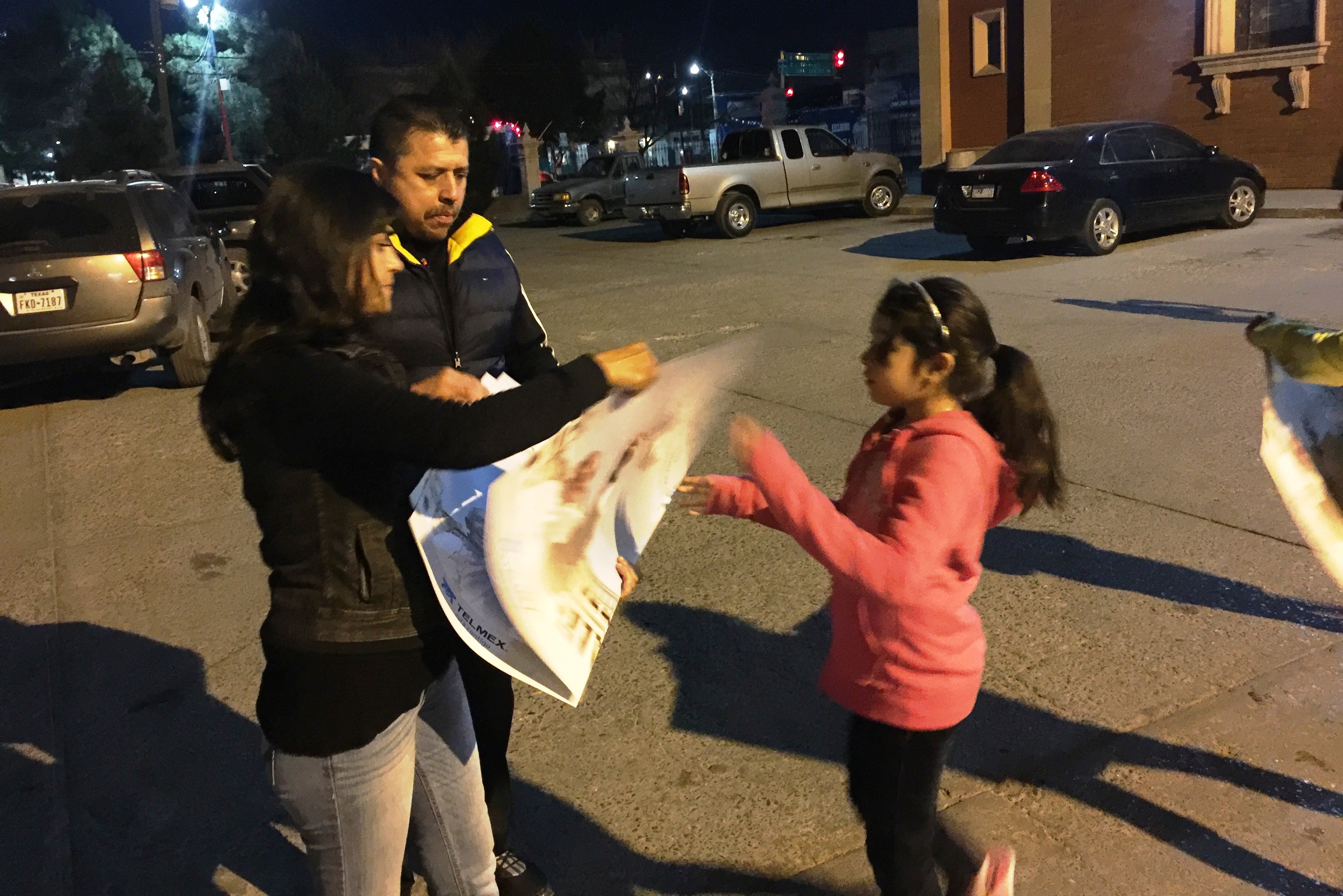
CIUDAD JUÁREZ ― Pope Francis comes to Ciudad Juárez with a message of hope and mercy, say Rosa and Sergio Siller, who are leading a group of pilgrims from Sacred Heart Parish in Phoenix.
Sergio is a native of the last city on the Holy Father’s apostolic visit to Mexico, and he and his family are staying with his family while they’re here.
“Being from Juárez, and after all this turmoil that happened, we’re so blessed the Pope chose to come to Juárez to bring a message of mercy, forgiveness and hope,” said Sergio.
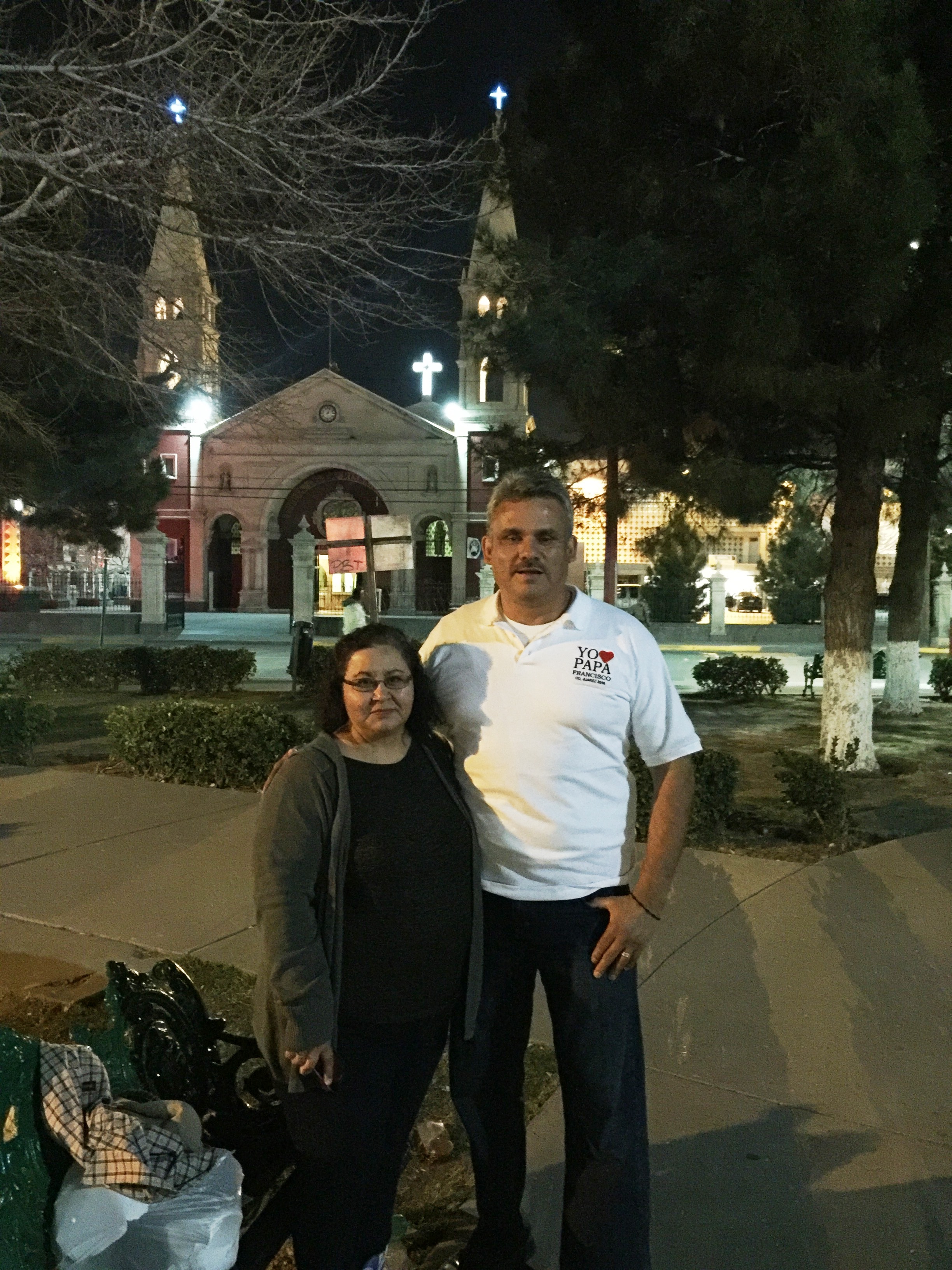
The Sillers typically visit Juárez three or four times a year, but when they learned of Pope Francis’ visit, they made arrangements right away.
“As soon as we learned it was like, ‘oh my goodness, we have to be there,’” said Rosa.
They are meeting with four other pilgrims from Phoenix while they’re in Juárez, and relatives from as far north as Indiana are coming to see the pope, also, she added.
While they are in Juárez, the pilgrims hope to visit several pilgrimage sites within the city. While visiting San Lorenzo (St. Lawrence) Parish, one of the parishes with designated Holy Doors of Mercy, the Sillers also shopped at the gift shop to buy gifts for friends and family to be blessed by the Holy Father.
In the San Lorenzo parking lot, Juárez locals Carlos Torres and Lourdes Gutierrez took the pope’s challenge to be “missionaries of mercy” to heart, passing out commemorative posters of Pope Francis’ visit.
When asked how much the posters were, they said they were free.
“We want to do this to help the people,” Torres said. “We’re doing this for no other reason than to thank God for all He has given us.”
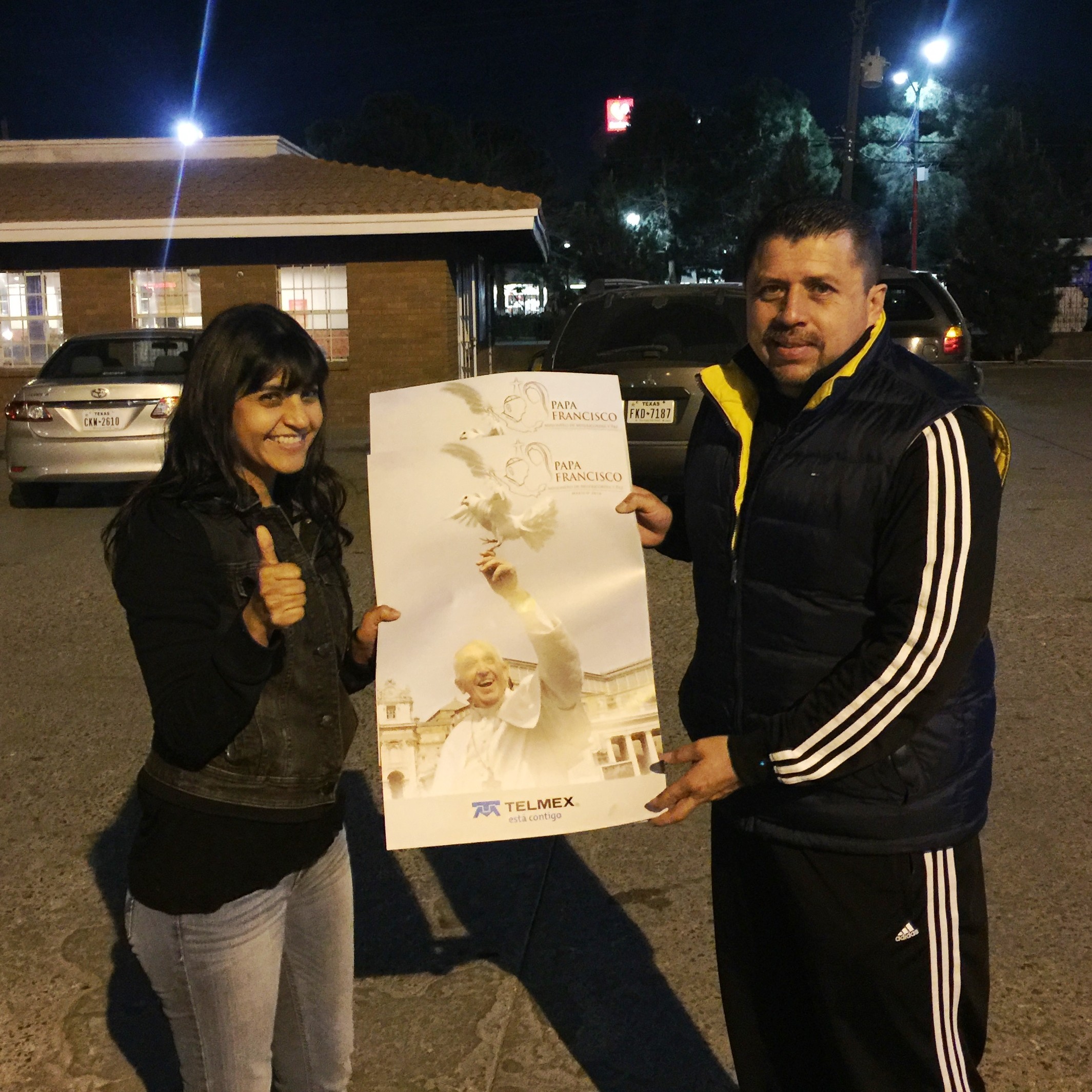
Torres and Gutierrez are parishioners at nearby San Judás (St. Jude), and are part of an unnamed group of Catholics from various local parishes wanting to show hospitality and mercy to all of the pilgrims.
“We’ll be meeting with some families to buy drinks, water, sandwiches, etc. for the people who will be waiting for the pope to pass,” Torres said.
San Lorenzo was the pair’s third stop Monday night. Gutierrez said she was filled with “excitement, joy, peace and much more joy,” at the pope’s coming visit to her city.
“We want the pilgrims to leave with a beautiful image of the people of Juárez,” she said.
Juarez has been plagued by violence over the past decade, with the homicide rate peaking above 3,100 in 2010; 300 murders in 2015 was the lowest reported since 2006.
“There’s hope. God knows we’re in need here,” said Rosa. “They need to feel like [Pope Francis] is bringing a message the Lord loves His people.”
Related
As Pope nears Ciudad Juárez, workers race to finish Mass stage
Arizonans to make the trek for Pope Francis’ first visit to border
‘Tatic Francis’ affirms Mexico’s indigenous people in visit to Chiapas

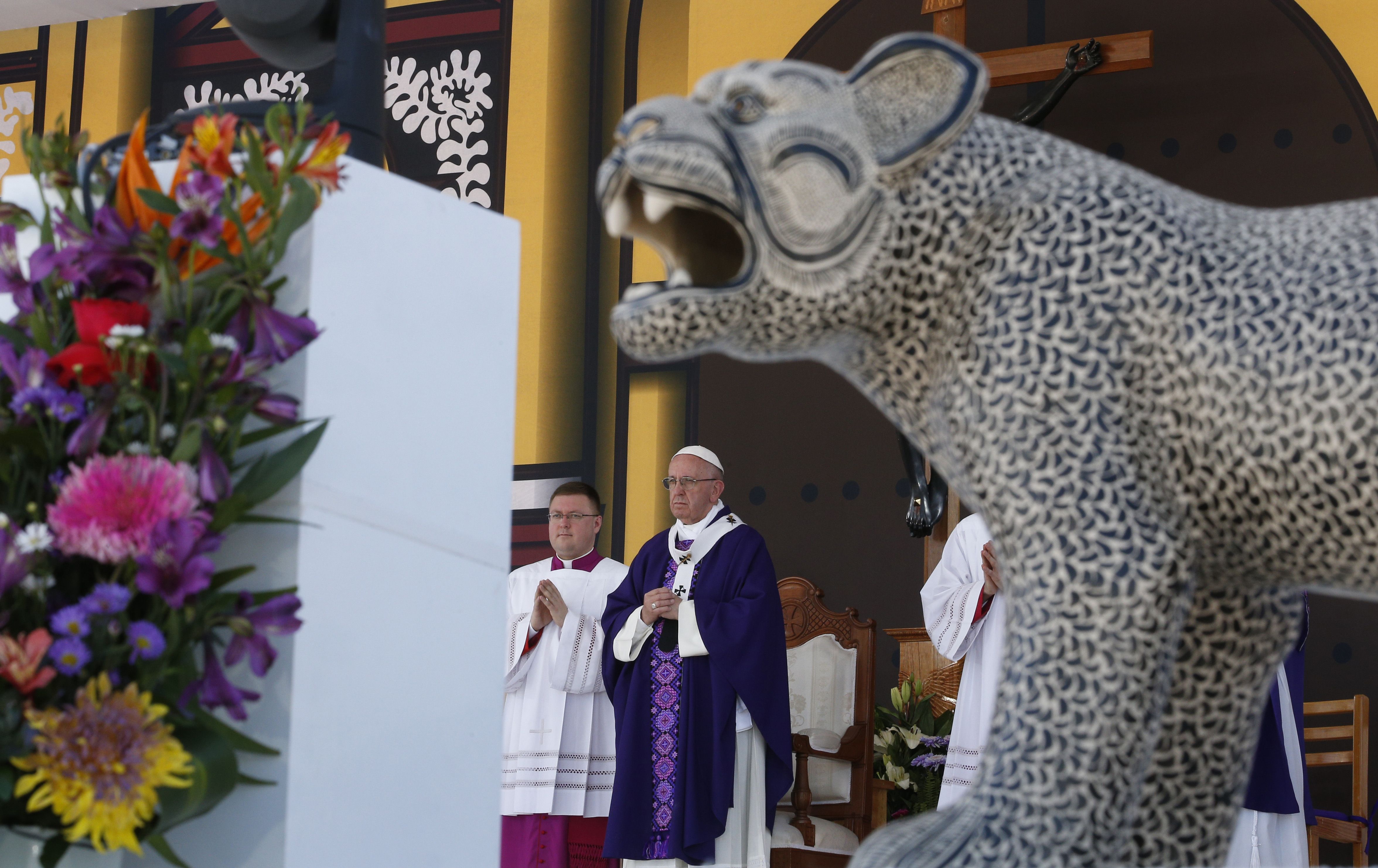
SAN CRISTOBAL DE LAS CASAS, Mexico (CNS) — Paying homage to the culture and ancient wisdom of Mexico’s indigenous peoples, Pope Francis urged them to hold on to hope and condemned those who exploit their people and their land.
“Some have considered your values, culture and traditions to be inferior. Others, intoxicated by power, money and market trends, have stolen your lands or contaminated them,” the pope said at a Mass Feb. 15 with representatives of Mexico’s indigenous communities.
“You have much to teach us,” he told the elders, activists and simple faithful gathered at a sports complex in San Cristobal de Las Casas, a city in Chiapas, Mexico’s southernmost state, and a center of advocacy and struggle for the indigenous rights.
Chiapas, and particularly the Diocese of San Cristobal de Las Casas, also has been a center of official Catholic support for indigenous culture, support that was not always shared by all of Mexico’s bishops.
During his stay in the city, Pope Francis communicated the Vatican’s official approval of the use of the local languages in liturgical prayer. Two of the languages — Tzotzil and Tzeltal — were used for some of the readings and prayers during the pope’s Mass. And, after the pope read his homily in Spanish, it was translated for the many in the crowd who speak only their Mayan tongue.
It was under Pope Francis that the diocese was allowed to start ordaining permanent deacons again in 2014 after ordering a 12-year suspension. The vast majority of the diocese’s more than 300 permanent deacons are married leaders in their indigenous communities; the late Bishop Samuel Ruiz Garcia began ordaining large numbers of the leaders in a program of pastoral outreach that many saw as exaggerating the place of indigenous culture in the local church, but also as a potential first step toward pushing for married priests for indigenous communities.

As the pope toured the crowd in the popemobile, a priest led the people in chanting: “Welcome, pope of peace. Welcome, pope of mercy. Welcome, pope of justice. Welcome, pope of freedom. Welcome, pope of the struggle.”
The cheer also hailed the pope for wanting “a Church that is born of the people” and bishops and priests who are “alongside the poor.”
To applause, the priest also acclaimed, “The people walk with Tatic Samuel (Bishop Ruiz) and Tatic Francis, who encourages us.” “Tatic” is the Mayan word for father.
In a country rich in natural resources, but scarred by pollution and inequality, Pope Francis compared the indigenous communities to the ancient Israelites enslaved in Egypt, and he assured them that God hears their cry for dignity and respect and their longing to protect their cultures.
In responding to the oppression of the Israelites, the pope said, God showed them his true face, “the face of a father who suffers as he sees the pain, mistreatment and lack of justice for his children.”
“They say that Chiapas is a rich state, but we don’t know where these riches are,” said Manuel Mendez, a vegetable farmer. Wearing a lambs-wool robe at Mass, Mendez comes from the tough indigenous town of San Juan Chamula — where the local authorities clashed with Bishop Ruiz and refused to allow his priests to serve while he led the diocese.
The federal and state governments have sent enormous sums of money to Chiapas since the 1994 Zapatista uprising of indigenous, but poverty rates have remained unchanged and still top 75 percent of the population.

“It’s better, but there are still great needs,” said Domingo Lopez, a corn farmer from the municipality of Oxchuc, who camped out overnight in the cold at the Mass site with 11 family members.
Pope Francis quoted “Popol Vuh,” a collection of traditional indigenous literature, which says, “The dawn rises on all of the tribes together. The face of the earth was immediately healed by the sun.” The story, he said, illustrates how “the sun rose for the people who at various times have walked in the midst of history’s darkest moments.”
The quotation expresses a yearning for freedom and for reaching “a promised land where oppression, mistreatment and humiliation are not the currency of the day,” Pope Francis said.
Mexico’s indigenous and many other people around the world still yearn for such a land and “for a time when human corruption will be overcome by fraternity, when injustice will be conquered by solidarity and when violence will be silenced by peace.”
Today, too, God suffers when his children do, he said. In his greatest sign of solidarity with humanity, God sent his son into the world to live like them and to suffer and die to save them.
God’s son rose “so that darkness may not have the last word and dawn may not cease to rise on the lives of his sons and daughters,” the pope told the people.
The yearning for freedom and a bright future is something to hold on to and keep alive, Pope Francis said. People must resist attempts others make to silence their yearning, “anesthetize our soul” or “lull our children” into thinking that nothing can change and their dreams will never come true.
The main road leading to the sports center was decorated with banners featuring photos of local people and quotations from Pope Francis, many of them from his encyclical, “Laudato Si’,” on safeguarding creation.
At the Mass, the pope praised the indigenous people’s wisdom in caring for the earth and encouraged their efforts to defend it from further destruction.
“The environmental challenge that we are experiencing and its human causes, affect us all and demands our response,” he said. “We can no longer remain silent before one of the greatest environmental crises in world history.”
— By Cindy Wooden, Catholic News Service. Contributing to this story was David Agren in San Cristobal de Las Casas.
Veteran, rookie top elementary school spellers compete in diocesan bee

Uniforms of red, blue and green filled the stage in the gymnasium as 26 students dreamed of being crowned the 2016 diocesan Spelling Bee Champion Feb. 2. Students from every corner of the diocese traveled to St. Francis Xavier Elementary School for the annual competition.
It’s held every year in conjunction with Catholic Schools Week and co-sponsored by The Catholic Sun. Many students who participated this year were seasoned professionals from previous Bees, while others displayed their spelling prowess for the first time.
The competition kicked off with a prayer, led by Kim Cavnar, principal at St. Francis Xavier.
“Contestants, I want you to take a breath and as you take that breath in, let the Holy Spirit fill you,” Cavnar said. “Sometimes things can get intense, so God give us your Spirit to really be peaceful.”
The students, who had won spelling bees at their schools, waited patiently for their practice round to begin while Colleen McCoy-Cejka, assistant superintendent of Catholic Schools, explained the rules and reminded them how far they each had come. “We’re so proud of your accomplishments so far,” McCoy-Cejka said.
Battle for the trophies began as students ranging from third through eighth grade rapidly fired off a variety of words. Deep into the competition, students began bowing out on words such as “Nonage,” “Bicameral” and “Quadruped.”
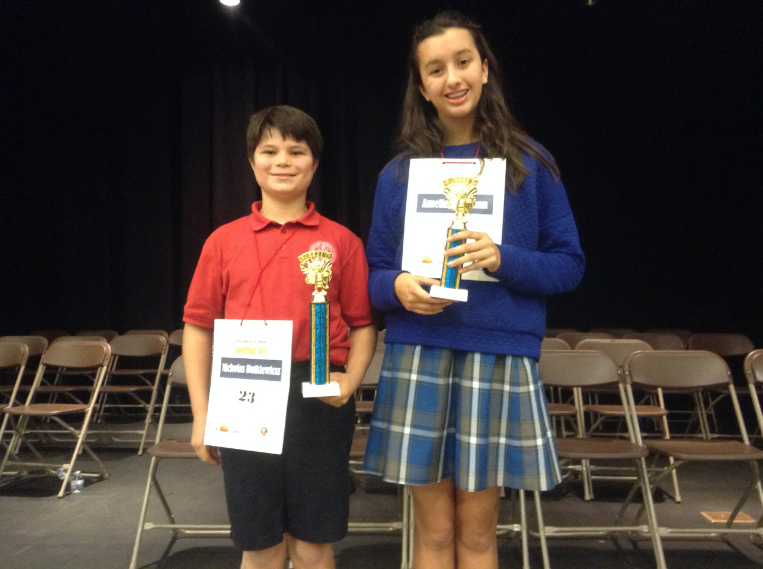
Eventually only two contestants remained — Amelia Chapman an eighth-grader from St. Gregory and Nickolas Butkiewicsz, a fifth-grader from St. Theresa. The competition was stiff between the two but Butkiewicsz managed to clinch the title of this year’s champion, with the word “Unau.”
Trophies had been presented and half the contestants exited the stage before the judges determined at the last minute that a tie-breaker was needed for second place. Gabriel Nield, the defending champion from last year’s bee and an eighth-grader at St. John Vianney, was called back to the stage.
Going head-to-head both contestants misspelled two words in a row. Chapman then spelled “Feminine” correctly while Nield successfully spelled “Dilemma.” The competitors fought for another five minutes until Nield misspelled “Dirigible.” By correctly spelling both “Pharaoh” and “Honeysuckle,” Chapman then secured her second place title.
With the competition finally over all the contestants could relax and celebrate the victories. Butkiewicsz explained that he never expected to win. “I had my hopes high because last year I was runner-up for our school spelling bee but I never thought I would win this. I’m really excited!”
Chapman expressed the same feelings. “I thought I could probably make it to the top five, that was the goal, but it was really nice to win second place. My school hasn’t moved past third place, so that was kind of my goal too, but I was okay if I didn’t make it that far.”
Both contestants won trophies and Butkiewicsz will receive an Amazon gift certificate. Butkiewicsz will also move on to the state competition coming March 19. He will demonstrate his superior spelling skills among Arizona’s other diocesan and county-level winners including Katrina Vollmer, a seventh-grader at San Francisco de Asís in Flagstaff. Vollmer returns to the statewide competition this year as Coconino County’s top speller.
In crime-plagued periphery, pope preaches conversion

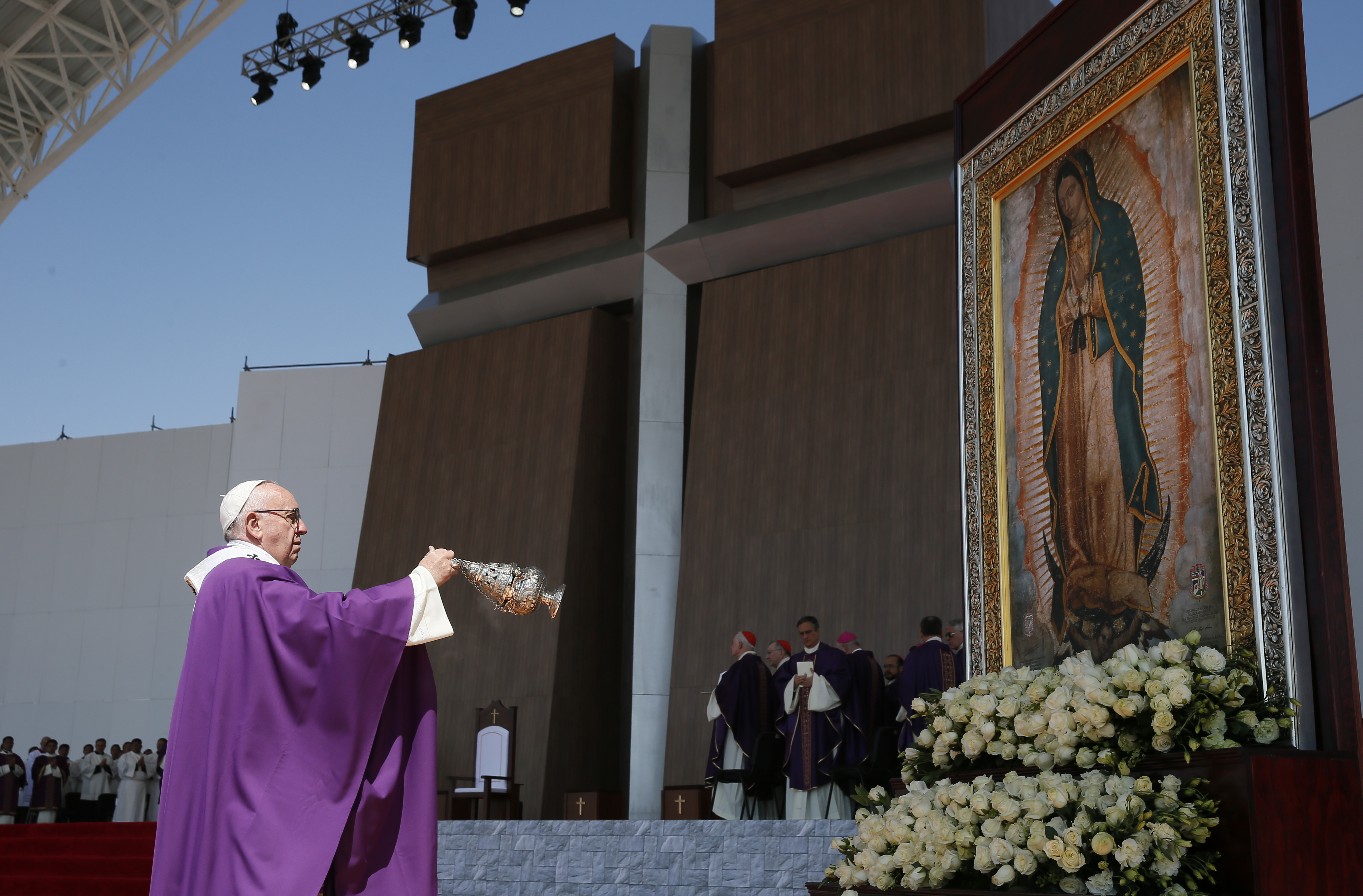
ECATEPEC, Mexico (CNS) — Pope Francis began his travels to Mexico’s “peripheries” by visiting an overcrowded, sprawling settlement known internationally as a hunting ground for girls to force into prostitution and for boys to enlist in the drug trade.
Ecatepec, on the northern edge of Mexico City, also has tidy gated communities and a new shopping mall with department stores like Sears, a big WalMart, Starbucks and dozens of other shops and restaurants.
Pope Francis celebrated Mass Feb. 14 on a vast open field with some 300,000 people. The high altar platform was decorated with Aztec designs — flowers and birds — made of flowers and petals.
More than 1.7 million people live in Ecatepec, which, Vatican Radio described as “a lawless neighborhood where organized crime, pollution and poverty reign and where most people fear to tread.” Like Ciudad Juárez in the north was a decade ago, Ecatepec has now become famous as a place where it is particularly dangerous to be a woman because of murders, kidnappings and human trafficking.
Sr. Angelica Garcia Barela, a member of the Servant Missionaries of the Word, was thrilled the pope was visiting. “He comes to show the faith and to change hearts. The pope’s faith, his enthusiasm and joy, isn’t fleeting and it’s contagious. Much can change.”
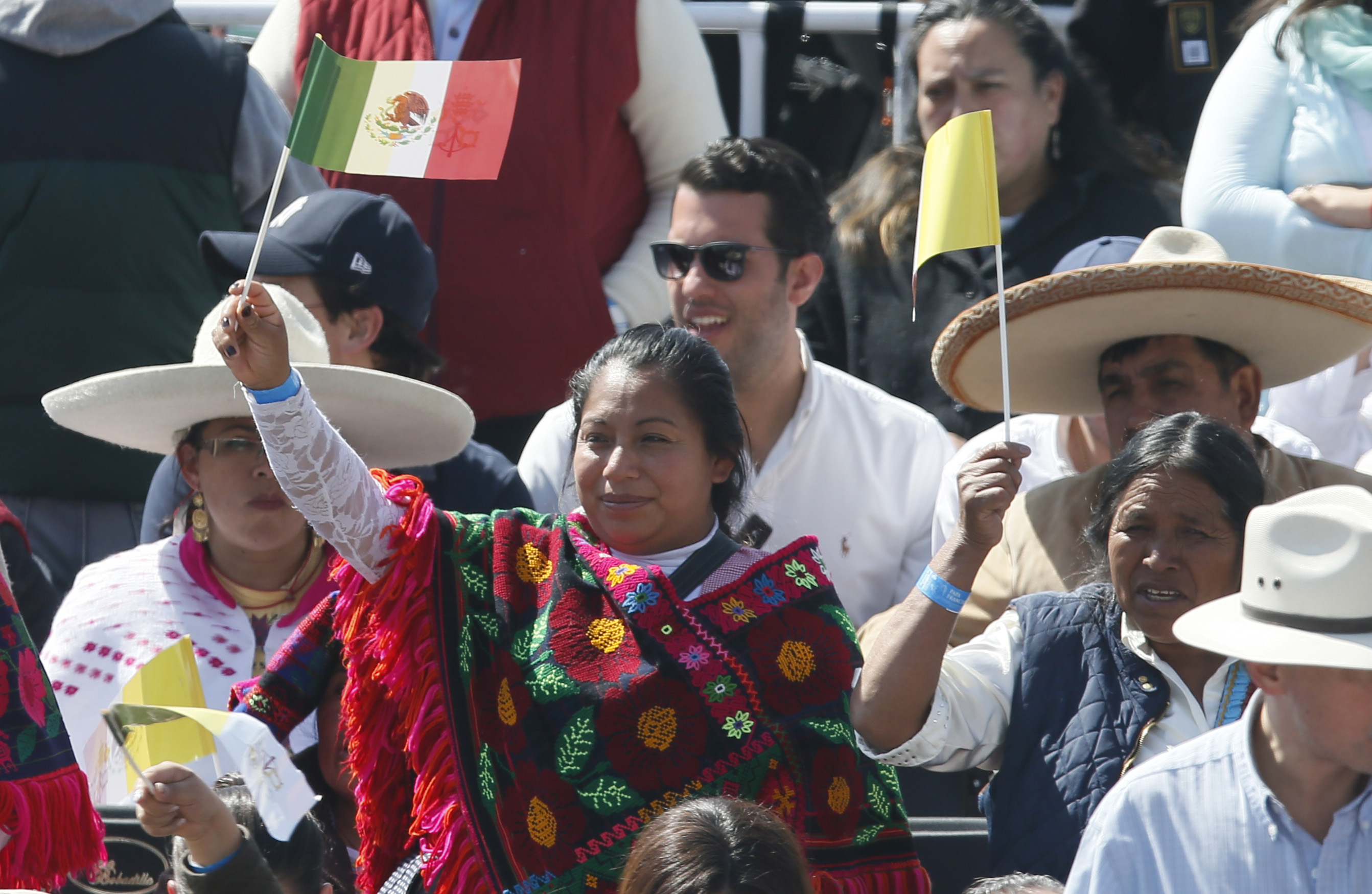
With other members of her order, Sister Garcia spent the night at the Mass site so she would be in place early to watch over the pre-consecrated hosts she would help distribute during Communion to people far from the papal altar.
Her main ministry is going door-to-door sharing the Bible with families. She knows how to evangelize and said Pope Francis is the perfect example of “evangelization through presence.”
After Mass, Pope Francis recited the Angelus with the thousands gathered on the dusty field. Before leading the prayer, he recognized “how much each one of you has suffered to reach this moment, how much you have ‘walked’ to make this day a day of feasting, a time of thanksgiving.”
He urged the people to step up and work together to “make this blessed land of Mexico a land of opportunities.”
It should be a land where, he said, there is “no need to emigrate in order to dream, no need to be exploited in order to work, no need to make the despair and poverty of many the opportunism of a few, a land that will not have to mourn men and women, young people and children who are destroyed at the hands of the dealers of death.”
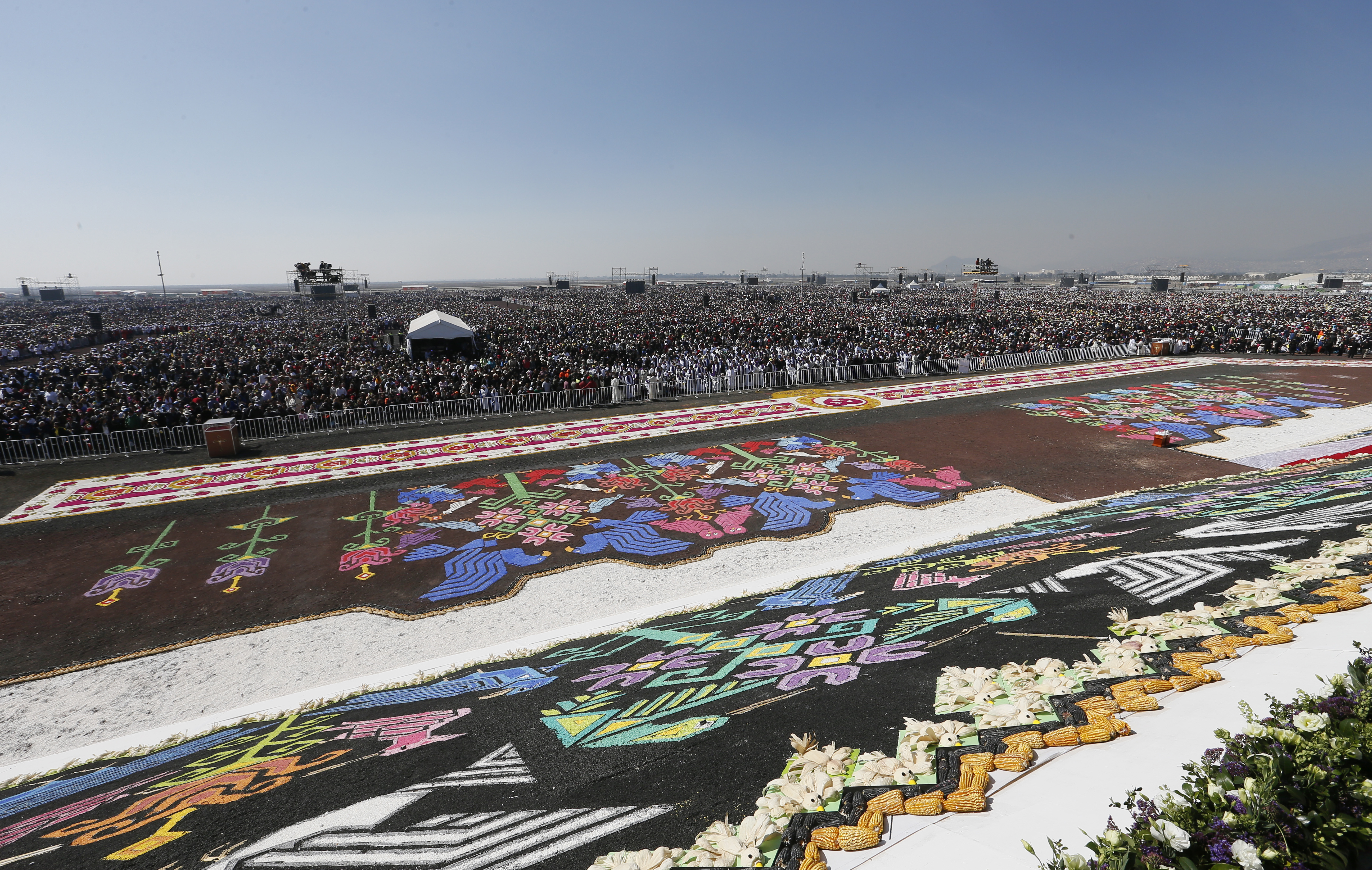
In his homily, Pope Francis did not specifically mention the violence against women or the drug traffickers, but instead addressed the ways in which people give into little temptations that too easily grow into great evil.
In the Gospel story of Jesus being tempted by the devil in the desert, the pope said, “Jesus does not respond to the devil with his own words, instead he uses the words of God, the words of Scripture. Because, brothers and sisters, ingrain this in your minds: You cannot dialogue with the devil!
“You cannot dialogue with the devil because he will always win,” he insisted. “Only the power of the Word of God can defeat him.”
Lent, the pope said, is a time of conversion, which involves acknowledging each day how the devil tries to tempt and divide people. In a country known for huge inequalities in income and opportunity, Pope Francis denounced as a work of the devil the idea of “a society of the few and for the few.”
“Three great temptations” — wealth, vanity and pride — are behind such an attitude and so many other ills that destroy society and attack human dignity, he said.
The sinful use of money and material things, he said, is “seizing hold of goods destined for all and using them only for ‘my own people.’” It involves living off the sweat and labor of others, “even at the expense of their very lives,” the pope said.
Such “bread,” he said, “tastes of pain, bitterness and suffering. This is the bread that a corrupt family or society gives its own children.”
“We know what it means to be seduced by money, fame and power,” Pope Francis said. “For this reason, the Church gives us the gift of this Lenten season, invites us to conversion, offering but one certainty: he is waiting for us and wants to heal our hearts of all that tears us down. He is the God who has a name: mercy. His name is our wealth.”
At the end of Mass, Bishop Oscar Domínguez Couttolenc of Ecatepec told the pope that “like many other places, we experience poverty and violence, made flesh in the pain of those who suffer because of corruption, hunger, poverty and all the manifestations of evil that lead to the deterioration of our common home.”
In response, he said, the faithful of Ecatepec pray, reflect and work, trying to live a “spirituality of communion,” a sense of solidarity strengthened by the pope’s visit.
Before landing by helicopter in Ecatepec, Pope Francis was treated to a special aerial viewing of the nearby Teotihuacan Pyramids, believed to date from about 300 B.C.
― By Cindy Wooden, Catholic News Service. Contributing to this story was Junno Arocho Esteves in Mexico City.