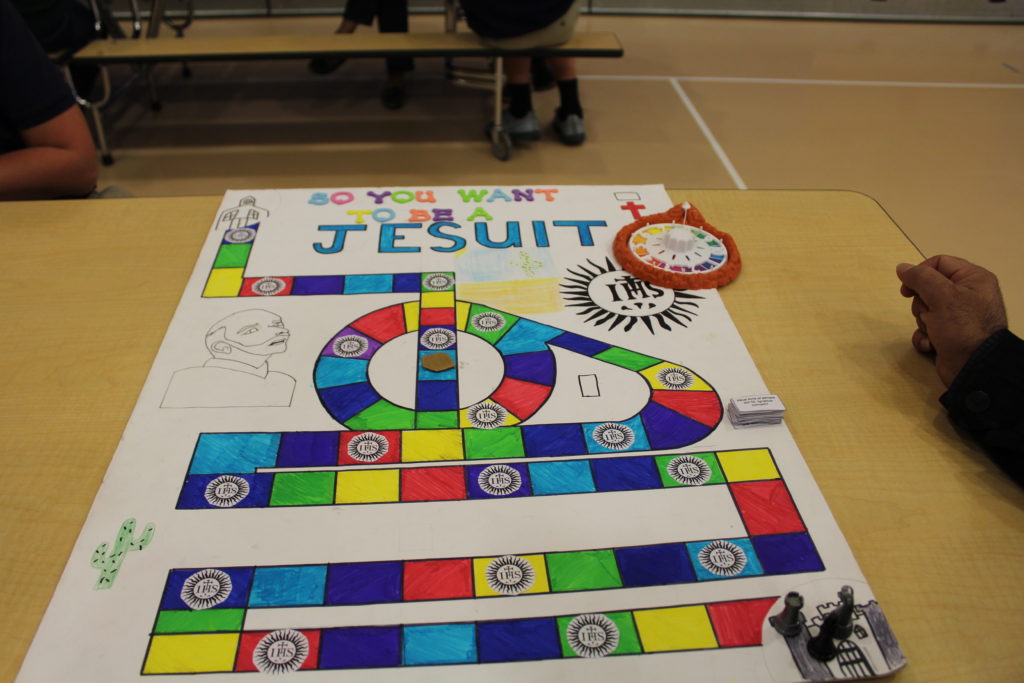
Sixth-graders at St. Francis Xavier learned about the lives and charisms of Jesuits then quizzed one another via homemade board games Jan. 22. (courtesy photo)
Two game days came two weeks apart at a pair of Jesuit schools in central Phoenix.
St. Francis Xavier, the only Jesuit elementary school in Arizona, held Jesuit Board Games Jan. 22 as an interactive way to showcase knowledge of the latest middle school religious education unit. Sixth-graders study Jesuit history as part of their curriculum and create board games to help one another review information about the lives and ministries of St. Ignatius of Loyola and St. Francis Xavier.
“The Jesuit unit is one of my most favorite lessons I do with my sixth graders. It is so fun to see the student apply what they have learned and transform them into informative clever and creative board games,” said Kelsey McKone, religious education teacher.
Brophy freshmen and their friends from Special Olympics in Arizona hold an impromptu dance party on campus Feb. 5. (courtesy photo)
Across the parking lot at Brophy College Preparatory, the freshmen class hosted a Game Day for athletes involved in Special Olympics. More than 175 Special Olympics athletes partnered with Brophy freshmen in relay races, board games, basketball and football on campus. Students also held a dance party.
(courtesy photo)
“This year the morning began with a sing-a-long and mini cheer camp hosted by Student Council which quickly became a favorite of our Special Olympic athletes,” said Bob Ryan, principal.
Paul Fisko, assistant principal for ministry, agreed that the day, led by Brophy freshmen, was a memorable one.
“The day is a win-win for athletes and Brophy students… so much joy and camaraderie everywhere you look,” Fisko said.
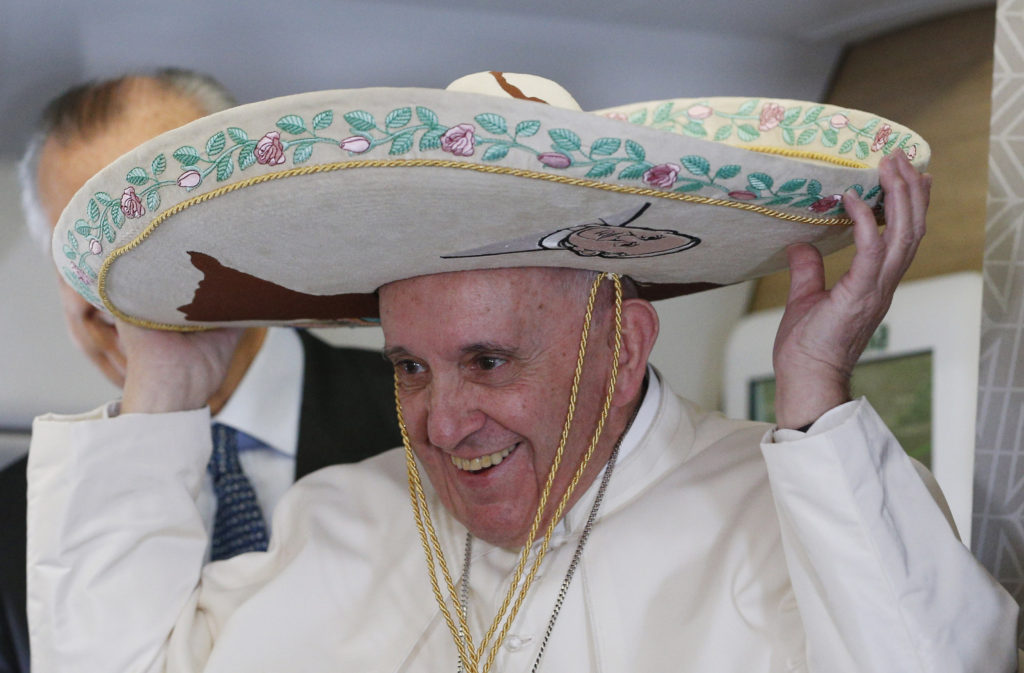
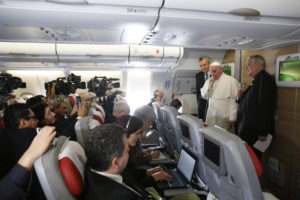
Pope Francis tries on a sombrero while meeting journalists aboard his flight to Havana Feb. 12. Traveling to Mexico for a six-day visit, the pope is stopping briefly in Cuba to meet with Russian Orthodox Patriarch Kirill of Moscow at the Havana airport. (CNS photo/Paul Haring)
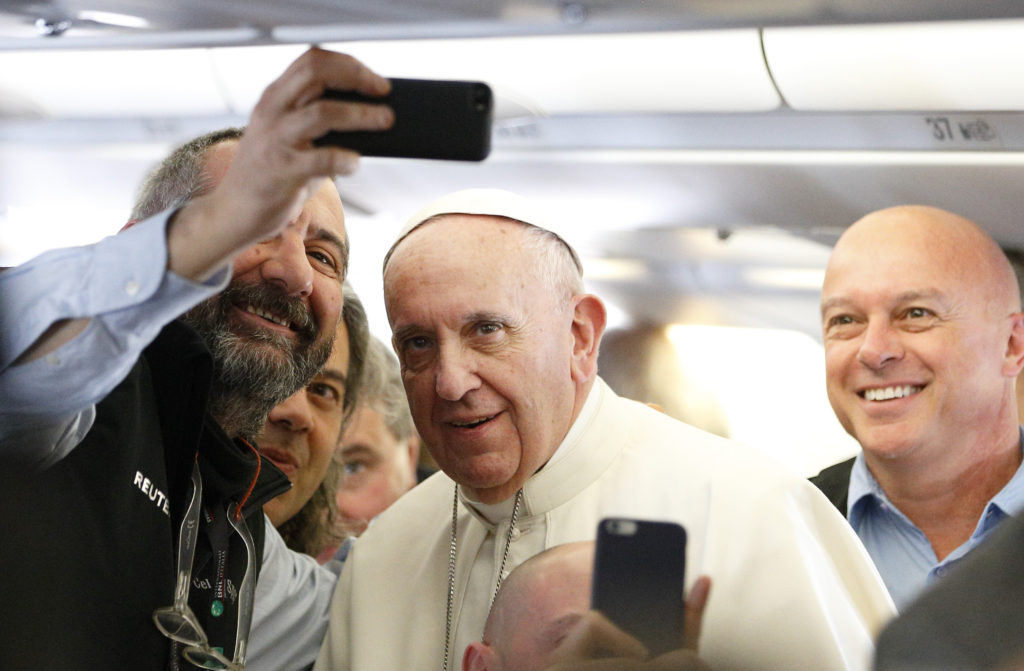
Pope Francis poses for a selfie with Reuters photographer Max Rossi, AP photographer Gregorio Borgia and AFP photographer Gabriel Bouys while meeting journalists aboard his flight to Havana Feb. 12. Traveling to Mexico for a six-day visit, the pope is stopping briefly in Cuba to meet with Russian Orthodox Patriarch Kirill of Moscow at the Havana airport. (CNS photo/Paul Haring)
But his flight to Cuba Feb. 12 had a unique moment. Noel Diaz, who lives in Los Angeles and was covering the trip for ESNE — a Catholic radio and television network — asked the pope if he could shine his shoes “in memory of all those people who struggle daily to put bread on their tables.”
Diaz told the pope that when he was growing up in Tijuana, Mexico, his mother told him he would have to delay his first Communion because she could not afford to buy him black pants and a white shirt. Although not quite 8 years old, Diaz said he went out with a shoe-shine box to earn the money for the clothes and was able to receive his first Communion with his peers.
The pope reluctantly conceded to Diaz, and the man knelt in the aisle of the plane and brushed the pope’s shoe. Then he gave the pope a shoe-shine kit.
Pope Francis tries on a sombrero while meeting journalists aboard his flight to Havana Feb. 12. Traveling to Mexico for a six-day visit, the pope is stopping briefly in Cuba to meet with Russian Orthodox Patriarch Kirill of Moscow at the Havana airport. (CNS photo/Paul Haring)
[/quote_box_right]Valentina Alazraki, a correspondent for the Mexican Televisa and the journalist who has done the most papal trips, gave the pope a large sombrero decorated with his coat of arms, his image and the image of Our Lady of Guadalupe.
Alazraki had given similar hats to St. John Paul II and Pope Benedict XVI when she traveled with them to her homeland. The pope put the sombrero on briefly and smiled for the cameras.
Nestor Ponguta Puerto, a radio journalist from Colombia, gave Pope Francis two golden bags of Colombia’s finest coffee and asked the pope when he would visit the South American country. If talks between the government and opposition groups continue and a peace treaty is signed, the pope said, “I will go next year.”
The pope also received a white rose, a box of homemade chocolate chip cookies and a brand new zucchetto or scullcap. He put it on his head for a few minutes, then gave it back to the TV correspondent as a souvenir.
Pope Francis greets journalists aboard his flight to Havana Feb. 12. Traveling to Mexico for a six-day visit, the pope is stopping briefly in Cuba to meet with Russian Orthodox Patriarch Kirill of Moscow at the Havana airport. (CNS photo/Paul Haring)
As is his custom at the beginning of a trip, Pope Francis thanked the traveling press corps and semi-apologized for the crazy hours they would work in Cuba Feb. 12 and in Mexico through Feb. 17.
“The schedule is full,” he said.
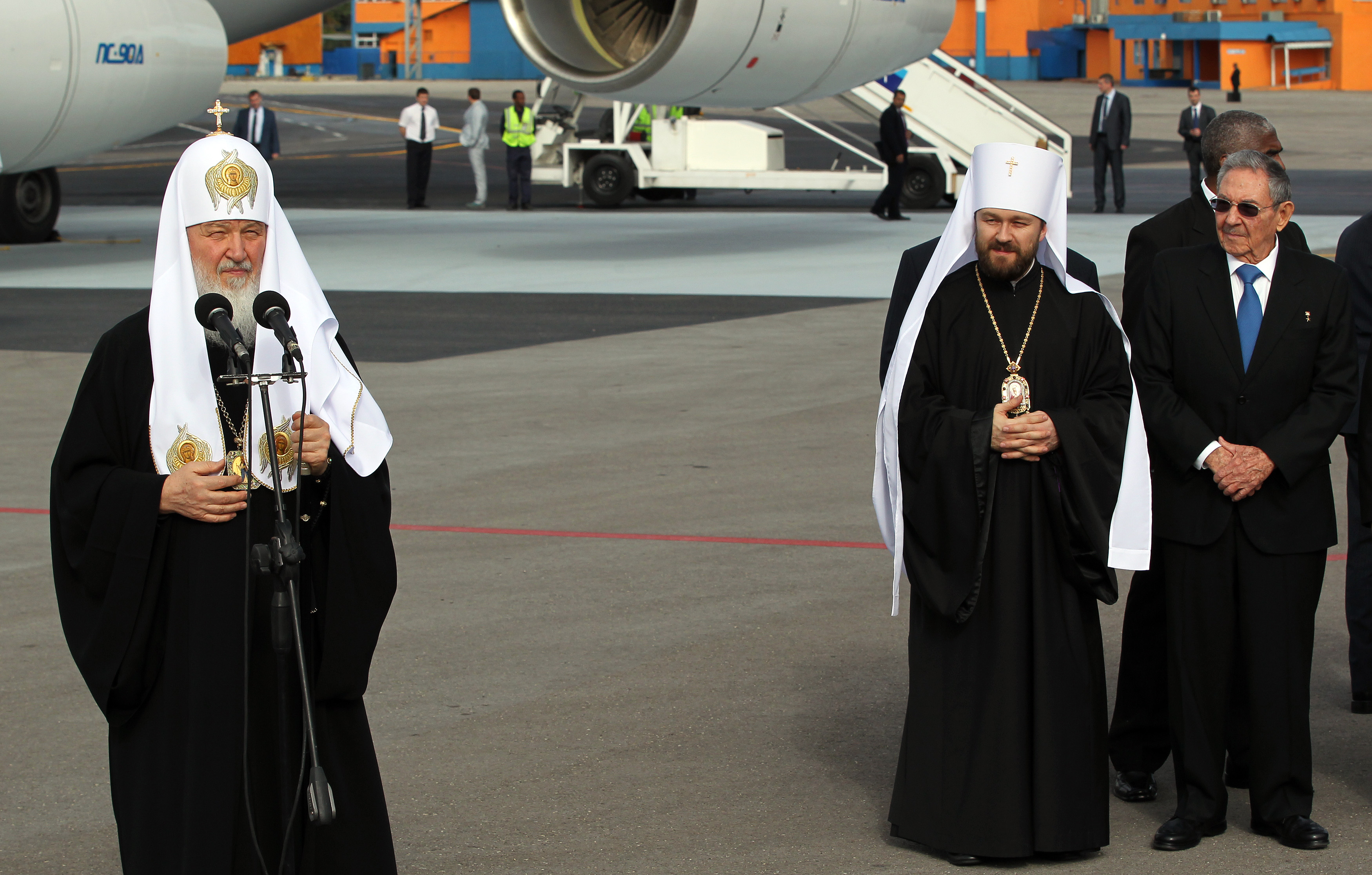
Although the planned stop of three-and-a-half hours in Cuba complicated matters, Pope Francis told reporters the meeting there with the head of the Russian Orthodox Church “was very much desired by my brother (Patriarch) Kirill and me.”
And speaking of Mexico, Pope Francis said, “My greatest desire is to pause” in front of the tilma, the cloak bearing the image of Our Lady of Guadalupe.
The tilma “is a mystery that is studied and studied, but there are no human explanations” for how the image was produced, the pope said. “It’s something of God.”
Before greeting each member of the media one by one, Pope Francis publicly thanked Alberto Gasparri, the main papal trip organizer who has worked at the Vatican 46 years and is about to retire.
Catholic Charities Community Services is giving moviegoers a chance to see “The Young Messiah” March 10, the night before it opens to the public. The inspiring and unique story of seven-year-old Jesus Christ and his family as they come to a fuller understanding of His divine nature and purpose.
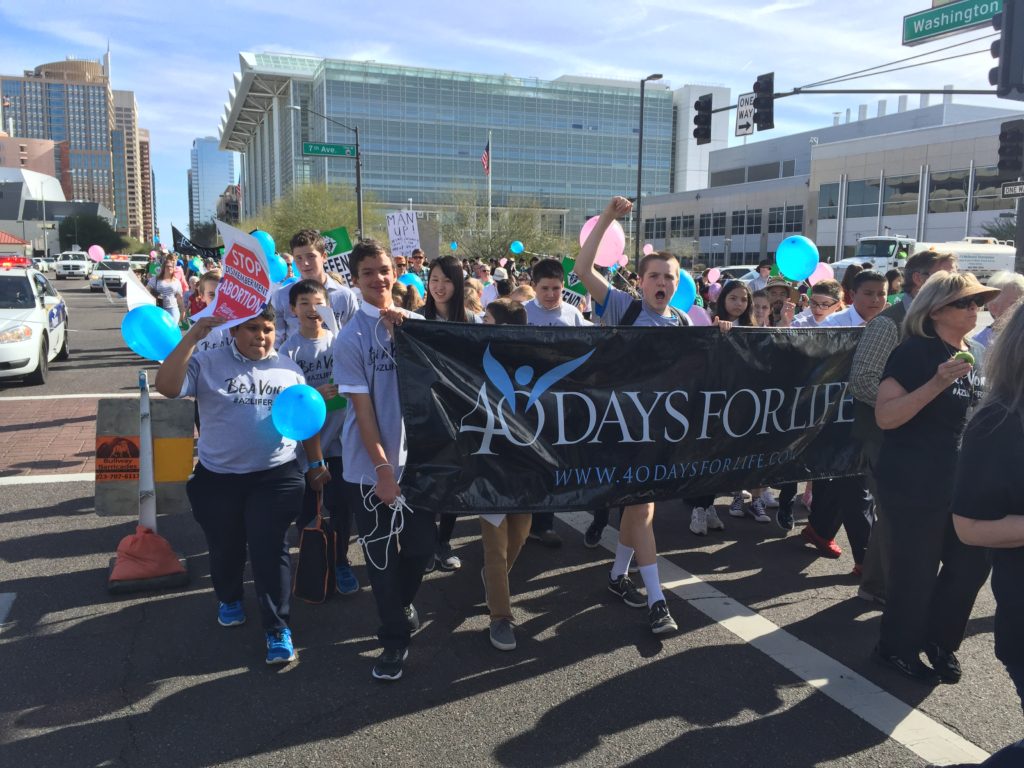
Youth carry a 40 Days for Life banner during the AZ Life Rally Jan. 22 in Phoenix. (Tony Gutierrez/CATHOLIC SUN)
Youth carry a 40 Days for Life banner during the AZ Life Rally Jan. 22 in Phoenix. The next 40 Days for Life prayer campaign runs Feb. 10-March 20 and includes five vigil locations in the Diocese of Phoenx. (Tony Gutierrez/CATHOLIC SUN)
Christ calls every person to a special mission, Bishop Thomas J. Olmsted instructed the faithful during a Mass he celebrated in honor of the “40 Days for Life” 2016 campaign.
The peaceful campaign launched in 2007 and focuses on prayer, fasting and public witness to help bring about an end to abortion. This year’s Mass was held at St. Mary’s Basilica Feb. 4, a week before the national campaign, which coincides with Lent, kicked off. The Gospel of the Mass reflected on the Apostles’ work of evangelization.
“There are five points which I think are all very helpful for us, who are engaged in witnessing to the Gospel of Life, and seeking to defend the most vulnerable among us,” Bishop Olmsted said. “The first is He sent the Apostles two by two. They were not to go alone.”
The second point made was that Jesus gave His Church authority over Satan. “This is vital,” Bishop Olmsted said. “We can be certain that when we’re near a place where abortions take place, the Evil One is especially active there, but we are not alone when we pray. … We give thanks to God for that and that’s why we pray there together. That’s why we call upon Our Lady of Guadalupe to be with us and keep us under her mantle.”
Mike Phelan, director of the diocesan Office of Marriage and Respect Life, re-affirmed the importance of prayer, specifically in conjunction with 40 Days for Life. “Forty Days for Life is doing the most fundamental, foundational and probably important part of the pro-life movement, which is public prayer and witness,” Phelan said. “There is a lot of spiritual battle that happens around these clinics.”
Bishop Olmsted illustrated that although the fruits of 40 Days for Life may not be witnessed directly, they certainly do exist. “The third piece of advice to the Apostles and for all of us in the Apostolic Church is ‘Take nothing for the journey.’ We should not worry if it seems that we don’t have enough words to say, convincing actions to perform, God’s work is being accomplished.”
Phelan re-iterated this point, saying, “We do know from Abby Johnson’s testimony that when people are outside praying in front of the clinics, they do have up to a 70 percent cancellation rate on appointments. … Whether you see the fruit or not, you can count on God working with your prayers.”
Bishop Olmsted’s fourth piece of advice is to “Shake the dust off your feet.”
“If our words are rebuked, if our efforts are disdained, made fun of, if we’re not welcomed, shake the dust off our feet.”
The sermon concluded with the fifth point, which is that “the Apostles went off and preached repentance.”
Forty Days for Life began on Ash Wednesday and is being carried out during the Lenten Season. Phelan explained this significance, saying “Our Lord showed us with His 40 days in the desert that a time apart of serious sacrifice, fasting and prayer, is how mighty things happen. Throughout the Scriptures, 40 days and 40 years are mighty times of change.”
Phelan mentioned that it is easy for anyone to get involved. “There is a national website and people can look for the five campaigns in the Diocese of Phoenix: Flagstaff, Tempe, Phoenix, Chandler and Glendale and sign up for hours of prayer,” Phelan said. “I would encourage everyone to go two by two and pray for an hour a week during Lent.”
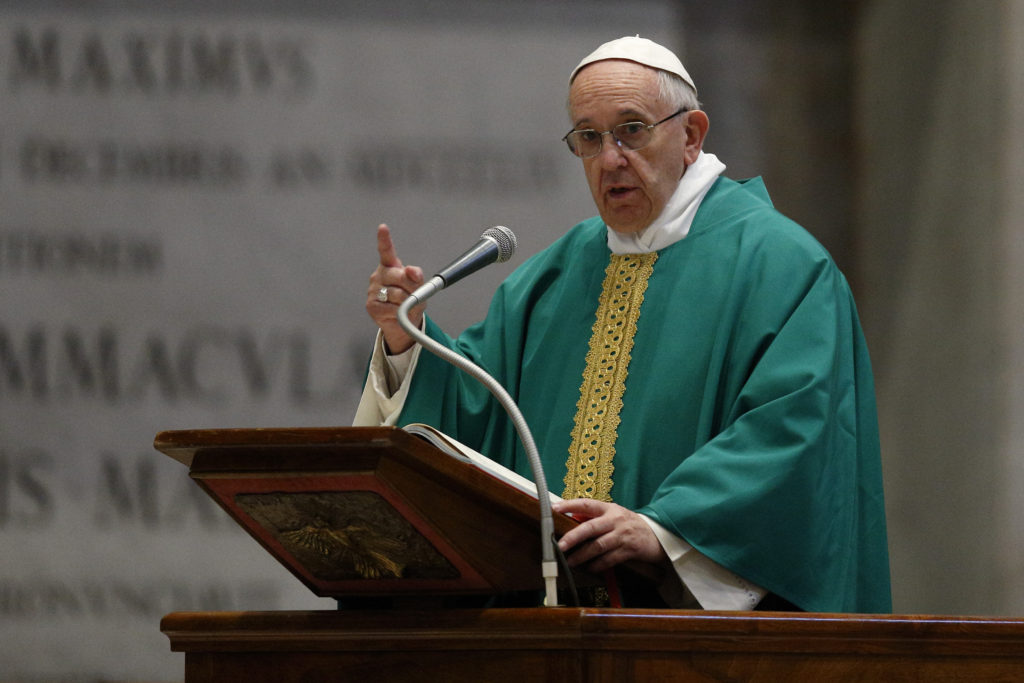
Pope Francis gives the homily while celebrating an early morning Mass with Capuchin friars in St. Peter's Basilica at the Vatican Feb. 9. (CNS photo/Paul Haring)
Pope Francis gives the homily while celebrating an early morning Mass with Capuchin friars in St. Peter’s Basilica at the Vatican Feb. 9. (CNS photo/Paul Haring)
VATICAN CITY (CNS) — On the eve of sending off “missionaries of mercy” to all corners of the globe, Pope Francis told his specially appointed men that the reassuring strength of God’s love — not the “bludgeon of judgment” — will bring the “lost sheep” back to the fold.
“Being a missionary of mercy is a responsibility that is entrusted to you because it asks you to be a firsthand witness of God’s closeness and his way of loving, not our way, which is always limited and sometimes contradictory,” he said Feb. 9.
Meeting with hundreds of missionaries who came to Rome to receive in person their special papal mandate on Ash Wednesday, Pope Francis said he wanted to highlight the unique aspects of their new ministry so they would carry it out properly and be “a real help” to the people they encounter.
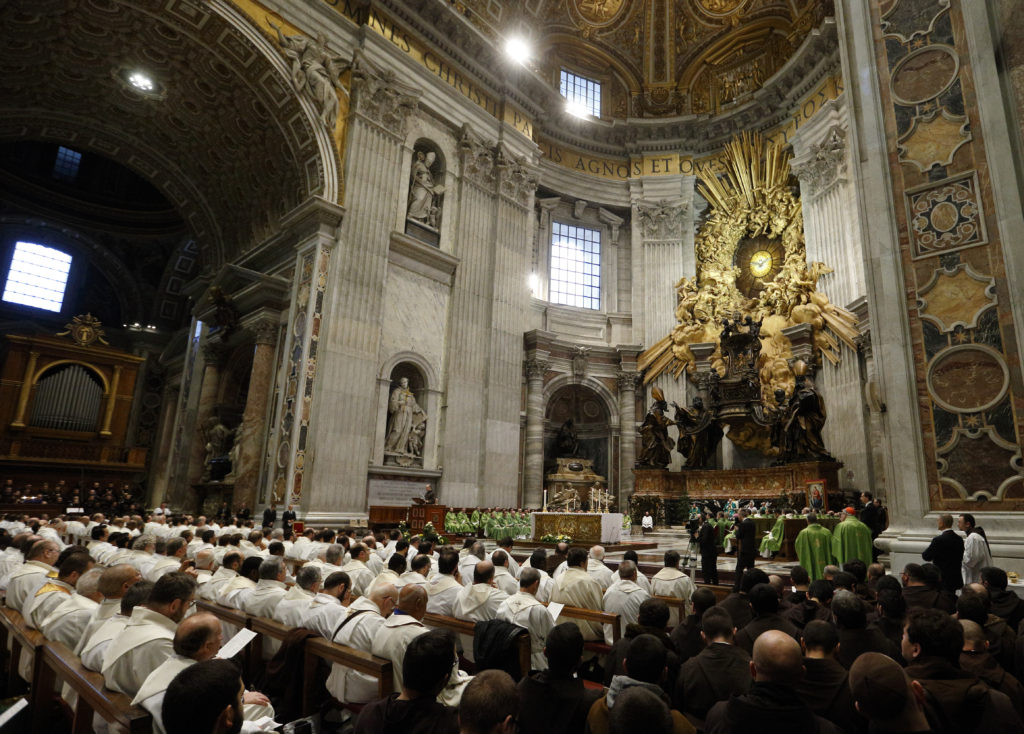
Pope Francis celebrates an early morning Mass with Capuchin friars in St. Peter’s Basilica at the Vatican Feb. 9. (CNS photo/Paul Haring)
He told the missionaries that they need to recognize that people’s desire for forgiveness might be obscured by their inability or embarrassment to talk about their sins.
“It’s not easy to go before another person, knowing he represents God, and confess one’s sins,” he said. Confessors should be respectful and encouraging, he said, because the penitents can easily feel exposed and vulnerable “with their weakness and limitations, with the shame of being a sinner.”
“Do not forget, there isn’t a sin before you, but a repentant sinner,” a person who wants to be listened to, forgiven, and brought home again, he told them.
With the little strength they have on their own, sinners want to do everything to be a child of God again, therefore, do not be a judge “with a sense of superiority, as if we were immune from sin,” or be too invasive with inappropriate or prying questions, the pope said.
Help the sinner — who may be feeling the same shame of nakedness Adam and Eve felt in the Garden of Eden when they recognized the evil they had done — by “covering the sinner with the blanket of mercy, so they will no longer be embarrassed and can regain the joy of their filial dignity,” he said.
Capuchin friars attend an early morning Mass with Pope Francis in St. Peter’s Basilica at the Vatican Feb. 9. (CNS photo/Paul Haring)
He said he wants the missionaries to be a living expression of “the church who, like a mother, welcomes anyone who approaches her,” knowing that through her they will become one with Christ.
In the confessional, the pope said, they must remember that it is Christ who welcomes, listens, forgives and grants peace. “We are his ministers and we always need to be forgiven by him first,” he said.
The pope said whatever sin a priest hears, he must always remember his own sinful nature and be a humble channel of God’s mercy.
He said he still feels the joyful, life-changing moment he experienced as a teenager Sept. 21, 1953, after he went to confession.
Speaking off the cuff, he said, “I don’t remember what the priest said” because what he said was not as important as his smile and the overwhelming sense of God’s presence.
“It was like being received by a father,” he said.
Paczki, pronounced "poonch-kee," is homemade at Bashas' bakeries statewide. Ten percent of sales today will go to the Society of St. Vicent de Paul. (courtesy photo)
Paczki, pronounced “poonch-kee,” is homemade at Bashas’ bakeries statewide. Ten percent of sales today will go to the Society of St. Vicent de Paul. (courtesy photo)
Bashas’ Supermarkets is offering Catholics a chance to start their Lenten service opportunities while celebrating Mardi Gras. Every one of its more than 50 stores is donating 10 percent of all Paczki sales today to the Society of St. Vicnent de Paul.
Pronounced “Poonch-kee,” the Polish pastry is a Fat Tuesday tradition. Historically, families would use up all of the fat, sugar, eggs and fruit in the house prior to Lent since such items were forbidden during the penitential season. The result: a sweet doughnut!
The homemade treats come in glazed or sugared options and are filled with your choice of lemon, raspberry or custard. Glazed paczki with raisins are especially popular, according to a media alert. Check out our local news anchors enjoying them.
Then stop by any Bashas’ to get your own. Half a dozen sells for $2.99 with single paczki available for 75 cents. Proceeds will help families throughout Arizona served by St. Vicnent de Paul. Donor and volunteer support served some 10 million meals through St. Vincent de Paul’s dining rooms and food box outreach, according to its annual report released yesterday. Check out the myriad of other ways the agency feeds, clothes, houses and heals those struggling in our community to get through any given day.
Almost forgot!
Once you buy your pazcki, be sure to capture the first bite and use #PaczkiSelfie on your favorite social media channel.
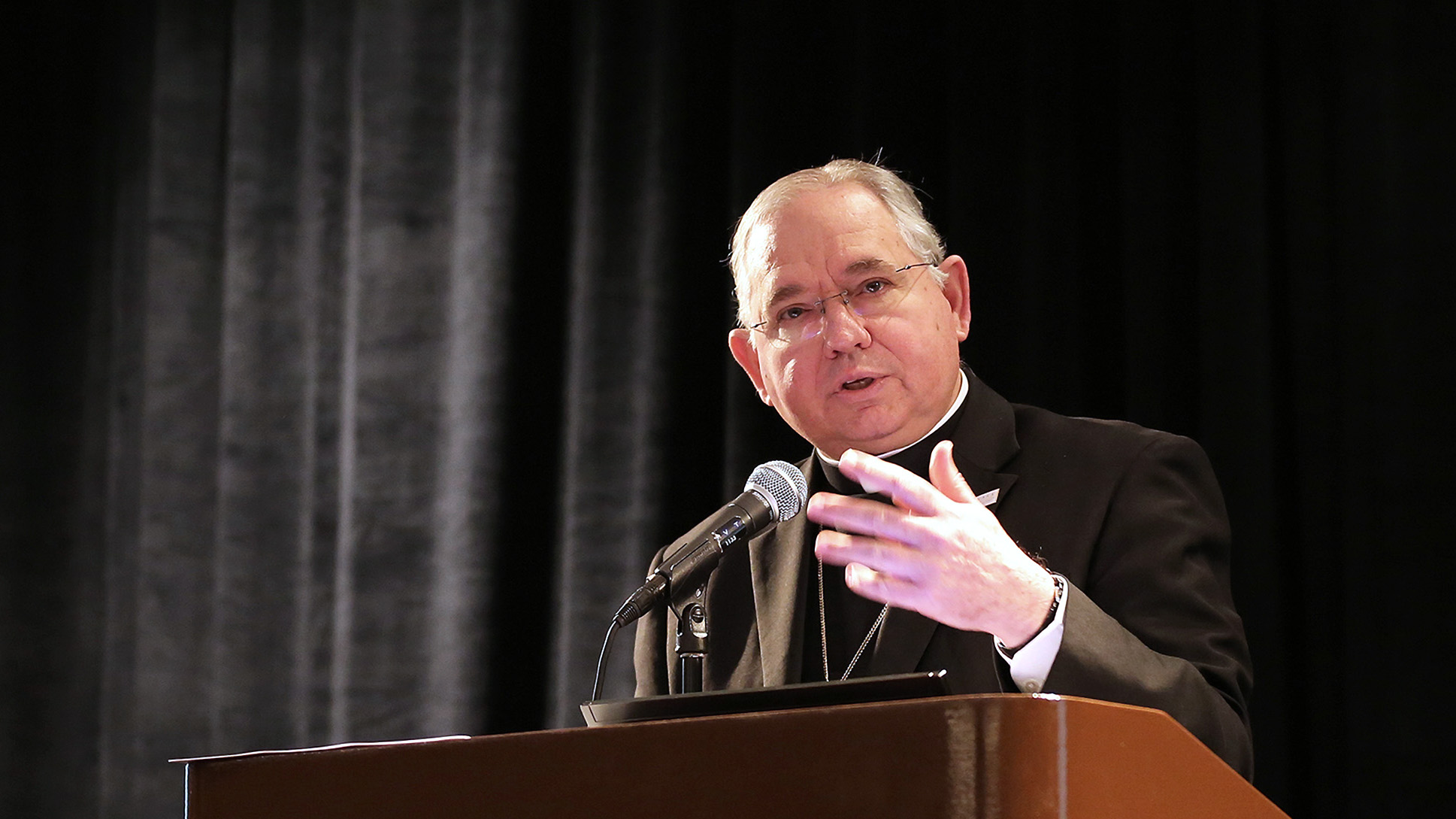
Archbishop Jose H. Gomez of Los Angeles is seen in this Aug. 24, 2013, file photo. In an address to a Hispanic pro-life congress, Archbishop Gomez called on Latinos to build a pro-life culture and not a political coalition. (CNS photo/Victor Aleman, Vida Nueva)
Archbishop Jose H. Gomez of Los Angeles is seen in this Aug. 24, 2013, file photo. In an address to a Hispanic pro-life congress, Archbishop Gomez called on Latinos to build a pro-life culture and not a political coalition. (CNS photo/Victor Aleman, Vida Nueva)
SANTA ANA, Calif. (CNS) — Saying the future of the pro-life movement is “cultural not political,” Archbishop José H. Gómez of Los Angeles called upon Catholic Latinos to work toward a “new Christian humanism, a new vision of society and human destiny that is rooted in the Gospel.”
“We want a new culture, not a new political coalition,” he told participants at the Hispanic Pro-life Congress Jan. 30 at Mater Dei High School in Santa Ana, pointing to the necessity of changing society’s views on the “fundamental injustice” of abortion and euthanasia.
Archbishop Gómez said that the practice of abortion and euthanasia raises concerns about “what kind of society we are and what kind of people we want to be.”
He expressed unease that society is losing a sense of its common humanity and responsibility for others, especially when it comes to abortion and euthanasia, which he called the most important issues facing the country.
While running through a list of social sins and the importance of addressing racial discrimination, deportations and unjust immigration policies, unemployment, homelessness, pollution of the environment, neighborhood violence, drug abuse, decrepit prisons and the death penalty, the archbishop said the Church must place abortion and euthanasia foremost in its efforts.
He said the “‘seamless garment’ or ‘consistent ethic of life’” positions espoused widely are “not the vision we need.”
“Because in practice the ‘seamless garment’ and ‘consistent ethic’ result in a mistaken idea that all issues are morally equivalent,” he said. “And, of course, they are not. So in everything we need to be clear that the root of violence in our society is the violence against those who are not yet born and those who are [at] the end of their lives.”
It is the Church’s role to declare that the right to life is the foundation of all other rights, justice and peace in the world, the archbishop explained in calling for a “new vision for our efforts.”
“This vision is spiritual not political. And because it is spiritual, it makes no sense for there to be any division between our ‘pro-life’ efforts and our work for ‘social justice.’ In the face of the suffering and human need in the world, we cannot compartmentalize our compassion or draw lines between those we will care about and those we will not,” Archbishop Gómez explained.
He urged a deeper appreciation for the Gospel, which he said “is the core of God’s beautiful plan of love for creation and for every human life that he revealed in Jesus Christ.”
The Gospel of Life, the archbishop added, is what the early Church called the “kerygma,” the core teaching of the faith.
He quoted Pope Francis, who summarized kerygma: “Jesus Christ loves you; he gave His life to save you; and now he is living at your side every day to enlighten, strengthen and free you.”
Urging his audience to “stay close to Jesus,” Archbishop Gómez said Catholics have a duty to welcome and protect life and to care for life, every life” because God loves every person, especially those who are poor, marginalized and alone. “With God’s love, there are no boundaries, no borders, no barriers,” he said.
He also called for building friendships and to “be in dialogue with those who disagree with us.”
“We can’t negotiate about good and evil. … But we need to work with and talk to people who may not share our full vision of a culture of life, or at least people who don’t share our vision yet,” he said. “We have to be optimistic that truth, lived with joy, will lead to conversions and new ways of thinking.”
Describing the Church’s mission as one of bringing mercy to society, especially for those who are “inconvenient and unexpected” and those who “impose a burden on our way of life,” Archbishop Gómez reminded the audience to love as God loves.
“We need to build a community of conscience; to defend life and protect life,” he said.
A talk by Steve and Becky Greene Feb. ## will be geared toward adults and (Catholic Sun file photo)
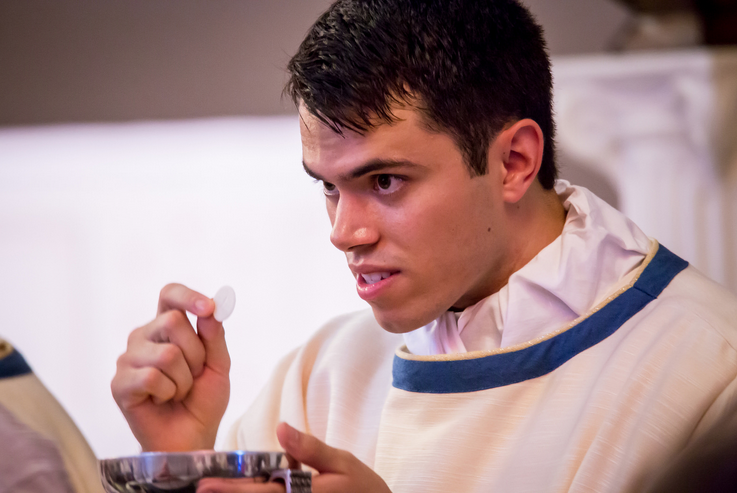
Fr. Fernando Camou distributes communion during his June 2015 priestly ordination Mass. Fr. Camou will address junior high and high school students as part of this year’s Eucharistic Congress. (Catholic Sun file photo)
The Diocese of Phoenix will again celebrate a Eucharistic Congress Feb. 16-19, but this year, organizers are shaking things up a bit.
There’s a push this year to bring in more young people plus draw on the resources of one of the best-known Catholic apostolates around, Catholic Answers, said Theresa Serrano-Keel, who’s been involved planning the congresses since they began in the Phoenix Diocese in 2009.
Organized by the Friends of the Cathedral, the Eucharistic Congress is a four-day, extravaganza that gathers Catholics from around the diocese at Ss. Simon and Jude Cathedral.
As always, the congress — taking place the first full week of Lent — will feature an array of speakers, 24 hours of confession, a 40-hours devotion and a Vatican exhibit.
“What’s a little different about it this year is we’re having two of our speakers come in from Catholic Answers: Trent Horn and Karlo Broussard,” Serrano-Keel said. “And on Feb. 18 we’re having a youth night.”
Horn will address adults Feb. 16 while Broussard will speak to high school students Feb. 18. Fr. Fernando Camou, ordained last June, will address junior-high-age students after the 6:30 p.m. Mass Feb. 18.
A talk by Steve and Becky Greene during the diocesan Eucharistic Congress Feb. 18 will be geared toward adults and how the Holy Eucharist strengthens the family. (Catholic Sun file photo)
“Steve and Becky will be talking about the domestic Church and the holy Eucharist and your family being strengthened by the Blessed Sacrament. It will be a great evening for family,” Serrano-Keel said.
[quote_box_right]
Coordinators from many of the 18 perpetual adoration chapels across the diocese have been involved in planning the congress. One of them, Loretta Winn, offered her take on the importance of the event.
“The congress reminds Catholics what we have, why we’re Catholic: the Eucharist,” Winn said. “This brings our community together to worship the Eucharistic King. We need to be reminded to put our computers down, to put our technology down and be present with the Divine Communicator, the Eucharistic King.”
The 6:30 p.m. bilingual opening Mass will be celebrated by Bishop Thomas J. Olmsted and the closing Mass Feb. 19 will be celebrated by Auxiliary Bishop Eduardo A. Nevares.
Cristofer Pereyra, director of the Hispanic Missions Office, will address Spanish speakers Feb. 16. He plans to direct his comments toward helping listeners make a plan for growing in holiness.
“Our power, our strength comes from the Eucharist.”
Adoring Christ in the Eucharist is more than just a private devotion, Winn said. “We are not there for only us. We’re praying for the community, for the country, for our priests, for vocations, and to end abortion,” Winn said.
A golden football honoring Jeff Feagles and Gerard Catholic High School was given to the Diocese of Phoenix Catholic Schools Office to commemorate Super Bowl 50. (Tony Gutierrez/CATHOLIC SUN)
A golden football honoring Jeff Feagles and Gerard Catholic High School was given to the Diocese of Phoenix Catholic Schools Office to commemorate Super Bowl 50. (Tony Gutierrez/CATHOLIC SUN)
A former Diocese of Phoenix athlete, who was on the roster for the 2007-08 Super Bowl champs, earned the diocese a spot in the first Super Bowl High School Honor Roll.
The NFL released the honorees as it marks the Super Bowl’s 50th season. Players and coaches of previous Super Bowl match ups — nearly 3,000 of them — are being recognized. They hail from more than 2,000 high schools. That includes former New York Giants punter Jeff Feagles, who graduated from Gerard Catholic High School. He played in Super Bowl XLII at University of Phoenix Stadium in Glendale in 2008.
Each honor roll campus receives a golden football. Since Gerard High School was torn down after its closure in 1989, the diocesan Catholic Schools Office received the football. It will be transferred to Seton Catholic Preparatory in Chandler, which houses Gerard memorabilia.
As part of the Super Bowl High School Honor Roll, the diocese will receive an NFL Character Education Curriculum and is eligible to apply for a grant from the NFL Foundation to support football programs.
“Football has always been about more than wins and losses,” Roger Goodell, NFL commissioner said in a letter to the Diocese of Phoenix. “The game teaches valuable skills that can last a lifetime. High school football programs from coast to coast have consistently developed citizens of high character by instilling the values of football in their student athletes.”
Super Bowl 50 kicks off at 4:30 p.m. Feb. 7 at Levi’s Stadium in Santa Clara and on CBS.