
‘Year of Consecrated Life’ ends with call to ‘be the light of Christ’

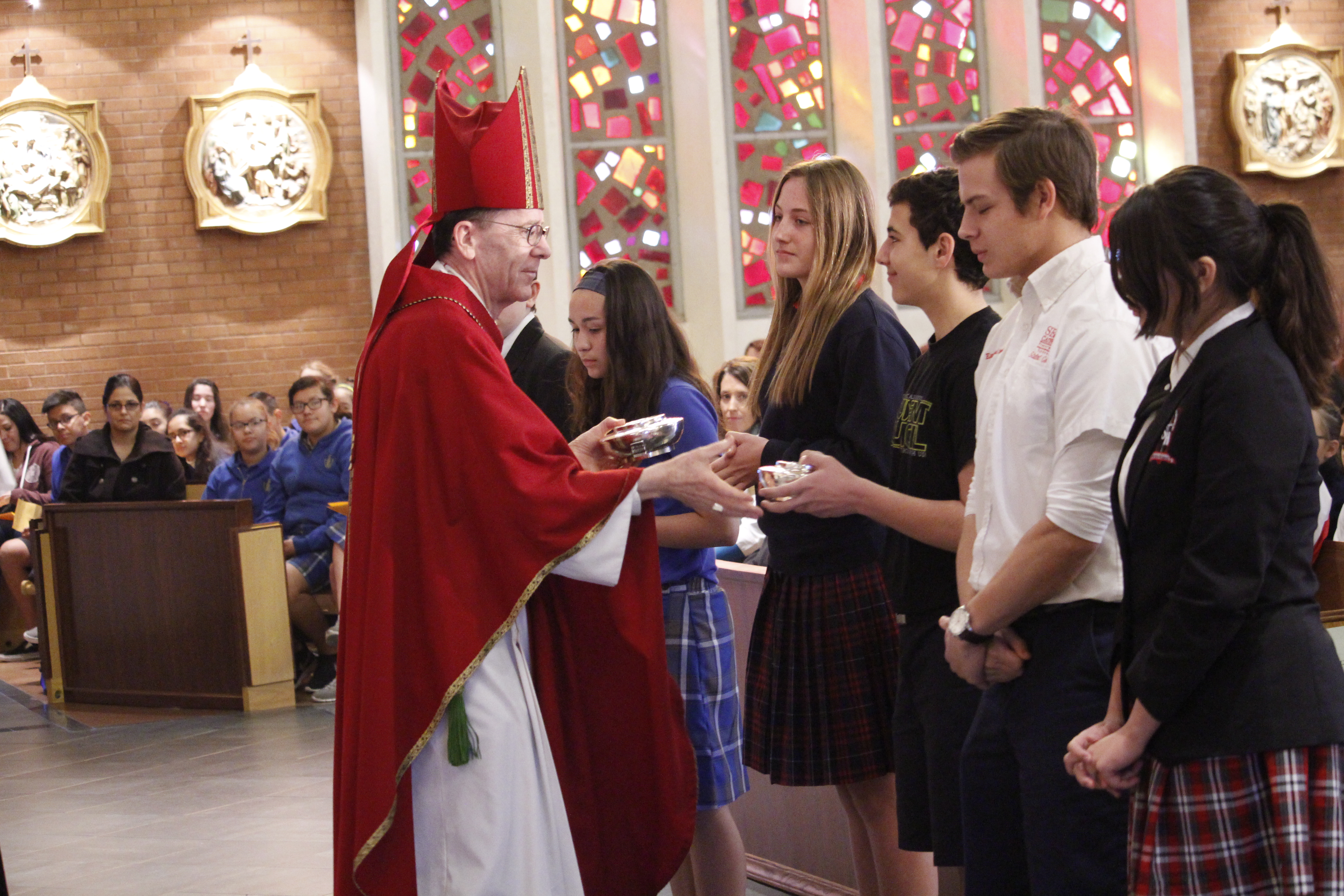
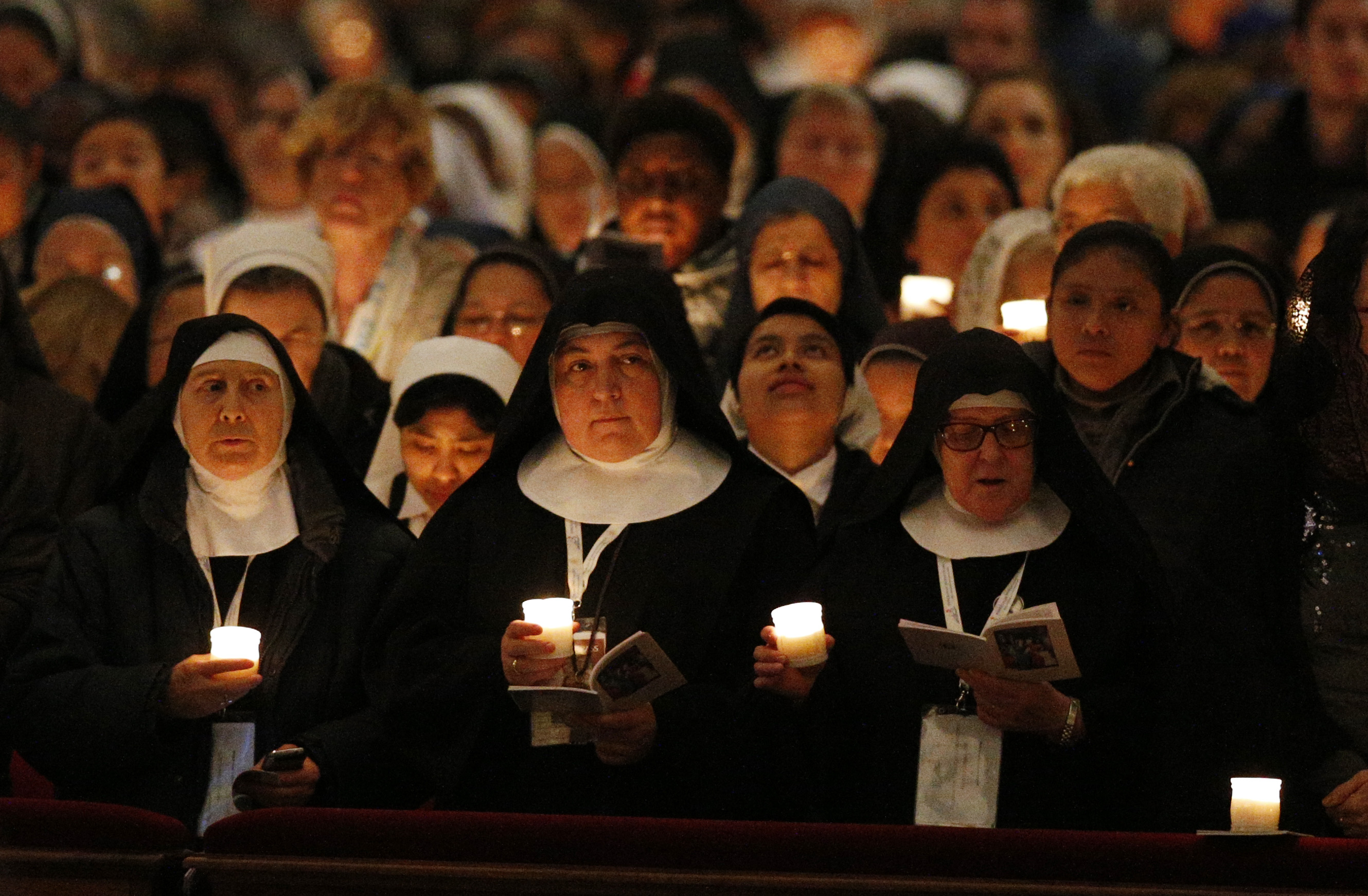
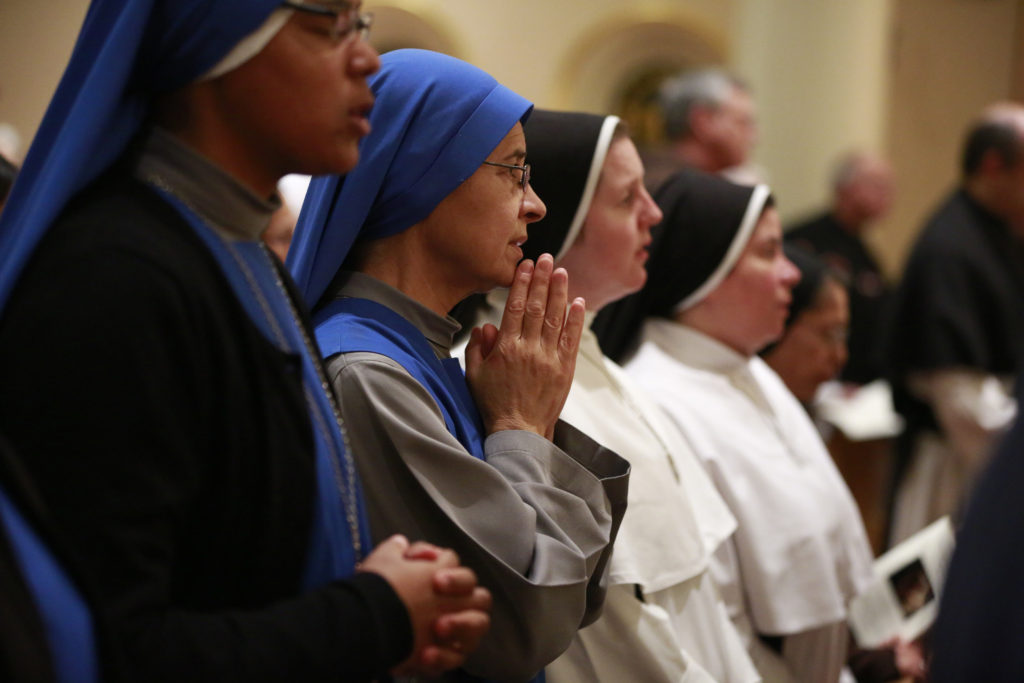
Mass marking the end of the Year of Consecrated Life, St. Mary's Basilica in Phoenix, Feb. 1. (Nancy Wiechec/CATHOLIC SUN)
Mass marking the end of the Year of Consecrated Life, St. Mary’s Basilica in Phoenix, Feb. 1. (Nancy Wiechec/CATHOLIC SUN)

[quote_box_center]Artículo en español   *   Article in Spanish[/quote_box_center]

With a Mass that began with a candlelight procession from the courtyard east of St. Mary’s Basilica to inside the church, the Year of Consecrated Life drew to a close in the Diocese of Phoenix Feb. 1.

Religious men and women from throughout the diocese gathered to mark the occasion with a vigil Mass for the Presentation of the Lord, the Feb. 2 feast that also marked the end of the Churchwide Year of Consecrated Life this year.

The festivities began under the canopy of mesquite trees. Standing with their candles, a group of young nuns from the Society of Our Lady of the Most Holy Trinity reflected on what the year meant to them.
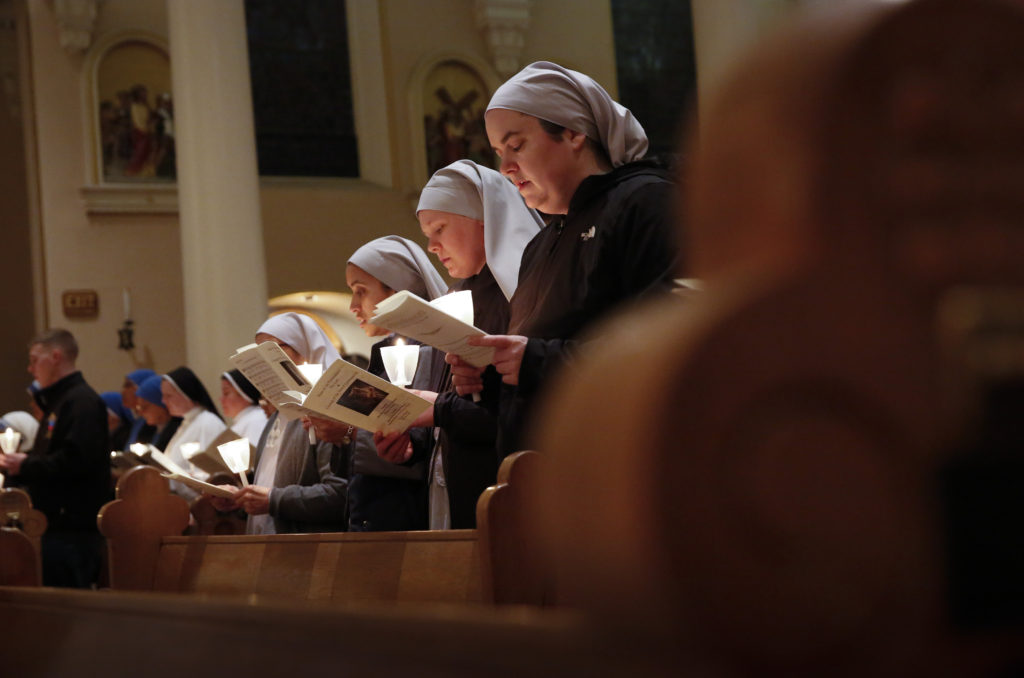
Mass marking the end of the Year of Consecrated Life, St. Mary's Basilica in Phoenix, Feb. 1. (Nancy Wiechec/CATHOLIC SUN)
Mass marking the end of the Year of Consecrated Life, St. Mary’s Basilica in Phoenix, Feb. 1. (Nancy Wiechec/CATHOLIC SUN)

The Year of Consecrated Life was “a celebration of who God has called us to be,” said Sr. Maria Mater Dei Fritz, SOLT, a third-grade teacher at Most Holy Trinity who has been a religious sister for five years One thing she’ll always remember about the year was the vocations day the SOLT sisters held. “We talked to them about religious life and did a service project for the missions,” Sr. Maria Mater Dei said. They’ve had a number of inquiries, she said, including some of her students.

Sr. Mary Joy Bernklau, SOLT joined in 2008 and professed vows in 2011. “For me, it’s been a time to refocus on the gift that consecrated life is for the wider Church but also to me personally,” she said. Choosing the religious life was the result of “a deep conviction that Christ was calling me to this and that I would find my happiness by following His plan for me.”
Mass marking the end of the Year of Consecrated Life, St. Mary's Basilica in Phoenix, Feb. 1. (Nancy Wiechec/CATHOLIC SUN)
Mass marking the end of the Year of Consecrated Life, St. Mary’s Basilica in Phoenix, Feb. 1. (Nancy Wiechec/CATHOLIC SUN)

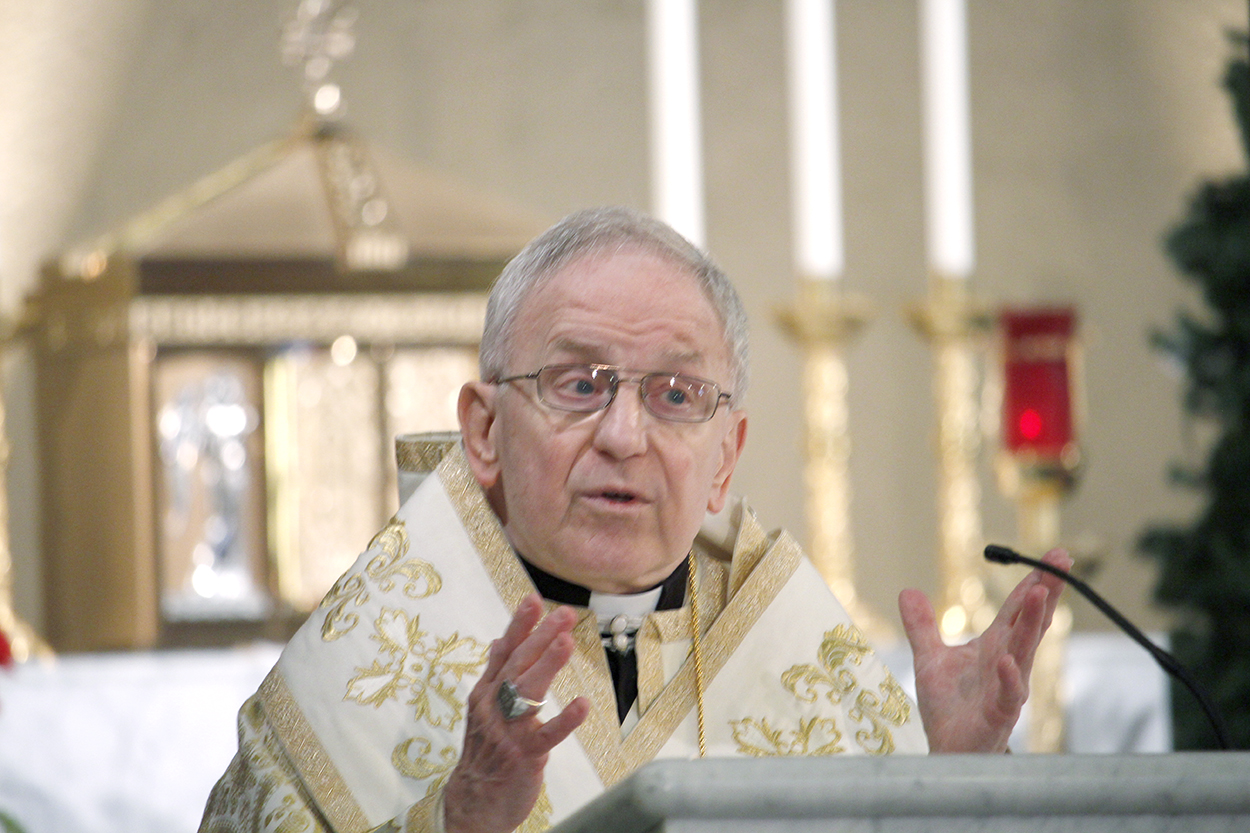
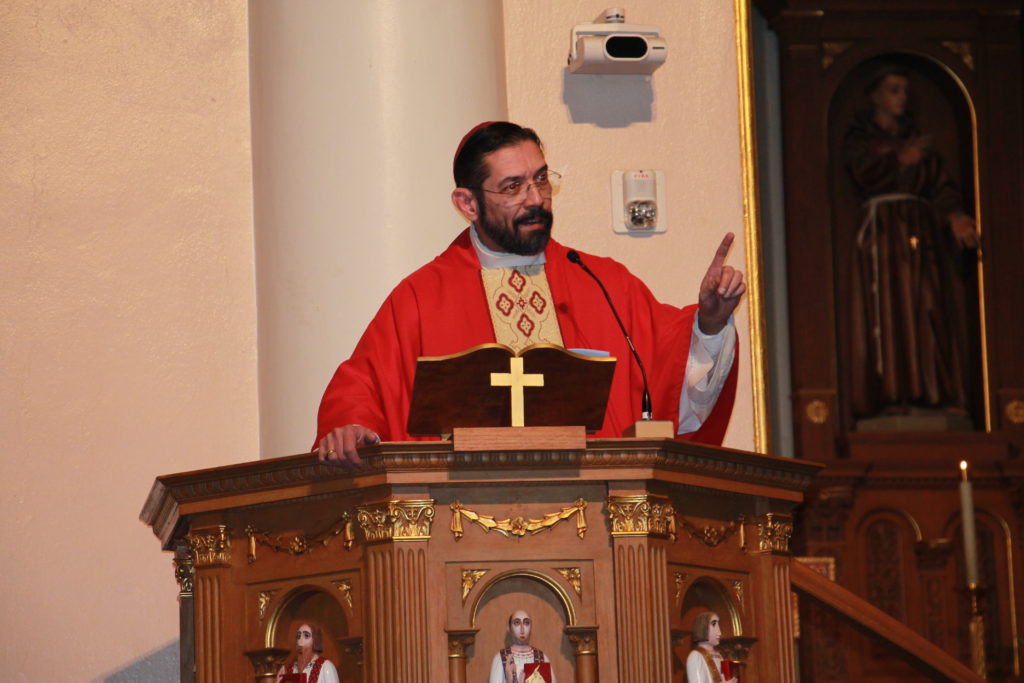
Auxiliary Bishop Eduardo A. Nevares, who was a member of the Missionaries of Our Lady of La Salette for 25 years, preached the homily at the Feb. 1 Mass.

“It has been 40 days since we celebrated Christmas when we all rejoiced together that Christ, the Word made flesh, has come to be the light for our world,” Bishop Nevares said. “We took the blessed candles to remind us that each of us have been enlightened by Jesus Christ at our baptism and to remind us that Jesus needs to be our light each and every day.”

One way the light of Christ is shared in the world today, the bishop said, is through the witness of religious men and women. “They have encountered the Lord in a deep and personal way and have come to know the love with which Jesus Christ died on the cross for the salvation of the world,” Bishop Nevares said. “They have a very special call from almighty God to respond generously, to respond totally.”
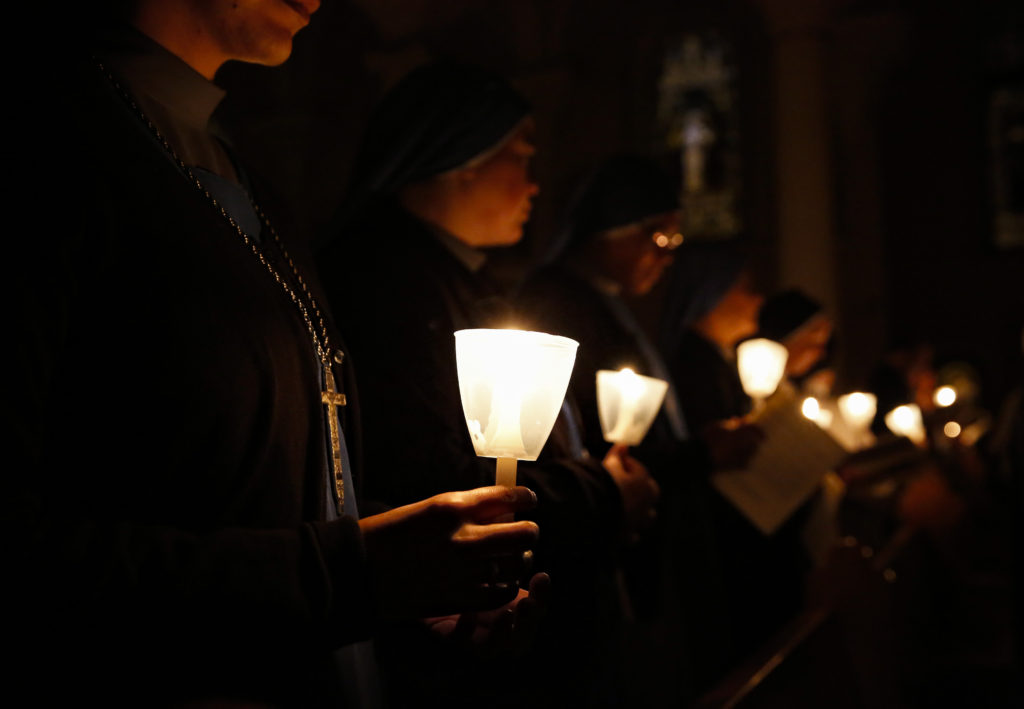
Mass marking the end of the Year of Consecrated Life, St. Mary's Basilica in Phoenix, Feb. 1. (Nancy Wiechec/CATHOLIC SUN)
Mass marking the end of the Year of Consecrated Life, St. Mary’s Basilica in Phoenix, Feb. 1. (Nancy Wiechec/CATHOLIC SUN)

More than 20 different religious communities serve in the Phoenix Diocese he said, bringing “the light of Christ to so many who are in such need of God’s tender mercy.”

Bishop Thomas J. Olmsted, who celebrated the Mass, noted that religious men and women were responsible for evangelizing Arizona in its early years and today are “a vital Gospel witness by their very person.”

“We give thanks to God for the gift of consecrated life and for the year that was celebrated and for the way that you help us carry forth the mission of the Church here in the Diocese of Phoenix,” Bishop Olmsted said.

He also thanked members of various lay organizations in attendance who support religious vocations, such as the Serra Club, the Knights of Columbus, the Knights and Dames of Malta and the Equestrian Order of the Holy Sepulchre.

[quote_box_right]

In her own words

Sr. Anthony Mary reflects on the closing liturgy 

[/quote_box_right]
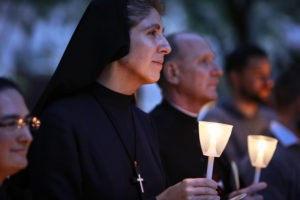
Sister Anthony Mary Diago, a member of the Religious Sisters of Mercy, joins the procession and Mass marking the end of the Year of Consecrated Life at St. Mary's Basilica in Phoenix, Feb. 1. (Nancy Wiechec/CATHOLIC SUN)
Sister Anthony Mary Diago, a member of the Religious Sisters of Mercy, joins the procession and Mass marking the end of the Year of Consecrated Life at St. Mary’s Basilica in Phoenix, Feb. 1. (Nancy Wiechec/CATHOLIC SUN)

Sr. Anthony Mary Diago, RSM, director of the diocesan Office of Consecrated Life, said the Year of Consecrated Life was a time to give thanks for the gift of religious life. As she and dozens of others processed through the courtyard prior to the Mass, she said she thought about the call of religious men and women to “manifest God’s love to the whole world. What a beautiful vocation that is to shine the light of Christ and lead people to God.”

Standing just outside the doors of the historic basilica, Br. Scott Slattum, OFM, who has been a Franciscan for seven years and will profess his final vows this summer, reflected on the year.

The yearlong celebration was a reminder, he said, to “try to live more faithfully, to be more concerned about the poor, the marginalized, people who are suffering … and be reminded that that’s where I’m called to be — to be with the people of God and to live my life in a more authentic way.”

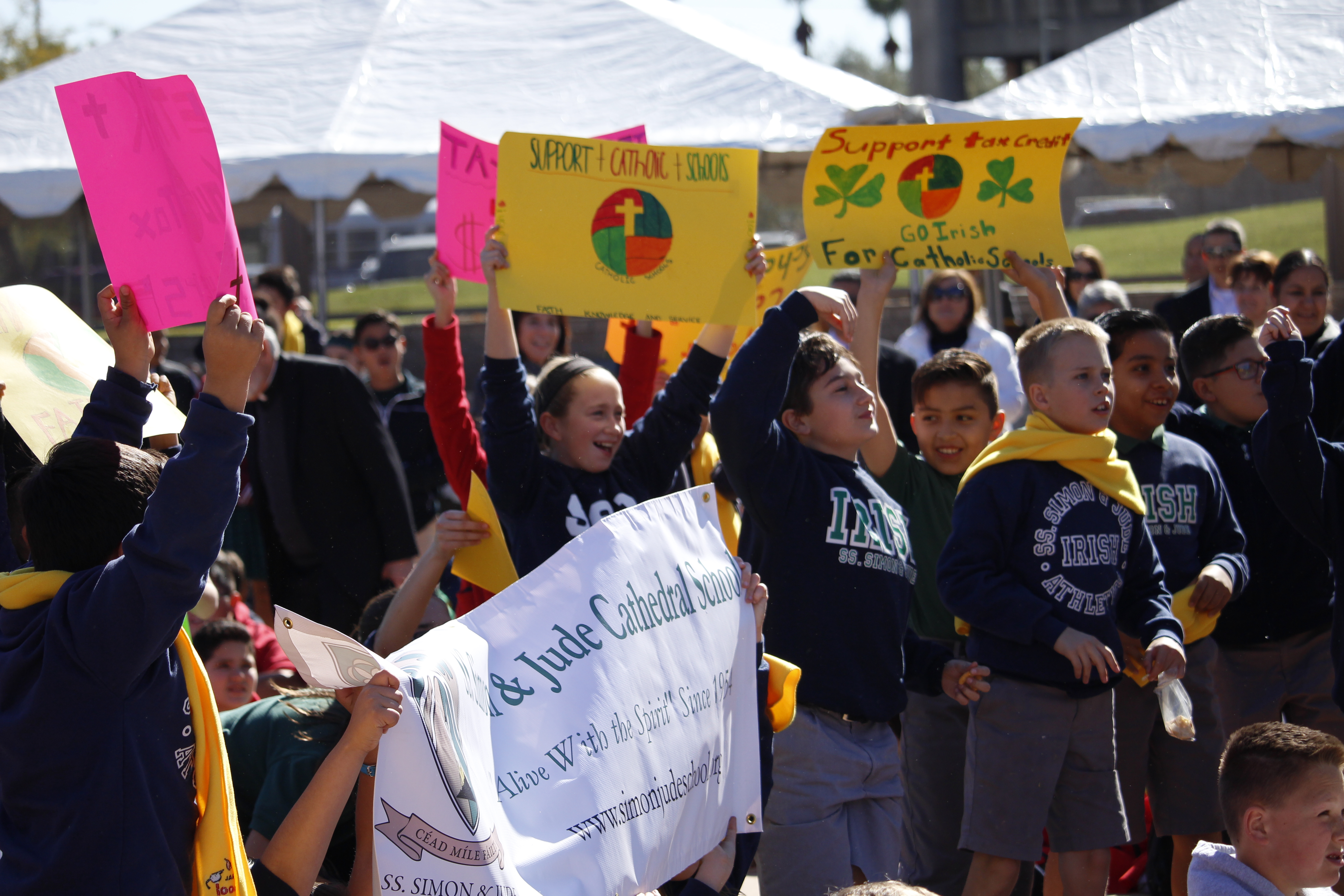
Students surround Arizona Capitol grounds for Catholic Schools Week rally

Students from Ss. Simon and Jude Cathedral School hold signs at the Catholic Schools Week rally at Wesley Bolin Plaza in front of the Arizona Capitol Feb. 3. (Ambria Hammel/CATHOLIC SUN)

Students from more than 30 Catholic schools in three dioceses across Arizona converged in one spot for a statewide field trip.

They filled the concrete circle at Wesley Bolin Plaza Feb. 3 for the annual Catholic Schools Week rally. Their physical presence and youthful energy represented more than 21,000 Catholic school students throughout the Grand Canyon state eager to affirm their role in a Catholic school and the need for a faithful community to support it.

A series of student speakers, bishops and other adult leaders shared brief remarks throughout the lunchtime rally. They highlighted the important role a Catholic education plays in the lives of students and communities.

Both student speakers had recently transferred to the Catholic school system and noted the value of a caring faculty and staff among the differences.

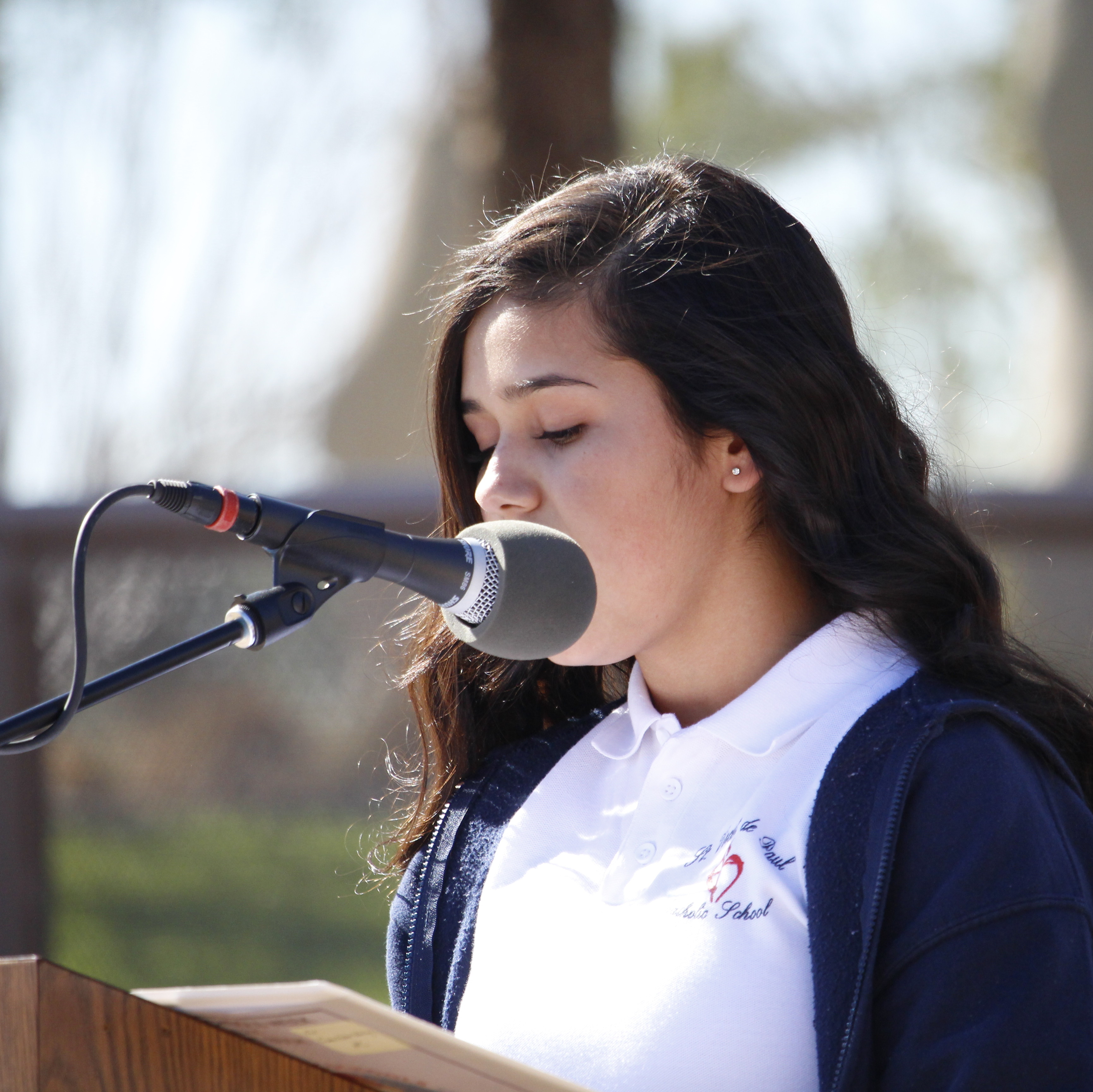
Citlally Ramirez, an eighth-grader at St. Vincent de Paul School in Maryvale, addresses her fellow Catholic Schools students from throughout the state at the Catholic Schools Week rally. (Ambria Hammel/CATHOLIC SUN)

Citlally Ramirez, an eighth-grader, is in her second year at St. Vincent de Paul School in Maryvale.

“Everyone is centered on how we can learn more about our religion … and helping others,” Ramirez said.

She expressed gratitude for state laws that allow donors to support private schools through a tuition tax credit because she knows life in a single-parent household would have been much more stressful without it.

The Xavier College Preparatory hopeful — and aspiring doctor — watched the Gators’ Spiritline lead the crowd in some cheers including one for Catholic Education Arizona, which awarded some $15.8 million in need-based tuition scholarship this school year.

Ilce Enriquez, a senior at San Miguel High School in Tucson, hinted that the Holy Spirit guided her toward a Catholic high school. The idea of a faith-based education hadn’t crossed her mind, but she expressed gratitude for teachers, staff and students for showing her a better way.

“I know I have gained the strengths and morals I never even knew existed,” Enriquez said.

She hopes to follow in the footsteps of her sister, a San Miguel alumna who was the first in their family to go to college.

Representative Steve Montenegro from Arizona Legislative District 13, which includes Avondale, was one of two legislators who stopped by during an undoubtedly busy fourth week of the legislature. He told students that Arizona is a leader in the country regarding empowerment scholarships and highlighted plans to offer universal education vouchers for children.

Although only two legislators were able to stop by the rally, exponentially more met with Arizona’s bishops during two days surrounding the rally. Ron Johnson, executive director of the Arizona Catholic Conference, the public policy arm of the state’s bishops, told The Catholic Sun that the bishops “had very good and productive meetings with almost two dozen legislators,” that included House Speaker David Gowan and Senate President Andy Biggs.

Johnson said the highlight of the visit was the 14th annual Catholic Schools Rally. Gowan and Montenegro briefly addressed students and were sure to share God’s blessing with the crowd before their departure. Teachers, parents and supporters from across Arizona filled out the crowd.

The rally “was a great way to say ‘thank you’ to the Arizona Legislature for being the national leader in school choice laws,” Johnson said.

Arizona’s bishops took turns encouraging students to be people of prayer and gratitude for the education they are receiving so they can be authentic witnesses for the Church of today and tomorrow.

University students to score ‘Super’ work experience hosting football fans Feb. 7

They might be wearing official Super Bowl gear and credentials, but 11 hospitality workers on duty Feb. 7 are actually Niagara University students.

The stage is set for Super Bowl 50 when 11 Niagara University students will work behind the scenes as the Carolina Panthers take on the Denver Broncos in the National Football League’s showcase event Feb. 7.

The students are all sport and recreation management majors at NU’s College of Hospitality and Tourism Management. They’ll spend six days in Santa Clara, California beginning Feb. 3 where they’ll get a first-hand look at what goes into organizing one of the world’s largest sporting events by greeting visitors, observing the media party and working with NFL On Location at a sold-out pre-game VIP party adjacent to Levi’s Stadium.

Students will also serve in numerous hospitality positions inside Levi’s Stadium where more than 70,000 fans are expected to see the NFL crown a champion. An additional 120 million viewers are projected to watch the game on television.

Students pose during preparation for Super Bowl XLIX in Glendale in 2015. The ___ majors will put their skills to good use during Super Bowl 50 Feb. 7.  (photo from Niagara.edu)
Students pose during preparation for Super Bowl XLIX in Glendale in 2015. The ___ majors will put their skills to good use during Super Bowl 50 Feb. 7. (photo from Niagara.edu)

This marks the seventh straight year that NU has sent students to the Super Bowl. Thirteen students came to the Valley last year for the big game at University of Phoenix Stadium in Glendale. Selected students emerged through an application and interview process.

“The trip is a valuable experience for students and will assist them in learning about all aspects of business, especially hospitality and tourism management,” said Dr. Youngsoo Choi, an assistant professor and program coordinator of sport and recreation management who will be one of two NU employees chaperoning the students. “The outstanding education that students receive at Niagara University will help open doors for them, but the experiences we provide for them outside of the classroom will make them extremely attractive to employers after graduation.”

[quote_box_right]

Related

Hospitality and Tourism Training Institute for refugees

[/quote_box_right]

Onsite service-learning experiences are a regular part of NU’s College of Hospitality and Tourism Management. Sport management students recently volunteered during Major League Baseball’s spring training, for example, and the NCAA Final Four.

The trip to Super Bowl 50 — which Brophy College Preparatory alum J.J. Jansen will play in for the Panthers — also comes with the added benefit of meeting Niagara University alumni during a private gathering Feb. 4. Niagara University was the first Vincentian university established in the U.S. and remains a comprehensive institution blending liberal arts and professional education that’s grounded in its values-based Catholic tradition.

Pope, Russian Orthodox patriarch to meet in Cuba, Vatican announces

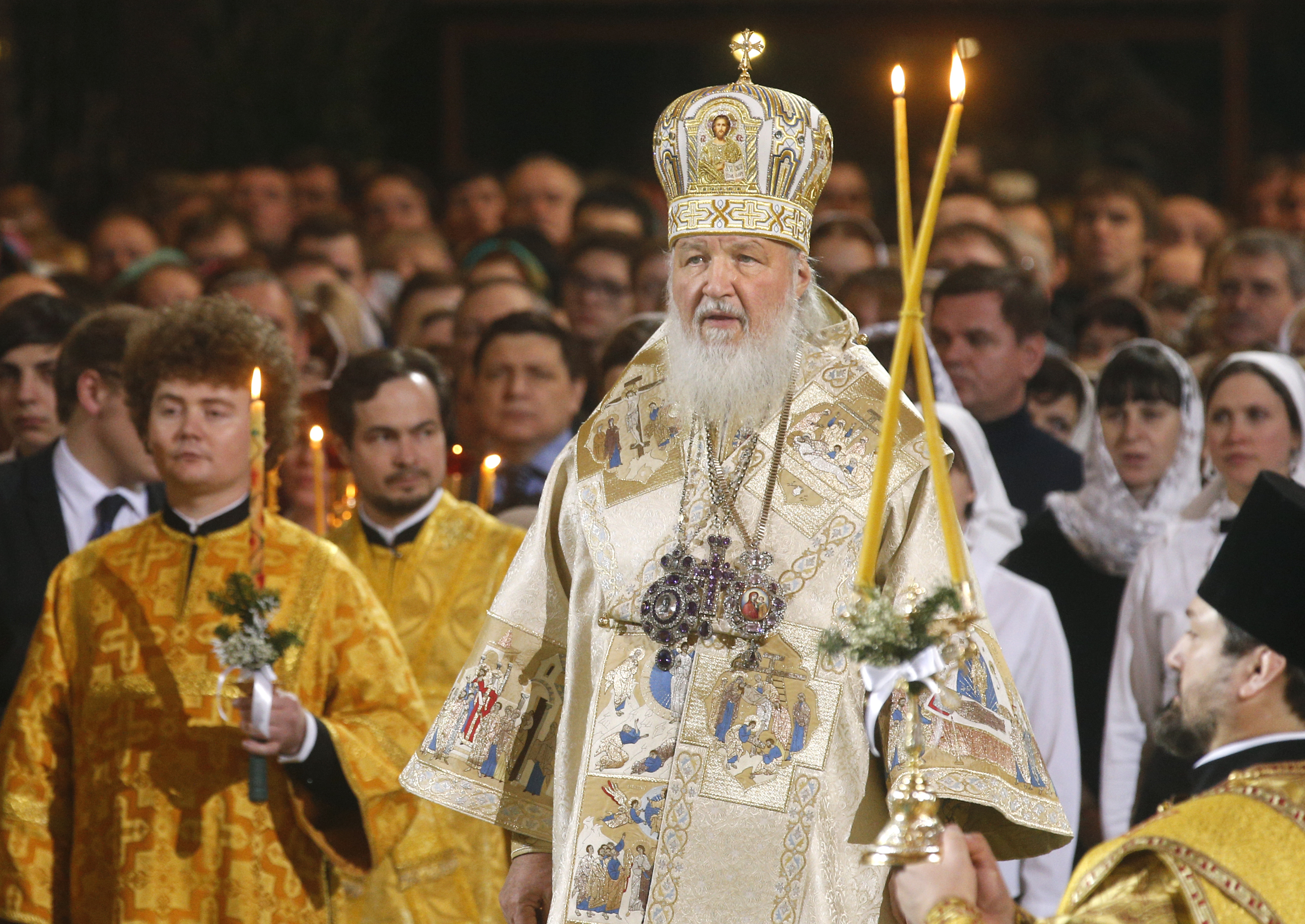
Russian Orthodox Patriarch Kirill reads a payer during the Christmas service Jan. 7 at Christ the Savior Cathedral in Moscow. After almost three decades of tense Catholic-Russian Orthodox relations, Pope Francis will meet Patriarch Kirill Feb. 12 in Cuba, en route to Mexico. (CNS photo/Sergei Chirikov, EPA)

VATICAN CITY (CNS) — After almost three decades of tense Catholic-Russian Orthodox relations, Pope Francis will meet Patriarch Kirill of Moscow Feb. 12 in Cuba on the pope’s way to Mexico.

It will be the first-ever meeting of a pope and Moscow patriarch, Jesuit Father Federico Lombardi, Vatican spokesman, told reporters Feb. 5.

As Pope Francis travels to Mexico and as Patriarch Kirill makes an official visit to Cuba, the two will meet at Havana’s José Martí International Airport and plan to sign a joint declaration, Fr. Lombardi said. The pope will leave Rome earlier than planned to allow time for the meeting without forcing any changes to his schedule in Mexico, he added.

The meeting “will mark an important stage in relations between the two Churches,” said a joint declaration on the meeting.

The Cuba meeting was not an “improvisation,” Fr. Lombardi said; it took two years of intense planning and negotiations to schedule. Even when the idea of a meeting was just a vague hope, both Catholic and Orthodox officials insisted it would have to take place on “neutral” territory rather than at the Vatican or in Russia.

Being the first ever meeting of a pope and Russian patriarch, he said, “is an event that, in the ecumenical journey and in the dialogue between Christian confessions, has an extraordinary importance.”

The meeting will come as representatives of Orthodox Churches from around the world are preparing for a pan-Orthodox Council meeting in Crete in June. Ecumenical Patriarch Bartholomew of Constantinople, spiritual leader of Orthodox Christians, “naturally, has been informed” of plans for the pope and Patriarch Kirill to meet and expressed “his joy for this step forward,” Fr. Lombardi said.

Holding a simple meeting with a Moscow patriarch, spiritual leader of the world’s largest Orthodox Church, was a failed dream of St. John Paul II and an opportunity that escaped retired Pope Benedict XVI as well.

Repeatedly after the Soviet bloc began dissolving in 1989 and the once-repressed Eastern Catholic Churches began functionally publicly again, Russian Orthodox leaders insisted there could be no meeting between a pope and a patriarch as long as Catholics were “proselytizing” in what the Orthodox considered their territory.

The Vatican insisted the Catholic Church rejects proselytism, which it defines as actively seeking converts from another Christian community, including through pressure or offering enticements. The Russian Orthodox had insisted such types of proselytism occurred in both Russia and Ukraine, although the Vatican said that when asked, the Orthodox provided no proof.

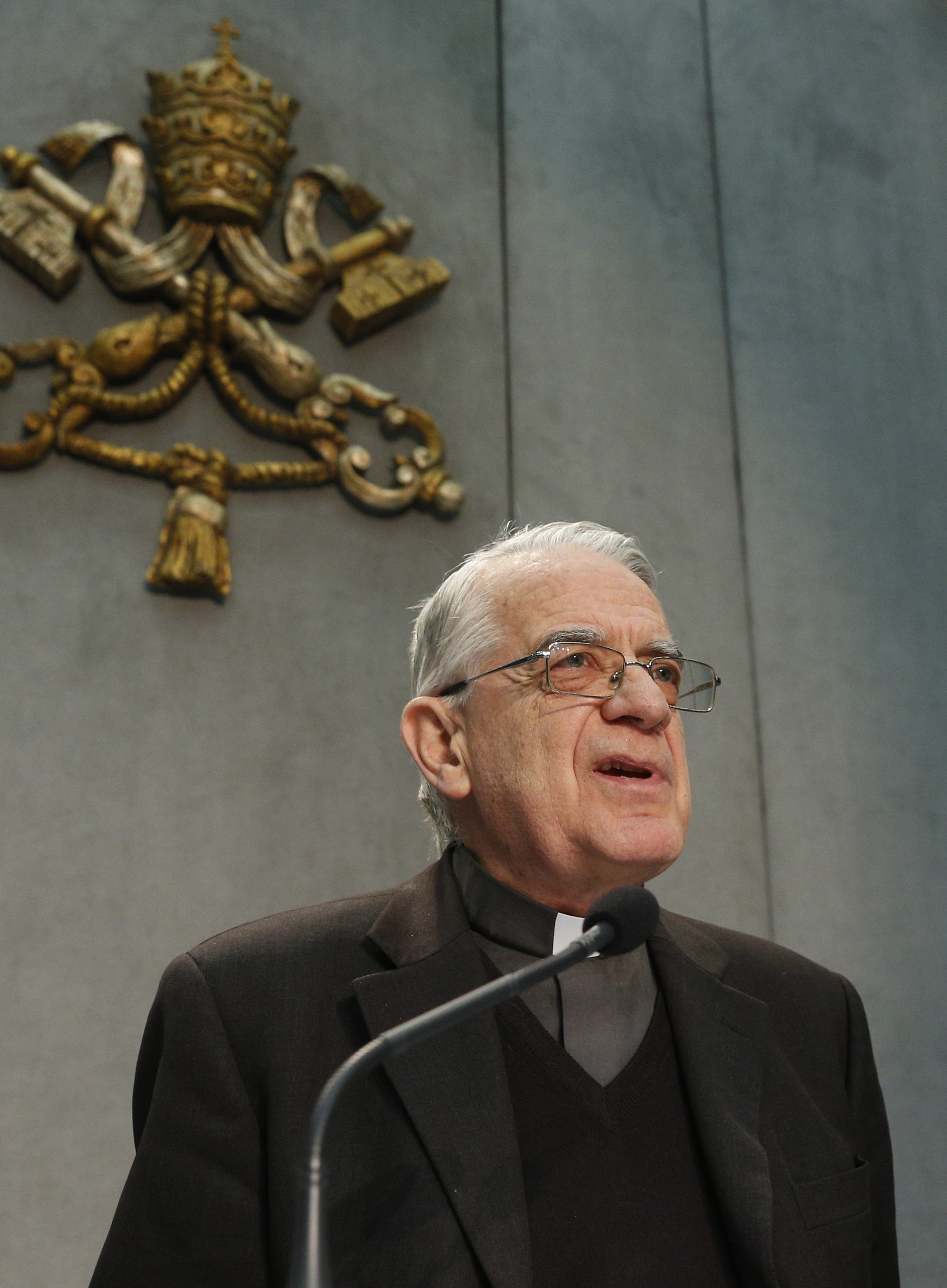
Jesuit Father Federico Lombardi, papal spokesman, speaks at a Vatican press conference Feb. 5. Father Lombardi announced that Pope Francis will meet Russian Orthodox Patriarch Kirill Feb. 12 in Havana, Cuba. The meeting will be the first in history between a leader of the Catholic Church and the Russian Orthodox Church. (CNS photo/Paul Haring)

St. John Paul re-established the Latin-rite Catholic hierarchy of Russia in 2002, which led to the Russian Orthodox withdrawing from dialogue with the Vatican for several years. Even as tensions over the Catholic presence in Russia waned, the Russian Orthodox insisted a bigger example of proselytism was the loss of its churches in the newly independent Ukraine.

The Vatican recognized there were some instances of excessive zeal early on, but rejected the use of the term “proselytism” as a blanket description for the re-establishment of the Ukrainian Catholic Church. The Ukrainian Catholic Church was outlawed by the Soviet government in the 1940s and its property was confiscated by the government, which in turn gave some churches to the Russian Orthodox. Byzantine-rite Catholics who once could worship only in a Russian Orthodox church, returned to Catholic services and sought the return of Church property.

Fr. Lombardi said the fact that a meeting has been scheduled “allows one to think that on various points dialogue has matured and allowed some things that were once seen as obstacles to be overcome.”

“Every step toward dialogue, understanding, a will to draw closer to each other, understand each other and walk together” after “a past of distancing themselves and even of polemics and division is a positive sign for everyone,” especially considering the huge numbers of Catholics and Russian Orthodox in the world, the spokesman said.

Jesuit Father David Nazar, rector of Rome’s Pontifical Oriental Institute and a Ukrainian Catholic from Canada, told Catholic News Service, “If this were to take place, it would be big news in the Year of Mercy. To make a step in this direction is beautiful, but also irreversible.”

Especially for Catholics in Russia and Ukraine, he said, relations with the Russian Orthodox are complicated, including because of the close relationship between the Russian Orthodox Church and the Russian government, which annexed the Crimea and is supporting fighting in Eastern Ukraine.

Fr. Nazar described his reaction to the news as “cautiously optimistic” and said he hoped it would mark “a new beginning” in Catholic-Russian Orthodox relations.

— By Cindy Wooden, Catholic News Service

Bishop Dino guides students through filling up their toolbox for success at statewide Catholic Schools Mass

Students representing several of the Catholic Schools in the Diocese of Phoenix carried the gifts to the altar during the Catholic Schools Week Mass at Ss. Simon and Jude Cathedral Feb. 3. (Ambria Hammel/CATHOLIC SUN)

Students require quite a few supplies before entering a learning environment. Fortunately, their toolbox — their mind — is within reach.

That’s the message Bishop Gerald N. Dino, bishop of the Holy Protection of Mary Byzantine Catholic Eparchy of Phoenix — an Eastern Rite Catholic Church — told an assembly of student leaders from Catholic schools across Arizona. Bishop Dino served as homilist for the special liturgy held Feb. 3 at Ss. Simon and Jude Cathedral as part of Catholic Schools Week celebrations. Bishop Thomas J. Olmsted celebrated the Mass, joined by the other bishops of Arizona, including Bishop Dino, Auxiliary Bishop Eduardo A. Nevares, Tucson Bishop Gerald F. Kicanas and Bishop James S. Wall of Gallup, New Mexico.

Bishop Dino referenced the carpenter father and son duo mentioned in the Gospel reading. He said Joseph and Jesus needed a hammer, saw and chisel to ensure success.

“All of you students have a toolbox in your heads,” Bishop Dino said during a homily that reached both high school students and the few younger elementary students in the crowd plus plenty in between from largely junior high grade levels.

More than 14,000 students attend one of the 28 Catholic elementary schools, six high schools and 28 preschools serving the Diocese of Phoenix. Some 21,000 Catholic students across Arizona attend a Catholic school.

Bishop Gerald N. Dino of the Byzantine Eparchy of Phoenix encouraged Catholic schools students from across the state to use the tools they receive from a Catholic education for success. (Ambria Hammel/CATHOLIC SUN)

Bishop Dino reminded them to “hammer away” at the problems in life by relying on their ability to think critically, reason and rationalize situations just like they’re taught to do at Catholic schools. He used the imagery of a saw’s sharp edges to encourage students to become “sharp” or intelligent.

The bishop stressed the need for a chisel too. It helps break away those rough edges of bad manners, less effective study habits and closed-mindedness, he said. He encouraged students to understand differing points of view.

“You have to get inside them to think as they think. Why are they so angry? What do they act the way that they do?” he said.

He referenced the day’s gospel reading that briefly mentioned Jesus teaching in the synagogue and the longer version found in Luke’s gospel. Today’s students, too, should remain engaged with their parents and teachers and not be afraid to ask questions.

“They’re trying to help you get a more important tool: the grace of God,” the bishop said. “This is a tool that will help you to use all of the other gifts you obtain in school properly.”

What God loves most of all, the bishop said, “is when you use those tools to let your light shine on those around you.”

That’s what educators and administrators of Catholic schools excel at. Before the final blessing, MaryBeth Mueller, superintendent for the Diocese of Phoenix, joined Bishop Thomas J. Olmsted and a cathedral full of students in honoring 25 years of service for teachers and staff at various schools.

Most of the students proceeded to an all-school rally at Wesley Bolin Plaza following the liturgy. Full story to come.

Show world God’s closeness and care, pope tells religious

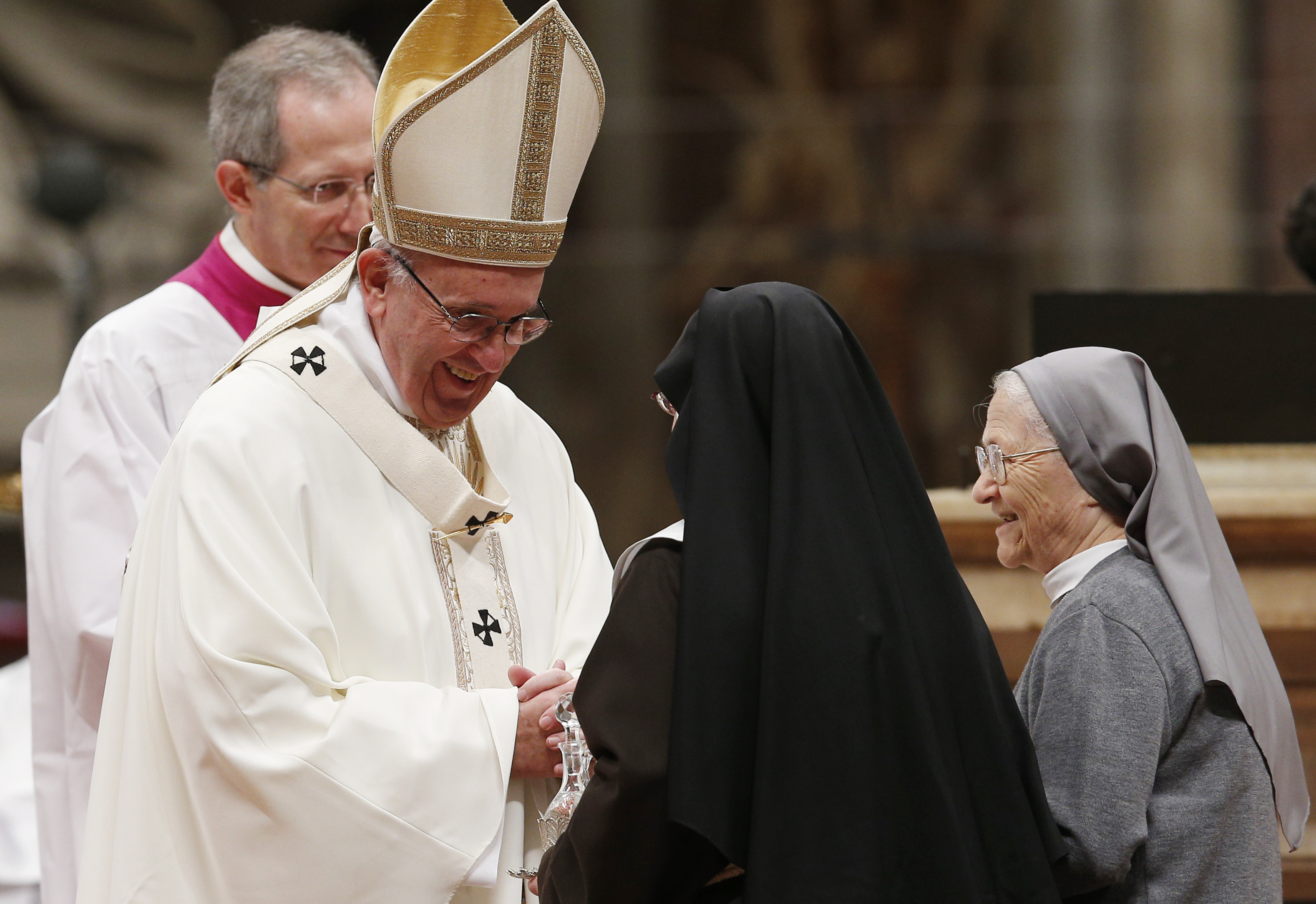
Pope Francis accepts offertory gifts from nuns as he celebrates a Mass with religious in St. Peter's Basilica at the Vatican Feb. 2. The Mass concluded the Year of Consecrated Life. (Paul Haring/CNS)
Pope Francis accepts offertory gifts from nuns as he celebrates a Mass with religious in St. Peter’s Basilica at the Vatican Feb. 2. The Mass concluded the Year of Consecrated Life. (Paul Haring/CNS)

VATICAN CITY (CNS) — An encounter with Jesus changes people’s lives, and that should be especially noticeable in those who are consecrated completely to serving God, the Church and others, Pope Francis said.

“One who has this encounter becomes a witness and makes the encounter possible for others, too,” he said Feb. 2, the feast of the Presentation of the Lord.

Overlapping by two months, the Catholic Church’s special Year of Consecrated Life has led to the Jubilee Year of Mercy, emphasizing God’s love and mercy for each individual and the mission to share that experience with the world, the pope told thousands of consecrated men and women who joined him in St. Peter’s Basilica and hundreds of others who watched on screens outside once the basilica was full.

The Mass in St. Peter’s Basilica began with the traditional blessing of candles and a prayer that God would guide his people toward his son, “the light that has no end.”

The feast day commemorates the 40th day after Jesus’ birth when, in accordance with ancient Jewish practice, Mary and Joseph took Him to the temple and presented Him to the Lord. The feast’s Gospel reading from St. Luke recounts how the aged Simeon and Anna were praying in the temple at the time and recognized Jesus as the Messiah.

The event, the pope said, is a “feast of encounter,” not just the meeting of Jesus with Simeon and Anna, but the encounter of people’s hopes and expectations for a savior with the fulfillment of those hopes in Jesus.

Christ’s birth is the ultimate encounter, he said; God’s decision to have his son born into the world, to live and suffer and die for the salvation of humanity, shows that he did not want to “remain outside of our drama, but wanted to share our lives.”

In the same way, whether living in a cloistered convent or traveling the world as a missionary, Pope Francis said, “consecrated men and women are called to be a concrete and prophetic sign of this closeness of God and of sharing with the fragile, sinful and wounded condition of people today.”

Religious attend a Mass with Pope Francis in St. Peter's Basilica at the Vatican Feb. 2. The Mass concluded the Year of Consecrated Life. (Paul Haring/CNS)
Religious attend a Mass with Pope Francis in St. Peter’s Basilica at the Vatican Feb. 2. The Mass concluded the Year of Consecrated Life. (Paul Haring/CNS)

Pope Francis, a Jesuit, spoke as one of the consecrated people, telling the congregation that as Christians and as religious “we are guardians of awe.”

The experience of an encounter with Jesus constantly must be renewed, he said. One’s spiritual life must never be simply routine, the mission and charisms of an order must never be “crystallized into abstract doctrine” and the spiritual insights of the order’s founder “are not to be sealed in a bottle. They aren’t museum pieces.”

“Our founders were moved by the Spirit and weren’t afraid to get their hands dirty” as they ministered in Jesus’ name to real people living real lives, the pope said. “They didn’t stop in the face of obstacles or when others misunderstood them because they preserved in their hearts the awe of having encountered Christ.”

“They did not domesticate the grace of the Gospel,” he said, but lived with an “all-consuming desire to share it with others.”

“We, too, are called today to make prophetic and courageous choices,” the pope said. In that way, “others will be attracted to the light and can encounter the father’s mercy.”

— By Cindy Wooden, Catholic News Service. Follow Wooden on Twitter: @Cindy_Wooden.

Carolina Panthers linebacker says faith impacts his outlook on life

Carolina Panthers middle linebacker Luke Kuechly returns an interception for a touchdown Jan. 17 against the Seattle Seahawks in the first quarter of the NFC Divisional round playoff game in Charlotte, N.C. Kuechly, who will be the starting linebacker when the Panthers play the Denver Broncos in the Feb. 7 Super Bowl, credits his parents and his Catholic faith for making a positive impact on his NFL career and his outlook on life. (CNS photo/Bob Donnan-USA TODAY Sports via Reuters)

CHARLOTTE, N.C. (CNS) — Middle linebacker Luke Kuechly of the Carolina Panthers, the team going up against the Denver Broncos in the Feb. 7 Super Bowl, credits his parents and his Catholic faith for making a positive impact on his NFL career and his outlook on life.

“I went to a Catholic grade school, Jesuit high school and a Jesuit college, and I think you just learn certain things growing up in that environment. Really, the biggest thing I learned from it is respect and to treat people correctly,” he said after a Jan. 28 practice.

“Your background has something to do with it, but my parents I think were the biggest impact on that, as far as to be a good person. You know, it’s not that hard, as long as you’re nice to people, everything works out,” he told the Catholic News Herald, newspaper of the Diocese of Charlotte. “Treat people how you want to be treated. It’s pretty straightforward stuff, and I think it makes things easier.”

[quote_box_right]

Check out Kuechly’s teammate

He’s from a Catholic school in the Diocese of Phoenix

[/quote_box_right]

Kuechly, a product of St. Xavier High School, a Catholic boys school, near his hometown of Evendale, Ohio, and a graduate of Boston College, is known as a fierce competitor who does not give up, a natural and humble leader, the person everyone calls “the nicest guy on the team.”

When he was in the fourth grade, Kuechly first played organized football with Cincinnati’s Catholic Youth Organization. In high school, he was a two-time All Greater Catholic League selection.

Kuechly, a three-time All America linebacker for Boston College, was the ninth overall pick in the 2012 NFL draft.

He was named the NFL Defensive Rookie of the Year in the 2012 season, and followed that up by being named the NFL Defensive Player of the Year by The Associated Press in 2013, joining Lawrence Taylor as the only players in NFL history to win the NFL Defensive Rookie of the Year and NFL Defensive Player of the Year in successive years.

Kuechly said he doesn’t really have a special patron saint or a special prayer he always says before a game.

“We say a couple prayers in the locker room before games, though,” he said.

The team is often seen praying at each game, and players are known as much for their charitable works off the field, especially for children in need.

Charitable works also were getting attention from supporters of both teams headed to the Super Bowl.

Gerry Carter, CEO and executive director of Catholic Charities of Charlotte, and Larry Smith, CEO and president of Catholic Charities of Denver, agreed to raise $50,000 by the end of the game in a fundraiser called Charity Bowl 50.

“It’s a worthy cause that will have a major impact on the lives of the poor and needy in each of our communities,” Carter said. “All of our team’s fans and Catholic Charities in the Carolinas look forward to this challenge, and the inevitable victory that will be ours.”

Smith responded that Denver is not afraid of a challenge.

“Through Charity Bowl 50, Denver football fans have a real opportunity to show they have the best team spirit and a passion for serving others,” Smith said. “This challenge is a true win for both Denver and Charlotte, but there’s no doubt we will seize the victory.”

Anyone can participate in Charity Bowl 50 to help one of the charities raise the most money by donating online at CharityBowl50.org.

The site began accepting online donations Jan. 31 and will take them until the end of the Super Bowl Feb. 7. The donations will be tallied and counted toward the total amount raised. The winning charity’s CEO planned to hold a victory celebration during which charity employees will dump cold sports drinks over him. The losing charity’s CEO will dress in the opposing team’s colors and send a message of congratulations to the other charity.

The competition can be tracked on social media with the hashtag #CharityBowl50.

By SueAnn Howell, Catholic News Service. Howell is a senior reporter with the Catholic News Herald, newspaper of of the Diocese of Charlotte.

‘Red Mass’ homilist challenges lawyers, lawmakers, to see the face of Christ

Bishop Flores of Brownsville, Texas, (CATHOLIC SUN)
Bishop Daniel E. Flores of Brownsville, Texas challenged those gathered for the Red Mass Jan.. 26 kicking off the 2016 legislative session in Arizona, to see Christ in their fellow man, especially those who have a different point of view. (Tony Gutiérrez/CATHOLIC SUN)

As the Arizona State Legislature launched the 2016 session, lawmakers, lawyers, judges and public officials gathered at St. Mary’s Basilica Jan. 26 for a bit of inspiration from guest homilist Bishop Daniel E. Flores. The bishop traveled from Brownsville, Texas to speak at the annual Red Mass.

With Bishop Thomas J. Olmsted presiding, the bilingual Mass featured a Gospel reading from Mark in which Jesus hears that His mother and brothers are outside calling for Him. He tells those gathered, “Whoever does the will of God is my brother, and sister and mother.” Rather than devaluing family relationships, Bishop Flores noted, Jesus is elevating all relations.

“Jesus Christ taught that … you should judge everybody as if they are your mother … so your relations with people out there are revolutionized because they are mother and brother to you — the relational reality is thrown off kilter.”

The world still thinks in terms of “us” and “them,” the bishop said, but Christ is asking us to rethink our relationships.

“You can’t really say there’s ‘them’ and there’s ‘us’ anymore. There’s just ‘us’ in the human race. God became flesh to become brother with the entire human race. That changes everything,” Bishop Flores said.

Christ crucified, the bishop said, “looks at us and says, ‘Will you respond to Me as your brother?’ God became flesh so His face could be that of every man and woman who suffers the rejection of the world. The power of Christ on the cross is, ‘Am I brother to you?’ That is by far the most profound and burning question the Gospel puts before the world today.”

Rep. Jill Norgard from Arizona’s Legislative District 18 said she planned to take Bishop Flores’ message back to the legislature and put it into practice in her dealings with fellow lawmakers.

“His message to treat everyone like your brother or your mother or your sibling or family is key,” Norgard said, citing the mix of lawmakers of differing backgrounds and viewpoints at the capitol. “Sometimes there’s a lot of animosity. People have to engage in a spirited debate, and at the end of the day, turn the page and move forward with progress and not hold that against somebody.”

Christina Estes-Werther, president of the St. Thomas More Society, the Catholic lawyers’ group that helped organize the Red Mass, lauded Bishop Flores’ message.

“The thing that struck me the most was when he was talking about treating each other like you would your most favorite relative. Immediately my grandmother sprung to mind and that’s a challenge to have to actually treat everybody in that manner,” Estes-Werther said.

Ron Johnson, executive director of the Arizona Catholic Conference, the Arizona Catholic bishops’ public policy arm, described Bishop Flores’ message as “a powerful punch in terms of reminding people to focus on Jesus on the cross and that we’re all sons and daughters of God.”

Tribunal of the Diocese of Phoenix

Fr. Chris Fraser, JCL, called Bishop Flores’ message “thought-provoking.” Though not a secular attorney, as judicial vicar for the diocese, Fr. Fraser applies similar principles to his work in administering justice in the diocesan Tribunal.

There’s a tendency sometimes, Fr. Fraser said, to see people as problems instead of brothers and sisters. “If you are a Christian you can’t look at other people as less than you because Jesus identified Himself with them.”

(CATHOLIC SUN)
Led by Chief Justice Diane M. Johnsen of the Arizona Court of Appeals, attorneys who attended the Jan. 26 Red Mass renew their oath of admission to the Arizona State Bar. (Tony Gutiérrez/CATHOLIC SUN)

Led by Chief Justice Diane M. Johnsen of the Arizona Court of Appeals, attorneys who attended the Jan. 26 Red Mass renewed their oath of admission to the Arizona State Bar, promising, among other things, to “never reject, from any consideration personal to myself, the cause of the defenseless or oppressed.”

FOX 10 interviews Seton’s ‘Grease’ cast

The Drama department at Seton Catholic Preparatory in Chandler is gearing up to perform the School Edition of “Grease,” complete with
Danny, Sandy, Rizzo, the Pink Ladies and T-Birds of the famed, fictitious Rydell High.

More than 60 Seton students—including cast, crew and dancers—will bring 1950’s youthful exuberance to the Seton stage Feb. 5-7 and Feb. 12-13.

Annual diocesan charity appeal supports works of mercy


[quote_box_right]

Charity and Development Appeal (CDA)

cda logo_grayBG

The CDA supports more than 70 charitable organizations connected to the Diocese of Phoenix.

Info: dphx.org/cda

Donate online

[/quote_box_right]

[dropcap]T[/dropcap]imothy and JoAnn Holland, this year’s co-chairs for the annual diocesan Charity and Development Appeal (CDA), have a simple message: if every Catholic gave one dollar more than they did last year, the campaign would raise an extra $700,000.

JoAnn said when the two visit parishes, they plan to encourage “if you would consider giving one more dollar than last year’s campaign. If you didn’t contribute last year, if you’d consider giving just one dollar.”

The annual campaign, which kicks off the weekend of Feb. 6-7, hopes to raise $8.5 million this year to support more than 70 charitable organizations connected to the diocese. The theme of this year’s campaign is the Year of Mercy, corresponding with the Jubilee Year declared by Pope Francis.

“In the Year of Mercy, these organizations are how the diocese lives out the spiritual and corporal works of mercy,” said CDA Director Carrie Aranda.

In a promotional video that will be shown in parishes throughout the diocese, children from four diocesan schools that receive support from the CDA read aloud Pope Francis’ Bull of Indicition declaring the Year of Mercy. Parishioners will then be invited to fill out a pledge card.

Aranda said the CDA has a new website and online giving portal where donors can create accounts and see their payment history.

“Donors can have more control over their giving,” she said.

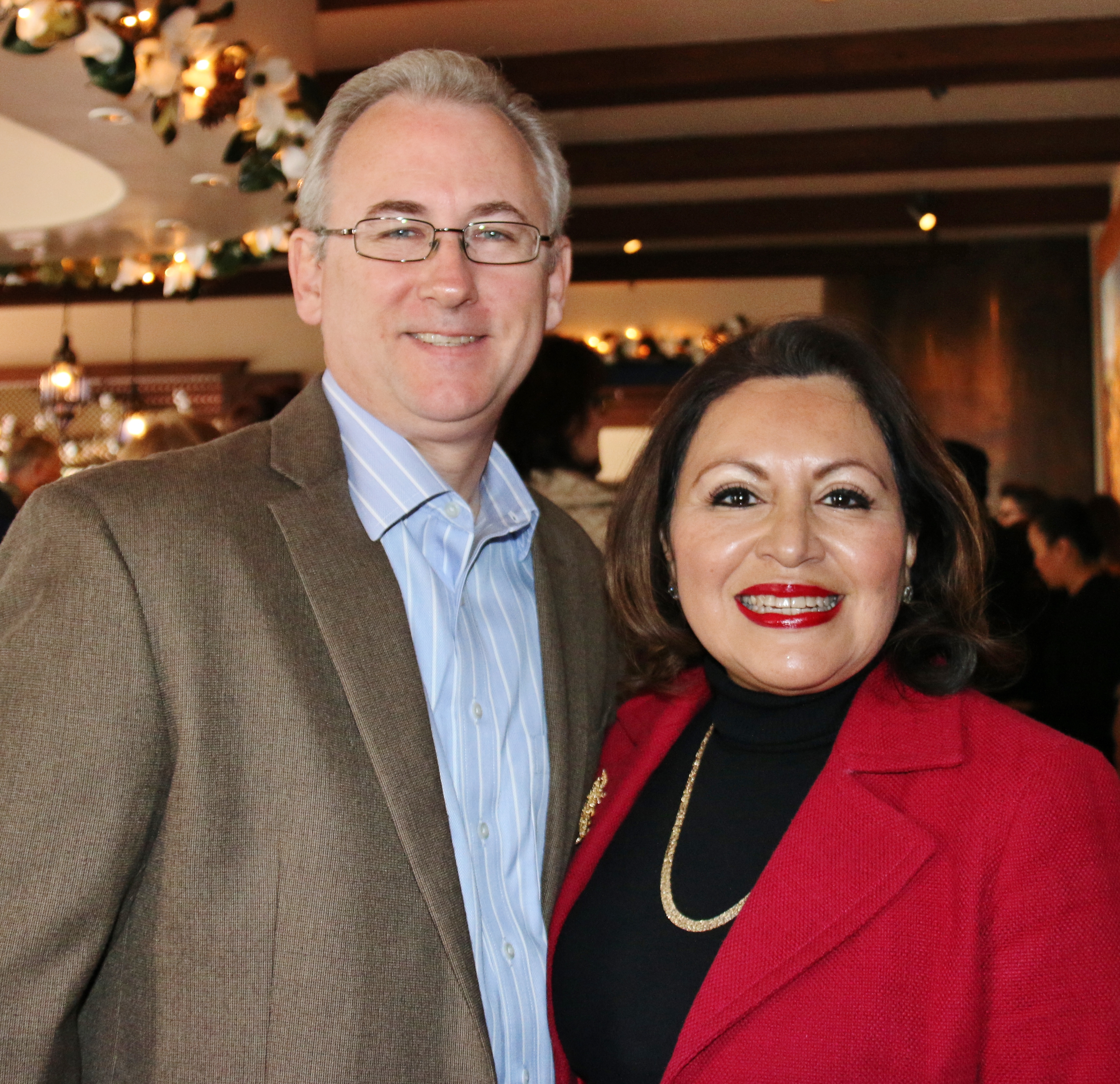
Timothy and JoAnn Holland have been selected as this year’s co-chairs for the diocese’s annual Charity and Development Appeal. (Photo courtesy of Timothy and JoAnn Holland)

The Hollands, who are parishioners at Our Lady of Mount Carmel Parish in Tempe, say that donating to the campaign is a way to participate in the Year of Mercy.

“The money is used to make a difference in so many people’s lives: food, shelter, transportation, programming, it’s all so highly impactful,” said JoAnn. “Every gift makes a difference.”

The Hollands have taken the Gospel call to give of time, talent and treasure to heart. JoAnn has been a catechist for 15 years and is a founding member of the diocesan Stewardship Council, and together with Timothy, was involved in an “Evenings with the Engaged” program at their parish.

“The whole CDA, especially when you look at the charitable organizations and who they cater to, they help people in general, without looking at what religion or race they are, just people in need,” said Timothy. “That goes with the theme of mercy.”

Recalling the excitement generated by Pope Francis’ apostolic visit to the U.S. in September of last year, the Hollands said they felt he encouraged people to look at their faith more deeply, especially in asking everybody to pray for him at each of his stops and in greeting the prisoners and poor before greeting dignitaries. This provided an example of living out the works of mercy, they said.

“He shook every single prisoner’s hand before he went to the dignitaries. It’s an example of what we all should be doing and it goes back to the works of mercy,” said JoAnn.

“You can feel and be a part of these works of mercy,” added Timothy. “Just one dollar [more] brings in $700,000. To me, that’s what Pope Francis is asking
of us.”