
‘Celebrating Differences’ event kicks off renewed effort to serve students with disabilities

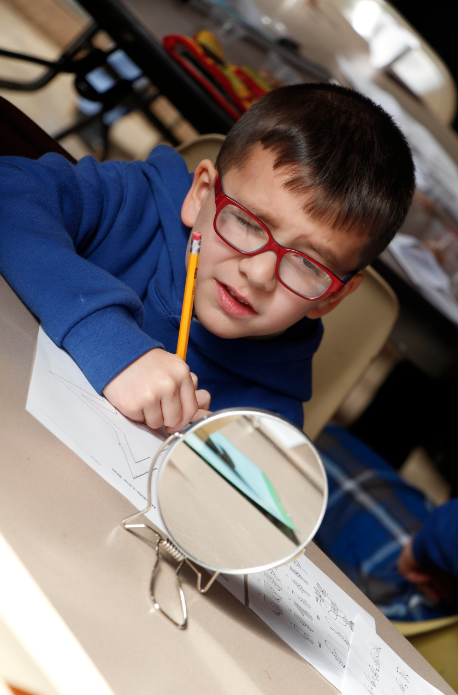
A St. Gregory student tries to trace a star shape while looking in a mirror during a "Celebrating Differences" event Jan. 8. Several simulation stations helped students better understand classmates who have learning disabilities, mobility challenges or difficulty hearing or seeing. (Ambria Hammel/CATHOLIC SUN)
A St. Gregory student tries to trace a star shape while looking in a mirror during a “Celebrating Differences” event Jan. 8. Several simulation stations helped students better understand classmates who have learning disabilities, mobility challenges or difficulty hearing or seeing. (Ambria Hammel/CATHOLIC SUN)

Their school uniforms might be the same, but underneath is a person God gifted with a unique set of abilities and challenges to overcome.

Yet none of it precludes them from being able to attend a Catholic school. That was the core lesson for students in every grade level at St. Gregory during a Celebrating Differences event Jan. 8. It served as a kickoff activity designating the campus as the Diocese of Phoenix’s pilot school for the newly re-branded Arizona Catholic Schools Disabilities Fund.

The organization, which launched in the fall of 2014, exists to help local Catholic schools successfully meet the needs of students with any kind of physical or cognitive disability.

“Many of our diocesan teachers are so willing to learn more about teaching students with disabilities,” said Kathy Johnson, a reading resource teacher at Our Lady of Perpetual Help in Scottsdale and part of the board of directors for the Arizona Catholic Schools Disabilities Fund.

She said teacher dedication already has many faculty successfully working with special needs students, but knows “there is so much more that we need to do and we are hoping that the ACSDF can be the support system that our special students and teachers want and need.”

Photos from ‘Celebrating Differences’ event

Pope Francis greets pilgrims with disabilities at Jan. 13 general audience
_MG_2603


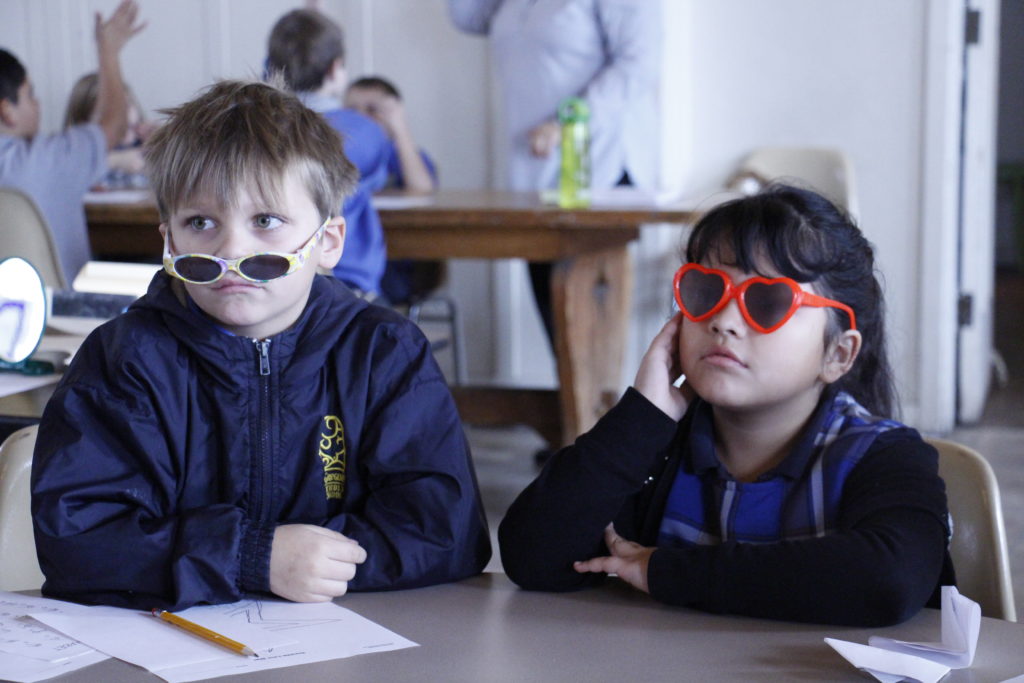
Understanding plays a huge role in that support system. That’s why St. Gregory students visited six simulation stations during the Celebrating Differences event. Each activity allowed them to better understand and even experience, to some degree, what it might be like to have challenges with hearing, vision, learning, fine motor skills or gross motor skills. Students also learned what it might be like to have autism.

More importantly, they learned how sometimes simple adaptations or additional time could help them accomplish the same task as those without a disability. Parents, the St. Gregory community and anyone else interested is invited to experience the same simulation activities Feb. 2 at the school.

Arizona Catholic Schools Disabilities Fund

Connect on Facebook

lisafischer@cox.net

P.O. Box 26638, Phoenix 85068

Celebrating Differences event for the community

Feb. 2 at St. Gregory School, 3440 N. 18th Ave.

Info: (602) 266-9527

“What I really want you to remember about today is that a person is a person first,” Kathy Smith, a member of the Arizona Council for Exceptional Children and part of ACSDF’s “cadre” of related professionals, told the students.

She reminded them to use expressions such as “a person with a hearing impairment” instead of “a deaf person.”

“The disability is just something about them like having curly hair or being tall or short,” Smith said.

Roughly 10-15 percent of St. Gregory students have been identified as having special needs. Maureen DeGrose, principal, said those needs include learning disabilities, medical issues, ADHD, autism and hearing impairments.

“The ultimate goal is student achievement,” DeGrose said. She is looking forward to professional development opportunities for teachers through ACSDF. “We have students with many needs and this is a wonderful opportunity to give all of our students the Catholic education they deserve.”

Lisa Fischer is the mastermind behind the Arizona Catholic Schools Disabilities Fund. She was born without the ability to hear, but still managed to graduate from Xavier College Preparatory. Fischer led the hearing impairment simulation station during the Celebrate Differences event and taught students how to count in sign language plus use its alphabet.

“Of all the disabilities the students have, 47 percent have dyslexia,” Fischer said. “Just about every school has someone.”

Whether it was dyslexia or another learning or cognitive disability, students donned an array of local Catholic school uniforms and joined Fischer at the State Capitol back in October. They watched as Governor Doug Ducey declared it Disabilities Awareness Month.

Tigers fall short on field, but score big with local Catholics [VIDEO]

Clemson University football fans didn’t leave the Valley without visiting a couple of places significant to the Diocese of Phoenix. Fans volunteered to feed the needy as part of the national championship weekend Jan. 10.

Just like the Fiesta Bowl’s visiting musicians did in December, Clemson’s marching band paid a visit to Notre Dame Preparatory for some private practice time.

Arizona Life Rally to unite people of all faiths behind pro-life cause

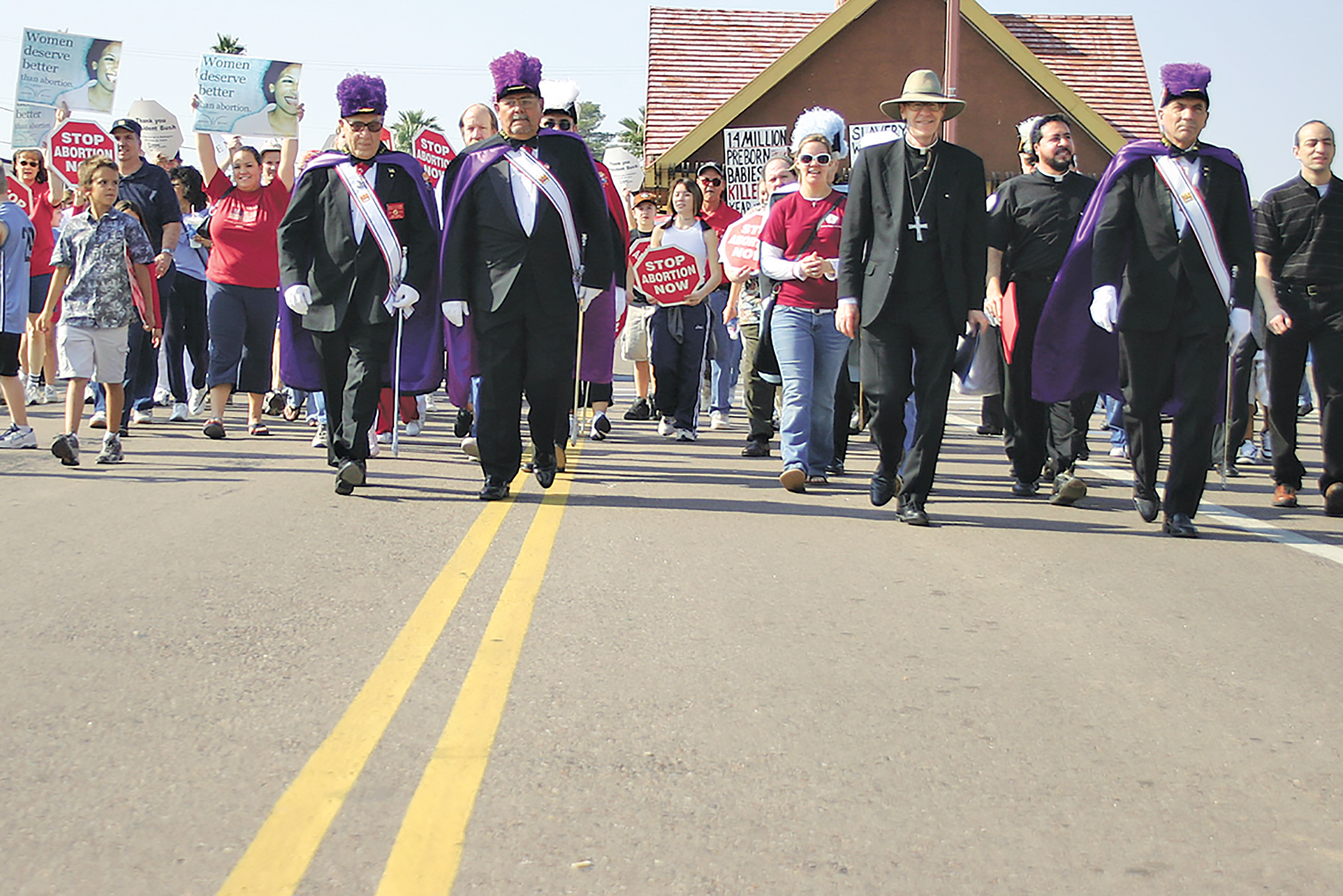
Bishop Thomas J. Olmsted leads pro-lifers in the Arizona for Life March and Rally in this undated file photo. (CATHOLIC SUN file photo)
Arizona Life Rally
  • 10:30 a.m. — Gather at Cesar Chavez Plaza on Washington Street between Second and Third Avenues
  • 11:05 a.m. — Call to attention
  • 11:30 a.m. — March begins
  • 12:15 p.m. — Rally at Wesley Bolin Plaza

Check AZLifeRally.org for further details.

Catholics and other people of faith, and some without, will be setting aside their differences for a common purpose Jan. 22, 2016 — the protection of all human life from the moment of conception.

The Arizona for Life March and Rally will process through downtown Phoenix at 11:30 a.m. that day — the 43rd anniversary of the infamous Roe v. Wade Supreme Court decision that legalized abortion throughout the country — ending with a rally from 12:30-2 p.m.

“We we are not going to be standing on the things that separate us or divide us; we are going to all be standing in unity on the life issue because it does go back to our formation … being a well-formed person really starts with knowing the value of your life, and that crosses over any religious boundary,” said Benta Clark, president of the Arizona Life Coalition, which is organizing the rally.

Gianna Jessen, who survived a saline abortion when she was born, will be the keynote speaker at the Arizona Life Rally. (Photo courtesy of ALC)

Abortion survivor Gianna Jessen will be the featured keynote speaker at the rally. She survived a failed saline abortion attempt when she was born in 1977. Jessen, who also has cerebral palsy, has since become a pro-life and disabilities rights activist. The 2011 film “October Baby” was loosely based on her life.

Bishop Thomas J. Olmsted will also be among the keynote presenters at the rally.

Clark, who is an Evangelical Christian, said that the event has three main purposes: to inspire Arizonans that life matters; educate them; and activate pro-lifers to take action.

Mike Phelan, director of the Diocese of Phoenix Office of Marriage and Respect Life, noted the importance of Catholics attending the Arizona for Life March and Rally to bear public witness to the truth that life begins at conception. The need is especially important now, he added, in light of the undercover Center for Medical Progress videos released earlier this year exposing the practices of Planned Parenthood.

“Every pro-lifer has to ask the question, ‘What am I willing to be part of? What am I willing to do now in order to stand for life in the face of very clear and revealed evil?’” said Phelan. “We’re called to overcome evil with good, and gathering on this memorial day of Roe v. Wade is a movement toward building the good.”

Jan. 22 is also designated as the “Day of Prayer for the Legal Protection of Unborn Children” in dioceses throughout the U.S. According to the General Instruction of the Roman Missal (GIRM), that day “shall be observed as a particular day of prayer for the full restoration of the legal guarantee of the right to life and of penance for violations to the dignity of the human person committed through acts of abortion” (373).

Faithful Catholics are called to observe the day through penitential practices such as fasting, giving alms, performing a corporal work of mercy, and/or participating in a holy hour. Attending the March and Rally helps fulfill this call of mercy.

With a hot-button topic such as abortion, it’s possible that some participants may interact with pro-abortion advocates.

“As a follower of Christ it’s impossible to live a life free from controversy and resistance, and that’s part of any display of justice and love,” Phelan advised. “I think a great response is to say without any sarcasm, ‘I’m very glad that you were born and you could be here today. God has a beautiful plan for your life.’”

Comedian, cardinal, inmate present Pope Francis book on mercy

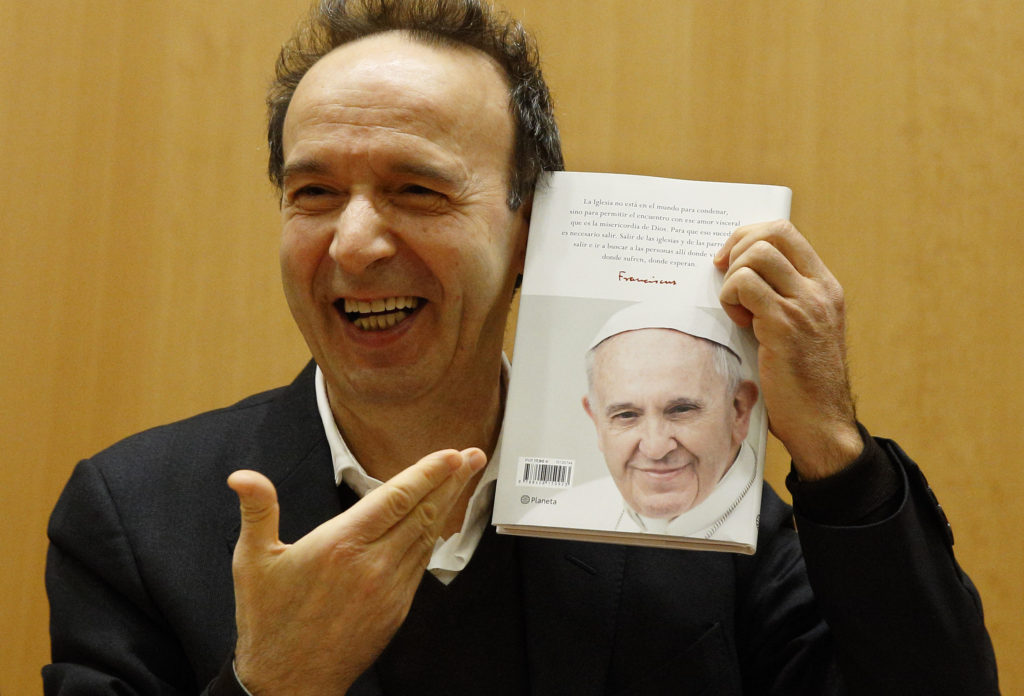
Italian actor Roberto Benigni holds a copy of the book, "The Name of God Is Mercy," during its presentation to journalists in Rome Jan. 12. The book is compiled from an interview Pope Francis did with Italian journalist Andrea Tornielli. (CNS photo/Paul Haring)
Italian actor Roberto Benigni holds a copy of the book, “The Name of God Is Mercy,” during its presentation to journalists in Rome Jan. 12. The book is compiled from an interview Pope Francis did with Italian journalist Andrea Tornielli. (CNS photo/Paul Haring)

VATICAN CITY (CNS) — Arms flailing, the exuberant and perhaps hyperactive Italian actor and comedian Roberto Benigni described Pope Francis as a masterful minister of God’s mercy, which is always active and always on the move.

Benigni brought the house down Jan. 12 during the presentation of the new book-length interview with Pope Francis, “The Name of God Is Mercy.” The actor read excerpts of the book, but also offered his own reflections on mercy and bubbled over with praise for Pope Francis.

When he received the call asking him to participate in the book launch, Benigni said, he was told, “‘His Holiness would like’ and I said, ‘Yes!’ without letting them finish. I’d do anything — be a Swiss Guard, drive the popemobile — absolutely anything for this pope.”

“Mercy,” Benigni said, “is not a virtue that’s seated in an easy chair. It’s an active virtue, one that moves. Just look at the pope, he’s never still. It moves not just the heart, but the arms, legs, heels, knees. It moves heart and soul. It’s never still.”

“I would have loved to be a priest,” he said. When he was small and people would ask what he wanted to be when he grew up, Benigni said, “I’d respond, ‘the pope.’ Because this response made everyone laugh, I understood I had to be a comedian. If they’d all knelt, I would (have tried to) be pope.”

Hundreds of people packed the auditorium of the Augustinian Patristic Institute across the street from the Vatican for the presentation.

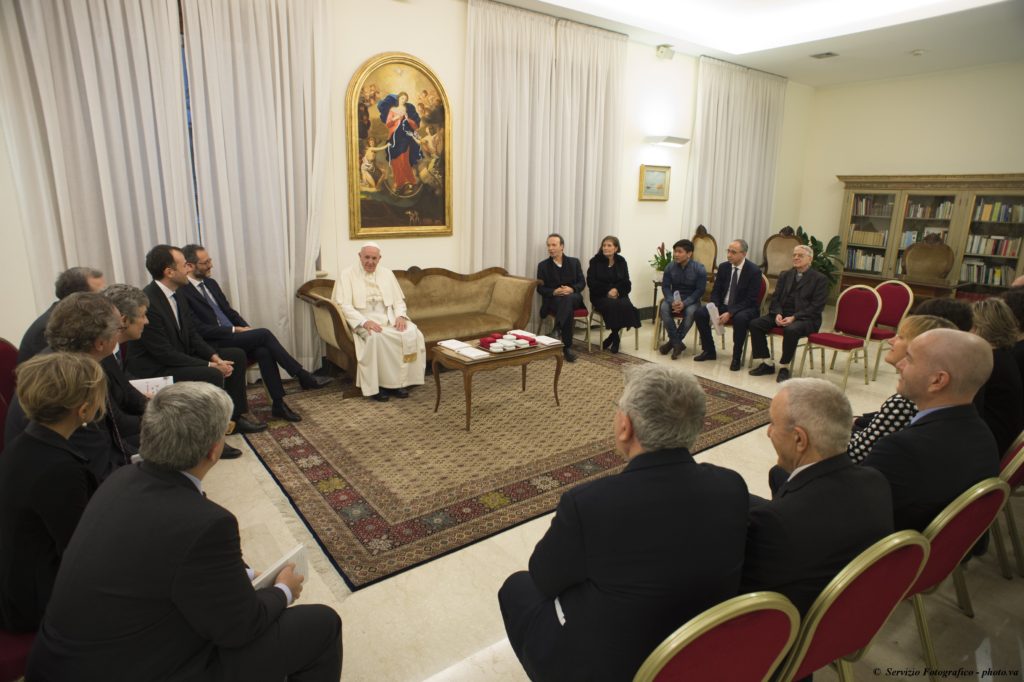
Pope Francis meets with people involved in the publishing of  "The Name of God Is Mercy" at the Domus Sanctae Marthae at the Vatican Jan. 11. The book features an interview the pope did with Italian journalist Andrea Tornielli. (CNS photo/L'Osservatore Romano, handout)
Pope Francis meets with people involved in the publishing of “The Name of God Is Mercy” at the Domus Sanctae Marthae at the Vatican Jan. 11. The book features an interview the pope did with Italian journalist Andrea Tornielli. (CNS photo/L’Osservatore Romano, handout)

Jesuit Father Federico Lombardi, Vatican spokesman, said there is little doubt that mercy is a central theme of Pope Francis’ pontificate, but the book is not so much an explanation of mercy as it is an account of how Pope Francis has experienced mercy in his personal life, his priestly ministry and his own spirituality.

Cardinal Pietro Parolin, Vatican secretary of state, said that in the published conversation with journalist Andrea Tornielli, it is as if Pope Francis wants “to take us by the hand and lead us into the great and comforting mystery of God’s mercy, a mystery far from our human logic and yet so desired by us pilgrims lost in this age of challenges and trials.”

Italian actor Roberto Benigni holds a copy of the book, "The Name of God Is Mercy," during its presentation to journalists in Rome Jan. 12. The book is compiled from an interview Pope Francis did with Italian journalist Andrea Tornielli. (CNS photo/Paul Haring)
Italian actor Roberto Benigni holds a copy of the book, “The Name of God Is Mercy,” during its presentation to journalists in Rome Jan. 12. The book is compiled from an interview Pope Francis did with Italian journalist Andrea Tornielli. (CNS photo/Paul Haring)

Benigni told the people at the book presentation that Pope Francis clearly demonstrates how mercy is not a soft, saccharine virtue, but one that challenges people and has both social and political implications for the way it offers people a second chance and a helping hand.

Zhang Jianqing, an immigrant from China incarcerated in Padua, Italy, who took the name Agostino when he was baptized in 2015, was given leave to meet Pope Francis and share his conversion story at the book presentation.

Meeting and becoming friends with Christians who visited the prison, Zhang came to learn about Jesus and grew to love him. He hesitated converting, though, he said, because he already had decided that he should do nothing more in his life to hurt his family and especially his mother, a practicing Buddhist.

But his mother told him he must follow his heart, Zhang said. “God’s mercy changed my life.”

By Cindy Wooden, Catholic News Service.

National Park Service honors Jesuit missionary with legacy day

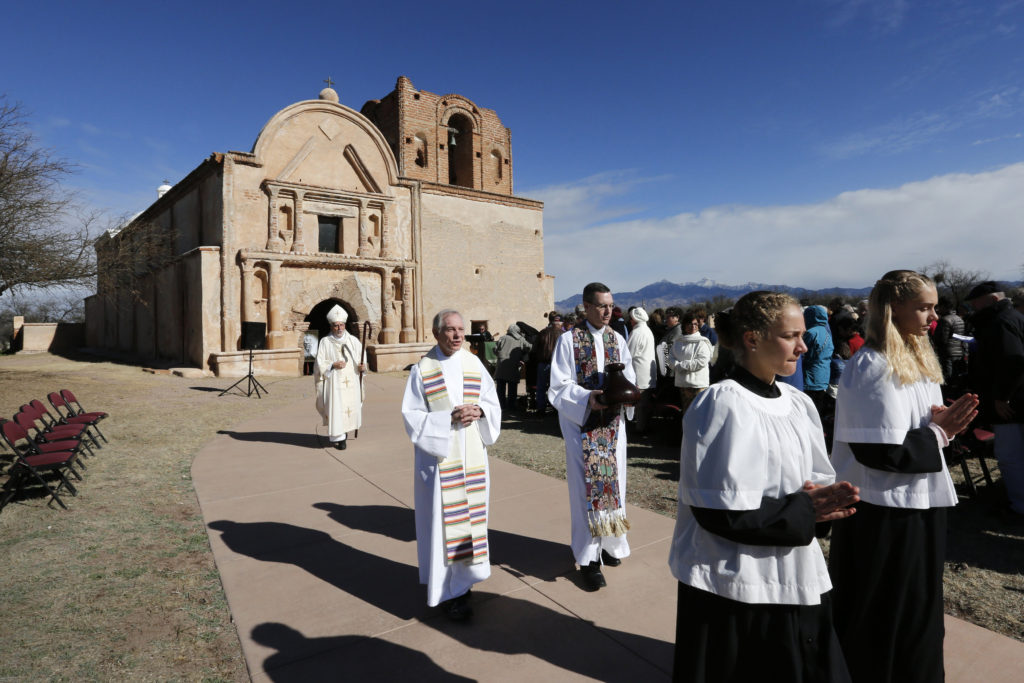
Bishop Gerald Kicanas of Tucson, Ariz., walks in procession to celebrate Mass outside the mission at Tumacacori National Historical Park in Tumacacori, Ariz., Jan. 10. The Mass was part of the park's Kino Legacy Day marking the 325th anniversary of the Jesuit missionary's first visit to an O’odham village there. (CNS photo/Nancy Wiechec)
Bishop Gerald Kicanas of Tucson, Ariz., walks with his crosier after celebrating Mass outside the mission at Tumacacori National Historical Park in Tumacacori, Ariz., Jan. 10. The Mass was part of the park's Kino Legacy Day marking the 325th anniversary of the Jesuit missionary's first visit to an O’odham village there. (CNS photo/Nancy Wiechec)
Bishop Gerald Kicanas of Tucson, Ariz., walks with his crosier after celebrating Mass outside the mission at Tumacacori National Historical Park in Tumacacori, Ariz., Jan. 10. The Mass was part of the park’s Kino Legacy Day marking the 325th anniversary of the Jesuit missionary’s first visit to an O’odham village there. (CNS photo/Nancy Wiechec)

TUMACACORI, Ariz. (CNS) — Jesuit Father Eusebio Francisco Kino, an Italian missionary to the American Southwest known as the “Padre on Horseback,” was honored Jan. 10 at the Tumacacori National Historical Park with Kino Legacy Day.

The celebration of the priest — who founded 24 missions, was also known as an astronomer, builder, mapmaker, linguist, agriculturalist and stockman and is the namesake for the Diocese of Phoenix’s Kino Catechetical Institute — kicked off the yearlong celebration of the National Park Service’s 100th anniversary.

Bob Love, superintendent of Tumacacori National Historical Park, said Father Kino played a key role in the park’s story.

But that morning, park rangers left much of the storytelling to Tucson Bishop Gerald F. Kicanas, whose diocese covers the land that Fr. Kino crisscrossed, building his missions when he traveled more than 15,000 miles by horseback.

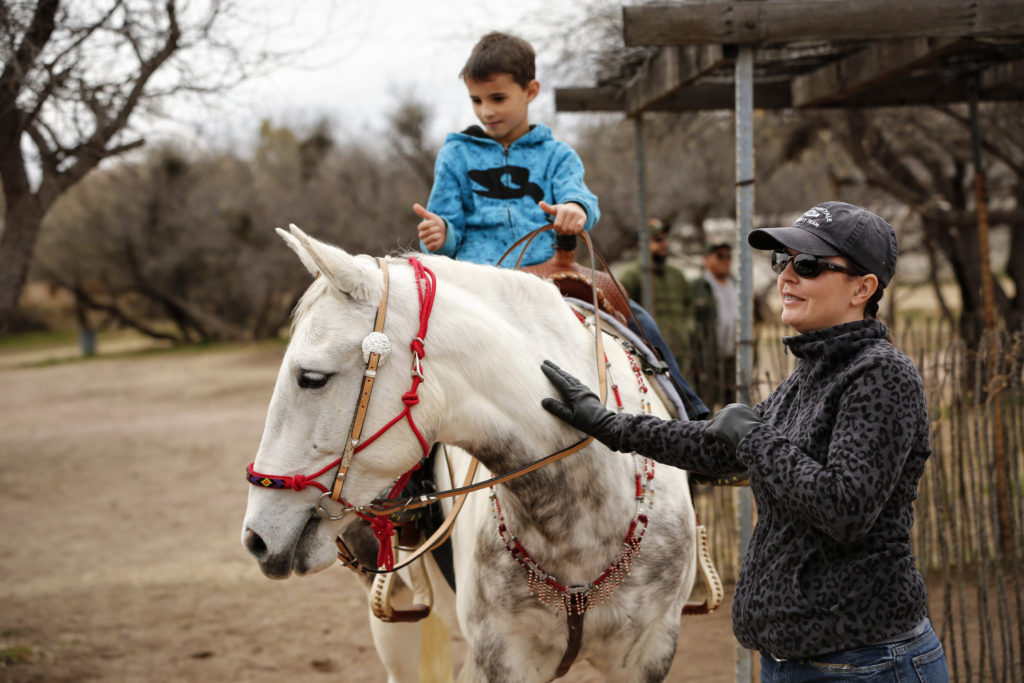
Desirae Steenken and her 7-year-old son, Draven Lee, admire Fabianna, a Wilbur-Cruce Spanish Barb horse, during the Kino Legacy Day at Tumacacori National Historical Park Jan. 10 in Tumacacori, Ariz. The now-endangered breed was brought to America by Europeans and was used by explorers and missionaries, including Fr. Eusebio Francisco Kino, who traveled more than 15,000 miles by horseback in the Pimeria Alta region. (CNS photo/Nancy Wiechec)

During Mass, held outside the ruins of Mission San Jose de Tumacacori church, the bishop told the crowd what it is to be a great missionary. He compared missionaries such as Fr. Kino to archers, ardent with a singular, fixed target.

“They teach Christ, they preach Christ, they lead to Christ,” he said. “That was the purpose of Kino’s whole life, to lead the native peoples to Christ. To teach them about a God who loved them dearly and who was there among them, always at their side.”

The Tumacacori mission church dates to the early 1800s. It had a short-lived tenure as an active church. Apache attacks, upheaval following war with Mexico and one particularly hard winter led to its abandonment by the mid-1800s. The site was named a national monument by President Theodore Roosevelt in 1908, and in 1990 Congress created Tumacacori National Historical Park, which includes the old monument land and the remains of two smaller missions.

Carmen Dolny (left) and Rosie Garcia display a banner showing an image of Jesuit Father Eusebio Francisco Kino at the Tumacacori National Historical Park in Tumacacori, Ariz., Jan. 10. The women, both admirers of the pioneer missionary, took part in the park's Kino Legacy Day, paying homage to his contributions to the church and people in Pimeria Alta, what is now southern Arizona and northern Sonora, Mexico. (CNS photo/Nancy Wiechec)
Carmen Dolny (left) and Rosie Garcia display a banner showing an image of Jesuit Father Eusebio Francisco Kino at the Tumacacori National Historical Park in Tumacacori, Ariz., Jan. 10. The women, both admirers of the pioneer missionary, took part in the park’s Kino Legacy Day, paying homage to his contributions to the church and people in Pimeria Alta, what is now southern Arizona and northern Sonora, Mexico. (CNS photo/Nancy Wiechec)

Fr. Kino was born in 1645 in the northern Italian town of Segno and was educated by Jesuits. As a young man, he fell seriously ill and prayed for God’s grace and healing, calling on the Jesuit missionary St. Francis Xavier as intercessor. When he got well, he joined the Jesuits.

He yearned to do missionary work in China, but was sent to Mexico instead. He worked in Baja California for three years and spent the rest of his life in Pimeria Alta, what is now the northern part of Mexico’s Sonora state and southern Arizona.

He first arrived in Tumacacori (pronounced Too muh ka’ koh ree) in January 1691, responding to an invitation of its O’odham people. Shortly after, there were four Kino missions in O’odham communities. Today, San Xavier del Bac remains the only active Kino mission in Arizona. Located just south of Tucson, the northernmost point of the Sonoran mission trail, it is a popular destination for pilgrims and tourists.

Tumacacori, about 20 miles from the border city of Nogales, Arizona, covers 360 acres and is among the smallest of the 23 national parks within Arizona.

During the Kino Legacy Day, the park service set up displays of heritage horses, livestock and other items associated with the missionary priest who brought cattle, other livestock, European farming tools and seeds to the area so the missions would be self-sufficient.

Southern Arizona rancher Dean Fish said Fr. Kino’s lasting impact on the area is significant.

Cattle raised for beef remains a large part of the economy in Arizona’s Santa Cruz County, Fish said.

Wheat stalks are displayed during the Kino Legacy Day event at Tumacacori National Historical Park in Tumacacori, Ariz., Jan. 10. Fr. Eusebio Francisco Kino, a Jesuit missionary, moved Old World cattle and crops to the area to support the missions he founded. (CNS photo/Nancy Wiechec)

“We’re honored to be a part of that, to feed America a little bit and to be able to work and be a part of God’s land,” he said.

Mark O’Hare of the Kino Heritage Society handed out Kino wheat to Tumacacori visitors. The grains came from a line of winter wheat the Jesuit brought to the missions.

O’Hare, a Tucson native and admirer of Fr. Kino since boyhood, runs the society’s website, padrekino.com. He said the group was formed in 2010 to make Fr. Kino’s life and legacy more known to the public and to assist the Diocese of Tucson in promoting his cause for canonization.

“Spiritually, he was this man of great faith,” O’Hare told Catholic News Service. “He was what we’d call a white martyr, not someone who died for the faith, but someone who dedicated his life for the salvation of souls.”

The Mexican Archdiocese of Hermosillo in Sonora, the Diocese of Tucson and the Italian Archdiocese of Trent, where Fr. Kino was born, have all been advocating for his canonization.

Photos: Fr. Kino honored in Arizona

The Vatican received the diocesan petition and documentation on Fr. Kino’s life and work in 2006, but has yet to act to name him venerable, the next step in the sainthood process.

Tucson resident Rosie Garcia, president of the Kino Heritage Society, said moving his cause along would a blessing for area. She marks her admiration for the missionary with the vanity Arizona license plate that reads KINOLND.

“He was a man of peace and that is what we need right now — peace in these border areas where there is so much turmoil,” she said.

By Nancy Wiechec, Catholic News Service.

Relics of St. Charbel to be venerated this weekend at St. Joseph Maronite Church

The relics of saint whose intercession has been linked to thousands of documented miracles will be on display in Phoenix Jan. 15-17.

St. Joseph Maronite Church is hosting the relics as part of the 50th anniversary celebration of the beatification of St. Charbel Makhlouf by Pope Paul VI.

First class relics are parts of a saint’s body that are venerated by the faithful, a practice that goes back to the second century AD. The relics of St. Charbel that will be on display in Phoenix include part of the saint’s skeleton.

[quote_box_right]

Relics of St. Charbel

Jan. 15-17 at St. Joseph Maronite Church, 5406 E. Virginia Ave.

Confessions in English and Spanish available throughout

3 p.m., Jan. 15 — Spanish Mass in the Latin Rite celebrated by Fr. Bob Rossi

6 p.m., Jan. 16 — English Mass celebrated in the Latin Rite by Bishop Thomas J. Olmsted

9 p.m., Jan. 16 — Movie about the life of St. Charbel with English subtitles

Masses in various rites available throughout

Full schedule

[/quote_box_right]

Fr. Wissam Akiki, pastor of St. Joseph, said the church will host 13 Masses during the three-day celebration, including liturgies in the Maronite, Melkite, Byzantine and Latin Rite. Masses will be offered in English and Spanish and confession will be available throughout the event, with Bishop Thomas J. Olmsted of the Diocese of Phoenix presiding at a 6 p.m. liturgy Jan. 16. Bishop Gerald N. Dino of the Byzantine Catholic Eparchy of Phoenix will celebrate a Byzantine liturgy at 3 p.m. Jan. 16.

Eucharistic Adoration and the Rosary will also take place and a movie about the life of St. Charbel will be shown at 9 p.m. Jan. 16.

A visit to St. Joseph Church, Fr. Akiki said, reaches beyond the historical significance of one of the Church’s greatest saints. It’s about building faith in a world that seems to have lost sight of God.

“We are living in a world with no more commitment, no more values, no more love, no more faith,” Fr. Akiki said. “The relic of St. Charbel coming to visit us here, it’s to bring us closer to God, to have more faith in God, to be more united with God.”

Known as the “second St. Anthony of the Desert” and “the Perfume of Lebanon,” St. Charbel has touched the lives of both Christians and non-Christians.

“St. Charbel is not just for one side, not just for Maronite. It’s for Maronite, Muslim, Catholic or non-Catholics,” Fr. Akiki said. “St. Charbel is for all people.”

Across religions and denominations, there is devotion to the humble hermit who entered into religious life at 23 and died on Christmas Eve, 1898. A few months after his death a bright light was seen surrounding his tomb. When superiors opened the saint’s tomb, they found his body still intact. St. Charbel was beatified in 1965 and canonized 12 years later by Pope Paul VI.

The visit of the relics of St. Charbel is part of a U.S tour that includes stops at 91 Maronite churches. According to Fr. Akiki, there have been 26,000 miracles recorded in the monastery in Lebanon where St. Charbel once lived.

“Those are recorded, approved by doctor and by Church,” Fr. Akiki said. Many have left their crutches behind at the monastery after being healed. Stela Paolini, a Phoenix woman, visited Fr. Akiki Jan. 8 and told him the intercession of St. Charbel had healed her of cancer. The priest said he plans to forward her file to Rome.

Fr. Akiki emphasized the importance of focusing on God with the understanding that healing takes place by the power of God through the intercession of the saint.

“People have to know that the home for St. Charbel outside of Lebanon is here at St. Joseph Catholic Church,” Fr. Akiki said. “We need people to focus on more than St. Charbel. They need to focus on God, on the Holy Spirit, on the Eucharist.”

Fr. Tom O’Dea (1933-2016) brought Irish faith, humor to Arizona

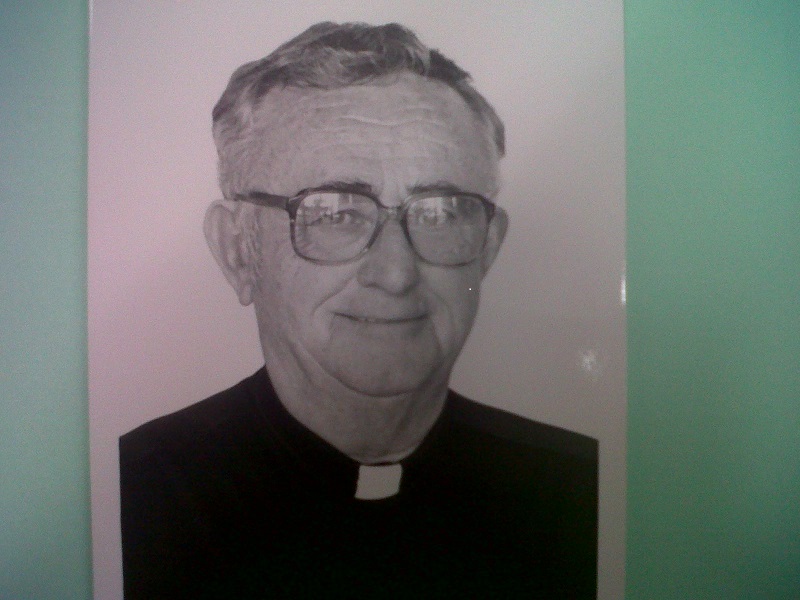
Fr. Thomas O'Dea (1933-2016)
Fr. Thomas O’Dea (1933-2016)

Fr. Tom “Tot” O’Dea, whose love of poetry permeated his life and ministry, died Jan. 2, at home in his native Ireland. He was 82.

Before crossing the Atlantic Ocean for the Diocese of Tucson, Fr. O’Dea was ordained a priest in Ireland on June 7, 1958 to serve as a missionary in Arizona.

And he wasn’t alone. He was accompanied on the trip by about a dozen young men; courted from the rolling hills of Ireland to the “lush” landscape of Arizona for ministry.

Fr. O’Dea served in various parishes in Tucson and later for the Diocese of Phoenix including St. Thomas the Apostle; Queen of Peace in Mesa; St. Anthony of Padua in Casa Grande; St. Francis in Superior; St. Patrick’s in Bisbee; St. John Vianney in Goodyear; St. Matthew; Christ the King in Mesa; and Holy Spirit in Tempe.

He retired in 2003 after serving as pastor of Ascension Parish in Fountain Hills, then returned to Ireland in 2005 where he served the parish of Ballynacally for the remaining years of his life.

A native of Newmarket, Fr. O’Dea attended St. Flannan’s College in Ennis, Co. Clare, where, at 13, he met his friend of 69 years, Msgr. Michael O’Grady.

“I often wonder why we bonded so well, we were very opposite in many ways,” Msgr. O’Grady said. “I lived for athletics of every kind. Tot preferred automobiles and tractors, but somehow we connected.”

Following high school, the two attended St. Patrick’s Seminary in Carlow.

“I was a bookworm, I had to be to get through. Tot was not a textbook advocate and I wonder if he even purchased them,” Msgr. O’Grady recalled. “He learned from conversations among the students; he had a really inquiring mind and thought outside the box.”

Not unlike those he ministered to and loved, Fr. O’Dea had his own crosses to bear, embracing the spirituality of the 12-step program.

“His cross became his grace,” Msgr. O’Grady said. “Every aspect of his ministry was based on the program, to him it was the ultimate Christian way.”

Msgr. O’Grady, who spoke at his longtime friend’s funeral, said the grief of the parishioners was palpable; the church was packed and a tent was set up to seat the overflow. Friends, parishioners and a local retired bishop came to pay respects.

“A man said to me, ‘he did so much for the people of this parish, he did nothing, just loved and respected us,’” Msgr. O’Grady said. “Tot would love the ‘nothing’ bit.”

That’s because Fr. O’Dea had a wonderful sense of humor, often summarizing his own prayer life as “one Our Father, once a day.”

Msgr. O’Grady expounded how really prayerful he was. Fr. O’Dea was known for his love of “textbooks,” which was every person he ever met and for little children whose company he delighted in.

In one lasting and final tribute, a friend invited the church to recite by memory Fr. O’Dea’s favorite poem, “The Lake Isle of Inisfree,” by Irish poet William Yeats.

“So many voices joined in. It was pure prayer as Tot would pray,” Msgr. O’Grady said.

He is survived by his brother Dr. Dominic (Dommie) from Toronto, sisters Evelyn Flanagan from Ballinasloe, Phyllis O’Halloran from Cashel, and extended family members. He is preceded in death by brothers, John and Patrick, and sister Irene Neylon.

He was buried Jan. 6, on the grounds of Christ the King Church in Ballycorick, Ballynacally following the funeral Mass.

Xavier, medical communities mourn loss of Sr. Nancy Perlick, RSM

Sr. Nancy Perlick, RSM (19##-2015)
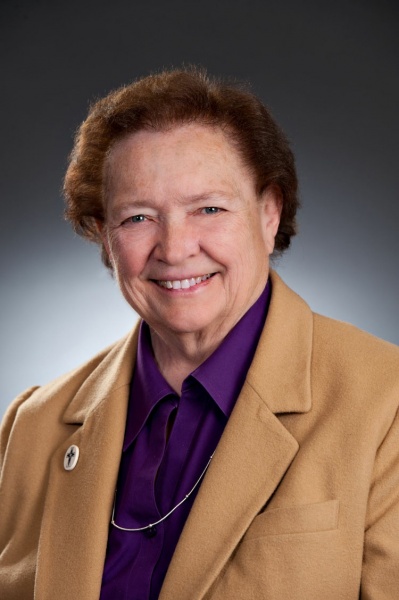
Sr. Nancy Perlick, RSM (1944-2015)

Local Catholic high school fixture, Sr. Nancy Perlick, RSM, known for her quiet competence on and off the field, died Dec. 11, 2015. She was 71.

Sr. Nancy was an educator at Xavier College Preparatory for two decades, in addition to being the associate director of activities and athletics at the all-girls private school. She worked closely with Sr. Lynn Winsor, BVM, athletic director.

Never one for the spotlight, Sr. Nancy worked tirelessly behind the scenes on the girls’ athletic programs; coordinating all athletic events, invitationals, and tournaments hosted at Xavier.
[quote_box_left]

Memories and condolences

[/quote_box_left]
“She was very kind, reserved, but extremely competent,” said Sr. Patricia Gehling, SSND, coordinator of ministry at Our Lady of Perpetual Help Church in Scottsdale. “Sr. Nancy liked being in the background so the two of them were a great complement to each other.”

Sr. Nancy’s legacy is vast and wide; she helped design Xavier’s Petznick Field, she announced the home softball, basketball and volleyball games and planned the annual commencement ceremonies.

She also represented Xavier at Arizona Interscholastic Association meetings, wrote articles for national publications, interviewed prospective coaches, spearheaded game-day programs and wrote Xavier’s coaching handbook.

Originally from Chicago, Sr. Nancy was the oldest of three children of Gene R. Perlick and Joanne Olender Perlick. The family later moved to the Los Angeles area where she attended St. Paul’s High School in Santa Fe Springs.

After graduating, she entered the Sisters of Mercy in Burlingame in 1963 and professed vows in 1966.

Sr. Nancy received a bachelor’s degree in nursing from the University of San Francisco in 1970, and served in healthcare for the next 25 years, including St. Joseph’s Hospital in Phoenix.

Sr. Nancy received her master’s degree from the University of Washington in 1983, and worked 10 years as an administrator at Barrow Neurological Institute where the innovative programs and services she implemented still remain.

She served on numerous medical boards and committees, but never lost her love of sports and changed careers when she took a job at Xavier in 1995.

Sr. Nancy was a member of many athletic boards and committees, and a recipient of multiple national and state commendations and distinguished service awards.

In addition, she also served on several diocesan committees including the Council on Religious Life, Future Schools Task Force and as president of the Diocesan School Board. She was also a founding board member of Central Arizona Shelter Services.

[quote_box_left]

Sports writers reflect on Sr. Nancy

Don Ketchum on Xavier’s sports blog

AZCentral sports reporter Richard Obert

[/quote_box_left]

All titles and affiliations aside, what Sr. Nancy will most be remembered for is her loving spirit.

Sophomore Sarah Goins said she vividly remembers Sr. Nancy. They met one year ago when she was registering, which she said was a frightening experience.

“But once I got to Sr. Perlick, she made me feel like I was the most important person there,” Goins said. “She was so welcoming and kind. I’ll always remember that.”

Sr. Nancy is survived by her sister Cynthia Hoffman, brother Terry Perlick, extended family, and her loving community of the Sisters of Mercy.

A Mass of Christian Burial was celebrated Dec. 18 at St. Francis Xavier Church, which was followed by a reception at Xavier College Preparatory Founders Hall.

Private burial was at St. Francis Cemetery. Memorial gifts may be sent to the Sisters of Mercy, 2300 Adeline Drive, Burlingame, CA 94010, or to the Sister Nancy Perlick Scholarship Fund, Xavier College Preparatory, 4710 N. Fifth St., Phoenix, AZ 85012.

The best legacy children can receive from parents is faith, pope says

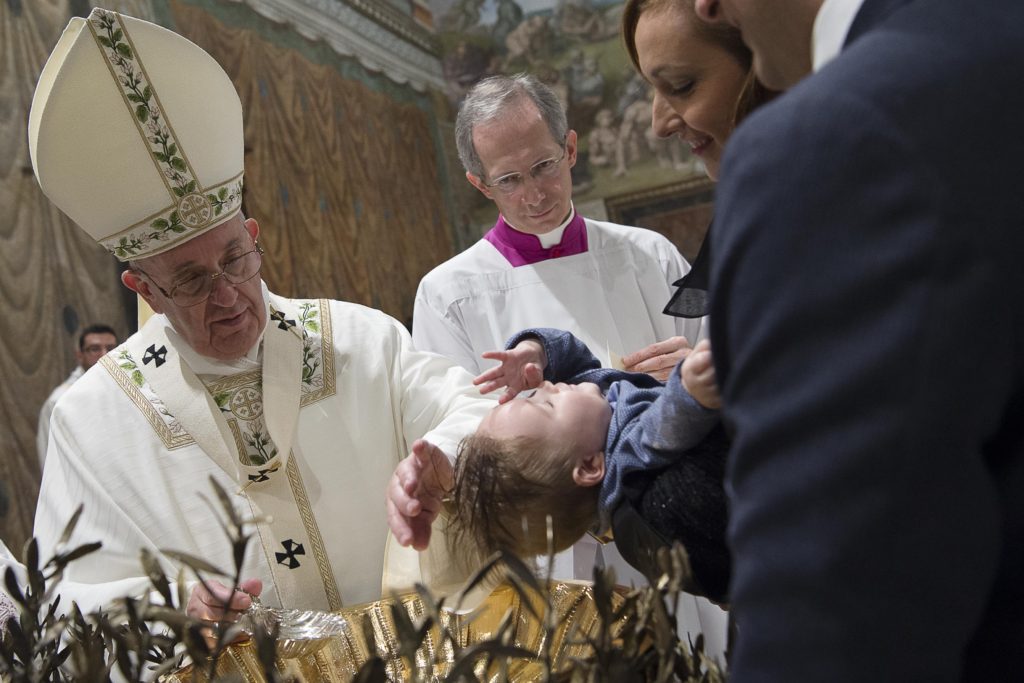
Pope Francis pours water over the head of a baby as he celebrates the baptism of 23 babies in the Sistine Chapel at the Vatican Jan. 10. The baptisms were held on the feast of the Baptism of the Lord. (CNS photo/L'Osservatore Romano, handout)
Pope Francis pours water over the head of a baby as he celebrates the baptism of 23 babies in the Sistine Chapel at the Vatican Jan. 10. The baptisms were held on the feast of the Baptism of the Lord. (CNS photo/L’Osservatore Romano, handout)

VATICAN CITY (CNS) — The best thing parents can pass on to their children is their religious faith, Pope Francis said as he baptized 26 babies.

Ensure this faith “not be lost, help make it grow and pass it on as a legacy,” he told the infants’ parents and godparents.

The pope presided over the annual morning liturgy in the Sistine Chapel Jan. 10, the feast of the Baptism of the Lord.

He told the parents that when he asked them, “What do you ask of God’s church” for their child and they responded, “Faith,” the ritual was part of “a chain” of handing on the faith throughout history.

“These children, as the years go by, will be taking your place with another child — your grandchildren — and they will ask the same thing: faith,” he said in his brief, unscripted homily.

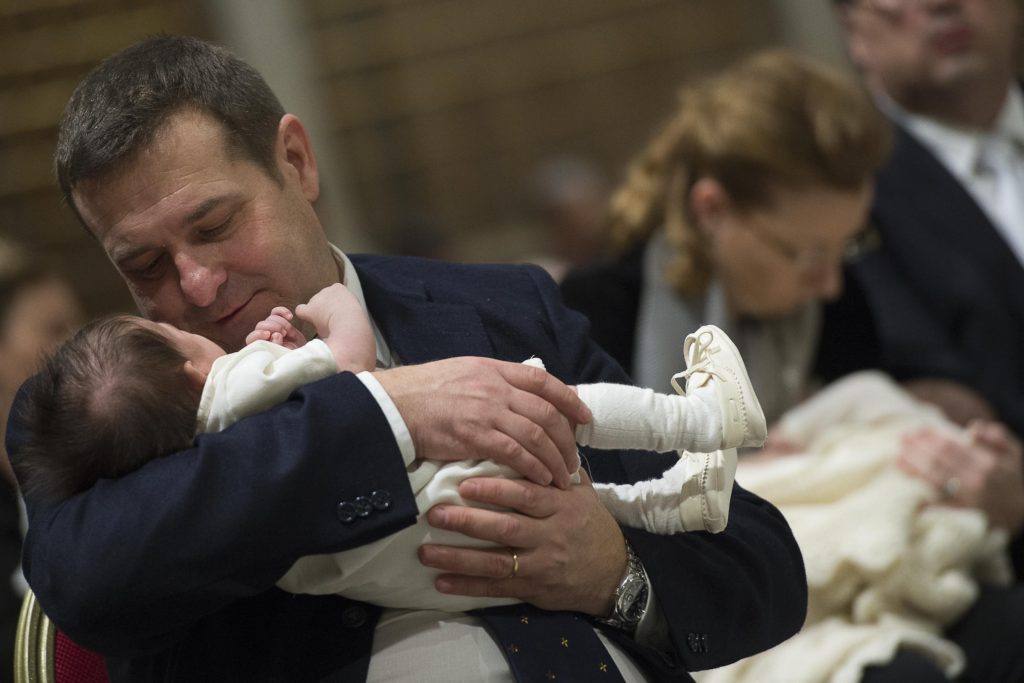
Family members hold babies as Pope Francis celebrates the baptism of 23 babies in the Sistine Chapel at the Vatican Jan. 10. The baptisms were held on the feast of the Baptism of the Lord. (CNS photo/L'Osservatore Romano, handout)
Family members hold babies as Pope Francis celebrates the baptism of 23 babies in the Sistine Chapel at the Vatican Jan. 10. The baptisms were held on the feast of the Baptism of the Lord. (CNS photo/L’Osservatore Romano, handout)

“Don’t forget that the greatest legacy that you can leave your children is faith,” he said, adding he hoped they would always be capable of helping their children grow in the faith.

The infants, wearing their Sunday best — chiffon or lacy dresses, cotton cardigans or plush overalls — were baptized over a font supported by an ornately detailed bronze olive tree. One by one, the pope poured water from a gilded shell and gently caressed the head of each of the 13 girls and 13 boys.

As he has done in the past, he told the mothers not to hesitate in breast-feeding their babies during the ceremony.

Later in the day, before praying the Angelus with visitors gathered in St. Peter’s Square, Pope Francis said being baptized carries with it “the responsibility of following Jesus — the obedient servant — and reproducing in us his same likeness, that is, gentleness, humility, tenderness.”

Even though “this is not easy, especially if we are surrounded by so much intolerance, pride, rigidity,” he said, “it is possible with the power that comes from the Holy Spirit.”

“The Holy Spirit, received for the first time on the day of our baptism, opens our heart to the truth, to the whole truth. The Spirit drives our lives along the challenging, but joyous path of charity and solidarity toward our brothers and sisters,” he said.

He reminded people to find out the date of their baptism if they didn’t know because it was an important day that merits celebrating every year.

“It is the date of our rebirth as children of God,” he said, and “celebrating that day signifies and reaffirms our belonging to Jesus with the commitment to live like Christians, members of the church and a new humanity in which all are brothers and sisters.”

By Carol Glatz, Catholic News Service.

[quote_box_center]

RELATED:

A priest in the Diocese of Phoenix preaches a similar message: “The number one job of a parent is the same job that a priest has as a ‘father’…is to get the kids to heaven. That’s your number one job as a parent, a grandparent a great-grandparent is to get your kids to heaven,” Fr. John Greb told Massgoers at St. Timothy Parish in Mesa.


[/quote_box_center]

Franciscan Renewal Center breaks ground for new ‘Casa’

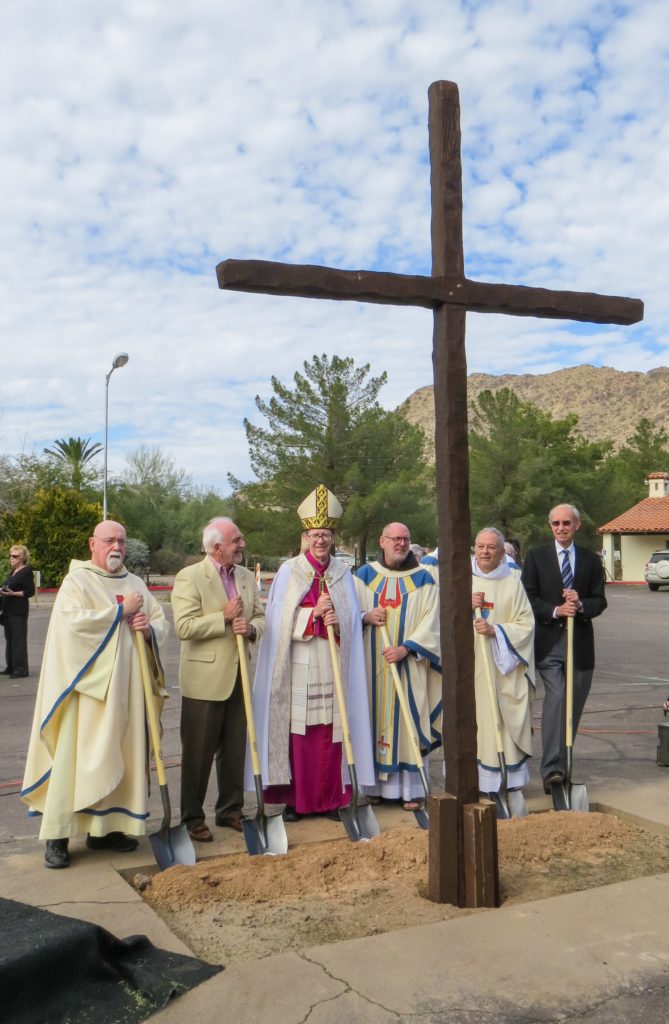
Fr. Peter Kirwin, OFM, Rector of the Church of Our Lady of the Angels; John Reyno, Co-Chair RENEWING LIVES Campaign; Very Reverend John S. Hardin, OFM, Provincial Minister; Fr. Joseph Schwab, OFM, Executive Director of the Franciscan Renewal Center; Ron Tisch, Co-Chair RENEWING LIVES Campaign. (photo courtesy of Kathleen Fitzpatrick, Westlake Reed Leskosky)
Fr. Peter Kirwin, OFM, rector of the Church of Our Lady of the Angels at the Franciscan Renewal Center in Scottsdale, poses with shovels Jan. 3 alongside John Reyno, co-chair of the “Renewing Lives” campaign; Bishop Thomas J. Olmsted; Fr. John S. Hardin, OFM, provincial minister; Fr. Joseph Schwab, OFM, executive director of the Franciscan Renewal Center; and Ron Tisch, campaign co-chair. (photo courtesy of Kathleen Fitzpatrick, Westlake Reed Leskosky)

Attendance at a ceremonial groundbreaking was proof positive Catholics outgrew their worship space at the Franciscan Renewal Center — “The Casa” — in Scottsdale.

Nearly 400 community members joined the staff plus a bishop and Franciscan friars for a turning of the shovel Jan. 3. The current church only seats 300.

Overflow spills out into the narthex, lawn and patio each weekend. Those days should be over by next spring. The future church will at least double Massgoer capacity and have the ability to welcome another 200 guests during Christmas, Easter and other well-attended liturgies.

Capital improvements have been a mainstay on Casa grounds since the “Renewing Lives” Master Plan launched the campaign phase four years ago. The 17,050-square-foot church on the central-south portion of the 25-acre campus facing Lincoln Drive accounts for the largest portion — some $8.5 million of the $20 million campaign.

Key leaders and community members took turns posing for groundbreaking photos in space that is currently the parking lot.

“This is the most significant moment in our 65-year history, since the establishment of the Center in 1951,” Franciscan Father Joe Schwab, executive director, said regarding the groundbreaking. “We’re responding to community growth and erecting a building that will speak to the future.”

Program growth has more than doubled in recent years. Registration has nearly tripled since the Casa became a conventual church — meaning its space belongs to the convent of the Franciscan friars rather than the local diocese — in 2006. Both factors threatened to compromise the unique serenity so many find on Casa grounds. Community members refused to let that happen. They raised necessary funds to make the master plan a reality by August 2015.

Now, it’s just a matter of building Our Lady of Angels Church anew. The worship space will include a glass-enclosed narthex, art glass windows, reconciliation chapel, hospitality room and sacristies, a bell tower and significant sculptures.

Faithful communities build churches as places to give homage to the king of kings, Bishop Thomas J. Olmsted said in his homily. They’re places to put Him first and give Him the glory and worship that He deserves. They’re not made strictly for members to stay inside, however.

“We’re building here a place that allows us to go out in a different way because something new is within us that wants to shine through us, so that whoever sees you sees Jesus,” the bishop said.

A new 32-room guest lodge was completed last March as part of the master plan with remodeling of existing gust rooms and exterior renovations also finished. A multi-purpose Community Life Center is in the design stage and will be built behind the new church.

“We’re so grateful that Bishop Olmsted was able to come and preside over Eucharist at Mass and lead the blessing for the groundbreaking ceremony,” said Franciscan Father Peter Kirwin, rector. “And we’re delighted that the community participated fully in the blessing.”